
Introduction: Course on “How to engage in
NS
Published · 34 slides · 0 views

1 / 1

Description
Introduction: Course on How to engage in broadband policy and regulatory processes Rohan Samarajiva Bangalore, April 5-8, 2013 What the course seeks to achieve To enable members of Indian civil-society groups (including academics and
Related Topics
Share
Embed code
Download this presentation From Below
"Introduction: Course on “How to engage in" is the property of its rightful owner. Permission is granted to download and print the materials on this website for personal, non-commercial use only, and to display it on your personal computer provided you do not modify the materials and that you retain all copyright notices contained in the materials. By downloading content from our website, you accept the terms of this agreement.
Presentation Transcript
01
Introduction: Course on “How to engage in broadband policy and regulatory processes” Rohan Samarajiva
Bangalore, April 5-8, 2013<br>
Bangalore, April 5-8, 2013<br>
02
What the course seeks to achieve To enable members of Indian civil-society groups (including academics and those from the media) to marshal available research and evidence for effective participation in broadband policy and regulatory processes including interactions with media, thereby facilitating and enriching policy discourse on means of increasing broadband access by the poor. 2<br>
03
Who is offering the course and why? LIRNEasia, whose mission is
To improve the lives of the people of the emerging Asia-Pacific by facilitating their use of ICTs and related infrastructures; by catalyzing the reform of laws, policies and regulations to enable those uses through the conduct of policy-relevant research, training and advocacy with emphasis on building in-situ expertise. 3<br>
To improve the lives of the people of the emerging Asia-Pacific by facilitating their use of ICTs and related infrastructures; by catalyzing the reform of laws, policies and regulations to enable those uses through the conduct of policy-relevant research, training and advocacy with emphasis on building in-situ expertise. 3<br>
04
Supported by The Ford Foundation which “supports visionary leaders and organizations on the frontlines of social change worldwide.”
“We believe all people should have the opportunity to reach their full potential, contribute to society, and have voice in the decisions that affect them. We believe the best way to achieve these goals is to encourage initiatives by those living and working closest to where problems are located; to promote collaboration among the nonprofit, government and business sectors; and to ensure participation by men and women from diverse communities and all levels of society. In our experience, such activities help build common understanding, enhance excellence, enable people to improve their lives and reinforce their commitment to society.” 4<br>
“We believe all people should have the opportunity to reach their full potential, contribute to society, and have voice in the decisions that affect them. We believe the best way to achieve these goals is to encourage initiatives by those living and working closest to where problems are located; to promote collaboration among the nonprofit, government and business sectors; and to ensure participation by men and women from diverse communities and all levels of society. In our experience, such activities help build common understanding, enhance excellence, enable people to improve their lives and reinforce their commitment to society.” 4<br>
05
Objective of the course Is to produce discerning and knowledgeable consumers of research who are able to engage in broadband policy and regulatory processes
Not, as in our CPRsouth activities, to produce policy-oriented researchers like us
But no harm if it improves your research/scholarship 5<br>
Not, as in our CPRsouth activities, to produce policy-oriented researchers like us
But no harm if it improves your research/scholarship 5<br>
06
At end of course, attendees will Be able to find and assess relevant research & evidence
Be able to summarize the research in a coherent and comprehensive manner
Have an understanding of broadband policy and regulatory processes in India
Have the necessary tools to improve their communication skills
Have some understanding of how media function and how to effectively interact with media 6<br>
Be able to summarize the research in a coherent and comprehensive manner
Have an understanding of broadband policy and regulatory processes in India
Have the necessary tools to improve their communication skills
Have some understanding of how media function and how to effectively interact with media 6<br>
07
Who is teaching? Rohan Samarajiva, Phd
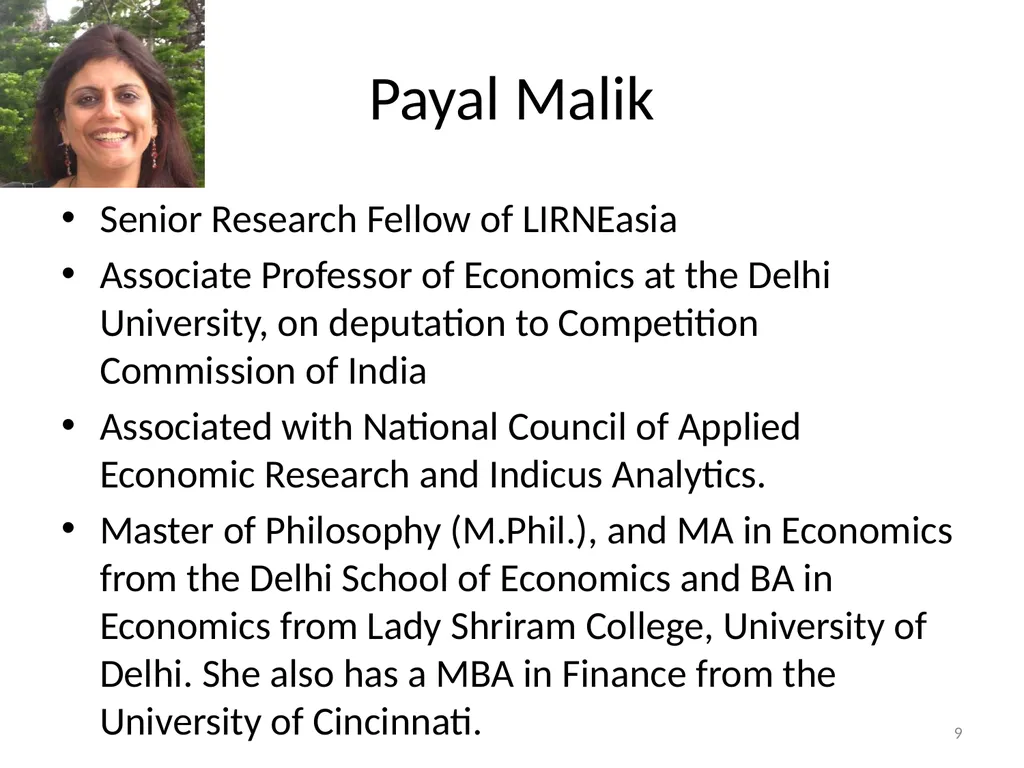
Payal Malik
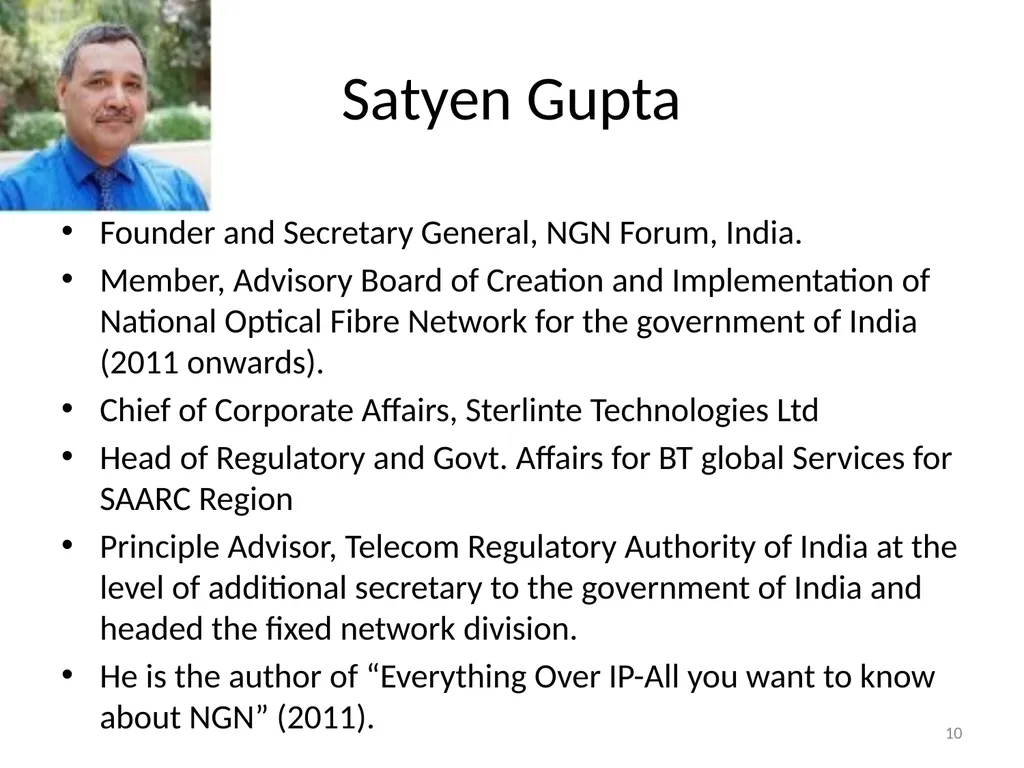
Satyen Gupta
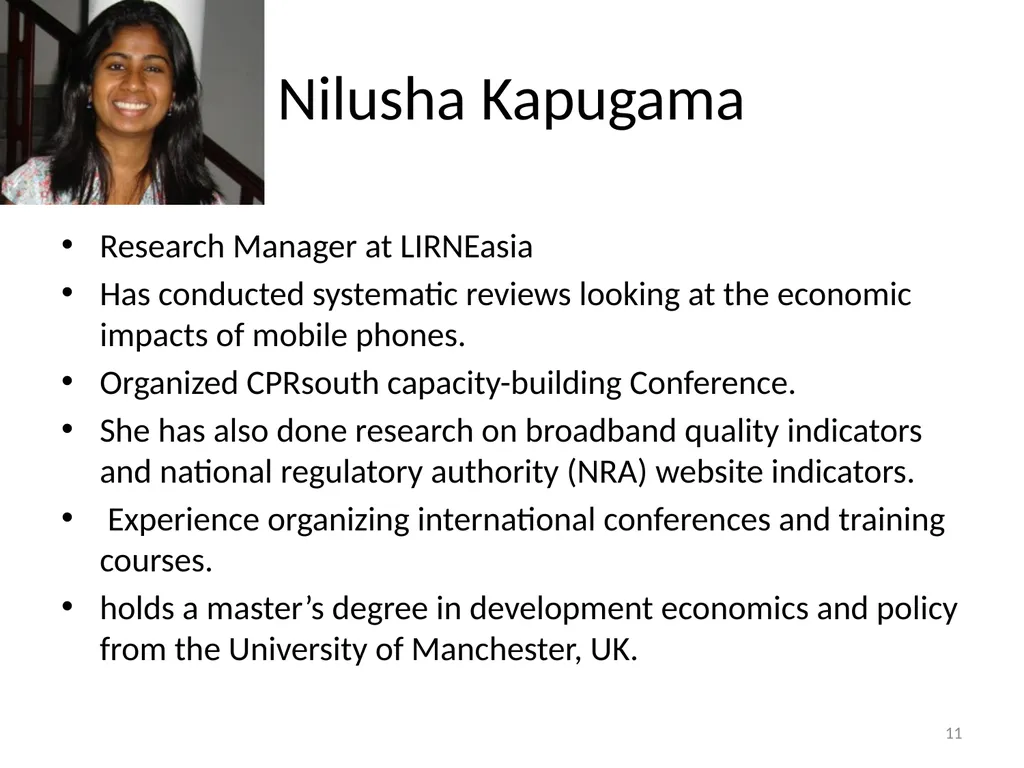
Nilusha Kapugama
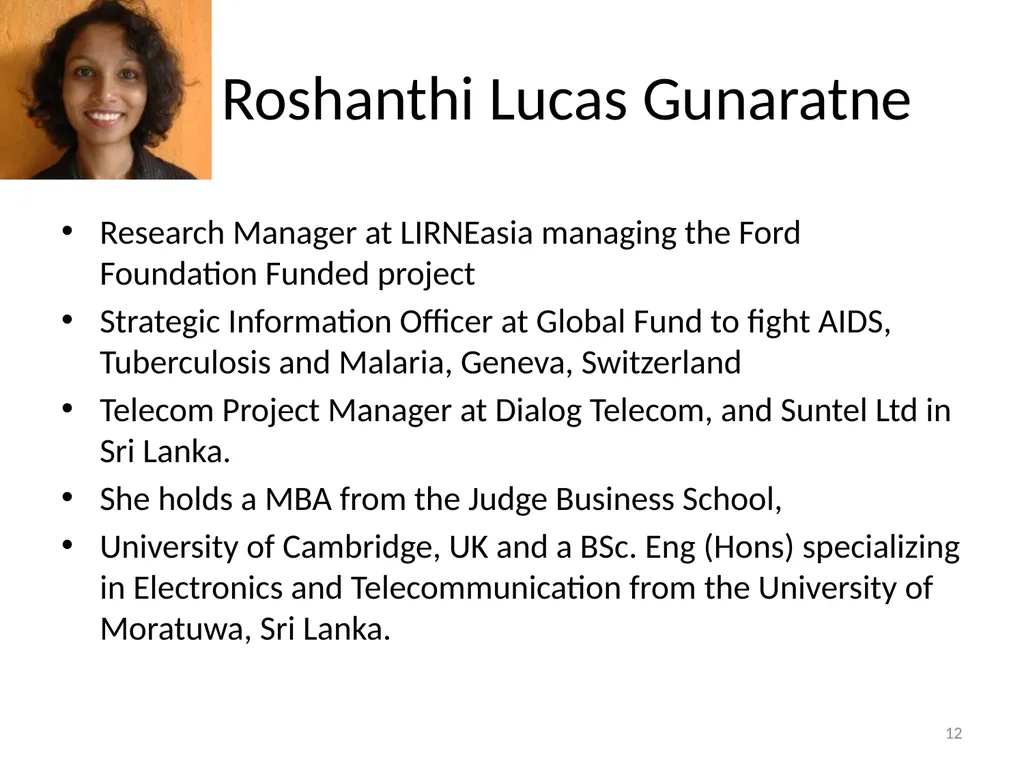
Roshanthi Lucas Gunaratne
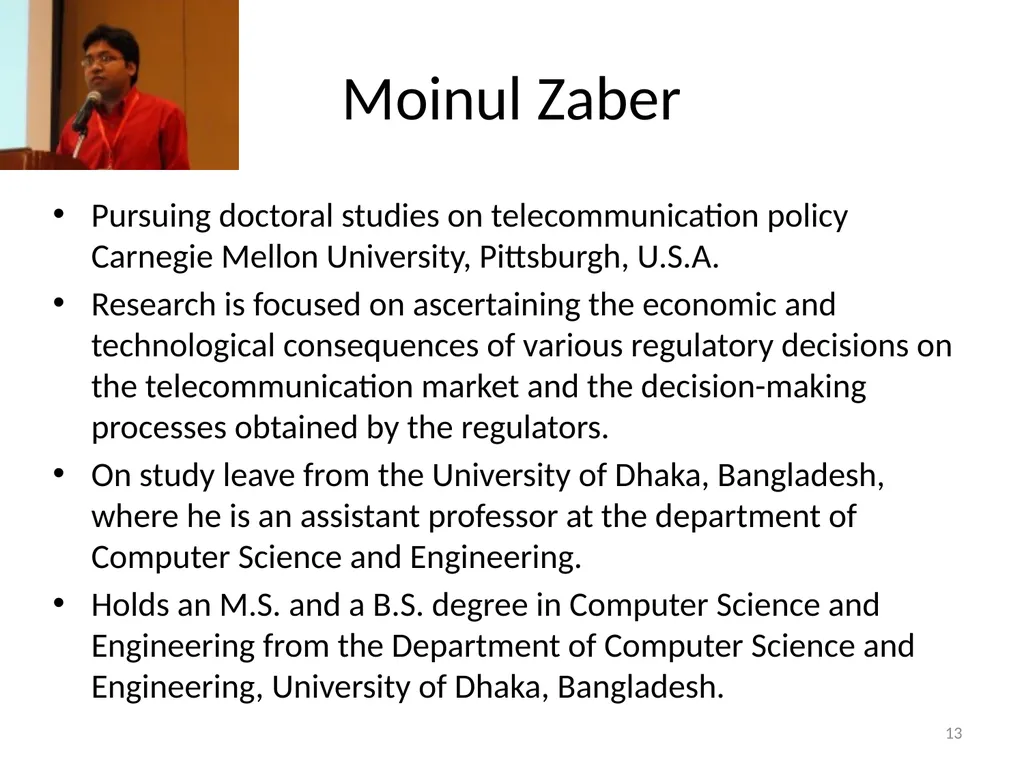
Moinul Zaber 7<br>
Payal Malik
Satyen Gupta
Nilusha Kapugama
Roshanthi Lucas Gunaratne
Moinul Zaber 7<br>
08
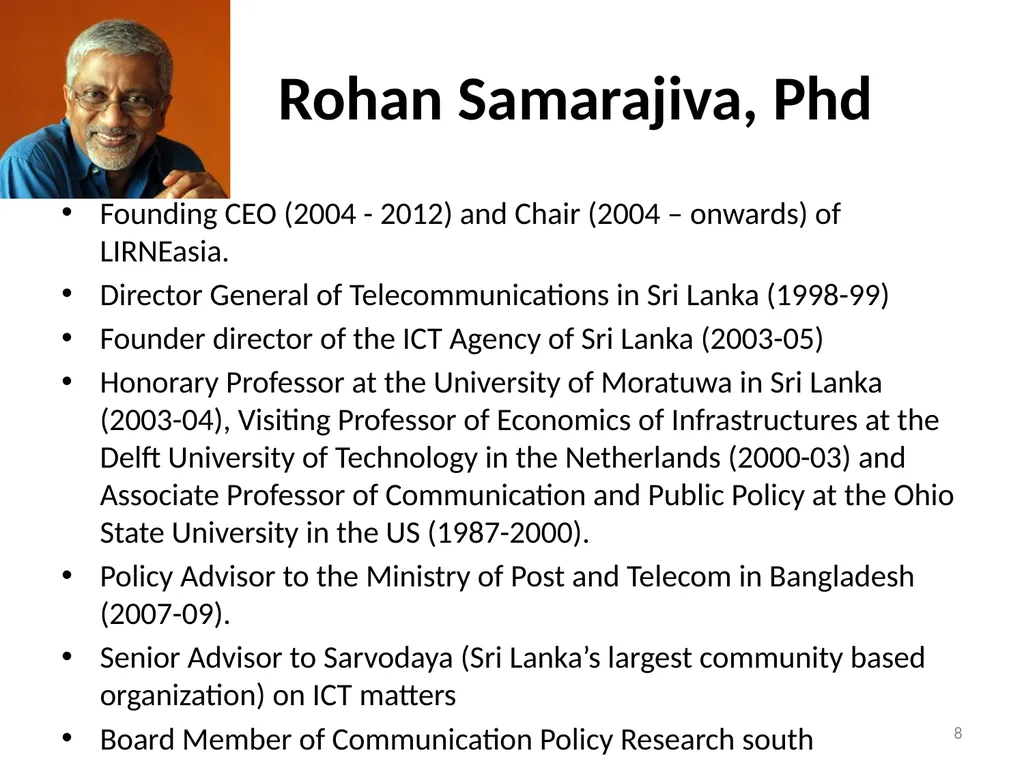
Rohan Samarajiva, Phd Founding CEO (2004 - 2012) and Chair (2004 – onwards) of LIRNEasia.
Director General of Telecommunications in Sri Lanka (1998-99)
Founder director of the ICT Agency of Sri Lanka (2003-05)
Honorary Professor at the University of Moratuwa in Sri Lanka (2003-04), Visiting Professor of Economics of Infrastructures at the Delft University of Technology in the Netherlands (2000-03) and Associate Professor of Communication and Public Policy at the Ohio State University in the US (1987-2000).
Policy Advisor to the Ministry of Post and Telecom in Bangladesh (2007-09).
Senior Advisor to Sarvodaya (Sri Lanka’s largest community based organization) on ICT matters
Board Member of Communication Policy Research south 8<br>
Director General of Telecommunications in Sri Lanka (1998-99)
Founder director of the ICT Agency of Sri Lanka (2003-05)
Honorary Professor at the University of Moratuwa in Sri Lanka (2003-04), Visiting Professor of Economics of Infrastructures at the Delft University of Technology in the Netherlands (2000-03) and Associate Professor of Communication and Public Policy at the Ohio State University in the US (1987-2000).
Policy Advisor to the Ministry of Post and Telecom in Bangladesh (2007-09).
Senior Advisor to Sarvodaya (Sri Lanka’s largest community based organization) on ICT matters
Board Member of Communication Policy Research south 8<br>
09
Payal Malik 9 Senior Research Fellow of LIRNEasia
Associate Professor of Economics at the Delhi University, on deputation to Competition Commission of India
Associated with National Council of Applied Economic Research and Indicus Analytics.
Master of Philosophy (M.Phil.), and MA in Economics from the Delhi School of Economics and BA in Economics from Lady Shriram College, University of Delhi. She also has a MBA in Finance from the University of Cincinnati.<br>
Associate Professor of Economics at the Delhi University, on deputation to Competition Commission of India
Associated with National Council of Applied Economic Research and Indicus Analytics.
Master of Philosophy (M.Phil.), and MA in Economics from the Delhi School of Economics and BA in Economics from Lady Shriram College, University of Delhi. She also has a MBA in Finance from the University of Cincinnati.<br>
10
Satyen Gupta 10 Founder and Secretary General, NGN Forum, India.
Member, Advisory Board of Creation and Implementation of National Optical Fibre Network for the government of India (2011 onwards).
Chief of Corporate Affairs, Sterlinte Technologies Ltd
Head of Regulatory and Govt. Affairs for BT global Services for SAARC Region
Principle Advisor, Telecom Regulatory Authority of India at the level of additional secretary to the government of India and headed the fixed network division.
He is the author of “Everything Over IP-All you want to know about NGN” (2011).<br>
Member, Advisory Board of Creation and Implementation of National Optical Fibre Network for the government of India (2011 onwards).
Chief of Corporate Affairs, Sterlinte Technologies Ltd
Head of Regulatory and Govt. Affairs for BT global Services for SAARC Region
Principle Advisor, Telecom Regulatory Authority of India at the level of additional secretary to the government of India and headed the fixed network division.
He is the author of “Everything Over IP-All you want to know about NGN” (2011).<br>
11
Nilusha Kapugama 11 Research Manager at LIRNEasia
Has conducted systematic reviews looking at the economic impacts of mobile phones.
Organized CPRsouth capacity-building Conference.
She has also done research on broadband quality indicators and national regulatory authority (NRA) website indicators.
Experience organizing international conferences and training courses.
holds a master’s degree in development economics and policy from the University of Manchester, UK.<br>
Has conducted systematic reviews looking at the economic impacts of mobile phones.
Organized CPRsouth capacity-building Conference.
She has also done research on broadband quality indicators and national regulatory authority (NRA) website indicators.
Experience organizing international conferences and training courses.
holds a master’s degree in development economics and policy from the University of Manchester, UK.<br>
12
Roshanthi Lucas Gunaratne 12 Research Manager at LIRNEasia managing the Ford Foundation Funded project
Strategic Information Officer at Global Fund to fight AIDS, Tuberculosis and Malaria, Geneva, Switzerland
Telecom Project Manager at Dialog Telecom, and Suntel Ltd in Sri Lanka.
She holds a MBA from the Judge Business School,
University of Cambridge, UK and a BSc. Eng (Hons) specializing in Electronics and Telecommunication from the University of Moratuwa, Sri Lanka.<br>
Strategic Information Officer at Global Fund to fight AIDS, Tuberculosis and Malaria, Geneva, Switzerland
Telecom Project Manager at Dialog Telecom, and Suntel Ltd in Sri Lanka.
She holds a MBA from the Judge Business School,
University of Cambridge, UK and a BSc. Eng (Hons) specializing in Electronics and Telecommunication from the University of Moratuwa, Sri Lanka.<br>
13
Moinul Zaber 13 Pursuing doctoral studies on telecommunication policy Carnegie Mellon University, Pittsburgh, U.S.A.
Research is focused on ascertaining the economic and technological consequences of various regulatory decisions on the telecommunication market and the decision-making processes obtained by the regulators.
On study leave from the University of Dhaka, Bangladesh, where he is an assistant professor at the department of Computer Science and Engineering.
Holds an M.S. and a B.S. degree in Computer Science and Engineering from the Department of Computer Science and Engineering, University of Dhaka, Bangladesh.<br>
Research is focused on ascertaining the economic and technological consequences of various regulatory decisions on the telecommunication market and the decision-making processes obtained by the regulators.
On study leave from the University of Dhaka, Bangladesh, where he is an assistant professor at the department of Computer Science and Engineering.
Holds an M.S. and a B.S. degree in Computer Science and Engineering from the Department of Computer Science and Engineering, University of Dhaka, Bangladesh.<br>
14
How we will teach? Tell me and I'll forget less theory
Show me and I may remember greater reliance on examples
Involve me and I'll understand active learning through assignments 14<br>
Show me and I may remember greater reliance on examples
Involve me and I'll understand active learning through assignments 14<br>
15
Assignments Participants teams on Day1.
First assignment is individual, though teams should get to know each other
conduct research on an assigned broadband-related topic
write it up based on a template that will be provided
Prepare to make oral presentation on Day2, though only randomly selected persons will have to (because of lack of time)
The instructional team will provide written feedback on all research summaries by the start of Day3 15<br>
First assignment is individual, though teams should get to know each other
conduct research on an assigned broadband-related topic
write it up based on a template that will be provided
Prepare to make oral presentation on Day2, though only randomly selected persons will have to (because of lack of time)
The instructional team will provide written feedback on all research summaries by the start of Day3 15<br>
16
Assignments Second assignment is to be performed by teams
Oral presentation, accompanied by a policy brief of two pages max. at a mock public hearing at which Indian Department of Telecommunications is seeking input on the question of subsidizing fiber-to-the-home (FTTH) as 2nd phase of current INR 20,000 Crore (USD 4 Billion) National Optical Fiber Network initiative
Each team will be assigned a role (which has to be researched on the evening of Day2
All presentations must be evidence based
Output from assignment 1 can be used
Additional research must be conducted on Days 3 and 4 16<br>
Oral presentation, accompanied by a policy brief of two pages max. at a mock public hearing at which Indian Department of Telecommunications is seeking input on the question of subsidizing fiber-to-the-home (FTTH) as 2nd phase of current INR 20,000 Crore (USD 4 Billion) National Optical Fiber Network initiative
Each team will be assigned a role (which has to be researched on the evening of Day2
All presentations must be evidence based
Output from assignment 1 can be used
Additional research must be conducted on Days 3 and 4 16<br>
17
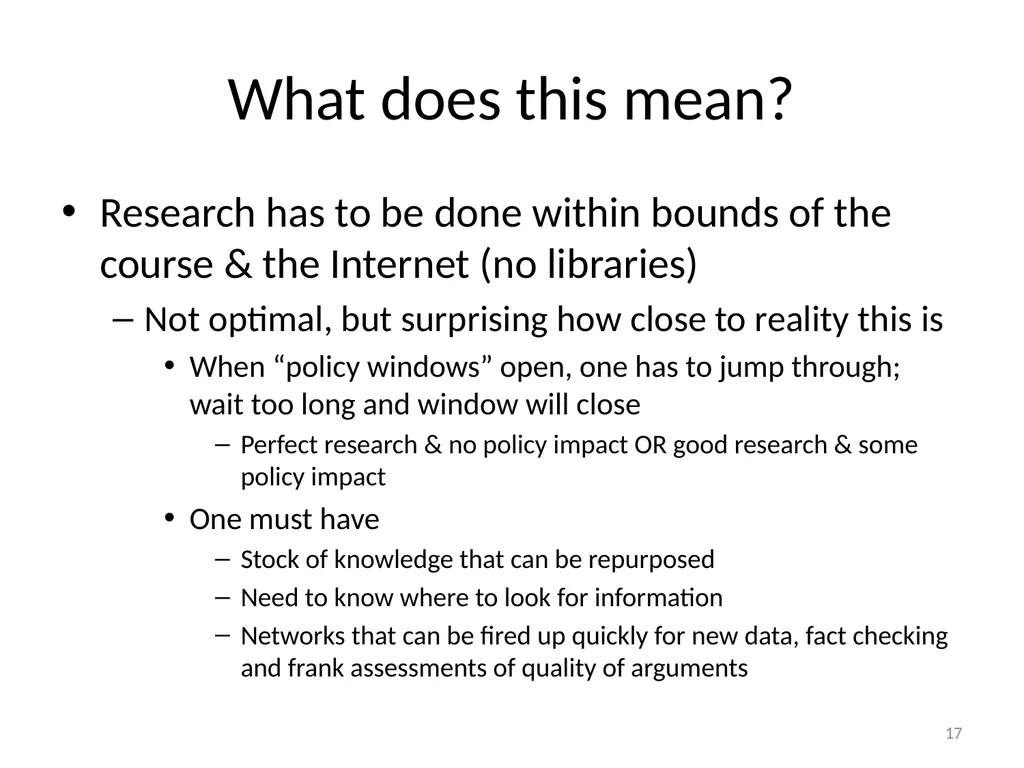
What does this mean? Research has to be done within bounds of the course & the Internet (no libraries)
Not optimal, but surprising how close to reality this is
When “policy windows” open, one has to jump through; wait too long and window will close
Perfect research & no policy impact OR good research & some policy impact
One must have
Stock of knowledge that can be repurposed
Need to know where to look for information
Networks that can be fired up quickly for new data, fact checking and frank assessments of quality of arguments 17<br>
Not optimal, but surprising how close to reality this is
When “policy windows” open, one has to jump through; wait too long and window will close
Perfect research & no policy impact OR good research & some policy impact
One must have
Stock of knowledge that can be repurposed
Need to know where to look for information
Networks that can be fired up quickly for new data, fact checking and frank assessments of quality of arguments 17<br>
18
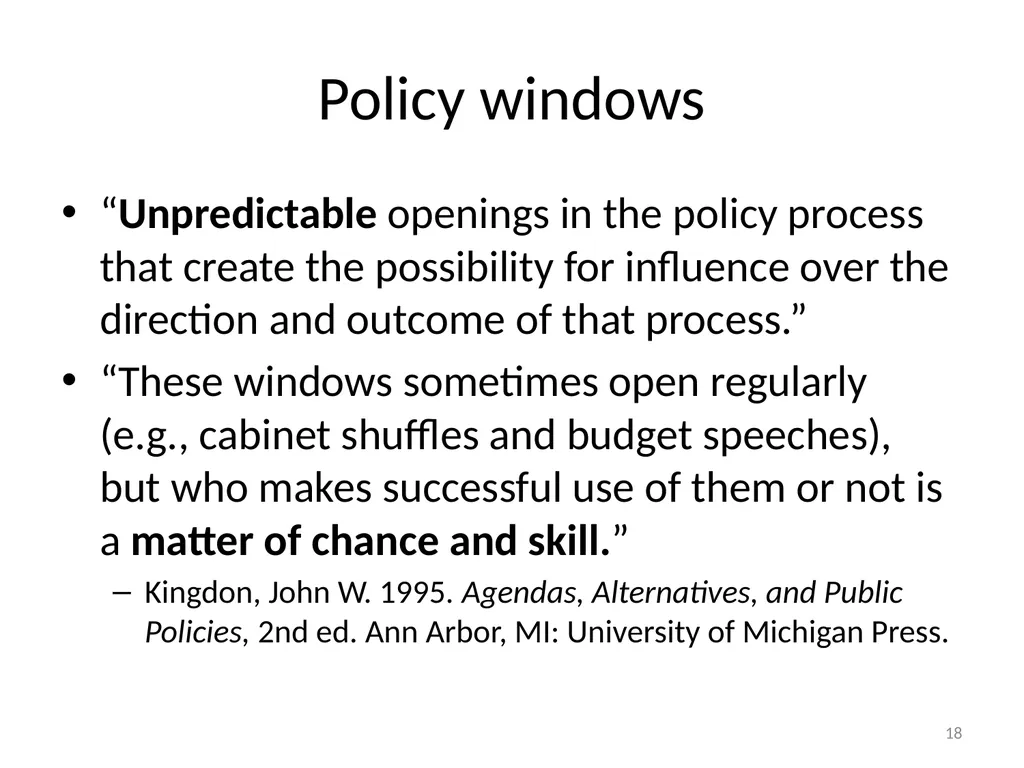
Policy windows “Unpredictable openings in the policy process that create the possibility for influence over the direction and outcome of that process.”
“These windows sometimes open regularly (e.g., cabinet shuffles and budget speeches), but who makes successful use of them or not is a matter of chance and skill.”
Kingdon, John W. 1995. Agendas, Alternatives, and Public Policies, 2nd ed. Ann Arbor, MI: University of Michigan Press. 18<br>
“These windows sometimes open regularly (e.g., cabinet shuffles and budget speeches), but who makes successful use of them or not is a matter of chance and skill.”
Kingdon, John W. 1995. Agendas, Alternatives, and Public Policies, 2nd ed. Ann Arbor, MI: University of Michigan Press. 18<br>
19
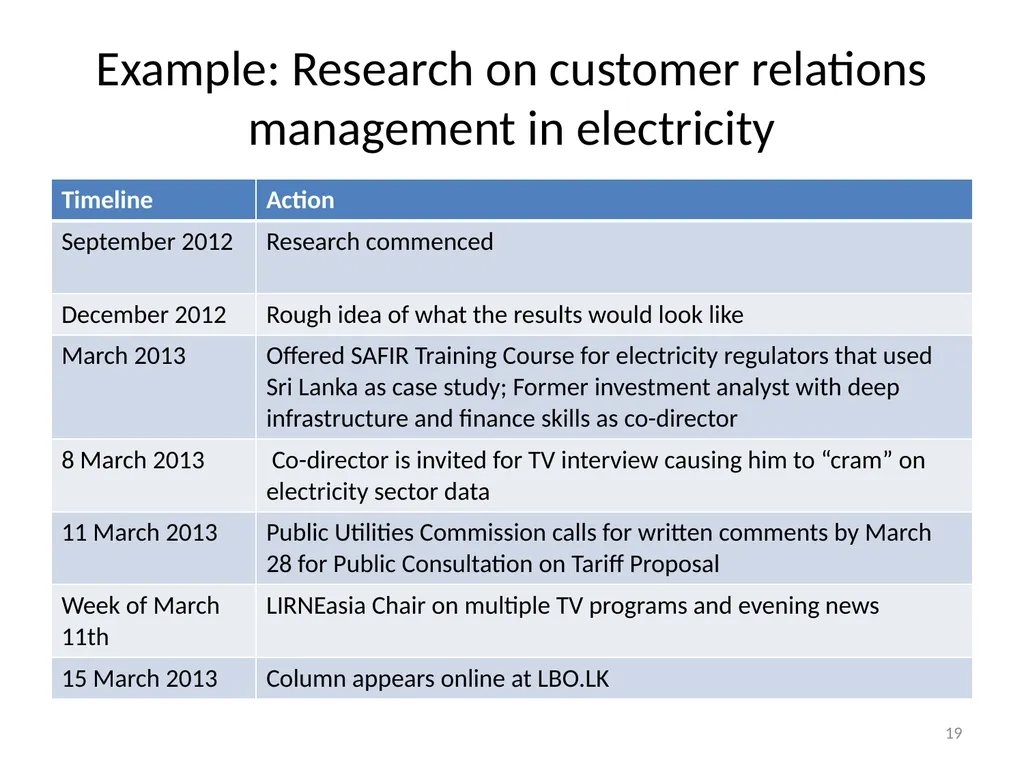
Example: Research on customer relations management in electricity 19<br>
20
20<br>
21
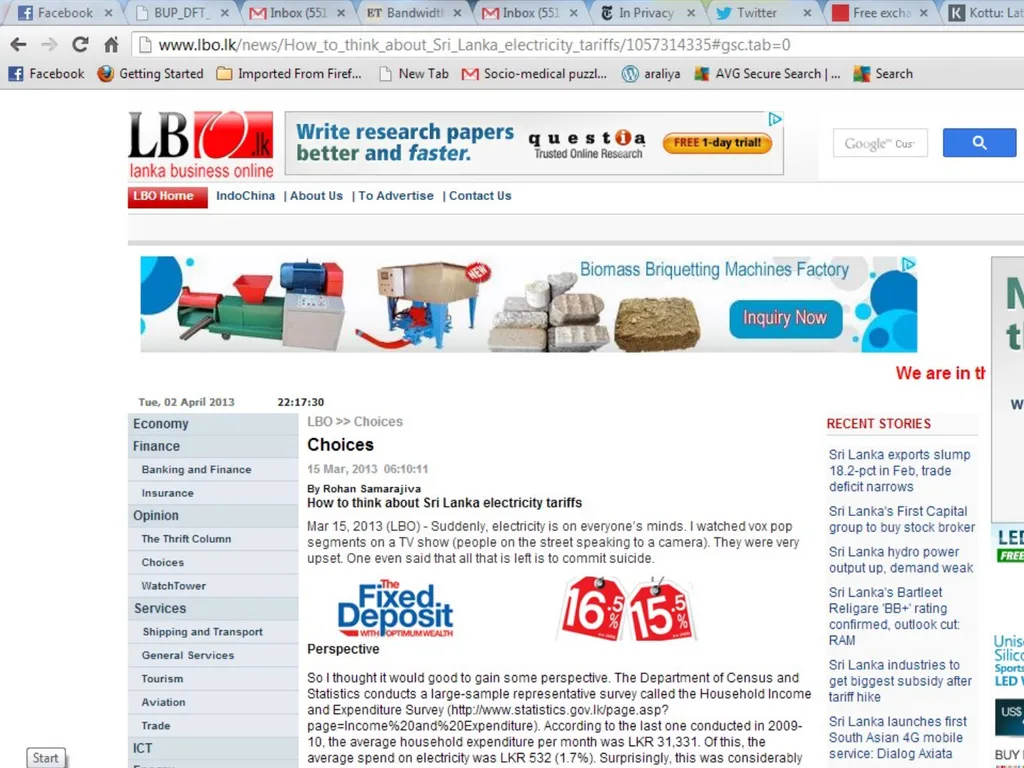
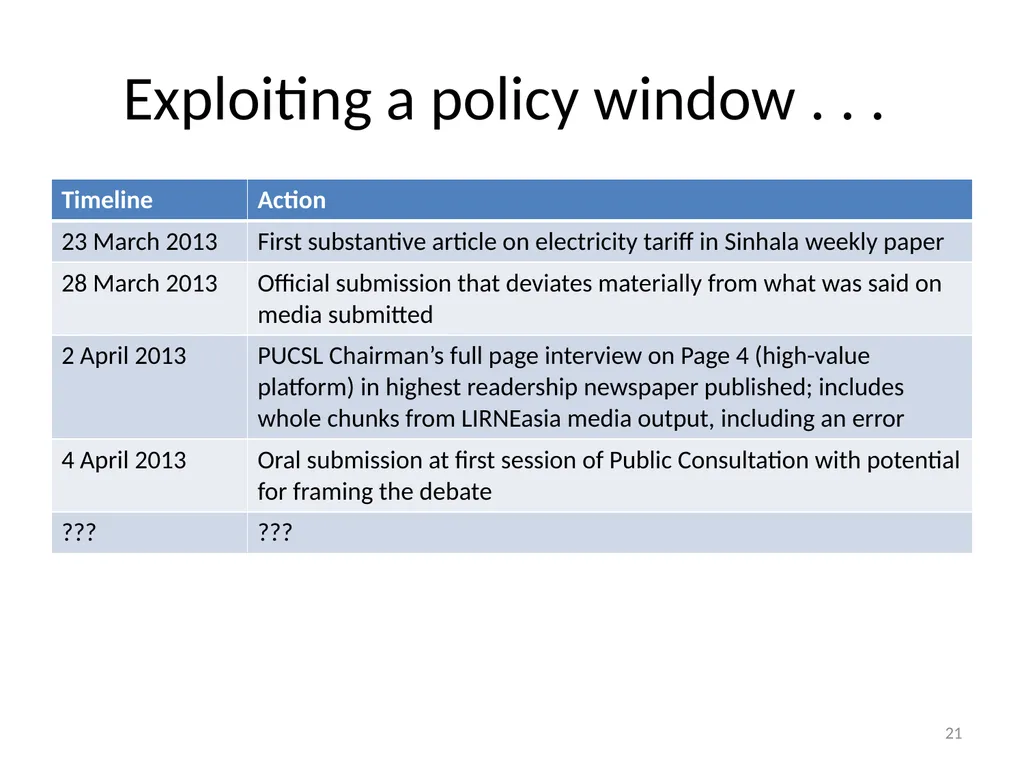
Exploiting a policy window . . . 21<br>
22
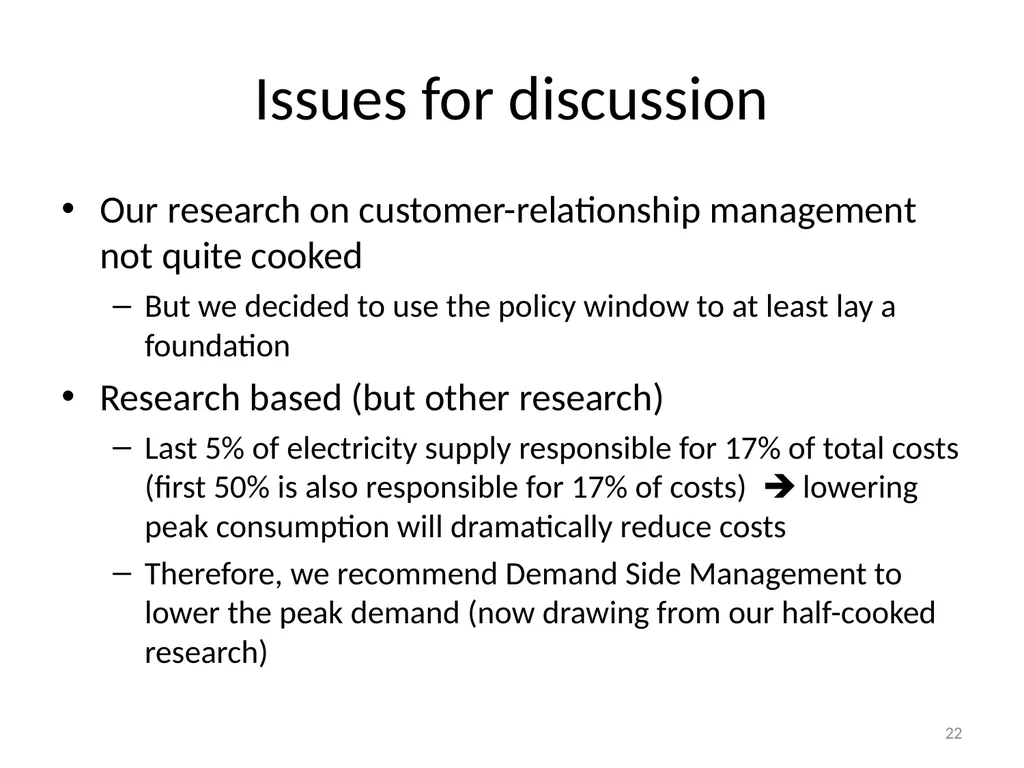
Issues for discussion Our research on customer-relationship management not quite cooked
But we decided to use the policy window to at least lay a foundation
Research based (but other research)
Last 5% of electricity supply responsible for 17% of total costs (first 50% is also responsible for 17% of costs) lowering peak consumption will dramatically reduce costs
Therefore, we recommend Demand Side Management to lower the peak demand (now drawing from our half-cooked research) 22<br>
But we decided to use the policy window to at least lay a foundation
Research based (but other research)
Last 5% of electricity supply responsible for 17% of total costs (first 50% is also responsible for 17% of costs) lowering peak consumption will dramatically reduce costs
Therefore, we recommend Demand Side Management to lower the peak demand (now drawing from our half-cooked research) 22<br>
23
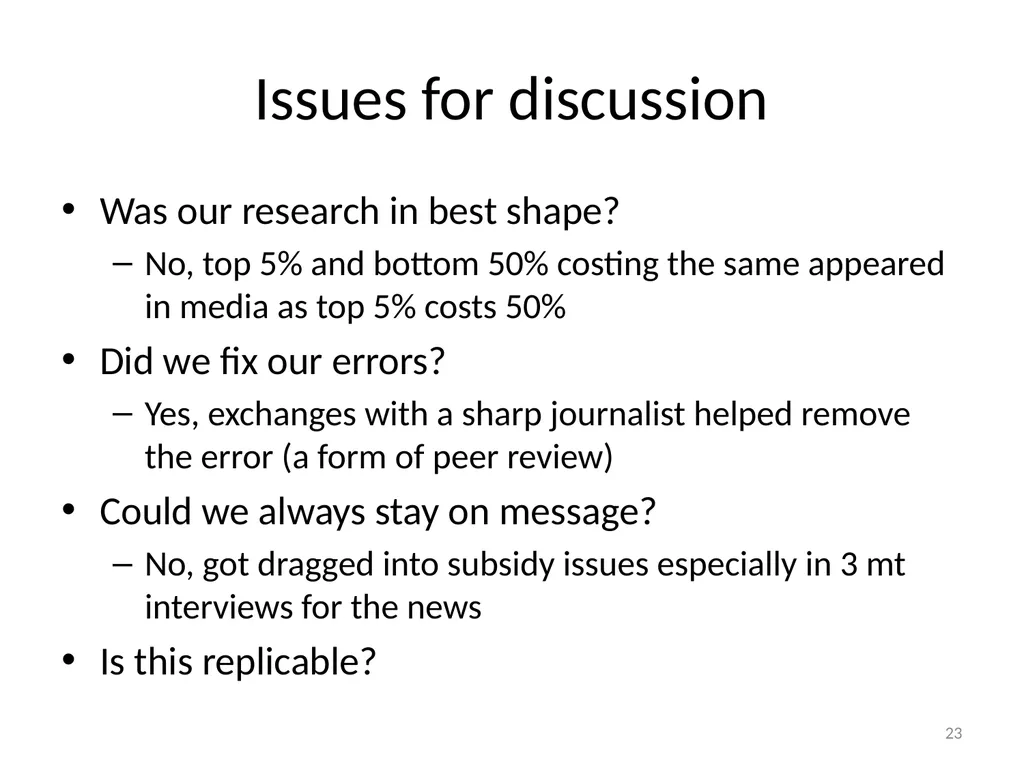
Issues for discussion Was our research in best shape?
No, top 5% and bottom 50% costing the same appeared in media as top 5% costs 50%
Did we fix our errors?
Yes, exchanges with a sharp journalist helped remove the error (a form of peer review)
Could we always stay on message?
No, got dragged into subsidy issues especially in 3 mt interviews for the news
Is this replicable? 23<br>
No, top 5% and bottom 50% costing the same appeared in media as top 5% costs 50%
Did we fix our errors?
Yes, exchanges with a sharp journalist helped remove the error (a form of peer review)
Could we always stay on message?
No, got dragged into subsidy issues especially in 3 mt interviews for the news
Is this replicable? 23<br>
24
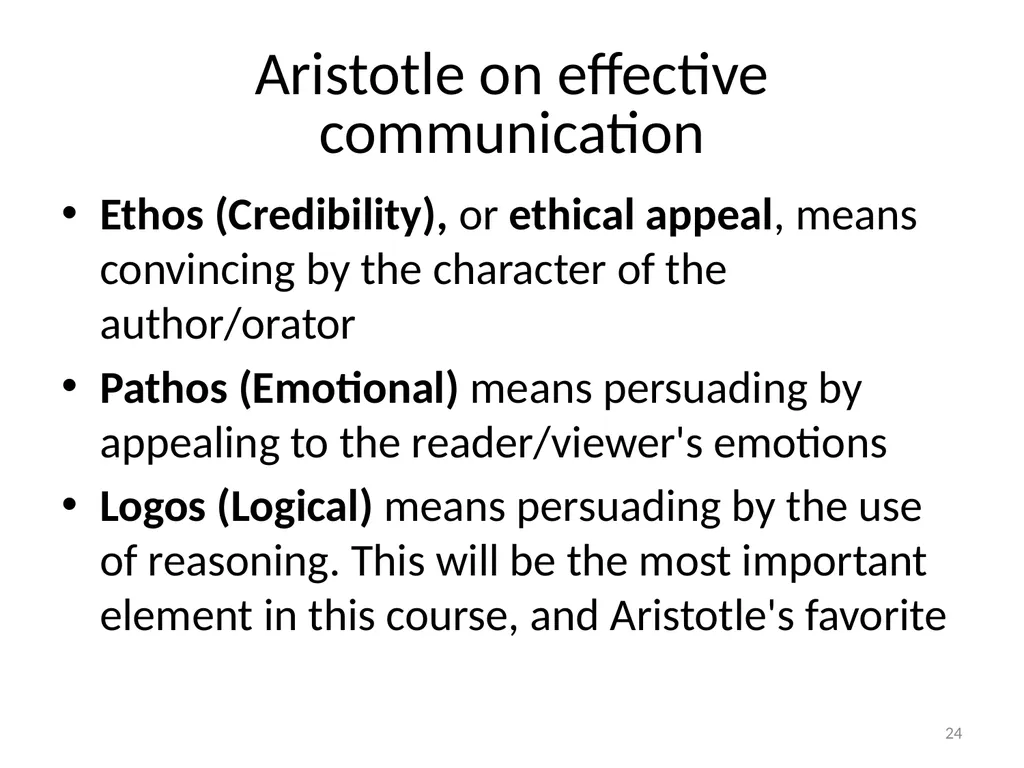
Aristotle on effective communication Ethos (Credibility), or ethical appeal, means convincing by the character of the author/orator
Pathos (Emotional) means persuading by appealing to the reader/viewer's emotions
Logos (Logical) means persuading by the use of reasoning. This will be the most important element in this course, and Aristotle's favorite 24<br>
Pathos (Emotional) means persuading by appealing to the reader/viewer's emotions
Logos (Logical) means persuading by the use of reasoning. This will be the most important element in this course, and Aristotle's favorite 24<br>
25
Ethos Is not built in a day
Not everyone can get interviewed on the evening news 25<br>
Not everyone can get interviewed on the evening news 25<br>
26
Pathos and Logos More in S7, S11, and S15
Also more on ethos 26<br>
Also more on ethos 26<br>
27
How does one measure success? Just acting?
Measuring inputs, not outputs or outcomes 27<br>
Measuring inputs, not outputs or outcomes 27<br>
28
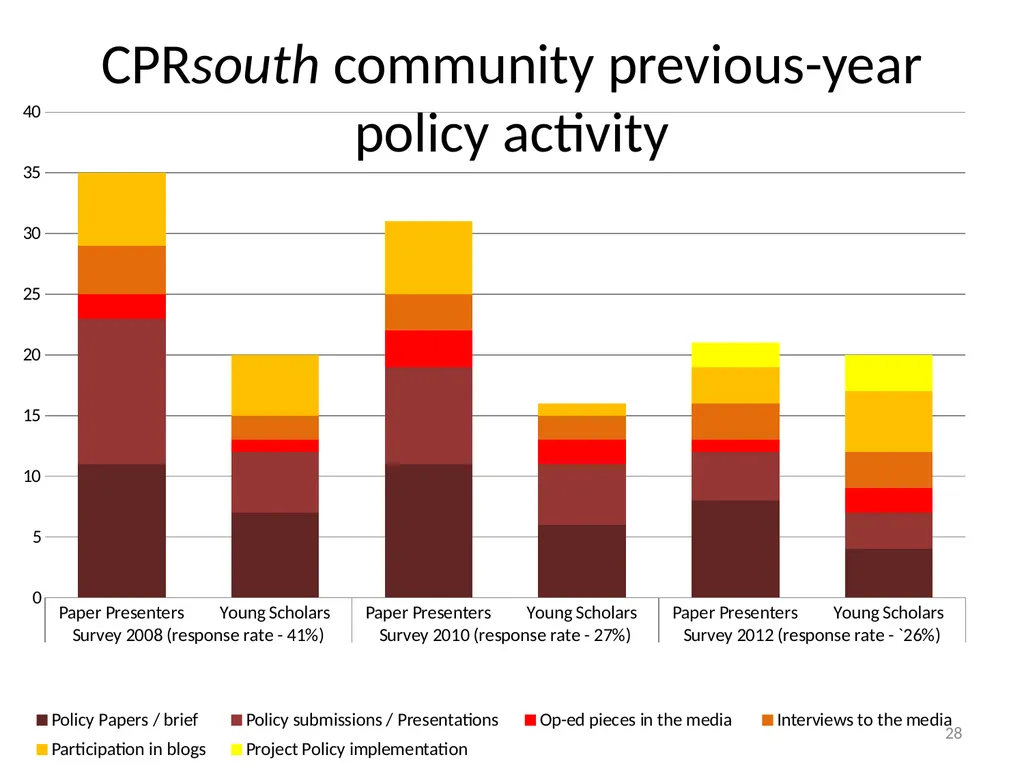
CPRsouth community previous-year policy activity 28<br>
29
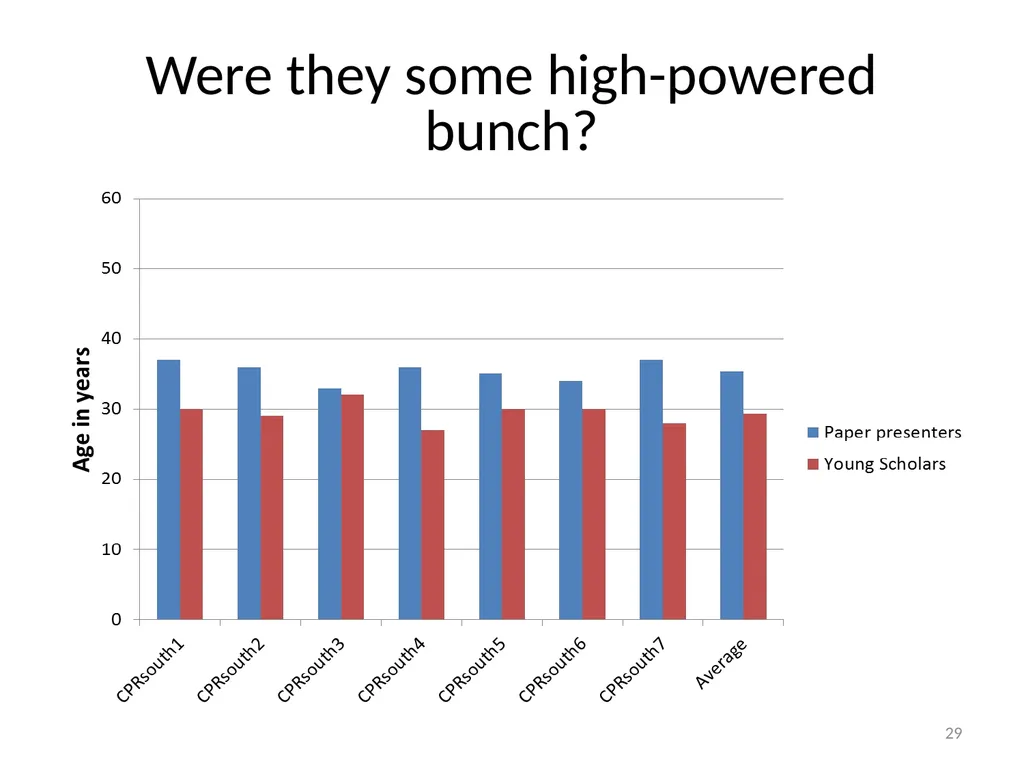
Were they some high-powered bunch? 29<br>
30
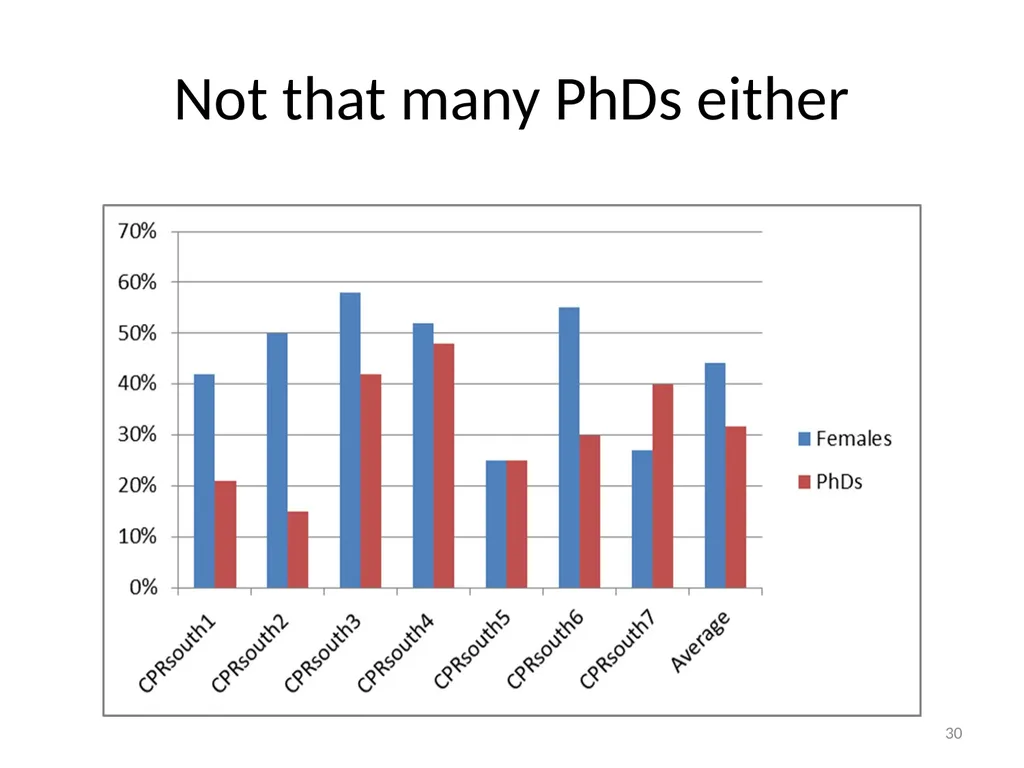
Not that many PhDs either 30<br>
31
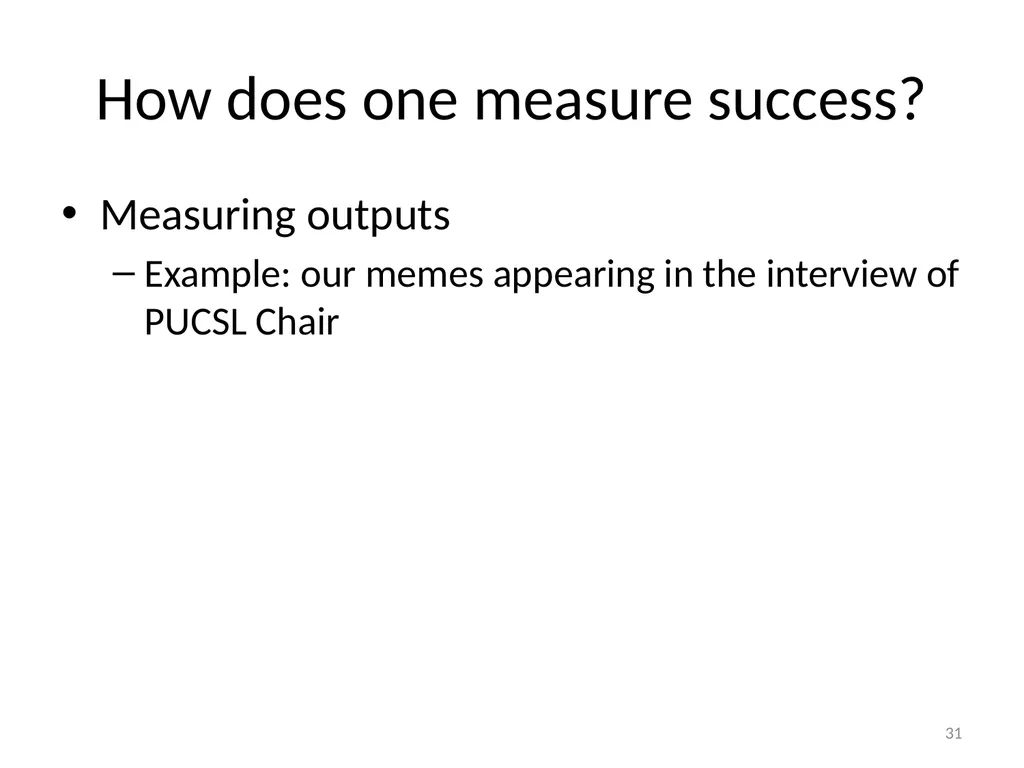
How does one measure success? Measuring outputs
Example: our memes appearing in the interview of PUCSL Chair 31<br>
Example: our memes appearing in the interview of PUCSL Chair 31<br>
32
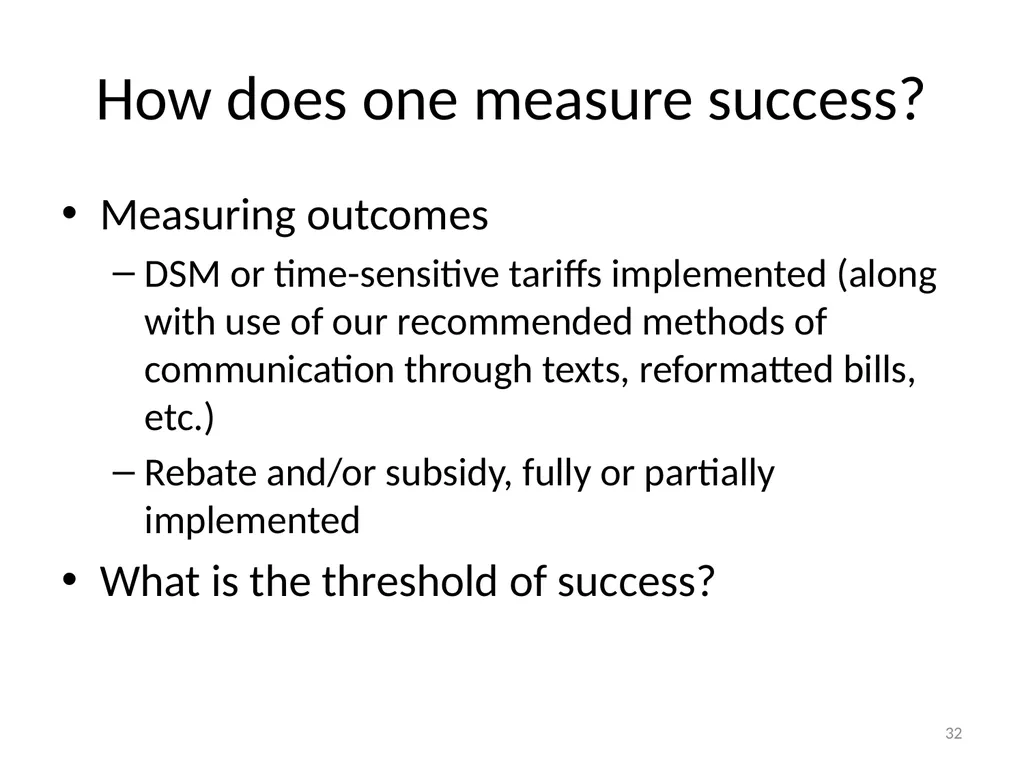
How does one measure success? Measuring outcomes
DSM or time-sensitive tariffs implemented (along with use of our recommended methods of communication through texts, reformatted bills, etc.)
Rebate and/or subsidy, fully or partially implemented
What is the threshold of success? 32<br>
DSM or time-sensitive tariffs implemented (along with use of our recommended methods of communication through texts, reformatted bills, etc.)
Rebate and/or subsidy, fully or partially implemented
What is the threshold of success? 32<br>
33
What we hope you will achieve by Monday Be able to find and assess relevant research & evidence
Be able to summarize the research in a coherent and comprehensive manner
Have an understanding of broadband policy and regulatory processes in India
Have the necessary tools to improve their communication skills
Have some understanding of how media function and how to effectively interact with media 33<br>
Be able to summarize the research in a coherent and comprehensive manner
Have an understanding of broadband policy and regulatory processes in India
Have the necessary tools to improve their communication skills
Have some understanding of how media function and how to effectively interact with media 33<br>
34
What we really hope you will achieve “We believe all people should have the opportunity to reach their full potential, contribute to society, and have voice in the decisions that affect them. We believe the best way to achieve these goals is to encourage initiatives by those living and working closest to where problems are located; to promote collaboration among the nonprofit, government and business sectors; and to ensure participation by men and women from diverse communities and all levels of society. In our experience, such activities help build common understanding, enhance excellence, enable people to improve their lives and reinforce their commitment to society.” 34<br>