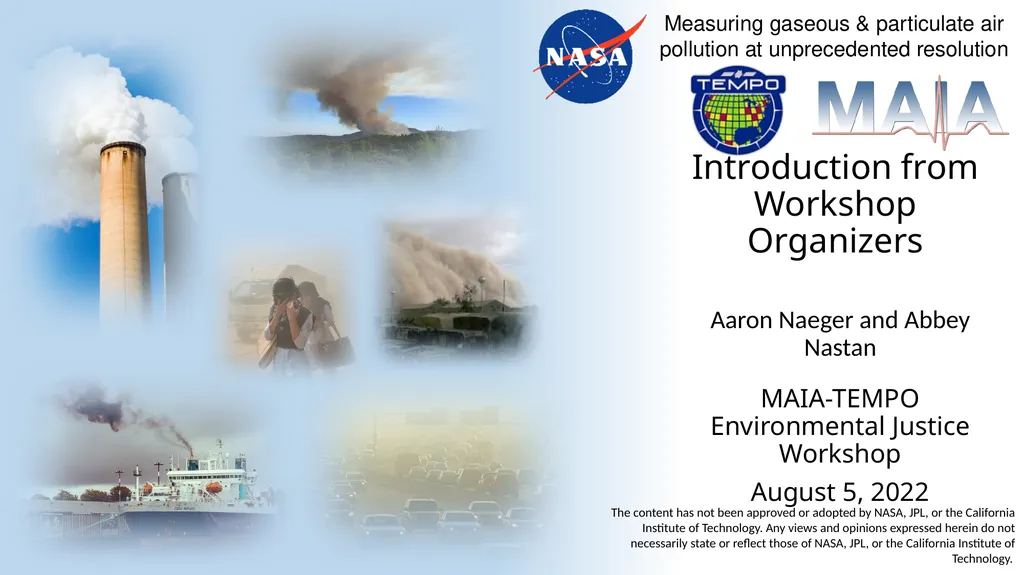
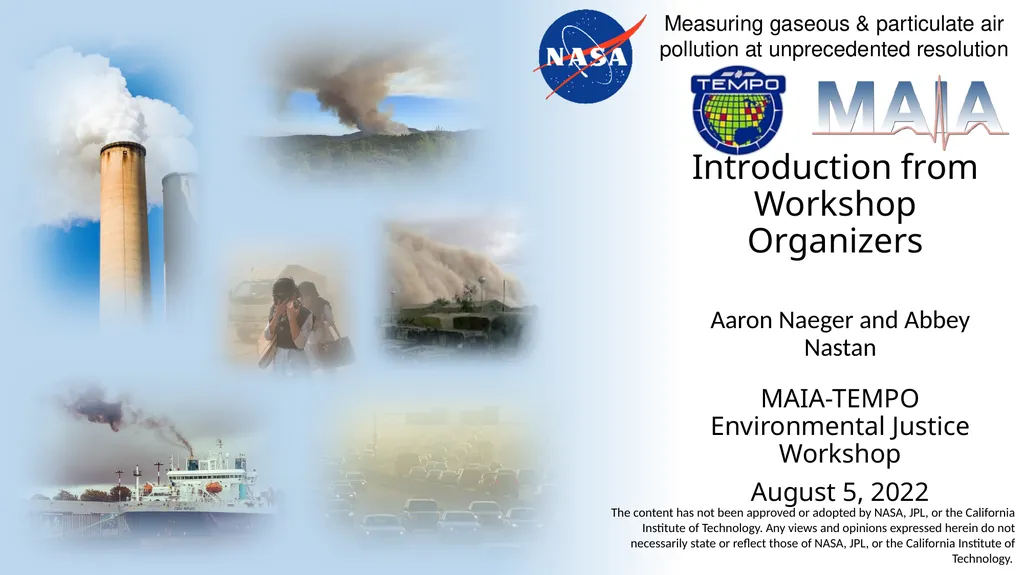
Introduction from Workshop Organizers Aaron Naeger and Abbey Nastan MAIA-TEMPO Environmental Justice Workshop August 5, 2022 The content has not been approved or adopted by NASA, JPL, or the California Institute of Technology. Any views and
Related Topics
Share
Embed code
Download this presentation From Below
"Introduction from Workshop Organizers Aaron Naeger" is the property of its rightful owner. Permission is granted to
download and print the materials on this website for personal, non-commercial use only, and to display it
on your personal computer provided you do not modify the materials and that you retain all copyright
notices contained in the materials. By downloading content from our website, you accept the terms of this
agreement.
Presentation Transcript
01
Introduction from Workshop Organizers Aaron Naeger and Abbey Nastan MAIA-TEMPO Environmental Justice Workshop
August 5, 2022 The content has not been approved or adopted by NASA, JPL, or the California Institute of Technology. Any views and opinions expressed herein do not necessarily state or reflect those of NASA, JPL, or the California Institute of Technology.<br>
02
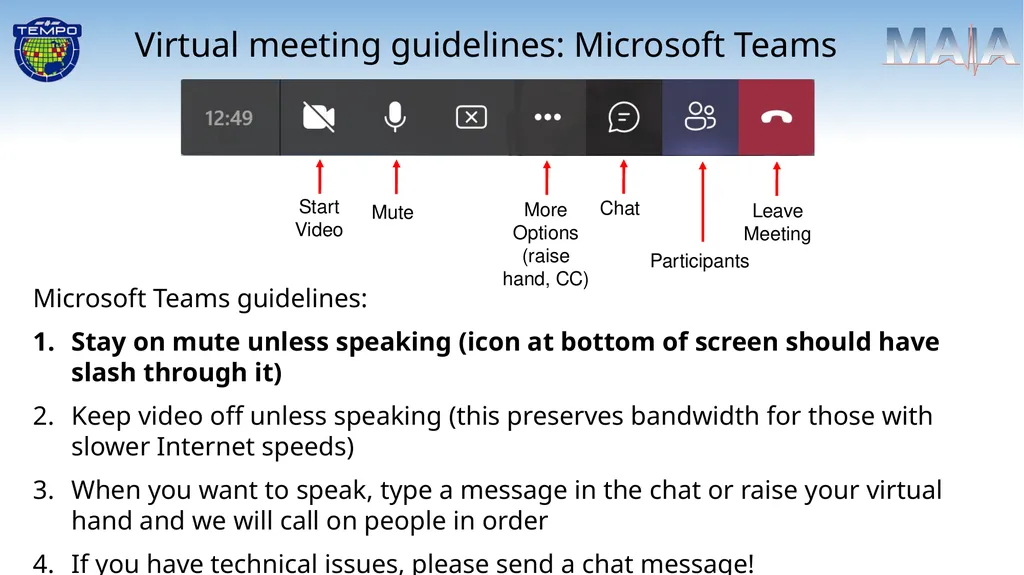
Virtual meeting guidelines: Microsoft Teams Microsoft Teams guidelines:
Stay on mute unless speaking (icon at bottom of screen should have slash through it)
Keep video off unless speaking (this preserves bandwidth for those with slower Internet speeds)
When you want to speak, type a message in the chat or raise your virtual hand and we will call on people in order
If you have technical issues, please send a chat message! Mute Start Video Chat More Options
(raise hand, CC) Leave Meeting Participants<br>
03
Land acknowledgement Fairbanks, Alaska exists on the lands of the Tanana Athabascan people. The interests of the vibrant Indigenous community in Fairbanks and the surrounding areas are represented by the Doyon, Limited regional corporation and the Tanana Chiefs Conference. The relations between Indigenous people and US state and federal government in the region have always involved issues of environmental justice, especially regarding gold mining and the Trans-Alaska Pipeline.
Northern Alabama is situated upon the traditional homelands of the Creek, Cherokee, and Chickasaw tribal nations. Environmental justice issues impacted the Indigenous people as a rush to settle and build infrastructure in the region quickly forced them off their ancestral lands. Indigenous people are still connected to this land today which they stewarded throughout generations.
Indigenous rights are central to environmental justice!<br>
04
Today’s meeting General guidelines:
We request that you mute your phone notifications and close your other work while participating in the workshop
Please be respectful of all participants!
This meeting is being recorded. Why are we requesting your full participation?
We want your time to be valuable: This workshop is fast-paced so it can be as short as possible
All material should be of interest to the whole audience<br>
05
Objectives for today Raise awareness about MAIA/TEMPO to you, environmental justice (EJ) advocacy groups, and provide background information on the missions
Improve understanding of the TEMPO and MAIA project teams about the EJ user community’s needs: Do you need certain data formats/compatibility/tools? What capacity building resources do you need and desire?
Participate in collaborative brainstorming regarding how MAIA/TEMPO data might be useful to EJ Not from an EJ group? We’re so glad you’re interested in EJ too! Please allow representatives from EJ groups to speak and ask questions first, since this is an EJ focus session.<br>
06
Who’s who Aaron Naeger and Abbey Nastan (TEMPO and MAIA applications representatives)
Today’s workshop organizers
John Haynes (NASA Applied Sciences, workshop sponsor)
Nancy Searby (NASA Applied Sciences)
Kelly Chance and Xiong Liu (TEMPO PI and Deputy PI)
David Diner (MAIA PI – can’t make it today) and Sina Hasheminassab (MAIA ST)
Our amazing panelists:
Janice Archuleta and Arlyssia Sells – Ute Mountain Ute Tribe
Denise Bruce – CleanAIRE NC
Jane Williams – California Communities Against Toxics<br>
07
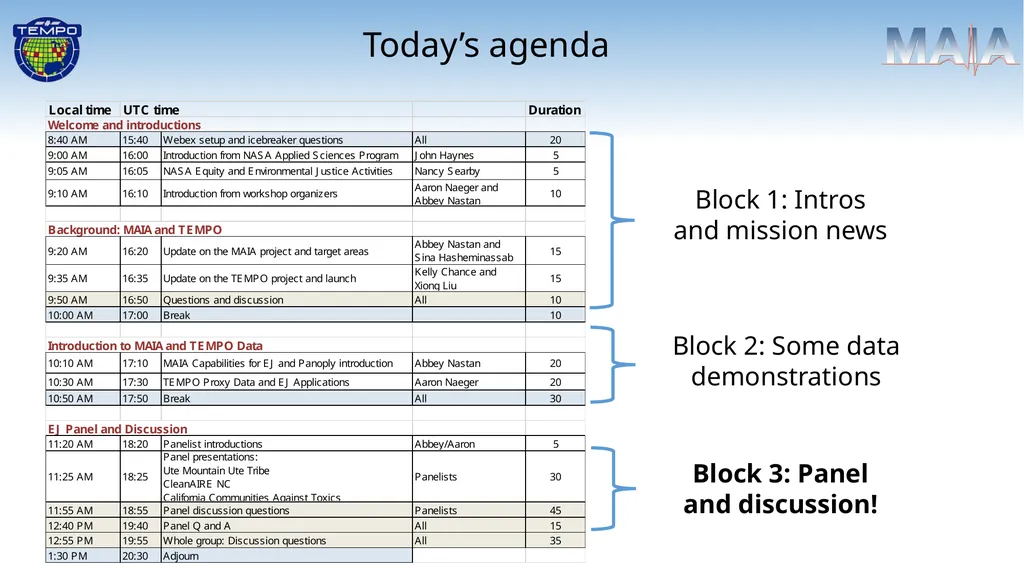
Today’s agenda Block 1: Intros and mission news Block 2: Some data demonstrations Block 3: Panel and discussion!<br>
08
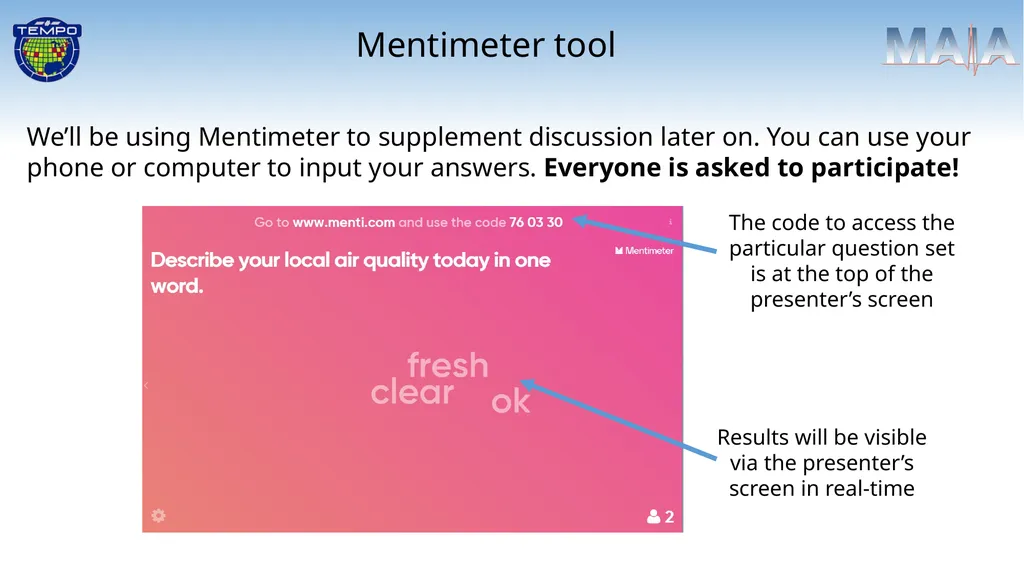
Mentimeter tool The code to access the particular question set is at the top of the presenter’s screen We’ll be using Mentimeter to supplement discussion later on. You can use your phone or computer to input your answers. Everyone is asked to participate! Results will be visible via the presenter’s screen in real-time<br>
09
What will TEMPO offer you? TEMPO will observe key air pollutants every daylight hour at high spatial resolution (~2 x 4.8 km2) over Greater North America
Trace gas products will include U.S. EPA “criteria” pollutants of nitrogen dioxide (NO2), sulfur dioxide (SO2), and ozone (O3), along with formaldehyde (HCHO) and glyoxal (CHOCHO), major proxies for air pollution
Aerosol products, including aerosol layer height, aerosol optical depth, and aerosol absorption index, will add value to currently available aerosol data
New knowledge for understanding and tackling air pollution issues from sub-urban to continental scales
User-friendly interfaces and tools for downloading, processing, and visualizing TEMPO data, which will be free and publicly available to everyone<br>
10
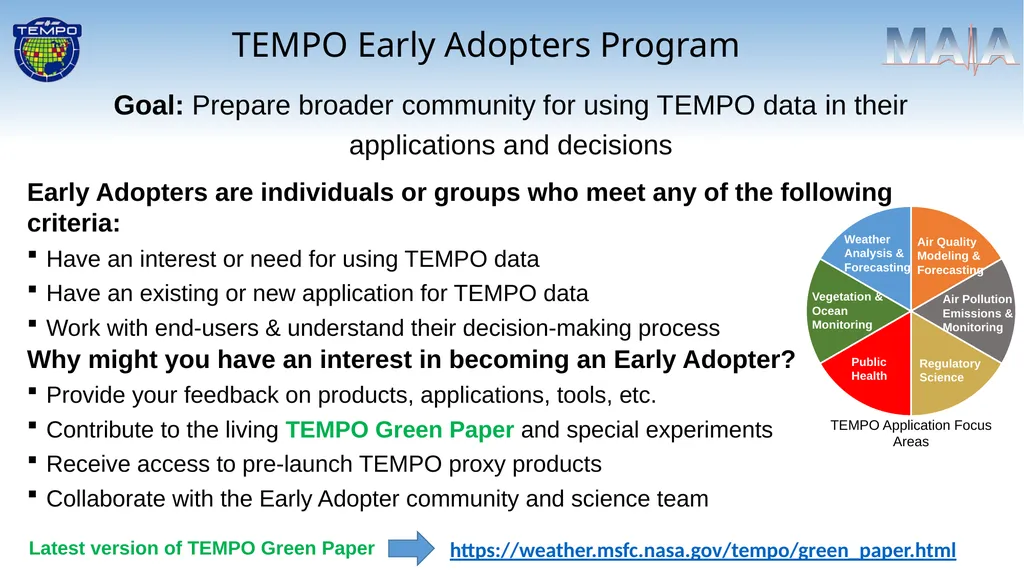
TEMPO Early Adopters Program Goal: Prepare broader community for using TEMPO data in their applications and decisions Early Adopters are individuals or groups who meet any of the following criteria:
Have an interest or need for using TEMPO data
Have an existing or new application for TEMPO data
Work with end-users & understand their decision-making process Why might you have an interest in becoming an Early Adopter?
Provide your feedback on products, applications, tools, etc.
Contribute to the living TEMPO Green Paper and special experiments
Receive access to pre-launch TEMPO proxy products
Collaborate with the Early Adopter community and science team https://weather.msfc.nasa.gov/tempo/green_paper.html Latest version of TEMPO Green Paper Vegetation & Ocean Monitoring Air Pollution Emissions & Monitoring Regulatory Science Public Health Weather Analysis & Forecasting Air Quality Modeling & Forecasting TEMPO Application Focus Areas<br>
11
MAIA: Why might it interest you? MAIA will provide 1 km resolution, daily concentrations of PM2.5, PM10, and sulfate, nitrate, elemental carbon, organic carbon, and dust PM2.5 in 11+ target regions around the globe (3 in the US)
MAIA will also produce studies of the health effects of PM in these regions
The MAIA team is committed to making the data easy to use and accessible to everyone
MAIA is what NASA calls a pathfinder: it establishes the need for future missions and demonstrates how to accomplish them<br>
12
MAIA Early Adopters Program Who is an Early Adopter?
You! (We hope)
Someone interested in using MAIA data
Has a particular use in mind (eventually)
Why be an Early Adopter?
Chance to offer feedback pre-launch
Get access to test data products
Collaborate with the science team and receive any needed assistance to entrain data products<br>
13
Some useful resources More on TEMPO:
TEMPO Early Adopters website: https://weather.msfc.nasa.gov/tempo/
Click button link on the home page to join the Early Adopters Program
Green Paper & Experiment Request Form: https://weather.msfc.nasa.gov/tempo/green_paper.html
TEMPO Mission website: http://tempo.si.edu/
More on MAIA:
MAIA website: https://maia.jpl.nasa.gov
Join the MAIA Early Adopters Program: https://maia.jpl.nasa.gov/assets/pdf/MAIA_Early_Adopters_Program.pdf
Get access to MAIA Simulated Data: https://maia.jpl.nasa.gov/assets/pdf/Early_Adopter_Simulated_Data_Product_access_agreement_form_v3.pdf<br>