
INTRODUCTION Soft robotics is an emerging research
Description: INTRODUCTION Soft robotics is an emerging research field that is rapidly expanding as soft robots are adaptable, reliable, and intrinsically safe. While the behavior of robots composed of rigid links, joints, and actuators can be easily
Related Topics
Download Presentation
"INTRODUCTION Soft robotics is an emerging research" is the property of its rightful owner. Permission is granted to download and print the materials on this website for personal, non-commercial use only, and to display it on your personal computer provided you do not modify the materials and that you retain all copyright notices contained in the materials. By downloading content from our website, you accept the terms of this agreement.
Presentation Transcript
slide1. INTRODUCTION
Soft robotics is an emerging research field that is rapidly expanding as soft robots are adaptable, reliable, and intrinsically safe. While the behavior of robots composed of rigid links, joints, and actuators can be easily described with classical mechanics modeling methods, modeling tools for soft robots are less exploited, and more complex to manage, as these devices are made of materials having highly non-linear behaviors. Having accurate models for soft robots, however, is very important to properly design them.
In this poster, we rely on accurate Finite Element Analysis (FEA) to study the behavior of a novel soft robotic component, called SoftPad. REFERENCES
C. Gaudeni, M. Pozzi, Z. Iqbal, M. Malvezzi, and D. Prattichizzo, “Grasping with the softpad, a soft sensorized surface for exploiting environmental constraints with rigid grippers,” IEEE Robotics and Automation Letters, vol. 5, no. 3, pp. 3884–3891, 2020.
M. Pozzi, C. Gaudeni, Z. Iqbal, D. Prattichizzo, and M. Malvezzi, “Modeling a sensorized soft layer for adding compliance to the environment in robotic manipulation,” To appear in IFToMM ITALY Proceedings, 2020. The SoftPad: a soft layer for adding compliance to the environment in robotic manipulation tasks
Maria Pozzi 1,2, Chiara Gaudeni 1, Zubair Iqbal 1, Domenico Prattichizzo 1,2, Monica Malvezzi 1
1. Department of Information Engineering and Mathematics, University of Siena, Siena, Italy
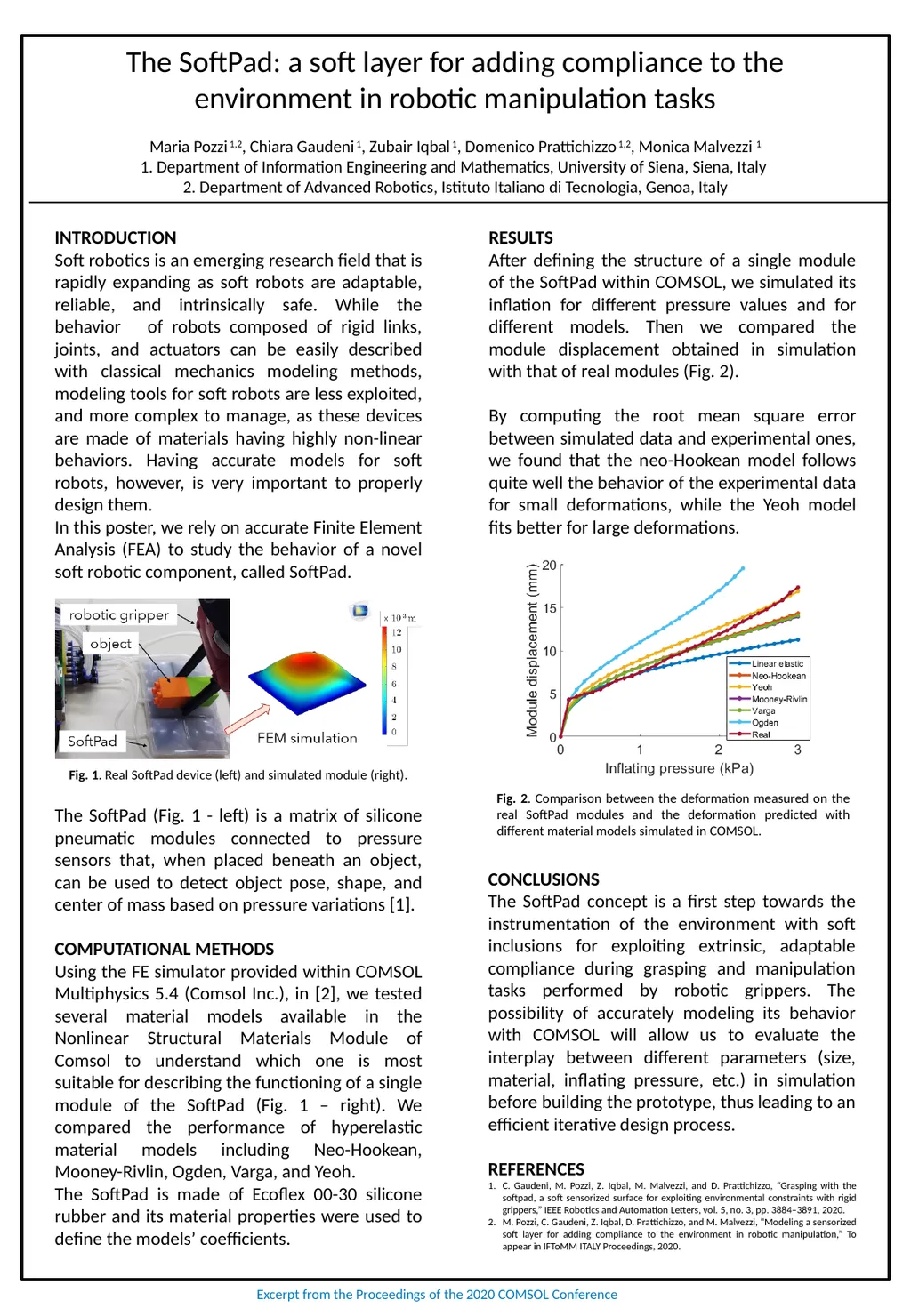
2. Department of Advanced Robotics, Istituto Italiano di Tecnologia, Genoa, Italy Excerpt from the Proceedings of the 2020 COMSOL Conference Fig. 1. Real SoftPad device (left) and simulated module (right). The SoftPad (Fig. 1 - left) is a matrix of silicone pneumatic modules connected to pressure sensors that, when placed beneath an object, can be used to detect object pose, shape, and center of mass based on pressure variations [1].
COMPUTATIONAL METHODS
Using the FE simulator provided within COMSOL Multiphysics 5.4 (Comsol Inc.), in [2], we tested several material models available in the Nonlinear Structural Materials Module of Comsol to understand which one is most suitable for describing the functioning of a single module of the SoftPad (Fig. 1 – right). We compared the performance of hyperelastic material models including Neo-Hookean, Mooney-Rivlin, Ogden, Varga, and Yeoh.
The SoftPad is made of Ecoflex 00-30 silicone rubber and its material properties were used to define the models’ coefficients. RESULTS
After defining the structure of a single module of the SoftPad within COMSOL, we simulated its inflation for different pressure values and for different models. Then we compared the module displacement obtained in simulation with that of real modules (Fig. 2).
By computing the root mean square error between simulated data and experimental ones, we found that the neo-Hookean model follows quite well the behavior of the experimental data for small deformations, while the Yeoh model fits better for large deformations. CONCLUSIONS
The SoftPad concept is a first step towards the instrumentation of the environment with soft inclusions for exploiting extrinsic, adaptable compliance during grasping and manipulation tasks performed by robotic grippers. The possibility of accurately modeling its behavior with COMSOL will allow us to evaluate the interplay between different parameters (size, material, inflating pressure, etc.) in simulation before building the prototype, thus leading to an efficient iterative design process. Fig. 2. Comparison between the deformation measured on the real SoftPad modules and the deformation predicted with different material models simulated in COMSOL.<br>
Soft robotics is an emerging research field that is rapidly expanding as soft robots are adaptable, reliable, and intrinsically safe. While the behavior of robots composed of rigid links, joints, and actuators can be easily described with classical mechanics modeling methods, modeling tools for soft robots are less exploited, and more complex to manage, as these devices are made of materials having highly non-linear behaviors. Having accurate models for soft robots, however, is very important to properly design them.
In this poster, we rely on accurate Finite Element Analysis (FEA) to study the behavior of a novel soft robotic component, called SoftPad. REFERENCES
C. Gaudeni, M. Pozzi, Z. Iqbal, M. Malvezzi, and D. Prattichizzo, “Grasping with the softpad, a soft sensorized surface for exploiting environmental constraints with rigid grippers,” IEEE Robotics and Automation Letters, vol. 5, no. 3, pp. 3884–3891, 2020.
M. Pozzi, C. Gaudeni, Z. Iqbal, D. Prattichizzo, and M. Malvezzi, “Modeling a sensorized soft layer for adding compliance to the environment in robotic manipulation,” To appear in IFToMM ITALY Proceedings, 2020. The SoftPad: a soft layer for adding compliance to the environment in robotic manipulation tasks
Maria Pozzi 1,2, Chiara Gaudeni 1, Zubair Iqbal 1, Domenico Prattichizzo 1,2, Monica Malvezzi 1
1. Department of Information Engineering and Mathematics, University of Siena, Siena, Italy
2. Department of Advanced Robotics, Istituto Italiano di Tecnologia, Genoa, Italy Excerpt from the Proceedings of the 2020 COMSOL Conference Fig. 1. Real SoftPad device (left) and simulated module (right). The SoftPad (Fig. 1 - left) is a matrix of silicone pneumatic modules connected to pressure sensors that, when placed beneath an object, can be used to detect object pose, shape, and center of mass based on pressure variations [1].
COMPUTATIONAL METHODS
Using the FE simulator provided within COMSOL Multiphysics 5.4 (Comsol Inc.), in [2], we tested several material models available in the Nonlinear Structural Materials Module of Comsol to understand which one is most suitable for describing the functioning of a single module of the SoftPad (Fig. 1 – right). We compared the performance of hyperelastic material models including Neo-Hookean, Mooney-Rivlin, Ogden, Varga, and Yeoh.
The SoftPad is made of Ecoflex 00-30 silicone rubber and its material properties were used to define the models’ coefficients. RESULTS
After defining the structure of a single module of the SoftPad within COMSOL, we simulated its inflation for different pressure values and for different models. Then we compared the module displacement obtained in simulation with that of real modules (Fig. 2).
By computing the root mean square error between simulated data and experimental ones, we found that the neo-Hookean model follows quite well the behavior of the experimental data for small deformations, while the Yeoh model fits better for large deformations. CONCLUSIONS
The SoftPad concept is a first step towards the instrumentation of the environment with soft inclusions for exploiting extrinsic, adaptable compliance during grasping and manipulation tasks performed by robotic grippers. The possibility of accurately modeling its behavior with COMSOL will allow us to evaluate the interplay between different parameters (size, material, inflating pressure, etc.) in simulation before building the prototype, thus leading to an efficient iterative design process. Fig. 2. Comparison between the deformation measured on the real SoftPad modules and the deformation predicted with different material models simulated in COMSOL.<br>