
Introduction This document provides an overview of
Description: Introduction This document provides an overview of findings from an independent review of the internal investigation into the care of Mr Q, who killed his wife and them himself. Agencies and teams who might benefit from this bulletin:
Related Topics
Download Presentation
"Introduction This document provides an overview of" is the property of its rightful owner. Permission is granted to download and print the materials on this website for personal, non-commercial use only, and to display it on your personal computer provided you do not modify the materials and that you retain all copyright notices contained in the materials. By downloading content from our website, you accept the terms of this agreement.
Presentation Transcript
slide1. Introduction
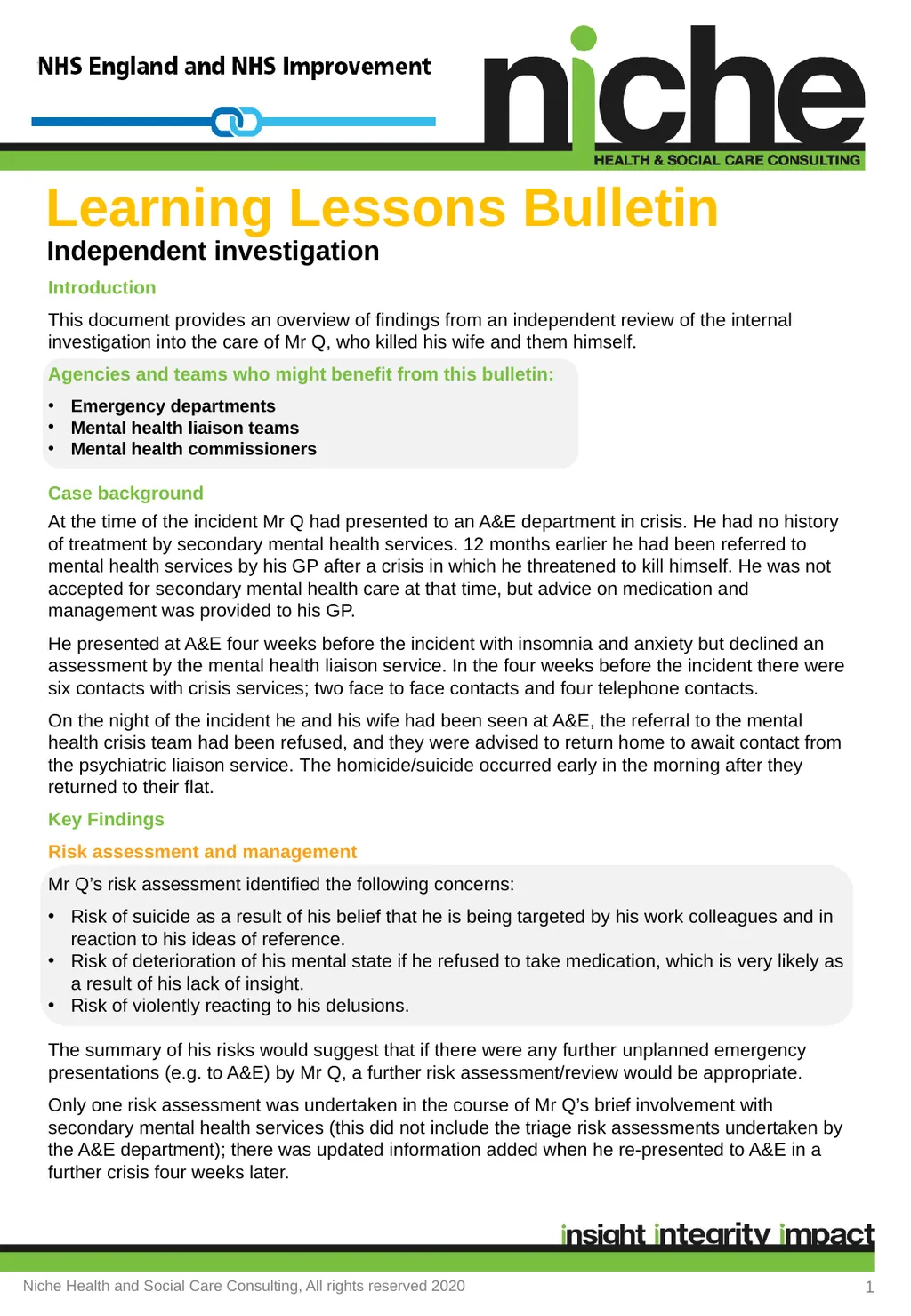
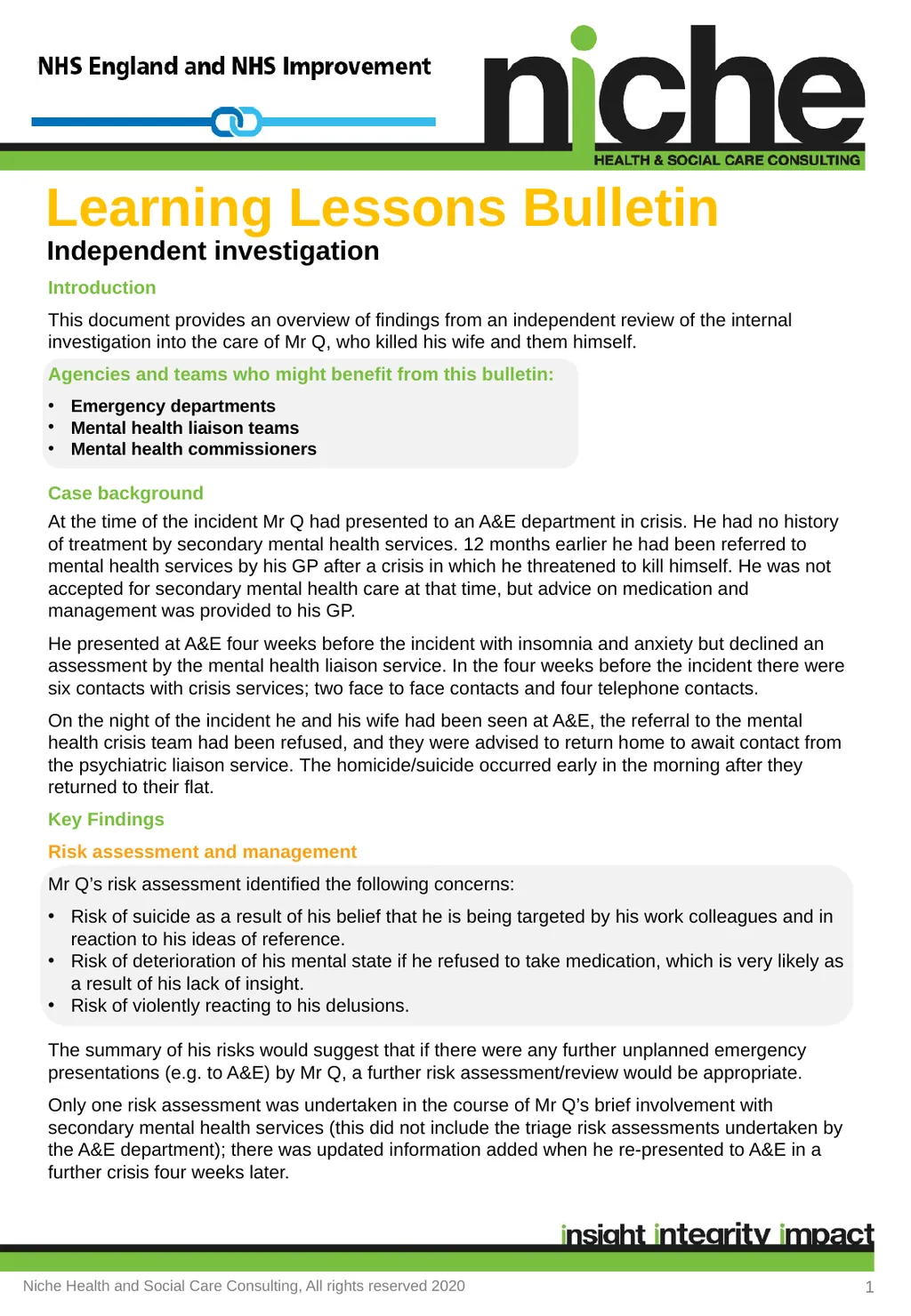
This document provides an overview of findings from an independent review of the internal investigation into the care of Mr Q, who killed his wife and them himself.
Agencies and teams who might benefit from this bulletin:
Emergency departments
Mental health liaison teams
Mental health commissioners
Case background
At the time of the incident Mr Q had presented to an A&E department in crisis. He had no history of treatment by secondary mental health services. 12 months earlier he had been referred to mental health services by his GP after a crisis in which he threatened to kill himself. He was not accepted for secondary mental health care at that time, but advice on medication and management was provided to his GP.
He presented at A&E four weeks before the incident with insomnia and anxiety but declined an assessment by the mental health liaison service. In the four weeks before the incident there were six contacts with crisis services; two face to face contacts and four telephone contacts.
On the night of the incident he and his wife had been seen at A&E, the referral to the mental health crisis team had been refused, and they were advised to return home to await contact from the psychiatric liaison service. The homicide/suicide occurred early in the morning after they returned to their flat.
Key Findings
Risk assessment and management
Mr Q’s risk assessment identified the following concerns:
Risk of suicide as a result of his belief that he is being targeted by his work colleagues and in reaction to his ideas of reference.
Risk of deterioration of his mental state if he refused to take medication, which is very likely as a result of his lack of insight.
Risk of violently reacting to his delusions.
The summary of his risks would suggest that if there were any further unplanned emergency presentations (e.g. to A&E) by Mr Q, a further risk assessment/review would be appropriate.
Only one risk assessment was undertaken in the course of Mr Q’s brief involvement with secondary mental health services (this did not include the triage risk assessments undertaken by the A&E department); there was updated information added when he re-presented to A&E in a further crisis four weeks later. Learning Lessons Bulletin Independent investigation 1 Niche Health and Social Care Consulting, All rights reserved 2020<br>
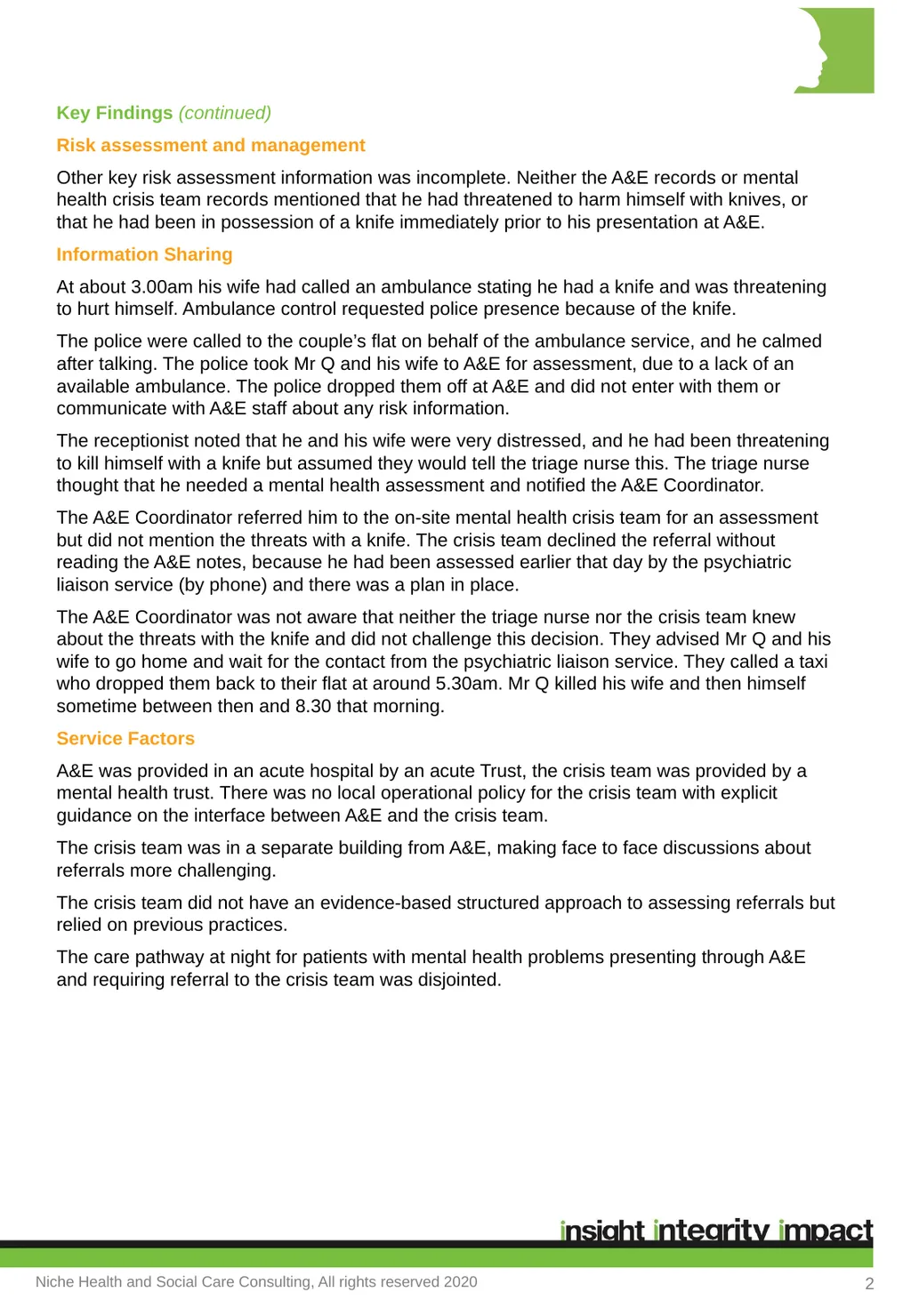
slide2. 2 Key Findings (continued)
Risk assessment and management
Other key risk assessment information was incomplete. Neither the A&E records or mental health crisis team records mentioned that he had threatened to harm himself with knives, or that he had been in possession of a knife immediately prior to his presentation at A&E.
Information Sharing
At about 3.00am his wife had called an ambulance stating he had a knife and was threatening to hurt himself. Ambulance control requested police presence because of the knife.
The police were called to the couple’s flat on behalf of the ambulance service, and he calmed after talking. The police took Mr Q and his wife to A&E for assessment, due to a lack of an available ambulance. The police dropped them off at A&E and did not enter with them or communicate with A&E staff about any risk information.
The receptionist noted that he and his wife were very distressed, and he had been threatening to kill himself with a knife but assumed they would tell the triage nurse this. The triage nurse thought that he needed a mental health assessment and notified the A&E Coordinator.
The A&E Coordinator referred him to the on-site mental health crisis team for an assessment but did not mention the threats with a knife. The crisis team declined the referral without reading the A&E notes, because he had been assessed earlier that day by the psychiatric liaison service (by phone) and there was a plan in place.
The A&E Coordinator was not aware that neither the triage nurse nor the crisis team knew about the threats with the knife and did not challenge this decision. They advised Mr Q and his wife to go home and wait for the contact from the psychiatric liaison service. They called a taxi who dropped them back to their flat at around 5.30am. Mr Q killed his wife and then himself sometime between then and 8.30 that morning.
Service Factors
A&E was provided in an acute hospital by an acute Trust, the crisis team was provided by a mental health trust. There was no local operational policy for the crisis team with explicit guidance on the interface between A&E and the crisis team.
The crisis team was in a separate building from A&E, making face to face discussions about referrals more challenging.
The crisis team did not have an evidence-based structured approach to assessing referrals but relied on previous practices.
The care pathway at night for patients with mental health problems presenting through A&E and requiring referral to the crisis team was disjointed. Niche Health and Social Care Consulting, All rights reserved 2020<br>
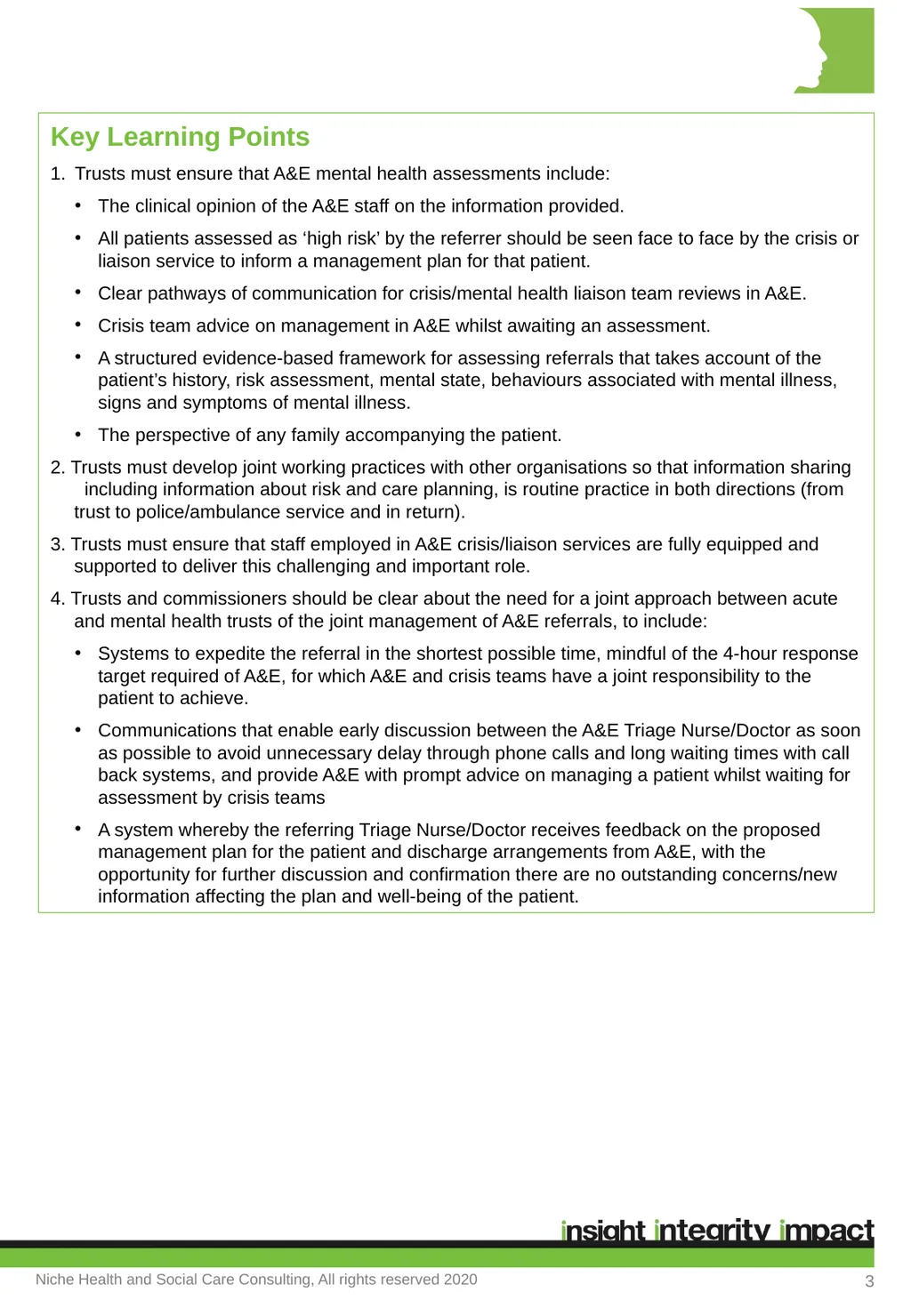
slide3. 3 Key Learning Points
Trusts must ensure that A&E mental health assessments include:
The clinical opinion of the A&E staff on the information provided.
All patients assessed as ‘high risk’ by the referrer should be seen face to face by the crisis or liaison service to inform a management plan for that patient.
Clear pathways of communication for crisis/mental health liaison team reviews in A&E.
Crisis team advice on management in A&E whilst awaiting an assessment.
A structured evidence-based framework for assessing referrals that takes account of the patient’s history, risk assessment, mental state, behaviours associated with mental illness, signs and symptoms of mental illness.
The perspective of any family accompanying the patient.
2. Trusts must develop joint working practices with other organisations so that information sharing including information about risk and care planning, is routine practice in both directions (from trust to police/ambulance service and in return).
3. Trusts must ensure that staff employed in A&E crisis/liaison services are fully equipped and supported to deliver this challenging and important role.
4. Trusts and commissioners should be clear about the need for a joint approach between acute and mental health trusts of the joint management of A&E referrals, to include:
Systems to expedite the referral in the shortest possible time, mindful of the 4-hour response target required of A&E, for which A&E and crisis teams have a joint responsibility to the patient to achieve.
Communications that enable early discussion between the A&E Triage Nurse/Doctor as soon as possible to avoid unnecessary delay through phone calls and long waiting times with call back systems, and provide A&E with prompt advice on managing a patient whilst waiting for assessment by crisis teams
A system whereby the referring Triage Nurse/Doctor receives feedback on the proposed management plan for the patient and discharge arrangements from A&E, with the opportunity for further discussion and confirmation there are no outstanding concerns/new information affecting the plan and well-being of the patient. Niche Health and Social Care Consulting, All rights reserved 2020<br>
slide4. Individual practice reflections
Does your risk assessment include information from each of the services that the patient has encountered that day? If another service mentions risk information, are you clear that this should be communicated clearly at each stage? Do you press for more detail or do you take it at ‘face value’ that it has been passed on? Staff are coping?
Have you asked any accompanying family for information?
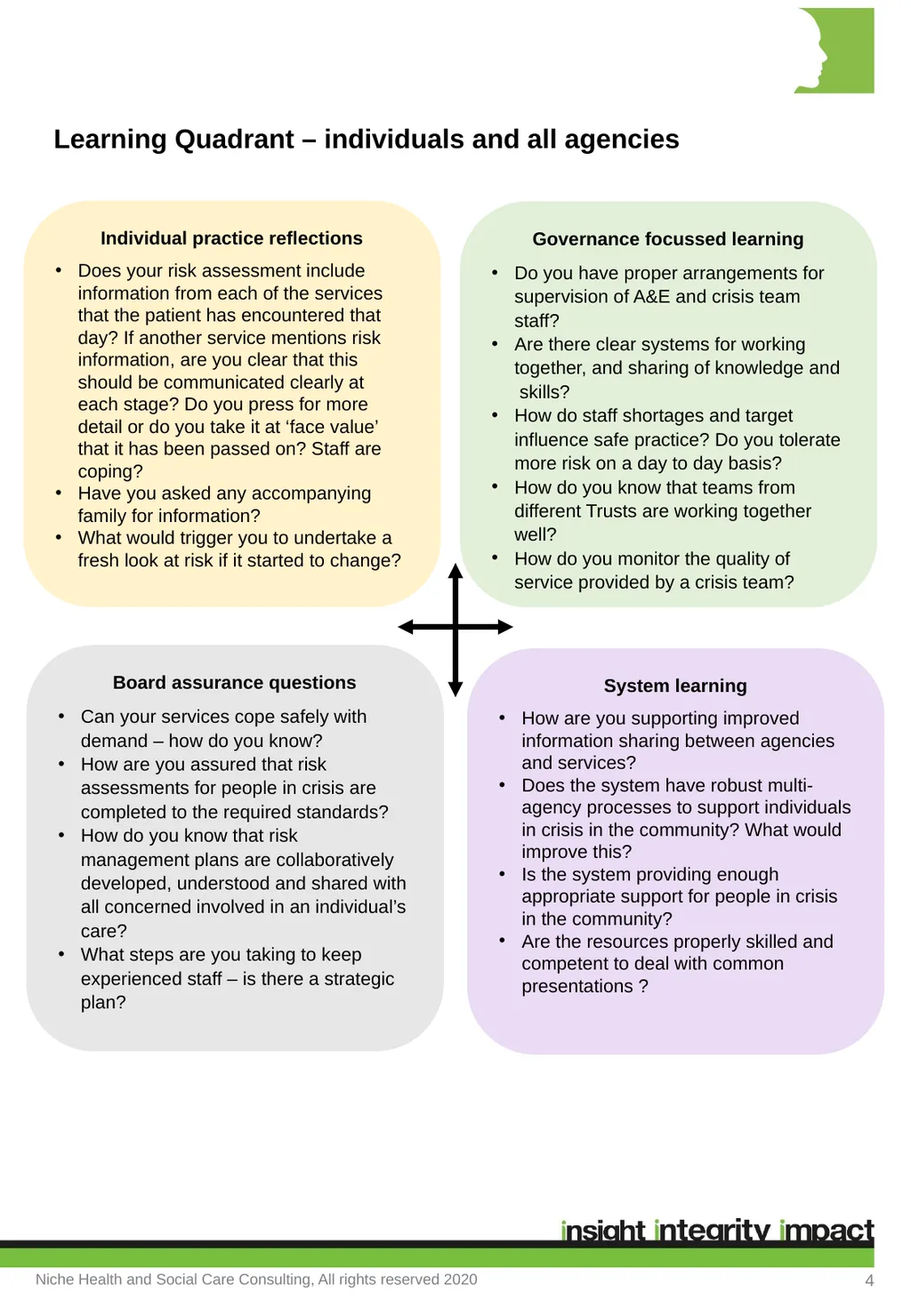
What would trigger you to undertake a fresh look at risk if it started to change? 4 Niche Health and Social Care Consulting, All rights reserved 2020 Learning Quadrant – individuals and all agencies Governance focussed learning
Do you have proper arrangements for supervision of A&E and crisis team staff?
Are there clear systems for working together, and sharing of knowledge and skills?
How do staff shortages and target influence safe practice? Do you tolerate more risk on a day to day basis?
How do you know that teams from different Trusts are working together well?
How do you monitor the quality of service provided by a crisis team? System learning
How are you supporting improved information sharing between agencies and services?
Does the system have robust multi-agency processes to support individuals in crisis in the community? What would improve this?
Is the system providing enough appropriate support for people in crisis in the community?
Are the resources properly skilled and competent to deal with common presentations ? Board assurance questions
Can your services cope safely with demand – how do you know?
How are you assured that risk assessments for people in crisis are completed to the required standards?
How do you know that risk management plans are collaboratively developed, understood and shared with all concerned involved in an individual’s care?
What steps are you taking to keep experienced staff – is there a strategic plan?<br>
This document provides an overview of findings from an independent review of the internal investigation into the care of Mr Q, who killed his wife and them himself.
Agencies and teams who might benefit from this bulletin:
Emergency departments
Mental health liaison teams
Mental health commissioners
Case background
At the time of the incident Mr Q had presented to an A&E department in crisis. He had no history of treatment by secondary mental health services. 12 months earlier he had been referred to mental health services by his GP after a crisis in which he threatened to kill himself. He was not accepted for secondary mental health care at that time, but advice on medication and management was provided to his GP.
He presented at A&E four weeks before the incident with insomnia and anxiety but declined an assessment by the mental health liaison service. In the four weeks before the incident there were six contacts with crisis services; two face to face contacts and four telephone contacts.
On the night of the incident he and his wife had been seen at A&E, the referral to the mental health crisis team had been refused, and they were advised to return home to await contact from the psychiatric liaison service. The homicide/suicide occurred early in the morning after they returned to their flat.
Key Findings
Risk assessment and management
Mr Q’s risk assessment identified the following concerns:
Risk of suicide as a result of his belief that he is being targeted by his work colleagues and in reaction to his ideas of reference.
Risk of deterioration of his mental state if he refused to take medication, which is very likely as a result of his lack of insight.
Risk of violently reacting to his delusions.
The summary of his risks would suggest that if there were any further unplanned emergency presentations (e.g. to A&E) by Mr Q, a further risk assessment/review would be appropriate.
Only one risk assessment was undertaken in the course of Mr Q’s brief involvement with secondary mental health services (this did not include the triage risk assessments undertaken by the A&E department); there was updated information added when he re-presented to A&E in a further crisis four weeks later. Learning Lessons Bulletin Independent investigation 1 Niche Health and Social Care Consulting, All rights reserved 2020<br>
slide2. 2 Key Findings (continued)
Risk assessment and management
Other key risk assessment information was incomplete. Neither the A&E records or mental health crisis team records mentioned that he had threatened to harm himself with knives, or that he had been in possession of a knife immediately prior to his presentation at A&E.
Information Sharing
At about 3.00am his wife had called an ambulance stating he had a knife and was threatening to hurt himself. Ambulance control requested police presence because of the knife.
The police were called to the couple’s flat on behalf of the ambulance service, and he calmed after talking. The police took Mr Q and his wife to A&E for assessment, due to a lack of an available ambulance. The police dropped them off at A&E and did not enter with them or communicate with A&E staff about any risk information.
The receptionist noted that he and his wife were very distressed, and he had been threatening to kill himself with a knife but assumed they would tell the triage nurse this. The triage nurse thought that he needed a mental health assessment and notified the A&E Coordinator.
The A&E Coordinator referred him to the on-site mental health crisis team for an assessment but did not mention the threats with a knife. The crisis team declined the referral without reading the A&E notes, because he had been assessed earlier that day by the psychiatric liaison service (by phone) and there was a plan in place.
The A&E Coordinator was not aware that neither the triage nurse nor the crisis team knew about the threats with the knife and did not challenge this decision. They advised Mr Q and his wife to go home and wait for the contact from the psychiatric liaison service. They called a taxi who dropped them back to their flat at around 5.30am. Mr Q killed his wife and then himself sometime between then and 8.30 that morning.
Service Factors
A&E was provided in an acute hospital by an acute Trust, the crisis team was provided by a mental health trust. There was no local operational policy for the crisis team with explicit guidance on the interface between A&E and the crisis team.
The crisis team was in a separate building from A&E, making face to face discussions about referrals more challenging.
The crisis team did not have an evidence-based structured approach to assessing referrals but relied on previous practices.
The care pathway at night for patients with mental health problems presenting through A&E and requiring referral to the crisis team was disjointed. Niche Health and Social Care Consulting, All rights reserved 2020<br>
slide3. 3 Key Learning Points
Trusts must ensure that A&E mental health assessments include:
The clinical opinion of the A&E staff on the information provided.
All patients assessed as ‘high risk’ by the referrer should be seen face to face by the crisis or liaison service to inform a management plan for that patient.
Clear pathways of communication for crisis/mental health liaison team reviews in A&E.
Crisis team advice on management in A&E whilst awaiting an assessment.
A structured evidence-based framework for assessing referrals that takes account of the patient’s history, risk assessment, mental state, behaviours associated with mental illness, signs and symptoms of mental illness.
The perspective of any family accompanying the patient.
2. Trusts must develop joint working practices with other organisations so that information sharing including information about risk and care planning, is routine practice in both directions (from trust to police/ambulance service and in return).
3. Trusts must ensure that staff employed in A&E crisis/liaison services are fully equipped and supported to deliver this challenging and important role.
4. Trusts and commissioners should be clear about the need for a joint approach between acute and mental health trusts of the joint management of A&E referrals, to include:
Systems to expedite the referral in the shortest possible time, mindful of the 4-hour response target required of A&E, for which A&E and crisis teams have a joint responsibility to the patient to achieve.
Communications that enable early discussion between the A&E Triage Nurse/Doctor as soon as possible to avoid unnecessary delay through phone calls and long waiting times with call back systems, and provide A&E with prompt advice on managing a patient whilst waiting for assessment by crisis teams
A system whereby the referring Triage Nurse/Doctor receives feedback on the proposed management plan for the patient and discharge arrangements from A&E, with the opportunity for further discussion and confirmation there are no outstanding concerns/new information affecting the plan and well-being of the patient. Niche Health and Social Care Consulting, All rights reserved 2020<br>
slide4. Individual practice reflections
Does your risk assessment include information from each of the services that the patient has encountered that day? If another service mentions risk information, are you clear that this should be communicated clearly at each stage? Do you press for more detail or do you take it at ‘face value’ that it has been passed on? Staff are coping?
Have you asked any accompanying family for information?
What would trigger you to undertake a fresh look at risk if it started to change? 4 Niche Health and Social Care Consulting, All rights reserved 2020 Learning Quadrant – individuals and all agencies Governance focussed learning
Do you have proper arrangements for supervision of A&E and crisis team staff?
Are there clear systems for working together, and sharing of knowledge and skills?
How do staff shortages and target influence safe practice? Do you tolerate more risk on a day to day basis?
How do you know that teams from different Trusts are working together well?
How do you monitor the quality of service provided by a crisis team? System learning
How are you supporting improved information sharing between agencies and services?
Does the system have robust multi-agency processes to support individuals in crisis in the community? What would improve this?
Is the system providing enough appropriate support for people in crisis in the community?
Are the resources properly skilled and competent to deal with common presentations ? Board assurance questions
Can your services cope safely with demand – how do you know?
How are you assured that risk assessments for people in crisis are completed to the required standards?
How do you know that risk management plans are collaboratively developed, understood and shared with all concerned involved in an individual’s care?
What steps are you taking to keep experienced staff – is there a strategic plan?<br>