01
Introduction This project focuses on resource recommendation using the AAN corpus, a completely new and publicly available dataset that aims to facilitate NLP education and research. Previous work has been done in recommending scientific papers to others but, in addition to not including a large variety of resource types included in corpora like AAN, this also may be largely unaccessible to a beginner in the relevant topics.
For this reason, we focus on recommending resources (tutorials, corpora, etc.) and, in short, the user of our project would provide a title and an abstract for their proposed research, and this project would recommend resources relevant to preparing for such research.
Two preliminary implementations are performed, using Doc2Vec and LDA each in isolation. Following this, a deep-learning approach is taken; a neural network determines, for a resource and project pair, whether the resource is likely helpful to preparing for the project. Methods The LDA base implementation determines the most relevant topic to the project query, and to recommend the resources most relevant to this topic.
The Doc2Vec base implementation instead embeds all the resources in a vector space, then determines the vector of the query and recommends similarly-embedded resources.
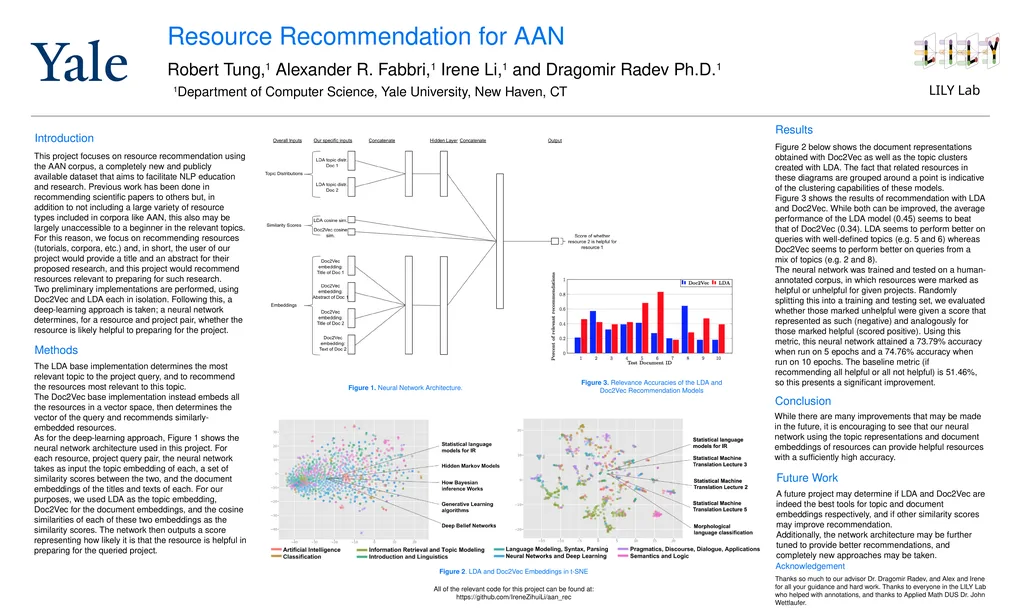
As for the deep-learning approach, Figure 1 shows the neural network architecture used in this project. For each resource, project query pair, the neural network takes as input the topic embedding of each, a set of similarity scores between the two, and the document embeddings of the titles and texts of each. For our purposes, we used LDA as the topic embedding, Doc2Vec for the document embeddings, and the cosine similarities of each of these two embeddings as the similarity scores. The network then outputs a score representing how likely it is that the resource is helpful in preparing for the queried project. Results Figure 2 below shows the document representations obtained with Doc2Vec as well as the topic clusters created with LDA. The fact that related resources in these diagrams are grouped around a point is indicative of the clustering capabilities of these models.
Figure 3 shows the results of recommendation with LDA and Doc2Vec. While both can be improved, the average performance of the LDA model (0.45) seems to beat that of Doc2Vec (0.34). LDA seems to perform better on queries with well-defined topics (e.g. 5 and 6) whereas Doc2Vec seems to perform better on queries from a mix of topics (e.g. 2 and 8).
The neural network was trained and tested on a human-annotated corpus, in which resources were marked as helpful or unhelpful for given projects. Randomly splitting this into a training and testing set, we evaluated whether those marked unhelpful were given a score that represented as such (negative) and analogously for those marked helpful (scored positive). Using this metric, this neural network attained a 73.79% accuracy when run on 5 epochs and a 74.76% accuracy when run on 10 epochs. The baseline metric (if recommending all helpful or all not helpful) is 51.46%, so this presents a significant improvement. Conclusion Acknowledgement Thanks so much to our advisor Dr. Dragomir Radev, and Alex and Irene for all your guidance and hard work. Thanks to everyone in the LILY Lab who helped with annotations, and thanks to Applied Math DUS Dr. John Wettlaufer. Robert Tung,1 Alexander R. Fabbri,1 Irene Li,1 and Dragomir Radev Ph.D.1 Resource Recommendation for AAN 1Department of Computer Science, Yale University, New Haven, CT Figure 1. Neural Network Architecture. Figure 2. LDA and Doc2Vec Embeddings in t-SNE LILY Lab Figure 3. Relevance Accuracies of the LDA and Doc2Vec Recommendation Models While there are many improvements that may be made in the future, it is encouraging to see that our neural network using the topic representations and document embeddings of resources can provide helpful resources with a sufficiently high accuracy. All of the relevant code for this project can be found at:
https://github.com/IreneZihuiLi/aan_rec Future Work A future project may determine if LDA and Doc2Vec are indeed the best tools for topic and document embeddings respectively, and if other similarity scores may improve recommendation.
Additionally, the network architecture may be further tuned to provide better recommendations, and completely new approaches may be taken.<br>