
Introduction to Bipartite Expression Systems Nice
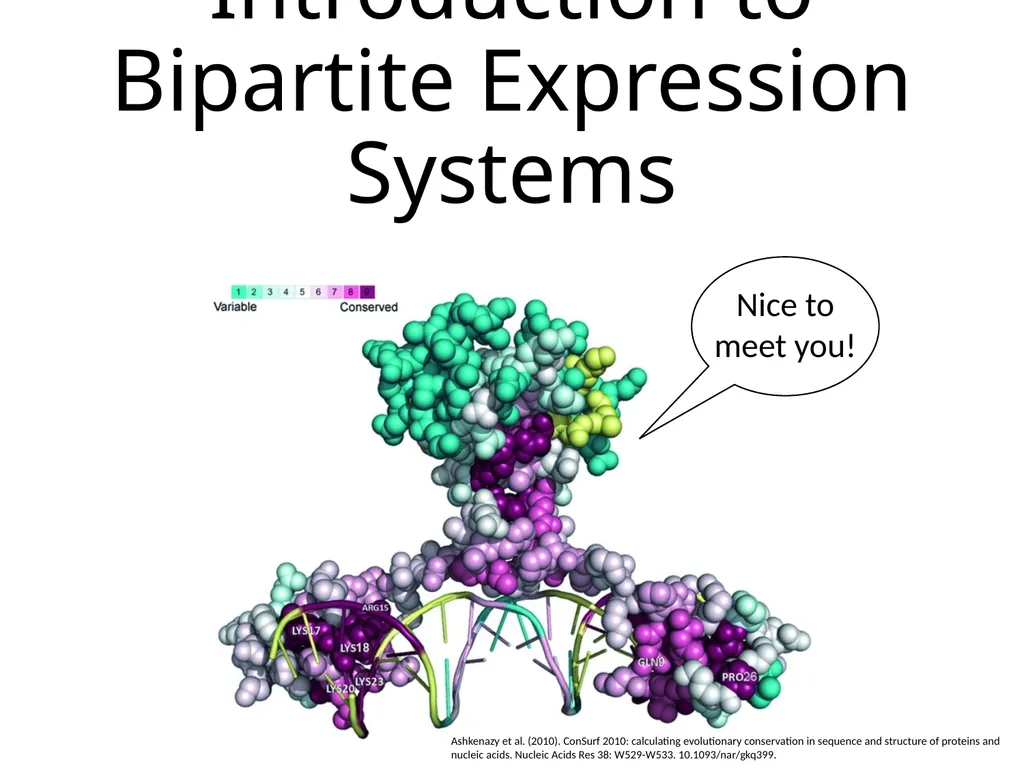
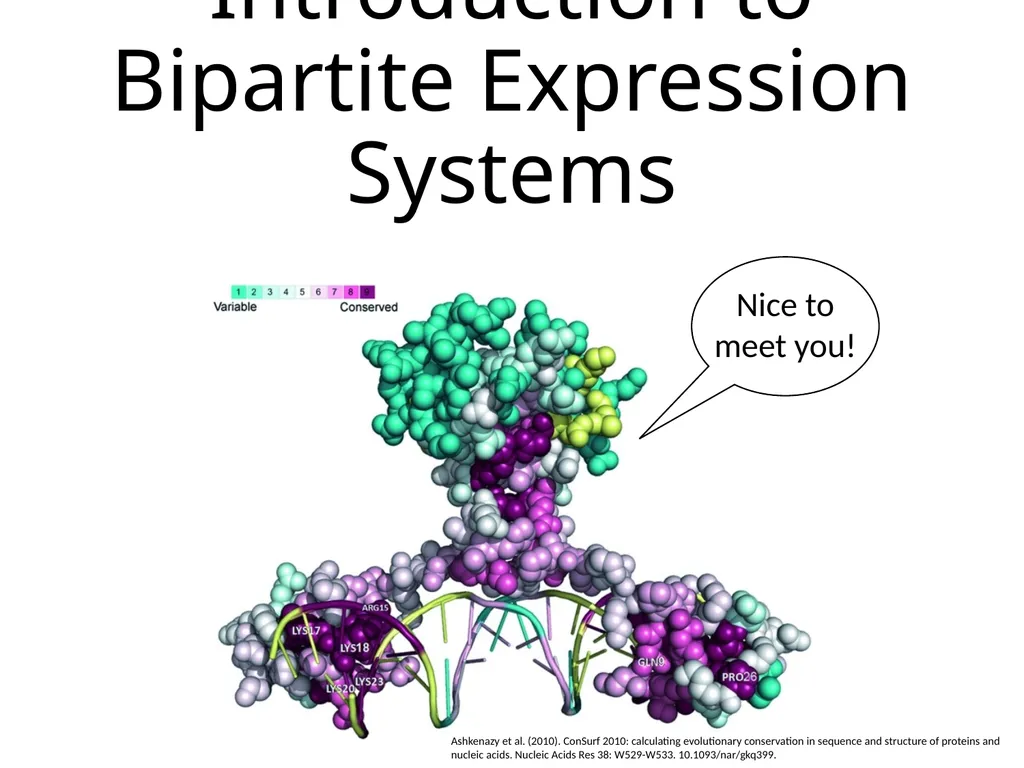

Description: Introduction to Bipartite Expression Systems Nice to meet you! Ashkenazy et al. (2010). ConSurf 2010: calculating evolutionary conservation in sequence and structure of proteins and nucleic acids. Nucleic Acids Res 38: W529-W533.
Related Topics
Download Presentation
"Introduction to Bipartite Expression Systems Nice" is the property of its rightful owner. Permission is granted to download and print the materials on this website for personal, non-commercial use only, and to display it on your personal computer provided you do not modify the materials and that you retain all copyright notices contained in the materials. By downloading content from our website, you accept the terms of this agreement.
Presentation Transcript
slide1. Introduction to Bipartite Expression Systems Nice to meet you! Ashkenazy et al. (2010). ConSurf 2010: calculating evolutionary conservation in sequence and structure of proteins and nucleic acids. Nucleic Acids Res 38: W529-W533. 10.1093/nar/gkq399.<br>
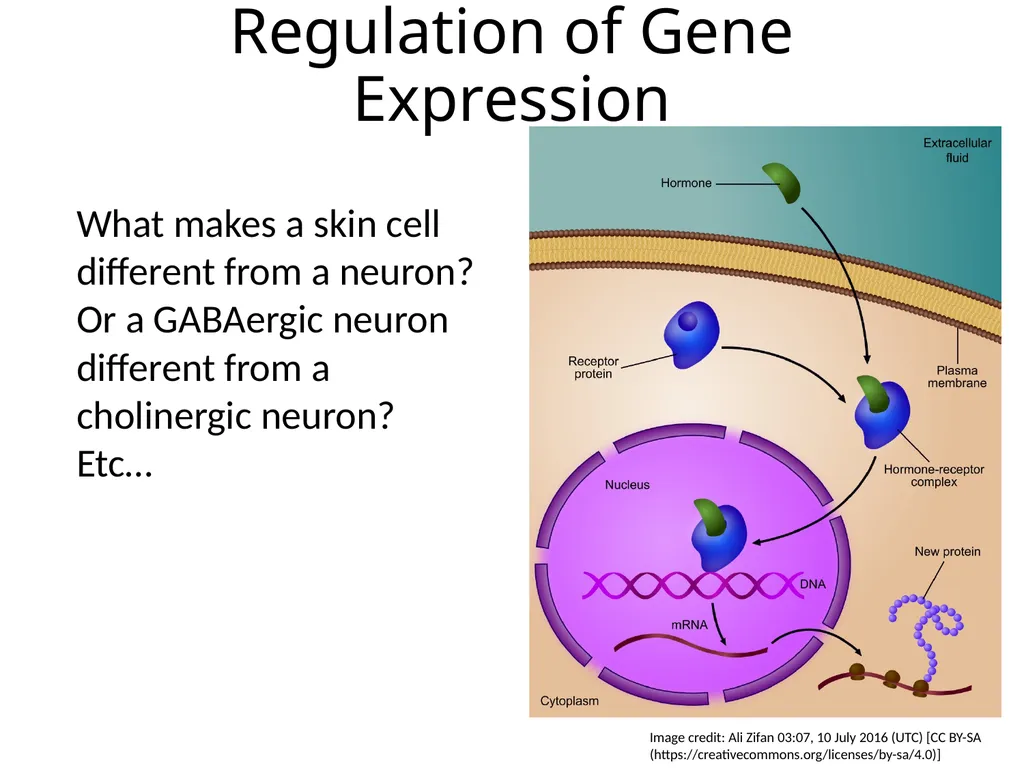
slide2. Regulation of Gene Expression What makes a skin cell different from a neuron? Or a GABAergic neuron different from a cholinergic neuron? Etc… Image credit: Ali Zifan 03:07, 10 July 2016 (UTC) [CC BY-SA (https://creativecommons.org/licenses/by-sa/4.0)]<br>
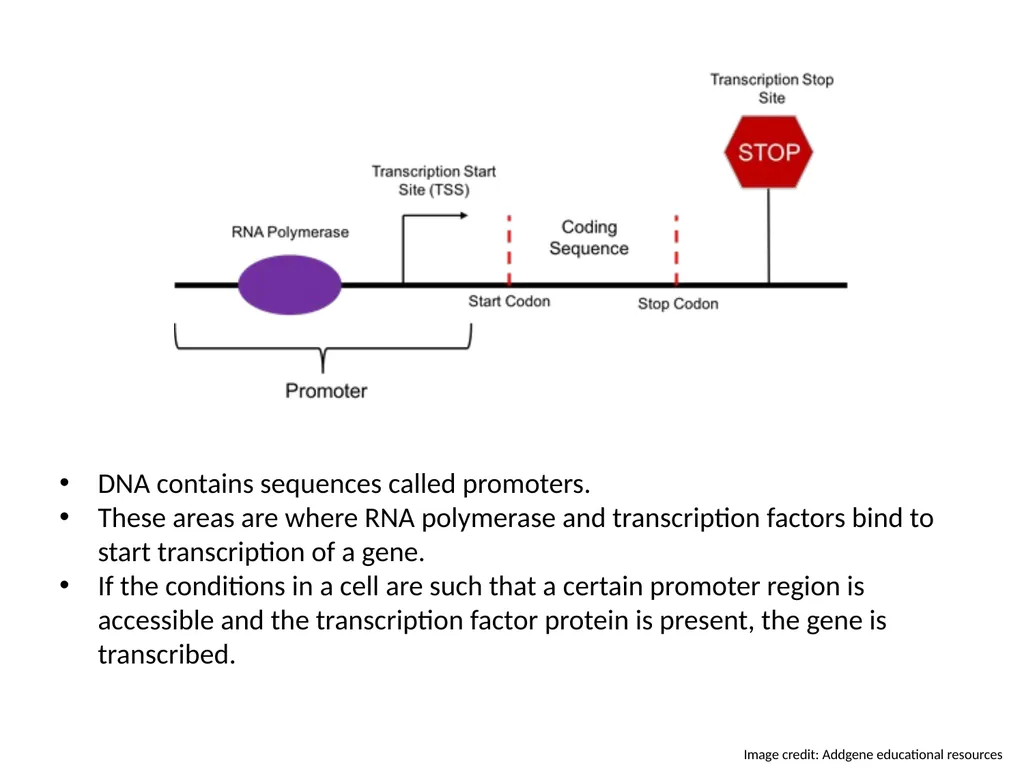
slide3. DNA contains sequences called promoters.
These areas are where RNA polymerase and transcription factors bind to start transcription of a gene.
If the conditions in a cell are such that a certain promoter region is accessible and the transcription factor protein is present, the gene is transcribed. Image credit: Addgene educational resources<br>
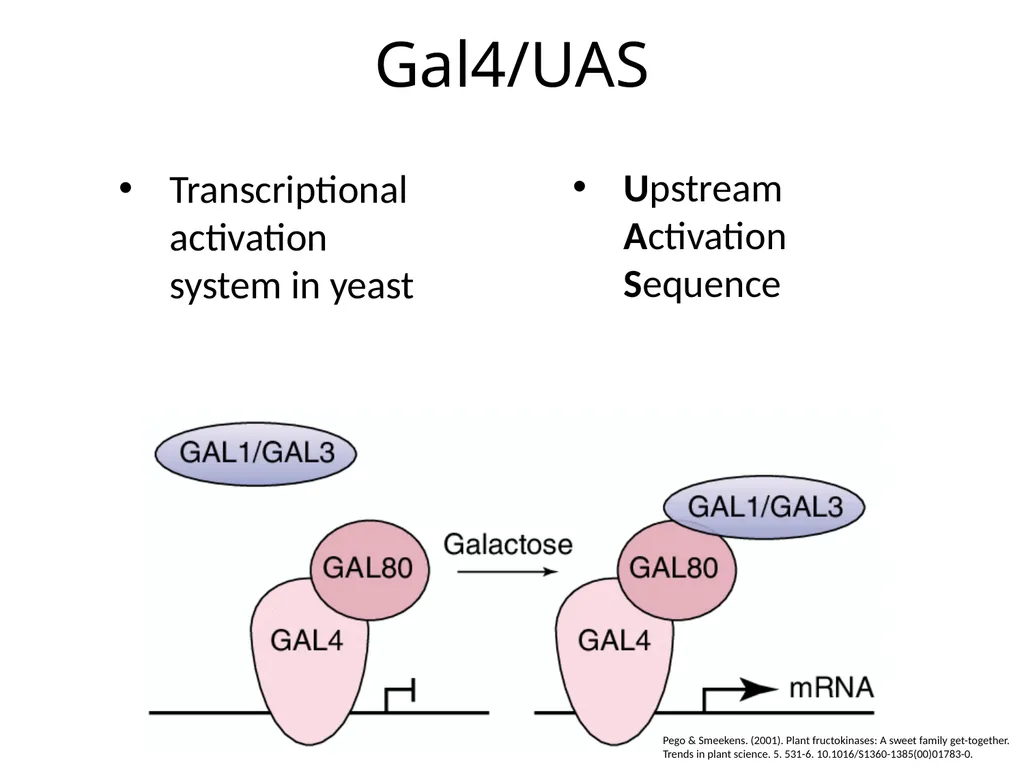
slide4. Gal4/UAS Transcriptional activation system in yeast Upstream Activation Sequence Pego & Smeekens. (2001). Plant fructokinases: A sweet family get-together. Trends in plant science. 5. 531-6. 10.1016/S1360-1385(00)01783-0.<br>
slide5. Gal4/UAS in Drosophila Gal4 under the control of a specific promoter
UAS upstream of desired gene Image credit: https://www.sciencedirect.com/topics/biochemistry-genetics-and-molecular-biology/gal4-uas-system<br>
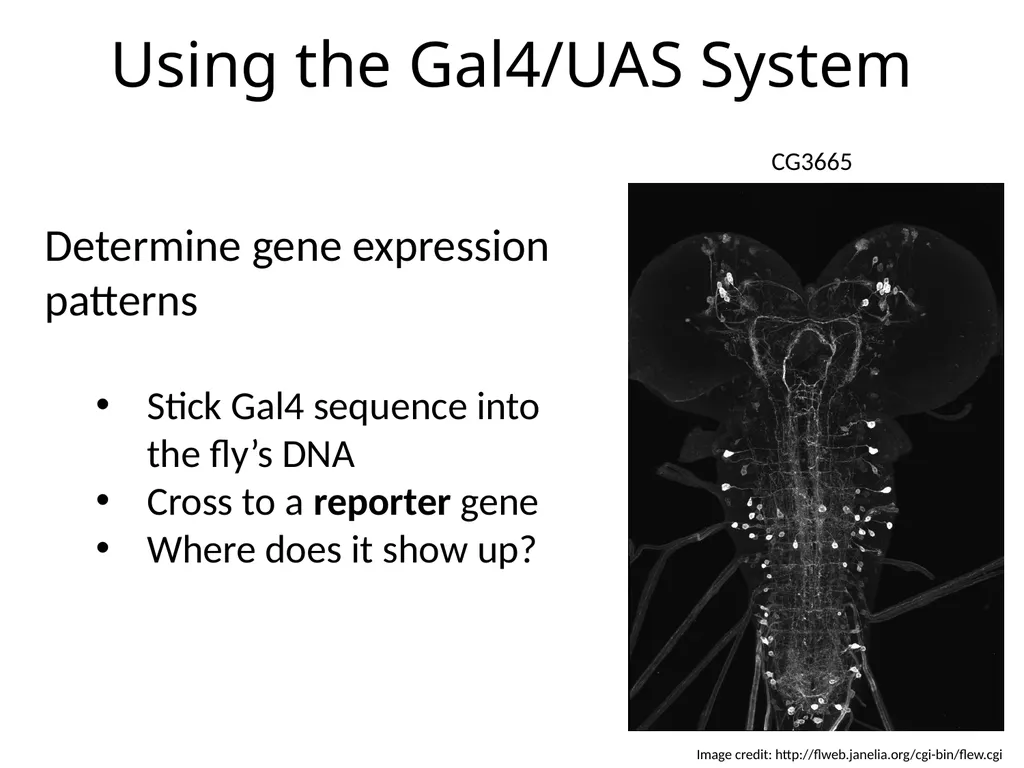
slide6. Using the Gal4/UAS System Determine gene expression patterns
Stick Gal4 sequence into the fly’s DNA
Cross to a reporter gene
Where does it show up? Image credit: http://flweb.janelia.org/cgi-bin/flew.cgi CG3665<br>
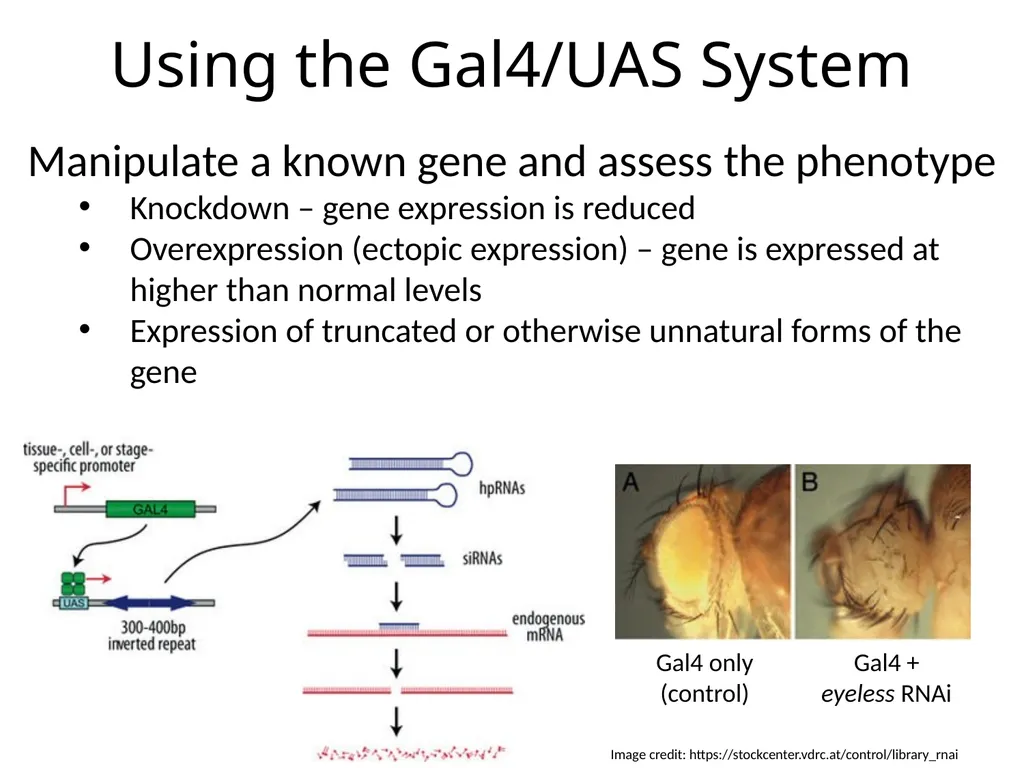
slide7. Using the Gal4/UAS System Manipulate a known gene and assess the phenotype
Knockdown – gene expression is reduced
Overexpression (ectopic expression) – gene is expressed at higher than normal levels
Expression of truncated or otherwise unnatural forms of the gene Image credit: https://stockcenter.vdrc.at/control/library_rnai Gal4 only (control) Gal4 + eyeless RNAi<br>
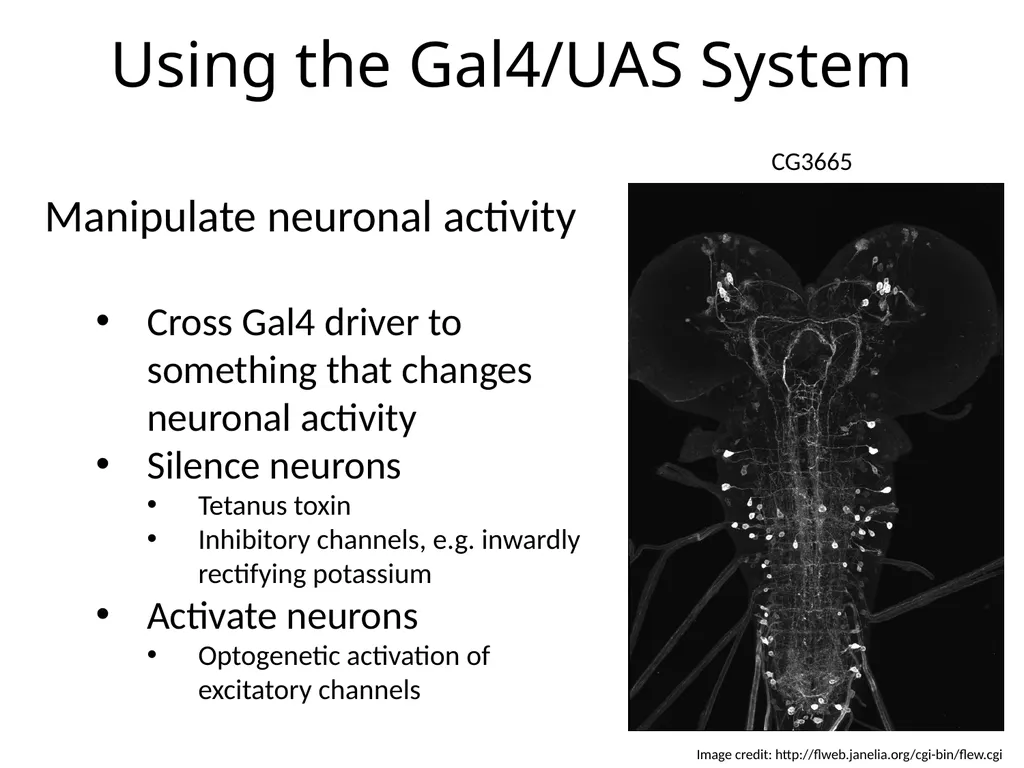
slide8. Using the Gal4/UAS System Manipulate neuronal activity
Cross Gal4 driver to something that changes neuronal activity
Silence neurons
Tetanus toxin
Inhibitory channels, e.g. inwardly rectifying potassium
Activate neurons
Optogenetic activation of excitatory channels Image credit: http://flweb.janelia.org/cgi-bin/flew.cgi CG3665<br>
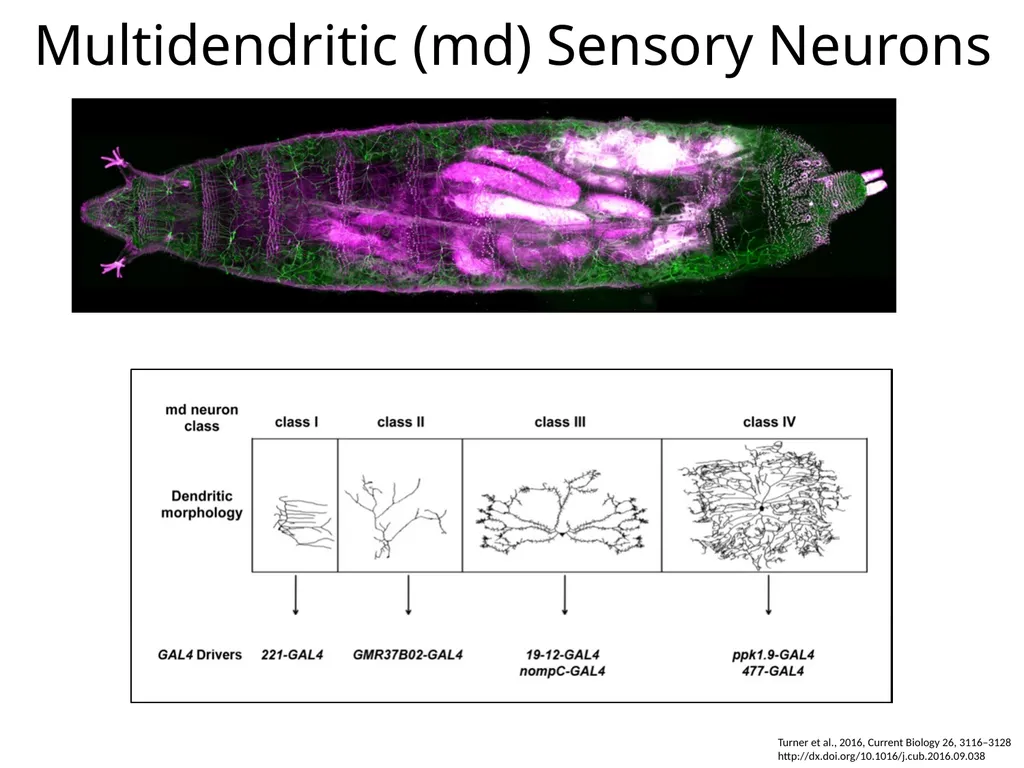
slide9. Multidendritic (md) Sensory Neurons Turner et al., 2016, Current Biology 26, 3116–3128
http://dx.doi.org/10.1016/j.cub.2016.09.038<br>
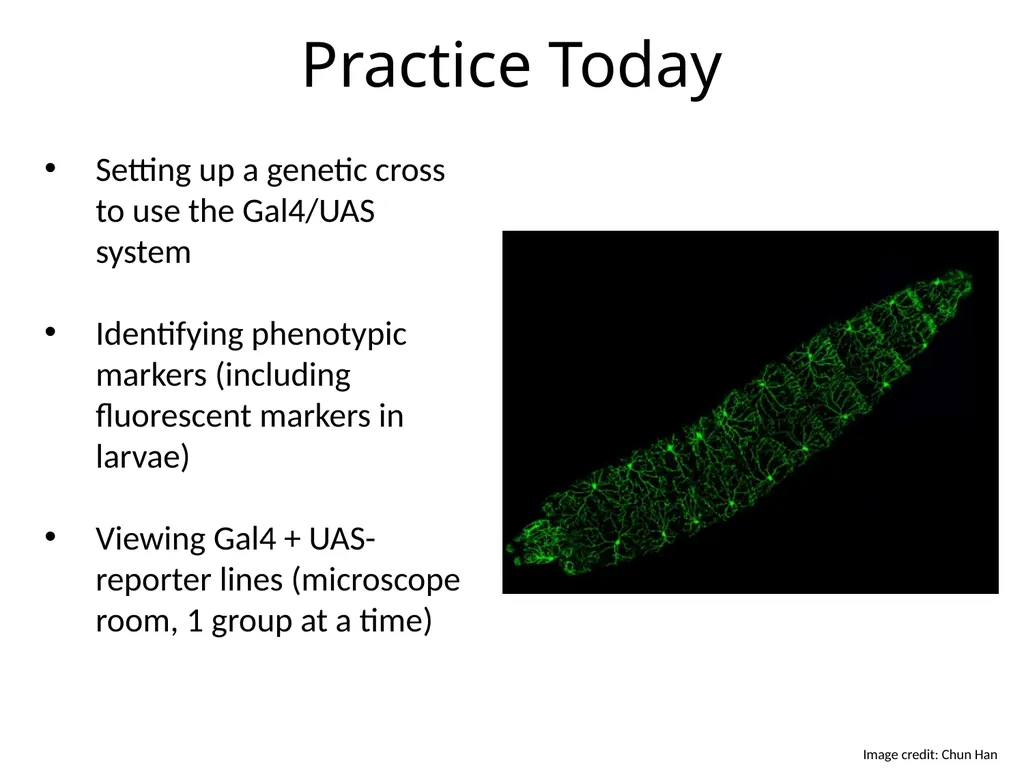
slide10. Practice Today Setting up a genetic cross to use the Gal4/UAS system
Identifying phenotypic markers (including fluorescent markers in larvae)
Viewing Gal4 + UAS-reporter lines (microscope room, 1 group at a time) Image credit: Chun Han<br>
slide2. Regulation of Gene Expression What makes a skin cell different from a neuron? Or a GABAergic neuron different from a cholinergic neuron? Etc… Image credit: Ali Zifan 03:07, 10 July 2016 (UTC) [CC BY-SA (https://creativecommons.org/licenses/by-sa/4.0)]<br>
slide3. DNA contains sequences called promoters.
These areas are where RNA polymerase and transcription factors bind to start transcription of a gene.
If the conditions in a cell are such that a certain promoter region is accessible and the transcription factor protein is present, the gene is transcribed. Image credit: Addgene educational resources<br>
slide4. Gal4/UAS Transcriptional activation system in yeast Upstream Activation Sequence Pego & Smeekens. (2001). Plant fructokinases: A sweet family get-together. Trends in plant science. 5. 531-6. 10.1016/S1360-1385(00)01783-0.<br>
slide5. Gal4/UAS in Drosophila Gal4 under the control of a specific promoter
UAS upstream of desired gene Image credit: https://www.sciencedirect.com/topics/biochemistry-genetics-and-molecular-biology/gal4-uas-system<br>
slide6. Using the Gal4/UAS System Determine gene expression patterns
Stick Gal4 sequence into the fly’s DNA
Cross to a reporter gene
Where does it show up? Image credit: http://flweb.janelia.org/cgi-bin/flew.cgi CG3665<br>
slide7. Using the Gal4/UAS System Manipulate a known gene and assess the phenotype
Knockdown – gene expression is reduced
Overexpression (ectopic expression) – gene is expressed at higher than normal levels
Expression of truncated or otherwise unnatural forms of the gene Image credit: https://stockcenter.vdrc.at/control/library_rnai Gal4 only (control) Gal4 + eyeless RNAi<br>
slide8. Using the Gal4/UAS System Manipulate neuronal activity
Cross Gal4 driver to something that changes neuronal activity
Silence neurons
Tetanus toxin
Inhibitory channels, e.g. inwardly rectifying potassium
Activate neurons
Optogenetic activation of excitatory channels Image credit: http://flweb.janelia.org/cgi-bin/flew.cgi CG3665<br>
slide9. Multidendritic (md) Sensory Neurons Turner et al., 2016, Current Biology 26, 3116–3128
http://dx.doi.org/10.1016/j.cub.2016.09.038<br>
slide10. Practice Today Setting up a genetic cross to use the Gal4/UAS system
Identifying phenotypic markers (including fluorescent markers in larvae)
Viewing Gal4 + UAS-reporter lines (microscope room, 1 group at a time) Image credit: Chun Han<br>