Introduction to Breeding for Disease Resistance Dr. Jay Prakash Gupta Associate Professor, Animal Genetics Breeding Bihar Veterinary College BASU, Patna Bihar - 800014 2 Loss of production owing to mortality, growth rate etc. Increased
"Introduction to Breeding for Disease Resistance" is the property of its rightful owner. Permission is granted to
download and print the materials on this website for personal, non-commercial use only, and to display it
on your personal computer provided you do not modify the materials and that you retain all copyright
notices contained in the materials. By downloading content from our website, you accept the terms of this
agreement.
Presentation Transcript
01
Introduction to Breeding for Disease Resistance Dr. Jay Prakash Gupta
Associate Professor, Animal Genetics & Breeding
Bihar Veterinary College
BASU, Patna
Bihar - 800014<br>
02
2 Loss of production owing to mortality, growth rate etc.
Increased Cost for treatment and culling rate
Labour intensive animal management (culling, treatment etc.)
No new class of antibiotic in over 40 years<br>
03
Disease: Pathological condition,
from infection,
genetic defect and/or
environmental stress
Resistance:
An ecological consideration of the interaction between the host and the pathogen species.
Ability of the host to exert control over the pathogen life cycle up to certain degree 3<br>
04
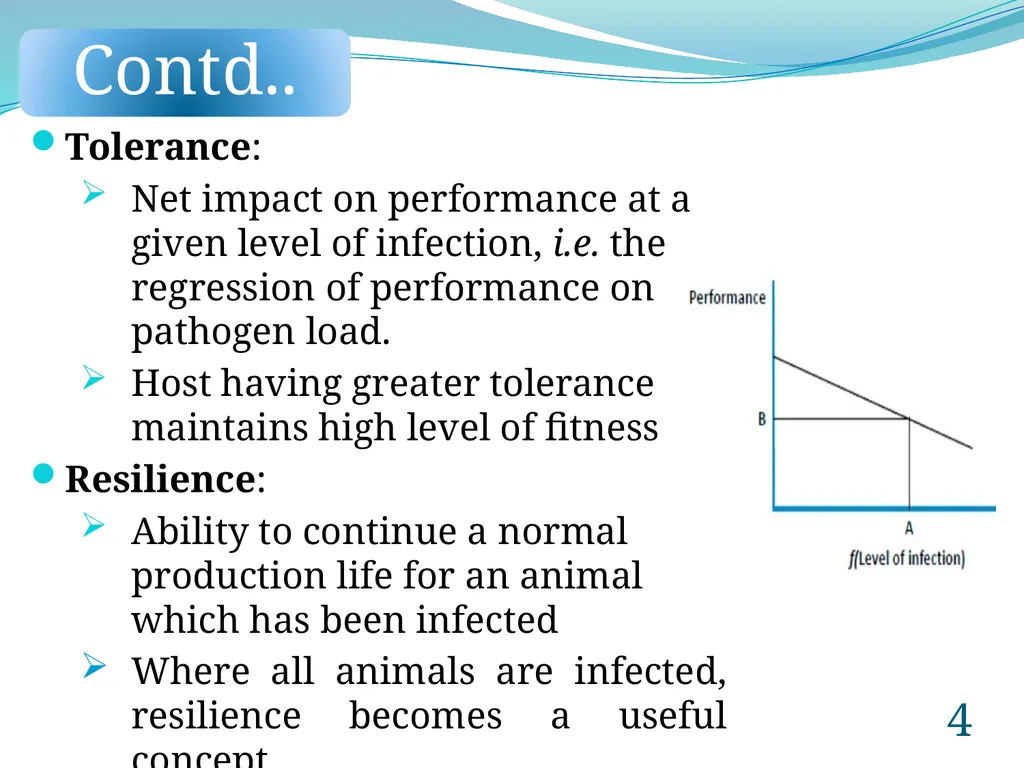
Tolerance:
Net impact on performance at a given level of infection, i.e. the regression of performance on pathogen load.
Host having greater tolerance maintains high level of fitness
Resilience:
Ability to continue a normal production life for an animal which has been infected
Where all animals are infected, resilience becomes a useful concept. 4<br>
05
Breeding for resistance or tolerance?
Enhance animal health but have potentially different effect on the prevalence of infection.
Breeding for tolerance would not necessarily affect the pathogen.
Breeding for resistance would reduce disease transmission possibly by imposing selection pressure upon the pathogen.
Therefore, breeding animals tolerant to a disease would be disadvantageous when the aim is to reduce the transmission of infection. 5<br>
06
Host resistance to certain pathogen or disease mainly manifested through the variability in host immune responses to infection
Therefore, there is possibility to improve genetic resistance to most diseases however, ascertaining resistance phenotypes under field conditions is still challenging 6<br>
07
Genetic resistance is permanent and cumulative resistance to a particular disease.
Disease resistance – multi-factorial (polygenic) – No absolute resistance.
Selection for genetic resistance - in conjunction with other disease control measures to reduce the size of challenges or to assist in treating existing infections / infestations. 7<br>
08
In cases where the gene(s) controlling expression of an affected phenotype has been identified, reduction in the frequency of affected animals can be done through selection to increase the frequency of the desirable phenotype in the population.
In cases where genetic cause has not been identified, culling affected animals and their relatives may be effective, but the success depends on the disease incidence, and progress will become slower as the incidence falls. 8<br>
09
Selective breeding (response) - heritability of the trait associated with disease resistance + variation among the animals.
The direct selection - Individual or family selection in normal as well as in challenged environment is ideal selection strategy for detection of genetic variation.
This is one of the simplest method, applied to various diseases like Marek’s disease, New Castel disease etc.
However, this classical selection approach incurs high cost, large infrastructure as well as time. 9<br>
10
Finding direct markers for disease resistance is tough and thereby alternate way is to look for the markers that are non-pathological, easy to detect and are associated with disease.
Such markers are,
Observables or Phenotypic markers
Genetic markers
Transgenesis 10<br>
11
Skin, hair, mucous membranes, secretions like tears, urine, ruminal content, saliva, mucous, skin secretions, etc.
Variation between the hosts in such secretions may be associated with certain pathological conditions.
Other such markers are faecal egg count of GI tract parasites, Tick count on body tick infection, somatic cell count of milk mastitis, Ig response in case of certain poultry diseases etc. 11<br>
12
Sequencing of genomes have led to discovery of several genetic markers and even genes related to the immune system.
Immune responsiveness would be an useful indicator of disease resistance in cattle. (Hernandez et al. 2003)
Various genetic markers; microsatellites, SSCP, RFLPs, RAPDs, and AFLPs have been utilised to select animals for resistance against specific infectious diseases.
The resistant animals are selected based on the marker allele linked to the trait. 12<br>
13
Disease resistance - detecting variance in the speed of epidemic development among groups - requires huge data and “replicated” epidemics for computation.
Measuring of resistance phenotypes, is costly and difficult.
Treatment with antibiotics is choice but carry the risk for emergence of resistant pathogens. 13<br>
14
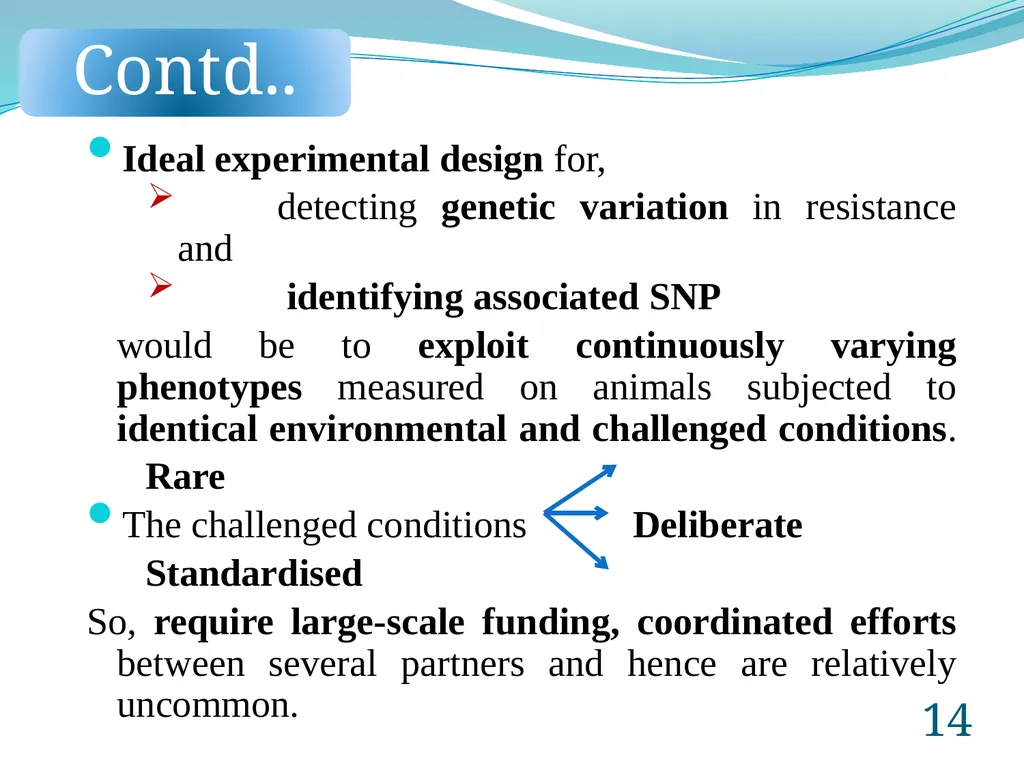
Ideal experimental design for,
detecting genetic variation in resistance and
identifying associated SNP
would be to exploit continuously varying phenotypes measured on animals subjected to identical environmental and challenged conditions.
Rare
The challenged conditions Deliberate
Standardised
So, require large-scale funding, coordinated efforts between several partners and hence are relatively uncommon. 14<br>
15
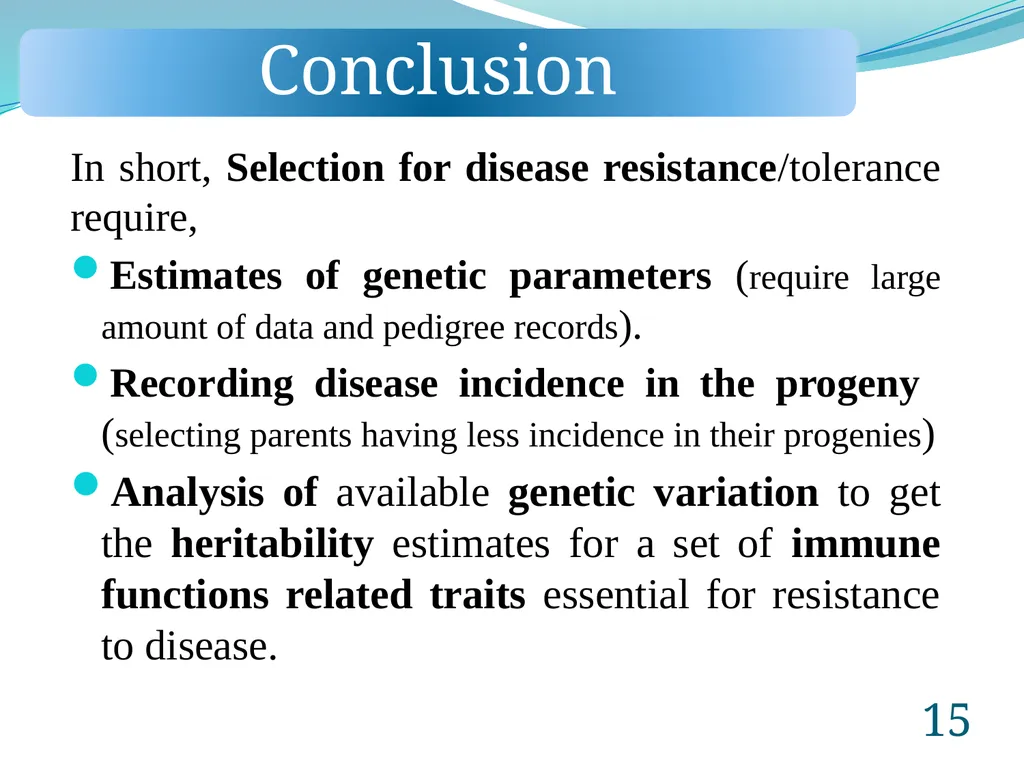
In short, Selection for disease resistance/tolerance require,
Estimates of genetic parameters (require large amount of data and pedigree records).
Recording disease incidence in the progeny (selecting parents having less incidence in their progenies)
Analysis of available genetic variation to get the heritability estimates for a set of immune functions related traits essential for resistance to disease. 15<br>
16
16 Thanks! Any questions?
You can find me at:
@JP_AAtrey
jp.prakash01@gmail.com<br>