
Introduction to Change Management October 2023
EM
Published · 32 slides · 0 views

1 / 1
Description
Introduction to Change Management October 2023 Department of Clinical Informatics providencehealthcare.org Agenda 2 Clinical Informatics Competencies related to Change Management 3 Learning Objectives Describe Infoways CM framework for
Related Topics
Share
Embed code
Download this presentation From Below
"Introduction to Change Management October 2023" is the property of its rightful owner. Permission is granted to download and print the materials on this website for personal, non-commercial use only, and to display it on your personal computer provided you do not modify the materials and that you retain all copyright notices contained in the materials. By downloading content from our website, you accept the terms of this agreement.
Presentation Transcript
01
Introduction to
Change Management October 2023 Department of Clinical Informatics | providencehealthcare.org<br>
02
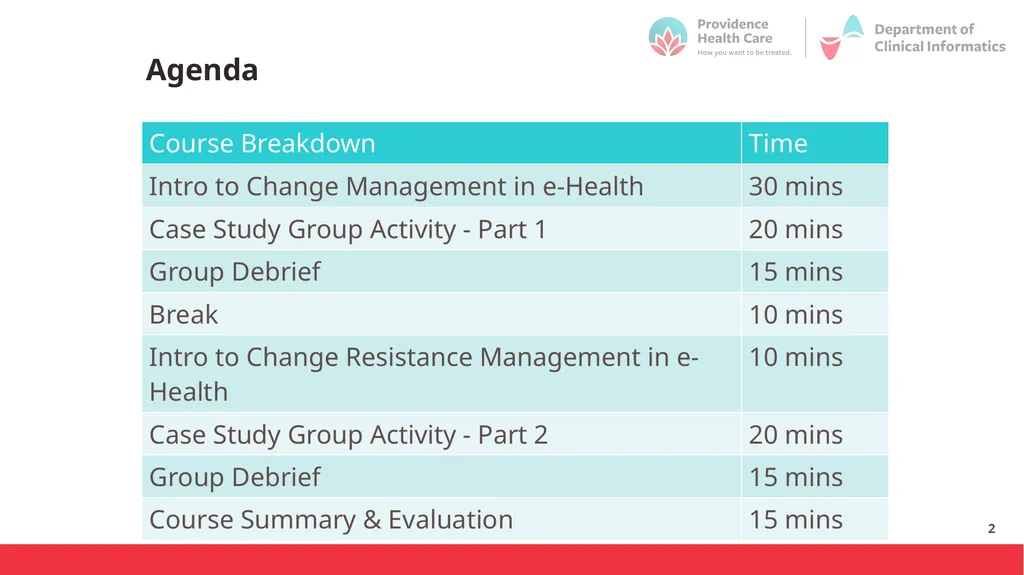
Agenda 2<br>
03
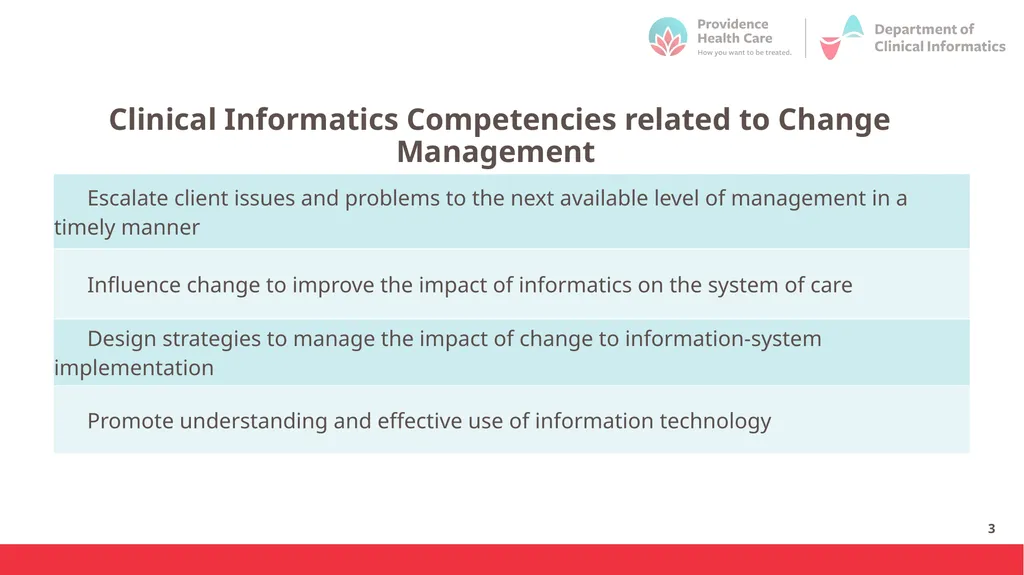
Clinical Informatics Competencies related to Change Management 3<br>
04
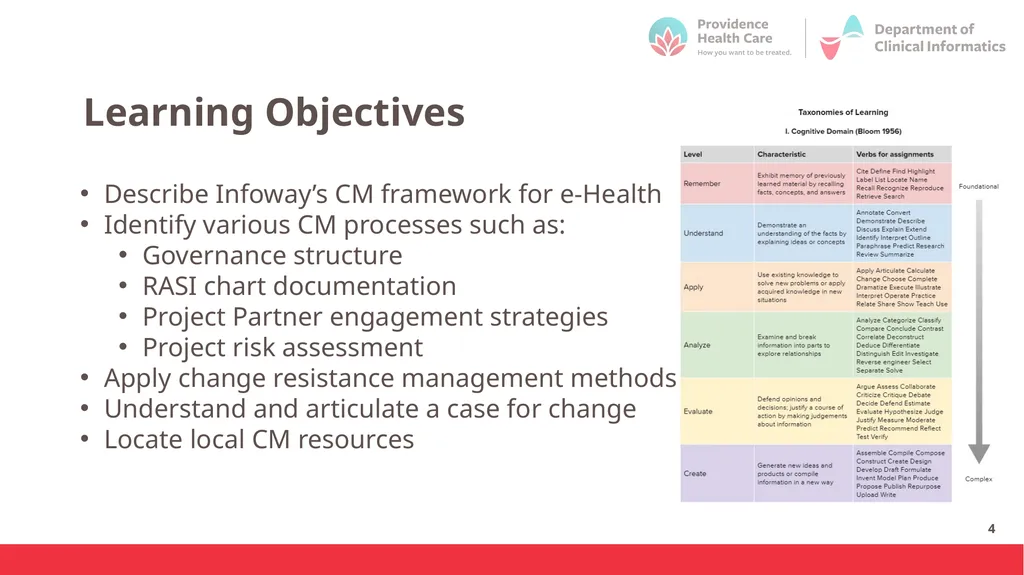
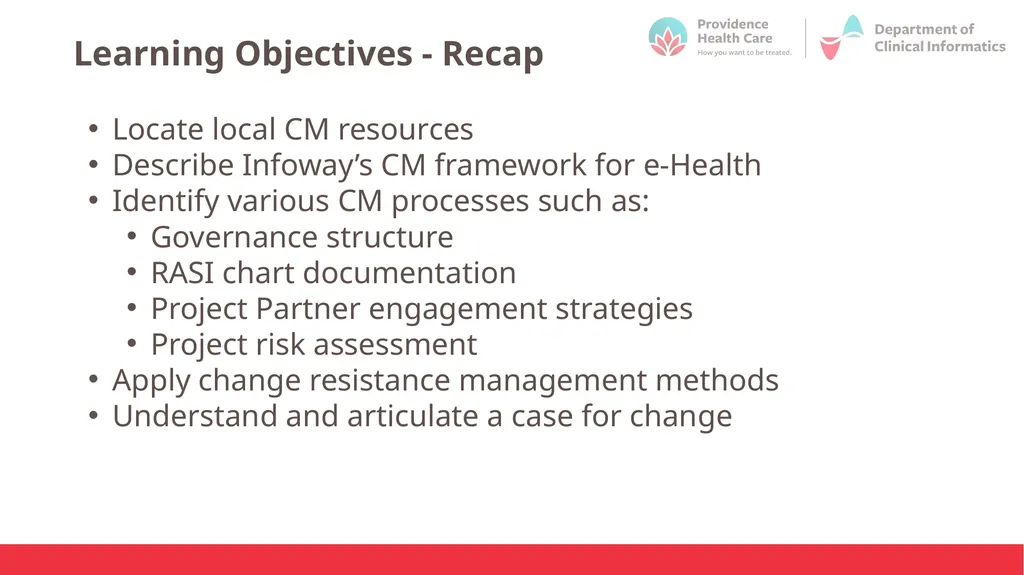
Learning Objectives Describe Infoway’s CM framework for e-Health
Identify various CM processes such as:
Governance structure
RASI chart documentation
Project Partner engagement strategies
Project risk assessment
Apply change resistance management methods
Understand and articulate a case for change
Locate local CM resources 4<br>
Identify various CM processes such as:
Governance structure
RASI chart documentation
Project Partner engagement strategies
Project risk assessment
Apply change resistance management methods
Understand and articulate a case for change
Locate local CM resources 4<br>
05
Intro to Change Management Frameworks<br>
06
Change Management (CM) is the application of a structured process and set of tools for leading the people side of change to achieve a desired outcome
(Prosci Management, 2023)
Why is CM Important?
Literature has identified that poorly managed change can result in negative consequences including:
employee turnover, lower productivity, change resistance, cancellation/delays of projects; slow or non-adoption of new processes, and little or negative return on investment (CHI, 2013).
Failed organizational change tends to occur for several reasons, including: absence of a change champion; poor executive sponsorship; poor project management skills; poorly defined organizational objectives (CHI, 2013). 6 Change Management<br>
Why is CM Important?
Literature has identified that poorly managed change can result in negative consequences including:
employee turnover, lower productivity, change resistance, cancellation/delays of projects; slow or non-adoption of new processes, and little or negative return on investment (CHI, 2013).
Failed organizational change tends to occur for several reasons, including: absence of a change champion; poor executive sponsorship; poor project management skills; poorly defined organizational objectives (CHI, 2013). 6 Change Management<br>
07
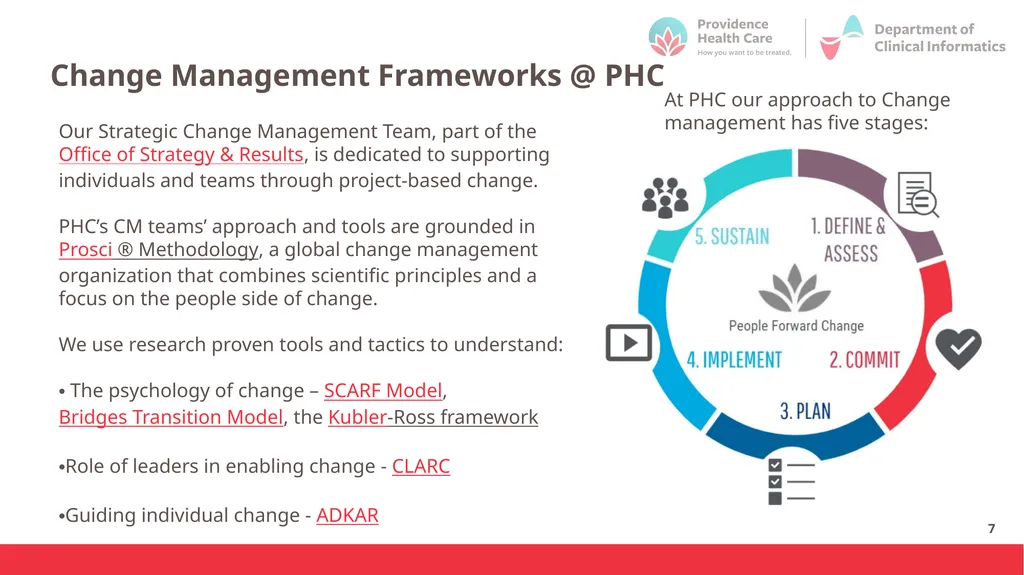
7 Change Management Frameworks @ PHC Our Strategic Change Management Team, part of the Office of Strategy & Results, is dedicated to supporting individuals and teams through project-based change.
PHC’s CM teams’ approach and tools are grounded in Prosci ® Methodology, a global change management organization that combines scientific principles and a focus on the people side of change.
We use research proven tools and tactics to understand:
The psychology of change – SCARF Model, Bridges Transition Model, the Kubler-Ross framework
Role of leaders in enabling change - CLARC
Guiding individual change - ADKAR At PHC our approach to Change management has five stages: <br>
PHC’s CM teams’ approach and tools are grounded in Prosci ® Methodology, a global change management organization that combines scientific principles and a focus on the people side of change.
We use research proven tools and tactics to understand:
The psychology of change – SCARF Model, Bridges Transition Model, the Kubler-Ross framework
Role of leaders in enabling change - CLARC
Guiding individual change - ADKAR At PHC our approach to Change management has five stages: <br>
08
8 Canada Health Infoway’s Change
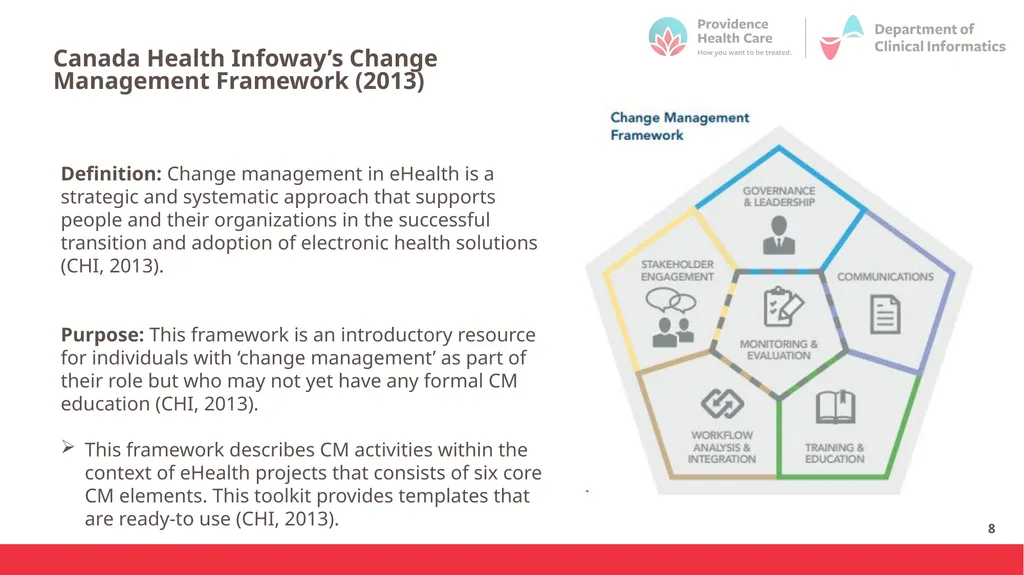
Management Framework (2013) Definition: Change management in eHealth is a strategic and systematic approach that supports people and their organizations in the successful transition and adoption of electronic health solutions (CHI, 2013).
Purpose: This framework is an introductory resource for individuals with ‘change management’ as part of their role but who may not yet have any formal CM education (CHI, 2013).
This framework describes CM activities within the context of eHealth projects that consists of six core CM elements. This toolkit provides templates that are ready-to use (CHI, 2013).<br>
Purpose: This framework is an introductory resource for individuals with ‘change management’ as part of their role but who may not yet have any formal CM education (CHI, 2013).
This framework describes CM activities within the context of eHealth projects that consists of six core CM elements. This toolkit provides templates that are ready-to use (CHI, 2013).<br>
09
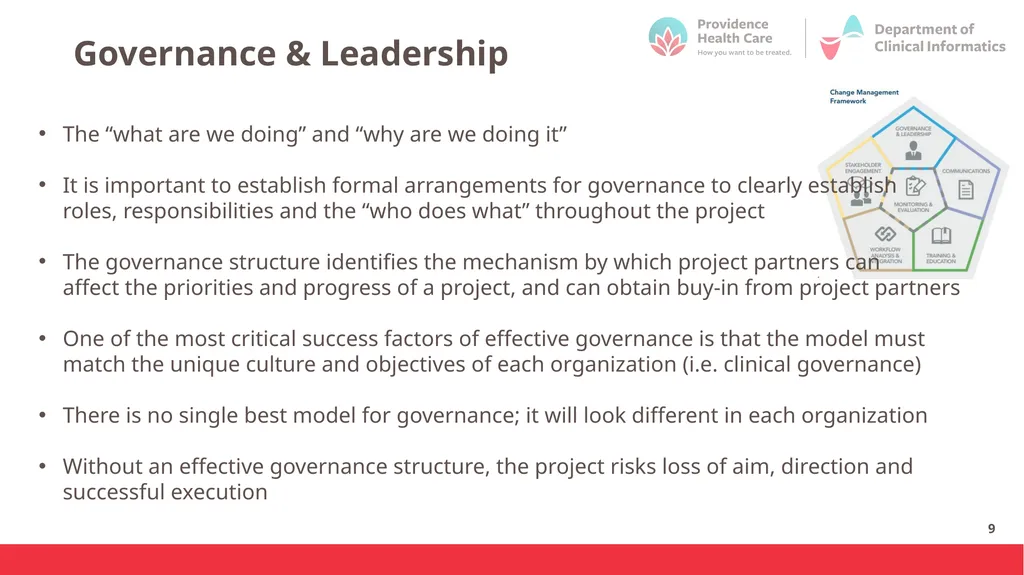
9 Governance & Leadership The “what are we doing” and “why are we doing it”
It is important to establish formal arrangements for governance to clearly establish roles, responsibilities and the “who does what” throughout the project
The governance structure identifies the mechanism by which project partners can affect the priorities and progress of a project, and can obtain buy-in from project partners
One of the most critical success factors of effective governance is that the model must match the unique culture and objectives of each organization (i.e. clinical governance)
There is no single best model for governance; it will look different in each organization
Without an effective governance structure, the project risks loss of aim, direction and successful execution<br>
It is important to establish formal arrangements for governance to clearly establish roles, responsibilities and the “who does what” throughout the project
The governance structure identifies the mechanism by which project partners can affect the priorities and progress of a project, and can obtain buy-in from project partners
One of the most critical success factors of effective governance is that the model must match the unique culture and objectives of each organization (i.e. clinical governance)
There is no single best model for governance; it will look different in each organization
Without an effective governance structure, the project risks loss of aim, direction and successful execution<br>
10
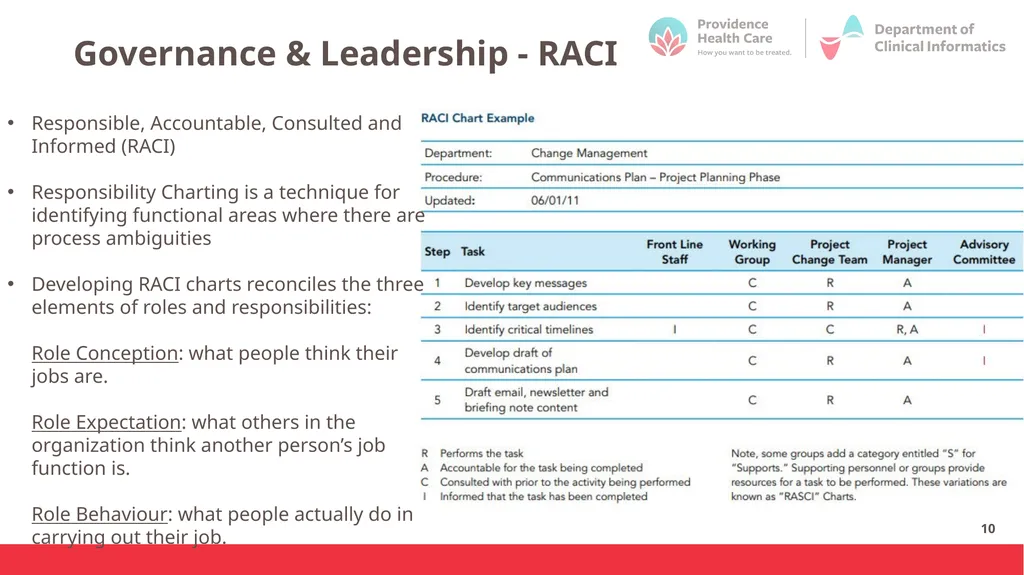
10 Responsible, Accountable, Consulted and Informed (RACI)
Responsibility Charting is a technique for identifying functional areas where there are process ambiguities
Developing RACI charts reconciles the three elements of roles and responsibilities: Role Conception: what people think their jobs are. Role Expectation: what others in the organization think another person’s job function is. Role Behaviour: what people actually do in carrying out their job. Governance & Leadership - RACI<br>
Responsibility Charting is a technique for identifying functional areas where there are process ambiguities
Developing RACI charts reconciles the three elements of roles and responsibilities: Role Conception: what people think their jobs are. Role Expectation: what others in the organization think another person’s job function is. Role Behaviour: what people actually do in carrying out their job. Governance & Leadership - RACI<br>
11
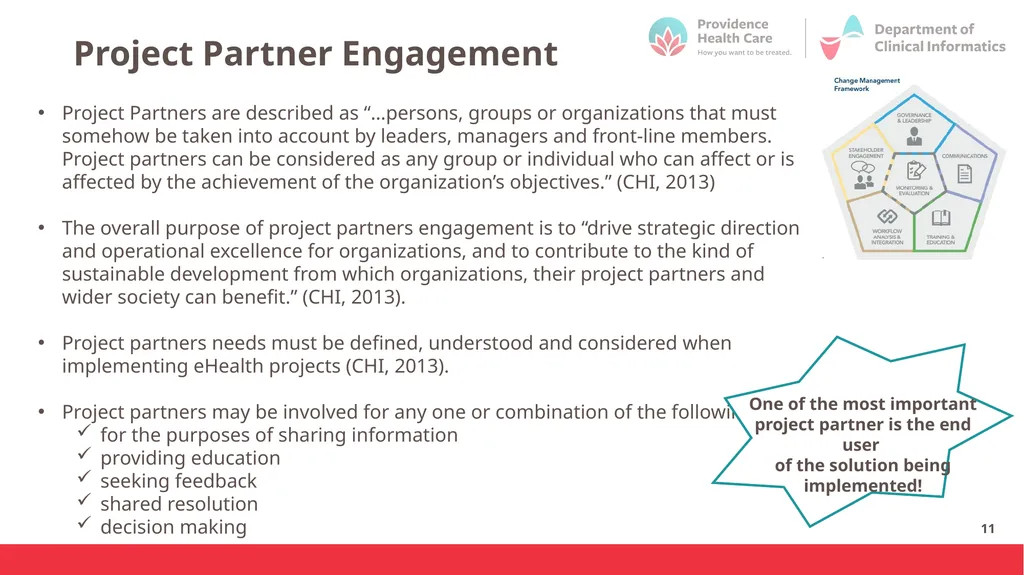
11 Project Partners are described as “…persons, groups or organizations that must somehow be taken into account by leaders, managers and front-line members. Project partners can be considered as any group or individual who can affect or is affected by the achievement of the organization’s objectives.” (CHI, 2013)
The overall purpose of project partners engagement is to “drive strategic direction and operational excellence for organizations, and to contribute to the kind of sustainable development from which organizations, their project partners and wider society can benefit.” (CHI, 2013).
Project partners needs must be defined, understood and considered when implementing eHealth projects (CHI, 2013).
Project partners may be involved for any one or combination of the following:
for the purposes of sharing information
providing education
seeking feedback
shared resolution
decision making Project Partner Engagement<br>
The overall purpose of project partners engagement is to “drive strategic direction and operational excellence for organizations, and to contribute to the kind of sustainable development from which organizations, their project partners and wider society can benefit.” (CHI, 2013).
Project partners needs must be defined, understood and considered when implementing eHealth projects (CHI, 2013).
Project partners may be involved for any one or combination of the following:
for the purposes of sharing information
providing education
seeking feedback
shared resolution
decision making Project Partner Engagement<br>
12
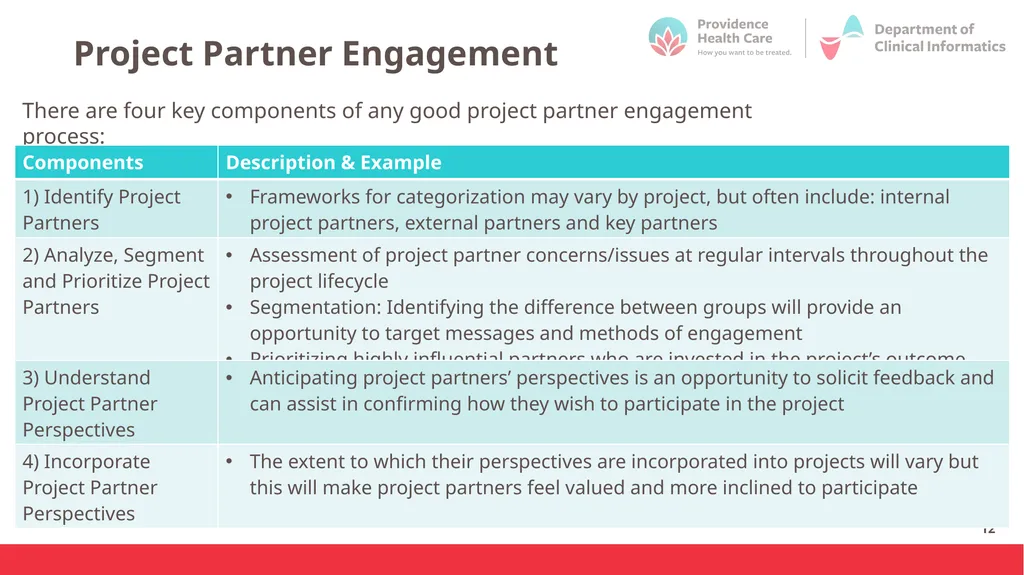
12 There are four key components of any good project partner engagement process: Project Partner Engagement<br>
13
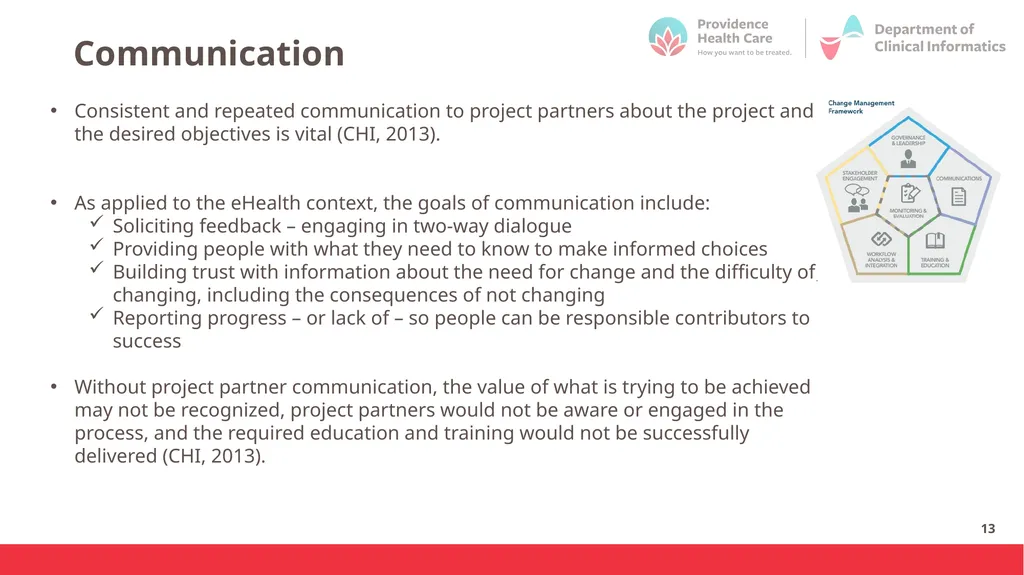
13 Consistent and repeated communication to project partners about the project and the desired objectives is vital (CHI, 2013).
As applied to the eHealth context, the goals of communication include:
Soliciting feedback – engaging in two-way dialogue
Providing people with what they need to know to make informed choices
Building trust with information about the need for change and the difficulty of changing, including the consequences of not changing
Reporting progress – or lack of – so people can be responsible contributors to success
Without project partner communication, the value of what is trying to be achieved may not be recognized, project partners would not be aware or engaged in the process, and the required education and training would not be successfully delivered (CHI, 2013). Communication<br>
As applied to the eHealth context, the goals of communication include:
Soliciting feedback – engaging in two-way dialogue
Providing people with what they need to know to make informed choices
Building trust with information about the need for change and the difficulty of changing, including the consequences of not changing
Reporting progress – or lack of – so people can be responsible contributors to success
Without project partner communication, the value of what is trying to be achieved may not be recognized, project partners would not be aware or engaged in the process, and the required education and training would not be successfully delivered (CHI, 2013). Communication<br>
14
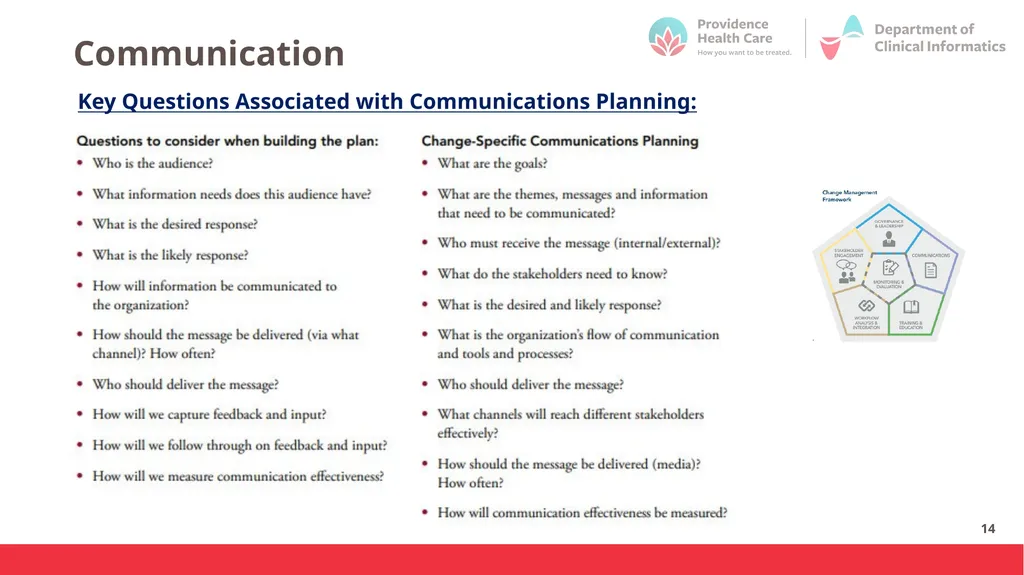
14 Communication Key Questions Associated with Communications Planning:<br>
15
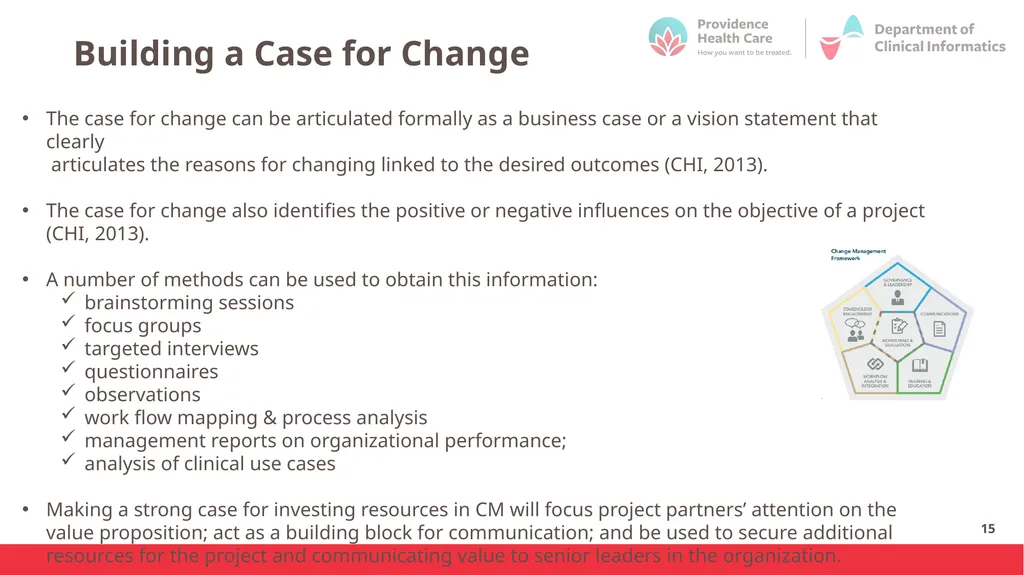
15 The case for change can be articulated formally as a business case or a vision statement that clearly
articulates the reasons for changing linked to the desired outcomes (CHI, 2013).
The case for change also identifies the positive or negative influences on the objective of a project (CHI, 2013).
A number of methods can be used to obtain this information:
brainstorming sessions
focus groups
targeted interviews
questionnaires
observations
work flow mapping & process analysis
management reports on organizational performance;
analysis of clinical use cases
Making a strong case for investing resources in CM will focus project partners’ attention on the value proposition; act as a building block for communication; and be used to secure additional resources for the project and communicating value to senior leaders in the organization. Building a Case for Change<br>
The case for change also identifies the positive or negative influences on the objective of a project (CHI, 2013).
A number of methods can be used to obtain this information:
brainstorming sessions
focus groups
targeted interviews
questionnaires
observations
work flow mapping & process analysis
management reports on organizational performance;
analysis of clinical use cases
Making a strong case for investing resources in CM will focus project partners’ attention on the value proposition; act as a building block for communication; and be used to secure additional resources for the project and communicating value to senior leaders in the organization. Building a Case for Change<br>
16
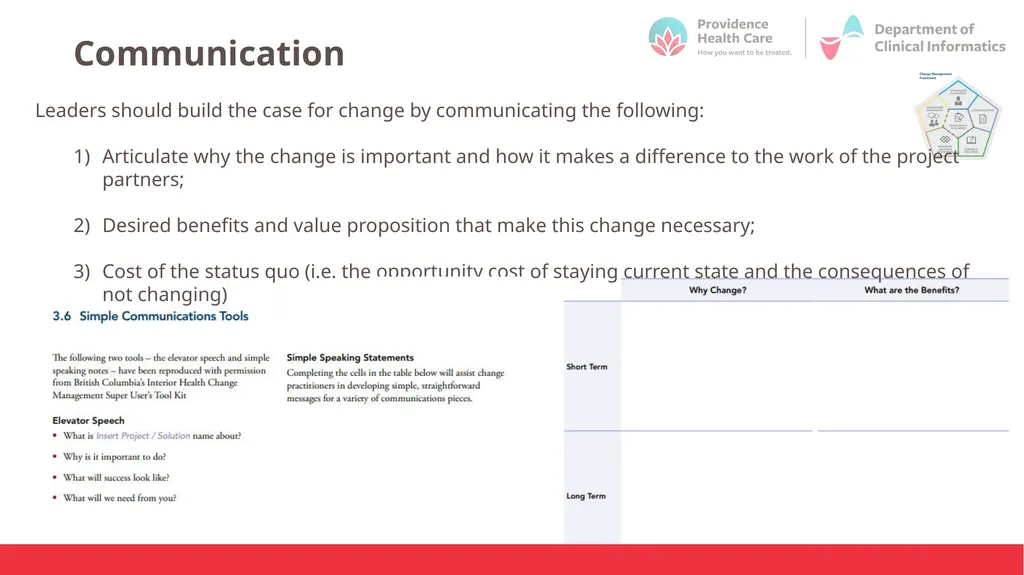
16 Leaders should build the case for change by communicating the following:
Articulate why the change is important and how it makes a difference to the work of the project partners;
Desired benefits and value proposition that make this change necessary;
Cost of the status quo (i.e. the opportunity cost of staying current state and the consequences of not changing) Communication<br>
Articulate why the change is important and how it makes a difference to the work of the project partners;
Desired benefits and value proposition that make this change necessary;
Cost of the status quo (i.e. the opportunity cost of staying current state and the consequences of not changing) Communication<br>
17
Group Question:
What are interdisciplinary care plans (IPOC)?
How are these used today, and how do they impact clinical care?<br>
18
PowerChart IPOC:
https://www.youtube.com/watch?v=3mbMI6SHtWI<br>
19
Case Study - Part 1<br>
20
Group Discussion - Part 1<br>
21
10 min Break<br>
22
Intro to Change Resistance
Management in e-Health<br>
23
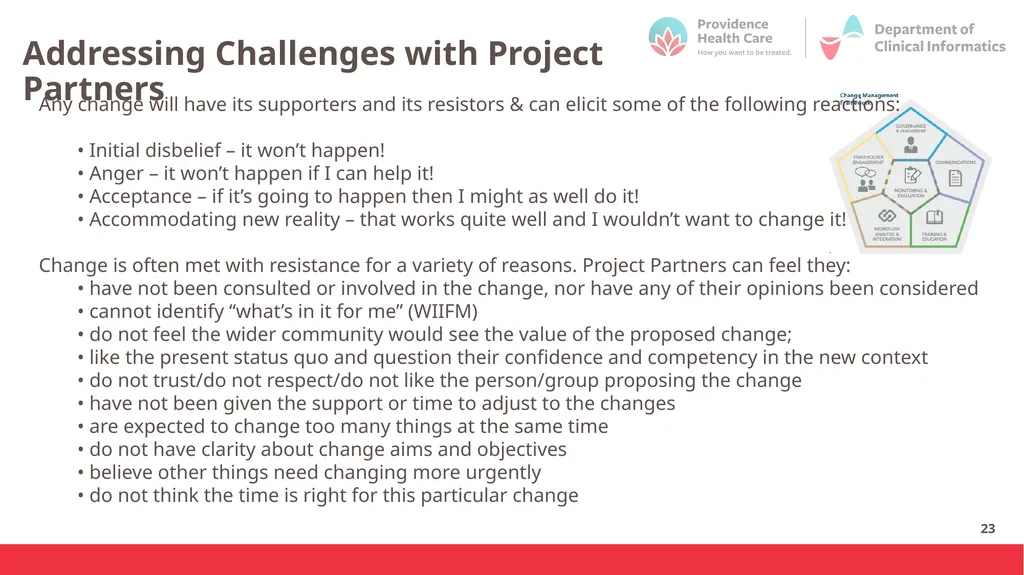
23 Any change will have its supporters and its resistors & can elicit some of the following reactions:
• Initial disbelief – it won’t happen!
• Anger – it won’t happen if I can help it!
• Acceptance – if it’s going to happen then I might as well do it!
• Accommodating new reality – that works quite well and I wouldn’t want to change it!
Change is often met with resistance for a variety of reasons. Project Partners can feel they:
• have not been consulted or involved in the change, nor have any of their opinions been considered
• cannot identify “what’s in it for me” (WIIFM)
• do not feel the wider community would see the value of the proposed change;
• like the present status quo and question their confidence and competency in the new context
• do not trust/do not respect/do not like the person/group proposing the change
• have not been given the support or time to adjust to the changes
• are expected to change too many things at the same time
• do not have clarity about change aims and objectives
• believe other things need changing more urgently
• do not think the time is right for this particular change Addressing Challenges with Project Partners<br>
• Initial disbelief – it won’t happen!
• Anger – it won’t happen if I can help it!
• Acceptance – if it’s going to happen then I might as well do it!
• Accommodating new reality – that works quite well and I wouldn’t want to change it!
Change is often met with resistance for a variety of reasons. Project Partners can feel they:
• have not been consulted or involved in the change, nor have any of their opinions been considered
• cannot identify “what’s in it for me” (WIIFM)
• do not feel the wider community would see the value of the proposed change;
• like the present status quo and question their confidence and competency in the new context
• do not trust/do not respect/do not like the person/group proposing the change
• have not been given the support or time to adjust to the changes
• are expected to change too many things at the same time
• do not have clarity about change aims and objectives
• believe other things need changing more urgently
• do not think the time is right for this particular change Addressing Challenges with Project Partners<br>
24
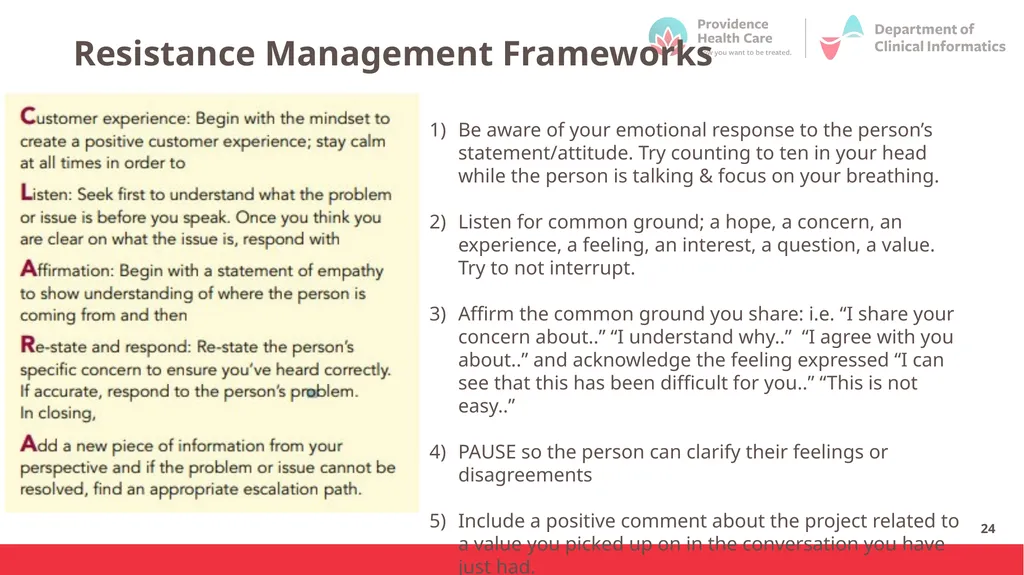
24 Be aware of your emotional response to the person’s statement/attitude. Try counting to ten in your head while the person is talking & focus on your breathing.
Listen for common ground; a hope, a concern, an experience, a feeling, an interest, a question, a value. Try to not interrupt.
Affirm the common ground you share: i.e. “I share your concern about..” “I understand why..” “I agree with you about..” and acknowledge the feeling expressed “I can see that this has been difficult for you..” “This is not easy..”
PAUSE so the person can clarify their feelings or disagreements
Include a positive comment about the project related to a value you picked up on in the conversation you have just had. Resistance Management Frameworks<br>
Listen for common ground; a hope, a concern, an experience, a feeling, an interest, a question, a value. Try to not interrupt.
Affirm the common ground you share: i.e. “I share your concern about..” “I understand why..” “I agree with you about..” and acknowledge the feeling expressed “I can see that this has been difficult for you..” “This is not easy..”
PAUSE so the person can clarify their feelings or disagreements
Include a positive comment about the project related to a value you picked up on in the conversation you have just had. Resistance Management Frameworks<br>
25
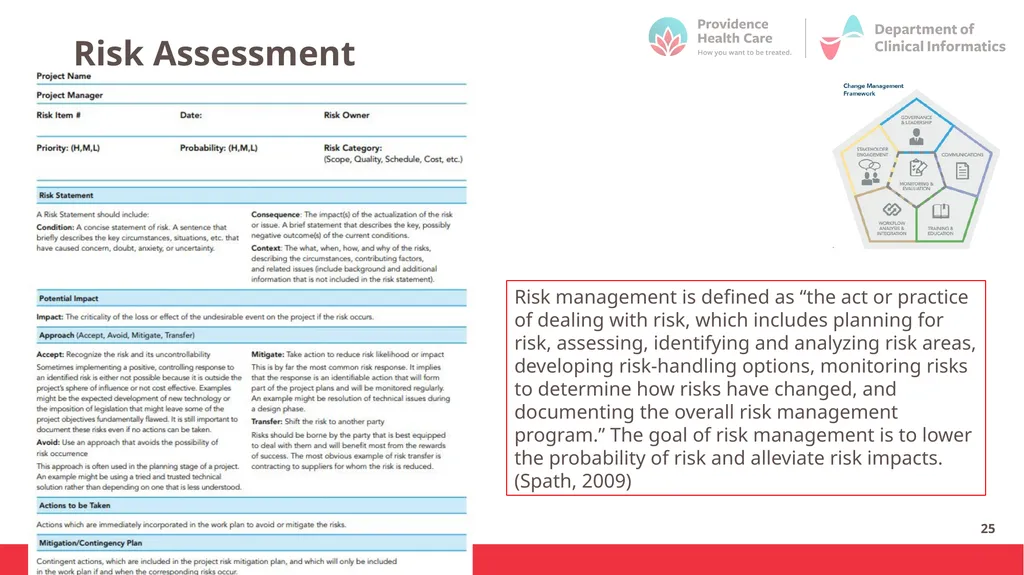
14 June 2024 25 Risk management is defined as “the act or practice of dealing with risk, which includes planning for risk, assessing, identifying and analyzing risk areas, developing risk-handling options, monitoring risks to determine how risks have changed, and documenting the overall risk management program.” The goal of risk management is to lower the probability of risk and alleviate risk impacts. (Spath, 2009) Risk Assessment<br>
26
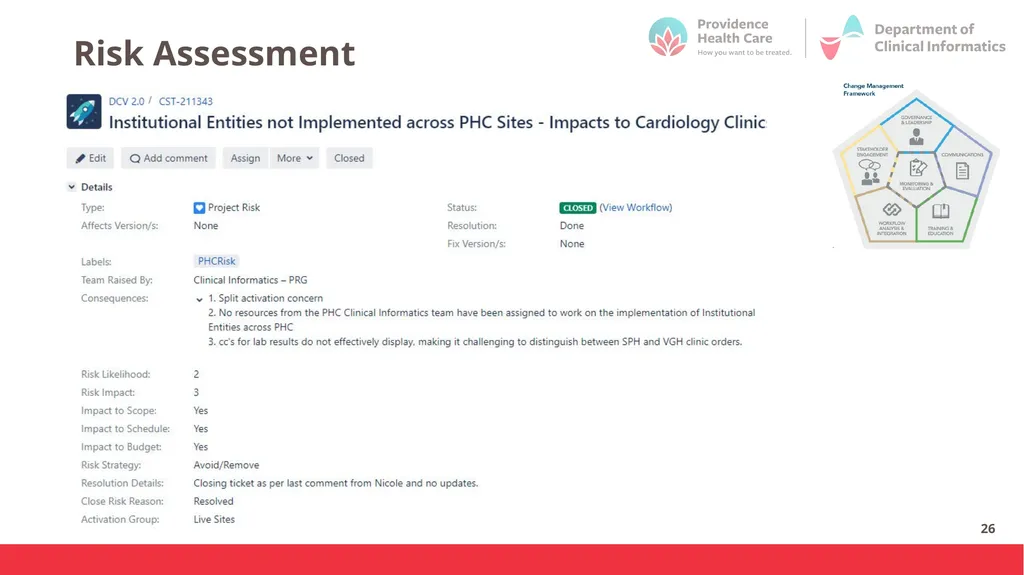
26 Risk Assessment<br>
27
Case Study - Part 2<br>
28
Group Discussion - Part 2<br>
29
Locate local CM resources
Describe Infoway’s CM framework for e-Health
Identify various CM processes such as:
Governance structure
RASI chart documentation
Project Partner engagement strategies
Project risk assessment
Apply change resistance management methods
Understand and articulate a case for change Learning Objectives - Recap<br>
Describe Infoway’s CM framework for e-Health
Identify various CM processes such as:
Governance structure
RASI chart documentation
Project Partner engagement strategies
Project risk assessment
Apply change resistance management methods
Understand and articulate a case for change Learning Objectives - Recap<br>
30
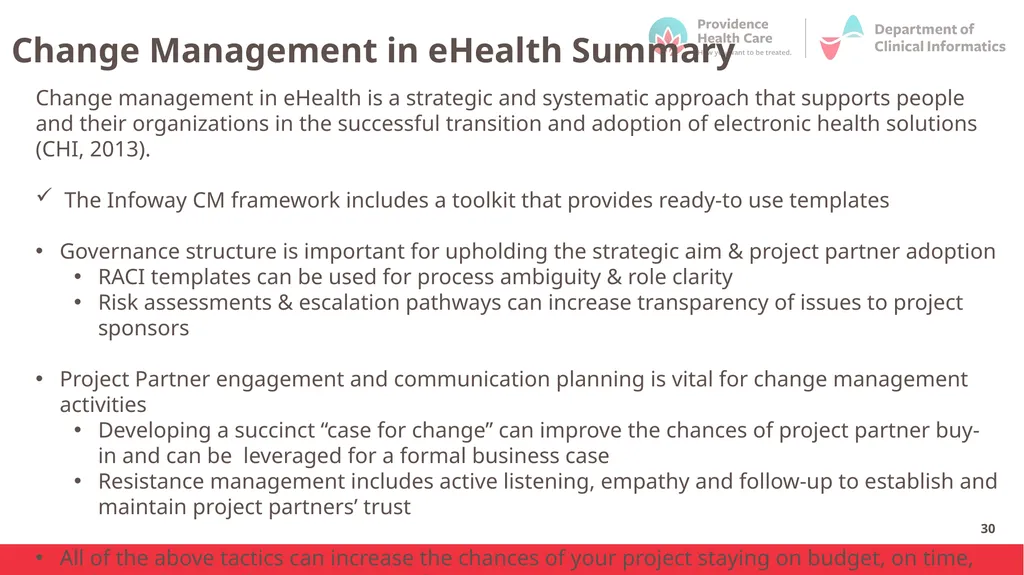
30 Change management in eHealth is a strategic and systematic approach that supports people and their organizations in the successful transition and adoption of electronic health solutions (CHI, 2013).
The Infoway CM framework includes a toolkit that provides ready-to use templates
Governance structure is important for upholding the strategic aim & project partner adoption
RACI templates can be used for process ambiguity & role clarity
Risk assessments & escalation pathways can increase transparency of issues to project sponsors
Project Partner engagement and communication planning is vital for change management activities
Developing a succinct “case for change” can improve the chances of project partner buy-in and can be leveraged for a formal business case
Resistance management includes active listening, empathy and follow-up to establish and maintain project partners’ trust
All of the above tactics can increase the chances of your project staying on budget, on time, and provide overall positive change for your organization Change Management in eHealth Summary<br>
The Infoway CM framework includes a toolkit that provides ready-to use templates
Governance structure is important for upholding the strategic aim & project partner adoption
RACI templates can be used for process ambiguity & role clarity
Risk assessments & escalation pathways can increase transparency of issues to project sponsors
Project Partner engagement and communication planning is vital for change management activities
Developing a succinct “case for change” can improve the chances of project partner buy-in and can be leveraged for a formal business case
Resistance management includes active listening, empathy and follow-up to establish and maintain project partners’ trust
All of the above tactics can increase the chances of your project staying on budget, on time, and provide overall positive change for your organization Change Management in eHealth Summary<br>
31
Evaluation Survey<br>
32
Questions? Thank you!<br>