Introduction to Intellectual Property Right By Ashok Kumar Assistant Professor A.B.V. School of Legal Studies C.S.J.M. University, Kanpur What is Intellectual Property? Ideas, inventions, and creative expressions based on which there is a
"Introduction to Intellectual Property Right By" is the property of its rightful owner. Permission is granted to
download and print the materials on this website for personal, non-commercial use only, and to display it
on your personal computer provided you do not modify the materials and that you retain all copyright
notices contained in the materials. By downloading content from our website, you accept the terms of this
agreement.
Presentation Transcript
01
Introduction to Intellectual Property Right By
Ashok Kumar
Assistant Professor
A.B.V. School of Legal Studies
C.S.J.M. University, Kanpur<br>
02
What is Intellectual Property? Ideas, inventions, and creative expressions based on which there is a public willingness to bestow the status of property which provide certain exclusive rights to the inventors or creators of that property, in order to enable them to reap commercial benefits from their creative efforts or reputation.
or
Intellectual property (IP) refers to creations of the mind, such as inventions; literary and artistic works; designs; and symbols, names and images used in commerce.<br>
03
The Concept of Intellectual property Intellectual property, very broadly, means the legal property which results from intellectual activity in the industrial, scientific and artistic fields.
Countries have laws to protect intellectual property for two main reasons:
To give statutory expression to the moral and economic rights of creators in their creations and such rights of the public in access to those creations.
to promote, as a deliberate act of government policy, creativity and the dissemination and application of its results and to encourage fair trading which would contribute to economic and social development.
I.P. law aims at safeguarding creators and other producers of intellectual goods and services by granting them certain time- limited rights to control the use made of those productions.<br>
04
Scope of intellectual property Intellectual property rights include copyright, patent, trademark, geographic indication of origin, industrial design, trade secrets, database protection laws, publicity rights laws, laws for the protection of plant varieties, laws for the protection of semi-conductor chips (which store information for later retrieval), etc.
There is a conventional mode of classification of intellectual property as industrial property and copyrights. Industrial properties include inventions (patent), property interest on minor invention (Utility model certificate) and commercial interests (Trade Marks, trade names, geographical indications, and industrial design), plant breeder rights, biodiversity, etc.<br>
05
kinds of intellectual property Copyright
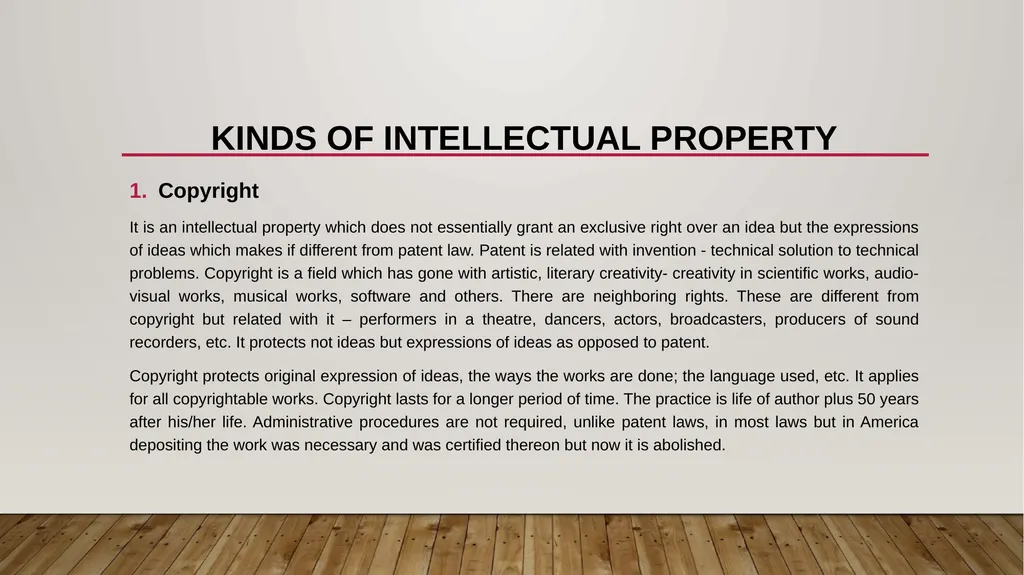
It is an intellectual property which does not essentially grant an exclusive right over an idea but the expressions of ideas which makes if different from patent law. Patent is related with invention - technical solution to technical problems. Copyright is a field which has gone with artistic, literary creativity- creativity in scientific works, audio-visual works, musical works, software and others. There are neighboring rights. These are different from copyright but related with it – performers in a theatre, dancers, actors, broadcasters, producers of sound recorders, etc. It protects not ideas but expressions of ideas as opposed to patent.
Copyright protects original expression of ideas, the ways the works are done; the language used, etc. It applies for all copyrightable works. Copyright lasts for a longer period of time. The practice is life of author plus 50 years after his/her life. Administrative procedures are not required, unlike patent laws, in most laws but in America depositing the work was necessary and was certified thereon but now it is abolished.<br>
06
Patents
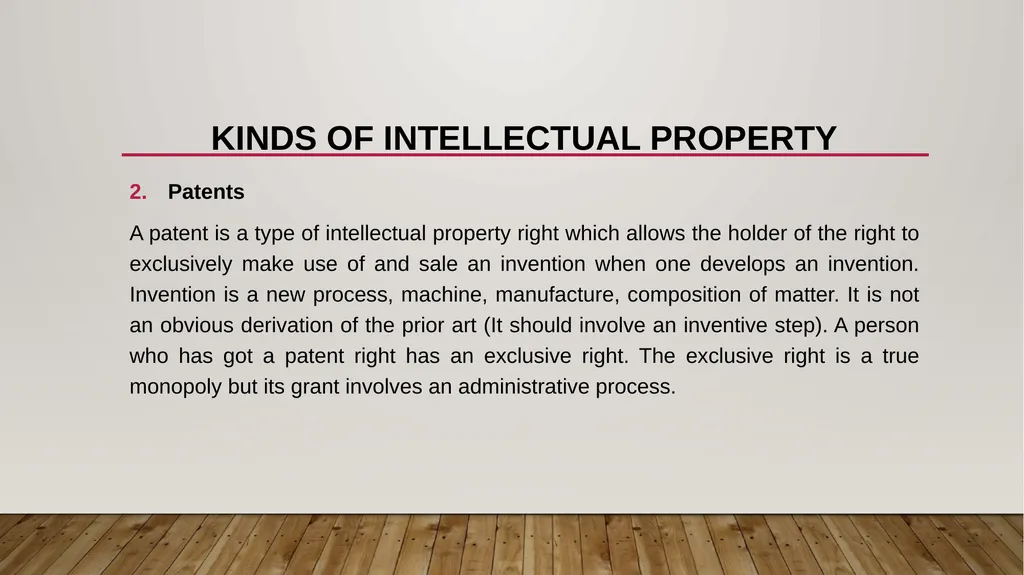
A patent is a type of intellectual property right which allows the holder of the right to exclusively make use of and sale an invention when one develops an invention. Invention is a new process, machine, manufacture, composition of matter. It is not an obvious derivation of the prior art (It should involve an inventive step). A person who has got a patent right has an exclusive right. The exclusive right is a true monopoly but its grant involves an administrative process. kinds of intellectual property<br>
07
Trademarks
It is a regime of the law giving protection to graphic representation to words or logos or depending on the jurisdiction question such as sound or smells which are distinctive in nature and serve as source identification. There is also a recent phenomenon which is representing goods in their smell and sound. It is to be found on the goods associated with them. It enables the customer to identify the goods from others. They serve as a source identifier. Trademarks perform communication function. Once there is a valid representation, it gives the mark owner an exclusive right. It begins with registration and publication of the mark. But there are exceptions which serve what trademarks registered serve which are not registered. It means they deserve protection even though they are not registered. They exist forever so long as the good with which they are associated continue to be sold. But they require renewal. kinds of intellectual property<br>
08
kinds of intellectual property Geographical Indication
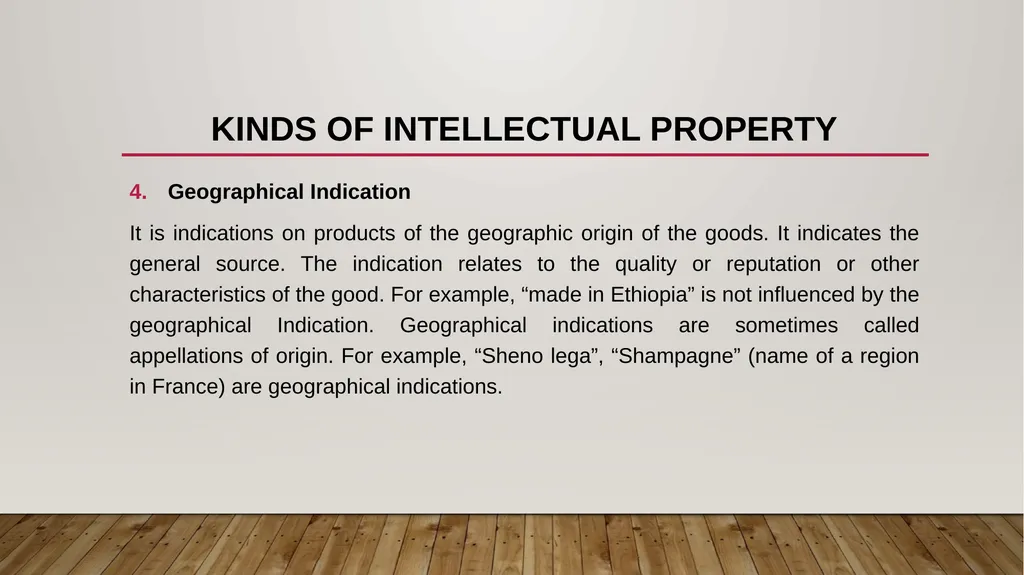
It is indications on products of the geographic origin of the goods. It indicates the general source. The indication relates to the quality or reputation or other characteristics of the good. For example, “made in Ethiopia” is not influenced by the geographical Indication. Geographical indications are sometimes called appellations of origin. For example, “Sheno lega”, “Shampagne” (name of a region in France) are geographical indications.<br>
09
Industrial Design
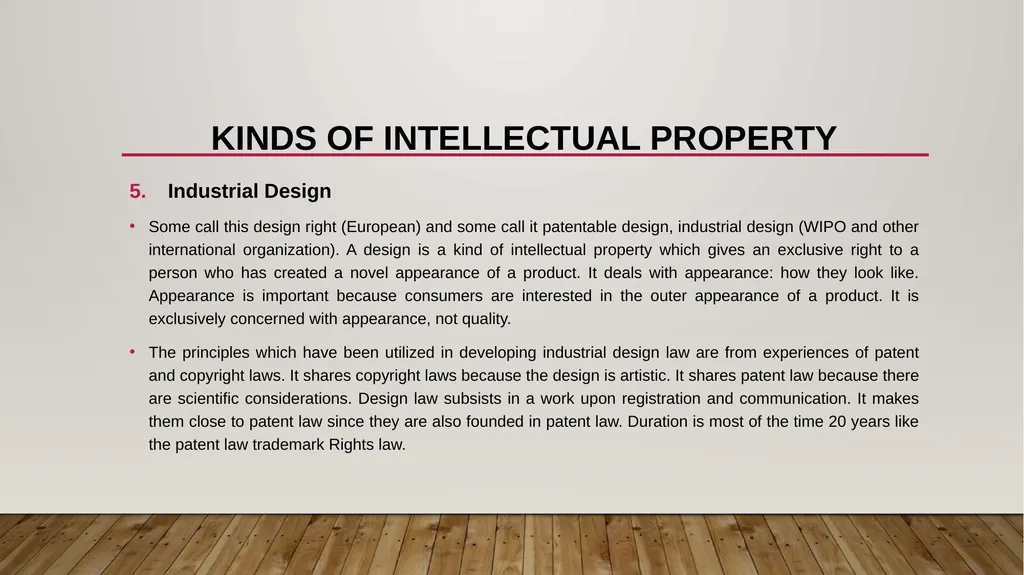
Some call this design right (European) and some call it patentable design, industrial design (WIPO and other international organization). A design is a kind of intellectual property which gives an exclusive right to a person who has created a novel appearance of a product. It deals with appearance: how they look like. Appearance is important because consumers are interested in the outer appearance of a product. It is exclusively concerned with appearance, not quality.
The principles which have been utilized in developing industrial design law are from experiences of patent and copyright laws. It shares copyright laws because the design is artistic. It shares patent law because there are scientific considerations. Design law subsists in a work upon registration and communication. It makes them close to patent law since they are also founded in patent law. Duration is most of the time 20 years like the patent law trademark Rights law. kinds of intellectual property<br>
10
Trade Secrets
It gives the owner of commercial information that provides a competitive edge the right to keep others from using such information if the information was improperly disclosed to or acquired by a competitor and the owner of the information took reasonable precautions to keep it secret. It protects confidential secrets of some commercial value. The holder of the secret wants this information to be protected; some protect the holder from an unauthorized disclosure of the information. A tort law, unfair competition or contract law can protect such information which is secret /confidential information/. The holder (owner) has to do his/her best to keep the information secret. Trade secrets exist without registration as it is to make the information public, for example, the formula of Coca Cola. Information that are protected in trade secrets can be patentable if they are novel and non obvious. But it is, most of the time, not to make the secret public. However, their full-fledged IP rights are contestable. kinds of intellectual property<br>