
Introduction to LPR 7150.2B LaRC Software
Description: Introduction to LPR 7150.2B LaRC Software Engineering Requirements Presented by Michael Madden LaRC Software Engineering Process Group (SEPG) Lead Overview Audience Course Objectives What has changed? Document Relationships Document
Related Topics
Download Presentation
"Introduction to LPR 7150.2B LaRC Software" is the property of its rightful owner. Permission is granted to download and print the materials on this website for personal, non-commercial use only, and to display it on your personal computer provided you do not modify the materials and that you retain all copyright notices contained in the materials. By downloading content from our website, you accept the terms of this agreement.
Presentation Transcript
slide1. Introduction to LPR 7150.2B
LaRC Software Engineering Requirements Presented by
Michael Madden
LaRC Software Engineering Process Group (SEPG) Lead<br>
slide2. Overview Audience
Course Objectives
What has changed?
Document Relationships
Document Structure
LPR 7150.2B In-depth: Preface
LPR 7150.2B In-depth: Chapter 1 LPR 7150.2B In-depth: Chapters 2 & 3
Project Level Roles
Software Classification
Compliance Matrix
Tailoring Approvals
Software Documents, Records, and Data
Acquisition
Project Portfolios
LPR 7150.2B In-depth: Appendix G<br>
slide3. Audience Contracting Officers and Contracting Officer Representatives
Chief Engineers
Technical Authorities for software
Branch Heads
Program and Project Leads
NASA Software Leads (an LPR 7150.2B role)
Leads for teams that develop, maintain, operate, retire, manage, acquire, or assure software<br>
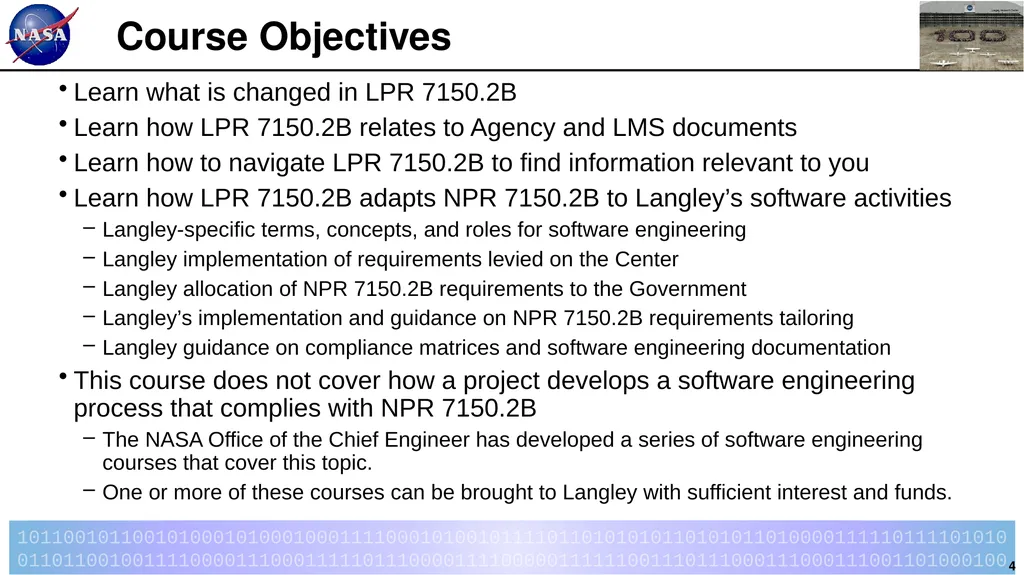
slide4. Course Objectives Learn what is changed in LPR 7150.2B
Learn how LPR 7150.2B relates to Agency and LMS documents
Learn how to navigate LPR 7150.2B to find information relevant to you
Learn how LPR 7150.2B adapts NPR 7150.2B to Langley’s software activities
Langley-specific terms, concepts, and roles for software engineering
Langley implementation of requirements levied on the Center
Langley allocation of NPR 7150.2B requirements to the Government
Langley’s implementation and guidance on NPR 7150.2B requirements tailoring
Langley guidance on compliance matrices and software engineering documentation
This course does not cover how a project develops a software engineering process that complies with NPR 7150.2B
The NASA Office of the Chief Engineer has developed a series of software engineering courses that cover this topic.
One or more of these courses can be brought to Langley with sufficient interest and funds.<br>
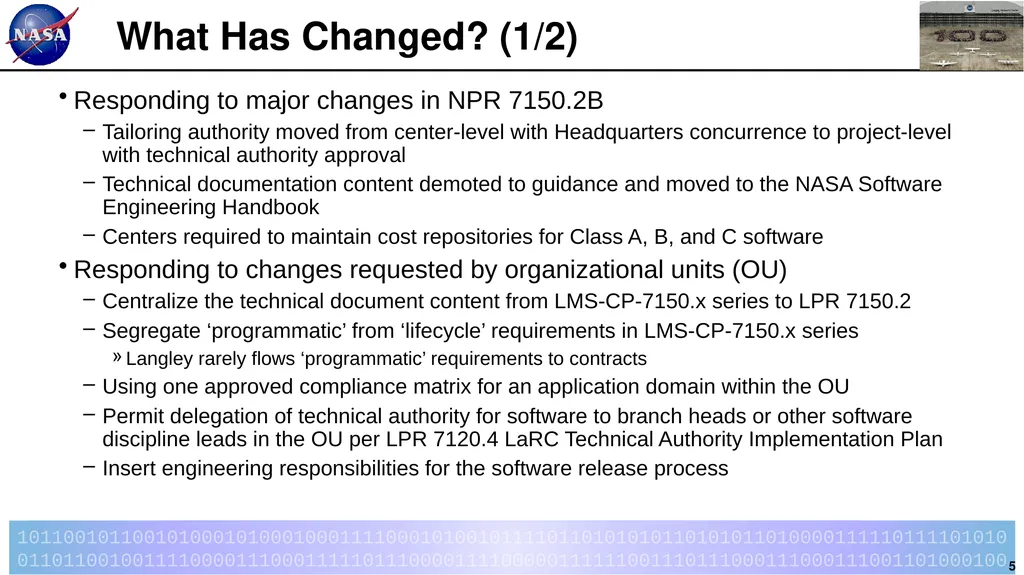
slide5. What Has Changed? (1/2) Responding to major changes in NPR 7150.2B
Tailoring authority moved from center-level with Headquarters concurrence to project-level with technical authority approval
Technical documentation content demoted to guidance and moved to the NASA Software Engineering Handbook
Centers required to maintain cost repositories for Class A, B, and C software
Responding to changes requested by organizational units (OU)
Centralize the technical document content from LMS-CP-7150.x series to LPR 7150.2
Segregate ‘programmatic’ from ‘lifecycle’ requirements in LMS-CP-7150.x series
Langley rarely flows ‘programmatic’ requirements to contracts
Using one approved compliance matrix for an application domain within the OU
Permit delegation of technical authority for software to branch heads or other software discipline leads in the OU per LPR 7120.4 LaRC Technical Authority Implementation Plan
Insert engineering responsibilities for the software release process<br>
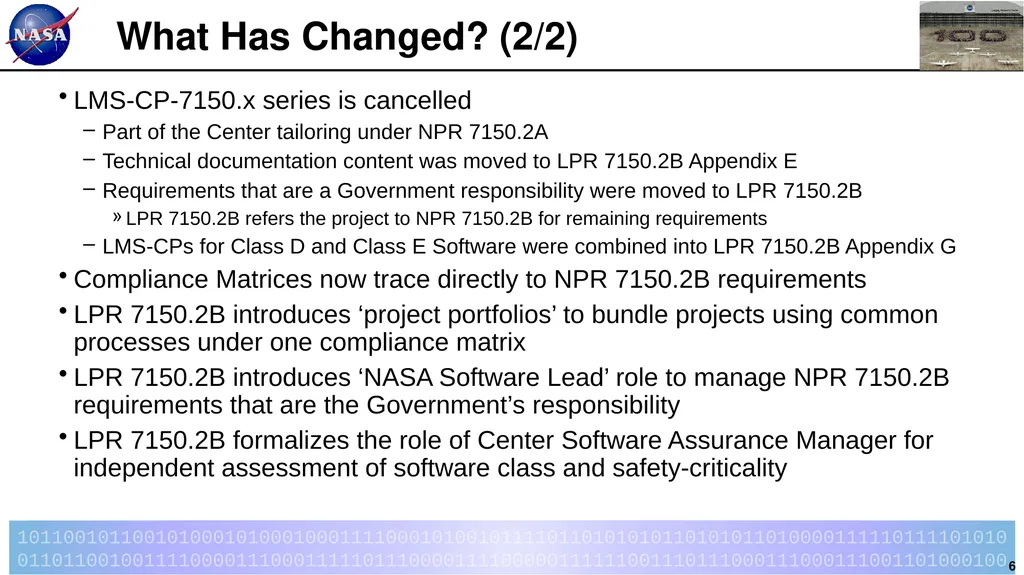
slide6. What Has Changed? (2/2) LMS-CP-7150.x series is cancelled
Part of the Center tailoring under NPR 7150.2A
Technical documentation content was moved to LPR 7150.2B Appendix E
Requirements that are a Government responsibility were moved to LPR 7150.2B
LPR 7150.2B refers the project to NPR 7150.2B for remaining requirements
LMS-CPs for Class D and Class E Software were combined into LPR 7150.2B Appendix G
Compliance Matrices now trace directly to NPR 7150.2B requirements
LPR 7150.2B introduces ‘project portfolios’ to bundle projects using common processes under one compliance matrix
LPR 7150.2B introduces ‘NASA Software Lead’ role to manage NPR 7150.2B requirements that are the Government’s responsibility
LPR 7150.2B formalizes the role of Center Software Assurance Manager for independent assessment of software class and safety-criticality<br>
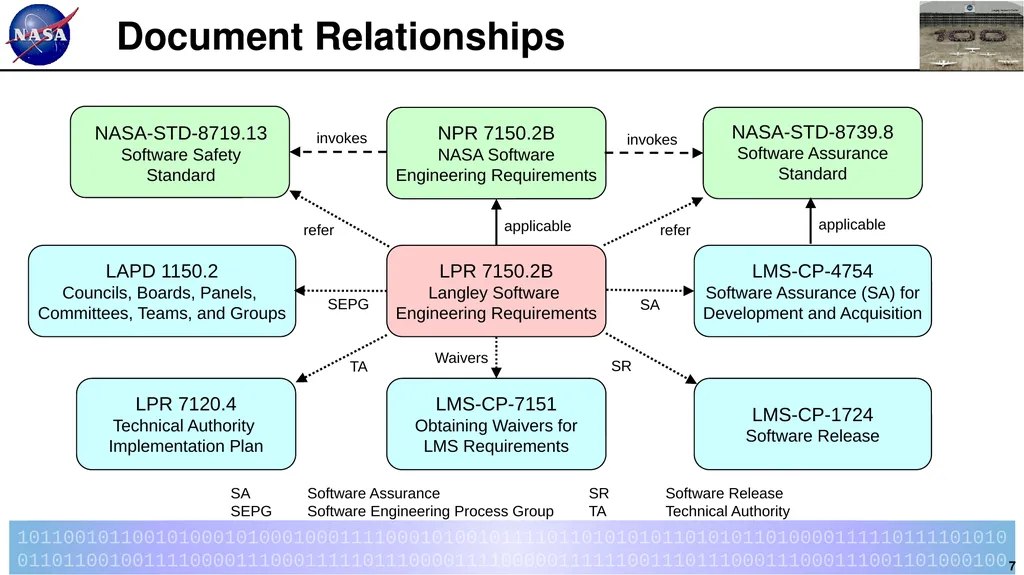
slide7. Document Relationships LPR 7150.2B
Langley Software
Engineering Requirements NPR 7150.2B NASA Software Engineering Requirements NASA-STD-8739.8
Software Assurance
Standard invokes NASA-STD-8719.13
Software Safety
Standard invokes applicable refer refer LAPD 1150.2
Councils, Boards, Panels, Committees, Teams, and Groups SEPG LPR 7120.4
Technical Authority Implementation Plan TA LMS-CP-4754 Software Assurance (SA) for Development and Acquisition applicable SA LMS-CP-1724 Software Release SR LMS-CP-7151
Obtaining Waivers for
LMS Requirements Waivers<br>
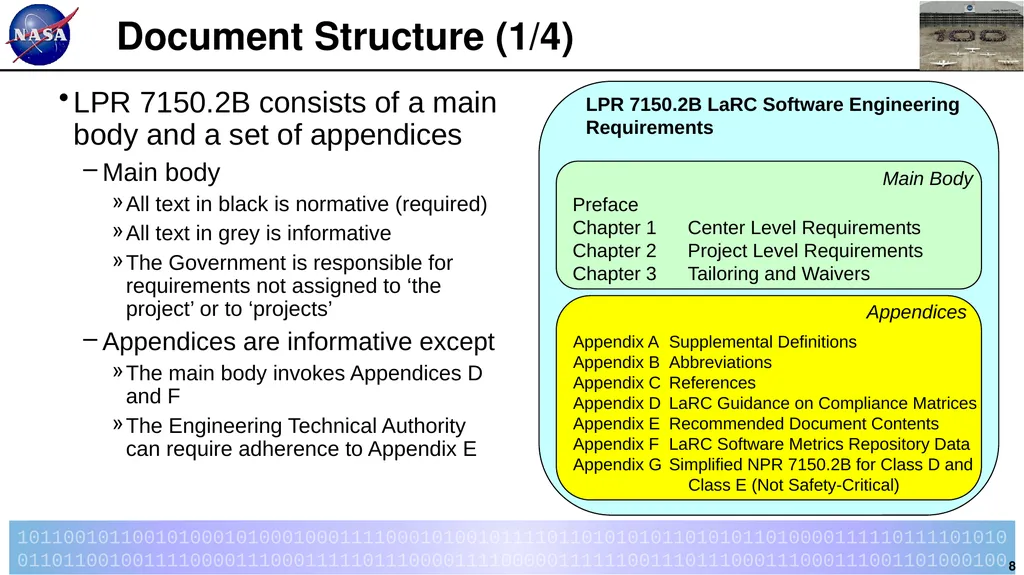
slide8. Document Structure (1/4) LPR 7150.2B consists of a main body and a set of appendices
Main body
All text in black is normative (required)
All text in grey is informative
The Government is responsible for requirements not assigned to ‘the project’ or to ‘projects’
Appendices are informative except
The main body invokes Appendices D and F
The Engineering Technical Authority can require adherence to Appendix E<br>
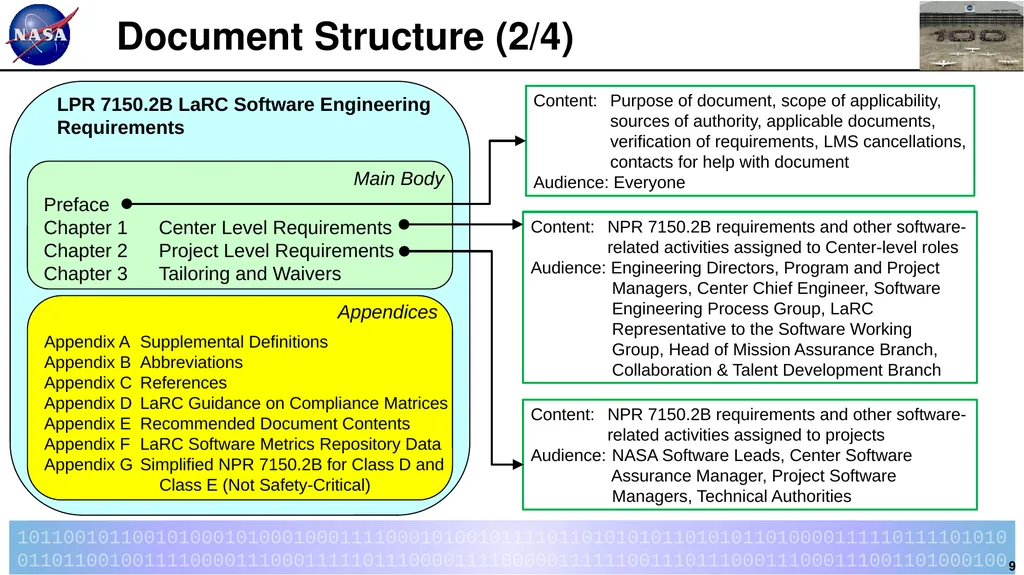
slide9. Document Structure (2/4) Content: Purpose of document, scope of applicability,
sources of authority, applicable documents,
verification of requirements, LMS cancellations,
contacts for help with document
Audience: Everyone Content: NPR 7150.2B requirements and other software-
related activities assigned to Center-level roles
Audience: Engineering Directors, Program and Project
Managers, Center Chief Engineer, Software
Engineering Process Group, LaRC Representative to the Software Working Group, Head of Mission Assurance Branch,
Collaboration & Talent Development Branch Content: NPR 7150.2B requirements and other software-
related activities assigned to projects
Audience: NASA Software Leads, Center Software Assurance Manager, Project Software Managers, Technical Authorities<br>
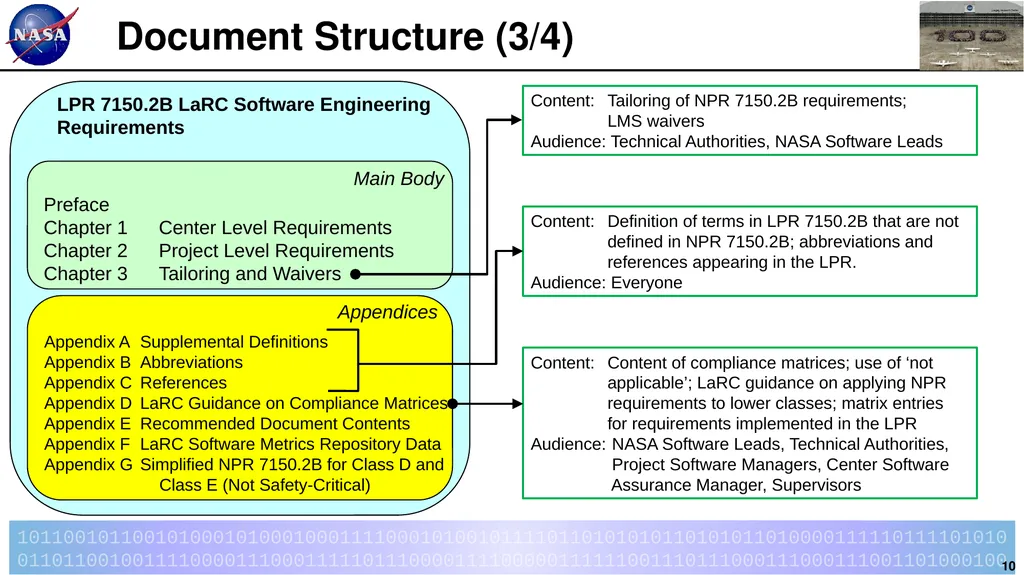
slide10. Document Structure (3/4) Content: Tailoring of NPR 7150.2B requirements; LMS waivers
Audience: Technical Authorities, NASA Software Leads Content: Definition of terms in LPR 7150.2B that are not defined in NPR 7150.2B; abbreviations and references appearing in the LPR.
Audience: Everyone Content: Content of compliance matrices; use of ‘not applicable’; LaRC guidance on applying NPR requirements to lower classes; matrix entries for requirements implemented in the LPR
Audience: NASA Software Leads, Technical Authorities, Project Software Managers, Center Software Assurance Manager, Supervisors<br>
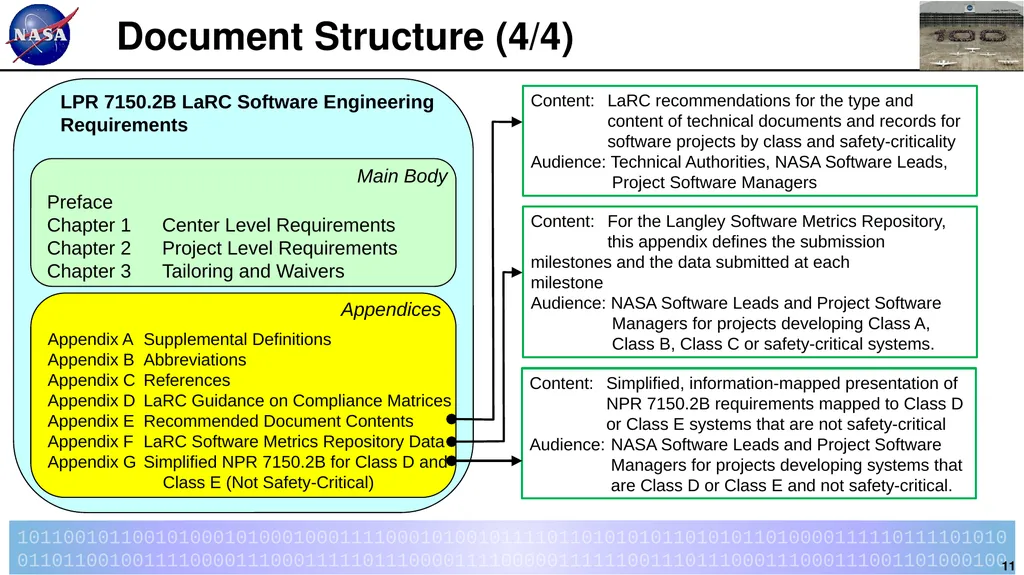
slide11. Document Structure (4/4) Content: LaRC recommendations for the type and content of technical documents and records for software projects by class and safety-criticality
Audience: Technical Authorities, NASA Software Leads, Project Software Managers Content: For the Langley Software Metrics Repository, this appendix defines the submission milestones and the data submitted at each milestone
Audience: NASA Software Leads and Project Software Managers for projects developing Class A, Class B, Class C or safety-critical systems. Content: Simplified, information-mapped presentation of NPR 7150.2B requirements mapped to Class D or Class E systems that are not safety-critical
Audience: NASA Software Leads and Project Software Managers for projects developing systems that are Class D or Class E and not safety-critical.<br>
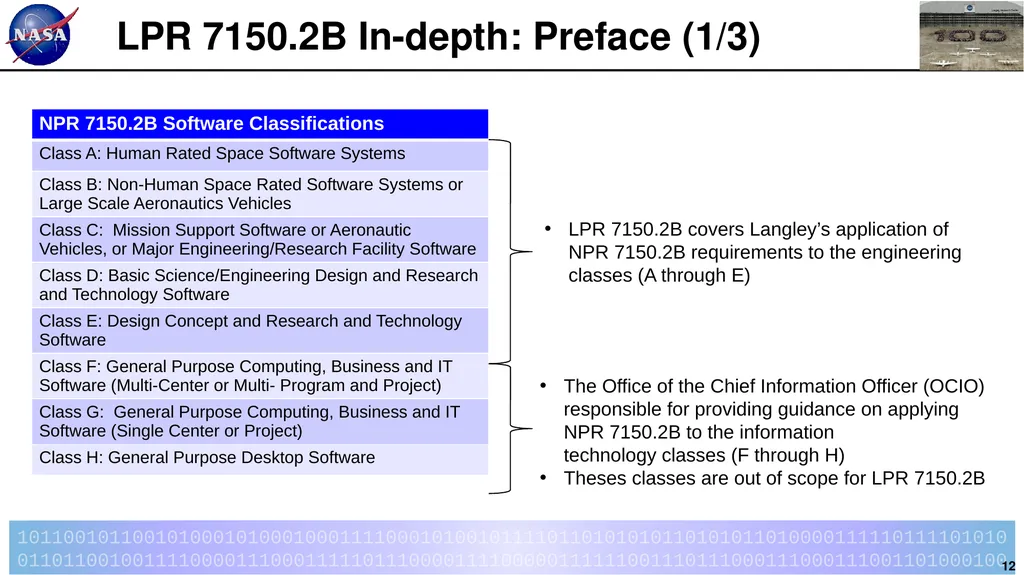
slide12. LPR 7150.2B In-depth: Preface (1/3) LPR 7150.2B covers Langley’s application of NPR 7150.2B requirements to the engineering classes (A through E) The Office of the Chief Information Officer (OCIO) responsible for providing guidance on applying NPR 7150.2B to the information technology classes (F through H)
Theses classes are out of scope for LPR 7150.2B<br>
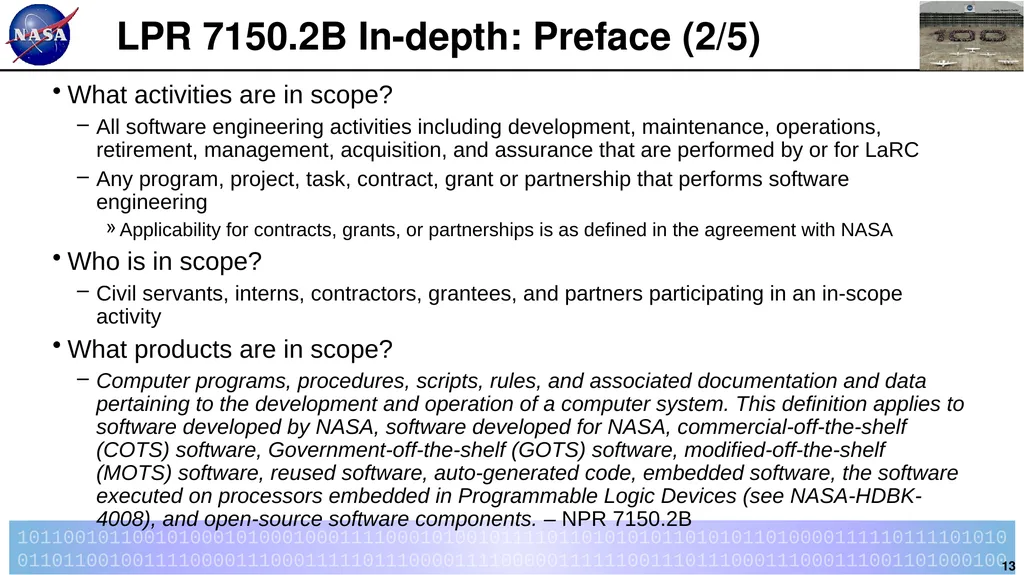
slide13. LPR 7150.2B In-depth: Preface (2/5) What activities are in scope?
All software engineering activities including development, maintenance, operations, retirement, management, acquisition, and assurance that are performed by or for LaRC
Any program, project, task, contract, grant or partnership that performs software engineering
Applicability for contracts, grants, or partnerships is as defined in the agreement with NASA
Who is in scope?
Civil servants, interns, contractors, grantees, and partners participating in an in-scope activity
What products are in scope?
Computer programs, procedures, scripts, rules, and associated documentation and data pertaining to the development and operation of a computer system. This definition applies to software developed by NASA, software developed for NASA, commercial-off-the-shelf (COTS) software, Government-off-the-shelf (GOTS) software, modified-off-the-shelf (MOTS) software, reused software, auto-generated code, embedded software, the software executed on processors embedded in Programmable Logic Devices (see NASA-HDBK-4008), and open-source software components. – NPR 7150.2B<br>
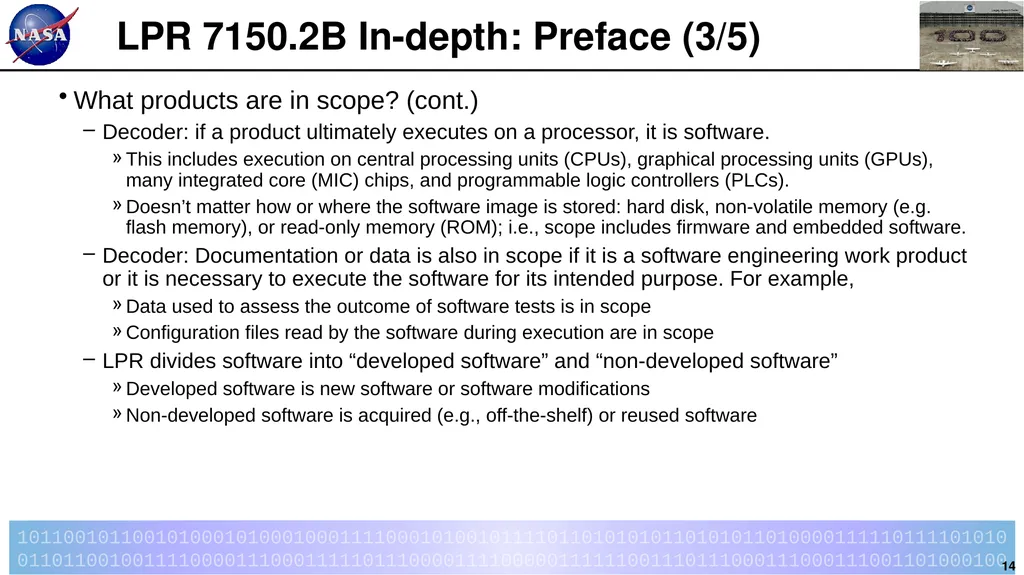
slide14. LPR 7150.2B In-depth: Preface (3/5) What products are in scope? (cont.)
Decoder: if a product ultimately executes on a processor, it is software.
This includes execution on central processing units (CPUs), graphical processing units (GPUs), many integrated core (MIC) chips, and programmable logic controllers (PLCs).
Doesn’t matter how or where the software image is stored: hard disk, non-volatile memory (e.g. flash memory), or read-only memory (ROM); i.e., scope includes firmware and embedded software.
Decoder: Documentation or data is also in scope if it is a software engineering work product or it is necessary to execute the software for its intended purpose. For example,
Data used to assess the outcome of software tests is in scope
Configuration files read by the software during execution are in scope
LPR divides software into “developed software” and “non-developed software”
Developed software is new software or software modifications
Non-developed software is acquired (e.g., off-the-shelf) or reused software<br>
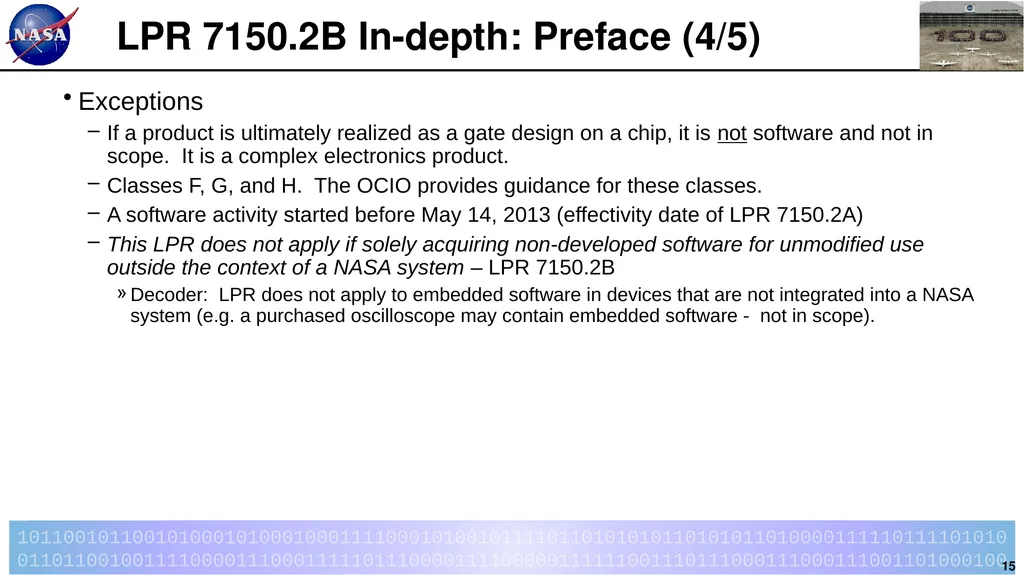
slide15. LPR 7150.2B In-depth: Preface (4/5) Exceptions
If a product is ultimately realized as a gate design on a chip, it is not software and not in scope. It is a complex electronics product.
Classes F, G, and H. The OCIO provides guidance for these classes.
A software activity started before May 14, 2013 (effectivity date of LPR 7150.2A)
This LPR does not apply if solely acquiring non-developed software for unmodified use outside the context of a NASA system – LPR 7150.2B
Decoder: LPR does not apply to embedded software in devices that are not integrated into a NASA system (e.g. a purchased oscilloscope may contain embedded software - not in scope).<br>
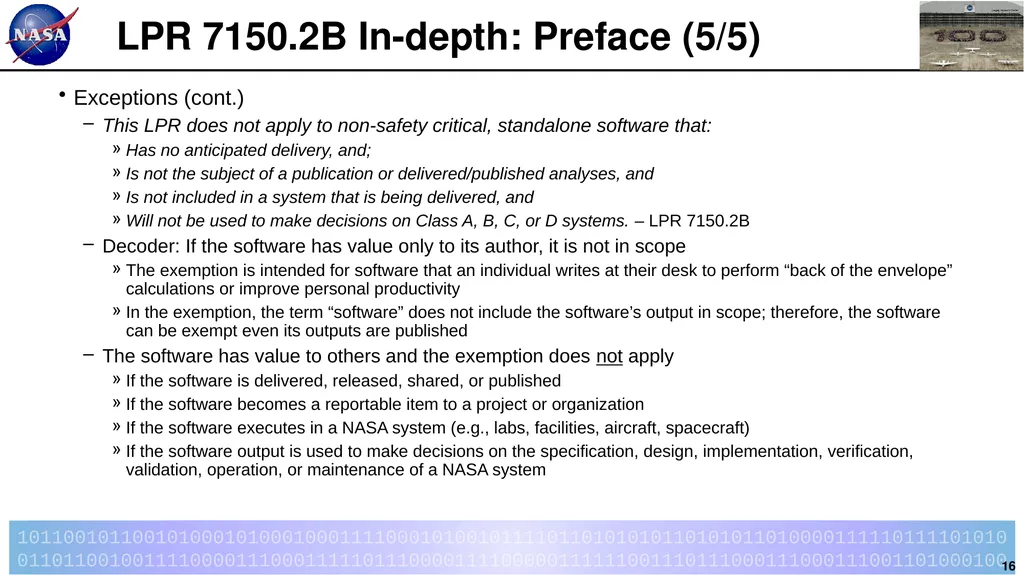
slide16. LPR 7150.2B In-depth: Preface (5/5) Exceptions (cont.)
This LPR does not apply to non-safety critical, standalone software that:
Has no anticipated delivery, and;
Is not the subject of a publication or delivered/published analyses, and
Is not included in a system that is being delivered, and
Will not be used to make decisions on Class A, B, C, or D systems. – LPR 7150.2B
Decoder: If the software has value only to its author, it is not in scope
The exemption is intended for software that an individual writes at their desk to perform “back of the envelope” calculations or improve personal productivity
In the exemption, the term “software” does not include the software’s output in scope; therefore, the software can be exempt even its outputs are published
The software has value to others and the exemption does not apply
If the software is delivered, released, shared, or published
If the software becomes a reportable item to a project or organization
If the software executes in a NASA system (e.g., labs, facilities, aircraft, spacecraft)
If the software output is used to make decisions on the specification, design, implementation, verification, validation, operation, or maintenance of a NASA system<br>
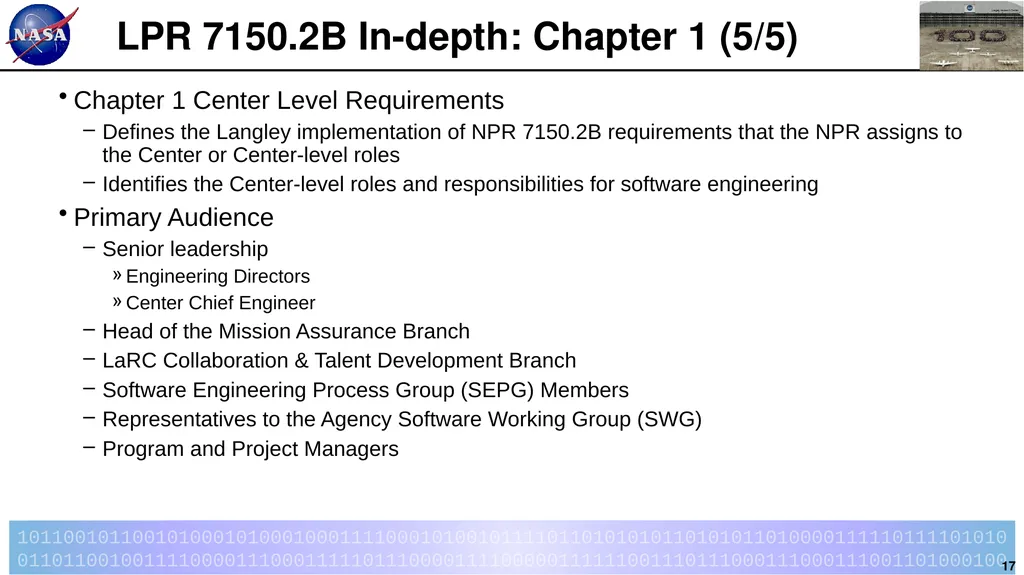
slide17. LPR 7150.2B In-depth: Chapter 1 (5/5) Chapter 1 Center Level Requirements
Defines the Langley implementation of NPR 7150.2B requirements that the NPR assigns to the Center or Center-level roles
Identifies the Center-level roles and responsibilities for software engineering
Primary Audience
Senior leadership
Engineering Directors
Center Chief Engineer
Head of the Mission Assurance Branch
LaRC Collaboration & Talent Development Branch
Software Engineering Process Group (SEPG) Members
Representatives to the Agency Software Working Group (SWG)
Program and Project Managers<br>
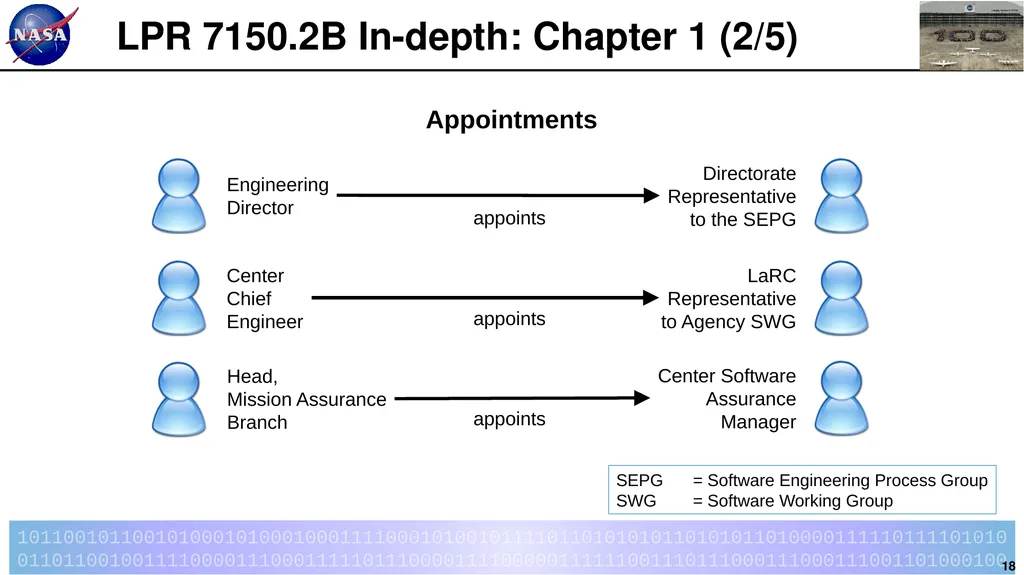
slide18. LPR 7150.2B In-depth: Chapter 1 (2/5) Appointments appoints appoints appoints SEPG = Software Engineering Process Group
SWG = Software Working Group<br>
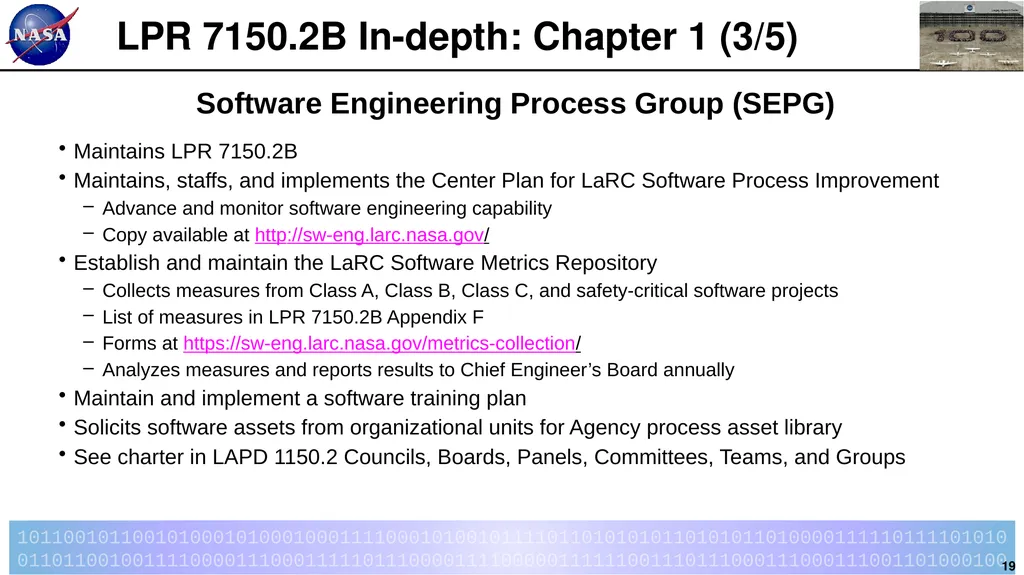
slide19. LPR 7150.2B In-depth: Chapter 1 (3/5) Maintains LPR 7150.2B
Maintains, staffs, and implements the Center Plan for LaRC Software Process Improvement
Advance and monitor software engineering capability
Copy available at http://sw-eng.larc.nasa.gov/
Establish and maintain the LaRC Software Metrics Repository
Collects measures from Class A, Class B, Class C, and safety-critical software projects
List of measures in LPR 7150.2B Appendix F
Forms at https://sw-eng.larc.nasa.gov/metrics-collection/
Analyzes measures and reports results to Chief Engineer’s Board annually
Maintain and implement a software training plan
Solicits software assets from organizational units for Agency process asset library
See charter in LAPD 1150.2 Councils, Boards, Panels, Committees, Teams, and Groups Software Engineering Process Group (SEPG)<br>
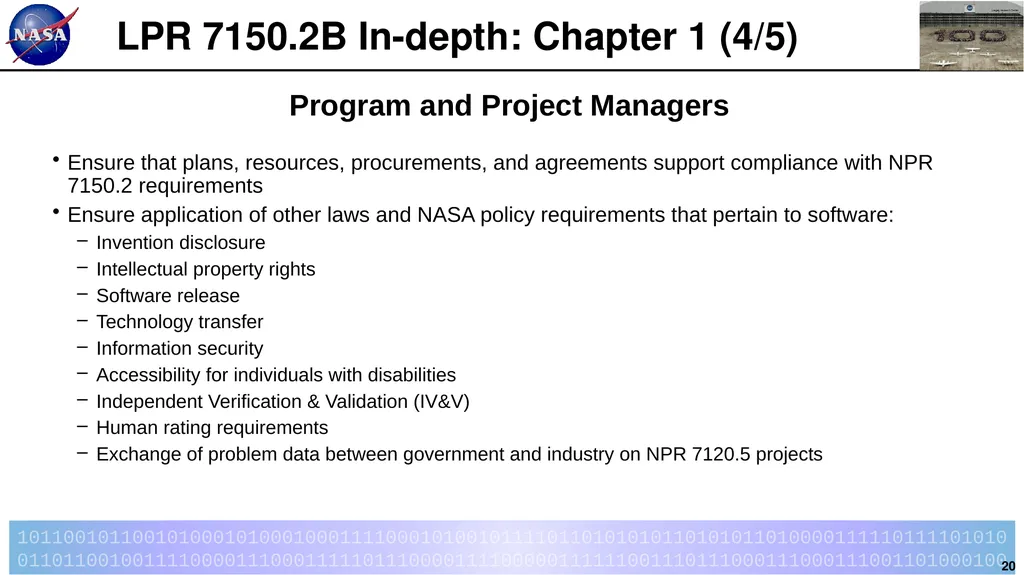
slide20. LPR 7150.2B In-depth: Chapter 1 (4/5) Ensure that plans, resources, procurements, and agreements support compliance with NPR 7150.2 requirements
Ensure application of other laws and NASA policy requirements that pertain to software:
Invention disclosure
Intellectual property rights
Software release
Technology transfer
Information security
Accessibility for individuals with disabilities
Independent Verification & Validation (IV&V)
Human rating requirements
Exchange of problem data between government and industry on NPR 7120.5 projects Program and Project Managers<br>
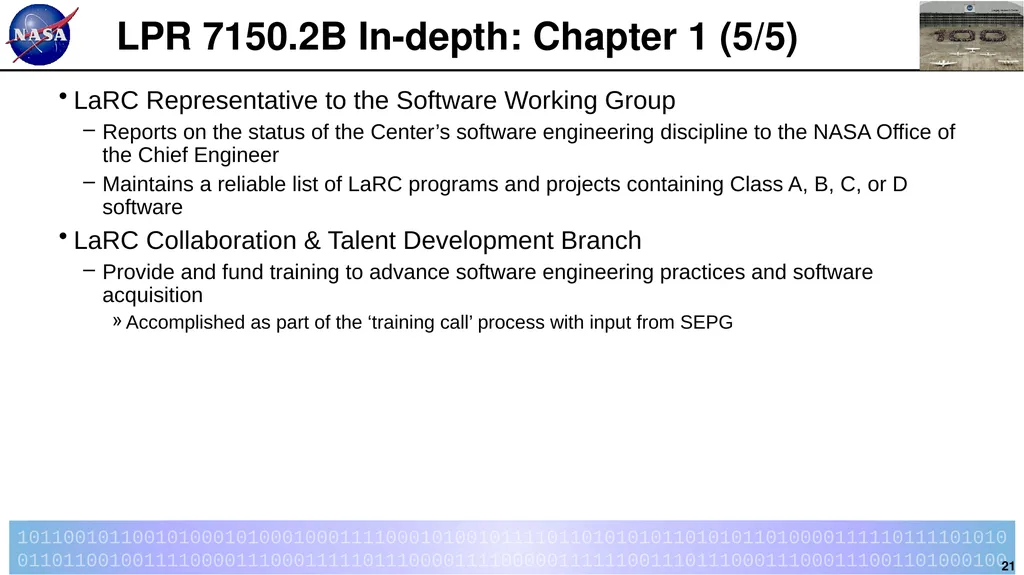
slide21. LPR 7150.2B In-depth: Chapter 1 (5/5) LaRC Representative to the Software Working Group
Reports on the status of the Center’s software engineering discipline to the NASA Office of the Chief Engineer
Maintains a reliable list of LaRC programs and projects containing Class A, B, C, or D software
LaRC Collaboration & Talent Development Branch
Provide and fund training to advance software engineering practices and software acquisition
Accomplished as part of the ‘training call’ process with input from SEPG<br>
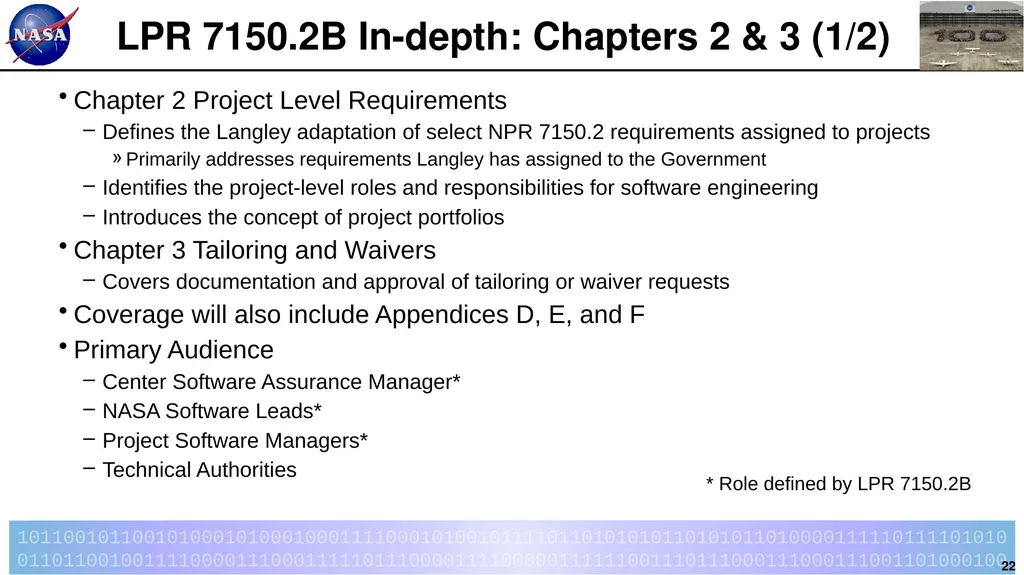
slide22. LPR 7150.2B In-depth: Chapters 2 & 3 (1/2) Chapter 2 Project Level Requirements
Defines the Langley adaptation of select NPR 7150.2 requirements assigned to projects
Primarily addresses requirements Langley has assigned to the Government
Identifies the project-level roles and responsibilities for software engineering
Introduces the concept of project portfolios
Chapter 3 Tailoring and Waivers
Covers documentation and approval of tailoring or waiver requests
Coverage will also include Appendices D, E, and F
Primary Audience
Center Software Assurance Manager*
NASA Software Leads*
Project Software Managers*
Technical Authorities * Role defined by LPR 7150.2B<br>
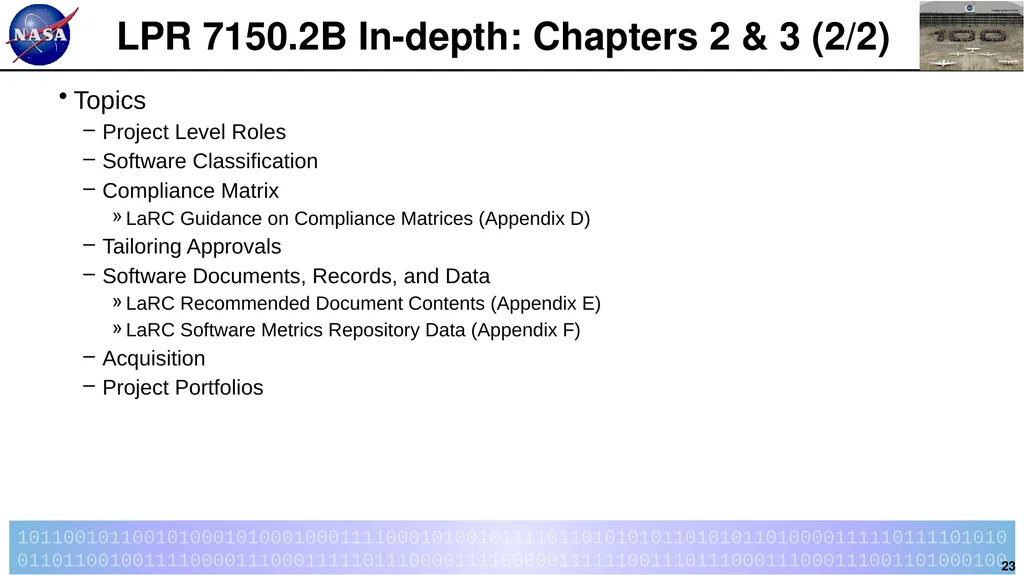
slide23. LPR 7150.2B In-depth: Chapters 2 & 3 (2/2) Topics
Project Level Roles
Software Classification
Compliance Matrix
LaRC Guidance on Compliance Matrices (Appendix D)
Tailoring Approvals
Software Documents, Records, and Data
LaRC Recommended Document Contents (Appendix E)
LaRC Software Metrics Repository Data (Appendix F)
Acquisition
Project Portfolios<br>
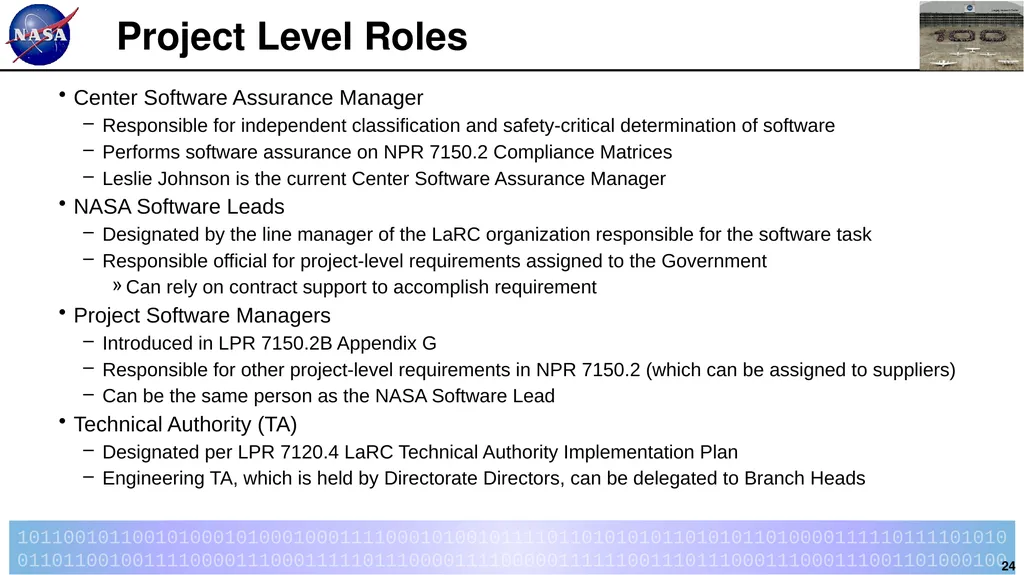
slide24. Project Level Roles Center Software Assurance Manager
Responsible for independent classification and safety-critical determination of software
Performs software assurance on NPR 7150.2 Compliance Matrices
Leslie Johnson is the current Center Software Assurance Manager
NASA Software Leads
Designated by the line manager of the LaRC organization responsible for the software task
Responsible official for project-level requirements assigned to the Government
Can rely on contract support to accomplish requirement
Project Software Managers
Introduced in LPR 7150.2B Appendix G
Responsible for other project-level requirements in NPR 7150.2 (which can be assigned to suppliers)
Can be the same person as the NASA Software Lead
Technical Authority (TA)
Designated per LPR 7120.4 LaRC Technical Authority Implementation Plan
Engineering TA, which is held by Directorate Directors, can be delegated to Branch Heads<br>
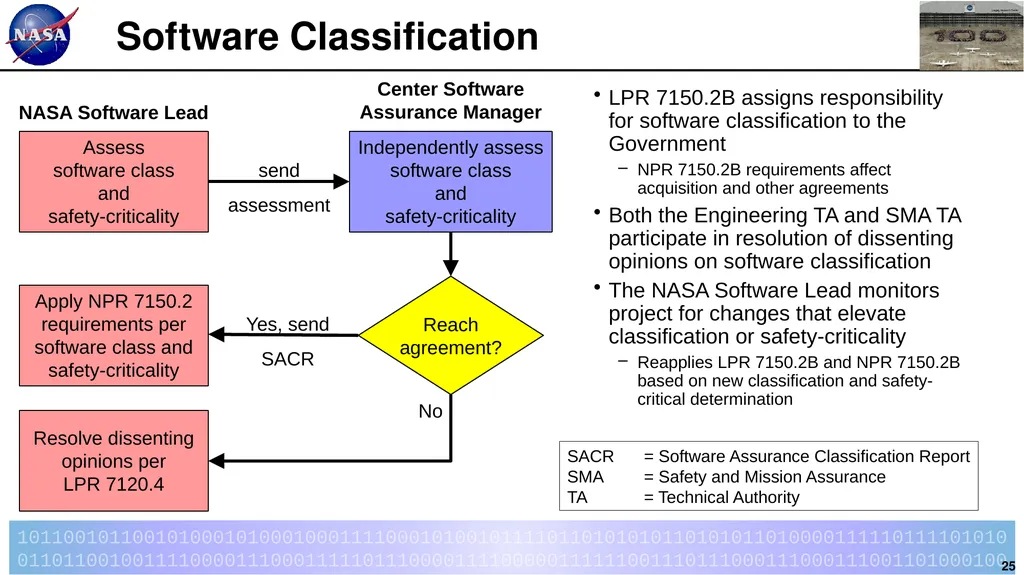
slide25. Software Classification LPR 7150.2B assigns responsibility for software classification to the Government
NPR 7150.2B requirements affect acquisition and other agreements
Both the Engineering TA and SMA TA participate in resolution of dissenting opinions on software classification
The NASA Software Lead monitors project for changes that elevate classification or safety-criticality
Reapplies LPR 7150.2B and NPR 7150.2B based on new classification and safety-critical determination SACR = Software Assurance Classification Report
SMA = Safety and Mission Assurance
TA = Technical Authority<br>
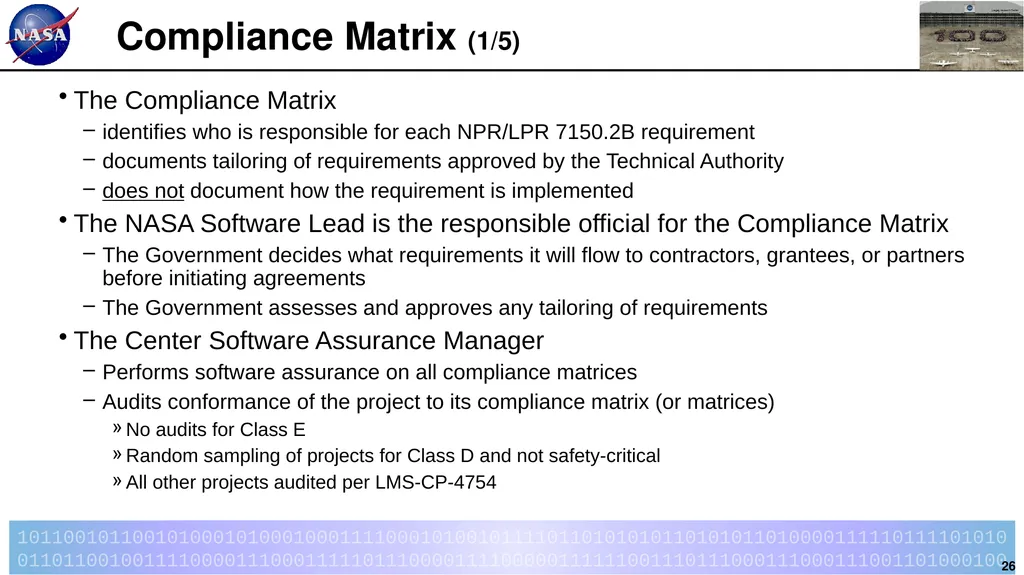
slide26. Compliance Matrix (1/5) The Compliance Matrix
identifies who is responsible for each NPR/LPR 7150.2B requirement
documents tailoring of requirements approved by the Technical Authority
does not document how the requirement is implemented
The NASA Software Lead is the responsible official for the Compliance Matrix
The Government decides what requirements it will flow to contractors, grantees, or partners before initiating agreements
The Government assesses and approves any tailoring of requirements
The Center Software Assurance Manager
Performs software assurance on all compliance matrices
Audits conformance of the project to its compliance matrix (or matrices)
No audits for Class E
Random sampling of projects for Class D and not safety-critical
All other projects audited per LMS-CP-4754<br>
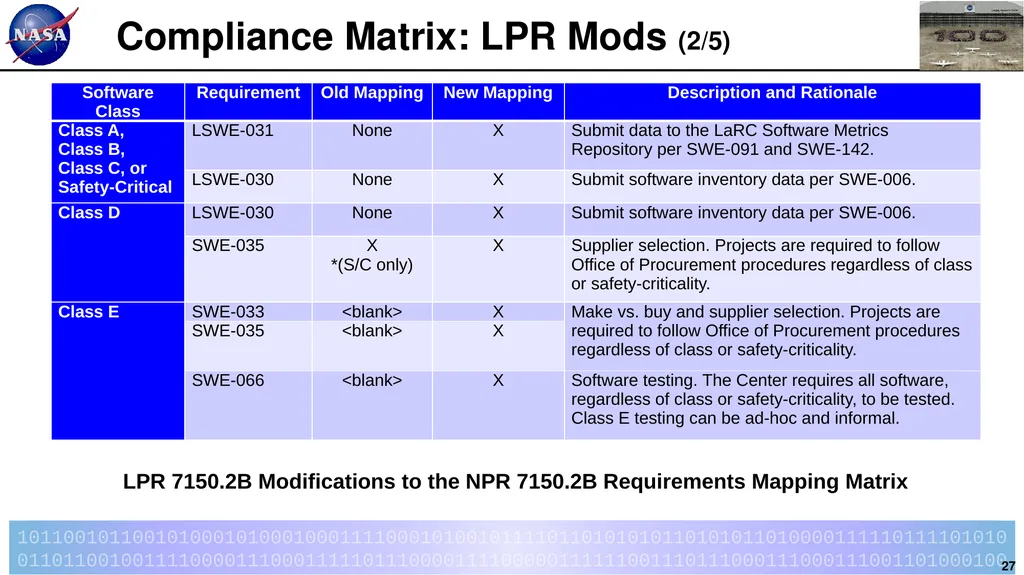
slide27. Compliance Matrix: LPR Mods (2/5) LPR 7150.2B Modifications to the NPR 7150.2B Requirements Mapping Matrix<br>
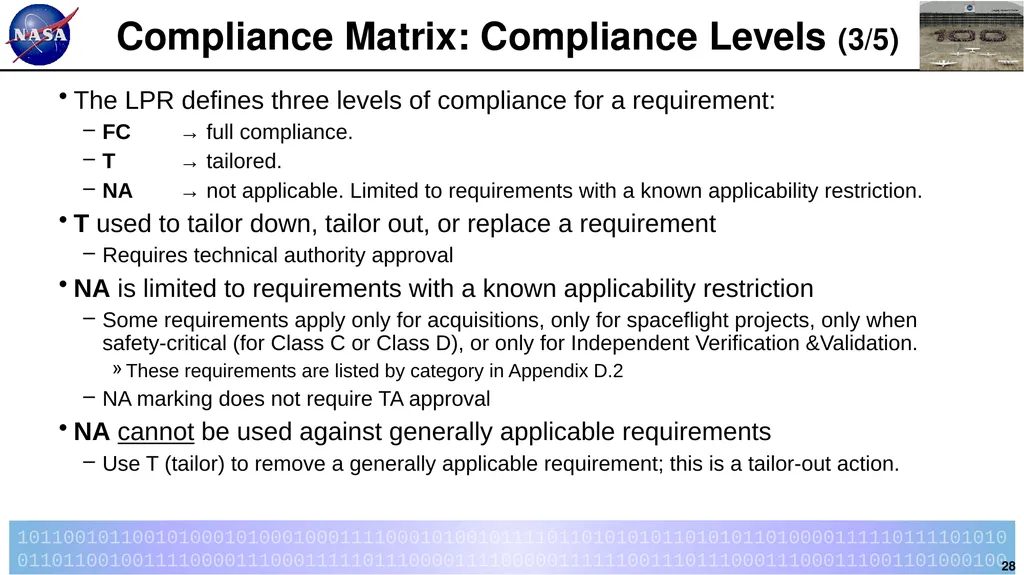
slide28. Compliance Matrix: Compliance Levels (3/5) The LPR defines three levels of compliance for a requirement:
FC → full compliance.
T → tailored.
NA → not applicable. Limited to requirements with a known applicability restriction.
T used to tailor down, tailor out, or replace a requirement
Requires technical authority approval
NA is limited to requirements with a known applicability restriction
Some requirements apply only for acquisitions, only for spaceflight projects, only when safety-critical (for Class C or Class D), or only for Independent Verification &Validation.
These requirements are listed by category in Appendix D.2
NA marking does not require TA approval
NA cannot be used against generally applicable requirements
Use T (tailor) to remove a generally applicable requirement; this is a tailor-out action.<br>
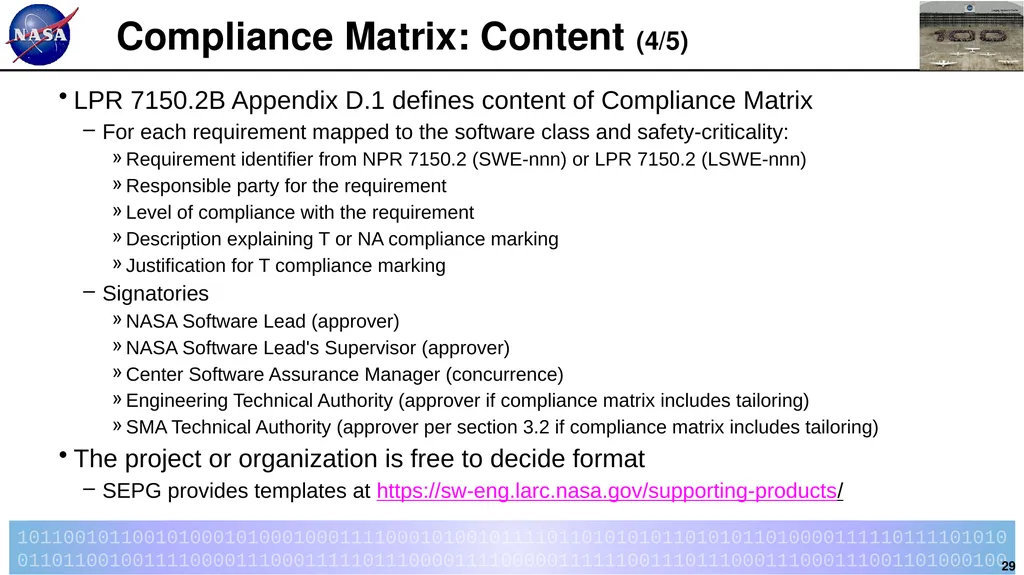
slide29. Compliance Matrix: Content (4/5) LPR 7150.2B Appendix D.1 defines content of Compliance Matrix
For each requirement mapped to the software class and safety-criticality:
Requirement identifier from NPR 7150.2 (SWE-nnn) or LPR 7150.2 (LSWE-nnn)
Responsible party for the requirement
Level of compliance with the requirement
Description explaining T or NA compliance marking
Justification for T compliance marking
Signatories
NASA Software Lead (approver)
NASA Software Lead's Supervisor (approver)
Center Software Assurance Manager (concurrence)
Engineering Technical Authority (approver if compliance matrix includes tailoring)
SMA Technical Authority (approver per section 3.2 if compliance matrix includes tailoring)
The project or organization is free to decide format
SEPG provides templates at https://sw-eng.larc.nasa.gov/supporting-products/<br>
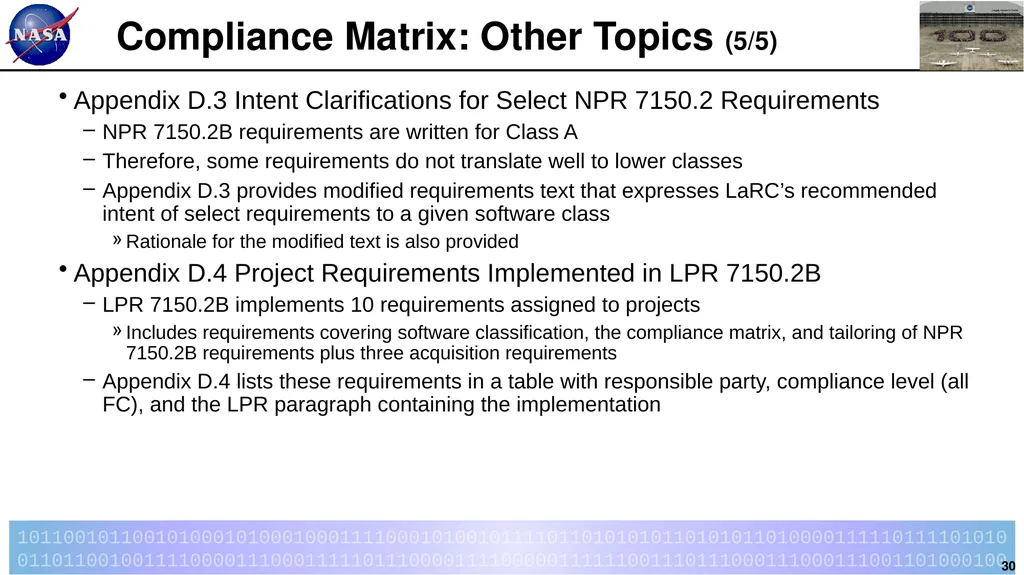
slide30. Compliance Matrix: Other Topics (5/5) Appendix D.3 Intent Clarifications for Select NPR 7150.2 Requirements
NPR 7150.2B requirements are written for Class A
Therefore, some requirements do not translate well to lower classes
Appendix D.3 provides modified requirements text that expresses LaRC’s recommended intent of select requirements to a given software class
Rationale for the modified text is also provided
Appendix D.4 Project Requirements Implemented in LPR 7150.2B
LPR 7150.2B implements 10 requirements assigned to projects
Includes requirements covering software classification, the compliance matrix, and tailoring of NPR 7150.2B requirements plus three acquisition requirements
Appendix D.4 lists these requirements in a table with responsible party, compliance level (all FC), and the LPR paragraph containing the implementation<br>
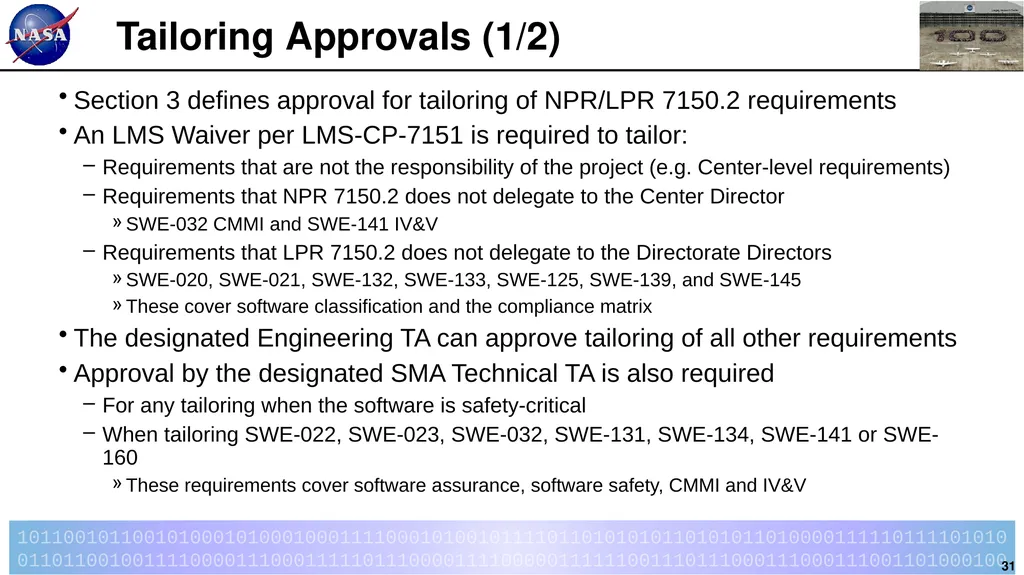
slide31. Tailoring Approvals (1/2) Section 3 defines approval for tailoring of NPR/LPR 7150.2 requirements
An LMS Waiver per LMS-CP-7151 is required to tailor:
Requirements that are not the responsibility of the project (e.g. Center-level requirements)
Requirements that NPR 7150.2 does not delegate to the Center Director
SWE-032 CMMI and SWE-141 IV&V
Requirements that LPR 7150.2 does not delegate to the Directorate Directors
SWE-020, SWE-021, SWE-132, SWE-133, SWE-125, SWE-139, and SWE-145
These cover software classification and the compliance matrix
The designated Engineering TA can approve tailoring of all other requirements
Approval by the designated SMA Technical TA is also required
For any tailoring when the software is safety-critical
When tailoring SWE-022, SWE-023, SWE-032, SWE-131, SWE-134, SWE-141 or SWE-160
These requirements cover software assurance, software safety, CMMI and IV&V<br>
slide32. Tailoring Approvals (2/3) The TA assesses the compliance matrix and tailoring per SWE-126
Checks the accuracy of the project’s classification of software components
Evaluates the compliance matrix for commitment to meet requirements mapped to the software class(es)
Confirming that requirements marked “Not-Applicable” in the project’s compliance matrix are not relevant or not capable of being applied
This applies to both the NA compliance level and ‘tailor out’ under T compliance level
Determining whether the project’s risks, mitigations, and related requests for relief from requirements are reasonable and acceptable.
Coordinate with the Center SMA organization that the compliance matrix and tailoring does not impact safety and mission assurance on the project
Approving/disapproving requests for relief from requirements as delegated
Facilitating the processing of projects’ tailoring or waivers from requirements which falls under the responsibilities of a different Technical Authority
Ensuring that approved compliance matrices, including any tailoring, are archived<br>
slide33. Tailoring Approval (3/3) When tailoring requires an LMS waiver per LMS-CP-7151
The NASA Software Lead submits the request
The Engineering and SMA Technical Authority chains are the Recommending Authorities
Starting with the designated Engineering and SMA Technical Authorities for the software task
For requirements not delegated to the Engineering Directors, the Approvers are the Center Chief Engineer and the Director of the Safety and Mission Assurance Office
For requirements not delegated to the Center Director, the Approver is the Center Director
In other words, the Center Director first approves any waivers to be submitted to Headquarters
The Center Director then forwards the request, for final approval, to the Headquarters Chief Engineer and the Headquarters Chief for Safety and Mission Assurance
The designated Engineering TA retains a copy of the approved compliance matrix with tailoring as a retrievable, archived record<br>
slide34. Software Docs, Records, and Data (1/3) The Engineering TA defines the content requirements for software engineering documents and records of the project
For safety-critical software, the Engineering TA coordinates content with the SMA TA
The SMA TA defines the content requirements for software assurance documents and records of the project
Appendix E assists the Engineering TAs by providing recommended content by software class
The Engineering TA can simply apply Appendix E to a project
The Engineering TA can also augment Appendix E or create an alternative set of content requirements (e.g. using IEEE or ISO standards)<br>
slide35. Software Docs, Records, and Data (2/3) Except for Class E, the NASA Software Lead provides the following data to the LaRC SWG Representative for the software inventory at project start:
Name of project
Work breakdown structure (WBS) number (in the NASA financial system)
Name and contact information for the NASA Software Lead
Name of the development organization(s)
Name of the software assurance organization(s), if applicable
Primary lifecycle methodology
Current lifecycle phase
For each software item, provide the following information:
Name of item
Estimate of software size as KSLOC (thousand source lines of code)
Software class and safety-critical determination
The primary programming language<br>
slide36. Software Docs, Records, and Data (3/3) Except for Class E, the NASA Software Lead defines the acceptance criteria and conditions for the software
Defines the criteria by which the Government will accept the software for its intended use
Criteria may be evaluated under conditions such maximum resource load, an operational mode, a user access control level, in the presence of intrusion attempts, etc.
Except for Class E, the NASA Software Lead evaluates software for contribution to the Agency Software Catalog as reusable software
During formulation, the NASA Software Lead should consider the necessary intellectual property rights to permit sharing of the software
Currently requires submitting software through the software release process, LMS-CP-1724
The project submits a New Technology Report (NTR) for developed software
NTRs are submitted online via http://invention.nasa.gov
Should start the NTR when the software need is first identified
A new NTR is expected for future revisions of the software that add new features<br>
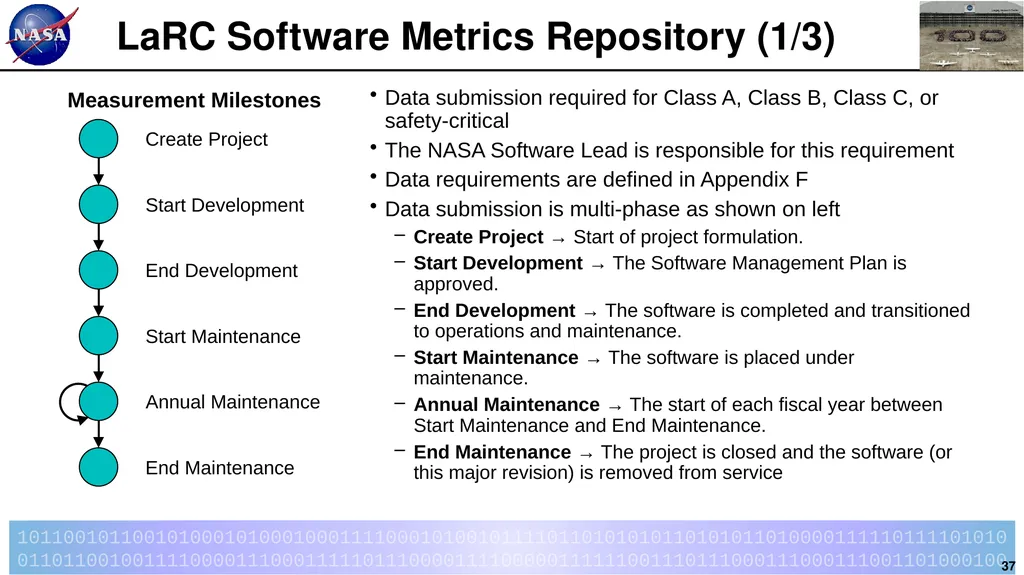
slide37. LaRC Software Metrics Repository (1/3) Data submission required for Class A, Class B, Class C, or safety-critical
The NASA Software Lead is responsible for this requirement
Data requirements are defined in Appendix F
Data submission is multi-phase as shown on left
Create Project → Start of project formulation.
Start Development → The Software Management Plan is approved.
End Development → The software is completed and transitioned to operations and maintenance.
Start Maintenance → The software is placed under maintenance.
Annual Maintenance → The start of each fiscal year between Start Maintenance and End Maintenance.
End Maintenance → The project is closed and the software (or this major revision) is removed from service<br>
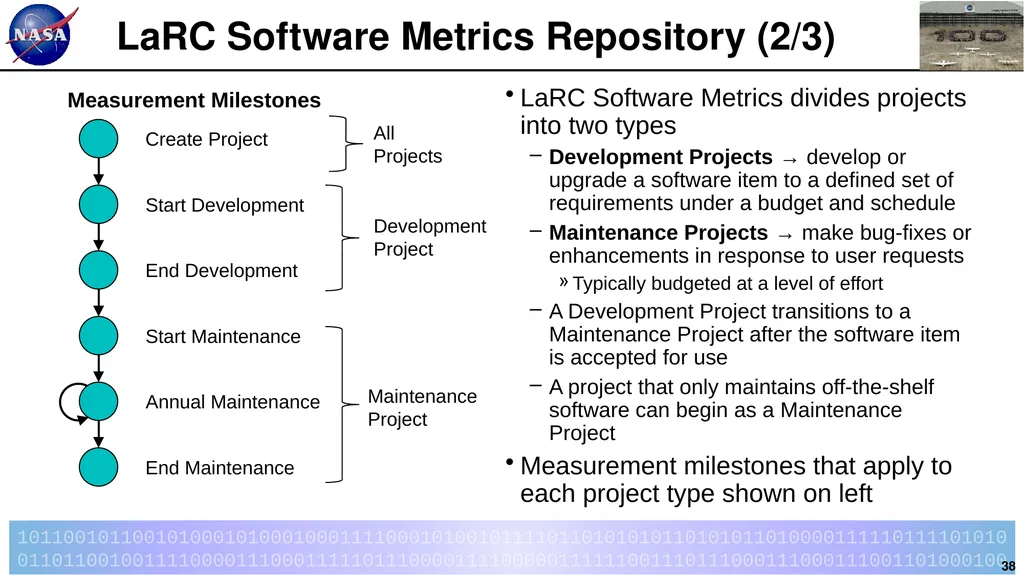
slide38. LaRC Software Metrics Repository (2/3) LaRC Software Metrics divides projects into two types
Development Projects → develop or upgrade a software item to a defined set of requirements under a budget and schedule
Maintenance Projects → make bug-fixes or enhancements in response to user requests
Typically budgeted at a level of effort
A Development Project transitions to a Maintenance Project after the software item is accepted for use
A project that only maintains off-the-shelf software can begin as a Maintenance Project
Measurement milestones that apply to each project type shown on left Development
Project Maintenance
Project All
Projects<br>
slide39. LaRC Software Metrics Repository (3/3) Projects submit data using Excel workbooks located at: https://sw-eng.larc.nasa.gov/metrics-collection/
The is one workbook for Development Projects and a second for Maintenance Projects
A Development Project will eventually fill out both workbooks, switching to the workbook for Maintenance Projects after the software is accepted for use
Each Excel workbook has an instruction sheet and a sheet for each measurement milestone
In the workbook for maintenance projects, there are multiple sheets for the annual maintenance milestone, each named by fiscal year
Name the workbook <Development | Maintenance>_Project_Metrics_<project name>.xlsx
At each measurement milestone, the NASA Software Lead
updates the workbook by filling in the sheet associated with that milestone
E-mails the updated workbook to larc-dl-sepg@mail.nasa.gov
Appendix F has a table listing each measure to be submitted and the measurement milestone(s) when the submission is made<br>
slide40. Acquisition (1/2) The NASA Software Lead is responsible for
The make vs. buy decision (SWE-033)
Contacting the LaRC Office of Procurement to acquire software items or services (SWE-035)
When acquiring non-developed software, consulting with the Office of the Chief Counsel to assess whether intellectual property rights and licenses are agreeable to LaRC and meet the needs of the project
Since LPR was written, the Agency has issued new software license management requirements and the process now begins with an ITAM (IT Asset Management) request
Also required for open source software
When planning to release software developed or acquired via procurement, consulting with the Office of the Chief Counsel and the Office of Procurement to assure that LaRC receives the necessary intellectual property rights and licenses to the acquired software item
Identifying the NPR/LPR 7150.2B requirements to flow down to the supplier and assuring they are documented in the compliance matrix, solicitation, and final agreement<br>
slide41. Acquisition (2/2) The NASA Software Lead is responsible for (cont.)
Defining the technical work (e.g. statement of work) for the software activity
Except for Class E, define the acceptance criteria and conditions for deliverables
Assures that the solicitation and final agreement address NPR 7150.2 requirements for acquisition and supplier management, as applicable by software classification
Assures, as appropriate, that the solicitation and final agreement include delivery of data for the software inventory and LaRC Software Metrics Repository
When the software is Class A, Class B, Class C, or safety-critical, the NASA Software Lead and the Center Software Assurance Manager identify the NASA-STD-8739.8 software assurance requirements to flow down to the supplier
When the software is safety-critical, the NASA Software Lead and the SMA TA identify the NASA-STD-8710.13 software safety requirements to flow down to the supplier
The NASA Software Lead and Engineering TA identify and define the deliverable software plans and work products<br>
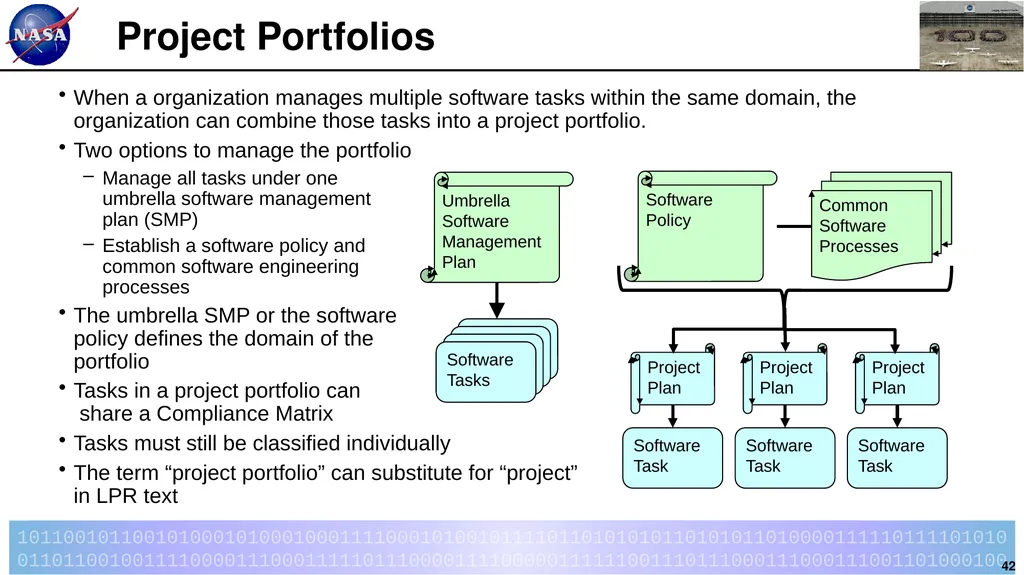
slide42. Project Portfolios When a organization manages multiple software tasks within the same domain, the organization can combine those tasks into a project portfolio.
Two options to manage the portfolio
Manage all tasks under one umbrella software management plan (SMP)
Establish a software policy and common software engineering processes
The umbrella SMP or the software policy defines the domain of the portfolio
Tasks in a project portfolio can share a Compliance Matrix
Tasks must still be classified individually
The term “project portfolio” can substitute for “project” in LPR text<br>
slide43. LPR 7120.2B In-Depth: Appendix G Provides a “Reader’s Digest” representation of NPR 7150.2B for projects that are Class E or Class D and not safety-critical
Class E is two pages
Class D (and not safety-critical) is five pages
Projects can use Appendix G as a substitute for NPR 7150.2B
NPR 7150.2B requirements provided in an information-mapped format like prior LMS-CP-7150.x series
A graphical flow of “steps”
A step-action table to detail each step
Covers project requirements assignable to either civil service or suppliers
The first step covers the Government activity detailed in Chapters 2 & 3
Therefore this appendix can be used as a reference in acquisitions<br>
slide44. How to Get Help on LPR 7150.2B? Contact your Directorate SEPG Representative
The list of Directorate SEPG Representatives is found on the home page of the LaRC Software Engineering web-site http://sw-eng.larc.nasa.gov
Send an e-mail to larc-dl-support-sepg-help@mail.nasa.gov
The SEPG help line
Also listed on the home page of the LaRC Software Engineering web-site<br>
slide45. Questions?<br>
Michael Madden
LaRC Software Engineering Process Group (SEPG) Lead<br>
slide2. Overview Audience
Course Objectives
What has changed?
Document Relationships
Document Structure
LPR 7150.2B In-depth: Preface
LPR 7150.2B In-depth: Chapter 1 LPR 7150.2B In-depth: Chapters 2 & 3
Project Level Roles
Software Classification
Compliance Matrix
Tailoring Approvals
Software Documents, Records, and Data
Acquisition
Project Portfolios
LPR 7150.2B In-depth: Appendix G<br>
slide3. Audience Contracting Officers and Contracting Officer Representatives
Chief Engineers
Technical Authorities for software
Branch Heads
Program and Project Leads
NASA Software Leads (an LPR 7150.2B role)
Leads for teams that develop, maintain, operate, retire, manage, acquire, or assure software<br>
slide4. Course Objectives Learn what is changed in LPR 7150.2B
Learn how LPR 7150.2B relates to Agency and LMS documents
Learn how to navigate LPR 7150.2B to find information relevant to you
Learn how LPR 7150.2B adapts NPR 7150.2B to Langley’s software activities
Langley-specific terms, concepts, and roles for software engineering
Langley implementation of requirements levied on the Center
Langley allocation of NPR 7150.2B requirements to the Government
Langley’s implementation and guidance on NPR 7150.2B requirements tailoring
Langley guidance on compliance matrices and software engineering documentation
This course does not cover how a project develops a software engineering process that complies with NPR 7150.2B
The NASA Office of the Chief Engineer has developed a series of software engineering courses that cover this topic.
One or more of these courses can be brought to Langley with sufficient interest and funds.<br>
slide5. What Has Changed? (1/2) Responding to major changes in NPR 7150.2B
Tailoring authority moved from center-level with Headquarters concurrence to project-level with technical authority approval
Technical documentation content demoted to guidance and moved to the NASA Software Engineering Handbook
Centers required to maintain cost repositories for Class A, B, and C software
Responding to changes requested by organizational units (OU)
Centralize the technical document content from LMS-CP-7150.x series to LPR 7150.2
Segregate ‘programmatic’ from ‘lifecycle’ requirements in LMS-CP-7150.x series
Langley rarely flows ‘programmatic’ requirements to contracts
Using one approved compliance matrix for an application domain within the OU
Permit delegation of technical authority for software to branch heads or other software discipline leads in the OU per LPR 7120.4 LaRC Technical Authority Implementation Plan
Insert engineering responsibilities for the software release process<br>
slide6. What Has Changed? (2/2) LMS-CP-7150.x series is cancelled
Part of the Center tailoring under NPR 7150.2A
Technical documentation content was moved to LPR 7150.2B Appendix E
Requirements that are a Government responsibility were moved to LPR 7150.2B
LPR 7150.2B refers the project to NPR 7150.2B for remaining requirements
LMS-CPs for Class D and Class E Software were combined into LPR 7150.2B Appendix G
Compliance Matrices now trace directly to NPR 7150.2B requirements
LPR 7150.2B introduces ‘project portfolios’ to bundle projects using common processes under one compliance matrix
LPR 7150.2B introduces ‘NASA Software Lead’ role to manage NPR 7150.2B requirements that are the Government’s responsibility
LPR 7150.2B formalizes the role of Center Software Assurance Manager for independent assessment of software class and safety-criticality<br>
slide7. Document Relationships LPR 7150.2B
Langley Software
Engineering Requirements NPR 7150.2B NASA Software Engineering Requirements NASA-STD-8739.8
Software Assurance
Standard invokes NASA-STD-8719.13
Software Safety
Standard invokes applicable refer refer LAPD 1150.2
Councils, Boards, Panels, Committees, Teams, and Groups SEPG LPR 7120.4
Technical Authority Implementation Plan TA LMS-CP-4754 Software Assurance (SA) for Development and Acquisition applicable SA LMS-CP-1724 Software Release SR LMS-CP-7151
Obtaining Waivers for
LMS Requirements Waivers<br>
slide8. Document Structure (1/4) LPR 7150.2B consists of a main body and a set of appendices
Main body
All text in black is normative (required)
All text in grey is informative
The Government is responsible for requirements not assigned to ‘the project’ or to ‘projects’
Appendices are informative except
The main body invokes Appendices D and F
The Engineering Technical Authority can require adherence to Appendix E<br>
slide9. Document Structure (2/4) Content: Purpose of document, scope of applicability,
sources of authority, applicable documents,
verification of requirements, LMS cancellations,
contacts for help with document
Audience: Everyone Content: NPR 7150.2B requirements and other software-
related activities assigned to Center-level roles
Audience: Engineering Directors, Program and Project
Managers, Center Chief Engineer, Software
Engineering Process Group, LaRC Representative to the Software Working Group, Head of Mission Assurance Branch,
Collaboration & Talent Development Branch Content: NPR 7150.2B requirements and other software-
related activities assigned to projects
Audience: NASA Software Leads, Center Software Assurance Manager, Project Software Managers, Technical Authorities<br>
slide10. Document Structure (3/4) Content: Tailoring of NPR 7150.2B requirements; LMS waivers
Audience: Technical Authorities, NASA Software Leads Content: Definition of terms in LPR 7150.2B that are not defined in NPR 7150.2B; abbreviations and references appearing in the LPR.
Audience: Everyone Content: Content of compliance matrices; use of ‘not applicable’; LaRC guidance on applying NPR requirements to lower classes; matrix entries for requirements implemented in the LPR
Audience: NASA Software Leads, Technical Authorities, Project Software Managers, Center Software Assurance Manager, Supervisors<br>
slide11. Document Structure (4/4) Content: LaRC recommendations for the type and content of technical documents and records for software projects by class and safety-criticality
Audience: Technical Authorities, NASA Software Leads, Project Software Managers Content: For the Langley Software Metrics Repository, this appendix defines the submission milestones and the data submitted at each milestone
Audience: NASA Software Leads and Project Software Managers for projects developing Class A, Class B, Class C or safety-critical systems. Content: Simplified, information-mapped presentation of NPR 7150.2B requirements mapped to Class D or Class E systems that are not safety-critical
Audience: NASA Software Leads and Project Software Managers for projects developing systems that are Class D or Class E and not safety-critical.<br>
slide12. LPR 7150.2B In-depth: Preface (1/3) LPR 7150.2B covers Langley’s application of NPR 7150.2B requirements to the engineering classes (A through E) The Office of the Chief Information Officer (OCIO) responsible for providing guidance on applying NPR 7150.2B to the information technology classes (F through H)
Theses classes are out of scope for LPR 7150.2B<br>
slide13. LPR 7150.2B In-depth: Preface (2/5) What activities are in scope?
All software engineering activities including development, maintenance, operations, retirement, management, acquisition, and assurance that are performed by or for LaRC
Any program, project, task, contract, grant or partnership that performs software engineering
Applicability for contracts, grants, or partnerships is as defined in the agreement with NASA
Who is in scope?
Civil servants, interns, contractors, grantees, and partners participating in an in-scope activity
What products are in scope?
Computer programs, procedures, scripts, rules, and associated documentation and data pertaining to the development and operation of a computer system. This definition applies to software developed by NASA, software developed for NASA, commercial-off-the-shelf (COTS) software, Government-off-the-shelf (GOTS) software, modified-off-the-shelf (MOTS) software, reused software, auto-generated code, embedded software, the software executed on processors embedded in Programmable Logic Devices (see NASA-HDBK-4008), and open-source software components. – NPR 7150.2B<br>
slide14. LPR 7150.2B In-depth: Preface (3/5) What products are in scope? (cont.)
Decoder: if a product ultimately executes on a processor, it is software.
This includes execution on central processing units (CPUs), graphical processing units (GPUs), many integrated core (MIC) chips, and programmable logic controllers (PLCs).
Doesn’t matter how or where the software image is stored: hard disk, non-volatile memory (e.g. flash memory), or read-only memory (ROM); i.e., scope includes firmware and embedded software.
Decoder: Documentation or data is also in scope if it is a software engineering work product or it is necessary to execute the software for its intended purpose. For example,
Data used to assess the outcome of software tests is in scope
Configuration files read by the software during execution are in scope
LPR divides software into “developed software” and “non-developed software”
Developed software is new software or software modifications
Non-developed software is acquired (e.g., off-the-shelf) or reused software<br>
slide15. LPR 7150.2B In-depth: Preface (4/5) Exceptions
If a product is ultimately realized as a gate design on a chip, it is not software and not in scope. It is a complex electronics product.
Classes F, G, and H. The OCIO provides guidance for these classes.
A software activity started before May 14, 2013 (effectivity date of LPR 7150.2A)
This LPR does not apply if solely acquiring non-developed software for unmodified use outside the context of a NASA system – LPR 7150.2B
Decoder: LPR does not apply to embedded software in devices that are not integrated into a NASA system (e.g. a purchased oscilloscope may contain embedded software - not in scope).<br>
slide16. LPR 7150.2B In-depth: Preface (5/5) Exceptions (cont.)
This LPR does not apply to non-safety critical, standalone software that:
Has no anticipated delivery, and;
Is not the subject of a publication or delivered/published analyses, and
Is not included in a system that is being delivered, and
Will not be used to make decisions on Class A, B, C, or D systems. – LPR 7150.2B
Decoder: If the software has value only to its author, it is not in scope
The exemption is intended for software that an individual writes at their desk to perform “back of the envelope” calculations or improve personal productivity
In the exemption, the term “software” does not include the software’s output in scope; therefore, the software can be exempt even its outputs are published
The software has value to others and the exemption does not apply
If the software is delivered, released, shared, or published
If the software becomes a reportable item to a project or organization
If the software executes in a NASA system (e.g., labs, facilities, aircraft, spacecraft)
If the software output is used to make decisions on the specification, design, implementation, verification, validation, operation, or maintenance of a NASA system<br>
slide17. LPR 7150.2B In-depth: Chapter 1 (5/5) Chapter 1 Center Level Requirements
Defines the Langley implementation of NPR 7150.2B requirements that the NPR assigns to the Center or Center-level roles
Identifies the Center-level roles and responsibilities for software engineering
Primary Audience
Senior leadership
Engineering Directors
Center Chief Engineer
Head of the Mission Assurance Branch
LaRC Collaboration & Talent Development Branch
Software Engineering Process Group (SEPG) Members
Representatives to the Agency Software Working Group (SWG)
Program and Project Managers<br>
slide18. LPR 7150.2B In-depth: Chapter 1 (2/5) Appointments appoints appoints appoints SEPG = Software Engineering Process Group
SWG = Software Working Group<br>
slide19. LPR 7150.2B In-depth: Chapter 1 (3/5) Maintains LPR 7150.2B
Maintains, staffs, and implements the Center Plan for LaRC Software Process Improvement
Advance and monitor software engineering capability
Copy available at http://sw-eng.larc.nasa.gov/
Establish and maintain the LaRC Software Metrics Repository
Collects measures from Class A, Class B, Class C, and safety-critical software projects
List of measures in LPR 7150.2B Appendix F
Forms at https://sw-eng.larc.nasa.gov/metrics-collection/
Analyzes measures and reports results to Chief Engineer’s Board annually
Maintain and implement a software training plan
Solicits software assets from organizational units for Agency process asset library
See charter in LAPD 1150.2 Councils, Boards, Panels, Committees, Teams, and Groups Software Engineering Process Group (SEPG)<br>
slide20. LPR 7150.2B In-depth: Chapter 1 (4/5) Ensure that plans, resources, procurements, and agreements support compliance with NPR 7150.2 requirements
Ensure application of other laws and NASA policy requirements that pertain to software:
Invention disclosure
Intellectual property rights
Software release
Technology transfer
Information security
Accessibility for individuals with disabilities
Independent Verification & Validation (IV&V)
Human rating requirements
Exchange of problem data between government and industry on NPR 7120.5 projects Program and Project Managers<br>
slide21. LPR 7150.2B In-depth: Chapter 1 (5/5) LaRC Representative to the Software Working Group
Reports on the status of the Center’s software engineering discipline to the NASA Office of the Chief Engineer
Maintains a reliable list of LaRC programs and projects containing Class A, B, C, or D software
LaRC Collaboration & Talent Development Branch
Provide and fund training to advance software engineering practices and software acquisition
Accomplished as part of the ‘training call’ process with input from SEPG<br>
slide22. LPR 7150.2B In-depth: Chapters 2 & 3 (1/2) Chapter 2 Project Level Requirements
Defines the Langley adaptation of select NPR 7150.2 requirements assigned to projects
Primarily addresses requirements Langley has assigned to the Government
Identifies the project-level roles and responsibilities for software engineering
Introduces the concept of project portfolios
Chapter 3 Tailoring and Waivers
Covers documentation and approval of tailoring or waiver requests
Coverage will also include Appendices D, E, and F
Primary Audience
Center Software Assurance Manager*
NASA Software Leads*
Project Software Managers*
Technical Authorities * Role defined by LPR 7150.2B<br>
slide23. LPR 7150.2B In-depth: Chapters 2 & 3 (2/2) Topics
Project Level Roles
Software Classification
Compliance Matrix
LaRC Guidance on Compliance Matrices (Appendix D)
Tailoring Approvals
Software Documents, Records, and Data
LaRC Recommended Document Contents (Appendix E)
LaRC Software Metrics Repository Data (Appendix F)
Acquisition
Project Portfolios<br>
slide24. Project Level Roles Center Software Assurance Manager
Responsible for independent classification and safety-critical determination of software
Performs software assurance on NPR 7150.2 Compliance Matrices
Leslie Johnson is the current Center Software Assurance Manager
NASA Software Leads
Designated by the line manager of the LaRC organization responsible for the software task
Responsible official for project-level requirements assigned to the Government
Can rely on contract support to accomplish requirement
Project Software Managers
Introduced in LPR 7150.2B Appendix G
Responsible for other project-level requirements in NPR 7150.2 (which can be assigned to suppliers)
Can be the same person as the NASA Software Lead
Technical Authority (TA)
Designated per LPR 7120.4 LaRC Technical Authority Implementation Plan
Engineering TA, which is held by Directorate Directors, can be delegated to Branch Heads<br>
slide25. Software Classification LPR 7150.2B assigns responsibility for software classification to the Government
NPR 7150.2B requirements affect acquisition and other agreements
Both the Engineering TA and SMA TA participate in resolution of dissenting opinions on software classification
The NASA Software Lead monitors project for changes that elevate classification or safety-criticality
Reapplies LPR 7150.2B and NPR 7150.2B based on new classification and safety-critical determination SACR = Software Assurance Classification Report
SMA = Safety and Mission Assurance
TA = Technical Authority<br>
slide26. Compliance Matrix (1/5) The Compliance Matrix
identifies who is responsible for each NPR/LPR 7150.2B requirement
documents tailoring of requirements approved by the Technical Authority
does not document how the requirement is implemented
The NASA Software Lead is the responsible official for the Compliance Matrix
The Government decides what requirements it will flow to contractors, grantees, or partners before initiating agreements
The Government assesses and approves any tailoring of requirements
The Center Software Assurance Manager
Performs software assurance on all compliance matrices
Audits conformance of the project to its compliance matrix (or matrices)
No audits for Class E
Random sampling of projects for Class D and not safety-critical
All other projects audited per LMS-CP-4754<br>
slide27. Compliance Matrix: LPR Mods (2/5) LPR 7150.2B Modifications to the NPR 7150.2B Requirements Mapping Matrix<br>
slide28. Compliance Matrix: Compliance Levels (3/5) The LPR defines three levels of compliance for a requirement:
FC → full compliance.
T → tailored.
NA → not applicable. Limited to requirements with a known applicability restriction.
T used to tailor down, tailor out, or replace a requirement
Requires technical authority approval
NA is limited to requirements with a known applicability restriction
Some requirements apply only for acquisitions, only for spaceflight projects, only when safety-critical (for Class C or Class D), or only for Independent Verification &Validation.
These requirements are listed by category in Appendix D.2
NA marking does not require TA approval
NA cannot be used against generally applicable requirements
Use T (tailor) to remove a generally applicable requirement; this is a tailor-out action.<br>
slide29. Compliance Matrix: Content (4/5) LPR 7150.2B Appendix D.1 defines content of Compliance Matrix
For each requirement mapped to the software class and safety-criticality:
Requirement identifier from NPR 7150.2 (SWE-nnn) or LPR 7150.2 (LSWE-nnn)
Responsible party for the requirement
Level of compliance with the requirement
Description explaining T or NA compliance marking
Justification for T compliance marking
Signatories
NASA Software Lead (approver)
NASA Software Lead's Supervisor (approver)
Center Software Assurance Manager (concurrence)
Engineering Technical Authority (approver if compliance matrix includes tailoring)
SMA Technical Authority (approver per section 3.2 if compliance matrix includes tailoring)
The project or organization is free to decide format
SEPG provides templates at https://sw-eng.larc.nasa.gov/supporting-products/<br>
slide30. Compliance Matrix: Other Topics (5/5) Appendix D.3 Intent Clarifications for Select NPR 7150.2 Requirements
NPR 7150.2B requirements are written for Class A
Therefore, some requirements do not translate well to lower classes
Appendix D.3 provides modified requirements text that expresses LaRC’s recommended intent of select requirements to a given software class
Rationale for the modified text is also provided
Appendix D.4 Project Requirements Implemented in LPR 7150.2B
LPR 7150.2B implements 10 requirements assigned to projects
Includes requirements covering software classification, the compliance matrix, and tailoring of NPR 7150.2B requirements plus three acquisition requirements
Appendix D.4 lists these requirements in a table with responsible party, compliance level (all FC), and the LPR paragraph containing the implementation<br>
slide31. Tailoring Approvals (1/2) Section 3 defines approval for tailoring of NPR/LPR 7150.2 requirements
An LMS Waiver per LMS-CP-7151 is required to tailor:
Requirements that are not the responsibility of the project (e.g. Center-level requirements)
Requirements that NPR 7150.2 does not delegate to the Center Director
SWE-032 CMMI and SWE-141 IV&V
Requirements that LPR 7150.2 does not delegate to the Directorate Directors
SWE-020, SWE-021, SWE-132, SWE-133, SWE-125, SWE-139, and SWE-145
These cover software classification and the compliance matrix
The designated Engineering TA can approve tailoring of all other requirements
Approval by the designated SMA Technical TA is also required
For any tailoring when the software is safety-critical
When tailoring SWE-022, SWE-023, SWE-032, SWE-131, SWE-134, SWE-141 or SWE-160
These requirements cover software assurance, software safety, CMMI and IV&V<br>
slide32. Tailoring Approvals (2/3) The TA assesses the compliance matrix and tailoring per SWE-126
Checks the accuracy of the project’s classification of software components
Evaluates the compliance matrix for commitment to meet requirements mapped to the software class(es)
Confirming that requirements marked “Not-Applicable” in the project’s compliance matrix are not relevant or not capable of being applied
This applies to both the NA compliance level and ‘tailor out’ under T compliance level
Determining whether the project’s risks, mitigations, and related requests for relief from requirements are reasonable and acceptable.
Coordinate with the Center SMA organization that the compliance matrix and tailoring does not impact safety and mission assurance on the project
Approving/disapproving requests for relief from requirements as delegated
Facilitating the processing of projects’ tailoring or waivers from requirements which falls under the responsibilities of a different Technical Authority
Ensuring that approved compliance matrices, including any tailoring, are archived<br>
slide33. Tailoring Approval (3/3) When tailoring requires an LMS waiver per LMS-CP-7151
The NASA Software Lead submits the request
The Engineering and SMA Technical Authority chains are the Recommending Authorities
Starting with the designated Engineering and SMA Technical Authorities for the software task
For requirements not delegated to the Engineering Directors, the Approvers are the Center Chief Engineer and the Director of the Safety and Mission Assurance Office
For requirements not delegated to the Center Director, the Approver is the Center Director
In other words, the Center Director first approves any waivers to be submitted to Headquarters
The Center Director then forwards the request, for final approval, to the Headquarters Chief Engineer and the Headquarters Chief for Safety and Mission Assurance
The designated Engineering TA retains a copy of the approved compliance matrix with tailoring as a retrievable, archived record<br>
slide34. Software Docs, Records, and Data (1/3) The Engineering TA defines the content requirements for software engineering documents and records of the project
For safety-critical software, the Engineering TA coordinates content with the SMA TA
The SMA TA defines the content requirements for software assurance documents and records of the project
Appendix E assists the Engineering TAs by providing recommended content by software class
The Engineering TA can simply apply Appendix E to a project
The Engineering TA can also augment Appendix E or create an alternative set of content requirements (e.g. using IEEE or ISO standards)<br>
slide35. Software Docs, Records, and Data (2/3) Except for Class E, the NASA Software Lead provides the following data to the LaRC SWG Representative for the software inventory at project start:
Name of project
Work breakdown structure (WBS) number (in the NASA financial system)
Name and contact information for the NASA Software Lead
Name of the development organization(s)
Name of the software assurance organization(s), if applicable
Primary lifecycle methodology
Current lifecycle phase
For each software item, provide the following information:
Name of item
Estimate of software size as KSLOC (thousand source lines of code)
Software class and safety-critical determination
The primary programming language<br>
slide36. Software Docs, Records, and Data (3/3) Except for Class E, the NASA Software Lead defines the acceptance criteria and conditions for the software
Defines the criteria by which the Government will accept the software for its intended use
Criteria may be evaluated under conditions such maximum resource load, an operational mode, a user access control level, in the presence of intrusion attempts, etc.
Except for Class E, the NASA Software Lead evaluates software for contribution to the Agency Software Catalog as reusable software
During formulation, the NASA Software Lead should consider the necessary intellectual property rights to permit sharing of the software
Currently requires submitting software through the software release process, LMS-CP-1724
The project submits a New Technology Report (NTR) for developed software
NTRs are submitted online via http://invention.nasa.gov
Should start the NTR when the software need is first identified
A new NTR is expected for future revisions of the software that add new features<br>
slide37. LaRC Software Metrics Repository (1/3) Data submission required for Class A, Class B, Class C, or safety-critical
The NASA Software Lead is responsible for this requirement
Data requirements are defined in Appendix F
Data submission is multi-phase as shown on left
Create Project → Start of project formulation.
Start Development → The Software Management Plan is approved.
End Development → The software is completed and transitioned to operations and maintenance.
Start Maintenance → The software is placed under maintenance.
Annual Maintenance → The start of each fiscal year between Start Maintenance and End Maintenance.
End Maintenance → The project is closed and the software (or this major revision) is removed from service<br>
slide38. LaRC Software Metrics Repository (2/3) LaRC Software Metrics divides projects into two types
Development Projects → develop or upgrade a software item to a defined set of requirements under a budget and schedule
Maintenance Projects → make bug-fixes or enhancements in response to user requests
Typically budgeted at a level of effort
A Development Project transitions to a Maintenance Project after the software item is accepted for use
A project that only maintains off-the-shelf software can begin as a Maintenance Project
Measurement milestones that apply to each project type shown on left Development
Project Maintenance
Project All
Projects<br>
slide39. LaRC Software Metrics Repository (3/3) Projects submit data using Excel workbooks located at: https://sw-eng.larc.nasa.gov/metrics-collection/
The is one workbook for Development Projects and a second for Maintenance Projects
A Development Project will eventually fill out both workbooks, switching to the workbook for Maintenance Projects after the software is accepted for use
Each Excel workbook has an instruction sheet and a sheet for each measurement milestone
In the workbook for maintenance projects, there are multiple sheets for the annual maintenance milestone, each named by fiscal year
Name the workbook <Development | Maintenance>_Project_Metrics_<project name>.xlsx
At each measurement milestone, the NASA Software Lead
updates the workbook by filling in the sheet associated with that milestone
E-mails the updated workbook to larc-dl-sepg@mail.nasa.gov
Appendix F has a table listing each measure to be submitted and the measurement milestone(s) when the submission is made<br>
slide40. Acquisition (1/2) The NASA Software Lead is responsible for
The make vs. buy decision (SWE-033)
Contacting the LaRC Office of Procurement to acquire software items or services (SWE-035)
When acquiring non-developed software, consulting with the Office of the Chief Counsel to assess whether intellectual property rights and licenses are agreeable to LaRC and meet the needs of the project
Since LPR was written, the Agency has issued new software license management requirements and the process now begins with an ITAM (IT Asset Management) request
Also required for open source software
When planning to release software developed or acquired via procurement, consulting with the Office of the Chief Counsel and the Office of Procurement to assure that LaRC receives the necessary intellectual property rights and licenses to the acquired software item
Identifying the NPR/LPR 7150.2B requirements to flow down to the supplier and assuring they are documented in the compliance matrix, solicitation, and final agreement<br>
slide41. Acquisition (2/2) The NASA Software Lead is responsible for (cont.)
Defining the technical work (e.g. statement of work) for the software activity
Except for Class E, define the acceptance criteria and conditions for deliverables
Assures that the solicitation and final agreement address NPR 7150.2 requirements for acquisition and supplier management, as applicable by software classification
Assures, as appropriate, that the solicitation and final agreement include delivery of data for the software inventory and LaRC Software Metrics Repository
When the software is Class A, Class B, Class C, or safety-critical, the NASA Software Lead and the Center Software Assurance Manager identify the NASA-STD-8739.8 software assurance requirements to flow down to the supplier
When the software is safety-critical, the NASA Software Lead and the SMA TA identify the NASA-STD-8710.13 software safety requirements to flow down to the supplier
The NASA Software Lead and Engineering TA identify and define the deliverable software plans and work products<br>
slide42. Project Portfolios When a organization manages multiple software tasks within the same domain, the organization can combine those tasks into a project portfolio.
Two options to manage the portfolio
Manage all tasks under one umbrella software management plan (SMP)
Establish a software policy and common software engineering processes
The umbrella SMP or the software policy defines the domain of the portfolio
Tasks in a project portfolio can share a Compliance Matrix
Tasks must still be classified individually
The term “project portfolio” can substitute for “project” in LPR text<br>
slide43. LPR 7120.2B In-Depth: Appendix G Provides a “Reader’s Digest” representation of NPR 7150.2B for projects that are Class E or Class D and not safety-critical
Class E is two pages
Class D (and not safety-critical) is five pages
Projects can use Appendix G as a substitute for NPR 7150.2B
NPR 7150.2B requirements provided in an information-mapped format like prior LMS-CP-7150.x series
A graphical flow of “steps”
A step-action table to detail each step
Covers project requirements assignable to either civil service or suppliers
The first step covers the Government activity detailed in Chapters 2 & 3
Therefore this appendix can be used as a reference in acquisitions<br>
slide44. How to Get Help on LPR 7150.2B? Contact your Directorate SEPG Representative
The list of Directorate SEPG Representatives is found on the home page of the LaRC Software Engineering web-site http://sw-eng.larc.nasa.gov
Send an e-mail to larc-dl-support-sepg-help@mail.nasa.gov
The SEPG help line
Also listed on the home page of the LaRC Software Engineering web-site<br>
slide45. Questions?<br>