04
What is Electromagnetic Theory Right from the use of invertors, power generation system, high digital computers and smart phones just to mention a few, the principle of electromagnetic theory are applied. As a matter of fact we leave in an electromagnetic age.
Electromagnetics: Is the study of interaction of fields generated by (time-varying) charge distributions and currents.
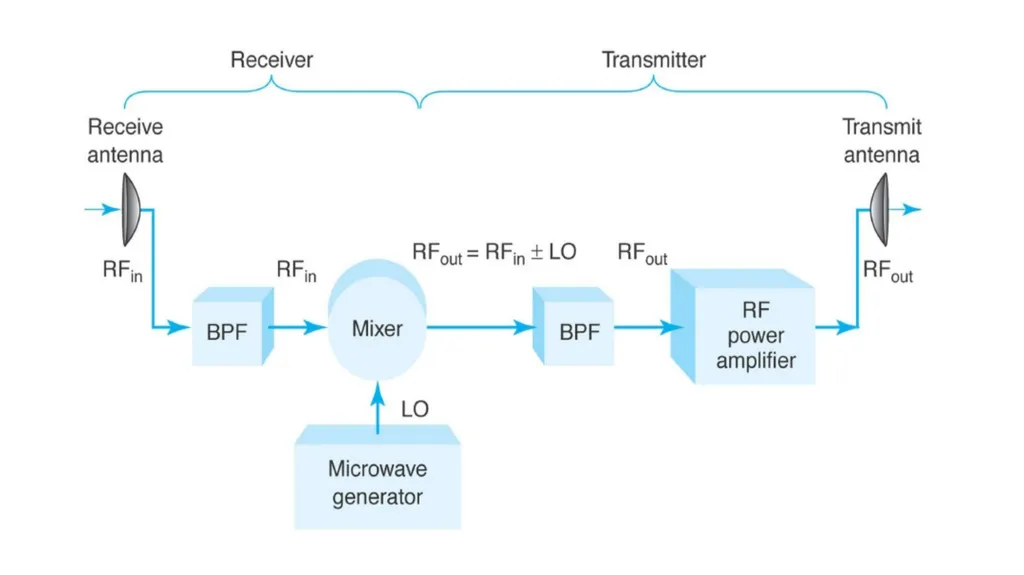
Electromagnetic Theory, therefore is the study of how charge distribution and current generate various fields and how these fields themselves interacts as well as how we harness or manage the electromagnetic energy in GENERATION (Transmitter), RADIATION (transmitting antenna), PROPAGATION (Free space or Vacuum) and INTERCEPTION (receiving antenna).
Transmission line theory is very important in the design of high speed digital or analogue system.
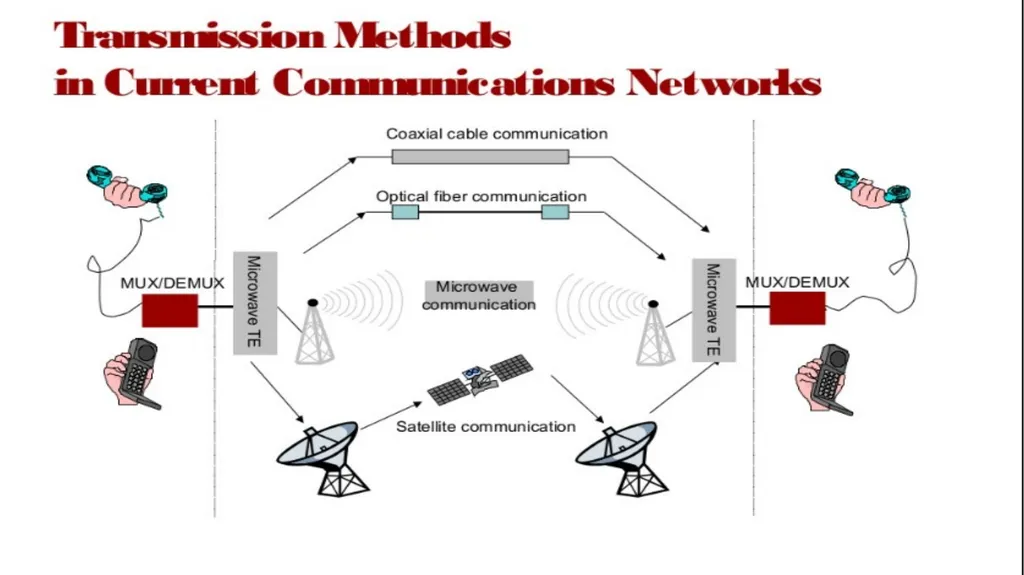
Microwave engineering concepts such as waveguides and fiber optics communication principles also employs Electromagnetic theory.<br>
05
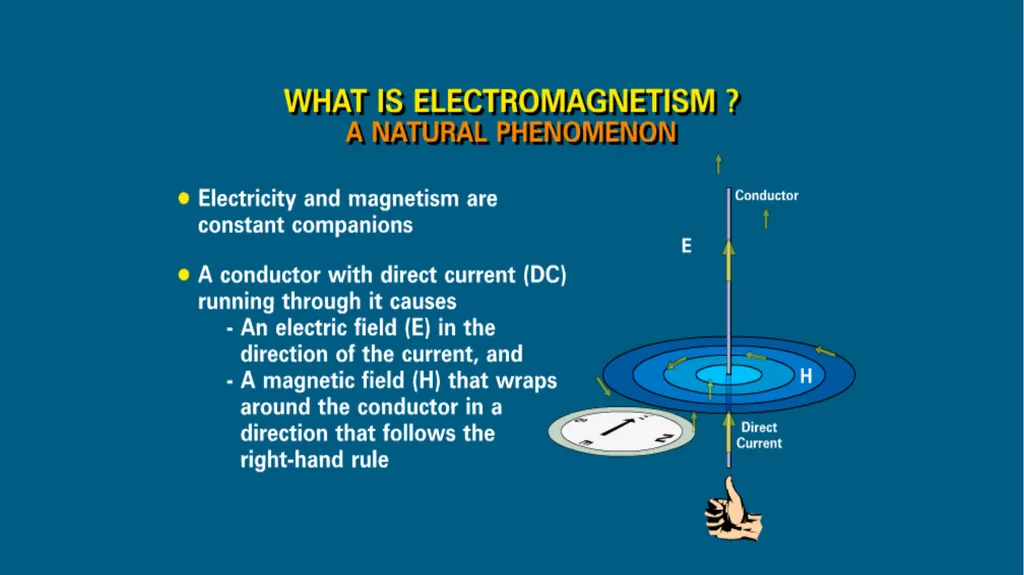
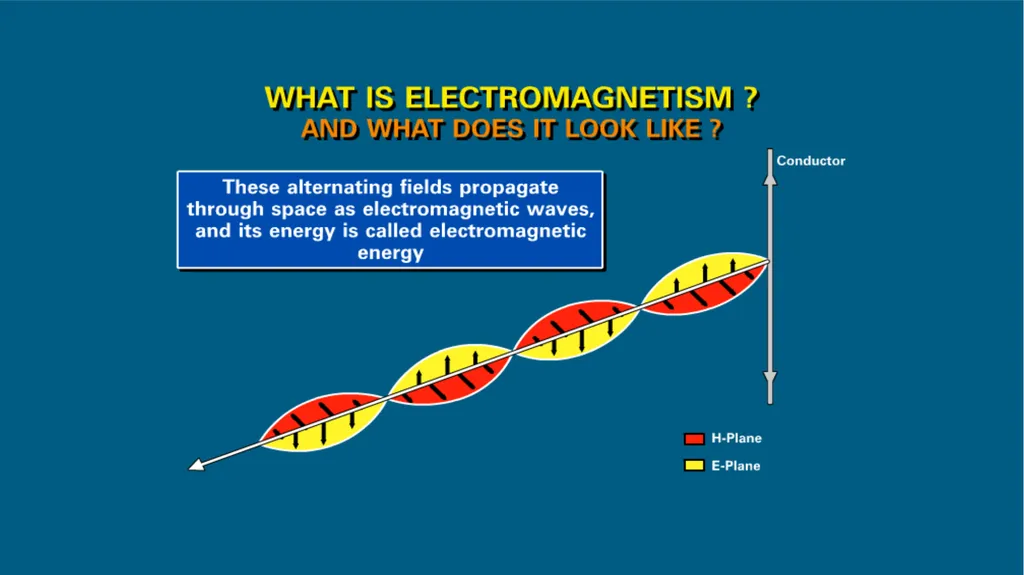
Electromagnetic field or Transverse Electro Magnetic wave, or TEM An electromagnetic field, sometimes referred to as an EM field, is generated when charged particles, such as electrons, are accelerated. All electrically charged particles are surrounded by electric fields. Charged particles in motion produce magnetic fields. When the velocity of a charged particle changes, an EM field is produced.
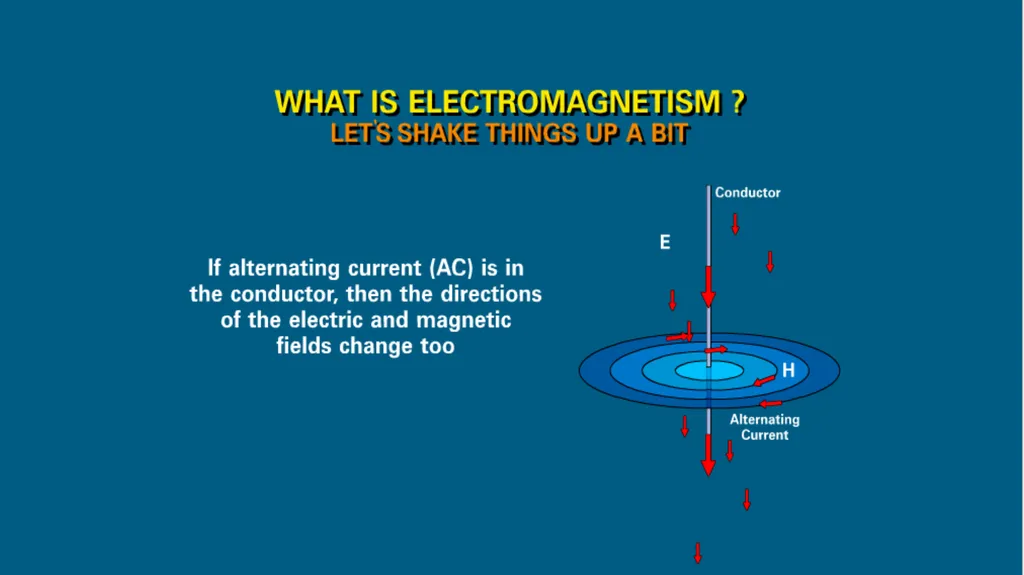
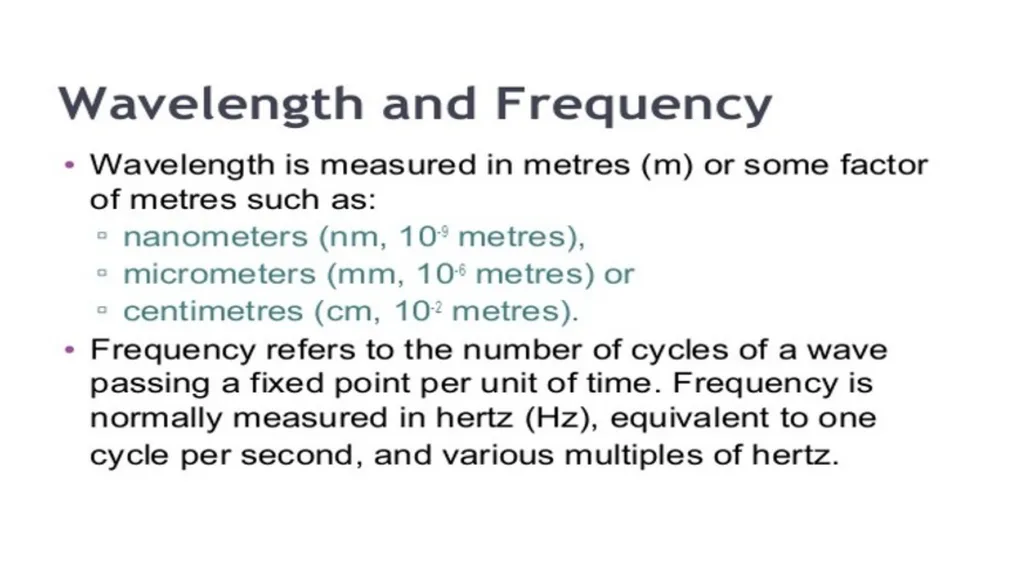
Electromagnetic fields are typically generated by alternating current (AC) in electrical conductors. The frequency of the AC can range from one cycle in thousands of years (at the low extreme) to trillions or quadrillions of cycles per second( at the high extreme). The standard unit of EM frequency is the hertz, abbreviated Hz. Larger units are often used. A frequency of 1,000 Hz is one kilohertz(kHz); a frequency of 1,000 kHz is one megahertz (MHz); a frequency of 1,000 MHz is one gigahertz (GHz).<br>
06
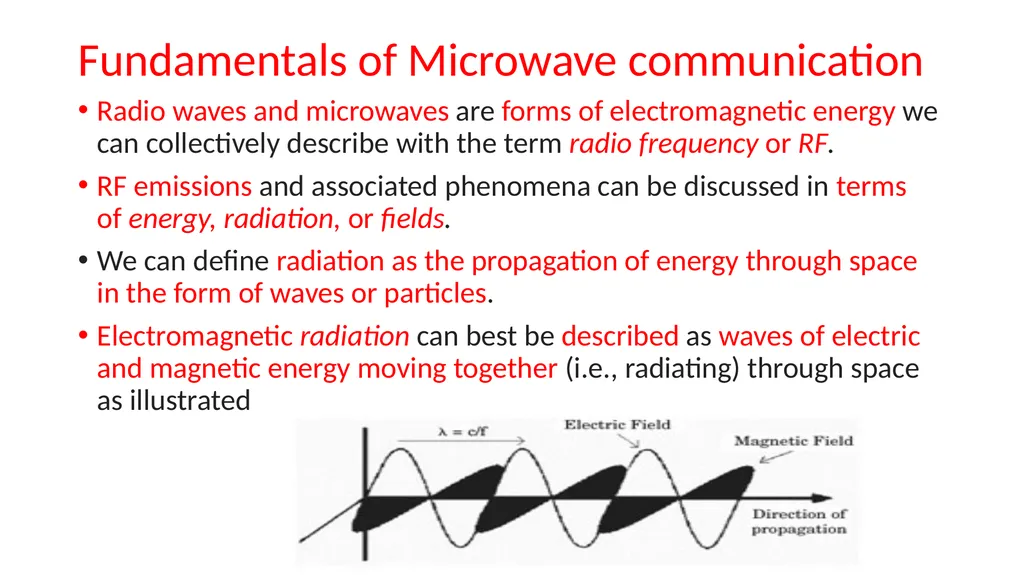
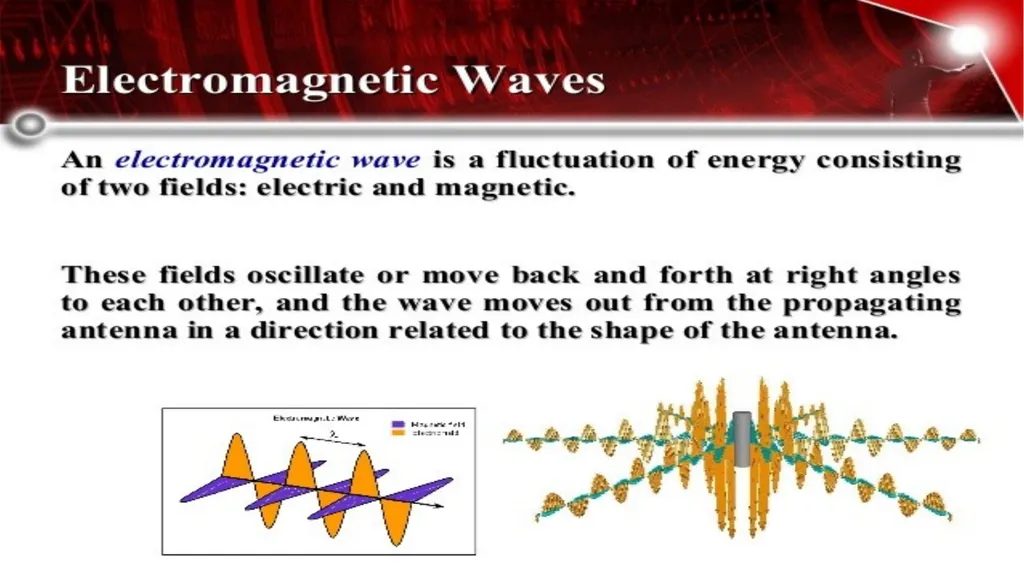
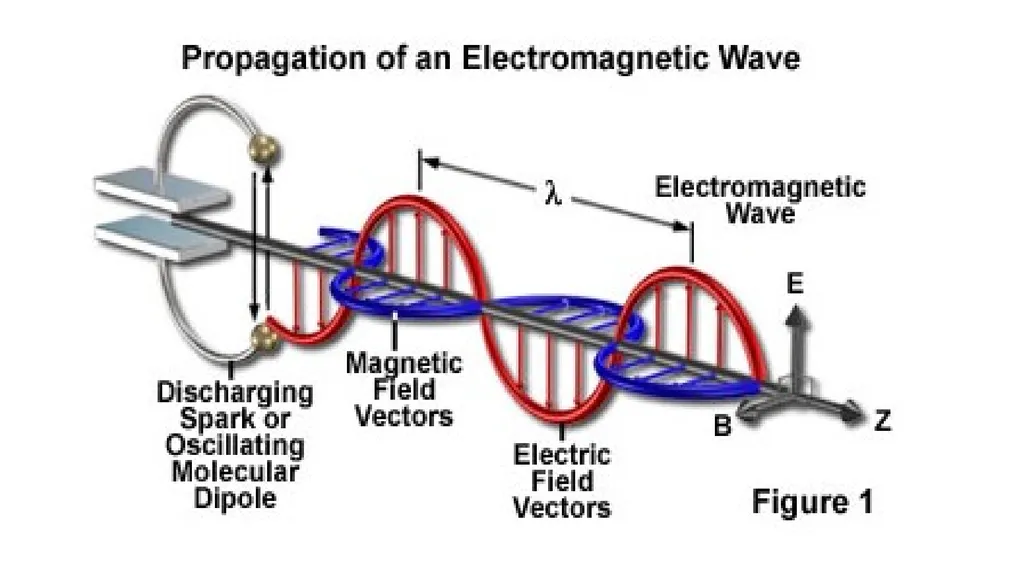
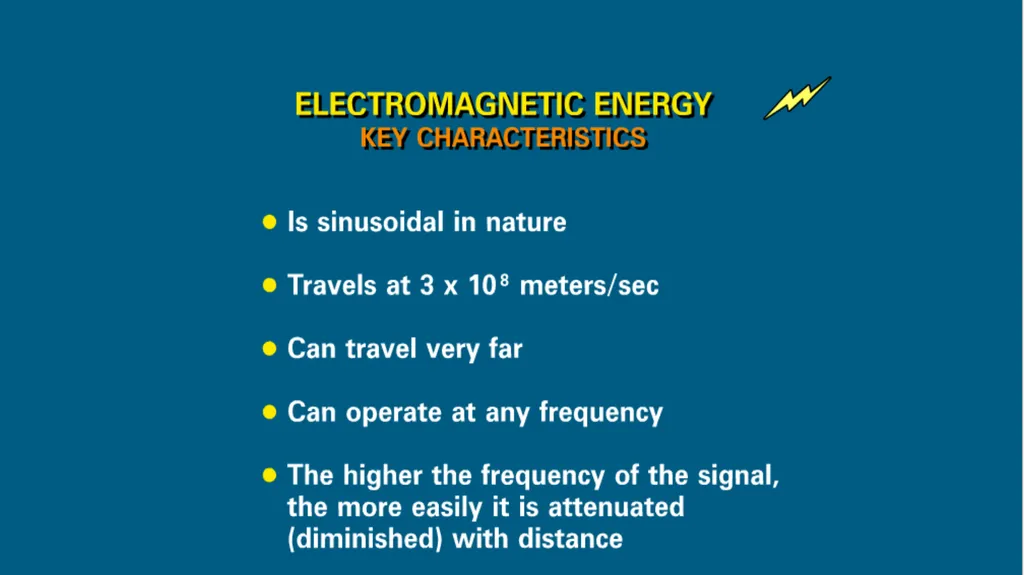
Electromagnetic wave theory Electromagnetic radiation consist of an electrical field (E) which varies in magnitude and a direction perpendicular to the direction in which the radiation is travelling, and a magnetic field (M) oriented at right angles to the electrical field.
Both of these fields travels at the speed of light [c]<br>
07
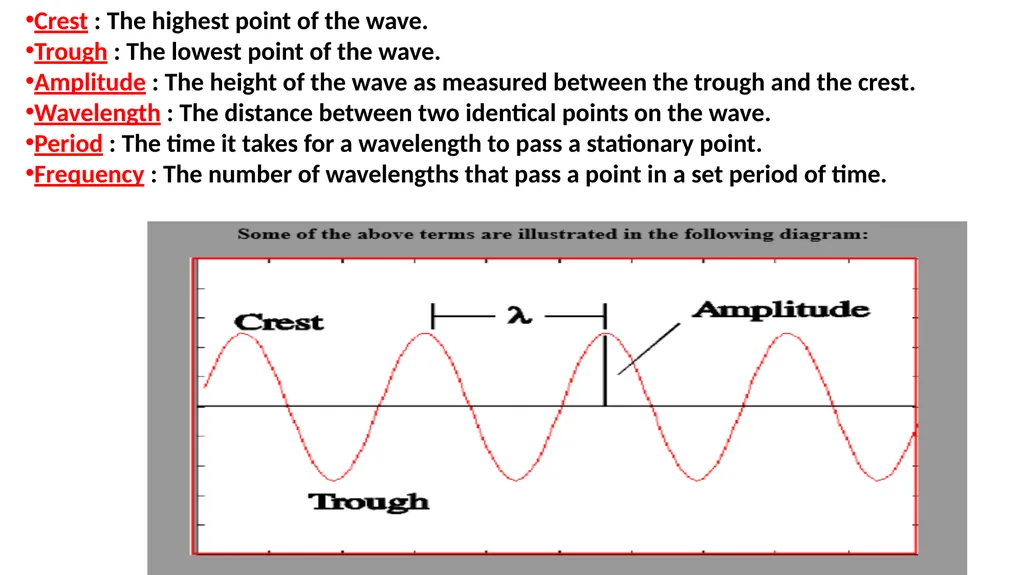
Crest : The highest point of the wave.
Trough : The lowest point of the wave.
Amplitude : The height of the wave as measured between the trough and the crest.
Wavelength : The distance between two identical points on the wave.
Period : The time it takes for a wavelength to pass a stationary point.
Frequency : The number of wavelengths that pass a point in a set period of time.<br>
08
The wavelength of an EM field is related to the frequency. If the frequency f of an EM wave is specified in megahertz and the wavelength λ is specified in meters (m), then in free space, the two are related according to the formula λ = 300/f<br>
09
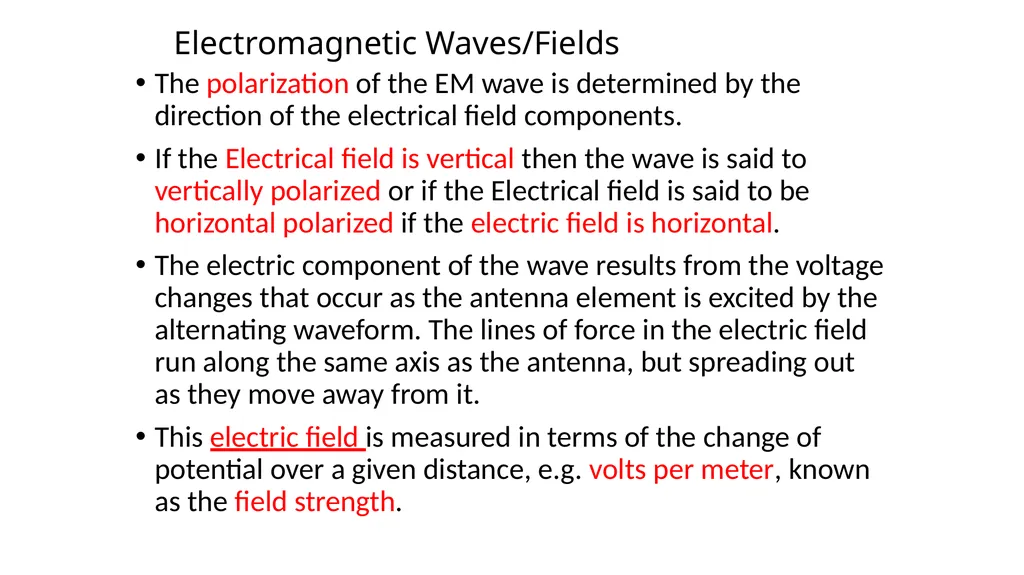
Electromagnetic Waves/Fields The polarization of the EM wave is determined by the direction of the electrical field components.
If the Electrical field is vertical then the wave is said to vertically polarized or if the Electrical field is said to be horizontal polarized if the electric field is horizontal.
The electric component of the wave results from the voltage changes that occur as the antenna element is excited by the alternating waveform. The lines of force in the electric field run along the same axis as the antenna, but spreading out as they move away from it.
This electric field is measured in terms of the change of potential over a given distance, e.g. volts per meter, known as the field strength.<br>
10
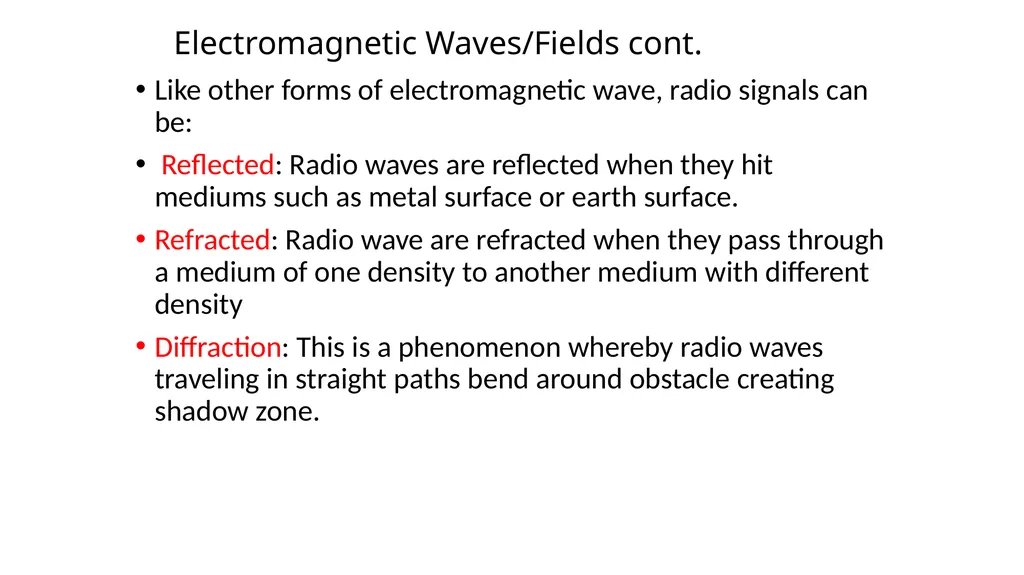
Electromagnetic Waves/Fields cont. Like other forms of electromagnetic wave, radio signals can be:
Reflected: Radio waves are reflected when they hit mediums such as metal surface or earth surface.
Refracted: Radio wave are refracted when they pass through a medium of one density to another medium with different density
Diffraction: This is a phenomenon whereby radio waves traveling in straight paths bend around obstacle creating shadow zone.<br>
11
Videos on Electromagnetic spectrum (EMS) https://www.youtube.com/watch?v=cfXzwh3KadE
https://www.youtube.com/watch?v=41Q6FeO-_8I
https://www.youtube.com/watch?v=54JYvB3CBc8
https://www.youtube.com/watch?v=pJSDFbCr-Qc<br>
12
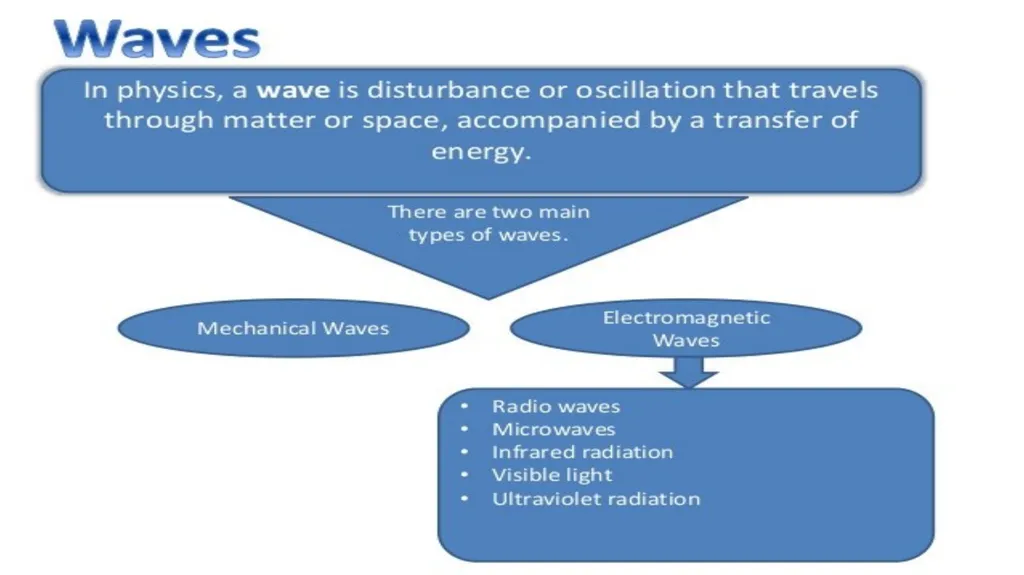
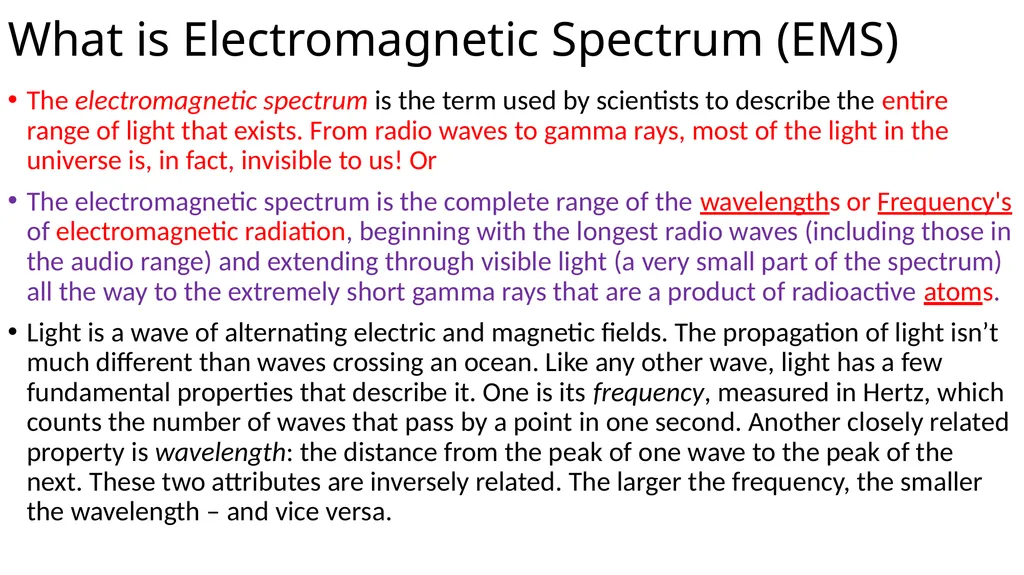
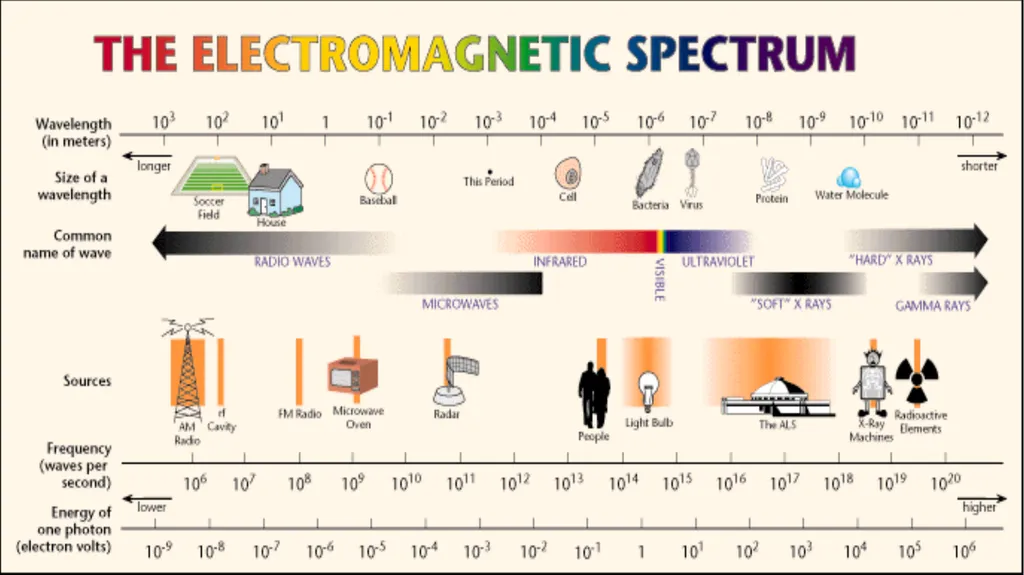
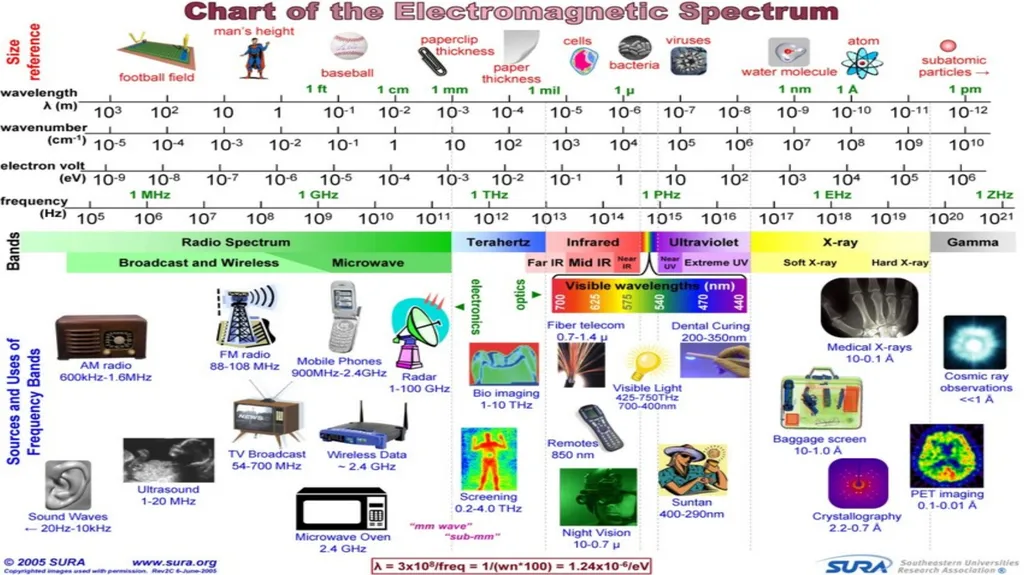
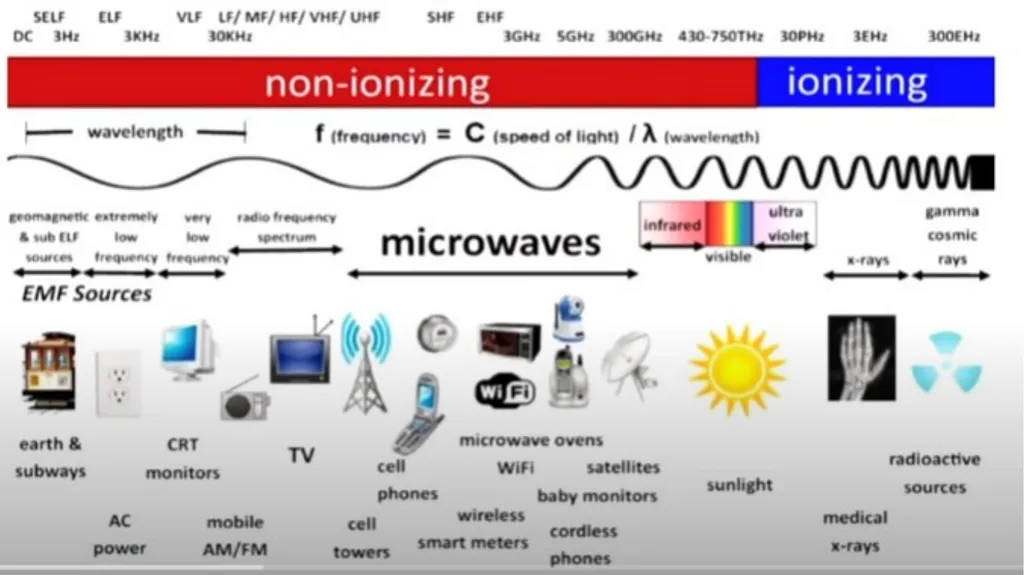
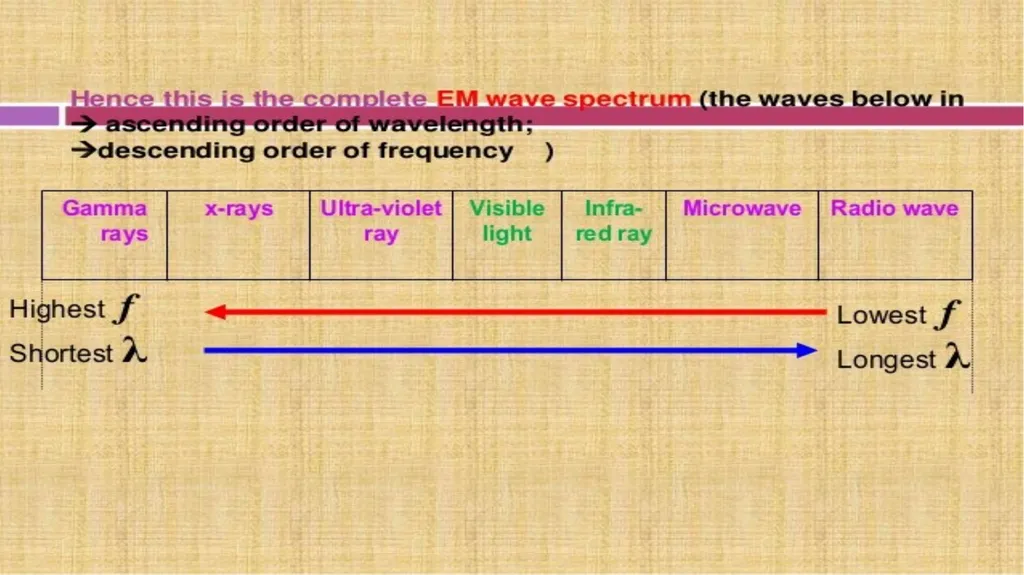
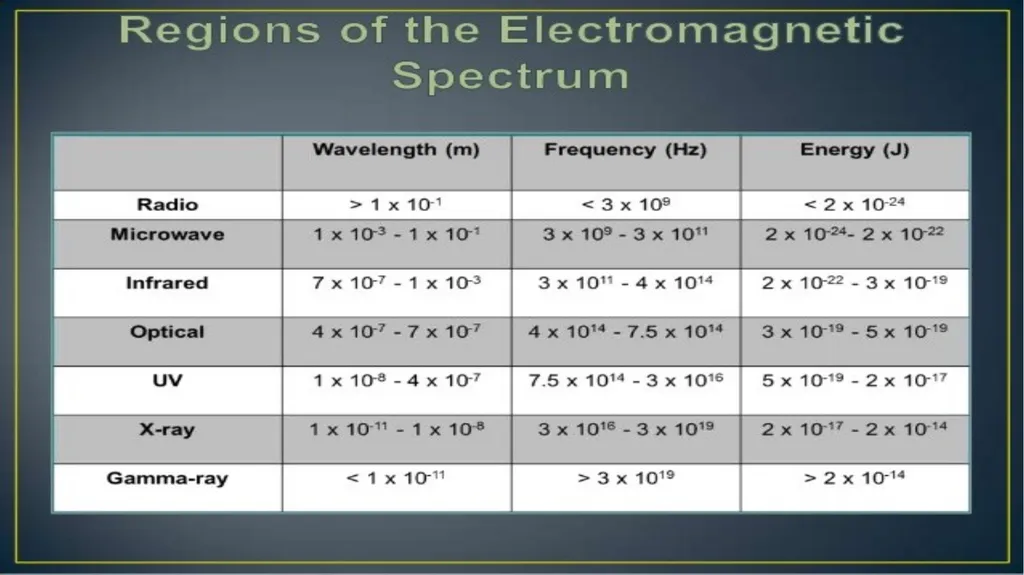
What is Electromagnetic Spectrum (EMS) The electromagnetic spectrum is the term used by scientists to describe the entire range of light that exists. From radio waves to gamma rays, most of the light in the universe is, in fact, invisible to us! Or
The electromagnetic spectrum is the complete range of the wavelengths or Frequency's of electromagnetic radiation, beginning with the longest radio waves (including those in the audio range) and extending through visible light (a very small part of the spectrum) all the way to the extremely short gamma rays that are a product of radioactive atoms.
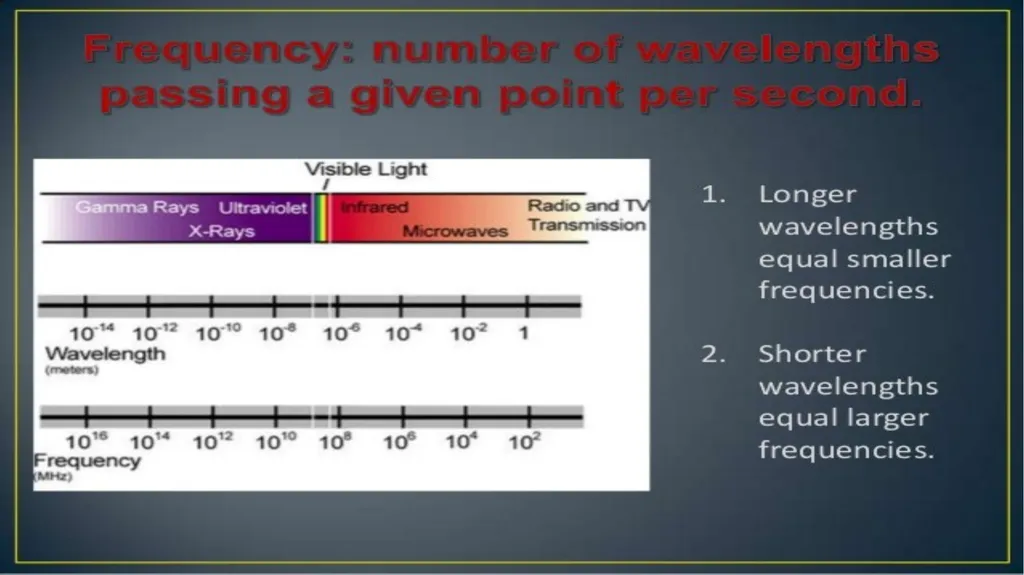
Light is a wave of alternating electric and magnetic fields. The propagation of light isn’t much different than waves crossing an ocean. Like any other wave, light has a few fundamental properties that describe it. One is its frequency, measured in Hertz, which counts the number of waves that pass by a point in one second. Another closely related property is wavelength: the distance from the peak of one wave to the peak of the next. These two attributes are inversely related. The larger the frequency, the smaller the wavelength – and vice versa.<br>
13
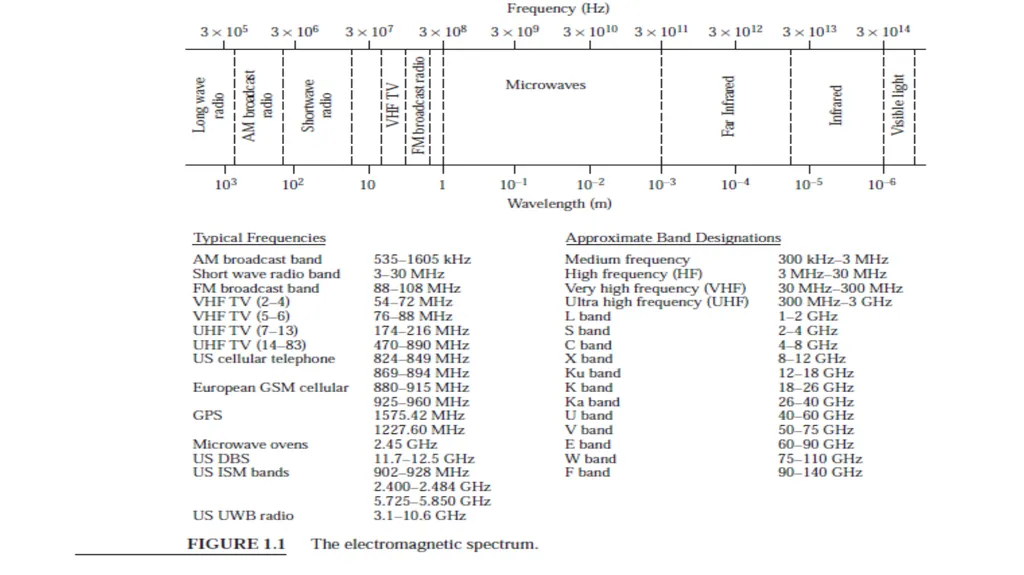
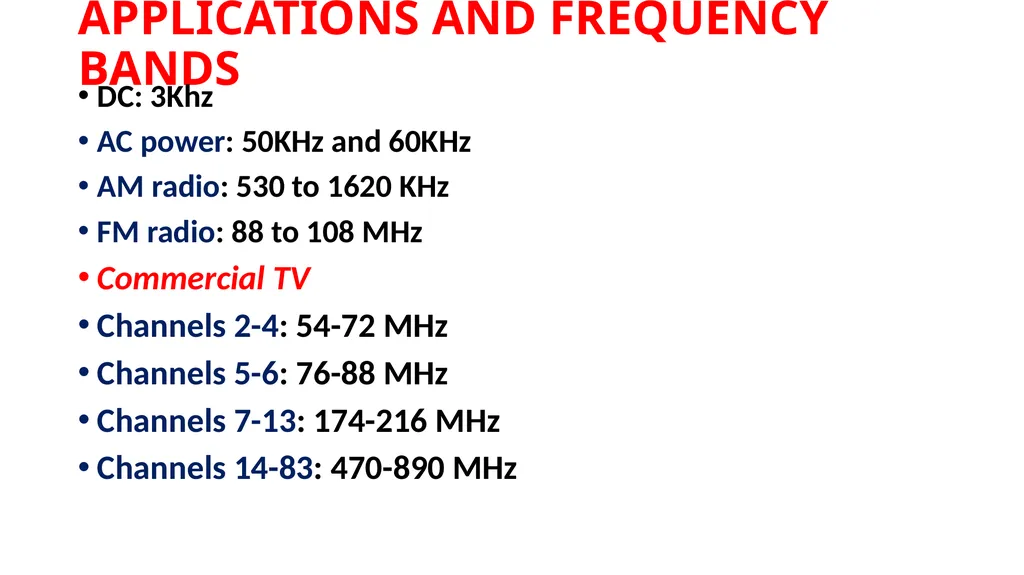
APPLICATIONS AND FREQUENCY BANDS DC: 3Khz
AC power: 50KHz and 60KHz
AM radio: 530 to 1620 KHz
FM radio: 88 to 108 MHz
Commercial TV
Channels 2-4: 54-72 MHz
Channels 5-6: 76-88 MHz
Channels 7-13: 174-216 MHz
Channels 14-83: 470-890 MHz<br>
14
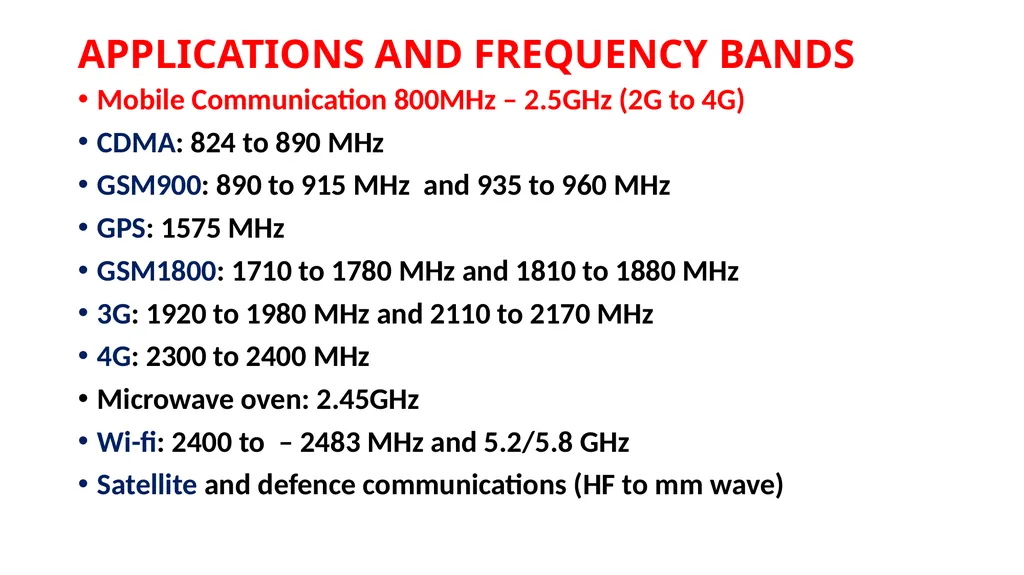
APPLICATIONS AND FREQUENCY BANDS Mobile Communication 800MHz – 2.5GHz (2G to 4G)
CDMA: 824 to 890 MHz
GSM900: 890 to 915 MHz and 935 to 960 MHz
GPS: 1575 MHz
GSM1800: 1710 to 1780 MHz and 1810 to 1880 MHz
3G: 1920 to 1980 MHz and 2110 to 2170 MHz
4G: 2300 to 2400 MHz
Microwave oven: 2.45GHz
Wi-fi: 2400 to – 2483 MHz and 5.2/5.8 GHz
Satellite and defence communications (HF to mm wave)<br>
15
Historical fact about Electromagnetic wave, radio communication and Transmission lines. https://en.wikipedia.org/wiki/Electromagnetism#History_of_the_theory
https://en.wikipedia.org/wiki/History_of_radio
https://en.wikipedia.org/wiki/Transmission_line<br>
16
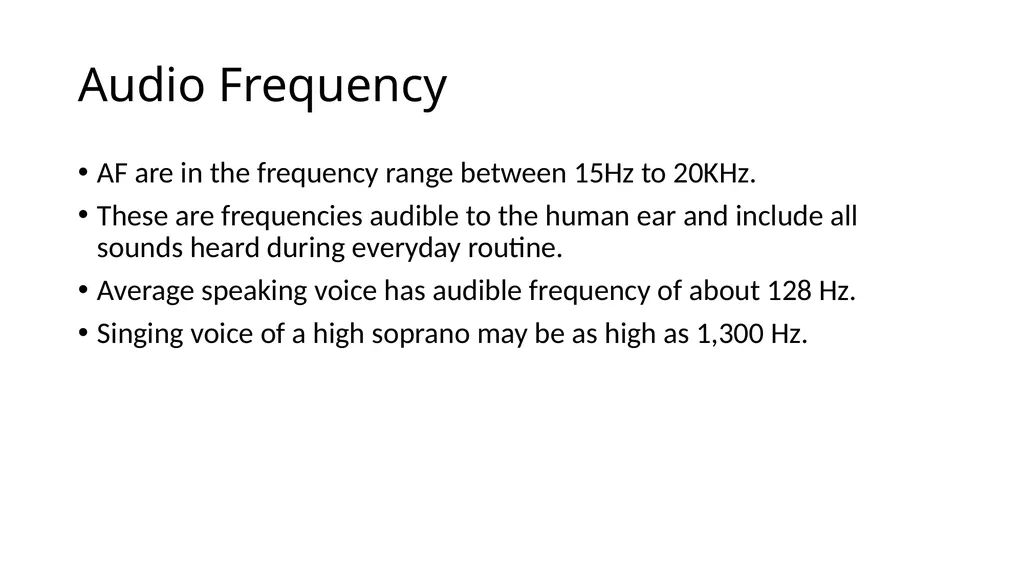
Audio Frequency AF are in the frequency range between 15Hz to 20KHz.
These are frequencies audible to the human ear and include all sounds heard during everyday routine.
Average speaking voice has audible frequency of about 128 Hz.
Singing voice of a high soprano may be as high as 1,300 Hz.<br>
17
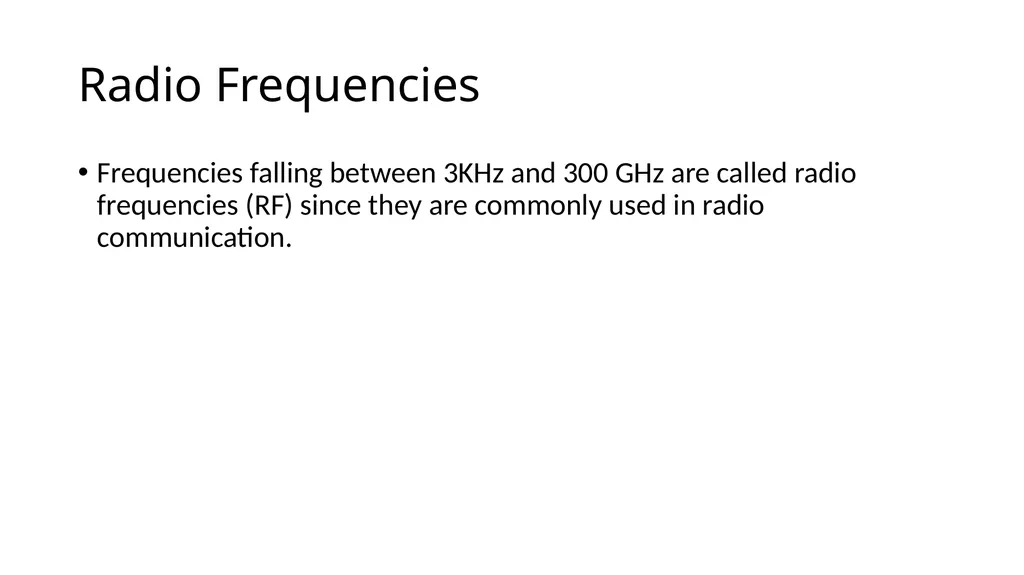
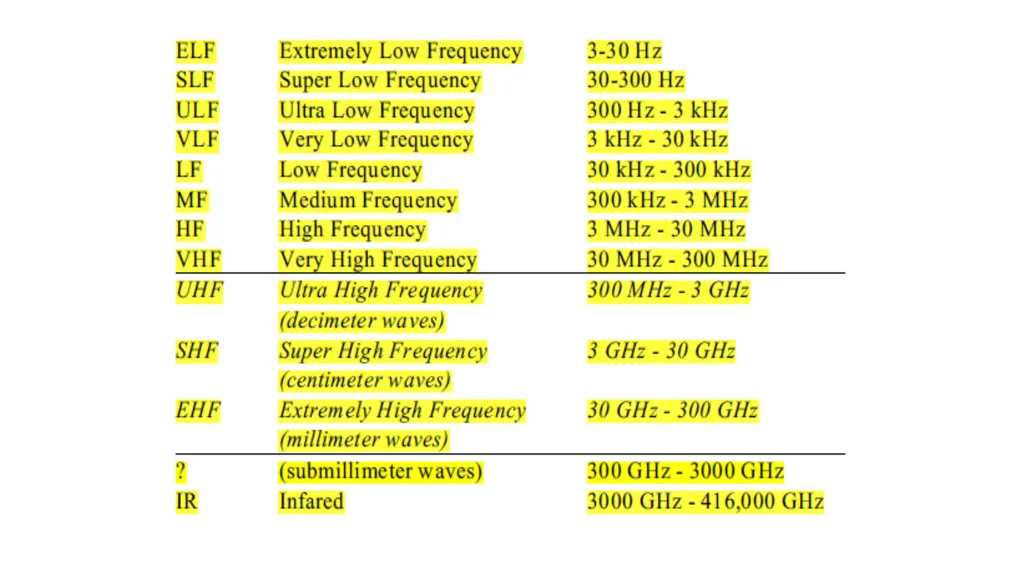
Radio Frequencies Frequencies falling between 3KHz and 300 GHz are called radio frequencies (RF) since they are commonly used in radio communication.<br>
18
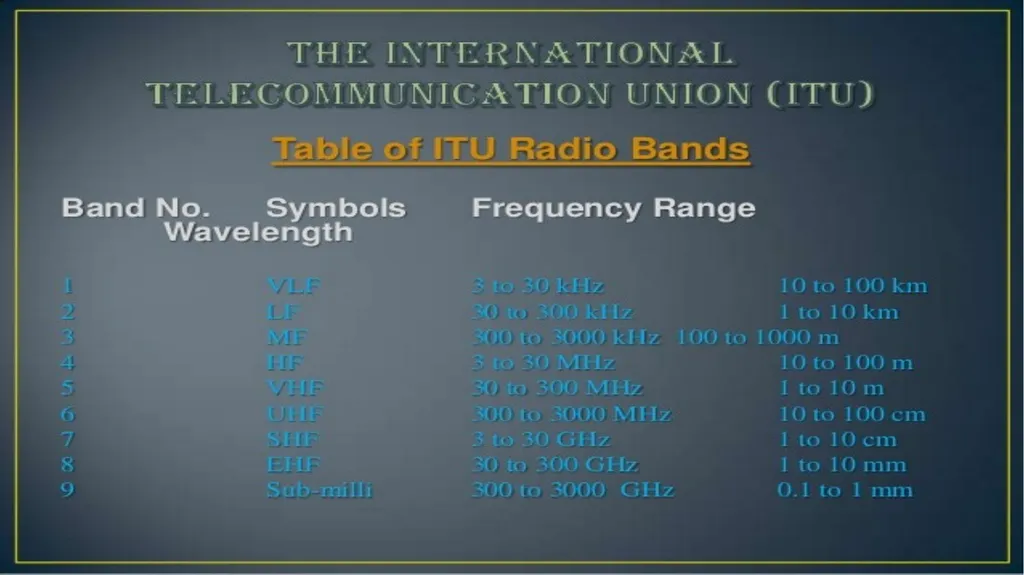
Low – Frequency (LF) :
30 KHz to 300 KHz.
Applications include
Radio Navigation
Underwater submarine communication
Aeronautical radio navigation
Fixed/ maritime communications
Low frequency broadcasting
Power lines frequencies 50 & 60 Hz<br>
19
Medium Frequency (MF):
300 KHz to 3 MHz.
Applications include
AM radio broadcasting (535.5 - 1605.5 k Hz) Radio navigation
Fixed / maritime communications
Aeronautical radio navigation
Fixed and mobile communications,
Amateur radio<br>
20
High Frequency (HF) :
3 MHz to 30 MHz.
Applications include
Shortwave broadcasting
Fixed mobile service
Telemetry
Amateur radio
Fixed/maritime mobile
Radio astronomy
Aeronautical fixed and mobile.<br>
21
Very High Frequency (VHF)
30 MHz to 300MHz.
Applications include
FM radio broadcasting (88-108 MHz)
Low band VHF television broadcasting.
High band VHF television broadcasting
Commercial fixed and mobile radio
Aeronautical radio navigation
Space research Fixed/ maritime mobile<br>
22
MICROWAVE SPECTRUM<br>
23
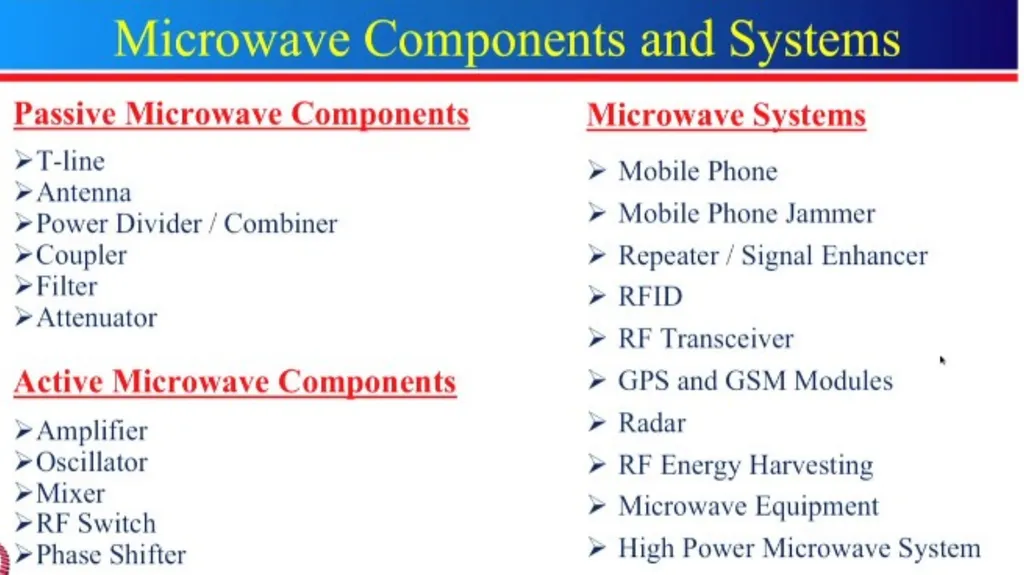
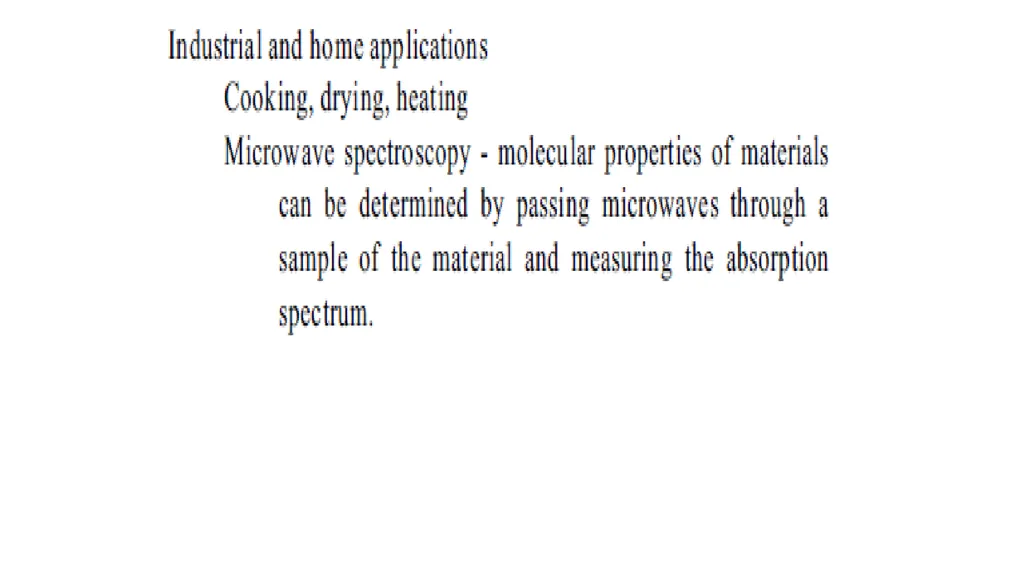
Definition of Microwave Microwave
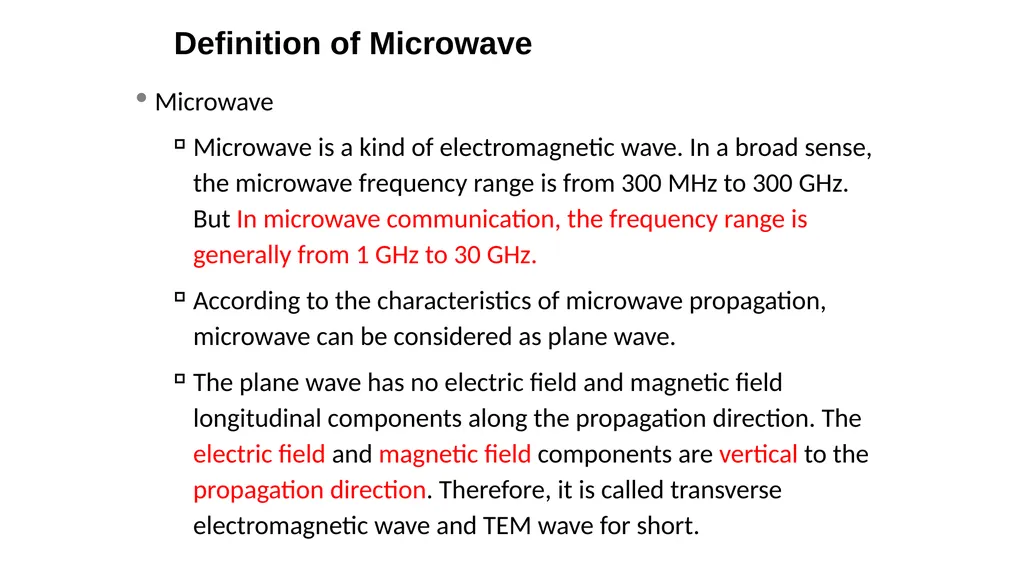
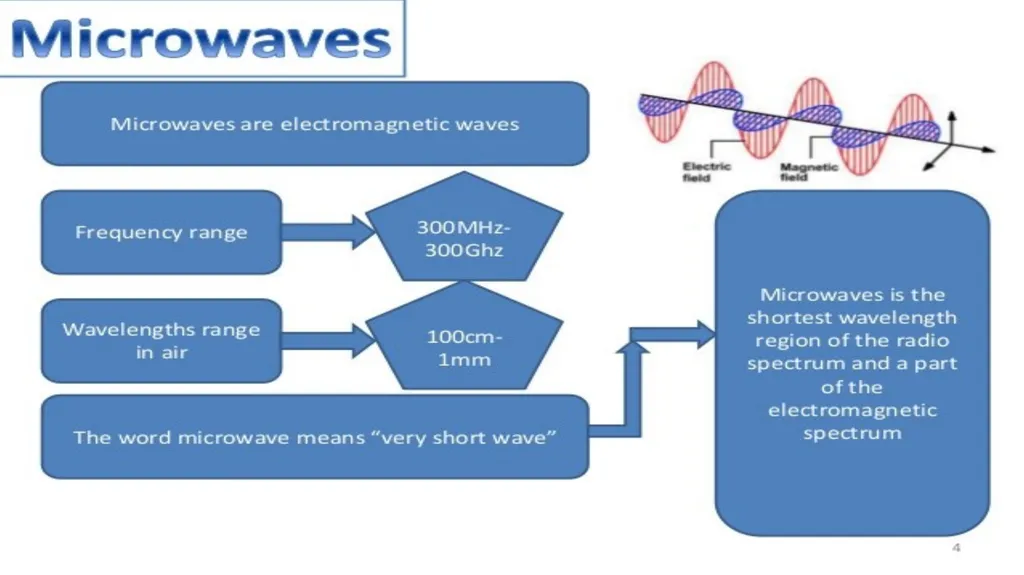
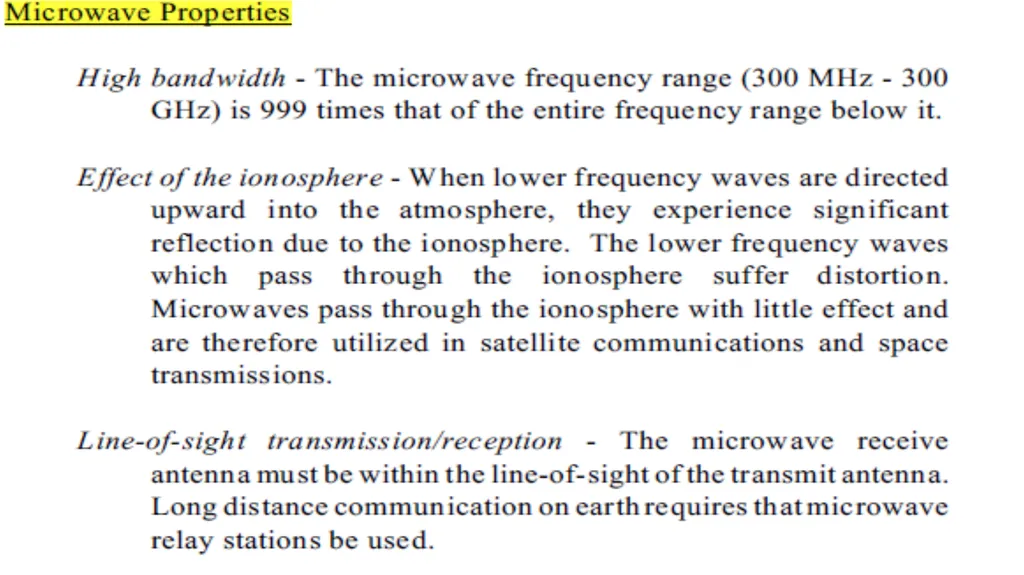
Microwave is a kind of electromagnetic wave. In a broad sense, the microwave frequency range is from 300 MHz to 300 GHz. But In microwave communication, the frequency range is generally from 1 GHz to 30 GHz.
According to the characteristics of microwave propagation, microwave can be considered as plane wave.
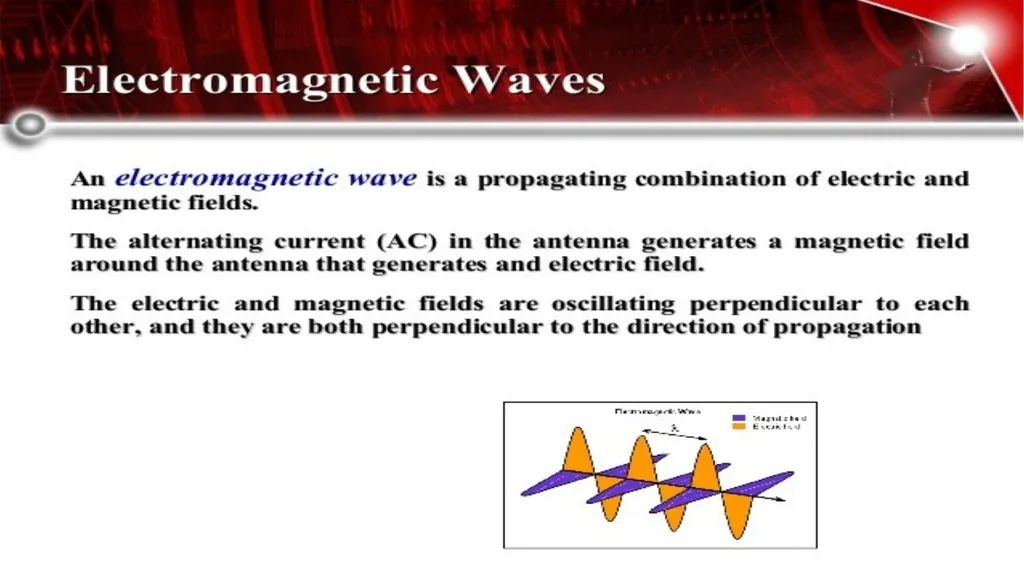
The plane wave has no electric field and magnetic field longitudinal components along the propagation direction. The electric field and magnetic field components are vertical to the propagation direction. Therefore, it is called transverse electromagnetic wave and TEM wave for short.<br>
24
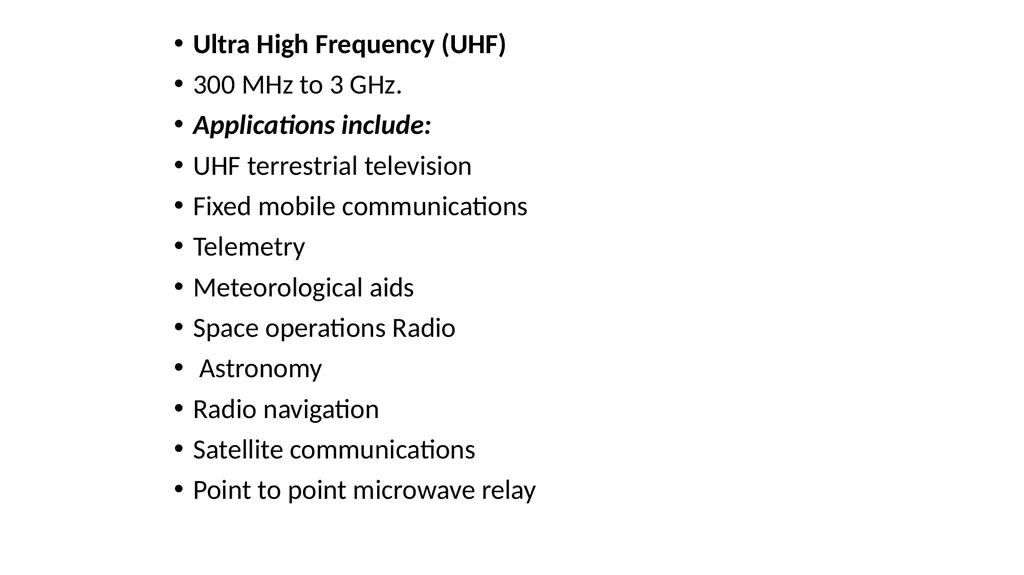
Ultra High Frequency (UHF)
300 MHz to 3 GHz.
Applications include:
UHF terrestrial television
Fixed mobile communications
Telemetry
Meteorological aids
Space operations Radio
Astronomy
Radio navigation
Satellite communications
Point to point microwave relay<br>
25
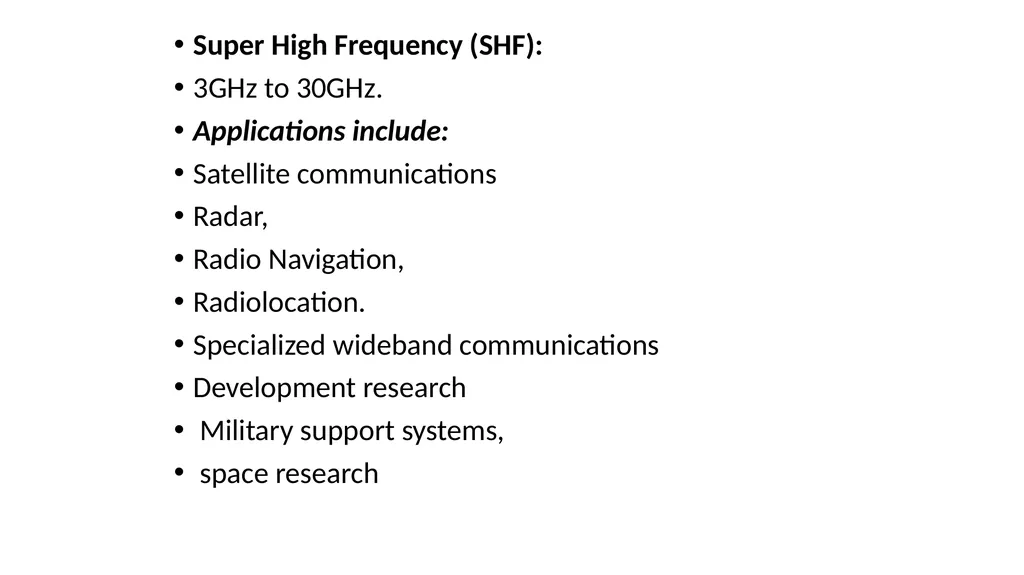
Super High Frequency (SHF):
3GHz to 30GHz.
Applications include:
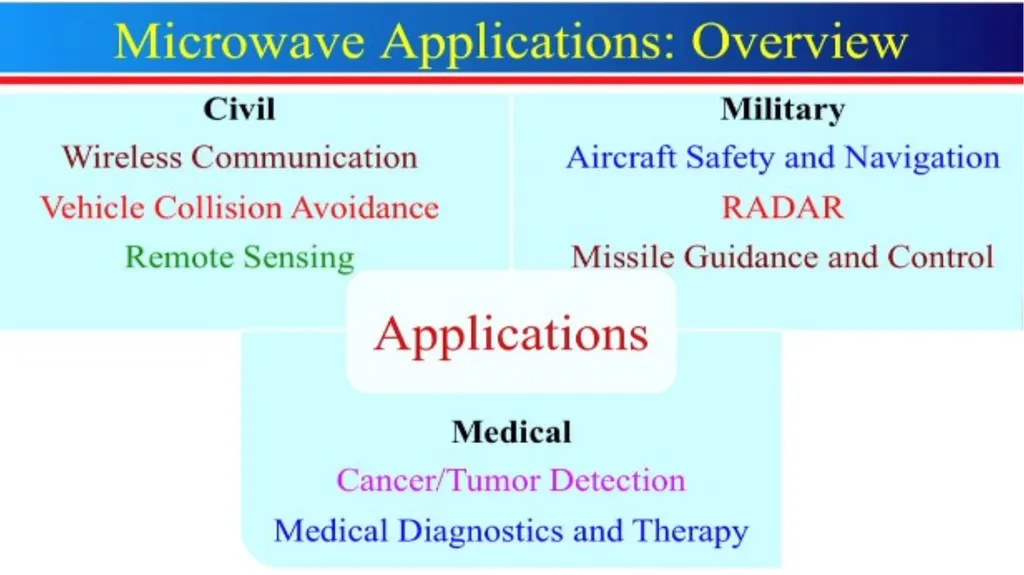
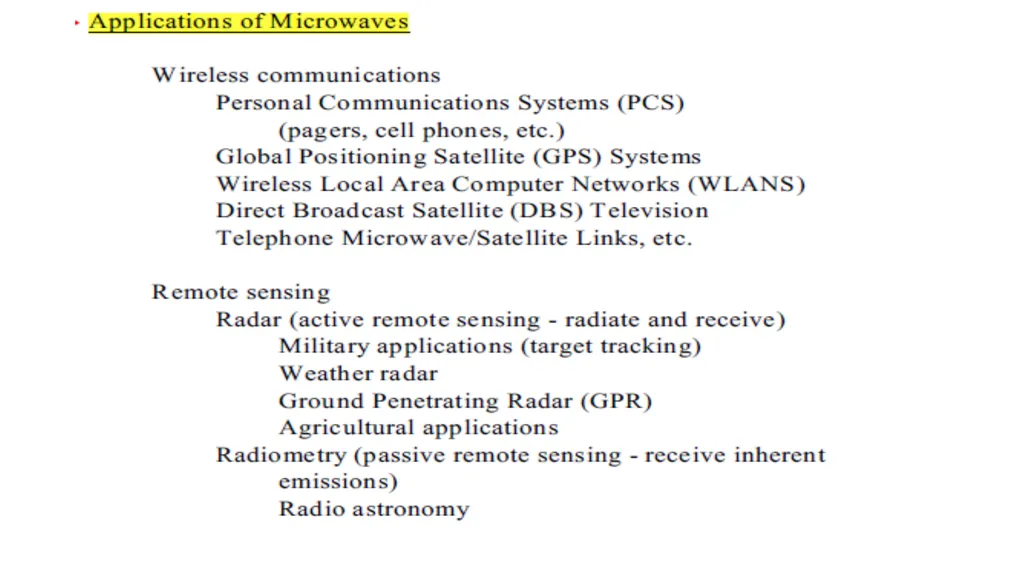
Satellite communications
Radar,
Radio Navigation,
Radiolocation.
Specialized wideband communications
Development research
Military support systems,
space research<br>
26
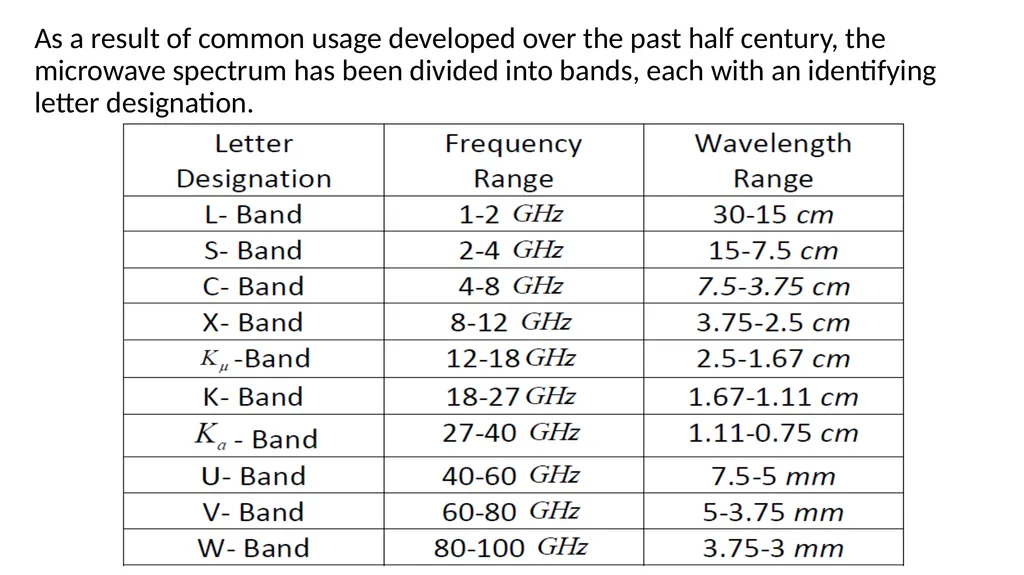
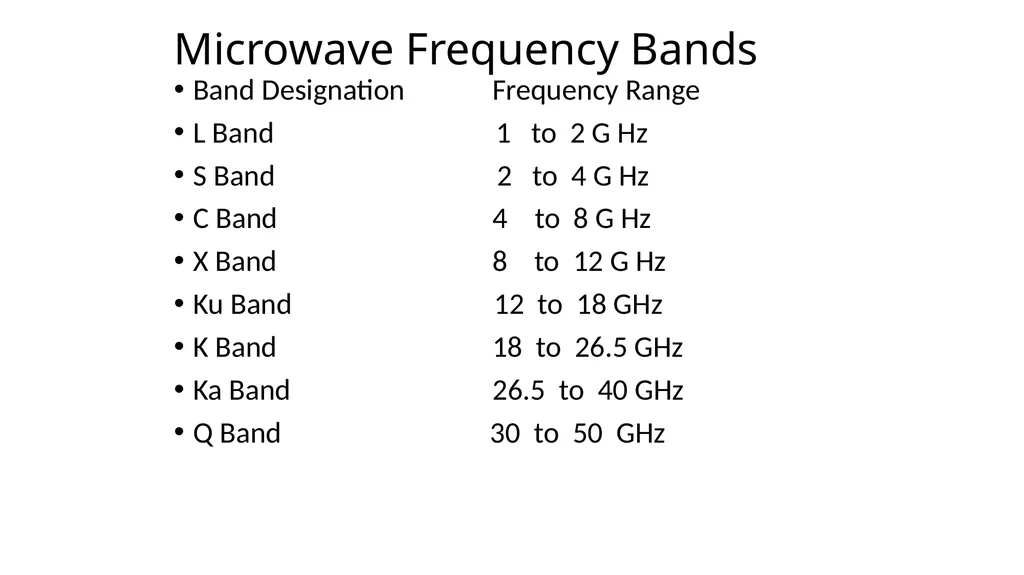
As a result of common usage developed over the past half century, the microwave spectrum has been divided into bands, each with an identifying letter designation.<br>
27
Microwave Frequency Bands Band Designation Frequency Range
L Band 1 to 2 G Hz
S Band 2 to 4 G Hz
C Band 4 to 8 G Hz
X Band 8 to 12 G Hz
Ku Band 12 to 18 GHz
K Band 18 to 26.5 GHz
Ka Band 26.5 to 40 GHz
Q Band 30 to 50 GHz<br>
28
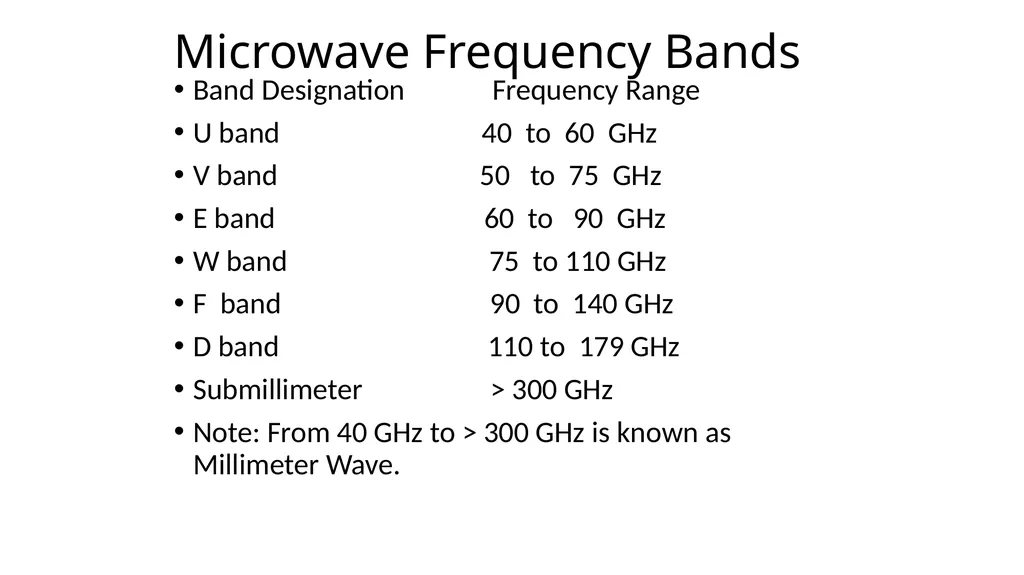
Microwave Frequency Bands Band Designation Frequency Range
U band 40 to 60 GHz
V band 50 to 75 GHz
E band 60 to 90 GHz
W band 75 to 110 GHz
F band 90 to 140 GHz
D band 110 to 179 GHz
Submillimeter > 300 GHz
Note: From 40 GHz to > 300 GHz is known as Millimeter Wave.<br>
29
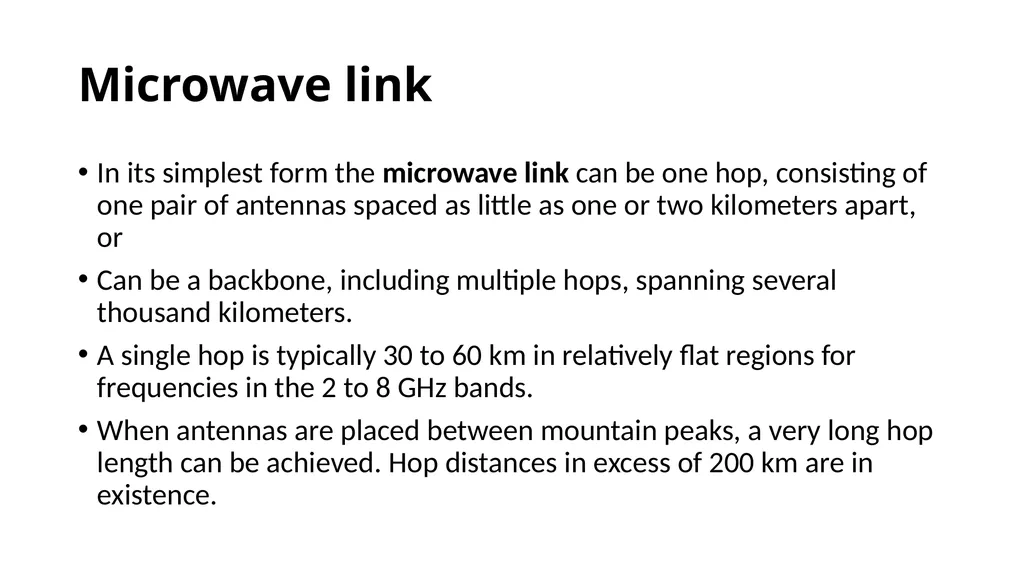
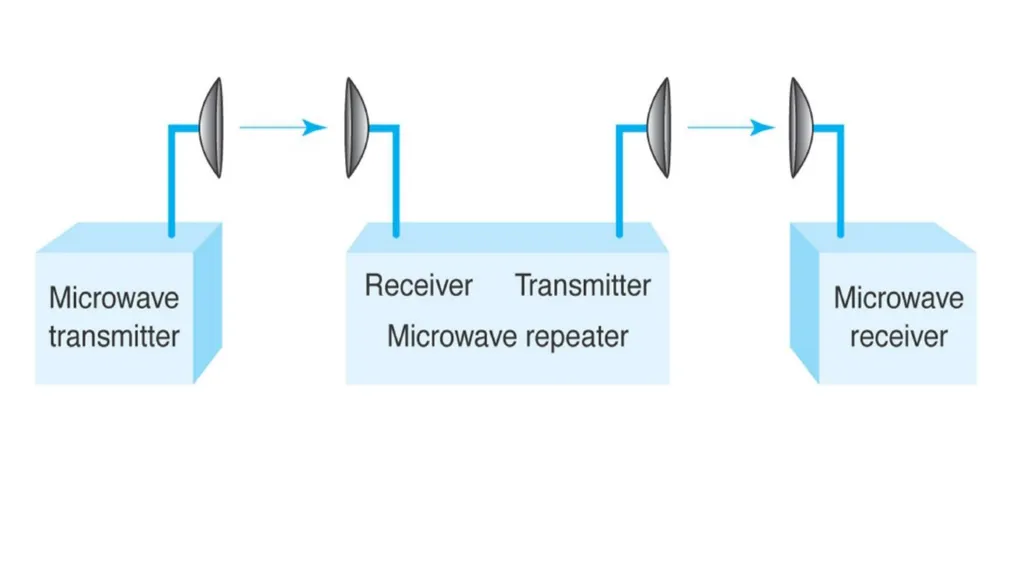
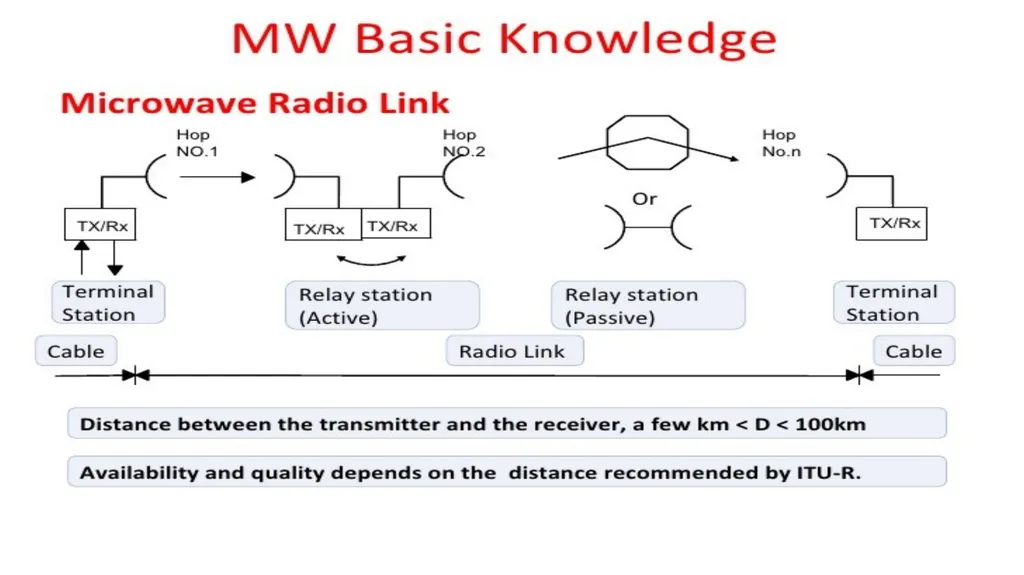
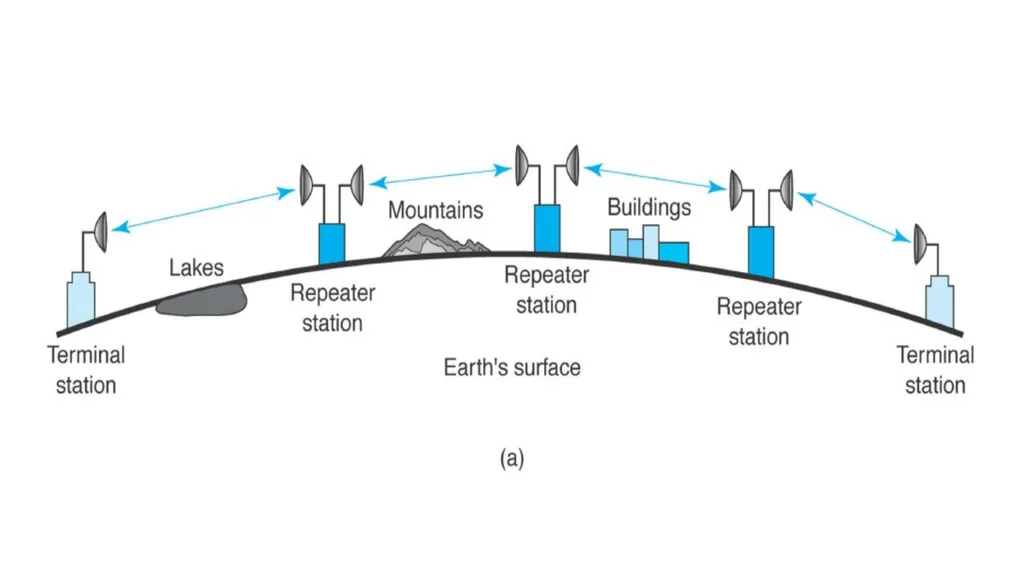
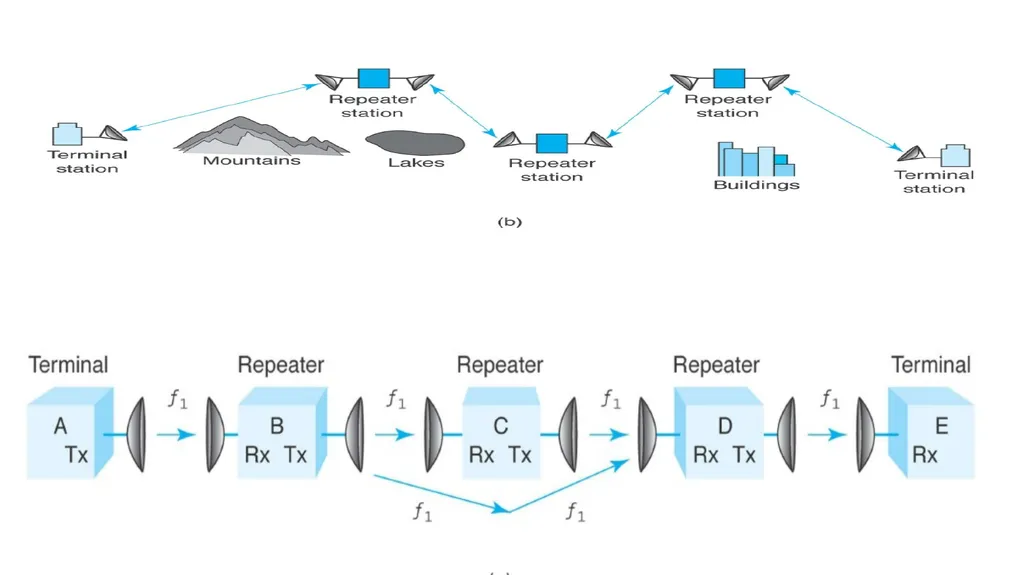
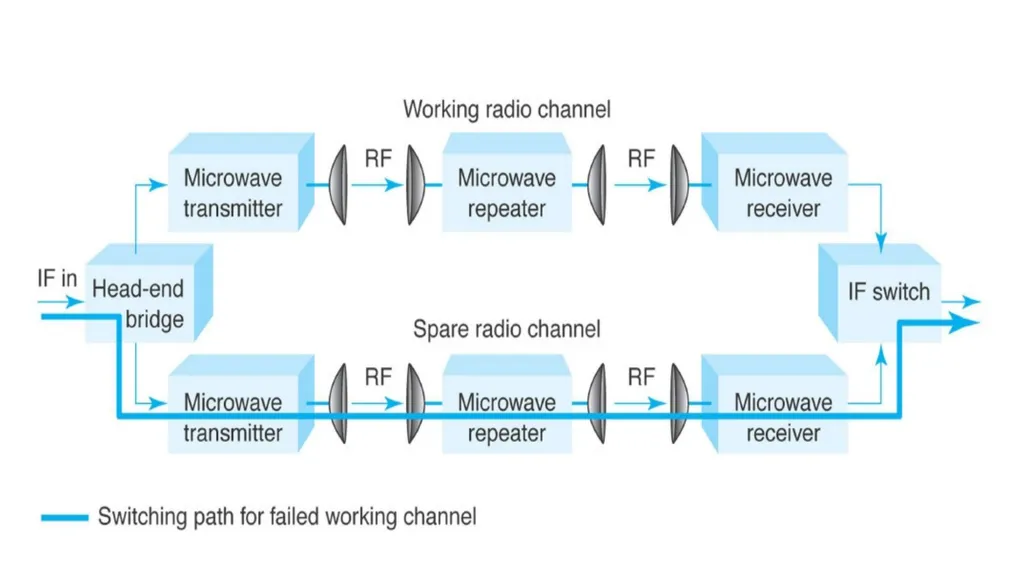
Microwave link In its simplest form the microwave link can be one hop, consisting of one pair of antennas spaced as little as one or two kilometers apart, or
Can be a backbone, including multiple hops, spanning several thousand kilometers.
A single hop is typically 30 to 60 km in relatively flat regions for frequencies in the 2 to 8 GHz bands.
When antennas are placed between mountain peaks, a very long hop length can be achieved. Hop distances in excess of 200 km are in existence.<br>
30
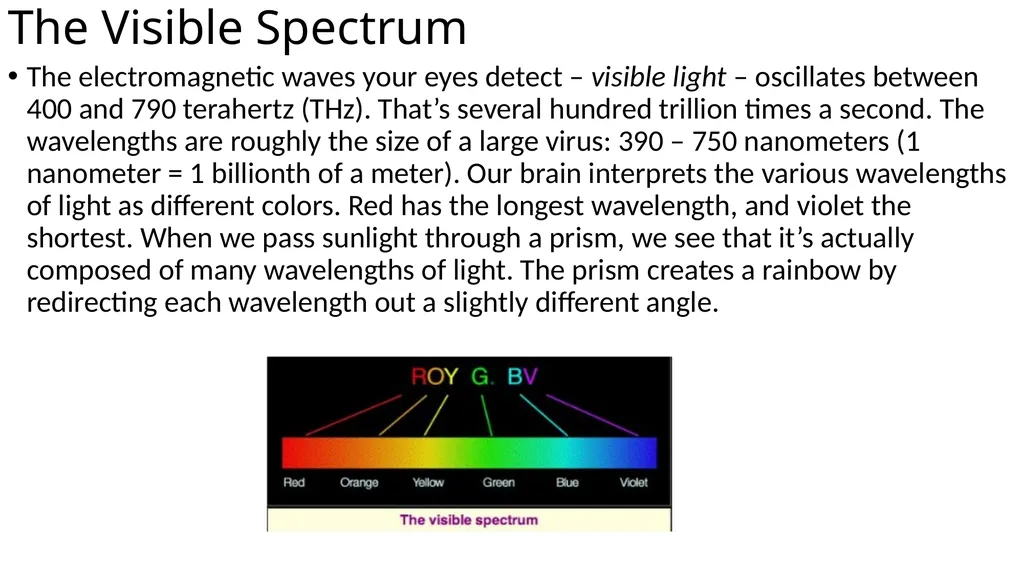
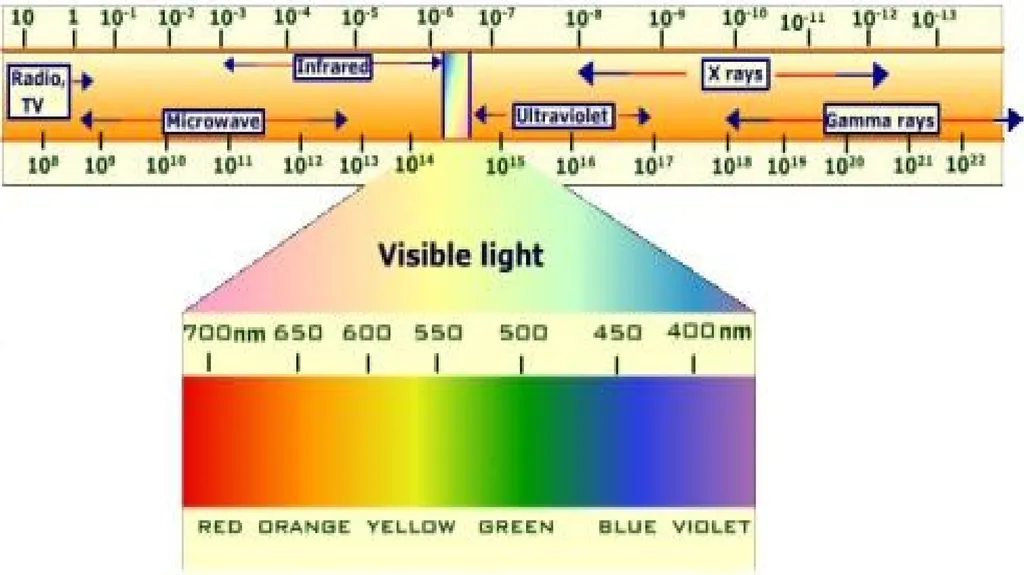
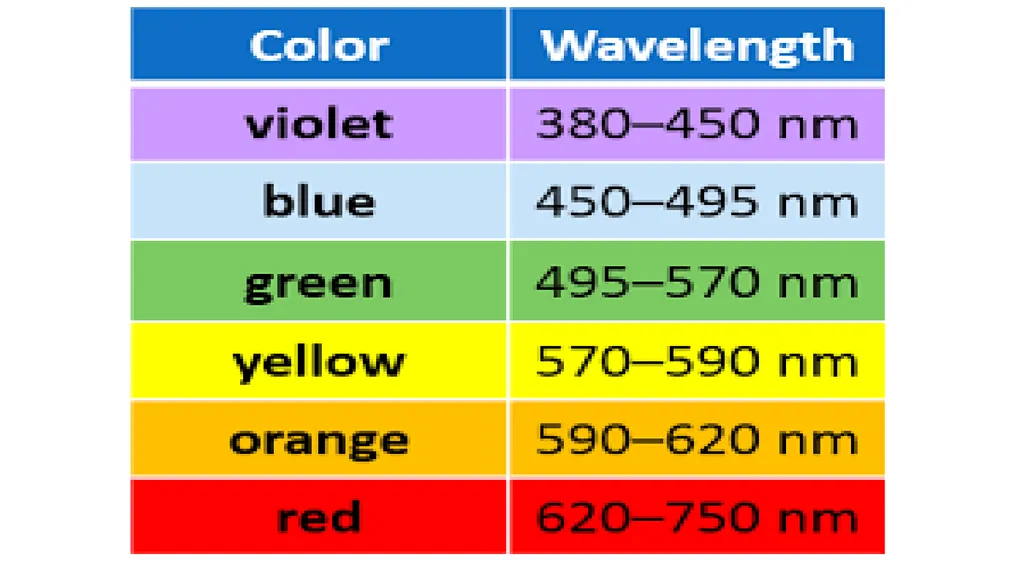
The Visible Spectrum The electromagnetic waves your eyes detect – visible light – oscillates between 400 and 790 terahertz (THz). That’s several hundred trillion times a second. The wavelengths are roughly the size of a large virus: 390 – 750 nanometers (1 nanometer = 1 billionth of a meter). Our brain interprets the various wavelengths of light as different colors. Red has the longest wavelength, and violet the shortest. When we pass sunlight through a prism, we see that it’s actually composed of many wavelengths of light. The prism creates a rainbow by redirecting each wavelength out a slightly different angle.<br>
31
The Visible Spectrum But light doesn’t stop at red or violet. Just like there are sounds we can’t hear (but other animals can), there is also an enormous range of light that our eyes can’t detect. In general, the longer wavelengths come from the coolest and darkest regions of space. Meanwhile, the shorter wavelengths measure extremely energetic phenomena.<br>
32
Assignment 1. EEE409 What is Electromagnetic Frequency spectrum? Why do we have to manage it effectively or efficiently.
2. What is the role of ITU in efficient management of electromagnetic spectrum.
3.What is the frequency range within which microwave systems are employed. Give ten application to support your answer stating the exact frequencies used by these applications.
Submission date: 9th August 2020 at 11:59 PM on Lemsas.<br>