
INTRODUCTION TO MINERAL EXPLORATION Rajnikant
KB
Published · 19 slides · 0 views

1 / 1



Description
INTRODUCTION TO MINERAL EXPLORATION Rajnikant Patidar Department of Geology, M.L. Sukhadia University, Udaipur 313002 Email: rajnikantpatidar7gmail.com B.Sc.3 Yr 1 Mineral:- Mineral is a homogeneous inorganic substance that occurs
Related Topics
Download this presentation From Below
"INTRODUCTION TO MINERAL EXPLORATION Rajnikant" is the property of its rightful owner. Permission is granted to download and print the materials on this website for personal, non-commercial use only, and to display it on your personal computer provided you do not modify the materials and that you retain all copyright notices contained in the materials. By downloading content from our website, you accept the terms of this agreement.
Share
Embed code
Presentation Transcript
01
INTRODUCTION TO MINERAL EXPLORATION Rajnikant Patidar
Department of Geology, M.L. Sukhadia University, Udaipur – 313002
Email: rajnikantpatidar7@gmail.com B.Sc.3 Yr 1<br>
Department of Geology, M.L. Sukhadia University, Udaipur – 313002
Email: rajnikantpatidar7@gmail.com B.Sc.3 Yr 1<br>
02
Mineral:- “Mineral” is a homogeneous inorganic substance that occurs naturally, usually in crystalline form with a definite chemical composition. It is generally in solid form, the exceptions being mercury, natural water and fossil fuel.
The common rock-forming minerals (RFM) are quartz (SiO2), orthoclase feldspar (KAlSi3O8), plagioclase feldspar (CaNaAlSi3O8), albite (NaAlSi3O8), mica group such as muscovite (H2KAL3 (SiO4)3) and biotite (H2K(MgFe)3Al (SiO4)3).
The common ore-forming
minerals (OFM) are hematite (Fe2O3), cassiterite (SnO2),chalcopyrite (CuFeS2), sphalerite (ZnS), galena (PbS),baryte (BaSO4 2H2O), gypsum (CaSO4), apatite(Ca5(PO4)3 (F,Cl,OH)), etc. B.Sc.3 Yr 2 Definitions<br>
The common rock-forming minerals (RFM) are quartz (SiO2), orthoclase feldspar (KAlSi3O8), plagioclase feldspar (CaNaAlSi3O8), albite (NaAlSi3O8), mica group such as muscovite (H2KAL3 (SiO4)3) and biotite (H2K(MgFe)3Al (SiO4)3).
The common ore-forming
minerals (OFM) are hematite (Fe2O3), cassiterite (SnO2),chalcopyrite (CuFeS2), sphalerite (ZnS), galena (PbS),baryte (BaSO4 2H2O), gypsum (CaSO4), apatite(Ca5(PO4)3 (F,Cl,OH)), etc. B.Sc.3 Yr 2 Definitions<br>
03
Rock:-“Rock” is an assemblage of mineral(s) formed under natural process of igneous, sedimentary and metamorphic origin. The common rocks are basalt, granite, quartzite, sandstone, limestone, marble and mica-schist.
Ore:-In the past, the word “ore” was restricted exclusively to naturally occurring material from which one or more types of metal could be mined and extracted at a profit. The economic deposits comprising of industrial minerals, rocks, bulk materials, gemstones and fossil fuel were excluded from ore. The concept has undergone radical changes over the years. The Institution of Mining and Metallurgy, UK, currently defines “Ore as a solid naturally occurring mineral aggregate of economic interest from which one or more valuable constituents may be recovered by treatment”. Therefore, ore and orebody include metallic deposits, noble metals, industrial minerals, rocks, bulk or aggregate materials, gravel, sand, gemstones, natural water, poly-metallic nodules and mineral fuel from land and ocean bed. B.Sc.3 Yr 3 Definitions………<br>
Ore:-In the past, the word “ore” was restricted exclusively to naturally occurring material from which one or more types of metal could be mined and extracted at a profit. The economic deposits comprising of industrial minerals, rocks, bulk materials, gemstones and fossil fuel were excluded from ore. The concept has undergone radical changes over the years. The Institution of Mining and Metallurgy, UK, currently defines “Ore as a solid naturally occurring mineral aggregate of economic interest from which one or more valuable constituents may be recovered by treatment”. Therefore, ore and orebody include metallic deposits, noble metals, industrial minerals, rocks, bulk or aggregate materials, gravel, sand, gemstones, natural water, poly-metallic nodules and mineral fuel from land and ocean bed. B.Sc.3 Yr 3 Definitions………<br>
04
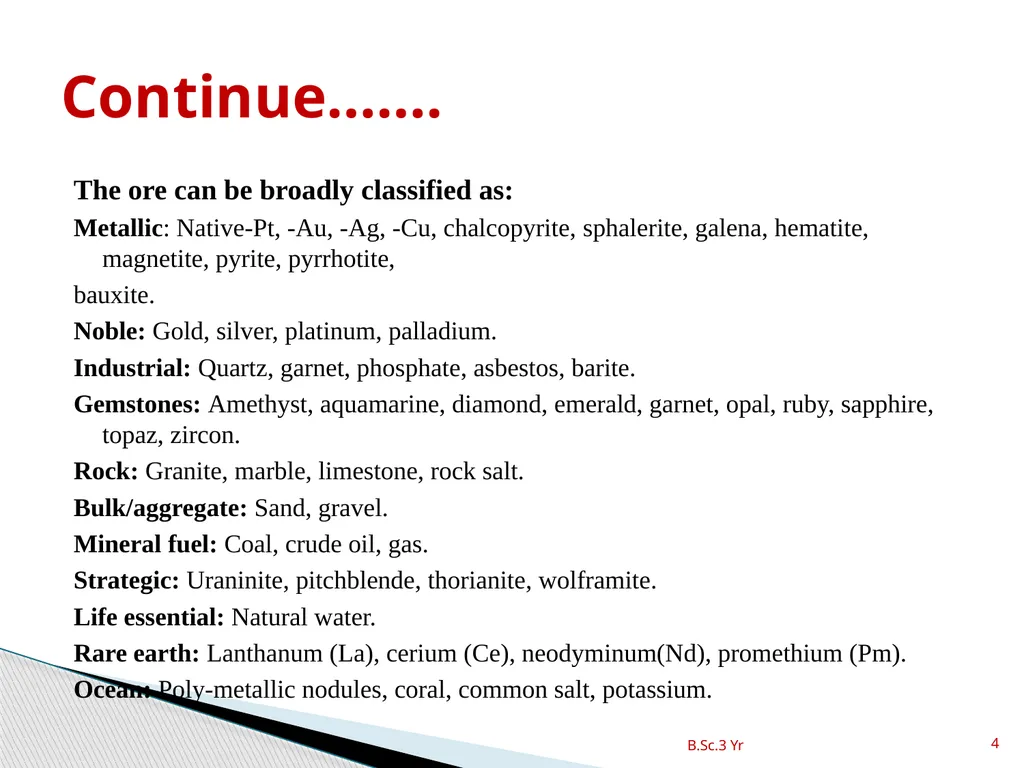
The ore can be broadly classified as:
Metallic: Native-Pt, -Au, -Ag, -Cu, chalcopyrite, sphalerite, galena, hematite, magnetite, pyrite, pyrrhotite,
bauxite.
Noble: Gold, silver, platinum, palladium.
Industrial: Quartz, garnet, phosphate, asbestos, barite.
Gemstones: Amethyst, aquamarine, diamond, emerald, garnet, opal, ruby, sapphire, topaz, zircon.
Rock: Granite, marble, limestone, rock salt.
Bulk/aggregate: Sand, gravel.
Mineral fuel: Coal, crude oil, gas.
Strategic: Uraninite, pitchblende, thorianite, wolframite.
Life essential: Natural water.
Rare earth: Lanthanum (La), cerium (Ce), neodyminum(Nd), promethium (Pm).
Ocean: Poly-metallic nodules, coral, common salt, potassium. B.Sc.3 Yr 4 Continue…….<br>
Metallic: Native-Pt, -Au, -Ag, -Cu, chalcopyrite, sphalerite, galena, hematite, magnetite, pyrite, pyrrhotite,
bauxite.
Noble: Gold, silver, platinum, palladium.
Industrial: Quartz, garnet, phosphate, asbestos, barite.
Gemstones: Amethyst, aquamarine, diamond, emerald, garnet, opal, ruby, sapphire, topaz, zircon.
Rock: Granite, marble, limestone, rock salt.
Bulk/aggregate: Sand, gravel.
Mineral fuel: Coal, crude oil, gas.
Strategic: Uraninite, pitchblende, thorianite, wolframite.
Life essential: Natural water.
Rare earth: Lanthanum (La), cerium (Ce), neodyminum(Nd), promethium (Pm).
Ocean: Poly-metallic nodules, coral, common salt, potassium. B.Sc.3 Yr 4 Continue…….<br>
05
Ore deposit:-An ore deposit is a natural concentration of one or more minerals within the host rock. It has a definite shape on economic criteria with finite quantity (tonnes) and average quality (grade). The shape varies according to the complex nature of the deposit such as layered, disseminated, veins, folded and deformed. It may be exposed to the surface or hidden below stony barren hills, agricultural soil, sand,river and forest.
Prime Commodity, Associated Commodity and Trace Element:-
“Prime commodity” is the principal ore mineral recovered from the mines.
“Associated commodities” are the associated minerals recovered as by-products along with the main mineral.
In general all ore deposits contain number of valuable “trace elements” that can be recovered during processing of ore.
Example-The prime commodity of a zinclead-copper-silver mine is zinc, and the associated commodities are lead and copper. The expected value-added trace elements are cadmium, silver, cobalt and gold. B.Sc.3 Yr 5 Definitions………<br>
Prime Commodity, Associated Commodity and Trace Element:-
“Prime commodity” is the principal ore mineral recovered from the mines.
“Associated commodities” are the associated minerals recovered as by-products along with the main mineral.
In general all ore deposits contain number of valuable “trace elements” that can be recovered during processing of ore.
Example-The prime commodity of a zinclead-copper-silver mine is zinc, and the associated commodities are lead and copper. The expected value-added trace elements are cadmium, silver, cobalt and gold. B.Sc.3 Yr 5 Definitions………<br>
06
Protore:-
“Protore” is an altered rock mass or primary mineral deposit having uneconomic concentration of minerals. It may be further enriched by natural processes to form ore.These are low-grade residual deposits formed by weathering, oxidation, leaching and similar alteration. The protore can turn into an economic deposit with advance technology and/or increase of price.
Example- Ultramafic rocks like peridotite to form laterite (Sukinda nickel deposit, India)
Gangue Minerals
Ore deposits are rarely comprised of 100% ore-bearing minerals, but usually associated with RFM during mineralizationn process. These associated minerals or rocks, having no significant or least commercial value, are called “gangue” minerals. Pure chalcopyrite having 34.5% Cu metal in copper deposit and sphalerite with 67% Zn metal in zinc deposit are hosted by quartzite/mica-schist and dolomite respectively. The constituent minerals of quartzite, mica-schist and dolomite are called the gangue minerals. B.Sc.3 Yr 6 Definitions……….<br>
“Protore” is an altered rock mass or primary mineral deposit having uneconomic concentration of minerals. It may be further enriched by natural processes to form ore.These are low-grade residual deposits formed by weathering, oxidation, leaching and similar alteration. The protore can turn into an economic deposit with advance technology and/or increase of price.
Example- Ultramafic rocks like peridotite to form laterite (Sukinda nickel deposit, India)
Gangue Minerals
Ore deposits are rarely comprised of 100% ore-bearing minerals, but usually associated with RFM during mineralizationn process. These associated minerals or rocks, having no significant or least commercial value, are called “gangue” minerals. Pure chalcopyrite having 34.5% Cu metal in copper deposit and sphalerite with 67% Zn metal in zinc deposit are hosted by quartzite/mica-schist and dolomite respectively. The constituent minerals of quartzite, mica-schist and dolomite are called the gangue minerals. B.Sc.3 Yr 6 Definitions……….<br>
07
Green field discovery:-Greenfield discoveries are the findings from a broad base grassroots exploration program well away from known orebodies or known mineralized belts in essence, pioneering discoveries in new locales. The term comes from the building industry, where undeveloped land is described as greenfield and previously developed land is described as brownfield.
Example-The knowledge base basin model discovery of the Kanpur-Maton-Jhamarkotra rock phosphate deposit in the Lower Aravalli formation during 1968 in Rajasthan, India, is a greenfield type B.Sc.3 Yr 7 Discovery Types<br>
Example-The knowledge base basin model discovery of the Kanpur-Maton-Jhamarkotra rock phosphate deposit in the Lower Aravalli formation during 1968 in Rajasthan, India, is a greenfield type B.Sc.3 Yr 7 Discovery Types<br>
08
Brownfield discoveries are assigned where discovery is made by enhancing the reserve in strike and dip continuity of a known orebody or in the vicinity of an existing mine. In such cases the economics of development are improved by existing infrastructures. This is an important distinction in the analysis of discovery trends, though both types contribute to the rate of development and depletion.
Examples-The rediscovery of Zawar Group (1943), Rajpura-Dariba Belt (1930), the world class largest and richest zinc-lead single orebody at Rampura-Agucha (1977), Khetri copper belt (1960s), Kolar gold field (first millennium BC), and iron ore deposits (1300 BC) in India are all examples of brownfield types of discovery. B.Sc.3 Yr 8 Continue……..<br>
Examples-The rediscovery of Zawar Group (1943), Rajpura-Dariba Belt (1930), the world class largest and richest zinc-lead single orebody at Rampura-Agucha (1977), Khetri copper belt (1960s), Kolar gold field (first millennium BC), and iron ore deposits (1300 BC) in India are all examples of brownfield types of discovery. B.Sc.3 Yr 8 Continue……..<br>
09
Any exploration program can be classified by successive stages: each stage is designed to achieve a combined specific objective within the time schedule and allocated fund.
Reconnaissance (G4)
Large Area Prospecting (G4/G3)
Prospecting (G3)
General Exploration (G2)
Detailed Exploration (G1) B.Sc.3 Yr 9 Stages of Exploration<br>
Reconnaissance (G4)
Large Area Prospecting (G4/G3)
Prospecting (G3)
General Exploration (G2)
Detailed Exploration (G1) B.Sc.3 Yr 9 Stages of Exploration<br>
10
Reconnaissance is grassroots exploration for identifying the existence of mineral potential or initial targets on a regional scale.
Preparations at this stage include literature survey, acquisition of geophysical data, if any, synthesis of all available data and concepts, and obtaining permission (reconnaissance license/permit [RP]) from the state/provincial/territorial government
Activities incorporate remote sensing, airborne and ground geophysical survey, regional geological overview, map checking/mapping on 1:250,000 and 1:50,000 scales, geochemical survey by chip/grab sampling of rocks and weathered profiles, broad geomorphology and drainage, pitting, and trenching to expose mineralized zones at ideal locations, and limited scouting/reverse circulation/diamond drilling to identify the possible existence/extent of mineralization. B.Sc.3 Yr 10 Reconnaissance (G4)<br>
Preparations at this stage include literature survey, acquisition of geophysical data, if any, synthesis of all available data and concepts, and obtaining permission (reconnaissance license/permit [RP]) from the state/provincial/territorial government
Activities incorporate remote sensing, airborne and ground geophysical survey, regional geological overview, map checking/mapping on 1:250,000 and 1:50,000 scales, geochemical survey by chip/grab sampling of rocks and weathered profiles, broad geomorphology and drainage, pitting, and trenching to expose mineralized zones at ideal locations, and limited scouting/reverse circulation/diamond drilling to identify the possible existence/extent of mineralization. B.Sc.3 Yr 10 Reconnaissance (G4)<br>
11
Petrographic and mineragraphic studies will help to determine principal host and country rocks and mineral assemblages.
The prime objective is to study the entire area under leasehold within a stipulated timeframe, and to identify probable mineralized areas (targets) worthy of further investigation.
The targets are ranked based on geological evidence suggestive of further investigation toward deposit identification.
Finally, the initial leasehold area is thus substantially reduced to smaller units.
Estimates are preliminary resource status (G4). This focuses concentration on the maximum exploration efforts to the target area in the next stage.
The total area and duration permissible for RP vary between states and countries. B.Sc.3 Yr 11 Continue………<br>
The prime objective is to study the entire area under leasehold within a stipulated timeframe, and to identify probable mineralized areas (targets) worthy of further investigation.
The targets are ranked based on geological evidence suggestive of further investigation toward deposit identification.
Finally, the initial leasehold area is thus substantially reduced to smaller units.
Estimates are preliminary resource status (G4). This focuses concentration on the maximum exploration efforts to the target area in the next stage.
The total area and duration permissible for RP vary between states and countries. B.Sc.3 Yr 11 Continue………<br>
12
Large area prospecting, a blend of reconnaissance (G4) and prospecting license (G3), is initiated in some countries.
This combines reconnaissance and prospecting activities, including general and detailed exploration.
It is the systematic exploration of potential target anomalies after obtaining a large area prospecting license (LAPL) from the state/provincial/territorial government.
Activities include detailed geological mapping, rock chip and soil samplings, close-spaced ground geophysics, diamond core drilling on wide-spaced section lines, and resource estimation of inferred or possible categories. Other information like rainfall, climate, availability of infrastructures, and logistic facilities, including health care and environmental implications, are collected.
The prime objective is to identify a suitable deposit that will be the target for further definitive exploration. The permissible area and duration will be between reconnaissance and prospecting. B.Sc.3 Yr 12 Large Area Prospecting (G4/G3)<br>
This combines reconnaissance and prospecting activities, including general and detailed exploration.
It is the systematic exploration of potential target anomalies after obtaining a large area prospecting license (LAPL) from the state/provincial/territorial government.
Activities include detailed geological mapping, rock chip and soil samplings, close-spaced ground geophysics, diamond core drilling on wide-spaced section lines, and resource estimation of inferred or possible categories. Other information like rainfall, climate, availability of infrastructures, and logistic facilities, including health care and environmental implications, are collected.
The prime objective is to identify a suitable deposit that will be the target for further definitive exploration. The permissible area and duration will be between reconnaissance and prospecting. B.Sc.3 Yr 12 Large Area Prospecting (G4/G3)<br>
13
“Prospecting” is the systematic process of searching promising mineral targets identified during Reconnaissance.
The objective is more definitive exploration for increasing geological confidence leading to further exploration.
The program starts on obtaining PL from State/ Provincial/Territorial Government within the framework of area and duration.
PL is granted to conduct prospecting, general exploration and detail exploration. PL shall be deemed to include “LAPL”, unless the context otherwise requires. B.Sc.3 Yr 13 Prospecting<br>
The objective is more definitive exploration for increasing geological confidence leading to further exploration.
The program starts on obtaining PL from State/ Provincial/Territorial Government within the framework of area and duration.
PL is granted to conduct prospecting, general exploration and detail exploration. PL shall be deemed to include “LAPL”, unless the context otherwise requires. B.Sc.3 Yr 13 Prospecting<br>
14
The activities include mapping on 1:50,000- 1:25,000 scale, linking maps with Universal Transversal Mercator (UTM), lithology, structure, surface signature, analysis of history of mining, if exists, ground geophysics, geochemical orientation survey, sampling of rock/soil/ debris of background and anomaly area, pitting/trenching, Reverse Circulation (RC) and diamond drilling at 100- 1000 m section at one level depending on mineral type, core sampling, petrographic and mineragraphic studies, borehole geophysical logging and baseline environment.
Estimates of quantities are inferred, based on interpretation of geological, geophysical and geochemical results B.Sc.3 Yr 14 Continue…..<br>
Estimates of quantities are inferred, based on interpretation of geological, geophysical and geochemical results B.Sc.3 Yr 14 Continue…..<br>
15
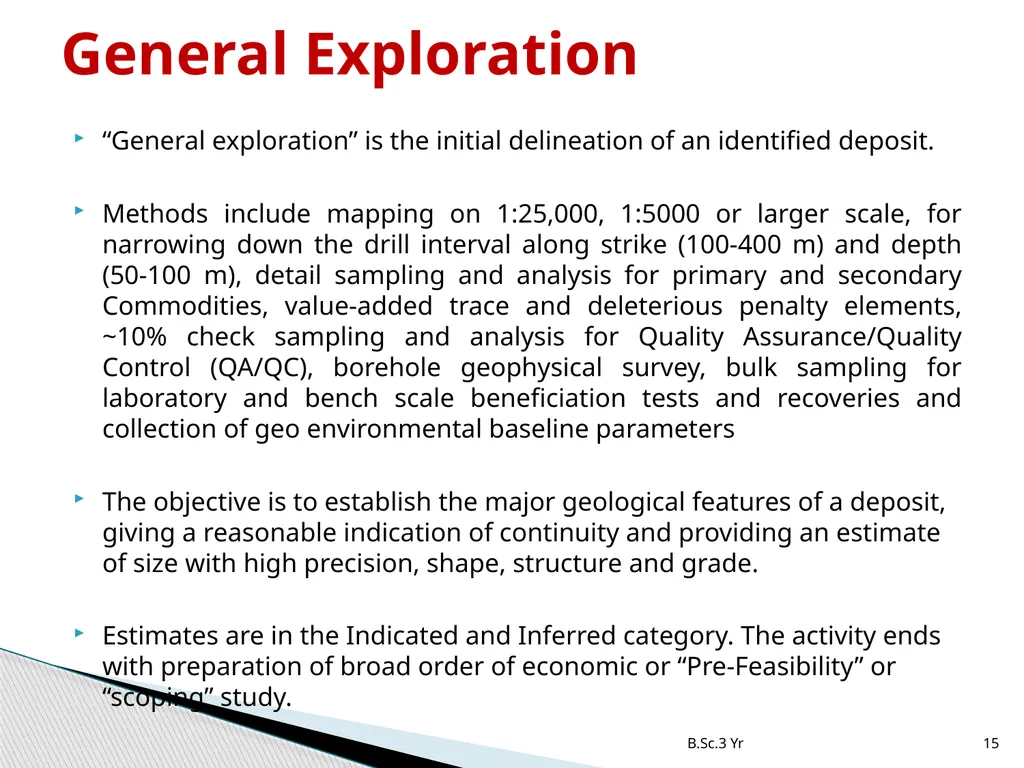
“General exploration” is the initial delineation of an identified deposit.
Methods include mapping on 1:25,000, 1:5000 or larger scale, for narrowing down the drill interval along strike (100-400 m) and depth (50-100 m), detail sampling and analysis for primary and secondary Commodities, value-added trace and deleterious penalty elements, ~10% check sampling and analysis for Quality Assurance/Quality Control (QA/QC), borehole geophysical survey, bulk sampling for laboratory and bench scale beneficiation tests and recoveries and collection of geo environmental baseline parameters
The objective is to establish the major geological features of a deposit, giving a reasonable indication of continuity and providing an estimate of size with high precision, shape, structure and grade.
Estimates are in the Indicated and Inferred category. The activity ends with preparation of broad order of economic or “Pre-Feasibility” or “scoping” study. B.Sc.3 Yr 15 General Exploration<br>
Methods include mapping on 1:25,000, 1:5000 or larger scale, for narrowing down the drill interval along strike (100-400 m) and depth (50-100 m), detail sampling and analysis for primary and secondary Commodities, value-added trace and deleterious penalty elements, ~10% check sampling and analysis for Quality Assurance/Quality Control (QA/QC), borehole geophysical survey, bulk sampling for laboratory and bench scale beneficiation tests and recoveries and collection of geo environmental baseline parameters
The objective is to establish the major geological features of a deposit, giving a reasonable indication of continuity and providing an estimate of size with high precision, shape, structure and grade.
Estimates are in the Indicated and Inferred category. The activity ends with preparation of broad order of economic or “Pre-Feasibility” or “scoping” study. B.Sc.3 Yr 15 General Exploration<br>
16
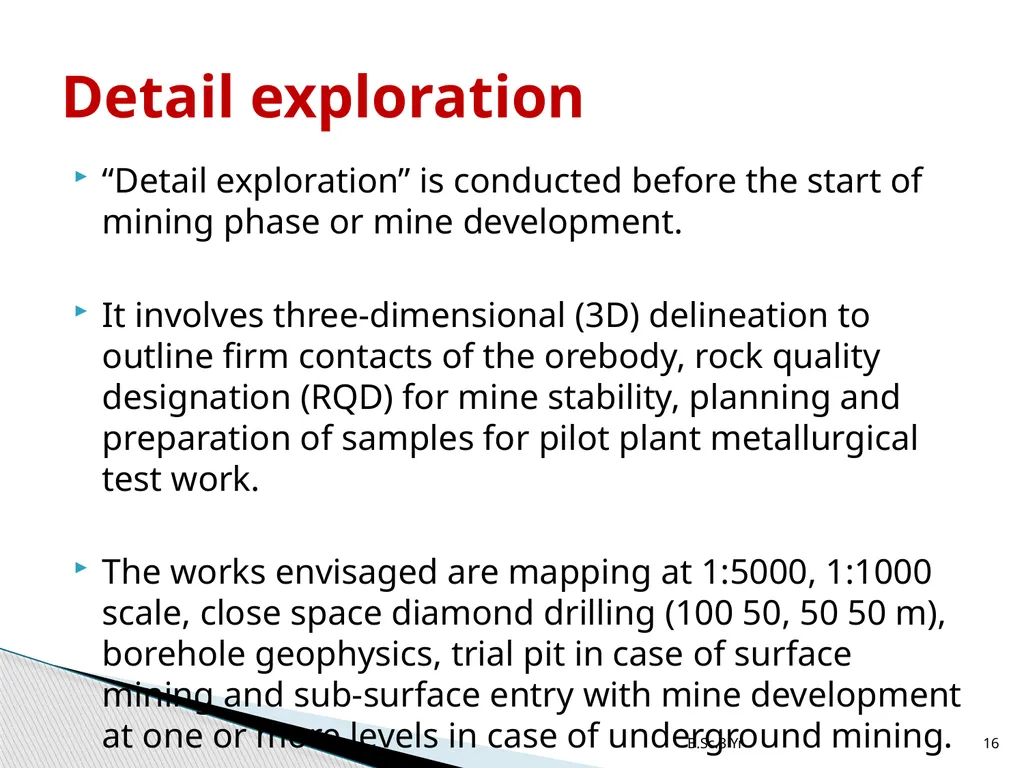
“Detail exploration” is conducted before the start of mining phase or mine development.
It involves three-dimensional (3D) delineation to outline firm contacts of the orebody, rock quality designation (RQD) for mine stability, planning and preparation of samples for pilot plant metallurgical test work.
The works envisaged are mapping at 1:5000, 1:1000 scale, close space diamond drilling (100 50, 50 50 m), borehole geophysics, trial pit in case of surface mining and sub-surface entry with mine development at one or more levels in case of underground mining. B.Sc.3 Yr 16 Detail exploration<br>
It involves three-dimensional (3D) delineation to outline firm contacts of the orebody, rock quality designation (RQD) for mine stability, planning and preparation of samples for pilot plant metallurgical test work.
The works envisaged are mapping at 1:5000, 1:1000 scale, close space diamond drilling (100 50, 50 50 m), borehole geophysics, trial pit in case of surface mining and sub-surface entry with mine development at one or more levels in case of underground mining. B.Sc.3 Yr 16 Detail exploration<br>
17
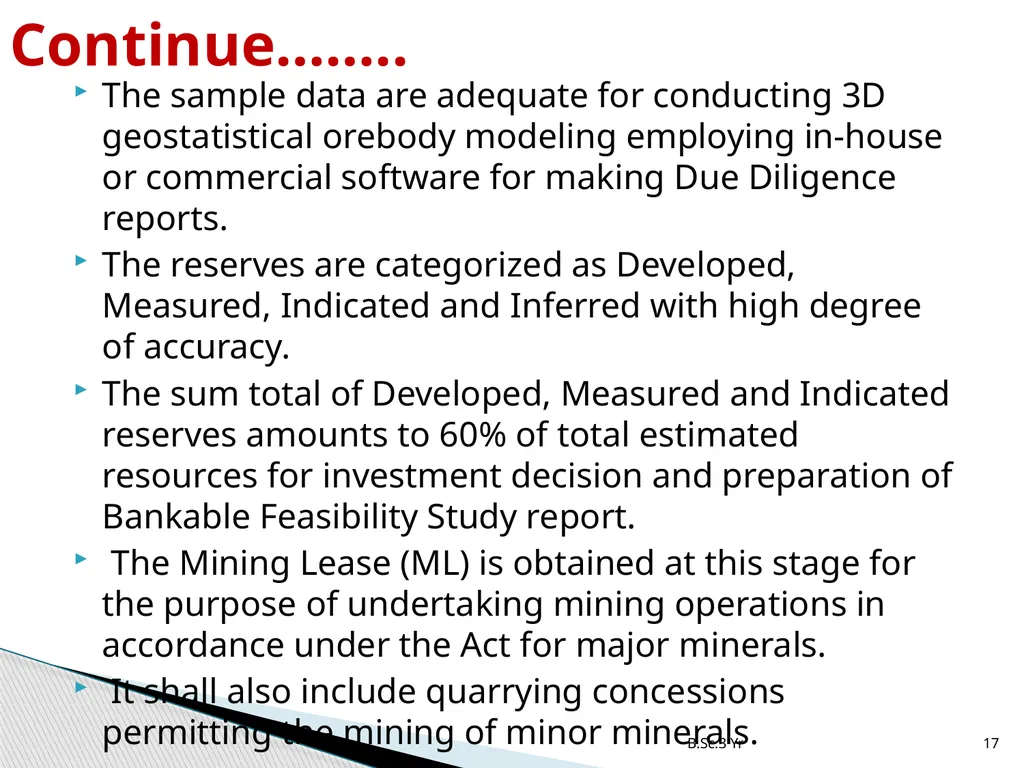
The sample data are adequate for conducting 3D geostatistical orebody modeling employing in-house or commercial software for making Due Diligence reports.
The reserves are categorized as Developed, Measured, Indicated and Inferred with high degree of accuracy.
The sum total of Developed, Measured and Indicated reserves amounts to 60% of total estimated resources for investment decision and preparation of Bankable Feasibility Study report.
The Mining Lease (ML) is obtained at this stage for the purpose of undertaking mining operations in accordance under the Act for major minerals.
It shall also include quarrying concessions permitting the mining of minor minerals. B.Sc.3 Yr 17 Continue……..<br>
The reserves are categorized as Developed, Measured, Indicated and Inferred with high degree of accuracy.
The sum total of Developed, Measured and Indicated reserves amounts to 60% of total estimated resources for investment decision and preparation of Bankable Feasibility Study report.
The Mining Lease (ML) is obtained at this stage for the purpose of undertaking mining operations in accordance under the Act for major minerals.
It shall also include quarrying concessions permitting the mining of minor minerals. B.Sc.3 Yr 17 Continue……..<br>
18
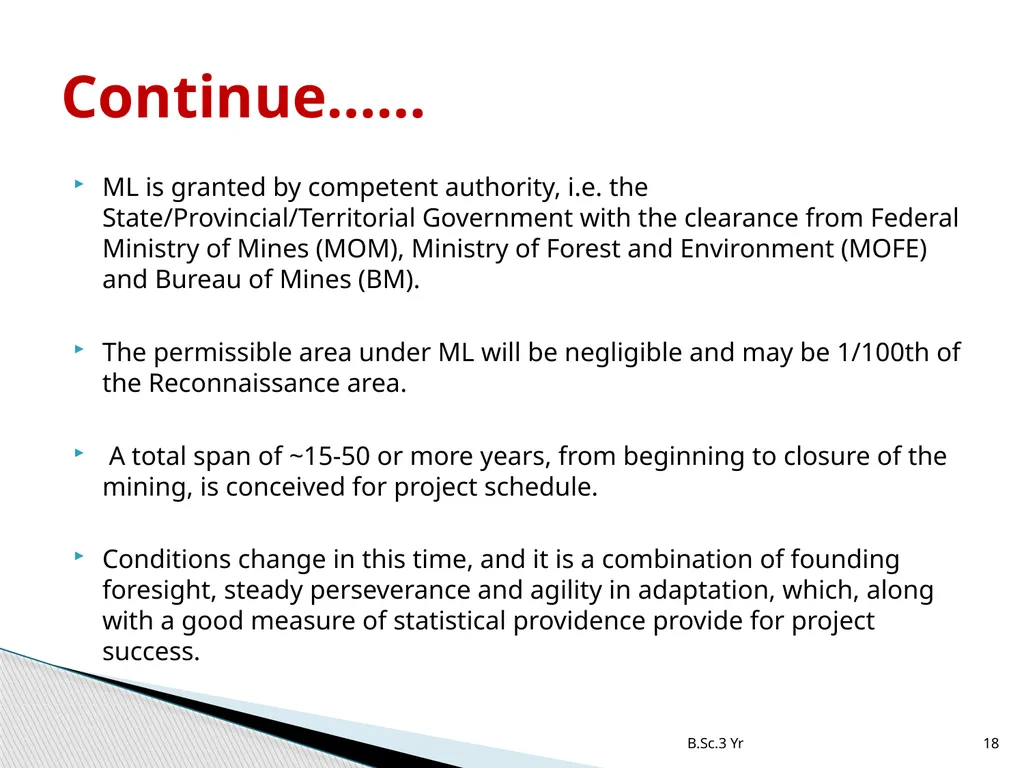
ML is granted by competent authority, i.e. the State/Provincial/Territorial Government with the clearance from Federal Ministry of Mines (MOM), Ministry of Forest and Environment (MOFE) and Bureau of Mines (BM).
The permissible area under ML will be negligible and may be 1/100th of the Reconnaissance area.
A total span of ~15-50 or more years, from beginning to closure of the mining, is conceived for project schedule.
Conditions change in this time, and it is a combination of founding foresight, steady perseverance and agility in adaptation, which, along with a good measure of statistical providence provide for project success. B.Sc.3 Yr 18 Continue……<br>
The permissible area under ML will be negligible and may be 1/100th of the Reconnaissance area.
A total span of ~15-50 or more years, from beginning to closure of the mining, is conceived for project schedule.
Conditions change in this time, and it is a combination of founding foresight, steady perseverance and agility in adaptation, which, along with a good measure of statistical providence provide for project success. B.Sc.3 Yr 18 Continue……<br>
19
B.Sc.3 Yr 19 Thanks<br>