Introduction to Prevention Outreach Specialist AUX-MEES Overview The Auxiliary Prevention Outreach Specialist (AUX-MEES) is one of the Letters of Designation (LODs) in the Marine Safety Device program To obtain the Marine Safety Training
"Introduction to Prevention Outreach Specialist" is the property of its rightful owner. Permission is granted to
download and print the materials on this website for personal, non-commercial use only, and to display it
on your personal computer provided you do not modify the materials and that you retain all copyright
notices contained in the materials. By downloading content from our website, you accept the terms of this
agreement.
Presentation Transcript
01
Introduction to Prevention Outreach Specialist AUX-MEES<br>
02
Overview The Auxiliary Prevention Outreach Specialist (AUX-MEES) is one of the Letters of Designation (LODs) in the Marine Safety Device program
To obtain the Marine Safety Training Ribbon (MSTR), all educational requirements for the Marine Safety Device plus one Letter of Designation must be earned
To obtain the Marine Safety Device, four Letters of Designation must be earned
AUX-MEES and AUX-MSAM are Auxiliary-specific and do not require task sign-off nor certification by Active Duty<br>
03
Why Should I Obtain This Qualification? Have you ever been asked, or wondered yourself…
Why can’t the Coast Guard just clean-up that oil spill?
Can’t I just pour Dawn® on a gas spill to clean it up?
Why are estuaries considered sensitive areas?
How long does it take for diapers to break down?
What is MARSEC and what do those numbers mean?
How do I report an oil spill?
What is MMPA?
What is CERCLA?
All of these questions — and more — are covered in the qualification<br>
04
Must I Have this Qualification to Report Marine Safety Hours? The short answer is — NO
The purpose of this qualification is to ensure that you have the background and knowledge to make presentations regarding marine environmental issues and/or America’s Waterway Watch, and to answer questions from the public — or fellow Auxiliarists — in an informed and articulate manner.<br>
05
Who Can Be A Verifying Officer? An Auxiliarist who holds the AUX-MEES qualification
Someone appointed by the person who issues the Letter of Designation (in this case your DIRAUX)
An Active Duty or Reservist who holds the Coast Guard EK qualification
Note: Some DIRAUXs require that all verifying officers be approved prior to signing<br>
06
Prerequisites Completion of three online courses
IMSEP
Good Mate
FEMA-EMI IS-5.A: An Introduction to Hazardous Materials
Hold Auxiliary IT qualification or complete CG Instructor Development course<br>
07
What’s Covered? Knowledge of pollution issues
Knowledge of laws and regulations and the Coast Guard’s role in pollution prevention
Maritime Transportation Security Act (MTSA)
America’s Waterway Watch (AWW)
Practical Application<br>
08
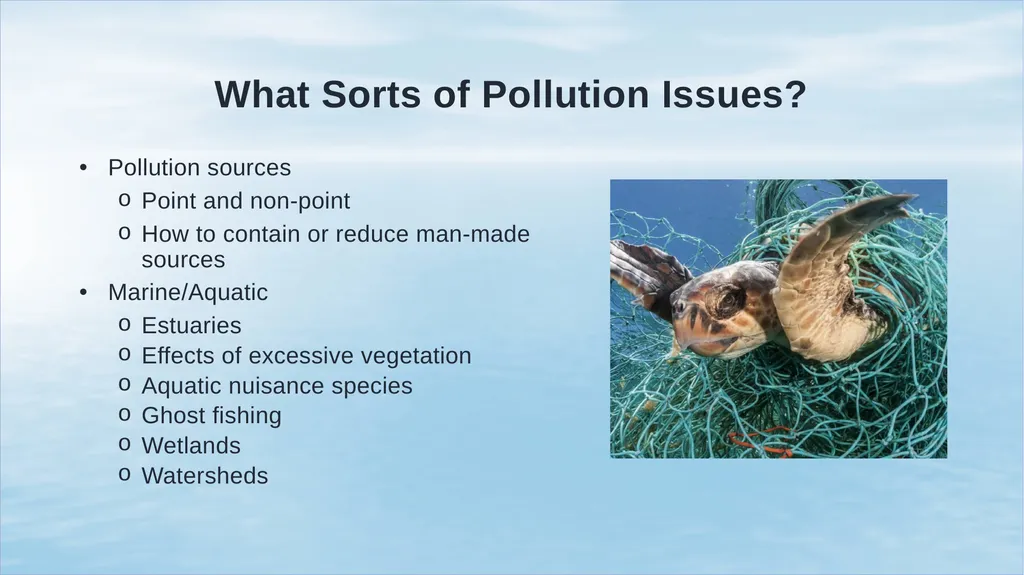
What Sorts of Pollution Issues? Pollution sources
Point and non-point
How to contain or reduce man-made sources
Marine/Aquatic
Estuaries
Effects of excessive vegetation
Aquatic nuisance species
Ghost fishing
Wetlands
Watersheds<br>
09
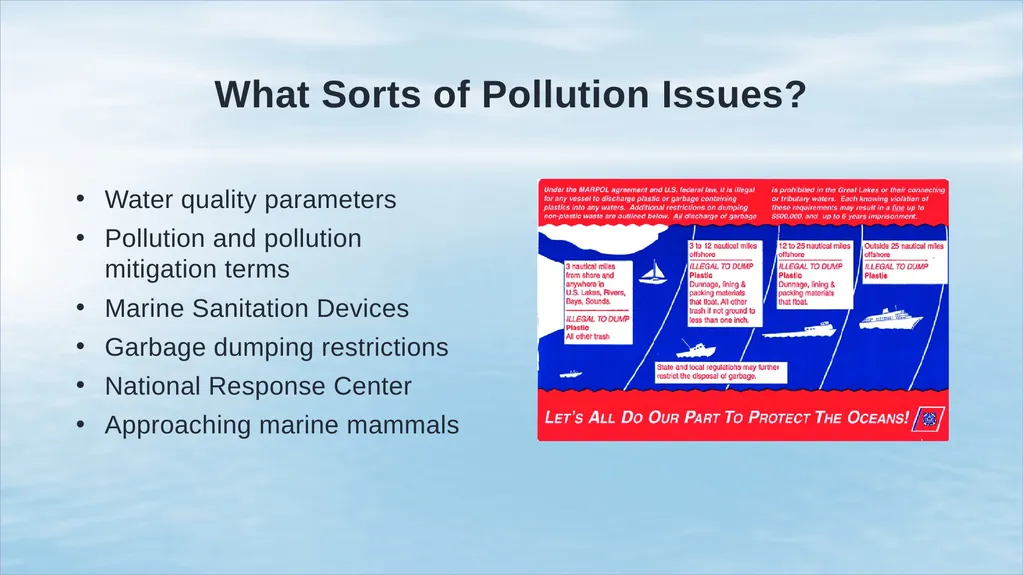
What Sorts of Pollution Issues? Water quality parameters
Pollution and pollution mitigation terms
Marine Sanitation Devices
Garbage dumping restrictions
National Response Center
Approaching marine mammals<br>
10
Knowledge of Laws and Regulations CERCLA (Comprehensive Environmental Response, Compensation, and Liability Act, or Superfund)
CWA (Clean Water Act)
ESA (Endangered Species Act)
FWPCA (Federal Water Pollution Control Act)
MARPOL (International Convention for the Prevention of Pollution from Ships)
MMPA (Marine Mammal Protection Act)
MPPRCA (Marine Plastic Pollution Research and Control Act)
NANPCA (Non-indigenous Aquatic Nuisance Prevention and Control Act)<br>
11
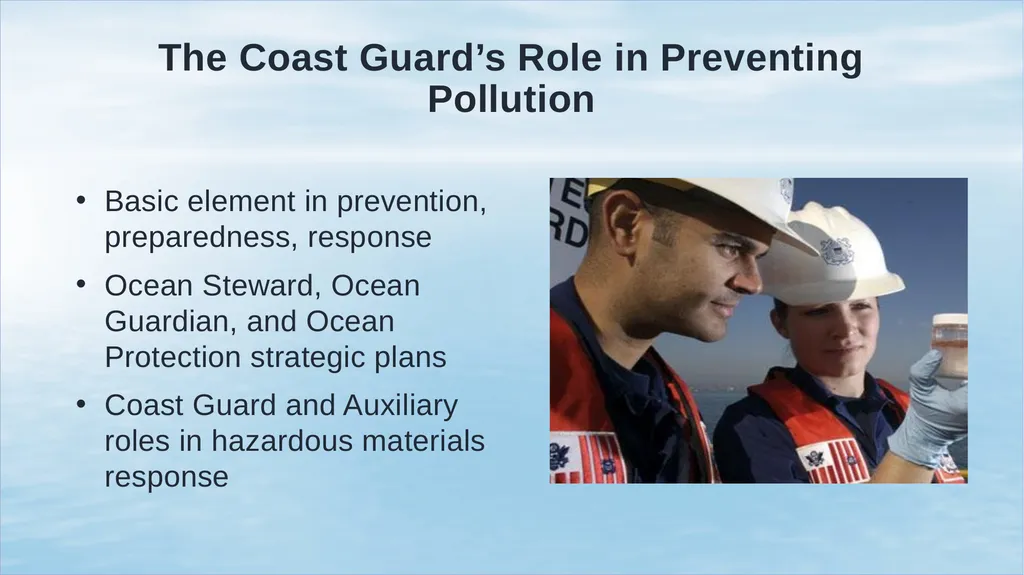
The Coast Guard’s Role in Preventing Pollution Basic element in prevention, preparedness, response
Ocean Steward, Ocean Guardian, and Ocean Protection strategic plans
Coast Guard and Auxiliary roles in hazardous materials response<br>
12
America’s Waterway Watch Why AWW was created
Purpose of AWW
What are suspicious behaviors?
Where is suspicious activity reported?<br>
13
Maritime Transportation Security Act Definitions
How this relates to AWW
Various regulations relating to MTSA
Goal of MTSA<br>
14
Practical Applications Develop and present at least two marine environmental training sessions
Good Mate
Sea Partners
Clean Marina
Aquatic Nuisance Species
Develop and present at least two AWW public education training sessions<br>
15
Practical Applications Participate in, or otherwise support, a shoreline debris cleanup
Alternatively, visit a local marina to identify Best Management Practices and address the environmental impacts of poor practices regarding fueling, sewage handling, potable water systems, vessel repair and safety — using a clean marina checklist
Participate in an America’s Waterway Watch booth at one of the following venues: boat show, public safety day or a marina safety event<br>
16
Okay, Now What? When the PQS is completed:
Contact your DSO-MS to schedule an oral board
After passing the oral board, send entire package to DSO-MS
DSO-MS will review package for completeness and forward to DIRAUX for the AUX-MEES Letter of Designation<br>
17
Questions? Contact your MS staff chain of leadership first
District policies may vary
If they can’t answer your question, go to the Prevention Directorate’s website, then select “Contact Us/ Prevention Question?” from the menu items at left<br>