
Investigating Science Science HSC hub We would
BR
Published · 20 slides · 0 views

1 / 1


Description
Investigating Science Science HSC hub We would like to pay our respect and acknowledge the traditional custodians of the land on which this film was made, and also pay respect to Elders both past and present. Acknowledgement of Country
Related Topics
Share
Embed code
Download this presentation From Below
"Investigating Science Science HSC hub We would" is the property of its rightful owner. Permission is granted to download and print the materials on this website for personal, non-commercial use only, and to display it on your personal computer provided you do not modify the materials and that you retain all copyright notices contained in the materials. By downloading content from our website, you accept the terms of this agreement.
Presentation Transcript
01
Investigating Science Science HSC hub<br>
02
We would like to pay our respect and acknowledge the traditional custodians of the land on which this film was made, and also pay respect to Elders both past and present. Acknowledgement of Country<br>
03
Module 7
Analysing claims Stage 6 Investigating Science<br>
Analysing claims Stage 6 Investigating Science<br>
04
4 This document contains topic specific content notes to support students. In addition, an example investigation to analyse the claims made about scientific concepts which can distort the understanding of the general public via the media.
Inquiry question - How can a claim be tested?
Compare emotive advertising with evidence-based claims, including but not limited to - health claims on food packaging and claims about the efficacy of a product
Inquiry question - How does the reporting of science influence the general public’s understanding of the subject?
Compare the difference in reporting between a peer-reviewed journal article and a scientific article published in popular media Investigating Science module 7 Inquiry questions<br>
Inquiry question - How can a claim be tested?
Compare emotive advertising with evidence-based claims, including but not limited to - health claims on food packaging and claims about the efficacy of a product
Inquiry question - How does the reporting of science influence the general public’s understanding of the subject?
Compare the difference in reporting between a peer-reviewed journal article and a scientific article published in popular media Investigating Science module 7 Inquiry questions<br>
05
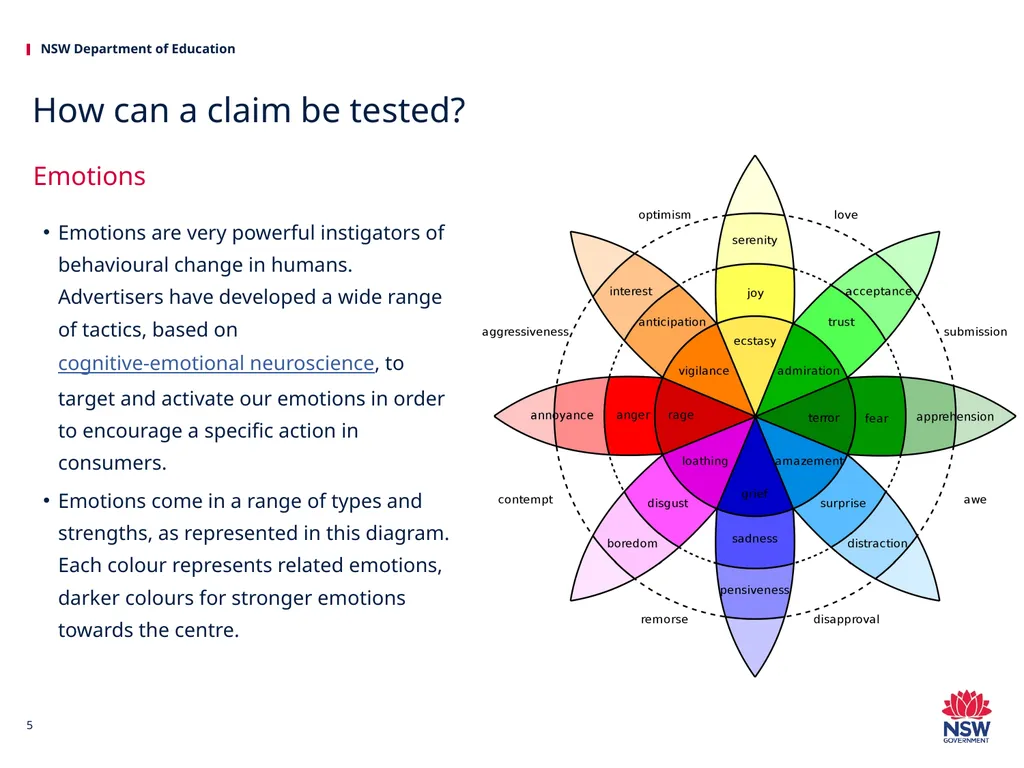
5 Emotions are very powerful instigators of behavioural change in humans. Advertisers have developed a wide range of tactics, based on cognitive-emotional neuroscience, to target and activate our emotions in order to encourage a specific action in consumers.
Emotions come in a range of types and strengths, as represented in this diagram. Each colour represents related emotions, darker colours for stronger emotions towards the centre. Emotions How can a claim be tested?<br>
Emotions come in a range of types and strengths, as represented in this diagram. Each colour represents related emotions, darker colours for stronger emotions towards the centre. Emotions How can a claim be tested?<br>
06
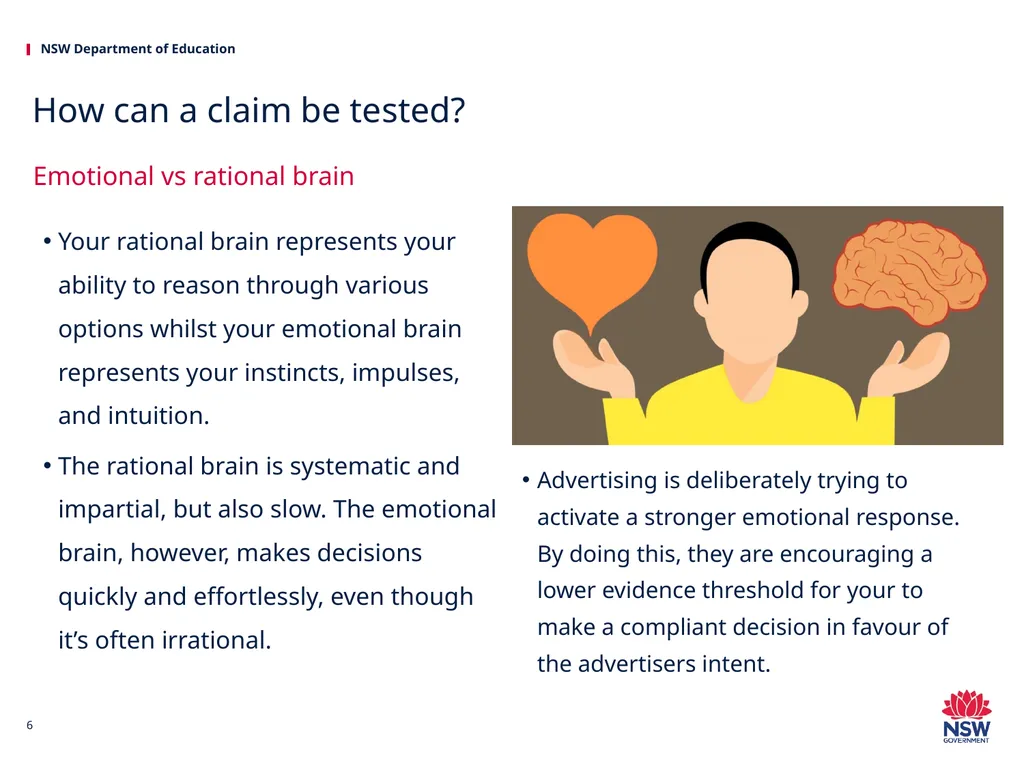
6 Your rational brain represents your ability to reason through various options whilst your emotional brain represents your instincts, impulses, and intuition.
The rational brain is systematic and impartial, but also slow. The emotional brain, however, makes decisions quickly and effortlessly, even though it’s often irrational. Emotional vs rational brain How can a claim be tested? Advertising is deliberately trying to activate a stronger emotional response. By doing this, they are encouraging a lower evidence threshold for your to make a compliant decision in favour of the advertisers intent.<br>
The rational brain is systematic and impartial, but also slow. The emotional brain, however, makes decisions quickly and effortlessly, even though it’s often irrational. Emotional vs rational brain How can a claim be tested? Advertising is deliberately trying to activate a stronger emotional response. By doing this, they are encouraging a lower evidence threshold for your to make a compliant decision in favour of the advertisers intent.<br>
07
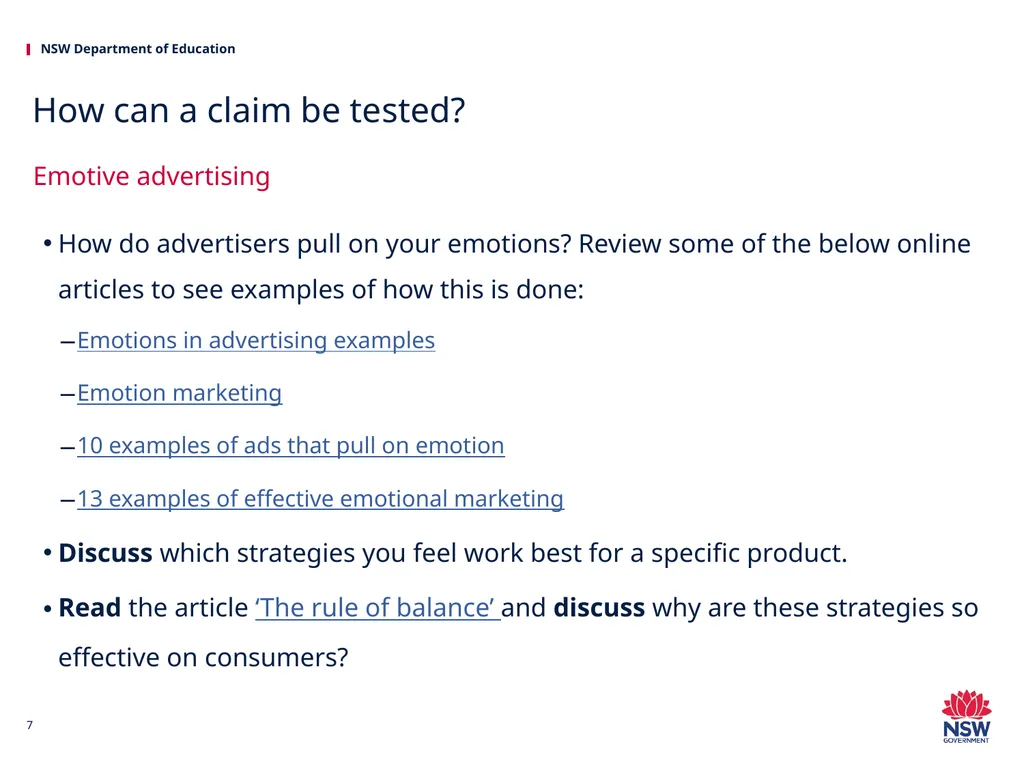
7 How do advertisers pull on your emotions? Review some of the below online articles to see examples of how this is done:
Emotions in advertising examples
Emotion marketing
10 examples of ads that pull on emotion
13 examples of effective emotional marketing
Discuss which strategies you feel work best for a specific product.
Read the article ‘The rule of balance’ and discuss why are these strategies so effective on consumers? Emotive advertising How can a claim be tested?<br>
Emotions in advertising examples
Emotion marketing
10 examples of ads that pull on emotion
13 examples of effective emotional marketing
Discuss which strategies you feel work best for a specific product.
Read the article ‘The rule of balance’ and discuss why are these strategies so effective on consumers? Emotive advertising How can a claim be tested?<br>
08
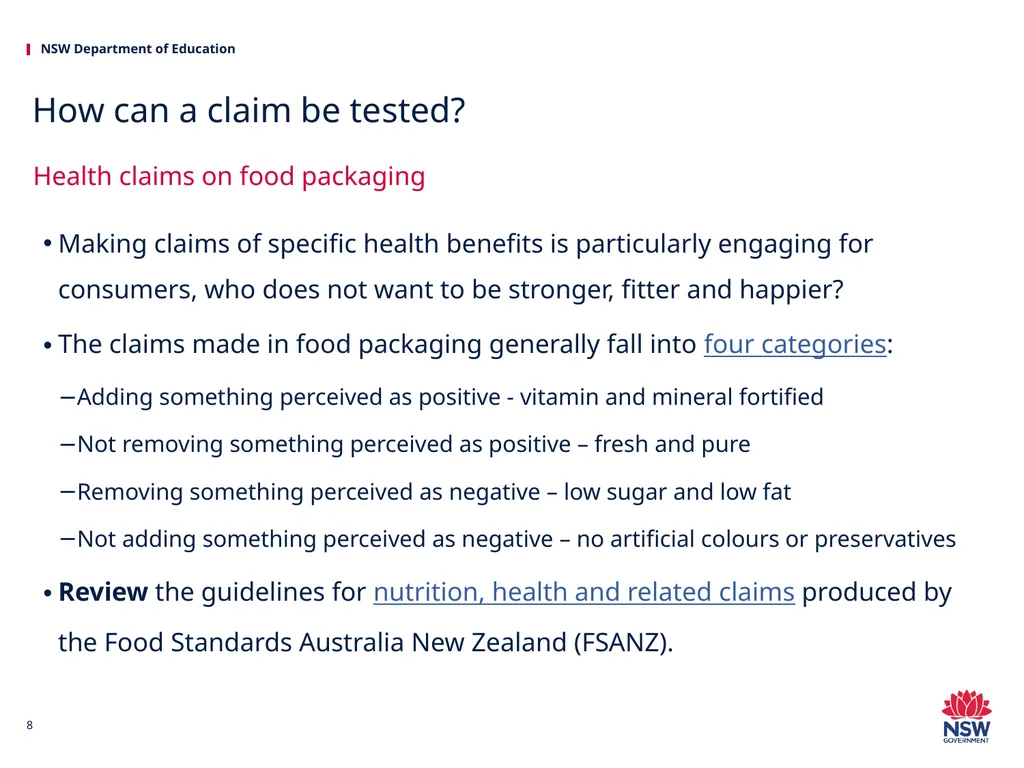
8 Making claims of specific health benefits is particularly engaging for consumers, who does not want to be stronger, fitter and happier?
The claims made in food packaging generally fall into four categories:
Adding something perceived as positive - vitamin and mineral fortified
Not removing something perceived as positive – fresh and pure
Removing something perceived as negative – low sugar and low fat
Not adding something perceived as negative – no artificial colours or preservatives
Review the guidelines for nutrition, health and related claims produced by the Food Standards Australia New Zealand (FSANZ). Health claims on food packaging How can a claim be tested?<br>
The claims made in food packaging generally fall into four categories:
Adding something perceived as positive - vitamin and mineral fortified
Not removing something perceived as positive – fresh and pure
Removing something perceived as negative – low sugar and low fat
Not adding something perceived as negative – no artificial colours or preservatives
Review the guidelines for nutrition, health and related claims produced by the Food Standards Australia New Zealand (FSANZ). Health claims on food packaging How can a claim be tested?<br>
09
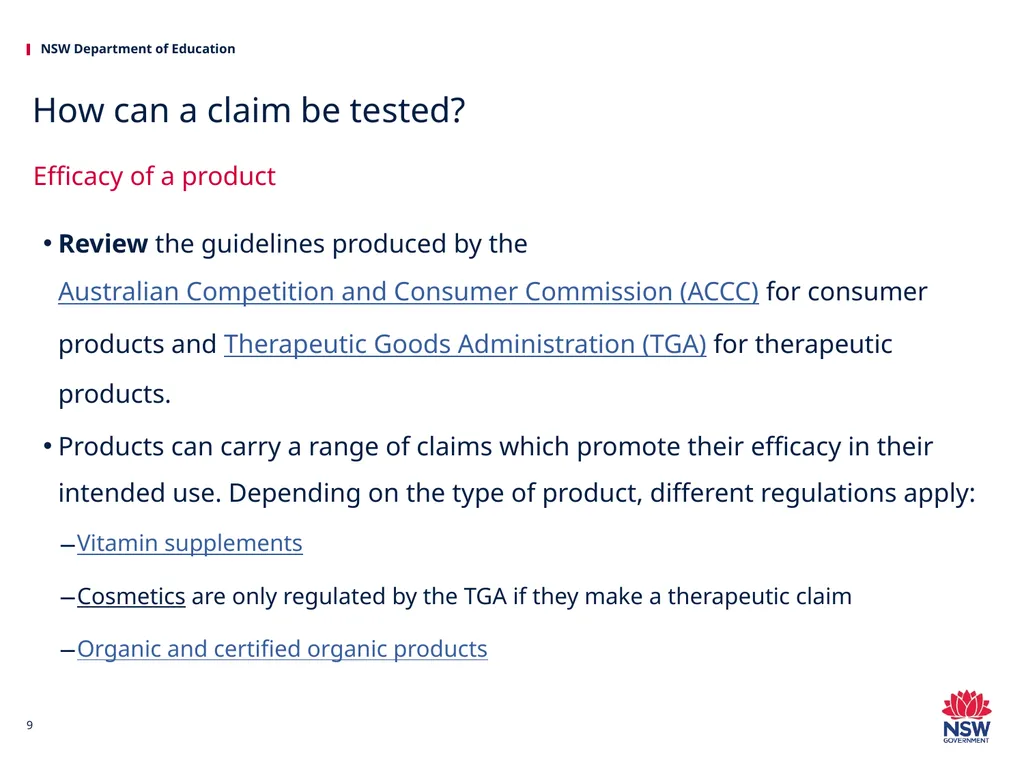
9 Review the guidelines produced by the Australian Competition and Consumer Commission (ACCC) for consumer products and Therapeutic Goods Administration (TGA) for therapeutic products.
Products can carry a range of claims which promote their efficacy in their intended use. Depending on the type of product, different regulations apply:
Vitamin supplements
Cosmetics are only regulated by the TGA if they make a therapeutic claim
Organic and certified organic products Efficacy of a product How can a claim be tested?<br>
Products can carry a range of claims which promote their efficacy in their intended use. Depending on the type of product, different regulations apply:
Vitamin supplements
Cosmetics are only regulated by the TGA if they make a therapeutic claim
Organic and certified organic products Efficacy of a product How can a claim be tested?<br>
10
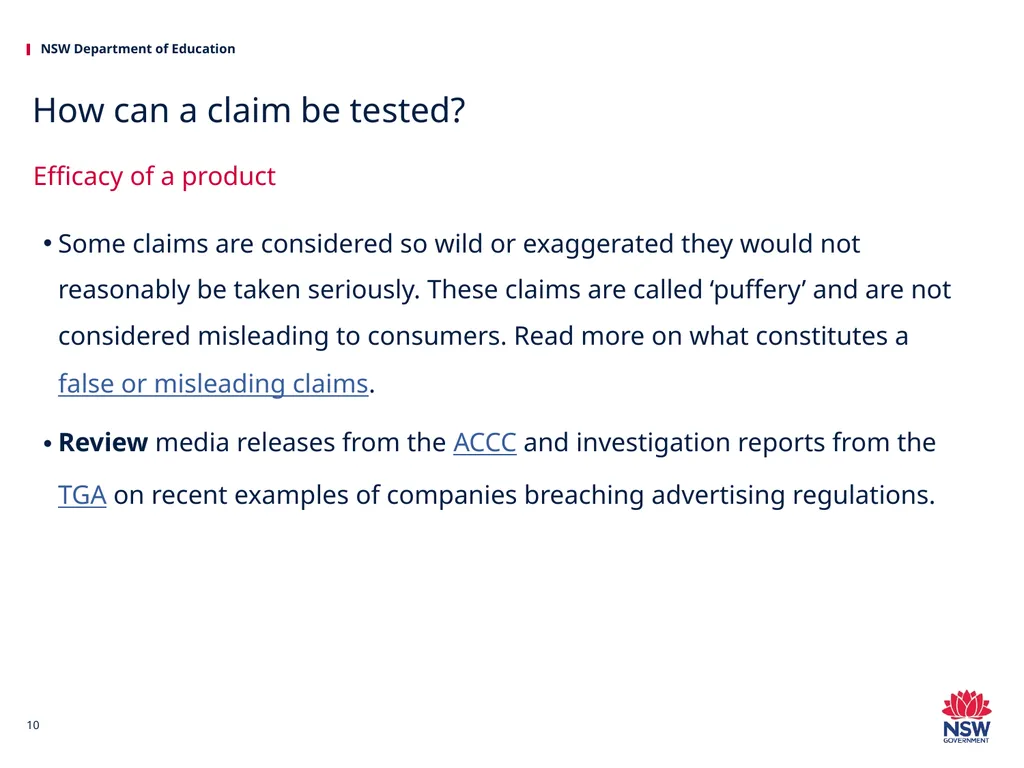
10 Some claims are considered so wild or exaggerated they would not reasonably be taken seriously. These claims are called ‘puffery’ and are not considered misleading to consumers. Read more on what constitutes a false or misleading claims.
Review media releases from the ACCC and investigation reports from the TGA on recent examples of companies breaching advertising regulations. Efficacy of a product How can a claim be tested?<br>
Review media releases from the ACCC and investigation reports from the TGA on recent examples of companies breaching advertising regulations. Efficacy of a product How can a claim be tested?<br>
11
11 In contrast to emotional claims, evidence-based claims are those which have a sound scientific basis. They are supported by peer-reviewed studies that back-up any health or efficacy claims.
Accepted evidence-based claims are able to be used by advertisers without further substantiation. Evidence-based claims are particularly important where the claim is directly related to chronic health, for example obesity or diabetes.
Both the Food and Drug Administration (USA) and FSANZ have a pre-defined selection of accepted evidence-based statements which can be used for general health claims.
FSANZ also release a range of scientific publications which can be accessed online. Evidence-based claims How can a claim be tested?<br>
Accepted evidence-based claims are able to be used by advertisers without further substantiation. Evidence-based claims are particularly important where the claim is directly related to chronic health, for example obesity or diabetes.
Both the Food and Drug Administration (USA) and FSANZ have a pre-defined selection of accepted evidence-based statements which can be used for general health claims.
FSANZ also release a range of scientific publications which can be accessed online. Evidence-based claims How can a claim be tested?<br>
12
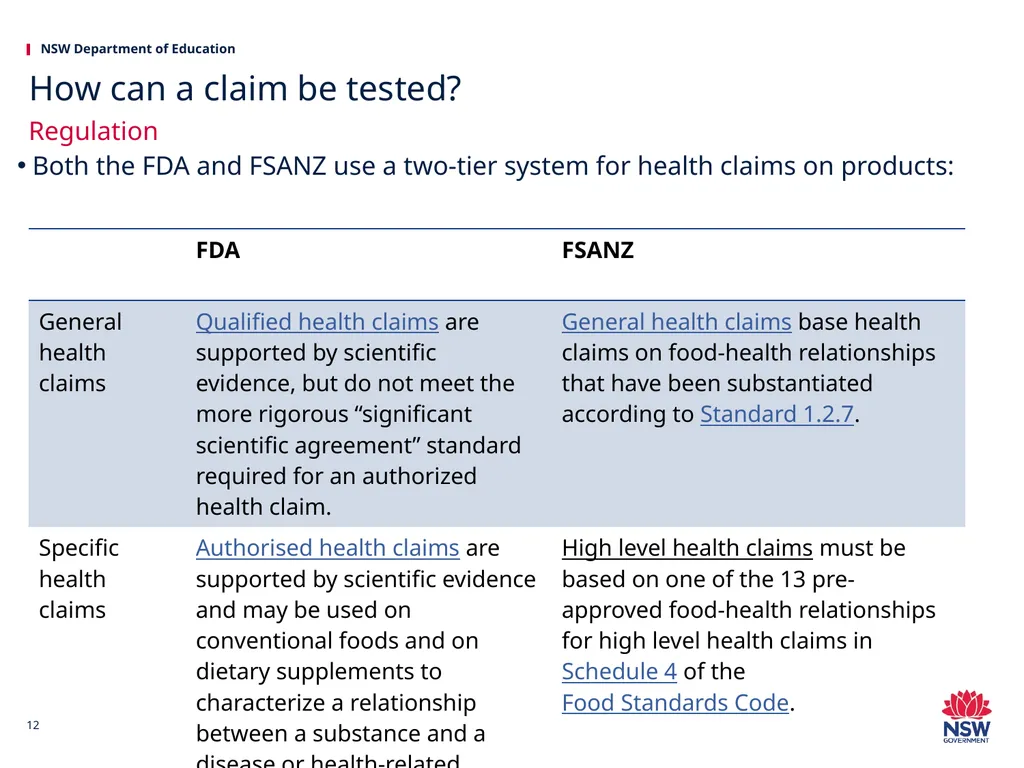
12 Both the FDA and FSANZ use a two-tier system for health claims on products: Regulation How can a claim be tested?<br>
13
13 Ben Goldacre unpicks dodgy scientific claims made by scaremongering journalists, dubious government reports, pharmaceutical corporations, PR companies and quacks.
Ben Goldacre - Battling Bad Science (6m 35s) - Every day there are news reports of new health advice, but how can you know if they're right? Evidence can be distorted, from the blindingly obvious nutrition claims to the very subtle tricks of the pharmaceutical industry. Bad Science How does the reporting of science influence the general public’s understanding of the subject?<br>
Ben Goldacre - Battling Bad Science (6m 35s) - Every day there are news reports of new health advice, but how can you know if they're right? Evidence can be distorted, from the blindingly obvious nutrition claims to the very subtle tricks of the pharmaceutical industry. Bad Science How does the reporting of science influence the general public’s understanding of the subject?<br>
14
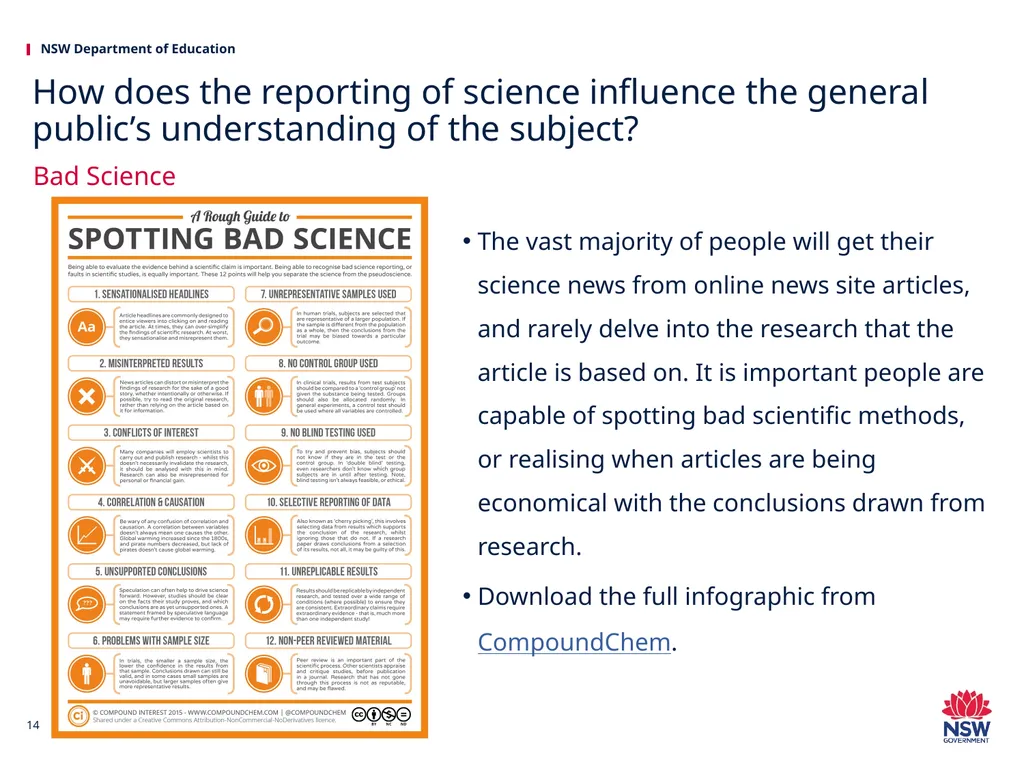
14 The vast majority of people will get their science news from online news site articles, and rarely delve into the research that the article is based on. It is important people are capable of spotting bad scientific methods, or realising when articles are being economical with the conclusions drawn from research.
Download the full infographic from CompoundChem. Bad Science How does the reporting of science influence the general public’s understanding of the subject?<br>
Download the full infographic from CompoundChem. Bad Science How does the reporting of science influence the general public’s understanding of the subject?<br>
15
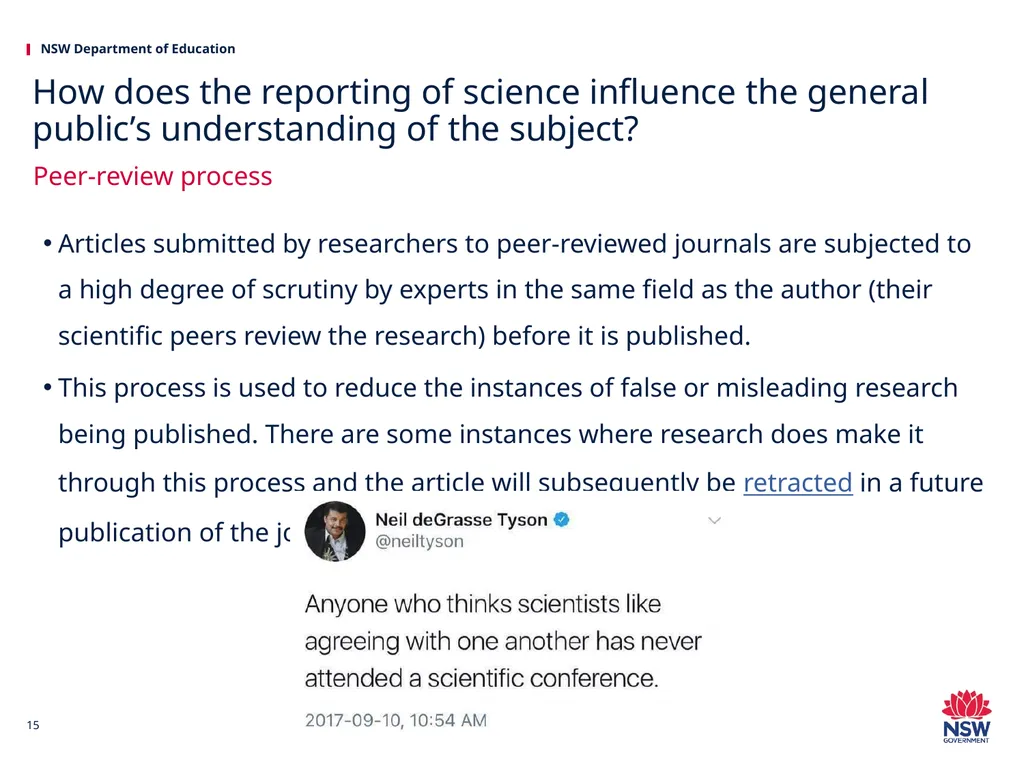
15 Articles submitted by researchers to peer-reviewed journals are subjected to a high degree of scrutiny by experts in the same field as the author (their scientific peers review the research) before it is published.
This process is used to reduce the instances of false or misleading research being published. There are some instances where research does make it through this process and the article will subsequently be retracted in a future publication of the journal. Peer-review process How does the reporting of science influence the general public’s understanding of the subject?<br>
This process is used to reduce the instances of false or misleading research being published. There are some instances where research does make it through this process and the article will subsequently be retracted in a future publication of the journal. Peer-review process How does the reporting of science influence the general public’s understanding of the subject?<br>
16
16 Popular media are designed to provide information in a format which is engaging and accessible to the general public, including any advertising mechanisms required to encourage consumers to choose their publication over a competitor.
Stories are rarely written by subject specialists and have little oversight over accuracy. The primary focus is on being first to publish in this highly competitive business space.
Popular media can oversimplify scientific publications and this can promote misconceptions, for example the tongue taste map.
The CRAAP test (alternative video) is a useful tool to make a preliminary assessment of a secondary source:
Currency, Relevance, Authority, Accuracy, Purpose Popular media How does the reporting of science influence the general public’s understanding of the subject?<br>
Stories are rarely written by subject specialists and have little oversight over accuracy. The primary focus is on being first to publish in this highly competitive business space.
Popular media can oversimplify scientific publications and this can promote misconceptions, for example the tongue taste map.
The CRAAP test (alternative video) is a useful tool to make a preliminary assessment of a secondary source:
Currency, Relevance, Authority, Accuracy, Purpose Popular media How does the reporting of science influence the general public’s understanding of the subject?<br>
17
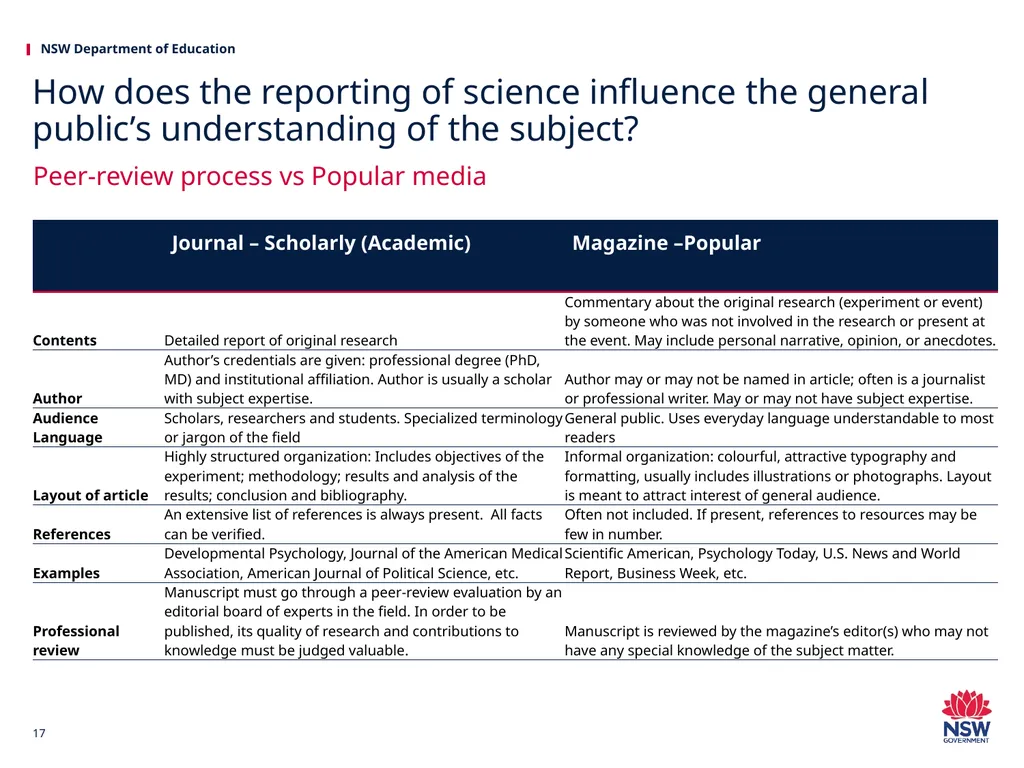
Peer-review process vs Popular media How does the reporting of science influence the general public’s understanding of the subject? 17<br>
18
18 Read the articles in the media:
ABC - Background music 'significantly impairs' creativity
TIME - Does Listening to Music Stimulate Creative Thinking, or Stifle It?
Read the journal article on which the stories are based:
Threadgold, E., Marsh, J., McLatchie, N. and Ball, L., 2019. Background music stints creativity: Evidence from compound remote associate tasks. Applied Cognitive Psychology, 33(5), pp.873-888.
Are the methods and conclusions the same between both sources? Article 1 - How does the reporting of science influence the general public’s understanding of the subject?<br>
ABC - Background music 'significantly impairs' creativity
TIME - Does Listening to Music Stimulate Creative Thinking, or Stifle It?
Read the journal article on which the stories are based:
Threadgold, E., Marsh, J., McLatchie, N. and Ball, L., 2019. Background music stints creativity: Evidence from compound remote associate tasks. Applied Cognitive Psychology, 33(5), pp.873-888.
Are the methods and conclusions the same between both sources? Article 1 - How does the reporting of science influence the general public’s understanding of the subject?<br>
19
19 Read the articles in the media:
https://www.washingtonpost.com/nation/2019/06/20/horns-are-growing-young-peoples-skulls-phone-use-is-blame-research-suggests/
Read the journal article on which the stories are based:
Shahar, D. and Sayers, M., 2018. Prominent exostosis projecting from the occipital squama more substantial and prevalent in young adult than older age groups. Scientific Reports, 8(1).
Are the methods and conclusions the same between both sources? Article 2 - How does the reporting of science influence the general public’s understanding of the subject?<br>
https://www.washingtonpost.com/nation/2019/06/20/horns-are-growing-young-peoples-skulls-phone-use-is-blame-research-suggests/
Read the journal article on which the stories are based:
Shahar, D. and Sayers, M., 2018. Prominent exostosis projecting from the occipital squama more substantial and prevalent in young adult than older age groups. Scientific Reports, 8(1).
Are the methods and conclusions the same between both sources? Article 2 - How does the reporting of science influence the general public’s understanding of the subject?<br>
20
20 Slide 3
Image https://www.publicdomainpictures.net/en/view-image.php?image=290460&picture=questions-amp-answers
Slide 5
Image https://commons.wikimedia.org/wiki/File:Plutchik_Emotions.png
This file is licensed under the Creative Commons Attribution-Share Alike 4.0 International license.
Slide 6
Image https://pxhere.com/en/photo/1585031
Text adapted from https://www.theladders.com/career-advice/your-emotional-brain-is-smarter-than-your-brain-thinks
This file is in the public domain. Credits<br>
Image https://www.publicdomainpictures.net/en/view-image.php?image=290460&picture=questions-amp-answers
Slide 5
Image https://commons.wikimedia.org/wiki/File:Plutchik_Emotions.png
This file is licensed under the Creative Commons Attribution-Share Alike 4.0 International license.
Slide 6
Image https://pxhere.com/en/photo/1585031
Text adapted from https://www.theladders.com/career-advice/your-emotional-brain-is-smarter-than-your-brain-thinks
This file is in the public domain. Credits<br>