Ions and Relative Atomic Mass Learning Objectives: Deduce the atomic structure in atoms and ions. State why Carbon-12 is used at the standard measurement of relative masses Calculate RAM, RMM (Relative molecular mass) and RFM (Relative
"Ions and Relative Atomic Mass Learning Objectives:" is the property of its rightful owner. Permission is granted to
download and print the materials on this website for personal, non-commercial use only, and to display it
on your personal computer provided you do not modify the materials and that you retain all copyright
notices contained in the materials. By downloading content from our website, you accept the terms of this
agreement.
Presentation Transcript
01
Ions and Relative Atomic Mass Learning Objectives:
Deduce the atomic structure in atoms and ions.
State why Carbon-12 is used at the standard measurement of relative masses
Calculate RAM, RMM (Relative molecular mass) and RFM (Relative formula mass).
Key Words:
Ion, electron, mass, relative.<br>
02
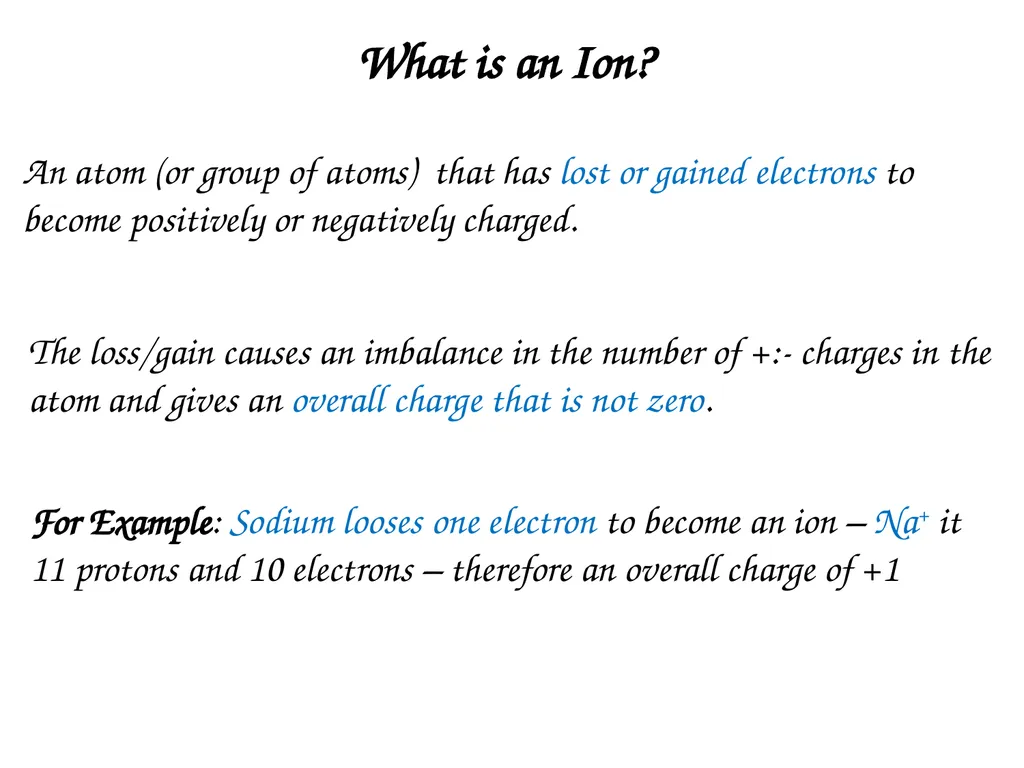
What is an Ion? An atom (or group of atoms) that has lost or gained electrons to become positively or negatively charged. The loss/gain causes an imbalance in the number of +:- charges in the atom and gives an overall charge that is not zero. For Example: Sodium looses one electron to become an ion – Na+ it 11 protons and 10 electrons – therefore an overall charge of +1<br>
03
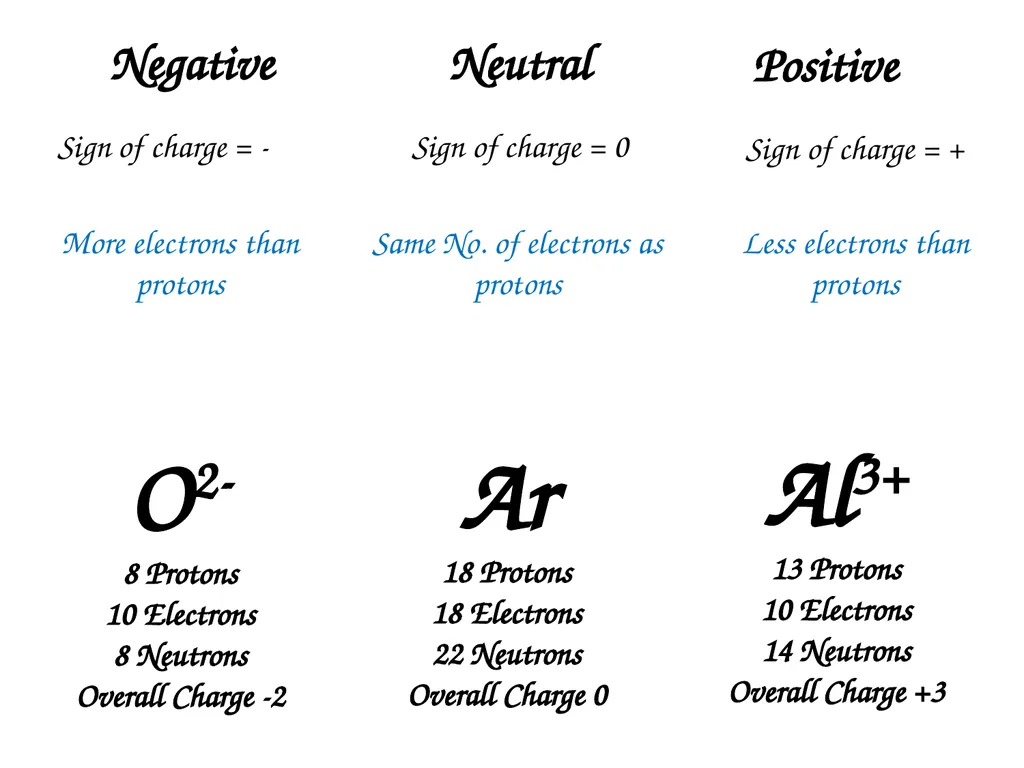
Negative Positive Neutral Sign of charge = - Sign of charge = 0 Sign of charge = + More electrons than protons Same No. of electrons as protons Less electrons than protons O2-
8 Protons
10 Electrons
8 Neutrons
Overall Charge -2 Ar
18 Protons
18 Electrons
22 Neutrons
Overall Charge 0 Al3+
13 Protons
10 Electrons
14 Neutrons
Overall Charge +3<br>
04
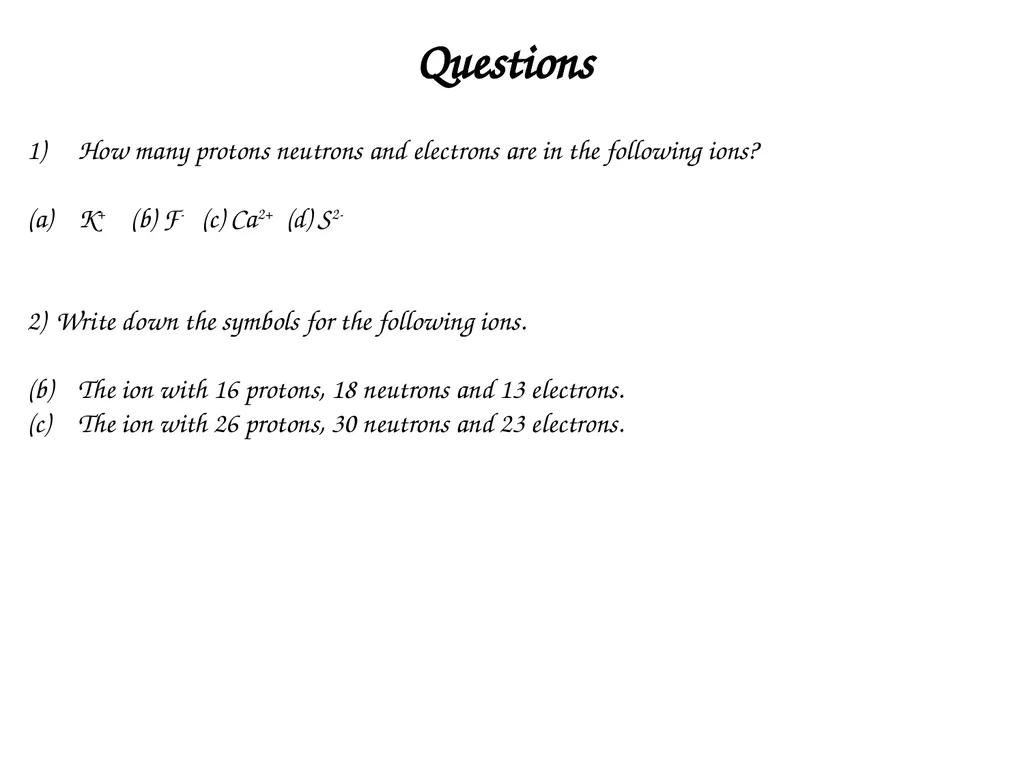
Questions How many protons neutrons and electrons are in the following ions?
K+ (b) F- (c) Ca2+ (d) S2-
2) Write down the symbols for the following ions.
The ion with 16 protons, 18 neutrons and 13 electrons.
The ion with 26 protons, 30 neutrons and 23 electrons.<br>
05
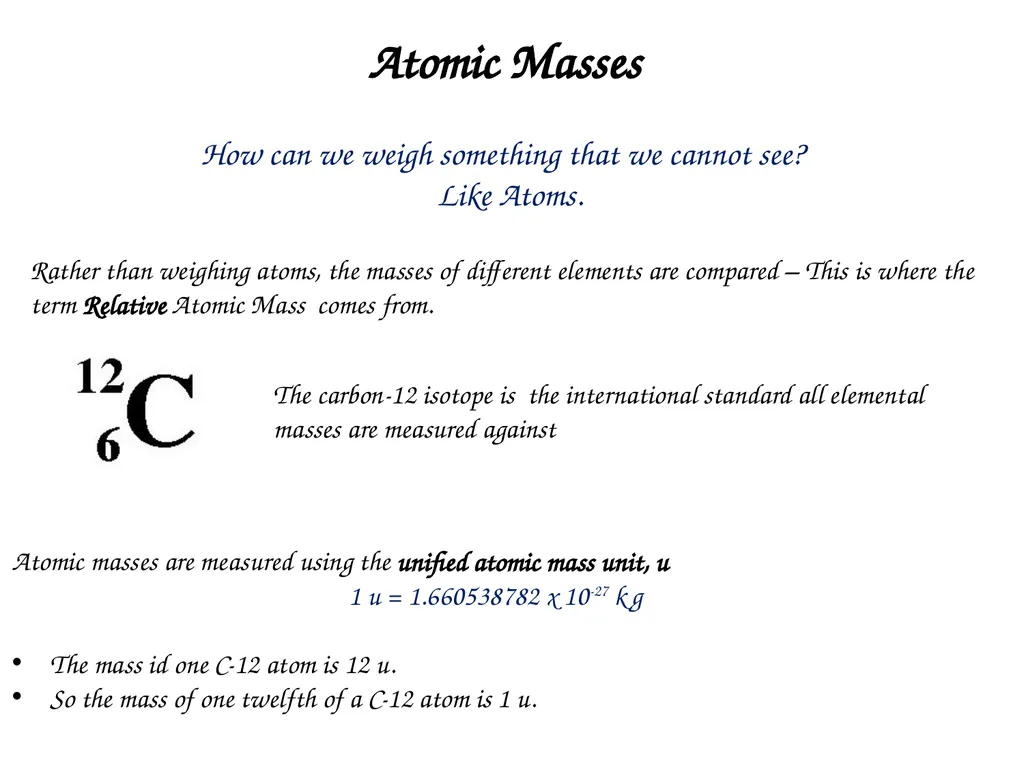
Atomic Masses How can we weigh something that we cannot see?
Like Atoms. Rather than weighing atoms, the masses of different elements are compared – This is where the term Relative Atomic Mass comes from. The carbon-12 isotope is the international standard all elemental masses are measured against Atomic masses are measured using the unified atomic mass unit, u
1 u = 1.660538782 x 10⁻²⁷ kg
The mass id one C-12 atom is 12 u.
So the mass of one twelfth of a C-12 atom is 1 u.<br>
06
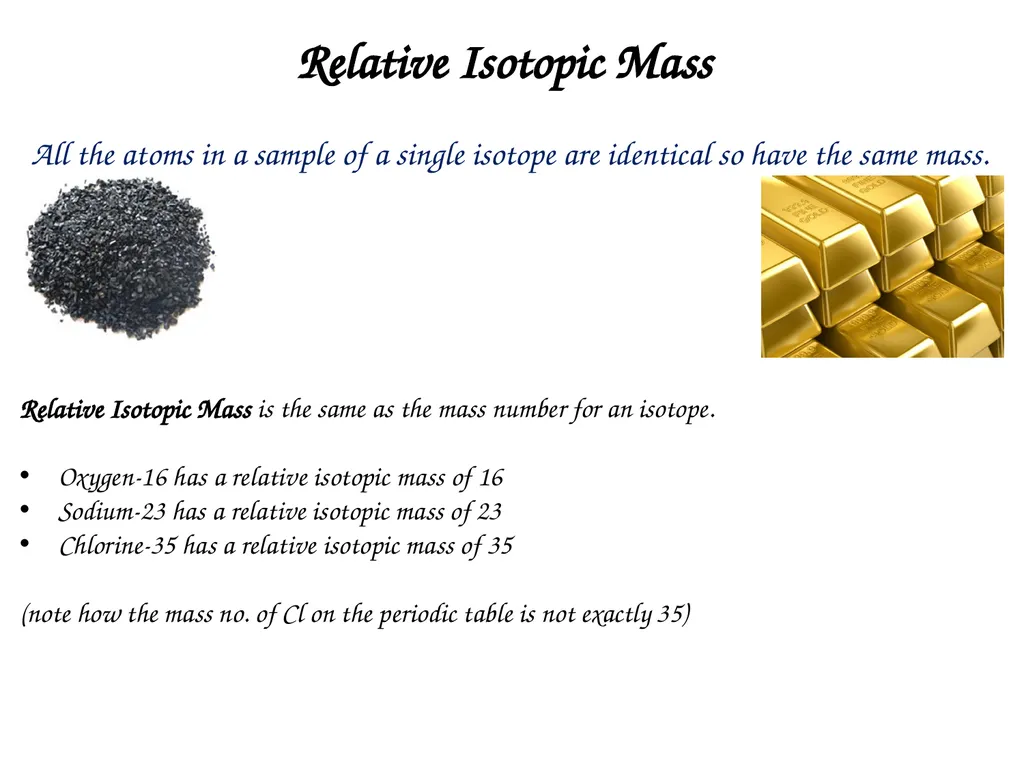
Relative Isotopic Mass Relative Isotopic Mass is the same as the mass number for an isotope.
Oxygen-16 has a relative isotopic mass of 16
Sodium-23 has a relative isotopic mass of 23
Chlorine-35 has a relative isotopic mass of 35
(note how the mass no. of Cl on the periodic table is not exactly 35) All the atoms in a sample of a single isotope are identical so have the same mass.<br>
07
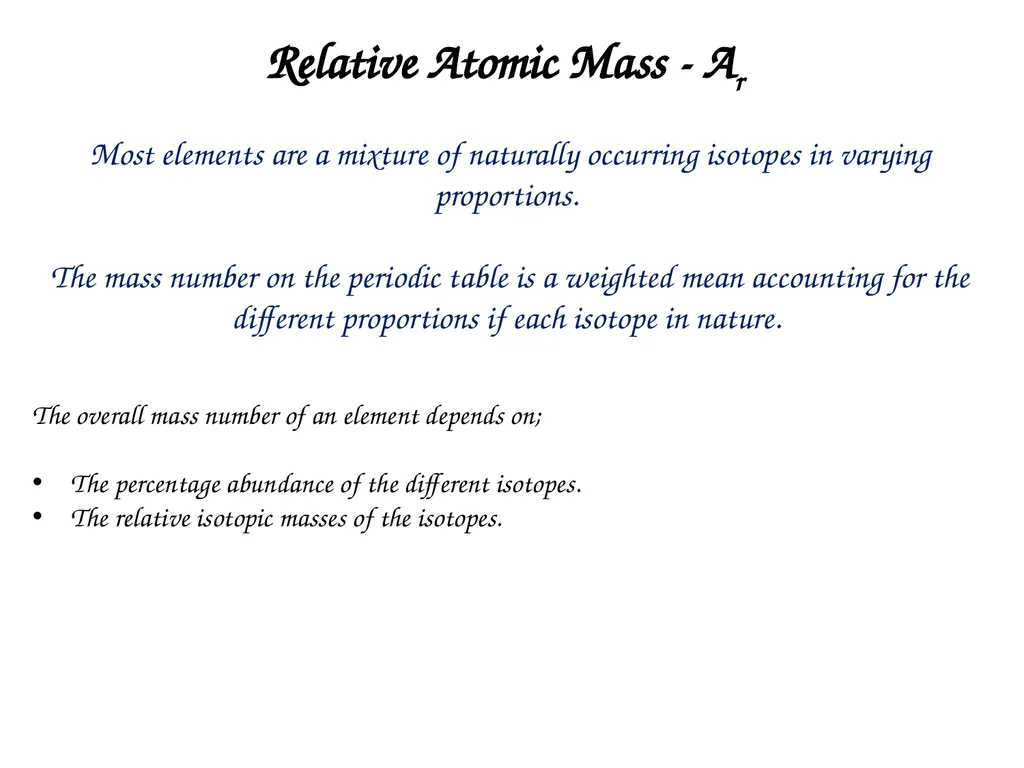
Relative Atomic Mass - Ar Most elements are a mixture of naturally occurring isotopes in varying proportions.
The mass number on the periodic table is a weighted mean accounting for the different proportions if each isotope in nature. The overall mass number of an element depends on;
The percentage abundance of the different isotopes.
The relative isotopic masses of the isotopes.<br>
08
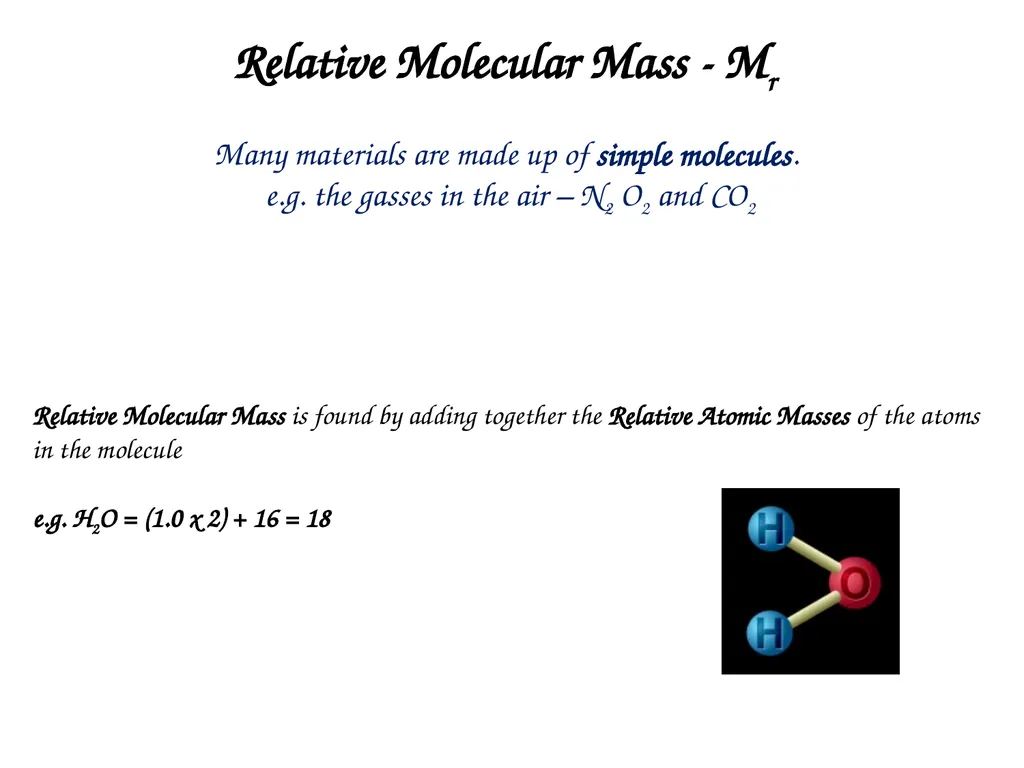
Relative Molecular Mass - Mr Many materials are made up of simple molecules.
e.g. the gasses in the air – N2 O2 and CO2 Relative Molecular Mass is found by adding together the Relative Atomic Masses of the atoms in the molecule
e.g. H2O = (1.0 x 2) + 16 = 18<br>
09
Relative Formula Mass Materials with giant structures don’t exist as simple molecules.
For example – NaCl (common salt) or SiO2 (sand)
So a different term is used (as they are no molecules)
Relative Formula Mass Relative Formula Mass is found by adding together the Relative Atomic Masses of the atoms in the formula unit
e.g. SiO2 = 28 + (16 x 2) = 60<br>
10
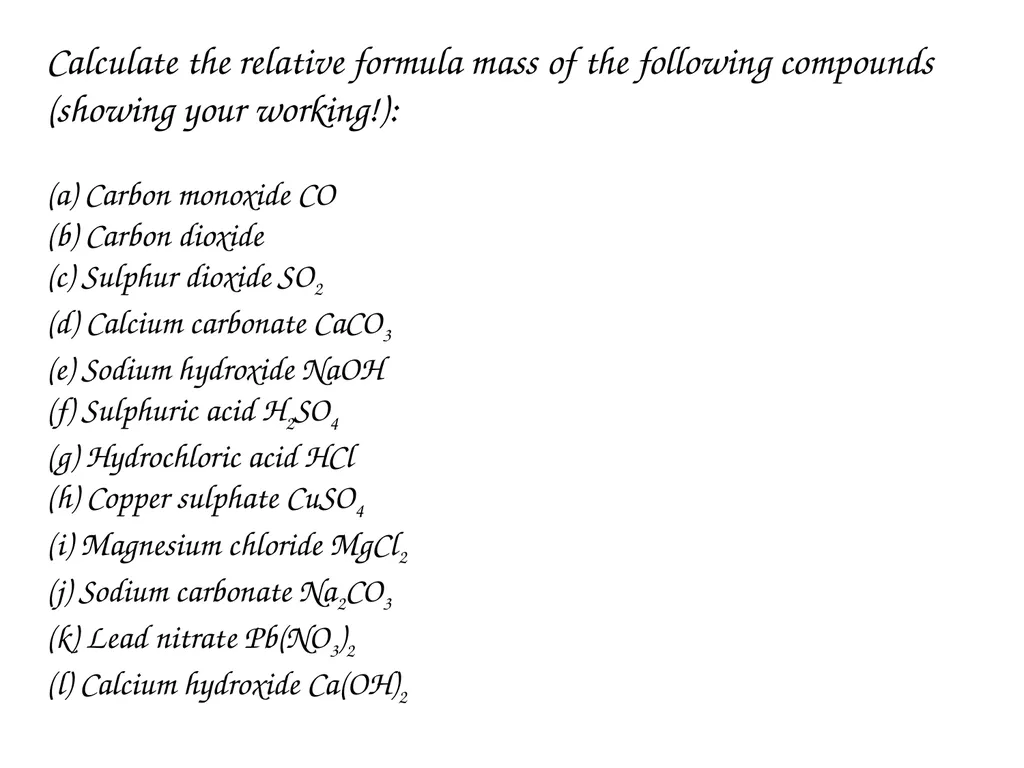
Calculate the relative formula mass of the following compounds (showing your working!):
(a) Carbon monoxide CO
(b) Carbon dioxide
(c) Sulphur dioxide SO2
(d) Calcium carbonate CaCO3
(e) Sodium hydroxide NaOH
(f) Sulphuric acid H2SO4
(g) Hydrochloric acid HCl
(h) Copper sulphate CuSO4
(i) Magnesium chloride MgCl2
(j) Sodium carbonate Na2CO3
(k) Lead nitrate Pb(NO3)2
(l) Calcium hydroxide Ca(OH)2<br>