IRA Agricultural Conservation Easement Program (ACEP) Agricultural Land Easements Wetland Reserve Easements Dean Kwasny - Easement Program Manager, CA NRCS IRA Easement Objectives Funding To carry out the agricultural conservation
"IRA Agricultural Conservation Easement Program" is the property of its rightful owner. Permission is granted to
download and print the materials on this website for personal, non-commercial use only, and to display it
on your personal computer provided you do not modify the materials and that you retain all copyright
notices contained in the materials. By downloading content from our website, you accept the terms of this
agreement.
Presentation Transcript
01
IRA Agricultural Conservation Easement Program (ACEP) Agricultural Land Easements Wetland Reserve Easements Dean Kwasny - Easement Program Manager, CA NRCS<br>
02
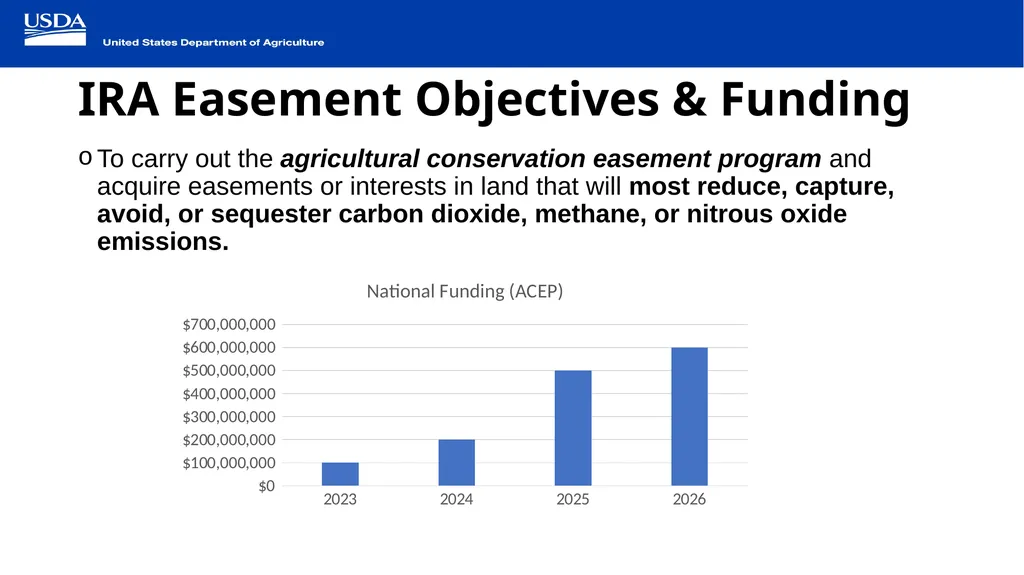
IRA Easement Objectives & Funding To carry out the agricultural conservation easement program and acquire easements or interests in land that will most reduce, capture, avoid, or sequester carbon dioxide, methane, or nitrous oxide emissions.<br>
03
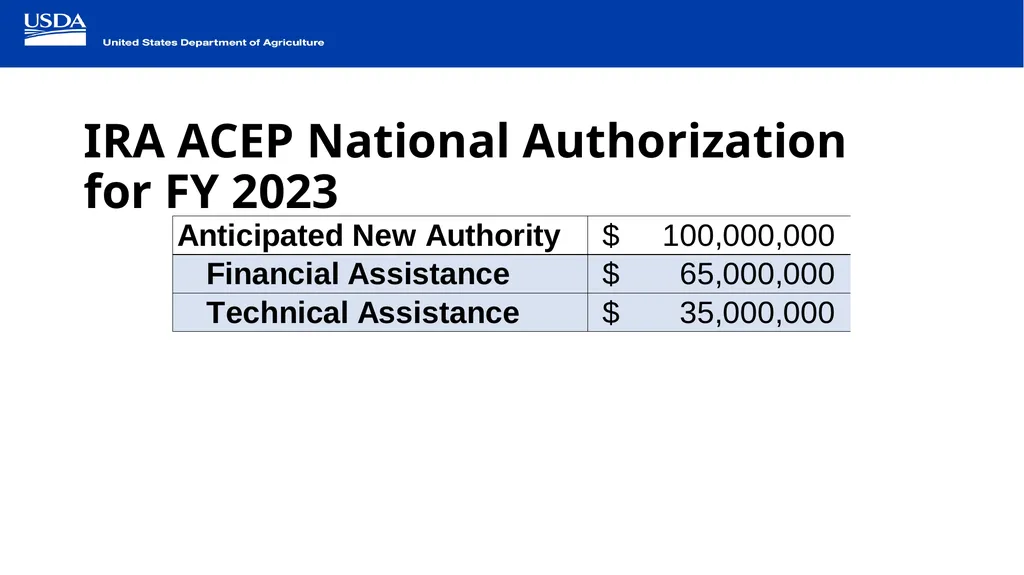
IRA ACEP National Authorization for FY 2023<br>
04
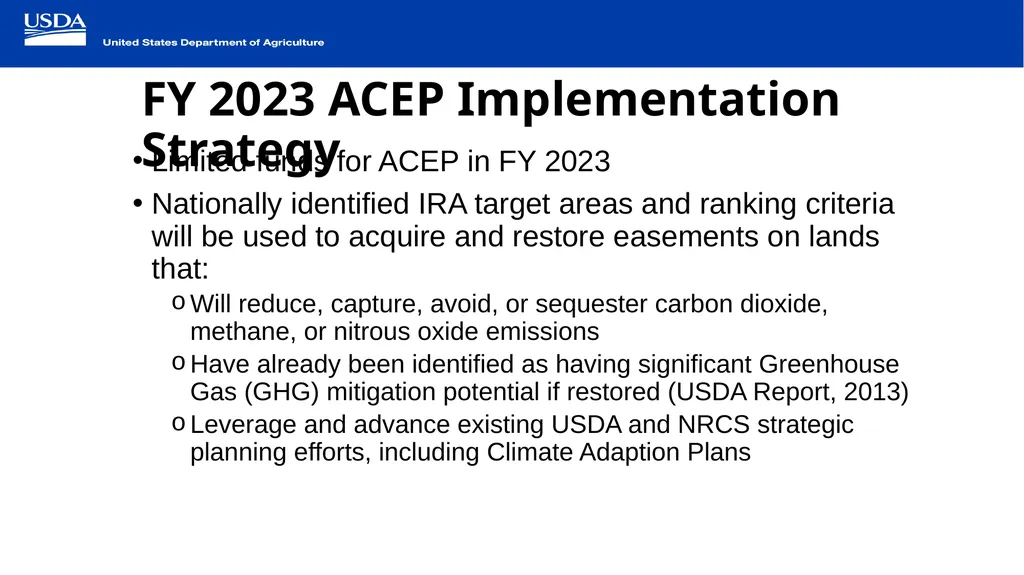
FY 2023 ACEP Implementation Strategy Limited funds for ACEP in FY 2023
Nationally identified IRA target areas and ranking criteria will be used to acquire and restore easements on lands that:
Will reduce, capture, avoid, or sequester carbon dioxide, methane, or nitrous oxide emissions
Have already been identified as having significant Greenhouse Gas (GHG) mitigation potential if restored (USDA Report, 2013)
Leverage and advance existing USDA and NRCS strategic planning efforts, including Climate Adaption Plans<br>
05
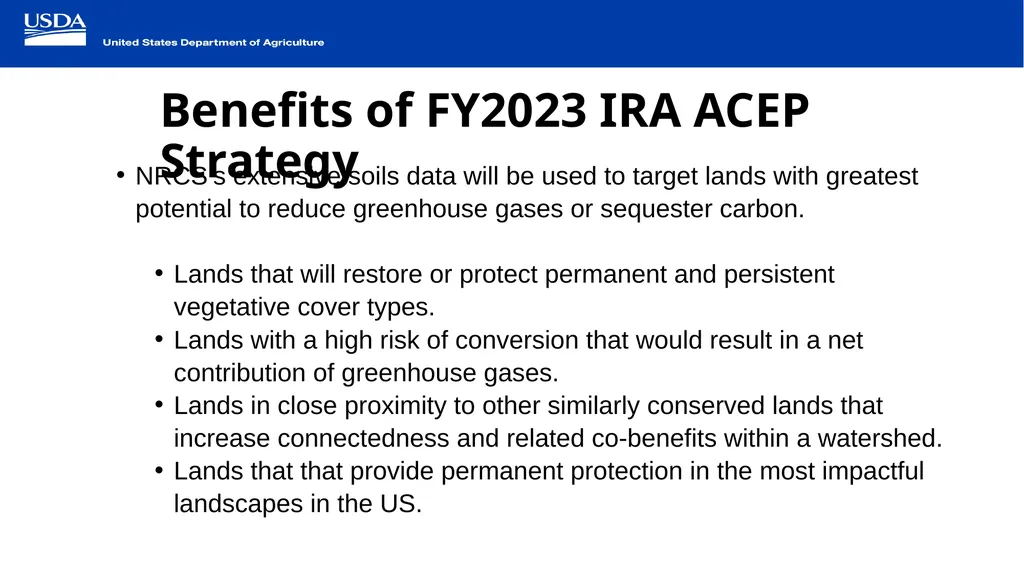
Benefits of FY2023 IRA ACEP Strategy NRCS’s extensive soils data will be used to target lands with greatest potential to reduce greenhouse gases or sequester carbon.
Lands that will restore or protect permanent and persistent vegetative cover types.
Lands with a high risk of conversion that would result in a net contribution of greenhouse gases.
Lands in close proximity to other similarly conserved lands that increase connectedness and related co-benefits within a watershed.
Lands that that provide permanent protection in the most impactful landscapes in the US.<br>
06
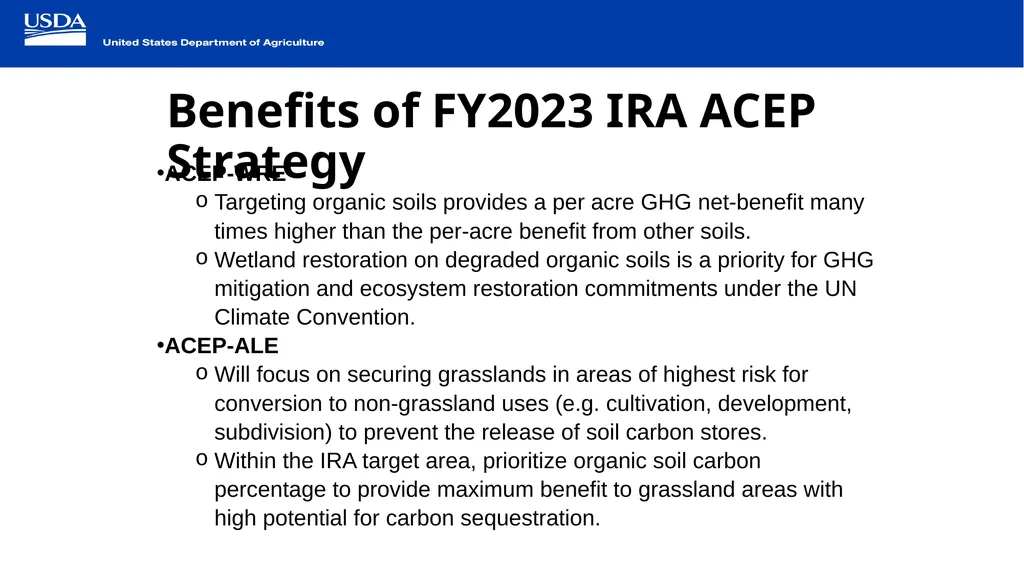
Benefits of FY2023 IRA ACEP Strategy ACEP-WRE
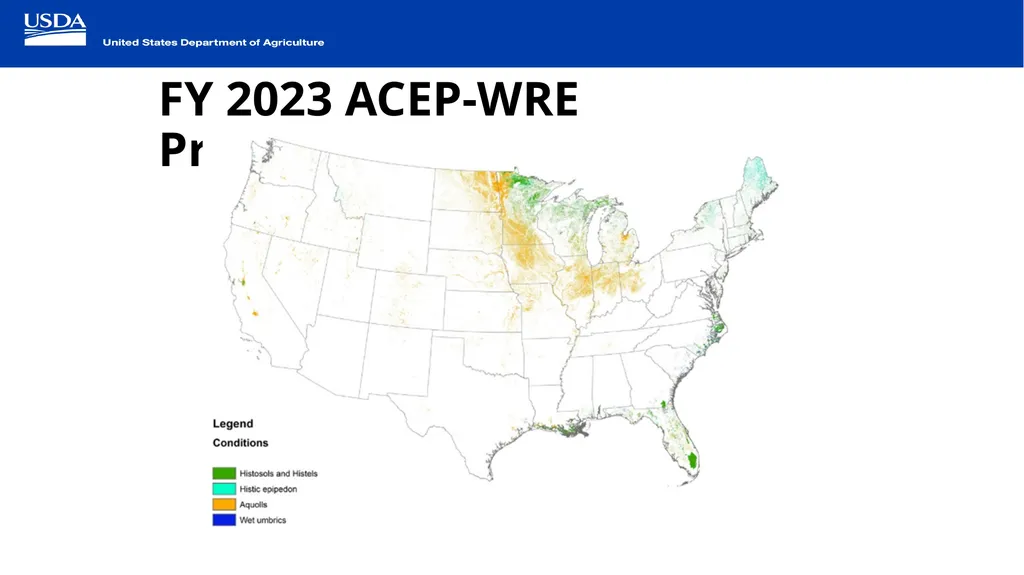
Targeting organic soils provides a per acre GHG net-benefit many times higher than the per-acre benefit from other soils.
Wetland restoration on degraded organic soils is a priority for GHG mitigation and ecosystem restoration commitments under the UN Climate Convention.
ACEP-ALE
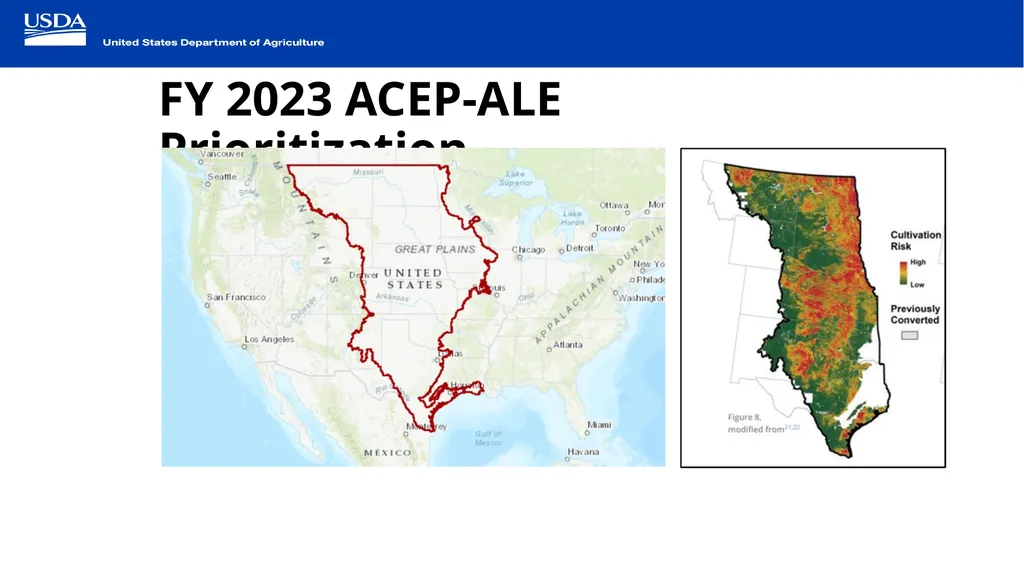
Will focus on securing grasslands in areas of highest risk for conversion to non-grassland uses (e.g. cultivation, development, subdivision) to prevent the release of soil carbon stores.
Within the IRA target area, prioritize organic soil carbon percentage to provide maximum benefit to grassland areas with high potential for carbon sequestration.<br>
07
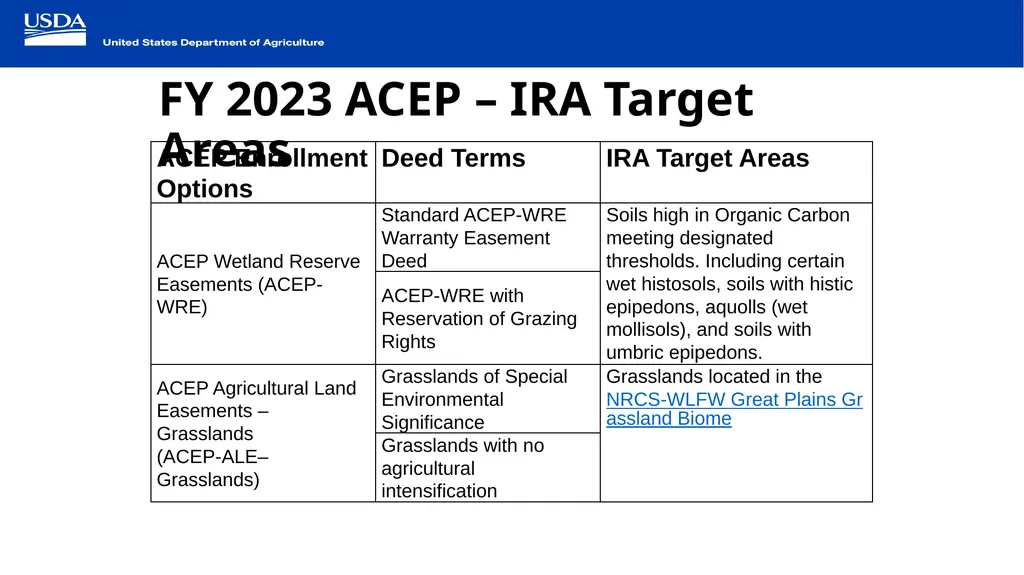
FY 2023 ACEP – IRA Target Areas<br>
08
FY 2023 ACEP-ALE Prioritization<br>
09
FY 2023 ACEP-WRE Prioritization<br>
10
FY2023 IRA ACEP Ranking and Project Selection National sign-up announcement and press release (applications were due 02/17/2023)
National Ranking Pools for IRA ACEP were published for WRE and ALE
All eligible and ranked applications will be compared nationally
IRA Financial Assistance (FA) funds will be allocated to States based on national selection of ranked applications<br>
11
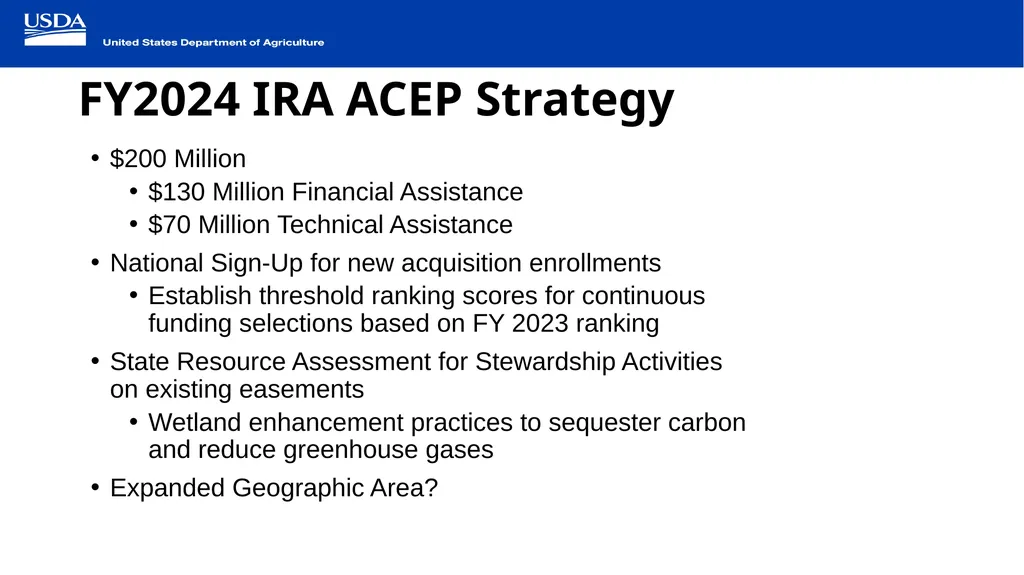
FY2024 IRA ACEP Strategy $200 Million
$130 Million Financial Assistance
$70 Million Technical Assistance
National Sign-Up for new acquisition enrollments
Establish threshold ranking scores for continuous funding selections based on FY 2023 ranking
State Resource Assessment for Stewardship Activities on existing easements
Wetland enhancement practices to sequester carbon and reduce greenhouse gases
Expanded Geographic Area?<br>