Is twenty-four weeks too short to assess virological success in primary HIV infection treatment ? Anne Vandendriessche1, Thomas Mourez2, Véronique Lemée2, Yasmine Debab1, Gilles Peytavin3, Joël Ladner4, François Caron1, Jean-Christophe
"Is twenty-four weeks too short to assess" is the property of its rightful owner. Permission is granted to
download and print the materials on this website for personal, non-commercial use only, and to display it
on your personal computer provided you do not modify the materials and that you retain all copyright
notices contained in the materials. By downloading content from our website, you accept the terms of this
agreement.
Presentation Transcript
01
Is twenty-four weeks too short to assess virological success in primary HIV infection treatment ? Anne Vandendriessche1,
Thomas Mourez2, Véronique Lemée2, Yasmine Debab1,
Gilles Peytavin3, Joël Ladner4, François Caron1,
Jean-Christophe Plantier2, Jérémie Leporrier1 1 Infectious Diseases Department, Rouen University Hospital, France
2 Virology Unit, Rouen University Hospital, France
3 Pharmacology and toxicology laboratory, Bichat-Claude Bernard hospital, APHP Paris, France
4 Epidemiology and Public Health Department, Rouen University Hospital, France 8th IAS Conference on HIV Pathogenesis, Treatment and Prevention, Vancouver, July 2015<br>
02
Disclosure No conflict of interest to report<br>
03
Background ART in primary HIV-1 infection (PHI)
No randomized clinical trial
Individual and collective benefits1-2
French3, European4 and US guidelines5: treat all PHI
Recommended ART in PHI3-5
Analogy with established infection
Commonly, TDF/FTC + 3rd agent (protease inhibitor)
Goal of ART: « virological success »
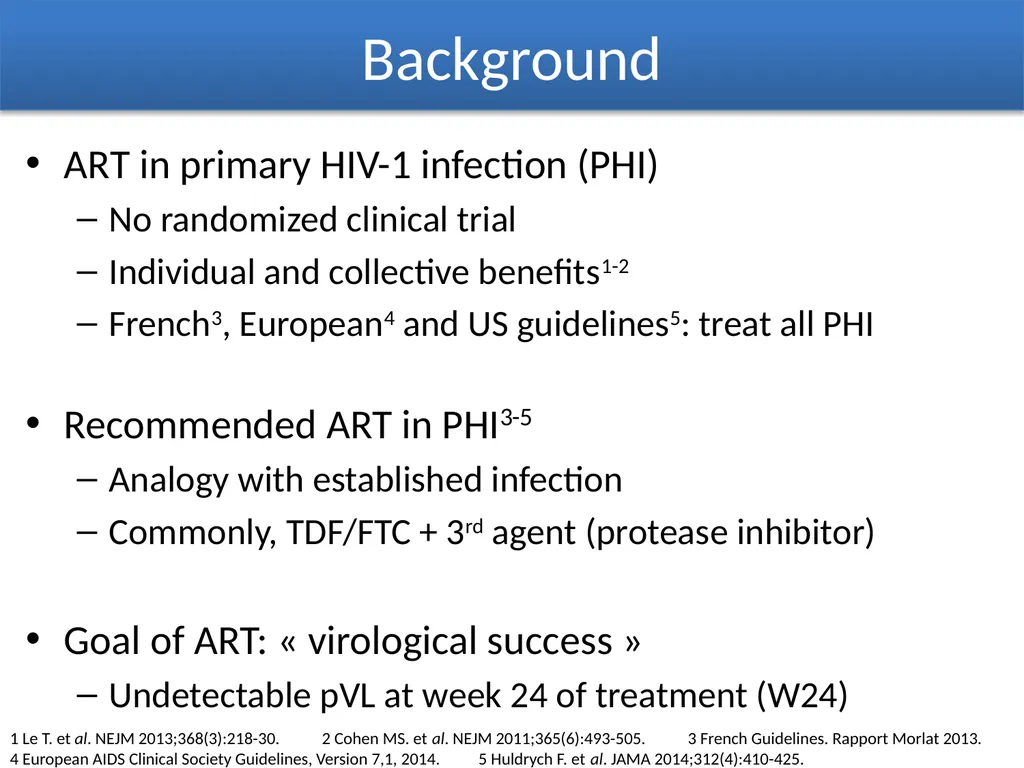
Undetectable pVL at week 24 of treatment (W24) 1 Le T. et al. NEJM 2013;368(3):218-30. 2 Cohen MS. et al. NEJM 2011;365(6):493-505. 3 French Guidelines. Rapport Morlat 2013.
4 European AIDS Clinical Society Guidelines, Version 7,1, 2014. 5 Huldrych F. et al. JAMA 2014;312(4):410-425.<br>
04
Objectives Analyze a cohort of patients with PHI:
Predictive factors of virological failure at W24 ?
Is the W24 end-point relevant for assess virological response ?<br>
05
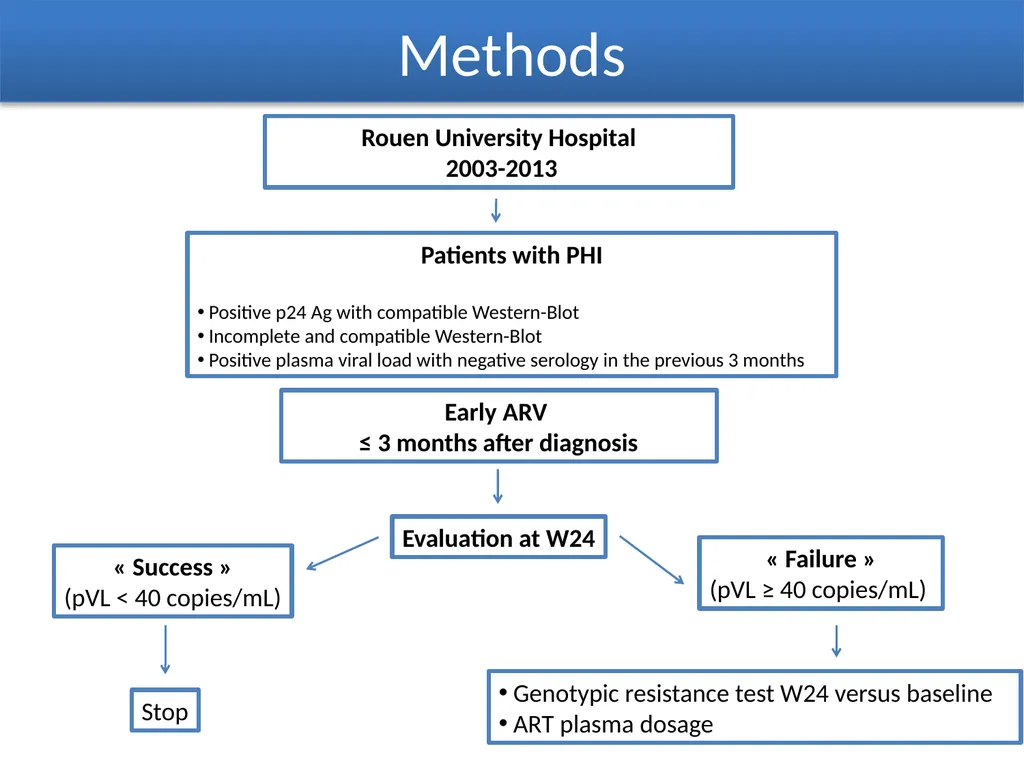
Methods Rouen University Hospital
2003-2013 Patients with PHI
Positive p24 Ag with compatible Western-Blot
Incomplete and compatible Western-Blot
Positive plasma viral load with negative serology in the previous 3 months Early ARV
≤ 3 months after diagnosis Evaluation at W24 « Success »
(pVL < 40 copies/mL) Stop « Failure »
(pVL ≥ 40 copies/mL) Genotypic resistance test W24 versus baseline
ART plasma dosage<br>
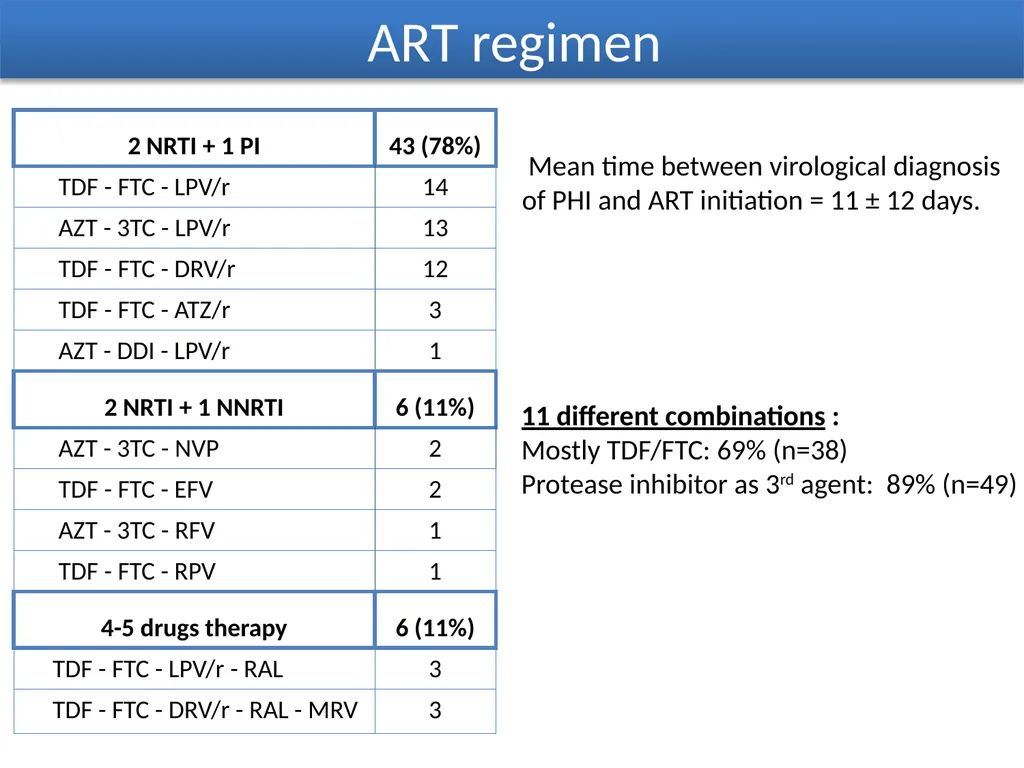
11 different combinations :
Mostly TDF/FTC: 69% (n=38)
Protease inhibitor as 3rd agent: 89% (n=49) ART regimen Mean time between virological diagnosis
of PHI and ART initiation = 11 ± 12 days.<br>
09
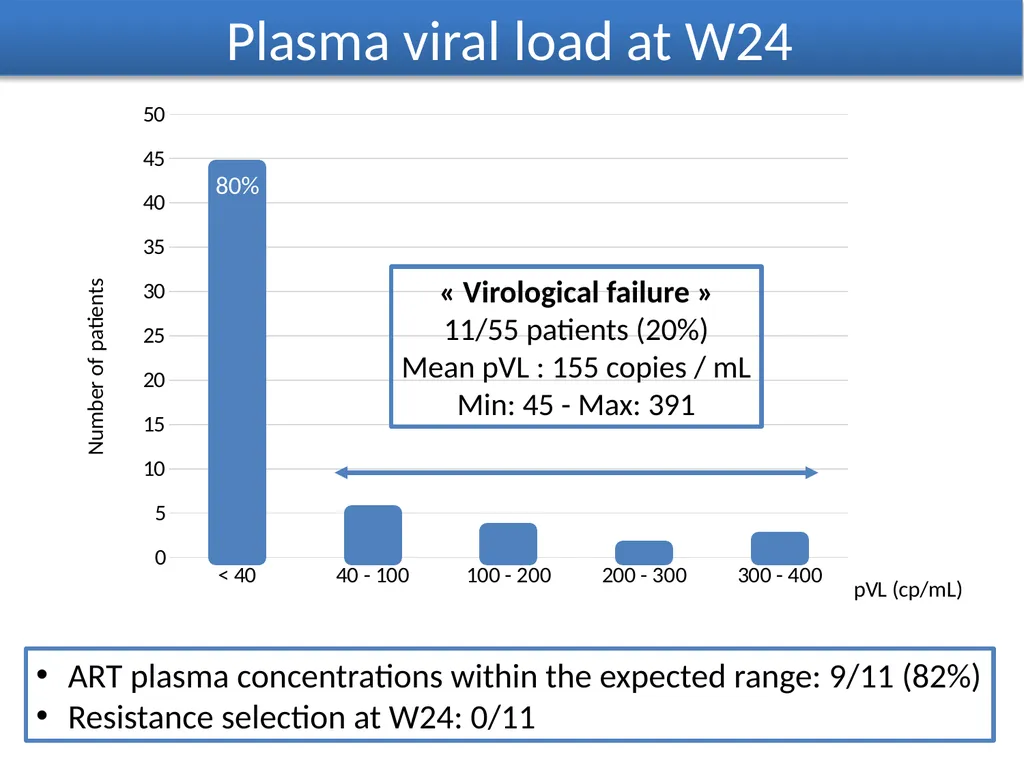
ART plasma concentrations within the expected range: 9/11 (82%)
Resistance selection at W24: 0/11 Plasma viral load at W24 « Virological failure »
11/55 patients (20%)
Mean pVL : 155 copies / mL
Min: 45 - Max: 391<br>
10
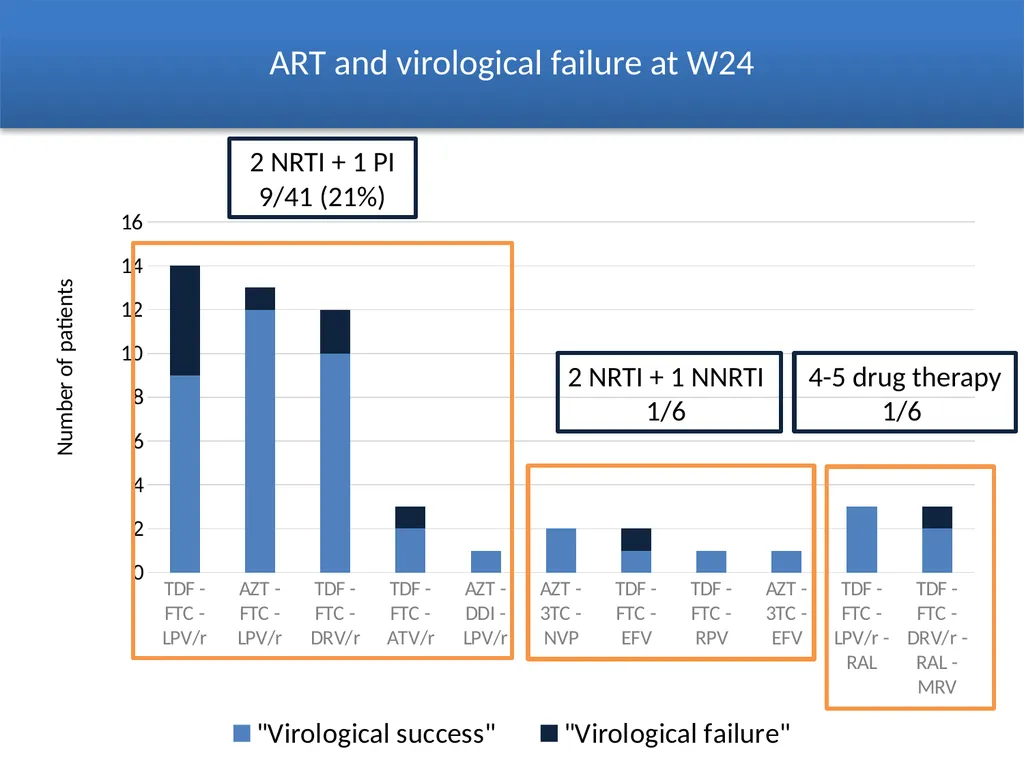
ART and virological failure at W24 2 NRTI + 1 PI
9/41 (21%) 2 NRTI + 1 NNRTI
1/6 4-5 drug therapy
1/6<br>
11
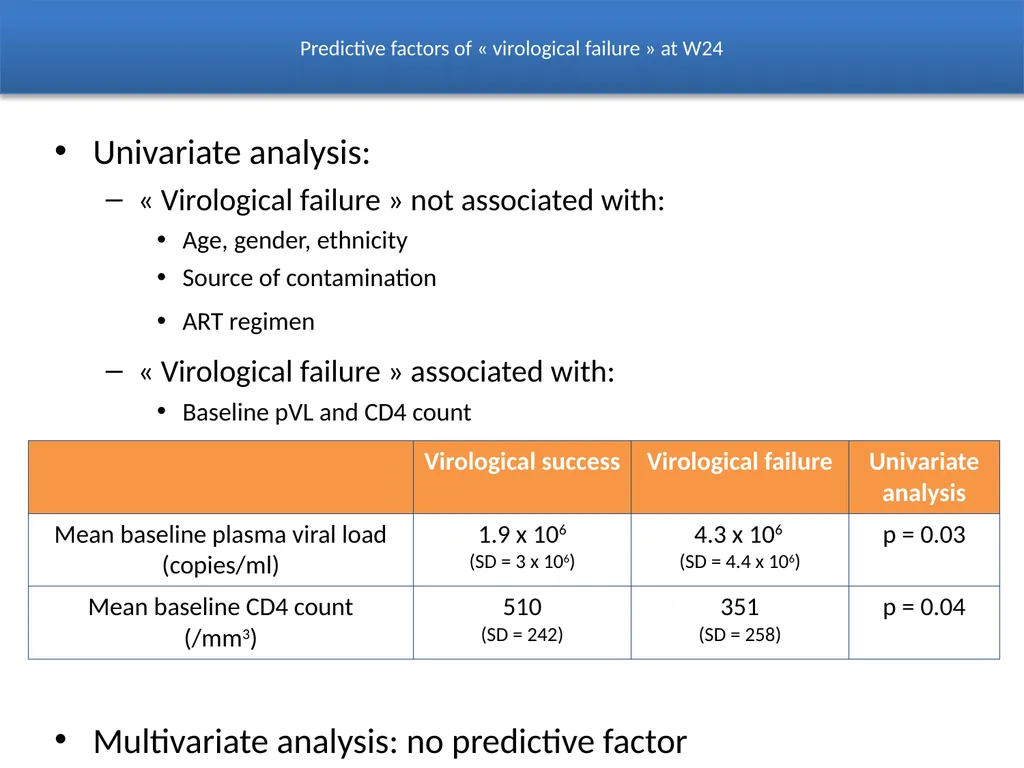
Predictive factors of « virological failure » at W24 Univariate analysis:
« Virological failure » not associated with:
Age, gender, ethnicity
Source of contamination
ART regimen
« Virological failure » associated with:
Baseline pVL and CD4 count
Multivariate analysis: no predictive factor<br>
12
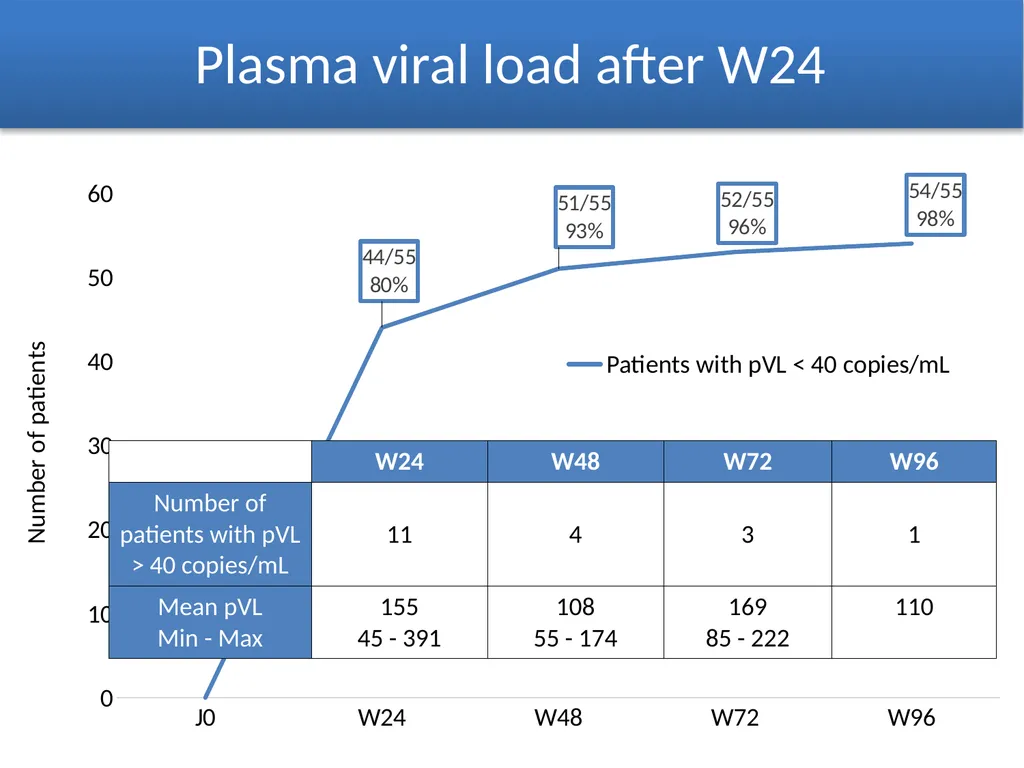
Plasma viral load after W24<br>
13
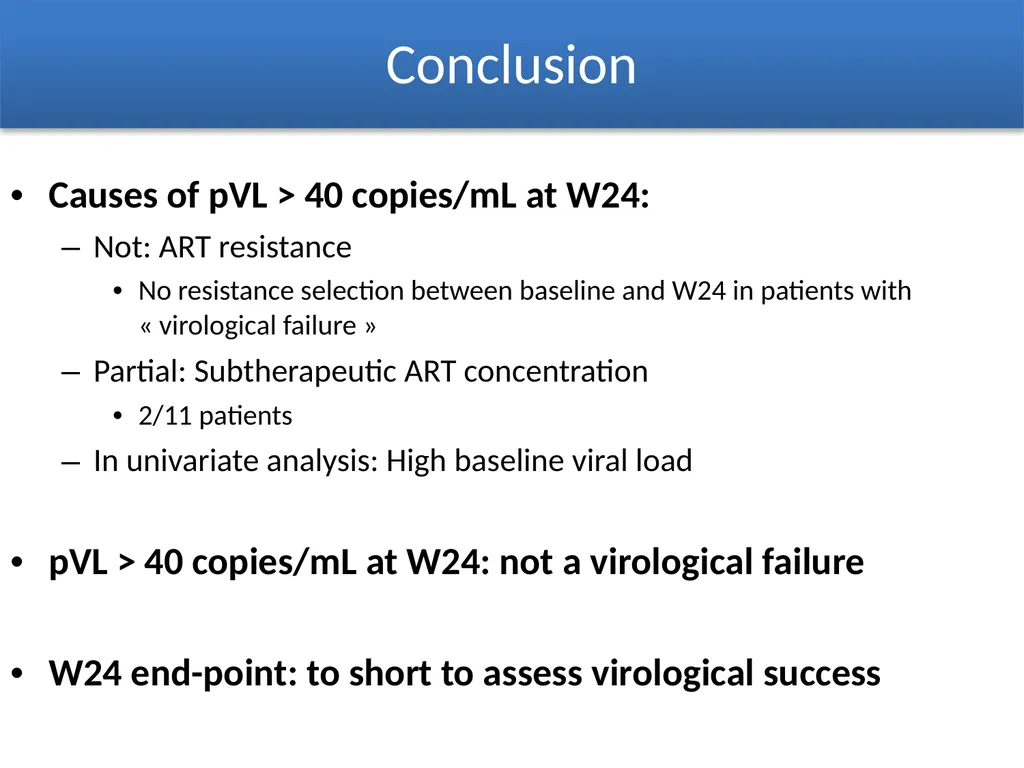
Conclusion Causes of pVL > 40 copies/mL at W24:
Not: ART resistance
No resistance selection between baseline and W24 in patients with « virological failure »
Partial: Subtherapeutic ART concentration
2/11 patients
In univariate analysis: High baseline viral load
pVL > 40 copies/mL at W24: not a virological failure
W24 end-point: to short to assess virological success<br>
14
Acknowledgments All co authors
Infectious Diseases Department: Dr Gueit, Dr Debab, Dr Etienne, Dr Delbos, Dr Chapuzet
Virology Unit: all the technicians Mrs Sabourin