
IS8014 Theory & Qualitative IS Research VIII:
AS
Published · 70 slides · 0 views

1 / 1




Description
IS8014 Theory Qualitative IS Research VIII: Action Research 2 Introduction Action Research involves solving organizational problems improving organizational circumstances for stakeholders (employees, managers, customers) by means of
Related Topics
Share
Embed code
Download this presentation From Below
"IS8014 Theory & Qualitative IS Research VIII:" is the property of its rightful owner. Permission is granted to download and print the materials on this website for personal, non-commercial use only, and to display it on your personal computer provided you do not modify the materials and that you retain all copyright notices contained in the materials. By downloading content from our website, you accept the terms of this agreement.
Presentation Transcript
01
IS8014
Theory & Qualitative IS Research VIII: Action Research<br>
02
2 Introduction Action Research involves…
solving organizational problems
improving organizational circumstances for stakeholders (employees, managers, customers)
…by means of researcher intervention, thus…
contributing to knowledge about both academic theory & organizational practice<br>
solving organizational problems
improving organizational circumstances for stakeholders (employees, managers, customers)
…by means of researcher intervention, thus…
contributing to knowledge about both academic theory & organizational practice<br>
03
3 Two Demanding Masters Client
Need for organizational problem solving
Research Community
Need for knowledge that is relevant in this organizational situation and is also applicable to other problem contexts (in other organizations)<br>
Need for organizational problem solving
Research Community
Need for knowledge that is relevant in this organizational situation and is also applicable to other problem contexts (in other organizations)<br>
04
4 Epistemology Canonical AR is usually premised on an *interpretivist* epistemology
The CAR researcher-practitioner needs to engage in many interpretive and diagnostic acts, thinking carefully about the organizational situation, representing the world as experienced by the clients.
Disciplined subjectivity and imagination are critical skills<br>
The CAR researcher-practitioner needs to engage in many interpretive and diagnostic acts, thinking carefully about the organizational situation, representing the world as experienced by the clients.
Disciplined subjectivity and imagination are critical skills<br>
05
5 Canonical AR is… Iterative - with one or more cycles of interventions
Rigorous - correct use of methods in the task context
Carefully planned iterations to develop detailed problem context knowledge and to identify relevant solutions
Continuous problem (re)diagnosis
Flexible application of the method
Collaborative
Researchers and Clients must work together
Clients must actively participate in the project<br>
Rigorous - correct use of methods in the task context
Carefully planned iterations to develop detailed problem context knowledge and to identify relevant solutions
Continuous problem (re)diagnosis
Flexible application of the method
Collaborative
Researchers and Clients must work together
Clients must actively participate in the project<br>
06
6 Canonical AR Projects A CAR project can be expected to investigate the evolution of an organizational change process in great detail
Each organizational context will have a unique set of constraints and idiosyncracies
Organizational circumstances are ever changing
So you can’t plan everything in advance
There is an infinite variety of circumstances that you will have to be prepared to adapt to!
Can be structured according to principles and criteria, but these need to be applied sensitively<br>
Each organizational context will have a unique set of constraints and idiosyncracies
Organizational circumstances are ever changing
So you can’t plan everything in advance
There is an infinite variety of circumstances that you will have to be prepared to adapt to!
Can be structured according to principles and criteria, but these need to be applied sensitively<br>
07
7 Principles & Criteria Researcher-Client Agreement
Cyclical Process Model
Role of Theory
Change through Action
Specification of Learning<br>
Cyclical Process Model
Role of Theory
Change through Action
Specification of Learning<br>
08
8 1. Researcher-Client Agreement Guiding foundation for the project
Client must understand what CAR involves
Mutual guarantees for behaviour
Basis for building trust in the organizational context
Promote a spirit of shared inquiry<br>
Client must understand what CAR involves
Mutual guarantees for behaviour
Basis for building trust in the organizational context
Promote a spirit of shared inquiry<br>
09
9 RCA Criteria C1a Both the researchers and the client agree that IAR is the appropriate approach for the organisational situation.
C1c The client has made an explicit commitment to the project.
C1b The researchers and the client jointly specify the focus of the AR project clearly and explicitly.
C1e The project objectives and evaluation measures are specified explicitly.
C1d The roles and responsibilities of the researchers and client organisation members are specified explicitly.
C1f The data collection and analysis methods are specified explicitly.<br>
C1c The client has made an explicit commitment to the project.
C1b The researchers and the client jointly specify the focus of the AR project clearly and explicitly.
C1e The project objectives and evaluation measures are specified explicitly.
C1d The roles and responsibilities of the researchers and client organisation members are specified explicitly.
C1f The data collection and analysis methods are specified explicitly.<br>
10
10 2. Cyclical Process Model Sequential progress through the Cyclical Process Model helps to ensure rigour
Some between-stage iteration may occur – needs to be justified
Usually several cycles are necessary<br>
Some between-stage iteration may occur – needs to be justified
Usually several cycles are necessary<br>
11
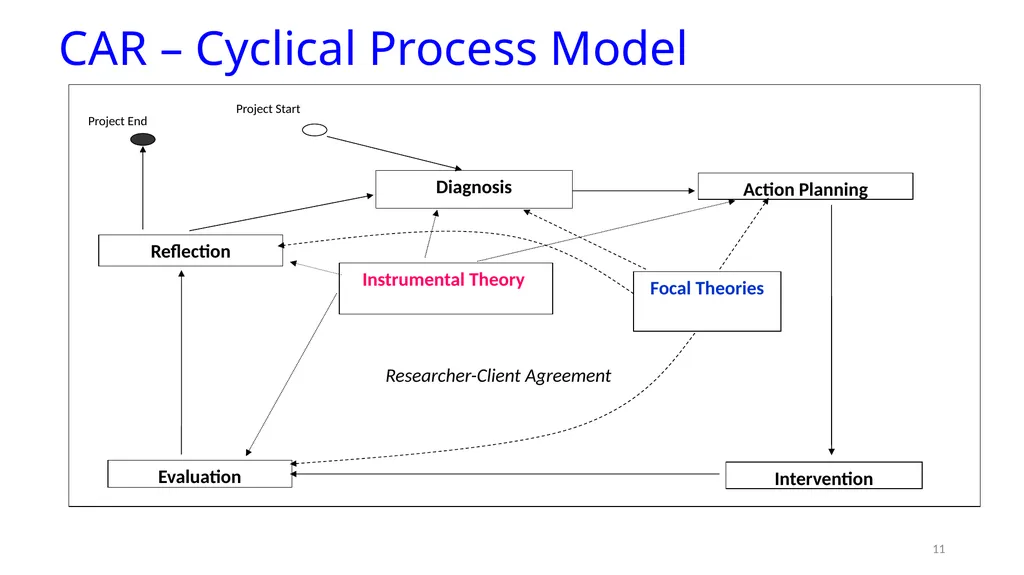
11 CAR – Cyclical Process Model Diagnosis Action Planning Intervention Evaluation Reflection Project End Project Start Focal Theories Instrumental Theory Researcher-Client Agreement<br>
12
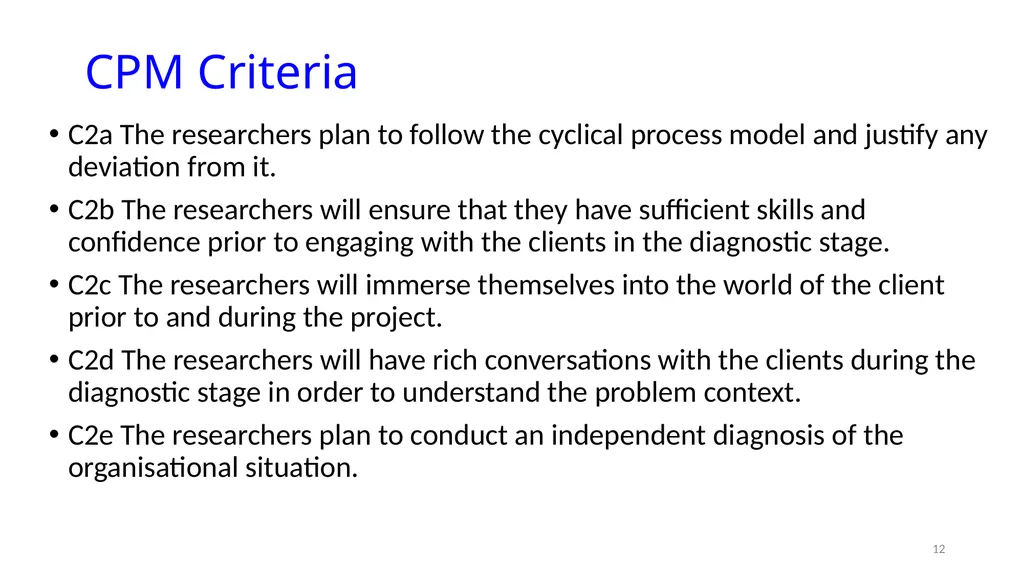
12 CPM Criteria C2a The researchers plan to follow the cyclical process model and justify any deviation from it.
C2b The researchers will ensure that they have sufficient skills and confidence prior to engaging with the clients in the diagnostic stage.
C2c The researchers will immerse themselves into the world of the client prior to and during the project.
C2d The researchers will have rich conversations with the clients during the diagnostic stage in order to understand the problem context.
C2e The researchers plan to conduct an independent diagnosis of the organisational situation.<br>
C2b The researchers will ensure that they have sufficient skills and confidence prior to engaging with the clients in the diagnostic stage.
C2c The researchers will immerse themselves into the world of the client prior to and during the project.
C2d The researchers will have rich conversations with the clients during the diagnostic stage in order to understand the problem context.
C2e The researchers plan to conduct an independent diagnosis of the organisational situation.<br>
13
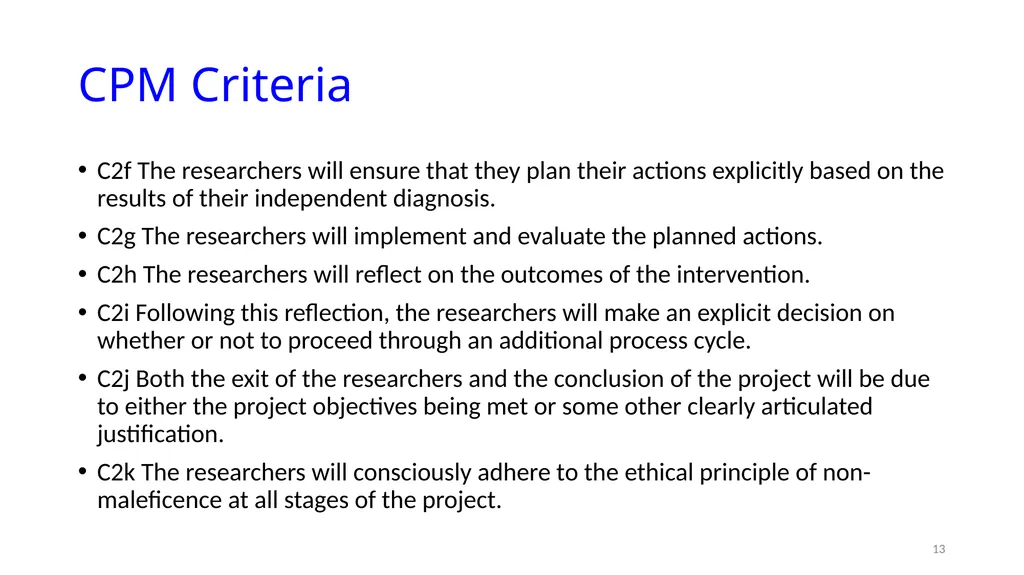
13 CPM Criteria C2f The researchers will ensure that they plan their actions explicitly based on the results of their independent diagnosis.
C2g The researchers will implement and evaluate the planned actions.
C2h The researchers will reflect on the outcomes of the intervention.
C2i Following this reflection, the researchers will make an explicit decision on whether or not to proceed through an additional process cycle.
C2j Both the exit of the researchers and the conclusion of the project will be due to either the project objectives being met or some other clearly articulated justification.
C2k The researchers will consciously adhere to the ethical principle of non-maleficence at all stages of the project.<br>
C2g The researchers will implement and evaluate the planned actions.
C2h The researchers will reflect on the outcomes of the intervention.
C2i Following this reflection, the researchers will make an explicit decision on whether or not to proceed through an additional process cycle.
C2j Both the exit of the researchers and the conclusion of the project will be due to either the project objectives being met or some other clearly articulated justification.
C2k The researchers will consciously adhere to the ethical principle of non-maleficence at all stages of the project.<br>
14
14 3. Theory “Action Research without theory - is not research”
McKay & Marshall (2001)
“It is highly unlikely that the researcher can know definitely and in advance the exact theory that will be used or developed”
Cunningham (1993)
Premature application of theory may be counterproductive
So theory-free problem diagnosis may need to precede CAR, yet theory is important
Two types of theory: instrumental and focal<br>
McKay & Marshall (2001)
“It is highly unlikely that the researcher can know definitely and in advance the exact theory that will be used or developed”
Cunningham (1993)
Premature application of theory may be counterproductive
So theory-free problem diagnosis may need to precede CAR, yet theory is important
Two types of theory: instrumental and focal<br>
15
15 Theory Lewin (1945): “There is nothing so practical as a good theory”.
Ghoshal (2005): “Nothing is as dangerous as a bad theory”.
Both of these two statements apply equally to CAR
Selection of an appropriate theory must be handled with great care given the potential for consequences in the organisational setting.<br>
Ghoshal (2005): “Nothing is as dangerous as a bad theory”.
Both of these two statements apply equally to CAR
Selection of an appropriate theory must be handled with great care given the potential for consequences in the organisational setting.<br>
16
16 Instrumental Theory Particularly valuable for diagnosis and planning
Play a mediating role between client and researcher
Used to explain and analyse organizational activities/phenomena related to the project/problem
Includes any tools, models or processes that theorise how work is done or how outcomes are achieved
Our use of the term ‘instrumental theory’ follows Hambrick’s (2007) comment that instrumental theories help us to “organize our thoughts, generate coherent explanations … [and so] achieve understanding”. Such theories will be practical (Lewin 1945) and closely match reality (cf. Weick 1995).<br>
Play a mediating role between client and researcher
Used to explain and analyse organizational activities/phenomena related to the project/problem
Includes any tools, models or processes that theorise how work is done or how outcomes are achieved
Our use of the term ‘instrumental theory’ follows Hambrick’s (2007) comment that instrumental theories help us to “organize our thoughts, generate coherent explanations … [and so] achieve understanding”. Such theories will be practical (Lewin 1945) and closely match reality (cf. Weick 1995).<br>
17
17 Focal Theory Provides the intellectual basis for action-oriented change.
May need to be modified as a result of its application in the problem context
Is unlikely to remedy an organizational problem alone.
Its application must be premised on one or more instrumental theories
May need to be changed if it does not fit the project circumstances<br>
May need to be modified as a result of its application in the problem context
Is unlikely to remedy an organizational problem alone.
Its application must be premised on one or more instrumental theories
May need to be changed if it does not fit the project circumstances<br>
18
18 Theory & Consequences A theory must be selected because it fits the organizational circumstances, the IT, the people, the culture.
The client needs to understand the theory and its implications for change before approving it formally.
An inappropriate theory could push the organization to change in a direction inconsistent with its organizational culture, leading to internal conflicts, or worse.<br>
The client needs to understand the theory and its implications for change before approving it formally.
An inappropriate theory could push the organization to change in a direction inconsistent with its organizational culture, leading to internal conflicts, or worse.<br>
19
19 Theory Criteria C3a The project activities will be guided by a theory or set of theories.
C3b The domain of investigation is theoretically relevant to the scholarly interests of the research community.
C3c The researchers will select and apply one or more instrumental theories for the independent diagnosis as they seek to derive the causes of the observed problems.
C3d The researchers will consider developing conceptual models as a form of instrumental theory to help in the problem diagnosis.
C3e The researchers will identify a focal theory during the problem diagnosis.<br>
C3b The domain of investigation is theoretically relevant to the scholarly interests of the research community.
C3c The researchers will select and apply one or more instrumental theories for the independent diagnosis as they seek to derive the causes of the observed problems.
C3d The researchers will consider developing conceptual models as a form of instrumental theory to help in the problem diagnosis.
C3e The researchers will identify a focal theory during the problem diagnosis.<br>
20
Theory Criteria C3f The researchers and clients will agree on the appropriateness of the instrumental and focal theories for the organisational context and practices.
C3g The researchers will consider how combining data from different sources could strengthen both their action-based intervention and their subsequent contribution to knowledge.
C3h The planned intervention will be premised on the focal theory and will address the problems diagnosed.
C3i The researchers will consider if relationships between the variables from the problem diagnosis and the planned changes could be tested statistically so as to triangulate their findings more rigorously.<br>
C3g The researchers will consider how combining data from different sources could strengthen both their action-based intervention and their subsequent contribution to knowledge.
C3h The planned intervention will be premised on the focal theory and will address the problems diagnosed.
C3i The researchers will consider if relationships between the variables from the problem diagnosis and the planned changes could be tested statistically so as to triangulate their findings more rigorously.<br>
21
21 Theory Criteria C3j The focal theory will be used to evaluate the outcomes of the intervention.
C3k The researchers will evaluate and reflect upon theoretical explanations for the current organisational problem situation.
C3l The researchers will reflect on the focal theory used and its ability to predict the change outcomes.
C3m The researchers will consider how theory can be inductively developed from the IAR project.<br>
C3k The researchers will evaluate and reflect upon theoretical explanations for the current organisational problem situation.
C3l The researchers will reflect on the focal theory used and its ability to predict the change outcomes.
C3m The researchers will consider how theory can be inductively developed from the IAR project.<br>
22
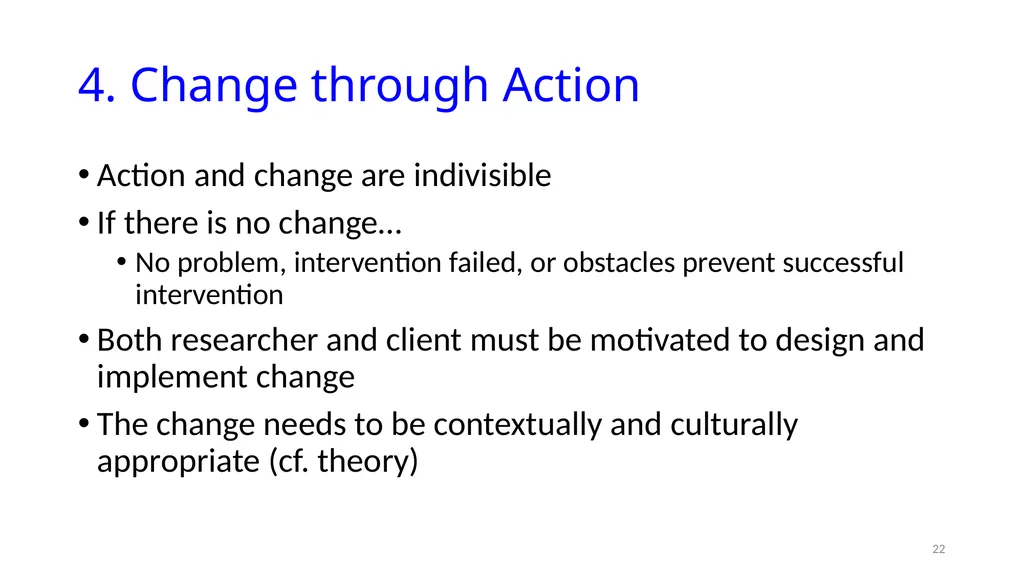
22 4. Change through Action Action and change are indivisible
If there is no change…
No problem, intervention failed, or obstacles prevent successful intervention
Both researcher and client must be motivated to design and implement change
The change needs to be contextually and culturally appropriate (cf. theory)<br>
If there is no change…
No problem, intervention failed, or obstacles prevent successful intervention
Both researcher and client must be motivated to design and implement change
The change needs to be contextually and culturally appropriate (cf. theory)<br>
23
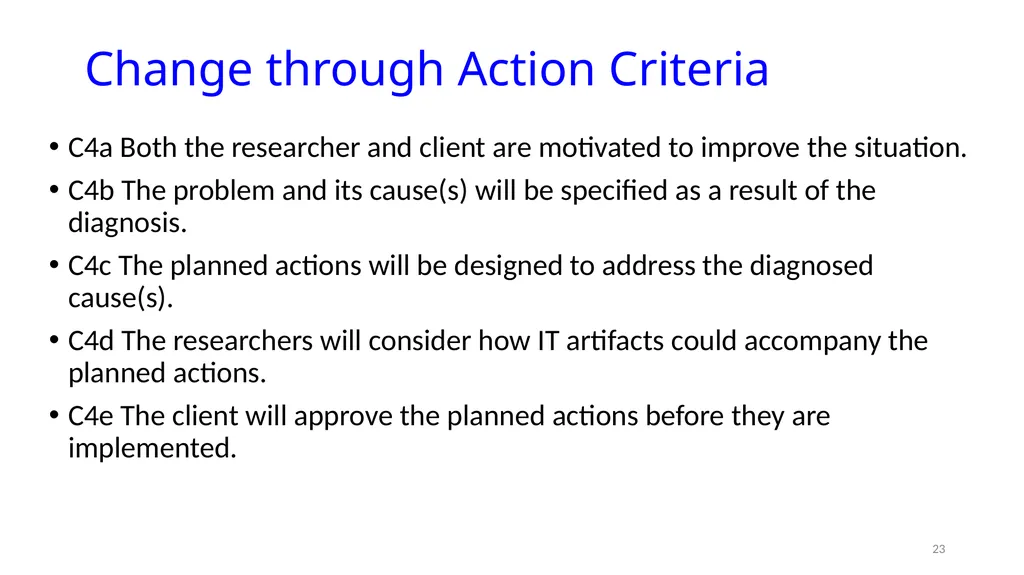
23 Change through Action Criteria C4a Both the researcher and client are motivated to improve the situation.
C4b The problem and its cause(s) will be specified as a result of the diagnosis.
C4c The planned actions will be designed to address the diagnosed cause(s).
C4d The researchers will consider how IT artifacts could accompany the planned actions.
C4e The client will approve the planned actions before they are implemented.<br>
C4b The problem and its cause(s) will be specified as a result of the diagnosis.
C4c The planned actions will be designed to address the diagnosed cause(s).
C4d The researchers will consider how IT artifacts could accompany the planned actions.
C4e The client will approve the planned actions before they are implemented.<br>
24
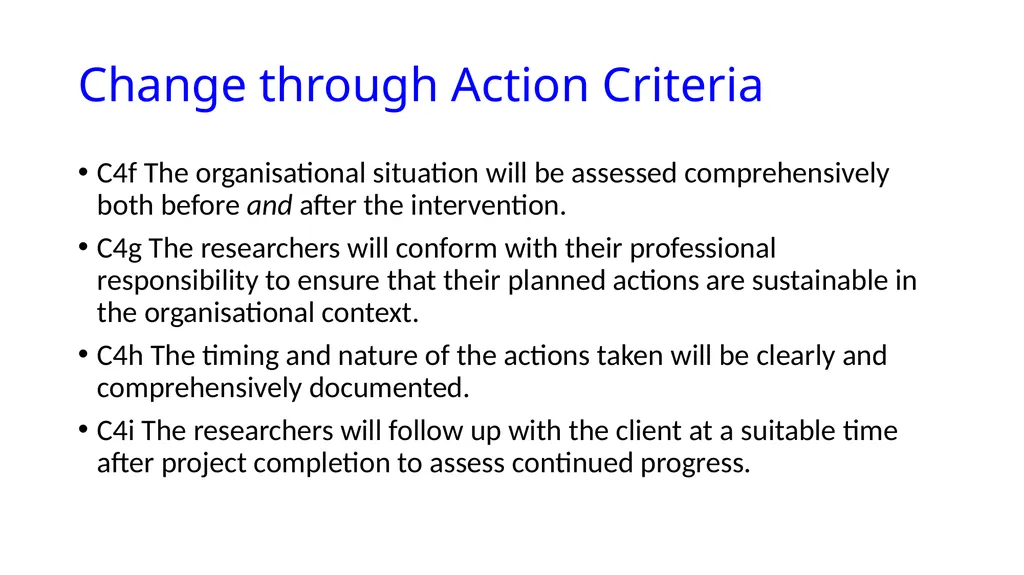
Change through Action Criteria C4f The organisational situation will be assessed comprehensively both before and after the intervention.
C4g The researchers will conform with their professional responsibility to ensure that their planned actions are sustainable in the organisational context.
C4h The timing and nature of the actions taken will be clearly and comprehensively documented.
C4i The researchers will follow up with the client at a suitable time after project completion to assess continued progress.<br>
C4g The researchers will conform with their professional responsibility to ensure that their planned actions are sustainable in the organisational context.
C4h The timing and nature of the actions taken will be clearly and comprehensively documented.
C4i The researchers will follow up with the client at a suitable time after project completion to assess continued progress.<br>
25
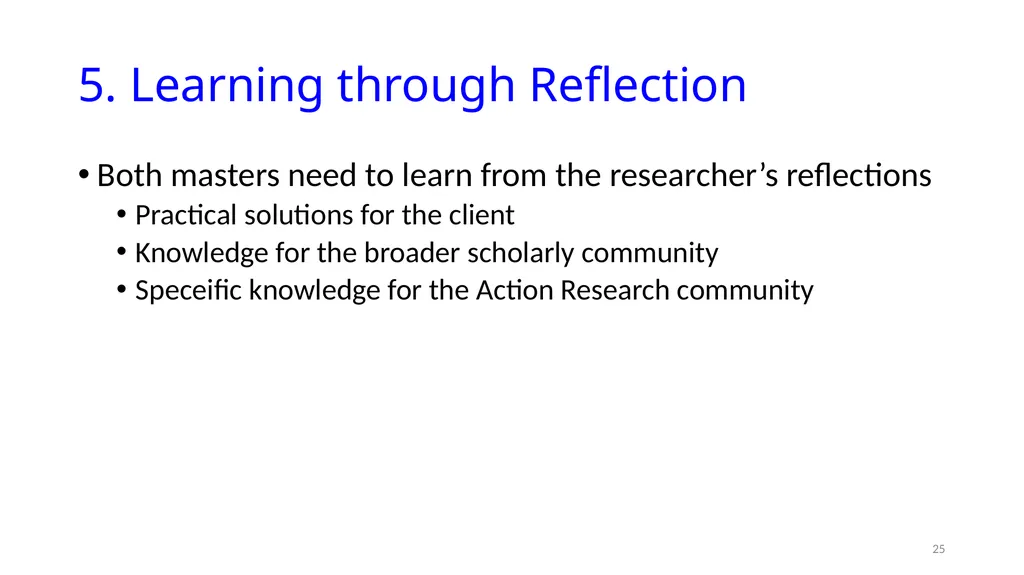
25 5. Learning through Reflection Both masters need to learn from the researcher’s reflections
Practical solutions for the client
Knowledge for the broader scholarly community
Speceific knowledge for the Action Research community<br>
Practical solutions for the client
Knowledge for the broader scholarly community
Speceific knowledge for the Action Research community<br>
26
26 Learning through Reflection Criteria C5a The researcher will provide progress reports to the client and organisational members.
C5b Both the researcher and the client will reflect upon the outcomes of the project.
C5c The researchers will report their activities and outcomes to the client clearly and comprehensively?
C5d The researchers will consider the project results in terms of implications for further action in this situation.
C5e The researchers will consider the project results in terms of implications for action to be taken in related research domains.<br>
C5b Both the researcher and the client will reflect upon the outcomes of the project.
C5c The researchers will report their activities and outcomes to the client clearly and comprehensively?
C5d The researchers will consider the project results in terms of implications for further action in this situation.
C5e The researchers will consider the project results in terms of implications for action to be taken in related research domains.<br>
27
Learning through Reflection Criteria C5f The researchers will reflect on the results in terms of implications for the research community (general knowledge, informing/re-informing theory).
C5g The researchers will reflect on the results in terms of the general applicability of IAR.
C5h The researchers will consciously reflect on how well their intervention balanced research and action.<br>
C5g The researchers will reflect on the results in terms of the general applicability of IAR.
C5h The researchers will consciously reflect on how well their intervention balanced research and action.<br>
28
6. Ethical Considerations for Action Research Avison et al. (1999, p.94), observed that “action research combines theory and practice (and researchers and practitioners) through change and reflection in an immediate problematic situation within a mutually acceptable ethical framework”.
McKay and Marshall (2001, p.55) also emphasise that the researcher “is ethically bound to … try to alleviate the problem”.
Shah et al. (2007a, p.764) note that they drew up “a formal research agreement … to define the ethical guidelines” yet provide no details about its content
Myers and Venable (2014, p.802) suggest that there is a need “to initiate a dialog and debate about the need for ethical principles”.<br>
McKay and Marshall (2001, p.55) also emphasise that the researcher “is ethically bound to … try to alleviate the problem”.
Shah et al. (2007a, p.764) note that they drew up “a formal research agreement … to define the ethical guidelines” yet provide no details about its content
Myers and Venable (2014, p.802) suggest that there is a need “to initiate a dialog and debate about the need for ethical principles”.<br>
29
Ethics and Stakeholders Apart from the action researchers, AR involves clients
These may be managers, employees, customers, supply chain partners, third party service providers, etc.
Arguably, each has a more-or-less participative role to play
AR is often premised on collaborative acts between researcher and client – the researcher and client work together in planning and implementing change in order to ameliorate a problem situation, and thereby improve circumstances for a variety of stakeholders
But here’s the rub: getting them to participate is far from simple
Also, the researcher has to get prepared in order to participate effectively<br>
These may be managers, employees, customers, supply chain partners, third party service providers, etc.
Arguably, each has a more-or-less participative role to play
AR is often premised on collaborative acts between researcher and client – the researcher and client work together in planning and implementing change in order to ameliorate a problem situation, and thereby improve circumstances for a variety of stakeholders
But here’s the rub: getting them to participate is far from simple
Also, the researcher has to get prepared in order to participate effectively<br>
30
Ethical Perspectives Chatterjee and Sarker (2014) identify consequentialism, deontology and virtue as three major ethical perspectives.
Consequentialist ethics usually focus on the generation of positive outcomes for the stakeholders whose interests are central to the topic of enquiry.
Deontological ethics are associated with duties. These often involve respecting the rights of individuals, so long as the rights of others are not impinged upon.
Virtue ethics relate to the character of the individual actor and the assertion that good people (or institutions) will do good things. For instance, Kohli and Kettinger (2004) suggest that patience and flexibility are two of the desired virtues for action researchers, 30<br>
Consequentialist ethics usually focus on the generation of positive outcomes for the stakeholders whose interests are central to the topic of enquiry.
Deontological ethics are associated with duties. These often involve respecting the rights of individuals, so long as the rights of others are not impinged upon.
Virtue ethics relate to the character of the individual actor and the assertion that good people (or institutions) will do good things. For instance, Kohli and Kettinger (2004) suggest that patience and flexibility are two of the desired virtues for action researchers, 30<br>
31
Ethical Dilemmas (after Rapoport, 1970) Role dilemma – action researchers play two roles: researcher and consultant, and thus serve two masters
What promises should the action researcher make, given the need to improve organizational circumstances and achieve research objectives?
Value dilemma – the differences in values between researchers and clients
Clients likely want quick and decisive action, but researchers tend to work more slowly, methodically in the pursuit of knowledge
Goal dilemma – the difference between the practical problem and the research problem
The interests of the client and researcher are not perfectly aligned<br>
What promises should the action researcher make, given the need to improve organizational circumstances and achieve research objectives?
Value dilemma – the differences in values between researchers and clients
Clients likely want quick and decisive action, but researchers tend to work more slowly, methodically in the pursuit of knowledge
Goal dilemma – the difference between the practical problem and the research problem
The interests of the client and researcher are not perfectly aligned<br>
32
For Instance,… Mumford (2001, p. 15) reported how she was always able to avoid working on projects where she disagreed with the ethics of the organization.
For instance, she always refused to work on projects “which would involve employee redundancy”, reflecting a deontological stance.
Researchers with a more critical interest may have an emancipatory goal for employees, aiming to ameliorate circumstances for them. 32<br>
For instance, she always refused to work on projects “which would involve employee redundancy”, reflecting a deontological stance.
Researchers with a more critical interest may have an emancipatory goal for employees, aiming to ameliorate circumstances for them. 32<br>
33
Ethics, and Theoretical Contributions A consequentialist view would be that the researcher has an ethical obligation to create a positive outcome for the organisation, only suggesting actions that improve the problem situation (Baskerville and Wood-Harper, 1996, 1998), even though this may constrain the researcher from reaching theoretically interesting conclusions.
Both Lewin (1945) and Ghoshal (1996) observed that theories must be appropriate for the organizational context. Scholars who venture into the organizational arena with theory-in-hand beware! If, by dint of your academic enthusiasm, you neglect the interests of the organization and foist on them a damaging process or solution based on a theory that is of intellectual interest to you, then watch out. In more litigious societies, professional indemnity insurance may be advisable. 33<br>
Both Lewin (1945) and Ghoshal (1996) observed that theories must be appropriate for the organizational context. Scholars who venture into the organizational arena with theory-in-hand beware! If, by dint of your academic enthusiasm, you neglect the interests of the organization and foist on them a damaging process or solution based on a theory that is of intellectual interest to you, then watch out. In more litigious societies, professional indemnity insurance may be advisable. 33<br>
34
Ethics and Participation in AR The ethics of collaboration
Researchers and clients work together collaboratively
The ethics of competence
researchers must be knowledgeable about the context, the industry, the nature of work in the client’s world and then engage in meaningful conversations with clients as they diagnose problems and plan interventions
The ethics of persistence
It can take years to complete an AR project
The ethics of consent and anonymity
Protecting identities and the right to opt out 34<br>
Researchers and clients work together collaboratively
The ethics of competence
researchers must be knowledgeable about the context, the industry, the nature of work in the client’s world and then engage in meaningful conversations with clients as they diagnose problems and plan interventions
The ethics of persistence
It can take years to complete an AR project
The ethics of consent and anonymity
Protecting identities and the right to opt out 34<br>
35
The Principle of Ethical Participation C6a Researchers will consciously consider involving client team members throughout all the stages of the project.
C6b Researchers will ensure that clients (especially the project champion) are aware of the academic dimension of the project.
C6c Both researchers and clients are responsible for communicating changes in circumstances that materially influence the project.
C6d Researchers will accept the client’s prerogative to attend to pressing needs that may interrupt a project.
C6e Researchers will seek to develop competence in both AR as a method and the context of the client before they start the diagnosis. 35<br>
C6b Researchers will ensure that clients (especially the project champion) are aware of the academic dimension of the project.
C6c Both researchers and clients are responsible for communicating changes in circumstances that materially influence the project.
C6d Researchers will accept the client’s prerogative to attend to pressing needs that may interrupt a project.
C6e Researchers will seek to develop competence in both AR as a method and the context of the client before they start the diagnosis. 35<br>
36
The Principle of Ethical Participation C6f Researchers will undertake to report how they developed competence central to the domain of investigation in the formal write up of the project.
C6g Researchers will persevere with a project until its completion or termination.
C6h Researchers will ensure that all those involved in a project are informed about its objectives.
C6i Researchers will ensure that all interactions with client team members are protected by a guarantee of anonymity (pseudonymity), unless an individual person explicitly affirms that such anonymity (pseudonymity) is not necessary.
C6j Researchers will ensure that all client team members provide affirmative consent to participate in an AR project. 36<br>
C6g Researchers will persevere with a project until its completion or termination.
C6h Researchers will ensure that all those involved in a project are informed about its objectives.
C6i Researchers will ensure that all interactions with client team members are protected by a guarantee of anonymity (pseudonymity), unless an individual person explicitly affirms that such anonymity (pseudonymity) is not necessary.
C6j Researchers will ensure that all client team members provide affirmative consent to participate in an AR project. 36<br>
37
37 Illustrating the CAR Process From 2014-2016, I worked with Louie Wong, my PhD student, on an extended study of knowledge sharing in Velox, a global logistics firm
I will draw on this experience to demonstrate the impact of CAR in practice in the next group of slides
“Knowledge Sharing in a Global Logistics Provider: An Action Research Project”<br>
I will draw on this experience to demonstrate the impact of CAR in practice in the next group of slides
“Knowledge Sharing in a Global Logistics Provider: An Action Research Project”<br>
38
Introduction Knowledge sharing is important for firms in today’s competitive business environment
Some resource-rich firms provide abundant IS-based work systems to their employees
Our focus is the global logistics sector
DHL, Fedex, UPS, TNT, SF Express, etc. 38<br>
Some resource-rich firms provide abundant IS-based work systems to their employees
Our focus is the global logistics sector
DHL, Fedex, UPS, TNT, SF Express, etc. 38<br>
39
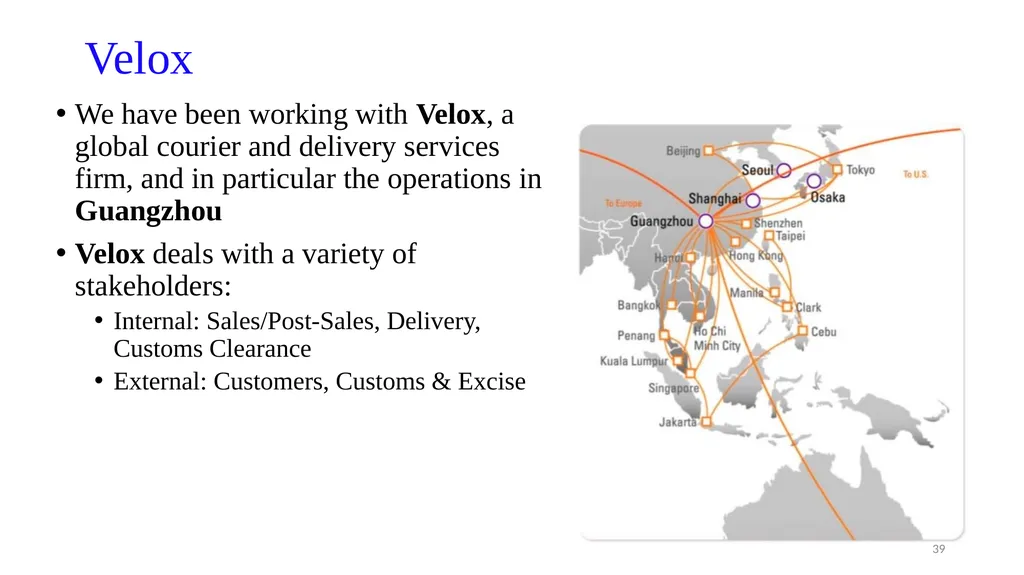
Velox We have been working with Velox, a global courier and delivery services firm, and in particular the operations in Guangzhou
Velox deals with a variety of stakeholders:
Internal: Sales/Post-Sales, Delivery, Customs Clearance
External: Customers, Customs & Excise 39<br>
Velox deals with a variety of stakeholders:
Internal: Sales/Post-Sales, Delivery, Customs Clearance
External: Customers, Customs & Excise 39<br>
40
The Nature of Work While some work is standardised, Velox operates in an environment characterised by a frequently changing legal infrastructure, as well as intense competition with other logistics firms, both local and global
As a result, knowledge about procedures and best practices must be both updated regularly and disseminated to all who need to know 40<br>
As a result, knowledge about procedures and best practices must be both updated regularly and disseminated to all who need to know 40<br>
41
Entrance The Greater China HR Managing Director introduced us to the China Operations Team and an Exec-VP for China
Mutual interest on knowledge sharing consulting collaboration as Velox is looking for a solution to address customs clearance knowledge proficiency
Based on over 1100 customers’ comments, “knowledge issues among employees” which they termed as “knowledge dimension” was identified as one of the key areas for improvement in Velox’s customs clearance operations
This led to our proposing an action research investigation that would seek to uncover the key barriers to effective knowledge sharing as well as work with Velox on overcoming those barriers 41<br>
Mutual interest on knowledge sharing consulting collaboration as Velox is looking for a solution to address customs clearance knowledge proficiency
Based on over 1100 customers’ comments, “knowledge issues among employees” which they termed as “knowledge dimension” was identified as one of the key areas for improvement in Velox’s customs clearance operations
This led to our proposing an action research investigation that would seek to uncover the key barriers to effective knowledge sharing as well as work with Velox on overcoming those barriers 41<br>
42
Initial Meetings & Proposal Explain the consulting approach
Establish mutual understanding for on-going commitments
time and resources
implementation of changes in the organisation
formal agreement to allow the consultant to gain access to employees and relevant corporate internal information
Prepared proposal, which detailed
Objectives
Scope
Consulting Approach
Estimated budget 42<br>
Establish mutual understanding for on-going commitments
time and resources
implementation of changes in the organisation
formal agreement to allow the consultant to gain access to employees and relevant corporate internal information
Prepared proposal, which detailed
Objectives
Scope
Consulting Approach
Estimated budget 42<br>
43
Problems to be Solved / Research Questions How is knowledge shared by the employees of Velox as they create knowledge-centric services and solutions for their customers?
How can effective knowledge sharing among employees be enabled and sustained in order to provide quality and consistent services to customers? 43<br>
How can effective knowledge sharing among employees be enabled and sustained in order to provide quality and consistent services to customers? 43<br>
44
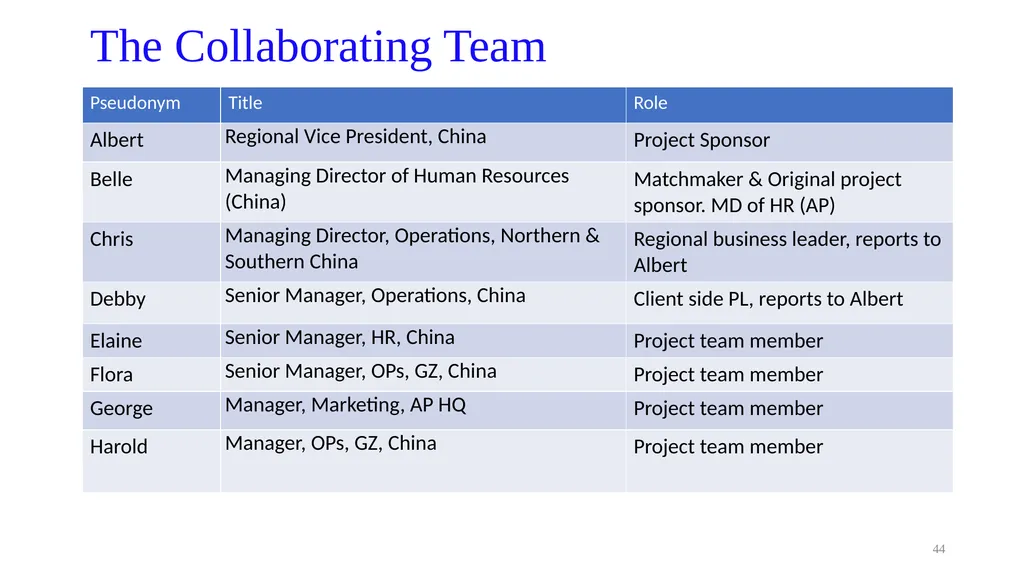
The Collaborating Team 44<br>
45
Research Approach Action Research
Iterative, rigorous and collaborative
Focuses on both organizational development and the generation of knowledge
We reached agreement with Velox before starting:
Action research is appropriate
The focus and objectives of the project
Client commitment
Roles and responsibilities
Procedures
Consent to participate and confidentiality 45<br>
Iterative, rigorous and collaborative
Focuses on both organizational development and the generation of knowledge
We reached agreement with Velox before starting:
Action research is appropriate
The focus and objectives of the project
Client commitment
Roles and responsibilities
Procedures
Consent to participate and confidentiality 45<br>
46
Initial Work Greater China HR Managing Director who introduced us to the China Operations Team and a VP for China
Mutual interest on knowledge sharing research collaboration as Velox is looking for a solution to address customs clearance knowledge proficiency
This led to our proposing an action research investigation that would seek to uncover the key barriers to effective knowledge sharing as well as work with Velox on overcoming those barriers 46<br>
Mutual interest on knowledge sharing research collaboration as Velox is looking for a solution to address customs clearance knowledge proficiency
This led to our proposing an action research investigation that would seek to uncover the key barriers to effective knowledge sharing as well as work with Velox on overcoming those barriers 46<br>
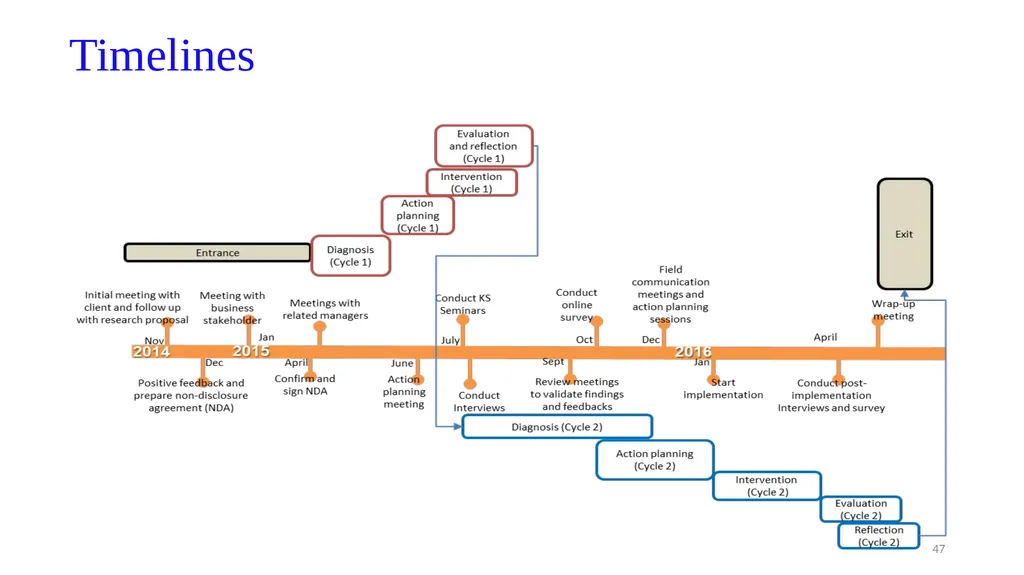
47
Timelines 47<br>
48
Seminars and Interviews In the first action cycle, we offered an introductory seminar to 60 managers where we highlighted key issues connected with knowledge sharing and its benefits, as well as the role of technology in knowledge sharing
Our diagnosis took the form of multiple interviews with employees at different levels and in different locations
In all these interviews, we sought to identify
Features of the operating environment that affected knowledge sharing
The types of knowledge involved and the way it could be represented
Attitudes towards knowledge sharing among employees
Resources available to stimulate, encourage, reward or facilitate knowledge sharing
The technology available for sharing
The technology not available yet preferred for sharing
We validated the interview findings and our analysis through communication meetings with Velox’s front-line employees 48<br>
Our diagnosis took the form of multiple interviews with employees at different levels and in different locations
In all these interviews, we sought to identify
Features of the operating environment that affected knowledge sharing
The types of knowledge involved and the way it could be represented
Attitudes towards knowledge sharing among employees
Resources available to stimulate, encourage, reward or facilitate knowledge sharing
The technology available for sharing
The technology not available yet preferred for sharing
We validated the interview findings and our analysis through communication meetings with Velox’s front-line employees 48<br>
49
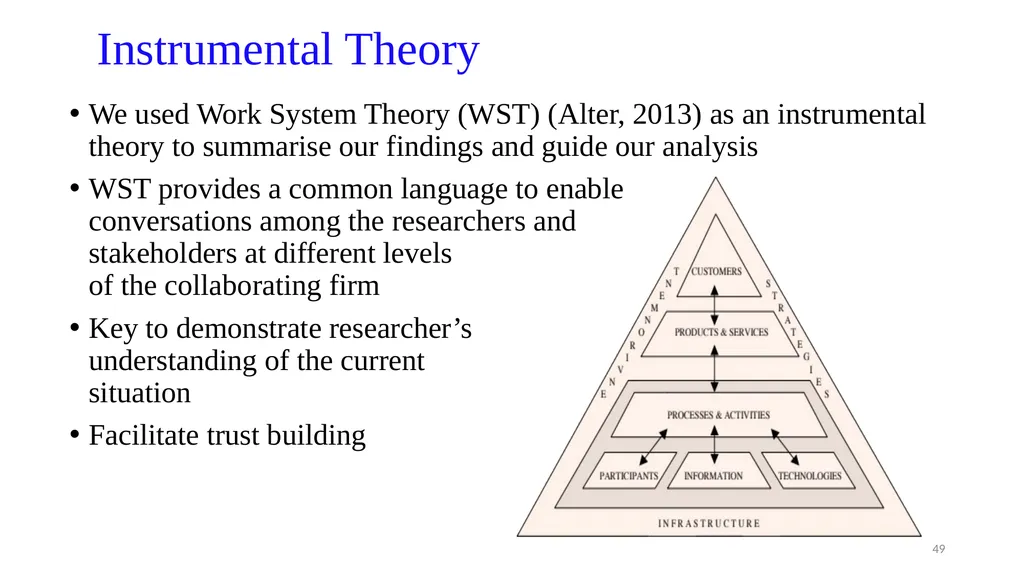
Instrumental Theory We used Work System Theory (WST) (Alter, 2013) as an instrumental theory to summarise our findings and guide our analysis
WST provides a common language to enable conversations among the researchers and stakeholders at different levels of the collaborating firm
Key to demonstrate researcher’s understanding of the current situation
Facilitate trust building 49<br>
WST provides a common language to enable conversations among the researchers and stakeholders at different levels of the collaborating firm
Key to demonstrate researcher’s understanding of the current situation
Facilitate trust building 49<br>
50
WST Analysis 1 Key Problem:
Customers perceive call agents lack knowledge on customs clearance process
Who are the Customers of the System?
Customers who have shipments with insufficient data for customs clearance
Customer service representatives at the call centre (CSR)
Account Executives (AE)
Products and Services in the Work System
Notification of customs clearance issues
Explanation of customs clearance issues
Request additional information/documents
Customs clearance status update 50<br>
Customers perceive call agents lack knowledge on customs clearance process
Who are the Customers of the System?
Customers who have shipments with insufficient data for customs clearance
Customer service representatives at the call centre (CSR)
Account Executives (AE)
Products and Services in the Work System
Notification of customs clearance issues
Explanation of customs clearance issues
Request additional information/documents
Customs clearance status update 50<br>
51
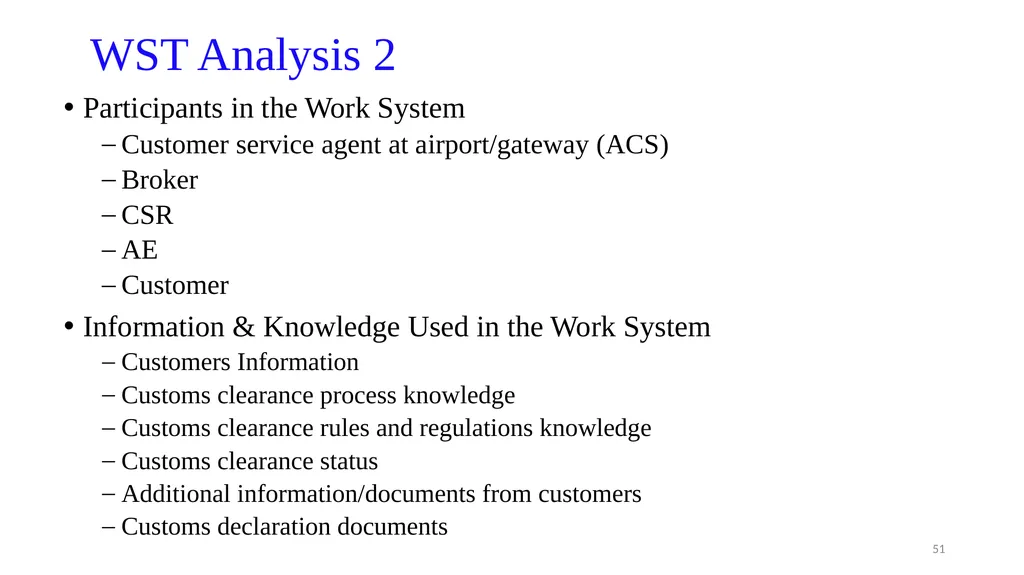
WST Analysis 2 Participants in the Work System
Customer service agent at airport/gateway (ACS)
Broker
CSR
AE
Customer
Information & Knowledge Used in the Work System
Customers Information
Customs clearance process knowledge
Customs clearance rules and regulations knowledge
Customs clearance status
Additional information/documents from customers
Customs declaration documents 51<br>
Customer service agent at airport/gateway (ACS)
Broker
CSR
AE
Customer
Information & Knowledge Used in the Work System
Customers Information
Customs clearance process knowledge
Customs clearance rules and regulations knowledge
Customs clearance status
Additional information/documents from customers
Customs declaration documents 51<br>
52
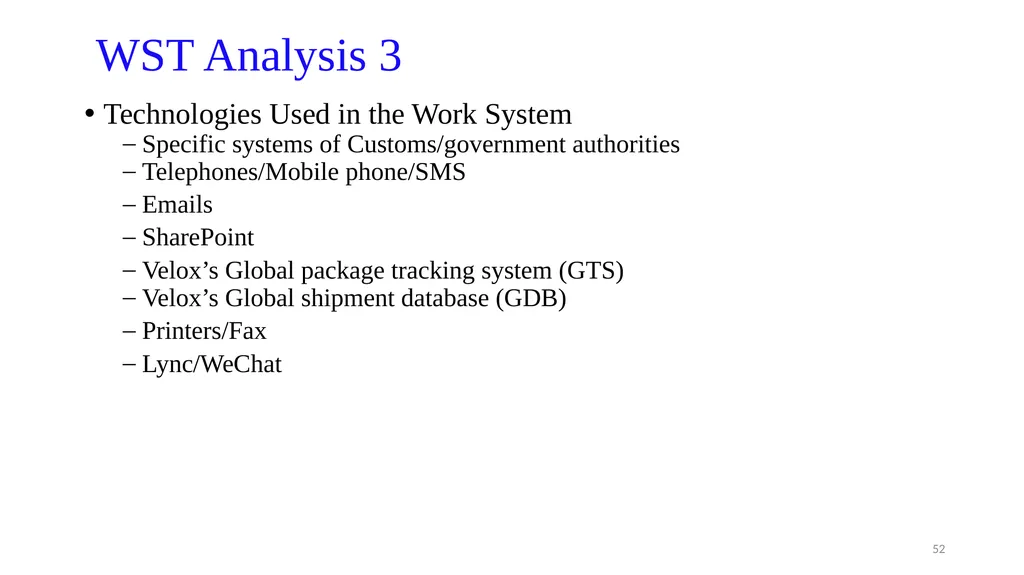
WST Analysis 3 Technologies Used in the Work System
Specific systems of Customs/government authorities
Telephones/Mobile phone/SMS
Emails
SharePoint
Velox’s Global package tracking system (GTS)
Velox’s Global shipment database (GDB)
Printers/Fax
Lync/WeChat 52<br>
Specific systems of Customs/government authorities
Telephones/Mobile phone/SMS
Emails
SharePoint
Velox’s Global package tracking system (GTS)
Velox’s Global shipment database (GDB)
Printers/Fax
Lync/WeChat 52<br>
53
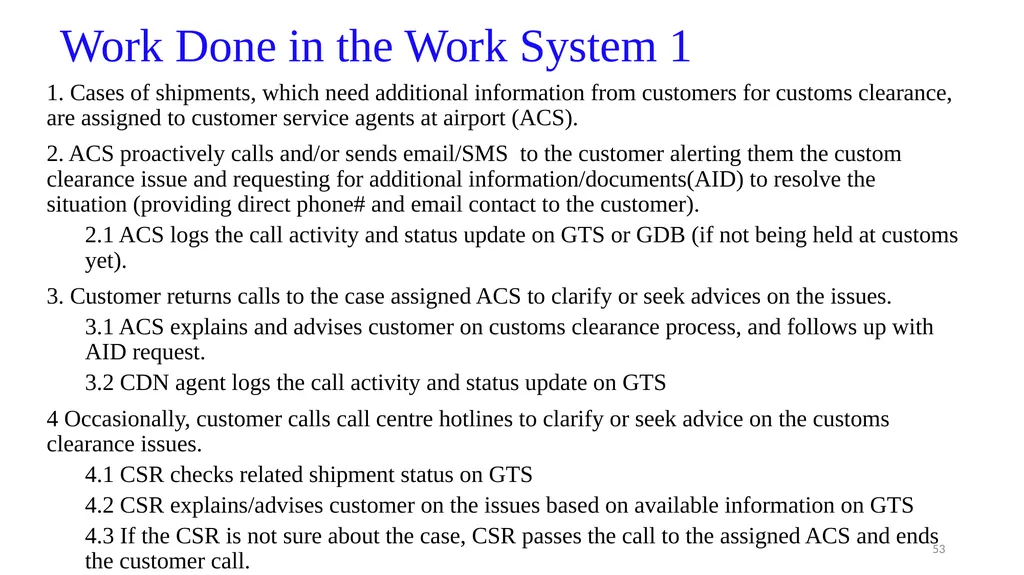
Work Done in the Work System 1 1. Cases of shipments, which need additional information from customers for customs clearance, are assigned to customer service agents at airport (ACS).
2. ACS proactively calls and/or sends email/SMS to the customer alerting them the custom clearance issue and requesting for additional information/documents(AID) to resolve the situation (providing direct phone# and email contact to the customer).
2.1 ACS logs the call activity and status update on GTS or GDB (if not being held at customs yet).
3. Customer returns calls to the case assigned ACS to clarify or seek advices on the issues.
3.1 ACS explains and advises customer on customs clearance process, and follows up with AID request.
3.2 CDN agent logs the call activity and status update on GTS
4 Occasionally, customer calls call centre hotlines to clarify or seek advice on the customs clearance issues.
4.1 CSR checks related shipment status on GTS
4.2 CSR explains/advises customer on the issues based on available information on GTS
4.3 If the CSR is not sure about the case, CSR passes the call to the assigned ACS and ends the customer call. 53<br>
2. ACS proactively calls and/or sends email/SMS to the customer alerting them the custom clearance issue and requesting for additional information/documents(AID) to resolve the situation (providing direct phone# and email contact to the customer).
2.1 ACS logs the call activity and status update on GTS or GDB (if not being held at customs yet).
3. Customer returns calls to the case assigned ACS to clarify or seek advices on the issues.
3.1 ACS explains and advises customer on customs clearance process, and follows up with AID request.
3.2 CDN agent logs the call activity and status update on GTS
4 Occasionally, customer calls call centre hotlines to clarify or seek advice on the customs clearance issues.
4.1 CSR checks related shipment status on GTS
4.2 CSR explains/advises customer on the issues based on available information on GTS
4.3 If the CSR is not sure about the case, CSR passes the call to the assigned ACS and ends the customer call. 53<br>
54
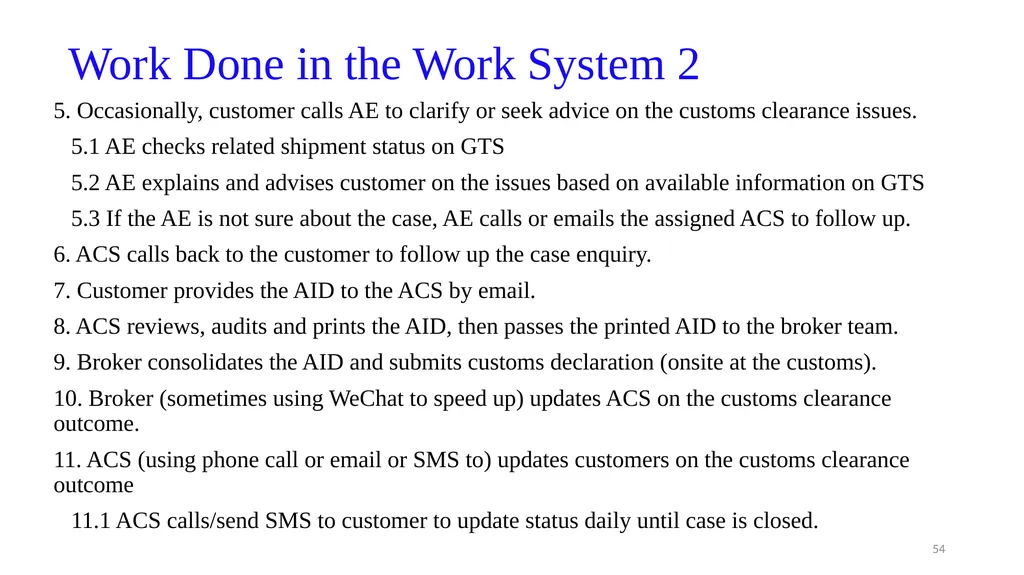
Work Done in the Work System 2 5. Occasionally, customer calls AE to clarify or seek advice on the customs clearance issues.
5.1 AE checks related shipment status on GTS
5.2 AE explains and advises customer on the issues based on available information on GTS
5.3 If the AE is not sure about the case, AE calls or emails the assigned ACS to follow up.
6. ACS calls back to the customer to follow up the case enquiry.
7. Customer provides the AID to the ACS by email.
8. ACS reviews, audits and prints the AID, then passes the printed AID to the broker team.
9. Broker consolidates the AID and submits customs declaration (onsite at the customs).
10. Broker (sometimes using WeChat to speed up) updates ACS on the customs clearance outcome.
11. ACS (using phone call or email or SMS to) updates customers on the customs clearance outcome
11.1 ACS calls/send SMS to customer to update status daily until case is closed. 54<br>
5.1 AE checks related shipment status on GTS
5.2 AE explains and advises customer on the issues based on available information on GTS
5.3 If the AE is not sure about the case, AE calls or emails the assigned ACS to follow up.
6. ACS calls back to the customer to follow up the case enquiry.
7. Customer provides the AID to the ACS by email.
8. ACS reviews, audits and prints the AID, then passes the printed AID to the broker team.
9. Broker consolidates the AID and submits customs declaration (onsite at the customs).
10. Broker (sometimes using WeChat to speed up) updates ACS on the customs clearance outcome.
11. ACS (using phone call or email or SMS to) updates customers on the customs clearance outcome
11.1 ACS calls/send SMS to customer to update status daily until case is closed. 54<br>
55
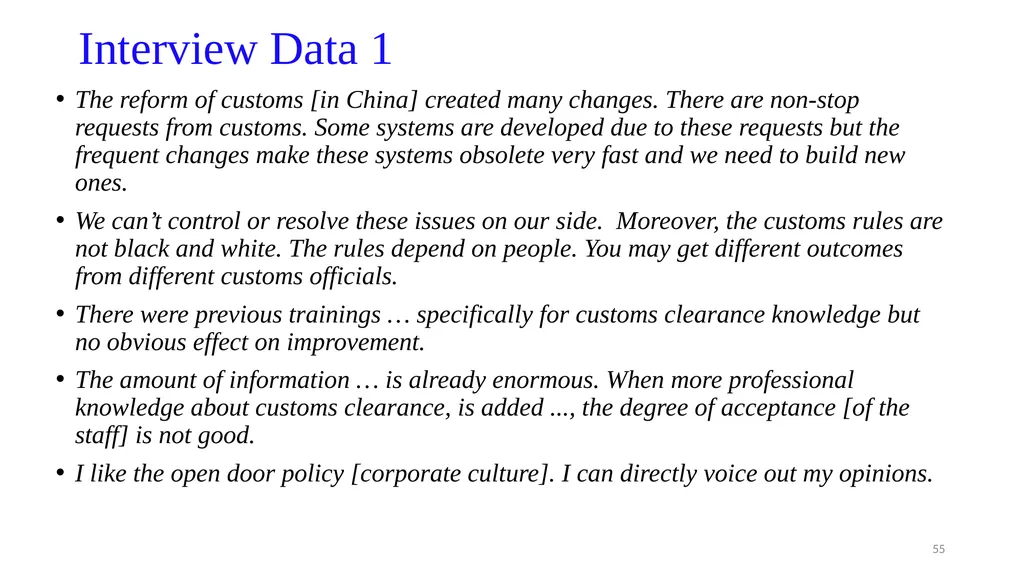
Interview Data 1 The reform of customs [in China] created many changes. There are non-stop requests from customs. Some systems are developed due to these requests but the frequent changes make these systems obsolete very fast and we need to build new ones.
We can’t control or resolve these issues on our side. Moreover, the customs rules are not black and white. The rules depend on people. You may get different outcomes from different customs officials.
There were previous trainings … specifically for customs clearance knowledge but no obvious effect on improvement.
The amount of information … is already enormous. When more professional knowledge about customs clearance, is added ..., the degree of acceptance [of the staff] is not good.
I like the open door policy [corporate culture]. I can directly voice out my opinions. 55<br>
We can’t control or resolve these issues on our side. Moreover, the customs rules are not black and white. The rules depend on people. You may get different outcomes from different customs officials.
There were previous trainings … specifically for customs clearance knowledge but no obvious effect on improvement.
The amount of information … is already enormous. When more professional knowledge about customs clearance, is added ..., the degree of acceptance [of the staff] is not good.
I like the open door policy [corporate culture]. I can directly voice out my opinions. 55<br>
56
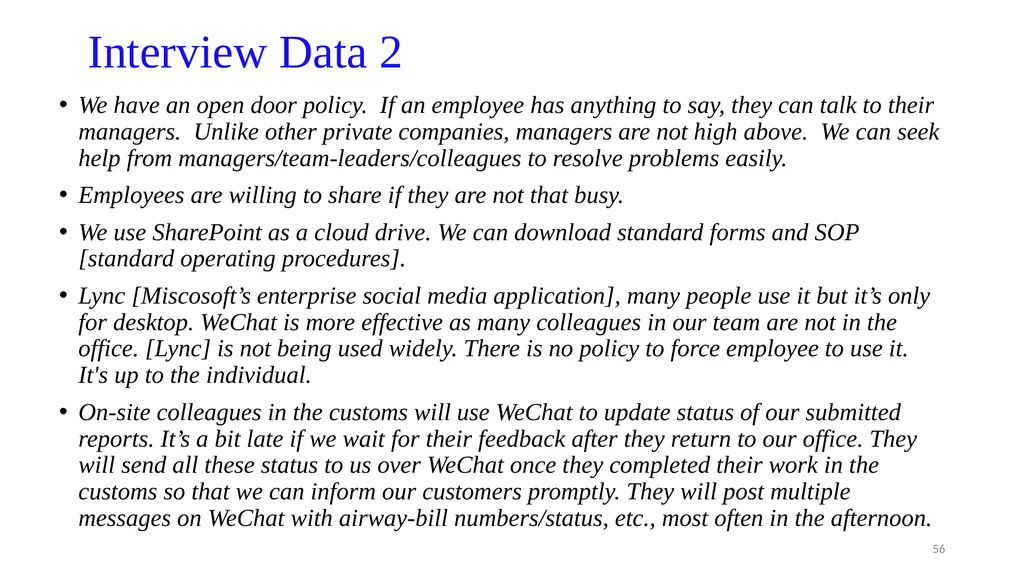
Interview Data 2 We have an open door policy. If an employee has anything to say, they can talk to their managers. Unlike other private companies, managers are not high above. We can seek help from managers/team-leaders/colleagues to resolve problems easily.
Employees are willing to share if they are not that busy.
We use SharePoint as a cloud drive. We can download standard forms and SOP [standard operating procedures].
Lync [Miscosoft’s enterprise social media application], many people use it but it’s only for desktop. WeChat is more effective as many colleagues in our team are not in the office. [Lync] is not being used widely. There is no policy to force employee to use it. It's up to the individual.
On-site colleagues in the customs will use WeChat to update status of our submitted reports. It’s a bit late if we wait for their feedback after they return to our office. They will send all these status to us over WeChat once they completed their work in the customs so that we can inform our customers promptly. They will post multiple messages on WeChat with airway-bill numbers/status, etc., most often in the afternoon. 56<br>
Employees are willing to share if they are not that busy.
We use SharePoint as a cloud drive. We can download standard forms and SOP [standard operating procedures].
Lync [Miscosoft’s enterprise social media application], many people use it but it’s only for desktop. WeChat is more effective as many colleagues in our team are not in the office. [Lync] is not being used widely. There is no policy to force employee to use it. It's up to the individual.
On-site colleagues in the customs will use WeChat to update status of our submitted reports. It’s a bit late if we wait for their feedback after they return to our office. They will send all these status to us over WeChat once they completed their work in the customs so that we can inform our customers promptly. They will post multiple messages on WeChat with airway-bill numbers/status, etc., most often in the afternoon. 56<br>
57
Results of Diagnosis 1 We found that while Velox encourages the free sharing of knowledge, which takes place extensively, a supportive knowledge sharing infrastructure, e.g. a reward system, was missing so all such sharing was based on individual initiatives
The technology regime was generally relaxed and supportive, but employees also made extensive (but cautious) use of non-corporate systems, especially social media, for sharing 57<br>
The technology regime was generally relaxed and supportive, but employees also made extensive (but cautious) use of non-corporate systems, especially social media, for sharing 57<br>
58
Results of Diagnosis 2 The legal environment changed frequently and the interpretation of customs rules and regulations varies among customs officials (who are relocated regularly), which complicated the value of knowledge over time
Frequent updates and sharing of latest practices and interpretations or personnel changes were needed
Most of the shared knowledge took the form of local best practices and solutions to get around problems
Employees do not see training as a solution to the knowledge sharing problems 58<br>
Frequent updates and sharing of latest practices and interpretations or personnel changes were needed
Most of the shared knowledge took the form of local best practices and solutions to get around problems
Employees do not see training as a solution to the knowledge sharing problems 58<br>
59
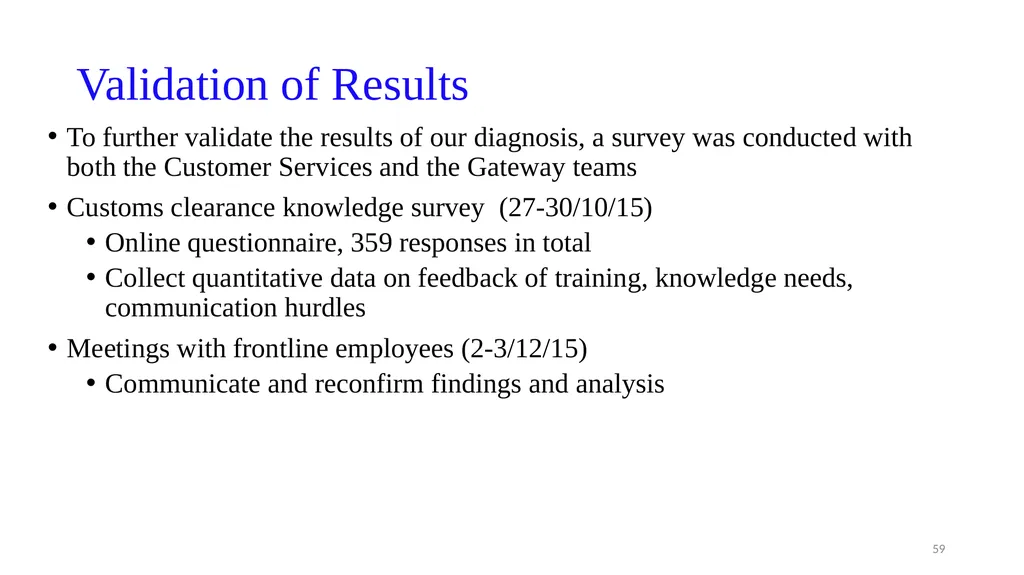
Validation of Results To further validate the results of our diagnosis, a survey was conducted with both the Customer Services and the Gateway teams
Customs clearance knowledge survey (27-30/10/15)
Online questionnaire, 359 responses in total
Collect quantitative data on feedback of training, knowledge needs, communication hurdles
Meetings with frontline employees (2-3/12/15)
Communicate and reconfirm findings and analysis 59<br>
Customs clearance knowledge survey (27-30/10/15)
Online questionnaire, 359 responses in total
Collect quantitative data on feedback of training, knowledge needs, communication hurdles
Meetings with frontline employees (2-3/12/15)
Communicate and reconfirm findings and analysis 59<br>
60
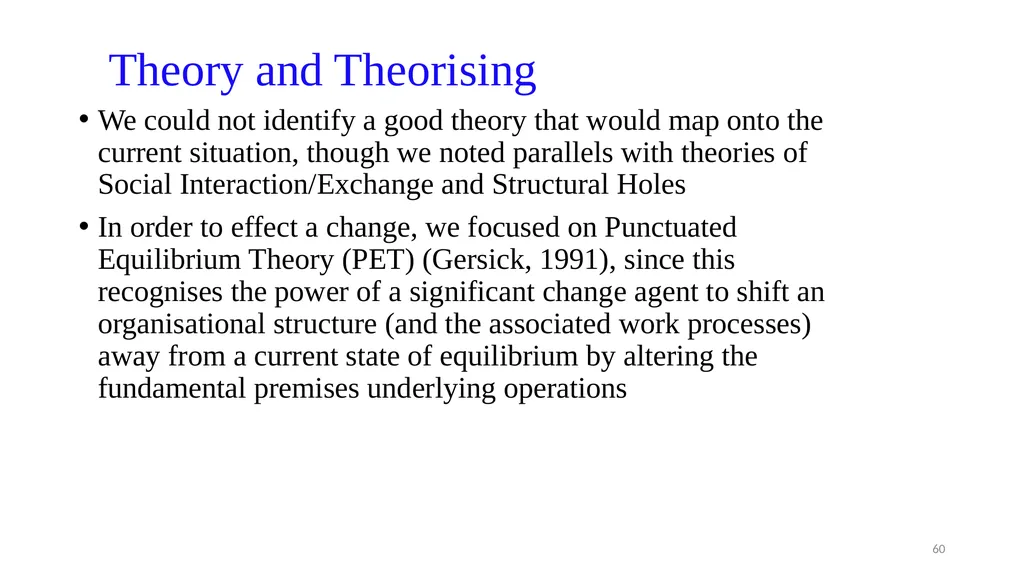
Theory and Theorising We could not identify a good theory that would map onto the current situation, though we noted parallels with theories of Social Interaction/Exchange and Structural Holes
In order to effect a change, we focused on Punctuated Equilibrium Theory (PET) (Gersick, 1991), since this recognises the power of a significant change agent to shift an organisational structure (and the associated work processes) away from a current state of equilibrium by altering the fundamental premises underlying operations 60<br>
In order to effect a change, we focused on Punctuated Equilibrium Theory (PET) (Gersick, 1991), since this recognises the power of a significant change agent to shift an organisational structure (and the associated work processes) away from a current state of equilibrium by altering the fundamental premises underlying operations 60<br>
61
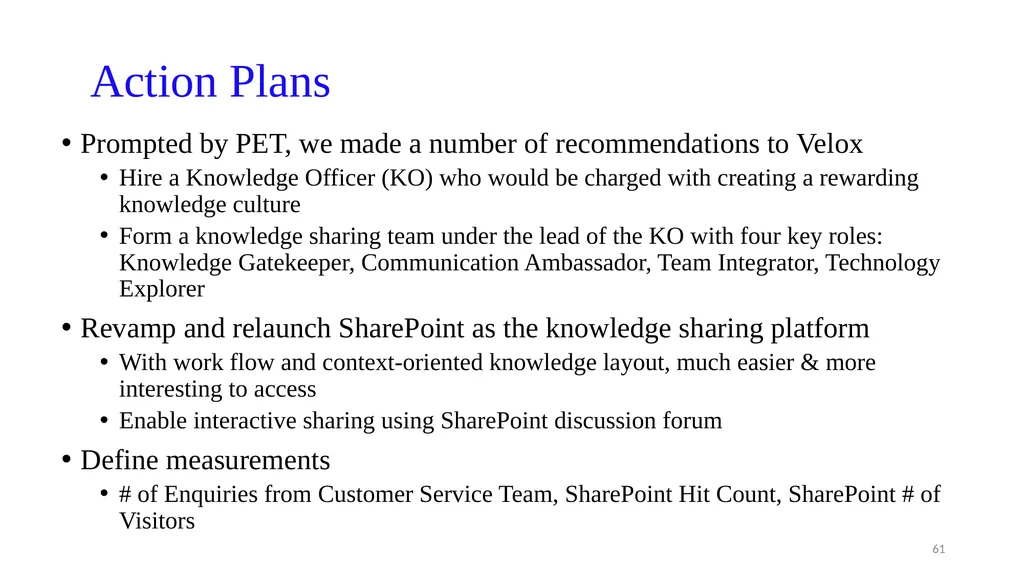
Action Plans Prompted by PET, we made a number of recommendations to Velox
Hire a Knowledge Officer (KO) who would be charged with creating a rewarding knowledge culture
Form a knowledge sharing team under the lead of the KO with four key roles: Knowledge Gatekeeper, Communication Ambassador, Team Integrator, Technology Explorer
Revamp and relaunch SharePoint as the knowledge sharing platform
With work flow and context-oriented knowledge layout, much easier & more interesting to access
Enable interactive sharing using SharePoint discussion forum
Define measurements
# of Enquiries from Customer Service Team, SharePoint Hit Count, SharePoint # of Visitors 61<br>
Hire a Knowledge Officer (KO) who would be charged with creating a rewarding knowledge culture
Form a knowledge sharing team under the lead of the KO with four key roles: Knowledge Gatekeeper, Communication Ambassador, Team Integrator, Technology Explorer
Revamp and relaunch SharePoint as the knowledge sharing platform
With work flow and context-oriented knowledge layout, much easier & more interesting to access
Enable interactive sharing using SharePoint discussion forum
Define measurements
# of Enquiries from Customer Service Team, SharePoint Hit Count, SharePoint # of Visitors 61<br>
62
Implementation Velox accepted our recommendation and shortly afterwards was able to secure permission from regional corporate HQ to initially hire one KO in the inbound customs clearance team
The KO was hired in Jan 2016 and implementation of proposed actions started during Feb – April 2016 62<br>
The KO was hired in Jan 2016 and implementation of proposed actions started during Feb – April 2016 62<br>
63
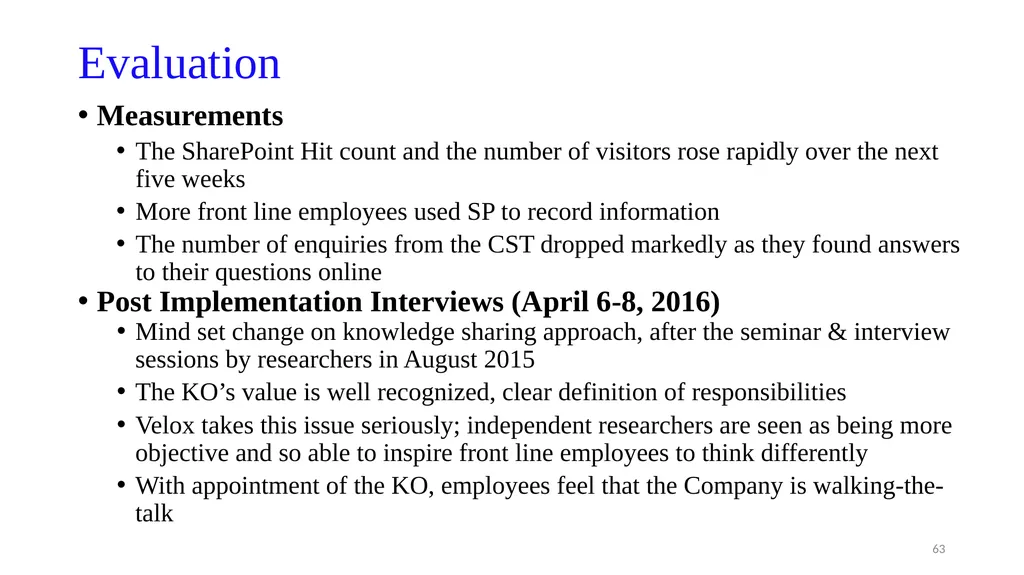
Evaluation Measurements
The SharePoint Hit count and the number of visitors rose rapidly over the next five weeks
More front line employees used SP to record information
The number of enquiries from the CST dropped markedly as they found answers to their questions online
Post Implementation Interviews (April 6-8, 2016)
Mind set change on knowledge sharing approach, after the seminar & interview sessions by researchers in August 2015
The KO’s value is well recognized, clear definition of responsibilities
Velox takes this issue seriously; independent researchers are seen as being more objective and so able to inspire front line employees to think differently
With appointment of the KO, employees feel that the Company is walking-the-talk 63<br>
The SharePoint Hit count and the number of visitors rose rapidly over the next five weeks
More front line employees used SP to record information
The number of enquiries from the CST dropped markedly as they found answers to their questions online
Post Implementation Interviews (April 6-8, 2016)
Mind set change on knowledge sharing approach, after the seminar & interview sessions by researchers in August 2015
The KO’s value is well recognized, clear definition of responsibilities
Velox takes this issue seriously; independent researchers are seen as being more objective and so able to inspire front line employees to think differently
With appointment of the KO, employees feel that the Company is walking-the-talk 63<br>
64
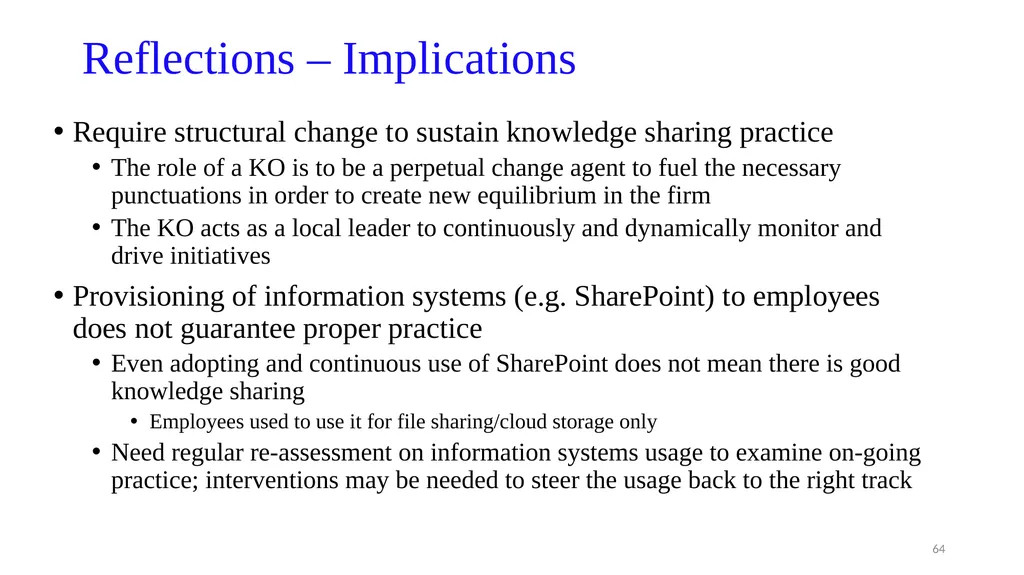
Reflections – Implications Require structural change to sustain knowledge sharing practice
The role of a KO is to be a perpetual change agent to fuel the necessary punctuations in order to create new equilibrium in the firm
The KO acts as a local leader to continuously and dynamically monitor and drive initiatives
Provisioning of information systems (e.g. SharePoint) to employees does not guarantee proper practice
Even adopting and continuous use of SharePoint does not mean there is good knowledge sharing
Employees used to use it for file sharing/cloud storage only
Need regular re-assessment on information systems usage to examine on-going practice; interventions may be needed to steer the usage back to the right track 64<br>
The role of a KO is to be a perpetual change agent to fuel the necessary punctuations in order to create new equilibrium in the firm
The KO acts as a local leader to continuously and dynamically monitor and drive initiatives
Provisioning of information systems (e.g. SharePoint) to employees does not guarantee proper practice
Even adopting and continuous use of SharePoint does not mean there is good knowledge sharing
Employees used to use it for file sharing/cloud storage only
Need regular re-assessment on information systems usage to examine on-going practice; interventions may be needed to steer the usage back to the right track 64<br>
65
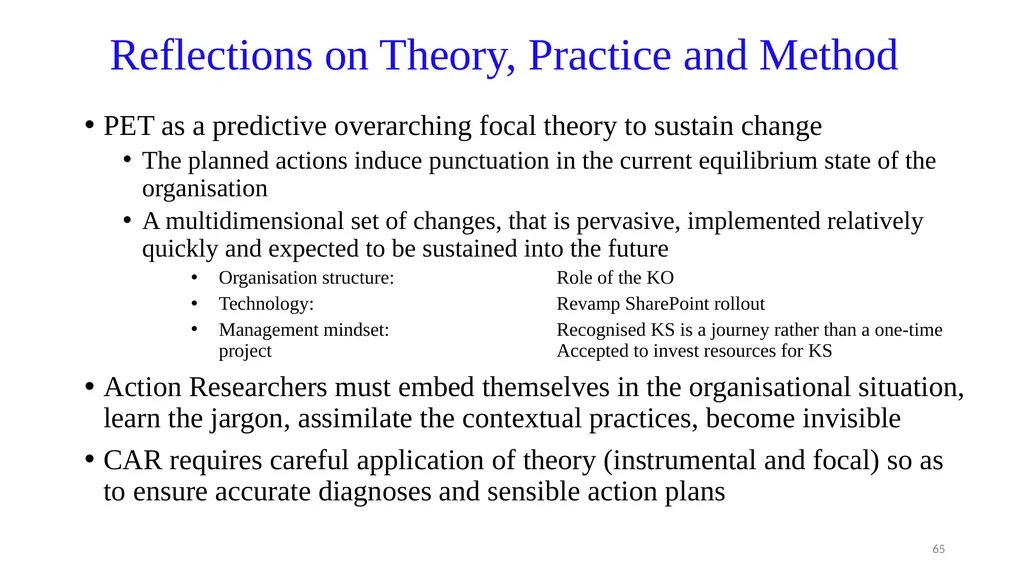
Reflections on Theory, Practice and Method PET as a predictive overarching focal theory to sustain change
The planned actions induce punctuation in the current equilibrium state of the organisation
A multidimensional set of changes, that is pervasive, implemented relatively quickly and expected to be sustained into the future
Organisation structure: Role of the KO
Technology: Revamp SharePoint rollout
Management mindset: Recognised KS is a journey rather than a one-time project Accepted to invest resources for KS
Action Researchers must embed themselves in the organisational situation, learn the jargon, assimilate the contextual practices, become invisible
CAR requires careful application of theory (instrumental and focal) so as to ensure accurate diagnoses and sensible action plans 65<br>
The planned actions induce punctuation in the current equilibrium state of the organisation
A multidimensional set of changes, that is pervasive, implemented relatively quickly and expected to be sustained into the future
Organisation structure: Role of the KO
Technology: Revamp SharePoint rollout
Management mindset: Recognised KS is a journey rather than a one-time project Accepted to invest resources for KS
Action Researchers must embed themselves in the organisational situation, learn the jargon, assimilate the contextual practices, become invisible
CAR requires careful application of theory (instrumental and focal) so as to ensure accurate diagnoses and sensible action plans 65<br>
66
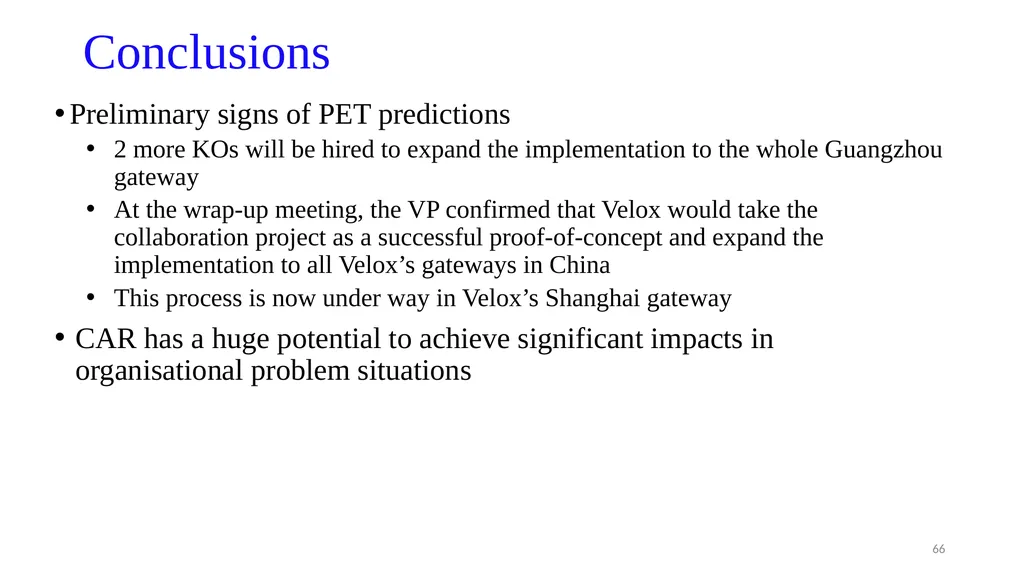
Conclusions Preliminary signs of PET predictions
2 more KOs will be hired to expand the implementation to the whole Guangzhou gateway
At the wrap-up meeting, the VP confirmed that Velox would take the collaboration project as a successful proof-of-concept and expand the implementation to all Velox’s gateways in China
This process is now under way in Velox’s Shanghai gateway
CAR has a huge potential to achieve significant impacts in organisational problem situations 66<br>
2 more KOs will be hired to expand the implementation to the whole Guangzhou gateway
At the wrap-up meeting, the VP confirmed that Velox would take the collaboration project as a successful proof-of-concept and expand the implementation to all Velox’s gateways in China
This process is now under way in Velox’s Shanghai gateway
CAR has a huge potential to achieve significant impacts in organisational problem situations 66<br>
67
Topics for AR What questions or problems would you like to address with an AR approach?<br>
68
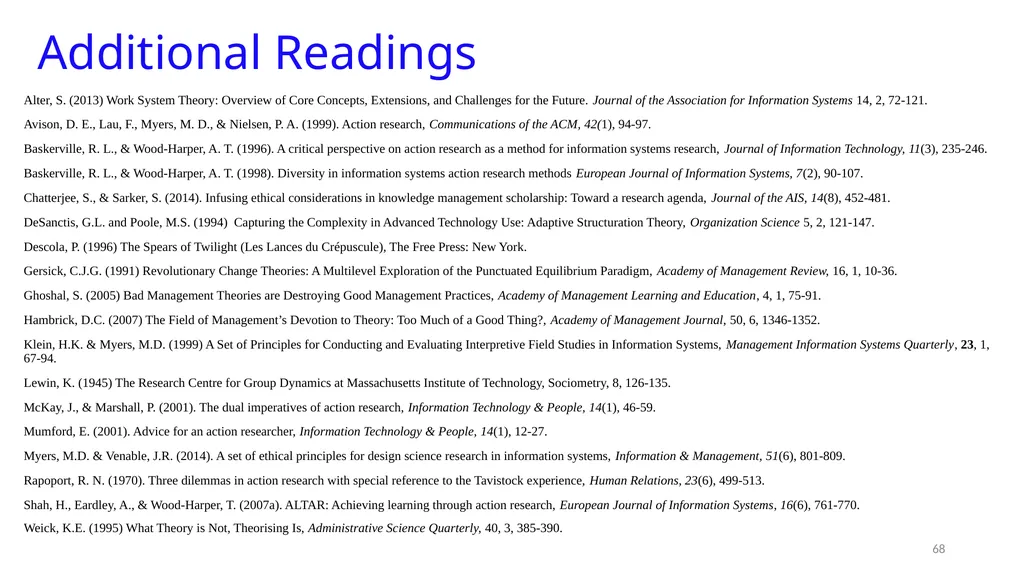
68 Additional Readings Alter, S. (2013) Work System Theory: Overview of Core Concepts, Extensions, and Challenges for the Future. Journal of the Association for Information Systems 14, 2, 72-121.
Avison, D. E., Lau, F., Myers, M. D., & Nielsen, P. A. (1999). Action research, Communications of the ACM, 42(1), 94-97.
Baskerville, R. L., & Wood-Harper, A. T. (1996). A critical perspective on action research as a method for information systems research, Journal of Information Technology, 11(3), 235-246.
Baskerville, R. L., & Wood-Harper, A. T. (1998). Diversity in information systems action research methods European Journal of Information Systems, 7(2), 90-107.
Chatterjee, S., & Sarker, S. (2014). Infusing ethical considerations in knowledge management scholarship: Toward a research agenda, Journal of the AIS, 14(8), 452-481.
DeSanctis, G.L. and Poole, M.S. (1994) Capturing the Complexity in Advanced Technology Use: Adaptive Structuration Theory, Organization Science 5, 2, 121-147.
Descola, P. (1996) The Spears of Twilight (Les Lances du Crépuscule), The Free Press: New York.
Gersick, C.J.G. (1991) Revolutionary Change Theories: A Multilevel Exploration of the Punctuated Equilibrium Paradigm, Academy of Management Review, 16, 1, 10-36.
Ghoshal, S. (2005) Bad Management Theories are Destroying Good Management Practices, Academy of Management Learning and Education, 4, 1, 75-91.
Hambrick, D.C. (2007) The Field of Management’s Devotion to Theory: Too Much of a Good Thing?, Academy of Management Journal, 50, 6, 1346-1352.
Klein, H.K. & Myers, M.D. (1999) A Set of Principles for Conducting and Evaluating Interpretive Field Studies in Information Systems, Management Information Systems Quarterly, 23, 1, 67-94.
Lewin, K. (1945) The Research Centre for Group Dynamics at Massachusetts Institute of Technology, Sociometry, 8, 126-135.
McKay, J., & Marshall, P. (2001). The dual imperatives of action research, Information Technology & People, 14(1), 46-59.
Mumford, E. (2001). Advice for an action researcher, Information Technology & People, 14(1), 12-27.
Myers, M.D. & Venable, J.R. (2014). A set of ethical principles for design science research in information systems, Information & Management, 51(6), 801-809.
Rapoport, R. N. (1970). Three dilemmas in action research with special reference to the Tavistock experience, Human Relations, 23(6), 499-513.
Shah, H., Eardley, A., & Wood-Harper, T. (2007a). ALTAR: Achieving learning through action research, European Journal of Information Systems, 16(6), 761-770.
Weick, K.E. (1995) What Theory is Not, Theorising Is, Administrative Science Quarterly, 40, 3, 385-390.<br>
Avison, D. E., Lau, F., Myers, M. D., & Nielsen, P. A. (1999). Action research, Communications of the ACM, 42(1), 94-97.
Baskerville, R. L., & Wood-Harper, A. T. (1996). A critical perspective on action research as a method for information systems research, Journal of Information Technology, 11(3), 235-246.
Baskerville, R. L., & Wood-Harper, A. T. (1998). Diversity in information systems action research methods European Journal of Information Systems, 7(2), 90-107.
Chatterjee, S., & Sarker, S. (2014). Infusing ethical considerations in knowledge management scholarship: Toward a research agenda, Journal of the AIS, 14(8), 452-481.
DeSanctis, G.L. and Poole, M.S. (1994) Capturing the Complexity in Advanced Technology Use: Adaptive Structuration Theory, Organization Science 5, 2, 121-147.
Descola, P. (1996) The Spears of Twilight (Les Lances du Crépuscule), The Free Press: New York.
Gersick, C.J.G. (1991) Revolutionary Change Theories: A Multilevel Exploration of the Punctuated Equilibrium Paradigm, Academy of Management Review, 16, 1, 10-36.
Ghoshal, S. (2005) Bad Management Theories are Destroying Good Management Practices, Academy of Management Learning and Education, 4, 1, 75-91.
Hambrick, D.C. (2007) The Field of Management’s Devotion to Theory: Too Much of a Good Thing?, Academy of Management Journal, 50, 6, 1346-1352.
Klein, H.K. & Myers, M.D. (1999) A Set of Principles for Conducting and Evaluating Interpretive Field Studies in Information Systems, Management Information Systems Quarterly, 23, 1, 67-94.
Lewin, K. (1945) The Research Centre for Group Dynamics at Massachusetts Institute of Technology, Sociometry, 8, 126-135.
McKay, J., & Marshall, P. (2001). The dual imperatives of action research, Information Technology & People, 14(1), 46-59.
Mumford, E. (2001). Advice for an action researcher, Information Technology & People, 14(1), 12-27.
Myers, M.D. & Venable, J.R. (2014). A set of ethical principles for design science research in information systems, Information & Management, 51(6), 801-809.
Rapoport, R. N. (1970). Three dilemmas in action research with special reference to the Tavistock experience, Human Relations, 23(6), 499-513.
Shah, H., Eardley, A., & Wood-Harper, T. (2007a). ALTAR: Achieving learning through action research, European Journal of Information Systems, 16(6), 761-770.
Weick, K.E. (1995) What Theory is Not, Theorising Is, Administrative Science Quarterly, 40, 3, 385-390.<br>
69
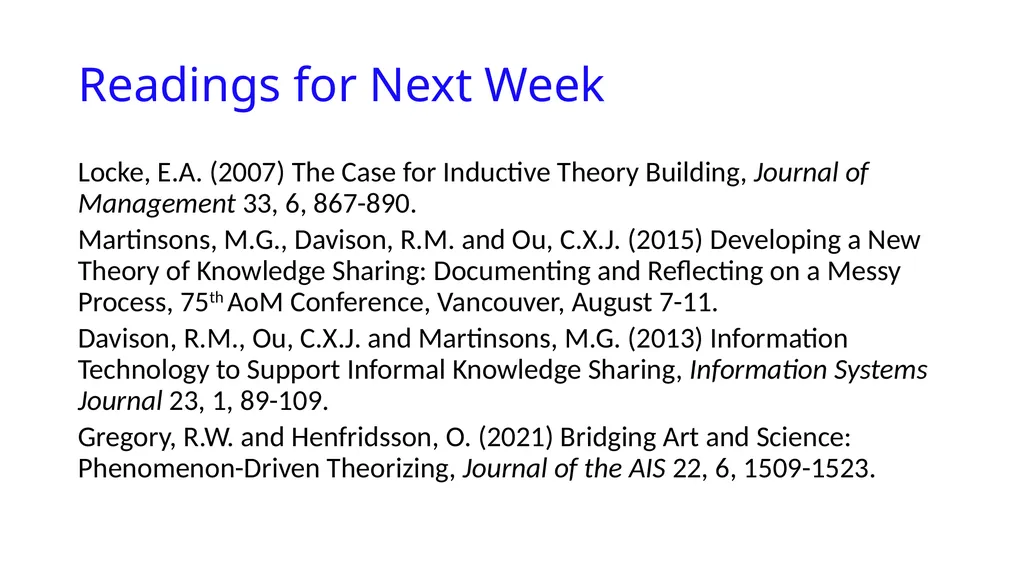
Readings for Next Week Locke, E.A. (2007) The Case for Inductive Theory Building, Journal of Management 33, 6, 867-890.
Martinsons, M.G., Davison, R.M. and Ou, C.X.J. (2015) Developing a New Theory of Knowledge Sharing: Documenting and Reflecting on a Messy Process, 75th AoM Conference, Vancouver, August 7-11.
Davison, R.M., Ou, C.X.J. and Martinsons, M.G. (2013) Information Technology to Support Informal Knowledge Sharing, Information Systems Journal 23, 1, 89-109.
Gregory, R.W. and Henfridsson, O. (2021) Bridging Art and Science: Phenomenon-Driven Theorizing, Journal of the AIS 22, 6, 1509-1523.<br>
Martinsons, M.G., Davison, R.M. and Ou, C.X.J. (2015) Developing a New Theory of Knowledge Sharing: Documenting and Reflecting on a Messy Process, 75th AoM Conference, Vancouver, August 7-11.
Davison, R.M., Ou, C.X.J. and Martinsons, M.G. (2013) Information Technology to Support Informal Knowledge Sharing, Information Systems Journal 23, 1, 89-109.
Gregory, R.W. and Henfridsson, O. (2021) Bridging Art and Science: Phenomenon-Driven Theorizing, Journal of the AIS 22, 6, 1509-1523.<br>
70
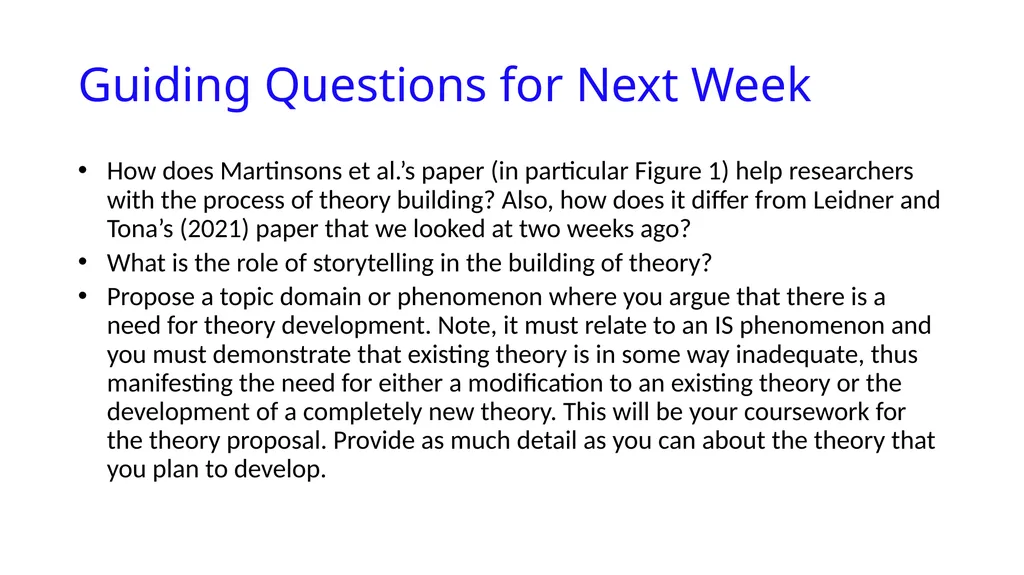
Guiding Questions for Next Week How does Martinsons et al.’s paper (in particular Figure 1) help researchers with the process of theory building? Also, how does it differ from Leidner and Tona’s (2021) paper that we looked at two weeks ago?
What is the role of storytelling in the building of theory?
Propose a topic domain or phenomenon where you argue that there is a need for theory development. Note, it must relate to an IS phenomenon and you must demonstrate that existing theory is in some way inadequate, thus manifesting the need for either a modification to an existing theory or the development of a completely new theory. This will be your coursework for the theory proposal. Provide as much detail as you can about the theory that you plan to develop.<br>
What is the role of storytelling in the building of theory?
Propose a topic domain or phenomenon where you argue that there is a need for theory development. Note, it must relate to an IS phenomenon and you must demonstrate that existing theory is in some way inadequate, thus manifesting the need for either a modification to an existing theory or the development of a completely new theory. This will be your coursework for the theory proposal. Provide as much detail as you can about the theory that you plan to develop.<br>