
Isolation of DNA from Plants Why and How The Basic

Description: Isolation of DNA from Plants Why and How The Basic Plant DNA Isolation Steps Take solid tissue and mash it up: Homogenization. Add a buffer that solubilizes the DNA and protects it. Remove the solid debris, usually by centrifugation. Decant
Related Topics
Download Presentation
"Isolation of DNA from Plants Why and How The Basic" is the property of its rightful owner. Permission is granted to download and print the materials on this website for personal, non-commercial use only, and to display it on your personal computer provided you do not modify the materials and that you retain all copyright notices contained in the materials. By downloading content from our website, you accept the terms of this agreement.
Presentation Transcript
slide1. Isolation of DNA from Plants Why and How<br>
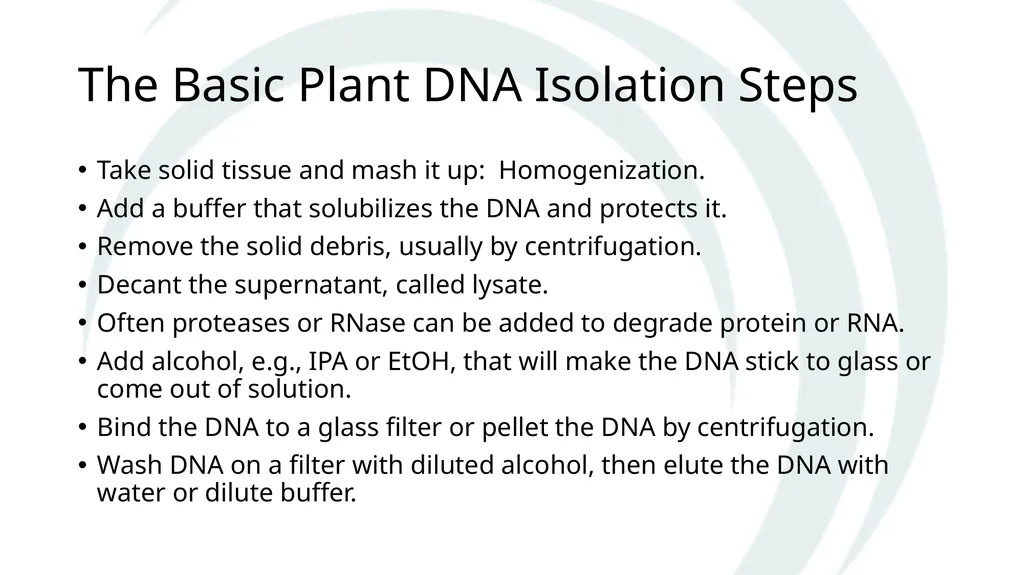
slide2. The Basic Plant DNA Isolation Steps Take solid tissue and mash it up: Homogenization.
Add a buffer that solubilizes the DNA and protects it.
Remove the solid debris, usually by centrifugation.
Decant the supernatant, called lysate.
Often proteases or RNase can be added to degrade protein or RNA.
Add alcohol, e.g., IPA or EtOH, that will make the DNA stick to glass or come out of solution.
Bind the DNA to a glass filter or pellet the DNA by centrifugation.
Wash DNA on a filter with diluted alcohol, then elute the DNA with water or dilute buffer.<br>
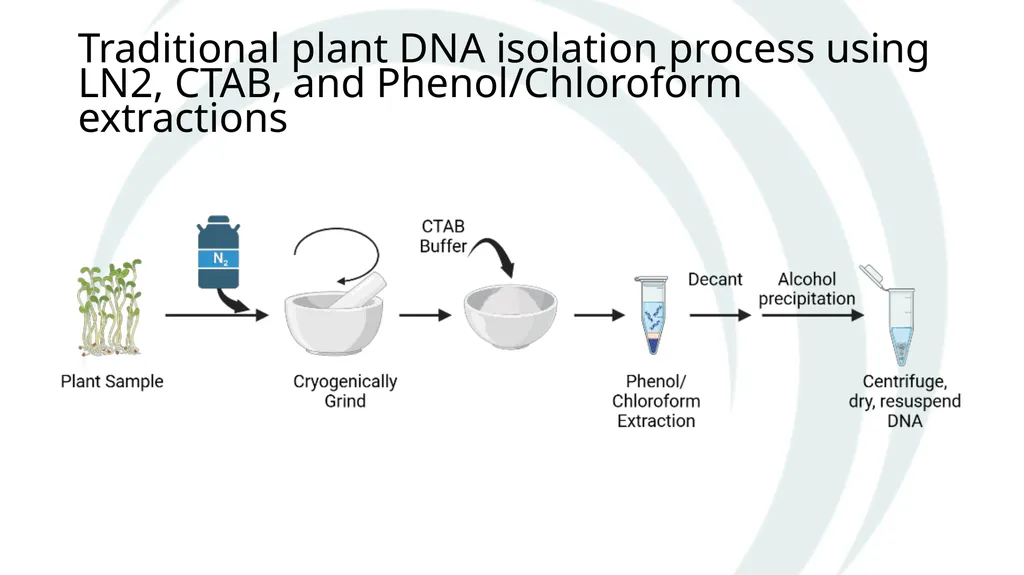
slide3. Traditional plant DNA isolation process using LN2, CTAB, and Phenol/Chloroform extractions<br>
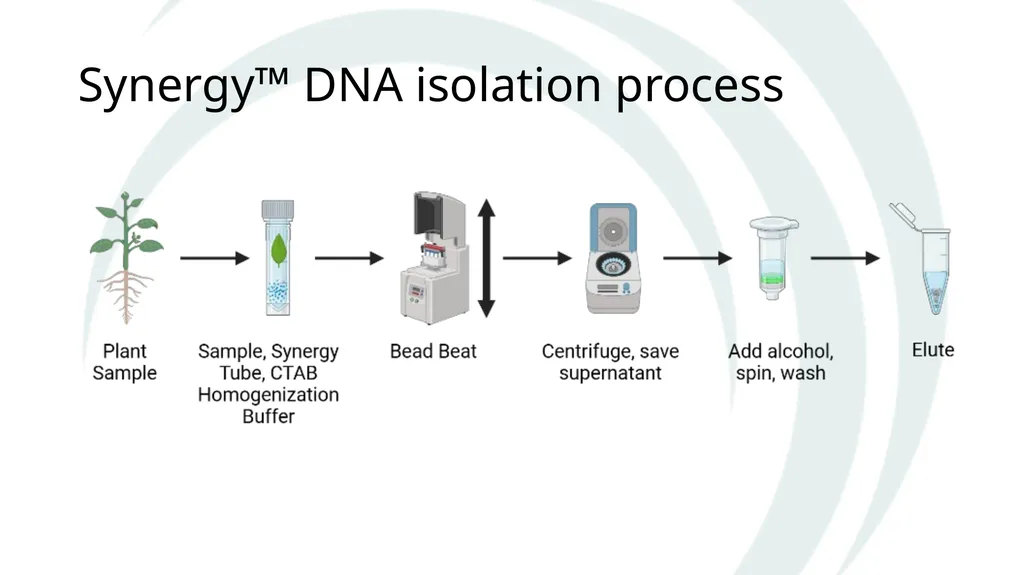
slide4. Synergy™ DNA isolation process<br>
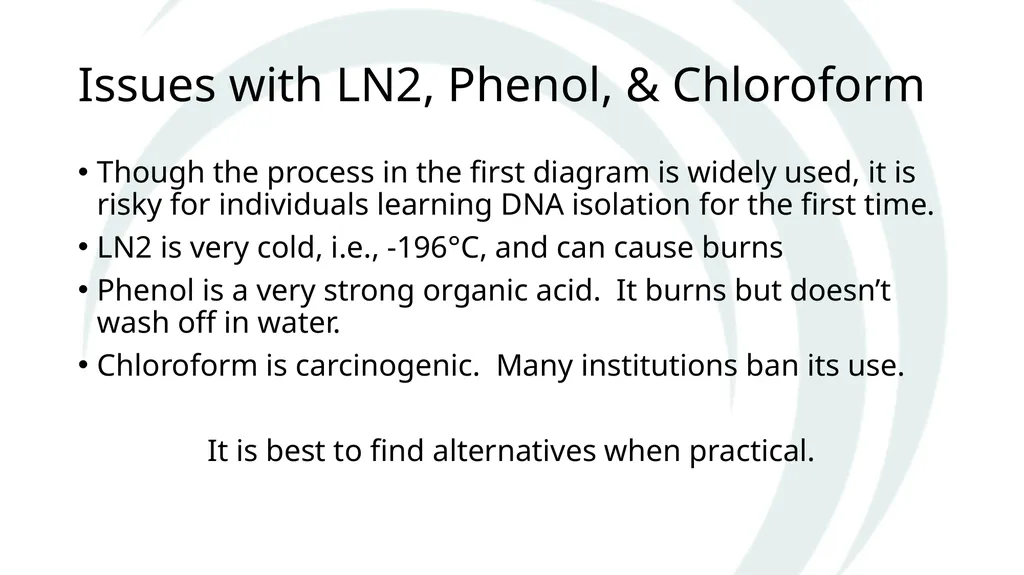
slide5. Issues with LN2, Phenol, & Chloroform Though the process in the first diagram is widely used, it is risky for individuals learning DNA isolation for the first time.
LN2 is very cold, i.e., -196°C, and can cause burns
Phenol is a very strong organic acid. It burns but doesn’t wash off in water.
Chloroform is carcinogenic. Many institutions ban its use.
It is best to find alternatives when practical.<br>
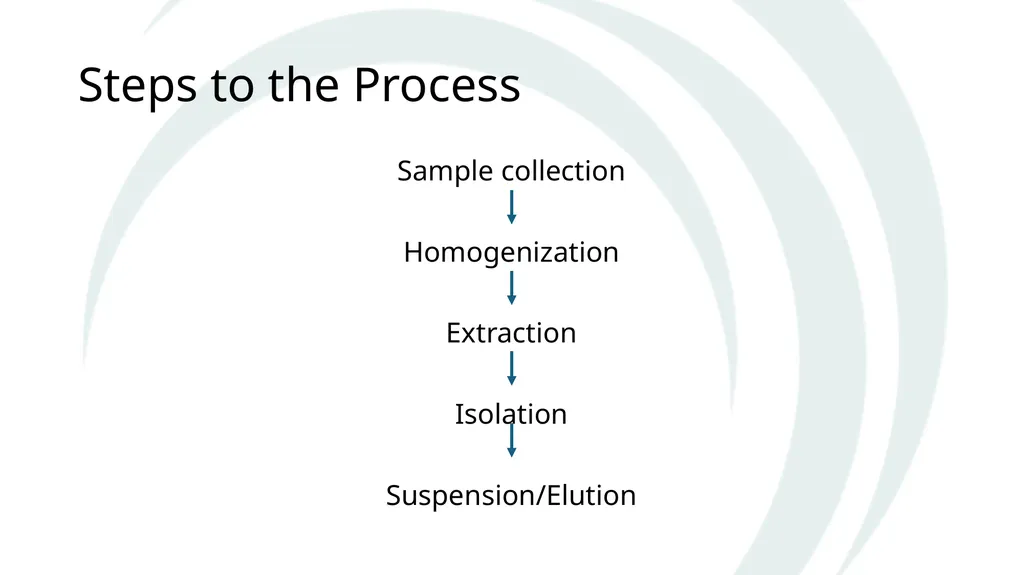
slide6. Steps to the Process Sample collection
Homogenization
Extraction
Isolation
Suspension/Elution<br>
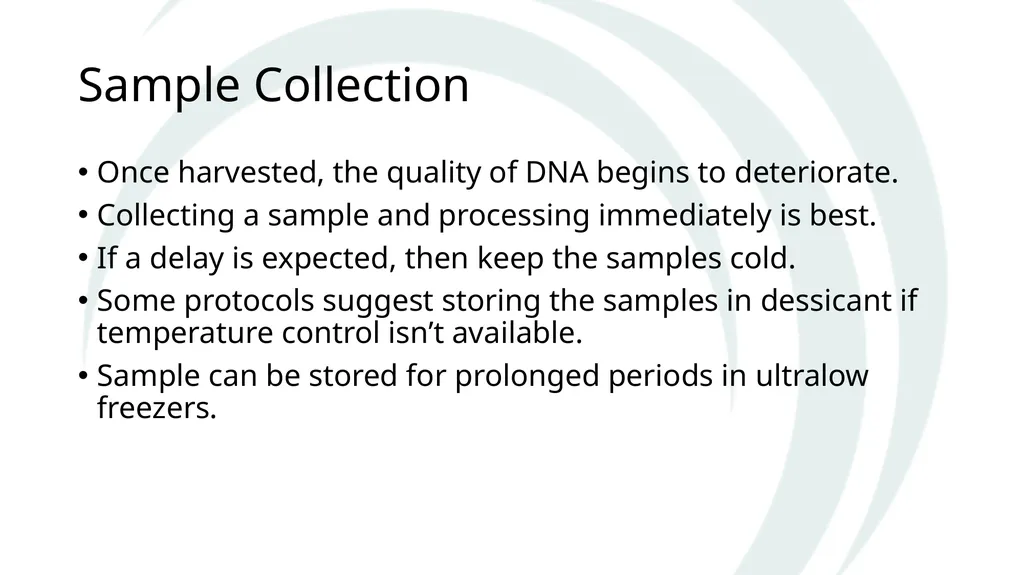
slide7. Sample Collection Once harvested, the quality of DNA begins to deteriorate.
Collecting a sample and processing immediately is best.
If a delay is expected, then keep the samples cold.
Some protocols suggest storing the samples in dessicant if temperature control isn’t available.
Sample can be stored for prolonged periods in ultralow freezers.<br>
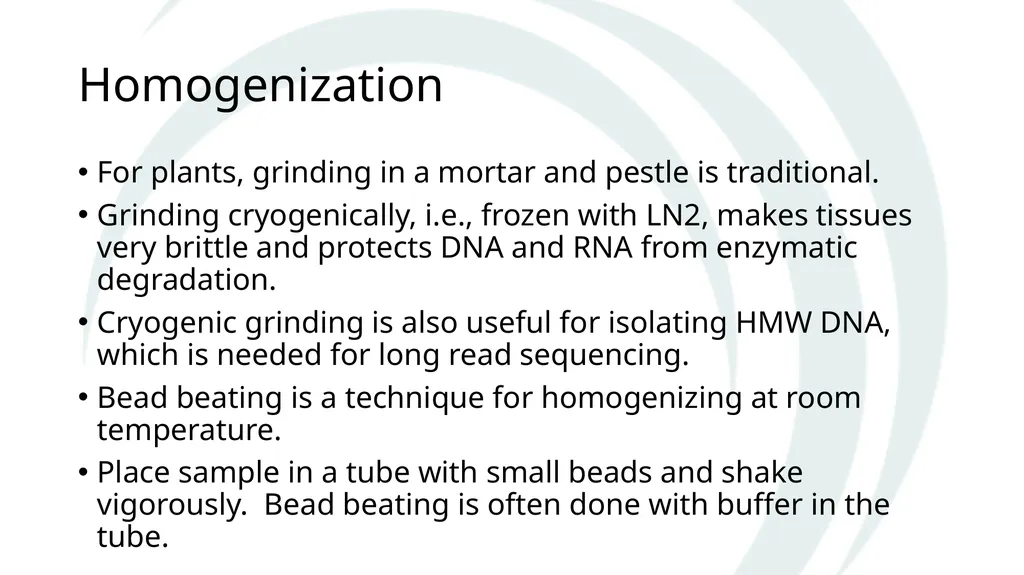
slide8. Homogenization For plants, grinding in a mortar and pestle is traditional.
Grinding cryogenically, i.e., frozen with LN2, makes tissues very brittle and protects DNA and RNA from enzymatic degradation.
Cryogenic grinding is also useful for isolating HMW DNA, which is needed for long read sequencing.
Bead beating is a technique for homogenizing at room temperature.
Place sample in a tube with small beads and shake vigorously. Bead beating is often done with buffer in the tube.<br>
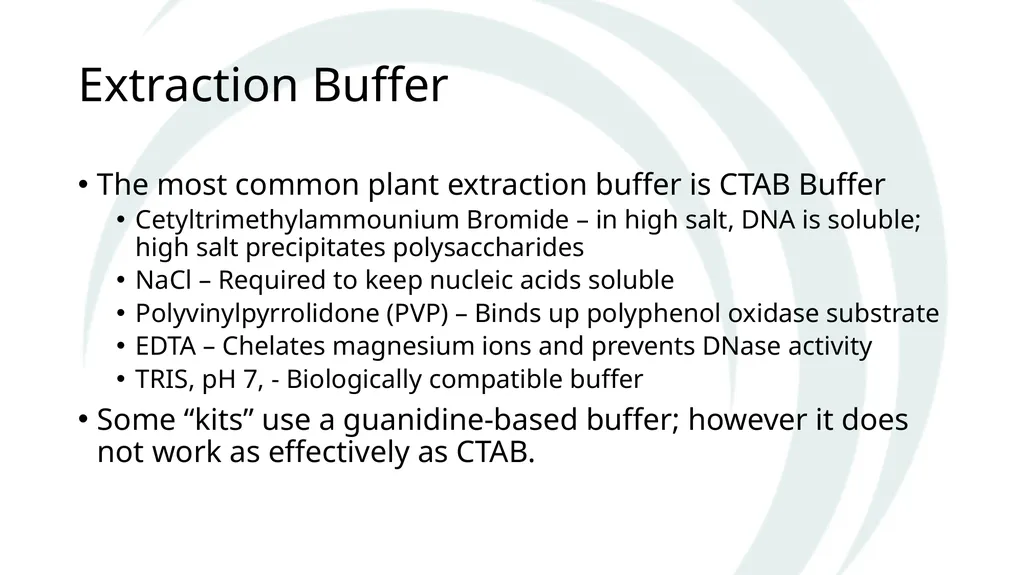
slide9. Extraction Buffer The most common plant extraction buffer is CTAB Buffer
Cetyltrimethylammounium Bromide – in high salt, DNA is soluble; high salt precipitates polysaccharides
NaCl – Required to keep nucleic acids soluble
Polyvinylpyrrolidone (PVP) – Binds up polyphenol oxidase substrate
EDTA – Chelates magnesium ions and prevents DNase activity
TRIS, pH 7, - Biologically compatible buffer
Some “kits” use a guanidine-based buffer; however it does not work as effectively as CTAB.<br>
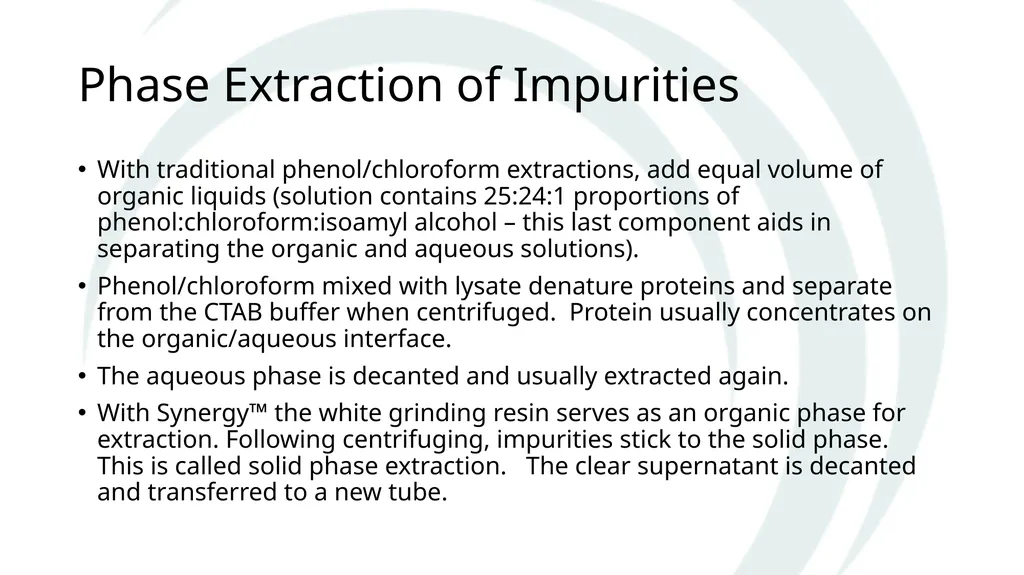
slide10. Phase Extraction of Impurities With traditional phenol/chloroform extractions, add equal volume of organic liquids (solution contains 25:24:1 proportions of phenol:chloroform:isoamyl alcohol – this last component aids in separating the organic and aqueous solutions).
Phenol/chloroform mixed with lysate denature proteins and separate from the CTAB buffer when centrifuged. Protein usually concentrates on the organic/aqueous interface.
The aqueous phase is decanted and usually extracted again.
With Synergy™ the white grinding resin serves as an organic phase for extraction. Following centrifuging, impurities stick to the solid phase. This is called solid phase extraction. The clear supernatant is decanted and transferred to a new tube.<br>
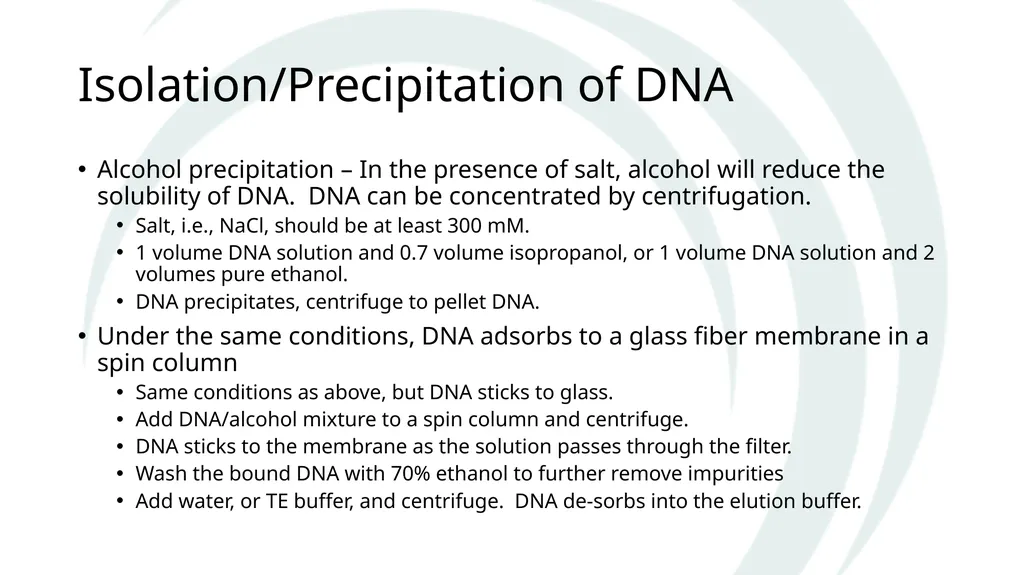
slide11. Isolation/Precipitation of DNA Alcohol precipitation – In the presence of salt, alcohol will reduce the solubility of DNA. DNA can be concentrated by centrifugation.
Salt, i.e., NaCl, should be at least 300 mM.
1 volume DNA solution and 0.7 volume isopropanol, or 1 volume DNA solution and 2 volumes pure ethanol.
DNA precipitates, centrifuge to pellet DNA.
Under the same conditions, DNA adsorbs to a glass fiber membrane in a spin column
Same conditions as above, but DNA sticks to glass.
Add DNA/alcohol mixture to a spin column and centrifuge.
DNA sticks to the membrane as the solution passes through the filter.
Wash the bound DNA with 70% ethanol to further remove impurities
Add water, or TE buffer, and centrifuge. DNA de-sorbs into the elution buffer.<br>
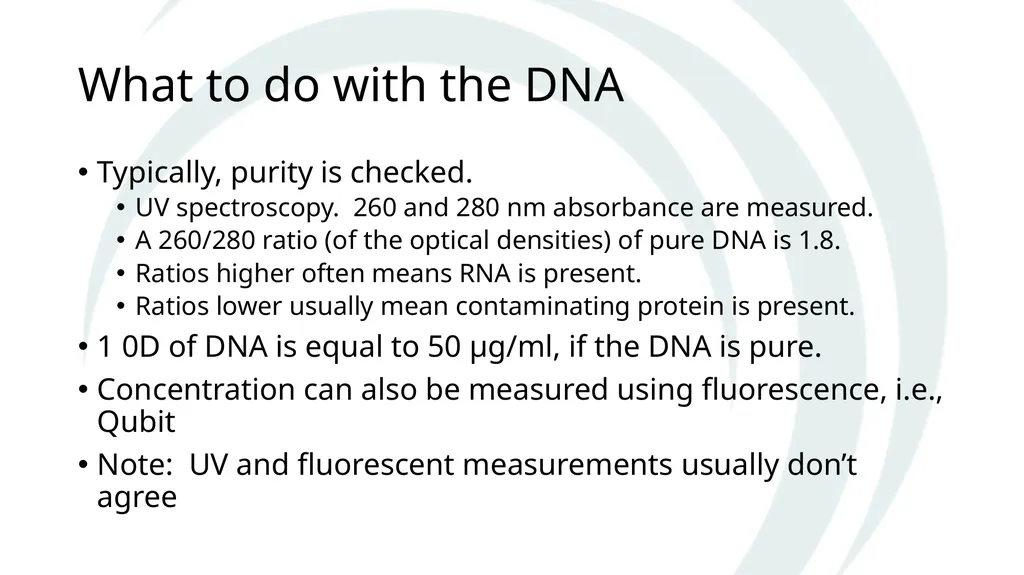
slide12. What to do with the DNA Typically, purity is checked.
UV spectroscopy. 260 and 280 nm absorbance are measured.
A 260/280 ratio (of the optical densities) of pure DNA is 1.8.
Ratios higher often means RNA is present.
Ratios lower usually mean contaminating protein is present.
1 0D of DNA is equal to 50 µg/ml, if the DNA is pure.
Concentration can also be measured using fluorescence, i.e., Qubit
Note: UV and fluorescent measurements usually don’t agree<br>
slide2. The Basic Plant DNA Isolation Steps Take solid tissue and mash it up: Homogenization.
Add a buffer that solubilizes the DNA and protects it.
Remove the solid debris, usually by centrifugation.
Decant the supernatant, called lysate.
Often proteases or RNase can be added to degrade protein or RNA.
Add alcohol, e.g., IPA or EtOH, that will make the DNA stick to glass or come out of solution.
Bind the DNA to a glass filter or pellet the DNA by centrifugation.
Wash DNA on a filter with diluted alcohol, then elute the DNA with water or dilute buffer.<br>
slide3. Traditional plant DNA isolation process using LN2, CTAB, and Phenol/Chloroform extractions<br>
slide4. Synergy™ DNA isolation process<br>
slide5. Issues with LN2, Phenol, & Chloroform Though the process in the first diagram is widely used, it is risky for individuals learning DNA isolation for the first time.
LN2 is very cold, i.e., -196°C, and can cause burns
Phenol is a very strong organic acid. It burns but doesn’t wash off in water.
Chloroform is carcinogenic. Many institutions ban its use.
It is best to find alternatives when practical.<br>
slide6. Steps to the Process Sample collection
Homogenization
Extraction
Isolation
Suspension/Elution<br>
slide7. Sample Collection Once harvested, the quality of DNA begins to deteriorate.
Collecting a sample and processing immediately is best.
If a delay is expected, then keep the samples cold.
Some protocols suggest storing the samples in dessicant if temperature control isn’t available.
Sample can be stored for prolonged periods in ultralow freezers.<br>
slide8. Homogenization For plants, grinding in a mortar and pestle is traditional.
Grinding cryogenically, i.e., frozen with LN2, makes tissues very brittle and protects DNA and RNA from enzymatic degradation.
Cryogenic grinding is also useful for isolating HMW DNA, which is needed for long read sequencing.
Bead beating is a technique for homogenizing at room temperature.
Place sample in a tube with small beads and shake vigorously. Bead beating is often done with buffer in the tube.<br>
slide9. Extraction Buffer The most common plant extraction buffer is CTAB Buffer
Cetyltrimethylammounium Bromide – in high salt, DNA is soluble; high salt precipitates polysaccharides
NaCl – Required to keep nucleic acids soluble
Polyvinylpyrrolidone (PVP) – Binds up polyphenol oxidase substrate
EDTA – Chelates magnesium ions and prevents DNase activity
TRIS, pH 7, - Biologically compatible buffer
Some “kits” use a guanidine-based buffer; however it does not work as effectively as CTAB.<br>
slide10. Phase Extraction of Impurities With traditional phenol/chloroform extractions, add equal volume of organic liquids (solution contains 25:24:1 proportions of phenol:chloroform:isoamyl alcohol – this last component aids in separating the organic and aqueous solutions).
Phenol/chloroform mixed with lysate denature proteins and separate from the CTAB buffer when centrifuged. Protein usually concentrates on the organic/aqueous interface.
The aqueous phase is decanted and usually extracted again.
With Synergy™ the white grinding resin serves as an organic phase for extraction. Following centrifuging, impurities stick to the solid phase. This is called solid phase extraction. The clear supernatant is decanted and transferred to a new tube.<br>
slide11. Isolation/Precipitation of DNA Alcohol precipitation – In the presence of salt, alcohol will reduce the solubility of DNA. DNA can be concentrated by centrifugation.
Salt, i.e., NaCl, should be at least 300 mM.
1 volume DNA solution and 0.7 volume isopropanol, or 1 volume DNA solution and 2 volumes pure ethanol.
DNA precipitates, centrifuge to pellet DNA.
Under the same conditions, DNA adsorbs to a glass fiber membrane in a spin column
Same conditions as above, but DNA sticks to glass.
Add DNA/alcohol mixture to a spin column and centrifuge.
DNA sticks to the membrane as the solution passes through the filter.
Wash the bound DNA with 70% ethanol to further remove impurities
Add water, or TE buffer, and centrifuge. DNA de-sorbs into the elution buffer.<br>
slide12. What to do with the DNA Typically, purity is checked.
UV spectroscopy. 260 and 280 nm absorbance are measured.
A 260/280 ratio (of the optical densities) of pure DNA is 1.8.
Ratios higher often means RNA is present.
Ratios lower usually mean contaminating protein is present.
1 0D of DNA is equal to 50 µg/ml, if the DNA is pure.
Concentration can also be measured using fluorescence, i.e., Qubit
Note: UV and fluorescent measurements usually don’t agree<br>