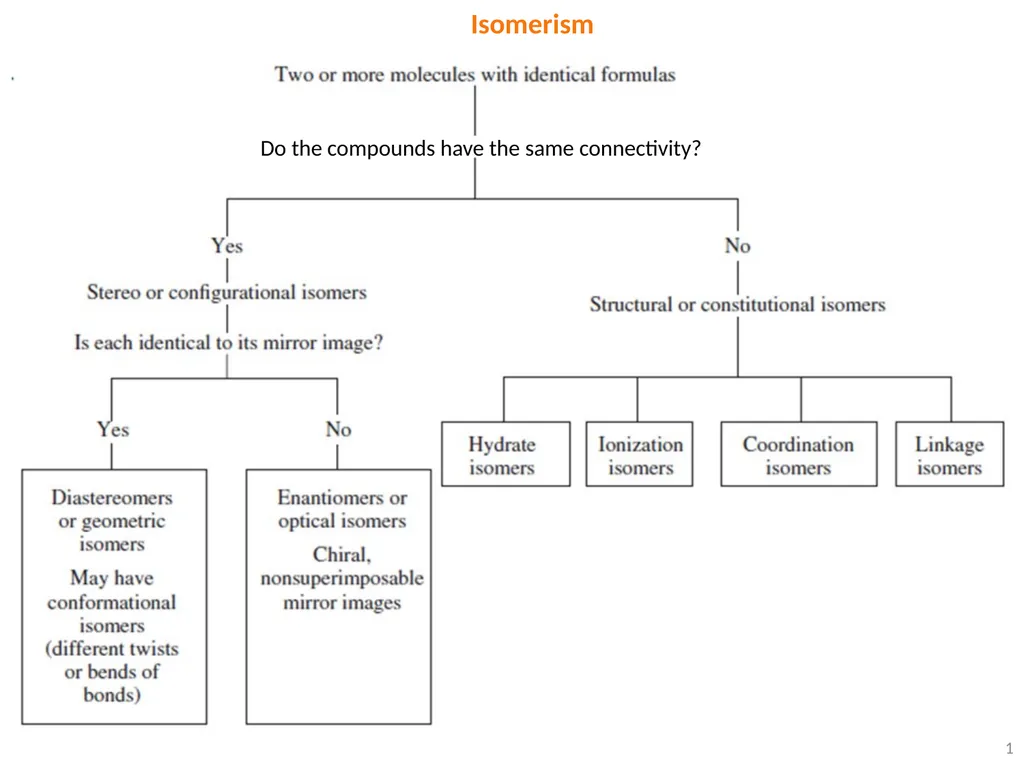
Isomerism 1 Do the compounds have the same connectivity? 2 Stereo Isomerism Stereo isomers : They have the same atoms, same sets of bonds, but differ in the relative orientation of these bonds. Geometrical Isomers: a) cis-trans Isomerism:
"Isomerism 1 Do the compounds have the same" is the property of its rightful owner. Permission is granted to
download and print the materials on this website for personal, non-commercial use only, and to display it
on your personal computer provided you do not modify the materials and that you retain all copyright
notices contained in the materials. By downloading content from our website, you accept the terms of this
agreement.
Presentation Transcript
01
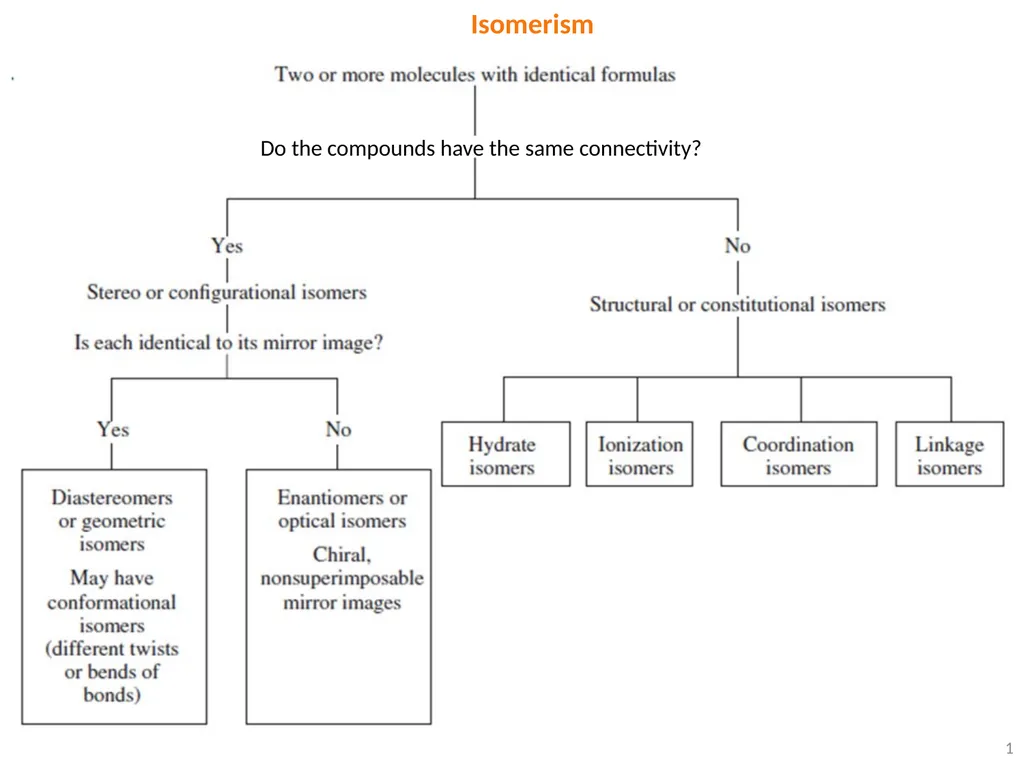
Isomerism 1 Do the compounds have the same connectivity?<br>
02
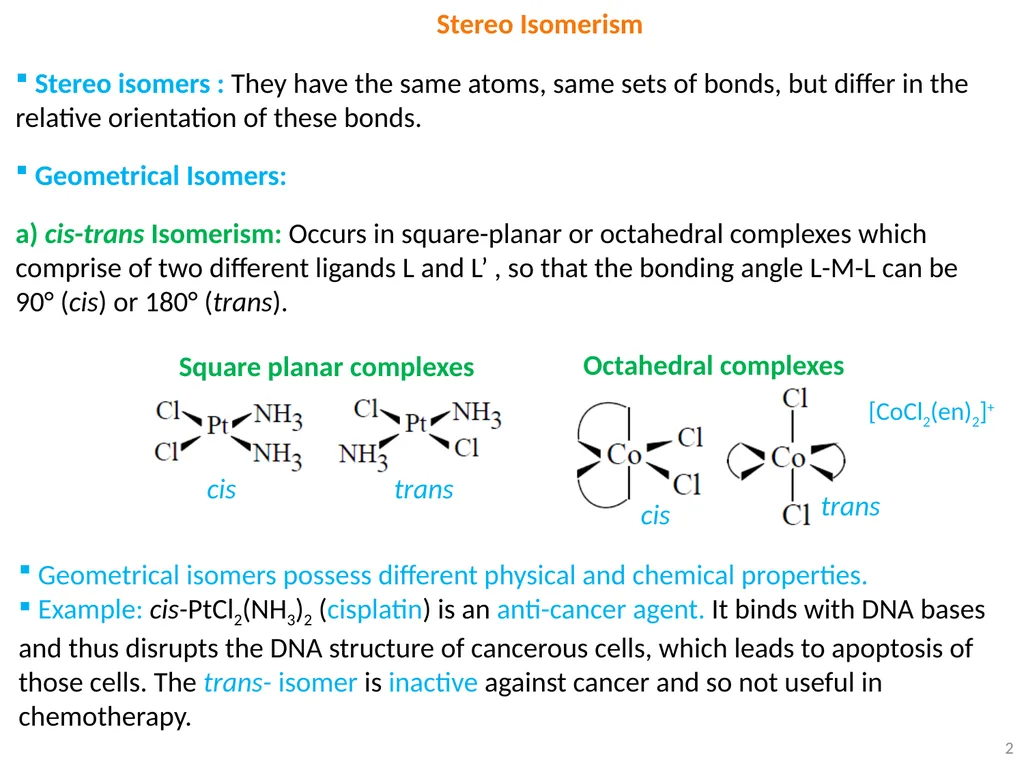
2 Stereo Isomerism Stereo isomers : They have the same atoms, same sets of bonds, but differ in the relative orientation of these bonds.
Geometrical Isomers:
a) cis-trans Isomerism: Occurs in square-planar or octahedral complexes which comprise of two different ligands L and L’ , so that the bonding angle L-M-L can be
90° (cis) or 180° (trans). cis trans trans cis Square planar complexes Octahedral complexes [CoCl2(en)2]+ Geometrical isomers possess different physical and chemical properties.
Example: cis-PtCl2(NH3)2 (cisplatin) is an anti-cancer agent. It binds with DNA bases and thus disrupts the DNA structure of cancerous cells, which leads to apoptosis of those cells. The trans- isomer is inactive against cancer and so not useful in chemotherapy.<br>
03
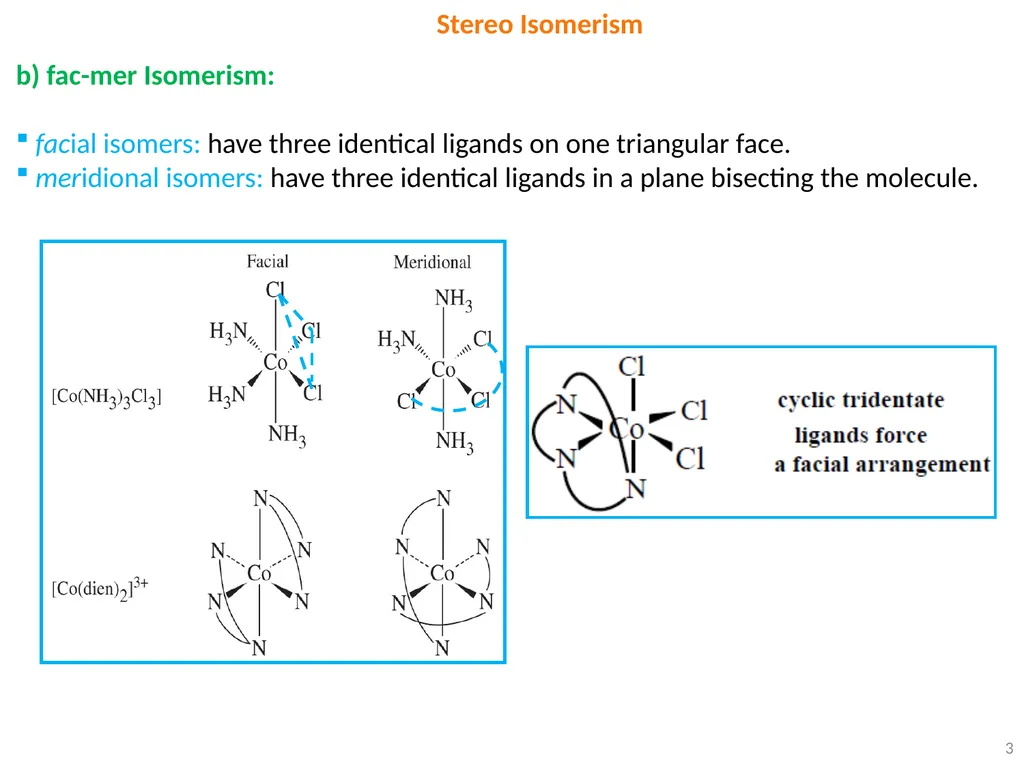
3 b) fac-mer Isomerism:
facial isomers: have three identical ligands on one triangular face.
meridional isomers: have three identical ligands in a plane bisecting the molecule. Stereo Isomerism<br>
04
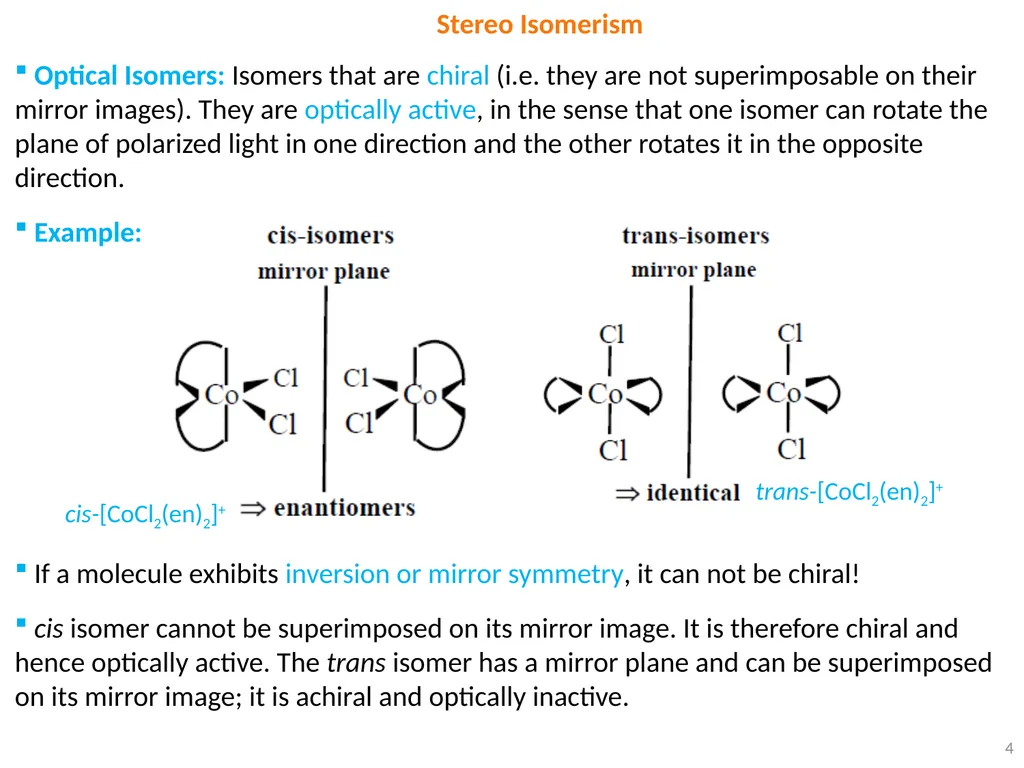
4 Stereo Isomerism Optical Isomers: Isomers that are chiral (i.e. they are not superimposable on their mirror images). They are optically active, in the sense that one isomer can rotate the plane of polarized light in one direction and the other rotates it in the opposite direction.
Example:
If a molecule exhibits inversion or mirror symmetry, it can not be chiral!
cis isomer cannot be superimposed on its mirror image. It is therefore chiral and hence optically active. The trans isomer has a mirror plane and can be superimposed on its mirror image; it is achiral and optically inactive. cis-[CoCl2(en)2]+ trans-[CoCl2(en)2]+<br>
05
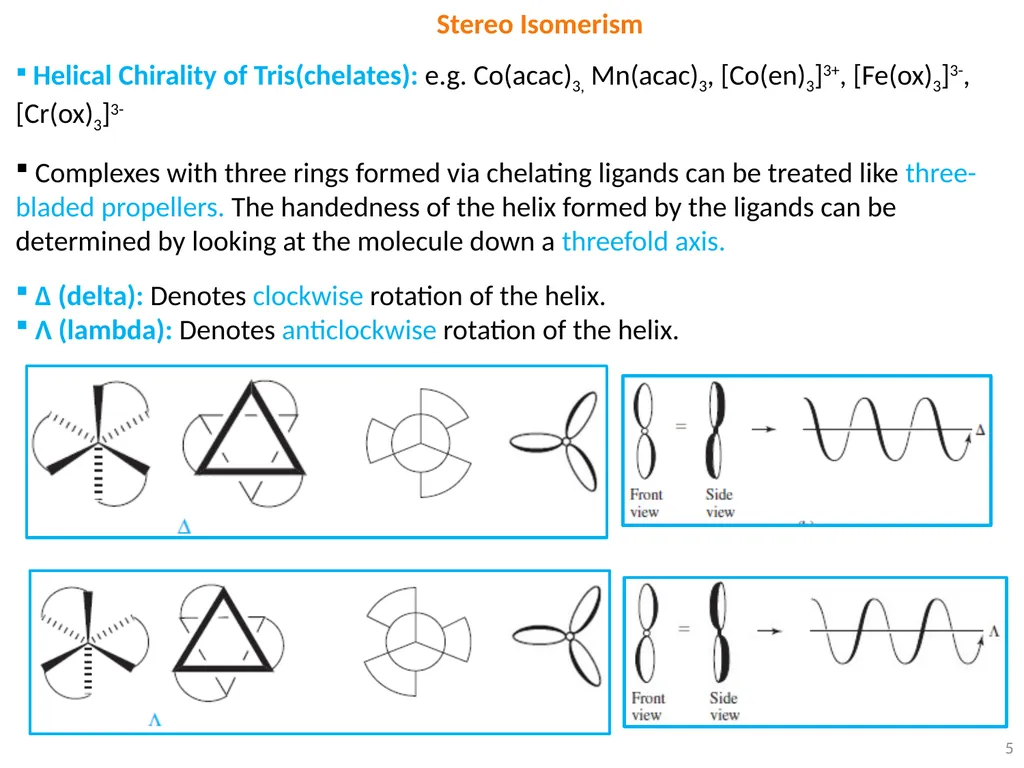
5 Stereo Isomerism Helical Chirality of Tris(chelates): e.g. Co(acac)3, Mn(acac)3, [Co(en)3]3+, [Fe(ox)3]3-, [Cr(ox)3]3-
Complexes with three rings formed via chelating ligands can be treated like three-bladed propellers. The handedness of the helix formed by the ligands can be determined by looking at the molecule down a threefold axis.
Δ (delta): Denotes clockwise rotation of the helix.
Λ (lambda): Denotes anticlockwise rotation of the helix.<br>
06
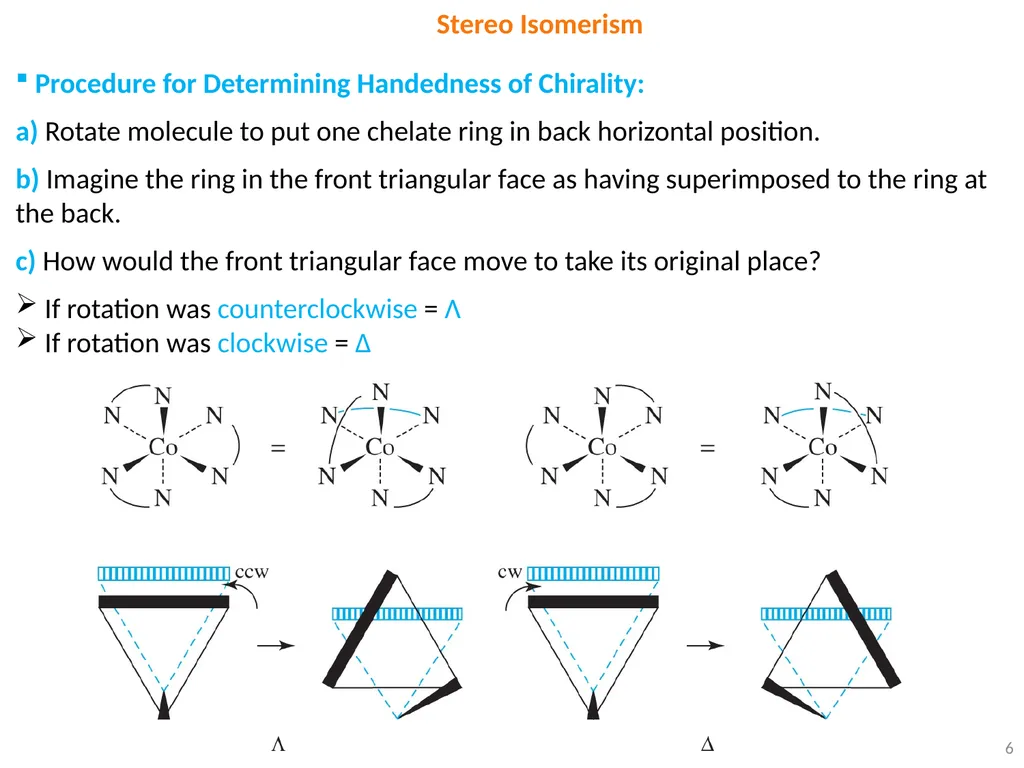
6 Stereo Isomerism Procedure for Determining Handedness of Chirality:
a) Rotate molecule to put one chelate ring in back horizontal position.
b) Imagine the ring in the front triangular face as having superimposed to the ring at the back.
c) How would the front triangular face move to take its original place?
If rotation was counterclockwise = Λ
If rotation was clockwise = Δ<br>
07
7 The designation of the absolute configuration must be distinguished from the experimentally determined direction in which an isomer rotates polarized light:
some compounds rotate in one direction, others rotate in the opposite direction,
and the direction may change with wavelength.
d-Isomer or (+)-isomer: Isomer that rotates the plane of polarization clockwise at
a specified wavelength.
l-isomer or (-)-isomer: Isomer that rotates the plane of polarization anticlockwise. Absolute Configuration Versus Optical Rotation<br>
08
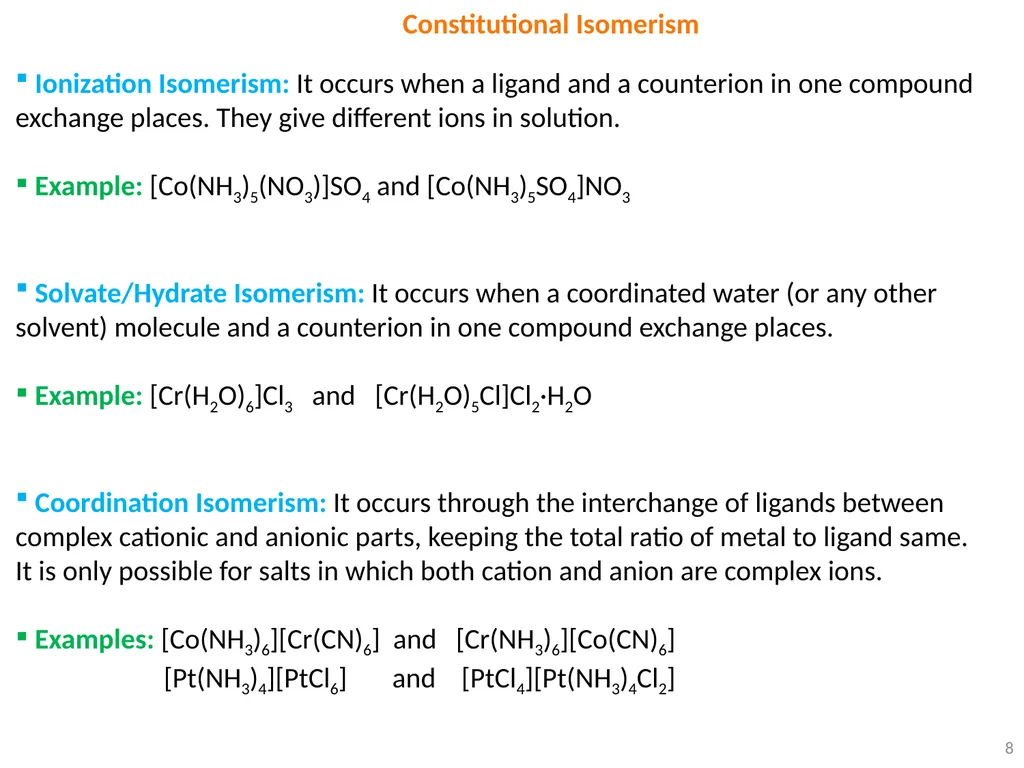
8 Constitutional Isomerism Ionization Isomerism: It occurs when a ligand and a counterion in one compound exchange places. They give different ions in solution.
Example: [Co(NH3)5(NO3)]SO4 and [Co(NH3)5SO4]NO3
Solvate/Hydrate Isomerism: It occurs when a coordinated water (or any other solvent) molecule and a counterion in one compound exchange places.
Example: [Cr(H2O)6]Cl3 and [Cr(H2O)5Cl]Cl2·H2O
Coordination Isomerism: It occurs through the interchange of ligands between complex cationic and anionic parts, keeping the total ratio of metal to ligand same.
It is only possible for salts in which both cation and anion are complex ions.
Examples: [Co(NH3)6][Cr(CN)6] and [Cr(NH3)6][Co(CN)6]
[Pt(NH3)4][PtCl6] and [PtCl4][Pt(NH3)4Cl2]<br>
09
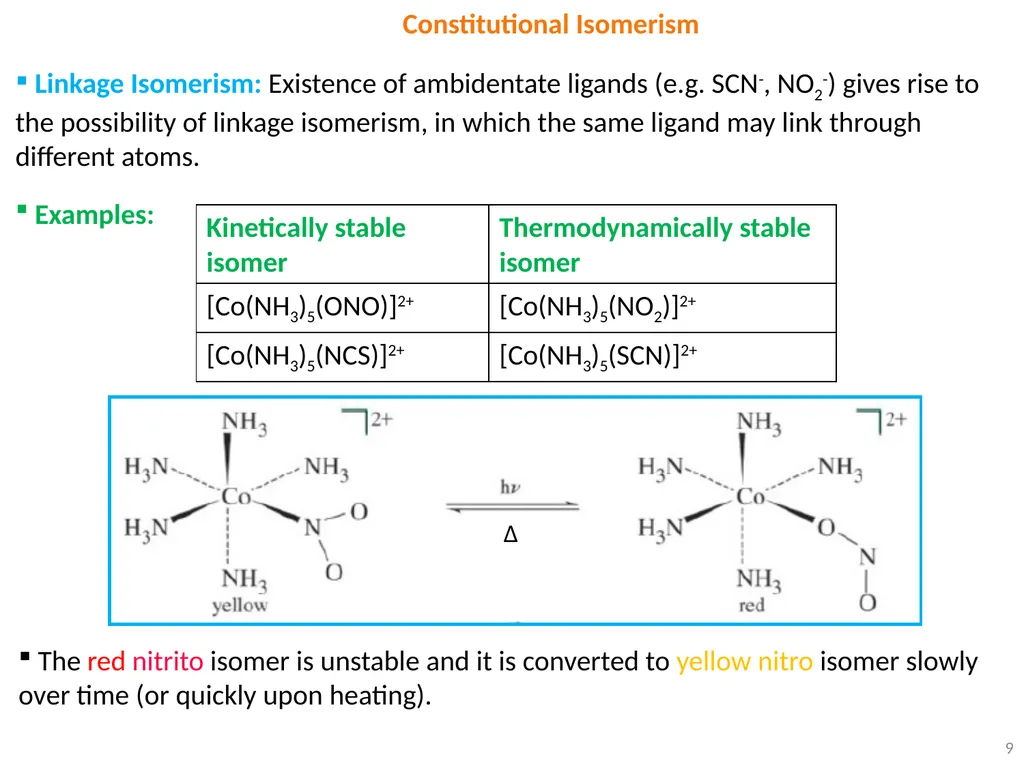
9 Linkage Isomerism: Existence of ambidentate ligands (e.g. SCN-, NO2-) gives rise to the possibility of linkage isomerism, in which the same ligand may link through different atoms.
Examples: The red nitrito isomer is unstable and it is converted to yellow nitro isomer slowly over time (or quickly upon heating). Δ Constitutional Isomerism<br>