
ITEGRATED PEST MANGAGEMENT SIMPLIFIED Presented by


Description: ITEGRATED PEST MANGAGEMENT SIMPLIFIED Presented by Bud Lopez ACES Tribal Extension What is IPM? Integrated Pest Management (IPM) is an effective and environmentally sensitive approach to pest management that relies on a combination of
Related Topics
Download Presentation
"ITEGRATED PEST MANGAGEMENT SIMPLIFIED Presented by" is the property of its rightful owner. Permission is granted to download and print the materials on this website for personal, non-commercial use only, and to display it on your personal computer provided you do not modify the materials and that you retain all copyright notices contained in the materials. By downloading content from our website, you accept the terms of this agreement.
Presentation Transcript
slide1. ITEGRATED PEST MANGAGEMENT SIMPLIFIED Presented by
Bud Lopez ACES Tribal Extension<br>
slide3. What is IPM? Integrated Pest Management (IPM) is an effective and environmentally sensitive approach to pest management that relies on a combination of common-sense practices.
IPM programs use current, comprehensive information on the life cycles of pests and their interaction with the environment. This information, in combination with available pest control methods, is used to manage pest damage by the most economical means, and with the least possible hazard to people, property, and the environment.
IPM takes advantage of all appropriate pest management options including, but not limited to, the judicious use of pesticides. UCNFA<br>
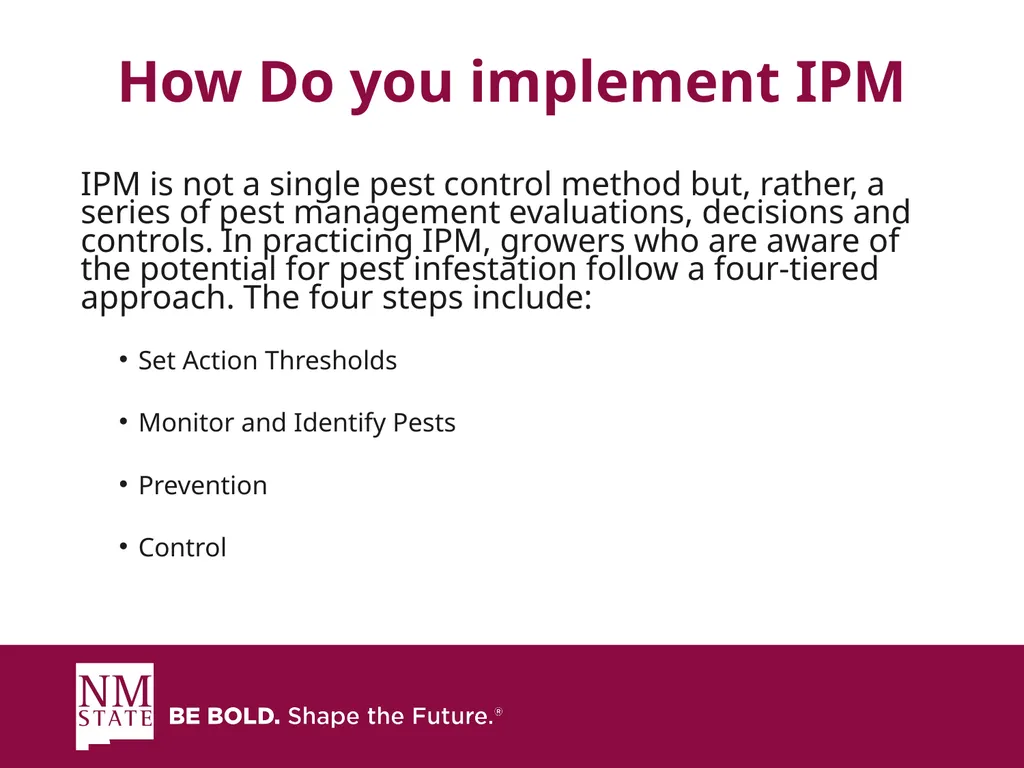
slide4. How Do you implement IPM IPM is not a single pest control method but, rather, a series of pest management evaluations, decisions and controls. In practicing IPM, growers who are aware of the potential for pest infestation follow a four-tiered approach. The four steps include:
Set Action Thresholds
Monitor and Identify Pests
Prevention
Control<br>
slide5. Set Action Thresholds Before taking any pest control action, IPM first sets an action threshold, a point at which pest populations or environmental conditions indicate that pest control action must be taken. Sighting a single pest does not always mean control is needed. The level at which pests will become an economic threat is critical to guide future pest control decisions.<br>
slide6. Monitor and Identify Pests Not all insects, weeds, and other living organisms require control. Many organisms are innocuous, and some are even beneficial. IPM programs work to monitor for pests and identify them accurately, so that appropriate control decisions can be made in conjunction with action thresholds. This monitoring and identification removes the possibility that pesticides will be used when they are not really needed or that the wrong kind of pesticide will be used.<br>
slide7. Prevention As a first line of defense, IPM programs work to manage the crop to prevent pests from becoming a threat.
In an agricultural crop, this may mean using cultural methods, such as rotating between different crops, selecting pest-resistant varieties, and planting pest-free rootstock.
These control methods can be very effective and cost-efficient and present little to no risk to people or the environment.<br>
slide8. Control Once monitoring, identification, and action thresholds indicate that pest control is required, and preventive methods are no longer effective, IPM programs then evaluate the proper control method both for effectiveness and risk. Effective, less risky pest controls are always chosen first.<br>
slide9. Methods of Control Cultural Controls
Biological Controls
Mechanical and Physical Controls
Chemical Controls<br>
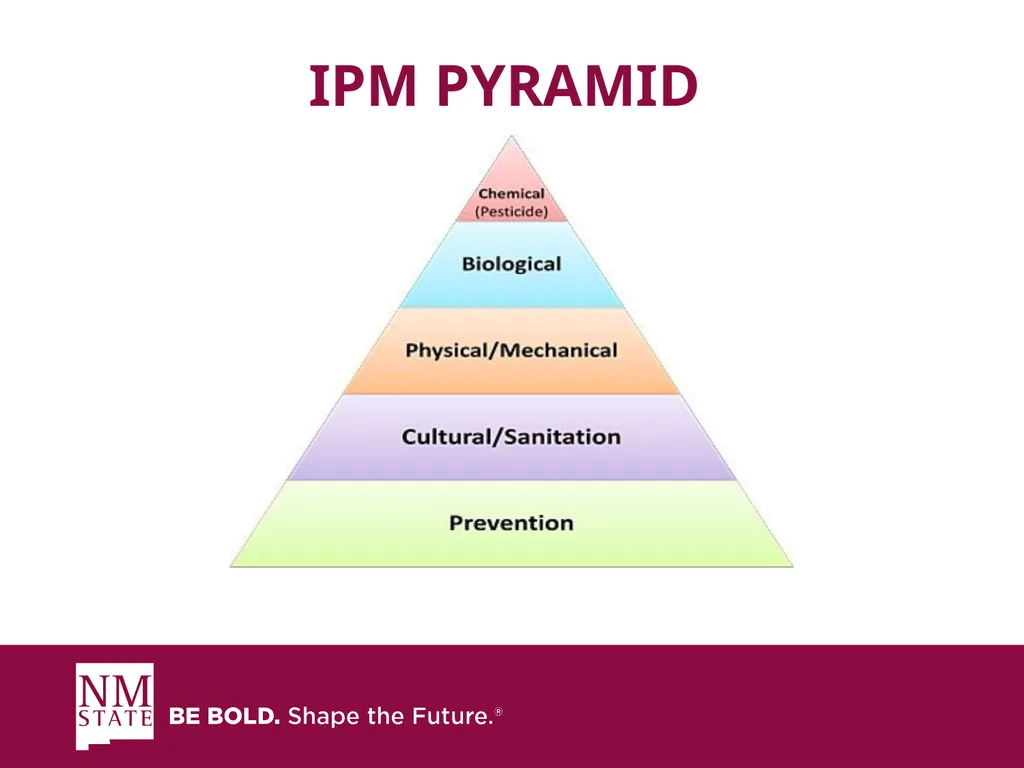
slide10. IPM PYRAMID<br>
slide11. Cultural Controls Cultural control methods include:
Sanitation
Proper selected and rotated crops.
Sanitizing and solarizing the soil
Choosing the best planting and harvest times.
Using resistant varieties and certified plants.
Taking advantage of allelopathy, and intercropping.<br>
slide12. Sanitation Sanitation is paramount with tools and other equipment, planting materials, containers, media, irrigation water, benches and growing areas. UCNFA
Weeds and dead plant material should be removed so that they can't serve as vectors for pests and diseases.
Yard waste should be removed from the site in secured in trash bags. Do not compost diseased material, because most often home compost piles do not get hot enough to kill all pathogens.<br>
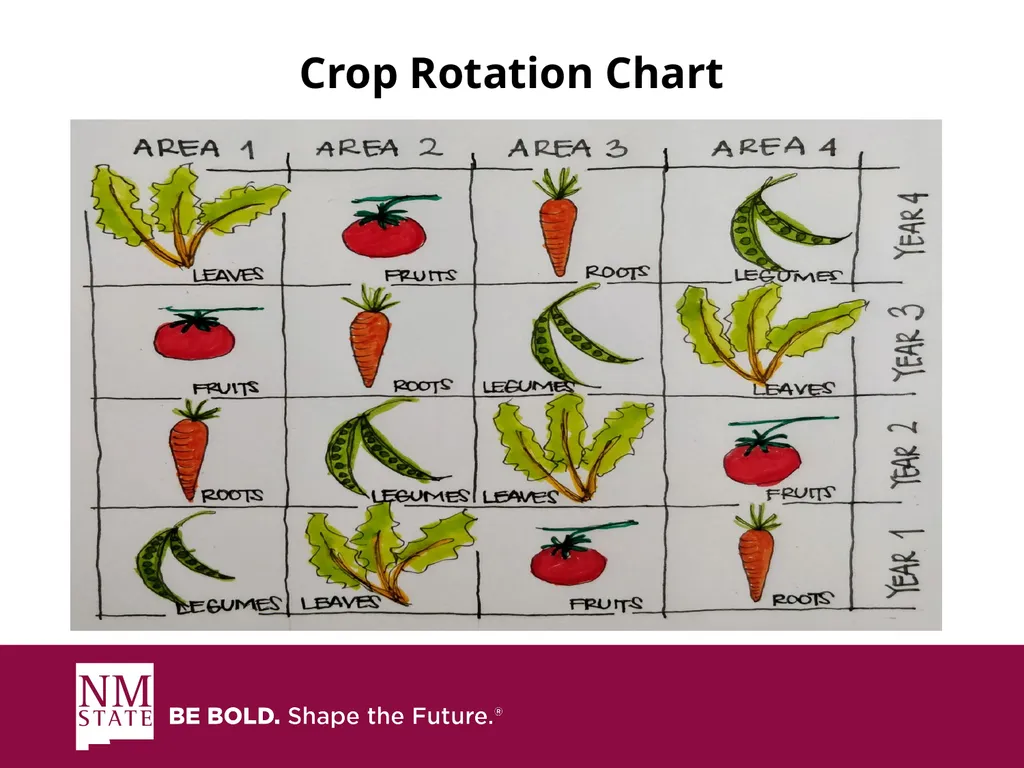
slide13. Crop rotation The principle of crop rotation is to plant a crop in a different location each year. Rotating crops disrupts pathogens, insects, and nematodes by removing the host required to complete their life cycle.
Pests may remain in the soil for quite some time, waiting for their required host to be planted; therefore, a crop should only be grown in the same spot a maximum of once every three years. While a three-year rotation is the minimum recommended, a four or five-year rotation will be even better at reducing the buildup of soil-borne pests.<br>
slide14. Crop Rotation Chart<br>
slide15. Soil Sanitation/Solarization Soil solarization is a nonchemical method for controlling soilborne pests using high temperatures produced by capturing radiant energy from the sun.
The method involves heating the soil by covering it with clear plastic for four to six weeks during a hot period of the year and when the soil will receive the most direct sunlight. Plastic tarps allow the sun’s radiant energy to be trapped in soil, heating the top 12 to 18 inches to temperatures lethal to a wide range of soilborne pests; including weeds, plant pathogens, nematodes, and insects.<br>
slide16. Timing of Planting and Harvesting The availability of crop varieties with a range of maturity periods allows considerable flexibility in planting dates. The most common manipulation of planting dates is the utilization of "safe dates" which are a range of dates where a given crop can be planted such that it is in a relatively invulnerable stage when the damaging stage of the pest is present.
Harvest frequency or scheduling can have major effects on pests, particularly weeds and diseases, but harvests can also be used to mitigate insect infestations.<br>
slide17. Resistant and Certified Disease-Free Varieties Resistant varieties are plants within a certain group/species that are less vulnerable to attack by plant pests or diseases. These have been developed mostly through breeding programs, selection or genetic manipulation.
To earn the label of certified disease-free, plants must be propagated following a strict set of procedures and inspections that minimize the risk of infection and spread of disease.
Read more at Gardening Know How: Disease-Resistant Plants – What Are Certified Disease-Free Plants.
www.gardeningknowhow.com/garden-how-to/shop/what-are-certified-disease-free-plants.htm
See a list of disease resistant varieties on the site below.
www.vegetables.cornell.edu/pest-management/disease-factsheets/disease-resistant-vegetable-varieties/<br>
slide18. Allelopathy and Intercropping Allelopathy is a biological phenomenon by which an organism produces one or more biochemicals that influence the germination, growth, survival, and reproduction of other organisms. Purple Sage, Black Walnut, Tree of Heaven and even our beloved chile are examples of allelopathic plants.
Intercropping is the activity or practice of growing one crop among others of a different species. It has potential pest management practice because it diversifies crops in an agro-ecosystem to reduce insect populations and attacks. Intercropping relies on a deep understanding of insect ecology and crop traits. Intercropping can be used alone or in combination with host-plant resistance and biological control.<br>
slide19. Physical/Mechanical Physical controls include mulches for weed management, steam sterilization of the soil for disease management, or barriers such as screens to keep birds or insects out.
Mechanical controls include hand picking, traps, hosing off, stomping and squishing/squashing.<br>
slide20. Biological Biological pest control is a method of controlling pests by using other organisms that are their natural enemies or pathogens. Biological agents can be introduced via:
Augmentation-Adding to an existing population.
Conservation-Prevention of waste, don’t kill the good guys.
Importation-To bring from a foreign or external source, add a new species.
trough:
Predation-Ladybug preying on aphids
Parasitism-Parasites on bad bugs
Herbivory-Resistance, pheromone repellents, bad tasting
Competition-Ground covers that compete for area
Pathogen-Introduction-To susceptible pests such as Bacillus thuringiensis(BT)<br>
slide21. Chemical Chemical controls in IPM is held as a last resort.
However, sometimes it is necessary. With all the planning, research and practice from the topics above, your discission and plan of attack will be much more sound, informed and effective when making the chemical choice.
Remember, there are many products that are better for you(non-toxic) and the environment that can be used in place of harsh chemicals.<br>
slide22. Less Toxic Insecticides While a good pest management plan will start with preventative, cultural, and other non-chemical methods, these are sometimes not completely effective on their own. In this case, a pesticide may be considered. If pesticide use is deemed necessary for control of the pest problem, it is good practice to use the least toxic pesticide that will do the job effectively. Although all pesticides are by their nature toxic in some way to some organisms, there are now a number of “less toxic” pesticide options.
https://hgic.clemson.edu/factsheet/less-toxic-insecticides/<br>
slide23. Less Toxic Insecticides Soaps and oils: Insecticidal soaps suffocate the pest.
Botanical Insecticides: Neem Oil, Neem tree extract. Insecticide and fungicide.
Limonene: citrus
Capsaicin: chile
Pyrethrins: synthetic plant extract from some Daisy’s. Paralyzes.
Essential Oils: From geraniums, cedar, rosemary and thyme and others.
Microbial Insecticides: Bacillus thuringiensis (Bt) bacteria for many Lepidoptera.
Beneficial Nematodes: Microscopic worm like parasites. Hosts, cutworm, grubs. Species specific.<br>
slide24. Minerals: Diatomaceous Earth: Ocean single celled algae. Soft bodied crawlers like slugs, millipedes, sowbugs, cockroaches, ants and soft bodied aphids.
Kaolin Clay: Irritates insects and disguises plants so they don’t recognize them.
Boric Acid: Stomach poison for many insects.
Silica Gel: Dries up the protective glossy coating on many insects and causes death through dehydration.
Sulfur: Primarily used for fungal disease but has pest control abilities also, mites, psyllids and trips,
Insect Growth Regulators: IGRs they interfere with pest egg development and molting of various life stages.
Traps and Bait stations: Sticky traps, bait stations use small amounts of pesticide. Beneficial Nematodes<br>
slide25. Bud Lopez Aces Tribal Agriculture Agent Tribal Extension Home (nmsu.edu) 505-863-3432 Budl2@nmsu.edu<br>
Bud Lopez ACES Tribal Extension<br>
slide3. What is IPM? Integrated Pest Management (IPM) is an effective and environmentally sensitive approach to pest management that relies on a combination of common-sense practices.
IPM programs use current, comprehensive information on the life cycles of pests and their interaction with the environment. This information, in combination with available pest control methods, is used to manage pest damage by the most economical means, and with the least possible hazard to people, property, and the environment.
IPM takes advantage of all appropriate pest management options including, but not limited to, the judicious use of pesticides. UCNFA<br>
slide4. How Do you implement IPM IPM is not a single pest control method but, rather, a series of pest management evaluations, decisions and controls. In practicing IPM, growers who are aware of the potential for pest infestation follow a four-tiered approach. The four steps include:
Set Action Thresholds
Monitor and Identify Pests
Prevention
Control<br>
slide5. Set Action Thresholds Before taking any pest control action, IPM first sets an action threshold, a point at which pest populations or environmental conditions indicate that pest control action must be taken. Sighting a single pest does not always mean control is needed. The level at which pests will become an economic threat is critical to guide future pest control decisions.<br>
slide6. Monitor and Identify Pests Not all insects, weeds, and other living organisms require control. Many organisms are innocuous, and some are even beneficial. IPM programs work to monitor for pests and identify them accurately, so that appropriate control decisions can be made in conjunction with action thresholds. This monitoring and identification removes the possibility that pesticides will be used when they are not really needed or that the wrong kind of pesticide will be used.<br>
slide7. Prevention As a first line of defense, IPM programs work to manage the crop to prevent pests from becoming a threat.
In an agricultural crop, this may mean using cultural methods, such as rotating between different crops, selecting pest-resistant varieties, and planting pest-free rootstock.
These control methods can be very effective and cost-efficient and present little to no risk to people or the environment.<br>
slide8. Control Once monitoring, identification, and action thresholds indicate that pest control is required, and preventive methods are no longer effective, IPM programs then evaluate the proper control method both for effectiveness and risk. Effective, less risky pest controls are always chosen first.<br>
slide9. Methods of Control Cultural Controls
Biological Controls
Mechanical and Physical Controls
Chemical Controls<br>
slide10. IPM PYRAMID<br>
slide11. Cultural Controls Cultural control methods include:
Sanitation
Proper selected and rotated crops.
Sanitizing and solarizing the soil
Choosing the best planting and harvest times.
Using resistant varieties and certified plants.
Taking advantage of allelopathy, and intercropping.<br>
slide12. Sanitation Sanitation is paramount with tools and other equipment, planting materials, containers, media, irrigation water, benches and growing areas. UCNFA
Weeds and dead plant material should be removed so that they can't serve as vectors for pests and diseases.
Yard waste should be removed from the site in secured in trash bags. Do not compost diseased material, because most often home compost piles do not get hot enough to kill all pathogens.<br>
slide13. Crop rotation The principle of crop rotation is to plant a crop in a different location each year. Rotating crops disrupts pathogens, insects, and nematodes by removing the host required to complete their life cycle.
Pests may remain in the soil for quite some time, waiting for their required host to be planted; therefore, a crop should only be grown in the same spot a maximum of once every three years. While a three-year rotation is the minimum recommended, a four or five-year rotation will be even better at reducing the buildup of soil-borne pests.<br>
slide14. Crop Rotation Chart<br>
slide15. Soil Sanitation/Solarization Soil solarization is a nonchemical method for controlling soilborne pests using high temperatures produced by capturing radiant energy from the sun.
The method involves heating the soil by covering it with clear plastic for four to six weeks during a hot period of the year and when the soil will receive the most direct sunlight. Plastic tarps allow the sun’s radiant energy to be trapped in soil, heating the top 12 to 18 inches to temperatures lethal to a wide range of soilborne pests; including weeds, plant pathogens, nematodes, and insects.<br>
slide16. Timing of Planting and Harvesting The availability of crop varieties with a range of maturity periods allows considerable flexibility in planting dates. The most common manipulation of planting dates is the utilization of "safe dates" which are a range of dates where a given crop can be planted such that it is in a relatively invulnerable stage when the damaging stage of the pest is present.
Harvest frequency or scheduling can have major effects on pests, particularly weeds and diseases, but harvests can also be used to mitigate insect infestations.<br>
slide17. Resistant and Certified Disease-Free Varieties Resistant varieties are plants within a certain group/species that are less vulnerable to attack by plant pests or diseases. These have been developed mostly through breeding programs, selection or genetic manipulation.
To earn the label of certified disease-free, plants must be propagated following a strict set of procedures and inspections that minimize the risk of infection and spread of disease.
Read more at Gardening Know How: Disease-Resistant Plants – What Are Certified Disease-Free Plants.
www.gardeningknowhow.com/garden-how-to/shop/what-are-certified-disease-free-plants.htm
See a list of disease resistant varieties on the site below.
www.vegetables.cornell.edu/pest-management/disease-factsheets/disease-resistant-vegetable-varieties/<br>
slide18. Allelopathy and Intercropping Allelopathy is a biological phenomenon by which an organism produces one or more biochemicals that influence the germination, growth, survival, and reproduction of other organisms. Purple Sage, Black Walnut, Tree of Heaven and even our beloved chile are examples of allelopathic plants.
Intercropping is the activity or practice of growing one crop among others of a different species. It has potential pest management practice because it diversifies crops in an agro-ecosystem to reduce insect populations and attacks. Intercropping relies on a deep understanding of insect ecology and crop traits. Intercropping can be used alone or in combination with host-plant resistance and biological control.<br>
slide19. Physical/Mechanical Physical controls include mulches for weed management, steam sterilization of the soil for disease management, or barriers such as screens to keep birds or insects out.
Mechanical controls include hand picking, traps, hosing off, stomping and squishing/squashing.<br>
slide20. Biological Biological pest control is a method of controlling pests by using other organisms that are their natural enemies or pathogens. Biological agents can be introduced via:
Augmentation-Adding to an existing population.
Conservation-Prevention of waste, don’t kill the good guys.
Importation-To bring from a foreign or external source, add a new species.
trough:
Predation-Ladybug preying on aphids
Parasitism-Parasites on bad bugs
Herbivory-Resistance, pheromone repellents, bad tasting
Competition-Ground covers that compete for area
Pathogen-Introduction-To susceptible pests such as Bacillus thuringiensis(BT)<br>
slide21. Chemical Chemical controls in IPM is held as a last resort.
However, sometimes it is necessary. With all the planning, research and practice from the topics above, your discission and plan of attack will be much more sound, informed and effective when making the chemical choice.
Remember, there are many products that are better for you(non-toxic) and the environment that can be used in place of harsh chemicals.<br>
slide22. Less Toxic Insecticides While a good pest management plan will start with preventative, cultural, and other non-chemical methods, these are sometimes not completely effective on their own. In this case, a pesticide may be considered. If pesticide use is deemed necessary for control of the pest problem, it is good practice to use the least toxic pesticide that will do the job effectively. Although all pesticides are by their nature toxic in some way to some organisms, there are now a number of “less toxic” pesticide options.
https://hgic.clemson.edu/factsheet/less-toxic-insecticides/<br>
slide23. Less Toxic Insecticides Soaps and oils: Insecticidal soaps suffocate the pest.
Botanical Insecticides: Neem Oil, Neem tree extract. Insecticide and fungicide.
Limonene: citrus
Capsaicin: chile
Pyrethrins: synthetic plant extract from some Daisy’s. Paralyzes.
Essential Oils: From geraniums, cedar, rosemary and thyme and others.
Microbial Insecticides: Bacillus thuringiensis (Bt) bacteria for many Lepidoptera.
Beneficial Nematodes: Microscopic worm like parasites. Hosts, cutworm, grubs. Species specific.<br>
slide24. Minerals: Diatomaceous Earth: Ocean single celled algae. Soft bodied crawlers like slugs, millipedes, sowbugs, cockroaches, ants and soft bodied aphids.
Kaolin Clay: Irritates insects and disguises plants so they don’t recognize them.
Boric Acid: Stomach poison for many insects.
Silica Gel: Dries up the protective glossy coating on many insects and causes death through dehydration.
Sulfur: Primarily used for fungal disease but has pest control abilities also, mites, psyllids and trips,
Insect Growth Regulators: IGRs they interfere with pest egg development and molting of various life stages.
Traps and Bait stations: Sticky traps, bait stations use small amounts of pesticide. Beneficial Nematodes<br>
slide25. Bud Lopez Aces Tribal Agriculture Agent Tribal Extension Home (nmsu.edu) 505-863-3432 Budl2@nmsu.edu<br>