
ITU-T Study Group 5: Environment and Climate
AS
Published · 21 slides · 0 views
1 / 1




Description
ITU-T Study Group 5: Environment and Climate Change Ahmed Zeddam ITU-T SG5 Chairman 25 October 2016 Hammamet, Tunisia World Telecommunication Standardization Assembly 2 ITU-T Study Group 5: Environment and Climate Change Producing standards
Related Topics
Share
Embed code
Download this presentation From Below
"ITU-T Study Group 5: Environment and Climate" is the property of its rightful owner. Permission is granted to download and print the materials on this website for personal, non-commercial use only, and to display it on your personal computer provided you do not modify the materials and that you retain all copyright notices contained in the materials. By downloading content from our website, you accept the terms of this agreement.
Presentation Transcript
01
ITU-T Study Group 5:
Environment and Climate Change Ahmed Zeddam
ITU-T SG5 Chairman 25 October 2016
Hammamet, Tunisia World Telecommunication Standardization Assembly<br>
02
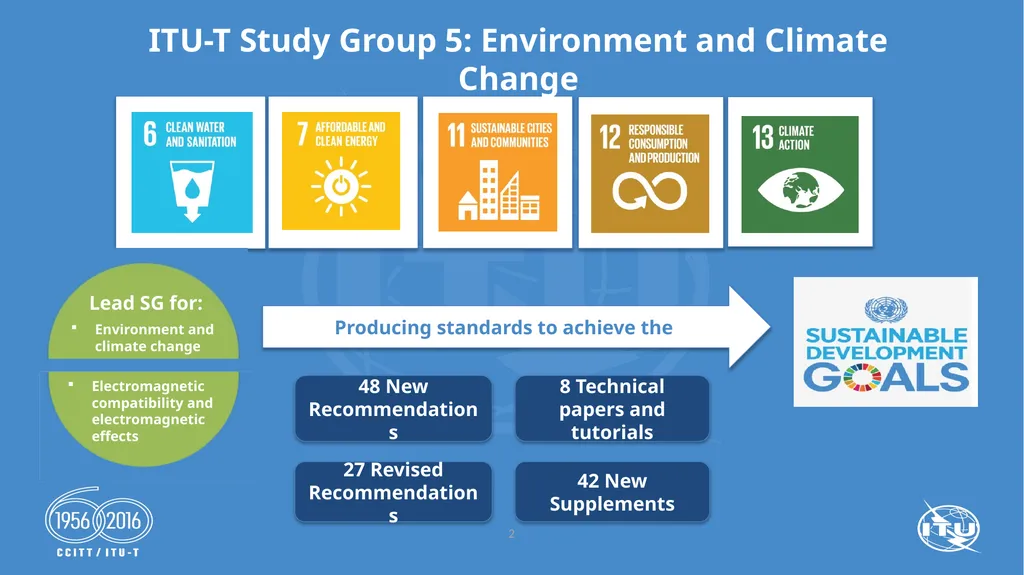
2 ITU-T Study Group 5: Environment and Climate Change Producing standards to achieve the Lead SG for: Environment and climate change Electromagnetic compatibility and electromagnetic effects 48 New Recommendations 42 New Supplements 8 Technical papers and tutorials 27 Revised
Recommendations<br>
Recommendations<br>
03
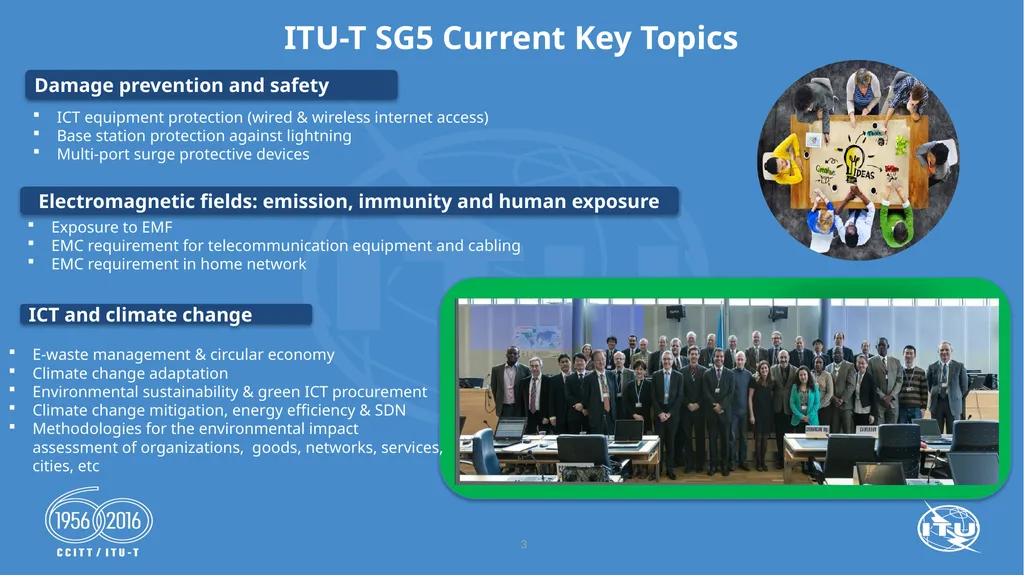
ITU-T SG5 Current Key Topics ICT equipment protection (wired & wireless internet access)
Base station protection against lightning
Multi-port surge protective devices 3 Exposure to EMF
EMC requirement for telecommunication equipment and cabling
EMC requirement in home network E-waste management & circular economy
Climate change adaptation
Environmental sustainability & green ICT procurement
Climate change mitigation, energy efficiency & SDN
Methodologies for the environmental impact assessment of organizations, goods, networks, services, cities, etc Damage prevention and safety Electromagnetic fields: emission, immunity and human exposure ICT and climate change<br>
Base station protection against lightning
Multi-port surge protective devices 3 Exposure to EMF
EMC requirement for telecommunication equipment and cabling
EMC requirement in home network E-waste management & circular economy
Climate change adaptation
Environmental sustainability & green ICT procurement
Climate change mitigation, energy efficiency & SDN
Methodologies for the environmental impact assessment of organizations, goods, networks, services, cities, etc Damage prevention and safety Electromagnetic fields: emission, immunity and human exposure ICT and climate change<br>
04
ITU-T SG5 main results Damage prevention and safety ITU-T K.105, K110 to K112 “Lightning protection rules for radio base stations” ITU-T K.100 “Measurement of radio frequency electromagnetic fields to determine
compliance with human exposure limits when a base station is put into service”
ITU EMF Guide and Mobile App produced and translated into the six UN languages.
A Malaysian version was launched in April 2016” Electromagnetic fields: emission, immunity and human exposure ITU-L.1002 “External universal power adapter solutions for portable information
and communication technology devices ”
Builds on ITU-T standards defining universal chargers for hand-held devices such as mobile phones (ITU-T L.1000)
and stationary devices such as xDSL modems (ITU-T L.1001) ICT and climate change<br>
ITU EMF Guide and Mobile App produced and translated into the six UN languages.
A Malaysian version was launched in April 2016” Electromagnetic fields: emission, immunity and human exposure ITU-L.1002 “External universal power adapter solutions for portable information
and communication technology devices ”
Builds on ITU-T standards defining universal chargers for hand-held devices such as mobile phones (ITU-T L.1000)
and stationary devices such as xDSL modems (ITU-T L.1001) ICT and climate change<br>
05
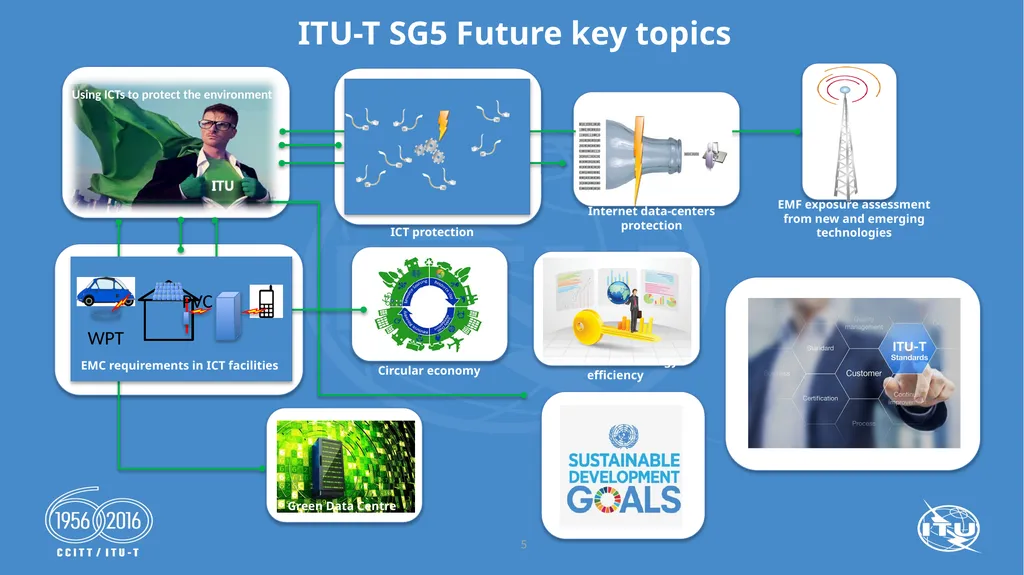
ITU-T SG5 Future key topics 5 Using ICTs to protect the environment ICT protection Internet data-centers protection EMF exposure assessment from new and emerging technologies EMC requirements in ICT facilities Circular economy Green Data Centre KPIs to assess energy efficiency<br>
06
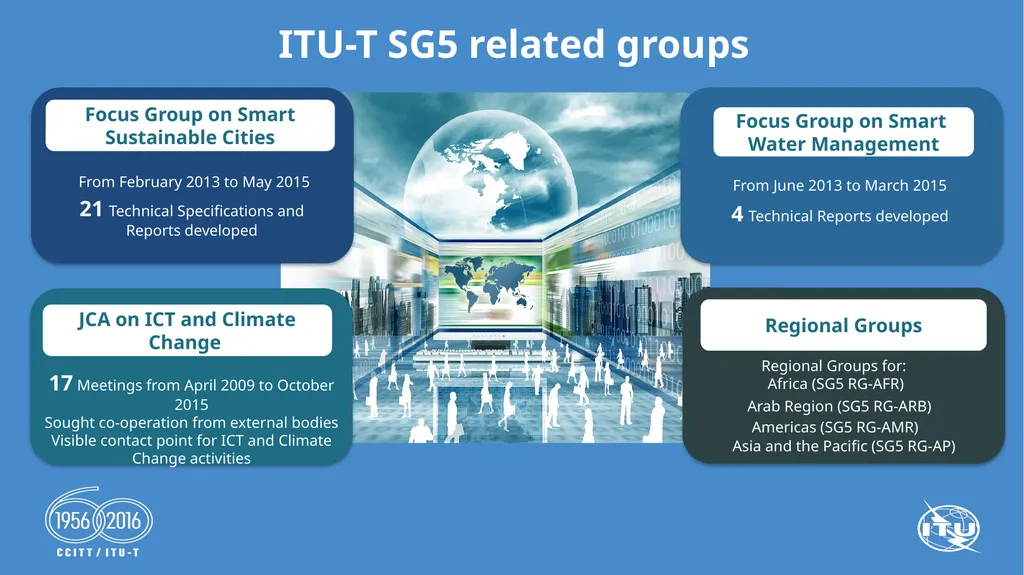
ITU-T SG5 related groups Focus Group on Smart Sustainable Cities From February 2013 to May 2015 21 Technical Specifications and Reports developed Focus Group on Smart
Water Management From June 2013 to March 2015 4 Technical Reports developed JCA on ICT and Climate Change 17 Meetings from April 2009 to October 2015
Sought co-operation from external bodies
Visible contact point for ICT and Climate Change activities Cooperation with external bodies such as IEC, ISO, Academia Regional Groups Regional Groups for:
Africa (SG5 RG-AFR) Arab Region (SG5 RG-ARB) Americas (SG5 RG-AMR) Asia and the Pacific (SG5 RG-AP)<br>
Sought co-operation from external bodies
Visible contact point for ICT and Climate Change activities Cooperation with external bodies such as IEC, ISO, Academia Regional Groups Regional Groups for:
Africa (SG5 RG-AFR) Arab Region (SG5 RG-ARB) Americas (SG5 RG-AMR) Asia and the Pacific (SG5 RG-AP)<br>
07
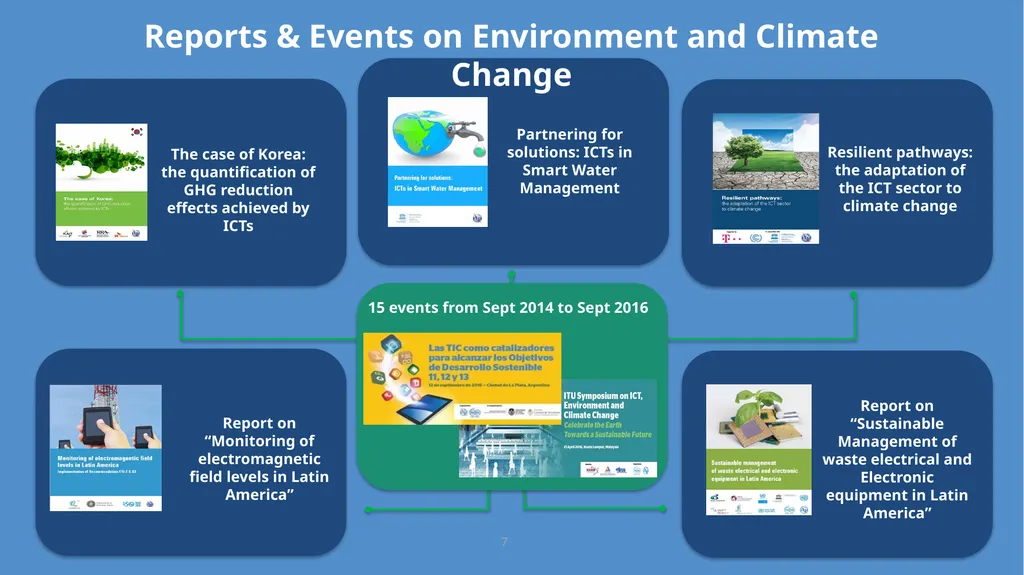
Reports & Events on Environment and Climate Change 7 The case of Korea: the quantification of GHG reduction effects achieved by ICTs Partnering for solutions: ICTs in Smart Water Management Resilient pathways: the adaptation of the ICT sector to climate change Report on “Sustainable Management of waste electrical and Electronic equipment in Latin America” Report on “Monitoring of electromagnetic field levels in Latin America” 15 events from Sept 2014 to Sept 2016<br>
08
Thank you
ITU-T, Environment and Climate Change http://itu.int/go/tsg05
tsbsg5@itu.int 8<br>
ITU-T, Environment and Climate Change http://itu.int/go/tsg05
tsbsg5@itu.int 8<br>
09
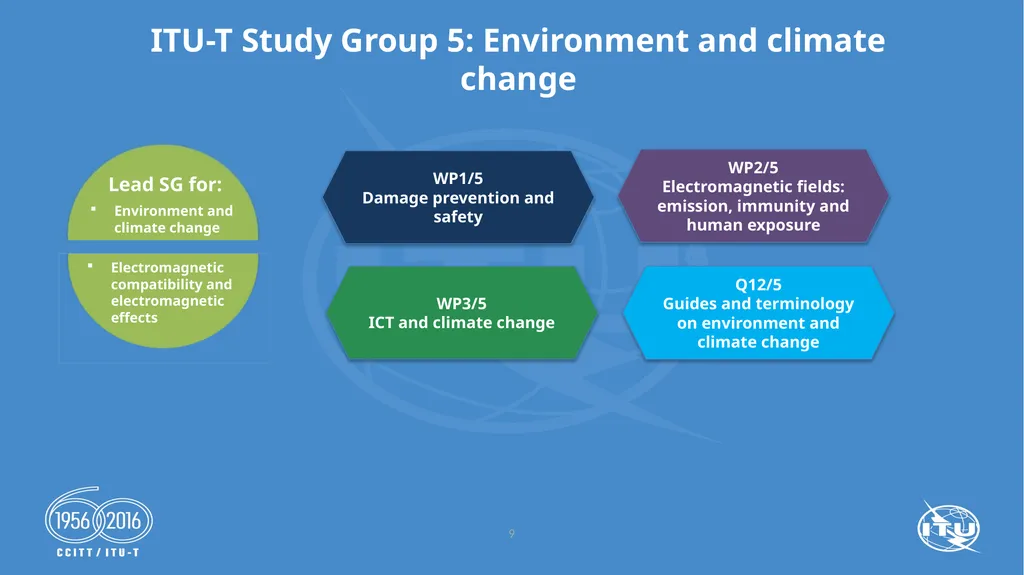
9 WP1/5
Damage prevention and safety WP2/5
Electromagnetic fields: emission, immunity and human exposure WP3/5
ICT and climate change Lead SG for: Environment and climate change Electromagnetic compatibility and electromagnetic effects ITU-T Study Group 5: Environment and climate change Q12/5
Guides and terminology on environment and climate change<br>
10
ITU-T SG5 main results Damage prevention and safety ITU-T K.105 “Lightning protection of photovoltaic power supply systems feeding radio base stations”
ITU-T K.110 “Lightning protection of the dedicated transformer for radio base station ”
ITU-T K.111 “Protection of surrounding structures of telecommunication towers against lightning ”.
ITU-T K.112 “Lightning protection, earthing and bonding: practical procedures for radio base station”.<br>
ITU-T K.110 “Lightning protection of the dedicated transformer for radio base station ”
ITU-T K.111 “Protection of surrounding structures of telecommunication towers against lightning ”.
ITU-T K.112 “Lightning protection, earthing and bonding: practical procedures for radio base station”.<br>
11
ITU-T SG5 main results Electromagnetic fields: emission, immunity and human exposure ITU-T K.100 “Measurement of radio frequency electromagnetic fields to determine compliance with human exposure limits when a base station is put into service”
ITU-T K.113 “Generation of radiofrequency electromagnetic field level maps”.
ITU-T K.115 “ Mitigation methods against electromagnetic security threats ITU EMF Guide and Mobile App produced and translated into the six UN languages. A Malaysian version was launched in April 2016.<br>
ITU-T K.113 “Generation of radiofrequency electromagnetic field level maps”.
ITU-T K.115 “ Mitigation methods against electromagnetic security threats ITU EMF Guide and Mobile App produced and translated into the six UN languages. A Malaysian version was launched in April 2016.<br>
12
ITU-T SG5 main results ICT and climate change ITU-T L.1002 “External universal power adapter solutions for portable information and communication technology devices ”
ITU-T L.1330 “Energy efficiency measurement and metrics for telecommunication networks” together with ETSI EE
ITU-T L.1440 “Methodology for environmental impact assessment of information and communication technologies at city level ”
ITU-T L.1500 “Framework on ICT and adaptation to the effects of climate change”
ITU-T L.1700 “Requirements and framework for low-cost sustainable telecommunications infrastructure for rural communications in developing countries ”.<br>
ITU-T L.1330 “Energy efficiency measurement and metrics for telecommunication networks” together with ETSI EE
ITU-T L.1440 “Methodology for environmental impact assessment of information and communication technologies at city level ”
ITU-T L.1500 “Framework on ICT and adaptation to the effects of climate change”
ITU-T L.1700 “Requirements and framework for low-cost sustainable telecommunications infrastructure for rural communications in developing countries ”.<br>
13
ITU-T SG5 main results Damage prevention and safety ITU-T K.95 “Surge parameters of isolating transformers used in telecommunication devices and equipment”
ITU-T K.96 “Surge protective components: Overview of surge mitigation functions and technologies”
ITU-T K.104 “Method for identifying the transfer potential of the earth potential rise from high or medium voltage networks to the earthing system or neutral of low voltage networks”
ITU-T K.107 “Method for determining the impedance to earth of earthing systems”
ITU-T K.98 “Overvoltage protection guide for telecommunication equipment installed in customer premises”
ITU-T K.20 “Resistibility of telecommunication equipment installed in a telecommunication centre to overvoltages and overcurrents”
ITU-T K.97 “Lightning protection of distributed base stations”
ITU-T K.101 “Shielding factors for lightning protection”
ITU-T K.105 “Lightning protection of photovoltaic power supply systems feeding radio base stations”<br>
ITU-T K.96 “Surge protective components: Overview of surge mitigation functions and technologies”
ITU-T K.104 “Method for identifying the transfer potential of the earth potential rise from high or medium voltage networks to the earthing system or neutral of low voltage networks”
ITU-T K.107 “Method for determining the impedance to earth of earthing systems”
ITU-T K.98 “Overvoltage protection guide for telecommunication equipment installed in customer premises”
ITU-T K.20 “Resistibility of telecommunication equipment installed in a telecommunication centre to overvoltages and overcurrents”
ITU-T K.97 “Lightning protection of distributed base stations”
ITU-T K.101 “Shielding factors for lightning protection”
ITU-T K.105 “Lightning protection of photovoltaic power supply systems feeding radio base stations”<br>
14
ITU-T SG5 main results Electromagnetic fields: emission, immunity and human exposure ITU-T K.58 “EMC, resistibility and safety requirements and guidance for determining responsibility under co-located information and communication technology installations” (rev)
ITU-T K.59 “Electromagnetic compatibility, resistibility and safety requirements and procedures for connection to unbundled cables” (rev)
ITU-T K.100 “Measurement of radio frequency electromagnetic fields to determine compliance with human exposure limits when a base station is put into service”
ITU-T K.113 “Generation of radiofrequency electromagnetic field level maps”.
ITU-T K.106 “Techniques to mitigate interference between radio devices and cable or equipment connected to wired broadband networks and cable television networks”
ITU-T K.114 “Electromagnetic compatibility requirements and measurement methods for digital cellular mobile communication base station equipment”.
ITU-T K.81 “High-power electromagnetic immunity guide for telecommunication systems”
ITU-T K.115 “Mitigation methods against electromagnetic security threats”
ITU-T K.116 “Electromagnetic compatibility requirements and test methods for radio telecommunication terminal equipment” Symposiums on human exposure to EMF were held, which disseminated knowledge on EMF exposure.
The studies were carried out in close cooperation with WHO, ICNIRP and IEC TC106.<br>
ITU-T K.59 “Electromagnetic compatibility, resistibility and safety requirements and procedures for connection to unbundled cables” (rev)
ITU-T K.100 “Measurement of radio frequency electromagnetic fields to determine compliance with human exposure limits when a base station is put into service”
ITU-T K.113 “Generation of radiofrequency electromagnetic field level maps”.
ITU-T K.106 “Techniques to mitigate interference between radio devices and cable or equipment connected to wired broadband networks and cable television networks”
ITU-T K.114 “Electromagnetic compatibility requirements and measurement methods for digital cellular mobile communication base station equipment”.
ITU-T K.81 “High-power electromagnetic immunity guide for telecommunication systems”
ITU-T K.115 “Mitigation methods against electromagnetic security threats”
ITU-T K.116 “Electromagnetic compatibility requirements and test methods for radio telecommunication terminal equipment” Symposiums on human exposure to EMF were held, which disseminated knowledge on EMF exposure.
The studies were carried out in close cooperation with WHO, ICNIRP and IEC TC106.<br>
15
ITU-T SG5 main results ICT and climate change ITU-T L.1101 “Measurement methods to characterize rare metals in information and communication technology goods”
ITU-T L.1005 “Test suites for assessment of the universal charger solution”
ITU-T L.1010 “ Green battery solution for mobile phones and other hand-held information and communication technology devices”.
ITU-T L.1700 “Requirements and framework for low-cost sustainable telecommunications infrastructure for rural communications in developing countries”
ITU-T L.1500 “Framework for information and communication technologies and adaptation to the effects of climate change”
ITU-T L.1501 “Best practices on how countries can utilize ICTs to adapt to the effects of climate change”
ITU-T L.1502 “Adapting information and communication technology infrastructure to the effects of climate change”
ITU-T L.1503 “Information and communication technologies for climate change adaptation in cities”.
ITU-T L.1300 “Best practices for green data centres”
ITU-T L.1301 “Minimum data set and communication interface requirements for data centre energy management”
ITU-T L.1302 “Assessment of energy efficiency on infrastructure in data centres and telecom centres”
ITU-T Y.4900/L.1600 “Overview of key performance indicators in smart sustainable cities”
ITU-T Y.4901/L.1601 “Key performance indicators related to the use of information and communication technology in smart sustainable cities”
ITU-T Y.4902/L.1602 “Key performance indicators related to the sustainability impacts of information and communication technology in smart sustainable cities”.
ITU-T L.1201 “Architecture of power feeding systems of up to 400 VDC”, ITU-T L.1202 “Methodologies for evaluating the performance of an up to 400 VDC power feeding system and its environmental impact”<br>
ITU-T L.1005 “Test suites for assessment of the universal charger solution”
ITU-T L.1010 “ Green battery solution for mobile phones and other hand-held information and communication technology devices”.
ITU-T L.1700 “Requirements and framework for low-cost sustainable telecommunications infrastructure for rural communications in developing countries”
ITU-T L.1500 “Framework for information and communication technologies and adaptation to the effects of climate change”
ITU-T L.1501 “Best practices on how countries can utilize ICTs to adapt to the effects of climate change”
ITU-T L.1502 “Adapting information and communication technology infrastructure to the effects of climate change”
ITU-T L.1503 “Information and communication technologies for climate change adaptation in cities”.
ITU-T L.1300 “Best practices for green data centres”
ITU-T L.1301 “Minimum data set and communication interface requirements for data centre energy management”
ITU-T L.1302 “Assessment of energy efficiency on infrastructure in data centres and telecom centres”
ITU-T Y.4900/L.1600 “Overview of key performance indicators in smart sustainable cities”
ITU-T Y.4901/L.1601 “Key performance indicators related to the use of information and communication technology in smart sustainable cities”
ITU-T Y.4902/L.1602 “Key performance indicators related to the sustainability impacts of information and communication technology in smart sustainable cities”.
ITU-T L.1201 “Architecture of power feeding systems of up to 400 VDC”, ITU-T L.1202 “Methodologies for evaluating the performance of an up to 400 VDC power feeding system and its environmental impact”<br>
16
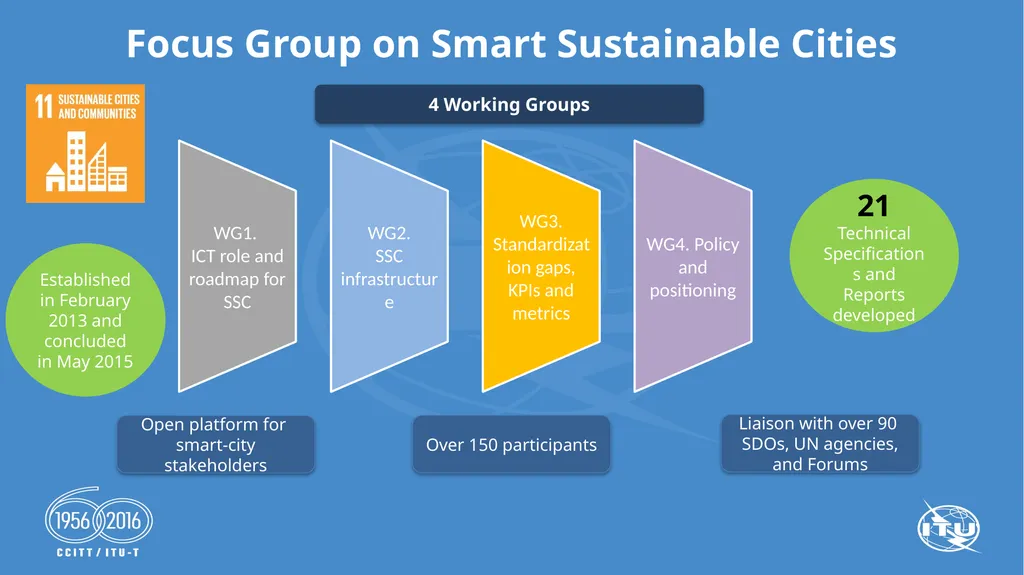
Focus Group on Smart Sustainable Cities Established in February 2013 and concluded in May 2015 21 Technical Specifications and Reports developed Open platform for
smart-city stakeholders Over 150 participants Liaison with over 90 SDOs, UN agencies, and Forums 4 Working Groups<br>
17
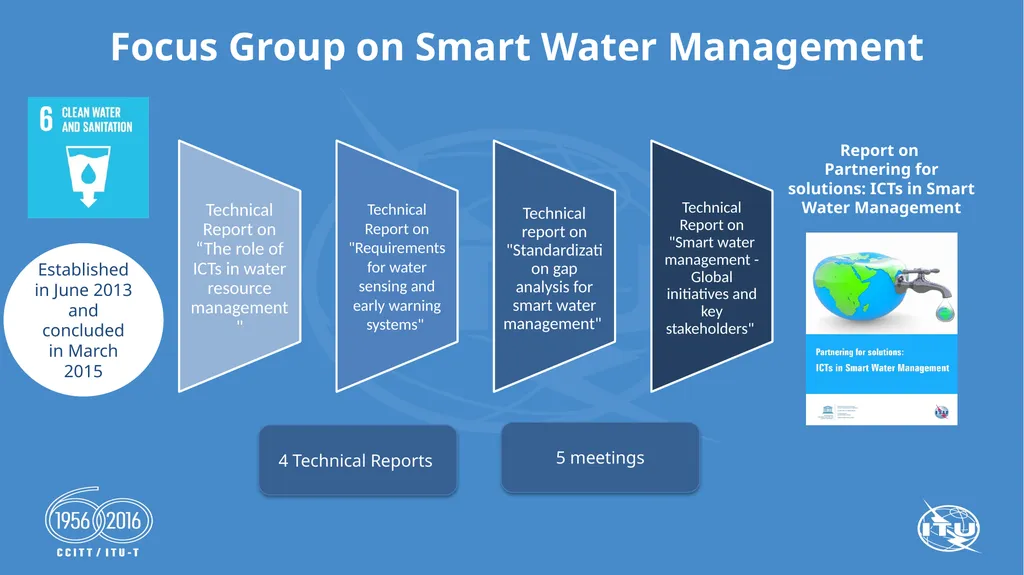
Focus Group on Smart Water Management Established in June 2013 and concluded in March 2015 5 meetings Report on
Partnering for solutions: ICTs in Smart Water Management 4 Technical Reports<br>
18
JCA on ICT and Climate Change (JCA-ICT&CC) 17 meetings were held Provided a visible contact point for ICT and Climate Change activities in ITU-T
Sought co-operation from external bodies working in the field of ICT & climate change and enabled effective two-way communication with these bodies.
External bodies included representatives from relevant SDOs such as IEC, ISO or relevant academia, consortia or fora. Co-Conveners:
Ahmed Zeddam (Orange)
Dave Faulkner (Climate Associates Ltd)
Secretariat:
Contact: tsbjcaictcc@itu.int Established in April 2009 and concluded in October 2015<br>
Sought co-operation from external bodies working in the field of ICT & climate change and enabled effective two-way communication with these bodies.
External bodies included representatives from relevant SDOs such as IEC, ISO or relevant academia, consortia or fora. Co-Conveners:
Ahmed Zeddam (Orange)
Dave Faulkner (Climate Associates Ltd)
Secretariat:
Contact: tsbjcaictcc@itu.int Established in April 2009 and concluded in October 2015<br>
19
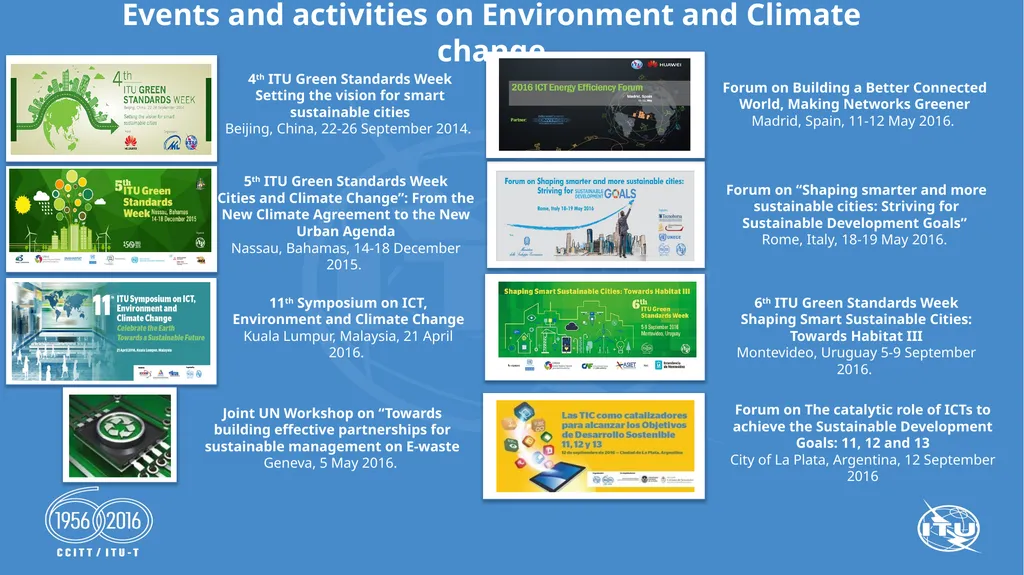
Events and activities on Environment and Climate change 5th ITU Green Standards Week
Cities and Climate Change”: From the New Climate Agreement to the New Urban Agenda
Nassau, Bahamas, 14-18 December 2015. Joint UN Workshop on “Towards building effective partnerships for sustainable management on E-waste Geneva, 5 May 2016. Forum on “Shaping smarter and more sustainable cities: Striving for Sustainable Development Goals”
Rome, Italy, 18-19 May 2016. 6th ITU Green Standards Week
Shaping Smart Sustainable Cities: Towards Habitat III
Montevideo, Uruguay 5-9 September 2016. Forum on The catalytic role of ICTs to achieve the Sustainable Development Goals: 11, 12 and 13
City of La Plata, Argentina, 12 September 2016 Forum on Building a Better Connected World, Making Networks Greener
Madrid, Spain, 11-12 May 2016. 11th Symposium on ICT, Environment and Climate Change Kuala Lumpur, Malaysia, 21 April 2016. 4th ITU Green Standards Week
Setting the vision for smart sustainable cities
Beijing, China, 22-26 September 2014.<br>