ITU Workshop on "Future Trust and Knowledge
Description: ITU Workshop on Future Trust and Knowledge Infrastructure, Phase 1 Geneva, Switzerland, 24 April 2015 Session 4 IoT data platform based on oneM2M Dr. Omar Elloumi, Technical Plenary Chair, Alcatel-Lucent (oneM2M member) oneM2M
Related Topics
Download Presentation
"ITU Workshop on "Future Trust and Knowledge" is the property of its rightful owner. Permission is granted to download and print the materials on this website for personal, non-commercial use only, and to display it on your personal computer provided you do not modify the materials and that you retain all copyright notices contained in the materials. By downloading content from our website, you accept the terms of this agreement.
Presentation Transcript
slide1. ITU Workshop on "Future Trust and Knowledge Infrastructure", Phase 1Geneva, Switzerland, 24 April 2015 Session 4 – IoT data platform based on oneM2M
Dr. Omar Elloumi,
Technical Plenary Chair,
Alcatel-Lucent (oneM2M member)
oneM2M www.oneM2M.org<br>
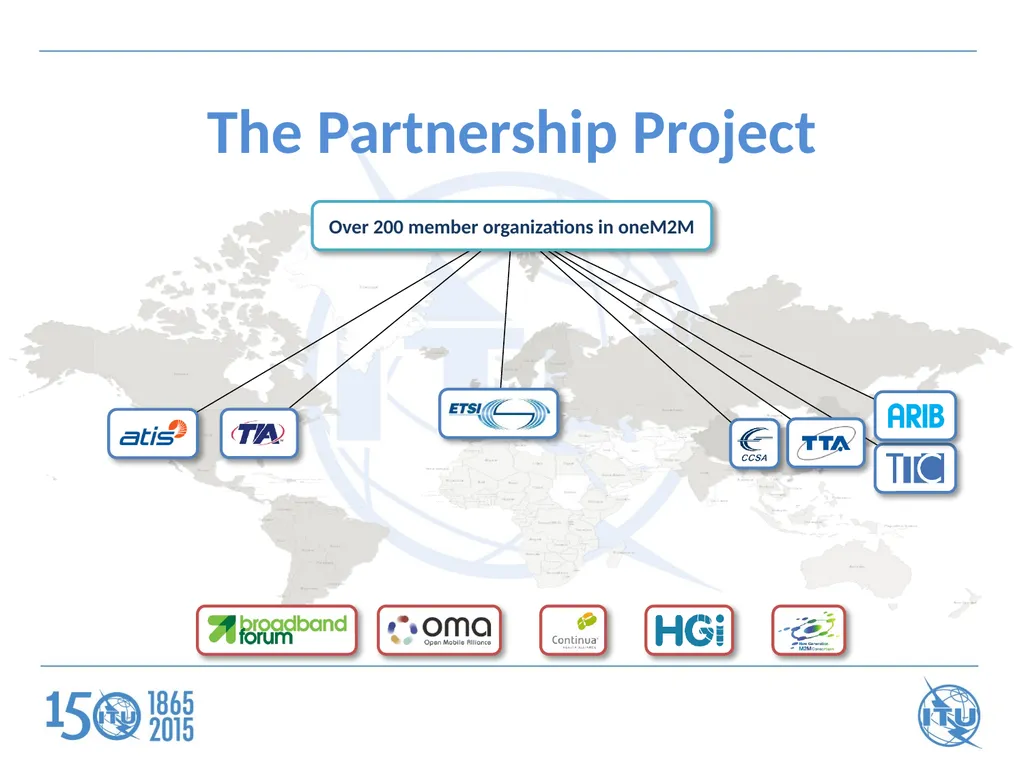
slide2. Over 200 member organizations in oneM2M The Partnership Project<br>
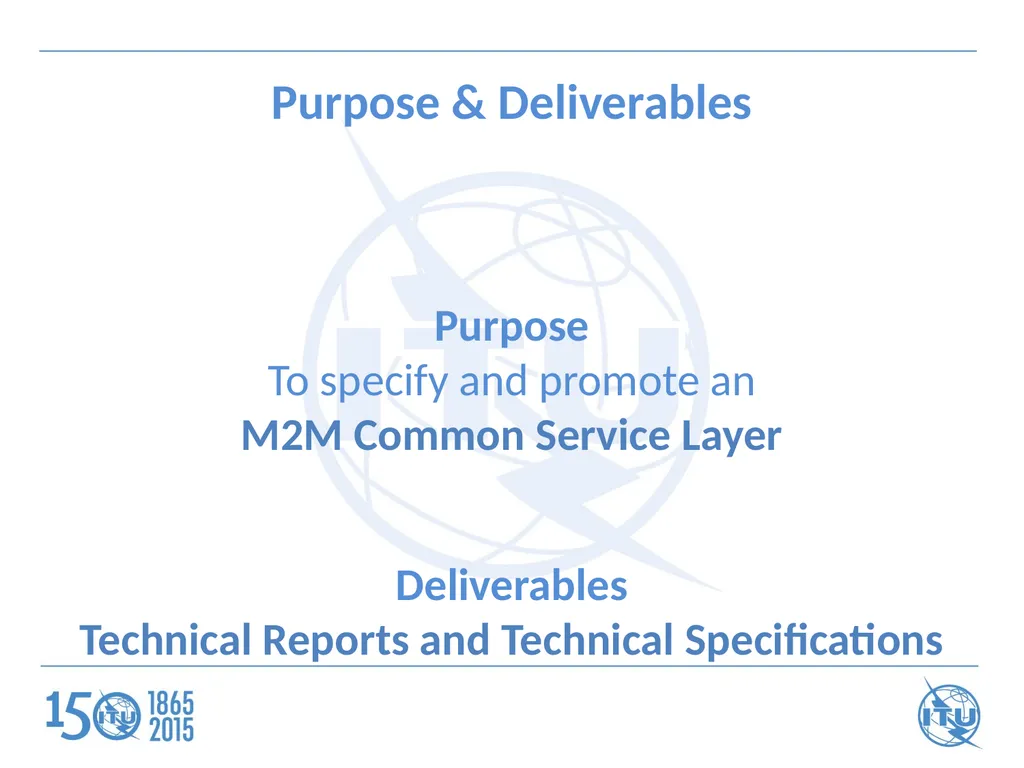
slide3. PurposeTo specify and promote anM2M Common Service Layer
Deliverables
Technical Reports and Technical Specifications Purpose & Deliverables<br>
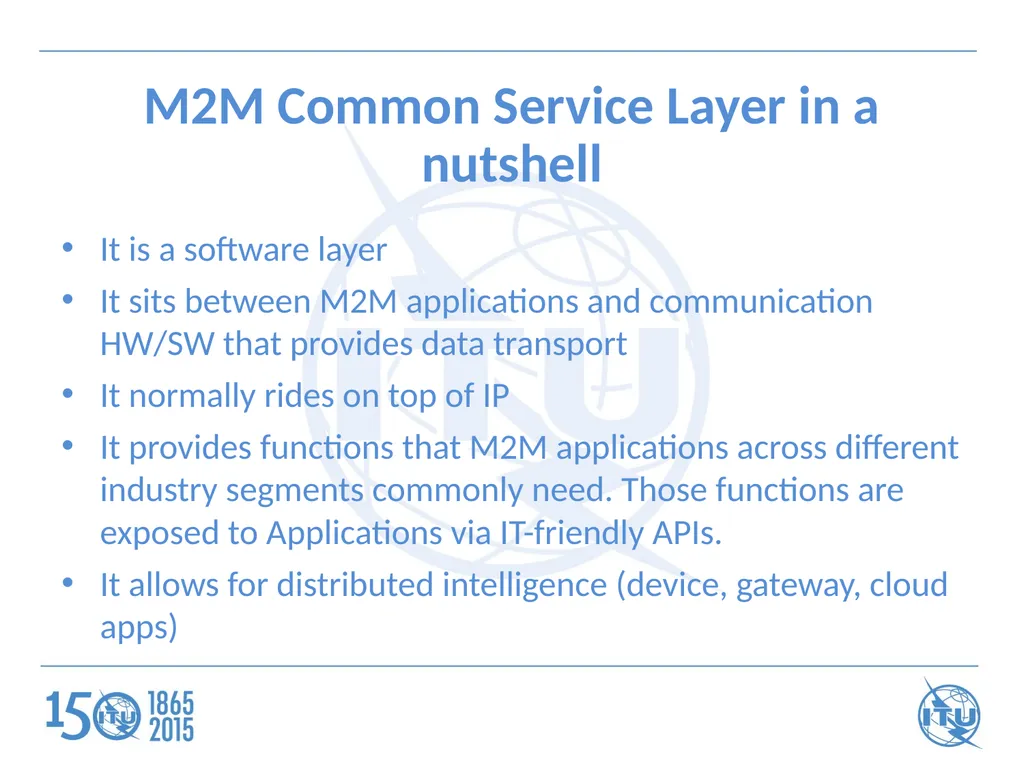
slide4. M2M Common Service Layer in a nutshell It is a software layer
It sits between M2M applications and communication HW/SW that provides data transport
It normally rides on top of IP
It provides functions that M2M applications across different industry segments commonly need. Those functions are exposed to Applications via IT-friendly APIs.
It allows for distributed intelligence (device, gateway, cloud apps)<br>
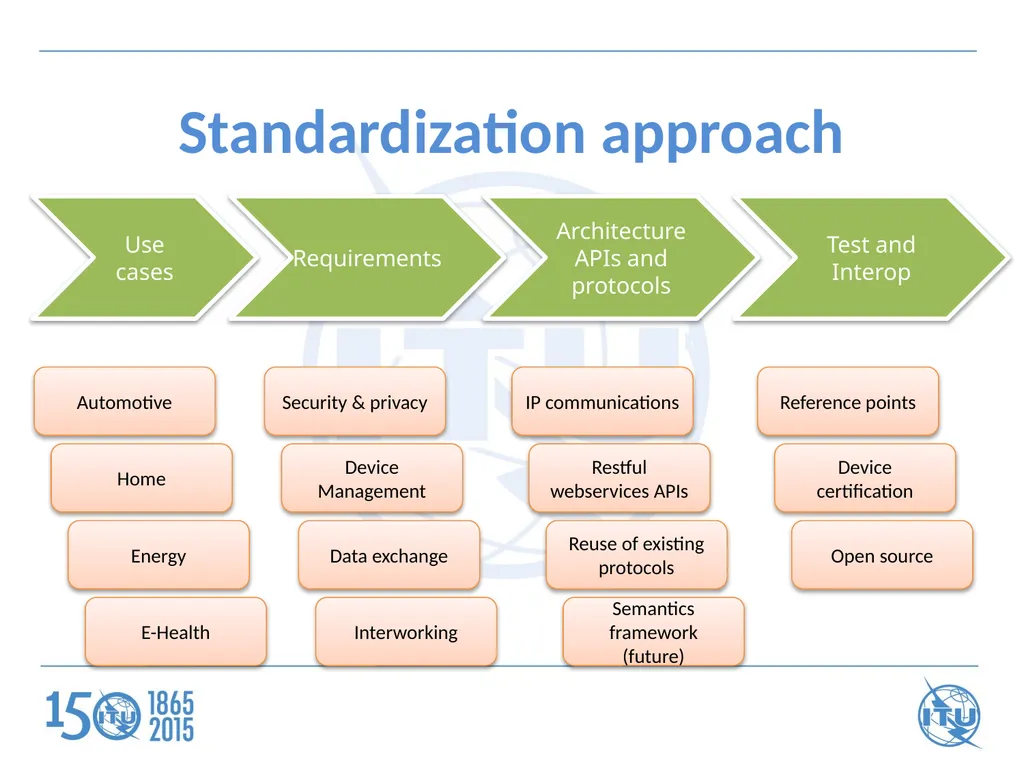
slide5. Use cases Requirements Architecture
APIs and protocols Test and Interop Standardization approach Automotive Home Energy E-Health Security & privacy Device Management Data exchange Interworking IP communications Restful webservices APIs Reuse of existing protocols Semantics framework (future) Reference points Device certification Open source<br>
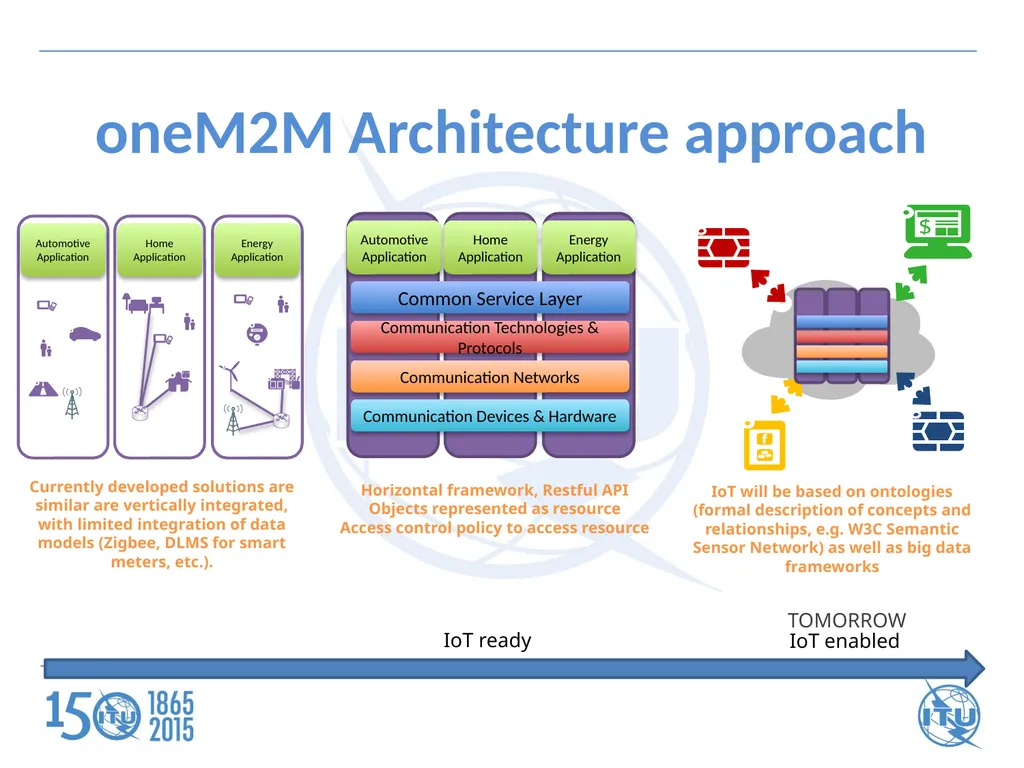
slide6. oneM2M Architecture approach Horizontal framework, Restful API
Objects represented as resource
Access control policy to access resource IoT will be based on ontologies (formal description of concepts and relationships, e.g. W3C Semantic Sensor Network) as well as big data frameworks Currently developed solutions are similar are vertically integrated, with limited integration of data models (Zigbee, DLMS for smart meters, etc.). AutomotiveApplication EnergyApplication HomeApplication AutomotiveApplication EnergyApplication HomeApplication TOMORROW IoT enabled IoT ready<br>
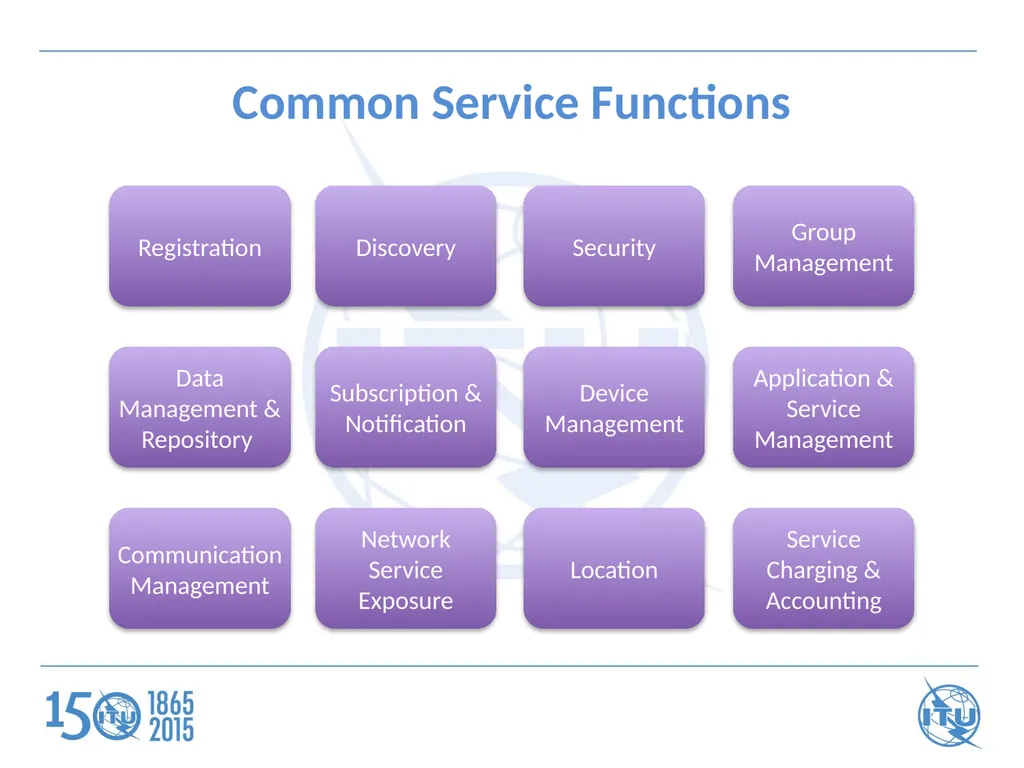
slide7. Registration Group Management Security Discovery Data Management & Repository Application & Service Management Device Management Subscription & Notification Communication Management Service Charging & Accounting Location Network Service Exposure Common Service Functions<br>
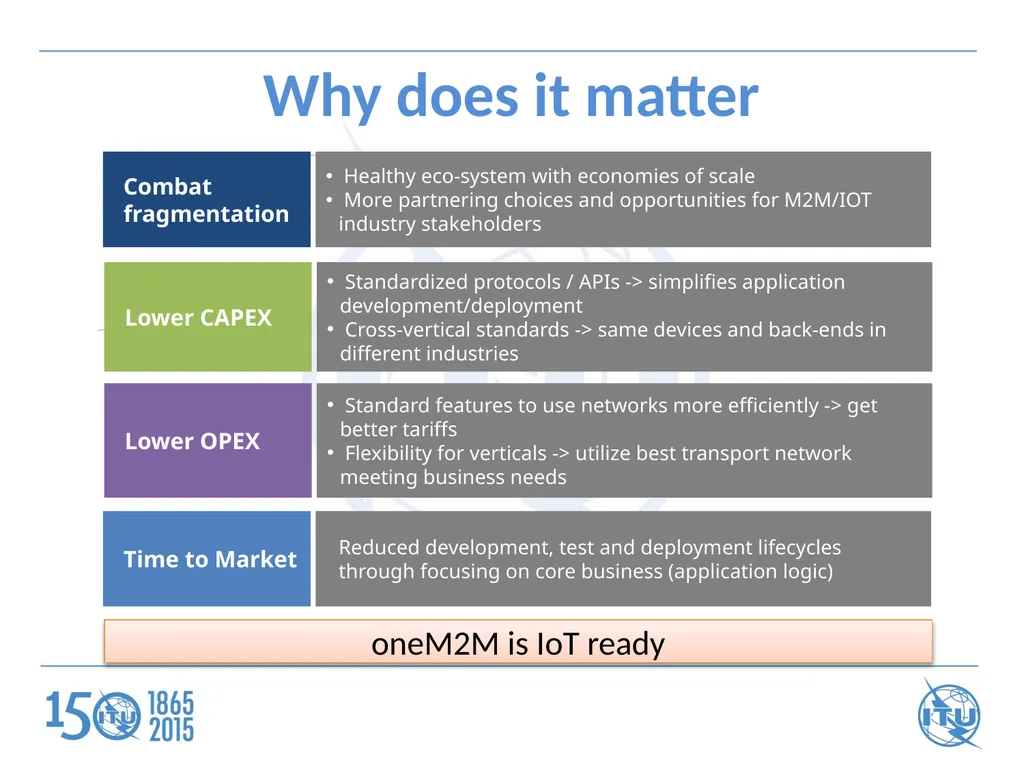
slide8. Why does it matter oneM2M is IoT ready<br>
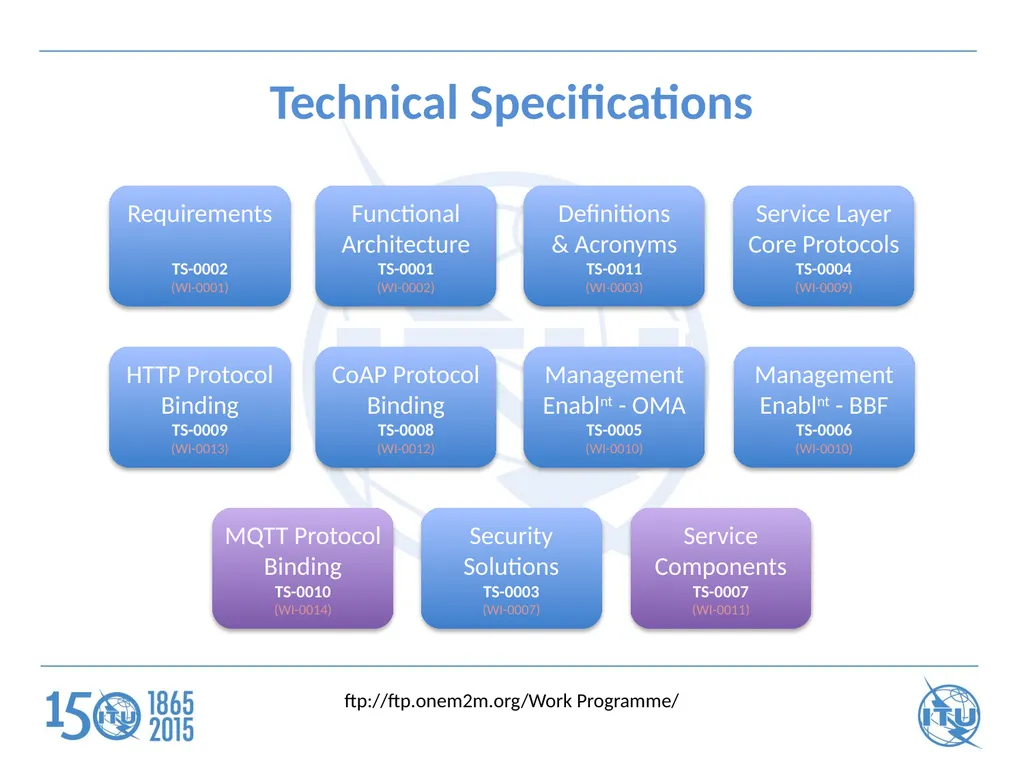
slide9. ServiceComponents
TS-0007(WI-0011) SecuritySolutionsTS-0003(WI-0007) MQTT ProtocolBindingTS-0010(WI-0014) Service Layer
Core Protocols
TS-0004(WI-0009) Functional
Architecture
TS-0001(WI-0002) Definitions& Acronyms
TS-0011(WI-0003) RequirementsTS-0002(WI-0001) Technical Specifications ftp://ftp.onem2m.org/Work Programme/ ManagementEnablnt - BBFTS-0006(WI-0010) ManagementEnablnt - OMATS-0005(WI-0010) CoAP ProtocolBindingTS-0008(WI-0012) HTTP ProtocolBindingTS-0009(WI-0013)<br>
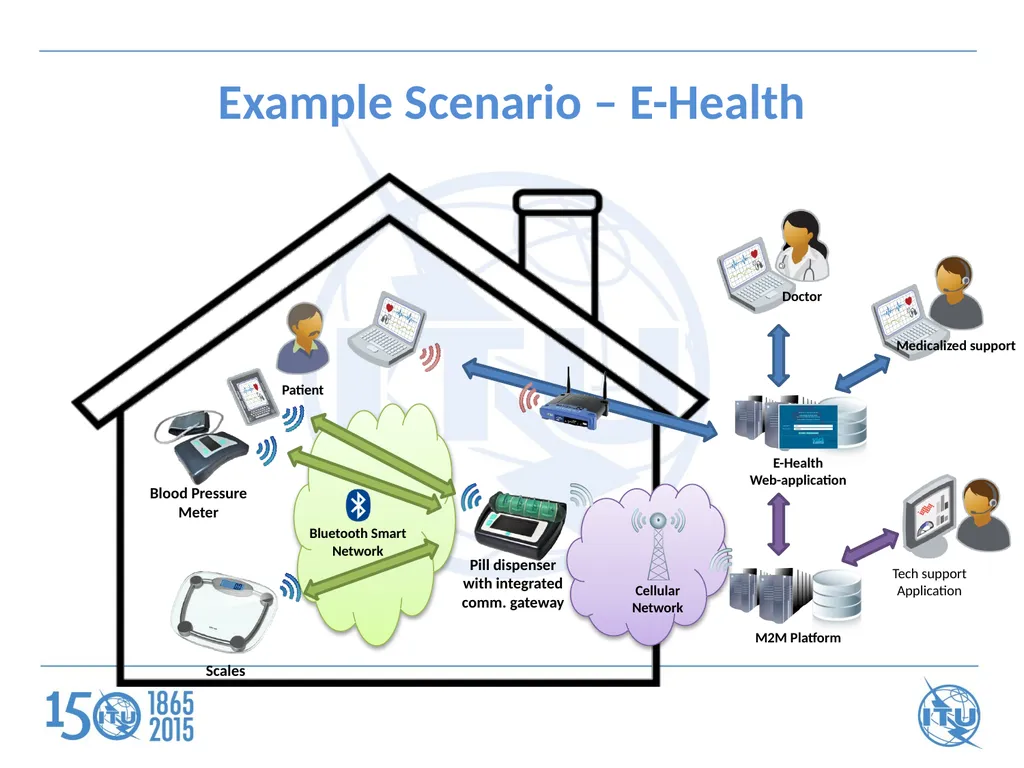
slide10. CellularNetwork Example Scenario – E-Health<br>
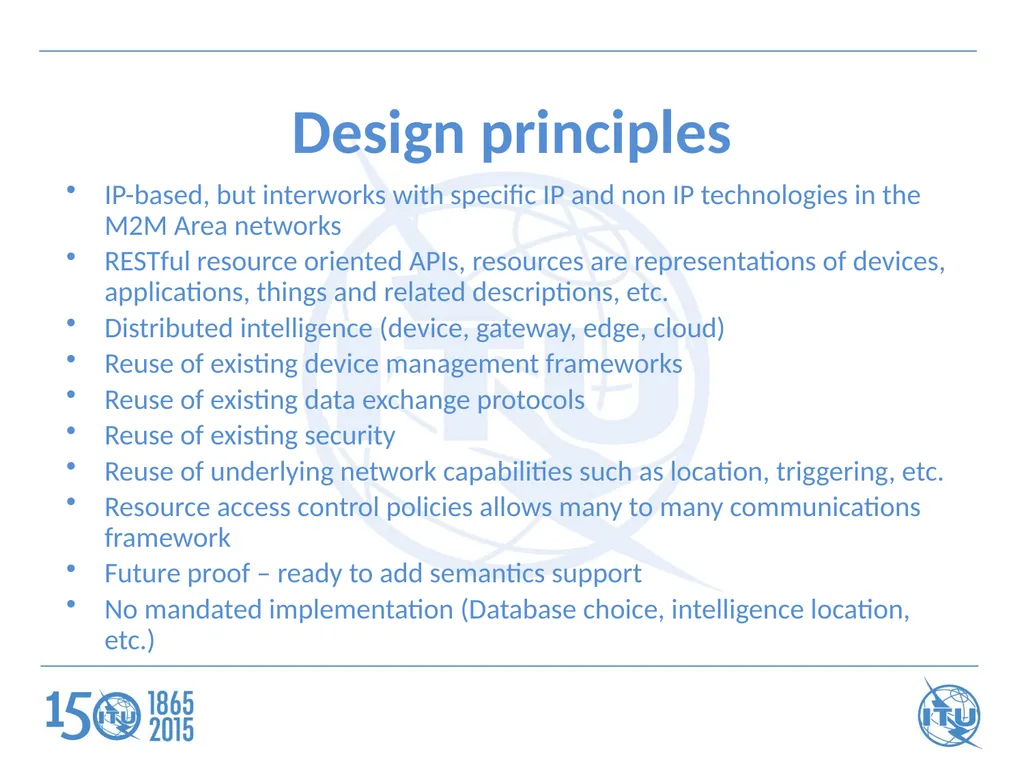
slide11. IP-based, but interworks with specific IP and non IP technologies in the M2M Area networks
RESTful resource oriented APIs, resources are representations of devices, applications, things and related descriptions, etc.
Distributed intelligence (device, gateway, edge, cloud)
Reuse of existing device management frameworks
Reuse of existing data exchange protocols
Reuse of existing security
Reuse of underlying network capabilities such as location, triggering, etc.
Resource access control policies allows many to many communications framework
Future proof – ready to add semantics support
No mandated implementation (Database choice, intelligence location, etc.) Design principles<br>
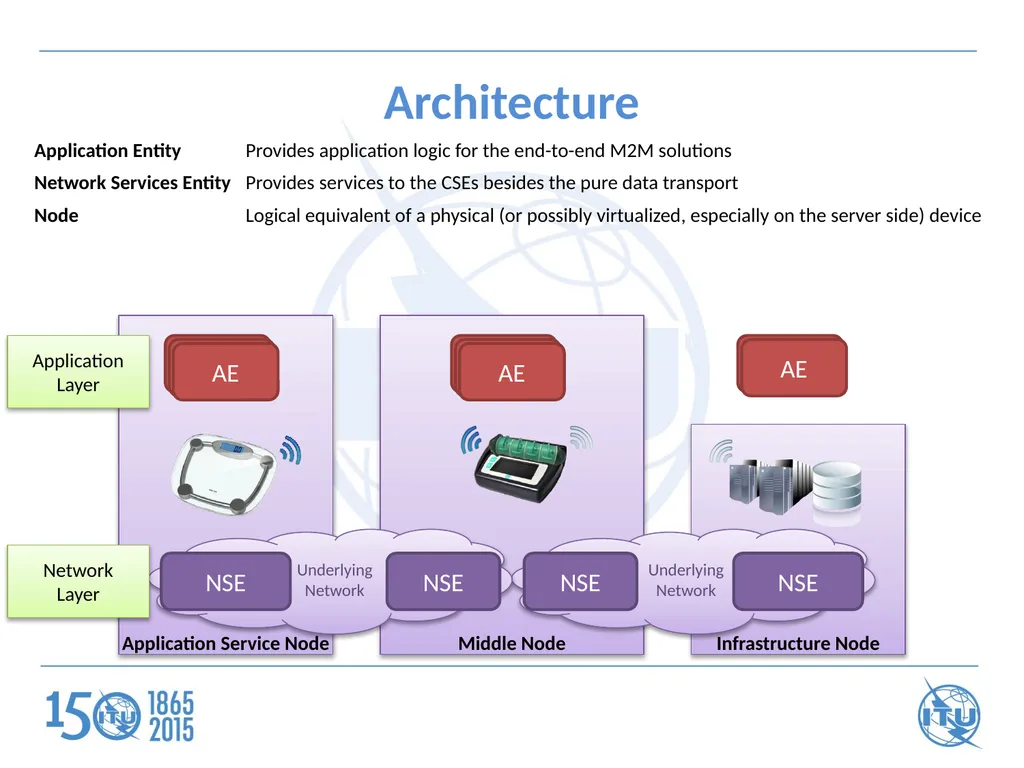
slide12. Underlying Network Underlying Network AE NSE AE NSE NSE NSE Application Service Node Middle Node Infrastructure Node ApplicationLayer NetworkLayer Architecture AE Application Entity Provides application logic for the end-to-end M2M solutions
Network Services Entity Provides services to the CSEs besides the pure data transport
Node Logical equivalent of a physical (or possibly virtualized, especially on the server side) device<br>
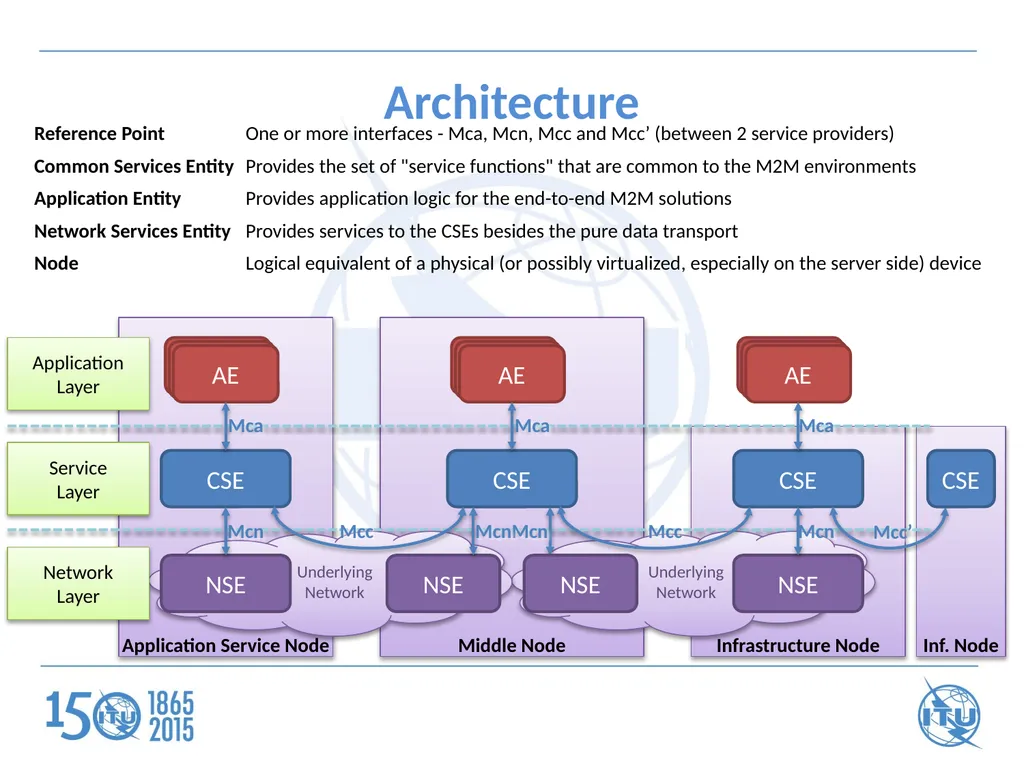
slide13. Underlying Network Underlying Network CSE AE NSE CSE AE NSE CSE AE NSE NSE Application Service Node Middle Node Infrastructure Node ApplicationLayer ServiceLayer NetworkLayer Mca Mcn Mca Mca Mcn Mcn Mcn Mcc Mcc Reference Point One or more interfaces - Mca, Mcn, Mcc and Mcc’ (between 2 service providers)
Common Services Entity Provides the set of "service functions" that are common to the M2M environments
Application Entity Provides application logic for the end-to-end M2M solutions
Network Services Entity Provides services to the CSEs besides the pure data transport
Node Logical equivalent of a physical (or possibly virtualized, especially on the server side) device Architecture CSE Mcc’ Inf. Node<br>
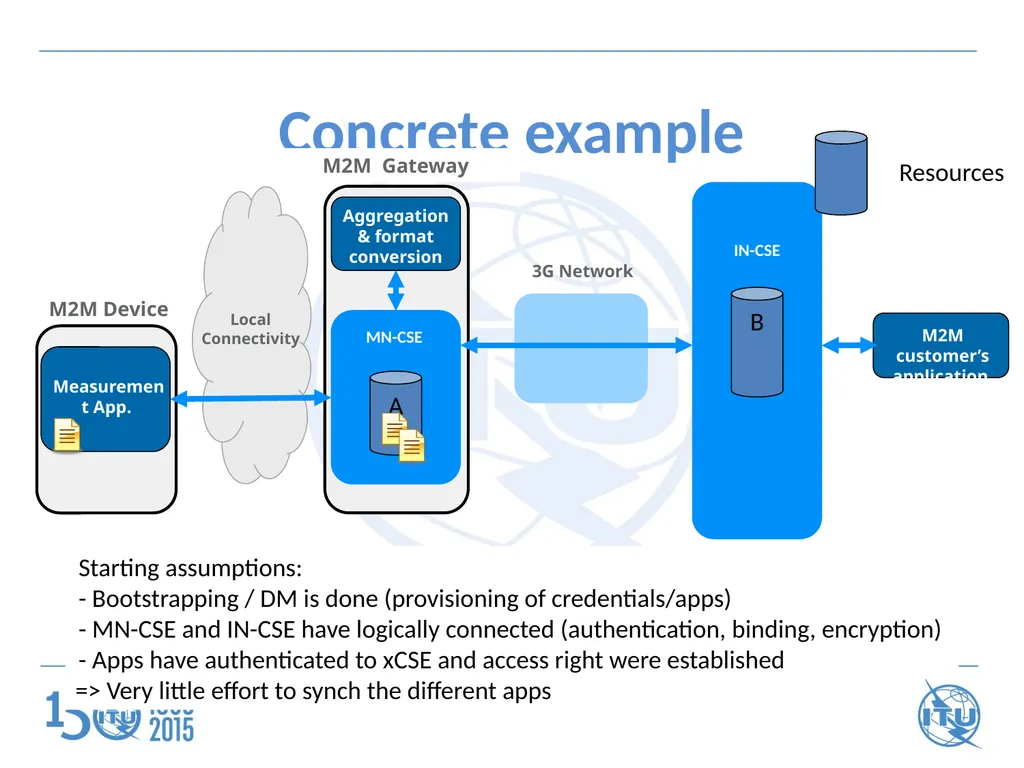
slide14. Concrete example New measurement value available Write to //MN-CSE/A MN-CSE notifies aggregation app about new data, MN-CSE keep a copy of the data
for subsequent use New measurement value available Write to //MN-CSE/A MN-CSE notifies aggregation app about new data, MN-CSE keep a copy of the data
for subsequent use … etc, etc … Ask MN-CSE to write aggregated/transformed data to //IN-CSE/B….and BTW, this is low priority and you got 12 h time for that! MN-CSE checks with policies and when time is good gets connected… ..and writes aggregated data to //IN-CSE/B IN-CSE notifies network app (DB, HRN) about new data. Measurement app can simply keep on delivering its data to the MN-CSEAggregation app gets always notified about the new bits coming in
MN-CSE will store-and-forward aggregated/transformed data at a good timeIN-CSE will notify DB app when new data arrived
=> Very little effort to synch the different apps M2M Gateway MN-CSE Aggregation & format conversion IN-CSE M2M Device LocalConnectivity 3G Network Measurement App. M2M customer’s application A B Resources Starting assumptions:- Bootstrapping / DM is done (provisioning of credentials/apps)- MN-CSE and IN-CSE have logically connected (authentication, binding, encryption)
- Apps have authenticated to xCSE and access right were established<br>
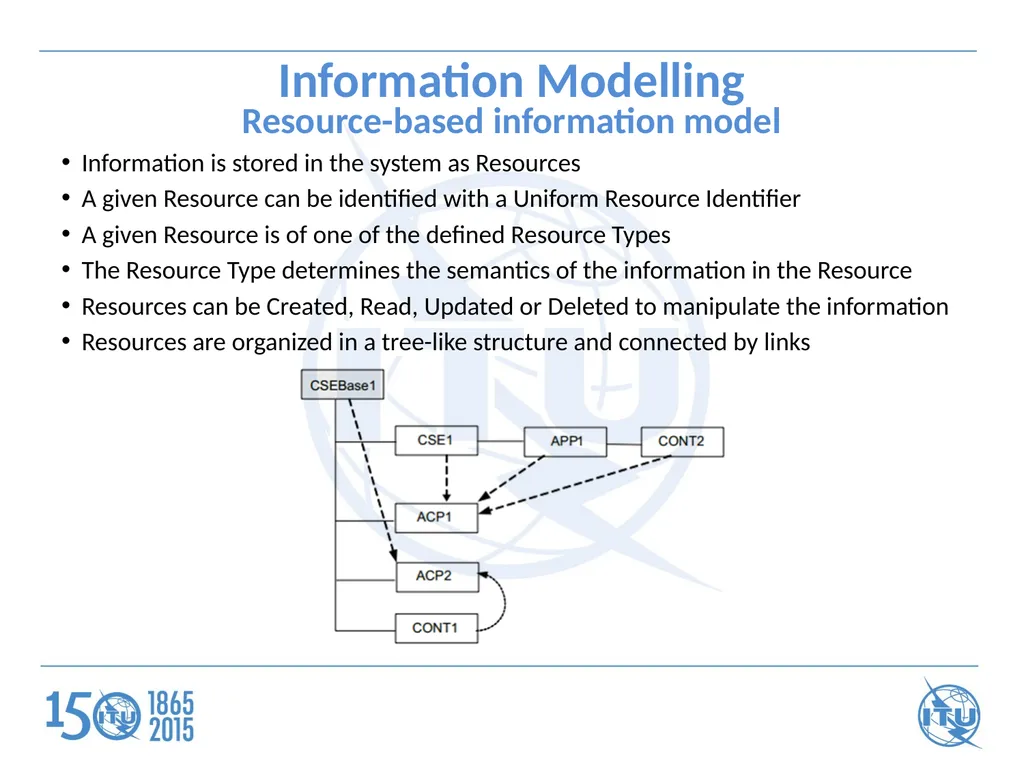
slide15. Resource-based information model
Information is stored in the system as Resources
A given Resource can be identified with a Uniform Resource Identifier
A given Resource is of one of the defined Resource Types
The Resource Type determines the semantics of the information in the Resource
Resources can be Created, Read, Updated or Deleted to manipulate the information
Resources are organized in a tree-like structure and connected by links Information Modelling<br>
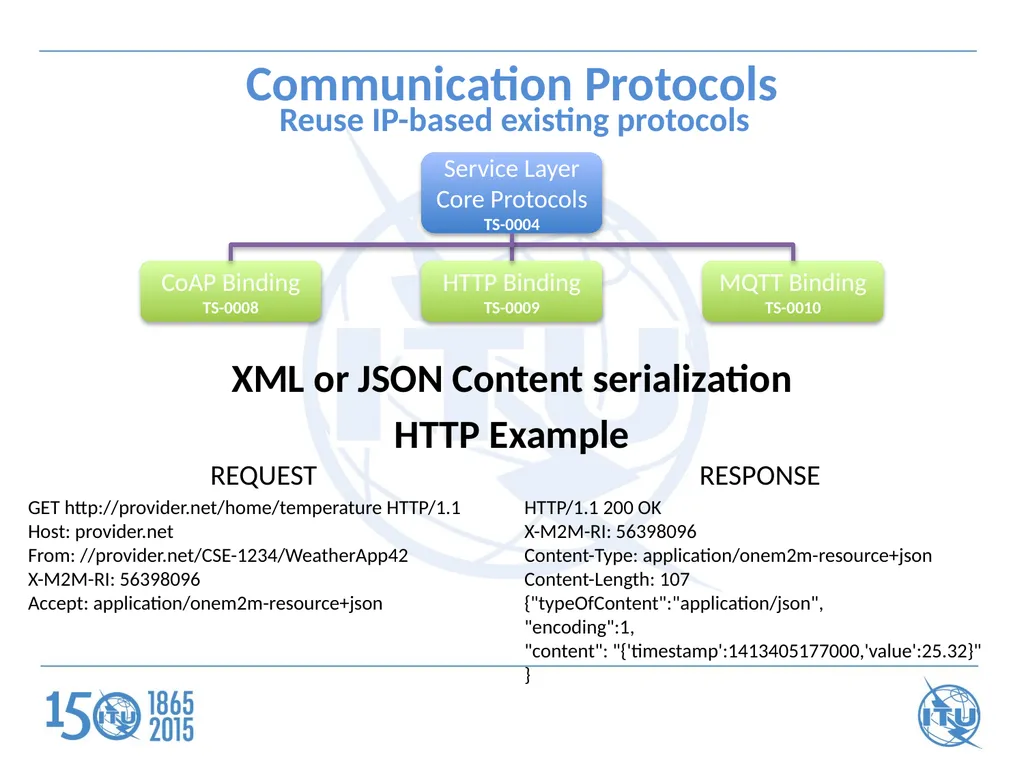
slide16. Communication Protocols Reuse IP-based existing protocols Service Layer
Core Protocols
TS-0004 CoAP BindingTS-0008 MQTT BindingTS-0010 HTTP BindingTS-0009 XML or JSON Content serialization
HTTP Example REQUEST
GET http://provider.net/home/temperature HTTP/1.1Host: provider.netFrom: //provider.net/CSE-1234/WeatherApp42X-M2M-RI: 56398096Accept: application/onem2m-resource+json RESPONSE
HTTP/1.1 200 OKX-M2M-RI: 56398096Content-Type: application/onem2m-resource+jsonContent-Length: 107{"typeOfContent":"application/json","encoding":1, "content": "{'timestamp':1413405177000,'value':25.32}"}<br>
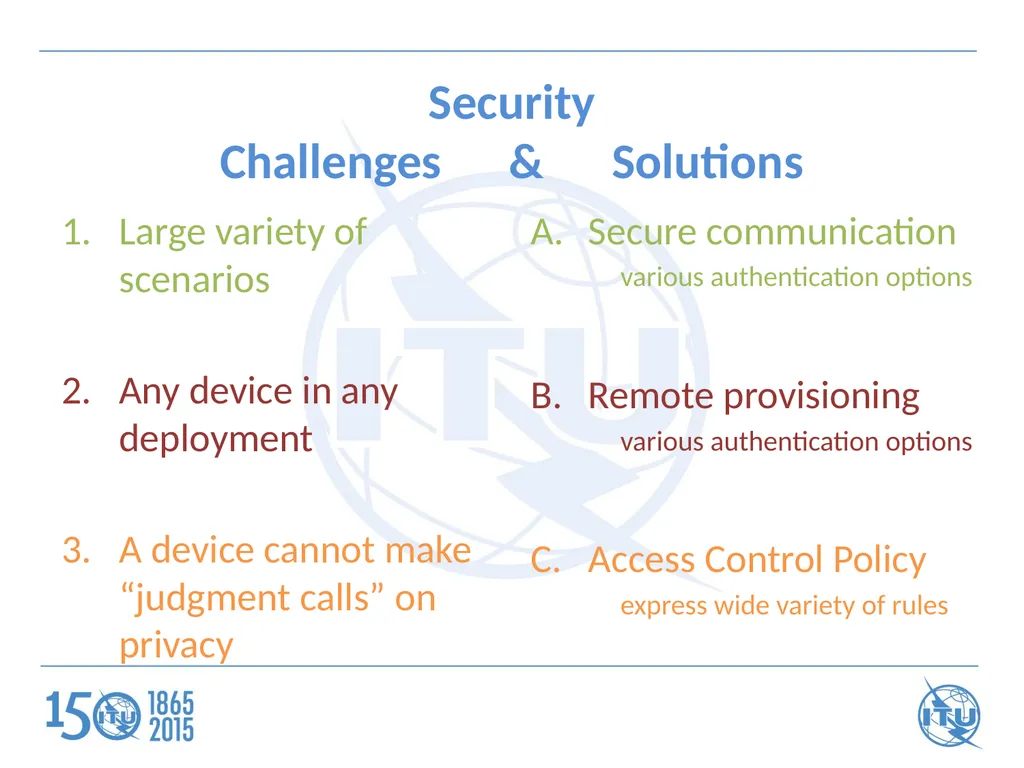
slide17. SecurityChallenges & Solutions Large variety of scenarios
Any device in any deployment
A device cannot make “judgment calls” on privacy Secure communication
various authentication options
Remote provisioning
various authentication options
Access Control Policy
express wide variety of rules<br>
slide18. oneM2M
Domain DM
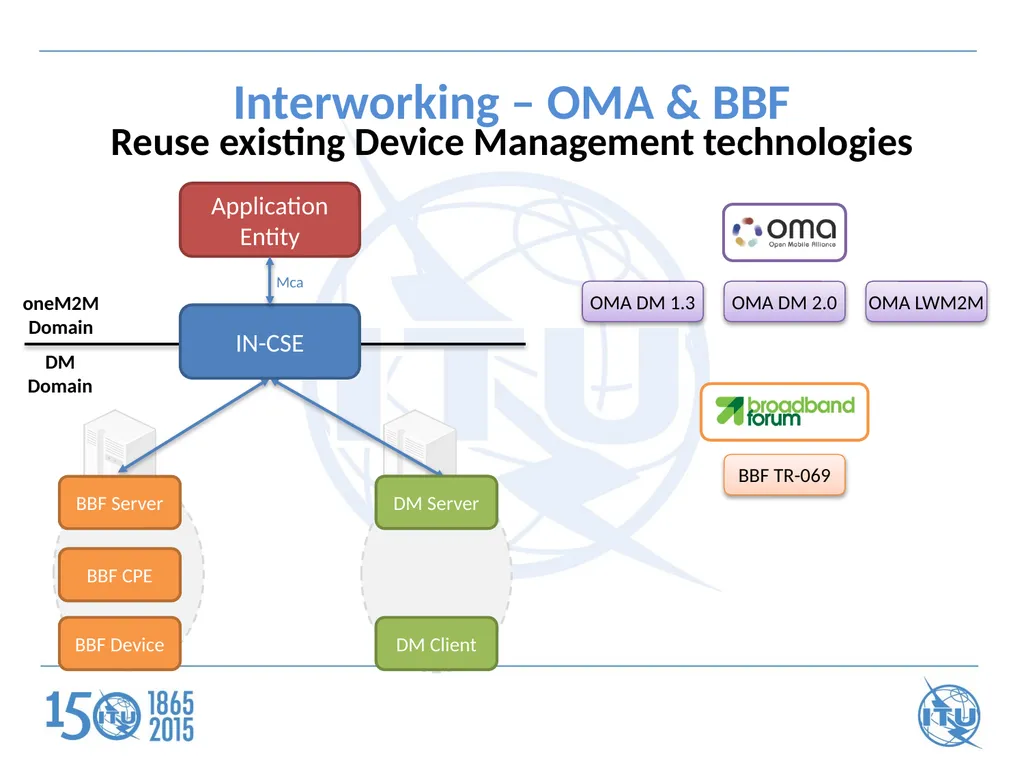
Domain Interworking – OMA & BBF Reuse existing Device Management technologies Application Entity IN-CSE Mca OMA DM 2.0 OMA DM 1.3 OMA LWM2M BBF TR-069 BBF Server BBF CPE BBF Device DM Server DM Client<br>

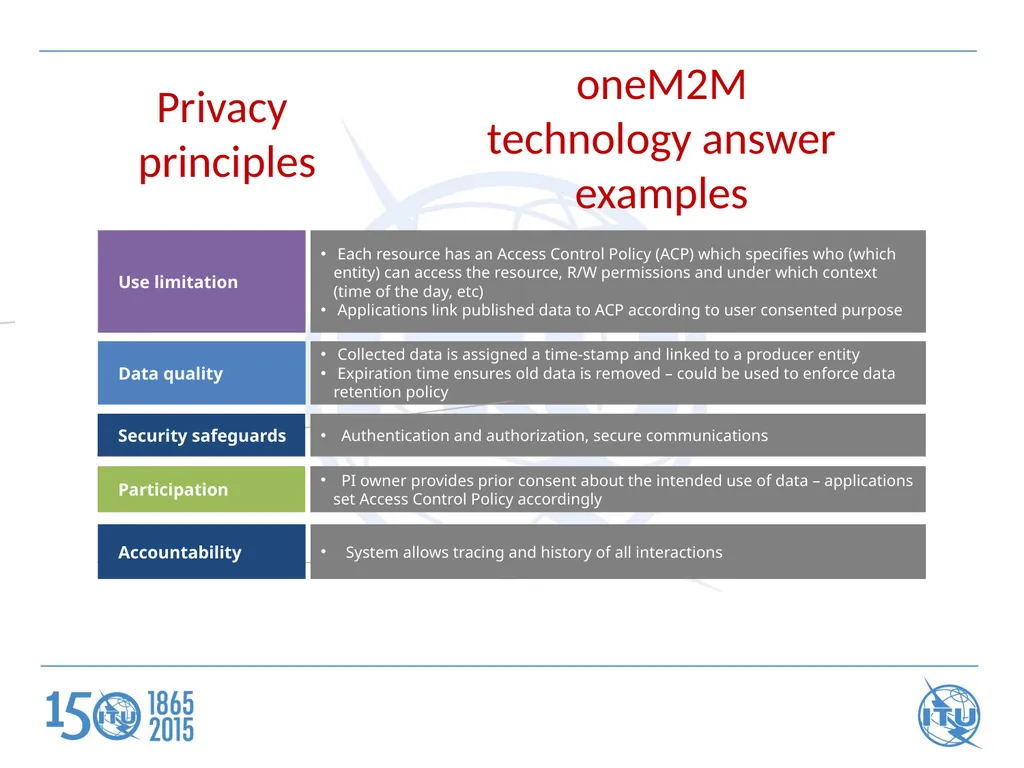
slide19. Privacy principles oneM2M technology answer examples<br>
slide20. Thank You! Q&A<br>
Dr. Omar Elloumi,
Technical Plenary Chair,
Alcatel-Lucent (oneM2M member)
oneM2M www.oneM2M.org<br>
slide2. Over 200 member organizations in oneM2M The Partnership Project<br>
slide3. PurposeTo specify and promote anM2M Common Service Layer
Deliverables
Technical Reports and Technical Specifications Purpose & Deliverables<br>
slide4. M2M Common Service Layer in a nutshell It is a software layer
It sits between M2M applications and communication HW/SW that provides data transport
It normally rides on top of IP
It provides functions that M2M applications across different industry segments commonly need. Those functions are exposed to Applications via IT-friendly APIs.
It allows for distributed intelligence (device, gateway, cloud apps)<br>
slide5. Use cases Requirements Architecture
APIs and protocols Test and Interop Standardization approach Automotive Home Energy E-Health Security & privacy Device Management Data exchange Interworking IP communications Restful webservices APIs Reuse of existing protocols Semantics framework (future) Reference points Device certification Open source<br>
slide6. oneM2M Architecture approach Horizontal framework, Restful API
Objects represented as resource
Access control policy to access resource IoT will be based on ontologies (formal description of concepts and relationships, e.g. W3C Semantic Sensor Network) as well as big data frameworks Currently developed solutions are similar are vertically integrated, with limited integration of data models (Zigbee, DLMS for smart meters, etc.). AutomotiveApplication EnergyApplication HomeApplication AutomotiveApplication EnergyApplication HomeApplication TOMORROW IoT enabled IoT ready<br>
slide7. Registration Group Management Security Discovery Data Management & Repository Application & Service Management Device Management Subscription & Notification Communication Management Service Charging & Accounting Location Network Service Exposure Common Service Functions<br>
slide8. Why does it matter oneM2M is IoT ready<br>
slide9. ServiceComponents
TS-0007(WI-0011) SecuritySolutionsTS-0003(WI-0007) MQTT ProtocolBindingTS-0010(WI-0014) Service Layer
Core Protocols
TS-0004(WI-0009) Functional
Architecture
TS-0001(WI-0002) Definitions& Acronyms
TS-0011(WI-0003) RequirementsTS-0002(WI-0001) Technical Specifications ftp://ftp.onem2m.org/Work Programme/ ManagementEnablnt - BBFTS-0006(WI-0010) ManagementEnablnt - OMATS-0005(WI-0010) CoAP ProtocolBindingTS-0008(WI-0012) HTTP ProtocolBindingTS-0009(WI-0013)<br>
slide10. CellularNetwork Example Scenario – E-Health<br>
slide11. IP-based, but interworks with specific IP and non IP technologies in the M2M Area networks
RESTful resource oriented APIs, resources are representations of devices, applications, things and related descriptions, etc.
Distributed intelligence (device, gateway, edge, cloud)
Reuse of existing device management frameworks
Reuse of existing data exchange protocols
Reuse of existing security
Reuse of underlying network capabilities such as location, triggering, etc.
Resource access control policies allows many to many communications framework
Future proof – ready to add semantics support
No mandated implementation (Database choice, intelligence location, etc.) Design principles<br>
slide12. Underlying Network Underlying Network AE NSE AE NSE NSE NSE Application Service Node Middle Node Infrastructure Node ApplicationLayer NetworkLayer Architecture AE Application Entity Provides application logic for the end-to-end M2M solutions
Network Services Entity Provides services to the CSEs besides the pure data transport
Node Logical equivalent of a physical (or possibly virtualized, especially on the server side) device<br>
slide13. Underlying Network Underlying Network CSE AE NSE CSE AE NSE CSE AE NSE NSE Application Service Node Middle Node Infrastructure Node ApplicationLayer ServiceLayer NetworkLayer Mca Mcn Mca Mca Mcn Mcn Mcn Mcc Mcc Reference Point One or more interfaces - Mca, Mcn, Mcc and Mcc’ (between 2 service providers)
Common Services Entity Provides the set of "service functions" that are common to the M2M environments
Application Entity Provides application logic for the end-to-end M2M solutions
Network Services Entity Provides services to the CSEs besides the pure data transport
Node Logical equivalent of a physical (or possibly virtualized, especially on the server side) device Architecture CSE Mcc’ Inf. Node<br>
slide14. Concrete example New measurement value available Write to //MN-CSE/A MN-CSE notifies aggregation app about new data, MN-CSE keep a copy of the data
for subsequent use New measurement value available Write to //MN-CSE/A MN-CSE notifies aggregation app about new data, MN-CSE keep a copy of the data
for subsequent use … etc, etc … Ask MN-CSE to write aggregated/transformed data to //IN-CSE/B….and BTW, this is low priority and you got 12 h time for that! MN-CSE checks with policies and when time is good gets connected… ..and writes aggregated data to //IN-CSE/B IN-CSE notifies network app (DB, HRN) about new data. Measurement app can simply keep on delivering its data to the MN-CSEAggregation app gets always notified about the new bits coming in
MN-CSE will store-and-forward aggregated/transformed data at a good timeIN-CSE will notify DB app when new data arrived
=> Very little effort to synch the different apps M2M Gateway MN-CSE Aggregation & format conversion IN-CSE M2M Device LocalConnectivity 3G Network Measurement App. M2M customer’s application A B Resources Starting assumptions:- Bootstrapping / DM is done (provisioning of credentials/apps)- MN-CSE and IN-CSE have logically connected (authentication, binding, encryption)
- Apps have authenticated to xCSE and access right were established<br>
slide15. Resource-based information model
Information is stored in the system as Resources
A given Resource can be identified with a Uniform Resource Identifier
A given Resource is of one of the defined Resource Types
The Resource Type determines the semantics of the information in the Resource
Resources can be Created, Read, Updated or Deleted to manipulate the information
Resources are organized in a tree-like structure and connected by links Information Modelling<br>
slide16. Communication Protocols Reuse IP-based existing protocols Service Layer
Core Protocols
TS-0004 CoAP BindingTS-0008 MQTT BindingTS-0010 HTTP BindingTS-0009 XML or JSON Content serialization
HTTP Example REQUEST
GET http://provider.net/home/temperature HTTP/1.1Host: provider.netFrom: //provider.net/CSE-1234/WeatherApp42X-M2M-RI: 56398096Accept: application/onem2m-resource+json RESPONSE
HTTP/1.1 200 OKX-M2M-RI: 56398096Content-Type: application/onem2m-resource+jsonContent-Length: 107{"typeOfContent":"application/json","encoding":1, "content": "{'timestamp':1413405177000,'value':25.32}"}<br>
slide17. SecurityChallenges & Solutions Large variety of scenarios
Any device in any deployment
A device cannot make “judgment calls” on privacy Secure communication
various authentication options
Remote provisioning
various authentication options
Access Control Policy
express wide variety of rules<br>
slide18. oneM2M
Domain DM
Domain Interworking – OMA & BBF Reuse existing Device Management technologies Application Entity IN-CSE Mca OMA DM 2.0 OMA DM 1.3 OMA LWM2M BBF TR-069 BBF Server BBF CPE BBF Device DM Server DM Client<br>
slide19. Privacy principles oneM2M technology answer examples<br>
slide20. Thank You! Q&A<br>