January 26, 2023 Emerging Technologies working group Webexteleconference Jeff Ulrich Lead Analyst Operations Analysis Integration Status Update for the NEPOOL Emerging Technologies Working Group Recent Wind Plant Data Issues
Related Topics
Share
Embed code
Download this presentation From Below
"January 26, 2023 | Emerging Technologies working" is the property of its rightful owner. Permission is granted to
download and print the materials on this website for personal, non-commercial use only, and to display it
on your personal computer provided you do not modify the materials and that you retain all copyright
notices contained in the materials. By downloading content from our website, you accept the terms of this
agreement.
Presentation Transcript
01
January 26, 2023 | Emerging Technologies working group | Webex/teleconference Jeff Ulrich Lead Analyst | Operations Analysis & Integration Status Update for the NEPOOL Emerging Technologies Working Group Recent Wind Plant Data Issues<br>
02
Overview ISO Operating Procedure 14-F specifies telemetry and web services requirements for wind plants
During early January 2023 some wind plants provided inaccurate telemetry and web services data
Inaccurate data negatively impacts downstream processes
Next steps 2<br>
03
ISO OP14-F: RTHOL Real Time High Operating Limit (RTHOL) -- telemetry
For purposes of clarity due to the unique nature of wind plants, a wind plant RTHOL is the maximum power production (MW) the Wind Plant would be capable of in real-time, given ideal wind conditions and no curtailment
Wind speeds should not affect the calculation of RTHOL; this includes both wind speeds that are below cut-in as well as wind speeds that are above cut-out
When icing, or other similar conditions occur, the RTHOL should be reduced to reflect the generation capability given those conditions. If one or more turbines are unable to produce energy given the conditions it should be reported equivalent to a turbine outage 3<br>
04
ISO OP14-F: WPFA Wind Plant Future Availability (WPFA) – web services
WPFA is equivalent to the future hour’s expected RTHOL and should therefore be calculated using the same methodology as RTHOL but with the expected turbine conditions for the hour being calculated 4<br>
05
ISO OP14-F: WHL Wind High Limit (WHL)-- telemetry
When a wind plant is not being curtailed, its WHL shall be calculated to be equal to the net generation
When a wind plant is being curtailed, its WHL shall be calculated to equal the wind plant’s possible power production given current wind/weather conditions and equipment status if the curtailment were not in place. This will be greater than the net generation 5<br>
06
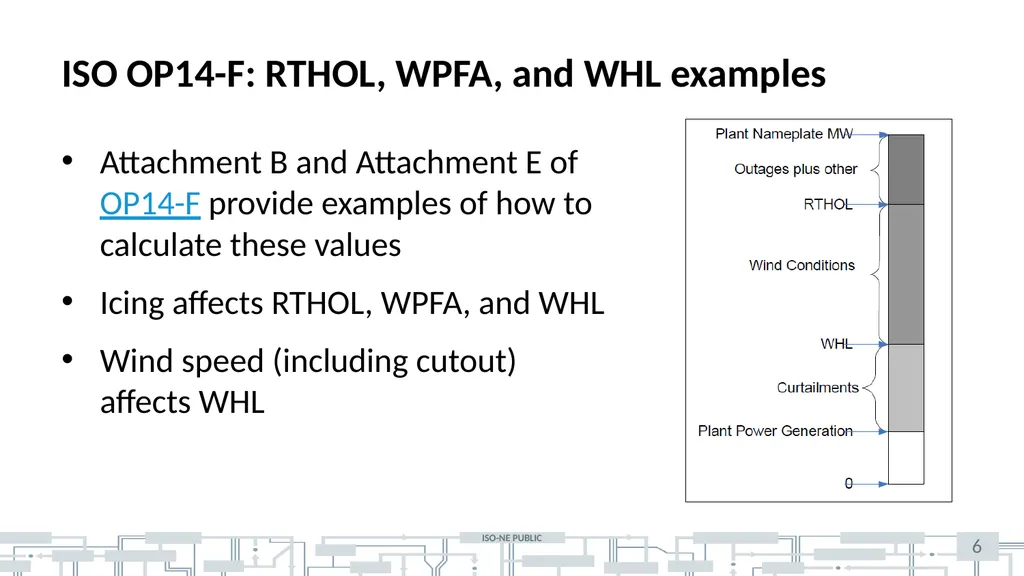
ISO OP14-F: RTHOL, WPFA, and WHL examples Attachment B and Attachment E of OP14-F provide examples of how to calculate these values
Icing affects RTHOL, WPFA, and WHL
Wind speed (including cutout) affects WHL 6<br>
07
Data Issues Related to Apparent Icing During early January 2023, at least 11 wind plants in New England seemed to experience extended icing events
Icing is difficult to forecast, but much easier to detect in-situ
E.g.,
Turbine output far below expected output based on wind speed
Temperature near/below freezing
High humidity/rain/rain-snow mix (in real-time or since last “warm up”)
In many cases, RTHOL, WPFA and WHL did not seem to reflect the apparent icing
MW output of the wind plants was far below RTHOL, WPFA, WHL and the short-term wind power forecast 7<br>
08
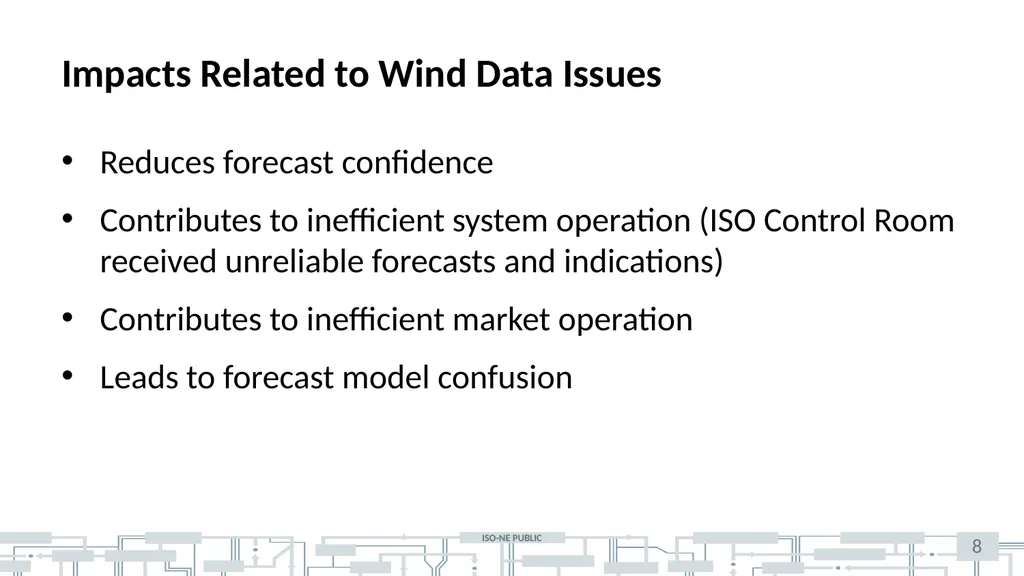
Impacts Related to Wind Data Issues Reduces forecast confidence
Contributes to inefficient system operation (ISO Control Room received unreliable forecasts and indications)
Contributes to inefficient market operation
Leads to forecast model confusion 8<br>
09
Next Steps Accurate data is essential – and required
ISO will be reaching out to wind plants that seemed to report inaccurate data 9<br>
10
10 Jeff Ulrich 413-535-4084 | julrich@iso-ne.com<br>