
Japanese Festivals 日本語 まつり There are endless
LV
Published · 16 slides · 0 views

1 / 1








Description
Japanese Festivals 日本語 まつり There are endless number of festivals in Japan. Almost every shrine or district in Japan has it own festival or celebration. Festivals are seasonal, annually and held over a few days. せいじんの日, also known as Coming
Related Topics
Share
Embed code
Download this presentation From Below
"Japanese Festivals 日本語 まつり There are endless" is the property of its rightful owner. Permission is granted to download and print the materials on this website for personal, non-commercial use only, and to display it on your personal computer provided you do not modify the materials and that you retain all copyright notices contained in the materials. By downloading content from our website, you accept the terms of this agreement.
Presentation Transcript
01
Japanese Festivals
日本語 まつり There are endless number of festivals in Japan. Almost every shrine or district in Japan has it own festival or celebration. Festivals are seasonal, annually and held over a few days.<br>
02
せいじんの日, also known as “Coming of Age Day”, is a national holiday celebrated annually in 一月 on the second げつようび. It was first established in 1948 and originally celebrated on 一月十五日 until the year 2000. The event is held to celebrate those who will be or have turned 二十歳 (20 years old), the “age of majority”. In Japan, 二十歳 is considered to be the start of adulthood and is the minimum legal age to drink alcohol, smoke and vote.
Festivities include coming of age ceremonies known as 成人式 (seijin shiki)which is a formal gathering organized by the local government to honour the new adults, as well as after-parties amongst family and friends. During the ceremony the new adults listen to speeches giving them advice and explaining their responsibilities as adults in society.
Women celebrate by wearing one of the most extravagant and formal kimono for unmarried women called “furisode”. The furisode kimono is expensive and can cost as much as a car so often women rent one for the event. Women also spend a lot of time dressing up for the event at salons or hairdressers for their makeup and hair styles.
Men celebrate by wearing, nowadays, suits although some men still wear the traditional male kimono. せいじんの日- Coming of Age Day http://japanvisitor.blogspot.com/2011/01/seijin-no-hi.html
http://www.tokyotopia.com/seijin-no-hi.html
http://tanutech.com/japan/seijin1.html
http://en.wikipedia.org/wiki/Coming_of_Age_Day
http://youtu.be/FhuR2K0q_e4<br>
Festivities include coming of age ceremonies known as 成人式 (seijin shiki)which is a formal gathering organized by the local government to honour the new adults, as well as after-parties amongst family and friends. During the ceremony the new adults listen to speeches giving them advice and explaining their responsibilities as adults in society.
Women celebrate by wearing one of the most extravagant and formal kimono for unmarried women called “furisode”. The furisode kimono is expensive and can cost as much as a car so often women rent one for the event. Women also spend a lot of time dressing up for the event at salons or hairdressers for their makeup and hair styles.
Men celebrate by wearing, nowadays, suits although some men still wear the traditional male kimono. せいじんの日- Coming of Age Day http://japanvisitor.blogspot.com/2011/01/seijin-no-hi.html
http://www.tokyotopia.com/seijin-no-hi.html
http://tanutech.com/japan/seijin1.html
http://en.wikipedia.org/wiki/Coming_of_Age_Day
http://youtu.be/FhuR2K0q_e4<br>
03
節分
Setsubun Ni gatsu mikka*
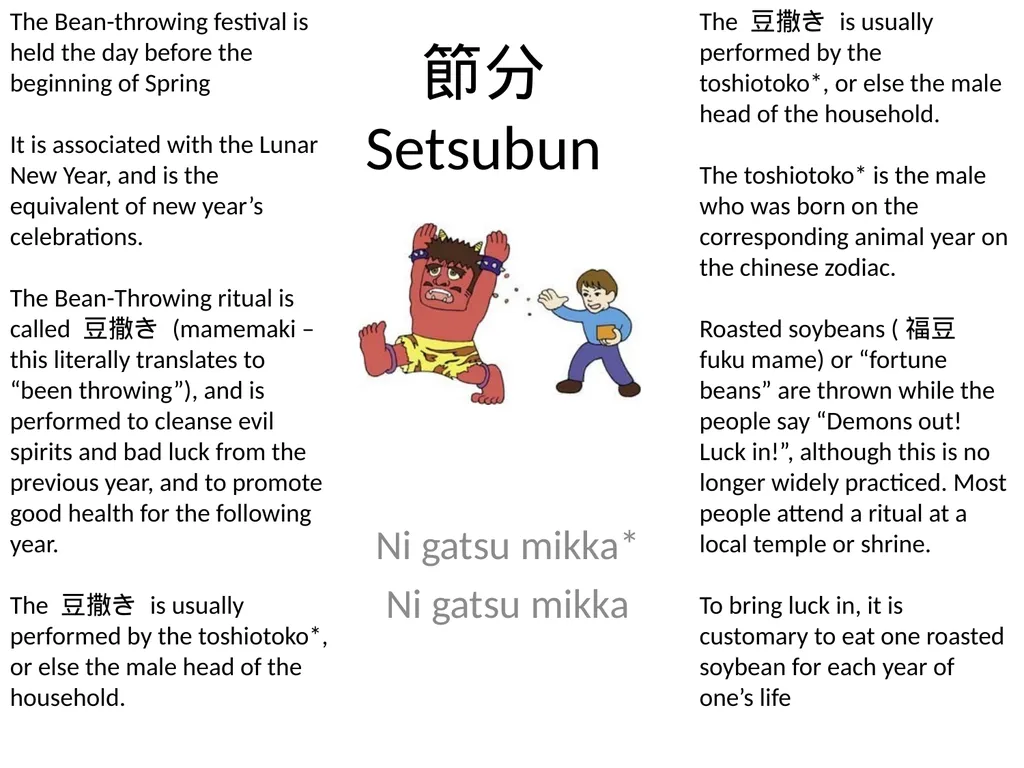
Ni gatsu mikka The Bean-throwing festival is held the day before the beginning of Spring
It is associated with the Lunar New Year, and is the equivalent of new year’s celebrations.
The Bean-Throwing ritual is called 豆撒き (mamemaki – this literally translates to “been throwing”), and is performed to cleanse evil spirits and bad luck from the previous year, and to promote good health for the following year.
The 豆撒き is usually performed by the toshiotoko*, or else the male head of the household. The 豆撒き is usually performed by the toshiotoko*, or else the male head of the household.
The toshiotoko* is the male who was born on the corresponding animal year on the chinese zodiac.
Roasted soybeans (福豆 fuku mame) or “fortune beans” are thrown while the people say “Demons out! Luck in!”, although this is no longer widely practiced. Most people attend a ritual at a local temple or shrine.
To bring luck in, it is customary to eat one roasted soybean for each year of one’s life<br>
Ni gatsu mikka The Bean-throwing festival is held the day before the beginning of Spring
It is associated with the Lunar New Year, and is the equivalent of new year’s celebrations.
The Bean-Throwing ritual is called 豆撒き (mamemaki – this literally translates to “been throwing”), and is performed to cleanse evil spirits and bad luck from the previous year, and to promote good health for the following year.
The 豆撒き is usually performed by the toshiotoko*, or else the male head of the household. The 豆撒き is usually performed by the toshiotoko*, or else the male head of the household.
The toshiotoko* is the male who was born on the corresponding animal year on the chinese zodiac.
Roasted soybeans (福豆 fuku mame) or “fortune beans” are thrown while the people say “Demons out! Luck in!”, although this is no longer widely practiced. Most people attend a ritual at a local temple or shrine.
To bring luck in, it is customary to eat one roasted soybean for each year of one’s life<br>
04
Valentines Day 二月 十四日
February 14th (Annually)
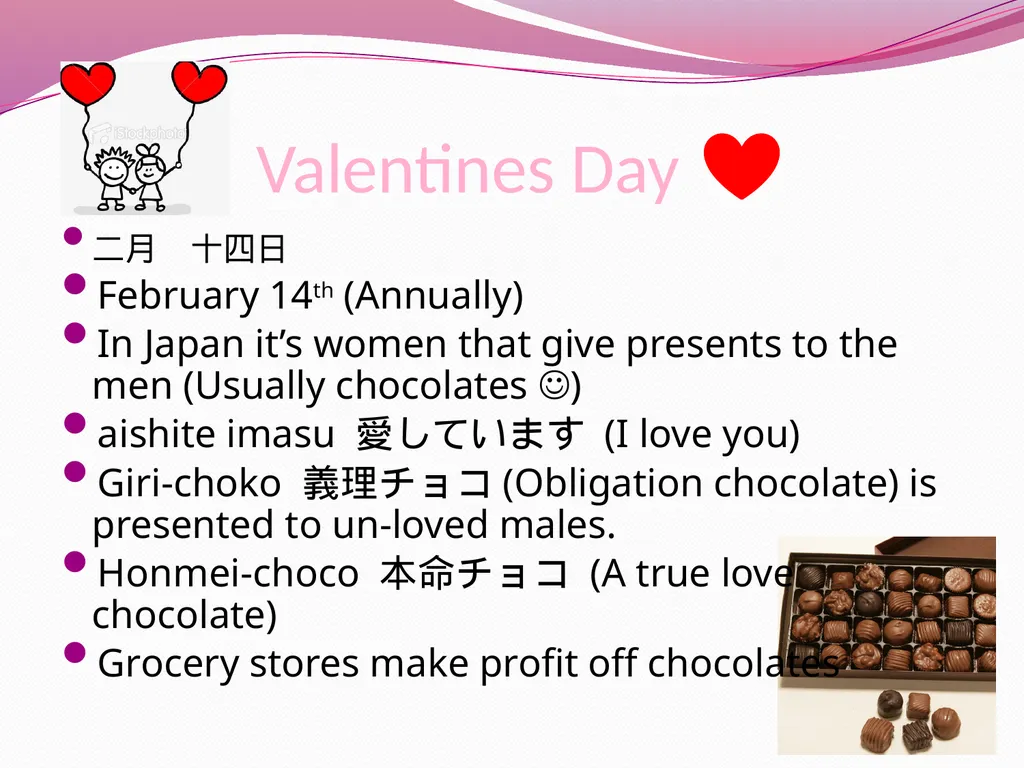
In Japan it’s women that give presents to the men (Usually chocolates )
aishite imasu 愛しています (I love you)
Giri-choko 義理チョコ(Obligation chocolate) is presented to un-loved males.
Honmei-choco 本命チョコ (A true love chocolate)
Grocery stores make profit off chocolates<br>
February 14th (Annually)
In Japan it’s women that give presents to the men (Usually chocolates )
aishite imasu 愛しています (I love you)
Giri-choko 義理チョコ(Obligation chocolate) is presented to un-loved males.
Honmei-choco 本命チョコ (A true love chocolate)
Grocery stores make profit off chocolates<br>
05
White Day (ホワイトデー) Started in 1978 年
Celebrate on 三月 じゅうよっか
Created by the Japanese chocolate industry
Male repay female gifts to their lover, friend or family.
The chocolate made by white sugar
Cookie means ‘I love you’; candies mean ‘I like you’; white chocolate means ‘ let’s be friend’
Have a rule called ‘さんばいーがいしいん’, the male needed to return the Valentine's Day gift that they received from the girl three times the cost<br>
Celebrate on 三月 じゅうよっか
Created by the Japanese chocolate industry
Male repay female gifts to their lover, friend or family.
The chocolate made by white sugar
Cookie means ‘I love you’; candies mean ‘I like you’; white chocolate means ‘ let’s be friend’
Have a rule called ‘さんばいーがいしいん’, the male needed to return the Valentine's Day gift that they received from the girl three times the cost<br>
06
ひ
な
ま
つ
り さんがつ
みっか ひな まつり(Hina-matsuri) is the Dolls Festival, but also known as ‘Girls Day’.
It was said to have originated in Ancient China, where people gathered at the river once a year to float a straw doll, it was said to was away all illnesses and bad luck. The festival was established in Japan as a girls festival during the Edo* period (1603- 1867).
During the week leading up to ひな まつり* displays of Hina dolls are set up in shop displays all around Japan to begin the festivals celebrations. The correct complete set of Hina Dolls traditionally includes a prince and princess (or alternatively emperor and empress), three court ladies, five musicians, two ministers, and three servants. The appearance is usually arranged in a tiered display with the prince and princess on top. The dolls are dressed from traditional clothing from the へじぇん* period (794- 1192). The kimono worn by the princess includes twelve layers of fabric and is now only used in royal wedding ceremonies. After the festival the dolls must be packed and stored away instantly or the girl is said to be doomed to marry late. The dolls themselves are quite expensive, costing up to 1 million yen ( 11, 778. 74 AUD) and most are inherited from mothers or grandmothers.
The traditions include sharing a family meal of ひしもち(a sweet made of three to seven multicoloured layers, it is
said to represent fertility), しろさけ
(a sweet tasting white sake) and a main
dish including clams as clams are
associated with chastity. The most
traditional Clam dish is a clam soup
with spring herbs. Metro-parent.com http://aurachan.faithweb.com/hinamatsuri.html<br>
な
ま
つ
り さんがつ
みっか ひな まつり(Hina-matsuri) is the Dolls Festival, but also known as ‘Girls Day’.
It was said to have originated in Ancient China, where people gathered at the river once a year to float a straw doll, it was said to was away all illnesses and bad luck. The festival was established in Japan as a girls festival during the Edo* period (1603- 1867).
During the week leading up to ひな まつり* displays of Hina dolls are set up in shop displays all around Japan to begin the festivals celebrations. The correct complete set of Hina Dolls traditionally includes a prince and princess (or alternatively emperor and empress), three court ladies, five musicians, two ministers, and three servants. The appearance is usually arranged in a tiered display with the prince and princess on top. The dolls are dressed from traditional clothing from the へじぇん* period (794- 1192). The kimono worn by the princess includes twelve layers of fabric and is now only used in royal wedding ceremonies. After the festival the dolls must be packed and stored away instantly or the girl is said to be doomed to marry late. The dolls themselves are quite expensive, costing up to 1 million yen ( 11, 778. 74 AUD) and most are inherited from mothers or grandmothers.
The traditions include sharing a family meal of ひしもち(a sweet made of three to seven multicoloured layers, it is
said to represent fertility), しろさけ
(a sweet tasting white sake) and a main
dish including clams as clams are
associated with chastity. The most
traditional Clam dish is a clam soup
with spring herbs. Metro-parent.com http://aurachan.faithweb.com/hinamatsuri.html<br>
07
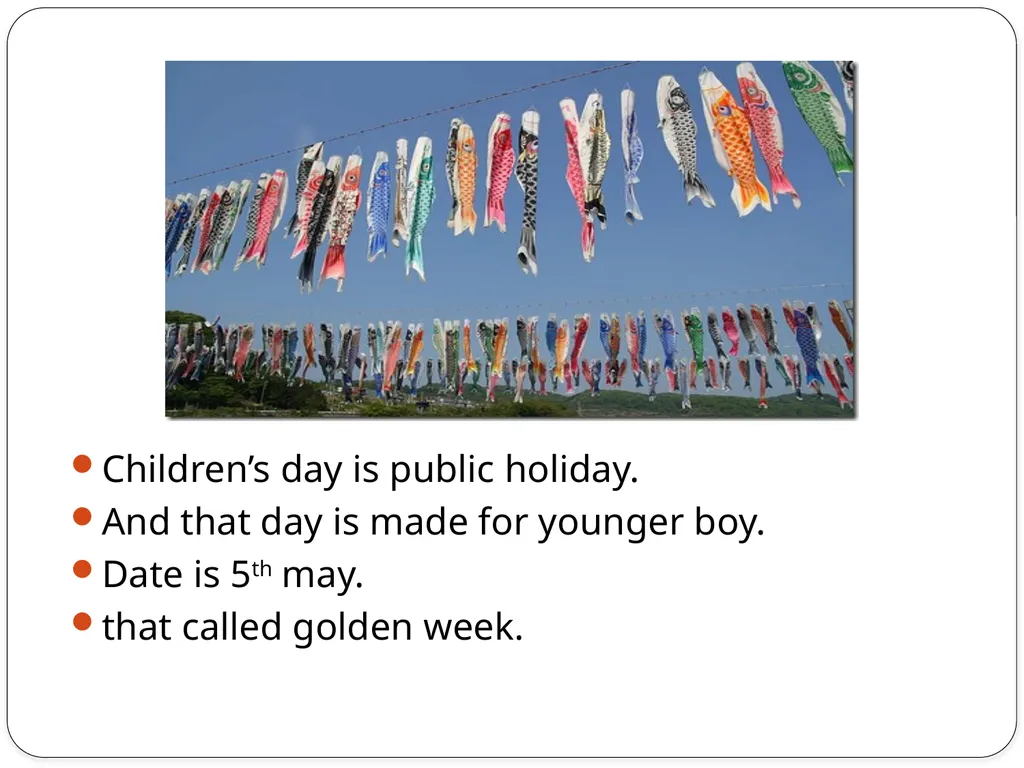
Children’s day is public holiday.
And that day is made for younger boy.
Date is 5th may.
that called golden week.<br>
And that day is made for younger boy.
Date is 5th may.
that called golden week.<br>
08
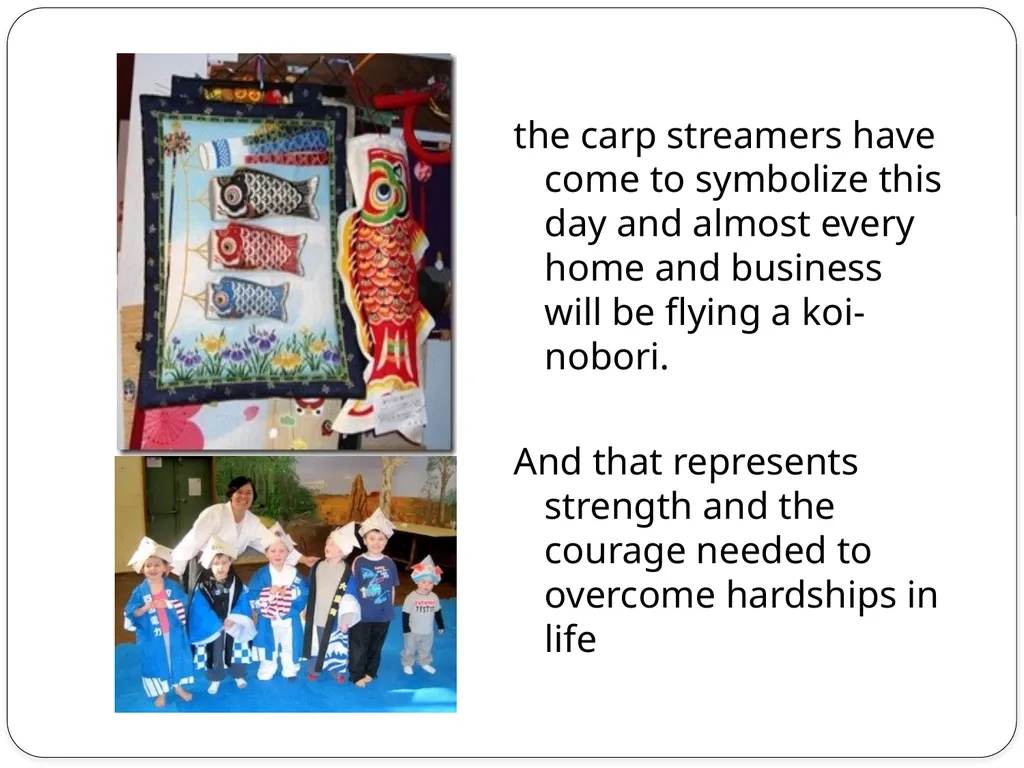
the carp streamers have come to symbolize this day and almost every home and business will be flying a koi-nobori.
And that represents strength and the courage needed to overcome hardships in life<br>
And that represents strength and the courage needed to overcome hardships in life<br>
09
たなばた is a Japanese tradition where people write their wishes on tanzaku papers (colourful, small strips of papers) and hang them on bamboo branches. People also decorate bamboo branches and place them outside their houses. The most common decorations are colourful streamers. Streamers are said to symbolize the weaving of threads. Others are toami (casting net), which means good luck for fishing and farming and kinchaku (hand bag), which means wealth. たなばた originated more than 2,000 years ago with an old Chinese tale called Kikkoden. Once there was a weaver princess named Orihime and a cow herder prince named Hikoboshi living in space. After they got together, they were playing all the time and forgot about their jobs. The king was angry at them and separated them on opposite sides of the Amanogawa River (Milky Way). The king allowed them to meet only once a year on the seventh day of the seventh month in the lunar calendar. たなばた
しちがつ なのか Depending on regions, it's celebrated on July 7th or August 7th (which is around the seventh day of the seventh month in the lunar calendar) in Japan. In some regions, people light lanterns and float them on the river, or float bamboo leaves on the river. http://gojapan.about.com/cs/japanesefestivals/a/tanabata.htm たなばた literally means the night of the seventh, and it's also known as the star festival. It's believed that Orihime and Hikoboshi can't see each other if the day is rainy, so people pray for good weather and also make wishes for themselves.<br>
10
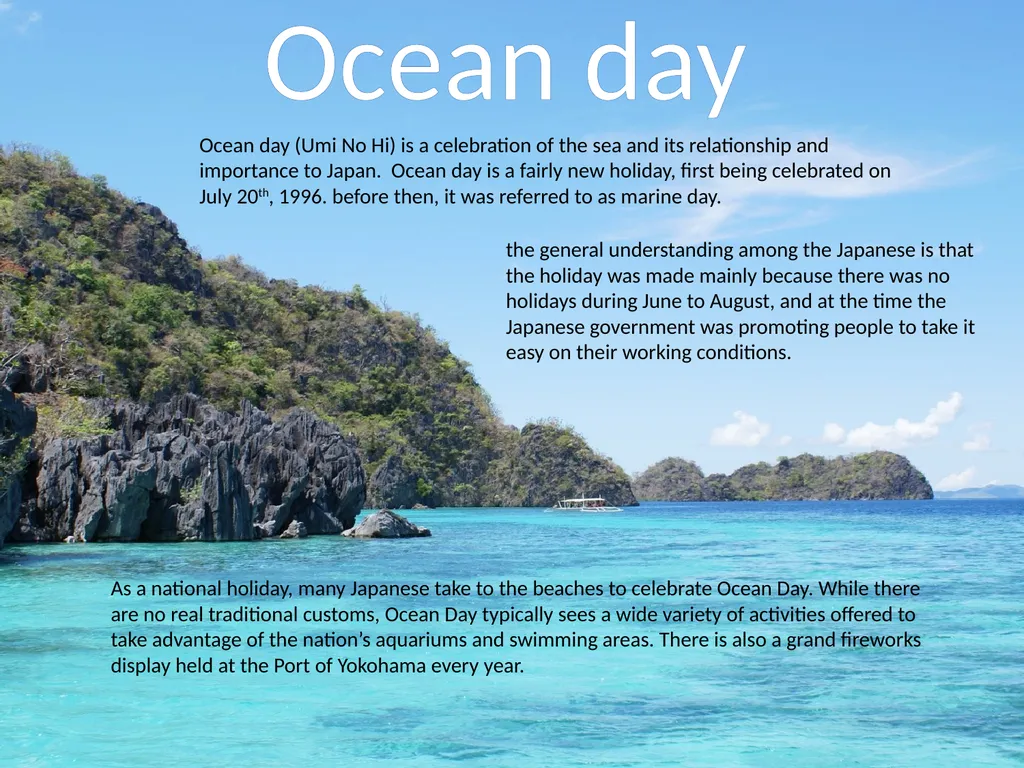
Ocean day the general understanding among the Japanese is that the holiday was made mainly because there was no holidays during June to August, and at the time the Japanese government was promoting people to take it easy on their working conditions. Ocean day (Umi No Hi) is a celebration of the sea and its relationship and importance to Japan. Ocean day is a fairly new holiday, first being celebrated on July 20th, 1996. before then, it was referred to as marine day. As a national holiday, many Japanese take to the beaches to celebrate Ocean Day. While there are no real traditional customs, Ocean Day typically sees a wide variety of activities offered to take advantage of the nation’s aquariums and swimming areas. There is also a grand fireworks display held at the Port of Yokohama every year.<br>
11
Obon
お盆 Obon is an annual Buddhist event for commemorating one's ancestors. It is believed that each year during obon, the ancestors' spirits return to this world in order to visit their relatives. Traditionally, lanterns are hung in front of houses to guide the ancestors' spirits, obon dances (bon odori) are performed, graves are visited and food offerings are made at house altars and temples.
At the end of Obon, floating lanterns are put into rivers, lakes and seas in order to guide the spirits back into their world. The customs followed vary strongly from region to region.
Obon is celebrated from the 13th to the 15th day of the 7th month of the year, which is July according to the solar calendar. However, since the 7th month of the year roughly coincides with August rather than July according to the formerly used lunar calendar, Obon is still celebrated in mid August in many regions of Japan, while it is celebrated in mid July in other regions.
The Obon week in mid August is one of Japan's three major holiday seasons, accompanied by intensive domestic and international travel activities and increased accommodation rates. Bon Dancing
盆踊り<br>
At the end of Obon, floating lanterns are put into rivers, lakes and seas in order to guide the spirits back into their world. The customs followed vary strongly from region to region.
Obon is celebrated from the 13th to the 15th day of the 7th month of the year, which is July according to the solar calendar. However, since the 7th month of the year roughly coincides with August rather than July according to the formerly used lunar calendar, Obon is still celebrated in mid August in many regions of Japan, while it is celebrated in mid July in other regions.
The Obon week in mid August is one of Japan's three major holiday seasons, accompanied by intensive domestic and international travel activities and increased accommodation rates. Bon Dancing
盆踊り<br>
12
Autumn Takayama Festival
Akimatsuri Takayama The Autumn festival is every year on October 9th and 10th, they are held all throughout Japan, it is most celebrated to either pray for a good harvest or to celebrate the local Shinto gods, depending on where you are in Japan. Takayama Autumn Festival October 9th – 10th
The Takayama Autumn festival is a well-liked site for tourists, the festival is a very exciting time to visit japan. It all starts with a ceremony at the Sakurayama Hachimangu Shrine. After the ceremony, a procession of 11 festival floats, or mikoshi, are pulled through town. The floats are lit with paper lanterns at night. After the ceremony, a procession of 11 festival floats, or mikoshi, are pulled through town. The floats are lit with paper lanterns at night.<br>
The Takayama Autumn festival is a well-liked site for tourists, the festival is a very exciting time to visit japan. It all starts with a ceremony at the Sakurayama Hachimangu Shrine. After the ceremony, a procession of 11 festival floats, or mikoshi, are pulled through town. The floats are lit with paper lanterns at night. After the ceremony, a procession of 11 festival floats, or mikoshi, are pulled through town. The floats are lit with paper lanterns at night.<br>
13
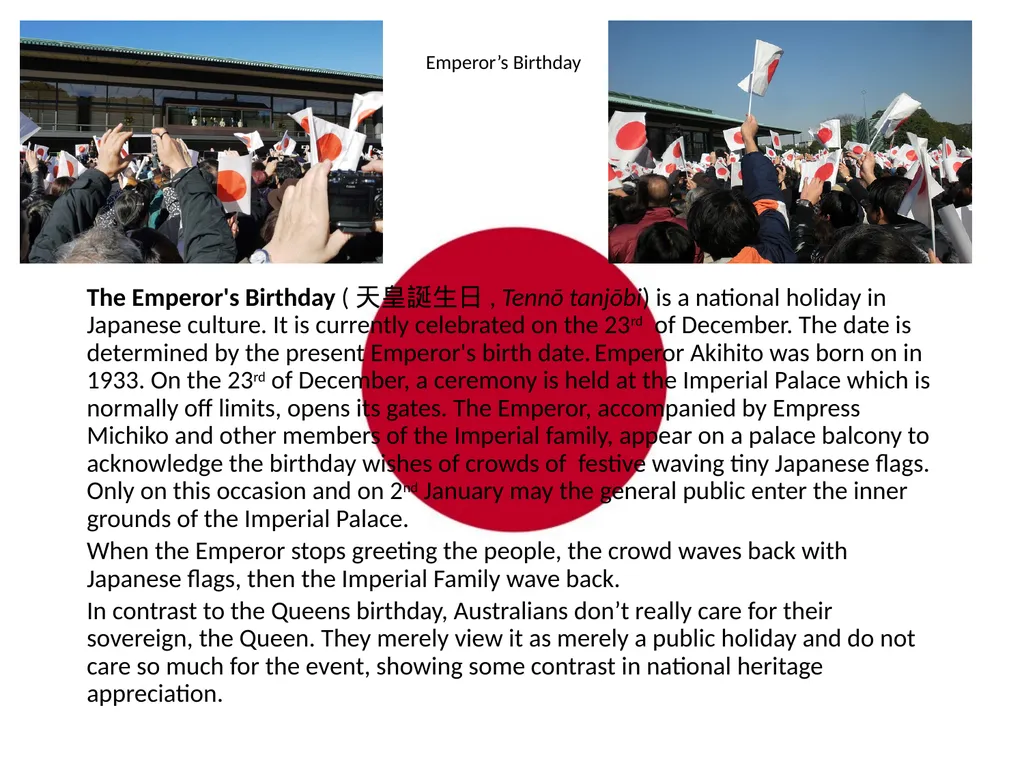
Emperor’s Birthday The Emperor's Birthday (天皇誕生日, Tennō tanjōbi) is a national holiday in Japanese culture. It is currently celebrated on the 23rd of December. The date is determined by the present Emperor's birth date. Emperor Akihito was born on in 1933. On the 23rd of December, a ceremony is held at the Imperial Palace which is normally off limits, opens its gates. The Emperor, accompanied by Empress Michiko and other members of the Imperial family, appear on a palace balcony to acknowledge the birthday wishes of crowds of festive waving tiny Japanese flags. Only on this occasion and on 2nd January may the general public enter the inner grounds of the Imperial Palace.
When the Emperor stops greeting the people, the crowd waves back with Japanese flags, then the Imperial Family wave back.
In contrast to the Queens birthday, Australians don’t really care for their sovereign, the Queen. They merely view it as merely a public holiday and do not care so much for the event, showing some contrast in national heritage appreciation.<br>
When the Emperor stops greeting the people, the crowd waves back with Japanese flags, then the Imperial Family wave back.
In contrast to the Queens birthday, Australians don’t really care for their sovereign, the Queen. They merely view it as merely a public holiday and do not care so much for the event, showing some contrast in national heritage appreciation.<br>
14
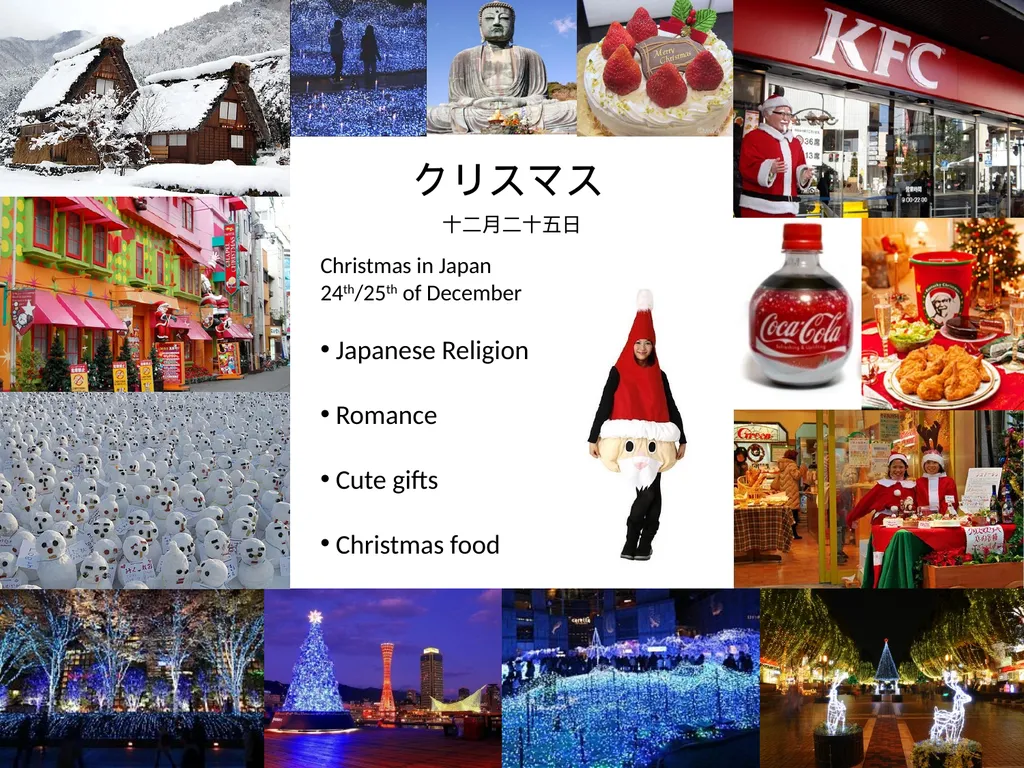
クリスマス 十二月二十五日 Christmas in Japan
24th/25th of December
Japanese Religion
Romance
Cute gifts
Christmas food<br>
24th/25th of December
Japanese Religion
Romance
Cute gifts
Christmas food<br>
15
Japanese new year 1. -visit family-
Japanese people often travel home to spend time with their own families. 2. -shrines-
On new year’s day they visit local shrines and pray for good health and happiness for the coming year. 3. -happy new year card-
they send new year cards to wish each other a happy new year. 4. -Rice cake-
This is traditionally a time to eat rice cake made at the end of the December by pounding hot rice in a wooden trough NEW YEAR in Japan is the most important celebration of the year<br>
Japanese people often travel home to spend time with their own families. 2. -shrines-
On new year’s day they visit local shrines and pray for good health and happiness for the coming year. 3. -happy new year card-
they send new year cards to wish each other a happy new year. 4. -Rice cake-
This is traditionally a time to eat rice cake made at the end of the December by pounding hot rice in a wooden trough NEW YEAR in Japan is the most important celebration of the year<br>
16
大晦日 (Omisoka) Omisoka is the celebration of New Year’s Eve. It is the second most important day in the Japanese calendar and thus is a national holiday unlike in Australia and most of the European settlements. There are many traditions that follow with this day. In Australia!!
New Year’s Eve is not a public holiday. Instead, many work at slack pace as once the working day is over, they begin the traditional drinking and staying up to welcome in the new year. 十二月三十一日 As Omisoka occurs during Winter for Japan, they begin their spring cleaning early. The ritual is called Ôsouji or the big clean up. They clean their schools, homes, and businesses and settle all debts and relationship problems. Other small traditions occur like the sitting at home and watching New Year’s Specials. This where Omisoka really begins. They eat special food called toshikoshi-soba. Toshikoshi-soba is a long thin noodle dish eaten only on Omisoka. The long noodles represent long life. http://www.mythicmaps.net/Festival_calendar/Dec/Omisoka.htm http://en.wikipedia.org/wiki/Omisoka To see in the New Year, the Japanese visit temples at 12am on New Year’s Day. They wait to hear the bells ring 108 times to drive away all of the previous year’s sins. http://www.foodbuzz.com/custom/photo/262/175/3106486-toshikoshi-soba.jpg<br>
New Year’s Eve is not a public holiday. Instead, many work at slack pace as once the working day is over, they begin the traditional drinking and staying up to welcome in the new year. 十二月三十一日 As Omisoka occurs during Winter for Japan, they begin their spring cleaning early. The ritual is called Ôsouji or the big clean up. They clean their schools, homes, and businesses and settle all debts and relationship problems. Other small traditions occur like the sitting at home and watching New Year’s Specials. This where Omisoka really begins. They eat special food called toshikoshi-soba. Toshikoshi-soba is a long thin noodle dish eaten only on Omisoka. The long noodles represent long life. http://www.mythicmaps.net/Festival_calendar/Dec/Omisoka.htm http://en.wikipedia.org/wiki/Omisoka To see in the New Year, the Japanese visit temples at 12am on New Year’s Day. They wait to hear the bells ring 108 times to drive away all of the previous year’s sins. http://www.foodbuzz.com/custom/photo/262/175/3106486-toshikoshi-soba.jpg<br>