
JDA – GST Issues and Implications on Developers
PM
Published · 81 slides · 0 views
1 / 1









Description
JDA GST Issues and Implications on Developers and Owners V Raghuraman, Advocate GST Basics Meaning of Goods and Services Sec 2(52): goods means every kind of movable property other than money and securities but includes
Related Topics
Share
Embed code
Download this presentation From Below
"JDA – GST Issues and Implications on Developers" is the property of its rightful owner. Permission is granted to download and print the materials on this website for personal, non-commercial use only, and to display it on your personal computer provided you do not modify the materials and that you retain all copyright notices contained in the materials. By downloading content from our website, you accept the terms of this agreement.
Presentation Transcript
01
JDA –
GST Issues and Implications on Developers and Owners V Raghuraman, Advocate<br>
02
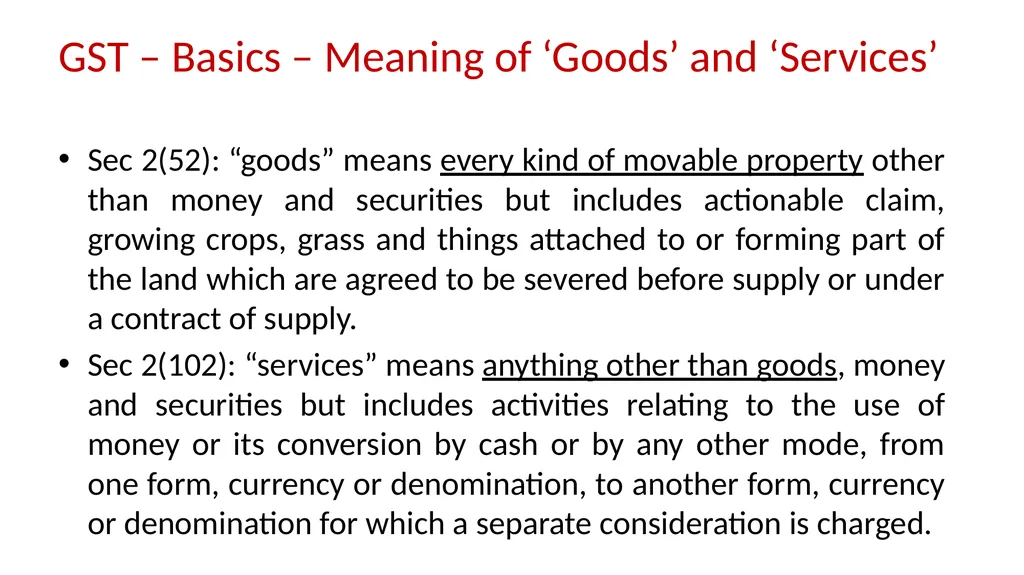
GST – Basics – Meaning of ‘Goods’ and ‘Services’ Sec 2(52): “goods” means every kind of movable property other than money and securities but includes actionable claim, growing crops, grass and things attached to or forming part of the land which are agreed to be severed before supply or under a contract of supply.
Sec 2(102): “services” means anything other than goods, money and securities but includes activities relating to the use of money or its conversion by cash or by any other mode, from one form, currency or denomination, to another form, currency or denomination for which a separate consideration is charged.<br>
Sec 2(102): “services” means anything other than goods, money and securities but includes activities relating to the use of money or its conversion by cash or by any other mode, from one form, currency or denomination, to another form, currency or denomination for which a separate consideration is charged.<br>
03
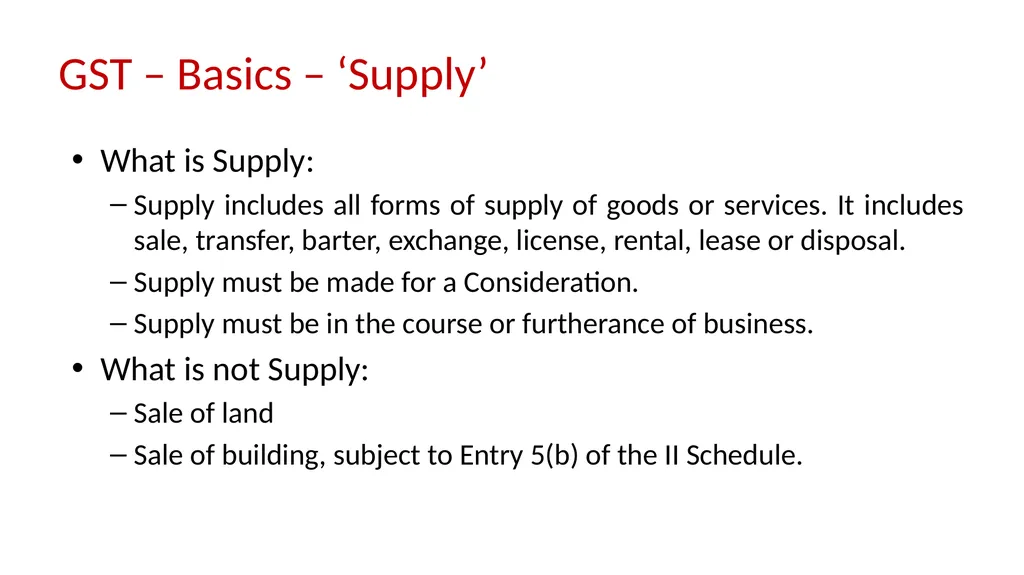
GST – Basics – ‘Supply’ What is Supply:
Supply includes all forms of supply of goods or services. It includes sale, transfer, barter, exchange, license, rental, lease or disposal.
Supply must be made for a Consideration.
Supply must be in the course or furtherance of business.
What is not Supply:
Sale of land
Sale of building, subject to Entry 5(b) of the II Schedule.<br>
Supply includes all forms of supply of goods or services. It includes sale, transfer, barter, exchange, license, rental, lease or disposal.
Supply must be made for a Consideration.
Supply must be in the course or furtherance of business.
What is not Supply:
Sale of land
Sale of building, subject to Entry 5(b) of the II Schedule.<br>
04
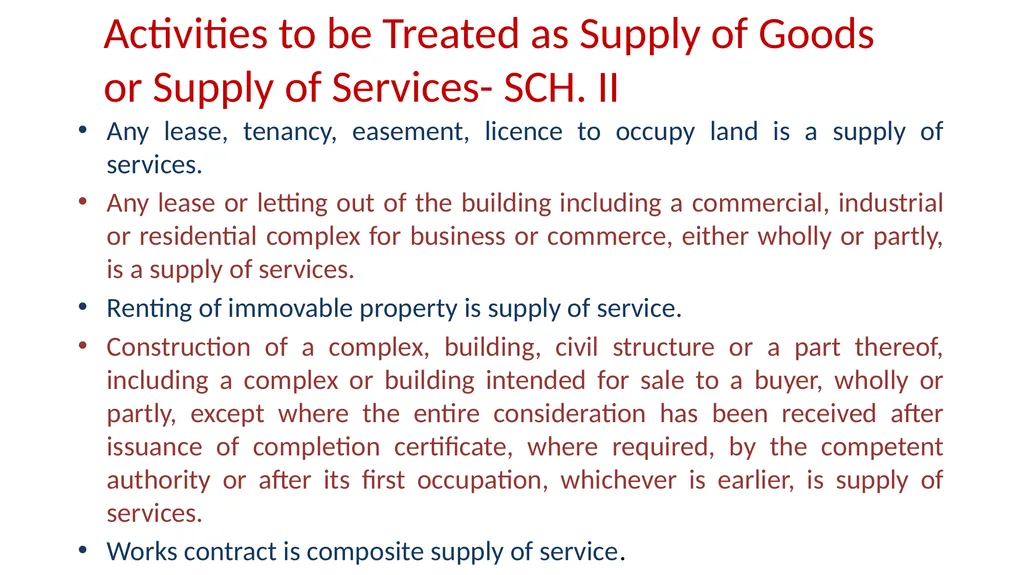
Activities to be Treated as Supply of Goods or Supply of Services- SCH. II Any lease, tenancy, easement, licence to occupy land is a supply of services.
Any lease or letting out of the building including a commercial, industrial or residential complex for business or commerce, either wholly or partly, is a supply of services.
Renting of immovable property is supply of service.
Construction of a complex, building, civil structure or a part thereof, including a complex or building intended for sale to a buyer, wholly or partly, except where the entire consideration has been received after issuance of completion certificate, where required, by the competent authority or after its first occupation, whichever is earlier, is supply of services.
Works contract is composite supply of service.<br>
Any lease or letting out of the building including a commercial, industrial or residential complex for business or commerce, either wholly or partly, is a supply of services.
Renting of immovable property is supply of service.
Construction of a complex, building, civil structure or a part thereof, including a complex or building intended for sale to a buyer, wholly or partly, except where the entire consideration has been received after issuance of completion certificate, where required, by the competent authority or after its first occupation, whichever is earlier, is supply of services.
Works contract is composite supply of service.<br>
05
JDA – Meaning / Nature / scope<br>
06
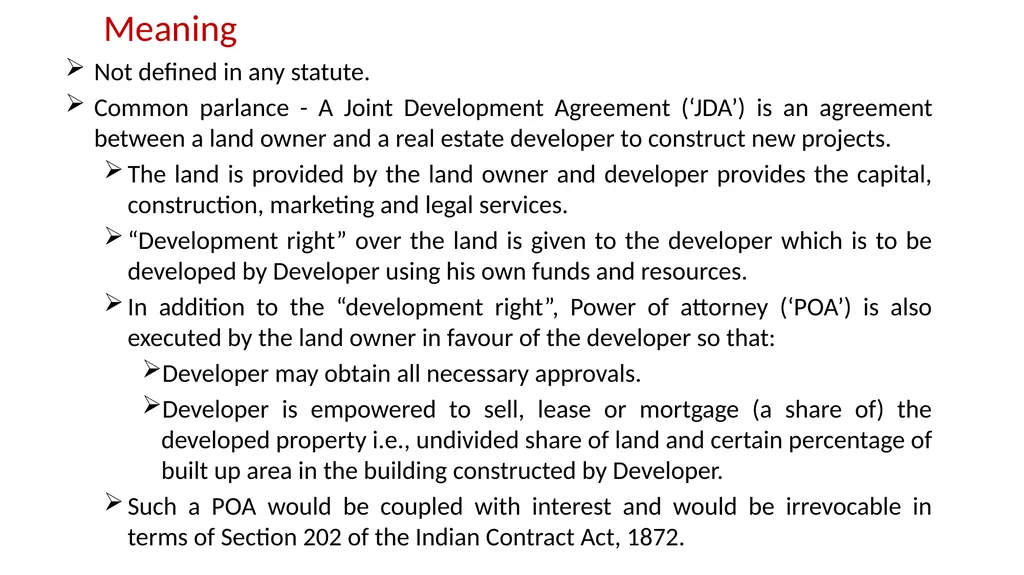
Not defined in any statute.
Common parlance - A Joint Development Agreement (‘JDA’) is an agreement between a land owner and a real estate developer to construct new projects.
The land is provided by the land owner and developer provides the capital, construction, marketing and legal services.
“Development right” over the land is given to the developer which is to be developed by Developer using his own funds and resources.
In addition to the “development right”, Power of attorney (‘POA’) is also executed by the land owner in favour of the developer so that:
Developer may obtain all necessary approvals.
Developer is empowered to sell, lease or mortgage (a share of) the developed property i.e., undivided share of land and certain percentage of built up area in the building constructed by Developer.
Such a POA would be coupled with interest and would be irrevocable in terms of Section 202 of the Indian Contract Act, 1872. Meaning<br>
Common parlance - A Joint Development Agreement (‘JDA’) is an agreement between a land owner and a real estate developer to construct new projects.
The land is provided by the land owner and developer provides the capital, construction, marketing and legal services.
“Development right” over the land is given to the developer which is to be developed by Developer using his own funds and resources.
In addition to the “development right”, Power of attorney (‘POA’) is also executed by the land owner in favour of the developer so that:
Developer may obtain all necessary approvals.
Developer is empowered to sell, lease or mortgage (a share of) the developed property i.e., undivided share of land and certain percentage of built up area in the building constructed by Developer.
Such a POA would be coupled with interest and would be irrevocable in terms of Section 202 of the Indian Contract Act, 1872. Meaning<br>
07
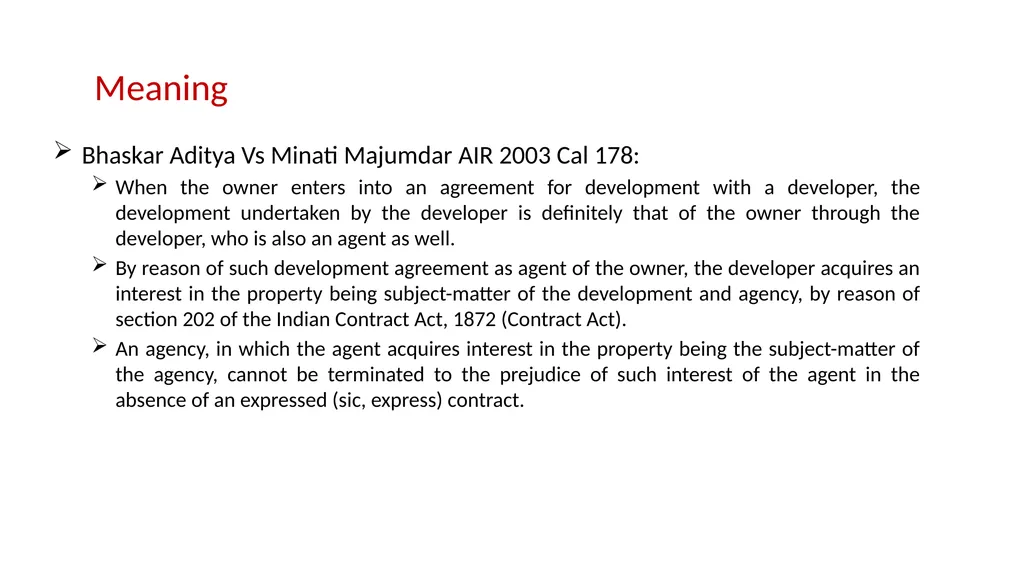
Bhaskar Aditya Vs Minati Majumdar AIR 2003 Cal 178:
When the owner enters into an agreement for development with a developer, the development undertaken by the developer is definitely that of the owner through the developer, who is also an agent as well.
By reason of such development agreement as agent of the owner, the developer acquires an interest in the property being subject-matter of the development and agency, by reason of section 202 of the Indian Contract Act, 1872 (Contract Act).
An agency, in which the agent acquires interest in the property being the subject-matter of the agency, cannot be terminated to the prejudice of such interest of the agent in the absence of an expressed (sic, express) contract. Meaning<br>
When the owner enters into an agreement for development with a developer, the development undertaken by the developer is definitely that of the owner through the developer, who is also an agent as well.
By reason of such development agreement as agent of the owner, the developer acquires an interest in the property being subject-matter of the development and agency, by reason of section 202 of the Indian Contract Act, 1872 (Contract Act).
An agency, in which the agent acquires interest in the property being the subject-matter of the agency, cannot be terminated to the prejudice of such interest of the agent in the absence of an expressed (sic, express) contract. Meaning<br>
08
Ashok Kumar Jaiswal vs Ashim Kumar Kar AIR 2014 Cal 92
An owner without any funds or the independent resources to construct a new building on such owner's land may engage another for such purpose with the consideration for the construction being paid by allocation of a part of the constructed area.
In the context in which certain agreements pertaining to the construction of new buildings contemplate the construction to be undertaken or orchestrated by a person other than the owner of the land, whether upon the demolition of the existing structure or otherwise, with such person other than the owner having a share in the constructed area, such agreements have now come to be regarded as development agreements.
Whether or not such agreements are in the nature of collaboration or joint venture, they are loosely referred to as development agreements.
Such agreements are not merely for the construction of any building or for the mere execution of any other work on the land. The developer is not merely a contractor engaged to undertake the construction; the developer is, under the agreement with the owner, promised a part of the constructed premises as owner thereof together with the proportionate area of the land. Meaning<br>
An owner without any funds or the independent resources to construct a new building on such owner's land may engage another for such purpose with the consideration for the construction being paid by allocation of a part of the constructed area.
In the context in which certain agreements pertaining to the construction of new buildings contemplate the construction to be undertaken or orchestrated by a person other than the owner of the land, whether upon the demolition of the existing structure or otherwise, with such person other than the owner having a share in the constructed area, such agreements have now come to be regarded as development agreements.
Whether or not such agreements are in the nature of collaboration or joint venture, they are loosely referred to as development agreements.
Such agreements are not merely for the construction of any building or for the mere execution of any other work on the land. The developer is not merely a contractor engaged to undertake the construction; the developer is, under the agreement with the owner, promised a part of the constructed premises as owner thereof together with the proportionate area of the land. Meaning<br>
09
Ashok Kumar Jaiswal vs Ashim Kumar Kar AIR 2014 Cal 92
In the context in which certain agreements are referred to as development agreements and the non-owner party to such an agreement is regarded as the developer qua the nature of the work envisaged under the agreement, the developer always has a share in the building or the area proposed to be constructed - which implies a proportionate share of the piece of earth - and such agreement envisages the developer to have a share of, and interest in, the final product which is the outcome of the agreement.
A development agreement entails the transfer of immovable property in the sense that the developer or an assignee of the developer, at the instance of the developer, would be entitled not only to a part of the constructed area but the proportionate share of the land on which the construction is made.
The position of a developer in the work undertaken pursuant to a development agreement has to be regarded as that of the conductor of an orchestra in the sense that he guides and controls the project and the owner's concern is limited to the timeliness and the quality of the project.
The agency created by a power of attorney executed by the owner in favour of the developer may be seen to recognise an interest of the developer in the property which forms the subject-matter of the agency. Meaning<br>
In the context in which certain agreements are referred to as development agreements and the non-owner party to such an agreement is regarded as the developer qua the nature of the work envisaged under the agreement, the developer always has a share in the building or the area proposed to be constructed - which implies a proportionate share of the piece of earth - and such agreement envisages the developer to have a share of, and interest in, the final product which is the outcome of the agreement.
A development agreement entails the transfer of immovable property in the sense that the developer or an assignee of the developer, at the instance of the developer, would be entitled not only to a part of the constructed area but the proportionate share of the land on which the construction is made.
The position of a developer in the work undertaken pursuant to a development agreement has to be regarded as that of the conductor of an orchestra in the sense that he guides and controls the project and the owner's concern is limited to the timeliness and the quality of the project.
The agency created by a power of attorney executed by the owner in favour of the developer may be seen to recognise an interest of the developer in the property which forms the subject-matter of the agency. Meaning<br>
10
Faqir Chand Gulati Vs Uppal Agencies (P) Ltd (2008) 10 SCC 345:
The landholder who gets some apartments may retain the same or may dispose of his share of apartments with corresponding undivided shares to others. The usual feature of these agreements is that the landholder will have no say or control in the construction. Nor will he have any say as to whom and at what cost the builder's share of apartments are to be dealt with or disposed of. His only right is to demand delivery of his share of constructed area in accordance with the specifications.
New Horizons Ltd Vs Union of India [(1995) 1 SCC 478]:
Joint venture connotes a legal entity in the nature of a partnership engaged in the joint undertaking of a particular transaction for mutual profit or an association of persons or companies jointly undertaking some commercial enterprise wherein all contribute assets and share risks.
It requires a community of interest in the performance of the subject-matter, a right to direct and govern the policy in connection therewith, and duty, which may be altered by agreement, to share both in profit and losses.
Joint ventures are, in general, governed by the same rules as partnerships.
A joint venture is to be distinguished from a relationship of independent contractor, the latter being one who, exercising an independent employment, contracts to do work according to his own methods and without being subject to the control of his employer except as to the result of the work, while a joint venture is a special combination of two or more persons where, in some specific venture, a profit is jointly sought without any actual partnership or corporate designation Meaning<br>
The landholder who gets some apartments may retain the same or may dispose of his share of apartments with corresponding undivided shares to others. The usual feature of these agreements is that the landholder will have no say or control in the construction. Nor will he have any say as to whom and at what cost the builder's share of apartments are to be dealt with or disposed of. His only right is to demand delivery of his share of constructed area in accordance with the specifications.
New Horizons Ltd Vs Union of India [(1995) 1 SCC 478]:
Joint venture connotes a legal entity in the nature of a partnership engaged in the joint undertaking of a particular transaction for mutual profit or an association of persons or companies jointly undertaking some commercial enterprise wherein all contribute assets and share risks.
It requires a community of interest in the performance of the subject-matter, a right to direct and govern the policy in connection therewith, and duty, which may be altered by agreement, to share both in profit and losses.
Joint ventures are, in general, governed by the same rules as partnerships.
A joint venture is to be distinguished from a relationship of independent contractor, the latter being one who, exercising an independent employment, contracts to do work according to his own methods and without being subject to the control of his employer except as to the result of the work, while a joint venture is a special combination of two or more persons where, in some specific venture, a profit is jointly sought without any actual partnership or corporate designation Meaning<br>
11
Faqir Chand Gulati Vs Uppal Agencies (P) Ltd (2008) 10 SCC 345:
The landholder who gets some apartments may retain the same or may dispose of his share of apartments with corresponding undivided shares to others. The usual feature of these agreements is that the landholder will have no say or control in the construction. Nor will he have any say as to whom and at what cost the builder's share of apartments are to be dealt with or disposed of. His only right is to demand delivery of his share of constructed area in accordance with the specifications.
New Horizons Ltd Vs Union of India [(1995) 1 SCC 478]:
Joint venture connotes a legal entity in the nature of a partnership engaged in the joint undertaking of a particular transaction for mutual profit or an association of persons or companies jointly undertaking some commercial enterprise wherein all contribute assets and share risks.
It requires a community of interest in the performance of the subject-matter, a right to direct and govern the policy in connection therewith, and duty, which may be altered by agreement, to share both in profit and losses.
Joint ventures are, in general, governed by the same rules as partnerships.
A joint venture is to be distinguished from a relationship of independent contractor, the latter being one who, exercising an independent employment, contracts to do work according to his own methods and without being subject to the control of his employer except as to the result of the work, while a joint venture is a special combination of two or more persons where, in some specific venture, a profit is jointly sought without any actual partnership or corporate designation Meaning<br>
The landholder who gets some apartments may retain the same or may dispose of his share of apartments with corresponding undivided shares to others. The usual feature of these agreements is that the landholder will have no say or control in the construction. Nor will he have any say as to whom and at what cost the builder's share of apartments are to be dealt with or disposed of. His only right is to demand delivery of his share of constructed area in accordance with the specifications.
New Horizons Ltd Vs Union of India [(1995) 1 SCC 478]:
Joint venture connotes a legal entity in the nature of a partnership engaged in the joint undertaking of a particular transaction for mutual profit or an association of persons or companies jointly undertaking some commercial enterprise wherein all contribute assets and share risks.
It requires a community of interest in the performance of the subject-matter, a right to direct and govern the policy in connection therewith, and duty, which may be altered by agreement, to share both in profit and losses.
Joint ventures are, in general, governed by the same rules as partnerships.
A joint venture is to be distinguished from a relationship of independent contractor, the latter being one who, exercising an independent employment, contracts to do work according to his own methods and without being subject to the control of his employer except as to the result of the work, while a joint venture is a special combination of two or more persons where, in some specific venture, a profit is jointly sought without any actual partnership or corporate designation Meaning<br>
12
Faqir Chand Gulati Vs Uppal Agencies (P) Ltd (2008) 10 SCC 345:
‘Joint venture’, a term used interchangeably and synonymous with ‘joint adventure’, or coventure, has been defined as a special combination of two or more persons wherein some specific venture for profit is jointly sought without any actual partnership or corporate designation, or as an association of two or more persons to carry out a single business enterprise for profit.
Among the acts or conduct which are indicative of a joint venture, no single one of which is controlling in determining whether a joint venture exists, are: (1) joint ownership and control of property; (2) sharing of expenses, profits and losses, and having and exercising some voice in determining division of net earnings; (3) community of control over, and active participation in, management and direction of business enterprise; (4) intention of parties, express or implied; and (5) fixing of salaries by joint agreement.
An agreement between the owner of a land and a builder, for construction of apartments and sale of those apartments so as to share the profits in a particular ratio may be a joint venture, if the agreement discloses an intent that both parties shall exercise joint control over the construction/development and be accountable to each other for their respective acts with reference to the project. Meaning<br>
‘Joint venture’, a term used interchangeably and synonymous with ‘joint adventure’, or coventure, has been defined as a special combination of two or more persons wherein some specific venture for profit is jointly sought without any actual partnership or corporate designation, or as an association of two or more persons to carry out a single business enterprise for profit.
Among the acts or conduct which are indicative of a joint venture, no single one of which is controlling in determining whether a joint venture exists, are: (1) joint ownership and control of property; (2) sharing of expenses, profits and losses, and having and exercising some voice in determining division of net earnings; (3) community of control over, and active participation in, management and direction of business enterprise; (4) intention of parties, express or implied; and (5) fixing of salaries by joint agreement.
An agreement between the owner of a land and a builder, for construction of apartments and sale of those apartments so as to share the profits in a particular ratio may be a joint venture, if the agreement discloses an intent that both parties shall exercise joint control over the construction/development and be accountable to each other for their respective acts with reference to the project. Meaning<br>
13
Faqir Chand Gulati Vs Uppal Agencies (P) Ltd (2008) 10 SCC 345:
The basic underlying purpose of the agreement is the construction of a house or an apartment (ground floor) in accordance with the specifications, by the builder for the owner, the consideration for such construction being the transfer of undivided share in land to the builder and grant of permission to the builder to construct two floors. Such agreement whether called as a “collaboration agreement” or a “joint venture agreement”, is not, however, a “joint venture”.
There is a contract for construction of an apartment or house for the appellant, in accordance with the specifications and in terms of the contract. There is a consideration for such construction, flowing from the landowner to the builder (in the form of sale of an undivided share in the land and permission to construct and own the upper floors).
To that extent, the landowner is a consumer, the builder is a service provider.
In a true joint venture agreement between the landowner and another (whether a recognised builder or fund provider), the landowner is a true partner or co-adventurer in the venture where the landowner has a say or control in the construction and participates in the business and management of the joint venture, and has a share in the profit/loss of the venture. In such a case, the landowner is not a consumer nor is the other co-adventurer in the joint venture, a service provider. The landowner himself is responsible for the construction as a co-adventurer in the venture. But such true joint ventures are comparatively rare. Meaning<br>
The basic underlying purpose of the agreement is the construction of a house or an apartment (ground floor) in accordance with the specifications, by the builder for the owner, the consideration for such construction being the transfer of undivided share in land to the builder and grant of permission to the builder to construct two floors. Such agreement whether called as a “collaboration agreement” or a “joint venture agreement”, is not, however, a “joint venture”.
There is a contract for construction of an apartment or house for the appellant, in accordance with the specifications and in terms of the contract. There is a consideration for such construction, flowing from the landowner to the builder (in the form of sale of an undivided share in the land and permission to construct and own the upper floors).
To that extent, the landowner is a consumer, the builder is a service provider.
In a true joint venture agreement between the landowner and another (whether a recognised builder or fund provider), the landowner is a true partner or co-adventurer in the venture where the landowner has a say or control in the construction and participates in the business and management of the joint venture, and has a share in the profit/loss of the venture. In such a case, the landowner is not a consumer nor is the other co-adventurer in the joint venture, a service provider. The landowner himself is responsible for the construction as a co-adventurer in the venture. But such true joint ventures are comparatively rare. Meaning<br>
14
Faqir Chand Gulati Vs Uppal Agencies (P) Ltd (2008) 10 SCC 345:
What is more prevalent are agreements of the nature found in this case, which are a hybrid agreement for construction for consideration and sale and are pseudo joint ventures. Normally a professional builder who develops properties of others is not interested in sharing the control and management of the business or the control over the construction with the landowners.
Except assuring the landowner a certain constructed area and/or certain cash consideration, the builder ensures absolute control in himself, only assuring the quality of construction and compliance with the requirements of local and municipal laws, and undertaking to deliver the owners' constructed area of the building with all certificates, clearances and approvals to the landowner. Meaning<br>
What is more prevalent are agreements of the nature found in this case, which are a hybrid agreement for construction for consideration and sale and are pseudo joint ventures. Normally a professional builder who develops properties of others is not interested in sharing the control and management of the business or the control over the construction with the landowners.
Except assuring the landowner a certain constructed area and/or certain cash consideration, the builder ensures absolute control in himself, only assuring the quality of construction and compliance with the requirements of local and municipal laws, and undertaking to deliver the owners' constructed area of the building with all certificates, clearances and approvals to the landowner. Meaning<br>
15
In the hands of Promoter/Developer: Under JDA transactions, the income accrues or arising to the developer in the form of consideration received on the sale of constructed property (only to the extent of developer’s share in the property) would be taxable as his ‘business income’.
In the hands of Landowner: The income that accrues or arises to the landowner is on the ‘transfer of title of land or immovable property’. The income may be either in the form of consideration in money (i.e. revenue sharing model) or in the form of specified area in the constructed property. Such incomes would be chargeable under the heading ‘capital gain’.
The expression ‘transfer’ is defined in section 2(47). Amongst other things, it includes section 2(47)(v) which says any transaction involving the allowing of the possession of any immovable property to be taken or retained in part performance of a contract of the nature referred to in section 53A of the Transfer of Property Act, 1882 Meaning – Income Tax Act Perspective<br>
In the hands of Landowner: The income that accrues or arises to the landowner is on the ‘transfer of title of land or immovable property’. The income may be either in the form of consideration in money (i.e. revenue sharing model) or in the form of specified area in the constructed property. Such incomes would be chargeable under the heading ‘capital gain’.
The expression ‘transfer’ is defined in section 2(47). Amongst other things, it includes section 2(47)(v) which says any transaction involving the allowing of the possession of any immovable property to be taken or retained in part performance of a contract of the nature referred to in section 53A of the Transfer of Property Act, 1882 Meaning – Income Tax Act Perspective<br>
16
In order to settle the issue of taxability of landowner’s share on the date of Transfer, section 45(5A) was introduced by the Finance Act, 2017 w.e.f 01.04.2018. It provides for the taxation of capital gain arising to an Individual or HUF from transfer of land or building or both in respect of “specified agreements”. The chargeable event is the year in which the certificate of completion for the whole or part of the project is issued by the competent agreement.
Explanation to section 45(5A) defines a ‘specified agreement”. It refers to a registered agreement in which a person owning land or building or both, agrees to allow another person to develop a real estate project on such land or building or both, in consideration of a share, being land or building or both in such project, whether with or without payment of part of the consideration in cash; Meaning – Income Tax Act Perspective<br>
Explanation to section 45(5A) defines a ‘specified agreement”. It refers to a registered agreement in which a person owning land or building or both, agrees to allow another person to develop a real estate project on such land or building or both, in consideration of a share, being land or building or both in such project, whether with or without payment of part of the consideration in cash; Meaning – Income Tax Act Perspective<br>
17
Jasbir Singh Sarkaria, In re [2007] 294 ITR 196 (AAR):
On adopting the principle of purposive construction, it must be held that possession contemplated by clause (v) need not necessarily be sole and exclusive possession.
So long as the transferee is, by virtue of the possession given, enabled to exercise general control over the property and to make use of it for the intended purpose, the mere fact that the owner has also the right to enter the property to oversee the development work or to ensure performance of the terms of agreement does not introduce any incompatibility.
What is spoken to in clause (v) of section 2 (47) is the 'transaction' which involves allowing the possession to be taken. By means of such transaction, a transferee like a developer is allowed to undertake development work on the land by assuming general control over the property in part performance of the contract.
The date of that transaction determines the date of transfer. The actual date of taking physical possession or the instances of possessory acts exercised is not very relevant. The ascertainment of such date, if called for, leads to complicated inquiries, which may frustrate the objective of the legislative provision. It is enough if the transferee has, by virtue of that transaction, a right to enter upon and exercise acts of possession effectively pursuant to the covenants in the contract. That tantamount to legal possession. Meaning – Income Tax Act Perspective<br>
On adopting the principle of purposive construction, it must be held that possession contemplated by clause (v) need not necessarily be sole and exclusive possession.
So long as the transferee is, by virtue of the possession given, enabled to exercise general control over the property and to make use of it for the intended purpose, the mere fact that the owner has also the right to enter the property to oversee the development work or to ensure performance of the terms of agreement does not introduce any incompatibility.
What is spoken to in clause (v) of section 2 (47) is the 'transaction' which involves allowing the possession to be taken. By means of such transaction, a transferee like a developer is allowed to undertake development work on the land by assuming general control over the property in part performance of the contract.
The date of that transaction determines the date of transfer. The actual date of taking physical possession or the instances of possessory acts exercised is not very relevant. The ascertainment of such date, if called for, leads to complicated inquiries, which may frustrate the objective of the legislative provision. It is enough if the transferee has, by virtue of that transaction, a right to enter upon and exercise acts of possession effectively pursuant to the covenants in the contract. That tantamount to legal possession. Meaning – Income Tax Act Perspective<br>
18
C.S. Atwal vs CIT [2015] 59 taxmann.com 359 (P&H): In the context of section 2(47)(v) of the Income Tax Act, 2017, the concept of possession to be defined is an enormous task to be precisely elaborated. "Possession" is a word of open texture. It is an abstract notion. It implies a right to enjoy which is attached to the right to property. It is not purely a legal concept but is a matter of fact. The issue of ownership depends on rule of law whereas possession is a question dependent upon fact without reference to law. To put it differently, ownership is strictly a legal concept and possession is both a legal and a non-legal or pre-legal concept. The test for determining whether any person is in possession of anything is to see whether it is under his general control. He should be actually holding, using and enjoying it, without interference on the part of others. Meaning – Income Tax Act Perspective<br>
19
Chaturbhuj Dwarkadas Kapadia Vs. CIT 260 ITR 491 (Bom), the Bombay High Court held that in the case of a development agreement, if the contract, read as a whole, indicates passing of or transferring of complete control over the property in favour of the developer, then the date of the contract would be relevant to decide the year of chargeability of capital gains and the substantial performance of the contract would be irrelevant. JDA Meaning – Income Tax Act Perspective<br>
20
Area sharing model:
Agreed portion of constructed / developed property is handed over to the land owner
Generally by entering into an area sharing agreement or a conveyance deed.
Revenue sharing model:
Entire developed property is sold through developer;
Agreed portion of the revenue is shared between developer and land owner Types<br>
Agreed portion of constructed / developed property is handed over to the land owner
Generally by entering into an area sharing agreement or a conveyance deed.
Revenue sharing model:
Entire developed property is sold through developer;
Agreed portion of the revenue is shared between developer and land owner Types<br>
21
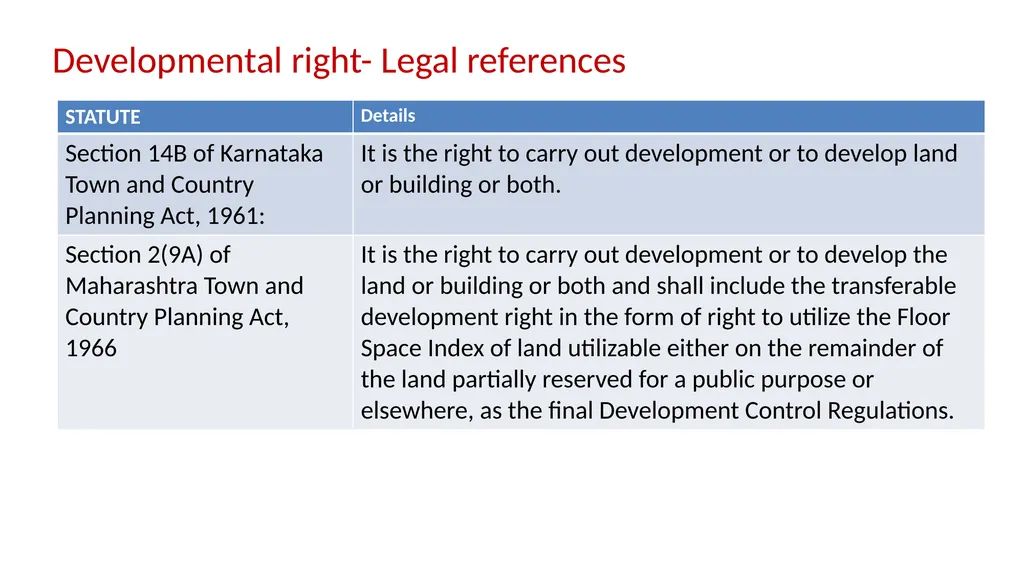
Developmental right- Legal references<br>
22
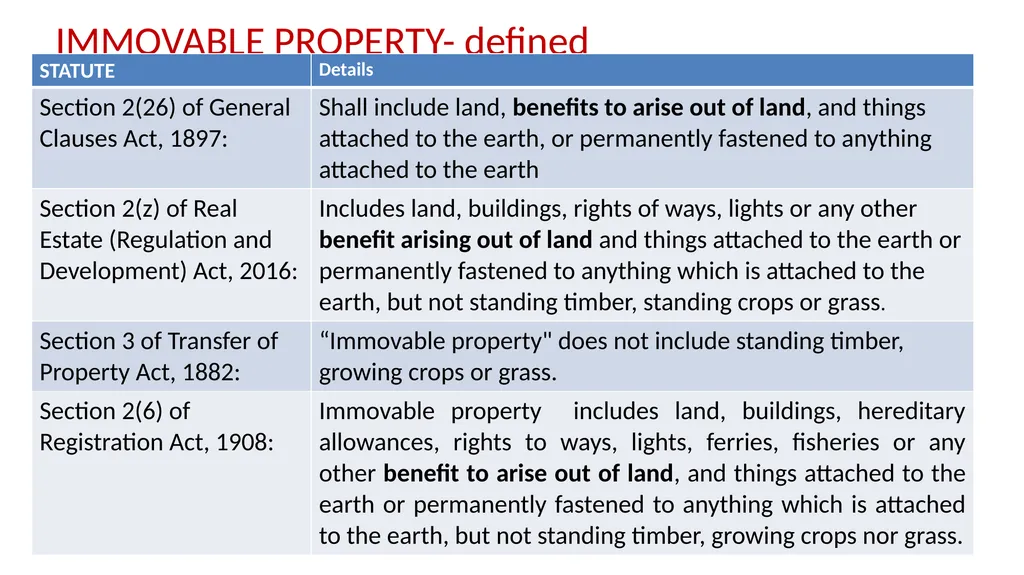
IMMOVABLE PROPERTY- defined<br>
23
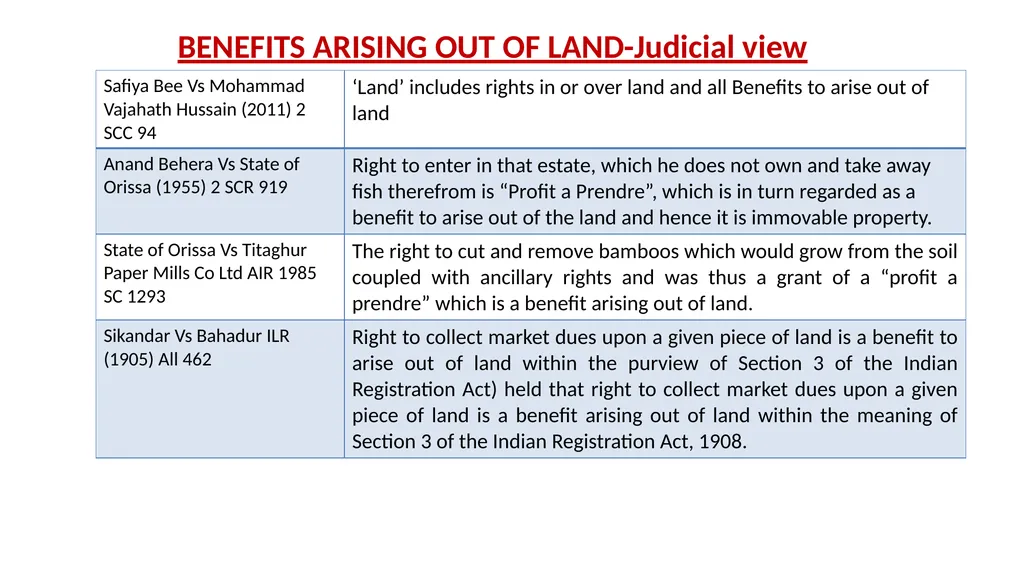
BENEFITS ARISING OUT OF LAND-Judicial view<br>
24
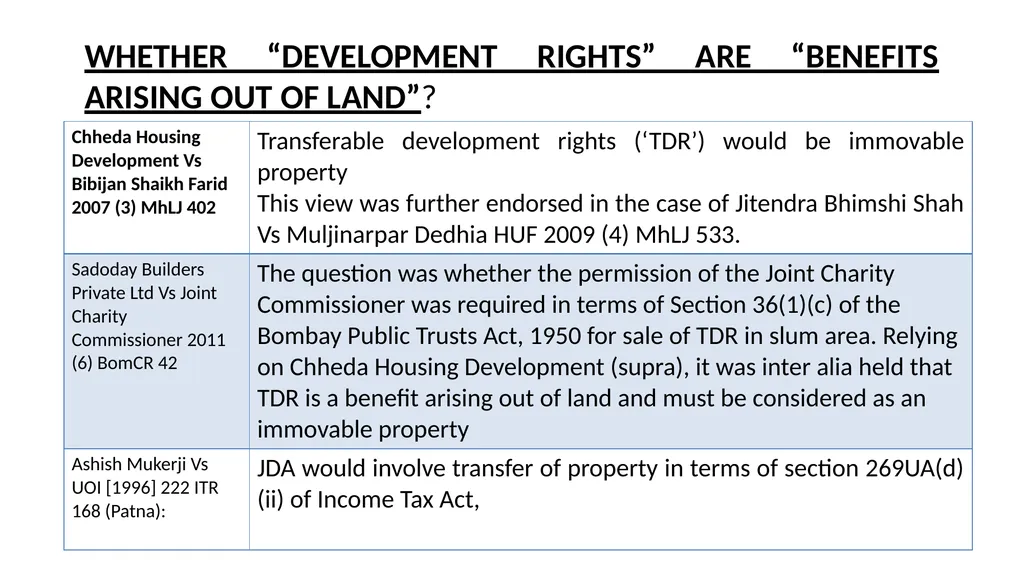
WHETHER “DEVELOPMENT RIGHTS” ARE “BENEFITS ARISING OUT OF LAND”?<br>
25
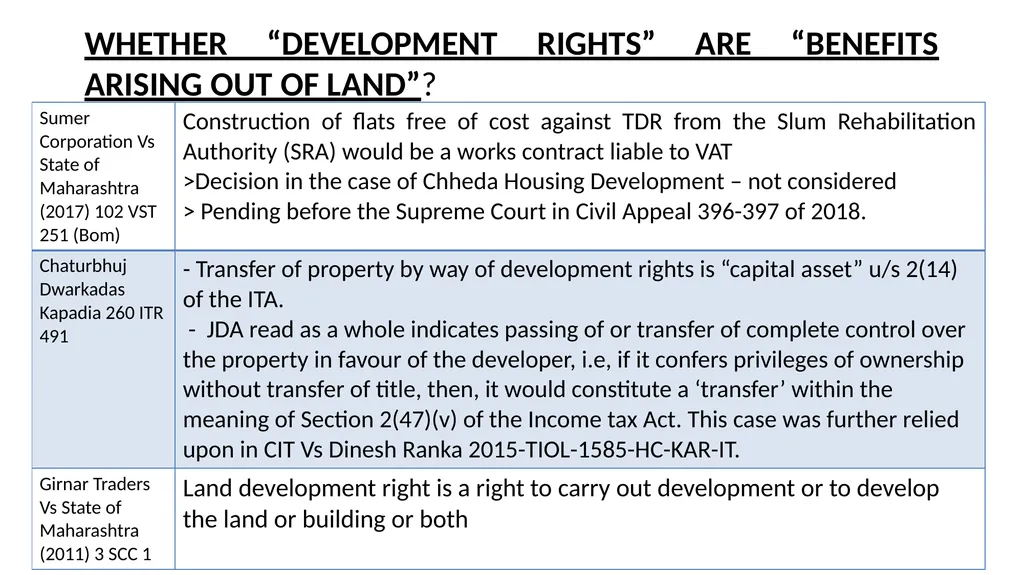
WHETHER “DEVELOPMENT RIGHTS” ARE “BENEFITS ARISING OUT OF LAND”?<br>
26
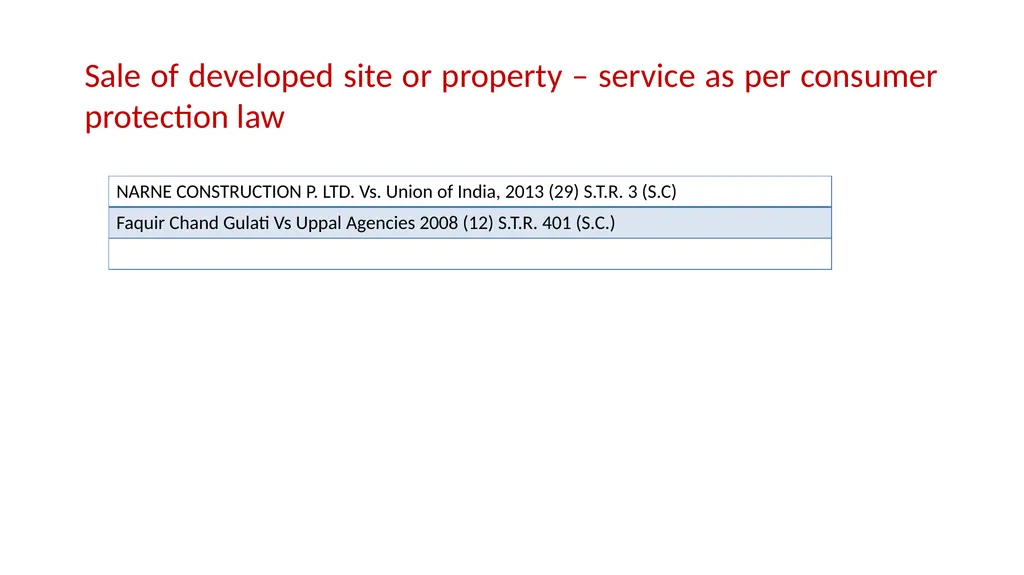
Sale of developed site or property – service as per consumer protection law<br>
27
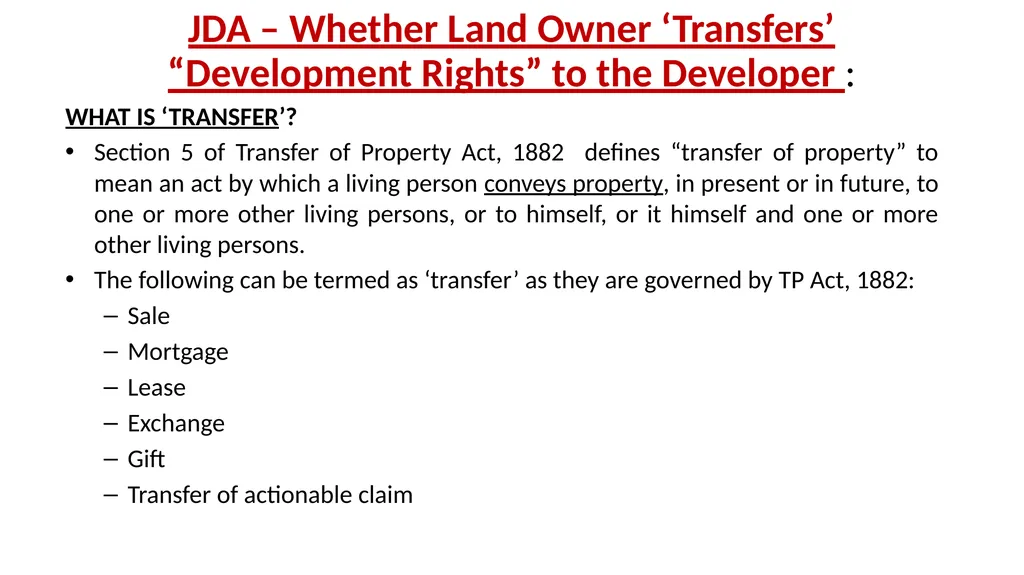
JDA – Whether Land Owner ‘Transfers’ “Development Rights” to the Developer : WHAT IS ‘TRANSFER’?
Section 5 of Transfer of Property Act, 1882 defines “transfer of property” to mean an act by which a living person conveys property, in present or in future, to one or more other living persons, or to himself, or it himself and one or more other living persons.
The following can be termed as ‘transfer’ as they are governed by TP Act, 1882:
Sale
Mortgage
Lease
Exchange
Gift
Transfer of actionable claim<br>
Section 5 of Transfer of Property Act, 1882 defines “transfer of property” to mean an act by which a living person conveys property, in present or in future, to one or more other living persons, or to himself, or it himself and one or more other living persons.
The following can be termed as ‘transfer’ as they are governed by TP Act, 1882:
Sale
Mortgage
Lease
Exchange
Gift
Transfer of actionable claim<br>
28
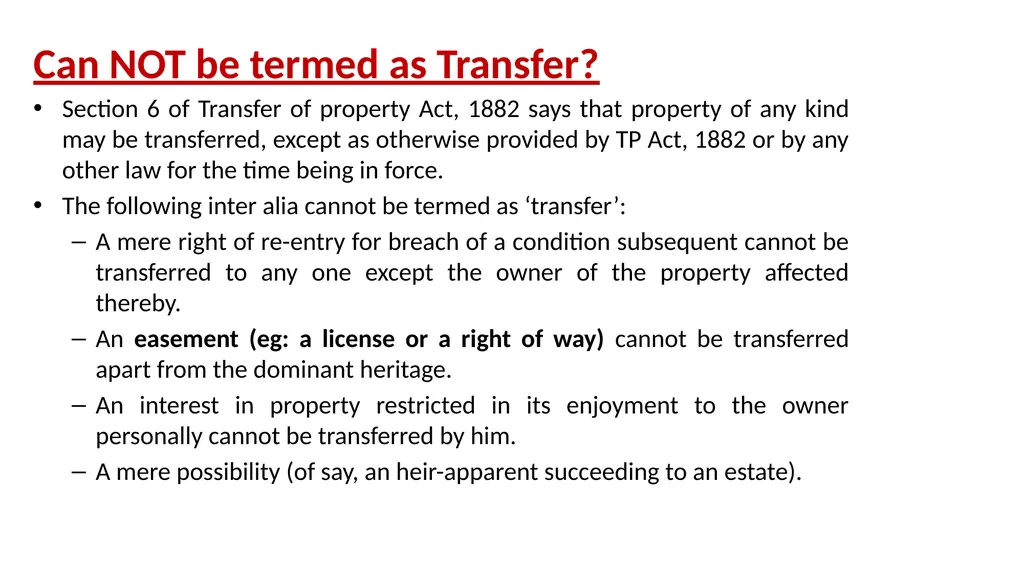
Can NOT be termed as Transfer?
Section 6 of Transfer of property Act, 1882 says that property of any kind may be transferred, except as otherwise provided by TP Act, 1882 or by any other law for the time being in force.
The following inter alia cannot be termed as ‘transfer’:
A mere right of re-entry for breach of a condition subsequent cannot be transferred to any one except the owner of the property affected thereby.
An easement (eg: a license or a right of way) cannot be transferred apart from the dominant heritage.
An interest in property restricted in its enjoyment to the owner personally cannot be transferred by him.
A mere possibility (of say, an heir-apparent succeeding to an estate).<br>
Section 6 of Transfer of property Act, 1882 says that property of any kind may be transferred, except as otherwise provided by TP Act, 1882 or by any other law for the time being in force.
The following inter alia cannot be termed as ‘transfer’:
A mere right of re-entry for breach of a condition subsequent cannot be transferred to any one except the owner of the property affected thereby.
An easement (eg: a license or a right of way) cannot be transferred apart from the dominant heritage.
An interest in property restricted in its enjoyment to the owner personally cannot be transferred by him.
A mere possibility (of say, an heir-apparent succeeding to an estate).<br>
29
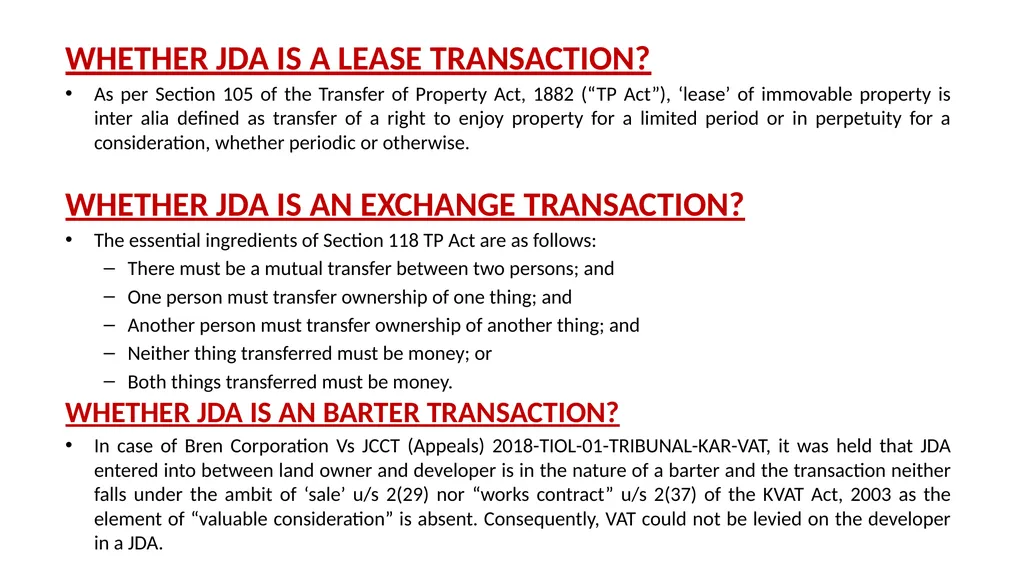
WHETHER JDA IS A LEASE TRANSACTION?
As per Section 105 of the Transfer of Property Act, 1882 (“TP Act”), ‘lease’ of immovable property is inter alia defined as transfer of a right to enjoy property for a limited period or in perpetuity for a consideration, whether periodic or otherwise.
WHETHER JDA IS AN EXCHANGE TRANSACTION?
The essential ingredients of Section 118 TP Act are as follows:
There must be a mutual transfer between two persons; and
One person must transfer ownership of one thing; and
Another person must transfer ownership of another thing; and
Neither thing transferred must be money; or
Both things transferred must be money.
WHETHER JDA IS AN BARTER TRANSACTION?
In case of Bren Corporation Vs JCCT (Appeals) 2018-TIOL-01-TRIBUNAL-KAR-VAT, it was held that JDA entered into between land owner and developer is in the nature of a barter and the transaction neither falls under the ambit of ‘sale’ u/s 2(29) nor “works contract” u/s 2(37) of the KVAT Act, 2003 as the element of “valuable consideration” is absent. Consequently, VAT could not be levied on the developer in a JDA.<br>
As per Section 105 of the Transfer of Property Act, 1882 (“TP Act”), ‘lease’ of immovable property is inter alia defined as transfer of a right to enjoy property for a limited period or in perpetuity for a consideration, whether periodic or otherwise.
WHETHER JDA IS AN EXCHANGE TRANSACTION?
The essential ingredients of Section 118 TP Act are as follows:
There must be a mutual transfer between two persons; and
One person must transfer ownership of one thing; and
Another person must transfer ownership of another thing; and
Neither thing transferred must be money; or
Both things transferred must be money.
WHETHER JDA IS AN BARTER TRANSACTION?
In case of Bren Corporation Vs JCCT (Appeals) 2018-TIOL-01-TRIBUNAL-KAR-VAT, it was held that JDA entered into between land owner and developer is in the nature of a barter and the transaction neither falls under the ambit of ‘sale’ u/s 2(29) nor “works contract” u/s 2(37) of the KVAT Act, 2003 as the element of “valuable consideration” is absent. Consequently, VAT could not be levied on the developer in a JDA.<br>
30
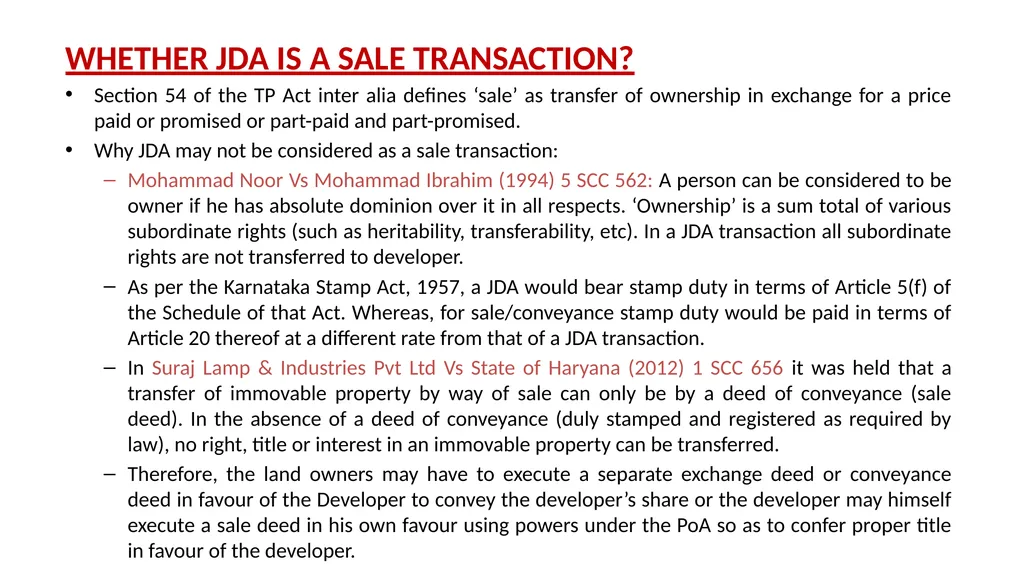
WHETHER JDA IS A SALE TRANSACTION?
Section 54 of the TP Act inter alia defines ‘sale’ as transfer of ownership in exchange for a price paid or promised or part-paid and part-promised.
Why JDA may not be considered as a sale transaction:
Mohammad Noor Vs Mohammad Ibrahim (1994) 5 SCC 562: A person can be considered to be owner if he has absolute dominion over it in all respects. ‘Ownership’ is a sum total of various subordinate rights (such as heritability, transferability, etc). In a JDA transaction all subordinate rights are not transferred to developer.
As per the Karnataka Stamp Act, 1957, a JDA would bear stamp duty in terms of Article 5(f) of the Schedule of that Act. Whereas, for sale/conveyance stamp duty would be paid in terms of Article 20 thereof at a different rate from that of a JDA transaction.
In Suraj Lamp & Industries Pvt Ltd Vs State of Haryana (2012) 1 SCC 656 it was held that a transfer of immovable property by way of sale can only be by a deed of conveyance (sale deed). In the absence of a deed of conveyance (duly stamped and registered as required by law), no right, title or interest in an immovable property can be transferred.
Therefore, the land owners may have to execute a separate exchange deed or conveyance deed in favour of the Developer to convey the developer’s share or the developer may himself execute a sale deed in his own favour using powers under the PoA so as to confer proper title in favour of the developer.<br>
Section 54 of the TP Act inter alia defines ‘sale’ as transfer of ownership in exchange for a price paid or promised or part-paid and part-promised.
Why JDA may not be considered as a sale transaction:
Mohammad Noor Vs Mohammad Ibrahim (1994) 5 SCC 562: A person can be considered to be owner if he has absolute dominion over it in all respects. ‘Ownership’ is a sum total of various subordinate rights (such as heritability, transferability, etc). In a JDA transaction all subordinate rights are not transferred to developer.
As per the Karnataka Stamp Act, 1957, a JDA would bear stamp duty in terms of Article 5(f) of the Schedule of that Act. Whereas, for sale/conveyance stamp duty would be paid in terms of Article 20 thereof at a different rate from that of a JDA transaction.
In Suraj Lamp & Industries Pvt Ltd Vs State of Haryana (2012) 1 SCC 656 it was held that a transfer of immovable property by way of sale can only be by a deed of conveyance (sale deed). In the absence of a deed of conveyance (duly stamped and registered as required by law), no right, title or interest in an immovable property can be transferred.
Therefore, the land owners may have to execute a separate exchange deed or conveyance deed in favour of the Developer to convey the developer’s share or the developer may himself execute a sale deed in his own favour using powers under the PoA so as to confer proper title in favour of the developer.<br>
31
WHETHER JDA IS A LICENSE TRANSACTION?
Section 52 of Easement Act, 1882 defines ‘license’.
Where one person grants to another, or to a definite number of other persons, a right to do, or continue to do, in or upon the immovable property of the grantor, something which would, in the absence of such right, be unlawful, and such right does not amount to an easement or an interest in the property, the right is called a license.
In a ‘license’, there is no creation of interest in property and merely a permission is granted to undertake an activity.
The legal possession , therefore, continues to be with the owner of the property, but the licensee-developer is permitted to make use of the premises for a particular purpose. But for the permission, the occupation of the developer would be unlawful.<br>
Section 52 of Easement Act, 1882 defines ‘license’.
Where one person grants to another, or to a definite number of other persons, a right to do, or continue to do, in or upon the immovable property of the grantor, something which would, in the absence of such right, be unlawful, and such right does not amount to an easement or an interest in the property, the right is called a license.
In a ‘license’, there is no creation of interest in property and merely a permission is granted to undertake an activity.
The legal possession , therefore, continues to be with the owner of the property, but the licensee-developer is permitted to make use of the premises for a particular purpose. But for the permission, the occupation of the developer would be unlawful.<br>
32
WHETHER JDA IS A LICENSE TRANSACTION?
A typical/standard JDA usually contains a clause which states that the land owner shall not revoke the permission granted to the developer (to develop property) under the JDA till completion of the project provided that nothing in the JDA shall be construed as delivery of possession in part performance of any Agreement of Sale under Section 53A of the TP Act.
The intention of such a clause in the JDA is that, after license is given to the developer for effecting construction (as per the JDA) and at a future date, if the land owner wants to evict the developer from the land, the developer should not be allowed to take the defense of having “part-performed” his side of the contract in terms of Section 53A of that Act.
So, by virtue of this clause, a strong argument can also be put forward that the developer is not in ‘possession’ of the immovable property in terms of the said contract and the JDA merely gives him a license to develop the immovable property.<br>
A typical/standard JDA usually contains a clause which states that the land owner shall not revoke the permission granted to the developer (to develop property) under the JDA till completion of the project provided that nothing in the JDA shall be construed as delivery of possession in part performance of any Agreement of Sale under Section 53A of the TP Act.
The intention of such a clause in the JDA is that, after license is given to the developer for effecting construction (as per the JDA) and at a future date, if the land owner wants to evict the developer from the land, the developer should not be allowed to take the defense of having “part-performed” his side of the contract in terms of Section 53A of that Act.
So, by virtue of this clause, a strong argument can also be put forward that the developer is not in ‘possession’ of the immovable property in terms of the said contract and the JDA merely gives him a license to develop the immovable property.<br>
33
WHETHER LAND OWNER ‘TRANSFERS’ “DEVELOPMENT RIGHTS” TO THE DEVELOPER?
Can be argued that development rights are nothing but merely a right to occupy and carry out work on the land and are hence a mere license and there is no transfer.
But since it is irrevocable, it means some interest is passing to the developer. Therefore, it cannot be a mere license.
Neither is it a sale.
Could be an exchange or barter. It may later crystalize as a sale when land owner executes a sale deed in favour of the developer for the developer’s share.
Grey area in law. Need for authoritative ruling.
If development right is not ‘transferred’, no service is said to be provided by land owner to the developer and no GST is attracted.<br>
Can be argued that development rights are nothing but merely a right to occupy and carry out work on the land and are hence a mere license and there is no transfer.
But since it is irrevocable, it means some interest is passing to the developer. Therefore, it cannot be a mere license.
Neither is it a sale.
Could be an exchange or barter. It may later crystalize as a sale when land owner executes a sale deed in favour of the developer for the developer’s share.
Grey area in law. Need for authoritative ruling.
If development right is not ‘transferred’, no service is said to be provided by land owner to the developer and no GST is attracted.<br>
34
JDA – Taxability<br>
35
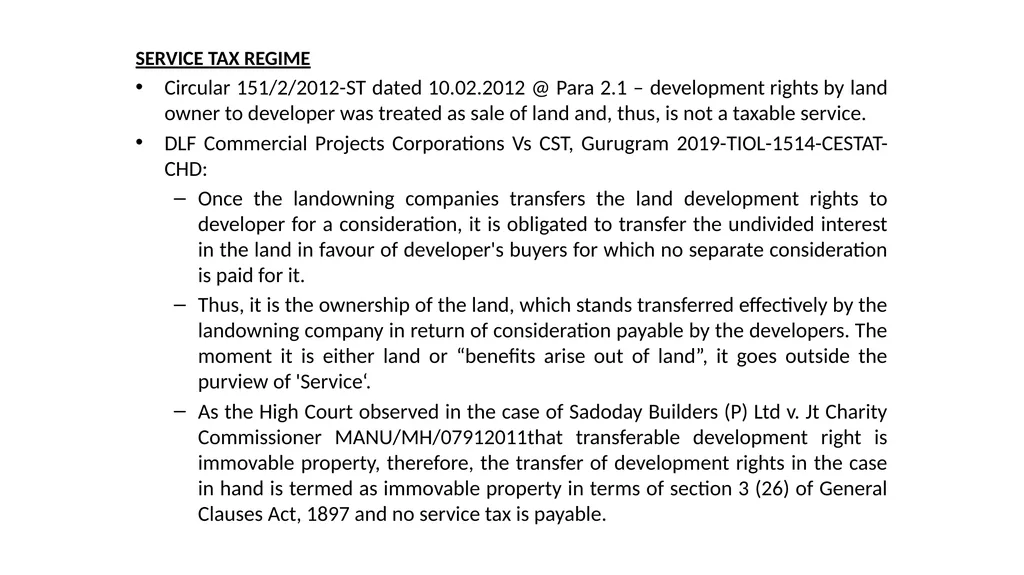
SERVICE TAX REGIME
Circular 151/2/2012-ST dated 10.02.2012 @ Para 2.1 – development rights by land owner to developer was treated as sale of land and, thus, is not a taxable service.
DLF Commercial Projects Corporations Vs CST, Gurugram 2019-TIOL-1514-CESTAT-CHD:
Once the landowning companies transfers the land development rights to developer for a consideration, it is obligated to transfer the undivided interest in the land in favour of developer's buyers for which no separate consideration is paid for it.
Thus, it is the ownership of the land, which stands transferred effectively by the landowning company in return of consideration payable by the developers. The moment it is either land or “benefits arise out of land”, it goes outside the purview of 'Service‘.
As the High Court observed in the case of Sadoday Builders (P) Ltd v. Jt Charity Commissioner MANU/MH/07912011that transferable development right is immovable property, therefore, the transfer of development rights in the case in hand is termed as immovable property in terms of section 3 (26) of General Clauses Act, 1897 and no service tax is payable.<br>
Circular 151/2/2012-ST dated 10.02.2012 @ Para 2.1 – development rights by land owner to developer was treated as sale of land and, thus, is not a taxable service.
DLF Commercial Projects Corporations Vs CST, Gurugram 2019-TIOL-1514-CESTAT-CHD:
Once the landowning companies transfers the land development rights to developer for a consideration, it is obligated to transfer the undivided interest in the land in favour of developer's buyers for which no separate consideration is paid for it.
Thus, it is the ownership of the land, which stands transferred effectively by the landowning company in return of consideration payable by the developers. The moment it is either land or “benefits arise out of land”, it goes outside the purview of 'Service‘.
As the High Court observed in the case of Sadoday Builders (P) Ltd v. Jt Charity Commissioner MANU/MH/07912011that transferable development right is immovable property, therefore, the transfer of development rights in the case in hand is termed as immovable property in terms of section 3 (26) of General Clauses Act, 1897 and no service tax is payable.<br>
36
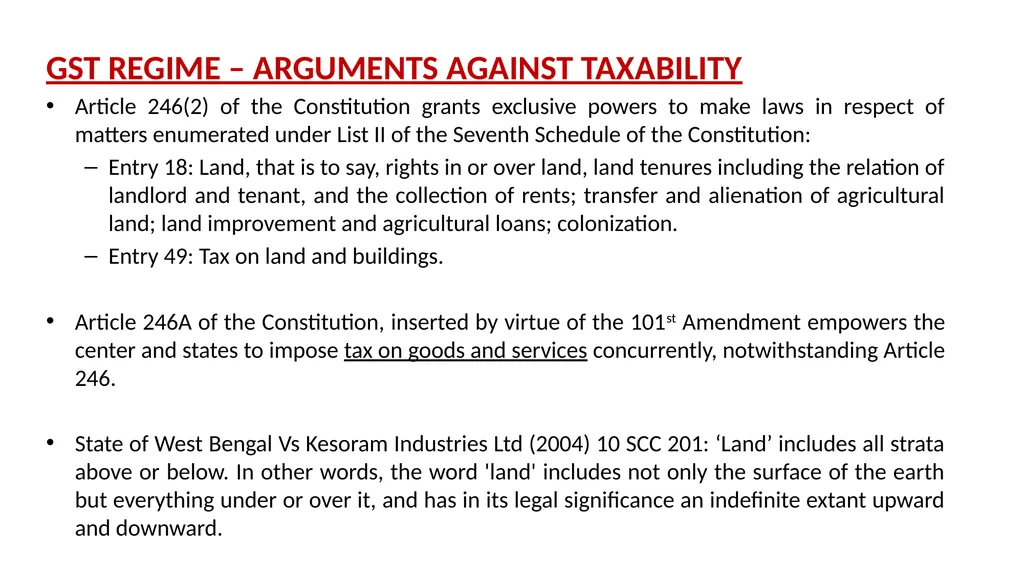
GST REGIME – ARGUMENTS AGAINST TAXABILITY
Article 246(2) of the Constitution grants exclusive powers to make laws in respect of matters enumerated under List II of the Seventh Schedule of the Constitution:
Entry 18: Land, that is to say, rights in or over land, land tenures including the relation of landlord and tenant, and the collection of rents; transfer and alienation of agricultural land; land improvement and agricultural loans; colonization.
Entry 49: Tax on land and buildings.
Article 246A of the Constitution, inserted by virtue of the 101st Amendment empowers the center and states to impose tax on goods and services concurrently, notwithstanding Article 246.
State of West Bengal Vs Kesoram Industries Ltd (2004) 10 SCC 201: ‘Land’ includes all strata above or below. In other words, the word 'land' includes not only the surface of the earth but everything under or over it, and has in its legal significance an indefinite extant upward and downward.<br>
Article 246(2) of the Constitution grants exclusive powers to make laws in respect of matters enumerated under List II of the Seventh Schedule of the Constitution:
Entry 18: Land, that is to say, rights in or over land, land tenures including the relation of landlord and tenant, and the collection of rents; transfer and alienation of agricultural land; land improvement and agricultural loans; colonization.
Entry 49: Tax on land and buildings.
Article 246A of the Constitution, inserted by virtue of the 101st Amendment empowers the center and states to impose tax on goods and services concurrently, notwithstanding Article 246.
State of West Bengal Vs Kesoram Industries Ltd (2004) 10 SCC 201: ‘Land’ includes all strata above or below. In other words, the word 'land' includes not only the surface of the earth but everything under or over it, and has in its legal significance an indefinite extant upward and downward.<br>
37
GST REGIME –
Land Owner
Land owner is ultimately transferring his ownership in land for a consideration which is either in Cash or in the nature of certain share in developed property.
There is no supply of goods or service
Developer
Developer has the right to sell the property constructed on the land.
Hence, the same is squarely covered as “transfer of property (viz. land)” and hence the same will fall in Schedule III.
Taxes on lands and buildings form part of State List (Entry 49 of List II). Hence once it is said that development right is nothing but immovable property(land), GST cannot be levied on its transfer.<br>
Land Owner
Land owner is ultimately transferring his ownership in land for a consideration which is either in Cash or in the nature of certain share in developed property.
There is no supply of goods or service
Developer
Developer has the right to sell the property constructed on the land.
Hence, the same is squarely covered as “transfer of property (viz. land)” and hence the same will fall in Schedule III.
Taxes on lands and buildings form part of State List (Entry 49 of List II). Hence once it is said that development right is nothing but immovable property(land), GST cannot be levied on its transfer.<br>
38
GST REGIME – ARGUMENTS AGAINST TAXABILITY
Schedule II is part of section 7 which deals with scope of supply.
The levy under GST is on supply.
Therefore, section 7 which deals with scope of supply and which influences the charging section has to be construed strictly. Nothing can be read into it which would enlarge the scope of supply and in turn enlarge of the scope of charge. The Supreme Court in Gopal and Sons (HUF) Vs CIT [2017] 391 ITR 1 (SC) reiterated this principle.
The principle of strict interpretation will have to be applied even on this count.<br>
Schedule II is part of section 7 which deals with scope of supply.
The levy under GST is on supply.
Therefore, section 7 which deals with scope of supply and which influences the charging section has to be construed strictly. Nothing can be read into it which would enlarge the scope of supply and in turn enlarge of the scope of charge. The Supreme Court in Gopal and Sons (HUF) Vs CIT [2017] 391 ITR 1 (SC) reiterated this principle.
The principle of strict interpretation will have to be applied even on this count.<br>
39
GST REGIME – ARGUMENTS AGAINST TAXABILITY
Section 7(1A) read with Schedule II is a provision that helps to classify certain transactions if they are in the nature of supply as per section 7.
In Para 2(a) of Schedule II, a fiction has been created stating that “license to occupy land” is supply of service.
In the Supreme Court in CIT Vs Mother India Refrigeration Industries (P) Ltd [1985] 155 ITR 711 (SC) following the decision of the Hon’ble Supreme Court in Bengal Immunity Co Ltd Vs State of Bihar [1955] 2 SCR 603 held that while construing the scope of legal fictions are created only for some definite purpose and these must be limited to that purpose and should not be extended beyond that legitimate field.
Therefore, the question of interpreting the provision in a manner which effectuates the purpose for which the fiction is sought to be created doesn’t arise if the plain reading of the provision doesn’t so warrant.<br>
Section 7(1A) read with Schedule II is a provision that helps to classify certain transactions if they are in the nature of supply as per section 7.
In Para 2(a) of Schedule II, a fiction has been created stating that “license to occupy land” is supply of service.
In the Supreme Court in CIT Vs Mother India Refrigeration Industries (P) Ltd [1985] 155 ITR 711 (SC) following the decision of the Hon’ble Supreme Court in Bengal Immunity Co Ltd Vs State of Bihar [1955] 2 SCR 603 held that while construing the scope of legal fictions are created only for some definite purpose and these must be limited to that purpose and should not be extended beyond that legitimate field.
Therefore, the question of interpreting the provision in a manner which effectuates the purpose for which the fiction is sought to be created doesn’t arise if the plain reading of the provision doesn’t so warrant.<br>
40
GST REGIME – ARGUMENTS AGAINST TAXABILITY
If a JDA was to be construed as giving a license to the developer to develop land, it would not fit into Para 2 of Schedule II of the Act.
Para 2(a) of Schedule II of the Act inter alia specifies that “license to occupy land is supply of services”.
The word ‘occupy’ is defined in Black’s Law Dictionary as “to take possession of”. Therefore, the phrase “licence to occupy land” would cover only those cases where the licensee has a right to occupy a defined piece of property as their own for an agreed period.
It does not entail license to construct on land.<br>
If a JDA was to be construed as giving a license to the developer to develop land, it would not fit into Para 2 of Schedule II of the Act.
Para 2(a) of Schedule II of the Act inter alia specifies that “license to occupy land is supply of services”.
The word ‘occupy’ is defined in Black’s Law Dictionary as “to take possession of”. Therefore, the phrase “licence to occupy land” would cover only those cases where the licensee has a right to occupy a defined piece of property as their own for an agreed period.
It does not entail license to construct on land.<br>
41
GST REGIME – ARGUMENTS AGAINST TAXABILITY
Further, Para 2(b) of Schedule II specifically deals with lease or letting out of building.
It doesn’t include licensing of building. If the intention were to include even building in paragraph 2(a), then paragraph 2(b) becomes otiose.
Moreover, if the intention were to cover land with superstructure, it would have used the expression land or building or both.
Moreover, the intention is not to include licensing of building. Hence, the expression license is conspicuously absent in para 2(b) of Schedule II.<br>
Further, Para 2(b) of Schedule II specifically deals with lease or letting out of building.
It doesn’t include licensing of building. If the intention were to include even building in paragraph 2(a), then paragraph 2(b) becomes otiose.
Moreover, if the intention were to cover land with superstructure, it would have used the expression land or building or both.
Moreover, the intention is not to include licensing of building. Hence, the expression license is conspicuously absent in para 2(b) of Schedule II.<br>
42
GST REGIME – ARGUMENTS AGAINST TAXABILITY
When Schedule II has carved out license to occupy land as supply of services so as to not to give any discretion either to the assessee or to the revenue to contend its nature, it defies logic to state that the rest (other kinds of licenses) which are connected to immovable property would continue to fall under section 7(1)(a).
The legislature has mindfully used the expression “license to occupy land”. It is evident from non-usage of term ‘license’ in Para 2(b) of Schedule II related to building.
Therefore, it is trite to contend that the rest of the categories of licenses would not be liable for GST.
It is irreconcilable to one’s mind that the legislature wanted to deem license to occupy land as supply of service to avoid litigation and did not want to deem rest of the licenses in relation to immovable property as supply of service.<br>
When Schedule II has carved out license to occupy land as supply of services so as to not to give any discretion either to the assessee or to the revenue to contend its nature, it defies logic to state that the rest (other kinds of licenses) which are connected to immovable property would continue to fall under section 7(1)(a).
The legislature has mindfully used the expression “license to occupy land”. It is evident from non-usage of term ‘license’ in Para 2(b) of Schedule II related to building.
Therefore, it is trite to contend that the rest of the categories of licenses would not be liable for GST.
It is irreconcilable to one’s mind that the legislature wanted to deem license to occupy land as supply of service to avoid litigation and did not want to deem rest of the licenses in relation to immovable property as supply of service.<br>
43
GST REGIME – ARGUMENTS AGAINST TAXABILITY
The rights given to a builder are clearly called developmental rights.
Lease or license is an inferior right or a “lesser right” as compared to the developmental right which is the superior right.
The inferior rights would merge into the superior right and therefore, developmental rights would be the defining moment in the transaction.
In this regard, we can refer to the judgment of the constitution Bench of the Supreme Court in Sunrise Associates (2006) 5 SCC 603.
Therefore, it can be argued that development right granted by the land owner under JDA is a superior right and being immovable property, the grant of developmental rights by the land owner cannot be subjected to the levy of GST.<br>
The rights given to a builder are clearly called developmental rights.
Lease or license is an inferior right or a “lesser right” as compared to the developmental right which is the superior right.
The inferior rights would merge into the superior right and therefore, developmental rights would be the defining moment in the transaction.
In this regard, we can refer to the judgment of the constitution Bench of the Supreme Court in Sunrise Associates (2006) 5 SCC 603.
Therefore, it can be argued that development right granted by the land owner under JDA is a superior right and being immovable property, the grant of developmental rights by the land owner cannot be subjected to the levy of GST.<br>
44
GST REGIME – ARGUMENTS IN FAVOR OF TAXABILITY
The definition of ‘supply’ is an inclusive one and purports to cover within its ambit even those activities which are not expressly mentioned but are implied to be part of the definition.
Home Retail Solutions Pvt Ltd Vs UOI 2011 (24) STR 129 (Del). observed that what is being taxed is an activity, and the activity denotes the letting or leasing with a purpose, and the purpose is fundamentally for commercial or business purpose and its furtherance. Once there is a value addition and the element of service is involved, in conceptual essentiality, service tax gets attracted and the impost gets out of the purview of Entry 49 of List II of the Seventh Schedule of the Constitution.
This case has been referred to larger bench of Supreme Court vide order reported in 2018 (13) GSTL 3 SC .<br>
The definition of ‘supply’ is an inclusive one and purports to cover within its ambit even those activities which are not expressly mentioned but are implied to be part of the definition.
Home Retail Solutions Pvt Ltd Vs UOI 2011 (24) STR 129 (Del). observed that what is being taxed is an activity, and the activity denotes the letting or leasing with a purpose, and the purpose is fundamentally for commercial or business purpose and its furtherance. Once there is a value addition and the element of service is involved, in conceptual essentiality, service tax gets attracted and the impost gets out of the purview of Entry 49 of List II of the Seventh Schedule of the Constitution.
This case has been referred to larger bench of Supreme Court vide order reported in 2018 (13) GSTL 3 SC .<br>
45
WHETHER SUPPLY (OF DEVELOPMENT RIGHTS BY THE LANDOWNER TO THE DEVELOPER) IS MADE FOR A CONSIDERATION?
One way of looking at the transaction is that for transfer of development rights, the consideration is the construction activity provided by the developer.
In terms of Section 2(31)(b), the monetary value of the construction service provided by the developer in response to the transfer of development rights by the landowner to the developer can be said to be the consideration.
Alternatively, the consideration for the transfer of developmental right would be to get a portion of the building constructed / land developed by the developer. Both being immovable properties (developmental rights as well as the building constructed or land developed), the same cannot brought to tax under GST.<br>
One way of looking at the transaction is that for transfer of development rights, the consideration is the construction activity provided by the developer.
In terms of Section 2(31)(b), the monetary value of the construction service provided by the developer in response to the transfer of development rights by the landowner to the developer can be said to be the consideration.
Alternatively, the consideration for the transfer of developmental right would be to get a portion of the building constructed / land developed by the developer. Both being immovable properties (developmental rights as well as the building constructed or land developed), the same cannot brought to tax under GST.<br>
46
WHETHER SUPPLY (OF DEVELOPMENT RIGHTS BY THE LANDOWNER TO THE DEVELOPER) IS MADE “IN THE COURSE OR FURTHERANCE OF BUSINESS”?
‘Business’ is defined in Section 2(17) of the CGST Act in a wide manner.
Circular F. No. 354/32/2019-TRU dated 07.05.2019, it has been clarified in the affirmative at Sl No. 39.<br>
‘Business’ is defined in Section 2(17) of the CGST Act in a wide manner.
Circular F. No. 354/32/2019-TRU dated 07.05.2019, it has been clarified in the affirmative at Sl No. 39.<br>
47
Taxability of Works Contract L&T Ltd Vs State of Karnataka 2014 (303) ELT 3 (SC)
Even though the ultimate transaction between the parties may be sale of the flat, it cannot be said that the characteristics of works contract are not involved in that transaction because the term “works contract” is nothing but a contract in which one of the parties is obliged to undertake or to execute the work and such an activity of construction bears all the characteristics and elements of works contract.
Works contract comes into picture only where there is an agreement to sell / construct and sell with a third party is entered into and from the date of such agreement.
Conversely, the construction activity undertaken by the developer on the land of the owner under the joint development agreement would not be a works contract if, either the said flat is sold after completion of the apartment or the flat is retained by the developer or by the owner.<br>
Even though the ultimate transaction between the parties may be sale of the flat, it cannot be said that the characteristics of works contract are not involved in that transaction because the term “works contract” is nothing but a contract in which one of the parties is obliged to undertake or to execute the work and such an activity of construction bears all the characteristics and elements of works contract.
Works contract comes into picture only where there is an agreement to sell / construct and sell with a third party is entered into and from the date of such agreement.
Conversely, the construction activity undertaken by the developer on the land of the owner under the joint development agreement would not be a works contract if, either the said flat is sold after completion of the apartment or the flat is retained by the developer or by the owner.<br>
48
JDA – Point of Taxation and valuation<br>
49
Prior to 1.4.2019<br>
50
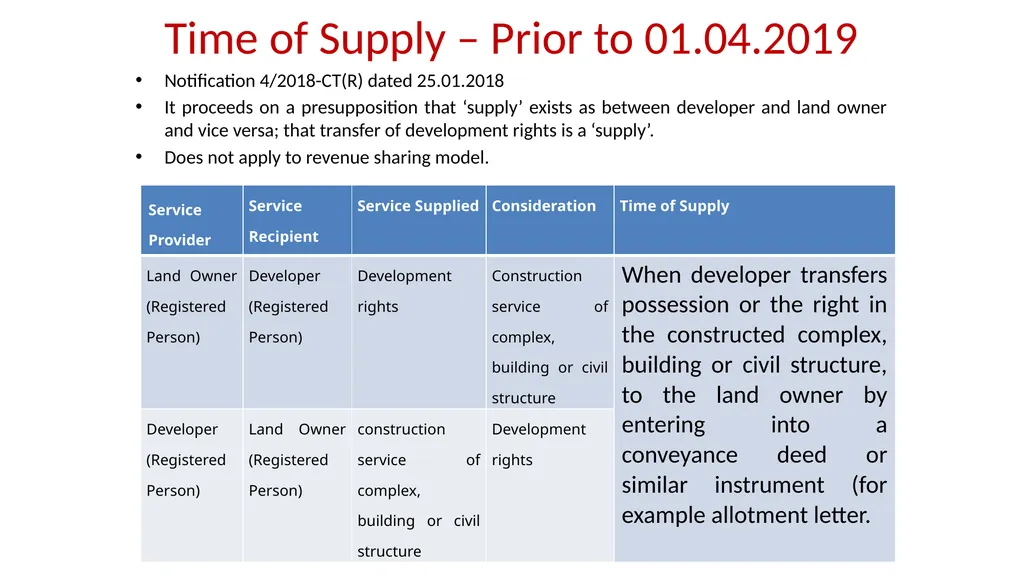
Time of Supply – Prior to 01.04.2019 Notification 4/2018-CT(R) dated 25.01.2018
It proceeds on a presupposition that ‘supply’ exists as between developer and land owner and vice versa; that transfer of development rights is a ‘supply’.
Does not apply to revenue sharing model.<br>
It proceeds on a presupposition that ‘supply’ exists as between developer and land owner and vice versa; that transfer of development rights is a ‘supply’.
Does not apply to revenue sharing model.<br>
51
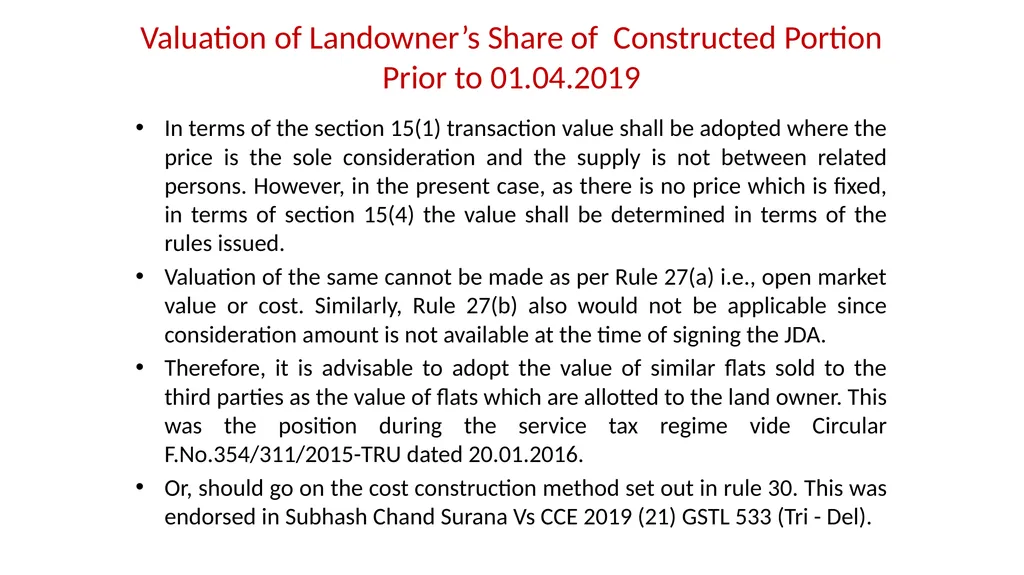
Valuation of Landowner’s Share of Constructed Portion Prior to 01.04.2019 In terms of the section 15(1) transaction value shall be adopted where the price is the sole consideration and the supply is not between related persons. However, in the present case, as there is no price which is fixed, in terms of section 15(4) the value shall be determined in terms of the rules issued.
Valuation of the same cannot be made as per Rule 27(a) i.e., open market value or cost. Similarly, Rule 27(b) also would not be applicable since consideration amount is not available at the time of signing the JDA.
Therefore, it is advisable to adopt the value of similar flats sold to the third parties as the value of flats which are allotted to the land owner. This was the position during the service tax regime vide Circular F.No.354/311/2015-TRU dated 20.01.2016.
Or, should go on the cost construction method set out in rule 30. This was endorsed in Subhash Chand Surana Vs CCE 2019 (21) GSTL 533 (Tri - Del).<br>
Valuation of the same cannot be made as per Rule 27(a) i.e., open market value or cost. Similarly, Rule 27(b) also would not be applicable since consideration amount is not available at the time of signing the JDA.
Therefore, it is advisable to adopt the value of similar flats sold to the third parties as the value of flats which are allotted to the land owner. This was the position during the service tax regime vide Circular F.No.354/311/2015-TRU dated 20.01.2016.
Or, should go on the cost construction method set out in rule 30. This was endorsed in Subhash Chand Surana Vs CCE 2019 (21) GSTL 533 (Tri - Del).<br>
52
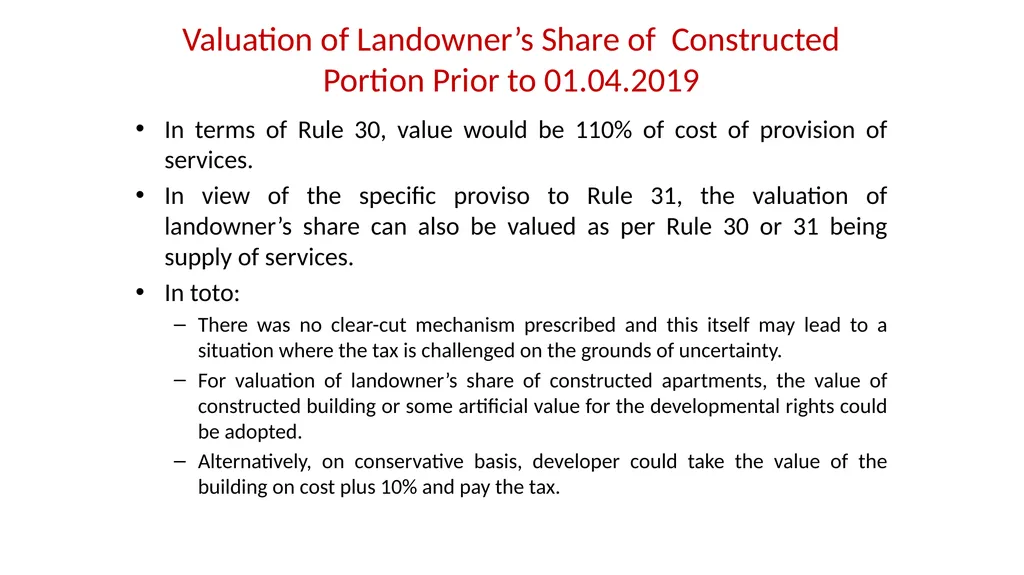
Valuation of Landowner’s Share of Constructed Portion Prior to 01.04.2019 In terms of Rule 30, value would be 110% of cost of provision of services.
In view of the specific proviso to Rule 31, the valuation of landowner’s share can also be valued as per Rule 30 or 31 being supply of services.
In toto:
There was no clear-cut mechanism prescribed and this itself may lead to a situation where the tax is challenged on the grounds of uncertainty.
For valuation of landowner’s share of constructed apartments, the value of constructed building or some artificial value for the developmental rights could be adopted.
Alternatively, on conservative basis, developer could take the value of the building on cost plus 10% and pay the tax.<br>
In view of the specific proviso to Rule 31, the valuation of landowner’s share can also be valued as per Rule 30 or 31 being supply of services.
In toto:
There was no clear-cut mechanism prescribed and this itself may lead to a situation where the tax is challenged on the grounds of uncertainty.
For valuation of landowner’s share of constructed apartments, the value of constructed building or some artificial value for the developmental rights could be adopted.
Alternatively, on conservative basis, developer could take the value of the building on cost plus 10% and pay the tax.<br>
53
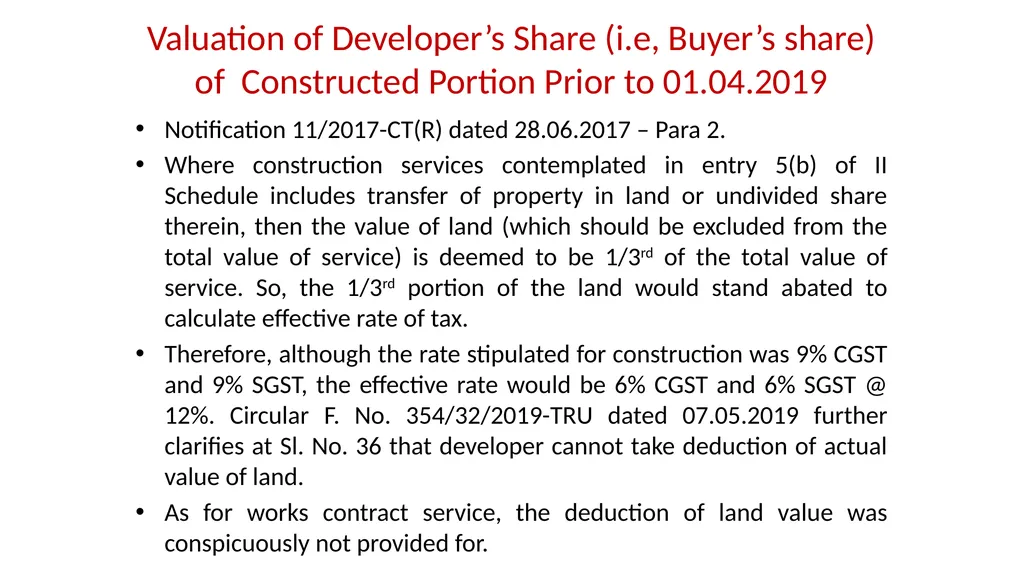
Valuation of Developer’s Share (i.e, Buyer’s share) of Constructed Portion Prior to 01.04.2019 Notification 11/2017-CT(R) dated 28.06.2017 – Para 2.
Where construction services contemplated in entry 5(b) of II Schedule includes transfer of property in land or undivided share therein, then the value of land (which should be excluded from the total value of service) is deemed to be 1/3rd of the total value of service. So, the 1/3rd portion of the land would stand abated to calculate effective rate of tax.
Therefore, although the rate stipulated for construction was 9% CGST and 9% SGST, the effective rate would be 6% CGST and 6% SGST @ 12%. Circular F. No. 354/32/2019-TRU dated 07.05.2019 further clarifies at Sl. No. 36 that developer cannot take deduction of actual value of land.
As for works contract service, the deduction of land value was conspicuously not provided for.<br>
Where construction services contemplated in entry 5(b) of II Schedule includes transfer of property in land or undivided share therein, then the value of land (which should be excluded from the total value of service) is deemed to be 1/3rd of the total value of service. So, the 1/3rd portion of the land would stand abated to calculate effective rate of tax.
Therefore, although the rate stipulated for construction was 9% CGST and 9% SGST, the effective rate would be 6% CGST and 6% SGST @ 12%. Circular F. No. 354/32/2019-TRU dated 07.05.2019 further clarifies at Sl. No. 36 that developer cannot take deduction of actual value of land.
As for works contract service, the deduction of land value was conspicuously not provided for.<br>
54
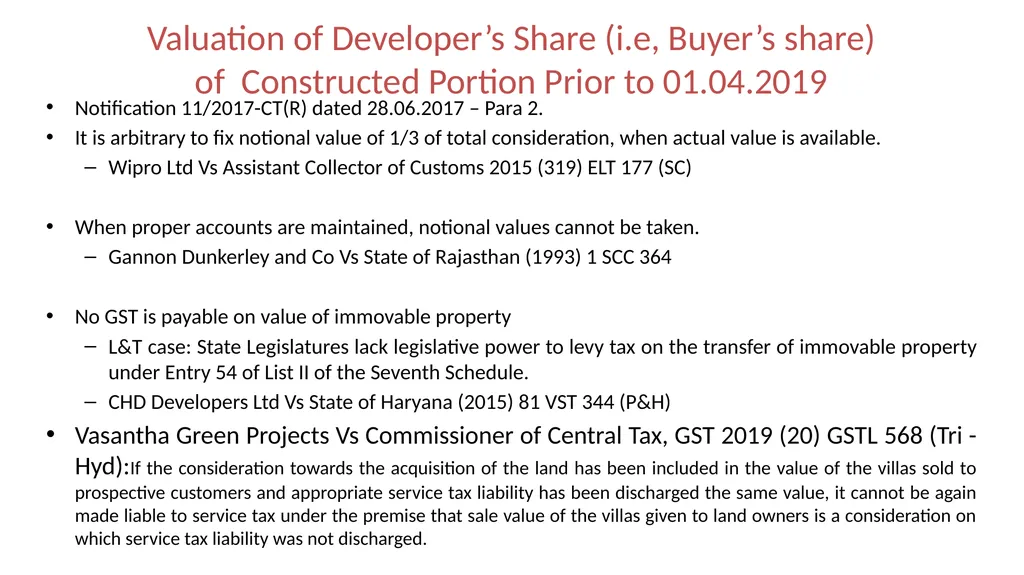
Valuation of Developer’s Share (i.e, Buyer’s share) of Constructed Portion Prior to 01.04.2019 Notification 11/2017-CT(R) dated 28.06.2017 – Para 2.
It is arbitrary to fix notional value of 1/3 of total consideration, when actual value is available.
Wipro Ltd Vs Assistant Collector of Customs 2015 (319) ELT 177 (SC)
When proper accounts are maintained, notional values cannot be taken.
Gannon Dunkerley and Co Vs State of Rajasthan (1993) 1 SCC 364
No GST is payable on value of immovable property
L&T case: State Legislatures lack legislative power to levy tax on the transfer of immovable property under Entry 54 of List II of the Seventh Schedule.
CHD Developers Ltd Vs State of Haryana (2015) 81 VST 344 (P&H)
Vasantha Green Projects Vs Commissioner of Central Tax, GST 2019 (20) GSTL 568 (Tri - Hyd):If the consideration towards the acquisition of the land has been included in the value of the villas sold to prospective customers and appropriate service tax liability has been discharged the same value, it cannot be again made liable to service tax under the premise that sale value of the villas given to land owners is a consideration on which service tax liability was not discharged.<br>
It is arbitrary to fix notional value of 1/3 of total consideration, when actual value is available.
Wipro Ltd Vs Assistant Collector of Customs 2015 (319) ELT 177 (SC)
When proper accounts are maintained, notional values cannot be taken.
Gannon Dunkerley and Co Vs State of Rajasthan (1993) 1 SCC 364
No GST is payable on value of immovable property
L&T case: State Legislatures lack legislative power to levy tax on the transfer of immovable property under Entry 54 of List II of the Seventh Schedule.
CHD Developers Ltd Vs State of Haryana (2015) 81 VST 344 (P&H)
Vasantha Green Projects Vs Commissioner of Central Tax, GST 2019 (20) GSTL 568 (Tri - Hyd):If the consideration towards the acquisition of the land has been included in the value of the villas sold to prospective customers and appropriate service tax liability has been discharged the same value, it cannot be again made liable to service tax under the premise that sale value of the villas given to land owners is a consideration on which service tax liability was not discharged.<br>
55
From 1.4.2019 onwards<br>
56
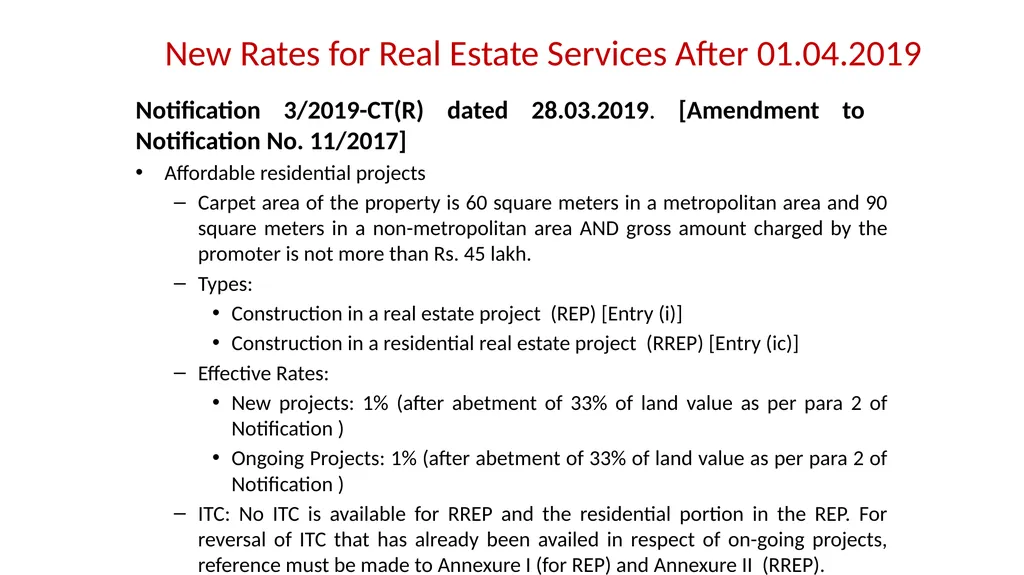
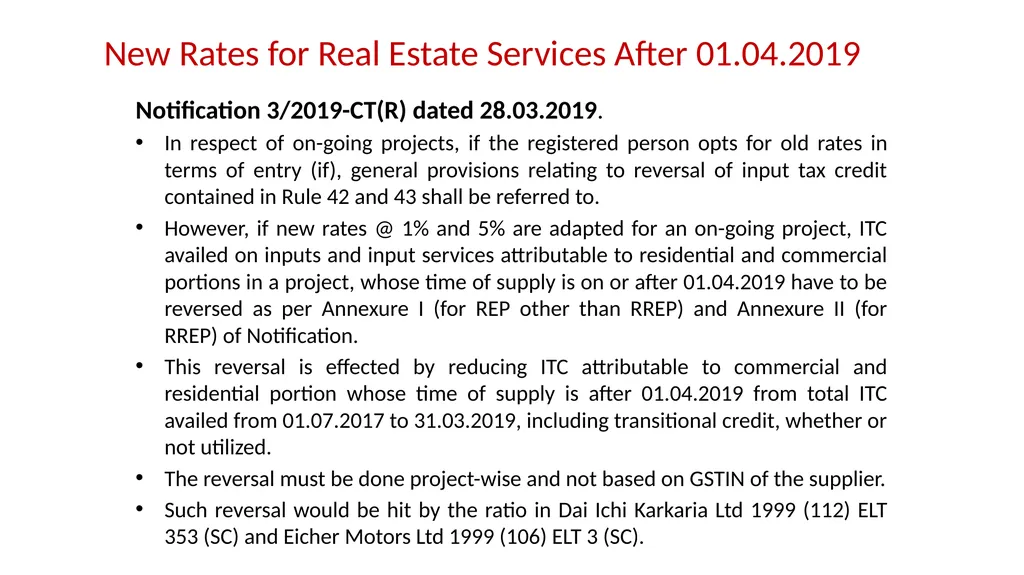
New Rates for Real Estate Services After 01.04.2019 Notification 3/2019-CT(R) dated 28.03.2019. [Amendment to Notification No. 11/2017]
Affordable residential projects
Carpet area of the property is 60 square meters in a metropolitan area and 90 square meters in a non-metropolitan area AND gross amount charged by the promoter is not more than Rs. 45 lakh.
Types:
Construction in a real estate project (REP) [Entry (i)]
Construction in a residential real estate project (RREP) [Entry (ic)]
Effective Rates:
New projects: 1% (after abetment of 33% of land value as per para 2 of Notification )
Ongoing Projects: 1% (after abetment of 33% of land value as per para 2 of Notification )
ITC: No ITC is available for RREP and the residential portion in the REP. For reversal of ITC that has already been availed in respect of on-going projects, reference must be made to Annexure I (for REP) and Annexure II (RREP).<br>
Affordable residential projects
Carpet area of the property is 60 square meters in a metropolitan area and 90 square meters in a non-metropolitan area AND gross amount charged by the promoter is not more than Rs. 45 lakh.
Types:
Construction in a real estate project (REP) [Entry (i)]
Construction in a residential real estate project (RREP) [Entry (ic)]
Effective Rates:
New projects: 1% (after abetment of 33% of land value as per para 2 of Notification )
Ongoing Projects: 1% (after abetment of 33% of land value as per para 2 of Notification )
ITC: No ITC is available for RREP and the residential portion in the REP. For reversal of ITC that has already been availed in respect of on-going projects, reference must be made to Annexure I (for REP) and Annexure II (RREP).<br>
57
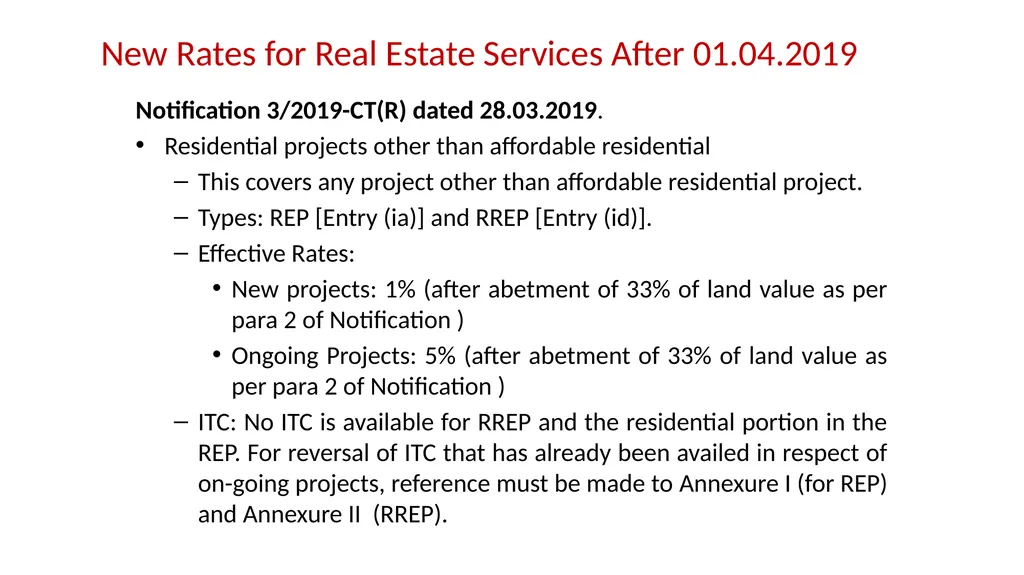
New Rates for Real Estate Services After 01.04.2019 Notification 3/2019-CT(R) dated 28.03.2019.
Residential projects other than affordable residential
This covers any project other than affordable residential project.
Types: REP [Entry (ia)] and RREP [Entry (id)].
Effective Rates:
New projects: 1% (after abetment of 33% of land value as per para 2 of Notification )
Ongoing Projects: 5% (after abetment of 33% of land value as per para 2 of Notification )
ITC: No ITC is available for RREP and the residential portion in the REP. For reversal of ITC that has already been availed in respect of on-going projects, reference must be made to Annexure I (for REP) and Annexure II (RREP).<br>
Residential projects other than affordable residential
This covers any project other than affordable residential project.
Types: REP [Entry (ia)] and RREP [Entry (id)].
Effective Rates:
New projects: 1% (after abetment of 33% of land value as per para 2 of Notification )
Ongoing Projects: 5% (after abetment of 33% of land value as per para 2 of Notification )
ITC: No ITC is available for RREP and the residential portion in the REP. For reversal of ITC that has already been availed in respect of on-going projects, reference must be made to Annexure I (for REP) and Annexure II (RREP).<br>
58
New Rates for Real Estate Services After 01.04.2019 Notification 3/2019-CT(R) dated 28.03.2019.
Commercial apartments in RREP
This covers 15% carpet area in the REP.
Types: RREP only [Entry (ib)].
Effective Rates:
New projects: 5% (after abetment of 33% of land value as per para 2 of Notification )
Ongoing Projects: 5% (after abetment of 33% of land value as per para 2 of Notification )
ITC: No ITC is available for RREP and the residential portion in the REP. For reversal of ITC that has already been availed in respect of on-going projects, reference must be made to Annexure I (for REP) and Annexure II (RREP).<br>
Commercial apartments in RREP
This covers 15% carpet area in the REP.
Types: RREP only [Entry (ib)].
Effective Rates:
New projects: 5% (after abetment of 33% of land value as per para 2 of Notification )
Ongoing Projects: 5% (after abetment of 33% of land value as per para 2 of Notification )
ITC: No ITC is available for RREP and the residential portion in the REP. For reversal of ITC that has already been availed in respect of on-going projects, reference must be made to Annexure I (for REP) and Annexure II (RREP).<br>
59
New Rates for Real Estate Services After 01.04.2019 Notification 3/2019-CT(R) dated 28.03.2019.
Other commercial Constructions
This covers Construction of a complex, building, civil structure or a part thereof, including:
Commercial apartments (shops, offices, godowns etc.) by a promoter in a REP other than RREP.
Residential apartments in an ongoing project, other than affordable residential apartments, in respect of which the promoter has exercised option to pay central tax on construction of apartments at the rates as specified for this item in the manner prescribed herein.
Effective Rates: 6% (after abetment of 33% of land value as per para 2 of Notification) as per Entry (if)
ITC: Available<br>
Other commercial Constructions
This covers Construction of a complex, building, civil structure or a part thereof, including:
Commercial apartments (shops, offices, godowns etc.) by a promoter in a REP other than RREP.
Residential apartments in an ongoing project, other than affordable residential apartments, in respect of which the promoter has exercised option to pay central tax on construction of apartments at the rates as specified for this item in the manner prescribed herein.
Effective Rates: 6% (after abetment of 33% of land value as per para 2 of Notification) as per Entry (if)
ITC: Available<br>
60
New Rates for Real Estate Services After 01.04.2019 Notification 3/2019-CT(R) dated 28.03.2019.
Meaning of Construction in REP: Construction by way of development of a building or a building consisting of apartments , or converting an existing building or a part thereof into apartments, or the development of land into plots or apartment, as the case may be, for the purpose of selling all or some of the said apartments or plots or building, as the case may be, and includes the common areas, the development works, all improvements and structures thereon, and all easement, rights and appurtenances belonging thereto.
Meaning of Construction in RREP: Construction of residential apartment is a REP in which the carpet area of the commercial apartments is not more than 15% of the total carpet area of all the apartments in the REP.<br>
Meaning of Construction in REP: Construction by way of development of a building or a building consisting of apartments , or converting an existing building or a part thereof into apartments, or the development of land into plots or apartment, as the case may be, for the purpose of selling all or some of the said apartments or plots or building, as the case may be, and includes the common areas, the development works, all improvements and structures thereon, and all easement, rights and appurtenances belonging thereto.
Meaning of Construction in RREP: Construction of residential apartment is a REP in which the carpet area of the commercial apartments is not more than 15% of the total carpet area of all the apartments in the REP.<br>
61
New Rates for Real Estate Services After 01.04.2019 Notification 3/2019-CT(R) dated 28.03.2019.
Meaning of “Ongoing Projects”:
In respect of on-going projects, there is a one-time option to pay tax at 6%+6% with ITC if form prescribed in Annexure 4 is submitted on or before 10th May 2019. However, it is compulsory to opt entries (i), (ia), (ib), (ic), (id), (ie) or (if), as the case may be, in respect of new projects.<br>
Meaning of “Ongoing Projects”:
In respect of on-going projects, there is a one-time option to pay tax at 6%+6% with ITC if form prescribed in Annexure 4 is submitted on or before 10th May 2019. However, it is compulsory to opt entries (i), (ia), (ib), (ic), (id), (ie) or (if), as the case may be, in respect of new projects.<br>
62
New Rates for Real Estate Services After 01.04.2019 Notification 3/2019-CT(R) dated 28.03.2019.
This applies to all new projects that would commence only on or after 31.03.2019.
Supplier procure more than 20% of inputs from unregistered dealers.
For new projects, opting the new rates at 1% and 5% without ITC is mandatory. Consequently, all conditions provided for in the notification for following of new rates for new projects must mandatorily complied.
This could be argued as being unconstitutional as, even if there is a residual entry (xii) @ 18% tax with ITC, the benefit of the same is prohibited to be taken.
CIT Vs G.V. Venugopal (2005) 273 ITR 307 (Mad): Where there were several provisions granting a certain twin benefits and other provisions that specifically prohibited the twin benefits, assessee is entitled to opt for the provisions giving twin benefits, if he was otherwise eligible.
Similar observations were made in CCE Vs Indian Petro Chemicals (1997) 92 ELT 13 (SC) and Share Medical Care Vs Union of India 2007 (209) ELT 321 (SC)<br>
This applies to all new projects that would commence only on or after 31.03.2019.
Supplier procure more than 20% of inputs from unregistered dealers.
For new projects, opting the new rates at 1% and 5% without ITC is mandatory. Consequently, all conditions provided for in the notification for following of new rates for new projects must mandatorily complied.
This could be argued as being unconstitutional as, even if there is a residual entry (xii) @ 18% tax with ITC, the benefit of the same is prohibited to be taken.
CIT Vs G.V. Venugopal (2005) 273 ITR 307 (Mad): Where there were several provisions granting a certain twin benefits and other provisions that specifically prohibited the twin benefits, assessee is entitled to opt for the provisions giving twin benefits, if he was otherwise eligible.
Similar observations were made in CCE Vs Indian Petro Chemicals (1997) 92 ELT 13 (SC) and Share Medical Care Vs Union of India 2007 (209) ELT 321 (SC)<br>
63
New Rates for Real Estate Services After 01.04.2019 Notification 3/2019-CT(R) dated 28.03.2019.
In respect of on-going projects, if the registered person opts for old rates in terms of entry (if), general provisions relating to reversal of input tax credit contained in Rule 42 and 43 shall be referred to.
However, if new rates @ 1% and 5% are adapted for an on-going project, ITC availed on inputs and input services attributable to residential and commercial portions in a project, whose time of supply is on or after 01.04.2019 have to be reversed as per Annexure I (for REP other than RREP) and Annexure II (for RREP) of Notification.
This reversal is effected by reducing ITC attributable to commercial and residential portion whose time of supply is after 01.04.2019 from total ITC availed from 01.07.2017 to 31.03.2019, including transitional credit, whether or not utilized.
The reversal must be done project-wise and not based on GSTIN of the supplier.
Such reversal would be hit by the ratio in Dai Ichi Karkaria Ltd 1999 (112) ELT 353 (SC) and Eicher Motors Ltd 1999 (106) ELT 3 (SC).<br>
In respect of on-going projects, if the registered person opts for old rates in terms of entry (if), general provisions relating to reversal of input tax credit contained in Rule 42 and 43 shall be referred to.
However, if new rates @ 1% and 5% are adapted for an on-going project, ITC availed on inputs and input services attributable to residential and commercial portions in a project, whose time of supply is on or after 01.04.2019 have to be reversed as per Annexure I (for REP other than RREP) and Annexure II (for RREP) of Notification.
This reversal is effected by reducing ITC attributable to commercial and residential portion whose time of supply is after 01.04.2019 from total ITC availed from 01.07.2017 to 31.03.2019, including transitional credit, whether or not utilized.
The reversal must be done project-wise and not based on GSTIN of the supplier.
Such reversal would be hit by the ratio in Dai Ichi Karkaria Ltd 1999 (112) ELT 353 (SC) and Eicher Motors Ltd 1999 (106) ELT 3 (SC).<br>
64
Valuation of Development Rights After 01.04.2019 Notification 4/2019-CT(R) dated 29.03.2019.
This notification adds Entry 41A and 41B to the Exemption Notification 12/2017-CT(R).
Supply of development rights by the land owner on or after 01.04.2019 for construction of residential apartments in a project is exempt subject to the following conditions:
it must be intended for sale to a buyer; and
entire consideration must be received by land owner prior to completion certificate.
However, if the said conditions are not fulfilled, the developer is liable to pay GST on reverse charge basis (as per Notification 5/2019, discussed below) on proportionate value of development rights as is attributable to the residential apartments, which remain un-booked on the date of issuance of completion certificate at 5%.<br>
This notification adds Entry 41A and 41B to the Exemption Notification 12/2017-CT(R).
Supply of development rights by the land owner on or after 01.04.2019 for construction of residential apartments in a project is exempt subject to the following conditions:
it must be intended for sale to a buyer; and
entire consideration must be received by land owner prior to completion certificate.
However, if the said conditions are not fulfilled, the developer is liable to pay GST on reverse charge basis (as per Notification 5/2019, discussed below) on proportionate value of development rights as is attributable to the residential apartments, which remain un-booked on the date of issuance of completion certificate at 5%.<br>
65
Valuation of Development Rights After 01.04.2019 Notification 4/2019-CT(R) dated 29.03.2019.
GST on TDR which is exempt is as follows:
GST on TDR which may become payable is as follows<br>
GST on TDR which is exempt is as follows:
GST on TDR which may become payable is as follows<br>
66
Valuation of Development Rights After 01.04.2019 Notification 4/2019-CT(R) dated 29.03.2019.
Para 1A and 1B of the said notification provides for valuation of development rights in respect of residential and commercial apartments.
Value of development rights or FSI by shall be deemed to be equal to the value of similar apartments charged by the promoter from the independent buyers nearest to the date on which such development rights or FSI is transferred to the promoter.
Value of portion of residential or commercial apartments remaining un-booked on the date of issuance of completion certificate or first occupation, as the case may be, shall be deemed to be equal to the value of similar apartments charged by the promoter nearest to the date of issuance of completion certificate or first occupation, as the case may be.<br>
Para 1A and 1B of the said notification provides for valuation of development rights in respect of residential and commercial apartments.
Value of development rights or FSI by shall be deemed to be equal to the value of similar apartments charged by the promoter from the independent buyers nearest to the date on which such development rights or FSI is transferred to the promoter.
Value of portion of residential or commercial apartments remaining un-booked on the date of issuance of completion certificate or first occupation, as the case may be, shall be deemed to be equal to the value of similar apartments charged by the promoter nearest to the date of issuance of completion certificate or first occupation, as the case may be.<br>
67
Valuation of Development Rights After 01.04.2019 Notification 4/2019-CT(R) dated 29.03.2019.
Developer would be eligible to claim exemption from payment of tax on the developmental rights (transferred by the land owner) utilized for construction of residential apartments to the extent of flats booked prior to issuance of completion certificate. Consequently, question of claiming credit thereon also would not arise.
However, to the extent of the un-booked flats as on 01.04.2019, developer should remit the tax on developmental rights at 18% as aforementioned. Here again, he would not be eligible to claim input tax credit due to the reason that the output services i.e. sale of un-booked flats are treated as exempt supply and consequently, restriction under section 17(3) would apply.
This is also clarified vide Sl No. 6 and 7 of Circular F. No. 354/32/2019-TRU dated 14.05.2019.<br>
Developer would be eligible to claim exemption from payment of tax on the developmental rights (transferred by the land owner) utilized for construction of residential apartments to the extent of flats booked prior to issuance of completion certificate. Consequently, question of claiming credit thereon also would not arise.
However, to the extent of the un-booked flats as on 01.04.2019, developer should remit the tax on developmental rights at 18% as aforementioned. Here again, he would not be eligible to claim input tax credit due to the reason that the output services i.e. sale of un-booked flats are treated as exempt supply and consequently, restriction under section 17(3) would apply.
This is also clarified vide Sl No. 6 and 7 of Circular F. No. 354/32/2019-TRU dated 14.05.2019.<br>
68
Who is Liable to Pay Tax on Transfer of Development Rights after 01.04.2019 Notification No. 05/2019–CT(R) dated 29.03.2019.
This notification amends the RCM Notification No. 13/2017-CT(R) dated 28.06.2017 by way of inserting sl. no. 5B and 5C.
Promoter is liable to pay tax on RCM basis:
Services supplied by any person by way of transfer of development rights or Floor Space Index (FSI) (including additional FSI) for construction of a project by a promoter.
Long term lease of land (30 years or more) by any person against consideration in the form of upfront amount (called as premium, salami, cost, price, development charges or by any other name) and/or periodic rent for construction of a project by a promoter.
The payment of tax on reverse charge basis is only to the extent of developmental rights transferred by the landowner to the developer.
In respect of construction services provided by the developer to the land owner, the levy and collection of GST would still be under forward charge.<br>
This notification amends the RCM Notification No. 13/2017-CT(R) dated 28.06.2017 by way of inserting sl. no. 5B and 5C.
Promoter is liable to pay tax on RCM basis:
Services supplied by any person by way of transfer of development rights or Floor Space Index (FSI) (including additional FSI) for construction of a project by a promoter.
Long term lease of land (30 years or more) by any person against consideration in the form of upfront amount (called as premium, salami, cost, price, development charges or by any other name) and/or periodic rent for construction of a project by a promoter.
The payment of tax on reverse charge basis is only to the extent of developmental rights transferred by the landowner to the developer.
In respect of construction services provided by the developer to the land owner, the levy and collection of GST would still be under forward charge.<br>
69
Who is Liable to Pay Tax on Transfer of Development Rights after 01.04.2019 Notification No. 05/2019–CT(R) dated 29.03.2019.
This notification neither covers the transaction of transfer of constructed apartments to the land owner nor the sale of constructed apartments by the developer or the land owner to the buyer.
This notification does not concern itself with who the seller of the constructed apartment is. The subject matter of tax is transfer of development rights and not sale of constructed apartments.
This notification is applicable to both residential and commercial projects (i.e. REP and RREP).
This notification is applicable only to new projects and not applicable to the ongoing projects. This is because:
the notification clearly specifies that it shall come into effect from 01.04.2019.
there were no other notifications issued specifying whether the GST liability on the development rights is to be paid under reverse charge or forward charge before the current Notification No. 05/2019-CT(R).
in view of Notification No. 04/2018 -CT(R) dated 25.01.2018 which provides the time of supply in respect of services provided by the land owner by way of transfer of developmental rights and the developer by way of construction services, if both the parties (land owner and developer) have already remitted the tax till date based on time of supply provisions then the payment of tax on the same service (i.e. on the development rights) under reverse charge due to this notification [i.e, 5/2019-CT(R)] would lead to payment of taxes twice on the same transaction which is impermissible under law.<br>
This notification neither covers the transaction of transfer of constructed apartments to the land owner nor the sale of constructed apartments by the developer or the land owner to the buyer.
This notification does not concern itself with who the seller of the constructed apartment is. The subject matter of tax is transfer of development rights and not sale of constructed apartments.
This notification is applicable to both residential and commercial projects (i.e. REP and RREP).
This notification is applicable only to new projects and not applicable to the ongoing projects. This is because:
the notification clearly specifies that it shall come into effect from 01.04.2019.
there were no other notifications issued specifying whether the GST liability on the development rights is to be paid under reverse charge or forward charge before the current Notification No. 05/2019-CT(R).
in view of Notification No. 04/2018 -CT(R) dated 25.01.2018 which provides the time of supply in respect of services provided by the land owner by way of transfer of developmental rights and the developer by way of construction services, if both the parties (land owner and developer) have already remitted the tax till date based on time of supply provisions then the payment of tax on the same service (i.e. on the development rights) under reverse charge due to this notification [i.e, 5/2019-CT(R)] would lead to payment of taxes twice on the same transaction which is impermissible under law.<br>
70
Time Of Supply After 01.04.2019 Notification 6/2019-CT(R) dated 29.03.2019.
For new projects, i.e, for projects commencing on or after 01.04.2019, time of supply will be on the date of issue of completion certificate or date of first occupation, whichever earlier.
The time of supply would arise on the date of issuance of completion certificate or first occupation whichever is earlier, in the following cases:
Promoter who receives developmental rights or FSI on or after 01.04.2019 for construction of projects and the consideration payable by him is in the form of:
Construction service of commercial/residential apartments.
Any other form including cash.
Promoter who receives long term lease of land on or after 01.04.2019 for construction of residential project and for which consideration is payable in the form of Upfront amount called as premium, salami etc or by any other name.
This notification cannot be construed to have impliedly rescinded Notification 4/2018 as, in cases of ongoing projects, Notification 6/2019 applies only in cases where development rights are supplied to land owner in REP or RREP on or after 01.04.2019. Notification 4/2018 continues to apply where construction services are provided by the developer to the land owner.<br>
For new projects, i.e, for projects commencing on or after 01.04.2019, time of supply will be on the date of issue of completion certificate or date of first occupation, whichever earlier.
The time of supply would arise on the date of issuance of completion certificate or first occupation whichever is earlier, in the following cases:
Promoter who receives developmental rights or FSI on or after 01.04.2019 for construction of projects and the consideration payable by him is in the form of:
Construction service of commercial/residential apartments.
Any other form including cash.
Promoter who receives long term lease of land on or after 01.04.2019 for construction of residential project and for which consideration is payable in the form of Upfront amount called as premium, salami etc or by any other name.
This notification cannot be construed to have impliedly rescinded Notification 4/2018 as, in cases of ongoing projects, Notification 6/2019 applies only in cases where development rights are supplied to land owner in REP or RREP on or after 01.04.2019. Notification 4/2018 continues to apply where construction services are provided by the developer to the land owner.<br>
71
Valuation of Services Provided by Developer To Land Owners after 01.04.2019 Para 2A of Notification No. 3/2019-CT(R)
valuation of construction service by the Developer under JDA involving transfer of development rights by landowner would be equal to the amount charged for similar apartments in the project nearest to the date on which development rights or FSI was transferred has to be taken and deduct the value of land transferred [as per Para 2 of Notification No. 11/2017-CT(R)] to arrive at the value of apartment constructed as land owners share under JDA.<br>
valuation of construction service by the Developer under JDA involving transfer of development rights by landowner would be equal to the amount charged for similar apartments in the project nearest to the date on which development rights or FSI was transferred has to be taken and deduct the value of land transferred [as per Para 2 of Notification No. 11/2017-CT(R)] to arrive at the value of apartment constructed as land owners share under JDA.<br>
72
Valuation of Services Provided by Developer To Buyers after 01.04.2019 No changes here except the rates would come down from 18% or 12% as the case may be to 1% in affordable housing projects or 5% in housing projects other than affordable projects, as the case may be.
Further, no ITC is available on such projects. Land value continues to be deemed as 1/3rd of the total value only, which can be abated. For residential projects, the relevant entry would be entry (ia) for which tax would be paid at 5% after abatement of land value at 33% and without ITC.<br>
Further, no ITC is available on such projects. Land value continues to be deemed as 1/3rd of the total value only, which can be abated. For residential projects, the relevant entry would be entry (ia) for which tax would be paid at 5% after abatement of land value at 33% and without ITC.<br>
73
Valuation of Services Provided by Developer To Buyers after 01.04.2019 No changes here except the rates would come down from 18% or 12% as the case may be to 1% in affordable housing projects or 5% in housing projects other than affordable projects, as the case may be.
Further, no ITC is available on such projects. Land value continues to be deemed as 1/3rd of the total value only, which can be abated. For residential projects, the relevant entry would be entry (ia) for which tax would be paid at 5% after abatement of land value at 33% and without ITC.<br>
Further, no ITC is available on such projects. Land value continues to be deemed as 1/3rd of the total value only, which can be abated. For residential projects, the relevant entry would be entry (ia) for which tax would be paid at 5% after abatement of land value at 33% and without ITC.<br>
74
74 FAQ’s Some of the issues addressed in FAQ’s
What is the rate of GST applicable on transfer of development rights, FSI and long term lease of land?
Supply of TDR or FSI or long term lease of land, on un-booked apartment on the date of issue of completion certificate or first occupation, would attract GST at the rate of 18%, but the amount of tax shall be limited to 1% or 5% of value of apartment depending upon whether the residential apartments for which such TDR or FSI is used, in the affordable residential apartment category or in other than affordable residential apartment.
TDR or FSI or long term lease of landused for construction of commercial apartments shall attract GST of 18%.<br>
What is the rate of GST applicable on transfer of development rights, FSI and long term lease of land?
Supply of TDR or FSI or long term lease of land, on un-booked apartment on the date of issue of completion certificate or first occupation, would attract GST at the rate of 18%, but the amount of tax shall be limited to 1% or 5% of value of apartment depending upon whether the residential apartments for which such TDR or FSI is used, in the affordable residential apartment category or in other than affordable residential apartment.
TDR or FSI or long term lease of landused for construction of commercial apartments shall attract GST of 18%.<br>
75
75 Land development corporation of Orissa has provided land on long term lease for 99 years, for construction of a real estate project. As per the lease agreement, promoter has to pay an upfront amount of Rs. 10 Crore and annual/ monthly licence fee of 5 lakhs. Does the promoter has to pay GST on these amounts?
The liability to pay tax on Long term lease of land (30 years or more) received against consideration in the form of upfront amount and periodic licence fee is on the promoter. The promoter has to discharge tax liability on the same on RCM basis. However, the upfront amount payable for the long term lease (known as premium, salami, cost, price, development charges etc.) is exempt to the extent it is used for construction of residential apartments that are booked before issuance of completion certificate or first occupation.<br>
The liability to pay tax on Long term lease of land (30 years or more) received against consideration in the form of upfront amount and periodic licence fee is on the promoter. The promoter has to discharge tax liability on the same on RCM basis. However, the upfront amount payable for the long term lease (known as premium, salami, cost, price, development charges etc.) is exempt to the extent it is used for construction of residential apartments that are booked before issuance of completion certificate or first occupation.<br>
76
76 3. From the plain reading of the provisions and the definitions of the various terms as defined in the Notification No. 3/2019- CT(R), it appears that the onetime option is required to be exercised for the entire REP or RREP. Does this mean that a Promoter can opt for old rates or new rates, as the case may be, for different projects being undertaken by him under the same entity?
Yes. The option to pay tax on construction of apartments in the ongoing projects at the effective old rates of 8% and 12% with ITC has to be exercised for each ongoing project separately. As per RERA, 2016, project wise registration is allowed. So, the promoter may exercise different options for different ongoing projects being undertaken by him.<br>
Yes. The option to pay tax on construction of apartments in the ongoing projects at the effective old rates of 8% and 12% with ITC has to be exercised for each ongoing project separately. As per RERA, 2016, project wise registration is allowed. So, the promoter may exercise different options for different ongoing projects being undertaken by him.<br>
77
77 3. Whether the GST is leviable on the output supply of Transferrable Development rights by a developer (usually evidenced by TDR Certificate issued by the authorities). If yes, under which entry and at what rate?
Yes, GST is payable on transfer of development rights by a developer to another developer or promoter or to any other person under reverse charge mechanism @ 18% with ITC under Sl. No. 16, item (iii) of Notification No. 11/2017 - Central Tax (Rate) dated 28-06-2017 (heading 9972).
4. Can a developer take deduction of actual value of Land involved in sale of unit instead of taking deduction of deemed value of Land as per Paragraph 2 to Notification No. 11/2017-CTR ?
No. Valuation mechanism prescribed in paragraph 2 of the notification No. 11/2017- CTR dated 28.06.2017 clearly prescribes one- third abatement towards value of land.<br>
Yes, GST is payable on transfer of development rights by a developer to another developer or promoter or to any other person under reverse charge mechanism @ 18% with ITC under Sl. No. 16, item (iii) of Notification No. 11/2017 - Central Tax (Rate) dated 28-06-2017 (heading 9972).
4. Can a developer take deduction of actual value of Land involved in sale of unit instead of taking deduction of deemed value of Land as per Paragraph 2 to Notification No. 11/2017-CTR ?
No. Valuation mechanism prescribed in paragraph 2 of the notification No. 11/2017- CTR dated 28.06.2017 clearly prescribes one- third abatement towards value of land.<br>
78
78 5. Land Owner being an individual is not engaged in the business of land relating activities and thus whether the transfer of development rights by an individual to a promoter is liable for GST and whether the same will fall within the scope of „Supply‟ as defined in Section 7 of CGST / SGST Act, 2017? Position of such a transaction may be clarified in light of amendments recently made.
The term business has been assigned a very wide meaning in the CGST Act and it includes any trade, commerce, manufacture, profession, vacation, adventure, or any other similar activity whether or not it is for a pecuniary benefit irrespective of the volume, frequency, continuity or regularity of such activity or transaction. Therefore, the activity of transfer of development rights by a land owner, whether an individual or not, to a promoter is a supply of service subject to GST.<br>
The term business has been assigned a very wide meaning in the CGST Act and it includes any trade, commerce, manufacture, profession, vacation, adventure, or any other similar activity whether or not it is for a pecuniary benefit irrespective of the volume, frequency, continuity or regularity of such activity or transaction. Therefore, the activity of transfer of development rights by a land owner, whether an individual or not, to a promoter is a supply of service subject to GST.<br>
79
79 6. In an area sharing model, a promoter has to handover constructed flats/ apartments to the land owner who supplied TDR for the project. Value of TDR at the time when the landowner transferred it to the promoter is not known. How would the promoter determine GST on TDR?.
Value of TDR, shall be equal to the amount charged by the promoter for similar apartments from the independent buyers booked on the date that is nearest to the date on which such development rights or FSI is transferred by the land owner to the promoter.<br>
Value of TDR, shall be equal to the amount charged by the promoter for similar apartments from the independent buyers booked on the date that is nearest to the date on which such development rights or FSI is transferred by the land owner to the promoter.<br>
80
Questions? 80<br>
81
Thank You Email id :vraghuraman@ vraghuraman.in V.Raghuraman V.RAGHURAMAN, B.Com., FCA, ACS, Grad.CWA LLB, 81<br>