Jo Linforth University of Liverpool Do student-led case studies improve engagement and confidence in developing person-centred clinical skills? An exploration using action research How can I better preach what I practised? And practice what
"Jo Linforth University of Liverpool Do student-led" is the property of its rightful owner. Permission is granted to
download and print the materials on this website for personal, non-commercial use only, and to display it
on your personal computer provided you do not modify the materials and that you retain all copyright
notices contained in the materials. By downloading content from our website, you accept the terms of this
agreement.
Presentation Transcript
01
Jo Linforth
University of Liverpool Do student-led case studies improve engagement and confidence in developing person-centred clinical skills?
An exploration using action research<br>
02
How can I better preach what I practised?
And practice what I preach?<br>
03
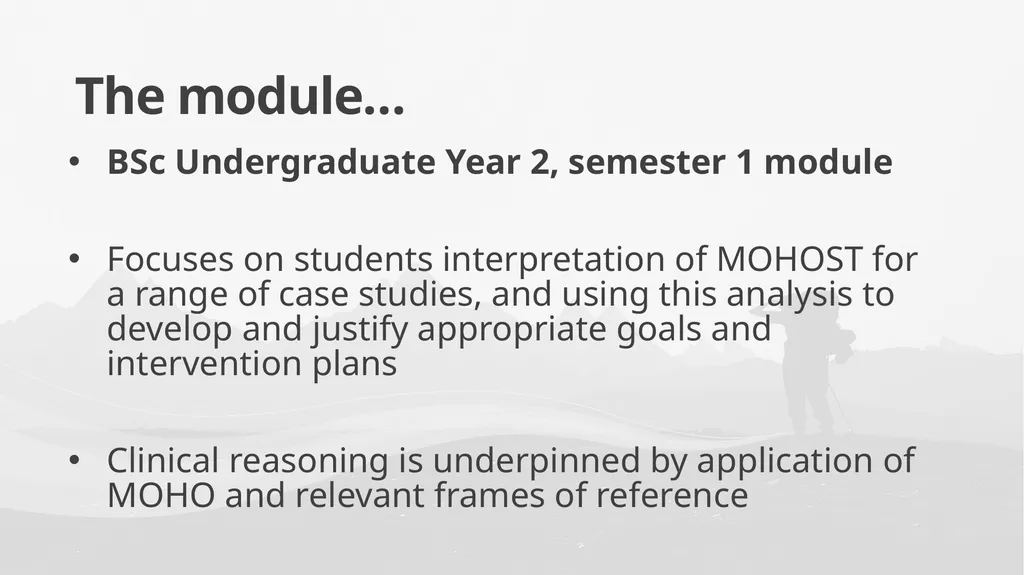
The module… BSc Undergraduate Year 2, semester 1 module
Focuses on students interpretation of MOHOST for a range of case studies, and using this analysis to develop and justify appropriate goals and intervention plans
Clinical reasoning is underpinned by application of MOHO and relevant frames of reference<br>
04
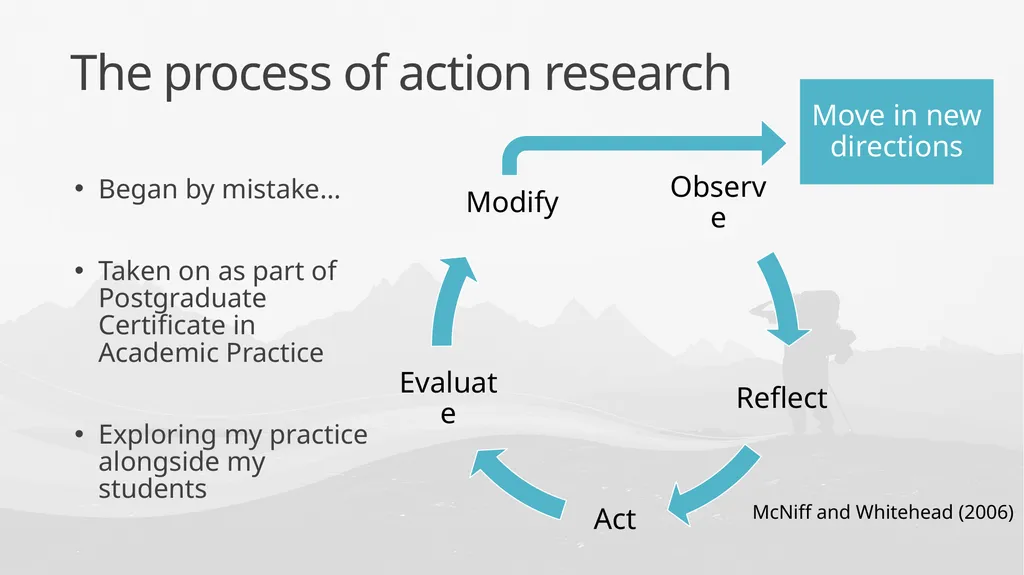
The process of action research Began by mistake…
Taken on as part of Postgraduate Certificate in Academic Practice
Exploring my practice alongside my students McNiff and Whitehead (2006) Move in new directions<br>
05
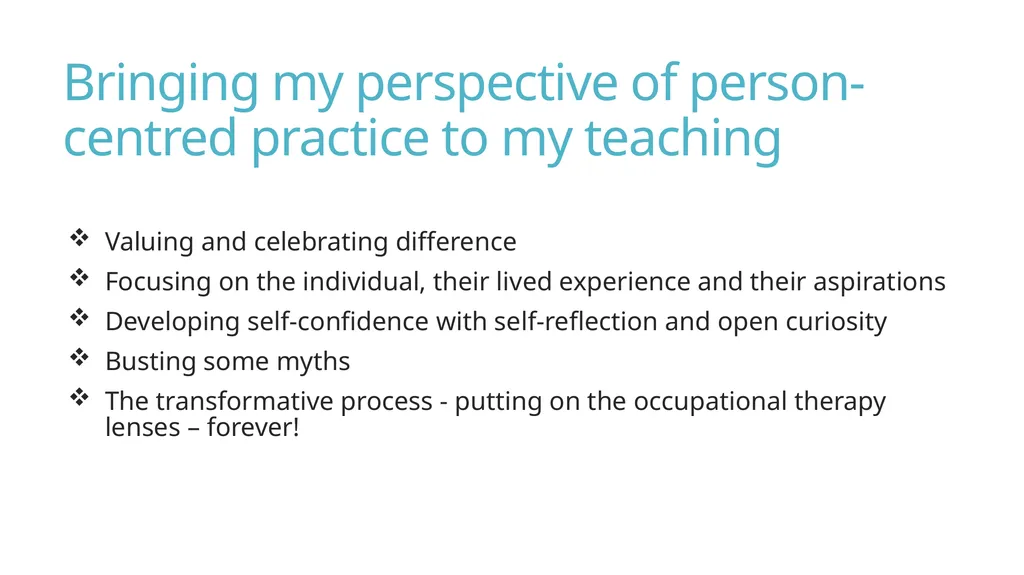
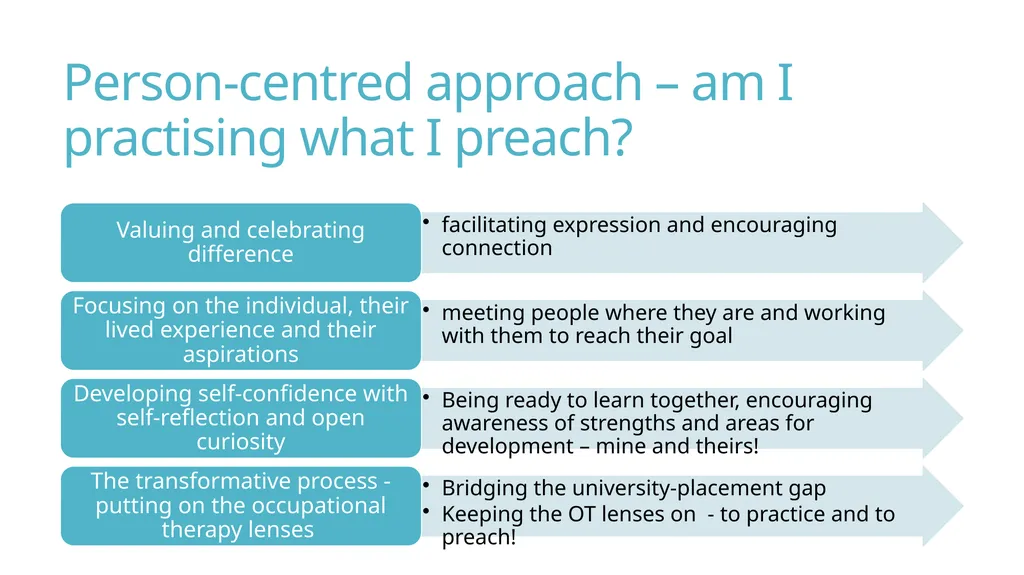
Bringing my perspective of person-centred practice to my teaching Valuing and celebrating difference
Focusing on the individual, their lived experience and their aspirations
Developing self-confidence with self-reflection and open curiosity
Busting some myths
The transformative process - putting on the occupational therapy lenses – forever!<br>
06
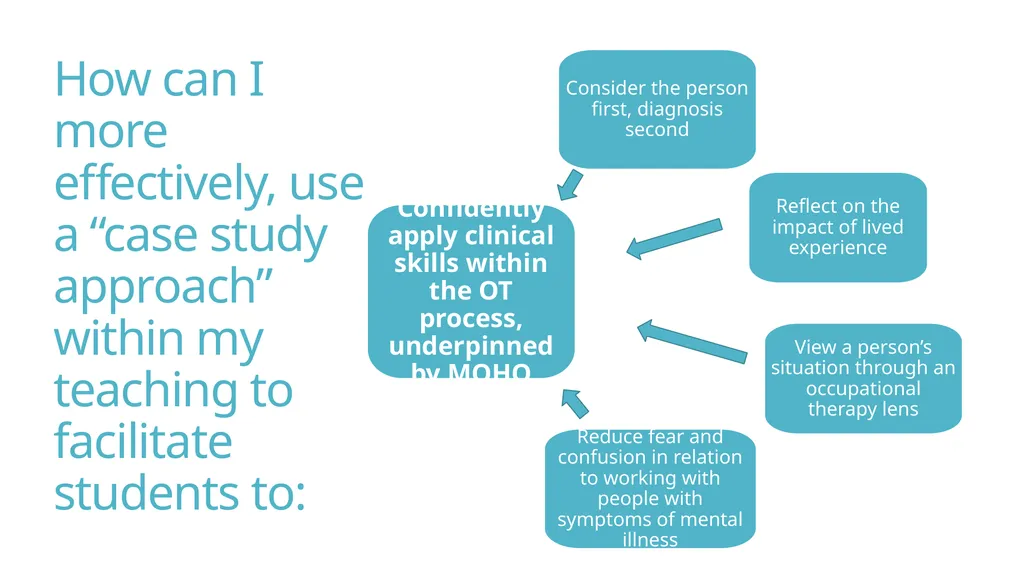
How can I more effectively, use a “case study approach” within my teaching to facilitate students to: Reflect on the impact of lived experience<br>
07
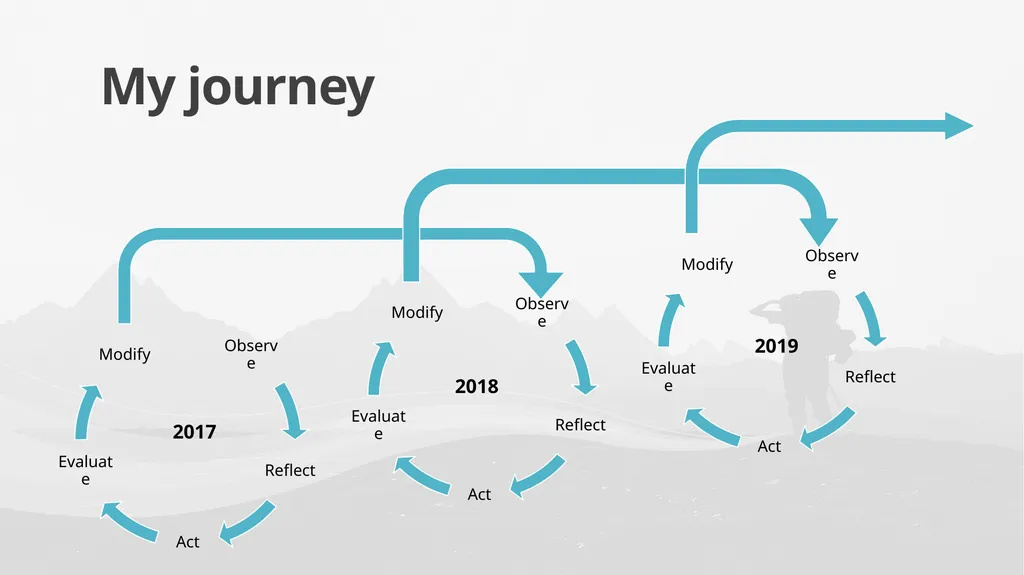
My journey 2017 2019 2018<br>
08
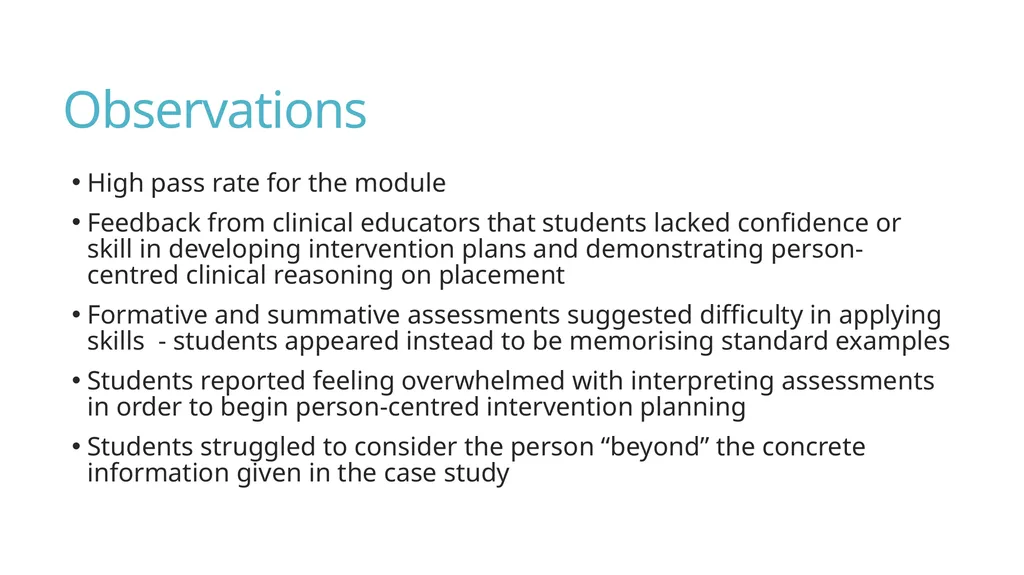
Observations High pass rate for the module
Feedback from clinical educators that students lacked confidence or skill in developing intervention plans and demonstrating person-centred clinical reasoning on placement
Formative and summative assessments suggested difficulty in applying skills - students appeared instead to be memorising standard examples
Students reported feeling overwhelmed with interpreting assessments in order to begin person-centred intervention planning
Students struggled to consider the person “beyond” the concrete information given in the case study<br>
09
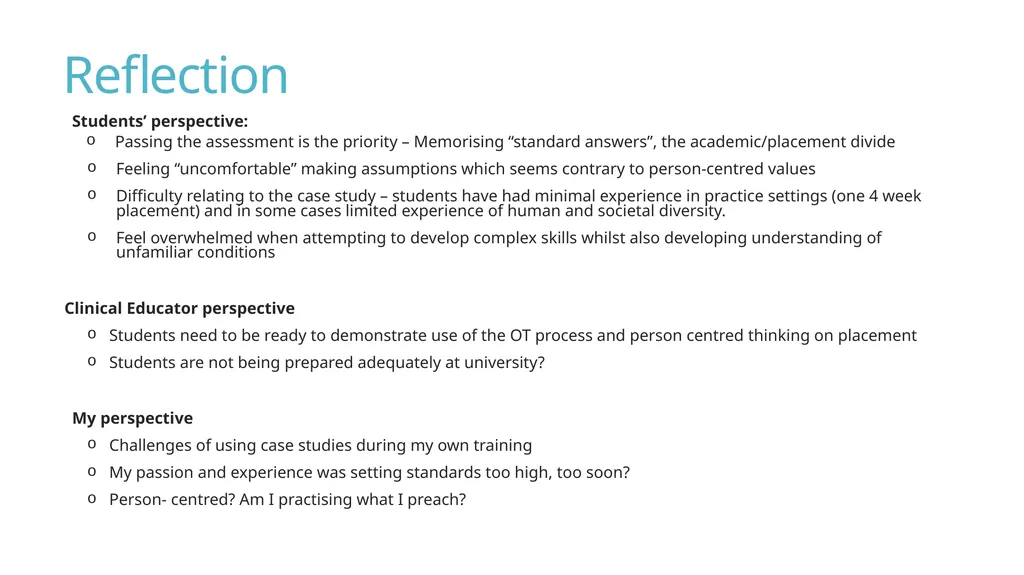
Reflection Students’ perspective:
Passing the assessment is the priority – Memorising “standard answers”, the academic/placement divide
Feeling “uncomfortable” making assumptions which seems contrary to person-centred values
Difficulty relating to the case study – students have had minimal experience in practice settings (one 4 week placement) and in some cases limited experience of human and societal diversity.
Feel overwhelmed when attempting to develop complex skills whilst also developing understanding of unfamiliar conditions
Clinical Educator perspective
Students need to be ready to demonstrate use of the OT process and person centred thinking on placement
Students are not being prepared adequately at university?
My perspective
Challenges of using case studies during my own training
My passion and experience was setting standards too high, too soon?
Person- centred? Am I practising what I preach?<br>
10
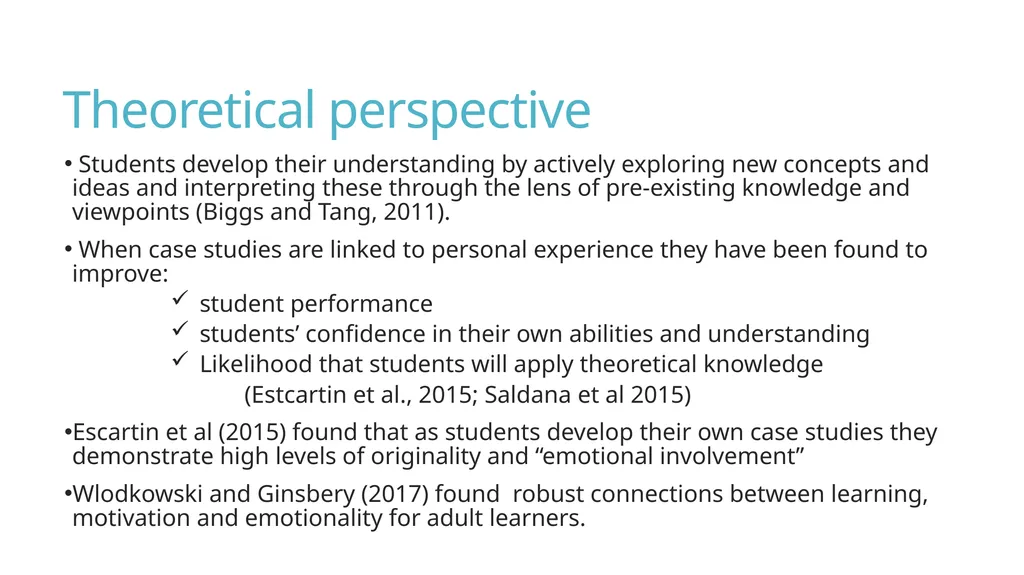
Theoretical perspective Students develop their understanding by actively exploring new concepts and ideas and interpreting these through the lens of pre-existing knowledge and viewpoints (Biggs and Tang, 2011).
When case studies are linked to personal experience they have been found to improve:
student performance
students’ confidence in their own abilities and understanding
Likelihood that students will apply theoretical knowledge
(Estcartin et al., 2015; Saldana et al 2015)
Escartin et al (2015) found that as students develop their own case studies they demonstrate high levels of originality and “emotional involvement”
Wlodkowski and Ginsbery (2017) found robust connections between learning, motivation and emotionality for adult learners.<br>
11
And so to action...my journey so far<br>
12
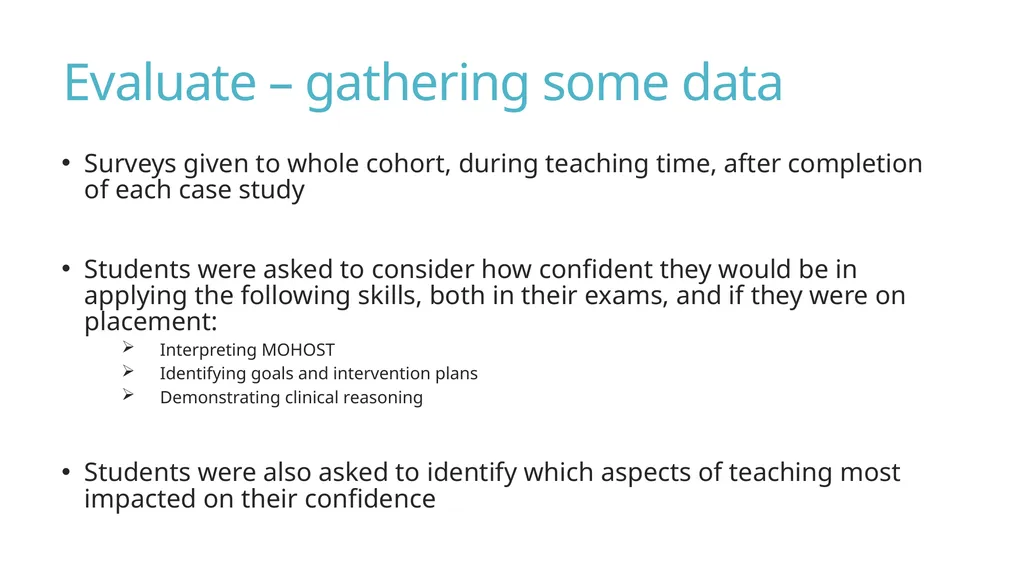
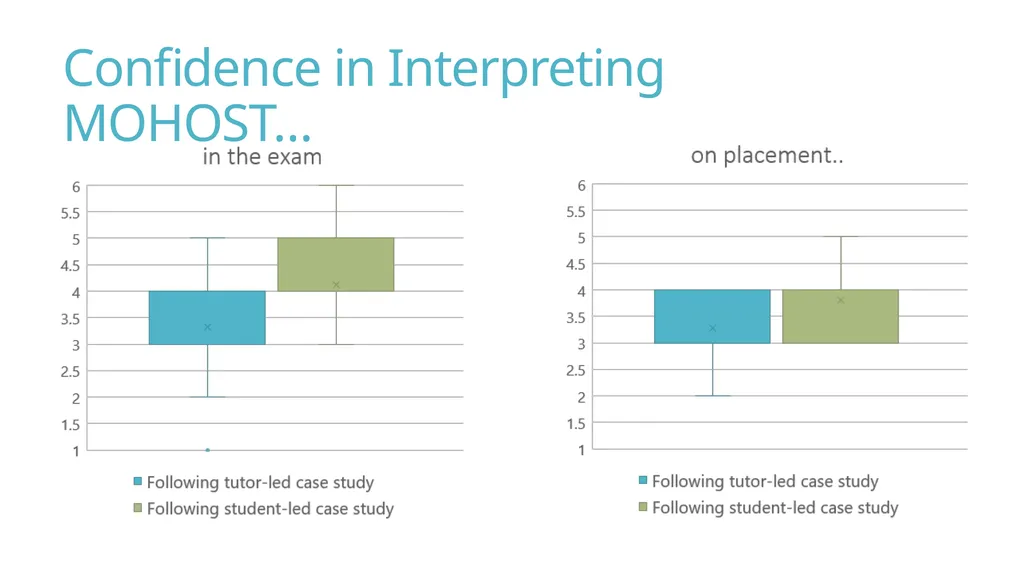
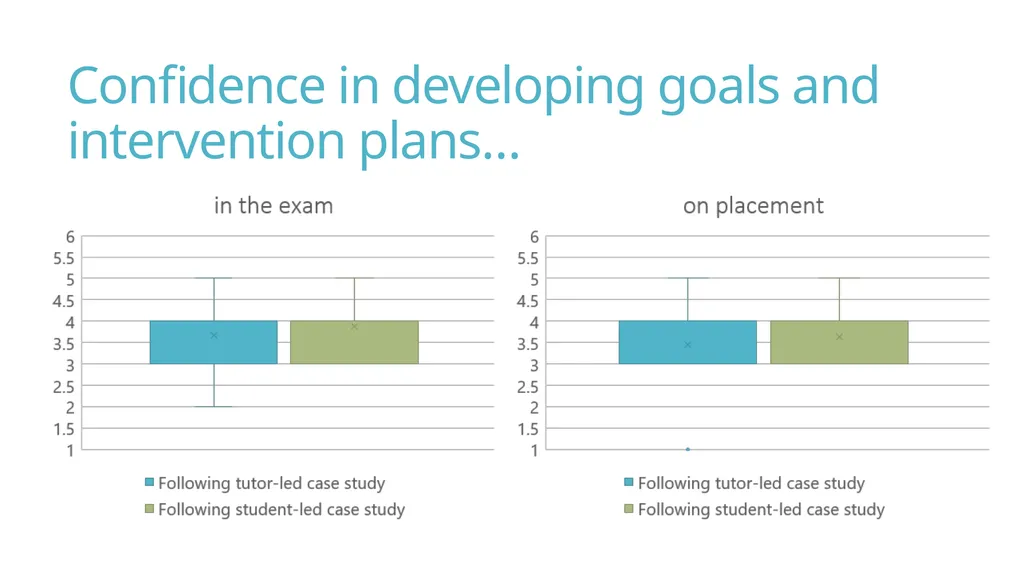
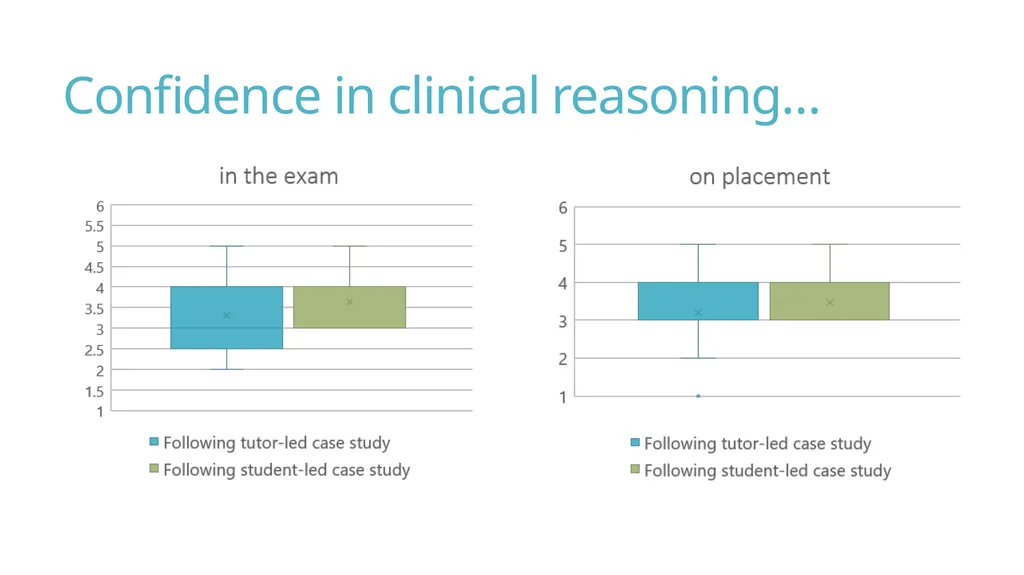
Evaluate – gathering some data Surveys given to whole cohort, during teaching time, after completion of each case study
Students were asked to consider how confident they would be in applying the following skills, both in their exams, and if they were on placement:
Interpreting MOHOST
Identifying goals and intervention plans
Demonstrating clinical reasoning
Students were also asked to identify which aspects of teaching most impacted on their confidence<br>
13
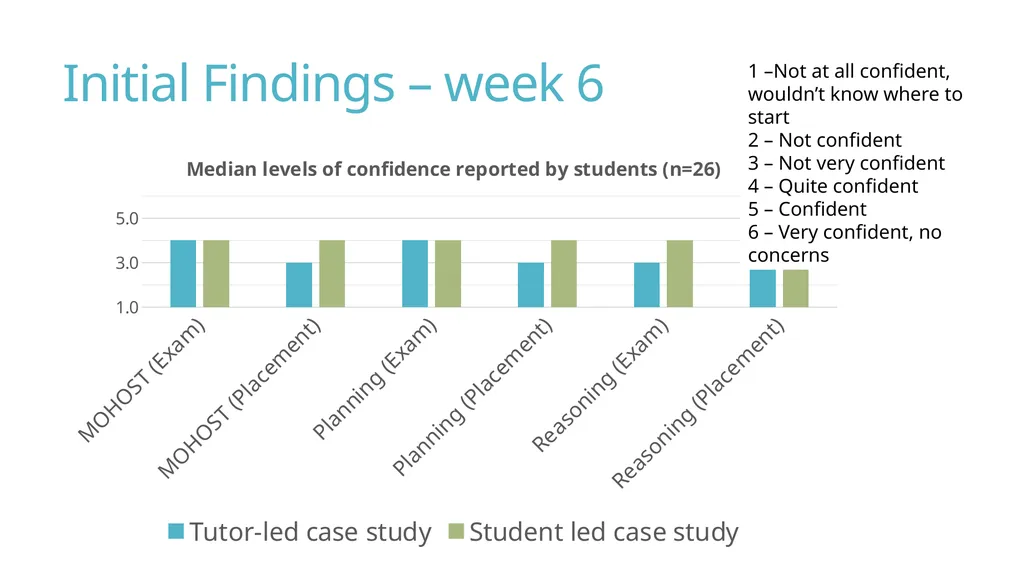
Initial Findings – week 6 1 –Not at all confident, wouldn’t know where to start
2 – Not confident
3 – Not very confident
4 – Quite confident
5 – Confident
6 – Very confident, no concerns<br>
14
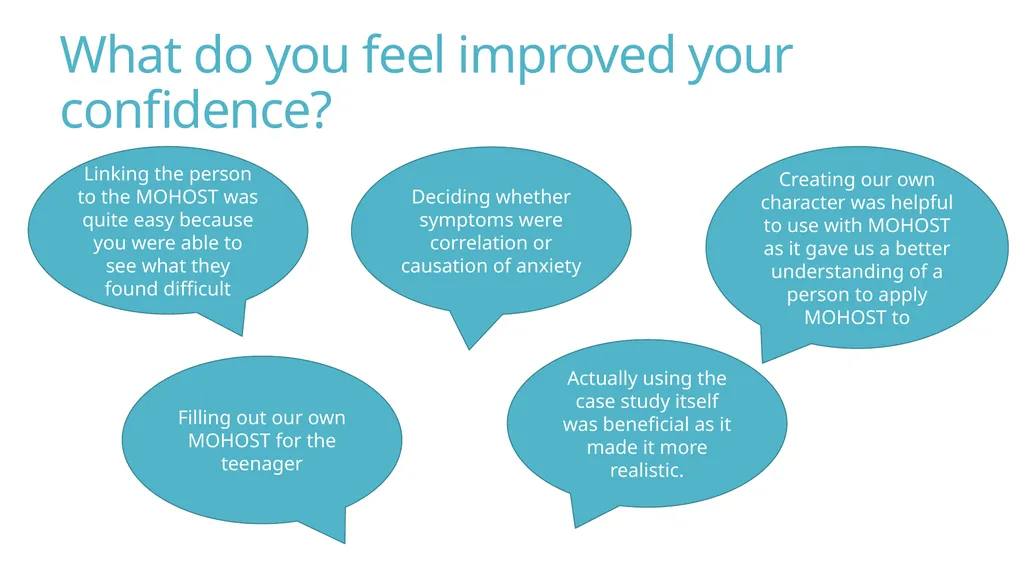
What do you feel improved your confidence? Linking the person to the MOHOST was quite easy because you were able to see what they found difficult Creating our own character was helpful to use with MOHOST as it gave us a better understanding of a person to apply MOHOST to Actually using the case study itself was beneficial as it made it more realistic. Filling out our own MOHOST for the teenager Deciding whether symptoms were correlation or causation of anxiety<br>
15
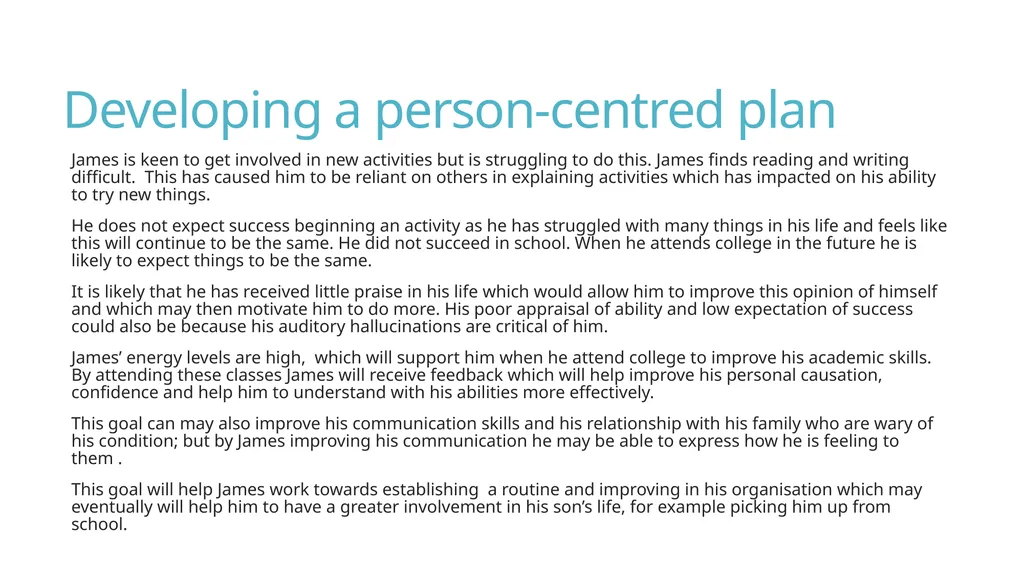
Developing a person-centred plan James is keen to get involved in new activities but is struggling to do this. James finds reading and writing difficult. This has caused him to be reliant on others in explaining activities which has impacted on his ability to try new things.
He does not expect success beginning an activity as he has struggled with many things in his life and feels like this will continue to be the same. He did not succeed in school. When he attends college in the future he is likely to expect things to be the same.
It is likely that he has received little praise in his life which would allow him to improve this opinion of himself and which may then motivate him to do more. His poor appraisal of ability and low expectation of success could also be because his auditory hallucinations are critical of him.
James’ energy levels are high, which will support him when he attend college to improve his academic skills. By attending these classes James will receive feedback which will help improve his personal causation, confidence and help him to understand with his abilities more effectively.
This goal can may also improve his communication skills and his relationship with his family who are wary of his condition; but by James improving his communication he may be able to express how he is feeling to them .
This goal will help James work towards establishing a routine and improving in his organisation which may eventually will help him to have a greater involvement in his son’s life, for example picking him up from school.<br>
16
Person-centred approach – am I practising what I preach?<br>
17
References Biggs, J. B. and Tang. C. (2011) Teaching for quality learning at university. Available at: http://ebookcentral.proquest.com/lib/liverpool/detail.action?docID=798265 (Downloaded: 8 July 2019)
Doyle, T., and Zakrajsek, T. (2013) The New Science of Learning: How to Learn in Harmony with Your Brain. Sterling, VA: Stylus
Escartín, J. et al. (2015) ‘The Impact of Writing Case Studies: Benefits for Students’ Success and Well-being’, Procedia - Social and Behavioral Sciences, 196, pp. 47–51. doi: 10.1016/j.sbspro.2015.07.009.
McNiff, J. and Whitehead, J. (2006) All you need to know about Action Research. London, UK, Sage
Saldaña, O. et al, (2015) ‘Development of psychosocial case studies by students to improve their ability to understand and analyze human behavior’, 8th International Conference of Education, Research and Innovation Conference. Seville, Spain, 16-18 November, pp1097-1102. Available at: http://diposit.ub.edu/dspace/bitstream/2445/114808/1/656199.pdf (Accessed 10 July 2019)
Wlodkowski, R. J. and Ginsberg, M. B. (2017) Enhancing adult motivation to learn: A comprehensive guide for teaching all adults. San-Fransico, CA; Jossey-Bass<br>
18
Confidence in Interpreting MOHOST…<br>
19
Confidence in developing goals and intervention plans…<br>
20
Confidence in clinical reasoning…<br>
21
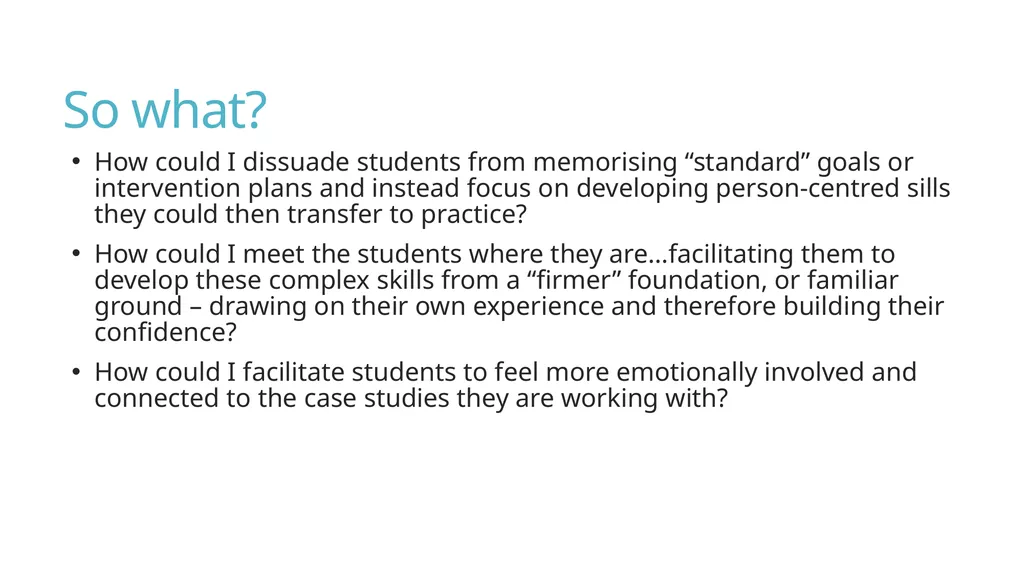
So what? How could I dissuade students from memorising “standard” goals or intervention plans and instead focus on developing person-centred sills they could then transfer to practice?
How could I meet the students where they are…facilitating them to develop these complex skills from a “firmer” foundation, or familiar ground – drawing on their own experience and therefore building their confidence?
How could I facilitate students to feel more emotionally involved and connected to the case studies they are working with?<br>