
Judaism Bell Ringer – 8/11 Write down 3 things you
TA
Published · 40 slides · 0 views
1 / 1


Description
Judaism Bell Ringer 811 Write down 3 things you know about Judaism and Jews. Judaism is A 4000 year old tradition with ideas about what it means to be human and how to make the world a holy place (Rabbi Harold Kushner, To Life) People
Related Topics
Share
Embed code
Download this presentation From Below
"Judaism Bell Ringer – 8/11 Write down 3 things you" is the property of its rightful owner. Permission is granted to download and print the materials on this website for personal, non-commercial use only, and to display it on your personal computer provided you do not modify the materials and that you retain all copyright notices contained in the materials. By downloading content from our website, you accept the terms of this agreement.
Presentation Transcript
01
Judaism<br>
02
Bell Ringer – 8/11 Write down 3 things you know about Judaism and Jews.<br>
03
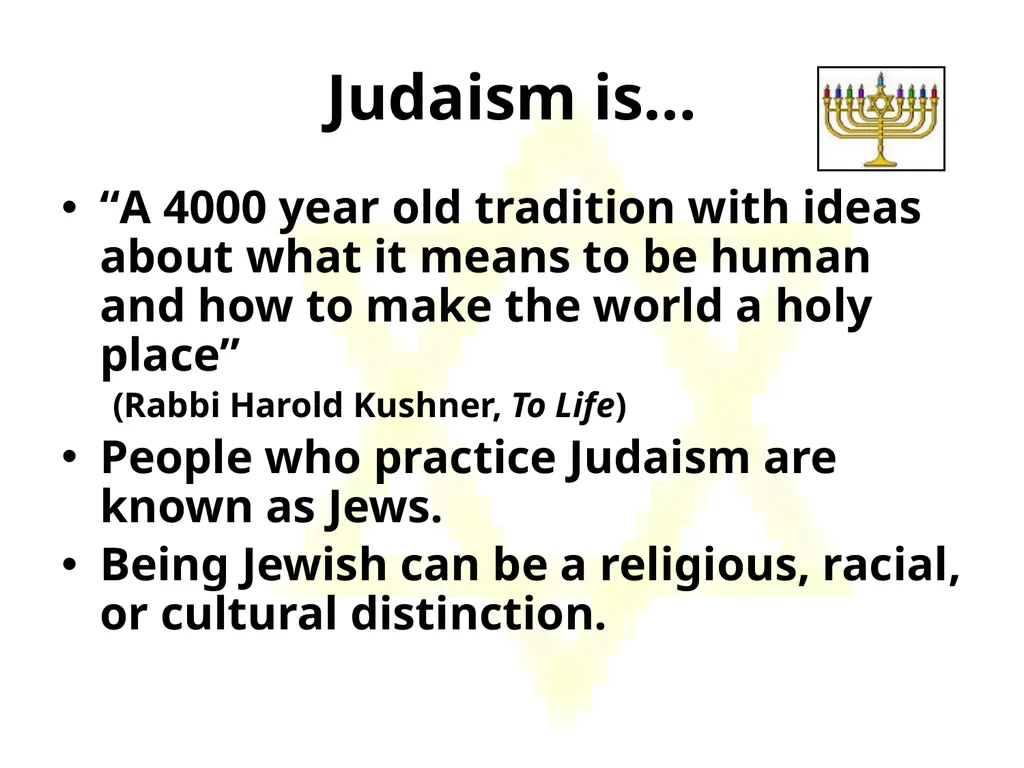
Judaism is… “A 4000 year old tradition with ideas about what it means to be human and how to make the world a holy place”
(Rabbi Harold Kushner, To Life)
People who practice Judaism are known as Jews.
Being Jewish can be a religious, racial, or cultural distinction.<br>
(Rabbi Harold Kushner, To Life)
People who practice Judaism are known as Jews.
Being Jewish can be a religious, racial, or cultural distinction.<br>
04
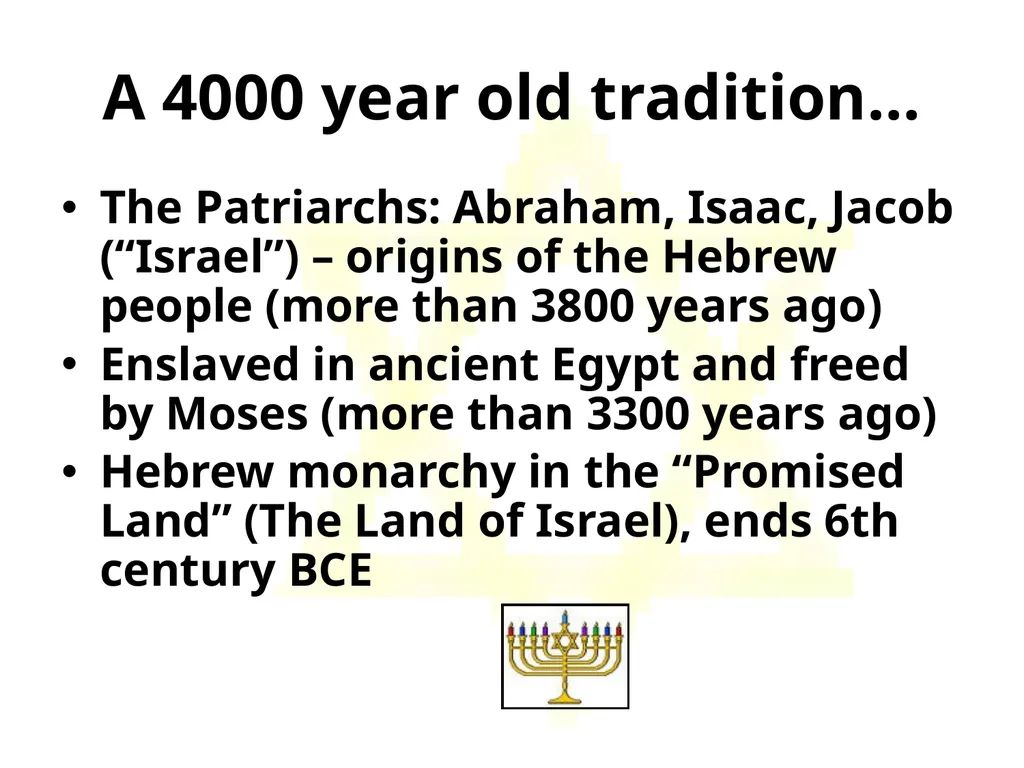
A 4000 year old tradition… The Patriarchs: Abraham, Isaac, Jacob (“Israel”) – origins of the Hebrew people (more than 3800 years ago)
Enslaved in ancient Egypt and freed by Moses (more than 3300 years ago)
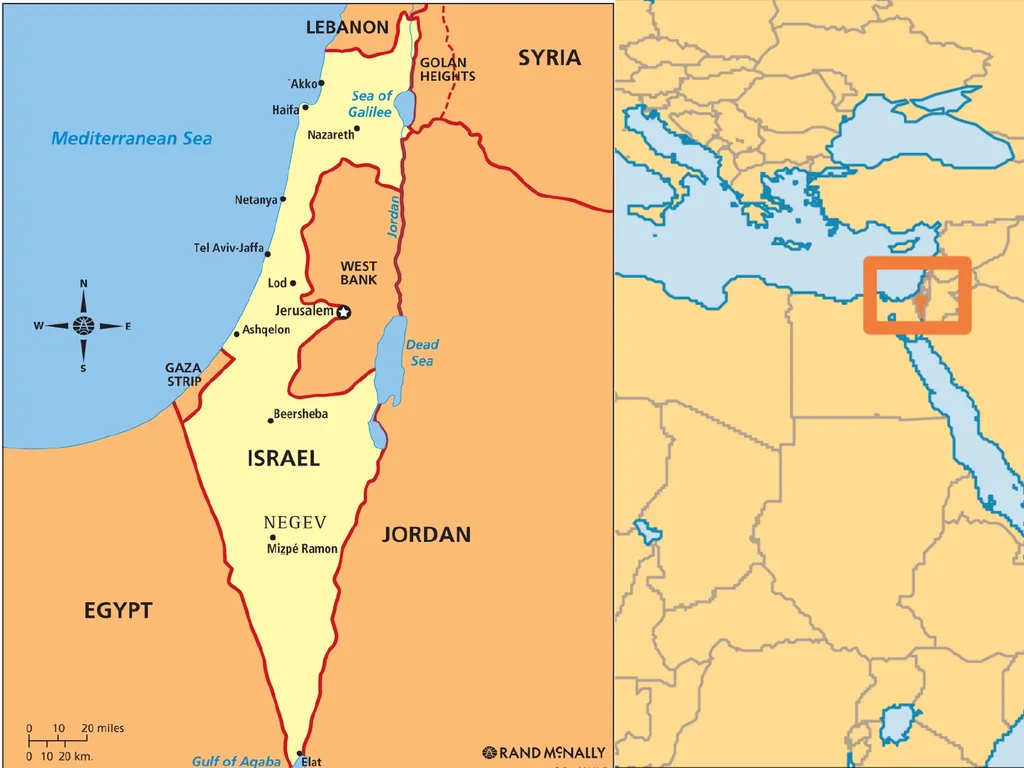
Hebrew monarchy in the “Promised Land” (The Land of Israel), ends 6th century BCE<br>
Enslaved in ancient Egypt and freed by Moses (more than 3300 years ago)
Hebrew monarchy in the “Promised Land” (The Land of Israel), ends 6th century BCE<br>
05
As a faith, Jews Believe… In one God, creator of the universe.
In prophets of old – especially Moses, through whom Torah was revealed to the Hebrew people
In Torah (first five books of the Bible), containing religious, moral and social law which guides the life of a Jew
the Hebrew Bible does not include the New Testament<br>
In prophets of old – especially Moses, through whom Torah was revealed to the Hebrew people
In Torah (first five books of the Bible), containing religious, moral and social law which guides the life of a Jew
the Hebrew Bible does not include the New Testament<br>
06
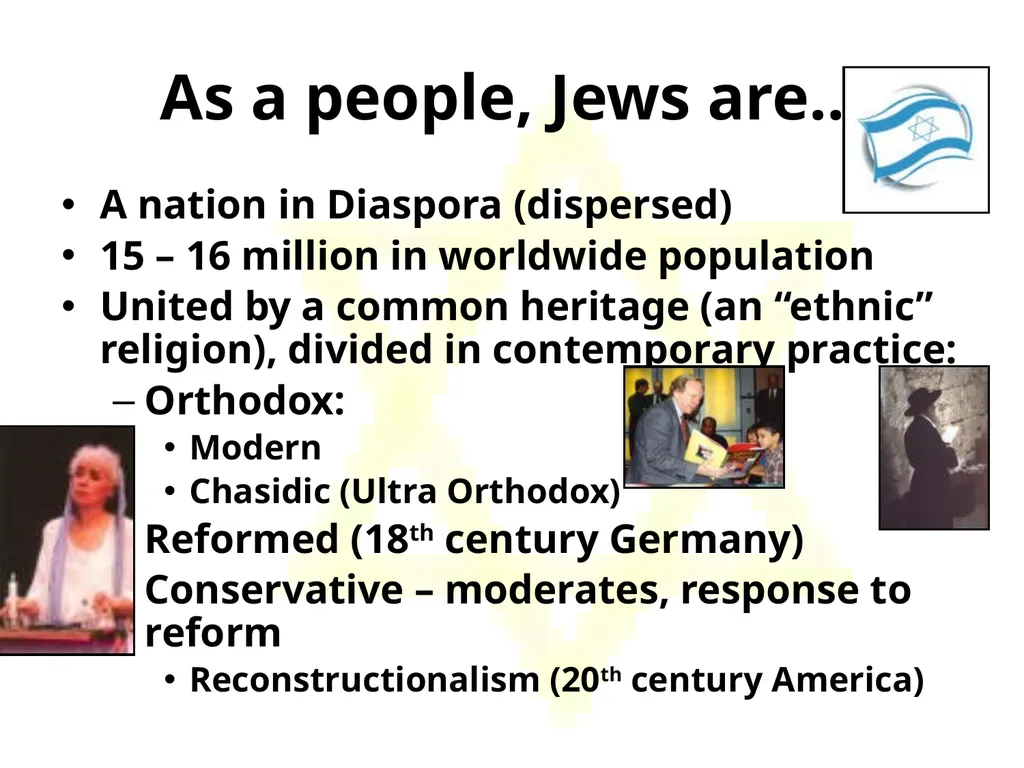
As a people, Jews are… A nation in Diaspora (dispersed)
15 – 16 million in worldwide population
United by a common heritage (an “ethnic” religion), divided in contemporary practice:
Orthodox:
Modern
Chasidic (Ultra Orthodox)
Reformed (18th century Germany)
Conservative – moderates, response to reform
Reconstructionalism (20th century America)<br>
15 – 16 million in worldwide population
United by a common heritage (an “ethnic” religion), divided in contemporary practice:
Orthodox:
Modern
Chasidic (Ultra Orthodox)
Reformed (18th century Germany)
Conservative – moderates, response to reform
Reconstructionalism (20th century America)<br>
07
As a way of life, Judaism is based on… 613 commandments found in Torah (“Written Law”)
Talmud (“Oral Law”) – commentary of ancient rabbis that elaborates on how to apply God’s Law in everyday life through:
Dietary rules (Kosher)
Dress and other symbols
Prayer and devotion to the one God
The Temple and Temple rites
Observance of Holy days
Proper social relations between male and female, in business, judicial rulings, etc.
Thus sanctifying life, blessing it in every way<br>
Talmud (“Oral Law”) – commentary of ancient rabbis that elaborates on how to apply God’s Law in everyday life through:
Dietary rules (Kosher)
Dress and other symbols
Prayer and devotion to the one God
The Temple and Temple rites
Observance of Holy days
Proper social relations between male and female, in business, judicial rulings, etc.
Thus sanctifying life, blessing it in every way<br>
08
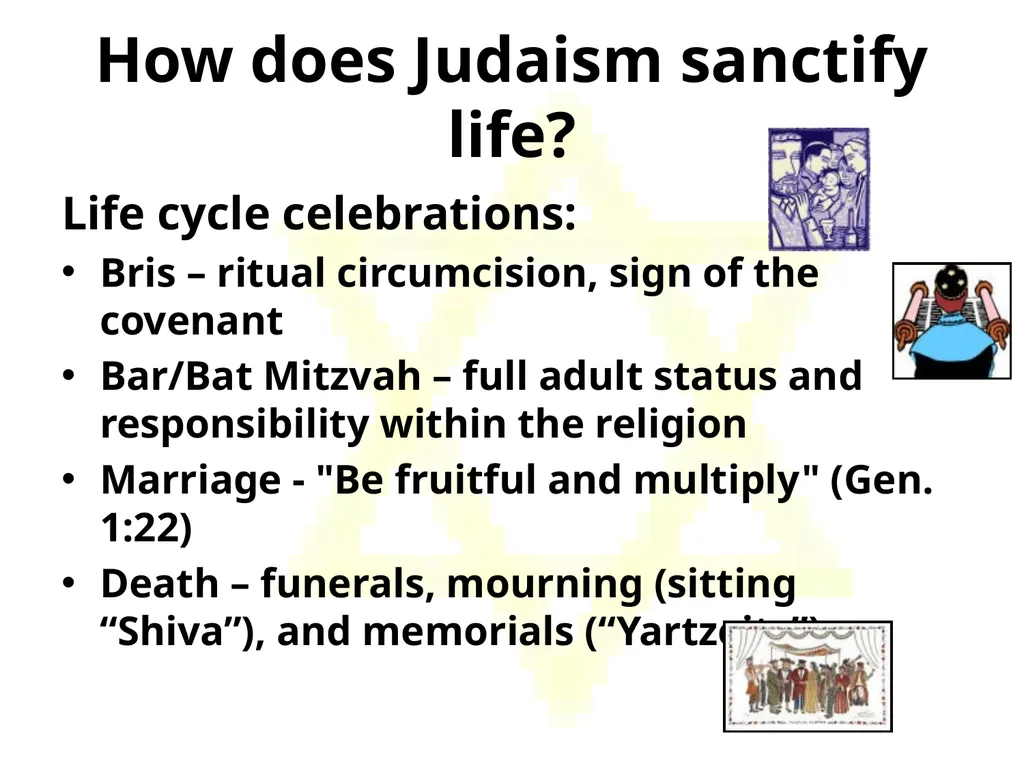
How does Judaism sanctify life? Life cycle celebrations:
Bris – ritual circumcision, sign of the covenant
Bar/Bat Mitzvah – full adult status and responsibility within the religion
Marriage - "Be fruitful and multiply" (Gen. 1:22)
Death – funerals, mourning (sitting “Shiva”), and memorials (“Yartzeits”)<br>
Bris – ritual circumcision, sign of the covenant
Bar/Bat Mitzvah – full adult status and responsibility within the religion
Marriage - "Be fruitful and multiply" (Gen. 1:22)
Death – funerals, mourning (sitting “Shiva”), and memorials (“Yartzeits”)<br>
09
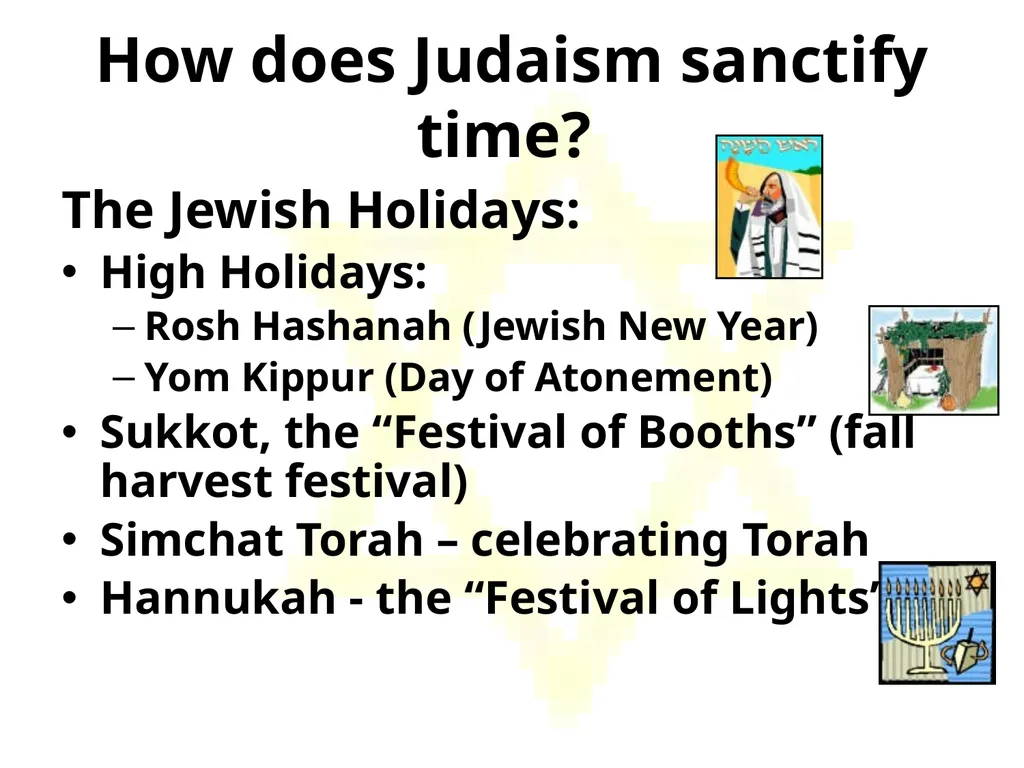
How does Judaism sanctify time? The Jewish Holidays:
High Holidays:
Rosh Hashanah (Jewish New Year)
Yom Kippur (Day of Atonement)
Sukkot, the “Festival of Booths” (fall harvest festival)
Simchat Torah – celebrating Torah
Hannukah - the “Festival of Lights”<br>
High Holidays:
Rosh Hashanah (Jewish New Year)
Yom Kippur (Day of Atonement)
Sukkot, the “Festival of Booths” (fall harvest festival)
Simchat Torah – celebrating Torah
Hannukah - the “Festival of Lights”<br>
10
More Holy Days… Purim (“Lots”) – a carnival (commemorates events told in book of Esther)
Pesach (“Passover”) – commemorates the exodus from Egypt (events told in Exodus)
Shavuot (“weeks,” Pentecost) – commemorates receipt of Torah at Sinai
Other, minor festivals
Shabbat (Sabbath, 7th day, on Saturday) – the “Day of Rest”<br>
Pesach (“Passover”) – commemorates the exodus from Egypt (events told in Exodus)
Shavuot (“weeks,” Pentecost) – commemorates receipt of Torah at Sinai
Other, minor festivals
Shabbat (Sabbath, 7th day, on Saturday) – the “Day of Rest”<br>
11
How is Judaism related to Christianity? Judaism predates Christianity – it is the foundation of Christianity but is not a part of it
Jesus was Jewish, as were his followers and the Apostles
Jews do not believe that Jesus was anything more than a good and wise man who lived and died 2000 years ago – Jews still await their messiah<br>
Jesus was Jewish, as were his followers and the Apostles
Jews do not believe that Jesus was anything more than a good and wise man who lived and died 2000 years ago – Jews still await their messiah<br>
12
What are Jews really concerned about? Tikkun Olam - “repairing this world” through justice and righteousness; through “deed, not creed”
The heart of Judaism is in the home and family, social responsibility and doing Mitzvot (“good deeds” based on God’s commandments)
Through education and hard work we make our lives, the lives of others, and the world, what God intended it to be – Holy!<br>
The heart of Judaism is in the home and family, social responsibility and doing Mitzvot (“good deeds” based on God’s commandments)
Through education and hard work we make our lives, the lives of others, and the world, what God intended it to be – Holy!<br>
13
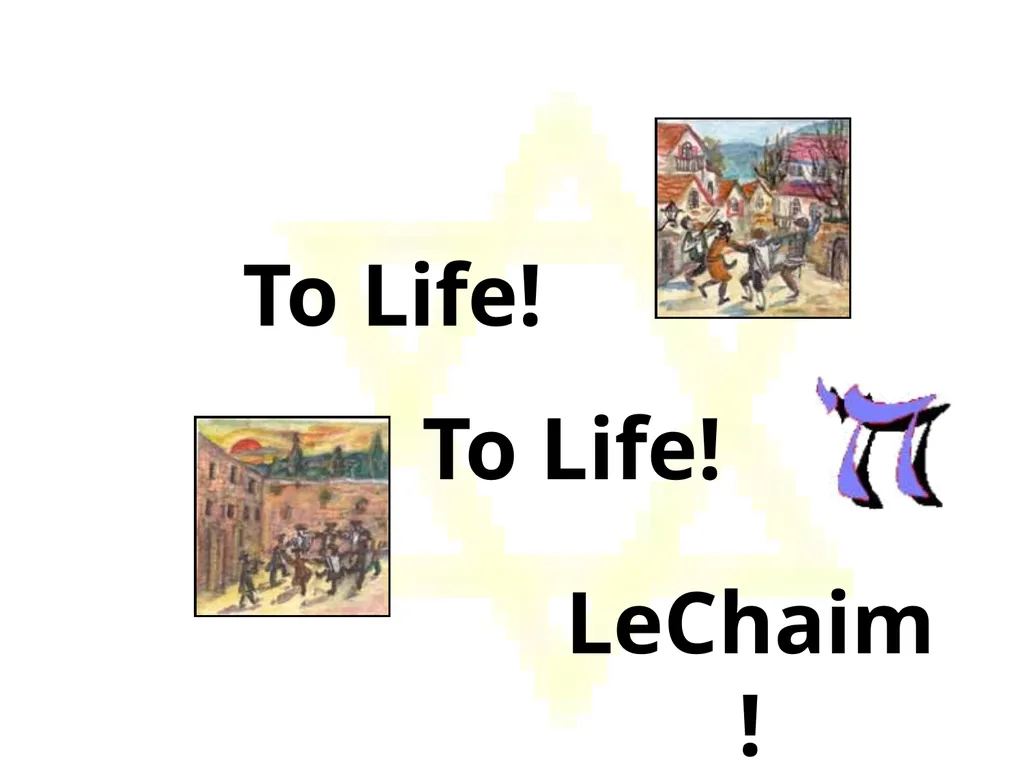
LeChaim! To Life! To Life!<br>
14
Web resources Judaism 101: http://jewfaq.org/
”an online encyclopedia of Judaism, covering Jewish beliefs, people, places, things, language, scripture, holidays, practices and customs”
ReligiousTolerance.org on Judaism: http://www.religioustolerance.org/judaism.htm
This P0werpoint presentation available at: http://www.nvcc.edu/home/lshulman/Rel232/resource/judaism.ppt<br>
ReligiousTolerance.org on Judaism: http://www.religioustolerance.org/judaism.htm
This P0werpoint presentation available at: http://www.nvcc.edu/home/lshulman/Rel232/resource/judaism.ppt<br>
15
Jewish Symbols From Living Judaism
by Rabbi Wayne Dosick<br>
by Rabbi Wayne Dosick<br>
16
Why are Jews persecuted throughout history? Economic -- "We hate Jews because they possess too much wealth and power."
Chosen People -- "We hate Jews because they arrogantly claim that they are the chosen people."
Scapegoat -- "Jews are a convenient group to single out and blame for our troubles."
Deicide -- "We hate Jews because they killed Jesus."
Outsiders, -- "We hate Jews because they are different than us." (The dislike of the unlike.)
Racial Theory -- "We hate Jews because they are an inferior race."<br>
Chosen People -- "We hate Jews because they arrogantly claim that they are the chosen people."
Scapegoat -- "Jews are a convenient group to single out and blame for our troubles."
Deicide -- "We hate Jews because they killed Jesus."
Outsiders, -- "We hate Jews because they are different than us." (The dislike of the unlike.)
Racial Theory -- "We hate Jews because they are an inferior race."<br>
17
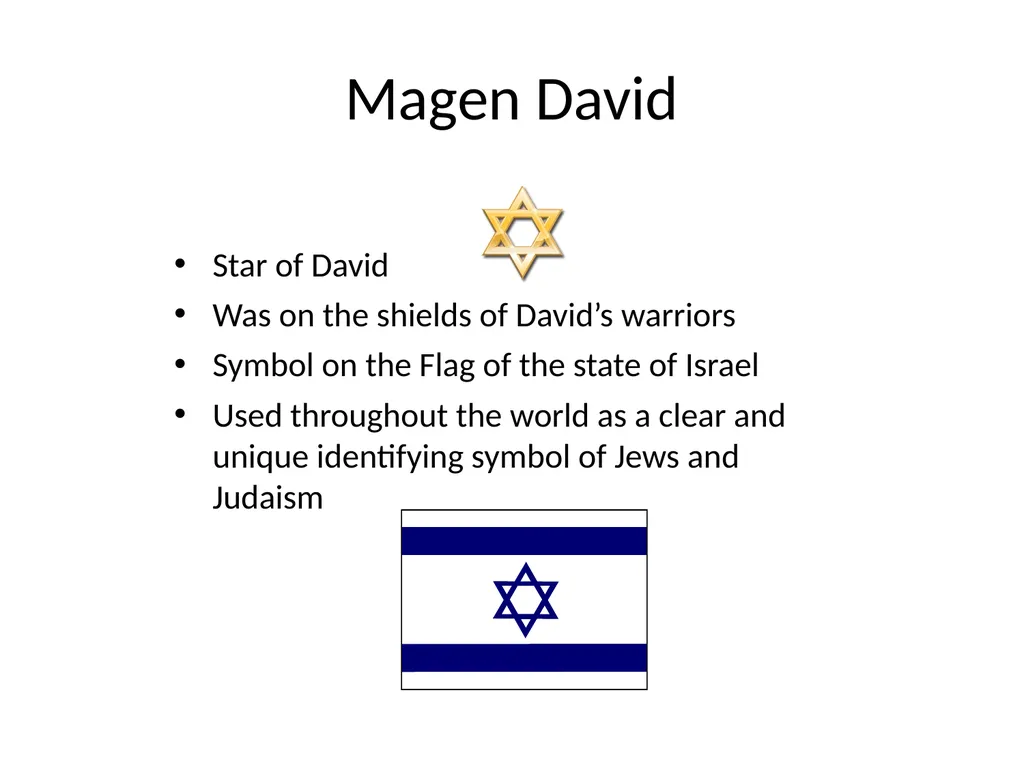
Magen David Star of David
Was on the shields of David’s warriors
Symbol on the Flag of the state of Israel
Used throughout the world as a clear and unique identifying symbol of Jews and Judaism<br>
Was on the shields of David’s warriors
Symbol on the Flag of the state of Israel
Used throughout the world as a clear and unique identifying symbol of Jews and Judaism<br>
18
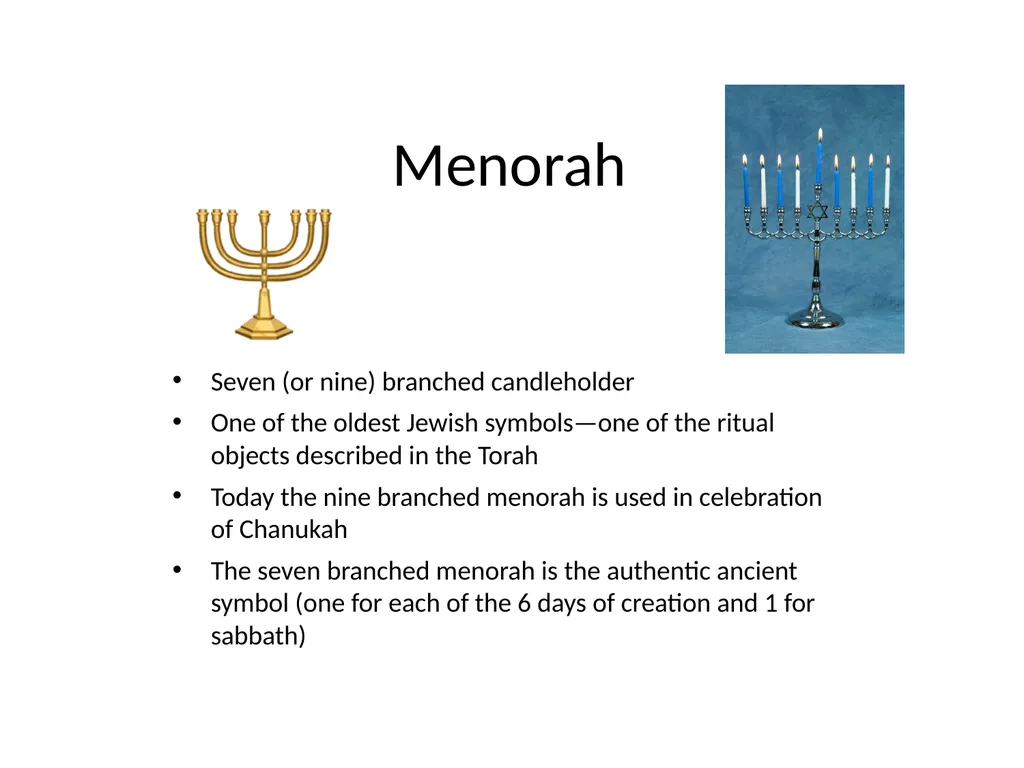
Menorah Seven (or nine) branched candleholder
One of the oldest Jewish symbols—one of the ritual objects described in the Torah
Today the nine branched menorah is used in celebration of Chanukah
The seven branched menorah is the authentic ancient symbol (one for each of the 6 days of creation and 1 for sabbath)<br>
One of the oldest Jewish symbols—one of the ritual objects described in the Torah
Today the nine branched menorah is used in celebration of Chanukah
The seven branched menorah is the authentic ancient symbol (one for each of the 6 days of creation and 1 for sabbath)<br>
19
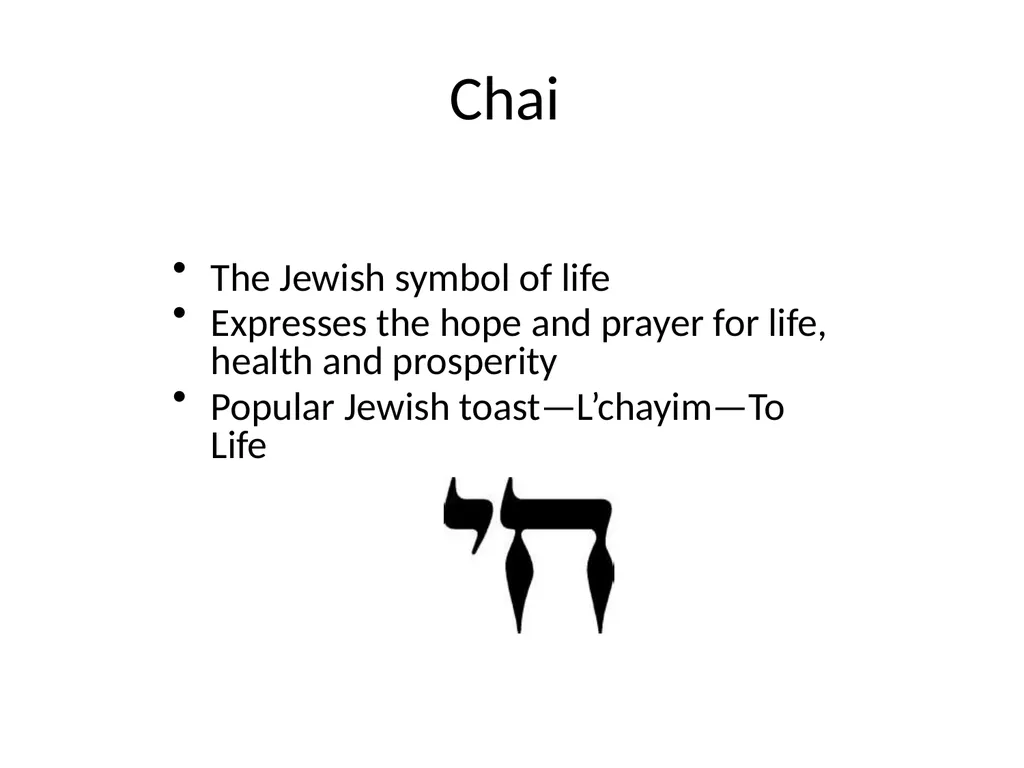
Chai The Jewish symbol of life
Expresses the hope and prayer for life, health and prosperity
Popular Jewish toast—L’chayim—To Life<br>
Expresses the hope and prayer for life, health and prosperity
Popular Jewish toast—L’chayim—To Life<br>
20
Mazal Tov Means good luck or congratulations
Particularly used for significant life events (ie. Bar Mitzvahs, weddings, birthdays, etc.)<br>
Particularly used for significant life events (ie. Bar Mitzvahs, weddings, birthdays, etc.)<br>
21
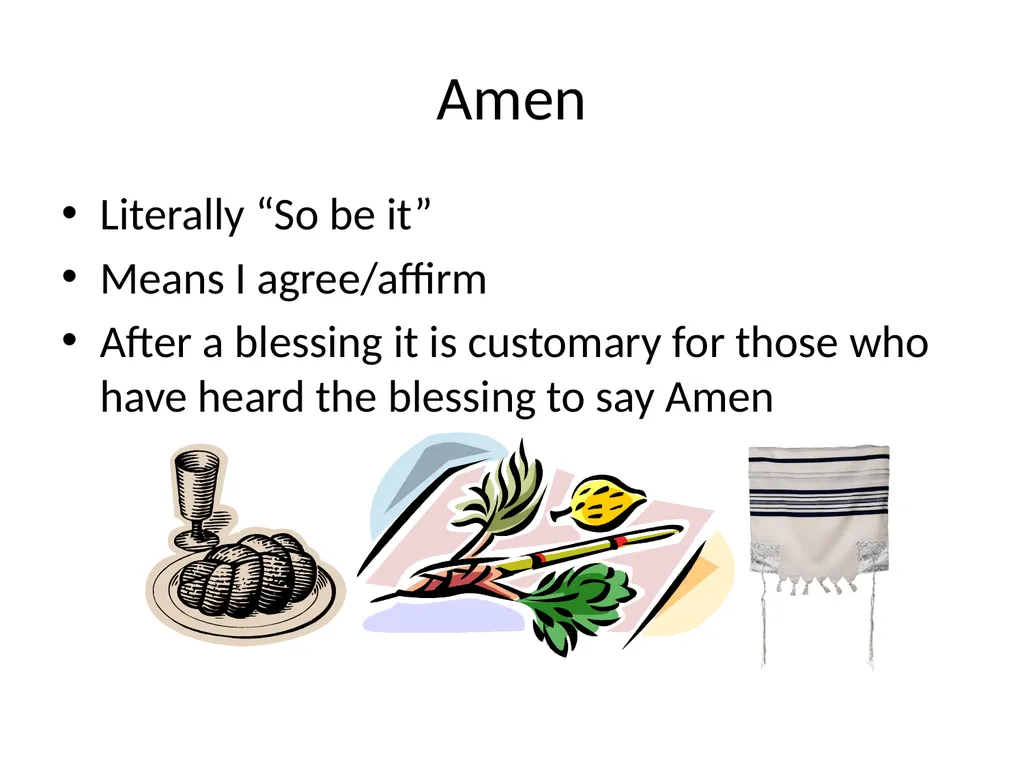
Amen Literally “So be it”
Means I agree/affirm
After a blessing it is customary for those who have heard the blessing to say Amen<br>
Means I agree/affirm
After a blessing it is customary for those who have heard the blessing to say Amen<br>
22
Shalom Means hello/goodbye/peace
Comes from root word shalem which means whole/complete
Peace comes when there is wholeness, completeness, unity.
Pease is the eternal Jewish prayer—world peace, peace between people, inner peace, harmony.<br>
Comes from root word shalem which means whole/complete
Peace comes when there is wholeness, completeness, unity.
Pease is the eternal Jewish prayer—world peace, peace between people, inner peace, harmony.<br>
23
Modern
Denominations
of Judaism From Living Judaism by Rabbi Wayne Dosick<br>
24
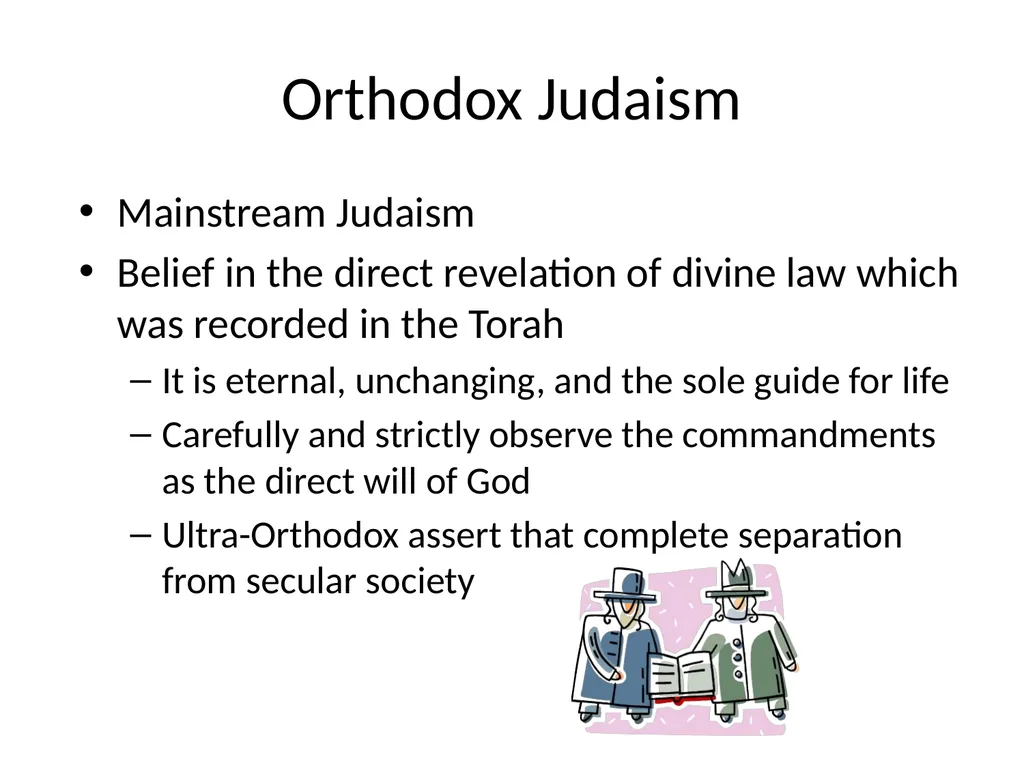
Orthodox Judaism Mainstream Judaism
Belief in the direct revelation of divine law which was recorded in the Torah
It is eternal, unchanging, and the sole guide for life
Carefully and strictly observe the commandments as the direct will of God
Ultra-Orthodox assert that complete separation from secular society<br>
Belief in the direct revelation of divine law which was recorded in the Torah
It is eternal, unchanging, and the sole guide for life
Carefully and strictly observe the commandments as the direct will of God
Ultra-Orthodox assert that complete separation from secular society<br>
25
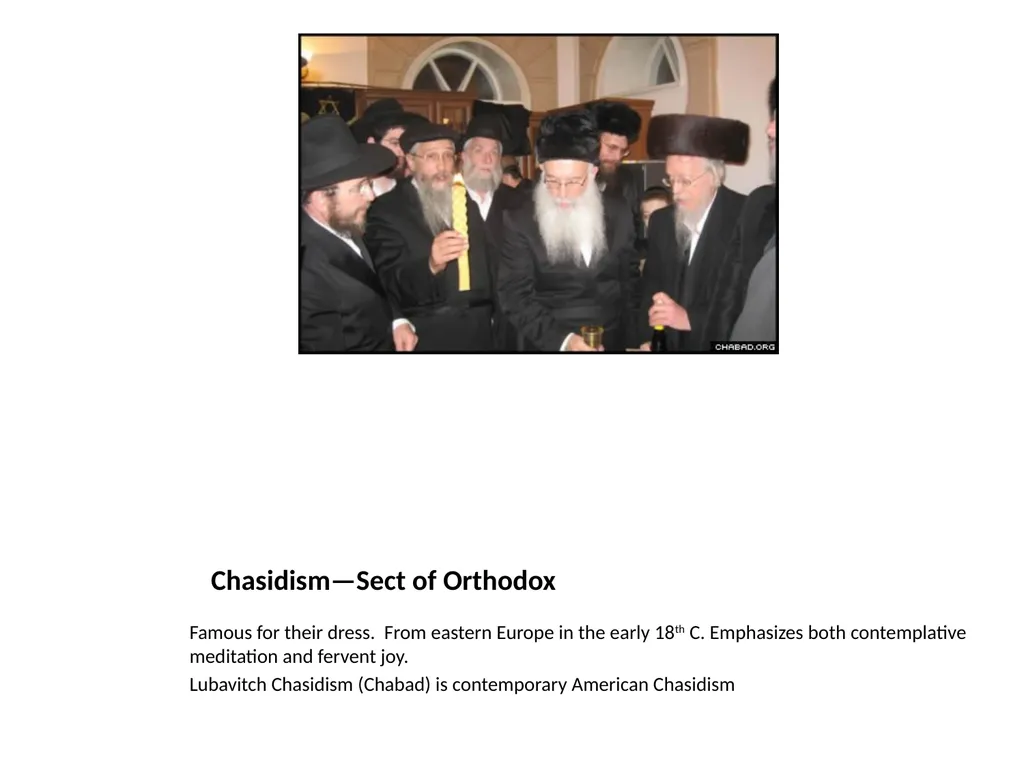
Famous for their dress. From eastern Europe in the early 18th C. Emphasizes both contemplative meditation and fervent joy.
Lubavitch Chasidism (Chabad) is contemporary American Chasidism Chasidism—Sect of Orthodox<br>
Lubavitch Chasidism (Chabad) is contemporary American Chasidism Chasidism—Sect of Orthodox<br>
26
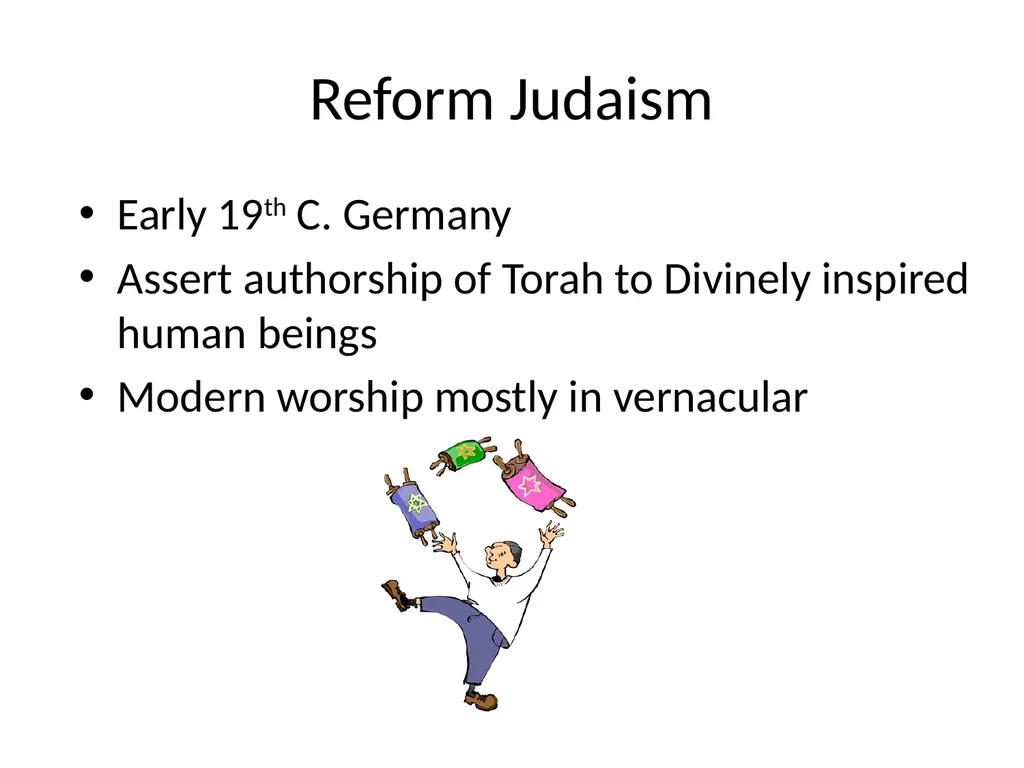
Reform Judaism Early 19th C. Germany
Assert authorship of Torah to Divinely inspired human beings
Modern worship mostly in vernacular<br>
Assert authorship of Torah to Divinely inspired human beings
Modern worship mostly in vernacular<br>
27
Conservative Judaism Response to Reform mid to late 19th C. Europe
Agree that change was necessary but felt Reform had eliminated too many basic Jewish practices
Motto is “tradition and change”
Fiddler on the Roof<br>
Agree that change was necessary but felt Reform had eliminated too many basic Jewish practices
Motto is “tradition and change”
Fiddler on the Roof<br>
28
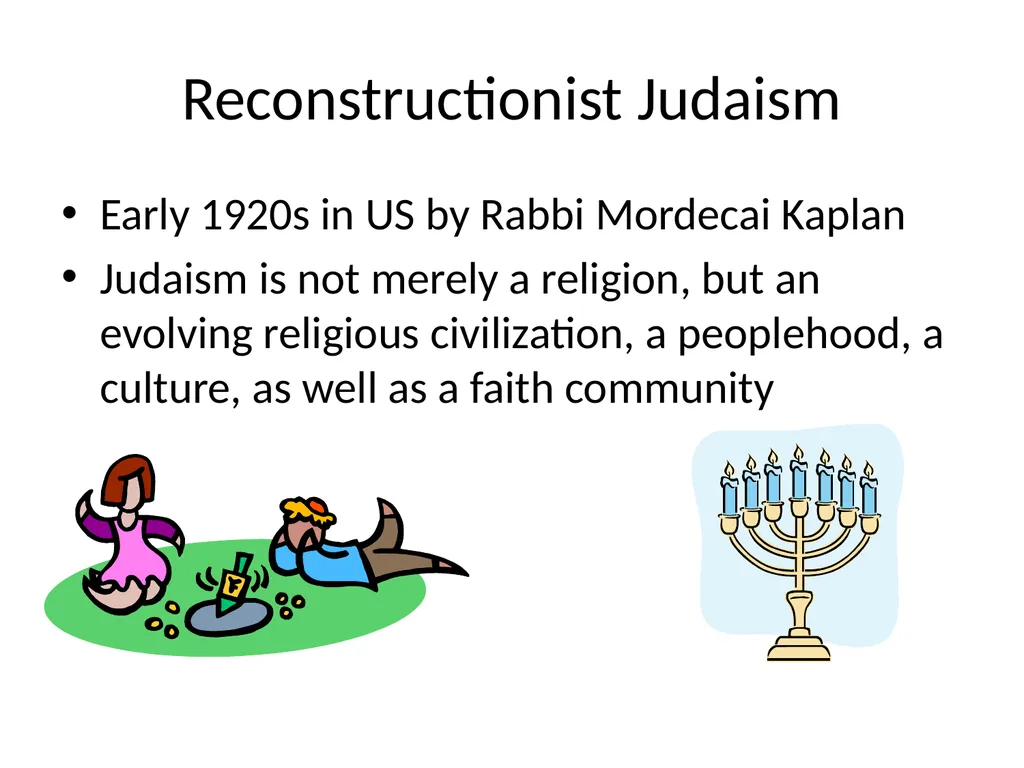
Reconstructionist Judaism Early 1920s in US by Rabbi Mordecai Kaplan
Judaism is not merely a religion, but an evolving religious civilization, a peoplehood, a culture, as well as a faith community<br>
Judaism is not merely a religion, but an evolving religious civilization, a peoplehood, a culture, as well as a faith community<br>
29
All of Judaism To accept Torah and fulfill its mitzvot
To embrace the ethical mandate of Judaism
To regulate existence to Judaism’s rituals & observances
To support Jewish causes
To be a devoted member of the Jewish community
To maintain a bond and a sense of mutual interdependence with the Jewish Land
To feel a connection to Jewish history
To be committed to the creative survival of the Jewish future<br>
To embrace the ethical mandate of Judaism
To regulate existence to Judaism’s rituals & observances
To support Jewish causes
To be a devoted member of the Jewish community
To maintain a bond and a sense of mutual interdependence with the Jewish Land
To feel a connection to Jewish history
To be committed to the creative survival of the Jewish future<br>
30
Jewish Literature From Living Judaism by Rabbi Wayne Dosick<br>
31
Torah Creation: God Created the Universe and everything in it, The covenant was created between God and Humanity (specifically between God and the Jewish people)
Redemption: Israelites were saved from bondage in Egypt (in order to experience revelation)
Revelation: God gave his 613 mitzvot as a standard for conduct and behavior
Mixed with ritual practices this provides the framework of lifestyle for all humanity.<br>
Redemption: Israelites were saved from bondage in Egypt (in order to experience revelation)
Revelation: God gave his 613 mitzvot as a standard for conduct and behavior
Mixed with ritual practices this provides the framework of lifestyle for all humanity.<br>
32
Torah Genesis (Bereshit): contains stories of creation, records the establishment of the covenant between God and the Jewish people, tells of the lives of the patriarchs and matriarchs
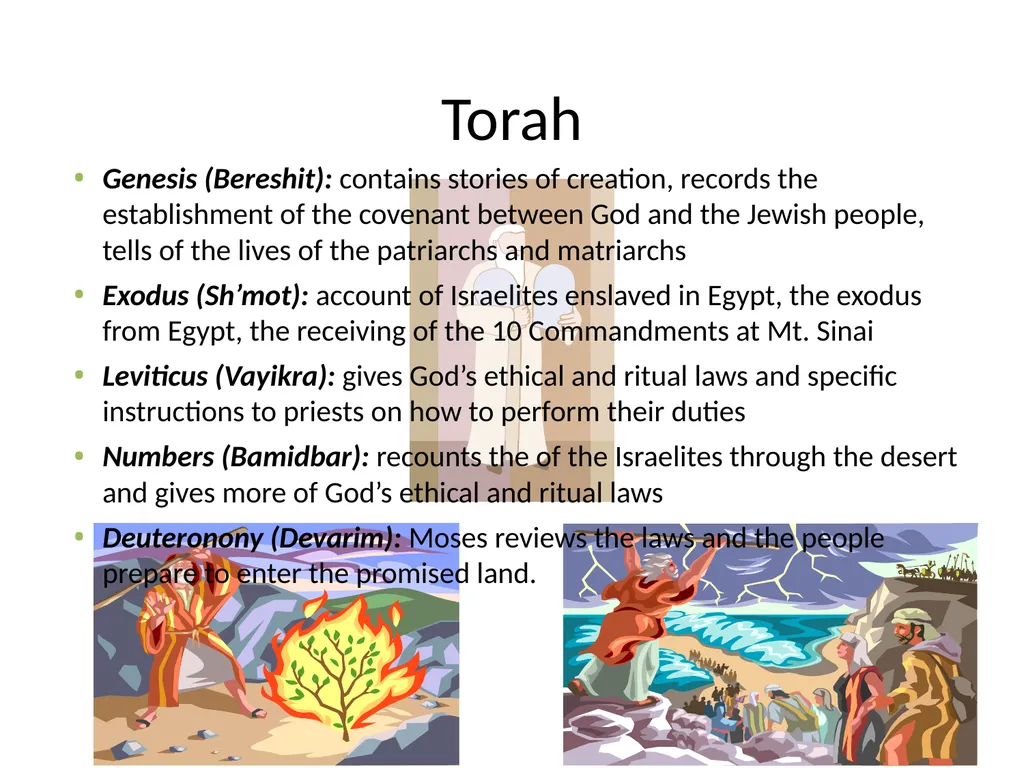
Exodus (Sh’mot): account of Israelites enslaved in Egypt, the exodus from Egypt, the receiving of the 10 Commandments at Mt. Sinai
Leviticus (Vayikra): gives God’s ethical and ritual laws and specific instructions to priests on how to perform their duties
Numbers (Bamidbar): recounts the of the Israelites through the desert and gives more of God’s ethical and ritual laws
Deuteronony (Devarim): Moses reviews the laws and the people prepare to enter the promised land.<br>
Exodus (Sh’mot): account of Israelites enslaved in Egypt, the exodus from Egypt, the receiving of the 10 Commandments at Mt. Sinai
Leviticus (Vayikra): gives God’s ethical and ritual laws and specific instructions to priests on how to perform their duties
Numbers (Bamidbar): recounts the of the Israelites through the desert and gives more of God’s ethical and ritual laws
Deuteronony (Devarim): Moses reviews the laws and the people prepare to enter the promised land.<br>
33
Nevi’im 2nd section of the Hebrew Bible, prophets
Not a soothsayer but rather a messenger of God to the people
Prophets admonished the Jewish people for forgetting and forsaking God’s commands
They called on the people to examine their lives and their conduct
Nevi’im is divided in two sections: early and latter prophets<br>
Not a soothsayer but rather a messenger of God to the people
Prophets admonished the Jewish people for forgetting and forsaking God’s commands
They called on the people to examine their lives and their conduct
Nevi’im is divided in two sections: early and latter prophets<br>
34
Nevi’im Early Prophets: Joshua, Judges, Samuel (2), Kings (2)
Latter Prophets:
Major Prophets: Isaiah, Jeremiah, Ezekiel
Minor Prophets: Hosea, Joel, Amos, Obadiah, Jonah, Micah, Nachum, Habakkuk, Zephaniah, Haggai, Zechariah, Malachi<br>
Latter Prophets:
Major Prophets: Isaiah, Jeremiah, Ezekiel
Minor Prophets: Hosea, Joel, Amos, Obadiah, Jonah, Micah, Nachum, Habakkuk, Zephaniah, Haggai, Zechariah, Malachi<br>
35
Ketuvim 3rd section of Hebrew Bible, writings
Contains wisdom literature, poetry, songs, narrative, history, religious philosophy, and love hymns…12 books in total
Books include: Psalms, Proverbs, Job, Songs, Ruth, Lamentations, Ecclesiastes, Esther, Daniel, Ezra, Nechemiah, Chronicles<br>
Contains wisdom literature, poetry, songs, narrative, history, religious philosophy, and love hymns…12 books in total
Books include: Psalms, Proverbs, Job, Songs, Ruth, Lamentations, Ecclesiastes, Esther, Daniel, Ezra, Nechemiah, Chronicles<br>
36
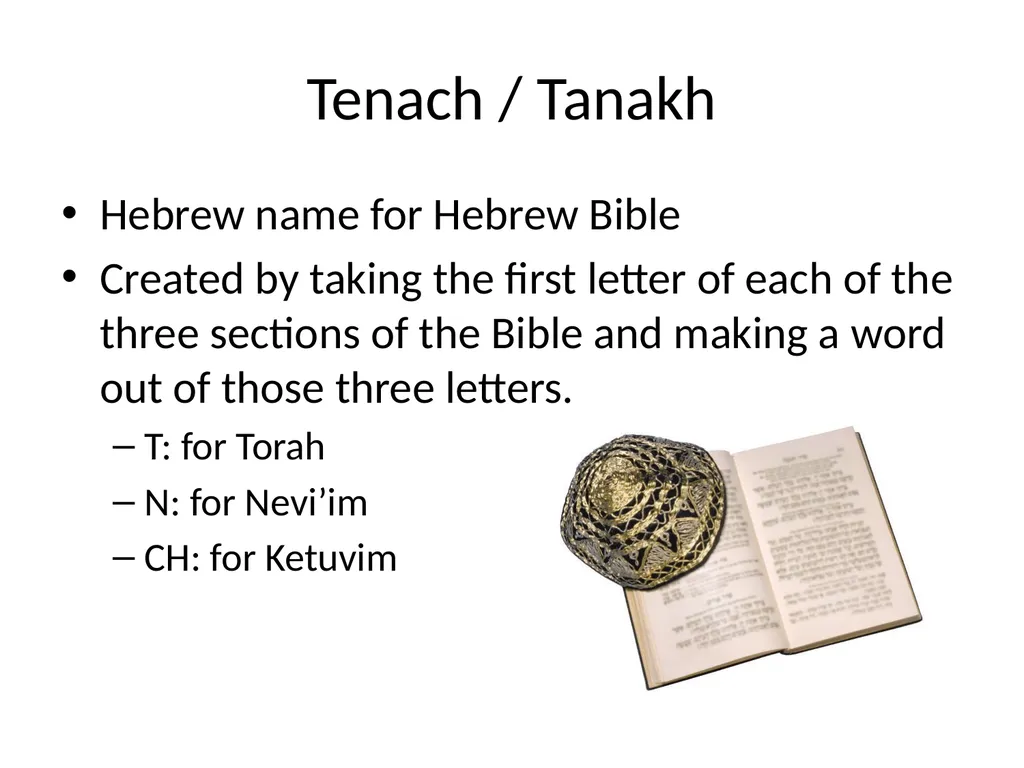
Tenach / Tanakh Hebrew name for Hebrew Bible
Created by taking the first letter of each of the three sections of the Bible and making a word out of those three letters.
T: for Torah
N: for Nevi’im
CH: for Ketuvim<br>
Created by taking the first letter of each of the three sections of the Bible and making a word out of those three letters.
T: for Torah
N: for Nevi’im
CH: for Ketuvim<br>
37
Mishnah The first compilation of the Oral Law between 200 BCE and 200 CE
Collects all of the Jewish legal material from the post-Torah era.
Divided into 6 orders (or chapters)
Seeds, Festivals, Women, Damages, Holy Things, Purifications<br>
Collects all of the Jewish legal material from the post-Torah era.
Divided into 6 orders (or chapters)
Seeds, Festivals, Women, Damages, Holy Things, Purifications<br>
38
Gemara A compilation of the discussions, interpretations, explanations, and theological arguments about the Mishnah.
New interpretations and new laws that arose after Mishnah from about 200-600 CE
Contains both Jewish law and Jewish stories<br>
New interpretations and new laws that arose after Mishnah from about 200-600 CE
Contains both Jewish law and Jewish stories<br>
39
Talmud Is the combined Mishnah and Gemara
Largest compilation of post-biblical law
Remains the basic and central document of post-biblical law
Talmud is studied:
For the practical application of its laws
For its mind-expanding challenges in logic and reasoning
For its total immersion in Jewish concerns
For its wisdom and insights into the human experience
And for the simple love of learning and growing<br>
Largest compilation of post-biblical law
Remains the basic and central document of post-biblical law
Talmud is studied:
For the practical application of its laws
For its mind-expanding challenges in logic and reasoning
For its total immersion in Jewish concerns
For its wisdom and insights into the human experience
And for the simple love of learning and growing<br>