Judging Criteria The Composite Engineering Challenge 2022 1 The Composite Engineering Challenge - October 2022 All you need to know before submitting your project 2 All submissions will be judged based on several criteria: Technical
"Judging Criteria The Composite Engineering" is the property of its rightful owner. Permission is granted to
download and print the materials on this website for personal, non-commercial use only, and to display it
on your personal computer provided you do not modify the materials and that you retain all copyright
notices contained in the materials. By downloading content from our website, you accept the terms of this
agreement.
Presentation Transcript
01
Judging Criteria The Composite Engineering Challenge 2022 1 The Composite Engineering Challenge - October 2022<br>
02
All you need to know before submitting your project 2 All submissions will be judged based on several criteria:
Technical Feasibility
Scalability (manufacturing and team)
Commercial Feasibility
Sustainability
All criteria are equally important for the judging process.
Are you still in the idea phase or have advanced further and ready to launch your product into the world?
Startups and scaleups typically test their first (functional) prototypes , so called beta-versions, with a selective set of customers to get valuable feedback in an early stage of your development. This approach reduces time-to-market and avoids wasting resources (time and money).
A great way to check both technical and commercial feasibility (in an early stage of development) is to create an MVP. This is a Minimum Viable Product, let’s say 60-80% ready that you’re going to test with a small audience to get early feedback. This first step is followed by multiple iteration loops. Typically, the final product (based on customer feedback) is not what you envisioned at the start of your journey. We recommend reading ‘The Lean Startup’ by Eric Ries (https://leanstartup.co/team/eric-ries/) to get more insights in this approach. The Composite Engineering Challenge - October 2022<br>
03
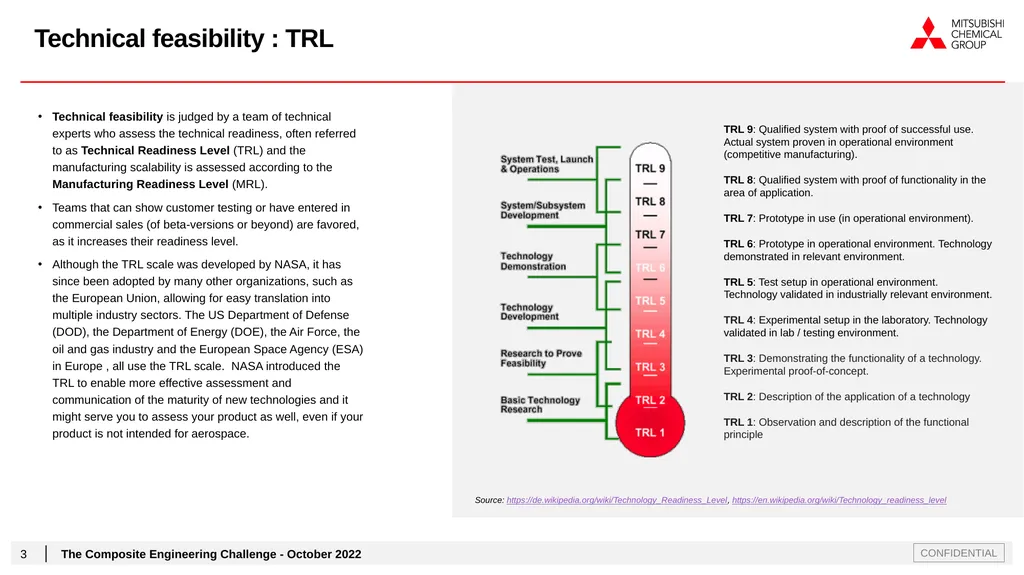
3 Technical feasibility : TRL The Composite Engineering Challenge - October 2022 TRL 9: Qualified system with proof of successful use. Actual system proven in operational environment (competitive manufacturing).
TRL 8: Qualified system with proof of functionality in the area of application.
TRL 7: Prototype in use (in operational environment).
TRL 6: Prototype in operational environment. Technology demonstrated in relevant environment.
TRL 5: Test setup in operational environment. Technology validated in industrially relevant environment.
TRL 4: Experimental setup in the laboratory. Technology validated in lab / testing environment.
TRL 3: Demonstrating the functionality of a technology. Experimental proof-of-concept.
TRL 2: Description of the application of a technology
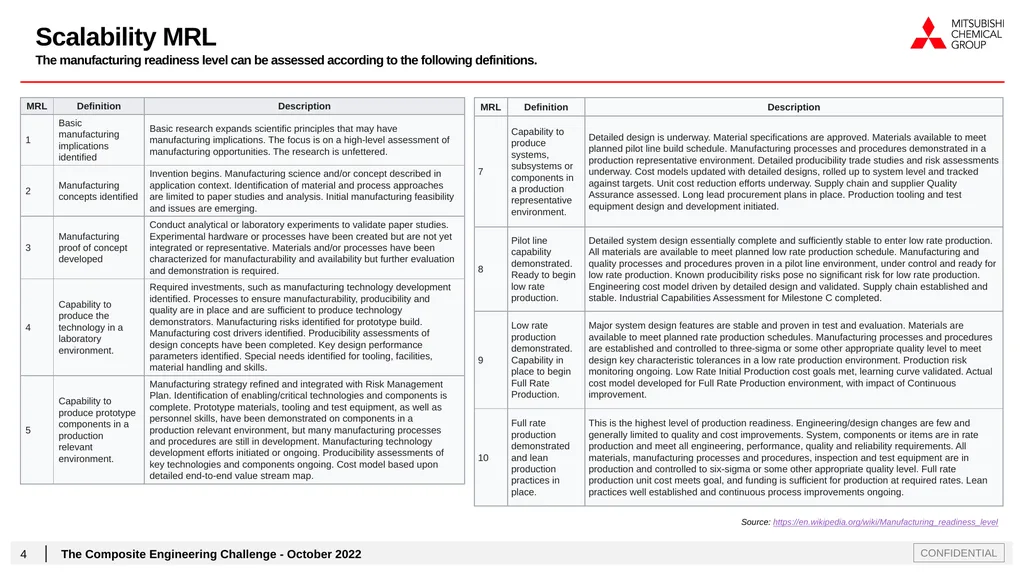
TRL 1: Observation and description of the functional principle Source: https://de.wikipedia.org/wiki/Technology_Readiness_Level, https://en.wikipedia.org/wiki/Technology_readiness_level Technical feasibility is judged by a team of technical experts who assess the technical readiness, often referred to as Technical Readiness Level (TRL) and the manufacturing scalability is assessed according to the Manufacturing Readiness Level (MRL).
Teams that can show customer testing or have entered in commercial sales (of beta-versions or beyond) are favored, as it increases their readiness level.
Although the TRL scale was developed by NASA, it has since been adopted by many other organizations, such as the European Union, allowing for easy translation into multiple industry sectors. The US Department of Defense (DOD), the Department of Energy (DOE), the Air Force, the oil and gas industry and the European Space Agency (ESA) in Europe , all use the TRL scale. NASA introduced the TRL to enable more effective assessment and communication of the maturity of new technologies and it might serve you to assess your product as well, even if your product is not intended for aerospace.<br>
04
4 Scalability MRL The manufacturing readiness level can be assessed according to the following definitions. The Composite Engineering Challenge - October 2022 Source: https://en.wikipedia.org/wiki/Manufacturing_readiness_level<br>
05
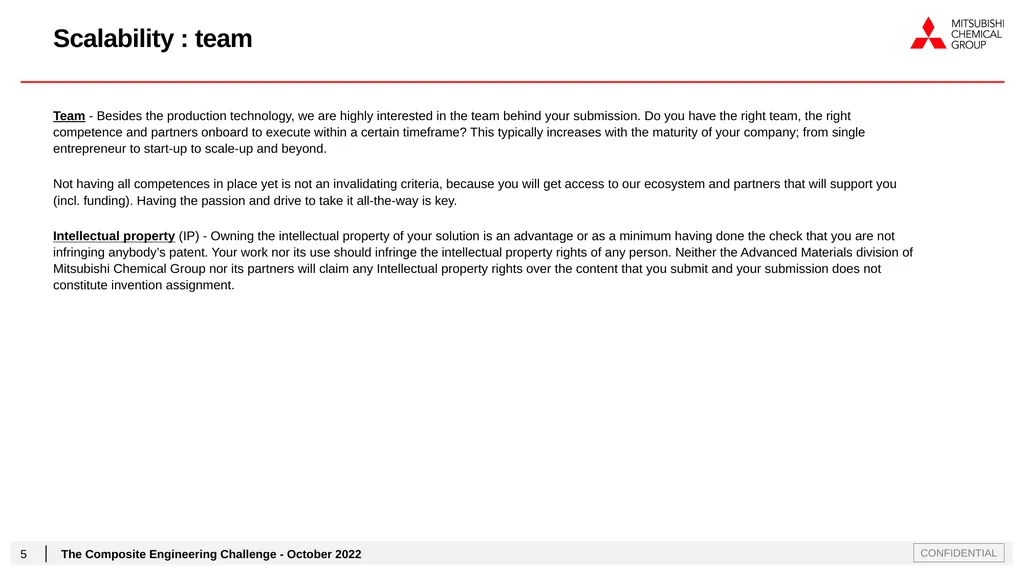
Scalability : team 5 Team - Besides the production technology, we are highly interested in the team behind your submission. Do you have the right team, the right competence and partners onboard to execute within a certain timeframe? This typically increases with the maturity of your company; from single entrepreneur to start-up to scale-up and beyond.
Not having all competences in place yet is not an invalidating criteria, because you will get access to our ecosystem and partners that will support you (incl. funding). Having the passion and drive to take it all-the-way is key.
Intellectual property (IP) - Owning the intellectual property of your solution is an advantage or as a minimum having done the check that you are not infringing anybody’s patent. Your work nor its use should infringe the intellectual property rights of any person. Neither the Advanced Materials division of Mitsubishi Chemical Group nor its partners will claim any Intellectual property rights over the content that you submit and your submission does not constitute invention assignment. The Composite Engineering Challenge - October 2022<br>
06
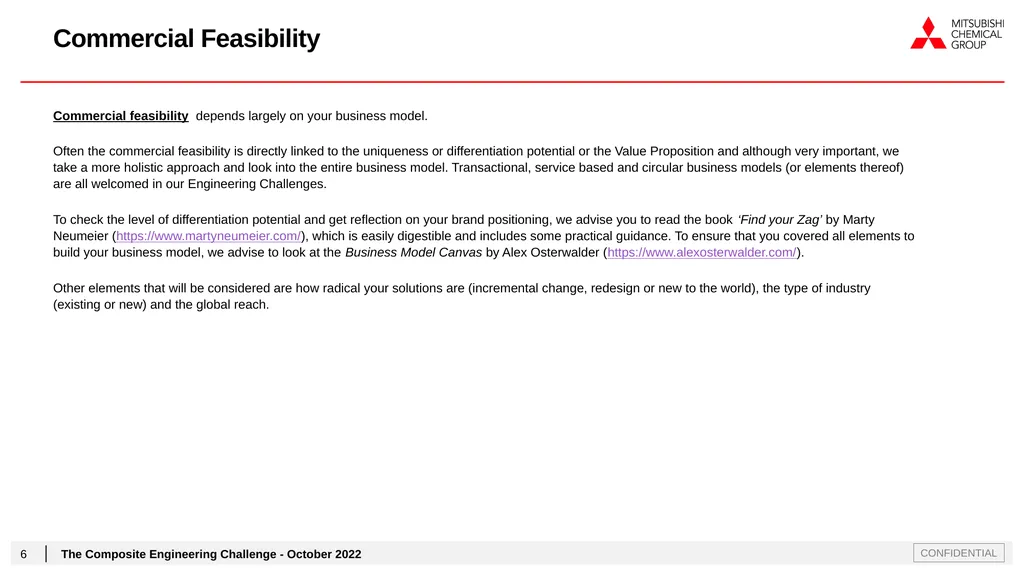
Commercial Feasibility 6 Commercial feasibility depends largely on your business model.
Often the commercial feasibility is directly linked to the uniqueness or differentiation potential or the Value Proposition and although very important, we take a more holistic approach and look into the entire business model. Transactional, service based and circular business models (or elements thereof) are all welcomed in our Engineering Challenges.
To check the level of differentiation potential and get reflection on your brand positioning, we advise you to read the book ‘Find your Zag’ by Marty Neumeier (https://www.martyneumeier.com/), which is easily digestible and includes some practical guidance. To ensure that you covered all elements to build your business model, we advise to look at the Business Model Canvas by Alex Osterwalder (https://www.alexosterwalder.com/).
Other elements that will be considered are how radical your solutions are (incremental change, redesign or new to the world), the type of industry (existing or new) and the global reach. The Composite Engineering Challenge - October 2022<br>
07
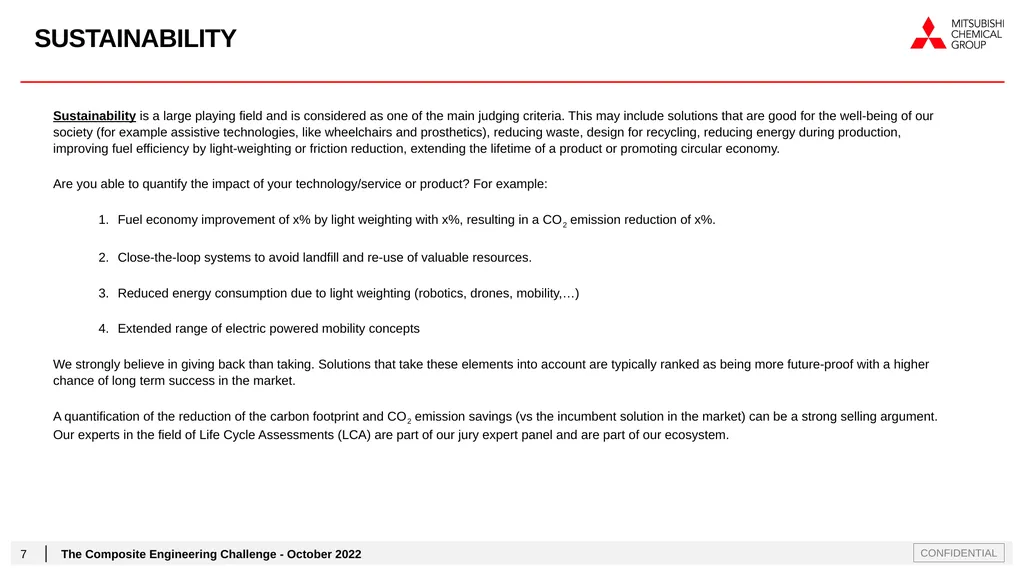
SUSTAINABILITY 7 Sustainability is a large playing field and is considered as one of the main judging criteria. This may include solutions that are good for the well-being of our society (for example assistive technologies, like wheelchairs and prosthetics), reducing waste, design for recycling, reducing energy during production, improving fuel efficiency by light-weighting or friction reduction, extending the lifetime of a product or promoting circular economy.
Are you able to quantify the impact of your technology/service or product? For example:
Fuel economy improvement of x% by light weighting with x%, resulting in a CO2 emission reduction of x%.
Close-the-loop systems to avoid landfill and re-use of valuable resources.
Reduced energy consumption due to light weighting (robotics, drones, mobility,…)
Extended range of electric powered mobility concepts
We strongly believe in giving back than taking. Solutions that take these elements into account are typically ranked as being more future-proof with a higher chance of long term success in the market.
A quantification of the reduction of the carbon footprint and CO2 emission savings (vs the incumbent solution in the market) can be a strong selling argument. Our experts in the field of Life Cycle Assessments (LCA) are part of our jury expert panel and are part of our ecosystem. The Composite Engineering Challenge - October 2022<br>