
Junior Certificate Ordinary Level Perimeter, Area
PC
Published · 59 slides · 0 views
1 / 1





Description
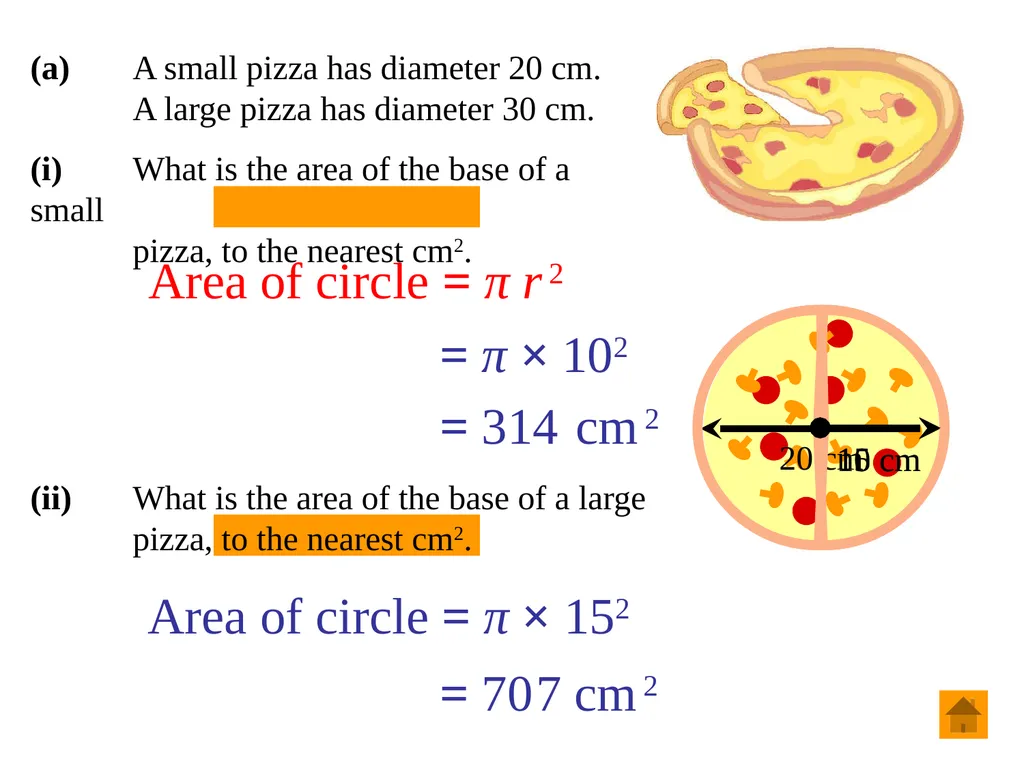
Junior Certificate Ordinary Level Perimeter, Area and Volume (a) A small pizza has diameter 20 cm. A large pizza has diameter 30 cm. (i) What is the area of the base of a small pizza, to the nearest cm2. 20 cm 10 cm Area of circle π r 2
Related Topics
Share
Embed code
Download this presentation From Below
"Junior Certificate Ordinary Level Perimeter, Area" is the property of its rightful owner. Permission is granted to download and print the materials on this website for personal, non-commercial use only, and to display it on your personal computer provided you do not modify the materials and that you retain all copyright notices contained in the materials. By downloading content from our website, you accept the terms of this agreement.
Presentation Transcript
01
Junior Certificate
Ordinary Level
Perimeter, Area and Volume<br>
Ordinary Level
Perimeter, Area and Volume<br>
02
(a) A small pizza has diameter 20 cm.
A large pizza has diameter 30 cm. (i) What is the area of the base of a small
pizza, to the nearest cm2. 20 cm 10 cm Area of circle = π r 2 = π × 102 = 314·159.. cm 2 (ii) What is the area of the base of a large
pizza, to the nearest cm2. 15 cm Area of circle = π × 152 = 706·858.. 7 cm 2<br>
A large pizza has diameter 30 cm. (i) What is the area of the base of a small
pizza, to the nearest cm2. 20 cm 10 cm Area of circle = π r 2 = π × 102 = 314·159.. cm 2 (ii) What is the area of the base of a large
pizza, to the nearest cm2. 15 cm Area of circle = π × 152 = 706·858.. 7 cm 2<br>
03
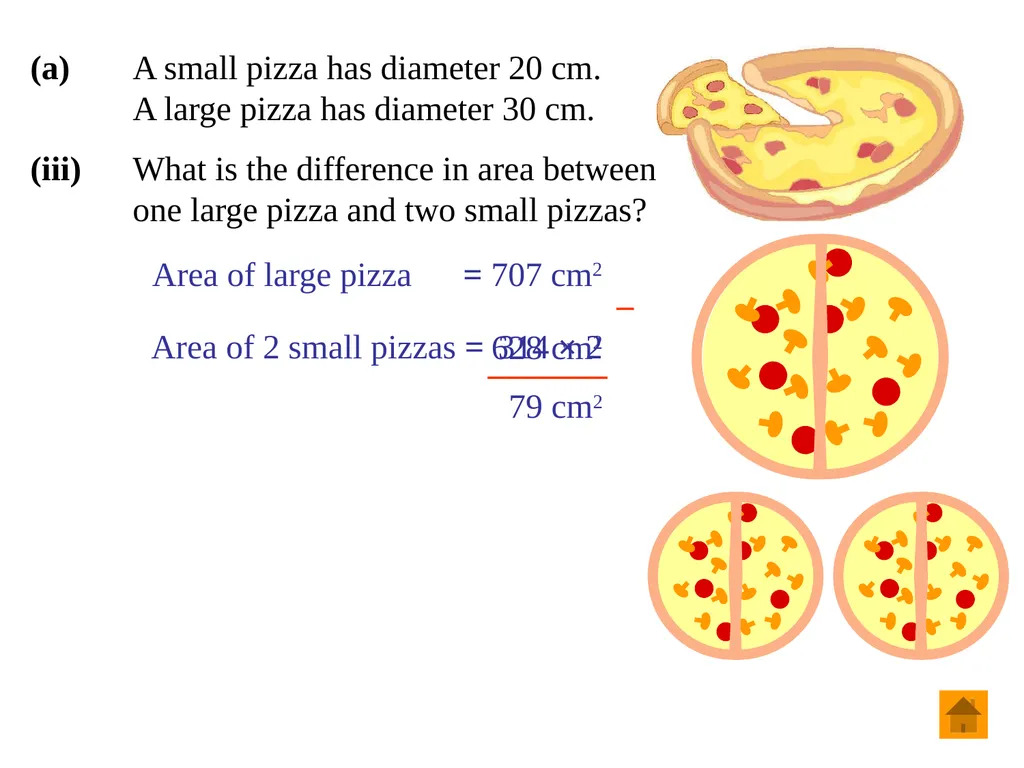
314 × 2 628 cm2 (a) A small pizza has diameter 20 cm.
A large pizza has diameter 30 cm. (iii) What is the difference in area between
one large pizza and two small pizzas? Area of large pizza = 707 cm2 Area of 2 small pizzas = – ––––––– 79 cm2<br>
A large pizza has diameter 30 cm. (iii) What is the difference in area between
one large pizza and two small pizzas? Area of large pizza = 707 cm2 Area of 2 small pizzas = – ––––––– 79 cm2<br>
04
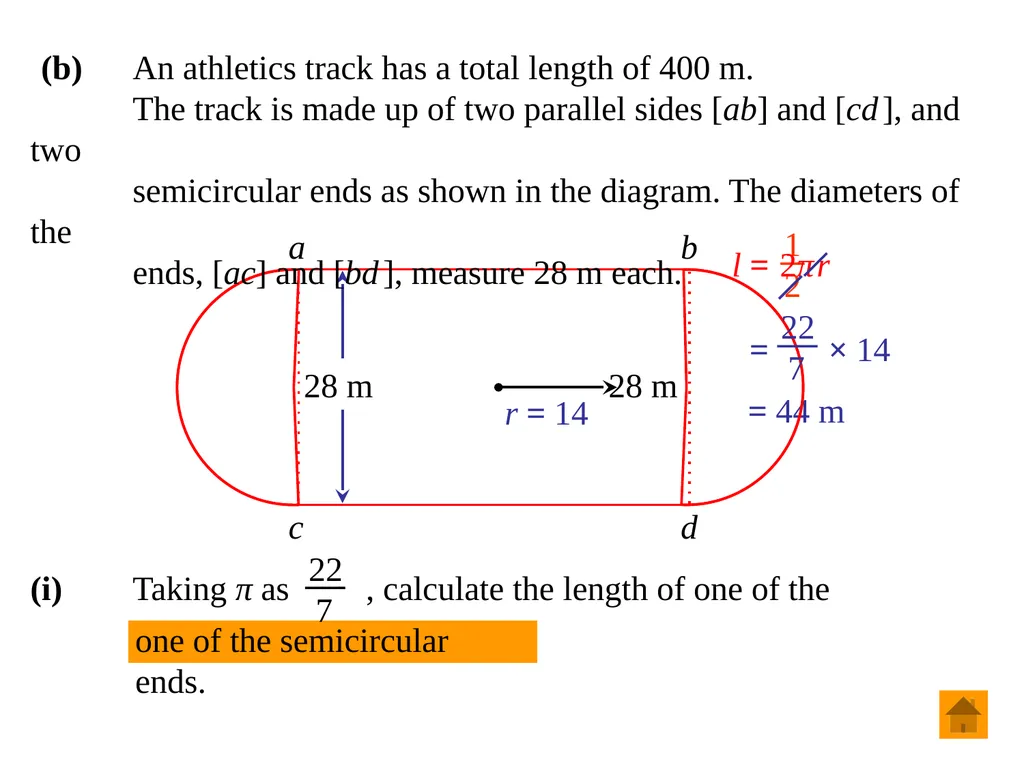
r = 14 = 44 m 28 m l = 28 m (b) An athletics track has a total length of 400 m.
The track is made up of two parallel sides [ab] and [cd ], and two
semicircular ends as shown in the diagram. The diameters of the
ends, [ac] and [bd ], measure 28 m each. a b c d one of the semicircular ends. 2π r<br>
The track is made up of two parallel sides [ab] and [cd ], and two
semicircular ends as shown in the diagram. The diameters of the
ends, [ac] and [bd ], measure 28 m each. a b c d one of the semicircular ends. 2π r<br>
05
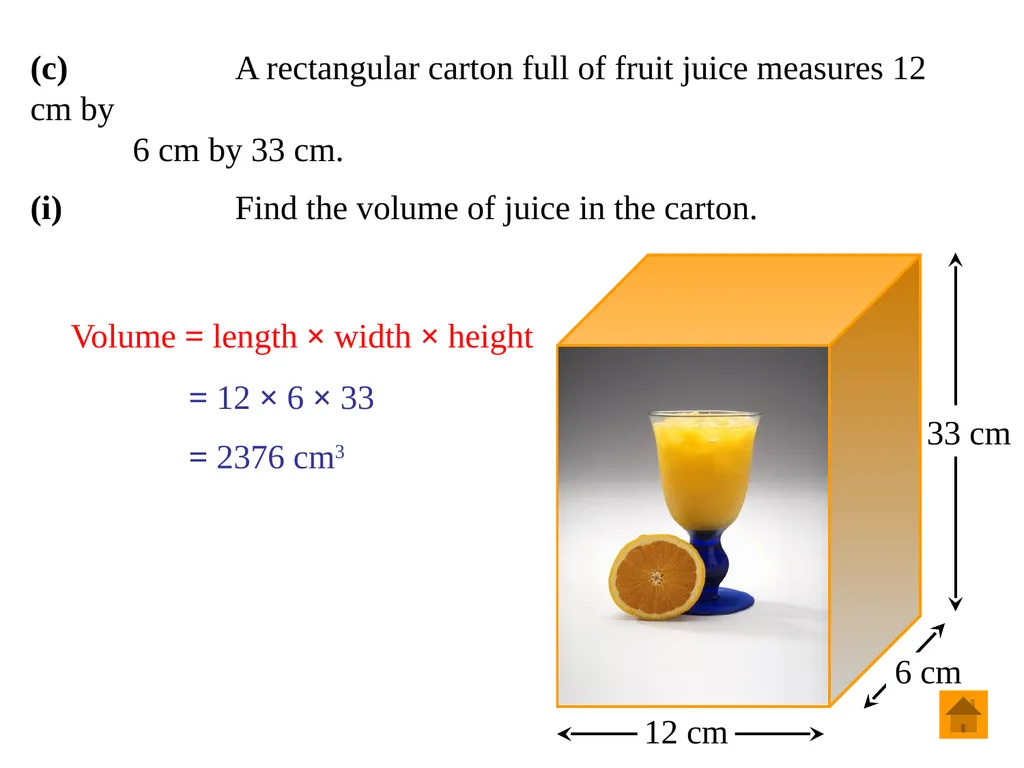
(c) A rectangular carton full of fruit juice measures 12 cm by
6 cm by 33 cm.
(i) Find the volume of juice in the carton. = 2376 cm3 12 cm = 12 × 6 × 33 Volume = length × width × height 33 cm 6 cm<br>
6 cm by 33 cm.
(i) Find the volume of juice in the carton. = 2376 cm3 12 cm = 12 × 6 × 33 Volume = length × width × height 33 cm 6 cm<br>
06
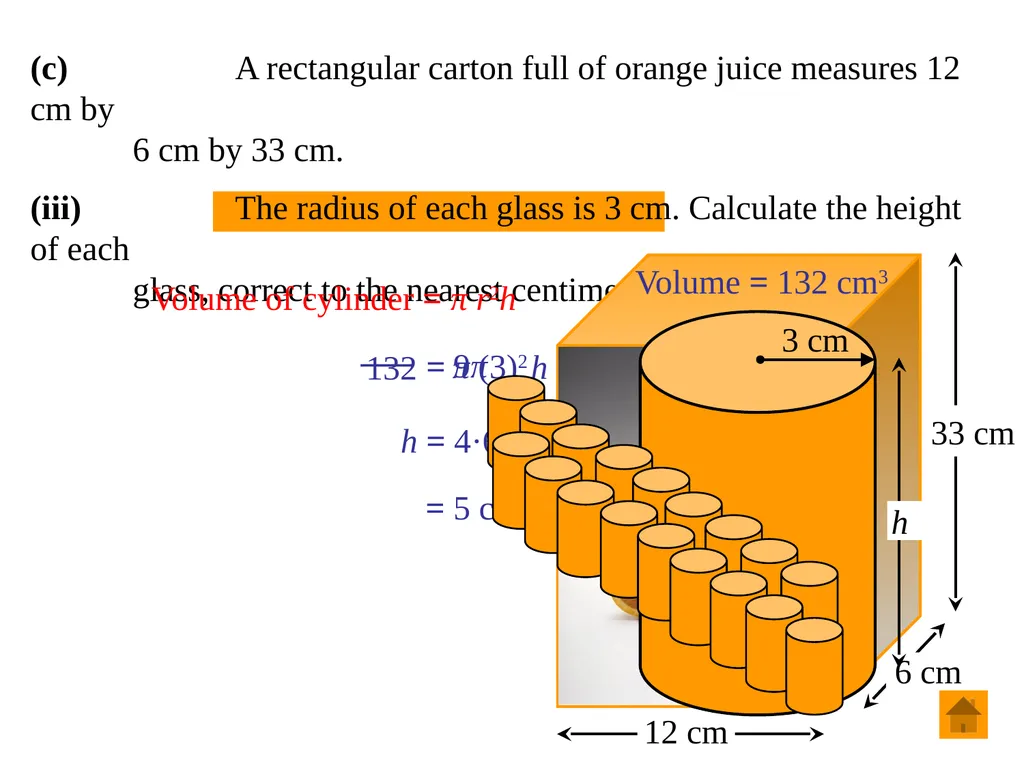
π (3)2 9π (c) A rectangular carton full of orange juice measures 12 cm by
6 cm by 33 cm.
(iii) The radius of each glass is 3 cm. Calculate the height of each
glass, correct to the nearest centimetre. 33 cm 12 cm Volume = 132 cm3 3 cm 6 cm h Volume of cylinder = π r2h 132 h = ___ h = 4·668… = 5 cm<br>
6 cm by 33 cm.
(iii) The radius of each glass is 3 cm. Calculate the height of each
glass, correct to the nearest centimetre. 33 cm 12 cm Volume = 132 cm3 3 cm 6 cm h Volume of cylinder = π r2h 132 h = ___ h = 4·668… = 5 cm<br>
07
(a) A swimming pool is 50 m in length.
Mary swims 25 lengths of the pool.
What distance, in kilometres, does Mary swim? = 1·25 km 50 × 25 = 1250 m 1000 m = 1 km<br>
Mary swims 25 lengths of the pool.
What distance, in kilometres, does Mary swim? = 1·25 km 50 × 25 = 1250 m 1000 m = 1 km<br>
08
(b) A garden is made up of a rectangular lawn that is surrounded
by a path. The garden is 16 m long and 10 m wide.
The path is 2 m wide. (i) Find, in m2, the area of the garden. 16 m = 160 m2 10 m 2 m 2 m 2 m 2 m Area = 16 × 10 Length × Breadth<br>
by a path. The garden is 16 m long and 10 m wide.
The path is 2 m wide. (i) Find, in m2, the area of the garden. 16 m = 160 m2 10 m 2 m 2 m 2 m 2 m Area = 16 × 10 Length × Breadth<br>
09
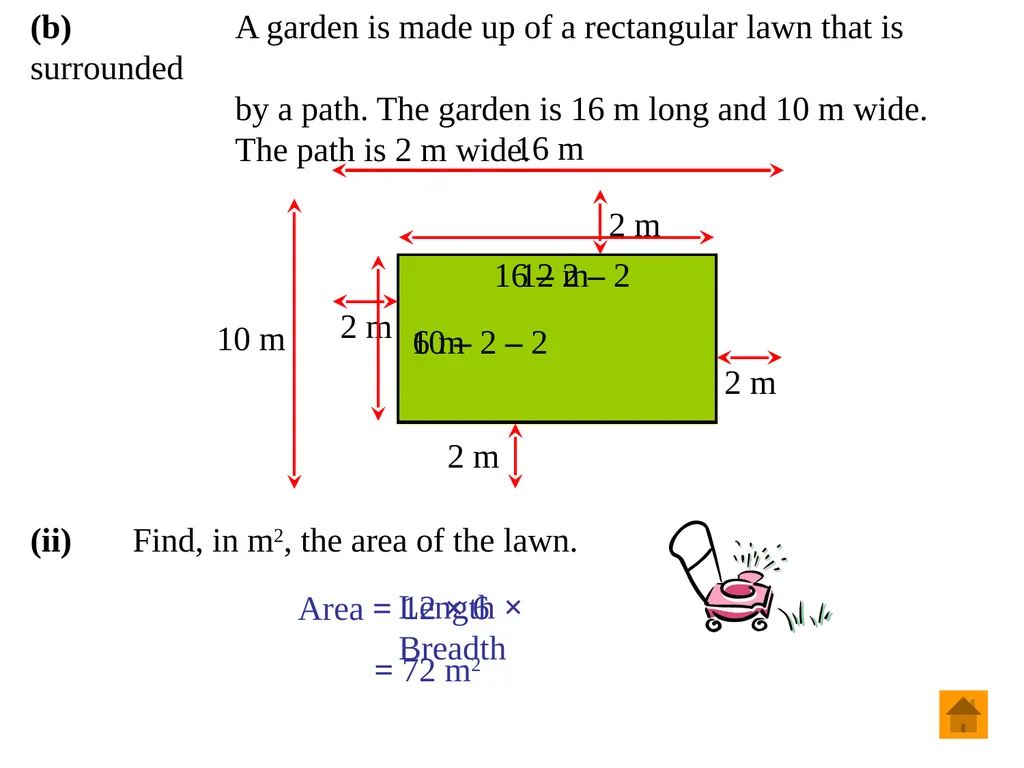
Length × Breadth (b) A garden is made up of a rectangular lawn that is surrounded
by a path. The garden is 16 m long and 10 m wide.
The path is 2 m wide. (ii) Find, in m2, the area of the lawn. 16 m = 72 m2 10 m Area = 12 × 6 16 – 2 – 2 12 m 10 – 2 – 2 6 m 2 m 2 m 2 m 2 m<br>
by a path. The garden is 16 m long and 10 m wide.
The path is 2 m wide. (ii) Find, in m2, the area of the lawn. 16 m = 72 m2 10 m Area = 12 × 6 16 – 2 – 2 12 m 10 – 2 – 2 6 m 2 m 2 m 2 m 2 m<br>
10
(b) A garden is made up of a rectangular lawn that is surrounded
by a path. The garden is 16 m long and 10 m wide.
The path is 2 m wide. (iii) Find, in m2, the area of the path. 16 m 10 m 2 m 2 m 2 m 2 m Area of garden = 160 m2 Area of lawn = 72 m2 –––––– – Area of path = 88 m2<br>
by a path. The garden is 16 m long and 10 m wide.
The path is 2 m wide. (iii) Find, in m2, the area of the path. 16 m 10 m 2 m 2 m 2 m 2 m Area of garden = 160 m2 Area of lawn = 72 m2 –––––– – Area of path = 88 m2<br>
11
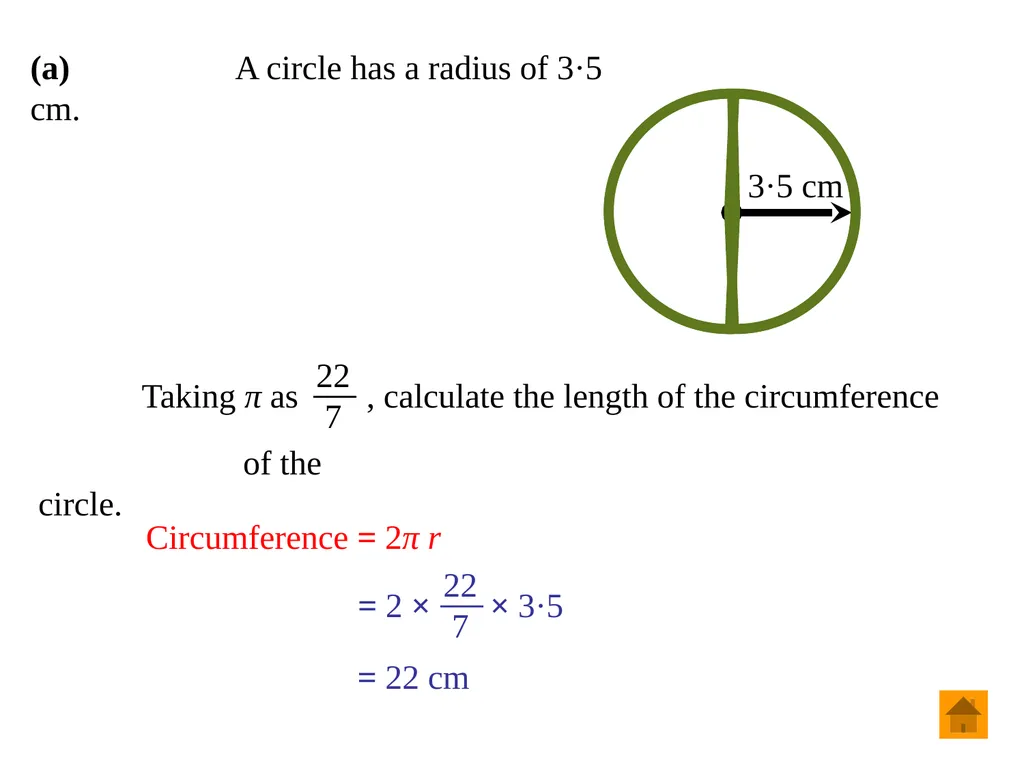
(a) A circle has a radius of 3·5 cm. 3·5 cm Circumference = 2π r = 22 cm of the circle.<br>
12
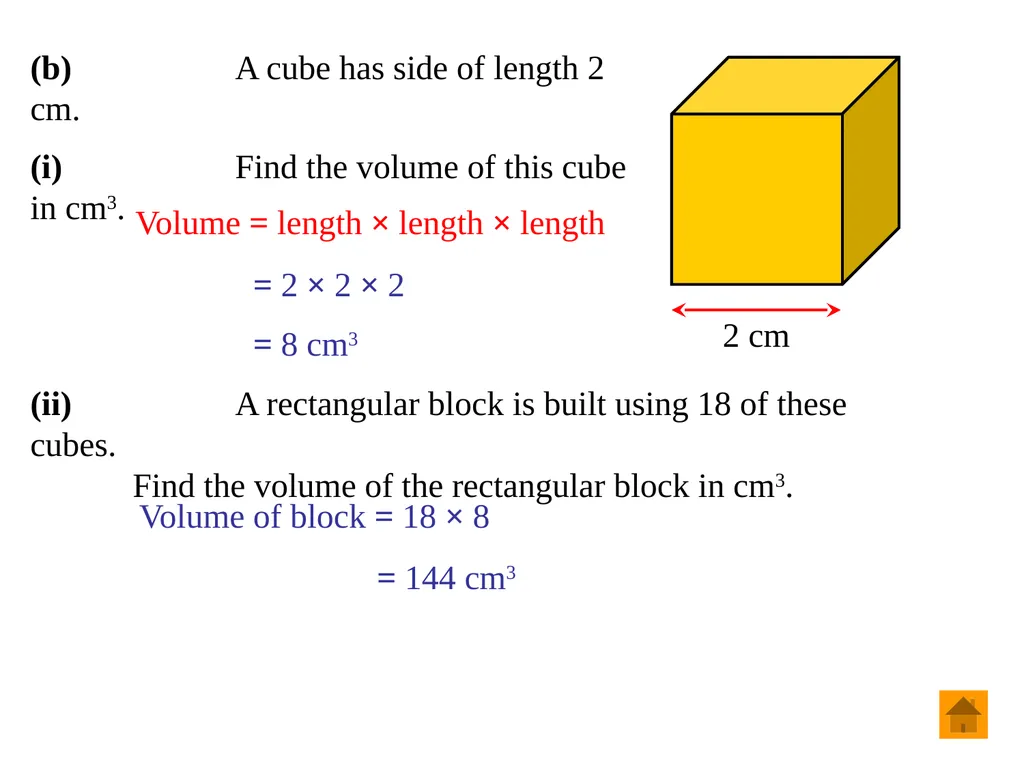
(b) A cube has side of length 2 cm.
(i) Find the volume of this cube in cm3. = 8 cm3 = 2 × 2 × 2 Volume = length × length × length 2 cm (ii) A rectangular block is built using 18 of these cubes.
Find the volume of the rectangular block in cm3. Volume of block = 18 × 8 = 144 cm3<br>
(i) Find the volume of this cube in cm3. = 8 cm3 = 2 × 2 × 2 Volume = length × length × length 2 cm (ii) A rectangular block is built using 18 of these cubes.
Find the volume of the rectangular block in cm3. Volume of block = 18 × 8 = 144 cm3<br>
13
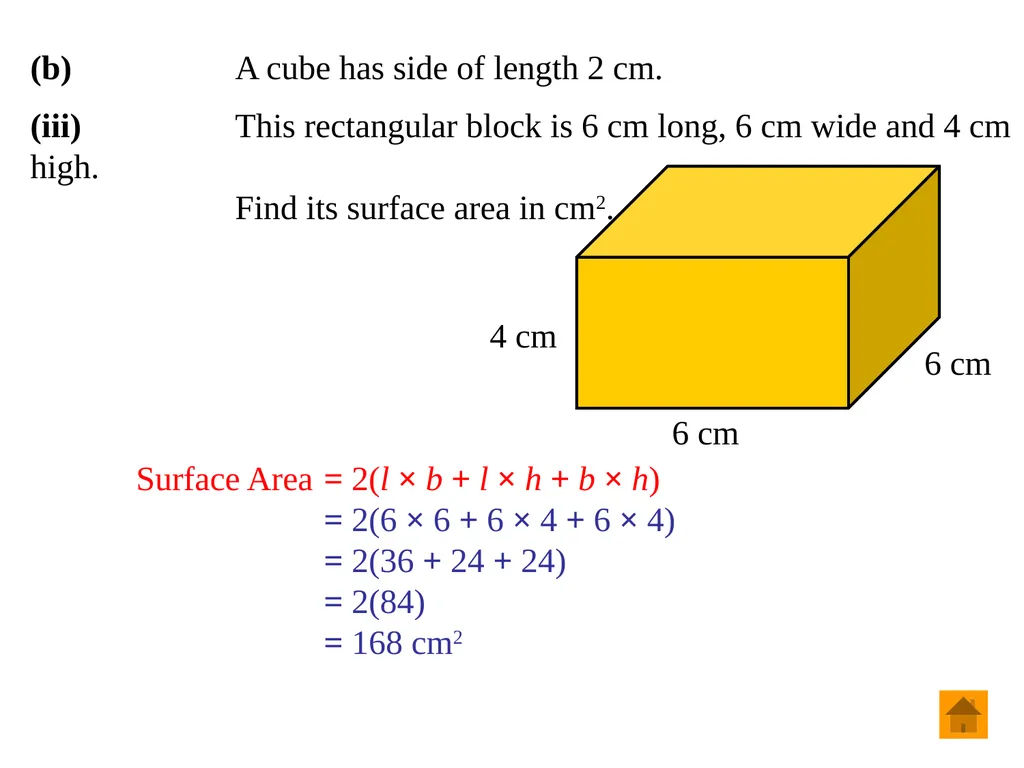
4 cm 6 cm 6 cm Surface Area = 2(l × b + l × h + b × h)
= 2(6 × 6 + 6 × 4 + 6 × 4)
= 2(36 + 24 + 24)
= 2(84)
= 168 cm2 (b) A cube has side of length 2 cm.
(iii) This rectangular block is 6 cm long, 6 cm wide and 4 cm high.
Find its surface area in cm2.<br>
= 2(6 × 6 + 6 × 4 + 6 × 4)
= 2(36 + 24 + 24)
= 2(84)
= 168 cm2 (b) A cube has side of length 2 cm.
(iii) This rectangular block is 6 cm long, 6 cm wide and 4 cm high.
Find its surface area in cm2.<br>
14
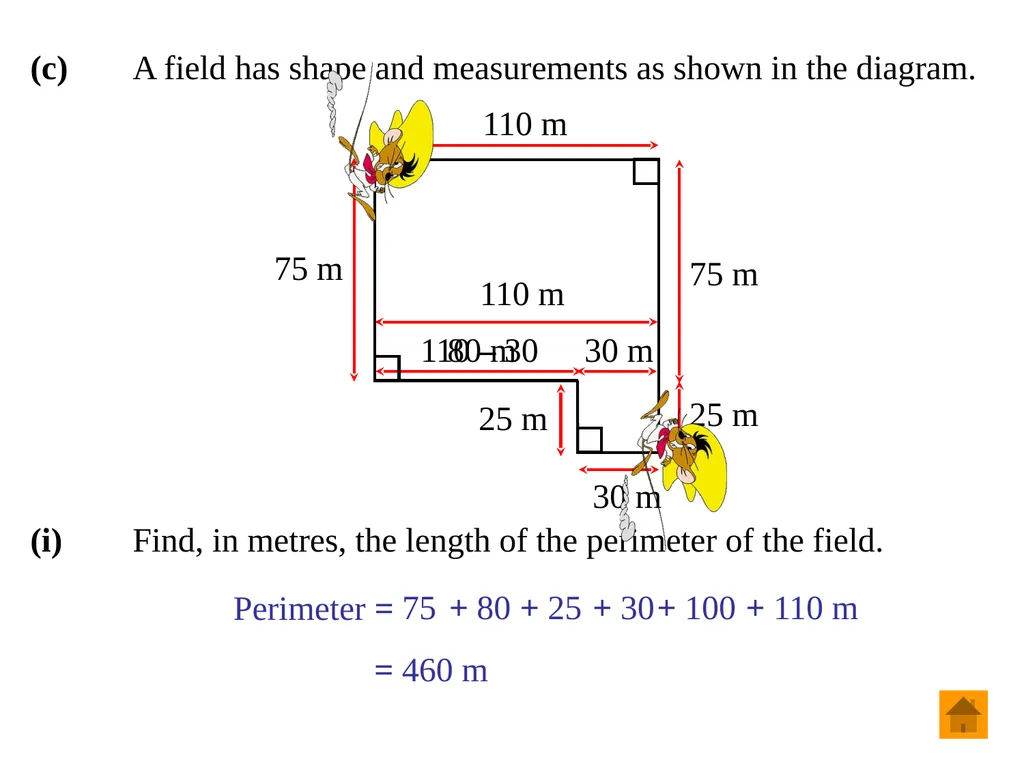
110 m 110 – 30 75 m (c) A field has shape and measurements as shown in the diagram. Perimeter = (i) Find, in metres, the length of the perimeter of the field. 110 m 75 m 30 m 25 m 25 m 30 m 80 m 75 + 80 + 25 + 30 + 100 + 110 m = 460 m<br>
15
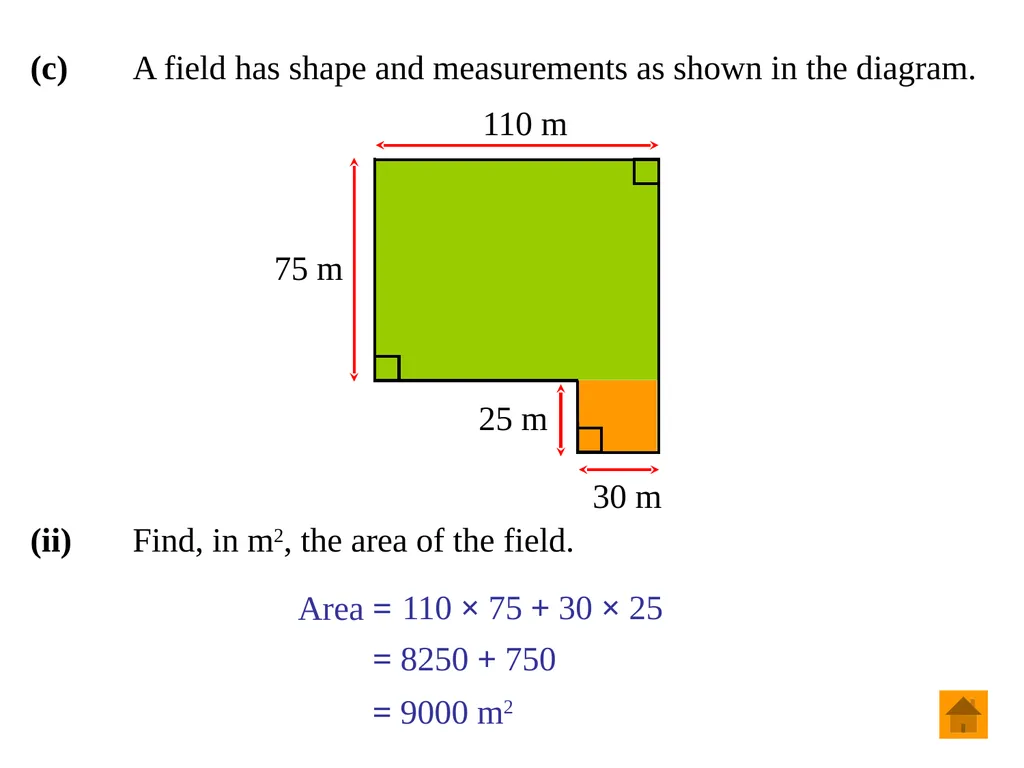
(c) A field has shape and measurements as shown in the diagram. Area = (ii) Find, in m2, the area of the field. 110 m 75 m 30 m 25 m 110 × 75 + 30 × 25 = 8250 + 750 = 9000 m2<br>
16
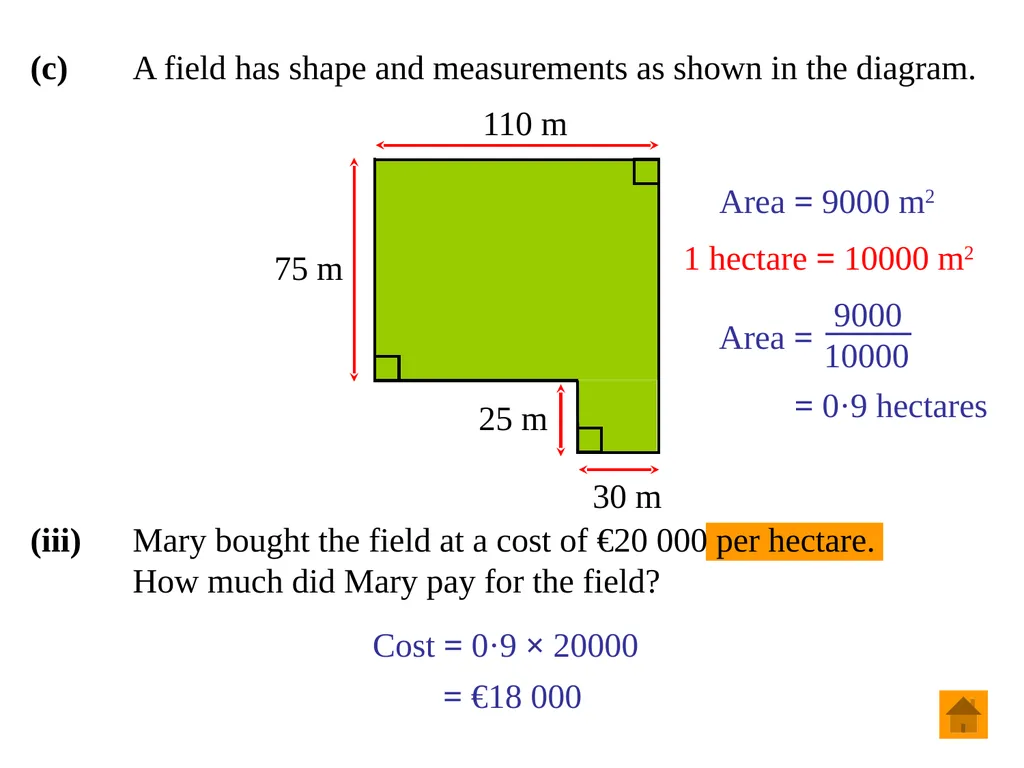
(c) A field has shape and measurements as shown in the diagram. 1 hectare = 10000 m2 (iii) Mary bought the field at a cost of €20 000 per hectare.
How much did Mary pay for the field? 110 m 75 m 30 m 25 m = 0·9 hectares Cost = 0·9 × 20000 Area = 9000 m2 Area = = €18 000<br>
How much did Mary pay for the field? 110 m 75 m 30 m 25 m = 0·9 hectares Cost = 0·9 × 20000 Area = 9000 m2 Area = = €18 000<br>
17
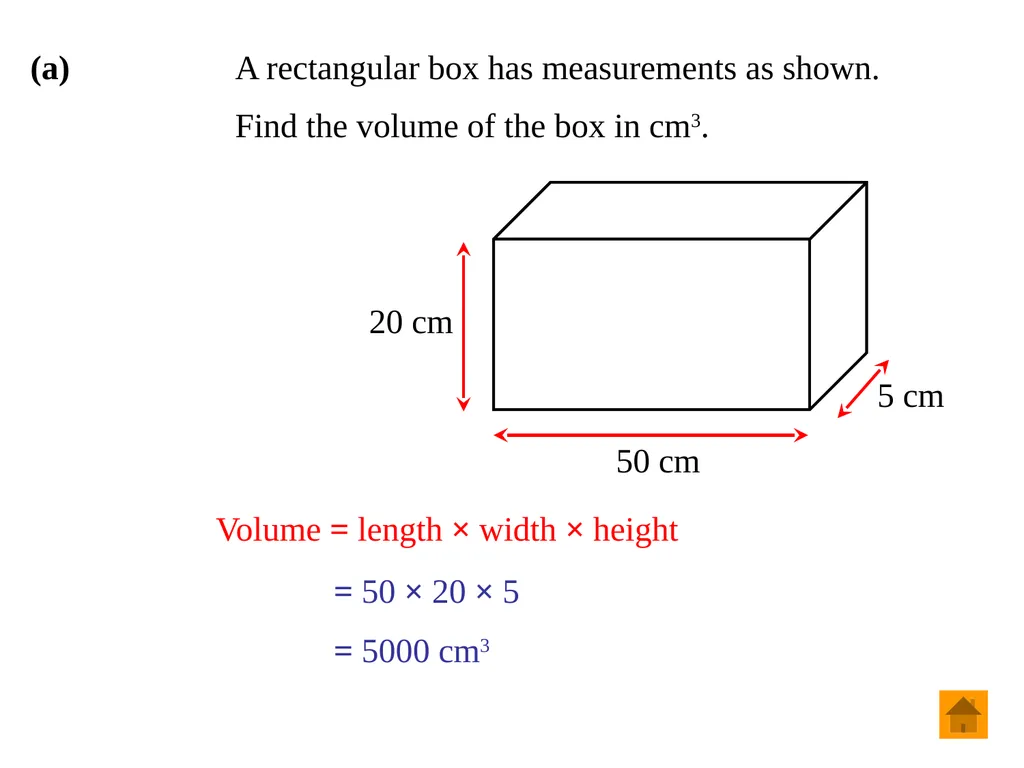
(a) A rectangular box has measurements as shown.
Find the volume of the box in cm3. = 5000 cm3 = 50 × 20 × 5 Volume = length × width × height 5 cm 50 cm 20 cm<br>
Find the volume of the box in cm3. = 5000 cm3 = 50 × 20 × 5 Volume = length × width × height 5 cm 50 cm 20 cm<br>
18
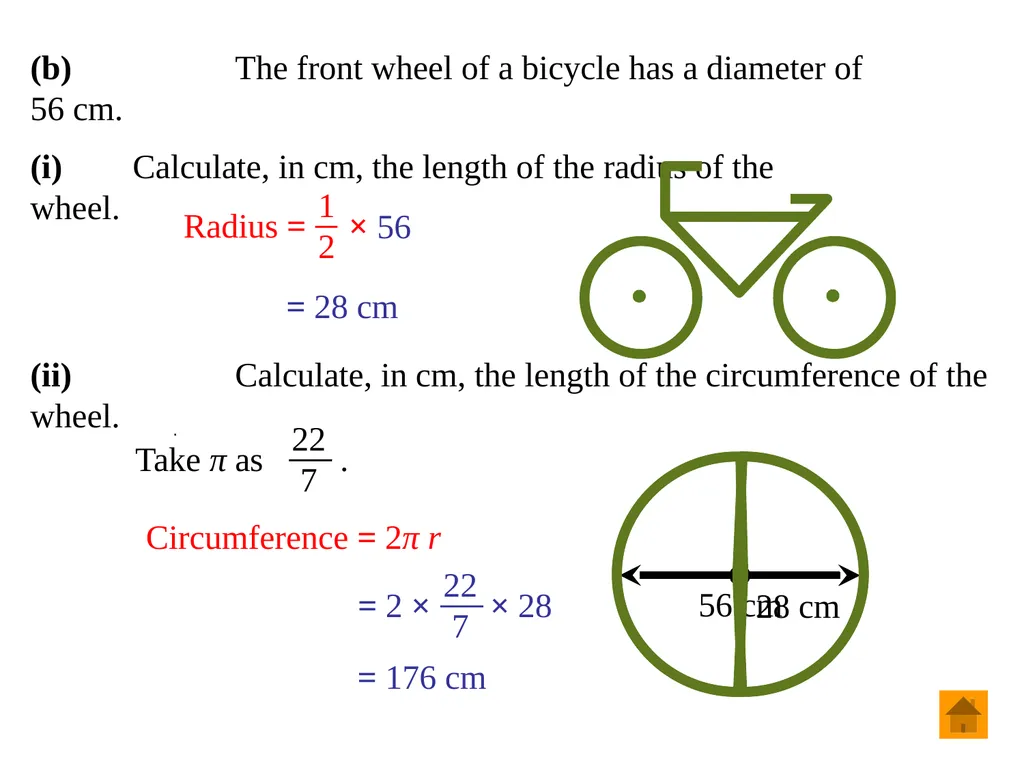
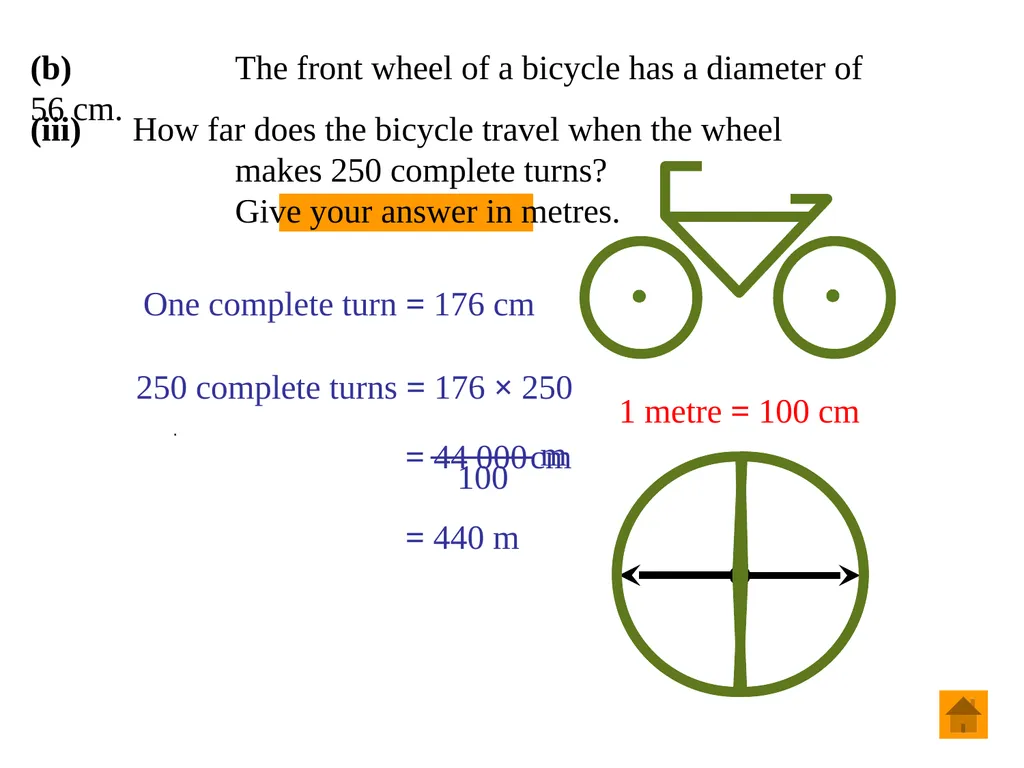
56 cm (b) The front wheel of a bicycle has a diameter of 56 cm.
(i) Calculate, in cm, the length of the radius of the wheel. Radius = × diameter 56 = 28 cm . (ii) Calculate, in cm, the length of the circumference of the wheel. 28 cm Circumference = 2π r = 176 cm<br>
(i) Calculate, in cm, the length of the radius of the wheel. Radius = × diameter 56 = 28 cm . (ii) Calculate, in cm, the length of the circumference of the wheel. 28 cm Circumference = 2π r = 176 cm<br>
19
cm –––––– (b) The front wheel of a bicycle has a diameter of 56 cm. . One complete turn = 176 cm (iii) How far does the bicycle travel when the wheel
makes 250 complete turns?
Give your answer in metres. 250 complete turns = 176 × 250 = 1 metre = 100 cm = 440 m 44 000 100 m<br>
makes 250 complete turns?
Give your answer in metres. 250 complete turns = 176 × 250 = 1 metre = 100 cm = 440 m 44 000 100 m<br>
20
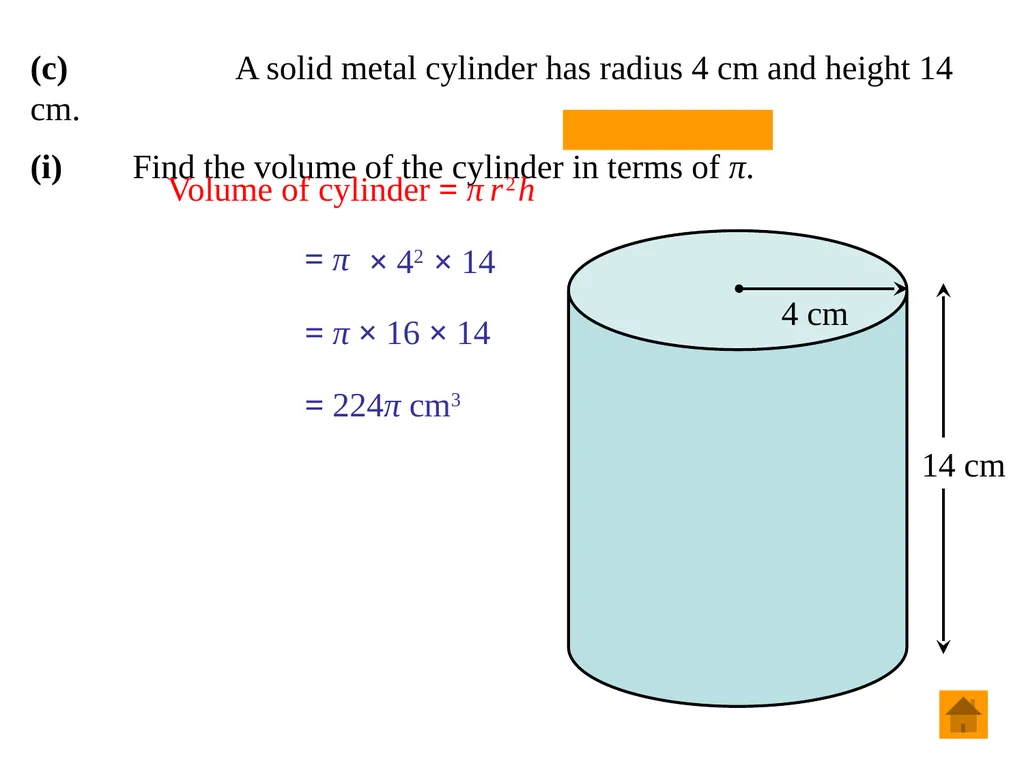
14 cm (c) A solid metal cylinder has radius 4 cm and height 14 cm.
(i) Find the volume of the cylinder in terms of π. Volume of cylinder = π r 2 h = π = 224π cm3 × 42 × 14 4 cm = π × 16 × 14<br>
(i) Find the volume of the cylinder in terms of π. Volume of cylinder = π r 2 h = π = 224π cm3 × 42 × 14 4 cm = π × 16 × 14<br>
21
(c) A solid metal cylinder has radius 4 cm and height 14 cm.
(ii) Find the curved surface area of the cylinder in terms of π. Curved surface area of cylinder = 2π r h = 2π = 112π cm2 × 4 × 14 = π × 8 × 14 14 cm 4 cm CSA<br>
(ii) Find the curved surface area of the cylinder in terms of π. Curved surface area of cylinder = 2π r h = 2π = 112π cm2 × 4 × 14 = π × 8 × 14 14 cm 4 cm CSA<br>
22
(c) A solid metal cylinder has radius 4 cm and height 14 cm.
(iii) Find the total surface area of the cylinder in terms of π. Total surface area of cylinder = 2π r h Area of circles = 2π r2 = 112π cm2 TSA = 112π + 32π cm2 CSA = π × 2 × 16 14 cm 4 cm + 2π r2 = 2 × π × 42 Area of circles = 32π cm2 TSA = 144π cm2<br>
(iii) Find the total surface area of the cylinder in terms of π. Total surface area of cylinder = 2π r h Area of circles = 2π r2 = 112π cm2 TSA = 112π + 32π cm2 CSA = π × 2 × 16 14 cm 4 cm + 2π r2 = 2 × π × 42 Area of circles = 32π cm2 TSA = 144π cm2<br>
23
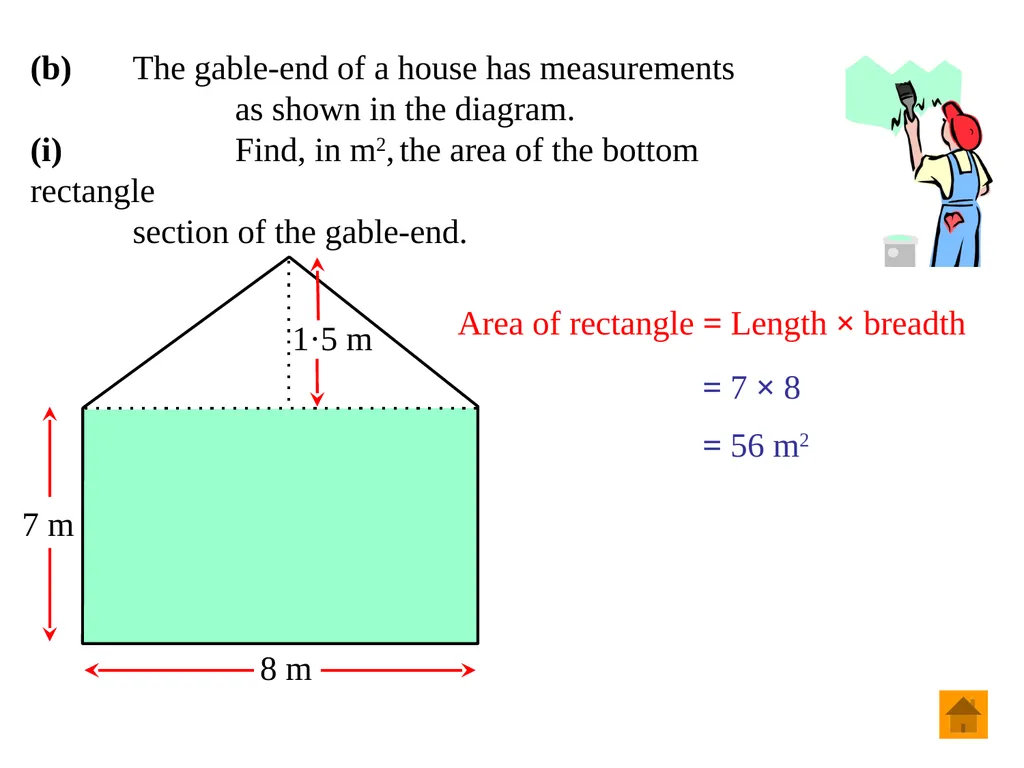
1·5 m (b) The gable-end of a house has measurements
as shown in the diagram.
(i) Find, in m2, the area of the bottom rectangle
section of the gable-end. Area of rectangle = Length × breadth = 7 × 8
= 56 m2 7 m 8 m<br>
as shown in the diagram.
(i) Find, in m2, the area of the bottom rectangle
section of the gable-end. Area of rectangle = Length × breadth = 7 × 8
= 56 m2 7 m 8 m<br>
24
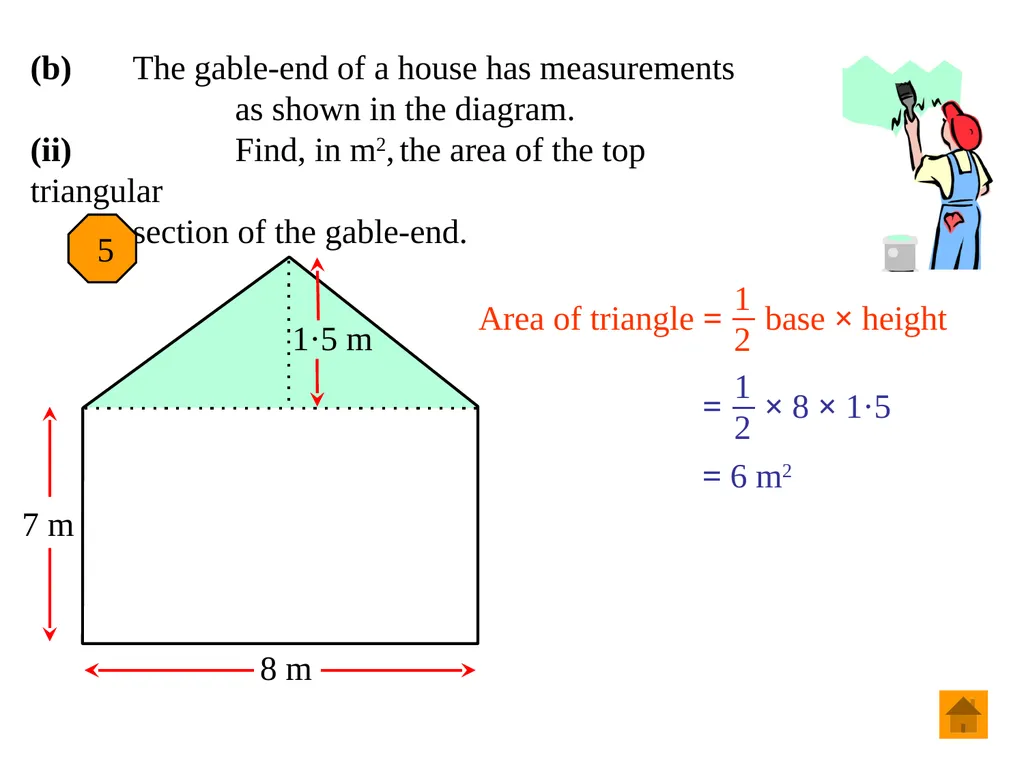
1·5 m (b) The gable-end of a house has measurements
as shown in the diagram.
(ii) Find, in m2, the area of the top triangular
section of the gable-end. 8 m 5 = 6 m2 7 m<br>
as shown in the diagram.
(ii) Find, in m2, the area of the top triangular
section of the gable-end. 8 m 5 = 6 m2 7 m<br>
25
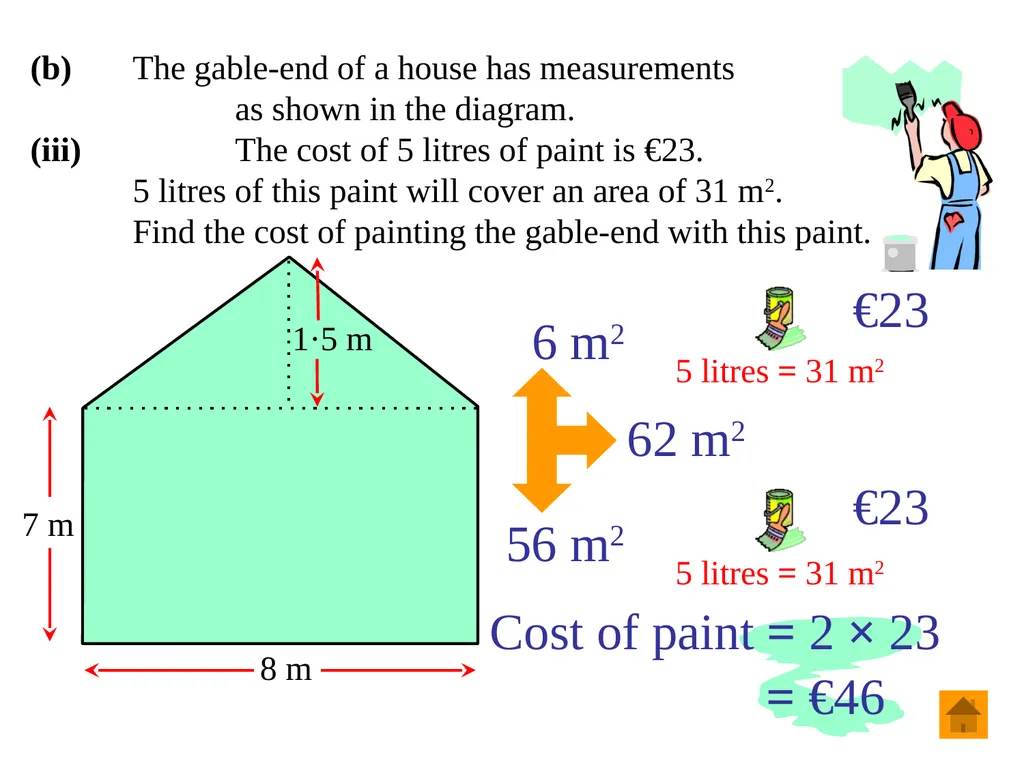
💧 = €46 1·5 m 8 m 6 m2 7 m 56 m2 62 m2 5 litres = 31 m2 5 litres = 31 m2 €23 €23 💧 Cost of paint = 2 × 23 (b) The gable-end of a house has measurements
as shown in the diagram.
(iii) The cost of 5 litres of paint is €23.
5 litres of this paint will cover an area of 31 m2.
Find the cost of painting the gable-end with this paint.<br>
as shown in the diagram.
(iii) The cost of 5 litres of paint is €23.
5 litres of this paint will cover an area of 31 m2.
Find the cost of painting the gable-end with this paint.<br>
26
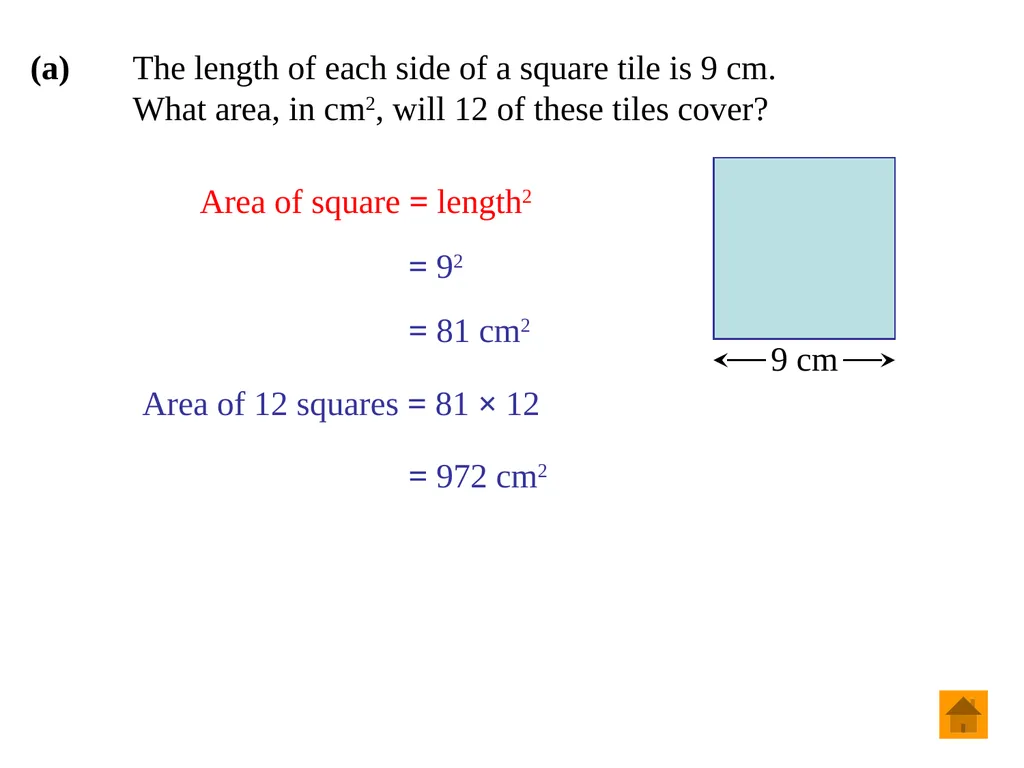
(a) The length of each side of a square tile is 9 cm.
What area, in cm2, will 12 of these tiles cover? Area of square = length2 = 972 cm2 Area of 12 squares = 81 × 12 9 cm = 92 = 81 cm2<br>
What area, in cm2, will 12 of these tiles cover? Area of square = length2 = 972 cm2 Area of 12 squares = 81 × 12 9 cm = 92 = 81 cm2<br>
27
(b)
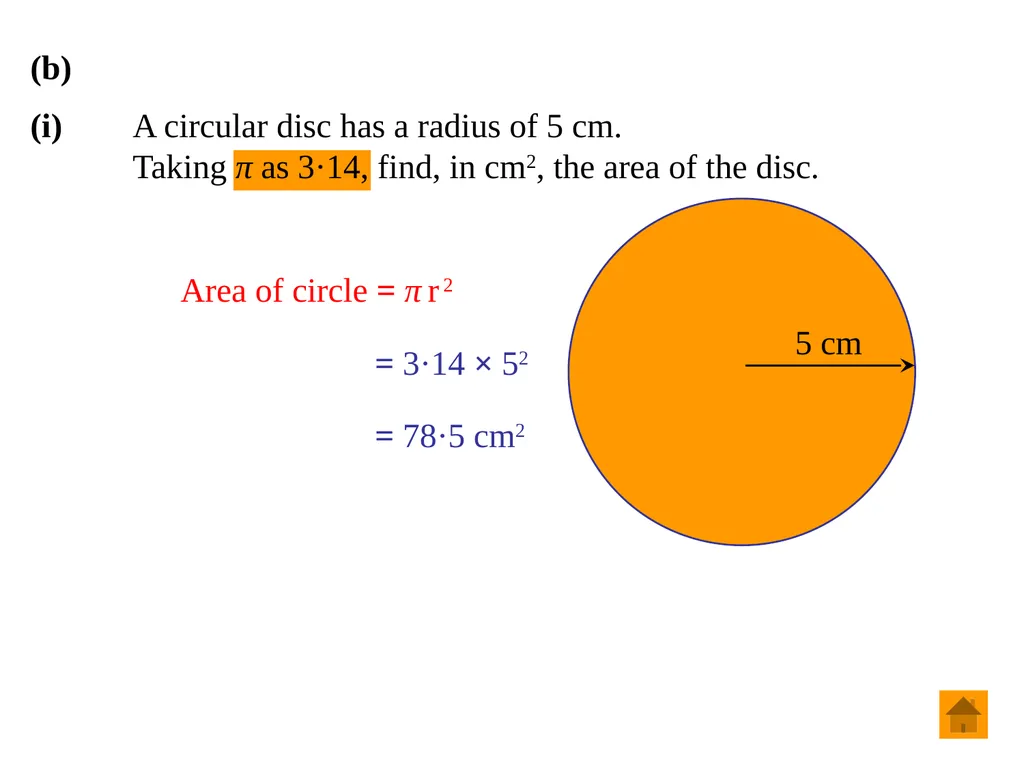
(i) A circular disc has a radius of 5 cm.
Taking π as 3·14, find, in cm2, the area of the disc. Area of circle = π r 2 5 cm = 3·14 = 78·5 cm2 × 52<br>
(i) A circular disc has a radius of 5 cm.
Taking π as 3·14, find, in cm2, the area of the disc. Area of circle = π r 2 5 cm = 3·14 = 78·5 cm2 × 52<br>
28
(b)
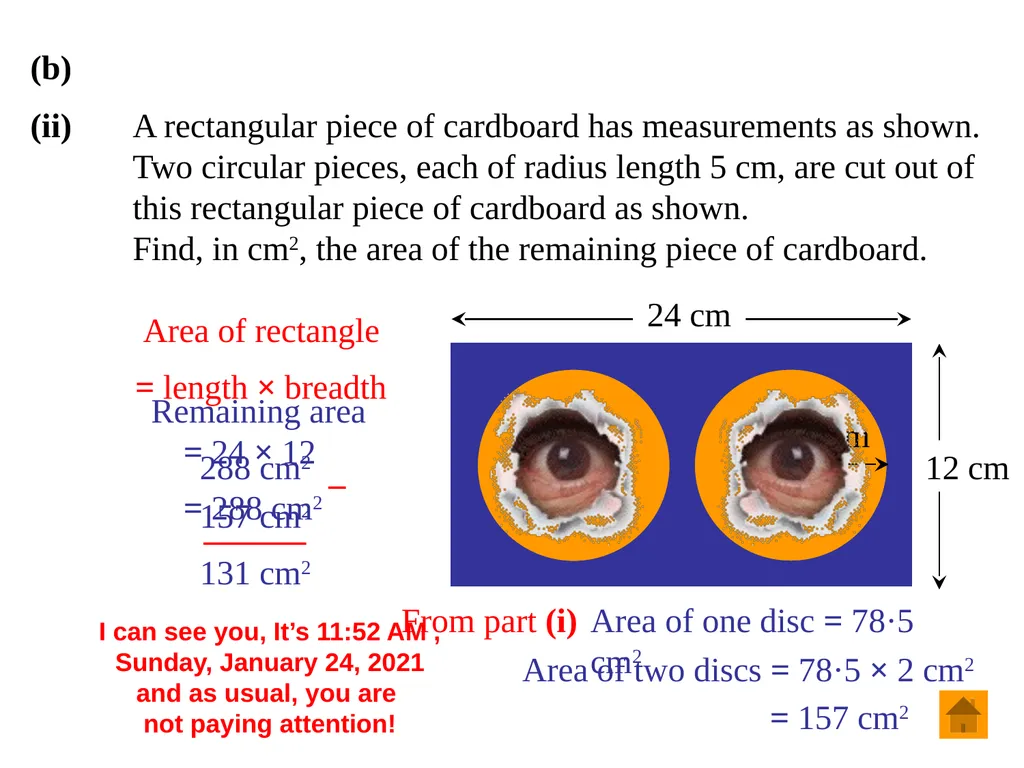
(ii) A rectangular piece of cardboard has measurements as shown.
Two circular pieces, each of radius length 5 cm, are cut out of
this rectangular piece of cardboard as shown.
Find, in cm2, the area of the remaining piece of cardboard. Area of rectangle 12 cm = 24 × 12 = 288 cm2 24 cm 5 cm = length × breadth From part (i) Area of one disc = 78·5 cm2 Area of two discs = 78·5 × 2 cm2 = 157 cm2 – 157 cm2 Remaining area 288 cm2 –––––– 131 cm2 I can see you, It’s 11:52 AM , Sunday, January 24, 2021 and as usual, you are not paying attention!<br>
(ii) A rectangular piece of cardboard has measurements as shown.
Two circular pieces, each of radius length 5 cm, are cut out of
this rectangular piece of cardboard as shown.
Find, in cm2, the area of the remaining piece of cardboard. Area of rectangle 12 cm = 24 × 12 = 288 cm2 24 cm 5 cm = length × breadth From part (i) Area of one disc = 78·5 cm2 Area of two discs = 78·5 × 2 cm2 = 157 cm2 – 157 cm2 Remaining area 288 cm2 –––––– 131 cm2 I can see you, It’s 11:52 AM , Sunday, January 24, 2021 and as usual, you are not paying attention!<br>
29
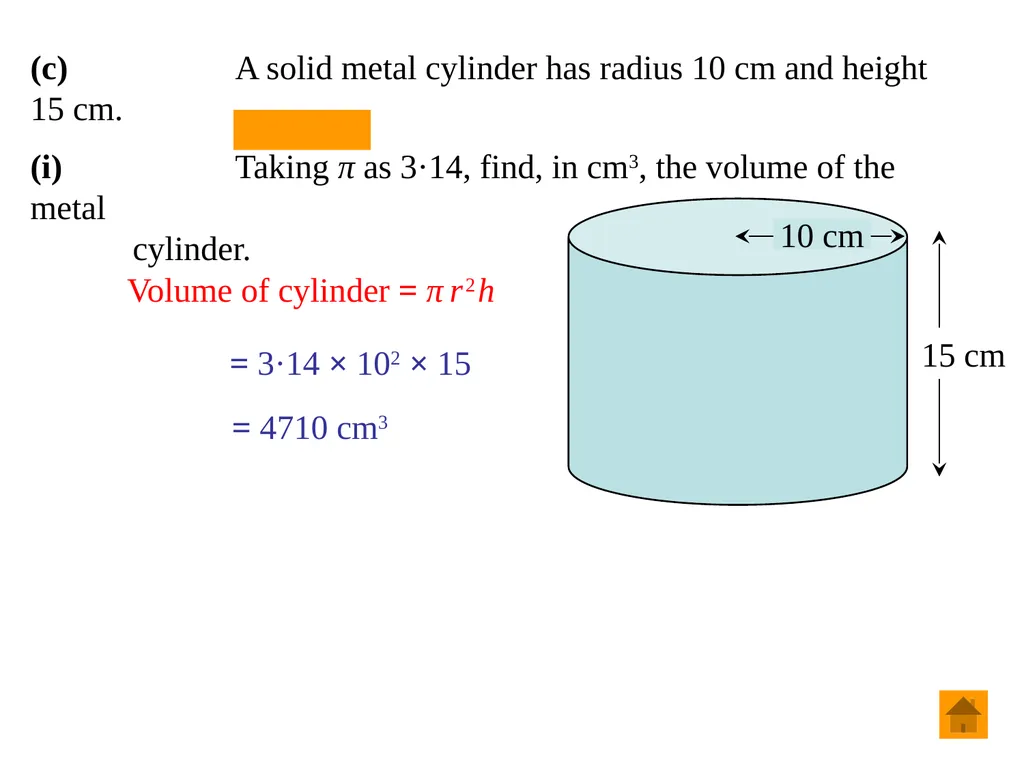
15 cm (c) A solid metal cylinder has radius 10 cm and height 15 cm.
(i) Taking π as 3·14, find, in cm3, the volume of the metal
cylinder. Volume of cylinder = π r 2 h = 3·14 = 4710 cm3 × 102 10 cm × 15<br>
(i) Taking π as 3·14, find, in cm3, the volume of the metal
cylinder. Volume of cylinder = π r 2 h = 3·14 = 4710 cm3 × 102 10 cm × 15<br>
30
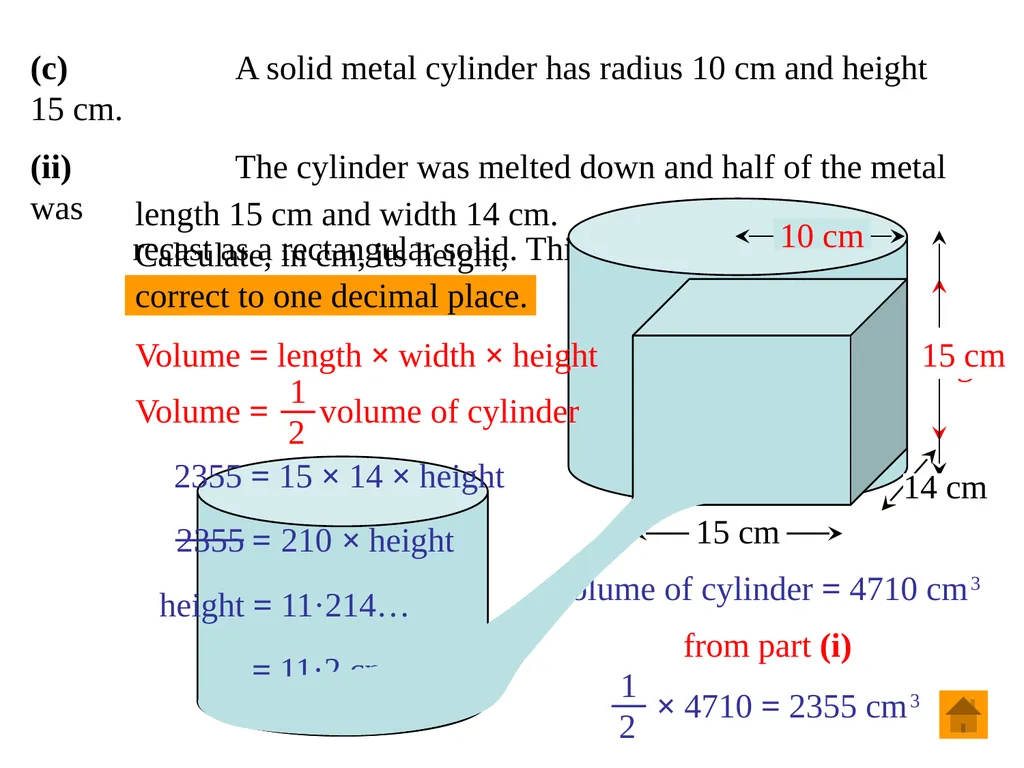
height –––– 2355 length 15 cm and width 14 cm.
Calculate, in cm, its height,
correct to one decimal place. (c) A solid metal cylinder has radius 10 cm and height 15 cm.
(ii) The cylinder was melted down and half of the metal was
recast as a rectangular solid. This rectangular solid has 15 cm Volume of cylinder = 4710 cm 3 2355 = 15 × 14 × height 15 cm 14 cm Volume = length × width × height from part (i) = 210 height × height = 11·214… = 11·2 cm 10 cm<br>
Calculate, in cm, its height,
correct to one decimal place. (c) A solid metal cylinder has radius 10 cm and height 15 cm.
(ii) The cylinder was melted down and half of the metal was
recast as a rectangular solid. This rectangular solid has 15 cm Volume of cylinder = 4710 cm 3 2355 = 15 × 14 × height 15 cm 14 cm Volume = length × width × height from part (i) = 210 height × height = 11·214… = 11·2 cm 10 cm<br>
31
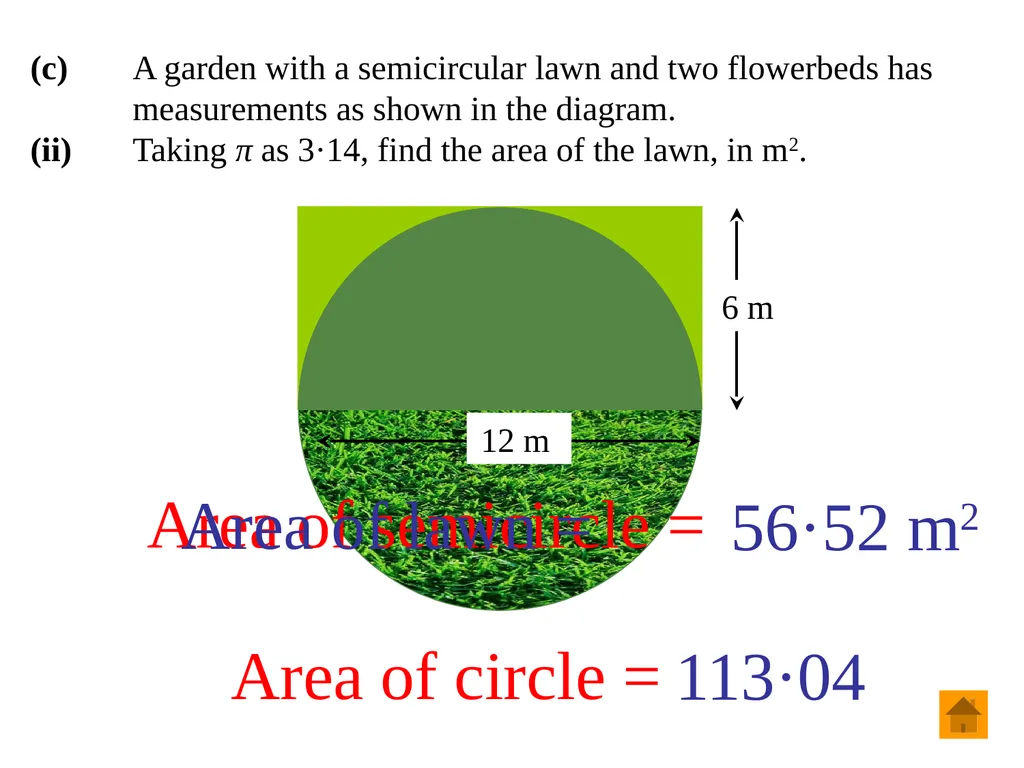
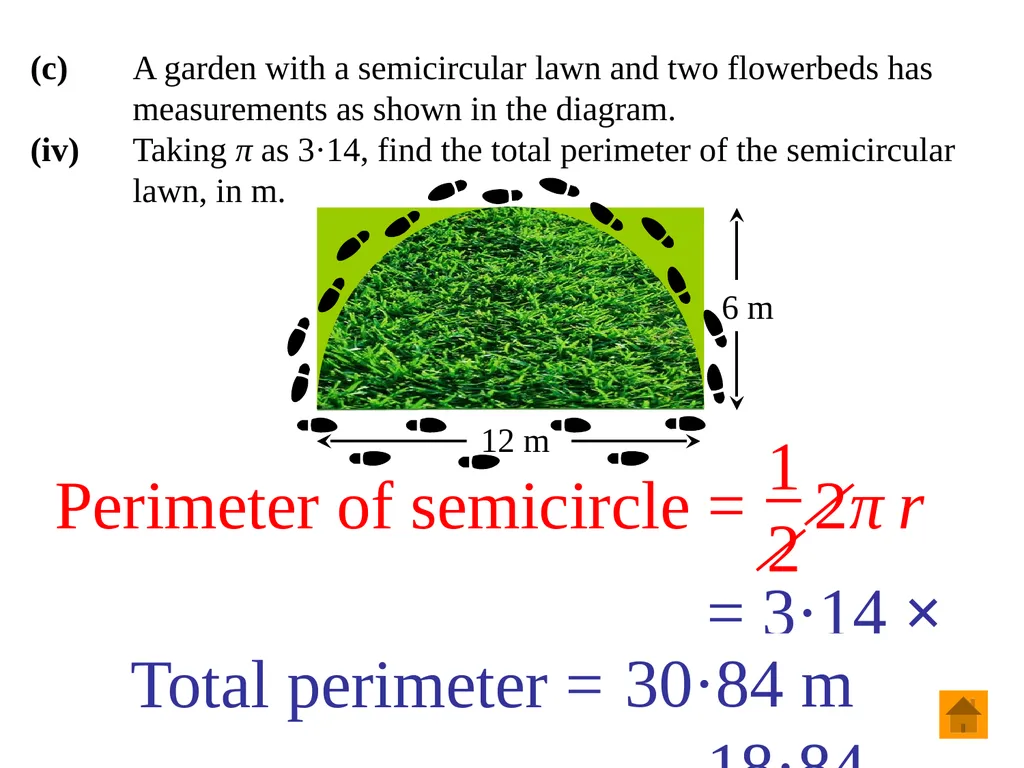
Area of circle = π r 2 12 m 6 m 3·14 × 62 113·04 (c) A garden with a semicircular lawn and two flowerbeds has
measurements as shown in the diagram.
(ii) Taking π as 3·14, find the area of the lawn, in m2. radius = 6 cm 113·04 Area of lawn = 56·52 m2<br>
measurements as shown in the diagram.
(ii) Taking π as 3·14, find the area of the lawn, in m2. radius = 6 cm 113·04 Area of lawn = 56·52 m2<br>
32
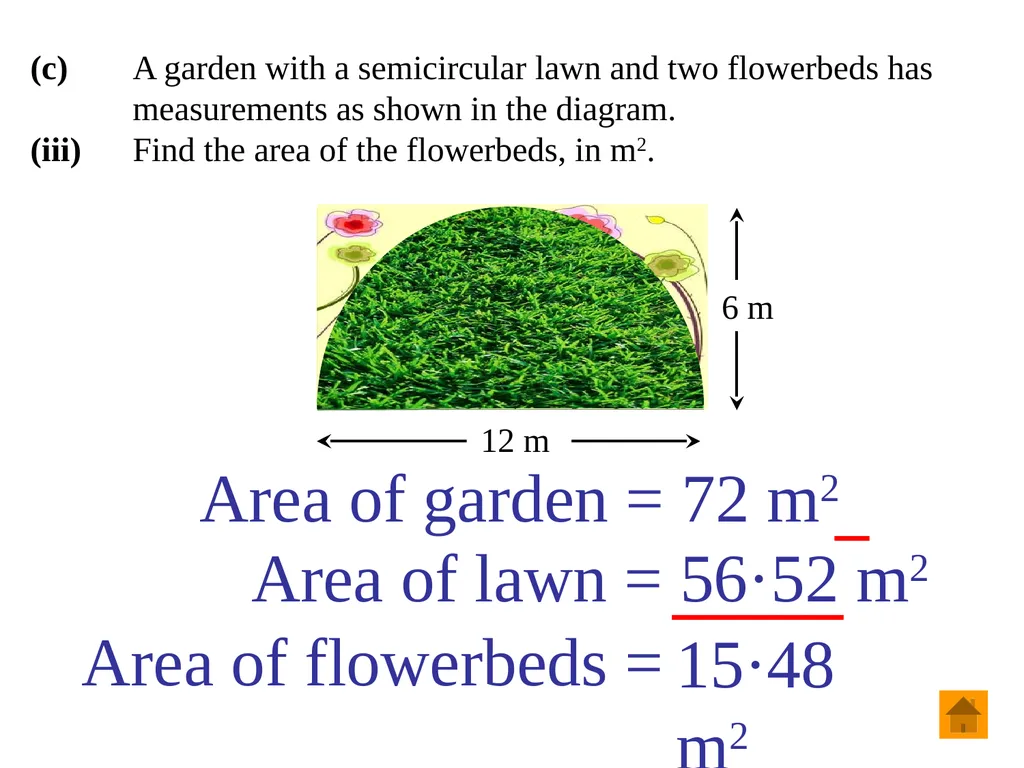
(c) A garden with a semicircular lawn and two flowerbeds has
measurements as shown in the diagram.
(iii) Find the area of the flowerbeds, in m2. 12 m 6 m Area of lawn = 56·52 m2 Area of garden = 72 m2 _____ – 15·48 m2 Area of flowerbeds =<br>
measurements as shown in the diagram.
(iii) Find the area of the flowerbeds, in m2. 12 m 6 m Area of lawn = 56·52 m2 Area of garden = 72 m2 _____ – 15·48 m2 Area of flowerbeds =<br>
33
(c) A garden with a semicircular lawn and two flowerbeds has
measurements as shown in the diagram.
(iv) Taking π as 3·14, find the total perimeter of the semicircular
lawn, in m. 6 m = 3·14 × 6 = 18·84 12 m Total perimeter = 12 + 30·84 m<br>
measurements as shown in the diagram.
(iv) Taking π as 3·14, find the total perimeter of the semicircular
lawn, in m. 6 m = 3·14 × 6 = 18·84 12 m Total perimeter = 12 + 30·84 m<br>
34
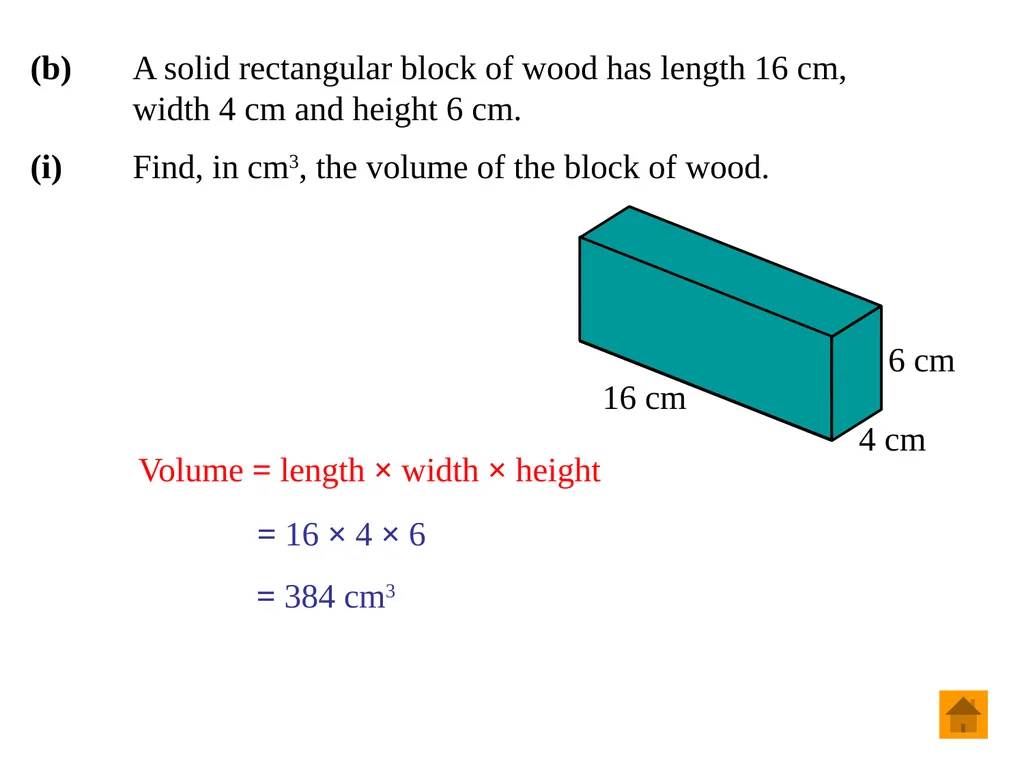
(b) A solid rectangular block of wood has length 16 cm,
width 4 cm and height 6 cm.
(i) Find, in cm3, the volume of the block of wood. Volume = length × width × height 4 cm = 384 cm3 = 16 × 4 × 6 6 cm 16 cm<br>
width 4 cm and height 6 cm.
(i) Find, in cm3, the volume of the block of wood. Volume = length × width × height 4 cm = 384 cm3 = 16 × 4 × 6 6 cm 16 cm<br>
35
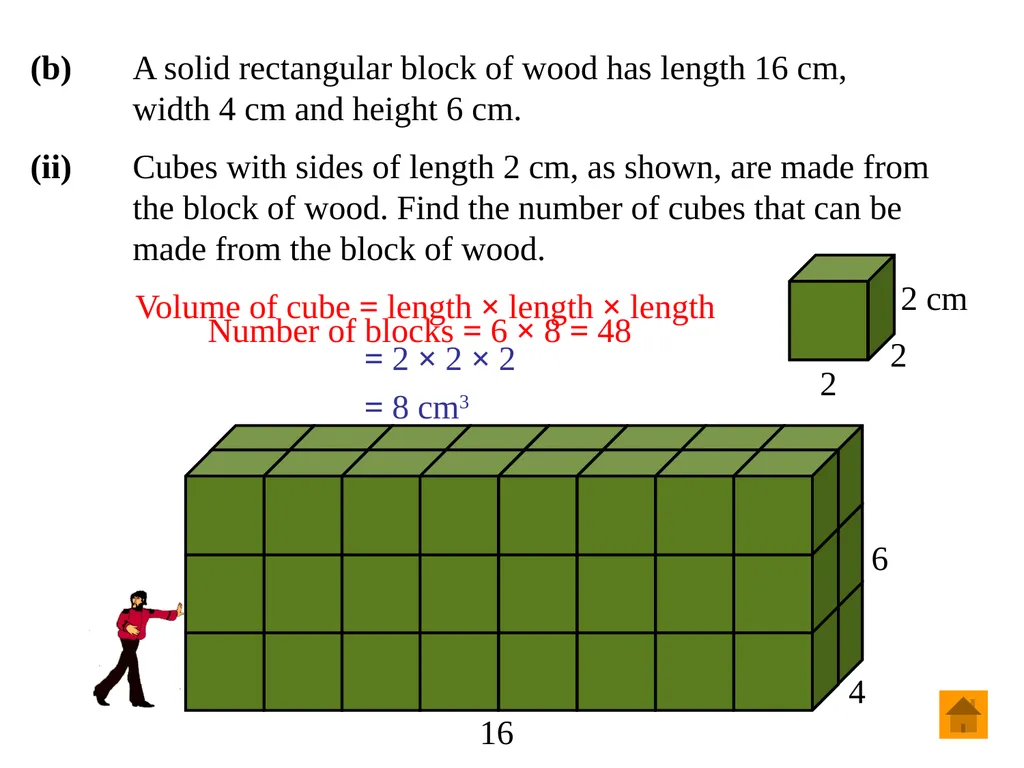
(b) A solid rectangular block of wood has length 16 cm,
width 4 cm and height 6 cm.
(ii) Cubes with sides of length 2 cm, as shown, are made from
the block of wood. Find the number of cubes that can be
made from the block of wood. 2 2 cm 2 4 6 16 Volume of cube = length × length × length = 8 cm3 = 2 × 2 × 2 From part (i) volume of block = 384 cm3 Number of blocks = = 48 Number of blocks = 6 × 8 = 48<br>
width 4 cm and height 6 cm.
(ii) Cubes with sides of length 2 cm, as shown, are made from
the block of wood. Find the number of cubes that can be
made from the block of wood. 2 2 cm 2 4 6 16 Volume of cube = length × length × length = 8 cm3 = 2 × 2 × 2 From part (i) volume of block = 384 cm3 Number of blocks = = 48 Number of blocks = 6 × 8 = 48<br>
36
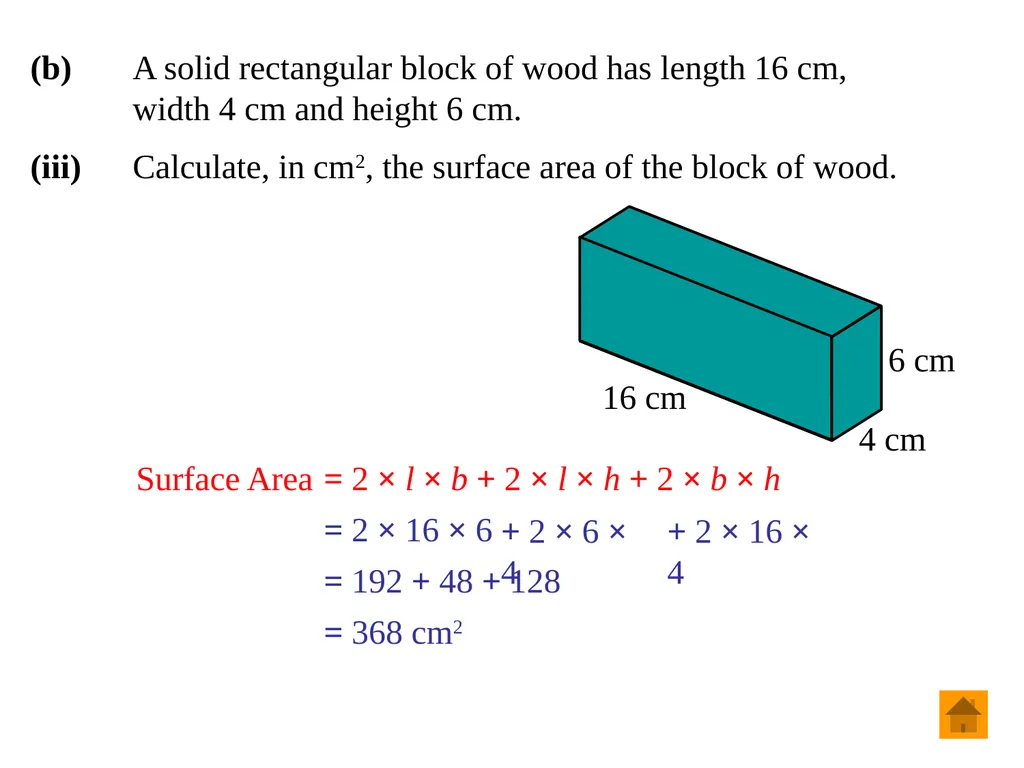
(b) A solid rectangular block of wood has length 16 cm,
width 4 cm and height 6 cm.
(iii) Calculate, in cm2, the surface area of the block of wood. Surface Area = 2 × l × b + 2 × l × h + 2 × b × h
= 2 × 16 × 6
= 192 + 48 + 128
= 368 cm2 + 2 × 6 × 4 + 2 × 16 × 4 4 cm 6 cm 16 cm<br>
width 4 cm and height 6 cm.
(iii) Calculate, in cm2, the surface area of the block of wood. Surface Area = 2 × l × b + 2 × l × h + 2 × b × h
= 2 × 16 × 6
= 192 + 48 + 128
= 368 cm2 + 2 × 6 × 4 + 2 × 16 × 4 4 cm 6 cm 16 cm<br>
37
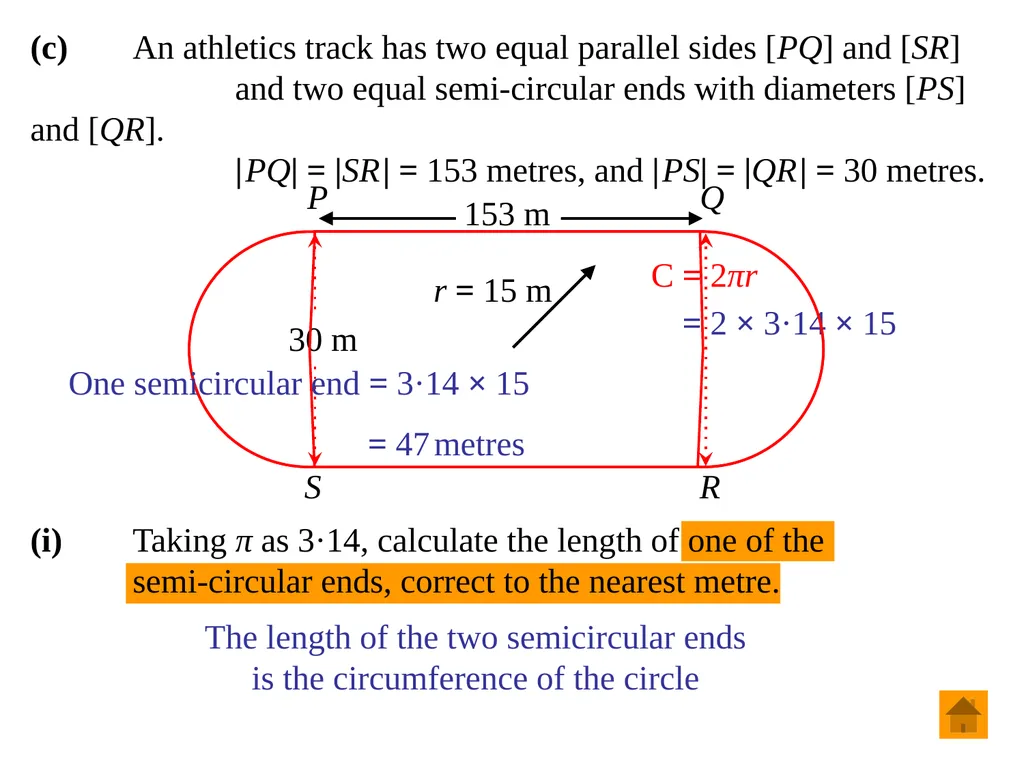
= 47·1 metres r = 15 m S The length of the two semicircular ends is the circumference of the circle 153 m C = 2πr (c) An athletics track has two equal parallel sides [PQ] and [SR]
and two equal semi-circular ends with diameters [PS] and [QR].
| PQ| = |SR | = 153 metres, and | PS| = |QR | = 30 metres. R Q P 30 m = 2 × 3·14 × 15 One semicircular end = 3·14 × 15 (i) Taking π as 3·14, calculate the length of one of the
semi-circular ends, correct to the nearest metre.<br>
and two equal semi-circular ends with diameters [PS] and [QR].
| PQ| = |SR | = 153 metres, and | PS| = |QR | = 30 metres. R Q P 30 m = 2 × 3·14 × 15 One semicircular end = 3·14 × 15 (i) Taking π as 3·14, calculate the length of one of the
semi-circular ends, correct to the nearest metre.<br>
38
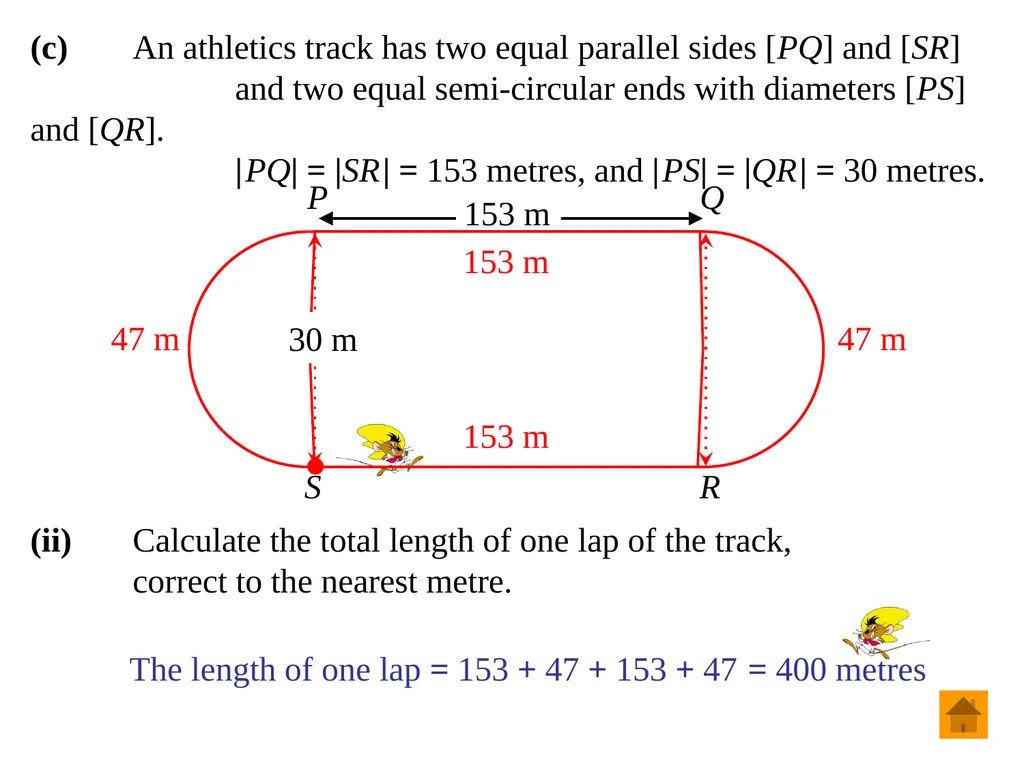
153 m (ii) Calculate the total length of one lap of the track,
correct to the nearest metre. 30 m 153 m 47 m 153 m 47 m The length of one lap = 153 + 47 + 153 + 47 = 400 metres (c) An athletics track has two equal parallel sides [PQ] and [SR]
and two equal semi-circular ends with diameters [PS] and [QR].
| PQ| = |SR | = 153 metres, and | PS| = |QR | = 30 metres. S R Q P<br>
correct to the nearest metre. 30 m 153 m 47 m 153 m 47 m The length of one lap = 153 + 47 + 153 + 47 = 400 metres (c) An athletics track has two equal parallel sides [PQ] and [SR]
and two equal semi-circular ends with diameters [PS] and [QR].
| PQ| = |SR | = 153 metres, and | PS| = |QR | = 30 metres. S R Q P<br>
39
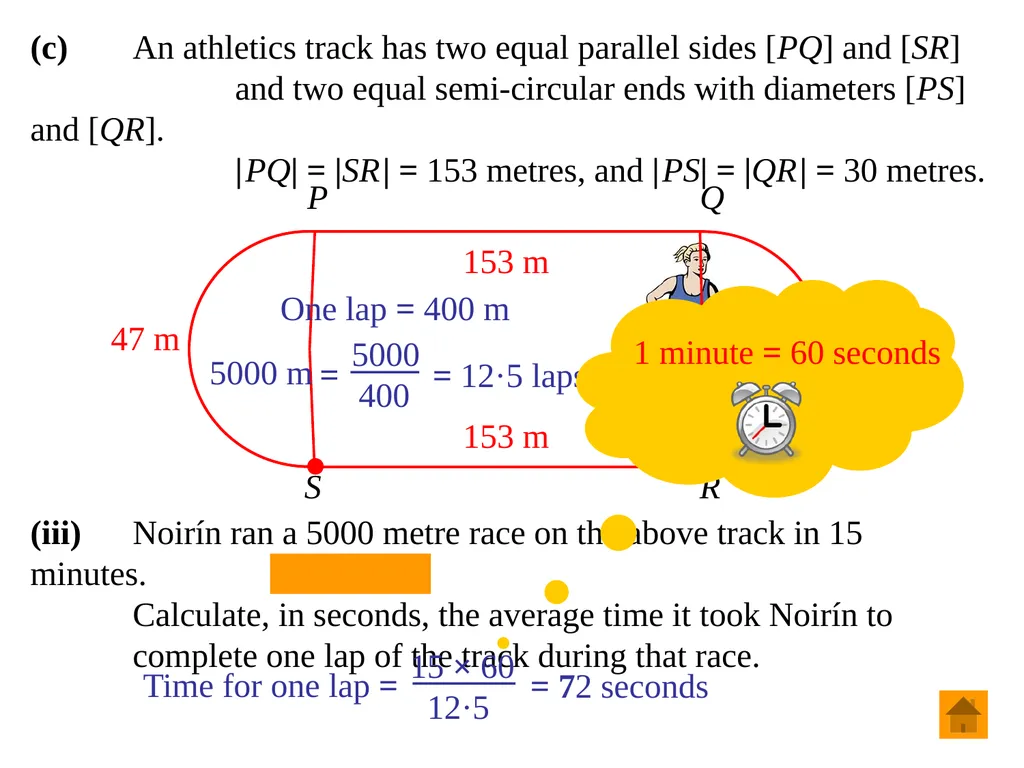
S R Q P (iii) Noirín ran a 5000 metre race on the above track in 15 minutes.
Calculate, in seconds, the average time it took Noirín to
complete one lap of the track during that race. 153 m 47 m 153 m 47 m One lap = 400 m = 12·5 laps 5000 m Time for one lap = = 72 seconds (c) An athletics track has two equal parallel sides [PQ] and [SR]
and two equal semi-circular ends with diameters [PS] and [QR].
| PQ| = |SR | = 153 metres, and | PS| = |QR | = 30 metres.<br>
Calculate, in seconds, the average time it took Noirín to
complete one lap of the track during that race. 153 m 47 m 153 m 47 m One lap = 400 m = 12·5 laps 5000 m Time for one lap = = 72 seconds (c) An athletics track has two equal parallel sides [PQ] and [SR]
and two equal semi-circular ends with diameters [PS] and [QR].
| PQ| = |SR | = 153 metres, and | PS| = |QR | = 30 metres.<br>
40
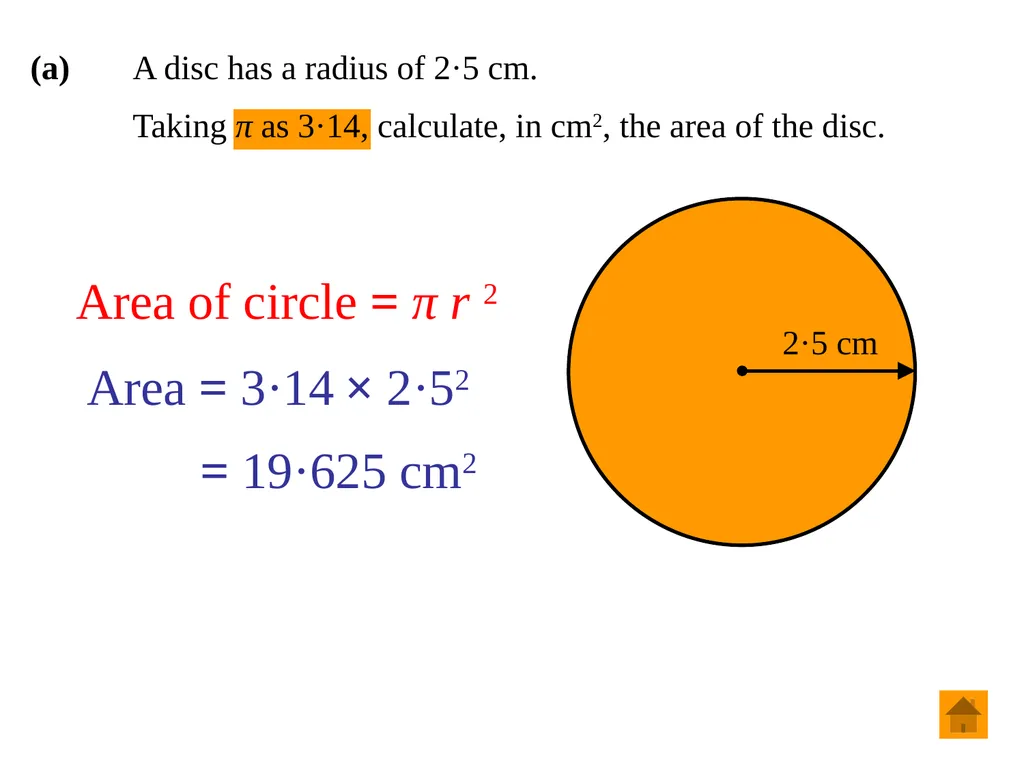
(a) A disc has a radius of 2·5 cm.
Taking π as 3·14, calculate, in cm2, the area of the disc. Area of circle = π r 2 2·5 cm Area = 3·14 = 19·625 cm2 × 2·52<br>
Taking π as 3·14, calculate, in cm2, the area of the disc. Area of circle = π r 2 2·5 cm Area = 3·14 = 19·625 cm2 × 2·52<br>
41
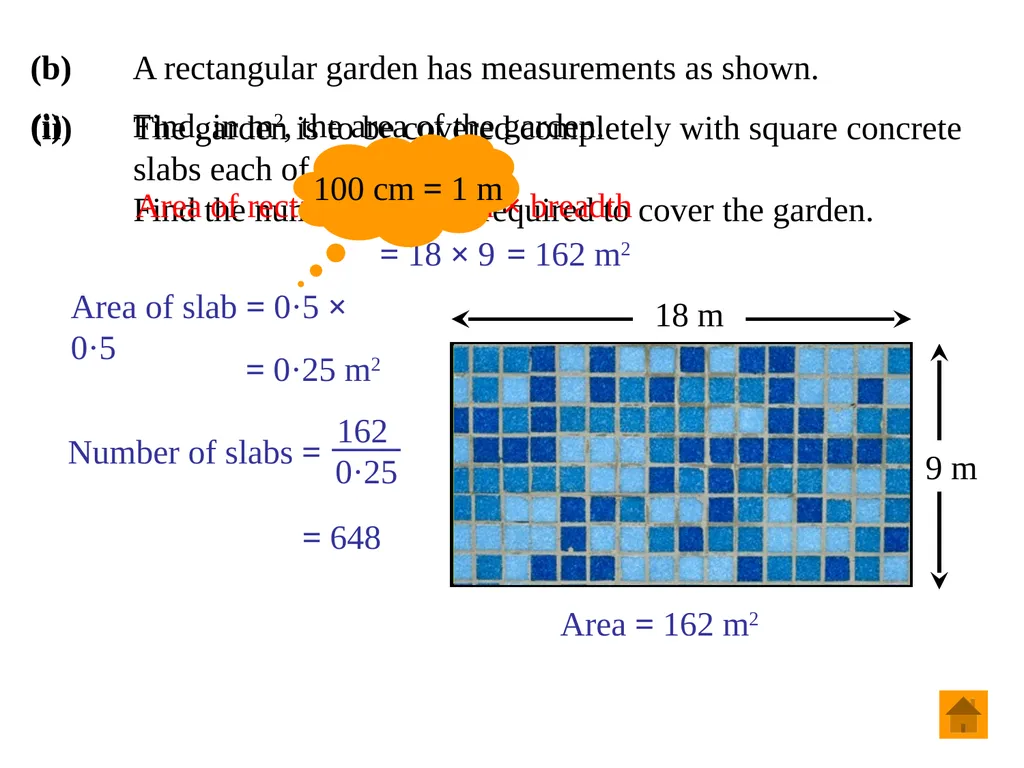
(ii) The garden is to be covered completely with square concrete
slabs each of side 50 cm.
Find the number of slabs required to cover the garden. (b) A rectangular garden has measurements as shown.
(i) Find, in m2, the area of the garden. Area of rectangle = length × breadth 9 m = 18 × 9 = 162 m2 18 m Area = 162 m2 = 0·25 m2 Area of slab = 0·5 × 0·5 Number of slabs = = 648<br>
slabs each of side 50 cm.
Find the number of slabs required to cover the garden. (b) A rectangular garden has measurements as shown.
(i) Find, in m2, the area of the garden. Area of rectangle = length × breadth 9 m = 18 × 9 = 162 m2 18 m Area = 162 m2 = 0·25 m2 Area of slab = 0·5 × 0·5 Number of slabs = = 648<br>
42
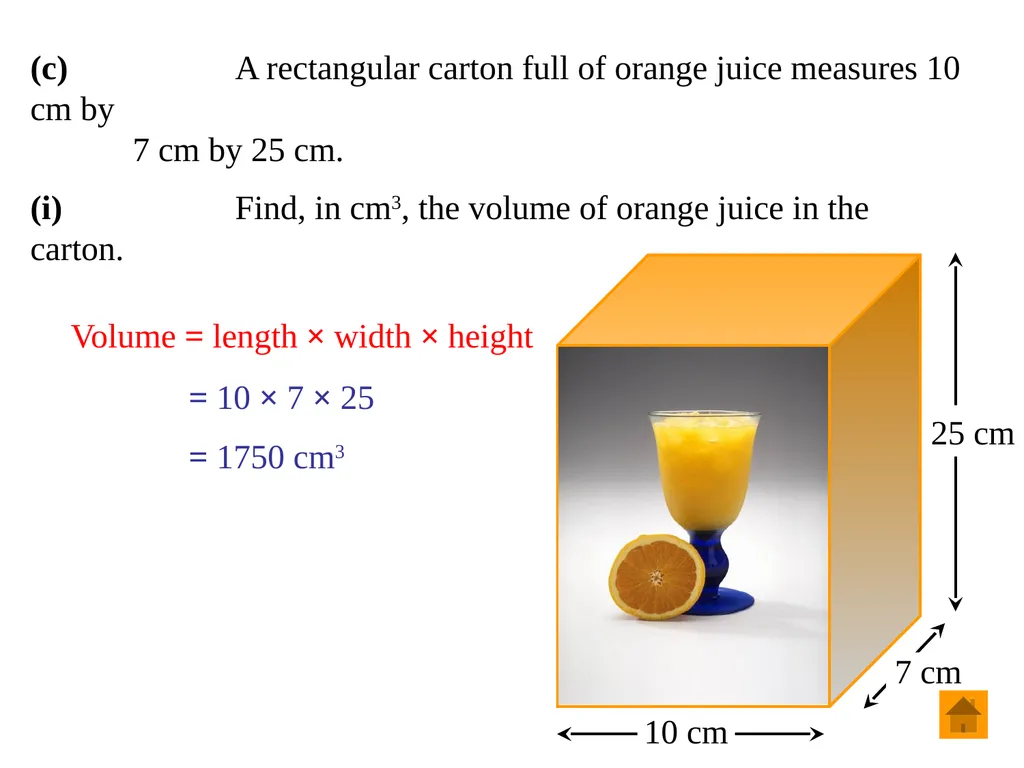
(c) A rectangular carton full of orange juice measures 10 cm by
7 cm by 25 cm.
(i) Find, in cm3, the volume of orange juice in the carton. = 1750 cm3 10 cm = 10 × 7 × 25 Volume = length × width × height 25 cm 7 cm<br>
7 cm by 25 cm.
(i) Find, in cm3, the volume of orange juice in the carton. = 1750 cm3 10 cm = 10 × 7 × 25 Volume = length × width × height 25 cm 7 cm<br>
43
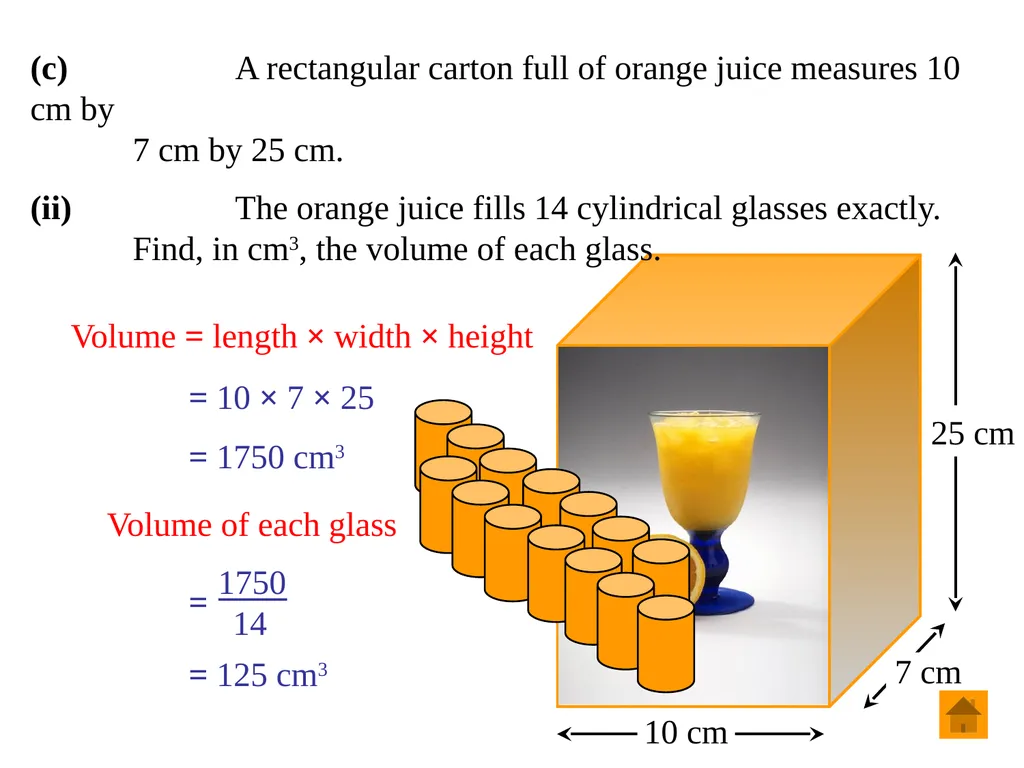
25 cm = 1750 cm3 10 cm = 10 × 7 × 25 Volume = length × width × height (c) A rectangular carton full of orange juice measures 10 cm by
7 cm by 25 cm.
(ii) The orange juice fills 14 cylindrical glasses exactly.
Find, in cm3, the volume of each glass. Volume of each glass = 125 cm3 7 cm<br>
7 cm by 25 cm.
(ii) The orange juice fills 14 cylindrical glasses exactly.
Find, in cm3, the volume of each glass. Volume of each glass = 125 cm3 7 cm<br>
44
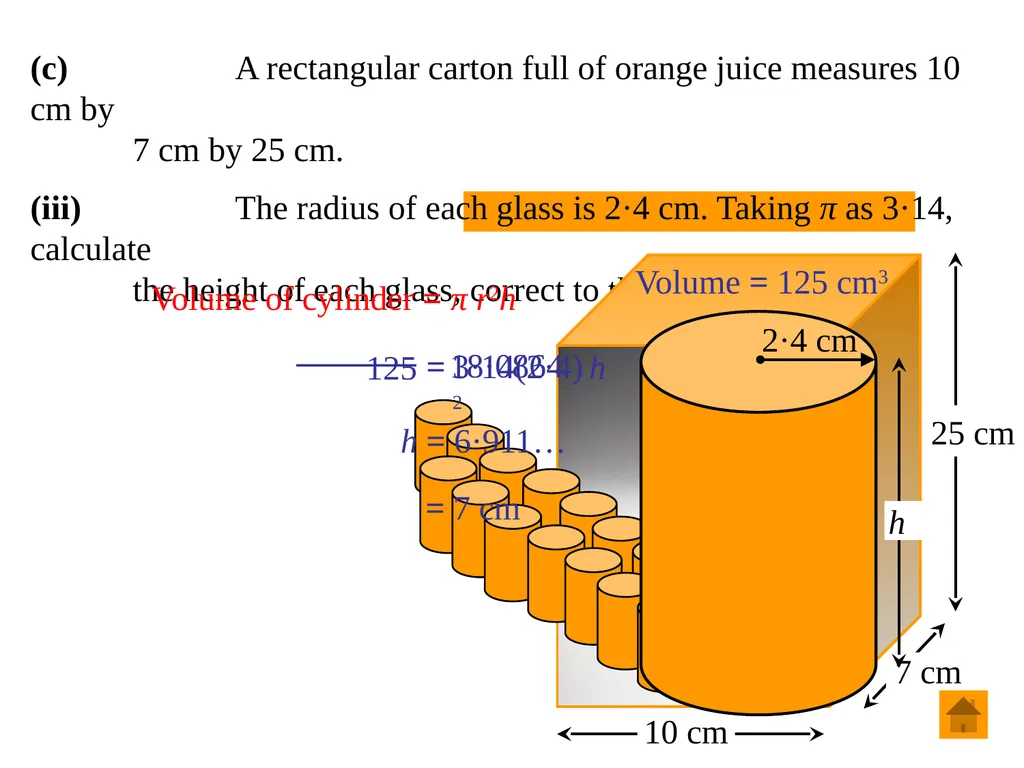
(c) A rectangular carton full of orange juice measures 10 cm by
7 cm by 25 cm.
(iii) The radius of each glass is 2·4 cm. Taking π as 3·14, calculate
the height of each glass, correct to the nearest centimetre. 25 cm 10 cm Volume = 125 cm3 2·4 cm 7 cm h Volume of cylinder = π r2h 125 h = 3·14(2·4)2 18·0864 _______ h = 6·911… = 7 cm<br>
7 cm by 25 cm.
(iii) The radius of each glass is 2·4 cm. Taking π as 3·14, calculate
the height of each glass, correct to the nearest centimetre. 25 cm 10 cm Volume = 125 cm3 2·4 cm 7 cm h Volume of cylinder = π r2h 125 h = 3·14(2·4)2 18·0864 _______ h = 6·911… = 7 cm<br>
45
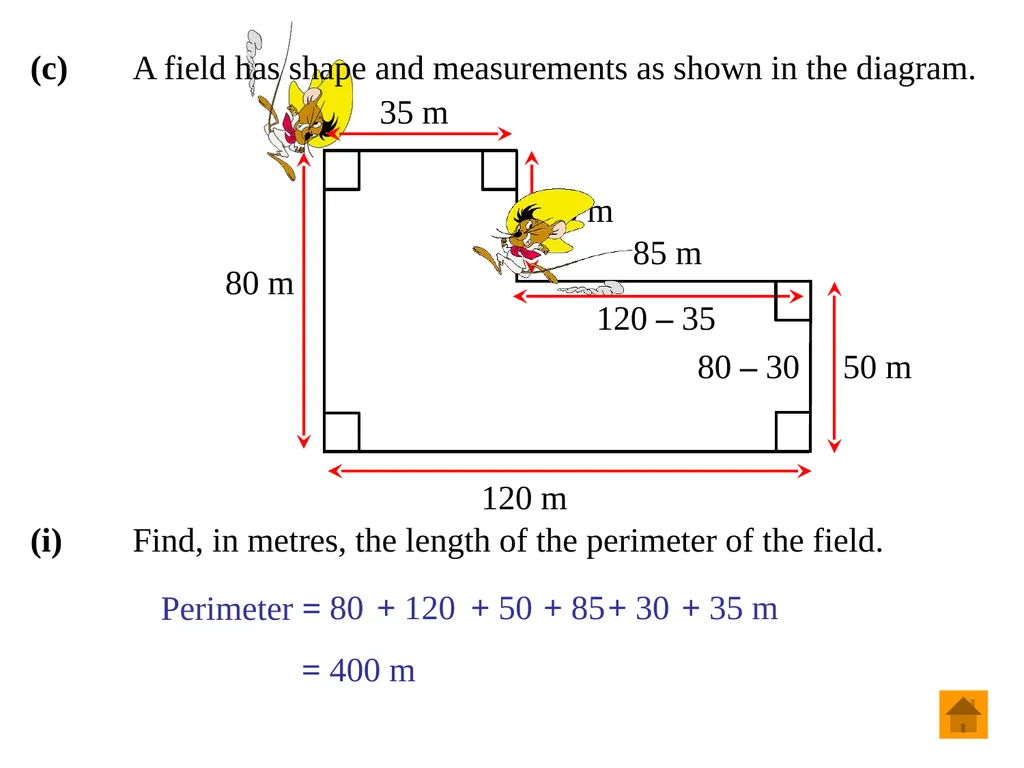
(c) A field has shape and measurements as shown in the diagram. (i) Find, in metres, the length of the perimeter of the field. 80 m 30 m 120 m 35 m 80 – 30 85 m 50 m Perimeter = 80 + 120 + 50 + 85 + 30 + 35 m = 400 m 120 – 35<br>
46
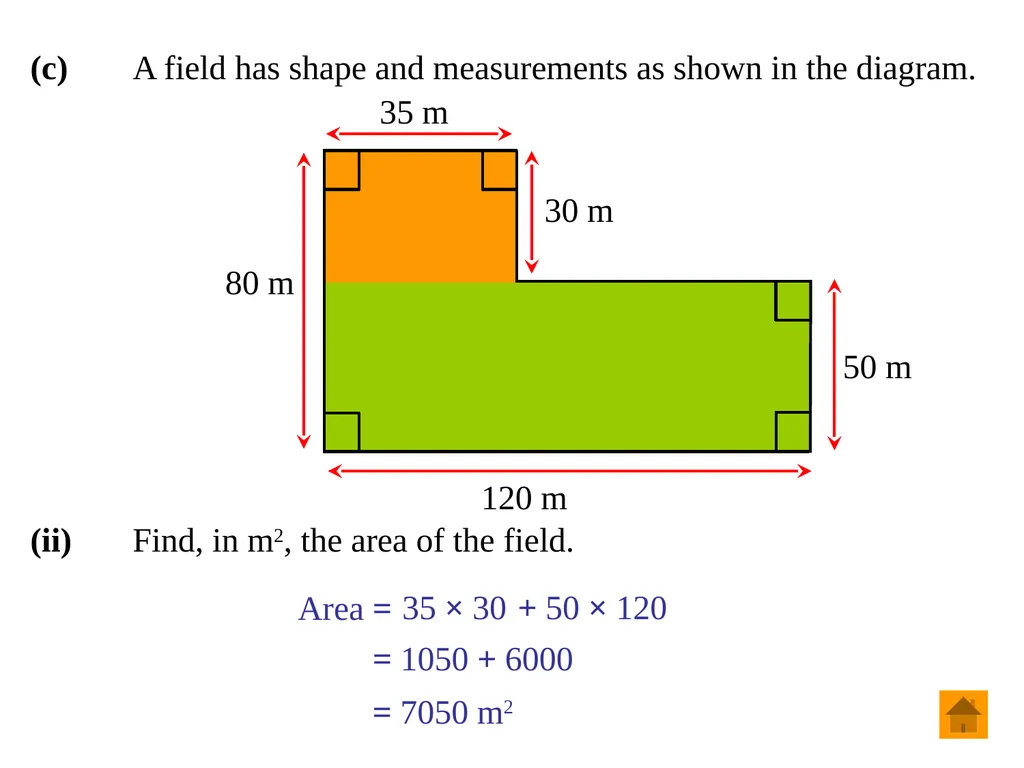
(c) A field has shape and measurements as shown in the diagram. Area = 35 × 30 + 50 × 120 = 1050 + 6000 = 7050 m2 (ii) Find, in m2, the area of the field. 80 m 30 m 120 m 35 m 50 m<br>
47
(c) A field has shape and measurements as shown in the diagram. 80 m 30 m 120 m 35 m (iii) Tim bought the field at a cost of €41 000 per hectare.
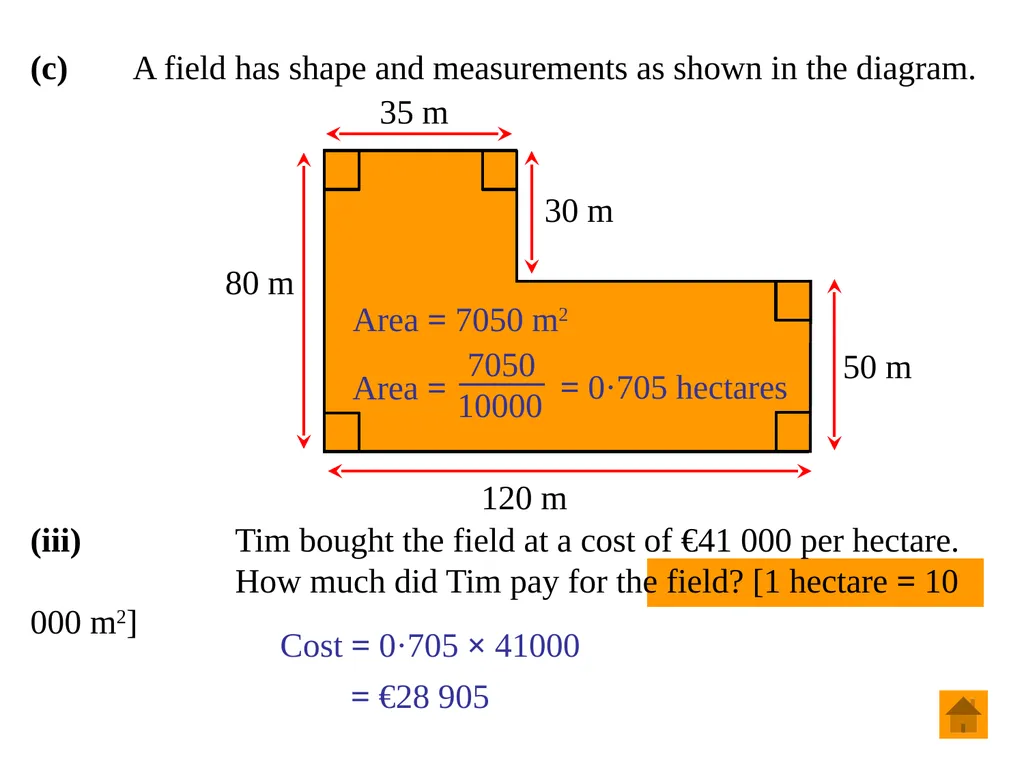
How much did Tim pay for the field? [1 hectare = 10 000 m2] = 0·705 hectares Area = 7050 m2 Area = 50 m Cost = 0·705 × 41000 = €28 905<br>
How much did Tim pay for the field? [1 hectare = 10 000 m2] = 0·705 hectares Area = 7050 m2 Area = 50 m Cost = 0·705 × 41000 = €28 905<br>
48
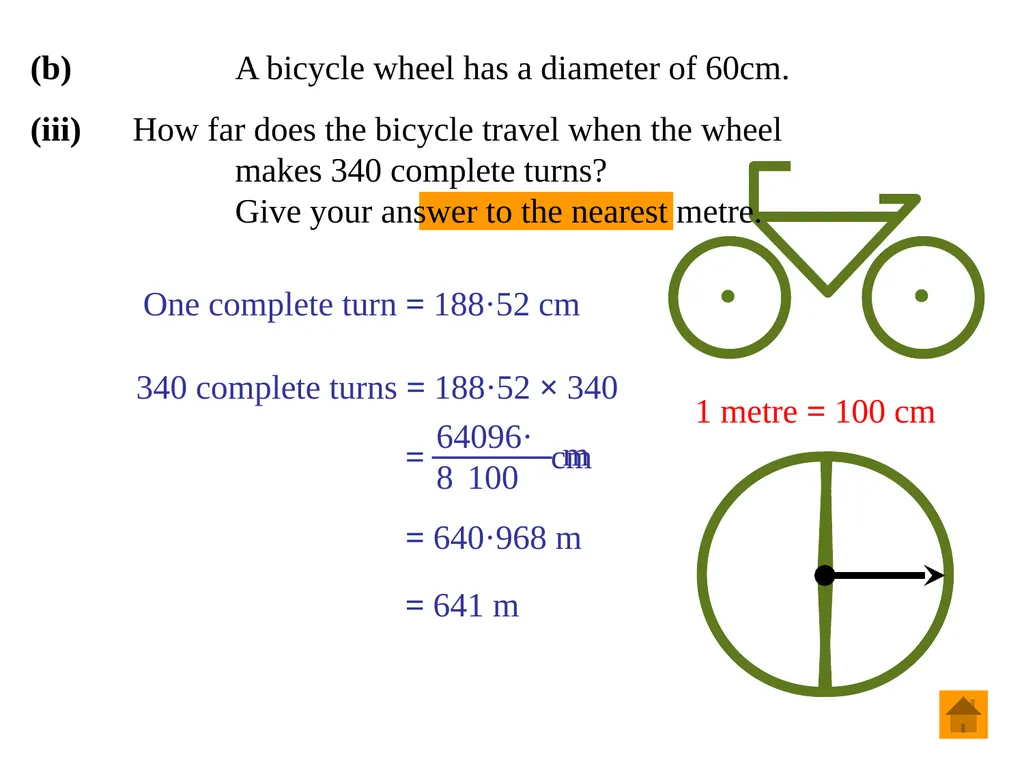
60 cm (b) A bicycle wheel has a diameter of 60cm.
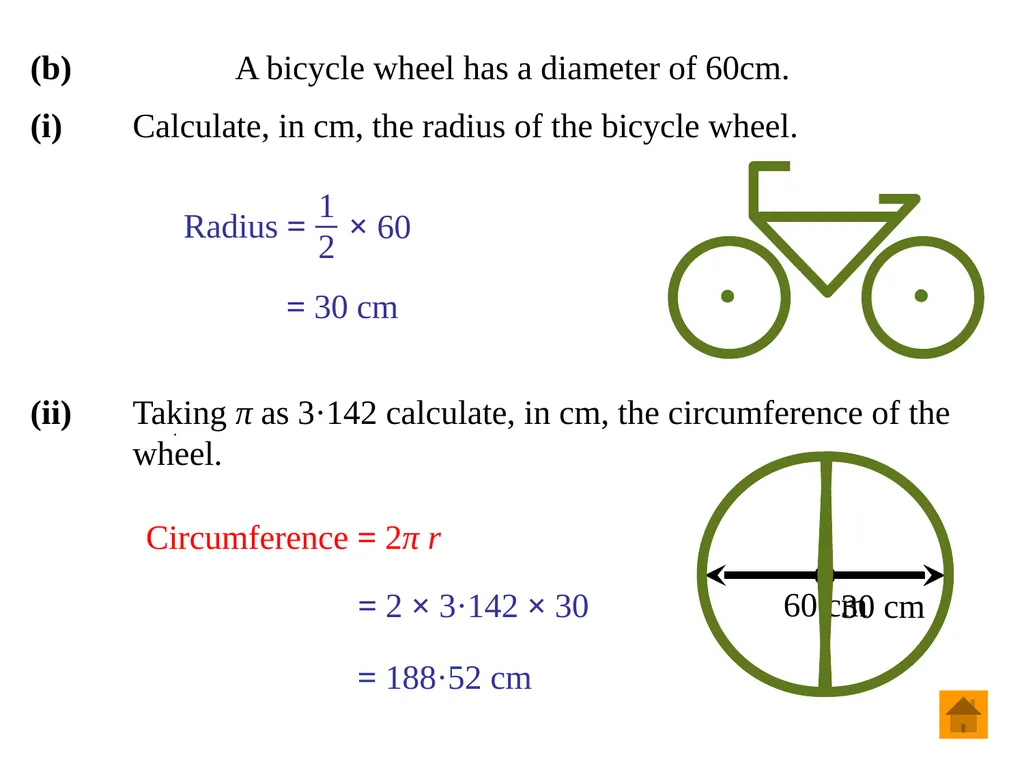
(i) Calculate, in cm, the radius of the bicycle wheel. 60 = 30 cm . (ii) Taking π as 3·142 calculate, in cm, the circumference of the
wheel. 30 cm Circumference = 2π r = 2 × 3·142 × 30 = 188·52 cm<br>
(i) Calculate, in cm, the radius of the bicycle wheel. 60 = 30 cm . (ii) Taking π as 3·142 calculate, in cm, the circumference of the
wheel. 30 cm Circumference = 2π r = 2 × 3·142 × 30 = 188·52 cm<br>
49
––––––– 64096·8 cm (b) A bicycle wheel has a diameter of 60cm. One complete turn = 188·52 cm (iii) How far does the bicycle travel when the wheel
makes 340 complete turns?
Give your answer to the nearest metre. 340 complete turns = 188·52 × 340 = 1 metre = 100 cm = 640·968 m 100 m = 641 m<br>
makes 340 complete turns?
Give your answer to the nearest metre. 340 complete turns = 188·52 × 340 = 1 metre = 100 cm = 640·968 m 100 m = 641 m<br>
50
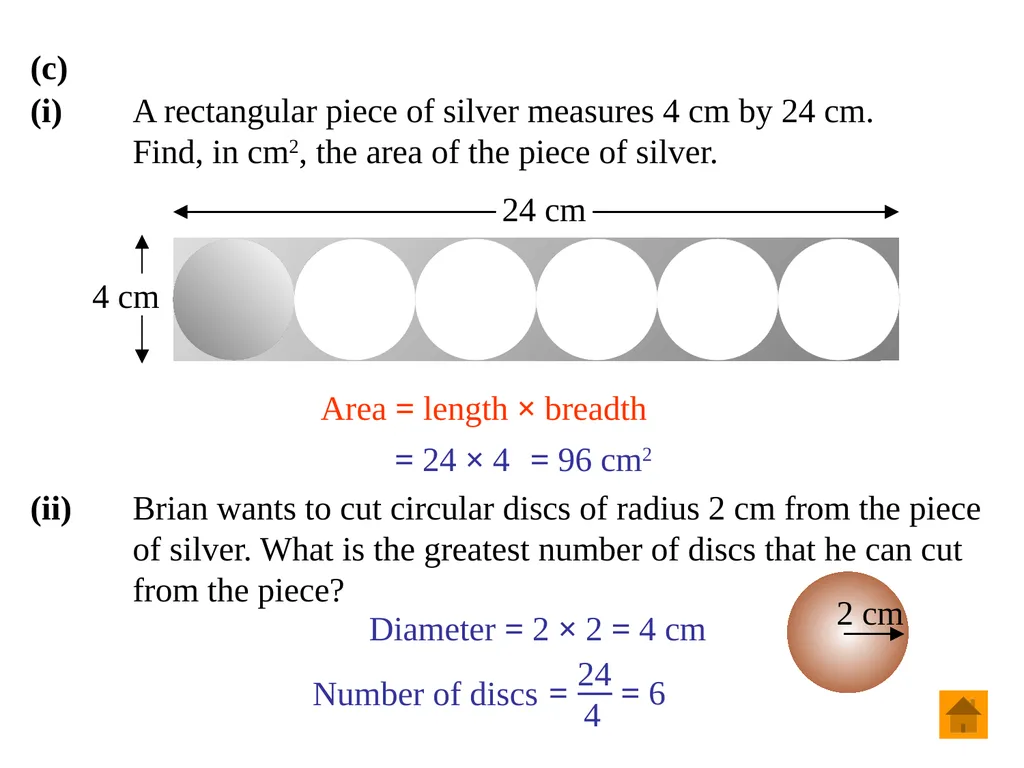
(i) A rectangular piece of silver measures 4 cm by 24 cm.
Find, in cm2, the area of the piece of silver. (c) (ii) Brian wants to cut circular discs of radius 2 cm from the piece
of silver. What is the greatest number of discs that he can cut
from the piece? Area = length × breadth 24 cm 4 cm = 24 × 4 = 96 cm2 2 cm Diameter = 2 × 2 = 4 cm Number of discs = 6<br>
Find, in cm2, the area of the piece of silver. (c) (ii) Brian wants to cut circular discs of radius 2 cm from the piece
of silver. What is the greatest number of discs that he can cut
from the piece? Area = length × breadth 24 cm 4 cm = 24 × 4 = 96 cm2 2 cm Diameter = 2 × 2 = 4 cm Number of discs = 6<br>
51
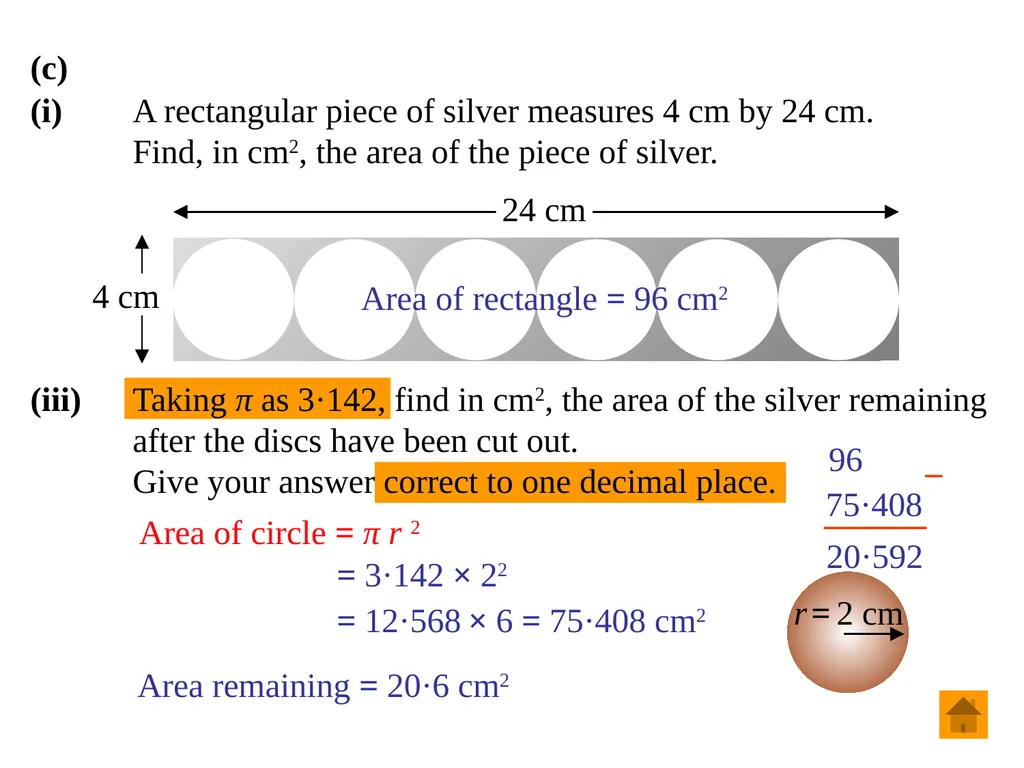
(i) A rectangular piece of silver measures 4 cm by 24 cm.
Find, in cm2, the area of the piece of silver. (c) (iii) Taking π as 3·142, find in cm2, the area of the silver remaining
after the discs have been cut out.
Give your answer correct to one decimal place. 24 cm 4 cm 2 cm Area of circle = π r 2 = 3·142 × 22 = 12·568 × 6 = 75·408 cm2 Area of rectangle = 96 cm2 75·408 96 – –––––– 20·592 Area remaining = 20·6 cm2 r =<br>
Find, in cm2, the area of the piece of silver. (c) (iii) Taking π as 3·142, find in cm2, the area of the silver remaining
after the discs have been cut out.
Give your answer correct to one decimal place. 24 cm 4 cm 2 cm Area of circle = π r 2 = 3·142 × 22 = 12·568 × 6 = 75·408 cm2 Area of rectangle = 96 cm2 75·408 96 – –––––– 20·592 Area remaining = 20·6 cm2 r =<br>
52
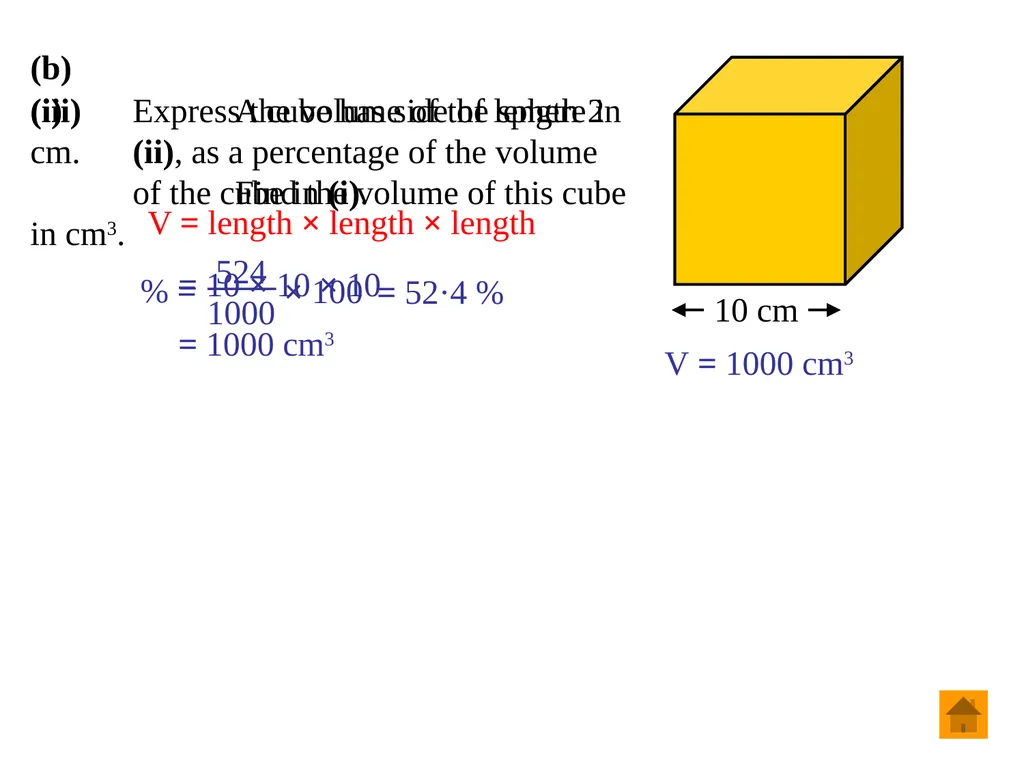
(iii) Express the volume of the sphere in
(ii), as a percentage of the volume
of the cube in (i). (i) A cube has side of length 2 cm.
Find the volume of this cube in cm3. = 1000 cm3 = 10 × 10 × 10 V = length × length × length 10 cm (b) V = 1000 cm3 = 52·4 %<br>
(ii), as a percentage of the volume
of the cube in (i). (i) A cube has side of length 2 cm.
Find the volume of this cube in cm3. = 1000 cm3 = 10 × 10 × 10 V = length × length × length 10 cm (b) V = 1000 cm3 = 52·4 %<br>
53
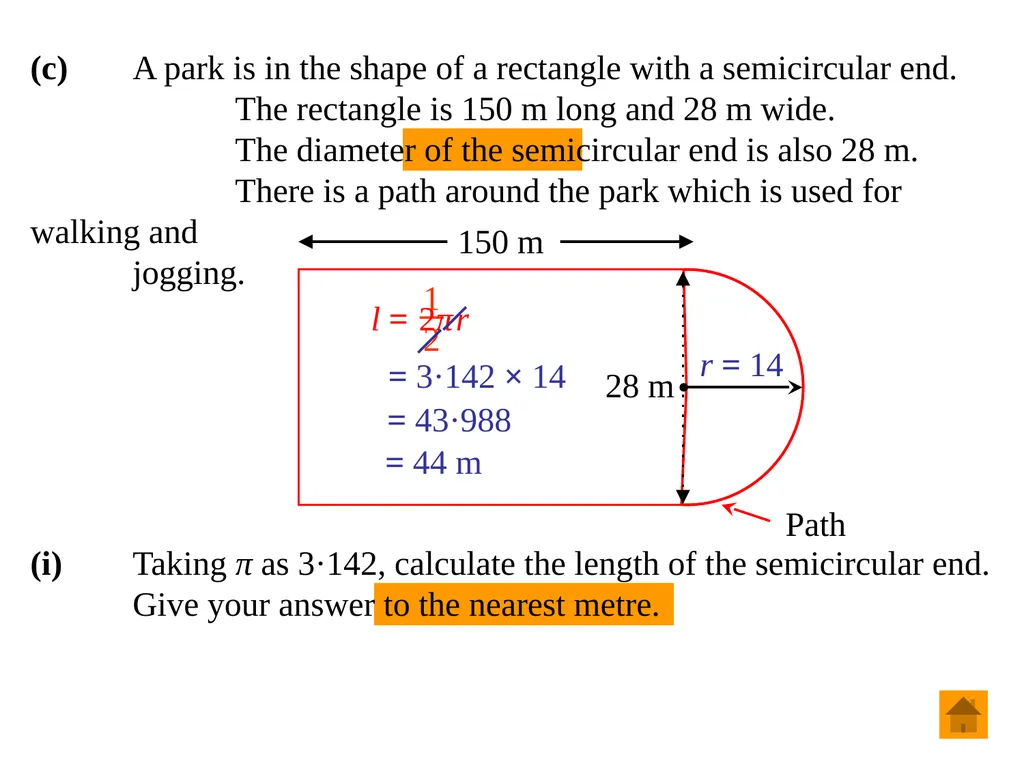
(i) Taking π as 3·142, calculate the length of the semicircular end.
Give your answer to the nearest metre. r = 14 = 43·988 28 m l = (c) A park is in the shape of a rectangle with a semicircular end.
The rectangle is 150 m long and 28 m wide.
The diameter of the semicircular end is also 28 m.
There is a path around the park which is used for walking and
jogging. Path 2π r = 3·142 × 14 150 m = 44 m<br>
Give your answer to the nearest metre. r = 14 = 43·988 28 m l = (c) A park is in the shape of a rectangle with a semicircular end.
The rectangle is 150 m long and 28 m wide.
The diameter of the semicircular end is also 28 m.
There is a path around the park which is used for walking and
jogging. Path 2π r = 3·142 × 14 150 m = 44 m<br>
54
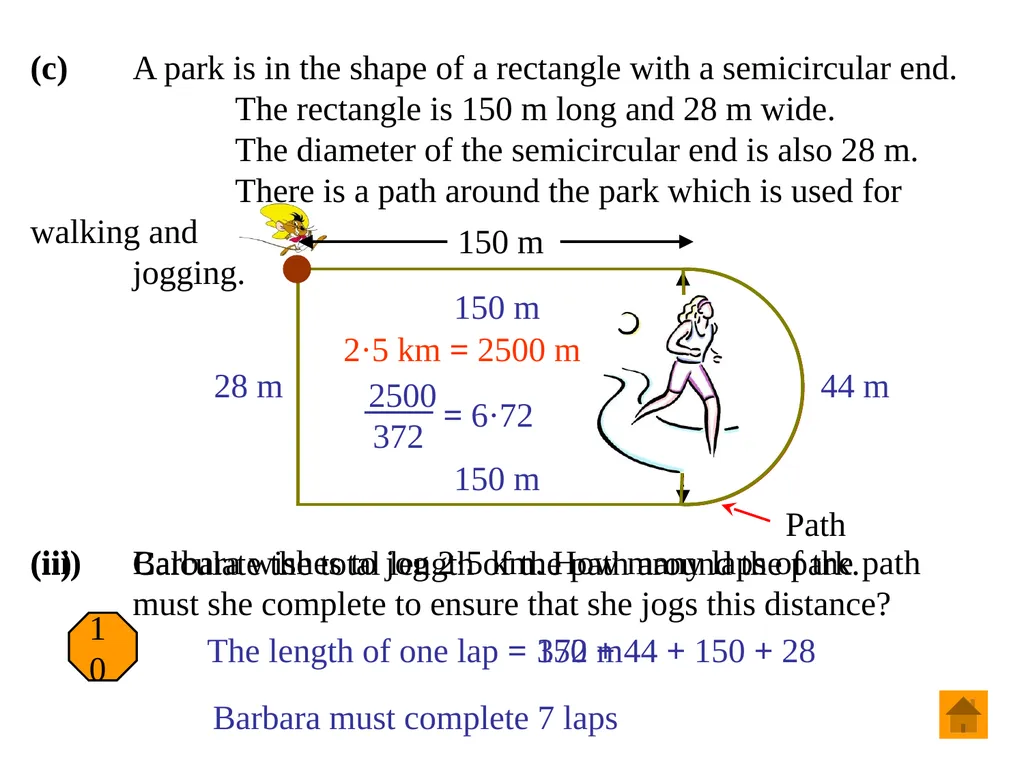
(ii) Calculate the total length of the path around the park. 10 28 m Path 150 m 44 m 150 m 150 m 28 m The length of one lap = 372 m (iii) Barbara wishes to jog 2·5 km. How many laps of the path
must she complete to ensure that she jogs this distance? 2·5 km = 2500 m 150 + 44 + 150 + 28 = 6·72 Barbara must complete 7 laps (c) A park is in the shape of a rectangle with a semicircular end.
The rectangle is 150 m long and 28 m wide.
The diameter of the semicircular end is also 28 m.
There is a path around the park which is used for walking and
jogging.<br>
must she complete to ensure that she jogs this distance? 2·5 km = 2500 m 150 + 44 + 150 + 28 = 6·72 Barbara must complete 7 laps (c) A park is in the shape of a rectangle with a semicircular end.
The rectangle is 150 m long and 28 m wide.
The diameter of the semicircular end is also 28 m.
There is a path around the park which is used for walking and
jogging.<br>
55
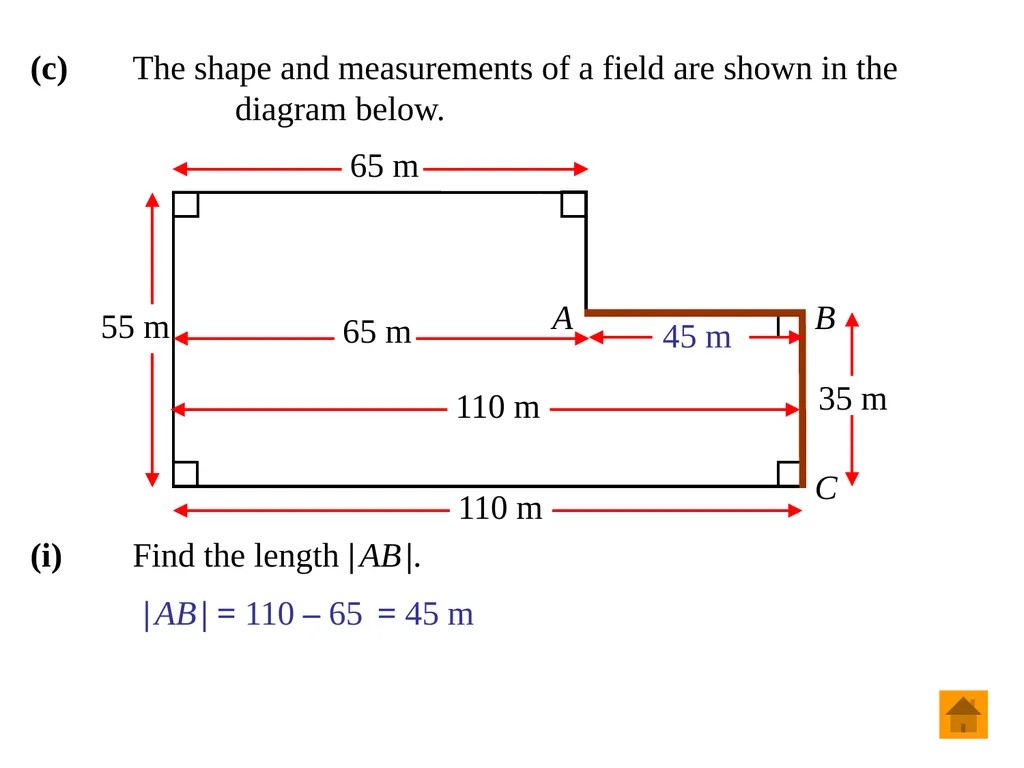
65 m A 110 m 35 m B C 55 m (c) The shape and measurements of a field are shown in the
diagram below. (i) Find the length | AB |. | AB | = 110 – 65 = 45 m 110 m 65 m 45 m<br>
diagram below. (i) Find the length | AB |. | AB | = 110 – 65 = 45 m 110 m 65 m 45 m<br>
56
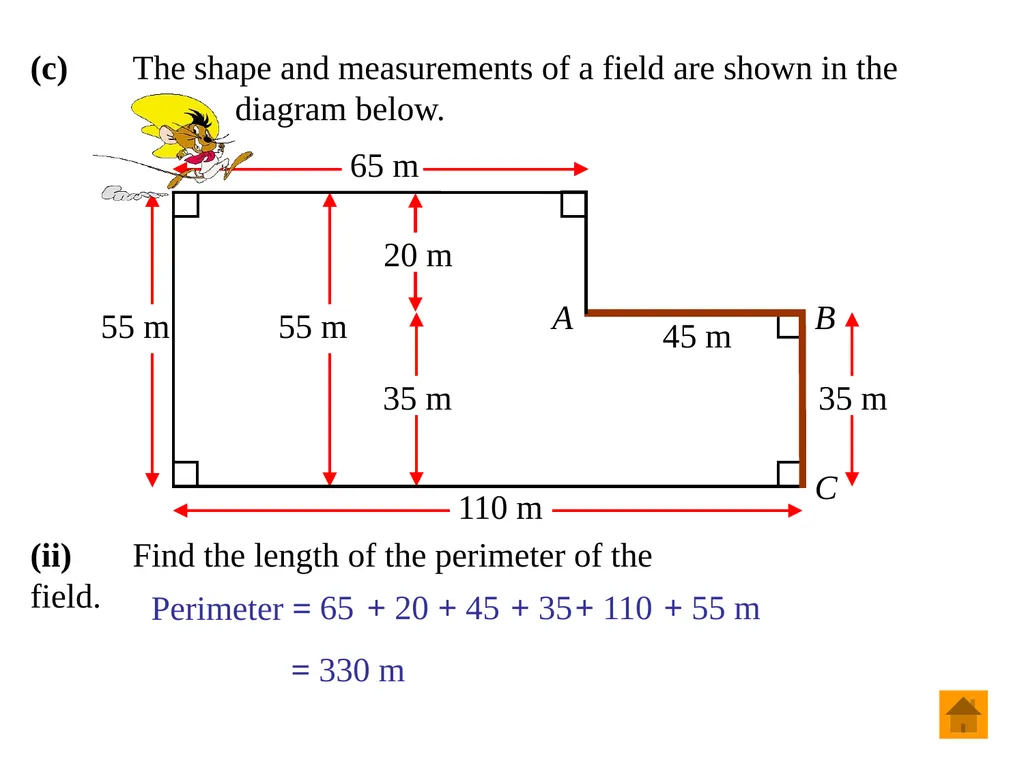
45 m 35 m 55 m 65 m A 110 m 35 m B C 55 m (c) The shape and measurements of a field are shown in the
diagram below. (ii) Find the length of the perimeter of the field. Perimeter = 65 + 20 + 45 + 35 + 110 + 55 m 20 m = 330 m<br>
diagram below. (ii) Find the length of the perimeter of the field. Perimeter = 65 + 20 + 45 + 35 + 110 + 55 m 20 m = 330 m<br>
57
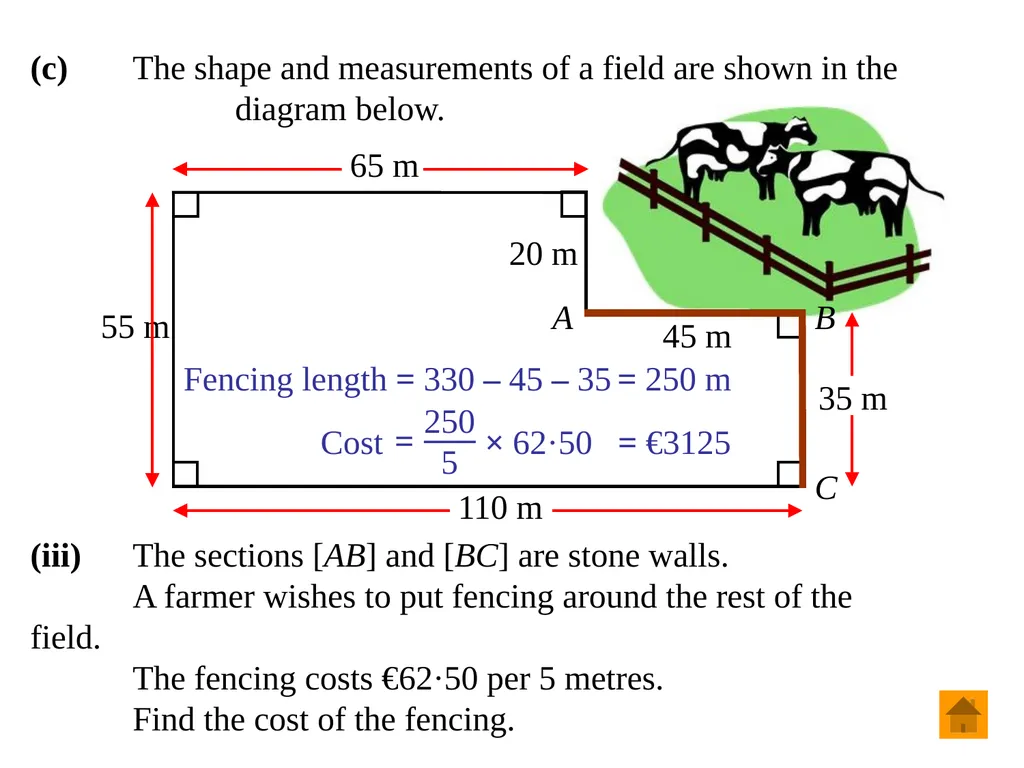
20 m 65 m A 110 m 35 m B C 55 m (c) The shape and measurements of a field are shown in the
diagram below. (iii) The sections [AB] and [BC] are stone walls.
A farmer wishes to put fencing around the rest of the field.
The fencing costs €62·50 per 5 metres.
Find the cost of the fencing. Fencing length = 330 – 45 – 35 = 250 m Cost × 62·50 45 m = €3125<br>
diagram below. (iii) The sections [AB] and [BC] are stone walls.
A farmer wishes to put fencing around the rest of the field.
The fencing costs €62·50 per 5 metres.
Find the cost of the fencing. Fencing length = 330 – 45 – 35 = 250 m Cost × 62·50 45 m = €3125<br>
58
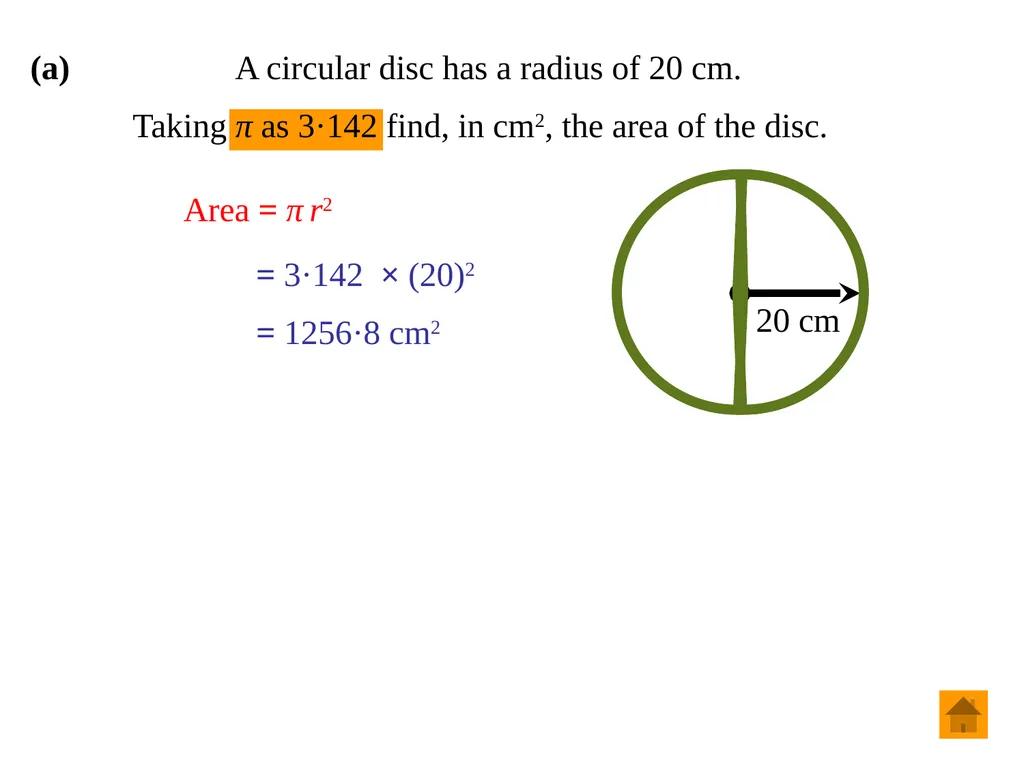
(a) A circular disc has a radius of 20 cm.
Taking π as 3·142 find, in cm2, the area of the disc. 20 cm Area = π r2 = 3·142 × (20)2
= 1256·8 cm2<br>
Taking π as 3·142 find, in cm2, the area of the disc. 20 cm Area = π r2 = 3·142 × (20)2
= 1256·8 cm2<br>
59
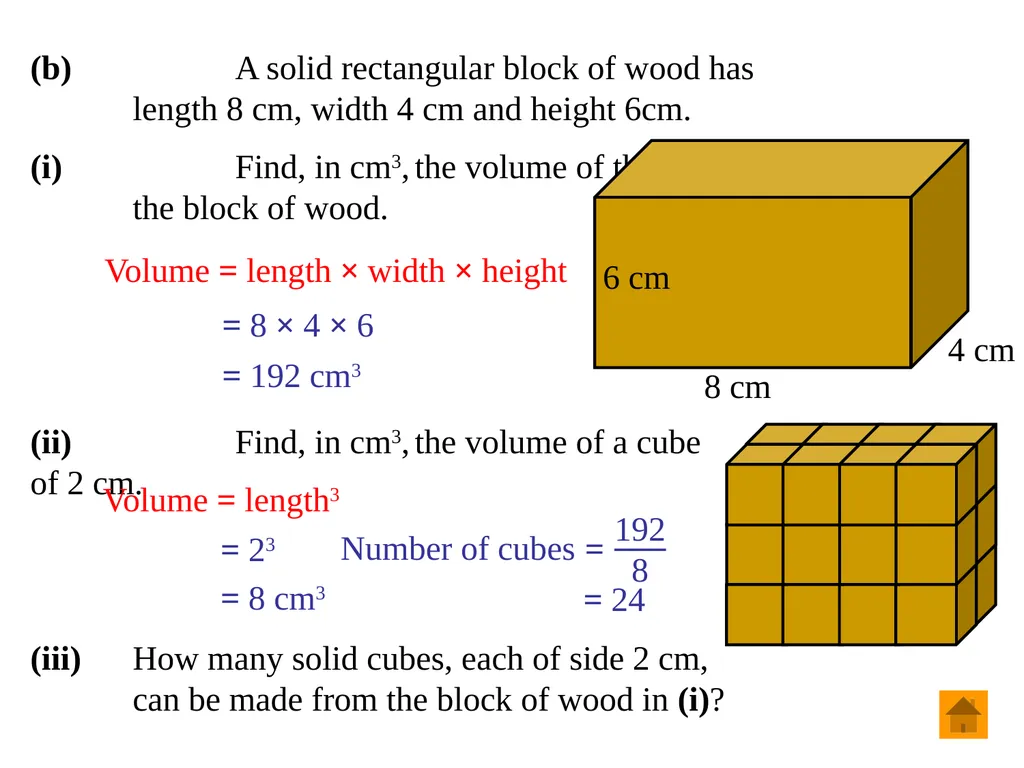
(b) A solid rectangular block of wood has
length 8 cm, width 4 cm and height 6cm.
(i) Find, in cm3, the volume of the
the block of wood. = 192 cm3 = 8 × 4 × 6 Volume = length × width × height 4 cm 8 cm 6 cm (ii) Find, in cm3, the volume of a cube of 2 cm. = 8 cm3 = 23 Volume = length3 (iii) How many solid cubes, each of side 2 cm,
can be made from the block of wood in (i)? Number of cubes = 24<br>
length 8 cm, width 4 cm and height 6cm.
(i) Find, in cm3, the volume of the
the block of wood. = 192 cm3 = 8 × 4 × 6 Volume = length × width × height 4 cm 8 cm 6 cm (ii) Find, in cm3, the volume of a cube of 2 cm. = 8 cm3 = 23 Volume = length3 (iii) How many solid cubes, each of side 2 cm,
can be made from the block of wood in (i)? Number of cubes = 24<br>