02
Established in 2008 in Bratislava, Slovakia
Not-for-profit independent research institute, 20+ employees, 60+ fellows
CELSI strives to
Contribute to cutting-edge international scientific research
provide reliable and timely evidence for policy making
enable talent, build bridges between forefront international expertise and in-depth knowledge of local experts.
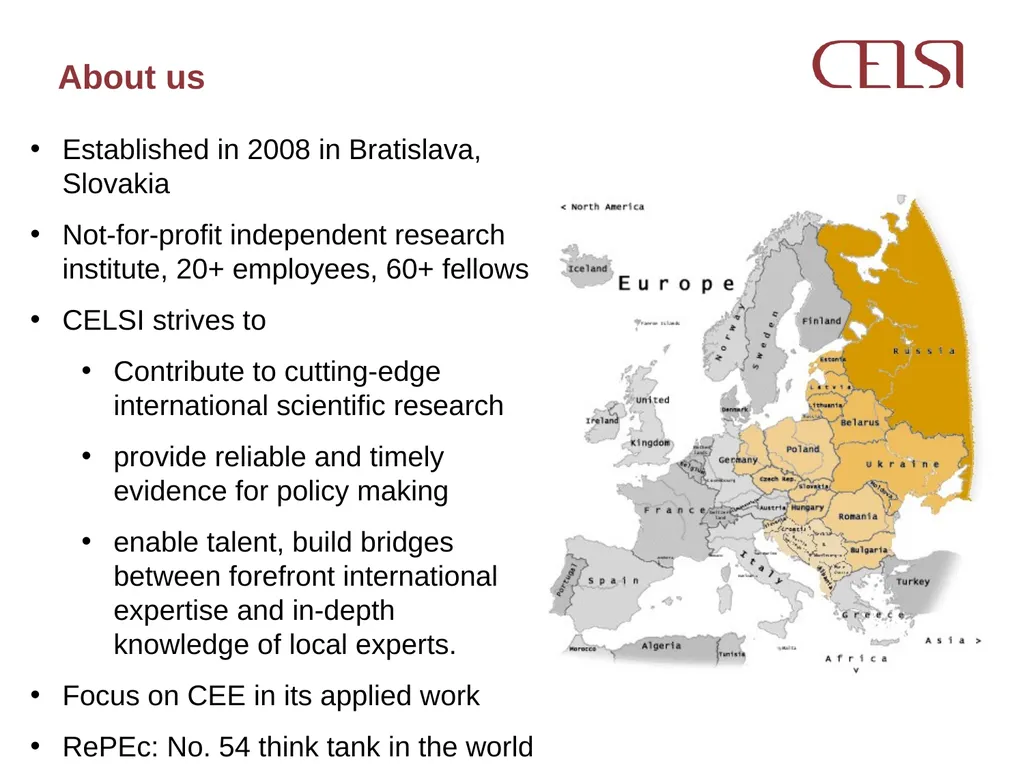
Focus on CEE in its applied work
RePEc: No. 54 think tank in the world About us<br>
04
Background report on Slovakia Purpose: Examine trends and patterns of temporary labour mobility and employment of migrant workers on fixed-term or outsourced temporary contracts in selected manufacturing and service sectors in Slovakia.
Dynamics of temporary labour migration in Slovakia
Deepening the analysis on temporary labour migration and its relationship with changes in industrial relation structures Methodology: Utilizes statistical analysis, policy review, desk research, and interviews.<br>
05
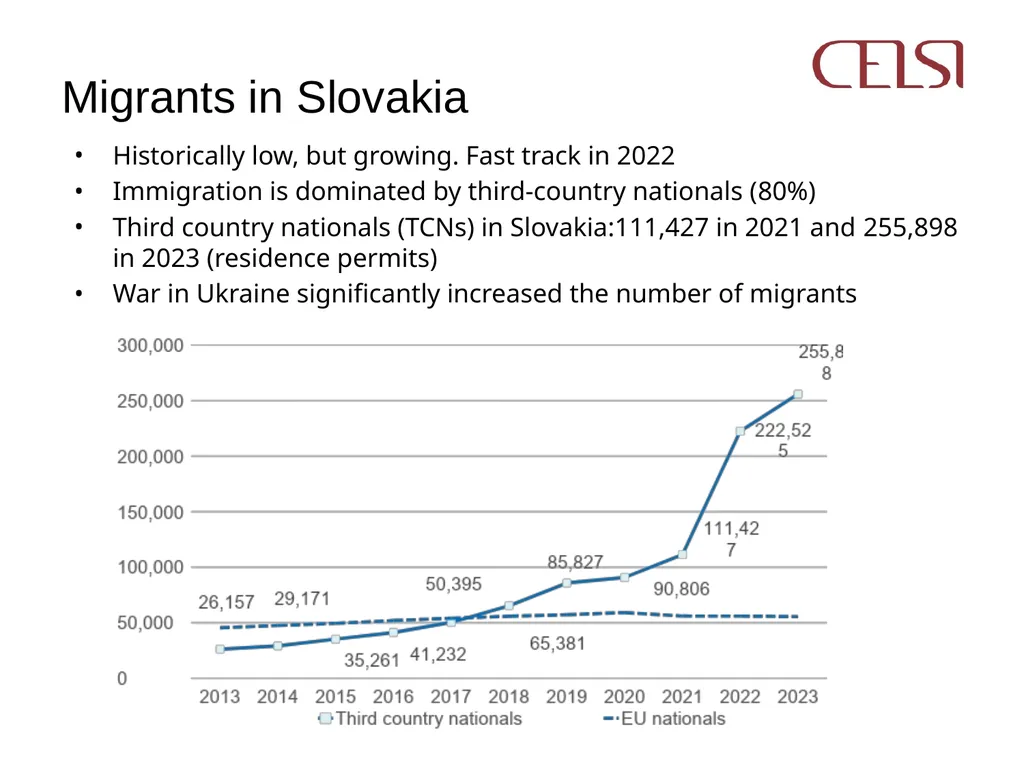
Migrants in Slovakia Historically low, but growing. Fast track in 2022
Immigration is dominated by third-country nationals (80%)
Third country nationals (TCNs) in Slovakia:111,427 in 2021 and 255,898 in 2023 (residence permits)
War in Ukraine significantly increased the number of migrants<br>
06
Inflow of migrants New origins: Vietnam, Philippines, Indonesia, Thailand, India, Serbia, Georgia, North Macedonia, Bosnia and Herzegovina, Moldova, Kyrgyzstan, Kazakhstan, Uzbekistan
Definition of temporary labour immigrants
first-time residence permits for employment reasons
shorter than one year
Temporary migrants dominant in construction, agriculture, �food processing and social care.<br>
07
Temporary protection holders �(war refugees) War refugees can be employed without work permit
Half of the refugees work in jobs below their qualifications, and a quarter with temporary small contracts (Veselkova and Habel, 2024)
Small contracts are flexible but provide lesser employee rights<br>
08
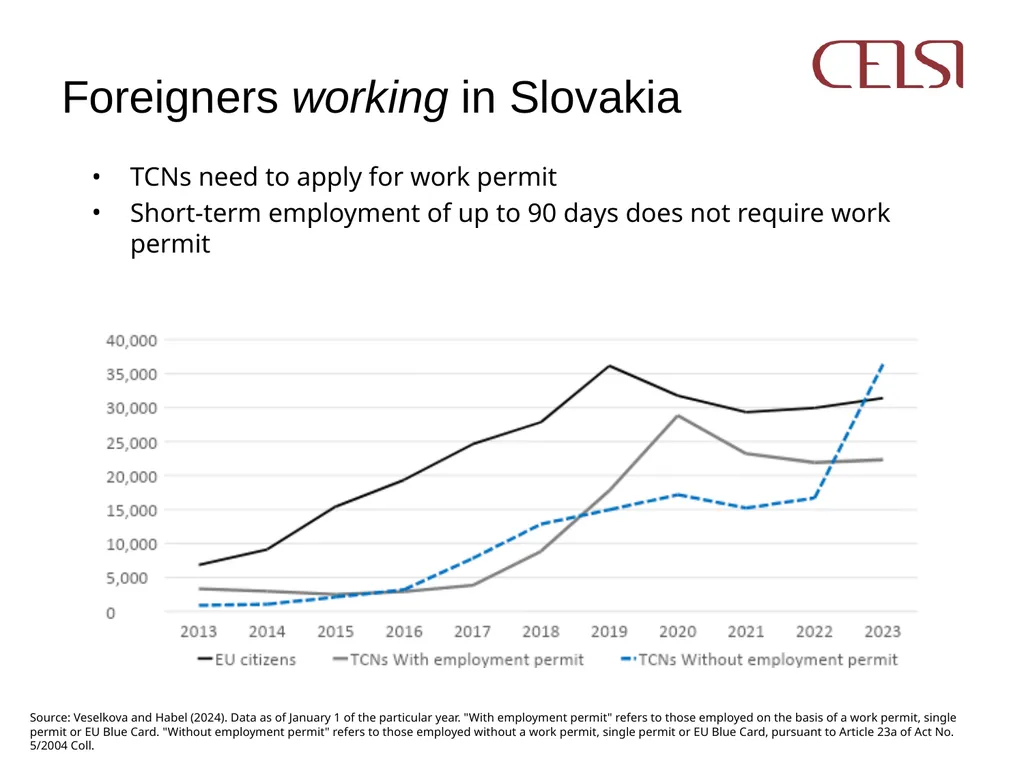
Foreigners working in Slovakia TCNs need to apply for work permit
Short-term employment of up to 90 days does not require work permit Source: Veselkova and Habel (2024). Data as of January 1 of the particular year. "With employment permit" refers to those employed on the basis of a work permit, single permit or EU Blue Card. "Without employment permit" refers to those employed without a work permit, single permit or EU Blue Card, pursuant to Article 23a of Act No. 5/2004 Coll.<br>
09
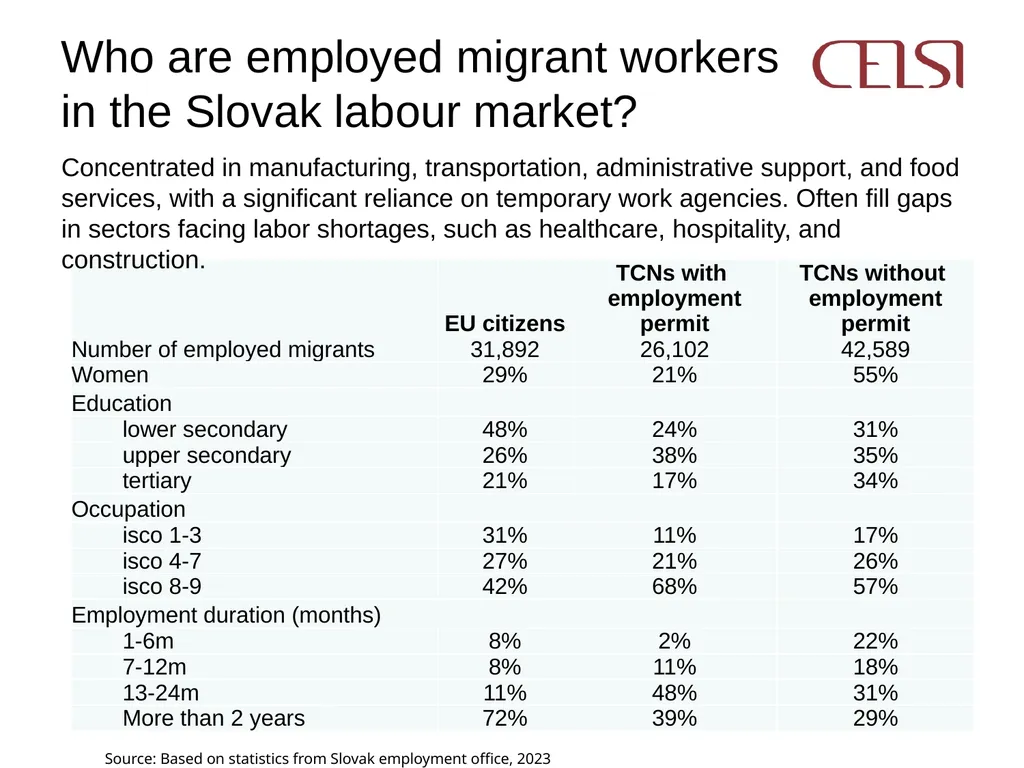
Source: Based on statistics from Slovak employment office, 2023 Who are employed migrant workers
in the Slovak labour market? Concentrated in manufacturing, transportation, administrative support, and food services, with a significant reliance on temporary work agencies. Often fill gaps in sectors facing labor shortages, such as healthcare, hospitality, and construction.<br>
10
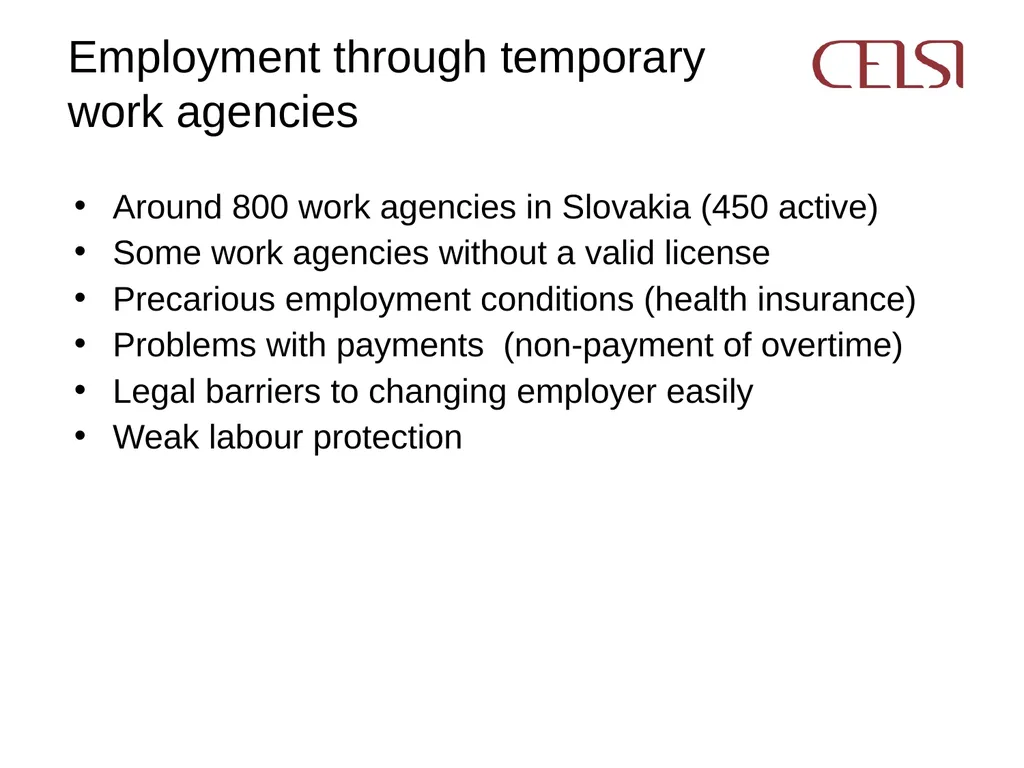
Employment through temporary �work agencies Around 800 work agencies in Slovakia (450 active)
Some work agencies without a valid license
Precarious employment conditions (health insurance)
Problems with payments (non-payment of overtime)
Legal barriers to changing employer easily
Weak labour protection<br>
11
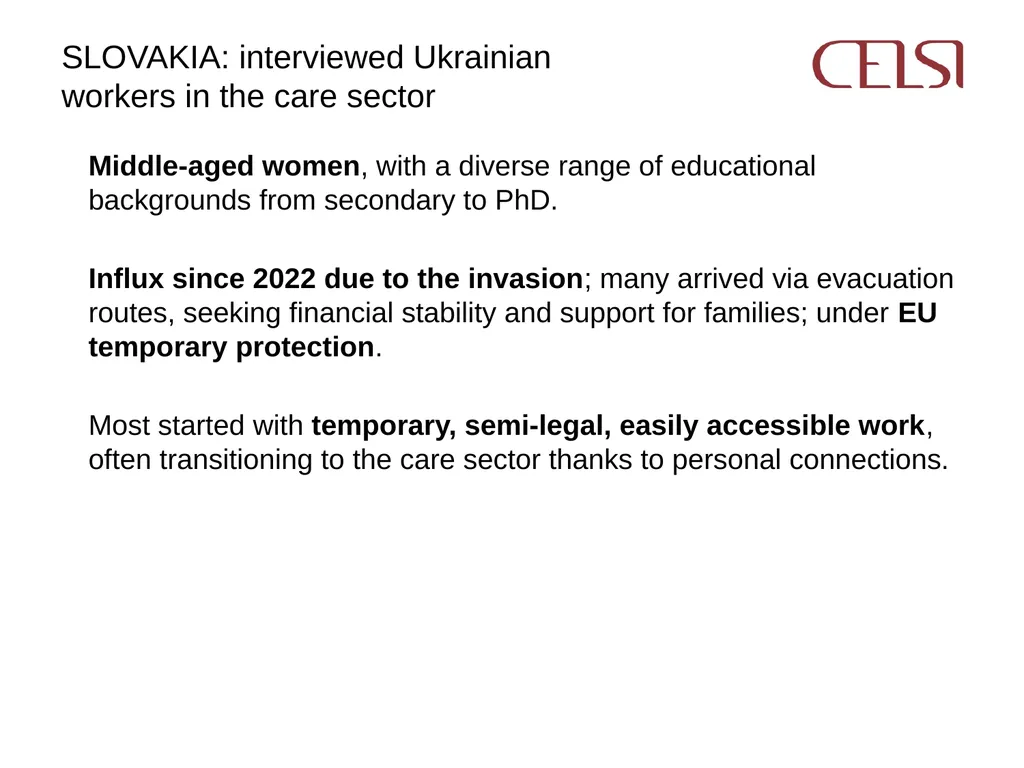
SLOVAKIA: interviewed Ukrainian �workers in the care sector Middle-aged women, with a diverse range of educational backgrounds from secondary to PhD.
Influx since 2022 due to the invasion; many arrived via evacuation routes, seeking financial stability and support for families; under EU temporary protection.
Most started with temporary, semi-legal, easily accessible work, often transitioning to the care sector thanks to personal connections.<br>
12
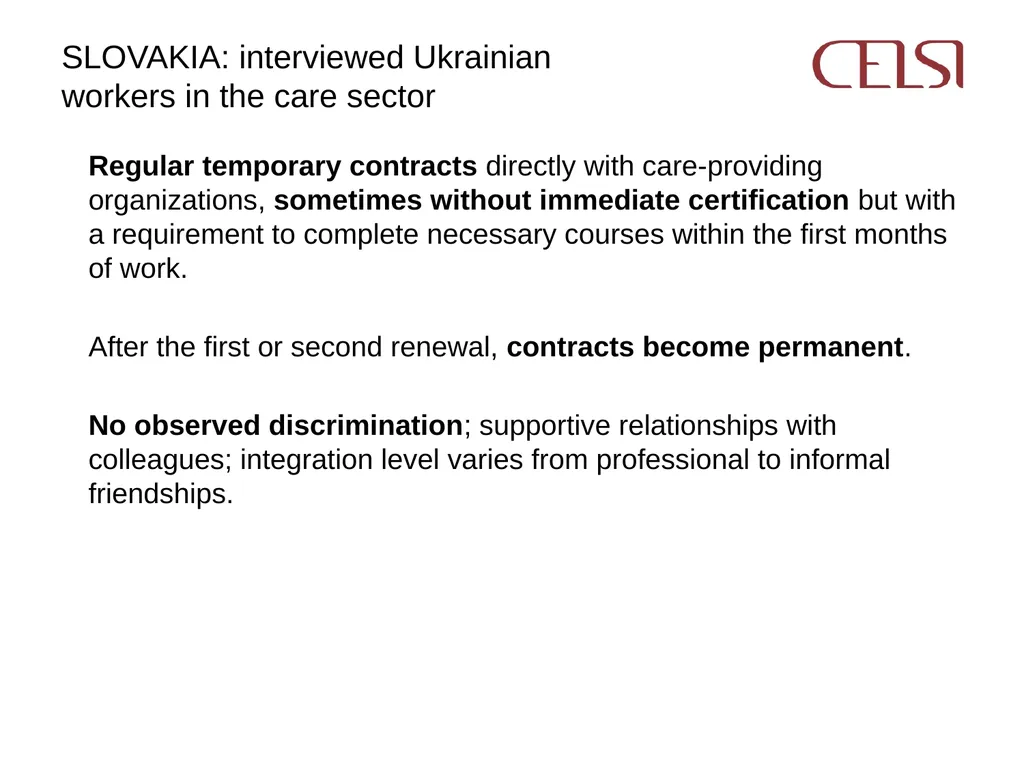
SLOVAKIA: interviewed Ukrainian �workers in the care sector Regular temporary contracts directly with care-providing organizations, sometimes without immediate certification but with a requirement to complete necessary courses within the first months of work.
After the first or second renewal, contracts become permanent.
No observed discrimination; supportive relationships with colleagues; integration level varies from professional to informal friendships.<br>
13
SLOVAKIA: interviewed Ukrainian �workers in the care sector Feelings of stability with limited career growth; preference to remain in the current sector even if changing jobs.
General satisfaction with income; many provide financial support to their family in Ukraine.
Some consider returning to Ukraine due to personal reasons or after war, but not due to dissatisfaction with life or work in Slovakia.<br>
14
SLOVAKIA: interviewed Serbian�workers in the automotive sector typically secondary school, middle-aged males
2016 a watershed: appeared on the Slovak labour market, since 2020 fewer (also comparatively among migrant workers)
employment trajectory: from illegal/semi/legal to permanent contracts (via temp agencies, fixed term contracts) but if on permanent contracts, at the bottom of the company hierarchy (production line workers).
precarious position, insufficient incomes etc.
for long-term planning: considering return home or starting new cycle of migration
marginalised social group, some critical of trade unions<br>
15
Overall Evaluation Complex and sometimes contradictory approach to migration in Slovakia
Economic Imperative vs. Social Resistance: Much demand for migrant labor, particularly in sectors with labor shortages. Yet, generally negative perception of migration, shaped by historical isolation from major migration waves and limited exposure to foreigners.
Integration Barriers and Dependency: Limited infrastructure for integration and reliance on temporary work agencies increase migrant dependency on employers, often restricting their social mobility and exacerbating marginalization.
Selective Support: Slovaks show higher acceptance of culturally similar, skilled migrants and those fleeing from a conflict (e.g. Ukrainians). However, societal friction exists, particularly when benefits and social support measures are perceived to favor migrants over locals.<br>
16
Migrant workers’ experiences Stable integration with positive workplace relationships: Ukrainian care workers report supportive, mostly non-discriminatory environments, feeling secure in their jobs and forming both professional and personal bonds with colleagues, despite limited career growth opportunities.
Financial stability and commitment to family support: The interviewed workers achieve financial satisfaction, allowing them to support families in Ukraine; while some may consider returning post-war, this is based on personal factors rather than dissatisfaction with their roles in Slovakia.<br>
17
martin.kahanec@celsi.sk THANK YOU FOR YOUR
ATTENTION!<br>