
Keeping Children Safe in Education: Honour or
FD
Published · 29 slides · 0 views

1 / 1

Description
Keeping Children Safe in Education: Honour or faith-based abuse (including FGM and forced marriage) Essex Education Safeguarding Team September 2026 Copyright Essex County Council 2026 No part of this publication may be reproduced, stored
Related Topics
Share
Embed code
Download this presentation From Below
"Keeping Children Safe in Education: Honour or" is the property of its rightful owner. Permission is granted to download and print the materials on this website for personal, non-commercial use only, and to display it on your personal computer provided you do not modify the materials and that you retain all copyright notices contained in the materials. By downloading content from our website, you accept the terms of this agreement.
Presentation Transcript
01
Keeping Children Safe in Education: Honour or faith-based abuse (including FGM and forced marriage) Essex Education Safeguarding Team
September 2026 Copyright © Essex County Council 2026 No part of this publication may be reproduced, stored in a retrieval system of any nature, downloaded, transmitted or distributed in any form or by any means including photocopying and recording, without the prior written permission of Essex County Council, the copyright owner<br>
September 2026 Copyright © Essex County Council 2026 No part of this publication may be reproduced, stored in a retrieval system of any nature, downloaded, transmitted or distributed in any form or by any means including photocopying and recording, without the prior written permission of Essex County Council, the copyright owner<br>
02
Contents<br>
03
Honour or faith-based abuse The SET procedures outline that:
honour-based abuse is a variety of abusive behaviours, mainly but not exclusively against women and girls
For young victims, this is a form of child abuse and a serious human rights violation. It often involves the approval or collusion of family and community members, resulting in abuse by multiple perpetrators in the UK and overseas.
Despite the use of the term, there is no honour in abuse, and cultural sensitivities should not get in the way of tackling this issue. Keeping Children Safe in Education:
Honour or faith-based abuse (HBA) encompasses incidents or crimes which have been committed to protect or defend the honour of the family and/or the community, including female genital mutilation (FGM), forced marriage, and practices such as breast ironing.
Abuse committed in the context of preserving ‘honour’ often involves a wider network of family or community pressure and can include multiple perpetrators.<br>
04
Female genital mutilation (FGM)<br>
05
Female Genital Mutilation (FGM) It is illegal in the UK and a form of child abuse with long-lasting harmful consequences.
It is a practice which takes place worldwide in at least 30 countries in Africa, Asia and the Middle East. It also takes place within parts of Western Europe and other developed countries.
FGM is a complex issue - despite the harm it causes, some women and men from affected communities consider it to be normal to protect their daughters and their cultural identity.
FGM is often claimed to be carried out in accordance with religious beliefs, but it is not supported by any religious doctrine.
(DfE Female genital mutilation resource pack 2023)<br>
06
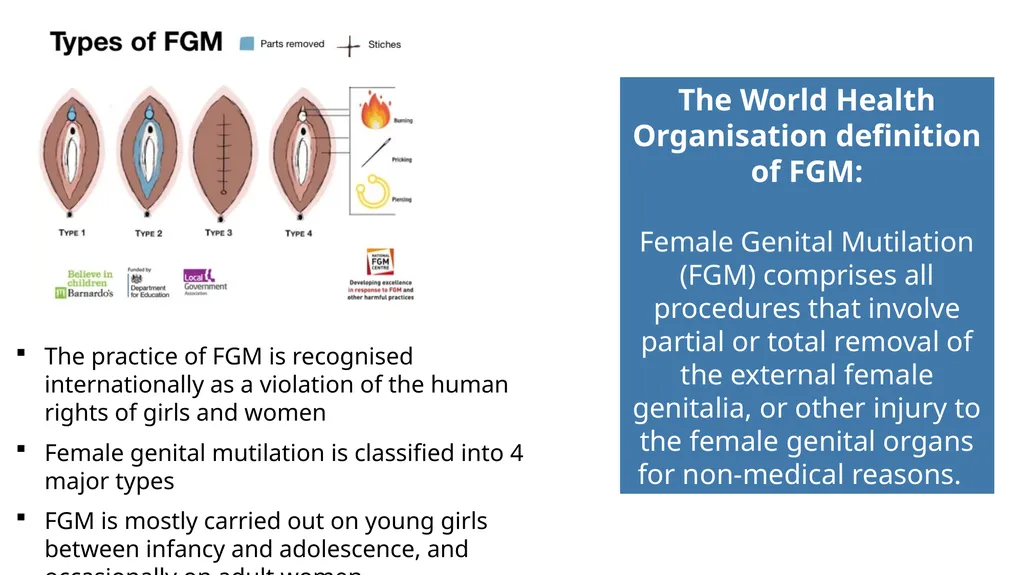
The World Health Organisation definition of FGM:
Female Genital Mutilation (FGM) comprises all procedures that involve partial or total removal of the external female genitalia, or other injury to the female genital organs for non-medical reasons. The practice of FGM is recognised internationally as a violation of the human rights of girls and women
Female genital mutilation is classified into 4 major types
FGM is mostly carried out on young girls between infancy and adolescence, and occasionally on adult women<br>
07
National FGM Centre
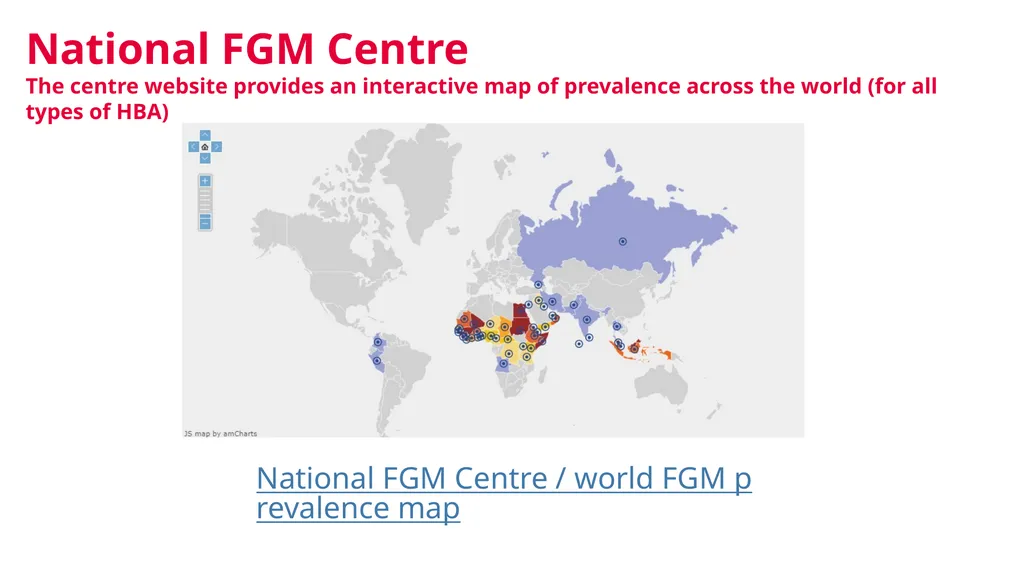
The centre website provides an interactive map of prevalence across the world (for all types of HBA) National FGM Centre / world FGM prevalence map<br>
08
Why is FGM practiced? Preservation of the female’s virginity
Perceived religious justification (there are no religions that advocate for FGM)
Protection of family honour
Culture
Rite of passage into womanhood
Social acceptance
To be eligible for marriage
Perceived health benefits
Cleanliness
Curbing a woman’s sexuality
Mis-information about fertility and childbirth making it safer
It makes a woman more beautiful
It prevents vaginal cancer<br>
09
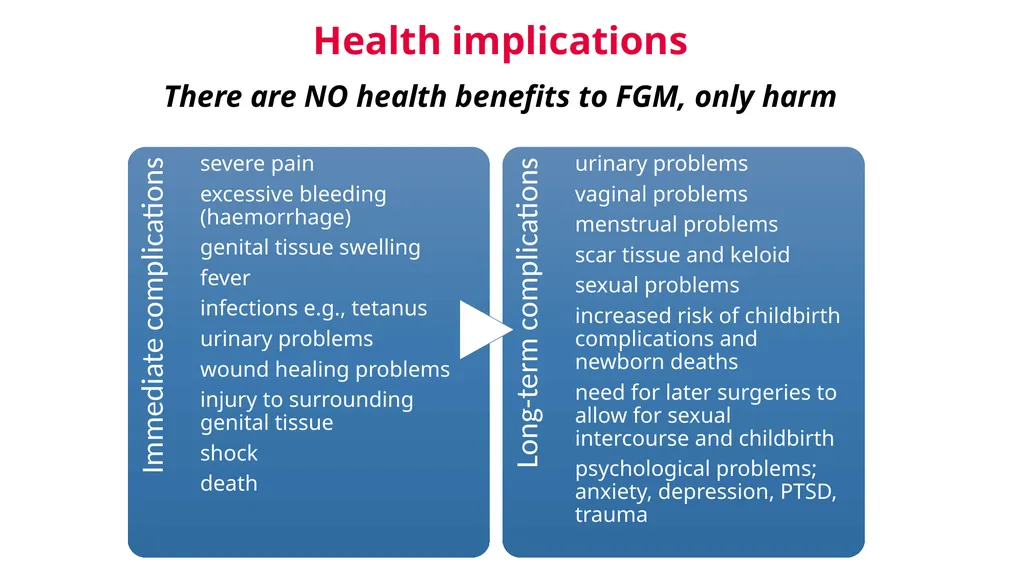
Health implications
There are NO health benefits to FGM, only harm<br>
10
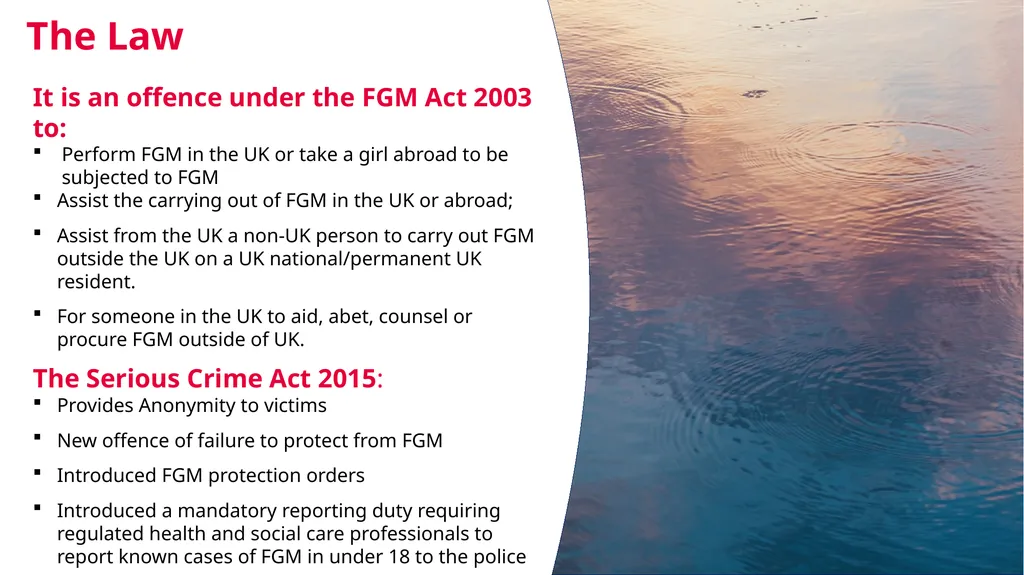
The Law It is an offence under the FGM Act 2003 to:
Perform FGM in the UK or take a girl abroad to be subjected to FGM
Assist the carrying out of FGM in the UK or abroad;
Assist from the UK a non-UK person to carry out FGM outside the UK on a UK national/permanent UK resident.
For someone in the UK to aid, abet, counsel or procure FGM outside of UK.
The Serious Crime Act 2015:
Provides Anonymity to victims
New offence of failure to protect from FGM
Introduced FGM protection orders
Introduced a mandatory reporting duty requiring regulated health and social care professionals to report known cases of FGM in under 18 to the police<br>
11
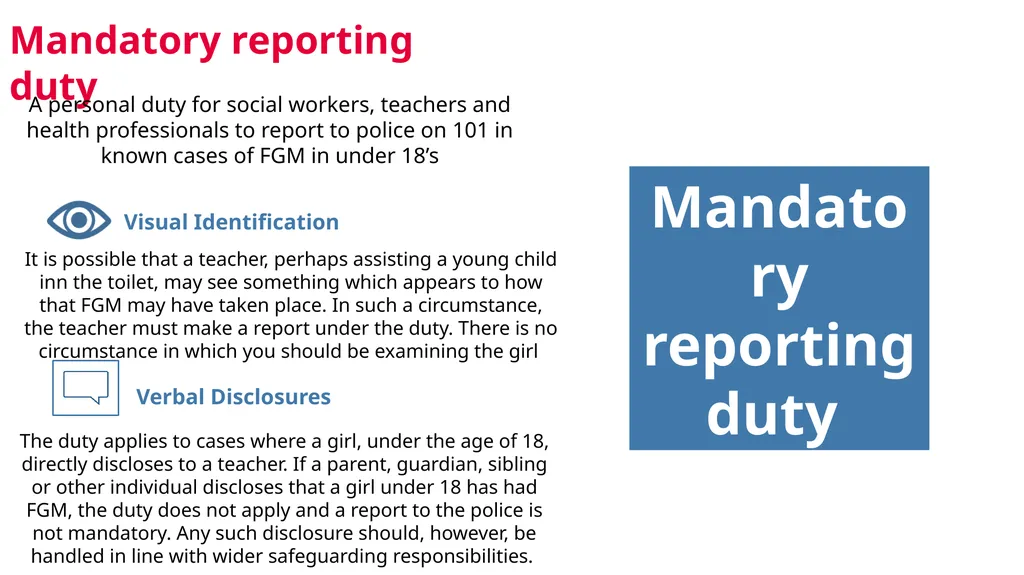
Mandatory reporting duty A personal duty for social workers, teachers and health professionals to report to police on 101 in known cases of FGM in under 18’s Visual Identification Verbal Disclosures It is possible that a teacher, perhaps assisting a young child inn the toilet, may see something which appears to how that FGM may have taken place. In such a circumstance, the teacher must make a report under the duty. There is no circumstance in which you should be examining the girl Mandatory reporting duty The duty applies to cases where a girl, under the age of 18, directly discloses to a teacher. If a parent, guardian, sibling or other individual discloses that a girl under 18 has had FGM, the duty does not apply and a report to the police is not mandatory. Any such disclosure should, however, be handled in line with wider safeguarding responsibilities.<br>
12
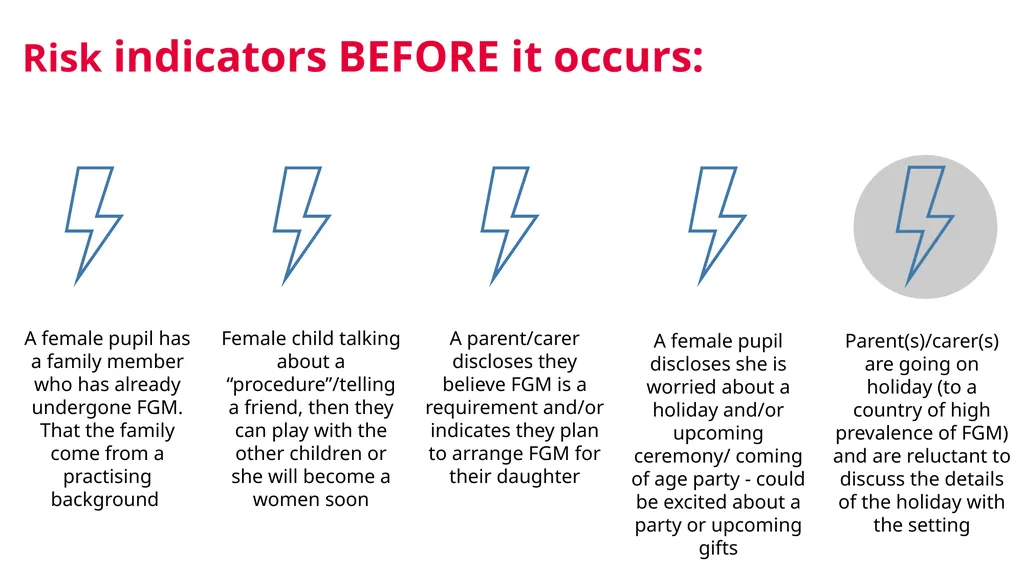
Risk indicators BEFORE it occurs: A female pupil has a family member who has already undergone FGM. That the family come from a practising background A female pupil discloses she is worried about a holiday and/or upcoming ceremony/ coming of age party - could be excited about a party or upcoming gifts A parent/carer discloses they believe FGM is a requirement and/or indicates they plan to arrange FGM for their daughter Female child talking about a “procedure”/telling a friend, then they can play with the other children or she will become a women soon Parent(s)/carer(s) are going on holiday (to a country of high prevalence of FGM) and are reluctant to discuss the details of the holiday with the setting<br>
13
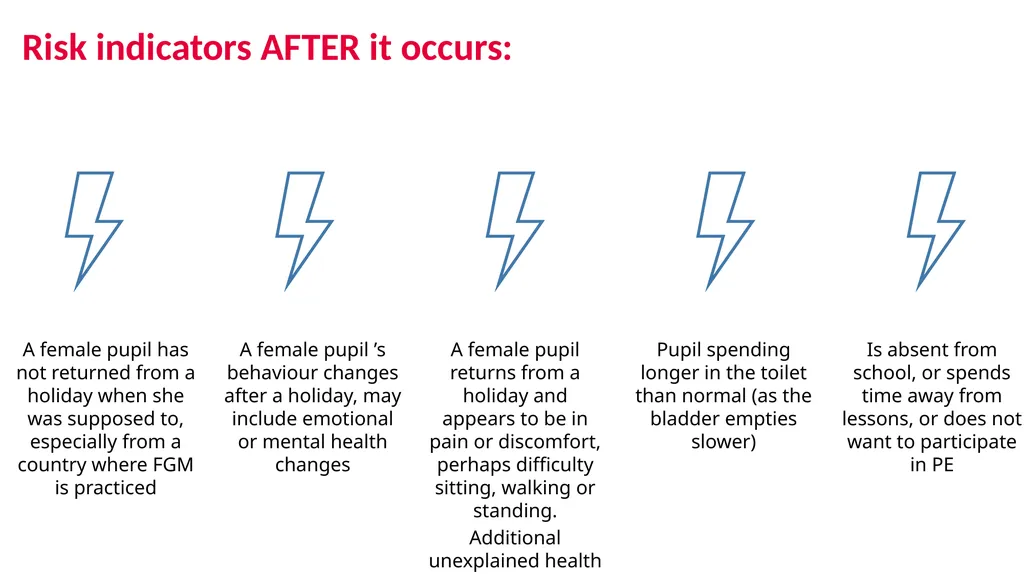
Risk indicators AFTER it occurs: A female pupil has not returned from a holiday when she was supposed to, especially from a country where FGM is practiced Pupil spending longer in the toilet than normal (as the bladder empties slower) A female pupil returns from a holiday and appears to be in pain or discomfort, perhaps difficulty sitting, walking or standing.
Additional unexplained health problems A female pupil ’s behaviour changes after a holiday, may include emotional or mental health changes Is absent from school, or spends time away from lessons, or does not want to participate in PE<br>
Additional unexplained health problems A female pupil ’s behaviour changes after a holiday, may include emotional or mental health changes Is absent from school, or spends time away from lessons, or does not want to participate in PE<br>
14
Talking with parents/carers Before a referral is made to Social Care, efforts should be made to explore concerns with the child and / or the parent/carer first (unless to do so would put the child in danger)
Research prevalence of FGM in the relevant country
Use a female worker wherever possible
Use simple language and straight forward questions – be curious
Use appropriate language with the family and terms they are familiar with
Ensure an independent interpreter is used, where this is required<br>
Research prevalence of FGM in the relevant country
Use a female worker wherever possible
Use simple language and straight forward questions – be curious
Use appropriate language with the family and terms they are familiar with
Ensure an independent interpreter is used, where this is required<br>
15
Advice and guidance National FGM Centre school's guidance (2019)
Provides advice and consultation
Support for teachers on speaking to parents
Advice on risk indicators of potential FGM
Support for families
Support for schools around awareness / training
For further advice and guidance on FGM you can contact the Children and Families Hub<br>
Provides advice and consultation
Support for teachers on speaking to parents
Advice on risk indicators of potential FGM
Support for families
Support for schools around awareness / training
For further advice and guidance on FGM you can contact the Children and Families Hub<br>
16
Case Study – part 1 The mother of a female pupil in your class has told you she will be taking her daughter out of school for one week before the Easter break in order to visit her family in Egypt, due to the ill-health of her mother. She explains that her daughter will be absent for that week, and she does not want to get a fine.
What conversation (if any) do you have with the mother?
What next steps should you take?<br>
What conversation (if any) do you have with the mother?
What next steps should you take?<br>
17
Case Study – part 2 A week later, the female pupil tells a friend that she will be missing a week of school next month to visit her mother’s family in Egypt and that there is to be a big family celebration. She is very excited as her mother has told her she will meet her grandmother for the first time and will be spending a lot of time with her.
What conversation (if any) do you have with the child?
What next steps should you take?<br>
What conversation (if any) do you have with the child?
What next steps should you take?<br>
18
Breast flattening<br>
19
Breast flattening The painful and harmful practice of bringing a girl's breasts into contact with hard or heated objects (which could include stones, belts, pestles and heated implements) to suppress or reverse the growth of breasts by destroying the tissue
Often carried out at the onset of puberty by female relatives, with the aim of reducing perceived sexual attractiveness, preventing relationships or pregnancy outside marriage, and protecting family or community honour
Breast flattening is a form of child abuse - can happen over a period of time
What is Breast Ironing? Animation - YouTube<br>
20
Forced marriage<br>
21
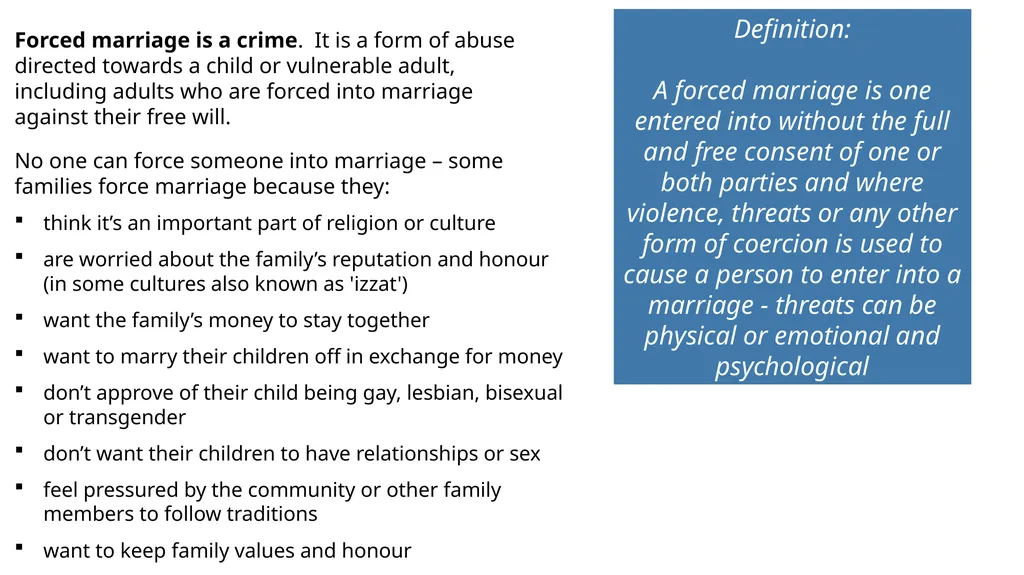
Definition:
A forced marriage is one entered into without the full and free consent of one or both parties and where violence, threats or any other form of coercion is used to cause a person to enter into a marriage - threats can be physical or emotional and psychological It is illegal in the UK
It is not the same as an arranged marriage - in an arranged marriage, the person involved still has a choice Forced marriage is a crime. It is a form of abuse directed towards a child or vulnerable adult, including adults who are forced into marriage against their free will. No one can force someone into marriage – some families force marriage because they:
think it’s an important part of religion or culture
are worried about the family’s reputation and honour (in some cultures also known as 'izzat')
want the family’s money to stay together
want to marry their children off in exchange for money
don’t approve of their child being gay, lesbian, bisexual or transgender
don’t want their children to have relationships or sex
feel pressured by the community or other family members to follow traditions
want to keep family values and honour<br>
22
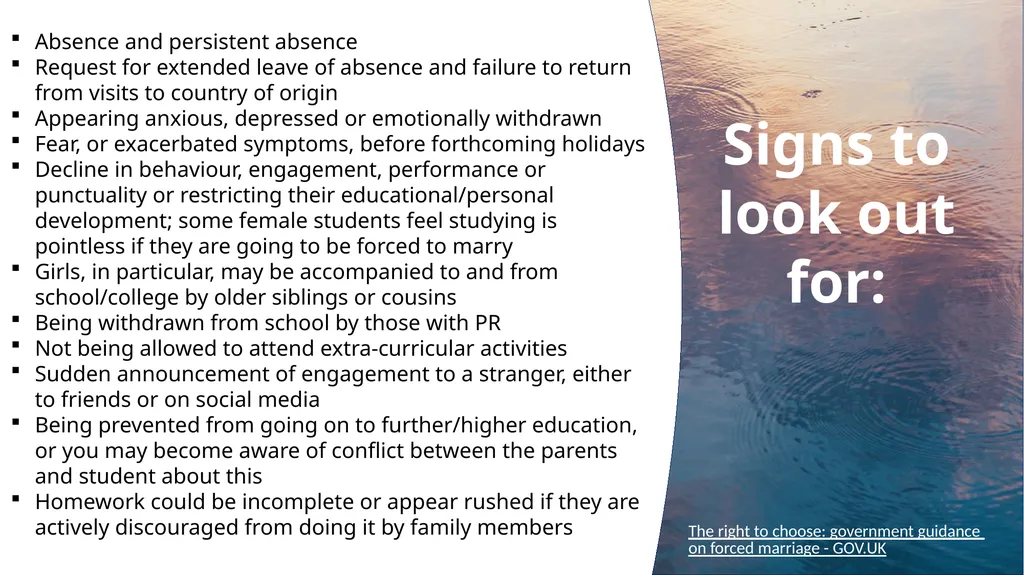
Absence and persistent absence
Request for extended leave of absence and failure to return from visits to country of origin
Appearing anxious, depressed or emotionally withdrawn
Fear, or exacerbated symptoms, before forthcoming holidays
Decline in behaviour, engagement, performance or punctuality or restricting their educational/personal development; some female students feel studying is pointless if they are going to be forced to marry
Girls, in particular, may be accompanied to and from school/college by older siblings or cousins
Being withdrawn from school by those with PR
Not being allowed to attend extra-curricular activities
Sudden announcement of engagement to a stranger, either to friends or on social media
Being prevented from going on to further/higher education, or you may become aware of conflict between the parents and student about this
Homework could be incomplete or appear rushed if they are actively discouraged from doing it by family members The right to choose: government guidance on forced marriage - GOV.UK Signs to look out for:<br>
23
Child Abuse Linked to Faith or Belief (CALFB)<br>
24
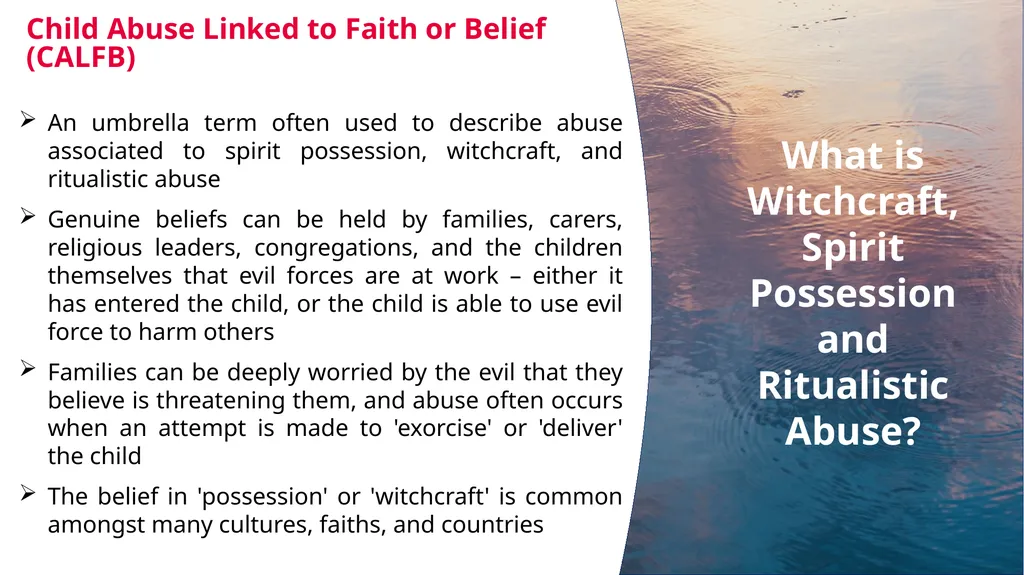
Child Abuse Linked to Faith or Belief (CALFB) What is Witchcraft, Spirit Possession and Ritualistic Abuse? An umbrella term often used to describe abuse associated to spirit possession, witchcraft, and ritualistic abuse
Genuine beliefs can be held by families, carers, religious leaders, congregations, and the children themselves that evil forces are at work – either it has entered the child, or the child is able to use evil force to harm others
Families can be deeply worried by the evil that they believe is threatening them, and abuse often occurs when an attempt is made to 'exorcise' or 'deliver' the child
The belief in 'possession' or 'witchcraft' is common amongst many cultures, faiths, and countries<br>
25
CALFB – beliefs in concepts of: witchcraft and spirit possession, demons or the devil acting through children or leading them astray (traditionally seen in some Christian beliefs),
the evil eye or djinns (traditionally known in some Islamic faith contexts) and dakini (in the Hindu context);
ritual or multi murders where the killing of children is believed to bring supernatural benefits or the use of their body parts is believed to produce potent magical remedies;
use of belief in magic or witchcraft to create fear in children to make them more compliant when they are being trafficked for domestic slavery or sexual exploitation.<br>
26
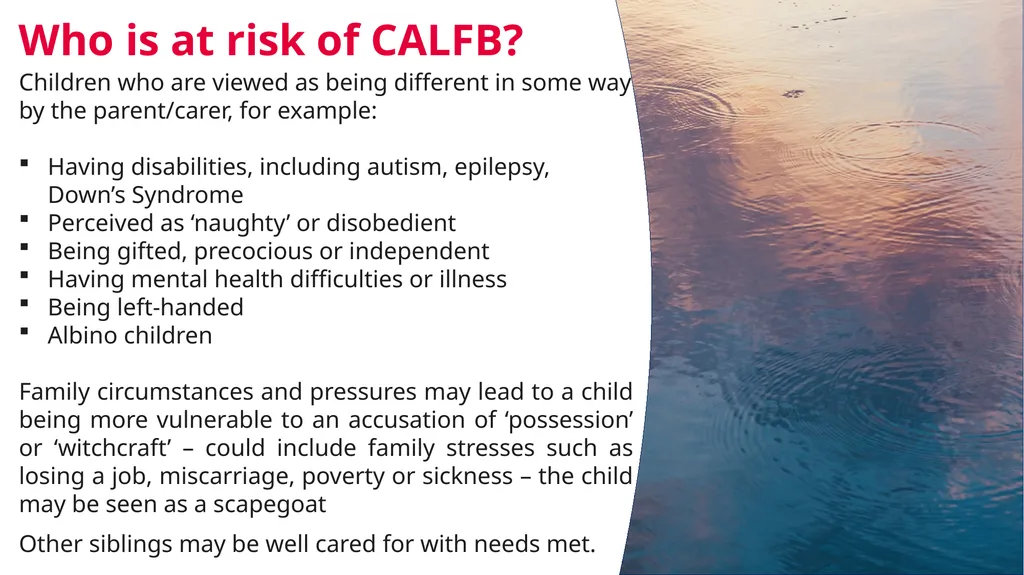
Who is at risk of CALFB? Children who are viewed as being different in some way by the parent/carer, for example:
Having disabilities, including autism, epilepsy, Down’s Syndrome
Perceived as ‘naughty’ or disobedient
Being gifted, precocious or independent
Having mental health difficulties or illness
Being left-handed
Albino children
Family circumstances and pressures may lead to a child being more vulnerable to an accusation of ‘possession’ or ‘witchcraft’ – could include family stresses such as losing a job, miscarriage, poverty or sickness – the child may be seen as a scapegoat
Other siblings may be well cared for with needs met.<br>
27
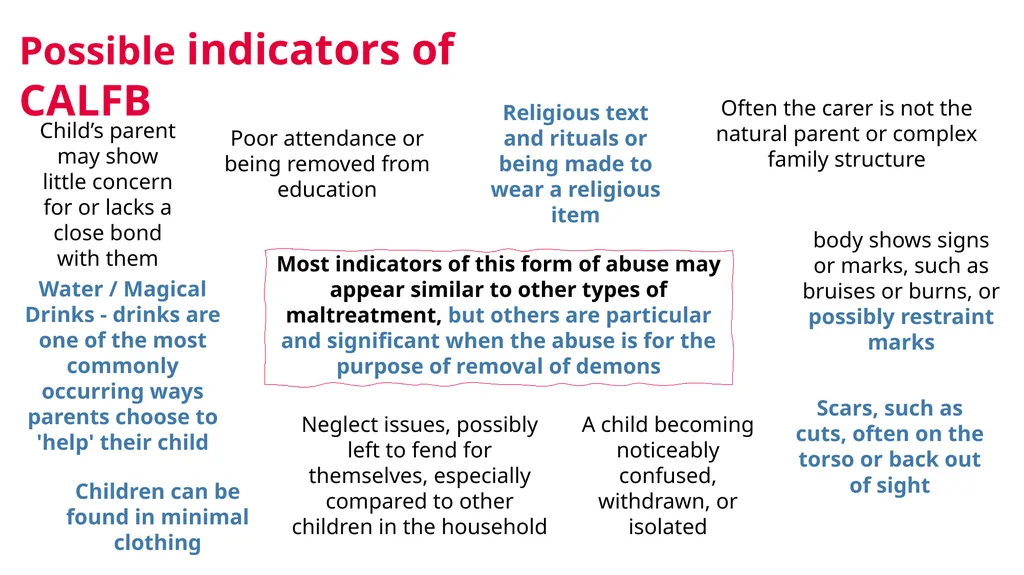
Possible indicators of CALFB Most indicators of this form of abuse may appear similar to other types of maltreatment, but others are particular and significant when the abuse is for the purpose of removal of demons Often the carer is not the natural parent or complex family structure body shows signs or marks, such as bruises or burns, or possibly restraint marks A child becoming noticeably confused, withdrawn, or isolated Scars, such as cuts, often on the torso or back out of sight Neglect issues, possibly left to fend for themselves, especially compared to other children in the household Children can be found in minimal clothing Child’s parent may show little concern for or lacks a close bond with them Water / Magical Drinks - drinks are one of the most commonly occurring ways parents choose to 'help' their child Poor attendance or being removed from education Religious text and rituals or being made to wear a religious item<br>
28
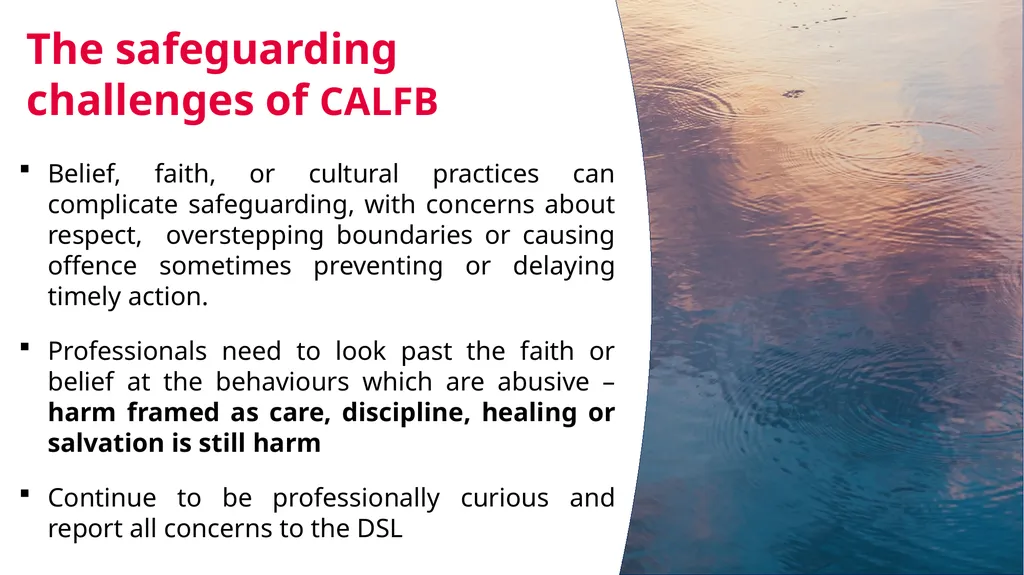
The safeguarding challenges of CALFB Belief, faith, or cultural practices can complicate safeguarding, with concerns about respect, overstepping boundaries or causing offence sometimes preventing or delaying timely action.
Professionals need to look past the faith or belief at the behaviours which are abusive – harm framed as care, discipline, healing or salvation is still harm
Continue to be professionally curious and report all concerns to the DSL<br>
Professionals need to look past the faith or belief at the behaviours which are abusive – harm framed as care, discipline, healing or salvation is still harm
Continue to be professionally curious and report all concerns to the DSL<br>
29
This information is issued by: Essex County Council Contact us:
educationsafeguarding@essex.gov.uk
Education Safeguarding Team Essex County Council County Hall, Chelmsford Essex, CM1 1QH Essex_CC facebook.com/essexcountycouncil Published August Autumn 2026<br>
Education Safeguarding Team Essex County Council County Hall, Chelmsford Essex, CM1 1QH Essex_CC facebook.com/essexcountycouncil Published August Autumn 2026<br>