Key aspects of the plan address : Leadership

Published  . 0 views
↓ Download
Key aspects of the plan address : Leadership
1 / 1
Description: Key aspects of the plan address : Leadership Physical health screening Food and nutrition Improved access and opportunity for physical activity Pharmacymedicine management Psychological therapies Education and information Developing

Related Topics

Download Presentation

"Key aspects of the plan address : Leadership" is the property of its rightful owner. Permission is granted to download and print the materials on this website for personal, non-commercial use only, and to display it on your personal computer provided you do not modify the materials and that you retain all copyright notices contained in the materials. By downloading content from our website, you accept the terms of this agreement.

Presentation Transcript

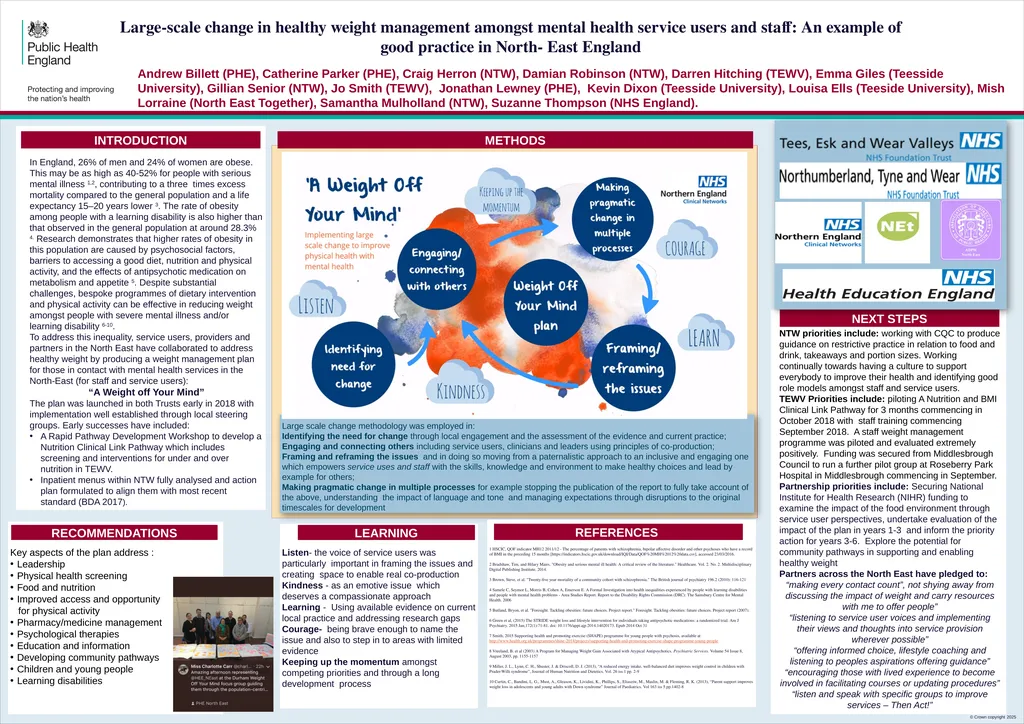
slide1. Key aspects of the plan address :
Leadership
Physical health screening
Food and nutrition
Improved access and opportunity
for physical activity
Pharmacy/medicine management
Psychological therapies
Education and information
Developing community pathways
Children and young people
Learning disabilities Andrew Billett (PHE), Catherine Parker (PHE), Craig Herron (NTW), Damian Robinson (NTW), Darren Hitching (TEWV), Emma Giles (Teesside University), Gillian Senior (NTW), Jo Smith (TEWV), Jonathan Lewney (PHE), Kevin Dixon (Teesside University), Louisa Ells (Teeside University), Mish Lorraine (North East Together), Samantha Mulholland (NTW), Suzanne Thompson (NHS England). INTRODUCTION In England, 26% of men and 24% of women are obese. This may be as high as 40-52% for people with serious mental illness 1,2, contributing to a three times excess mortality compared to the general population and a life expectancy 15–20 years lower 3. The rate of obesity among people with a learning disability is also higher than that observed in the general population at around 28.3% 4. Research demonstrates that higher rates of obesity in this population are caused by psychosocial factors, barriers to accessing a good diet, nutrition and physical activity, and the effects of antipsychotic medication on metabolism and appetite 5. Despite substantial challenges, bespoke programmes of dietary intervention and physical activity can be effective in reducing weight amongst people with severe mental illness and/or learning disability 6-10.
To address this inequality, service users, providers and partners in the North East have collaborated to address healthy weight by producing a weight management plan for those in contact with mental health services in the North-East (for staff and service users):
“A Weight off Your Mind”
The plan was launched in both Trusts early in 2018 with implementation well established through local steering groups. Early successes have included:
A Rapid Pathway Development Workshop to develop a Nutrition Clinical Link Pathway which includes screening and interventions for under and over nutrition in TEWV.
Inpatient menus within NTW fully analysed and action plan formulated to align them with most recent standard (BDA 2017). METHODS RECOMMENDATIONS NEXT STEPS Large-scale change in healthy weight management amongst mental health service users and staff: An example of good practice in North- East England . Large scale change methodology was employed in:
Identifying the need for change through local engagement and the assessment of the evidence and current practice;
Engaging and connecting others including service users, clinicians and leaders using principles of co-production;
Framing and reframing the issues and in doing so moving from a paternalistic approach to an inclusive and engaging one which empowers service uses and staff with the skills, knowledge and environment to make healthy choices and lead by example for others;
Making pragmatic change in multiple processes for example stopping the publication of the report to fully take account of the above, understanding the impact of language and tone and managing expectations through disruptions to the original timescales for development NTW priorities include: working with CQC to produce guidance on restrictive practice in relation to food and drink, takeaways and portion sizes. Working continually towards having a culture to support everybody to improve their health and identifying good role models amongst staff and service users.
TEWV Priorities include: piloting A Nutrition and BMI Clinical Link Pathway for 3 months commencing in October 2018 with staff training commencing September 2018. A staff weight management programme was piloted and evaluated extremely positively.  Funding was secured from Middlesbrough Council to run a further pilot group at Roseberry Park Hospital in Middlesbrough commencing in September.
Partnership priorities include: Securing National Institute for Health Research (NIHR) funding to examine the impact of the food environment through service user perspectives, undertake evaluation of the impact of the plan in years 1-3 and inform the priority action for years 3-6. Explore the potential for community pathways in supporting and enabling healthy weight
Partners across the North East have pledged to:
“making every contact count”, not shying away from discussing the impact of weight and carry resources with me to offer people”
“listening to service user voices and implementing their views and thoughts into service provision wherever possible”
“offering informed choice, lifestyle coaching and listening to peoples aspirations offering guidance”
“encouraging those with lived experience to become involved in facilitating courses or updating procedures”
“listen and speak with specific groups to improve services – Then Act!” 1 HSCIC, QOF indicator MH12 2011/12 - The percentage of patients with schizophrenia, bipolar affective disorder and other psychoses who have a record of BMI in the preceding 15 months [https://indicators.hscic.gov.uk/download/IQI/Data/QOF%20MH%2012%20data.csv], accessed 23/03/2016.
 
2 Bradshaw, Tim, and Hilary Mairs. "Obesity and serious mental ill health: A critical review of the literature." Healthcare. Vol. 2. No. 2. Multidisciplinary Digital Publishing Institute, 2014.
 
3 Brown, Steve, et al. "Twenty-five year mortality of a community cohort with schizophrenia." The British journal of psychiatry 196.2 (2010): 116-121
 
4 Samele C, Seymor L, Morris B, Cohen A, Emerson E. A Formal Investigation into health inequalities experienced by people with learning disabilities and people with mental health problems - Area Studies Report. Report to the Disability Rights Commission (DRC): The Sainsbury Centre for Mental Health. 2006
 
5 Butland, Bryon, et al. "Foresight. Tackling obesities: future choices. Project report." Foresight. Tackling obesities: future choices. Project report (2007).
 
6 Green et al, (2015) The STRIDE weight loss and lifestyle intervention for individuals taking antipsychotic medications: a randomized trial. Am J Psychiatry. 2015 Jan;172(1):71-81. doi: 10.1176/appi.ajp.2014.14020173. Epub 2014 Oct 31
 
7 Smith, 2015 Supporting health and promoting exercise (SHAPE) programme for young people with psychosis, available at http://www.health.org.uk/programmes/shine-2014/projects/supporting-health-and-promoting-exercise-shape-programme-young-people
 
8 Vreeland, B. et al (2003) A Program for Managing Weight Gain Associated with Atypical Antipsychotics. Psychiatric Services. Volume 54 Issue 8, August 2003, pp. 1155-1157
 
9 Miller, J. L., Lynn, C. H., Shuster, J. & Driscoll, D. J. (2013), “A reduced energy intake, well-balanced diet improves weight control in children with Prader-Willi syndrome”, Journal of Human Nutrition and Dietetics. Vol. 26 iss 1 pp. 2-9
 
10 Curtin, C., Bandini, L. G., Must, A., Gleason, K., Lividini, K., Phillips, S., Eliasziw, M., Maslin, M. & Fleming, R. K. (2013), “Parent support improves weight loss in adolescents and young adults with Down syndrome” Journal of Paediatrics. Vol 163 iss 5 pp.1402-8 REFERENCES Listen- the voice of service users was particularly important in framing the issues and creating space to enable real co-production
Kindness - as an emotive issue which deserves a compassionate approach
Learning - Using available evidence on current local practice and addressing research gaps
Courage- being brave enough to name the issue and also to step in to areas with limited evidence
Keeping up the momentum amongst competing priorities and through a long development process LEARNING<br>