Kick-Off Webinar 2018 2019 Sizing of Components and Conductors Objectives: Calculate the pull of the vehicle Calculate the torque of the drive wheel Determine your system pressure (PSI) Size the drive motor for cubic inches per revolution
"Kick-Off Webinar 2018 – 2019 Sizing of Components" is the property of its rightful owner. Permission is granted to
download and print the materials on this website for personal, non-commercial use only, and to display it
on your personal computer provided you do not modify the materials and that you retain all copyright
notices contained in the materials. By downloading content from our website, you accept the terms of this
agreement.
Presentation Transcript
01
Kick-Off Webinar 2018 – 2019<br>
02
Sizing of Components and Conductors Objectives:
Calculate the pull of the vehicle
Calculate the torque of the drive wheel
Determine your system pressure (PSI)
Size the drive motor for cubic inches per revolution (CIR) Calculate wheel RPM
Calculate GPM (gallons per minute)
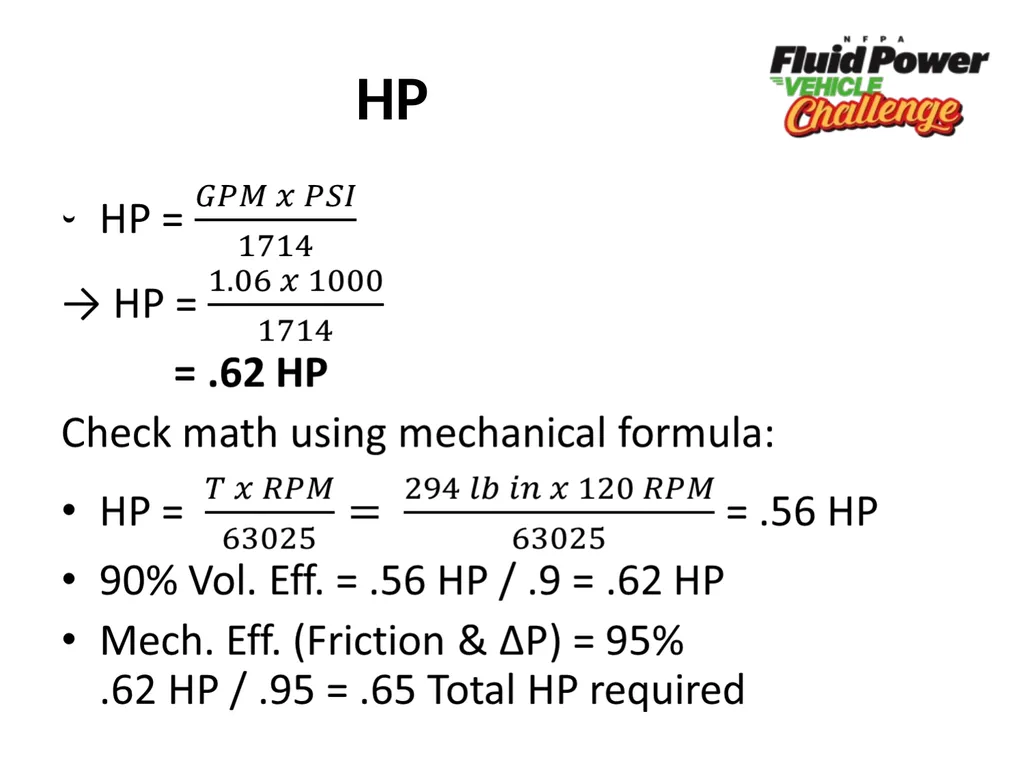
Calculate HP (Horsepower)
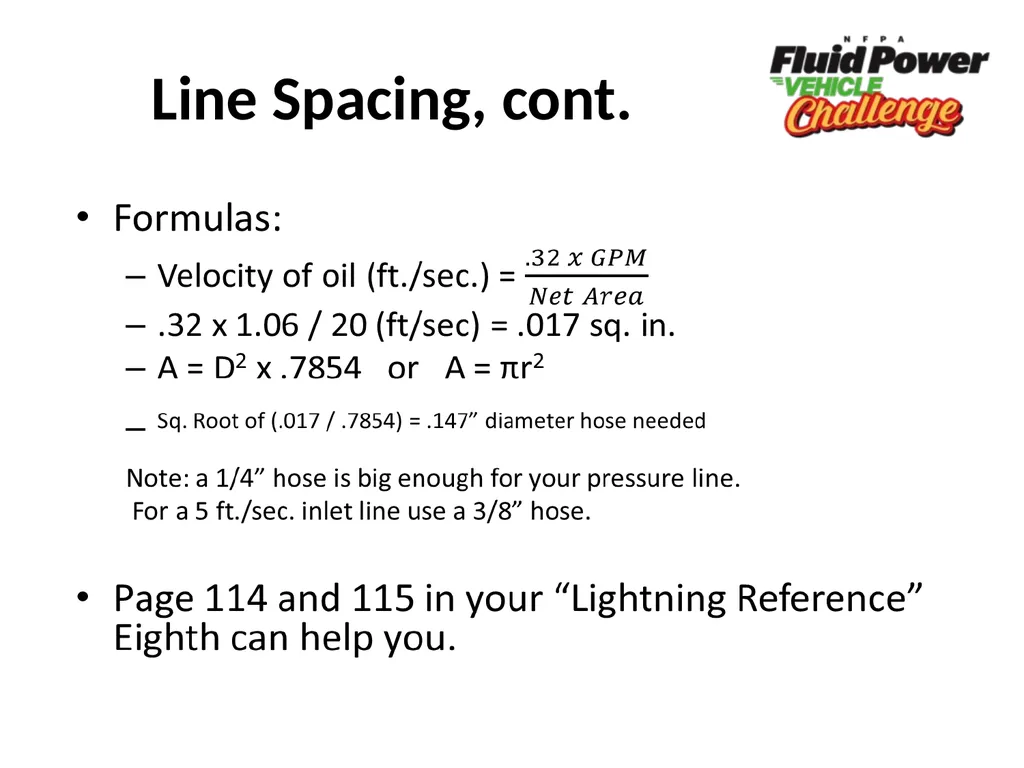
Size the hydraulic lines
Size the pump<br>
03
System Pressure System pressure based on working pressure of weakest component/conductor in system
Working pressure- pressure manufacturers are comfortable having their components run at (for safety and efficiency reasons)
Similarities:
Pressure (P); (PSI or MPA) = Voltage (E)
Flow (Q); (GPM or LPM) = Amperes (I)
E = IR; P = Flow x Constant<br>
04
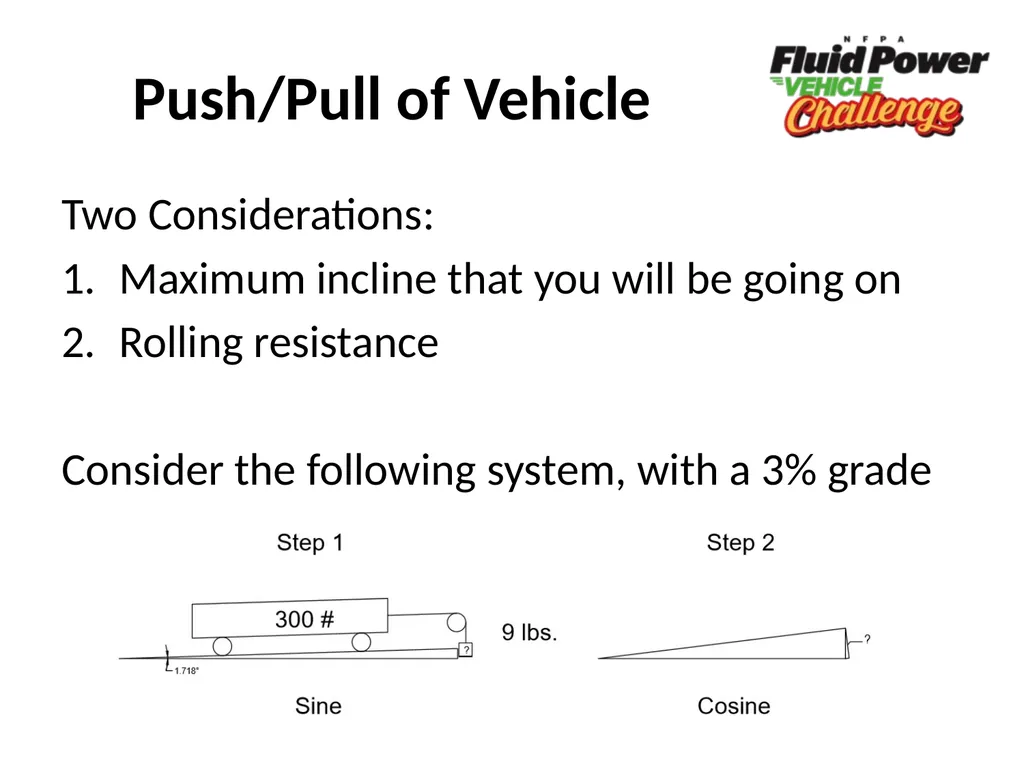
Push/Pull of Vehicle Two Considerations:
Maximum incline that you will be going on
Rolling resistance
Consider the following system, with a 3% grade<br>
05
Start with Incline Assume 3% grade
tan-1(.03)=1.718°
Find rolling resistance for given materials using available charts
e.g. .002 for concrete, -.04 for sand<br>
06
Pull to Climb Hill Assume load of 300 lbs.
- sin(1.718) x 300 lbs. = 9 lbs. of pull
2. Assume rolling resistance of .04
- cos(1.718) x 300 lbs. x .04 = 12 lbs. of pull*
Uphill: total pull = 9 + 12 = 21 lbs. of pull
Downhill: total pull = 12 – 9 = 3 lbs. of pull
*Note: pull would be different on concrete/different material<br>
07
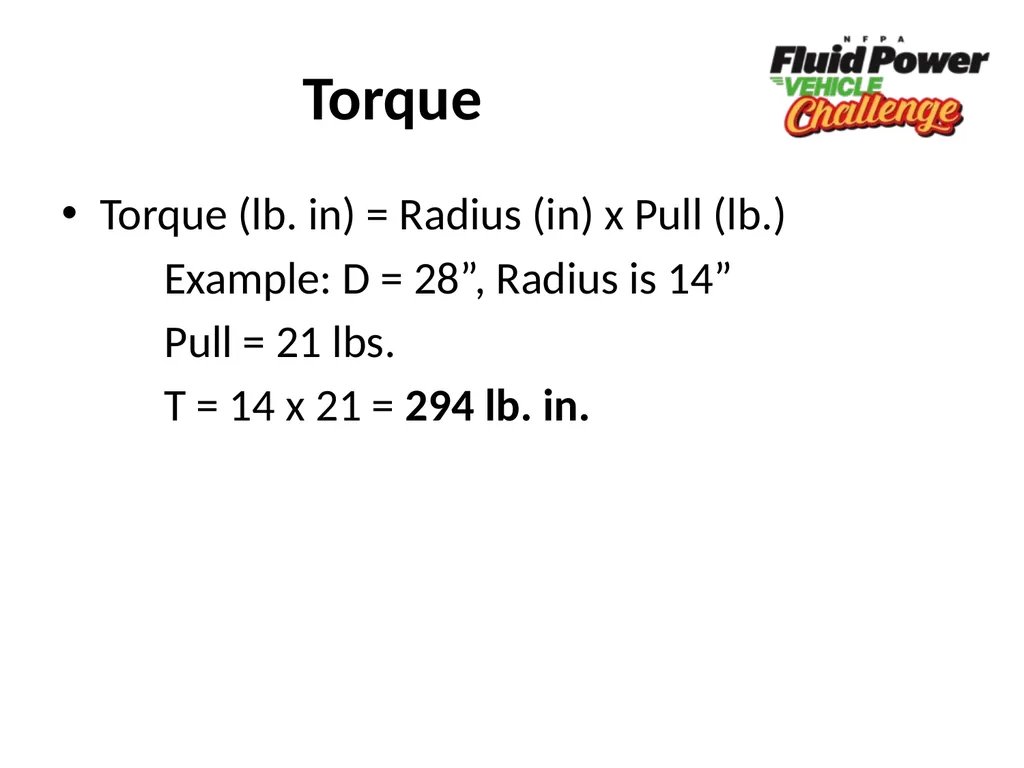
Torque Torque (lb. in) = Radius (in) x Pull (lb.)
Example: D = 28”, Radius is 14”
Pull = 21 lbs.
T = 14 x 21 = 294 lb. in.<br>
08
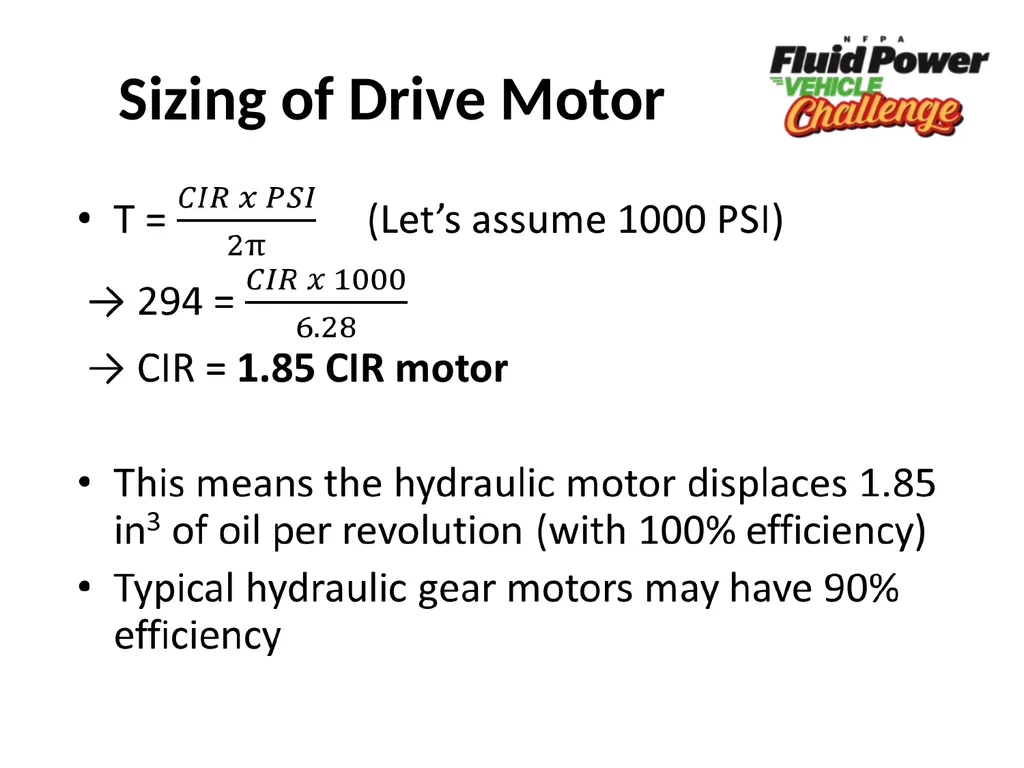
Sizing of Drive Motor<br>
09
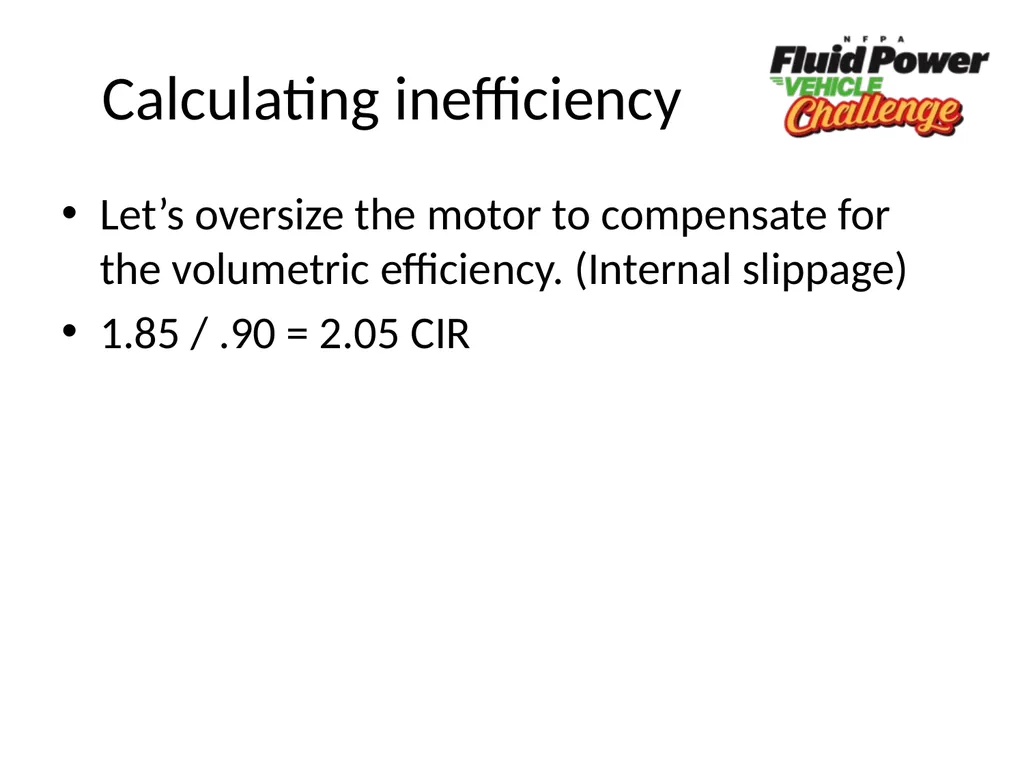
Calculating inefficiency Let’s oversize the motor to compensate for the volumetric efficiency. (Internal slippage)
1.85 / .90 = 2.05 CIR<br>
10
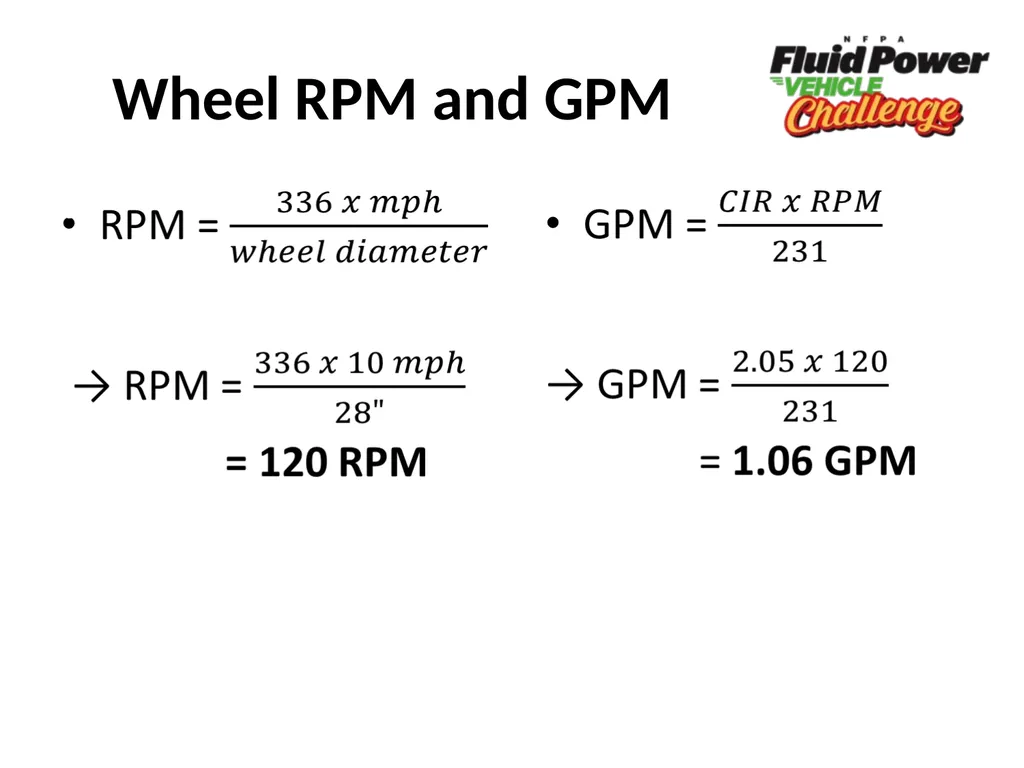
Wheel RPM and GPM<br>
11
HP<br>
12
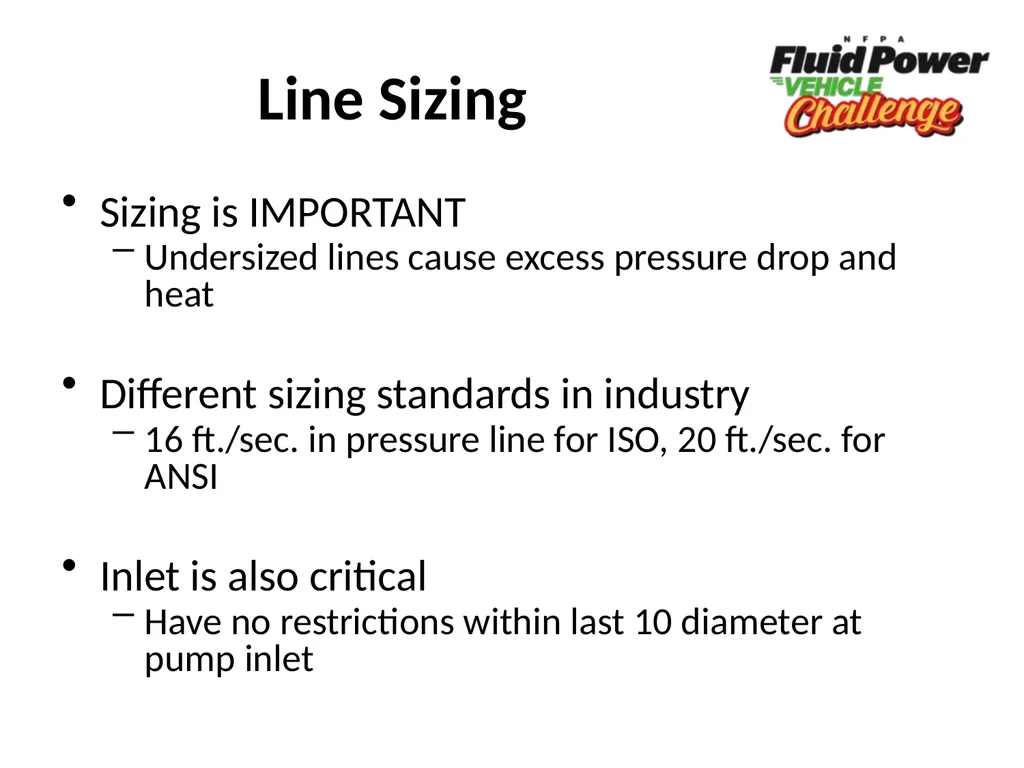
Line Sizing Sizing is IMPORTANT
Undersized lines cause excess pressure drop and heat
Different sizing standards in industry
16 ft./sec. in pressure line for ISO, 20 ft./sec. for ANSI
Inlet is also critical
Have no restrictions within last 10 diameter at pump inlet<br>
13
Line Spacing, cont.<br>
14
Size of the Pump<br>
15
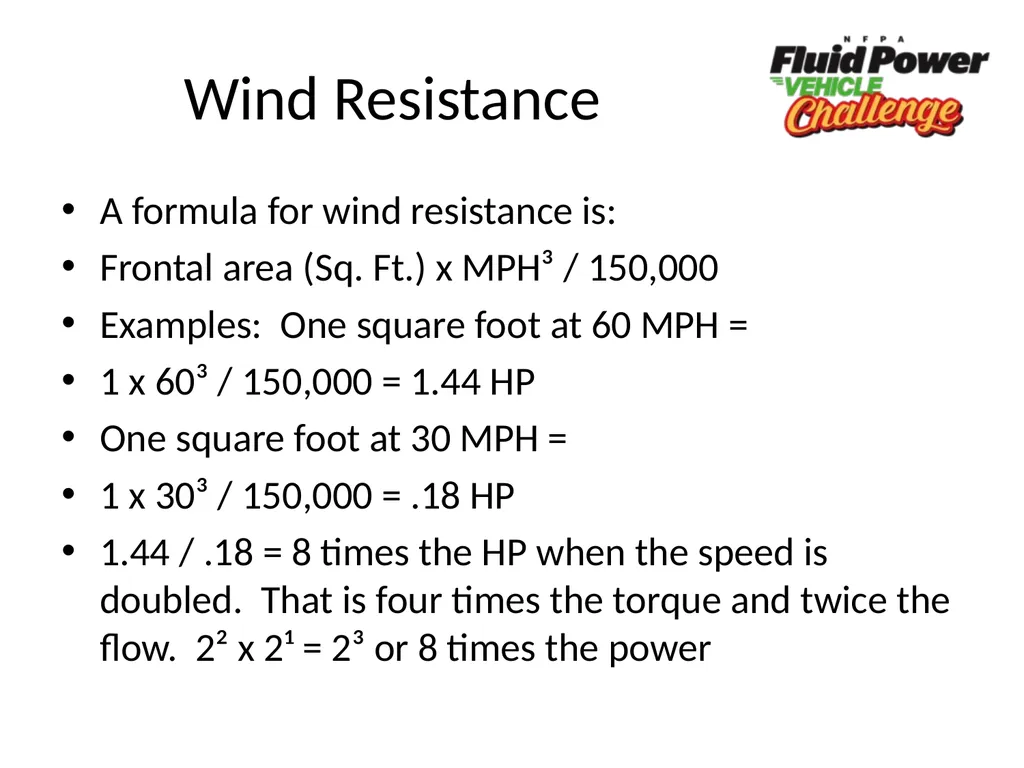
Wind Resistance A formula for wind resistance is:
Frontal area (Sq. Ft.) x MPH³ / 150,000
Examples: One square foot at 60 MPH =
1 x 60³ / 150,000 = 1.44 HP
One square foot at 30 MPH =
1 x 30³ / 150,000 = .18 HP
1.44 / .18 = 8 times the HP when the speed is doubled. That is four times the torque and twice the flow. 2² x 2¹ = 2³ or 8 times the power<br>
16
Wind Resistance When using the above formula add the speed of your bicycle and the wind that you are bucking as the MPH variable.
Side note: This formula is also effective for the speed of a fan. Doubling the RPM will require four times the torque and two times the speed or flow when using hydraulics.<br>
17
Size of the Pump, cont. Overall Efficiency = Volumetric Eff. X Mechanical Eff.
Usually calculate everything with 100% efficiency, then divide by overall system efficiency
Math Check: Wheel RPM = 120, Pedal RPM = 60
2:1 step up ratio, theoretical pump CIR should be twice the motor CIR
Can proportionally size up or down the pump and motor to purchase an actual displacement made by a manufacturer<br>
18
Hydraulic versa Electric Hybrids The big advantage is that hydraulic hybrid is far more efficient than an electric hybrid at capturing braking energy and accelerating and that it eliminates the need for a costly lithium-ion batteries.
Example 1: During braking the motor/generator becomes very inefficient at reduced speeds. A Toyota Prius recovers only 50 watts of energy. 746 watts is one HP. Most of the recovery is at low speeds with the engine running.<br>
19
Hydraulic versa Electric Hybrids Example 2: During acceleration, the electric hybrid can use full amp drain on the battery even though the wheels are just starting to turn. The hydraulic vehicle will only drain the accumulator as fast as the wheels are turning. If you stand on the brake and apply the accumulator, you will not use any energy or discharge the accumulator.<br>
20
Hydraulic versa Electric Hybrids Example 3: If an accumulator goes bad, it can be repaired for less than a couple hundred dollars and recharged with nitrogen.
If the electric battery goes bad and needs to be replace, the cost is more than an engine replacement. A Chevy Volt’s battery has a cost of over $20,000.
Hydraulics is much “greener”. If an accumulator seals or diaphragm goes bad, you will only loose nitrogen and doesn’t pollute anything. Purdue University has proven that a Hummer is actually greener than a Toyota Prius. Their batteries are very hard on our environment.<br>