KNOWLEDGE ACADEMY - SINGLE WINDOW - WORLD CUSTOMS
Description: KNOWLEDGE ACADEMY - SINGLE WINDOW - WORLD CUSTOMS ORGANISATION SINGLE WINDOW - DEFINITIONS - a facility that allows parties involved in trade and transport to lodge standardized information and documents with a single entry point to
Related Topics
Download Presentation
"KNOWLEDGE ACADEMY - SINGLE WINDOW - WORLD CUSTOMS" is the property of its rightful owner. Permission is granted to download and print the materials on this website for personal, non-commercial use only, and to display it on your personal computer provided you do not modify the materials and that you retain all copyright notices contained in the materials. By downloading content from our website, you accept the terms of this agreement.
Presentation Transcript
slide1. KNOWLEDGE ACADEMY- SINGLE WINDOW - WORLD CUSTOMS ORGANISATION<br>
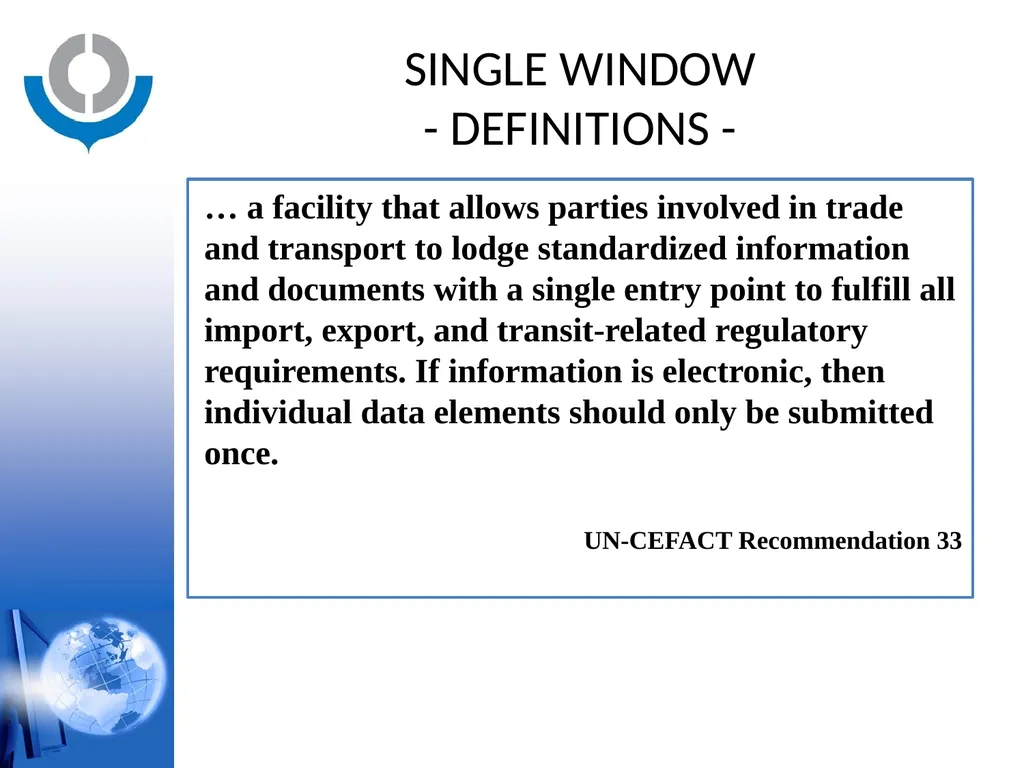
slide2. SINGLE WINDOW- DEFINITIONS - … a facility that allows parties involved in trade and transport to lodge standardized information and documents with a single entry point to fulfill all import, export, and transit-related regulatory requirements. If information is electronic, then individual data elements should only be submitted once.
UN-CEFACT Recommendation 33<br>
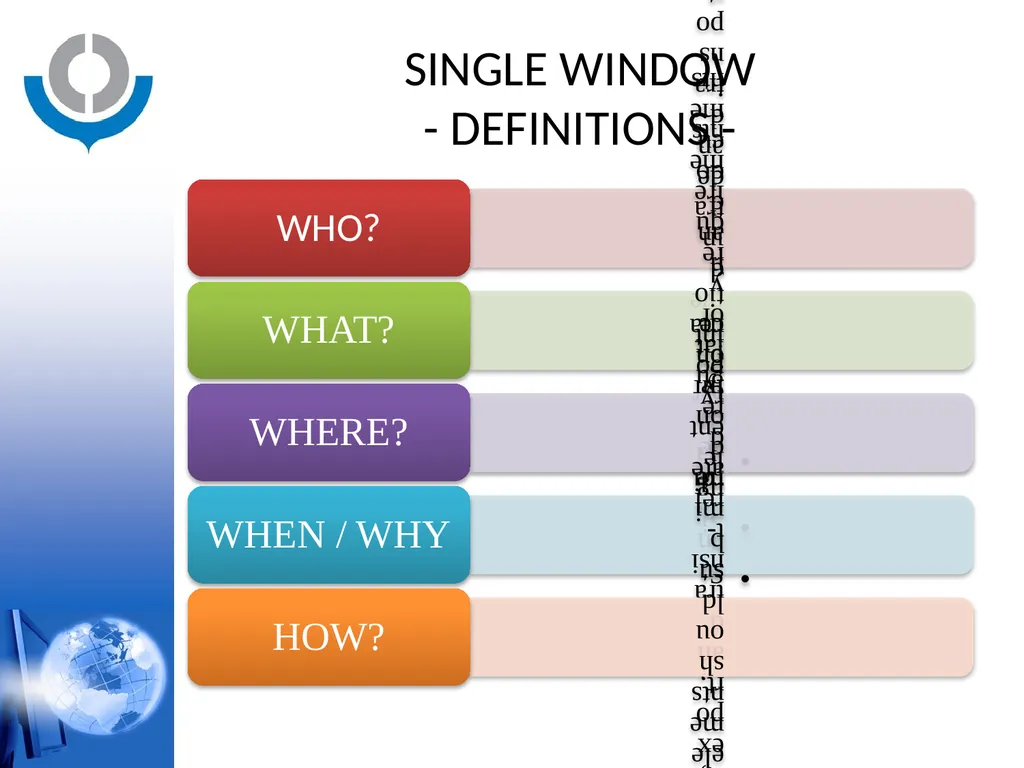
slide3. SINGLE WINDOW- DEFINITIONS -<br>
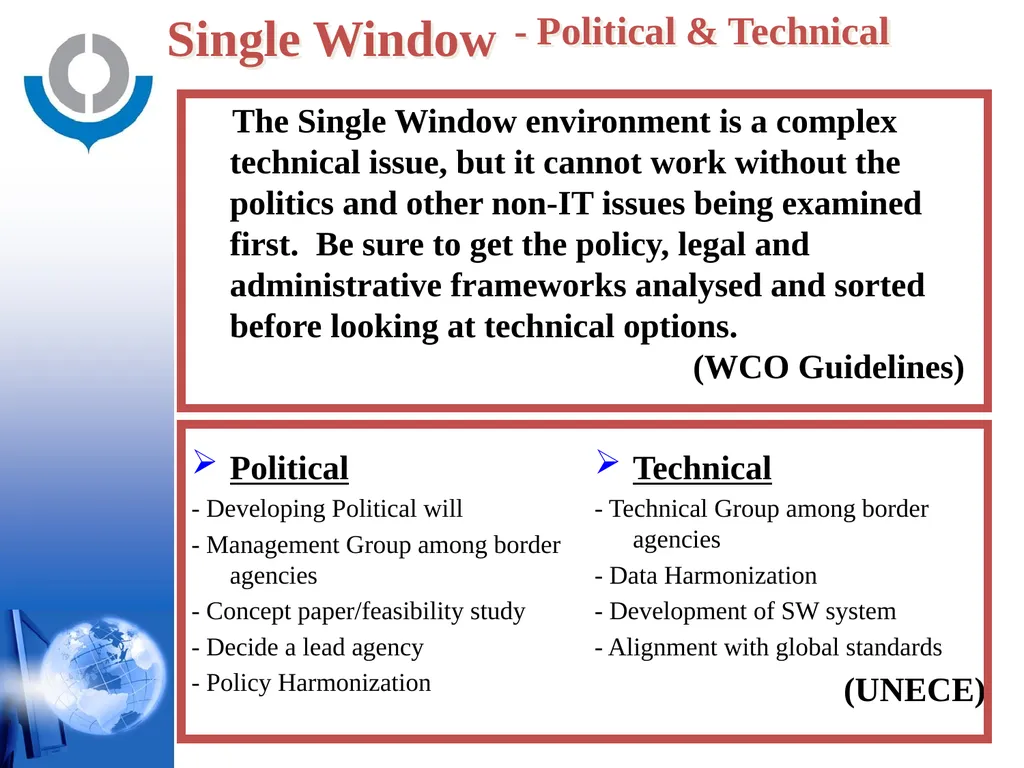
slide4. Single Window - Political & Technical The Single Window environment is a complex technical issue, but it cannot work without the politics and other non-IT issues being examined first. Be sure to get the policy, legal and administrative frameworks analysed and sorted before looking at technical options.
(WCO Guidelines) Political
- Developing Political will
- Management Group among border agencies
- Concept paper/feasibility study
- Decide a lead agency
- Policy Harmonization Technical
- Technical Group among border agencies
- Data Harmonization
- Development of SW system
- Alignment with global standards
(UNECE)<br>
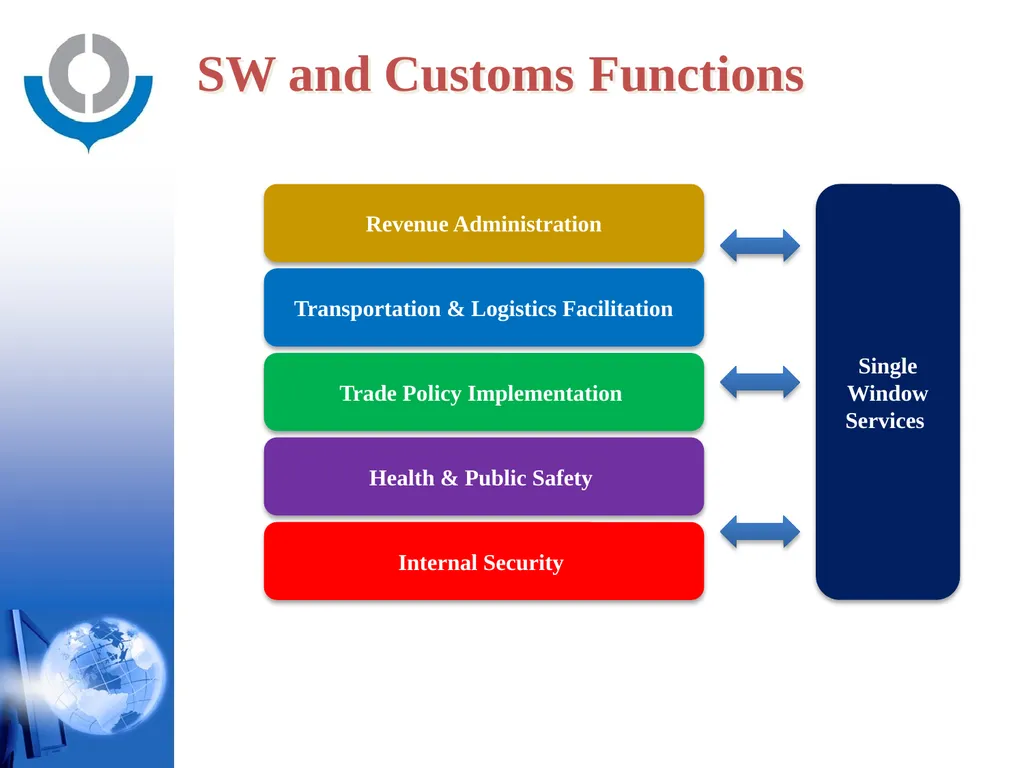
slide5. Revenue Administration Transportation & Logistics Facilitation Trade Policy Implementation Internal Security Health & Public Safety Single Window Services SW and Customs Functions<br>
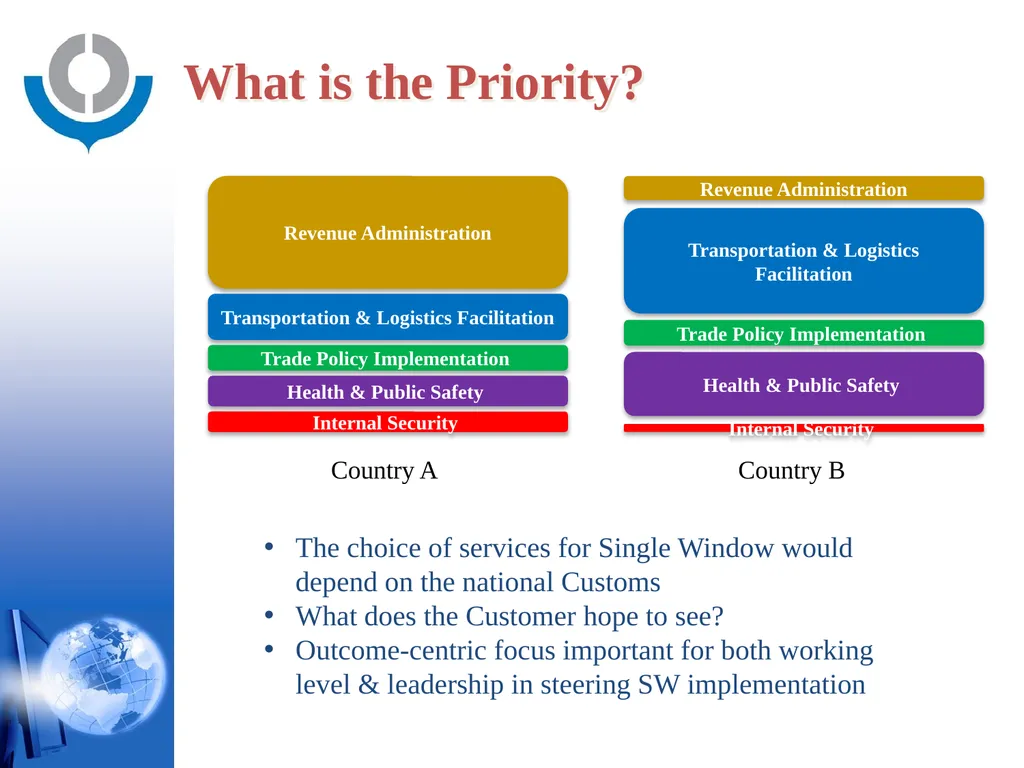
slide6. Country A Country B What is the Priority? The choice of services for Single Window would depend on the national Customs
What does the Customer hope to see?
Outcome-centric focus important for both working level & leadership in steering SW implementation<br>
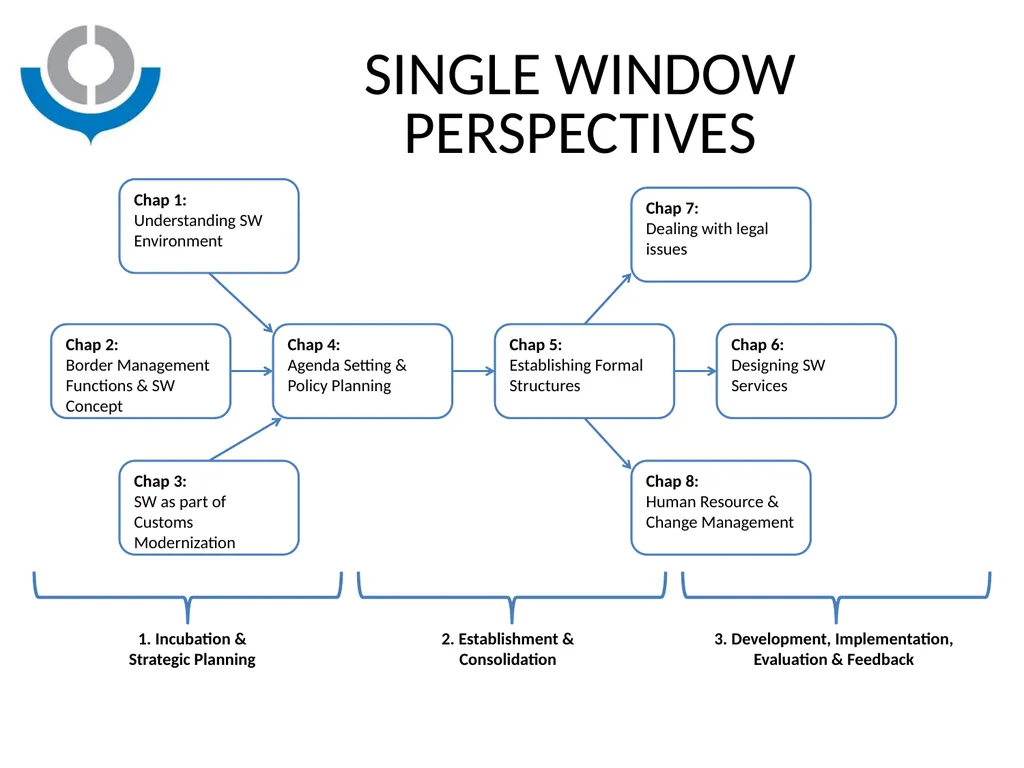
slide7. SINGLE WINDOW PERSPECTIVES Chap 1:
Understanding SW Environment Chap 2:
Border Management Functions & SW Concept Chap 3:
SW as part of Customs Modernization Chap 4:
Agenda Setting & Policy Planning Chap 5:
Establishing Formal Structures Chap 6:
Designing SW Services Chap 8:
Human Resource & Change Management Chap 7:
Dealing with legal issues 1. Incubation & Strategic Planning 2. Establishment & Consolidation 3. Development, Implementation, Evaluation & Feedback<br>
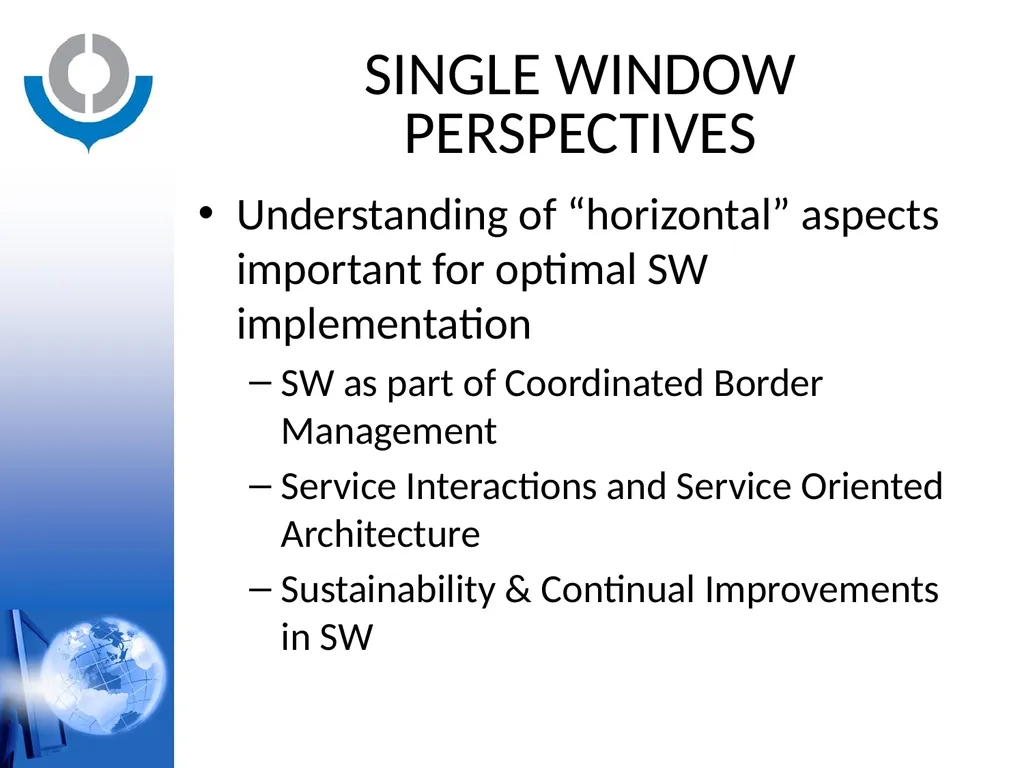
slide8. SINGLE WINDOW PERSPECTIVES Understanding of “horizontal” aspects important for optimal SW implementation
SW as part of Coordinated Border Management
Service Interactions and Service Oriented Architecture
Sustainability & Continual Improvements in SW<br>
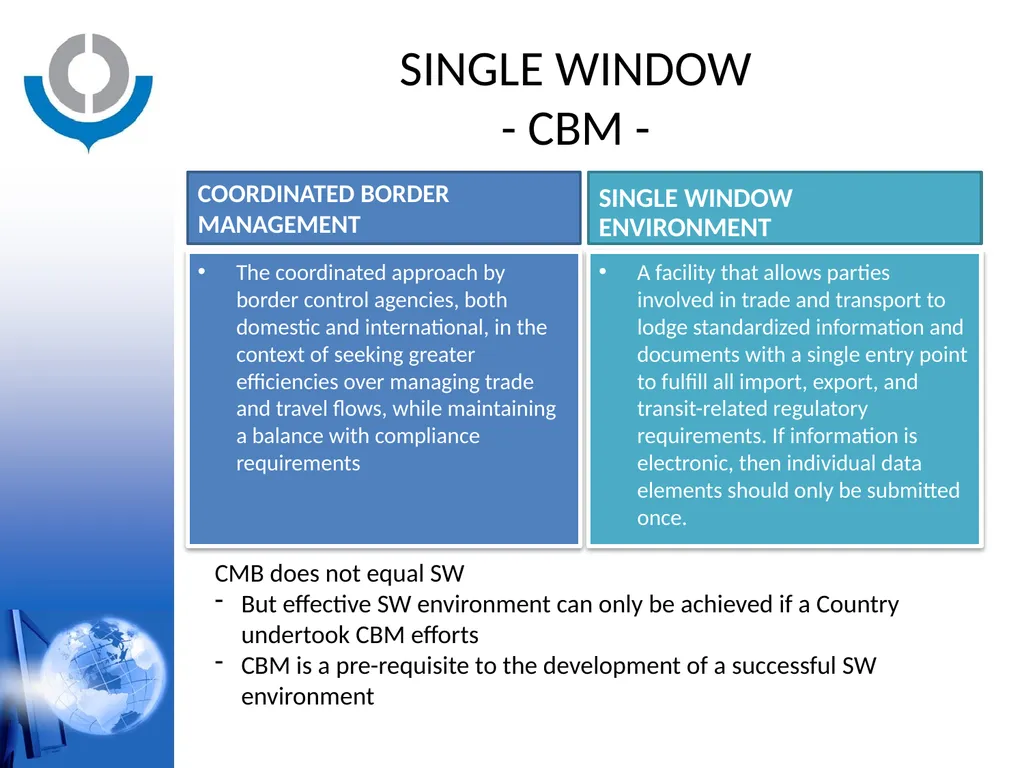
slide9. SINGLE WINDOW- CBM - COORDINATED BORDER MANAGEMENT The coordinated approach by border control agencies, both domestic and international, in the context of seeking greater efficiencies over managing trade and travel flows, while maintaining a balance with compliance requirements SINGLE WINDOW ENVIRONMENT A facility that allows parties involved in trade and transport to lodge standardized information and documents with a single entry point to fulfill all import, export, and transit-related regulatory requirements. If information is electronic, then individual data elements should only be submitted once. CMB does not equal SW
But effective SW environment can only be achieved if a Country undertook CBM efforts
CBM is a pre-requisite to the development of a successful SW environment<br>
slide10. SINGLE WINDOW- CBM - CBM in the context of SW development
Stakeholder involvement
Business process re-engineering
Dematerialization of supporting documents
Risk management<br>
slide11. SINGLE WINDOW- CBM - Stakeholder involvement
Forming a structure with clear leadership & directions for CBM
Active involvement / commitment of CBRA, Trade
Consultation, confidence building, feedback
Clear goals<br>
slide12. SINGLE WINDOW- CBM - Business Process Re-engineering
To re-cast existing manual processes into new electronic processes
Eliminate redundant / duplicative steps
Align digital workflow to physical goods clearance
A well-designed workflow allows essential checks / verifications to be achieved in a much shorter time without sacrificing rigour<br>
slide13. SINGLE WINDOW- CBM - Dematerialization of Supporting Documents
Need to verify data submitted with supporting documents
Potential source of bottleneck
Can physical documents be made electronic? Scans? Electronic from creation?
Can such checks be reduced? Removed?
Post clearance audit instead of up-front checks?<br>
slide14. SINGLE WINDOW- CBM - Risk Management
Structured data in electronic form opens up many possibilities
Pre-clearance
Enables data to be holistically reviewed for key risk areas (i.e. security, revenue, OGA requirements)
Identifying high-risk containers for checks (x-ray or intrusive)
Clearance
Availability of information to Officers at the border enables quick reference and intervention if necessary
Post-clearance
Identifying unusual trends, patterns
Business intelligence
Support effective allocation of scarce resources<br>
slide15. Service Interactions & Service Oriented Architecture Works hand-in-hand with business process re-engineering
Design of SW incorporating “ideal-state” for all stakeholders
Business value of regulators
Service design & Service delivery
Service mindset<br>
slide16. Service Interactions & Service Oriented Architecture Business Value of Regulators
Stereotypical mindset: Customs as hindrance to trade
Regulatory functions are necessary
Security, protection of society, revenue for government functions
Uncertainty, delays, inconsistencies in applying procedures that is the main problem, not the regulations<br>
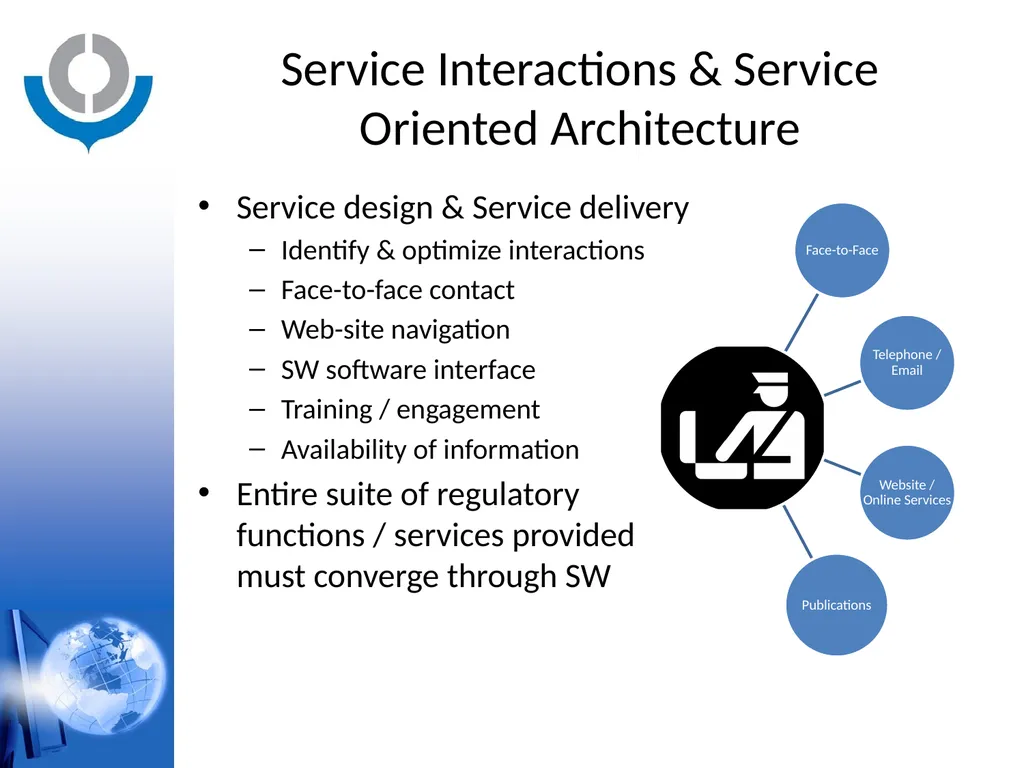
slide17. Service Interactions & Service Oriented Architecture Service design & Service delivery
Identify & optimize interactions
Face-to-face contact
Web-site navigation
SW software interface
Training / engagement
Availability of information
Entire suite of regulatory functions / services provided must converge through SW<br>
slide18. Service Interactions & Service Oriented Architecture Service mindset
Not always easy: regulator cum service provider
CBM provides foundation to standardize controls / reduce duplications
Designing effective SW services requires regulators to empathize with the public we serve<br>
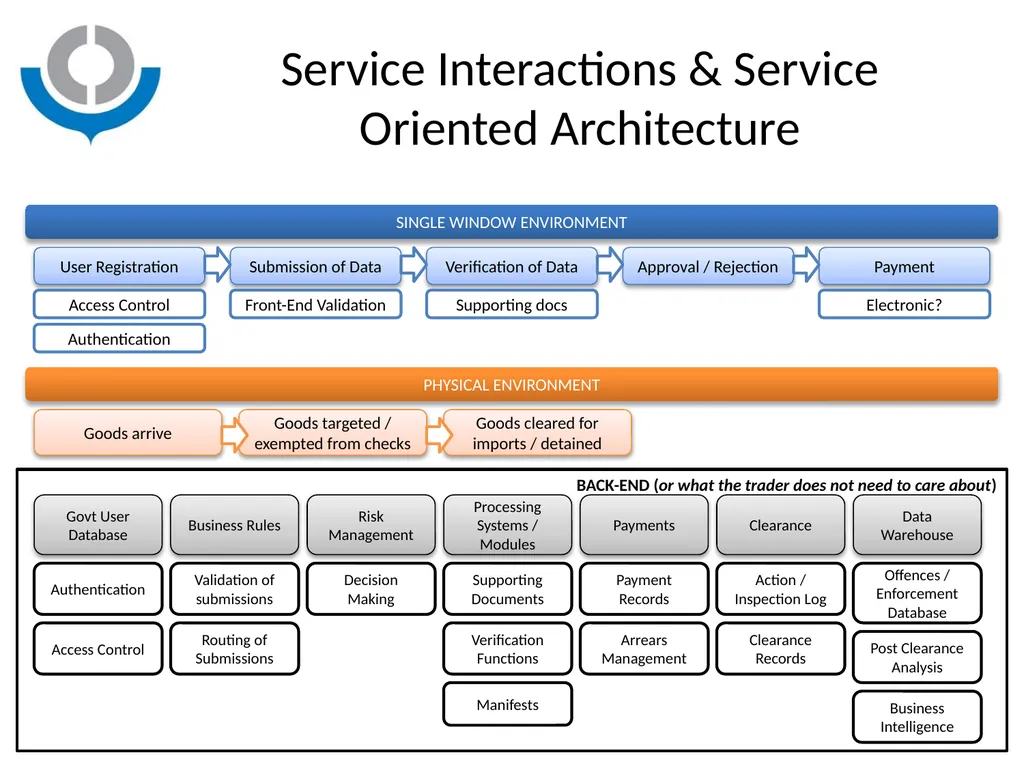
slide19. Service Interactions & Service Oriented Architecture User Registration Authentication Access Control Submission of Data Front-End Validation Verification of Data Supporting docs SINGLE WINDOW ENVIRONMENT Approval / Rejection PHYSICAL ENVIRONMENT Goods arrive Goods targeted / exempted from checks Goods cleared for imports / detained BACK-END (or what the trader does not need to care about) Processing Systems / Modules Business Rules Data Warehouse Govt User Database Risk Management Offences / Enforcement Database Routing of Submissions Validation of submissions Supporting Documents Manifests Access Control Authentication Verification Functions Post Clearance Analysis Decision Making Clearance Business Intelligence Action / Inspection Log Payments Payment Records Arrears Management Clearance Records Payment Electronic?<br>
slide20. Sustainability & Continual Improvements A SW environment is not static – it needs to be refined
Performance Measures
System availability
Feedback management
Service standards
Key performance indicators
Time Release Study
Diagnostic on checkpoint situation to drive improvements<br>
slide21. Sustainability & Continual Improvements Operating environment can change
CBM provides framework for agencies to coordinate responses
SW provides the tool to support prompt response
Information
Controls
Facilitation<br>
slide22. Conclusion A Single-Window is a tool that can unlock great trading and regulatory efficiencies
If it is designed properly, with the inputs from key stakeholders
If it is run with a service-centric mindset
If it is sustained and continually improved upon<br>
slide23. Resources UNCEFACT Recommendation 33
http://www.unece.org/fileadmin/DAM/cefact/recommendations/rec33/rec33_trd352e.pdf
WCO Single Window Compendium
http://www.wcoomd.org/en/topics/facilitation/activities-and-programmes/single-window/single-window-guidelines.aspx<br>

slide2. SINGLE WINDOW- DEFINITIONS - … a facility that allows parties involved in trade and transport to lodge standardized information and documents with a single entry point to fulfill all import, export, and transit-related regulatory requirements. If information is electronic, then individual data elements should only be submitted once.
UN-CEFACT Recommendation 33<br>
slide3. SINGLE WINDOW- DEFINITIONS -<br>
slide4. Single Window - Political & Technical The Single Window environment is a complex technical issue, but it cannot work without the politics and other non-IT issues being examined first. Be sure to get the policy, legal and administrative frameworks analysed and sorted before looking at technical options.
(WCO Guidelines) Political
- Developing Political will
- Management Group among border agencies
- Concept paper/feasibility study
- Decide a lead agency
- Policy Harmonization Technical
- Technical Group among border agencies
- Data Harmonization
- Development of SW system
- Alignment with global standards
(UNECE)<br>
slide5. Revenue Administration Transportation & Logistics Facilitation Trade Policy Implementation Internal Security Health & Public Safety Single Window Services SW and Customs Functions<br>
slide6. Country A Country B What is the Priority? The choice of services for Single Window would depend on the national Customs
What does the Customer hope to see?
Outcome-centric focus important for both working level & leadership in steering SW implementation<br>
slide7. SINGLE WINDOW PERSPECTIVES Chap 1:
Understanding SW Environment Chap 2:
Border Management Functions & SW Concept Chap 3:
SW as part of Customs Modernization Chap 4:
Agenda Setting & Policy Planning Chap 5:
Establishing Formal Structures Chap 6:
Designing SW Services Chap 8:
Human Resource & Change Management Chap 7:
Dealing with legal issues 1. Incubation & Strategic Planning 2. Establishment & Consolidation 3. Development, Implementation, Evaluation & Feedback<br>
slide8. SINGLE WINDOW PERSPECTIVES Understanding of “horizontal” aspects important for optimal SW implementation
SW as part of Coordinated Border Management
Service Interactions and Service Oriented Architecture
Sustainability & Continual Improvements in SW<br>
slide9. SINGLE WINDOW- CBM - COORDINATED BORDER MANAGEMENT The coordinated approach by border control agencies, both domestic and international, in the context of seeking greater efficiencies over managing trade and travel flows, while maintaining a balance with compliance requirements SINGLE WINDOW ENVIRONMENT A facility that allows parties involved in trade and transport to lodge standardized information and documents with a single entry point to fulfill all import, export, and transit-related regulatory requirements. If information is electronic, then individual data elements should only be submitted once. CMB does not equal SW
But effective SW environment can only be achieved if a Country undertook CBM efforts
CBM is a pre-requisite to the development of a successful SW environment<br>
slide10. SINGLE WINDOW- CBM - CBM in the context of SW development
Stakeholder involvement
Business process re-engineering
Dematerialization of supporting documents
Risk management<br>
slide11. SINGLE WINDOW- CBM - Stakeholder involvement
Forming a structure with clear leadership & directions for CBM
Active involvement / commitment of CBRA, Trade
Consultation, confidence building, feedback
Clear goals<br>
slide12. SINGLE WINDOW- CBM - Business Process Re-engineering
To re-cast existing manual processes into new electronic processes
Eliminate redundant / duplicative steps
Align digital workflow to physical goods clearance
A well-designed workflow allows essential checks / verifications to be achieved in a much shorter time without sacrificing rigour<br>
slide13. SINGLE WINDOW- CBM - Dematerialization of Supporting Documents
Need to verify data submitted with supporting documents
Potential source of bottleneck
Can physical documents be made electronic? Scans? Electronic from creation?
Can such checks be reduced? Removed?
Post clearance audit instead of up-front checks?<br>
slide14. SINGLE WINDOW- CBM - Risk Management
Structured data in electronic form opens up many possibilities
Pre-clearance
Enables data to be holistically reviewed for key risk areas (i.e. security, revenue, OGA requirements)
Identifying high-risk containers for checks (x-ray or intrusive)
Clearance
Availability of information to Officers at the border enables quick reference and intervention if necessary
Post-clearance
Identifying unusual trends, patterns
Business intelligence
Support effective allocation of scarce resources<br>
slide15. Service Interactions & Service Oriented Architecture Works hand-in-hand with business process re-engineering
Design of SW incorporating “ideal-state” for all stakeholders
Business value of regulators
Service design & Service delivery
Service mindset<br>
slide16. Service Interactions & Service Oriented Architecture Business Value of Regulators
Stereotypical mindset: Customs as hindrance to trade
Regulatory functions are necessary
Security, protection of society, revenue for government functions
Uncertainty, delays, inconsistencies in applying procedures that is the main problem, not the regulations<br>
slide17. Service Interactions & Service Oriented Architecture Service design & Service delivery
Identify & optimize interactions
Face-to-face contact
Web-site navigation
SW software interface
Training / engagement
Availability of information
Entire suite of regulatory functions / services provided must converge through SW<br>
slide18. Service Interactions & Service Oriented Architecture Service mindset
Not always easy: regulator cum service provider
CBM provides foundation to standardize controls / reduce duplications
Designing effective SW services requires regulators to empathize with the public we serve<br>
slide19. Service Interactions & Service Oriented Architecture User Registration Authentication Access Control Submission of Data Front-End Validation Verification of Data Supporting docs SINGLE WINDOW ENVIRONMENT Approval / Rejection PHYSICAL ENVIRONMENT Goods arrive Goods targeted / exempted from checks Goods cleared for imports / detained BACK-END (or what the trader does not need to care about) Processing Systems / Modules Business Rules Data Warehouse Govt User Database Risk Management Offences / Enforcement Database Routing of Submissions Validation of submissions Supporting Documents Manifests Access Control Authentication Verification Functions Post Clearance Analysis Decision Making Clearance Business Intelligence Action / Inspection Log Payments Payment Records Arrears Management Clearance Records Payment Electronic?<br>
slide20. Sustainability & Continual Improvements A SW environment is not static – it needs to be refined
Performance Measures
System availability
Feedback management
Service standards
Key performance indicators
Time Release Study
Diagnostic on checkpoint situation to drive improvements<br>
slide21. Sustainability & Continual Improvements Operating environment can change
CBM provides framework for agencies to coordinate responses
SW provides the tool to support prompt response
Information
Controls
Facilitation<br>
slide22. Conclusion A Single-Window is a tool that can unlock great trading and regulatory efficiencies
If it is designed properly, with the inputs from key stakeholders
If it is run with a service-centric mindset
If it is sustained and continually improved upon<br>
slide23. Resources UNCEFACT Recommendation 33
http://www.unece.org/fileadmin/DAM/cefact/recommendations/rec33/rec33_trd352e.pdf
WCO Single Window Compendium
http://www.wcoomd.org/en/topics/facilitation/activities-and-programmes/single-window/single-window-guidelines.aspx<br>