KNOWLEDGE AND CURRICULUM Unit I - Epistemological bases of education Dr.V.Regina Principal ,Asst,Professor of Biological Science CSI Bishop Newbigin College of Education No.109, Dr.Radhakrishnan salai, Mylapore, Chennai - 600004 Synopsis
Related Topics
Share
Embed code
Download this presentation From Below
"KNOWLEDGE AND CURRICULUM Unit I - Epistemological" is the property of its rightful owner. Permission is granted to
download and print the materials on this website for personal, non-commercial use only, and to display it
on your personal computer provided you do not modify the materials and that you retain all copyright
notices contained in the materials. By downloading content from our website, you accept the terms of this
agreement.
Presentation Transcript
01
KNOWLEDGE AND CURRICULUM
Unit I - Epistemological bases of education Dr.V.Regina
Principal ,Asst,Professor of Biological Science
CSI Bishop Newbigin College of Education
No.109, Dr.Radhakrishnan salai, Mylapore, Chennai - 600004<br>
02
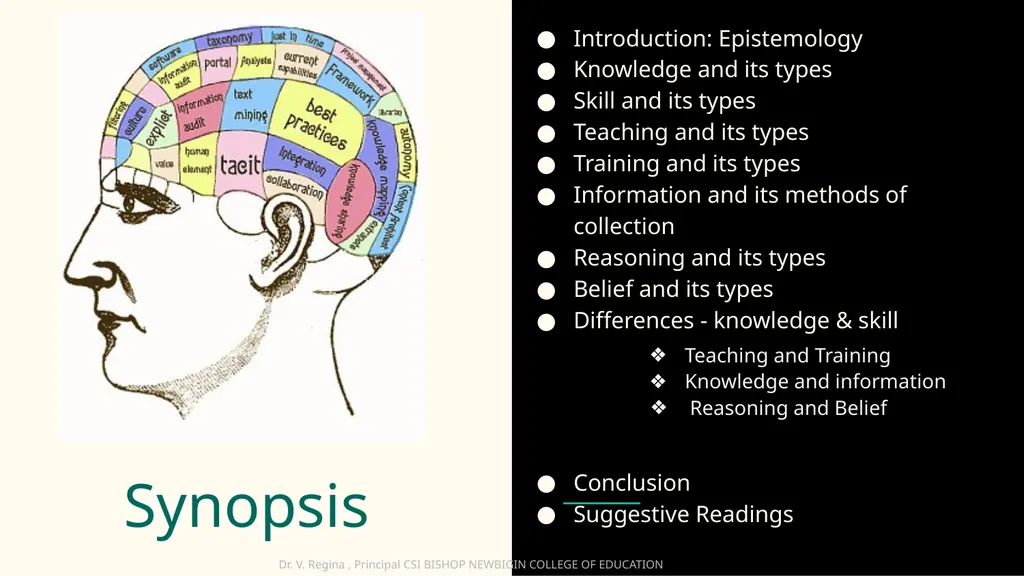
Synopsis Introduction: Epistemology
Knowledge and its types
Skill and its types
Teaching and its types
Training and its types
Information and its methods of collection
Reasoning and its types
Belief and its types
Differences - knowledge & skill
Conclusion
Suggestive Readings Teaching and Training
Knowledge and information
Reasoning and Belief Dr. V. Regina , Principal CSI BISHOP NEWBIGIN COLLEGE OF EDUCATION<br>
03
Learning Objectives Learning Outcomes To investigate the origin, nature, methods and limits
To influence our own theories It influences students approaches to study and develops problem solving skill
It stimulates thinking styles Dr. V. Regina , Principal CSI BISHOP NEWBIGIN COLLEGE OF EDUCATION<br>
04
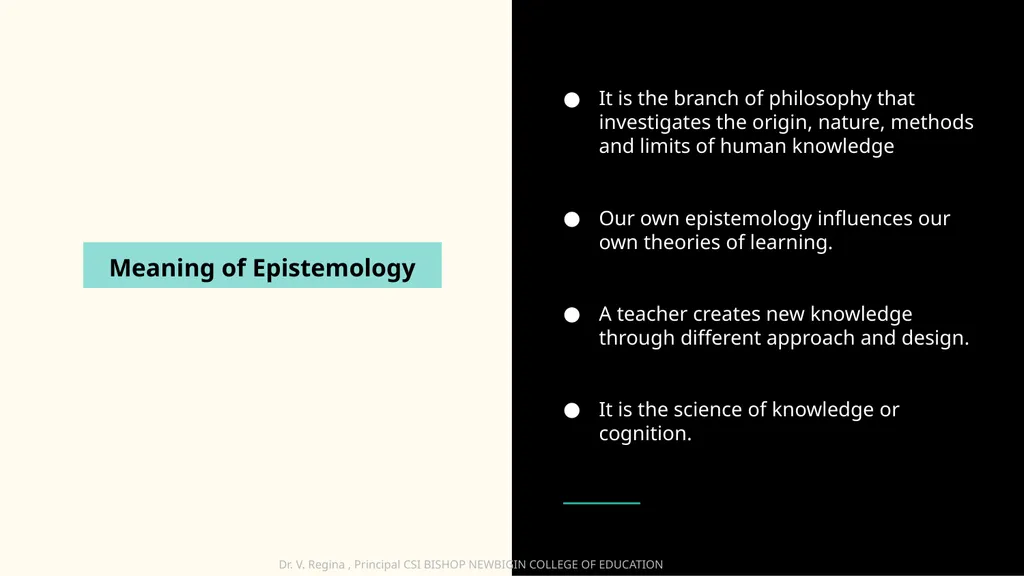
Meaning of Epistemology It is the branch of philosophy that investigates the origin, nature, methods and limits of human knowledge
Our own epistemology influences our own theories of learning.
A teacher creates new knowledge through different approach and design.
It is the science of knowledge or cognition. Dr. V. Regina , Principal CSI BISHOP NEWBIGIN COLLEGE OF EDUCATION<br>
05
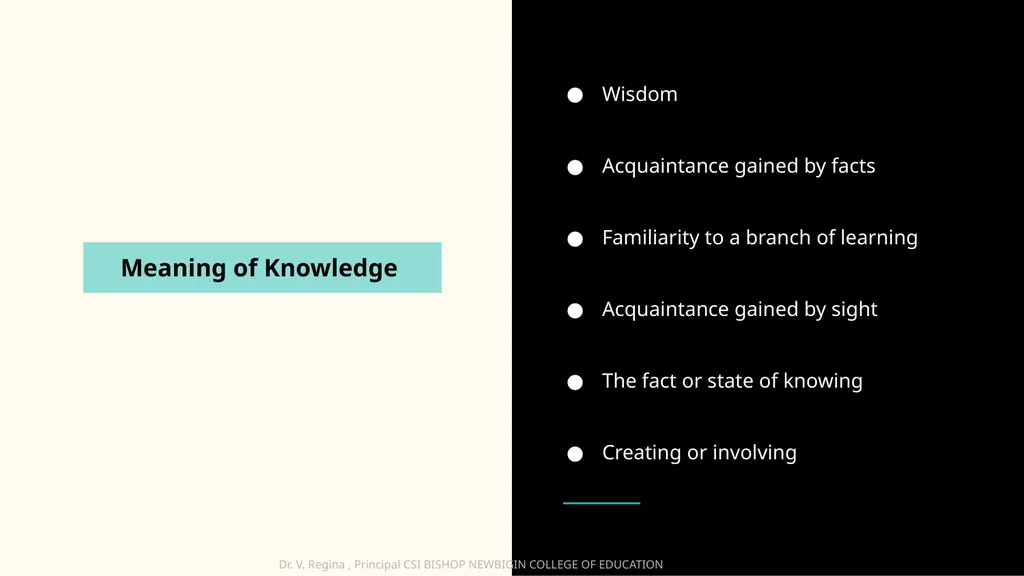
Meaning of Knowledge Wisdom
Acquaintance gained by facts
Familiarity to a branch of learning
Acquaintance gained by sight
The fact or state of knowing
Creating or involving Dr. V. Regina , Principal CSI BISHOP NEWBIGIN COLLEGE OF EDUCATION<br>
06
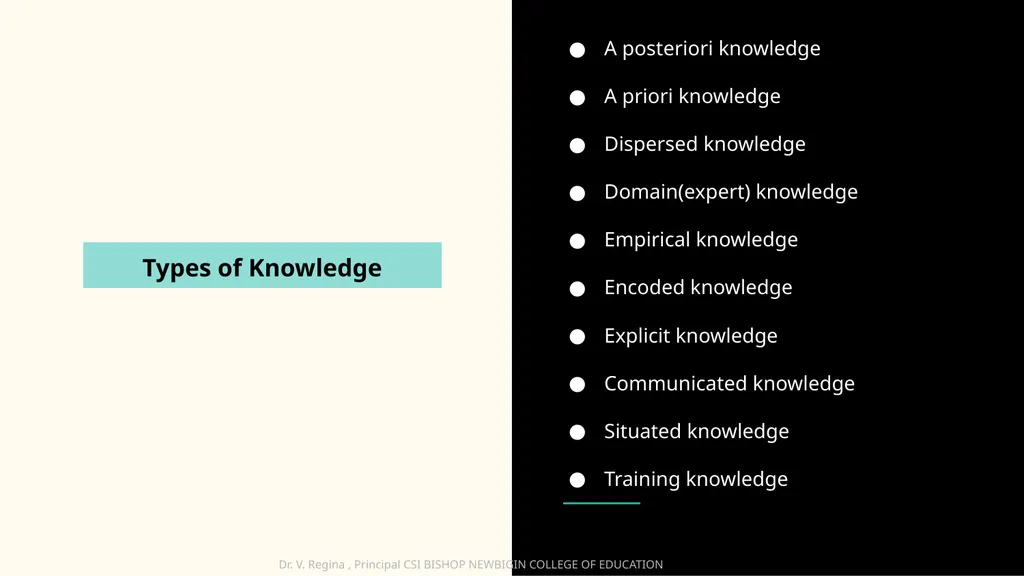
Types of Knowledge A posteriori knowledge
A priori knowledge
Dispersed knowledge
Domain(expert) knowledge
Empirical knowledge
Encoded knowledge
Explicit knowledge
Communicated knowledge
Situated knowledge
Training knowledge Dr. V. Regina , Principal CSI BISHOP NEWBIGIN COLLEGE OF EDUCATION<br>
07
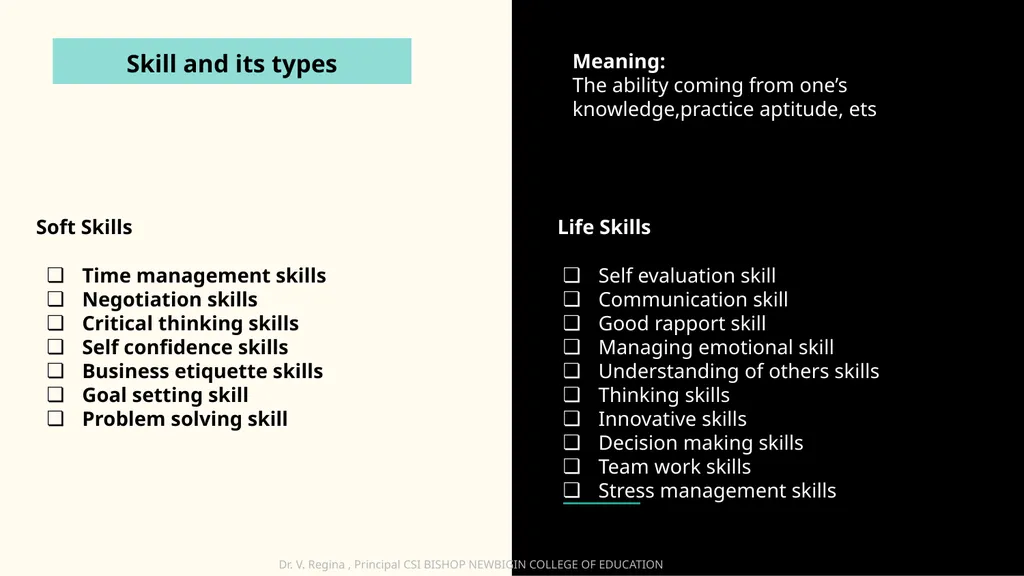
Skill and its types Meaning:
The ability coming from one’s knowledge,practice aptitude, ets Life Skills
Self evaluation skill
Communication skill
Good rapport skill
Managing emotional skill
Understanding of others skills
Thinking skills
Innovative skills
Decision making skills
Team work skills
Stress management skills Soft Skills
Time management skills
Negotiation skills
Critical thinking skills
Self confidence skills
Business etiquette skills
Goal setting skill
Problem solving skill Dr. V. Regina , Principal CSI BISHOP NEWBIGIN COLLEGE OF EDUCATION<br>
08
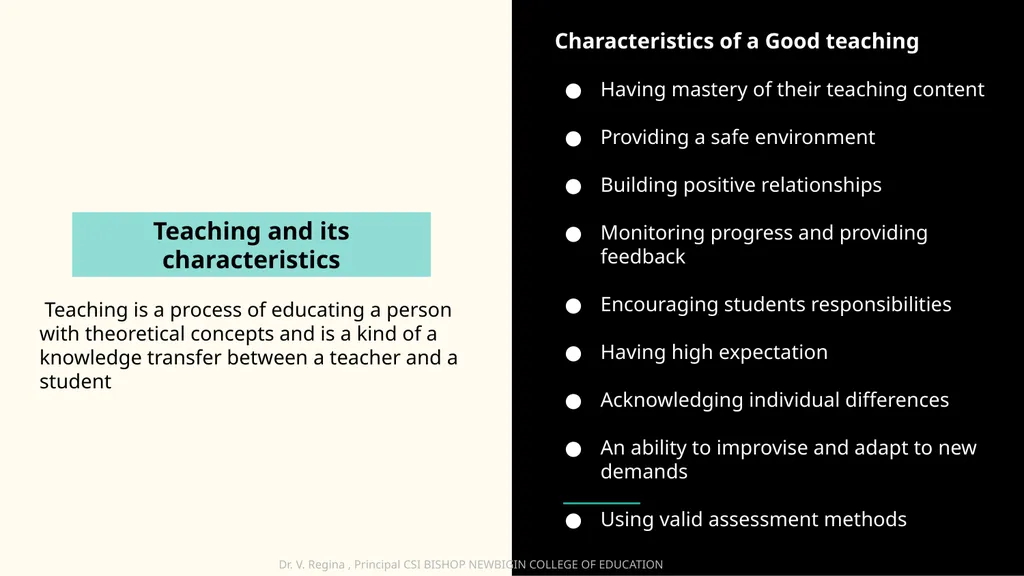
Teaching and its characteristics Teaching is a process of educating a person with theoretical concepts and is a kind of a knowledge transfer between a teacher and a student Characteristics of a Good teaching
Having mastery of their teaching content
Providing a safe environment
Building positive relationships
Monitoring progress and providing feedback
Encouraging students responsibilities
Having high expectation
Acknowledging individual differences
An ability to improvise and adapt to new demands
Using valid assessment methods Dr. V. Regina , Principal CSI BISHOP NEWBIGIN COLLEGE OF EDUCATION<br>
09
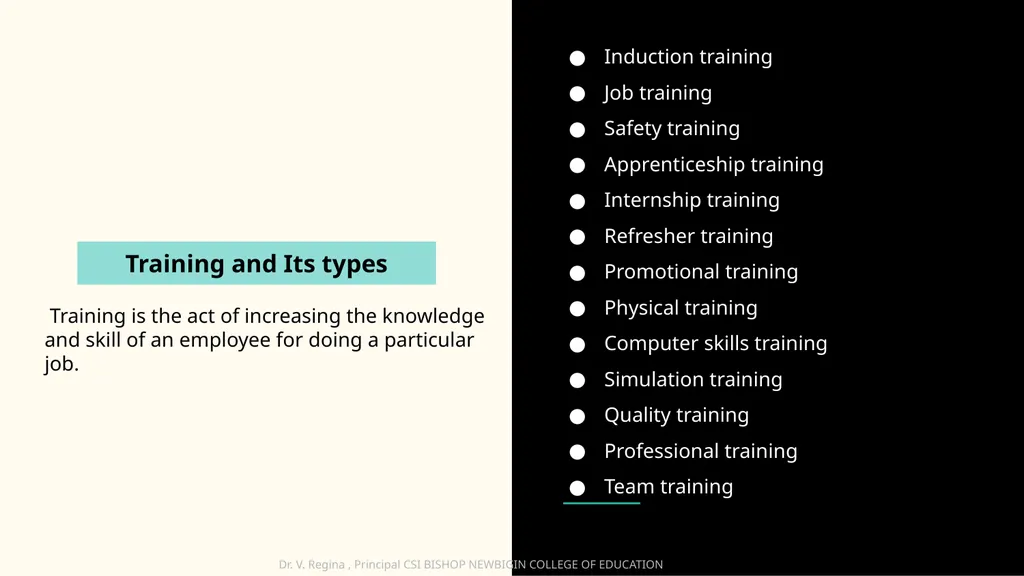
Training and Its types Training is the act of increasing the knowledge and skill of an employee for doing a particular job. Induction training
Job training
Safety training
Apprenticeship training
Internship training
Refresher training
Promotional training
Physical training
Computer skills training
Simulation training
Quality training
Professional training
Team training Dr. V. Regina , Principal CSI BISHOP NEWBIGIN COLLEGE OF EDUCATION<br>
10
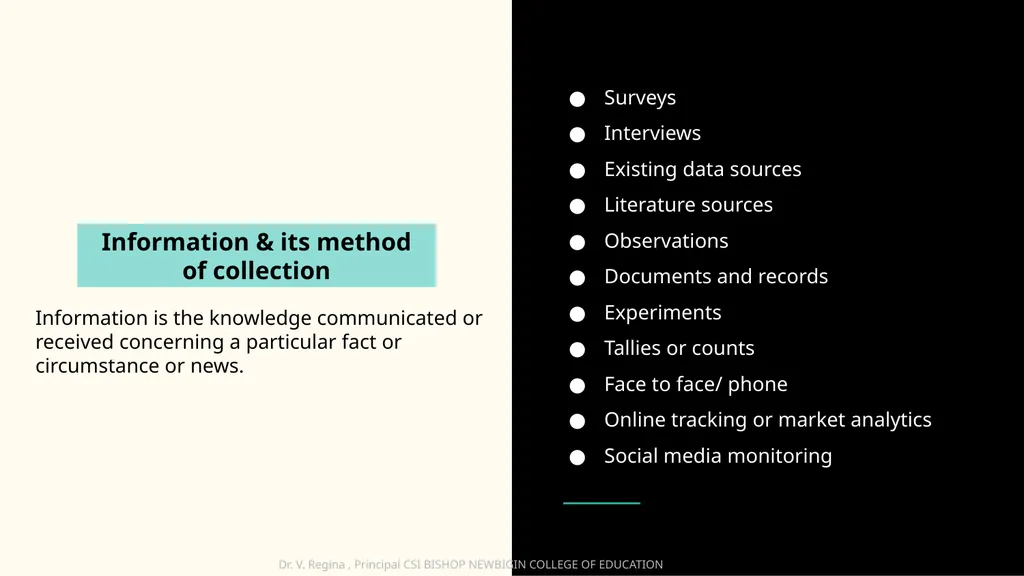
Information & its method of collection Information is the knowledge communicated or received concerning a particular fact or circumstance or news. Surveys
Interviews
Existing data sources
Literature sources
Observations
Documents and records
Experiments
Tallies or counts
Face to face/ phone
Online tracking or market analytics
Social media monitoring Dr. V. Regina , Principal CSI BISHOP NEWBIGIN COLLEGE OF EDUCATION<br>
11
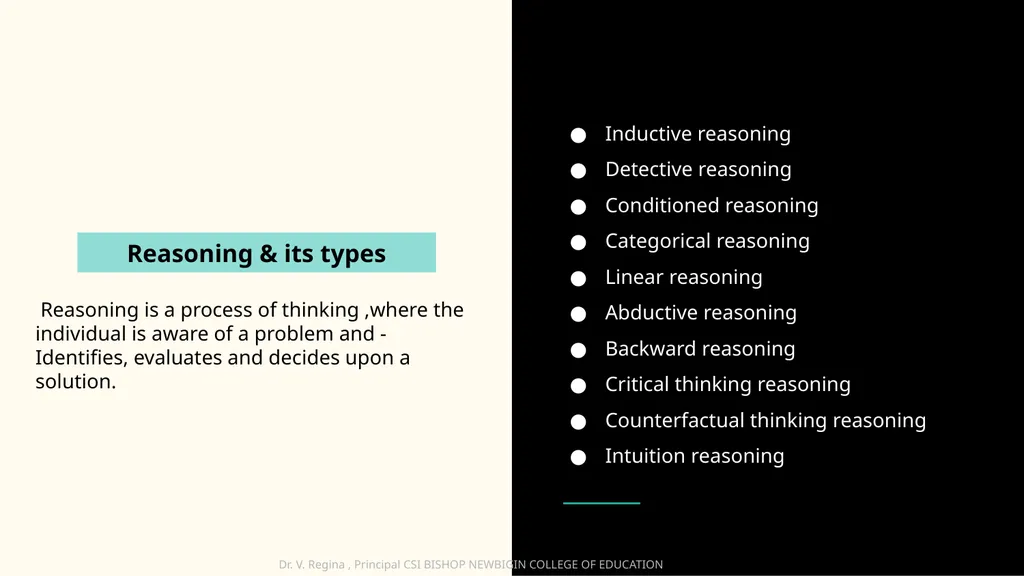
Inductive reasoning
Detective reasoning
Conditioned reasoning
Categorical reasoning
Linear reasoning
Abductive reasoning
Backward reasoning
Critical thinking reasoning
Counterfactual thinking reasoning
Intuition reasoning Reasoning & its types Reasoning is a process of thinking ,where the individual is aware of a problem and - Identifies, evaluates and decides upon a solution. Dr. V. Regina , Principal CSI BISHOP NEWBIGIN COLLEGE OF EDUCATION<br>
12
Belief & its types Belief is a feeling of certainty that something existing , is true or is good. It is a propositional attitude which cannot be proven scientifically. Belief systems
Religious faiths
Agnosticism
Animism
Atheism
Deism
Determinism
Esotericism
Vague belief
Self-supported belief
Belief beyond reasonable doubts Dr. V. Regina , Principal CSI BISHOP NEWBIGIN COLLEGE OF EDUCATION<br>
13
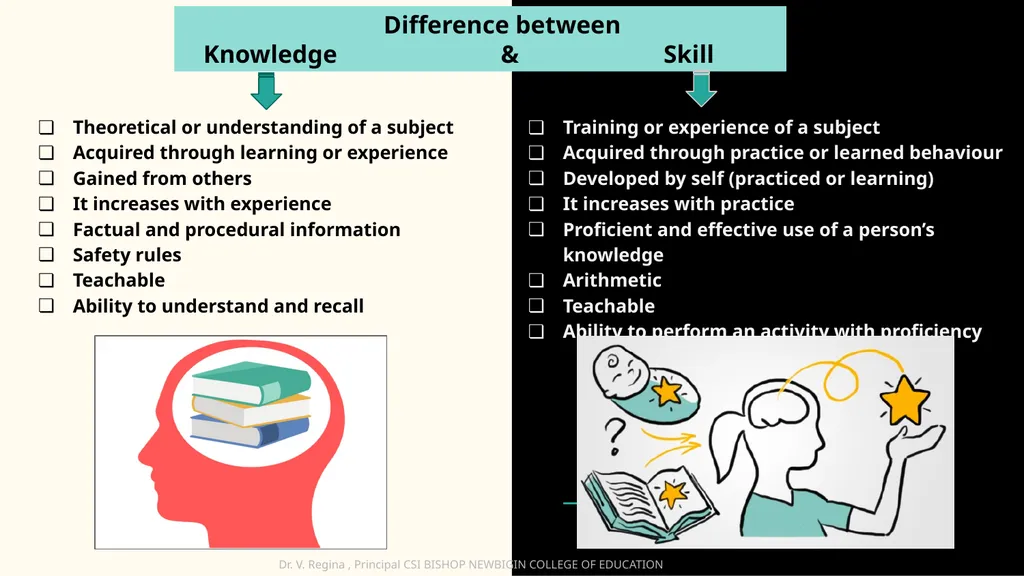
Difference between
Knowledge & Skill Theoretical or understanding of a subject
Acquired through learning or experience
Gained from others
It increases with experience
Factual and procedural information
Safety rules
Teachable
Ability to understand and recall Training or experience of a subject
Acquired through practice or learned behaviour
Developed by self (practiced or learning)
It increases with practice
Proficient and effective use of a person’s knowledge
Arithmetic
Teachable
Ability to perform an activity with proficiency Dr. V. Regina , Principal CSI BISHOP NEWBIGIN COLLEGE OF EDUCATION<br>
14
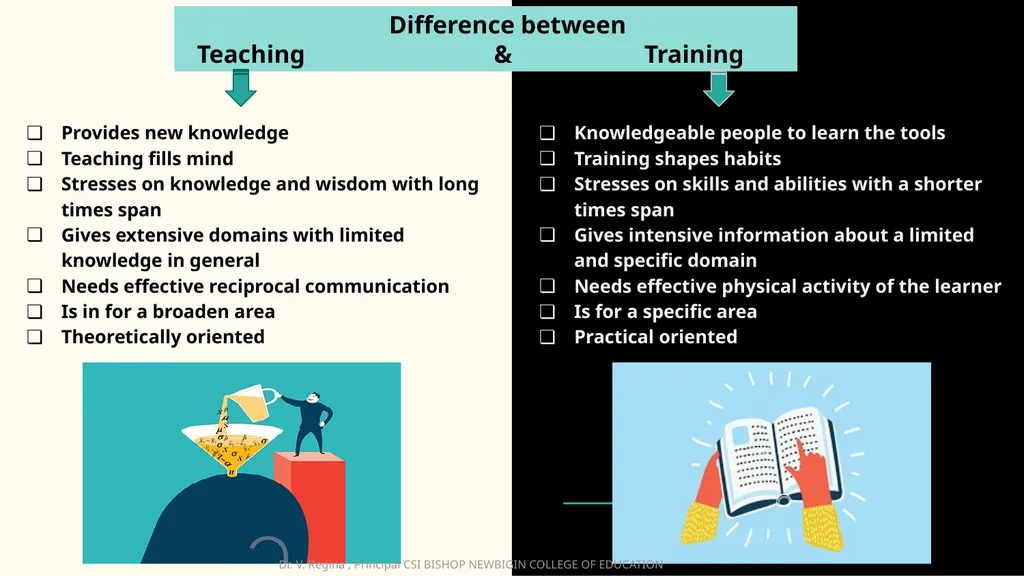
Difference between
Teaching & Training Provides new knowledge
Teaching fills mind
Stresses on knowledge and wisdom with long times span
Gives extensive domains with limited knowledge in general
Needs effective reciprocal communication
Is in for a broaden area
Theoretically oriented Knowledgeable people to learn the tools
Training shapes habits
Stresses on skills and abilities with a shorter times span
Gives intensive information about a limited and specific domain
Needs effective physical activity of the learner
Is for a specific area
Practical oriented Dr. V. Regina , Principal CSI BISHOP NEWBIGIN COLLEGE OF EDUCATION<br>
15
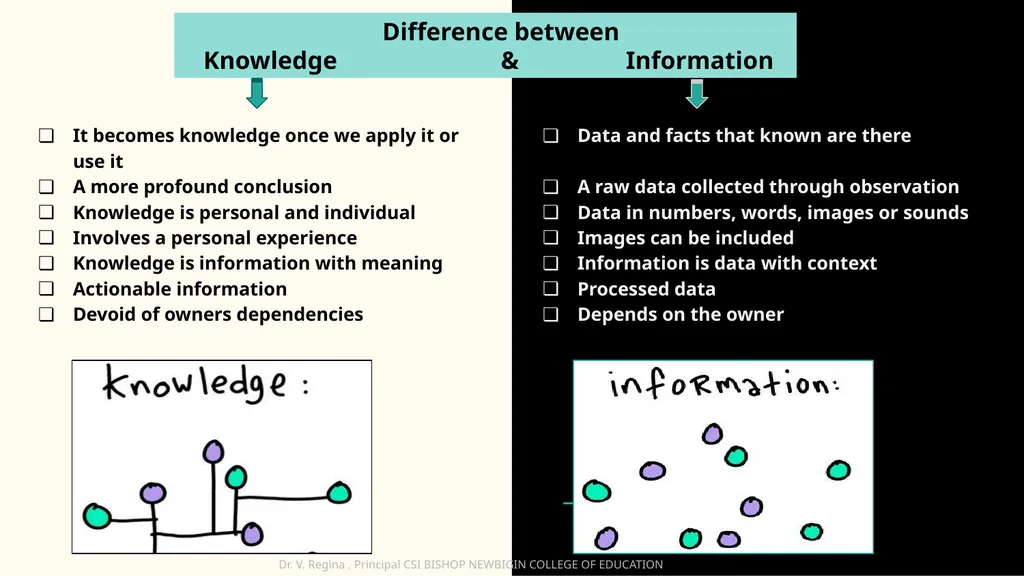
Difference between
Knowledge & Information It becomes knowledge once we apply it or use it
A more profound conclusion
Knowledge is personal and individual
Involves a personal experience
Knowledge is information with meaning
Actionable information
Devoid of owners dependencies Data and facts that known are there
A raw data collected through observation
Data in numbers, words, images or sounds
Images can be included
Information is data with context
Processed data
Depends on the owner Dr. V. Regina , Principal CSI BISHOP NEWBIGIN COLLEGE OF EDUCATION<br>
16
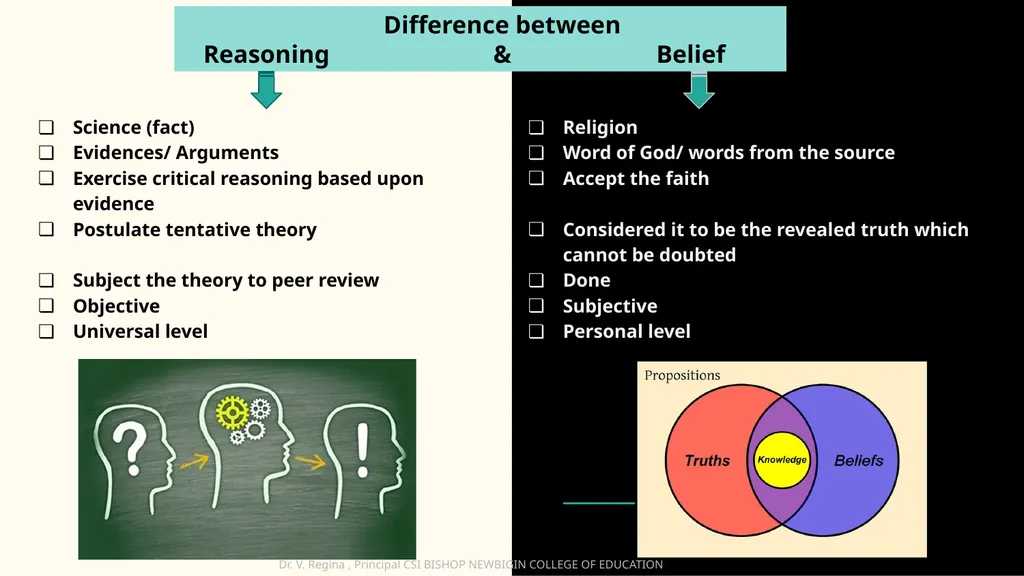
Difference between
Reasoning & Belief Science (fact)
Evidences/ Arguments
Exercise critical reasoning based upon evidence
Postulate tentative theory
Subject the theory to peer review
Objective
Universal level Religion
Word of God/ words from the source
Accept the faith
Considered it to be the revealed truth which cannot be doubted
Done
Subjective
Personal level Dr. V. Regina , Principal CSI BISHOP NEWBIGIN COLLEGE OF EDUCATION<br>
17
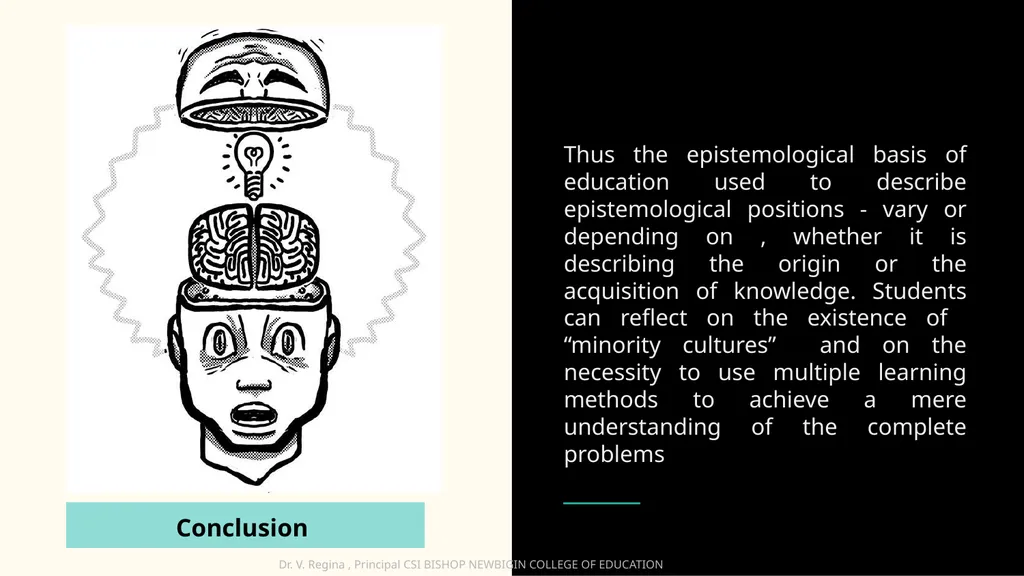
Conclusion Thus the epistemological basis of education used to describe epistemological positions - vary or depending on , whether it is describing the origin or the acquisition of knowledge. Students can reflect on the existence of “minority cultures” and on the necessity to use multiple learning methods to achieve a mere understanding of the complete problems Dr. V. Regina , Principal CSI BISHOP NEWBIGIN COLLEGE OF EDUCATION<br>
18
Suggestive Readings Barret, Brain., etal (2018) Knowledge curriculum and equity, social realist perspectives Routledge
http://www.mastek.com/careers/learning-development.html
Hoffman, T., “Nine Non Techie skills that hiring managers wish you had”. Computer world, november 12, 2007, accessed July 26, 2010. Dr. V. Regina , Principal CSI BISHOP NEWBIGIN COLLEGE OF EDUCATION<br>