
Knowledge Management infrastructure Knowledge

















Description: Knowledge Management infrastructure Knowledge Technology Lecture (8) The American Productivity and Quality Center (APQC) (1997) suggests that for organizations to succeed in KM initiatives, a suitable IT infrastructure must be established.
Related Topics
Download Presentation
"Knowledge Management infrastructure Knowledge" is the property of its rightful owner. Permission is granted to download and print the materials on this website for personal, non-commercial use only, and to display it on your personal computer provided you do not modify the materials and that you retain all copyright notices contained in the materials. By downloading content from our website, you accept the terms of this agreement.
Presentation Transcript
slide1. Knowledge Management infrastructure Knowledge Technology
Lecture (8)<br>
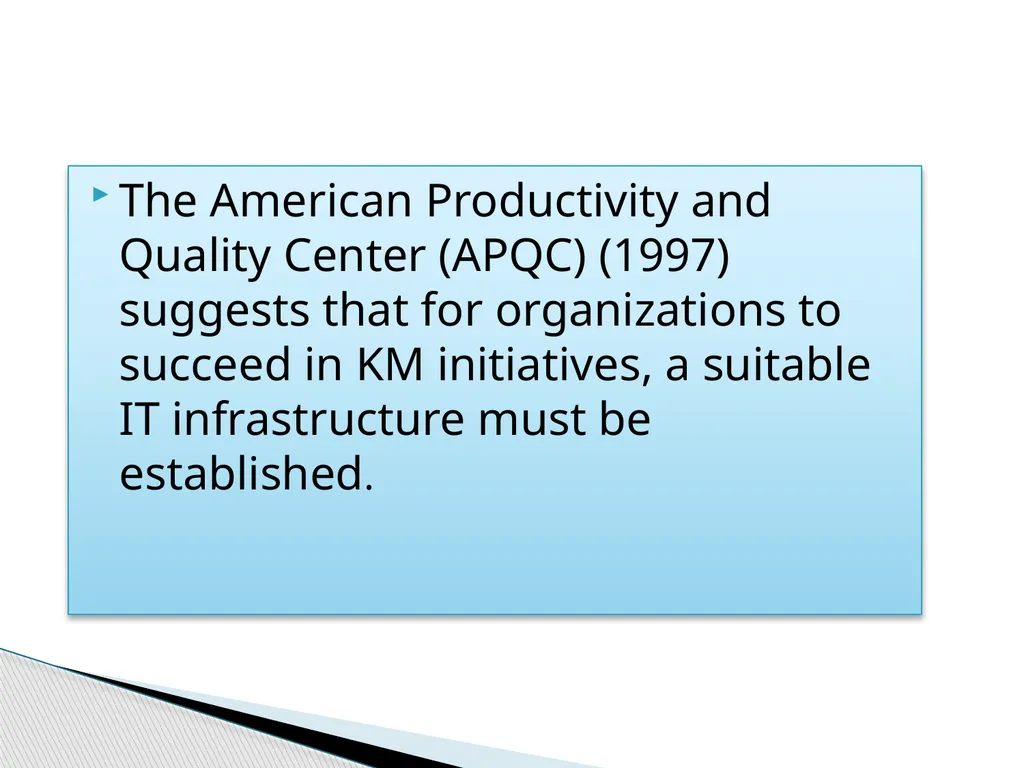
slide2. The American Productivity and Quality Center (APQC) (1997) suggests that for organizations to succeed in KM initiatives, a suitable IT infrastructure must be established.<br>
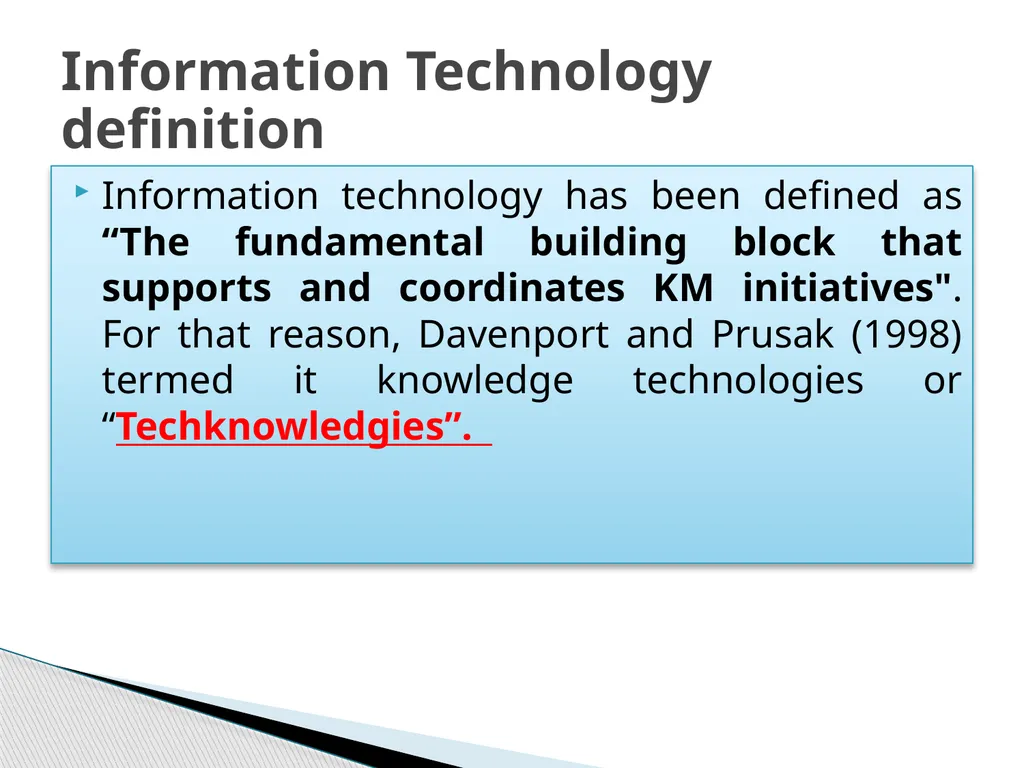
slide3. Information technology has been defined as “The fundamental building block that supports and coordinates KM initiatives". For that reason, Davenport and Prusak (1998) termed it knowledge technologies or “Techknowledgies”. Information Technology definition<br>
slide4. There is a debate around the effectiveness of the IT-based system as a facilitator for the KM process.
Some authors argue a limited role for IT in the KM process because its effectiveness is highly dependent on:-
Whether an individual knows or not what he is looking for.
How individuals modify, use and transfer their experiences to others.
An individual's trust in knowledge which resides in a system . The importance of technology for KM:<br>
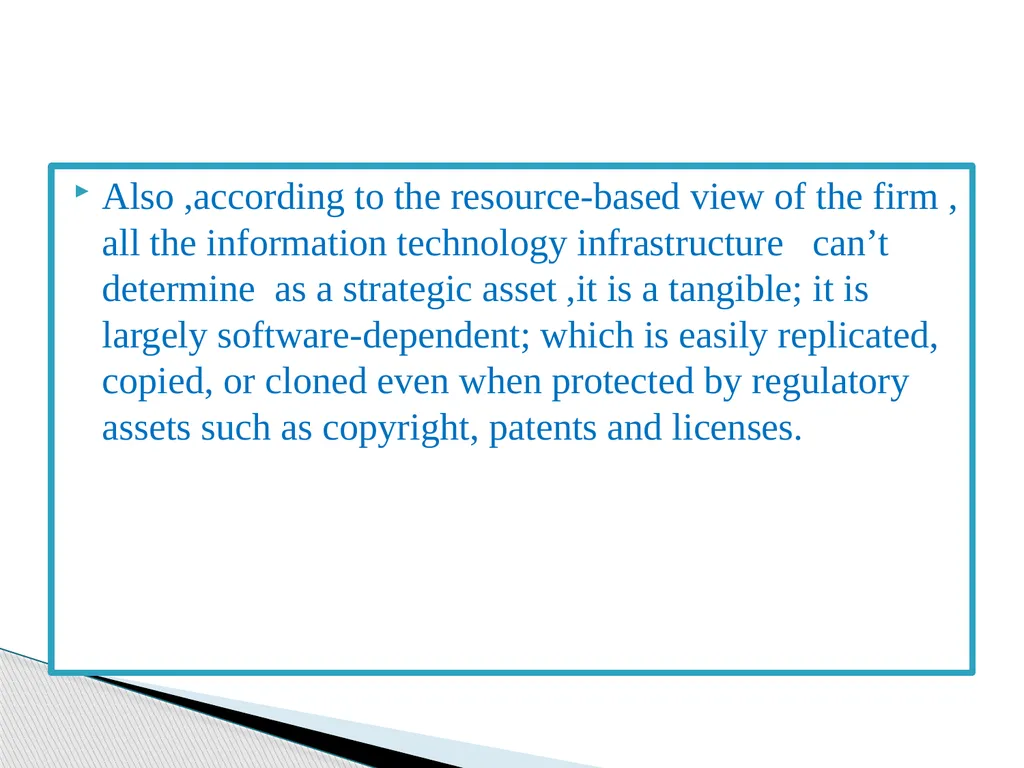
slide5. Also ,according to the resource-based view of the firm , all the information technology infrastructure can’t determine as a strategic asset ,it is a tangible; it is largely software-dependent; which is easily replicated, copied, or cloned even when protected by regulatory assets such as copyright, patents and licenses.<br>
slide6. On the other hand
Many authors maintain that technologies, if correctly designed and implemented, can effectively support KM.
Information technology plays different roles in KM:-
Obtaining knowledge.
Defining knowledge.
Storing knowledge .
Categorizing knowledge .
Indexing knowledge.<br>
slide7. 6- linking knowledge-related digital items.
7-Seeking and identifying related content.
8- Flexibly expressing content based on various utilization backgrounds.
According to this viewpoint organizations should have well-developed technology to leverage KM.<br>
slide8. Knowledge-intensive firms (KIF) today are employing one technology or a combination of many key technologies;
Groupware - Messaging -
Web browsers - Document management - Search &Retrieval -Data mining Visualization – Group decision support Knowledge Technologies in Practice<br>
slide9. Three types of Knowledge technology are found.
Firstly, The knowledge -oriented technologies
such as group-ware and web browsers which directly process knowledge work and the sharing of knowledge within the organization.
Secondly, The function-oriented technologies
such as office automation, robotics and desk-top computing technologies those support operational level activities such as data processing, production, marketing ,and service delivery. How IT helps in KM practice within different organizations;<br>
slide10. Finally, The specialty-oriented technology,
Which supports specialized functions within the firm: those functions which require a high level of know-how, for example computer-aided design and manufacture software (CAD/CAM), and expert systems software<br>
slide11. Knowledge Technology in Organizations<br>
slide12. E- Bay : is an E-business example in which knowledge and its management forms the lifeblood: the fundamental nature of its work involves the use and convey the knowledge to market participants, and to the system itself.
It acquires Knowledge about sellers' offers, buyers‘ commitments, and participants' market experiences.
It assimilates knowledge, filtering, screening and organizing.
It also selects simplified knowledge as needed to satisfy participants' requests and applies in its own internal processing for such activities as coordinating participant interactions and enforcing rules of conduct. E-Bay<br>
slide13. It distributes knowledge about states (issuing alerts, showing auction status, indicating participant reputation),
about procedures (how to initiate auctions, how to ensure a safe trading experience)
and about policies ( trading tips, pays ) (All in all) .
What the E-Bay system does is an example of Knowledge management which cannot be done without the computer based technology<br>
slide14. Ford Motor is a clear example of an organization which is heavily investing in knowledge technologies to redefine the auto manufacturing industry and create a SCA in the auto industry.
The organization has established the auto exchange mart -an intensive KM technology and electronic commerce system intended to shift the car-manufacturing model from a ‘push’ business model to the ’pull’ model, in which the consumer determines the precise configuration of the car before it is manufactured. Ford Motor<br>
slide15. Further, auto designers, marketers and production engineers are able to gain insights and knowledge about the customer. Thus, by effectively harnessing the capabilities provided by IT, Ford is attempting to create a SCA in the auto industry .<br>
slide16. Microsoft also developed a project entitled ‘skills planning development’ (SPD), which focused on competencies needed to stay on the leading edge in the workplace,
It implemented an on-line system which contained a job rating system and rating database, as well as competency levels for employees.
This system had a web front end for easy access through Microsoft's intranet, and thus it achieved increased communication among employees and an increased advantage over competitors . Microsoft<br>
slide17. Knowledge technology and KM processes are closely tied together, as both of them help the distribution of knowledge vertically as well as horizontally within the organization.
So the main goal of many organizations today is to use advancements in KT to conduct KM Knowledge Technology and KM Processes<br>
slide18. K- Technology is a key enabler of the knowledge creation process. Building on Nonaka’s theory, IT is considered as another form of Ba by which the different modes of knowledge creation can be enhanced.
For example; data warehousing, data mining, document repositories and software agents have a great value in cyber Ba.
Also, information systems designed for the support of collaboration, coordination and communication processes are a component of interacting Ba. KT and K-Creation Process<br>
slide19. Intranets and email can also support individual learning (conversion of explicit knowledge to personal tacit knowledge) through capabilities such as computer simulation (to support learning-by-doing) and smart software tutors.
Furthermore, communication technology can increase the quality of k. creation by increasing the interaction among organizational members, sharing ideas and perspectives, which enables individuals to arrive at new insights and accurate interpretations.<br>
slide20. Technology can provides solutions for the four conversion processes.<br>
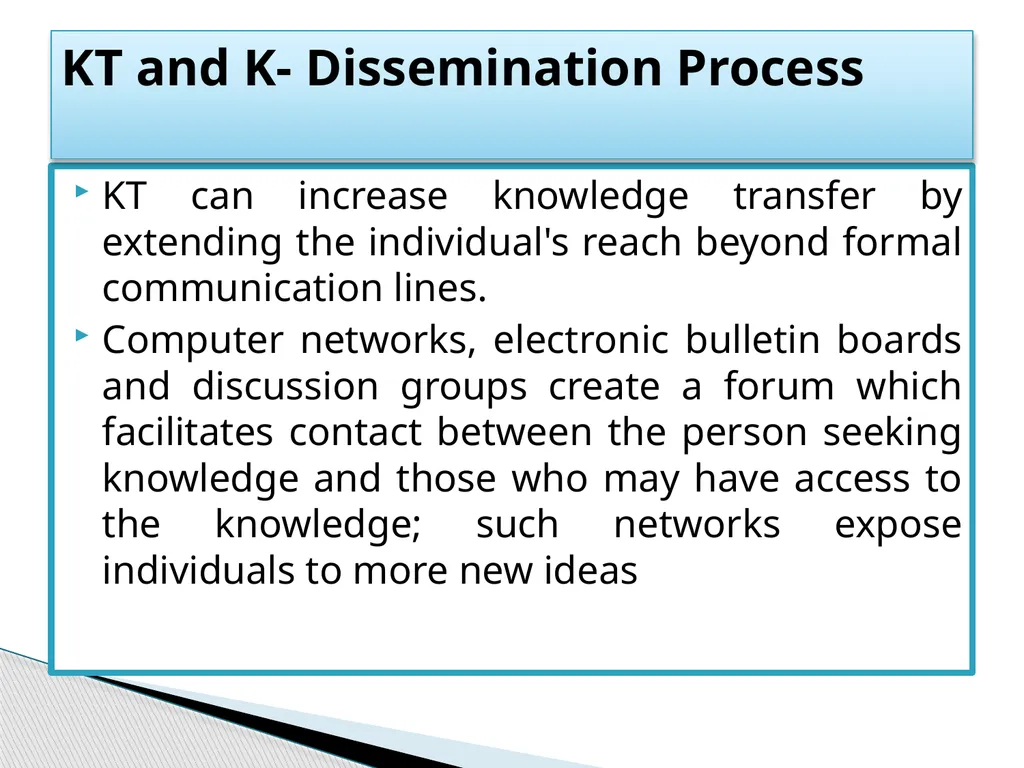
slide21. KT can increase knowledge transfer by extending the individual's reach beyond formal communication lines.
Computer networks, electronic bulletin boards and discussion groups create a forum which facilitates contact between the person seeking knowledge and those who may have access to the knowledge; such networks expose individuals to more new ideas KT and K- Dissemination Process<br>
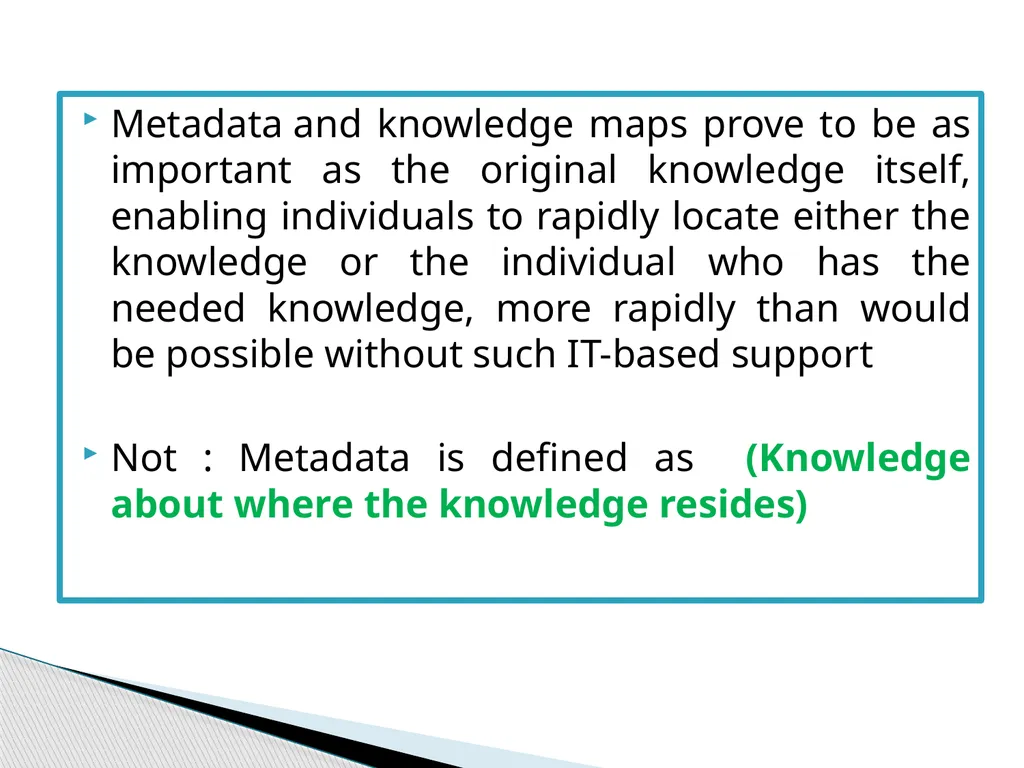
slide22. Metadata and knowledge maps prove to be as important as the original knowledge itself, enabling individuals to rapidly locate either the knowledge or the individual who has the needed knowledge, more rapidly than would be possible without such IT-based support
Not : Metadata is defined as (Knowledge about where the knowledge resides)<br>
slide23. In addition, informational communication technology has a direct and indirect influence on the motivation to share knowledge, because it can play different functions:-
1. Eliminate hindrances& obstacles
2. Provide channels to obtain information
3. Correct Knowledge flow processes
4. Identifies the location of knowledge carrier and knowledge seeker.
5. Make searching and using knowledge far easier<br>
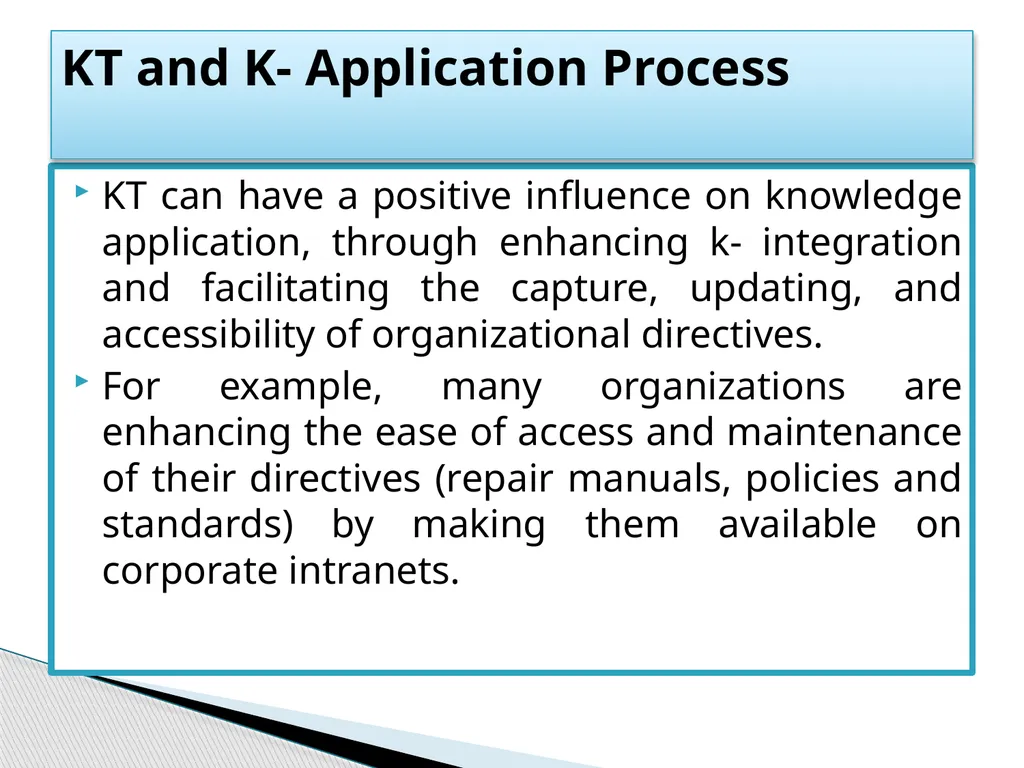
slide24. KT can have a positive influence on knowledge application, through enhancing k- integration and facilitating the capture, updating, and accessibility of organizational directives.
For example, many organizations are enhancing the ease of access and maintenance of their directives (repair manuals, policies and standards) by making them available on corporate intranets. KT and K- Application Process<br>
slide25. This increases the speed at which changes can be applied.
Also, organizational units can follow a faster learning curve by accessing the knowledge of other units which have gone through similar experiences.
Moreover, by increasing the size of individuals' internal social networks and by increasing the amount of organizational memory available, KT allow for organizational knowledge to be applied across time and space<br>
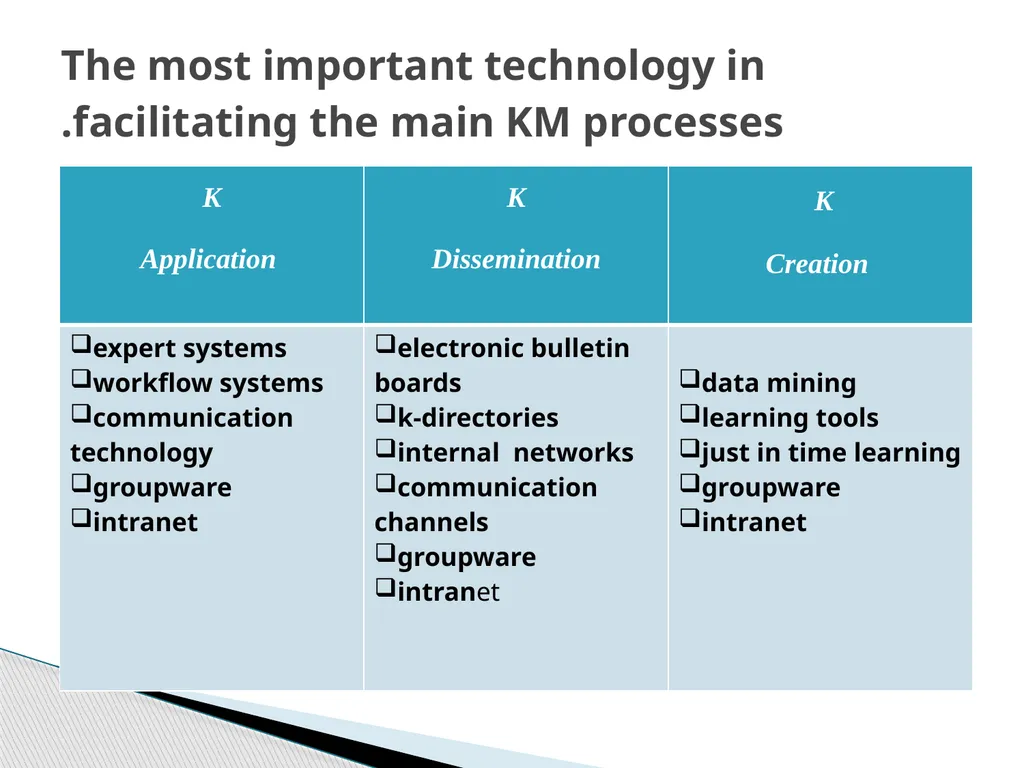
slide26. The most important technology in facilitating the main KM processes.<br>
slide27. Techknowledgies Examples<br>
slide28. Internet is a network to share knowledge with knowledge providers across the world –
Intranet provides same but restricted access from outside- that networks have been built in many corporations for information sharing and ecommerce
An extranet is a computer network that allows controlled access from the outside for specific business. Extranets are extensions to, or segments of, the private intranet . Internet/Intranet/Extranet<br>
slide29. Data mining is the exploration and analysis
of large quantities of data in order to
discover valid, novel, potentially useful,
and ultimately understandable patterns in
data.
Use a variety of decision trees and modelling algorithms to discover patterns and correlations in vast amounts of data .
Use sophisticated data search capabilities. Data mining<br>
slide30. Allows to work on same document by multiple users
Maintain and update identical data on numerous PCs
Organising discussions
Storing information
Moving and tracking documents of groups
Preventing unauthorised access of data
Mobile use to access corporate network Groupware tools<br>
slide31. Shift to dynamic social web applications
Network effects critical to their success
Provide customer services free – Google ($200bn), YouTube ($1.6bn), Face book ($50bn) WEB 2.0 PLATFORM<br>
slide32. Allows content from different sources to combine with applications for different business processes
E.g. Getting insurance quote (price offer )from website
E.g. Starbucks helps customers locate nearest café once they’ve entered postcode
Information from external sources can be inaccurate or may change significantly in future. MASHUPS<br>
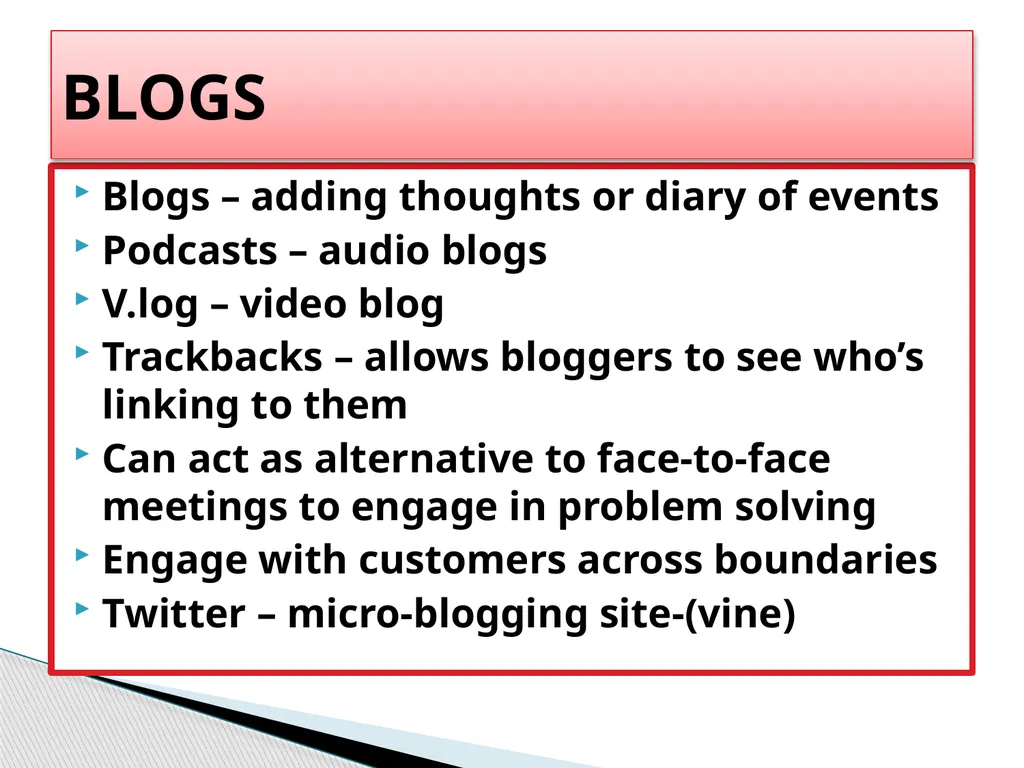
slide33. Blogs – adding thoughts or diary of events
Podcasts – audio blogs
V.log – video blog
Trackbacks – allows bloggers to see who’s linking to them
Can act as alternative to face-to-face meetings to engage in problem solving
Engage with customers across boundaries
Twitter – micro-blogging site-(vine) BLOGS<br>
slide34. ‘Connectors’ – social glue
Information brokers on best deals etc.
‘Salesmen’ – good at convincing you and getting you to act.
Amazon is reliant on ranking of reviewers to develop trust with customers Tipping Point Word OF Mouth Epidemics<br>
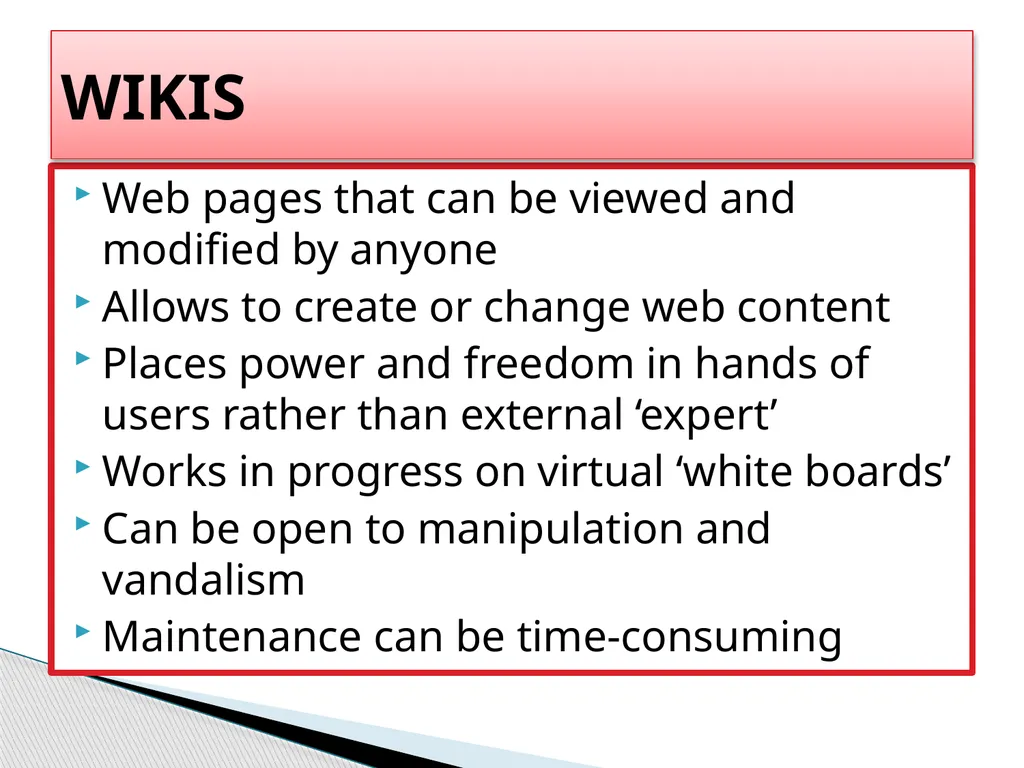
slide35. Web pages that can be viewed and modified by anyone
Allows to create or change web content
Places power and freedom in hands of users rather than external ‘expert’
Works in progress on virtual ‘white boards’
Can be open to manipulation and vandalism
Maintenance can be time-consuming WIKIS<br>
slide36. Individuals interact with others in community
Social network sites (SNS): Face book, MySpace, LinkedIn.
SNS tend to support pre-existing relationships rather than new ones
Benefit from social capital and self-presentation
Risk over privacy from third party securing personal information
Allows interaction with different people in network On-line Social Networks<br>
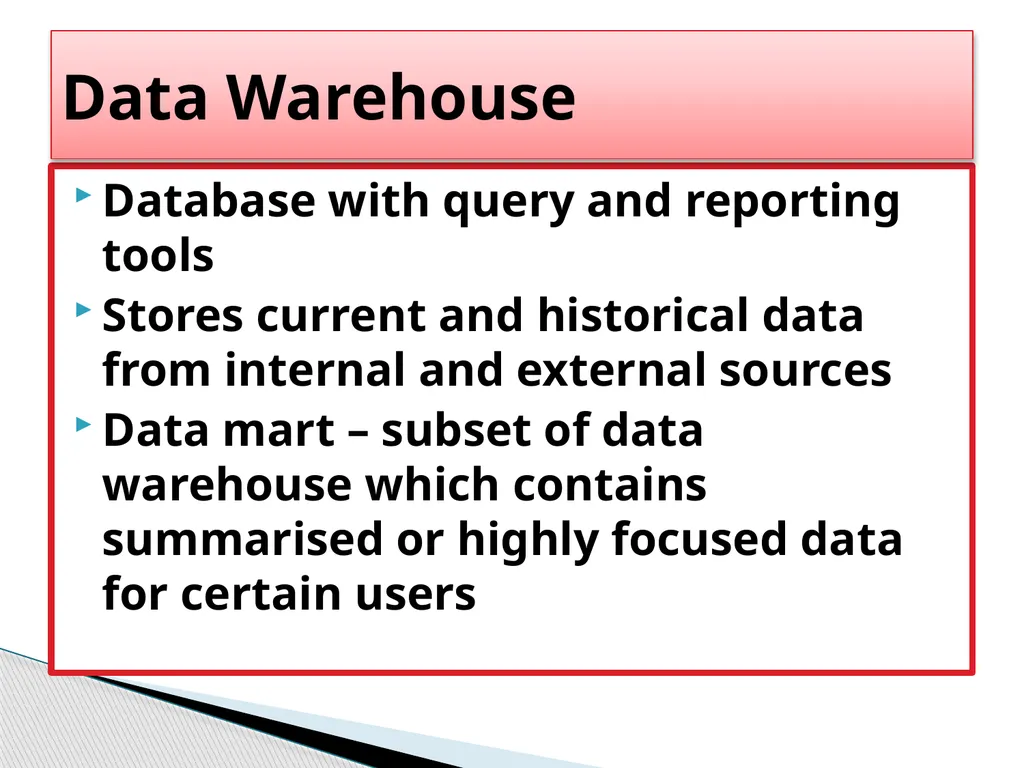
slide37. Database with query and reporting tools
Stores current and historical data from internal and external sources
Data mart – subset of data warehouse which contains summarised or highly focused data for certain users Data Warehouse<br>
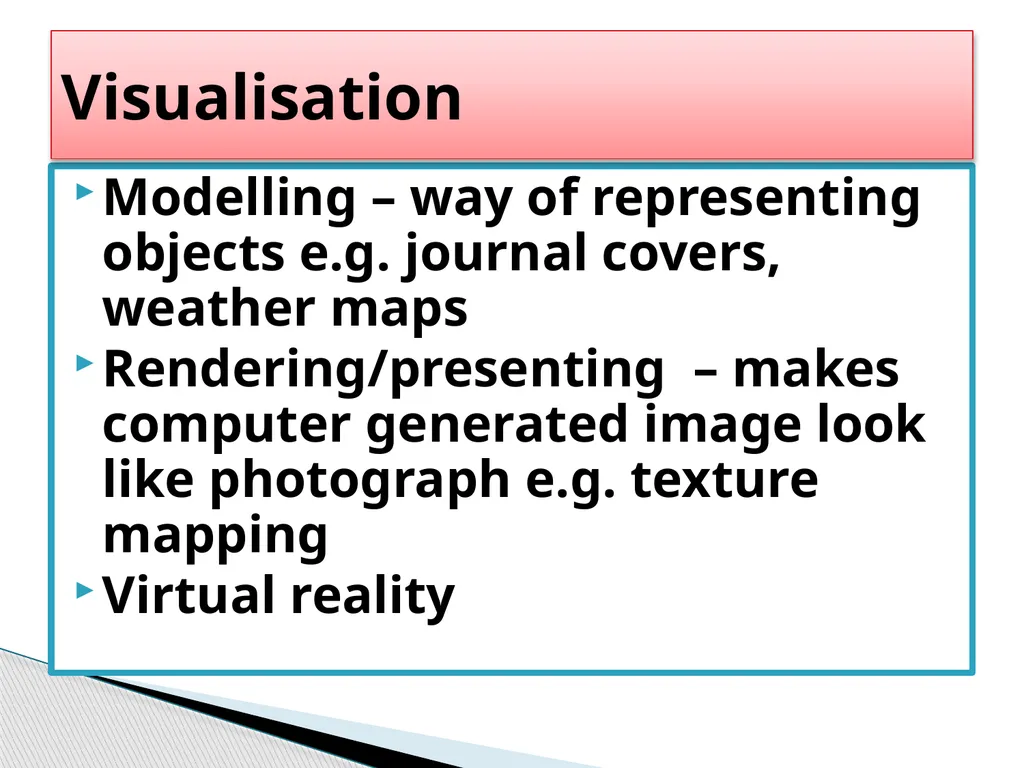
slide38. Modelling – way of representing objects e.g. journal covers, weather maps
Rendering/presenting – makes computer generated image look like photograph e.g. texture mapping
Virtual reality Visualisation<br>
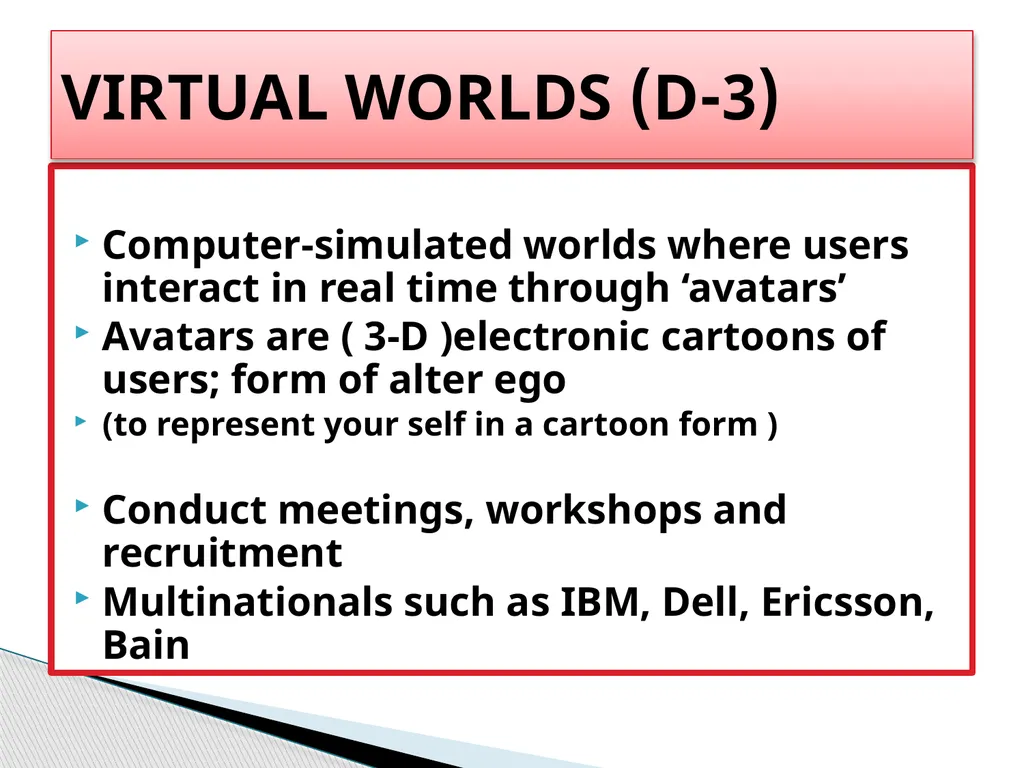
slide39. Computer-simulated worlds where users interact in real time through ‘avatars’
Avatars are ( 3-D )electronic cartoons of users; form of alter ego
(to represent your self in a cartoon form )
Conduct meetings, workshops and recruitment
Multinationals such as IBM, Dell, Ericsson, Bain (3-D) VIRTUAL WORLDS<br>
slide40. Capture and store past experiences as organisational knowledge
System searches for stored cases with similar profile to new problem
Adds unsuccessful cases to aid learning
Built on artificial intelligence technology Case-based reasoning<br>
slide41. Knowledge technology can lead to a greater breadth and depth of knowledge creation, transfer and application in organizations, resulting in the following :
Improving the decision making process
Increasing knowledge- transfer speed
Supporting knowledge codification
Improving knowledge productivity The Impact of KT<br>
slide42. 5-Improving communication among organizational members
6-Reducing the time and cost of information access
7-Facilitating rapid searches
8-Supporting collaboration<br>
slide43. The End<br>
Lecture (8)<br>
slide2. The American Productivity and Quality Center (APQC) (1997) suggests that for organizations to succeed in KM initiatives, a suitable IT infrastructure must be established.<br>
slide3. Information technology has been defined as “The fundamental building block that supports and coordinates KM initiatives". For that reason, Davenport and Prusak (1998) termed it knowledge technologies or “Techknowledgies”. Information Technology definition<br>
slide4. There is a debate around the effectiveness of the IT-based system as a facilitator for the KM process.
Some authors argue a limited role for IT in the KM process because its effectiveness is highly dependent on:-
Whether an individual knows or not what he is looking for.
How individuals modify, use and transfer their experiences to others.
An individual's trust in knowledge which resides in a system . The importance of technology for KM:<br>
slide5. Also ,according to the resource-based view of the firm , all the information technology infrastructure can’t determine as a strategic asset ,it is a tangible; it is largely software-dependent; which is easily replicated, copied, or cloned even when protected by regulatory assets such as copyright, patents and licenses.<br>
slide6. On the other hand
Many authors maintain that technologies, if correctly designed and implemented, can effectively support KM.
Information technology plays different roles in KM:-
Obtaining knowledge.
Defining knowledge.
Storing knowledge .
Categorizing knowledge .
Indexing knowledge.<br>
slide7. 6- linking knowledge-related digital items.
7-Seeking and identifying related content.
8- Flexibly expressing content based on various utilization backgrounds.
According to this viewpoint organizations should have well-developed technology to leverage KM.<br>
slide8. Knowledge-intensive firms (KIF) today are employing one technology or a combination of many key technologies;
Groupware - Messaging -
Web browsers - Document management - Search &Retrieval -Data mining Visualization – Group decision support Knowledge Technologies in Practice<br>
slide9. Three types of Knowledge technology are found.
Firstly, The knowledge -oriented technologies
such as group-ware and web browsers which directly process knowledge work and the sharing of knowledge within the organization.
Secondly, The function-oriented technologies
such as office automation, robotics and desk-top computing technologies those support operational level activities such as data processing, production, marketing ,and service delivery. How IT helps in KM practice within different organizations;<br>
slide10. Finally, The specialty-oriented technology,
Which supports specialized functions within the firm: those functions which require a high level of know-how, for example computer-aided design and manufacture software (CAD/CAM), and expert systems software<br>
slide11. Knowledge Technology in Organizations<br>
slide12. E- Bay : is an E-business example in which knowledge and its management forms the lifeblood: the fundamental nature of its work involves the use and convey the knowledge to market participants, and to the system itself.
It acquires Knowledge about sellers' offers, buyers‘ commitments, and participants' market experiences.
It assimilates knowledge, filtering, screening and organizing.
It also selects simplified knowledge as needed to satisfy participants' requests and applies in its own internal processing for such activities as coordinating participant interactions and enforcing rules of conduct. E-Bay<br>
slide13. It distributes knowledge about states (issuing alerts, showing auction status, indicating participant reputation),
about procedures (how to initiate auctions, how to ensure a safe trading experience)
and about policies ( trading tips, pays ) (All in all) .
What the E-Bay system does is an example of Knowledge management which cannot be done without the computer based technology<br>
slide14. Ford Motor is a clear example of an organization which is heavily investing in knowledge technologies to redefine the auto manufacturing industry and create a SCA in the auto industry.
The organization has established the auto exchange mart -an intensive KM technology and electronic commerce system intended to shift the car-manufacturing model from a ‘push’ business model to the ’pull’ model, in which the consumer determines the precise configuration of the car before it is manufactured. Ford Motor<br>
slide15. Further, auto designers, marketers and production engineers are able to gain insights and knowledge about the customer. Thus, by effectively harnessing the capabilities provided by IT, Ford is attempting to create a SCA in the auto industry .<br>
slide16. Microsoft also developed a project entitled ‘skills planning development’ (SPD), which focused on competencies needed to stay on the leading edge in the workplace,
It implemented an on-line system which contained a job rating system and rating database, as well as competency levels for employees.
This system had a web front end for easy access through Microsoft's intranet, and thus it achieved increased communication among employees and an increased advantage over competitors . Microsoft<br>
slide17. Knowledge technology and KM processes are closely tied together, as both of them help the distribution of knowledge vertically as well as horizontally within the organization.
So the main goal of many organizations today is to use advancements in KT to conduct KM Knowledge Technology and KM Processes<br>
slide18. K- Technology is a key enabler of the knowledge creation process. Building on Nonaka’s theory, IT is considered as another form of Ba by which the different modes of knowledge creation can be enhanced.
For example; data warehousing, data mining, document repositories and software agents have a great value in cyber Ba.
Also, information systems designed for the support of collaboration, coordination and communication processes are a component of interacting Ba. KT and K-Creation Process<br>
slide19. Intranets and email can also support individual learning (conversion of explicit knowledge to personal tacit knowledge) through capabilities such as computer simulation (to support learning-by-doing) and smart software tutors.
Furthermore, communication technology can increase the quality of k. creation by increasing the interaction among organizational members, sharing ideas and perspectives, which enables individuals to arrive at new insights and accurate interpretations.<br>
slide20. Technology can provides solutions for the four conversion processes.<br>
slide21. KT can increase knowledge transfer by extending the individual's reach beyond formal communication lines.
Computer networks, electronic bulletin boards and discussion groups create a forum which facilitates contact between the person seeking knowledge and those who may have access to the knowledge; such networks expose individuals to more new ideas KT and K- Dissemination Process<br>
slide22. Metadata and knowledge maps prove to be as important as the original knowledge itself, enabling individuals to rapidly locate either the knowledge or the individual who has the needed knowledge, more rapidly than would be possible without such IT-based support
Not : Metadata is defined as (Knowledge about where the knowledge resides)<br>
slide23. In addition, informational communication technology has a direct and indirect influence on the motivation to share knowledge, because it can play different functions:-
1. Eliminate hindrances& obstacles
2. Provide channels to obtain information
3. Correct Knowledge flow processes
4. Identifies the location of knowledge carrier and knowledge seeker.
5. Make searching and using knowledge far easier<br>
slide24. KT can have a positive influence on knowledge application, through enhancing k- integration and facilitating the capture, updating, and accessibility of organizational directives.
For example, many organizations are enhancing the ease of access and maintenance of their directives (repair manuals, policies and standards) by making them available on corporate intranets. KT and K- Application Process<br>
slide25. This increases the speed at which changes can be applied.
Also, organizational units can follow a faster learning curve by accessing the knowledge of other units which have gone through similar experiences.
Moreover, by increasing the size of individuals' internal social networks and by increasing the amount of organizational memory available, KT allow for organizational knowledge to be applied across time and space<br>
slide26. The most important technology in facilitating the main KM processes.<br>
slide27. Techknowledgies Examples<br>
slide28. Internet is a network to share knowledge with knowledge providers across the world –
Intranet provides same but restricted access from outside- that networks have been built in many corporations for information sharing and ecommerce
An extranet is a computer network that allows controlled access from the outside for specific business. Extranets are extensions to, or segments of, the private intranet . Internet/Intranet/Extranet<br>
slide29. Data mining is the exploration and analysis
of large quantities of data in order to
discover valid, novel, potentially useful,
and ultimately understandable patterns in
data.
Use a variety of decision trees and modelling algorithms to discover patterns and correlations in vast amounts of data .
Use sophisticated data search capabilities. Data mining<br>
slide30. Allows to work on same document by multiple users
Maintain and update identical data on numerous PCs
Organising discussions
Storing information
Moving and tracking documents of groups
Preventing unauthorised access of data
Mobile use to access corporate network Groupware tools<br>
slide31. Shift to dynamic social web applications
Network effects critical to their success
Provide customer services free – Google ($200bn), YouTube ($1.6bn), Face book ($50bn) WEB 2.0 PLATFORM<br>
slide32. Allows content from different sources to combine with applications for different business processes
E.g. Getting insurance quote (price offer )from website
E.g. Starbucks helps customers locate nearest café once they’ve entered postcode
Information from external sources can be inaccurate or may change significantly in future. MASHUPS<br>
slide33. Blogs – adding thoughts or diary of events
Podcasts – audio blogs
V.log – video blog
Trackbacks – allows bloggers to see who’s linking to them
Can act as alternative to face-to-face meetings to engage in problem solving
Engage with customers across boundaries
Twitter – micro-blogging site-(vine) BLOGS<br>
slide34. ‘Connectors’ – social glue
Information brokers on best deals etc.
‘Salesmen’ – good at convincing you and getting you to act.
Amazon is reliant on ranking of reviewers to develop trust with customers Tipping Point Word OF Mouth Epidemics<br>
slide35. Web pages that can be viewed and modified by anyone
Allows to create or change web content
Places power and freedom in hands of users rather than external ‘expert’
Works in progress on virtual ‘white boards’
Can be open to manipulation and vandalism
Maintenance can be time-consuming WIKIS<br>
slide36. Individuals interact with others in community
Social network sites (SNS): Face book, MySpace, LinkedIn.
SNS tend to support pre-existing relationships rather than new ones
Benefit from social capital and self-presentation
Risk over privacy from third party securing personal information
Allows interaction with different people in network On-line Social Networks<br>
slide37. Database with query and reporting tools
Stores current and historical data from internal and external sources
Data mart – subset of data warehouse which contains summarised or highly focused data for certain users Data Warehouse<br>
slide38. Modelling – way of representing objects e.g. journal covers, weather maps
Rendering/presenting – makes computer generated image look like photograph e.g. texture mapping
Virtual reality Visualisation<br>
slide39. Computer-simulated worlds where users interact in real time through ‘avatars’
Avatars are ( 3-D )electronic cartoons of users; form of alter ego
(to represent your self in a cartoon form )
Conduct meetings, workshops and recruitment
Multinationals such as IBM, Dell, Ericsson, Bain (3-D) VIRTUAL WORLDS<br>
slide40. Capture and store past experiences as organisational knowledge
System searches for stored cases with similar profile to new problem
Adds unsuccessful cases to aid learning
Built on artificial intelligence technology Case-based reasoning<br>
slide41. Knowledge technology can lead to a greater breadth and depth of knowledge creation, transfer and application in organizations, resulting in the following :
Improving the decision making process
Increasing knowledge- transfer speed
Supporting knowledge codification
Improving knowledge productivity The Impact of KT<br>
slide42. 5-Improving communication among organizational members
6-Reducing the time and cost of information access
7-Facilitating rapid searches
8-Supporting collaboration<br>
slide43. The End<br>