
L ®p-p K0s→ p+p- Ξ-→π-Λ→ π- p π- ALICE masterclass

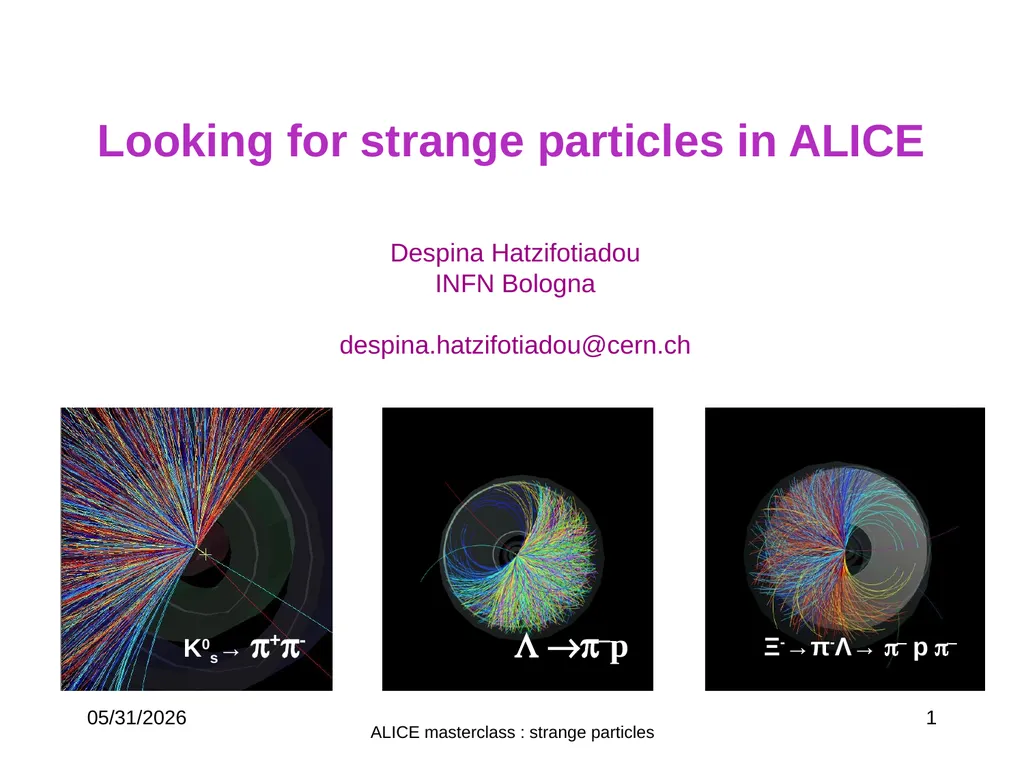
Description: L p-p K0s pp- Ξ-π-Λ π- p π- ALICE masterclass : strange particles 1 Looking for strange particles in ALICE Despina Hatzifotiadou INFN Bologna despina.hatzifotiadoucern.ch 10.09.25 ALICE masterclass : strange particles 2 10.09.25
Related Topics
Download Presentation
"L ®p-p K0s→ p+p- Ξ-→π-Λ→ π- p π- ALICE masterclass" is the property of its rightful owner. Permission is granted to download and print the materials on this website for personal, non-commercial use only, and to display it on your personal computer provided you do not modify the materials and that you retain all copyright notices contained in the materials. By downloading content from our website, you accept the terms of this agreement.
Presentation Transcript
slide1. L ®p-p K0s→ p+p- Ξ-→π-Λ→ π- p π- ALICE masterclass : strange particles 1 Looking for strange particles in ALICE Despina Hatzifotiadou
INFN Bologna
despina.hatzifotiadou@cern.ch 10.09.25<br>
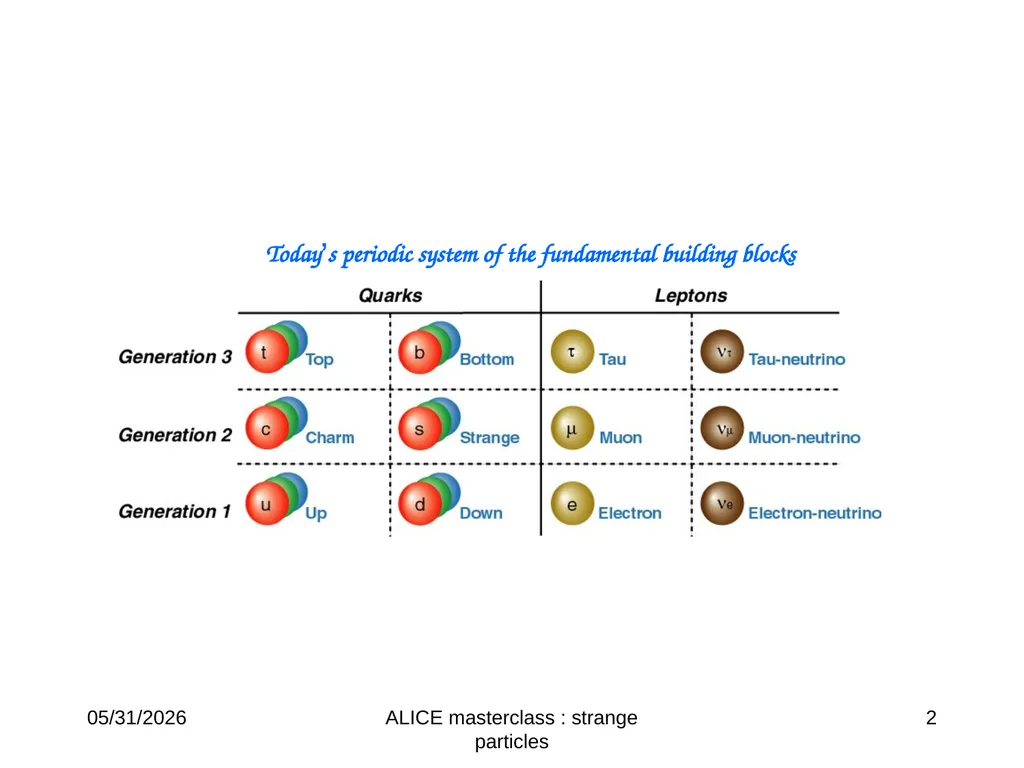
slide2. ALICE masterclass : strange particles 2 10.09.25<br>
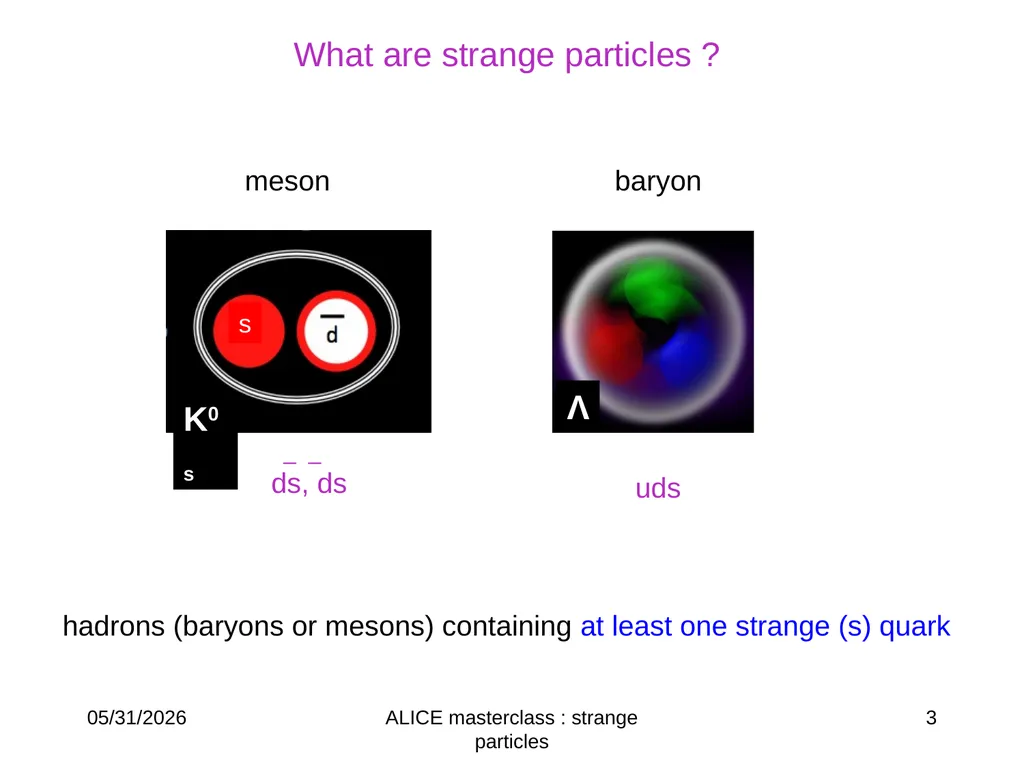
slide3. _ _
ds, ds meson baryon uds s K0s hadrons (baryons or mesons) containing at least one strange (s) quark What are strange particles ? ALICE masterclass : strange particles 3 Λ 10.09.25<br>
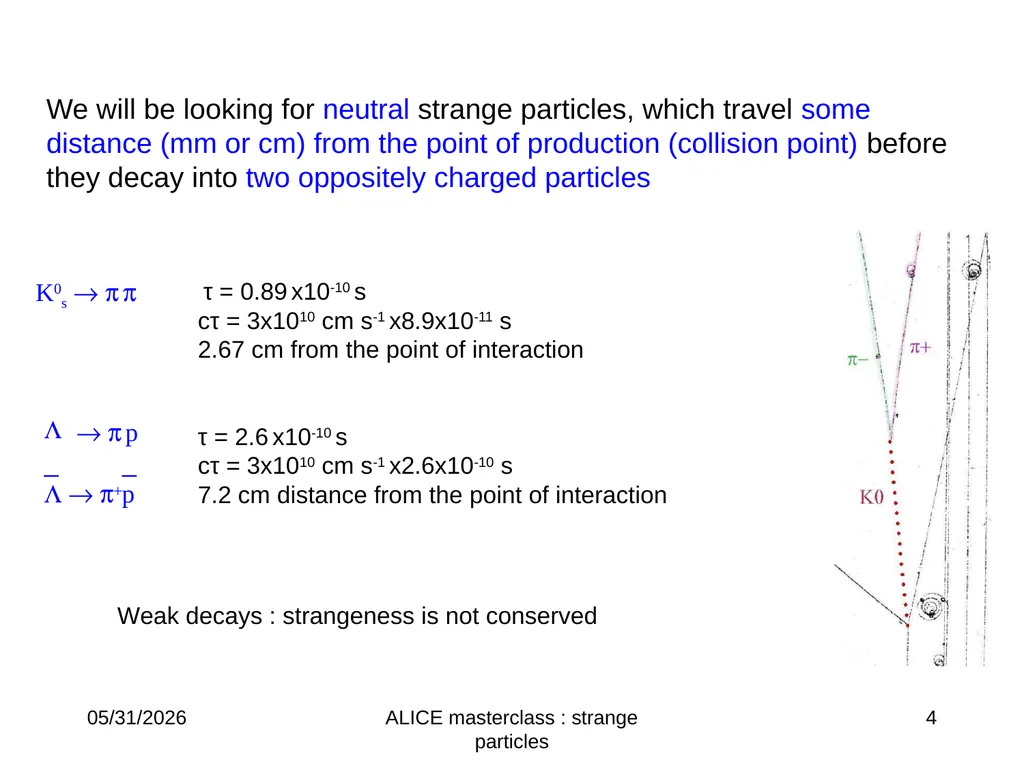
slide4. We will be looking for neutral strange particles, which travel some distance (mm or cm) from the point of production (collision point) before they decay into two oppositely charged particles ALICE masterclass : strange particles 4 τ = 0.89 x10⁻¹⁰ s
cτ = 3x1010 cm s-1 x8.9x10-11 s
2.67 cm from the point of interaction
τ = 2.6 x10⁻¹⁰ s
cτ = 3x1010 cm s-1 x2.6x10-10 s
7.2 cm distance from the point of interaction K0s ® pp ® pp
_ _
L ® p+p Weak decays : strangeness is not conserved 10.09.25<br>
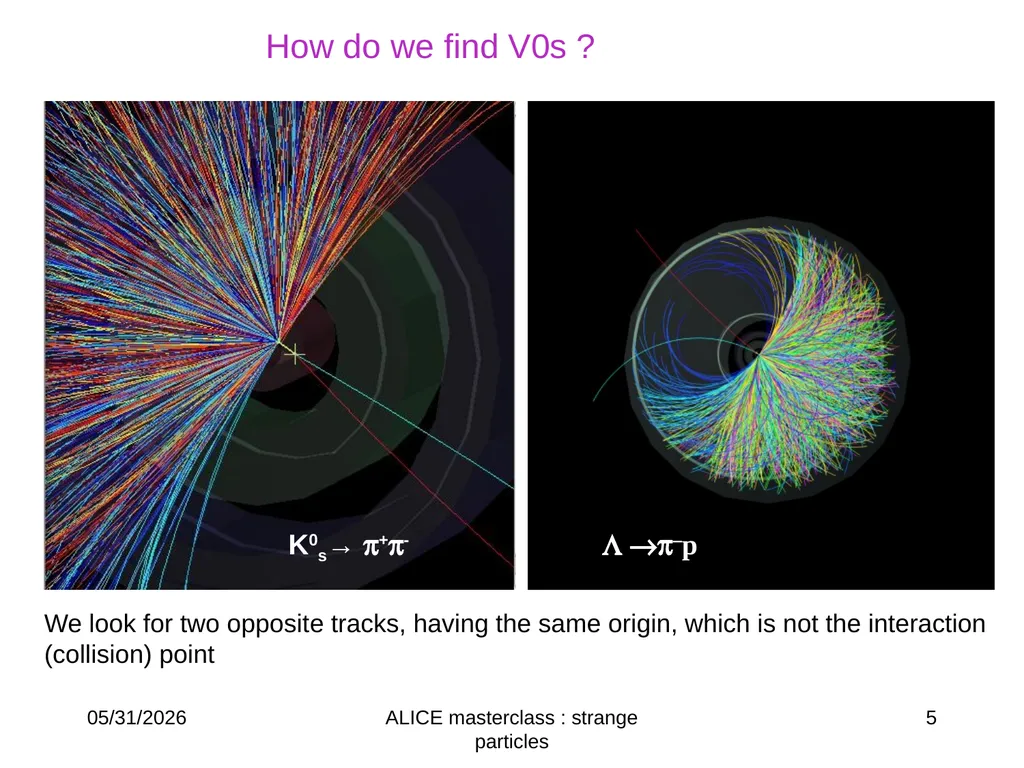
slide5. How do we find V0s ? We look for two opposite tracks, having the same origin, which is not the interaction (collision) point K0s→ p+p- L ®p-p ALICE masterclass : strange particles 5 10.09.25<br>
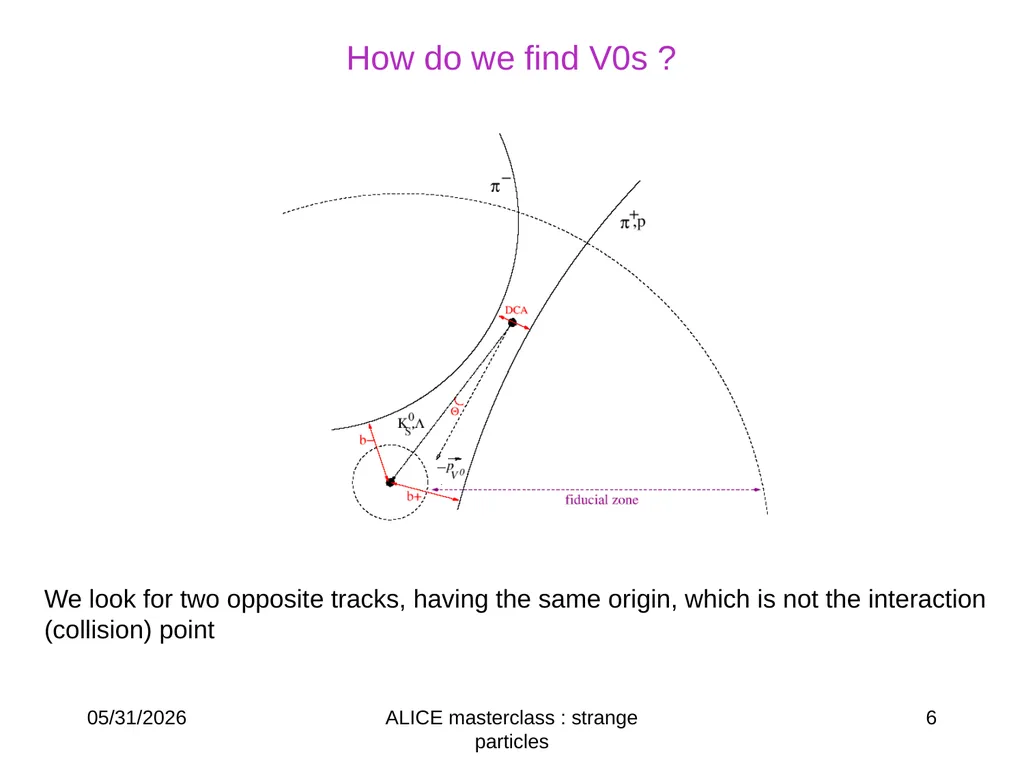
slide6. ALICE masterclass : strange particles 6 How do we find V0s ? We look for two opposite tracks, having the same origin, which is not the interaction (collision) point 10.09.25<br>
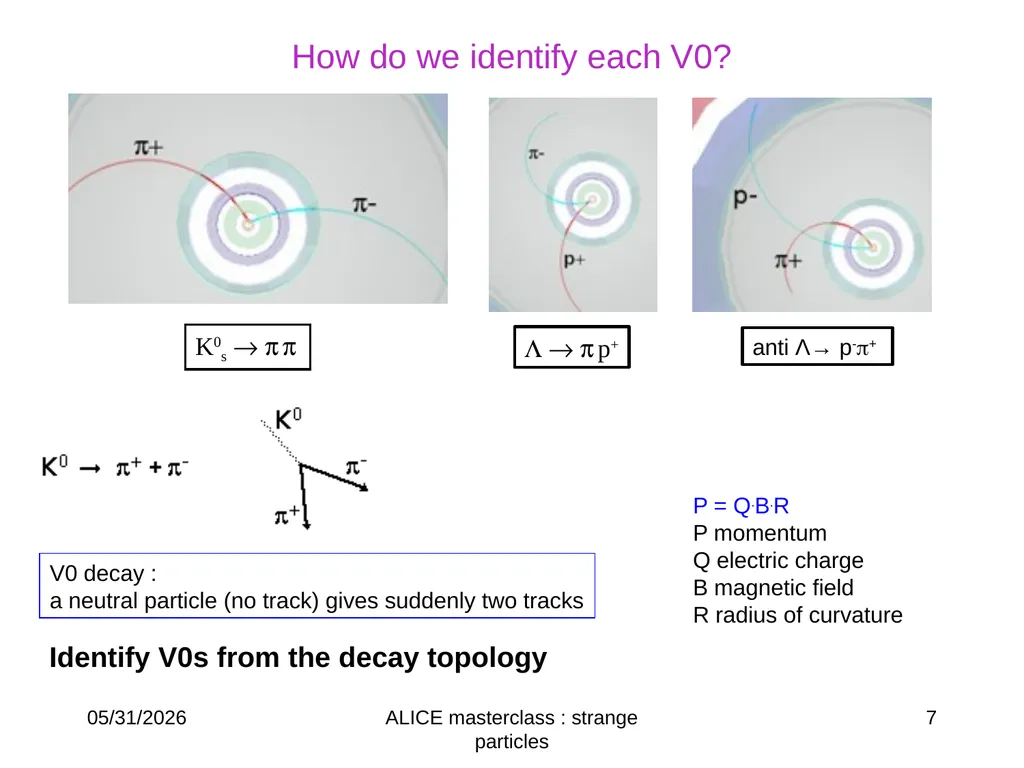
slide7. 7 ALICE masterclass : strange particles K0s ® pp L ® pp+ anti Λ→ p-π+ V0 decay :
a neutral particle (no track) gives suddenly two tracks How do we identify each V0? P = Q.B.R
P momentum
Q electric charge
B magnetic field
R radius of curvature Identify V0s from the decay topology 10.09.25<br>
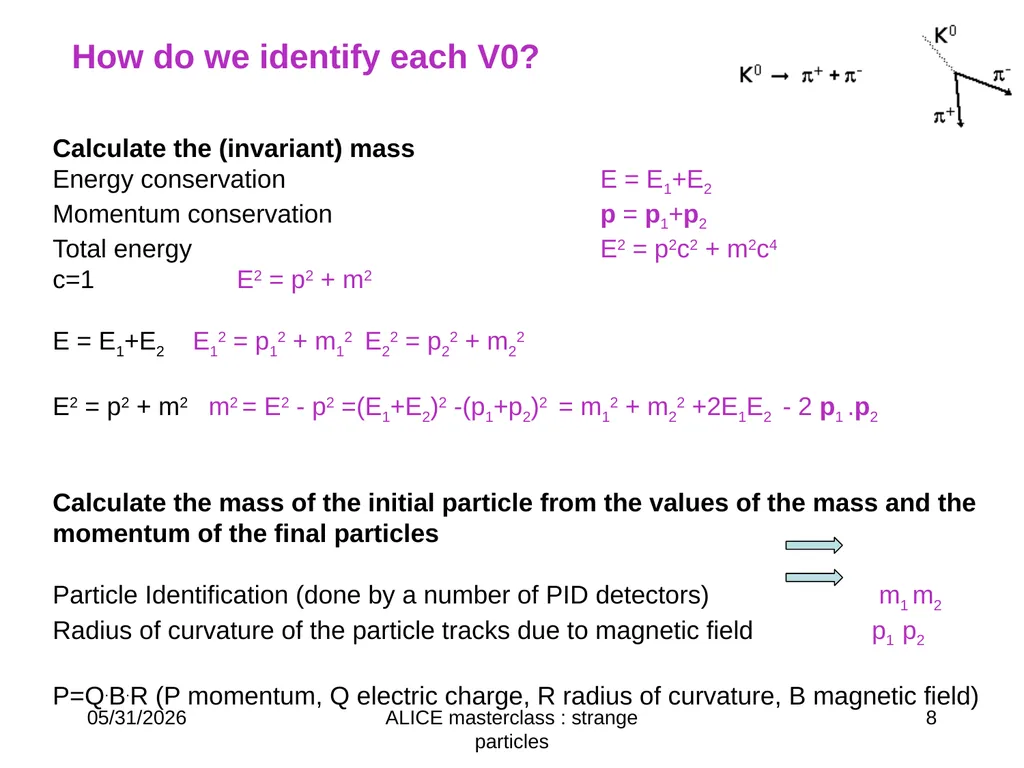
slide8. Calculate the (invariant) mass
Energy conservation E = E1+E2
Momentum conservation p = p1+p2
Total energy E2 = p2c2 + m2c4
c=1 E2 = p2 + m2
E = E1+E2 E12 = p12 + m12 E22 = p22 + m22
E2 = p2 + m2 m2 = E2 - p2 =(E1+E2)2 -(p1+p2)2 = m12 + m22 +2E1E2 - 2 p1 .p2
Calculate the mass of the initial particle from the values of the mass and the momentum of the final particles
Particle Identification (done by a number of PID detectors) m1 m2
Radius of curvature of the particle tracks due to magnetic field p1 p2
P=Q.B.R (P momentum, Q electric charge, R radius of curvature, B magnetic field) How do we identify each V0? ALICE masterclass : strange particles 8 10.09.25<br>
slide9. ALICE masterclass : strange particles 9 1st part
Identification of V0s (Ks, Λ, anti-Λ) in pp collisions
Visual analysis of small samples (~15 events) of pp
Find V0s with “V0 finder”
Calculate invariant mass (with “calculator”)
Classify in corresponding histograms
Merge all results at the end of the 1st part
Comment on width of the peak, background events 10.09.25<br>
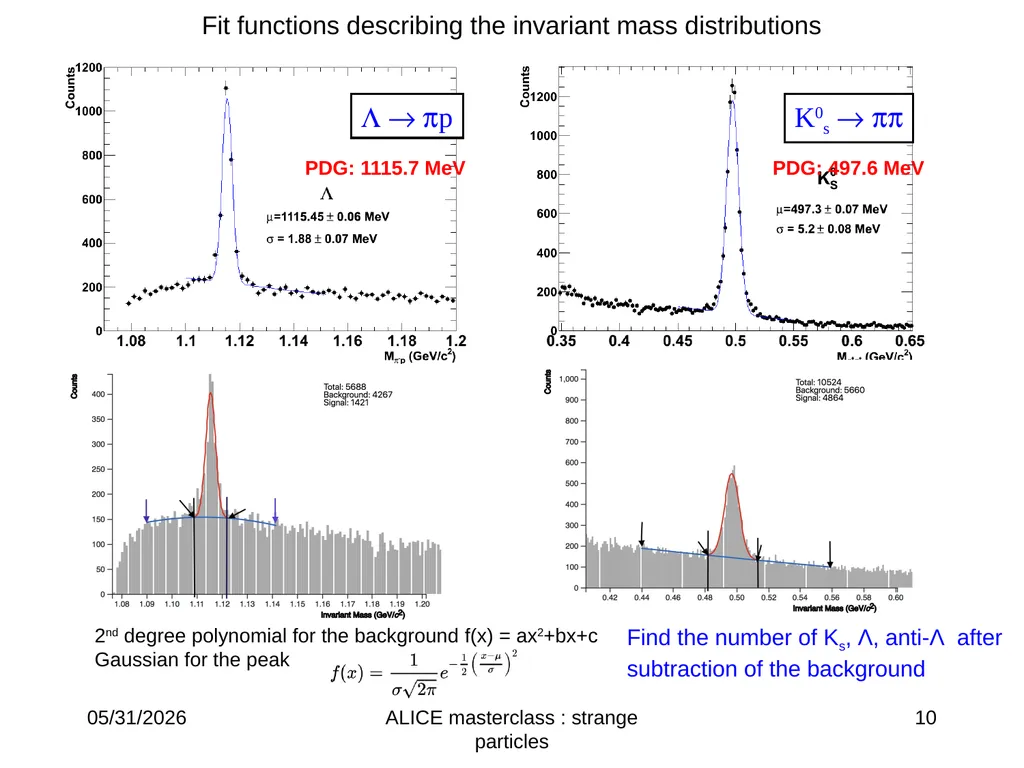
slide10. PDG: 1115.7 MeV K0s ® pp Fit functions describing the invariant mass distributions PDG: 497.6 MeV L ® pp 2nd degree polynomial for the background f(x) = ax2+bx+c
Gaussian for the peak ALICE masterclass : strange particles 10 Find the number of Ks, Λ, anti-Λ after subtraction of the background 10.09.25<br>
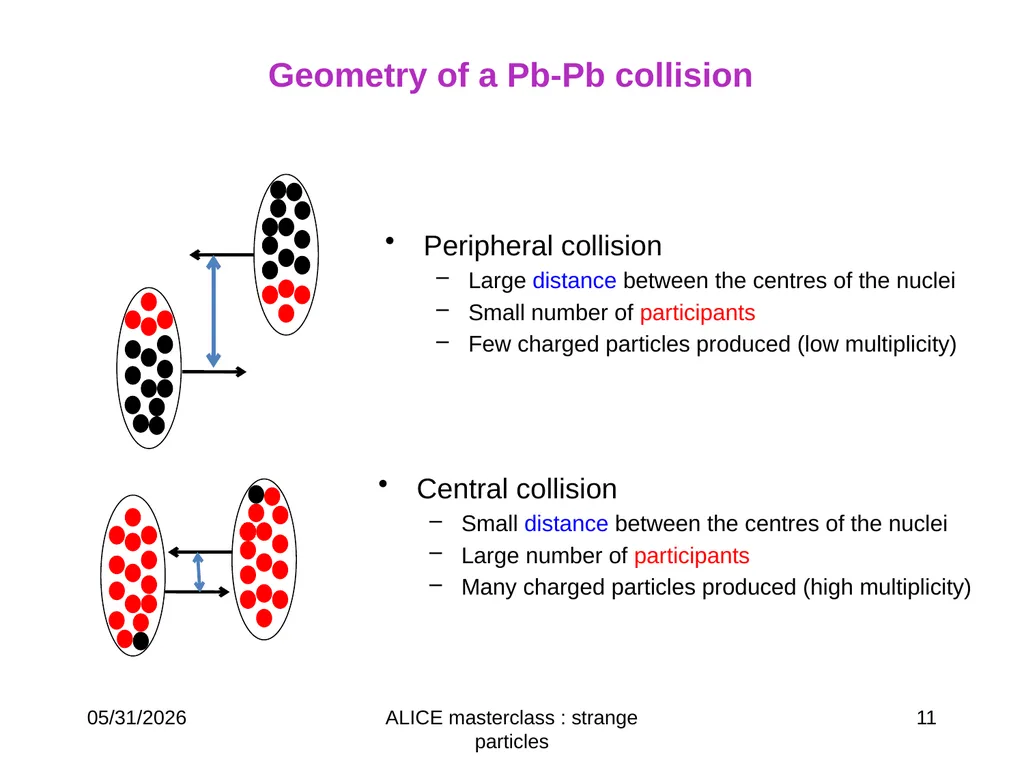
slide11. Geometry of a Pb-Pb collision Peripheral collision
Large distance between the centres of the nuclei
Small number of participants
Few charged particles produced (low multiplicity) Central collision
Small distance between the centres of the nuclei
Large number of participants
Many charged particles produced (high multiplicity) 11 ALICE masterclass : strange particles 10.09.25<br>
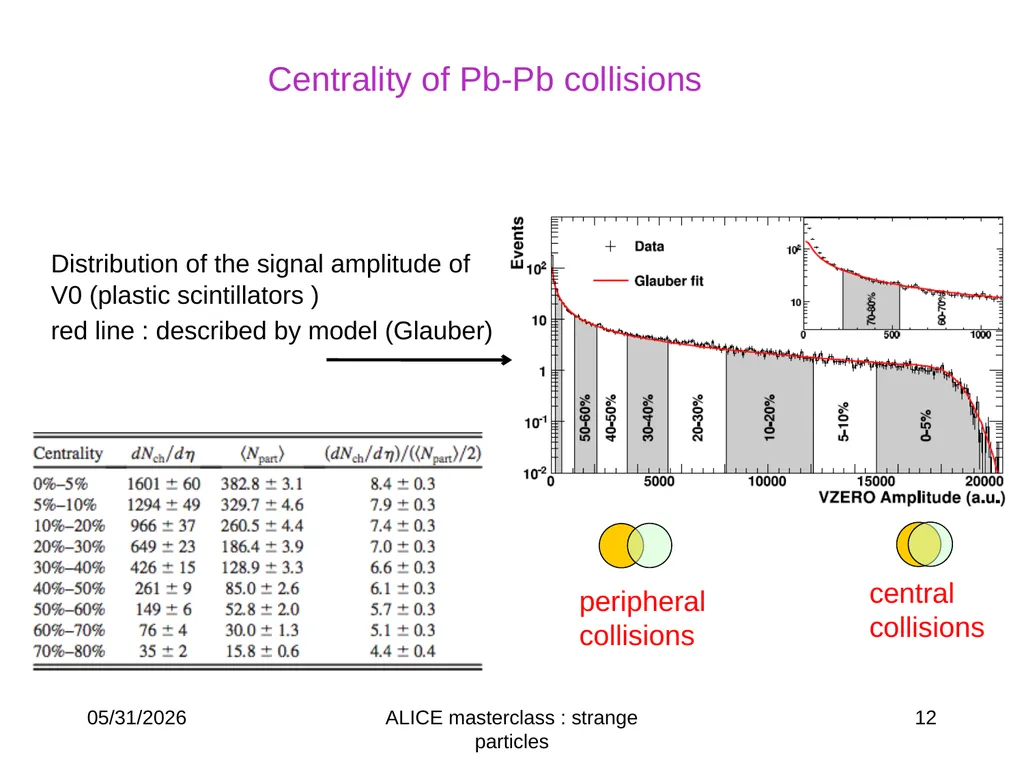
slide12. Distribution of the signal amplitude of V0 (plastic scintillators )
red line : described by model (Glauber) central
collisions peripheral
collisions Centrality of Pb-Pb collisions ALICE masterclass : strange particles 12 10.09.25<br>
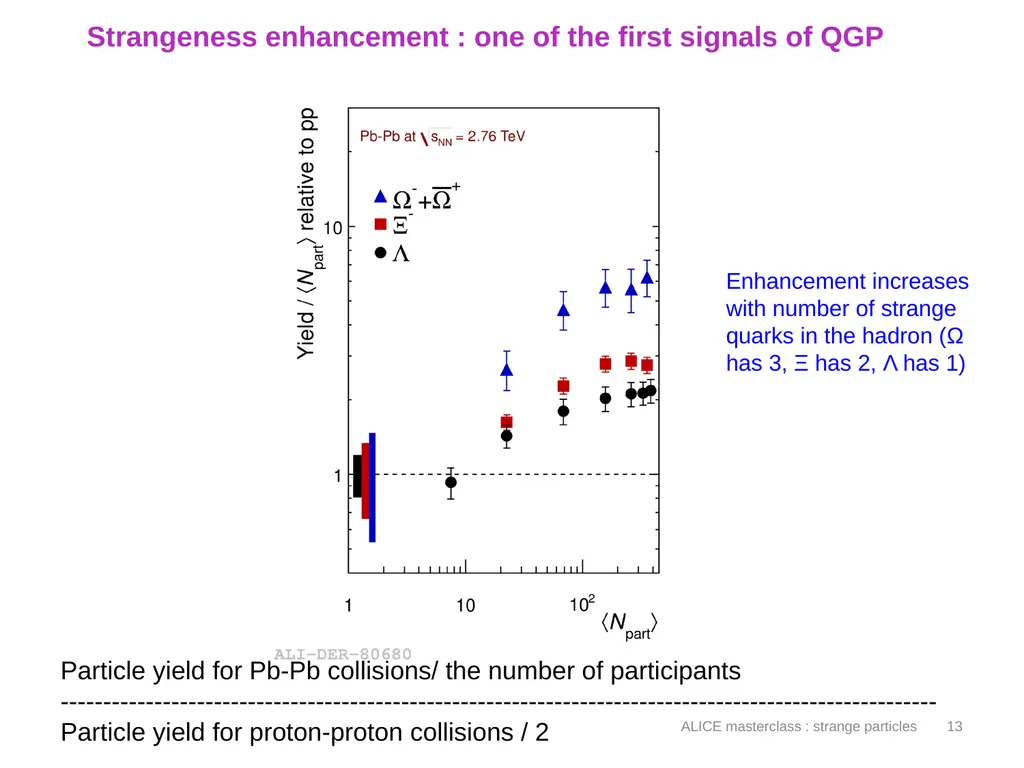
slide13. Strangeness enhancement : one of the first signals of QGP Enhancement increases with number of strange quarks in the hadron (Ω has 3, Ξ has 2, Λ has 1) 13 Particle yield for Pb-Pb collisions/ the number of participants
-------------------------------------------------------------------------------------------------------Particle yield for proton-proton collisions / 2 ALICE masterclass : strange particles<br>
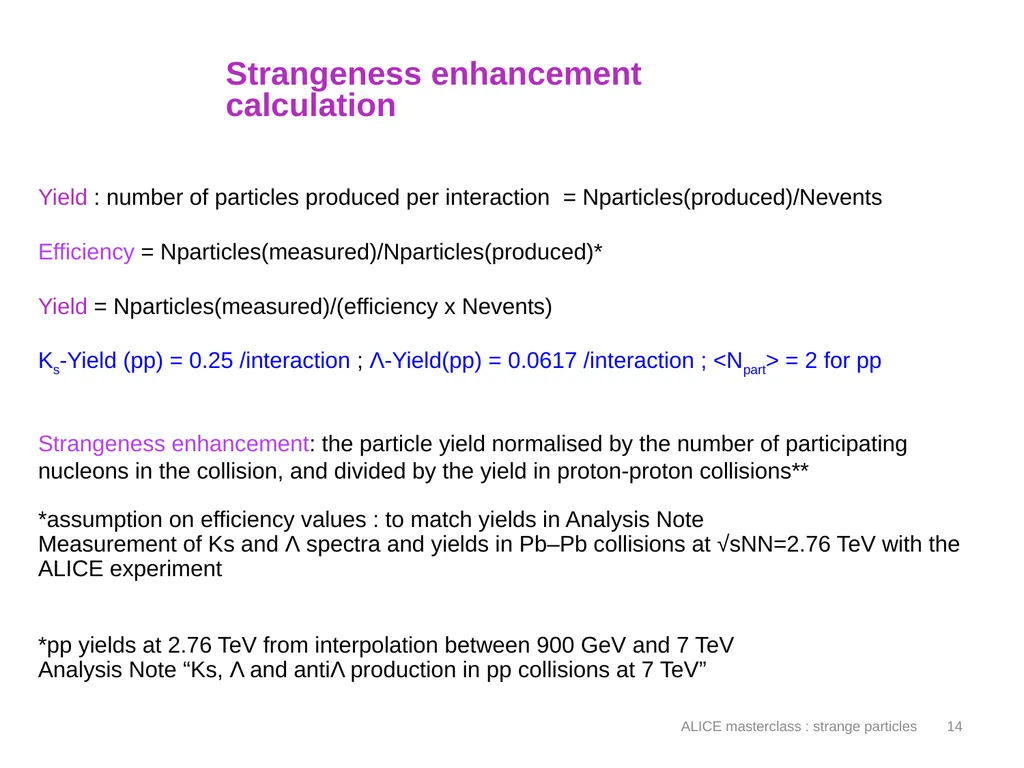
slide14. Strangeness enhancement calculation Yield : number of particles produced per interaction = Nparticles(produced)/Nevents
Efficiency = Nparticles(measured)/Nparticles(produced)*
Yield = Nparticles(measured)/(efficiency x Nevents)
Ks-Yield (pp) = 0.25 /interaction ; Λ-Yield(pp) = 0.0617 /interaction ; <Npart> = 2 for pp
Strangeness enhancement: the particle yield normalised by the number of participating nucleons in the collision, and divided by the yield in proton-proton collisions**
*assumption on efficiency values : to match yields in Analysis Note
Measurement of Ks and Λ spectra and yields in Pb–Pb collisions at √sNN=2.76 TeV with the ALICE experiment
*pp yields at 2.76 TeV from interpolation between 900 GeV and 7 TeV
Analysis Note “Ks, Λ and antiΛ production in pp collisions at 7 TeV” 14 ALICE masterclass : strange particles<br>
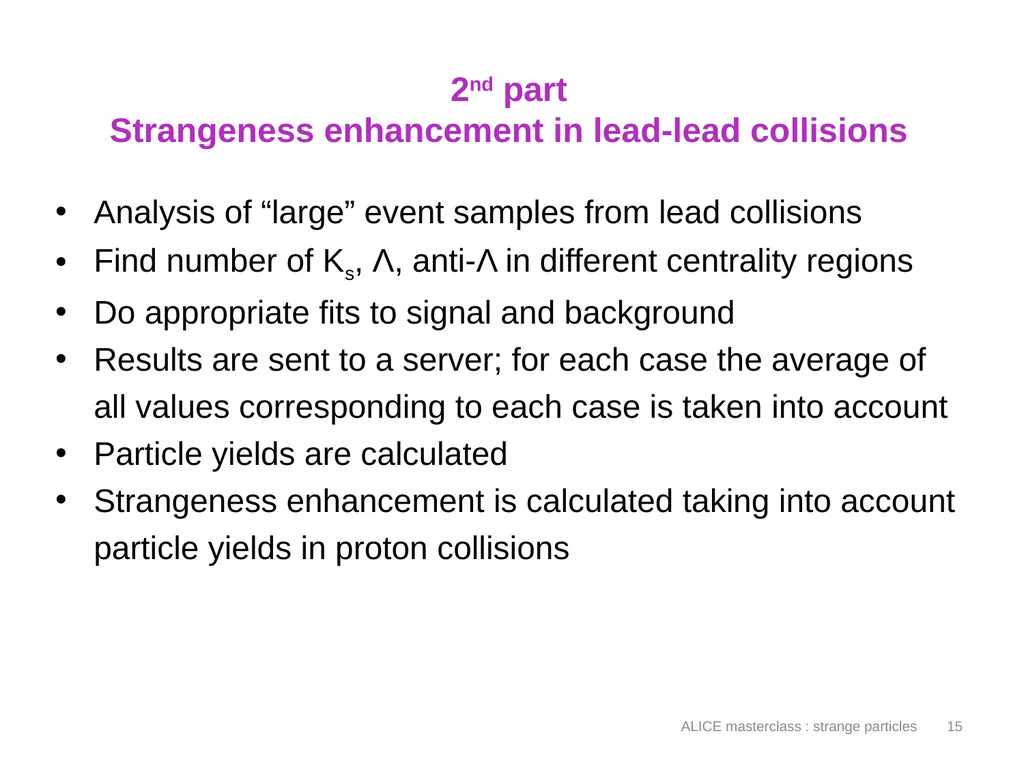
slide15. 15 2nd part
Strangeness enhancement in lead-lead collisions
Analysis of “large” event samples from lead collisions
Find number of Ks, Λ, anti-Λ in different centrality regions
Do appropriate fits to signal and background
Results are sent to a server; for each case the average of all values corresponding to each case is taken into account
Particle yields are calculated
Strangeness enhancement is calculated taking into account particle yields in proton collisions ALICE masterclass : strange particles<br>
INFN Bologna
despina.hatzifotiadou@cern.ch 10.09.25<br>
slide2. ALICE masterclass : strange particles 2 10.09.25<br>
slide3. _ _
ds, ds meson baryon uds s K0s hadrons (baryons or mesons) containing at least one strange (s) quark What are strange particles ? ALICE masterclass : strange particles 3 Λ 10.09.25<br>
slide4. We will be looking for neutral strange particles, which travel some distance (mm or cm) from the point of production (collision point) before they decay into two oppositely charged particles ALICE masterclass : strange particles 4 τ = 0.89 x10⁻¹⁰ s
cτ = 3x1010 cm s-1 x8.9x10-11 s
2.67 cm from the point of interaction
τ = 2.6 x10⁻¹⁰ s
cτ = 3x1010 cm s-1 x2.6x10-10 s
7.2 cm distance from the point of interaction K0s ® pp ® pp
_ _
L ® p+p Weak decays : strangeness is not conserved 10.09.25<br>
slide5. How do we find V0s ? We look for two opposite tracks, having the same origin, which is not the interaction (collision) point K0s→ p+p- L ®p-p ALICE masterclass : strange particles 5 10.09.25<br>
slide6. ALICE masterclass : strange particles 6 How do we find V0s ? We look for two opposite tracks, having the same origin, which is not the interaction (collision) point 10.09.25<br>
slide7. 7 ALICE masterclass : strange particles K0s ® pp L ® pp+ anti Λ→ p-π+ V0 decay :
a neutral particle (no track) gives suddenly two tracks How do we identify each V0? P = Q.B.R
P momentum
Q electric charge
B magnetic field
R radius of curvature Identify V0s from the decay topology 10.09.25<br>
slide8. Calculate the (invariant) mass
Energy conservation E = E1+E2
Momentum conservation p = p1+p2
Total energy E2 = p2c2 + m2c4
c=1 E2 = p2 + m2
E = E1+E2 E12 = p12 + m12 E22 = p22 + m22
E2 = p2 + m2 m2 = E2 - p2 =(E1+E2)2 -(p1+p2)2 = m12 + m22 +2E1E2 - 2 p1 .p2
Calculate the mass of the initial particle from the values of the mass and the momentum of the final particles
Particle Identification (done by a number of PID detectors) m1 m2
Radius of curvature of the particle tracks due to magnetic field p1 p2
P=Q.B.R (P momentum, Q electric charge, R radius of curvature, B magnetic field) How do we identify each V0? ALICE masterclass : strange particles 8 10.09.25<br>
slide9. ALICE masterclass : strange particles 9 1st part
Identification of V0s (Ks, Λ, anti-Λ) in pp collisions
Visual analysis of small samples (~15 events) of pp
Find V0s with “V0 finder”
Calculate invariant mass (with “calculator”)
Classify in corresponding histograms
Merge all results at the end of the 1st part
Comment on width of the peak, background events 10.09.25<br>
slide10. PDG: 1115.7 MeV K0s ® pp Fit functions describing the invariant mass distributions PDG: 497.6 MeV L ® pp 2nd degree polynomial for the background f(x) = ax2+bx+c
Gaussian for the peak ALICE masterclass : strange particles 10 Find the number of Ks, Λ, anti-Λ after subtraction of the background 10.09.25<br>
slide11. Geometry of a Pb-Pb collision Peripheral collision
Large distance between the centres of the nuclei
Small number of participants
Few charged particles produced (low multiplicity) Central collision
Small distance between the centres of the nuclei
Large number of participants
Many charged particles produced (high multiplicity) 11 ALICE masterclass : strange particles 10.09.25<br>
slide12. Distribution of the signal amplitude of V0 (plastic scintillators )
red line : described by model (Glauber) central
collisions peripheral
collisions Centrality of Pb-Pb collisions ALICE masterclass : strange particles 12 10.09.25<br>
slide13. Strangeness enhancement : one of the first signals of QGP Enhancement increases with number of strange quarks in the hadron (Ω has 3, Ξ has 2, Λ has 1) 13 Particle yield for Pb-Pb collisions/ the number of participants
-------------------------------------------------------------------------------------------------------Particle yield for proton-proton collisions / 2 ALICE masterclass : strange particles<br>
slide14. Strangeness enhancement calculation Yield : number of particles produced per interaction = Nparticles(produced)/Nevents
Efficiency = Nparticles(measured)/Nparticles(produced)*
Yield = Nparticles(measured)/(efficiency x Nevents)
Ks-Yield (pp) = 0.25 /interaction ; Λ-Yield(pp) = 0.0617 /interaction ; <Npart> = 2 for pp
Strangeness enhancement: the particle yield normalised by the number of participating nucleons in the collision, and divided by the yield in proton-proton collisions**
*assumption on efficiency values : to match yields in Analysis Note
Measurement of Ks and Λ spectra and yields in Pb–Pb collisions at √sNN=2.76 TeV with the ALICE experiment
*pp yields at 2.76 TeV from interpolation between 900 GeV and 7 TeV
Analysis Note “Ks, Λ and antiΛ production in pp collisions at 7 TeV” 14 ALICE masterclass : strange particles<br>
slide15. 15 2nd part
Strangeness enhancement in lead-lead collisions
Analysis of “large” event samples from lead collisions
Find number of Ks, Λ, anti-Λ in different centrality regions
Do appropriate fits to signal and background
Results are sent to a server; for each case the average of all values corresponding to each case is taken into account
Particle yields are calculated
Strangeness enhancement is calculated taking into account particle yields in proton collisions ALICE masterclass : strange particles<br>