
Labor Relations 1 Lunch with Labor Relations Labor
YM
Published · 30 slides · 0 views

1 / 1
Description
Labor Relations 1 Lunch with Labor Relations Labor Relations 2 Administrative Leave Labor Relations 3 In our area, requests for administrative leave generally occur during the winter season due to inclement weather; such as snow storms or
Related Topics
Share
Embed code
Download this presentation From Below
"Labor Relations 1 Lunch with Labor Relations Labor" is the property of its rightful owner. Permission is granted to download and print the materials on this website for personal, non-commercial use only, and to display it on your personal computer provided you do not modify the materials and that you retain all copyright notices contained in the materials. By downloading content from our website, you accept the terms of this agreement.
Presentation Transcript
01
Labor Relations 1 Lunch with
Labor Relations<br>
Labor Relations<br>
02
Labor Relations 2 Administrative Leave<br>
03
Labor Relations 3 In our area, requests for administrative leave generally occur during the winter season due to inclement weather; such as snow storms or hurricanes. It is essential that Postmasters/Managers make every effort to ensure that the course of action followed for granting or disapproving a request for administrative leave is consistent with service needs and due consideration given for employee’s safety, postal rules and regulations and local bargaining agreements. INTRODUCTION<br>
04
Labor Relations 4 WHAT IS ADMINISTRATIVE LEAVE? ELM 519.1 states: “Administrative leave is absence from duty authorized by appropriate postal officials without charge to annual or sick leave and without loss of pay.”
ELM 519.211 states: “Acts of God involve community disasters such as fire, flood, or storms. The disaster situation must be general rather than personal in scope and impact. It must prevent groups of employees from working or reporting to work.”<br>
ELM 519.211 states: “Acts of God involve community disasters such as fire, flood, or storms. The disaster situation must be general rather than personal in scope and impact. It must prevent groups of employees from working or reporting to work.”<br>
05
Labor Relations 5 WHO HAS AUTHORITY WHEN GRANTING ADMINISTRATIVE LEAVE? Postmasters and other installation heads have authority to grant Administrative Leave up to one day for Acts of God. District Managers and PCES plant managers have authority to grant Administrative Leave beyond one day but not more than 3 days. District Managers and Senior Plant Managers may also authorize Administrative Leave for periods beyond three days.<br>
06
Labor Relations 6 REFERENCES ELM 519.212 states in pertinent part: “Postmasters and other installation heads have authority to approve administrative leave….”
ELM 519.213 states: “Postmasters and other appropriate postal officials determine whether absences from duty allegedly due to “Acts of God” were, in fact, due to such cause or whether the employee or employees in question could, with due diligence, have reported for duty”.
ELM 519.216 states: “Employees on annual leave, sick leave, or LWOP remain in such status. They are not entitled to administrative leave.”<br>
ELM 519.213 states: “Postmasters and other appropriate postal officials determine whether absences from duty allegedly due to “Acts of God” were, in fact, due to such cause or whether the employee or employees in question could, with due diligence, have reported for duty”.
ELM 519.216 states: “Employees on annual leave, sick leave, or LWOP remain in such status. They are not entitled to administrative leave.”<br>
07
Labor Relations 7 Handling Administrative Leave Requests Due to Emergency Situations Determining the Cause of Absence
Postmasters and other appropriate Postal Service officials make the determination of whether an absence from duty allegedly due to an “Act of God” was, in fact due to such cause or whether the employee or employees in question could, with reasonable diligence, have reported for duty. [ELM 519.213]<br>
Postmasters and other appropriate Postal Service officials make the determination of whether an absence from duty allegedly due to an “Act of God” was, in fact due to such cause or whether the employee or employees in question could, with reasonable diligence, have reported for duty. [ELM 519.213]<br>
08
Labor Relations 8 Handling Administrative Leave Requests Due to Emergency Situations Criteria for Granting Administrative Leave
Each request for Administrative Leave must be evaluated on a case by case basis. There is an initial three part criterion to be satisfied prior to the granting of Administrative Leave for Acts of God, as follows:
An Act of God must involve a community disaster;
The disaster must be general rather than personal in scope and impact;
The disaster must prevent groups of employees from working or reporting to work. [ELM 519.211]<br>
Each request for Administrative Leave must be evaluated on a case by case basis. There is an initial three part criterion to be satisfied prior to the granting of Administrative Leave for Acts of God, as follows:
An Act of God must involve a community disaster;
The disaster must be general rather than personal in scope and impact;
The disaster must prevent groups of employees from working or reporting to work. [ELM 519.211]<br>
09
Labor Relations 9 BURDEN OF PROOF First and foremost, the employee/union must establish that there has been a “community disaster”. The burden of proof will be on the employee/union to establish his/her diligent efforts to report to work.<br>
10
Labor Relations 10 Handling Administrative Leave Requests Due to Emergency Situations When a request for administrative leave is denied, you can usually expect a grievance. Again, each absence must be evaluated on its own merit and when an employee requests administrative leave; they are required to show their diligent effort to report.
The following information is offered to assist local management in responding to those grievances and making a consistent, well-reasoned and supportable determination.<br>
The following information is offered to assist local management in responding to those grievances and making a consistent, well-reasoned and supportable determination.<br>
11
Labor Relations 11 Handling Administrative Leave Requests Due to Emergency Situations General Principles
Arbitral history demonstrates that the outcome of a grievance will be determined by the well-documented and individual facts of a particular case. The mere fact that a “state of emergency” has been declared, or a large amount of snow or rain has fallen, or the curtailment of mail delivery or operations will not always be the determinative factors of whether administrative leave should be granted or not. Consider the following questions when deciding to grant or deny administrative leave.<br>
Arbitral history demonstrates that the outcome of a grievance will be determined by the well-documented and individual facts of a particular case. The mere fact that a “state of emergency” has been declared, or a large amount of snow or rain has fallen, or the curtailment of mail delivery or operations will not always be the determinative factors of whether administrative leave should be granted or not. Consider the following questions when deciding to grant or deny administrative leave.<br>
12
Labor Relations 12 Handling Administrative Leave Requests Due to Emergency Situations General Principles
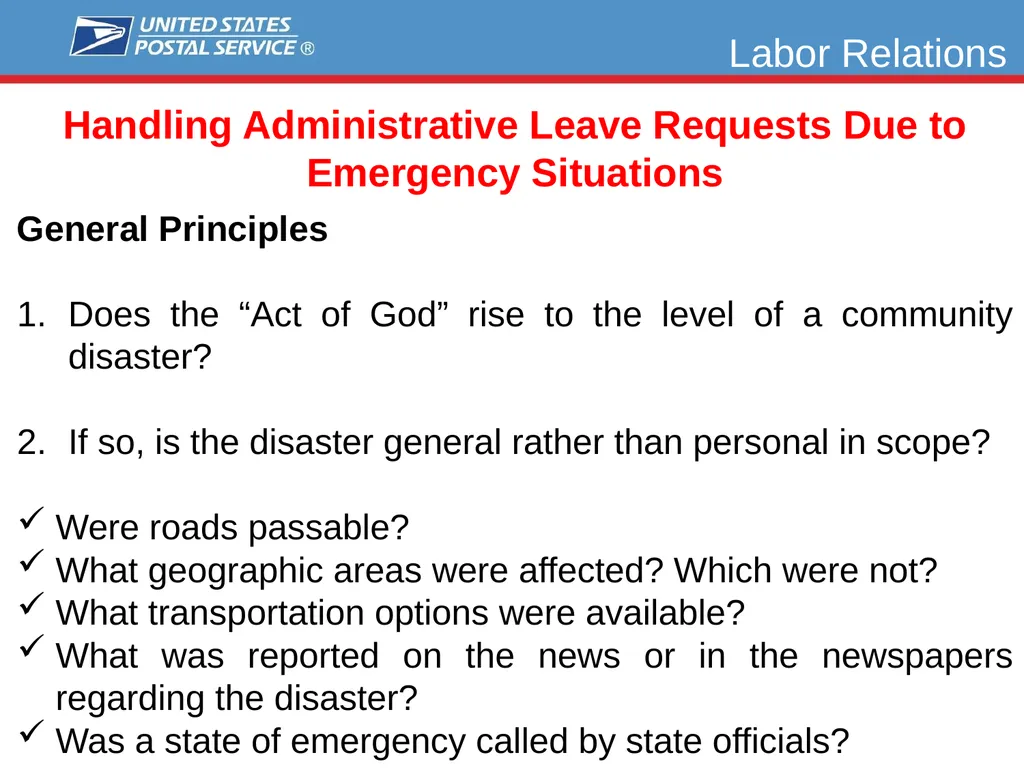
Does the “Act of God” rise to the level of a community disaster?
If so, is the disaster general rather than personal in scope?
Were roads passable?
What geographic areas were affected? Which were not?
What transportation options were available?
What was reported on the news or in the newspapers regarding the disaster?
Was a state of emergency called by state officials?<br>
Does the “Act of God” rise to the level of a community disaster?
If so, is the disaster general rather than personal in scope?
Were roads passable?
What geographic areas were affected? Which were not?
What transportation options were available?
What was reported on the news or in the newspapers regarding the disaster?
Was a state of emergency called by state officials?<br>
13
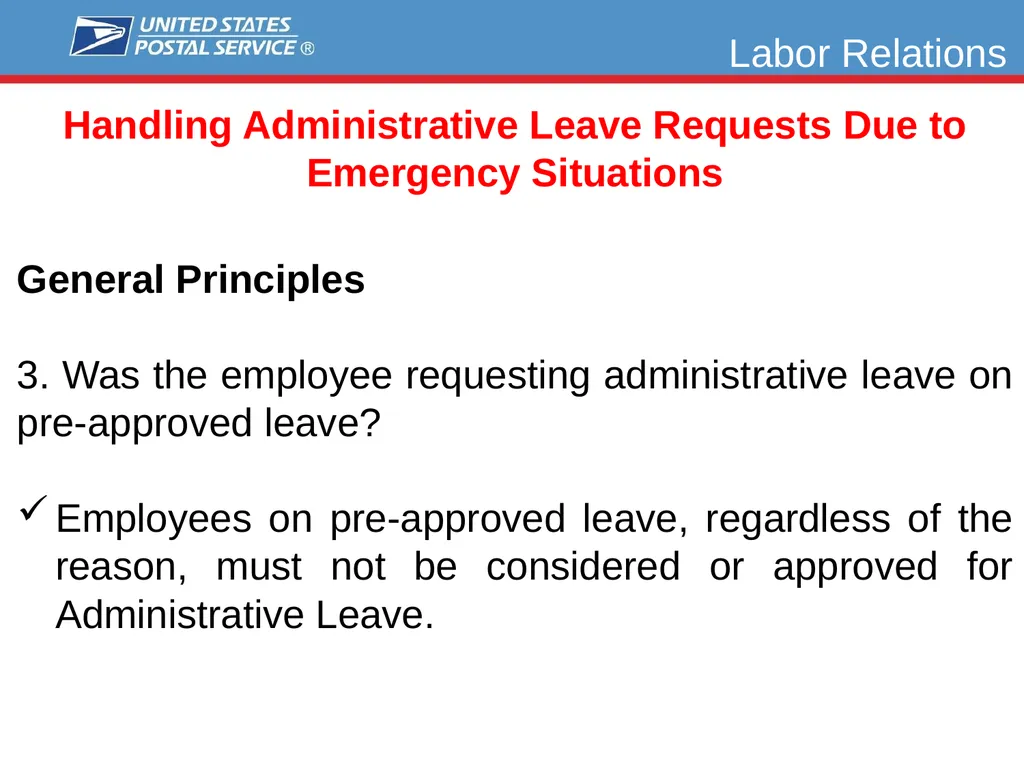
Labor Relations 13 Handling Administrative Leave Requests Due to Emergency Situations General Principles
3. Was the employee requesting administrative leave on pre-approved leave?
Employees on pre-approved leave, regardless of the reason, must not be considered or approved for Administrative Leave.<br>
3. Was the employee requesting administrative leave on pre-approved leave?
Employees on pre-approved leave, regardless of the reason, must not be considered or approved for Administrative Leave.<br>
14
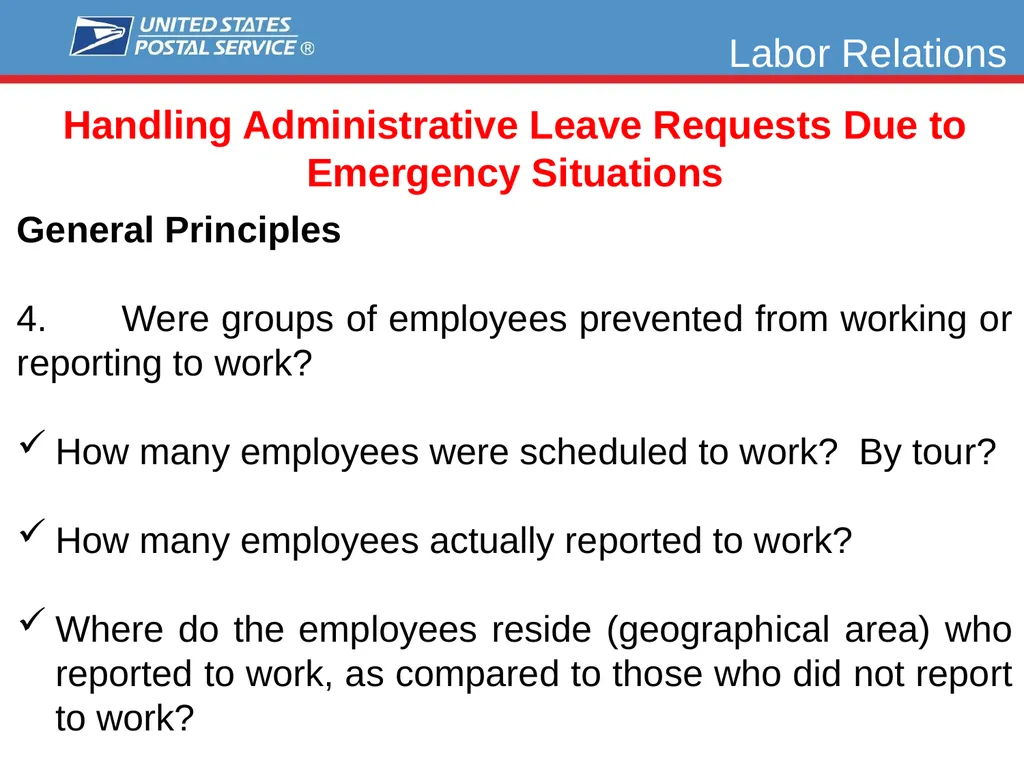
Labor Relations 14 Handling Administrative Leave Requests Due to Emergency Situations General Principles
4. Were groups of employees prevented from working or reporting to work?
How many employees were scheduled to work? By tour?
How many employees actually reported to work?
Where do the employees reside (geographical area) who reported to work, as compared to those who did not report to work?<br>
4. Were groups of employees prevented from working or reporting to work?
How many employees were scheduled to work? By tour?
How many employees actually reported to work?
Where do the employees reside (geographical area) who reported to work, as compared to those who did not report to work?<br>
15
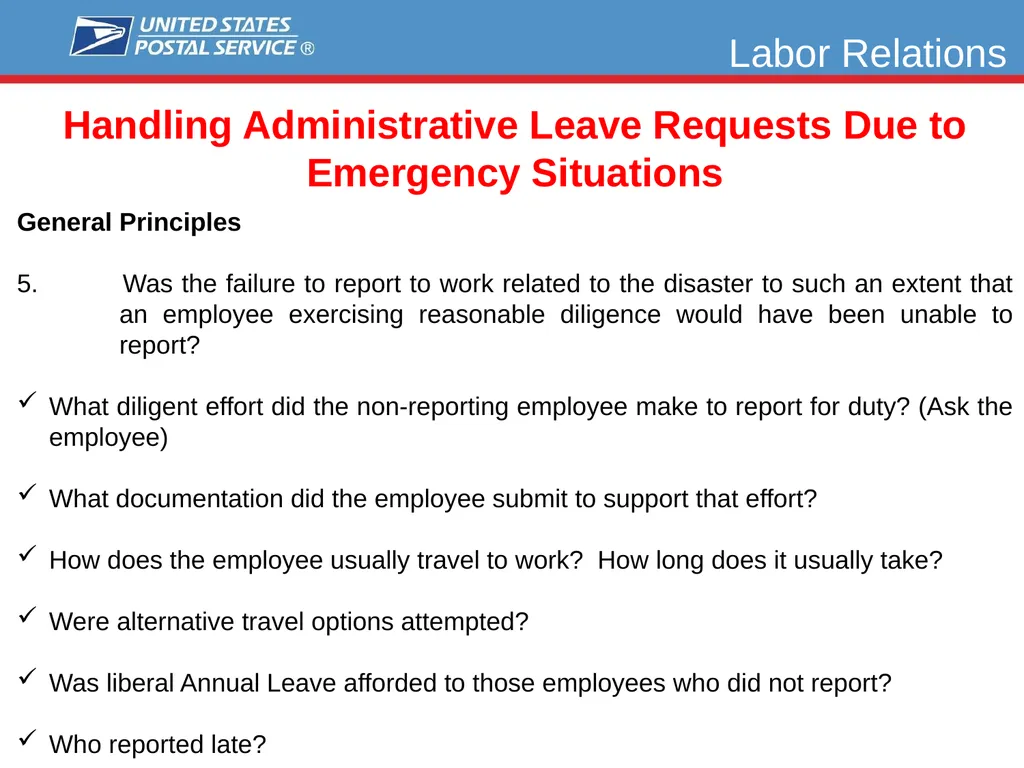
Labor Relations 15 Handling Administrative Leave Requests Due to Emergency Situations General Principles
5. Was the failure to report to work related to the disaster to such an extent that an employee exercising reasonable diligence would have been unable to report?
What diligent effort did the non-reporting employee make to report for duty? (Ask the employee)
What documentation did the employee submit to support that effort?
How does the employee usually travel to work? How long does it usually take?
Were alternative travel options attempted?
Was liberal Annual Leave afforded to those employees who did not report?
Who reported late?<br>
5. Was the failure to report to work related to the disaster to such an extent that an employee exercising reasonable diligence would have been unable to report?
What diligent effort did the non-reporting employee make to report for duty? (Ask the employee)
What documentation did the employee submit to support that effort?
How does the employee usually travel to work? How long does it usually take?
Were alternative travel options attempted?
Was liberal Annual Leave afforded to those employees who did not report?
Who reported late?<br>
16
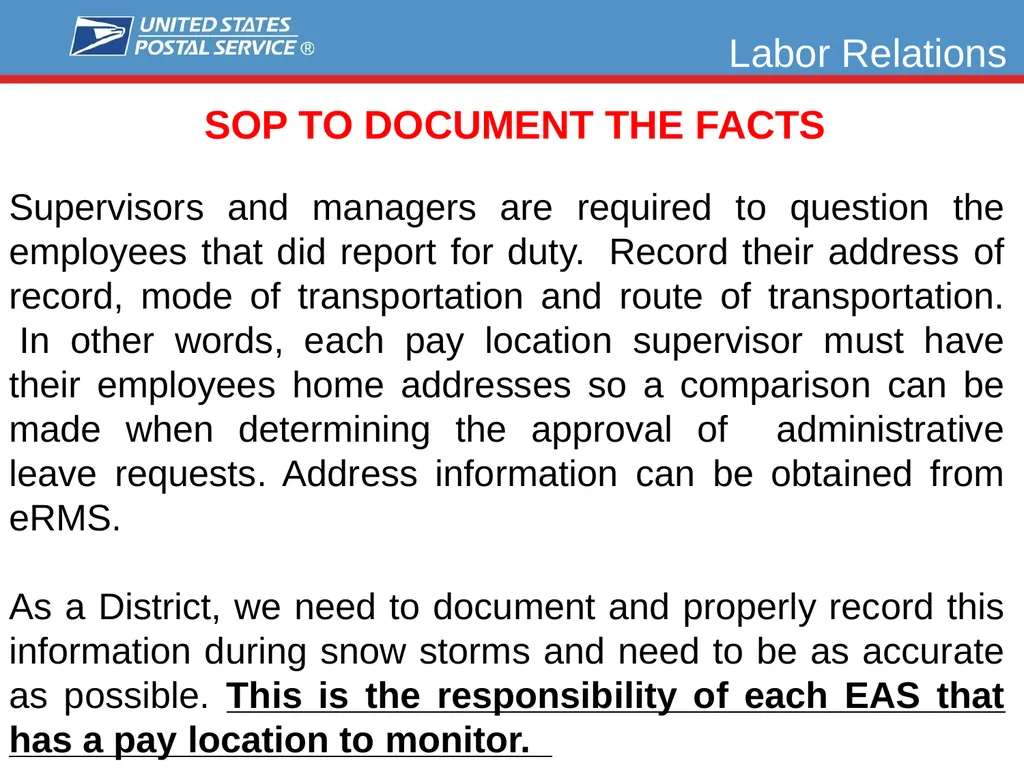
Labor Relations 16 SOP TO DOCUMENT THE FACTS Supervisors and managers are required to question the employees that did report for duty. Record their address of record, mode of transportation and route of transportation. In other words, each pay location supervisor must have their employees home addresses so a comparison can be made when determining the approval of administrative leave requests. Address information can be obtained from eRMS.
As a District, we need to document and properly record this information during snow storms and need to be as accurate as possible. This is the responsibility of each EAS that has a pay location to monitor.<br>
As a District, we need to document and properly record this information during snow storms and need to be as accurate as possible. This is the responsibility of each EAS that has a pay location to monitor.<br>
17
Labor Relations 17 HOW TO DOCUMENT THE FACTS It is essential that certain key information be collected at the time of the decision-making. For this purpose, please use the following forms, that should be filled out for every employee (all crafts) who request administrative leave based on an Act of God. Such information should be retained by the appropriate official in the event that a grievance is filed.<br>
18
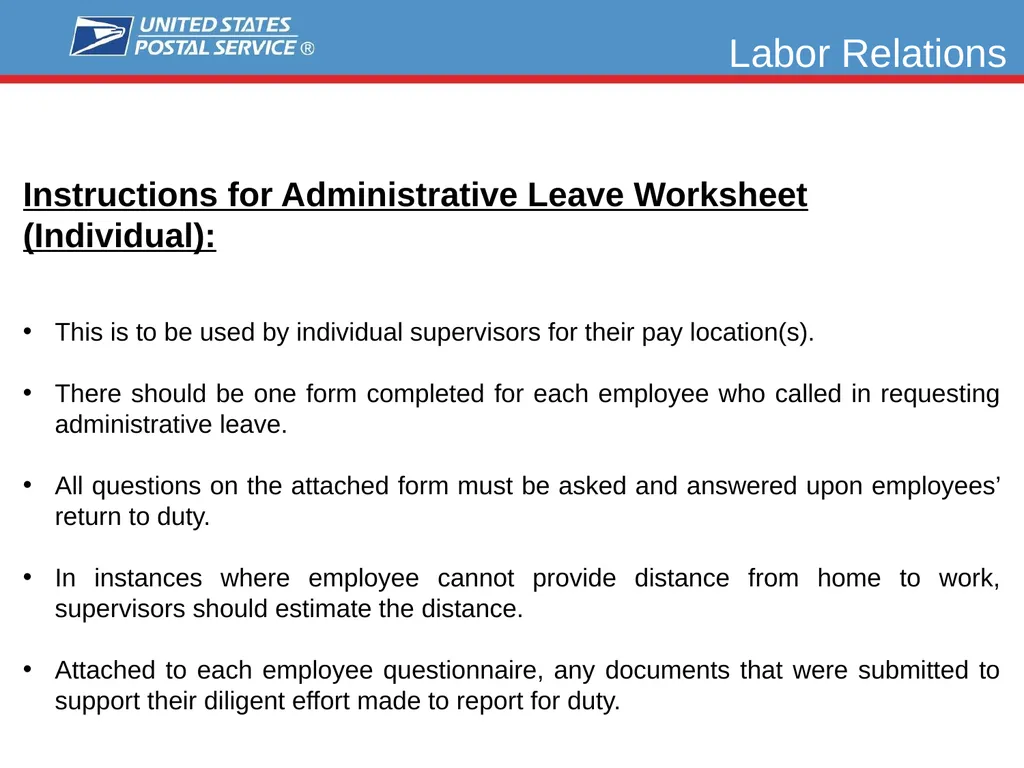
Labor Relations 18 Instructions for Administrative Leave Worksheet (Individual):
This is to be used by individual supervisors for their pay location(s).
There should be one form completed for each employee who called in requesting administrative leave.
All questions on the attached form must be asked and answered upon employees’ return to duty.
In instances where employee cannot provide distance from home to work, supervisors should estimate the distance.
Attached to each employee questionnaire, any documents that were submitted to support their diligent effort made to report for duty.<br>
This is to be used by individual supervisors for their pay location(s).
There should be one form completed for each employee who called in requesting administrative leave.
All questions on the attached form must be asked and answered upon employees’ return to duty.
In instances where employee cannot provide distance from home to work, supervisors should estimate the distance.
Attached to each employee questionnaire, any documents that were submitted to support their diligent effort made to report for duty.<br>
19
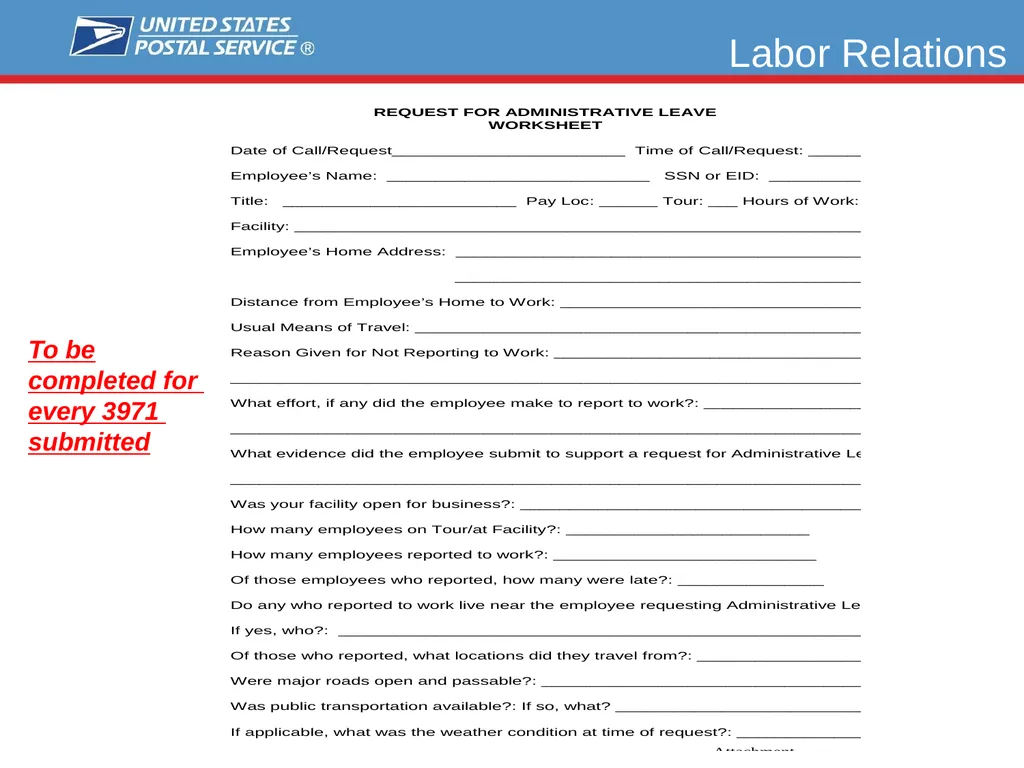
Labor Relations 19 To be
completed for
every 3971
submitted<br>
completed for
every 3971
submitted<br>
20
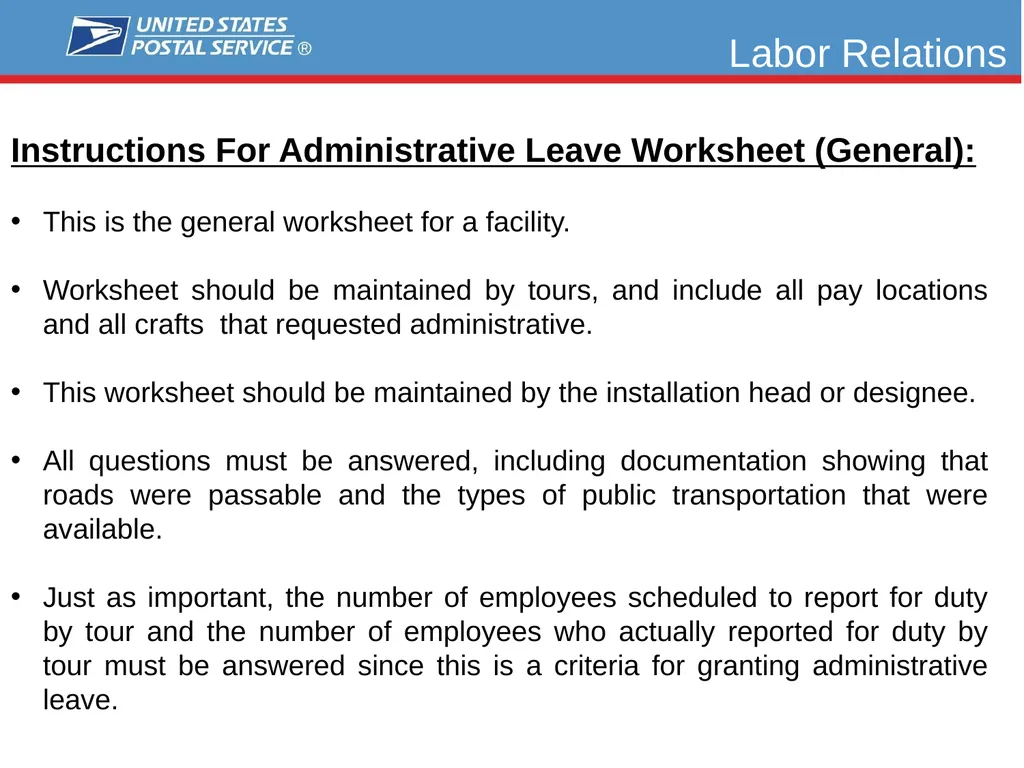
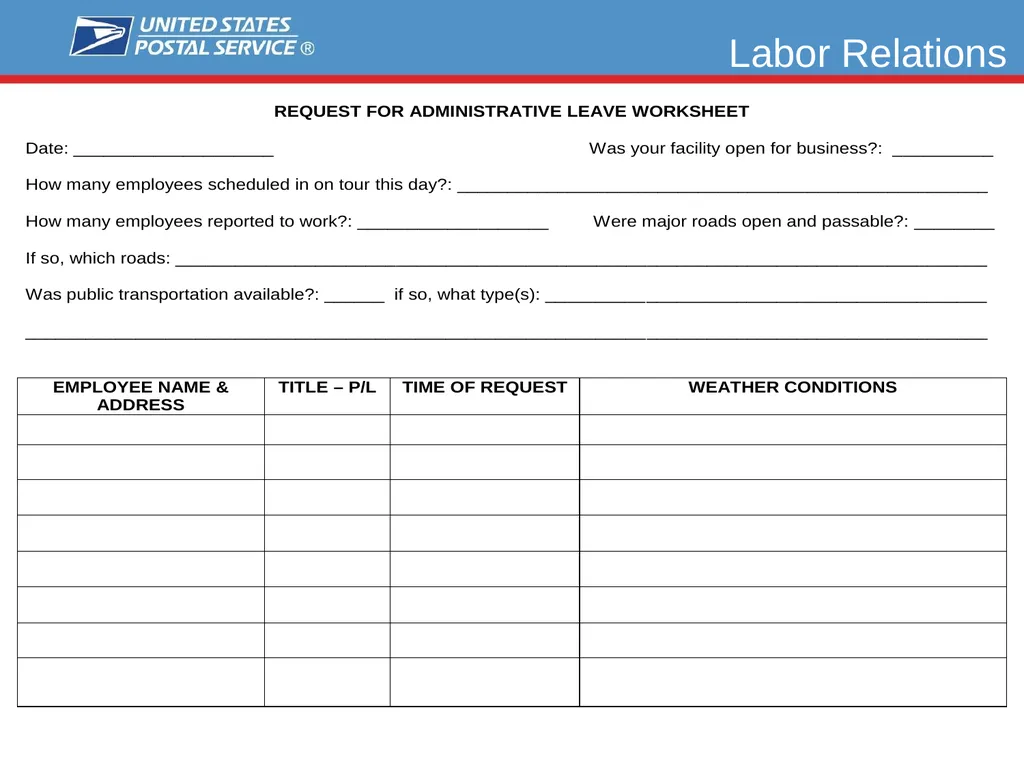
Labor Relations 20 Instructions For Administrative Leave Worksheet (General):
This is the general worksheet for a facility.
Worksheet should be maintained by tours, and include all pay locations and all crafts that requested administrative.
This worksheet should be maintained by the installation head or designee.
All questions must be answered, including documentation showing that roads were passable and the types of public transportation that were available.
Just as important, the number of employees scheduled to report for duty by tour and the number of employees who actually reported for duty by tour must be answered since this is a criteria for granting administrative leave.<br>
This is the general worksheet for a facility.
Worksheet should be maintained by tours, and include all pay locations and all crafts that requested administrative.
This worksheet should be maintained by the installation head or designee.
All questions must be answered, including documentation showing that roads were passable and the types of public transportation that were available.
Just as important, the number of employees scheduled to report for duty by tour and the number of employees who actually reported for duty by tour must be answered since this is a criteria for granting administrative leave.<br>
21
Labor Relations 21<br>
22
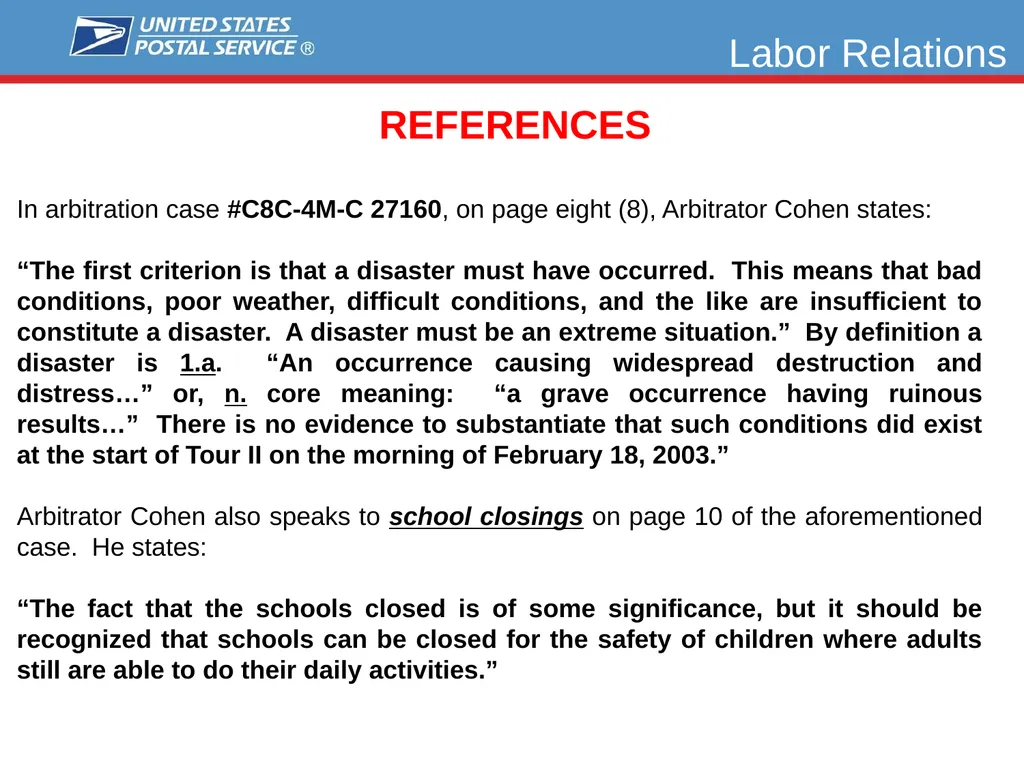
Labor Relations 22 REFERENCES In arbitration case #C8C-4M-C 27160, on page eight (8), Arbitrator Cohen states:
“The first criterion is that a disaster must have occurred. This means that bad conditions, poor weather, difficult conditions, and the like are insufficient to constitute a disaster. A disaster must be an extreme situation.” By definition a disaster is 1.a. “An occurrence causing widespread destruction and distress…” or, n. core meaning: “a grave occurrence having ruinous results…” There is no evidence to substantiate that such conditions did exist at the start of Tour II on the morning of February 18, 2003.”
Arbitrator Cohen also speaks to school closings on page 10 of the aforementioned case. He states:
“The fact that the schools closed is of some significance, but it should be recognized that schools can be closed for the safety of children where adults still are able to do their daily activities.”<br>
“The first criterion is that a disaster must have occurred. This means that bad conditions, poor weather, difficult conditions, and the like are insufficient to constitute a disaster. A disaster must be an extreme situation.” By definition a disaster is 1.a. “An occurrence causing widespread destruction and distress…” or, n. core meaning: “a grave occurrence having ruinous results…” There is no evidence to substantiate that such conditions did exist at the start of Tour II on the morning of February 18, 2003.”
Arbitrator Cohen also speaks to school closings on page 10 of the aforementioned case. He states:
“The fact that the schools closed is of some significance, but it should be recognized that schools can be closed for the safety of children where adults still are able to do their daily activities.”<br>
23
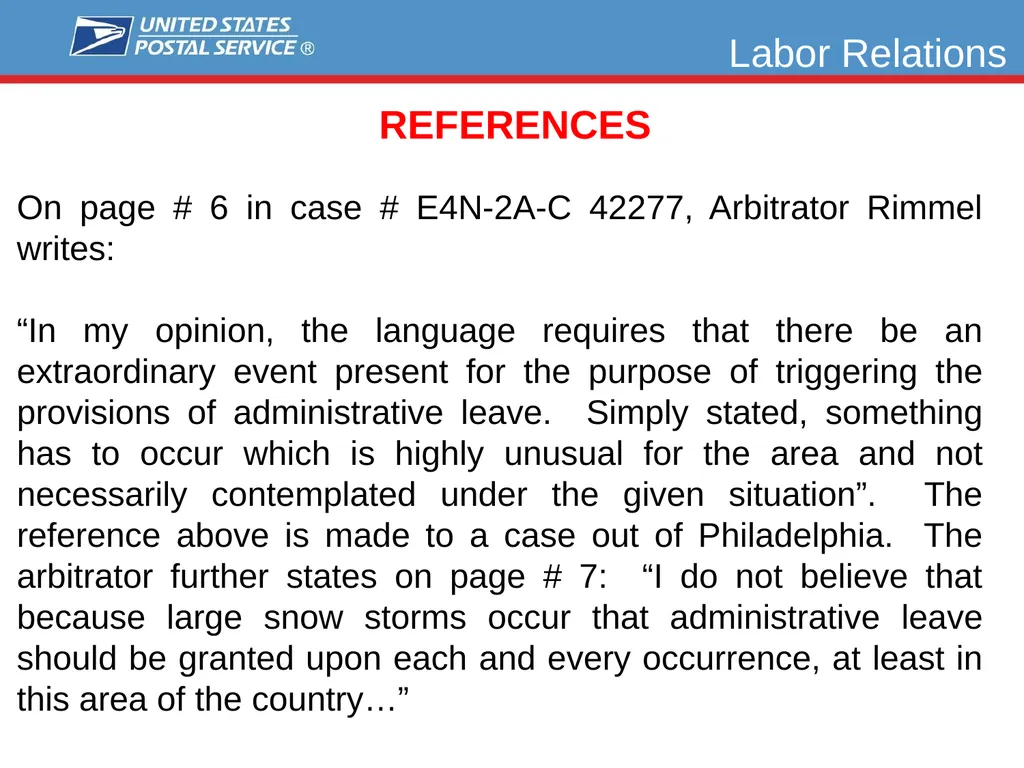
Labor Relations 23 REFERENCES On page # 6 in case # E4N-2A-C 42277, Arbitrator Rimmel writes:
“In my opinion, the language requires that there be an extraordinary event present for the purpose of triggering the provisions of administrative leave. Simply stated, something has to occur which is highly unusual for the area and not necessarily contemplated under the given situation”. The reference above is made to a case out of Philadelphia. The arbitrator further states on page # 7: “I do not believe that because large snow storms occur that administrative leave should be granted upon each and every occurrence, at least in this area of the country…”<br>
“In my opinion, the language requires that there be an extraordinary event present for the purpose of triggering the provisions of administrative leave. Simply stated, something has to occur which is highly unusual for the area and not necessarily contemplated under the given situation”. The reference above is made to a case out of Philadelphia. The arbitrator further states on page # 7: “I do not believe that because large snow storms occur that administrative leave should be granted upon each and every occurrence, at least in this area of the country…”<br>
24
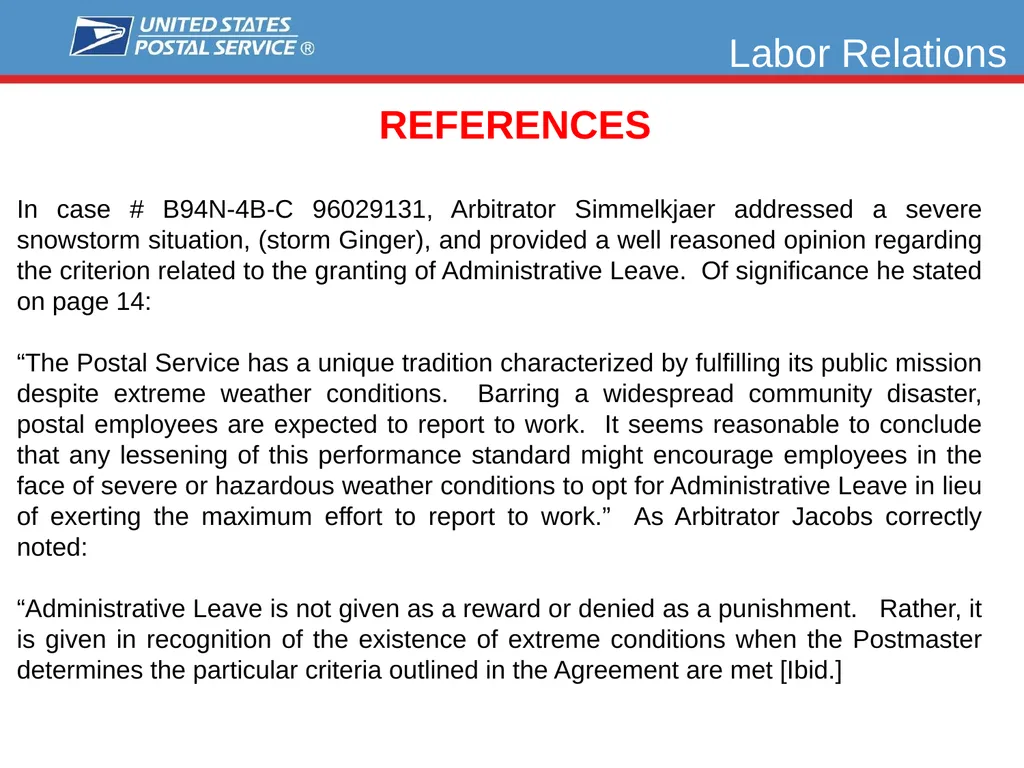
Labor Relations 24 REFERENCES In case # B94N-4B-C 96029131, Arbitrator Simmelkjaer addressed a severe snowstorm situation, (storm Ginger), and provided a well reasoned opinion regarding the criterion related to the granting of Administrative Leave. Of significance he stated on page 14:
“The Postal Service has a unique tradition characterized by fulfilling its public mission despite extreme weather conditions. Barring a widespread community disaster, postal employees are expected to report to work. It seems reasonable to conclude that any lessening of this performance standard might encourage employees in the face of severe or hazardous weather conditions to opt for Administrative Leave in lieu of exerting the maximum effort to report to work.” As Arbitrator Jacobs correctly noted:
“Administrative Leave is not given as a reward or denied as a punishment. Rather, it is given in recognition of the existence of extreme conditions when the Postmaster determines the particular criteria outlined in the Agreement are met [Ibid.]<br>
“The Postal Service has a unique tradition characterized by fulfilling its public mission despite extreme weather conditions. Barring a widespread community disaster, postal employees are expected to report to work. It seems reasonable to conclude that any lessening of this performance standard might encourage employees in the face of severe or hazardous weather conditions to opt for Administrative Leave in lieu of exerting the maximum effort to report to work.” As Arbitrator Jacobs correctly noted:
“Administrative Leave is not given as a reward or denied as a punishment. Rather, it is given in recognition of the existence of extreme conditions when the Postmaster determines the particular criteria outlined in the Agreement are met [Ibid.]<br>
25
Labor Relations 25 REFERENCES In case # A90C-4A-C 94029228, Arbitrator Rose F. Jacobs addresses the discretion a Postmaster has with Administrative Leave per ELM 519 and states in pertinent part beginning on pages 18 - 19:
“Of primary significance is the wording of the Administrative Leave provision giving authority to Postmasters to approve the leave up to one day. That wording is not a requirement and expresses a discretionary possibility rather than an obligation on the part of Management to grant the requested leave and supports Management’s position that the Manual provides no guaranteed employee benefit such as a negotiated leave program. Rather than a required benefit, the Manual gives the Postmaster the discretionary authority without the obligation or requirement to approve Administrative Leave. Therefore, without a requirement or obligation there can be no violation”. (emphasis added) She continues in her assessment of a disaster by concluding “[S]evere weather in and of itself does not fall within the industrial conception of an Act of God unless it renders the Employer inoperable and the immediate community impassable.<br>
“Of primary significance is the wording of the Administrative Leave provision giving authority to Postmasters to approve the leave up to one day. That wording is not a requirement and expresses a discretionary possibility rather than an obligation on the part of Management to grant the requested leave and supports Management’s position that the Manual provides no guaranteed employee benefit such as a negotiated leave program. Rather than a required benefit, the Manual gives the Postmaster the discretionary authority without the obligation or requirement to approve Administrative Leave. Therefore, without a requirement or obligation there can be no violation”. (emphasis added) She continues in her assessment of a disaster by concluding “[S]evere weather in and of itself does not fall within the industrial conception of an Act of God unless it renders the Employer inoperable and the immediate community impassable.<br>
26
Labor Relations 26 REFERENCES In case # B94N-4B-C 96030745, Arbitrator Wooters opined the following regarding the individual and personal choices various Postal employees make. He stated the following on pages 8 through 9:
“The Postal Service may not tell employees where to live. Nor may it determine what arrangements employees will make to get to work. Some employees may chose to purchase four wheel drive vehicles in order to deal with winter conditions in the Northeast. Some may choose to live closer to work than others. These choices may influence the ability to report to work in winter storm conditions. This does not mean, however, that when employees make choices which make it more difficult to report to work, they must be given administrative leave when foreseeable weather conditions make it more difficult to report to work.”<br>
“The Postal Service may not tell employees where to live. Nor may it determine what arrangements employees will make to get to work. Some employees may chose to purchase four wheel drive vehicles in order to deal with winter conditions in the Northeast. Some may choose to live closer to work than others. These choices may influence the ability to report to work in winter storm conditions. This does not mean, however, that when employees make choices which make it more difficult to report to work, they must be given administrative leave when foreseeable weather conditions make it more difficult to report to work.”<br>
27
Labor Relations 27 REFERENCES In case #C1M-4C-C 26510, Arbitrator Peter DiLeone dealt with a major snowstorm in Minnesota. He opined the following on page 7:
“There must be conditions of an unprecedented nature whose impact is so oppressive and burdensome as to make movement within a community almost impossible.”
He continued with:
“In the Twin Cities area, these storms are not unusual even when ten inches fall in a twenty-four hour period. It’s a lot of snow, and then inches can cause a lot of problems, but it is not necessarily a disaster…”<br>
“There must be conditions of an unprecedented nature whose impact is so oppressive and burdensome as to make movement within a community almost impossible.”
He continued with:
“In the Twin Cities area, these storms are not unusual even when ten inches fall in a twenty-four hour period. It’s a lot of snow, and then inches can cause a lot of problems, but it is not necessarily a disaster…”<br>
28
Labor Relations 28 REFERENCES It also must be said that the Postal Service and its Postal employees are not like other Employers and Employees. The Postal Service is unique in that we perform a vital function for the public. Arbitrator Cohen addresses that issue on page 10 in case # C8C-4B-C 35436. Arbitrator Cohen states:
“To a certain extent, any activity is risky and must be taken with a view as to what is at stake. In other words, one would not go to a movie in this storm. But attempting to get to work is another matter. The operation of the Postal Service requires that more risks be taken by its employees to get to work than is required by school children to get to school or by the employees of many other types of businesses. The Postal Service serves a vital public function akin to that of the police, fire department, city administrations, and the like. Its employees are expected to come to work except under disaster conditions. The evidence here did not disclose disaster conditions. It merely disclosed “severe” weather conditions, as many of the employees characterized in their statements. That is not sufficient to justify administrative leave.”<br>
“To a certain extent, any activity is risky and must be taken with a view as to what is at stake. In other words, one would not go to a movie in this storm. But attempting to get to work is another matter. The operation of the Postal Service requires that more risks be taken by its employees to get to work than is required by school children to get to school or by the employees of many other types of businesses. The Postal Service serves a vital public function akin to that of the police, fire department, city administrations, and the like. Its employees are expected to come to work except under disaster conditions. The evidence here did not disclose disaster conditions. It merely disclosed “severe” weather conditions, as many of the employees characterized in their statements. That is not sufficient to justify administrative leave.”<br>
29
Labor Relations 29 REFERENCES Finally, Postal employees do indeed bear a unique responsibility that other private sector employees do not have. Arbitrator Scearce comments on this in case # NIT-IE-C 4705 by opining:
“Finally, it is worth noting that Postal employees cannot be grouped into the same category of other working groups. They occupy a special place in our society and bear a public trust that requires a special effort on their part to meet their obligation—to move the mails.”<br>
“Finally, it is worth noting that Postal employees cannot be grouped into the same category of other working groups. They occupy a special place in our society and bear a public trust that requires a special effort on their part to meet their obligation—to move the mails.”<br>
30
Labor Relations 30 Questions?<br>