LAMENESS PART -V Fourth Professional(OLD) Dr. RAMESH TIWARY ASSSITANT PROFESSOR Department of Veterinary Surgery Radiology BVC, PATNA-14 Sand Crack A sand crack is a fissure in the wall of the hoof parallel to the horn tubules, extending
"LAMENESS PART -V Fourth Professional(OLD) Dr." is the property of its rightful owner. Permission is granted to
download and print the materials on this website for personal, non-commercial use only, and to display it
on your personal computer provided you do not modify the materials and that you retain all copyright
notices contained in the materials. By downloading content from our website, you accept the terms of this
agreement.
Presentation Transcript
01
LAMENESS PART -V
Fourth Professional(OLD) Dr. RAMESH TIWARY
ASSSITANT PROFESSOR
Department of Veterinary Surgery & Radiology
BVC, PATNA-14<br>
02
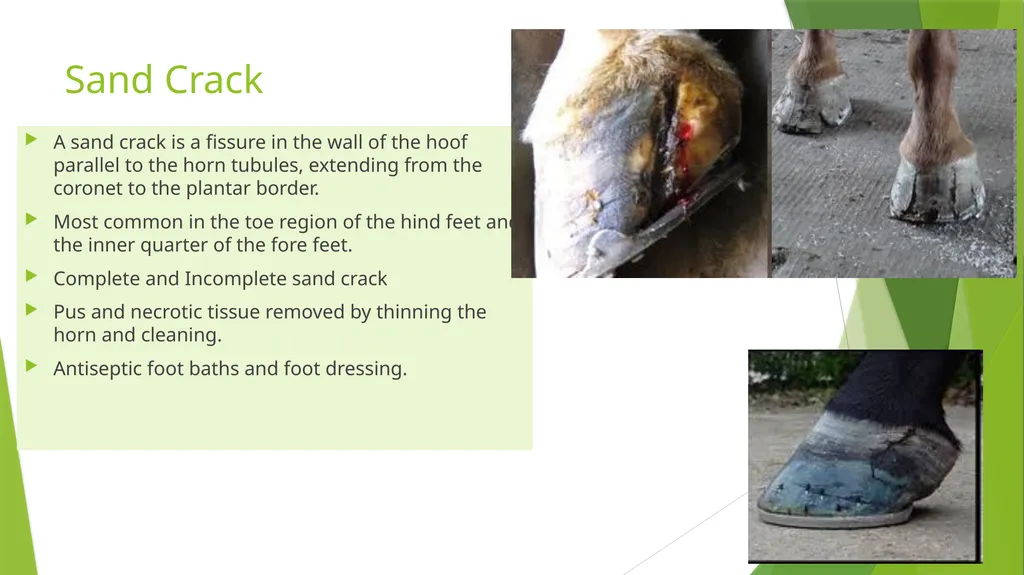
Sand Crack A sand crack is a fissure in the wall of the hoof parallel to the horn tubules, extending from the coronet to the plantar border.
Most common in the toe region of the hind feet and the inner quarter of the fore feet.
Complete and Incomplete sand crack
Pus and necrotic tissue removed by thinning the horn and cleaning.
Antiseptic foot baths and foot dressing.<br>
03
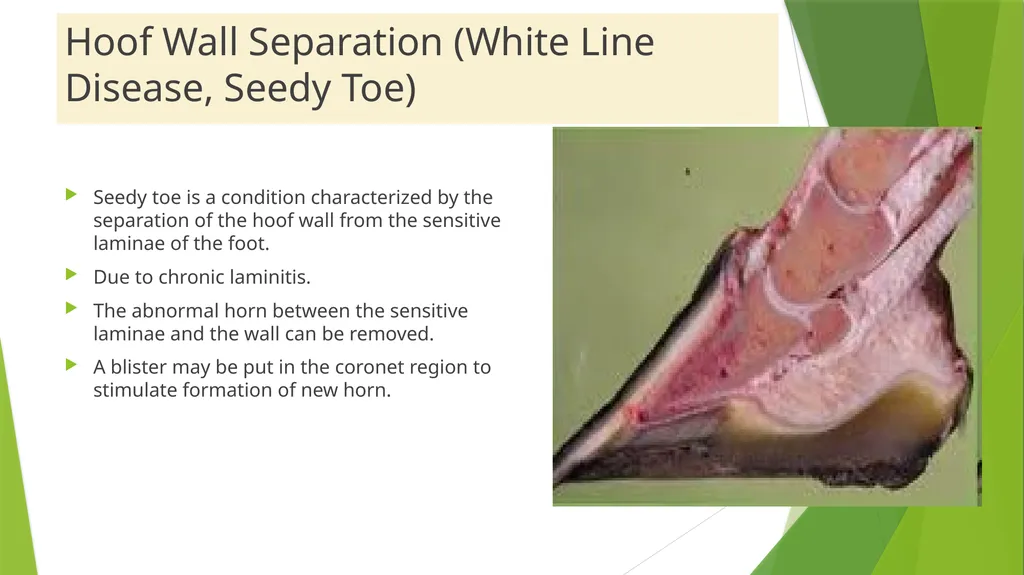
Hoof Wall Separation (White Line Disease, Seedy Toe) Seedy toe is a condition characterized by the separation of the hoof wall from the sensitive laminae of the foot.
Due to chronic laminitis.
The abnormal horn between the sensitive laminae and the wall can be removed.
A blister may be put in the coronet region to stimulate formation of new horn.<br>
04
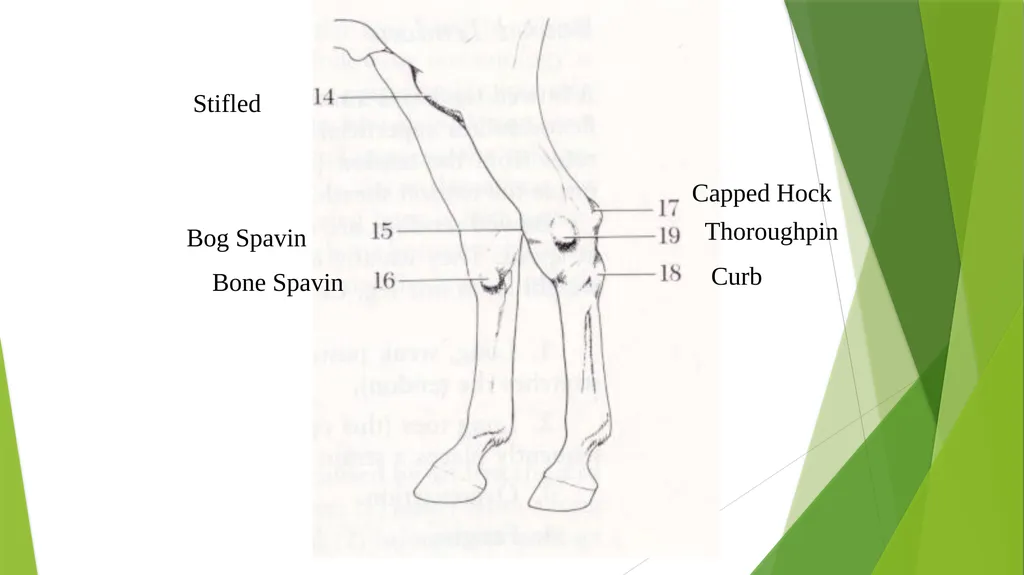
Stifled Bog Spavin Bone Spavin Capped Hock Thoroughpin Curb<br>
05
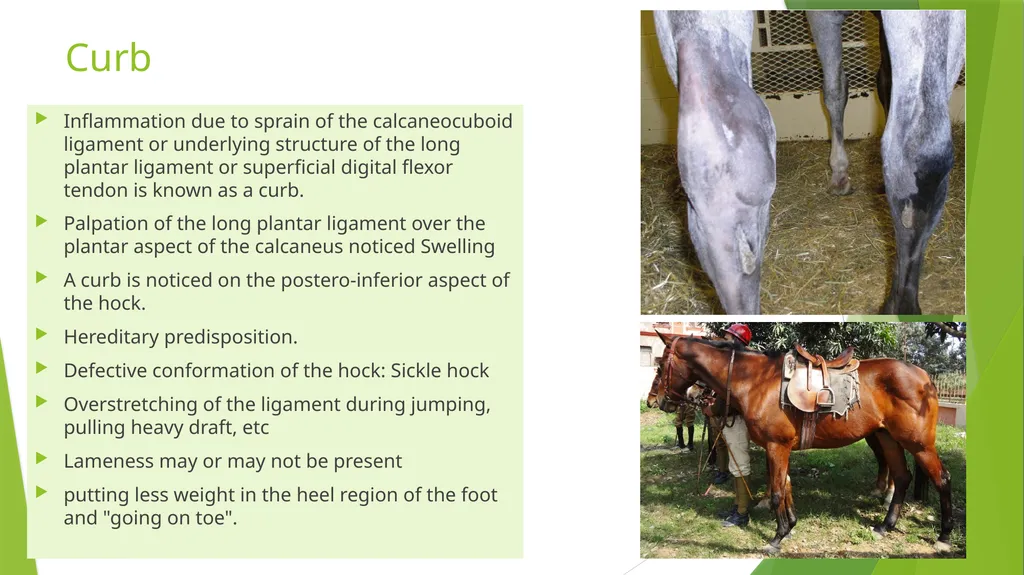
Curb Inflammation due to sprain of the calcaneocuboid ligament or underlying structure of the long plantar ligament or superficial digital flexor tendon is known as a curb.
Palpation of the long plantar ligament over the plantar aspect of the calcaneus noticed Swelling
A curb is noticed on the postero-inferior aspect of the hock.
Hereditary predisposition.
Defective conformation of the hock: Sickle hock
Overstretching of the ligament during jumping, pulling heavy draft, etc
Lameness may or may not be present
putting less weight in the heel region of the foot and "going on toe".<br>
06
Treatment In the acute stage rest and cold and astringent applications.
No lameness after about three weeks, but the local enlargement may persist.
In chronic stage iodine ointment, blistering, firing, etc.<br>
07
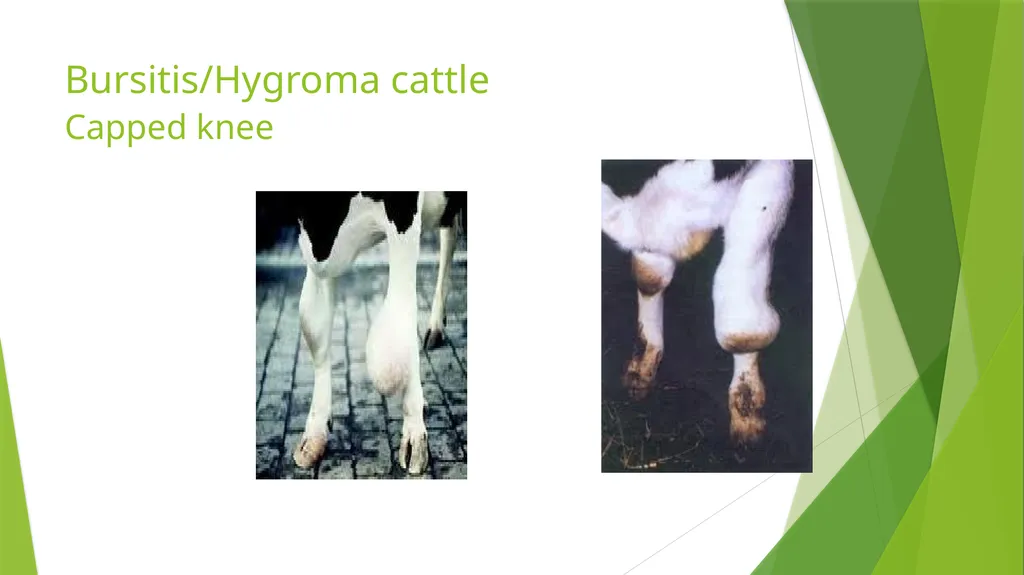
Bursitis/Hygroma cattle Capped knee<br>
08
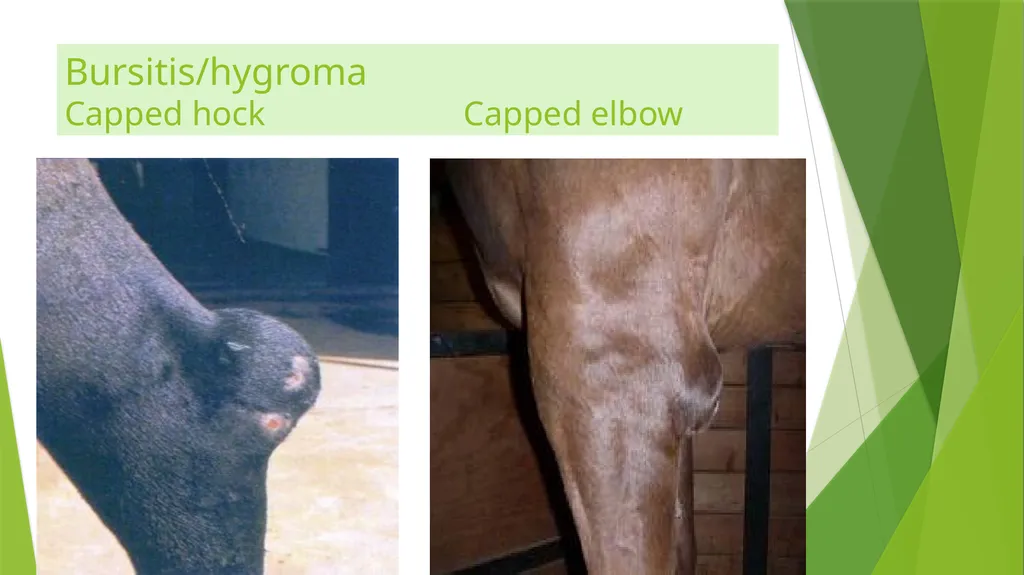
Bursitis/hygroma Capped hock Capped elbow<br>
09
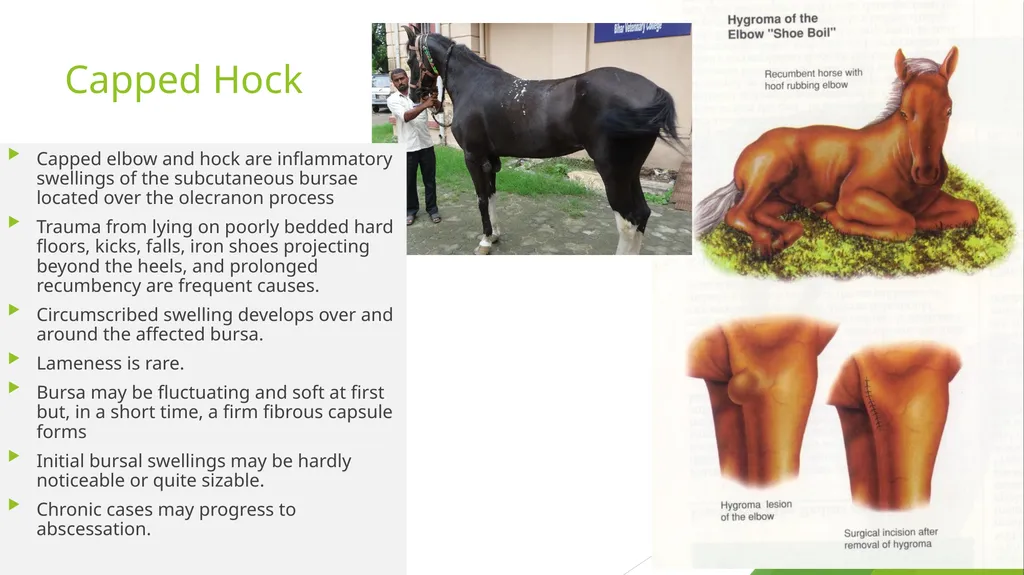
Capped Hock Capped elbow and hock are inflammatory swellings of the subcutaneous bursae located over the olecranon process
Trauma from lying on poorly bedded hard floors, kicks, falls, iron shoes projecting beyond the heels, and prolonged recumbency are frequent causes.
Circumscribed swelling develops over and around the affected bursa.
Lameness is rare.
Bursa may be fluctuating and soft at first but, in a short time, a firm fibrous capsule forms
Initial bursal swellings may be hardly noticeable or quite sizable.
Chronic cases may progress to abscessation.<br>
10
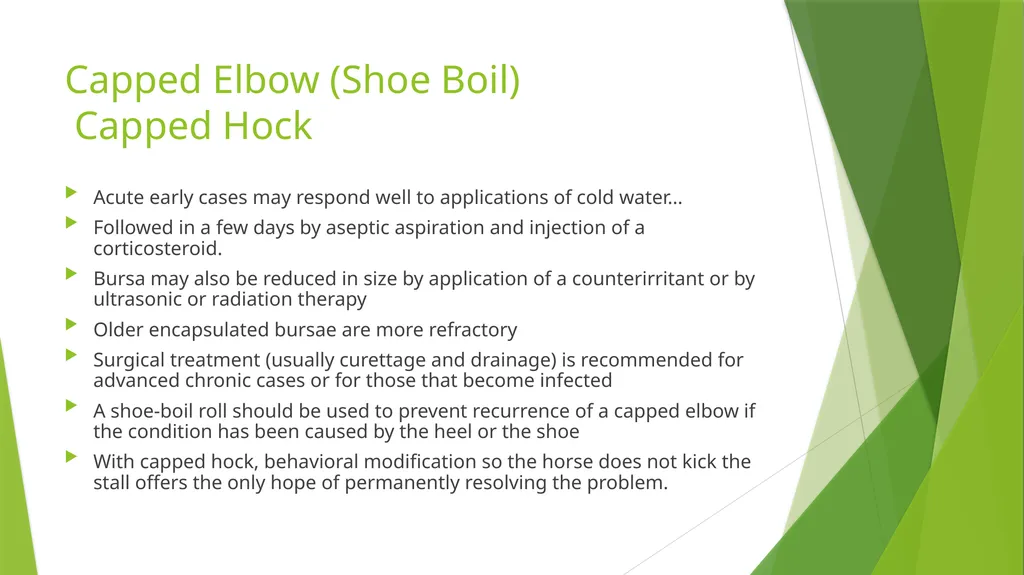
Acute early cases may respond well to applications of cold water…
Followed in a few days by aseptic aspiration and injection of a corticosteroid.
Bursa may also be reduced in size by application of a counterirritant or by ultrasonic or radiation therapy
Older encapsulated bursae are more refractory
Surgical treatment (usually curettage and drainage) is recommended for advanced chronic cases or for those that become infected
A shoe-boil roll should be used to prevent recurrence of a capped elbow if the condition has been caused by the heel or the shoe
With capped hock, behavioral modification so the horse does not kick the stall offers the only hope of permanently resolving the problem. Capped Elbow (Shoe Boil) Capped Hock<br>