
Language, Meaning, and Rational Thought Ray
T
Published · 111 slides · 0 views

1 / 1
Description
Language, Meaning, and Rational Thought Ray Jackendoff Tufts UniversityMIT What is it like when youre thinking? Common intuition: Thinking is talking to yourself inner speech Plato (The Sophist): Are not thought and speech the same,
Related Topics
Share
Embed code
Download this presentation From Below
"Language, Meaning, and Rational Thought Ray" is the property of its rightful owner. Permission is granted to download and print the materials on this website for personal, non-commercial use only, and to display it on your personal computer provided you do not modify the materials and that you retain all copyright notices contained in the materials. By downloading content from our website, you accept the terms of this agreement.
Presentation Transcript
01
Language, Meaning, and
Rational Thought Ray Jackendoff
Tufts University/MIT<br>
Tufts University/MIT<br>
02
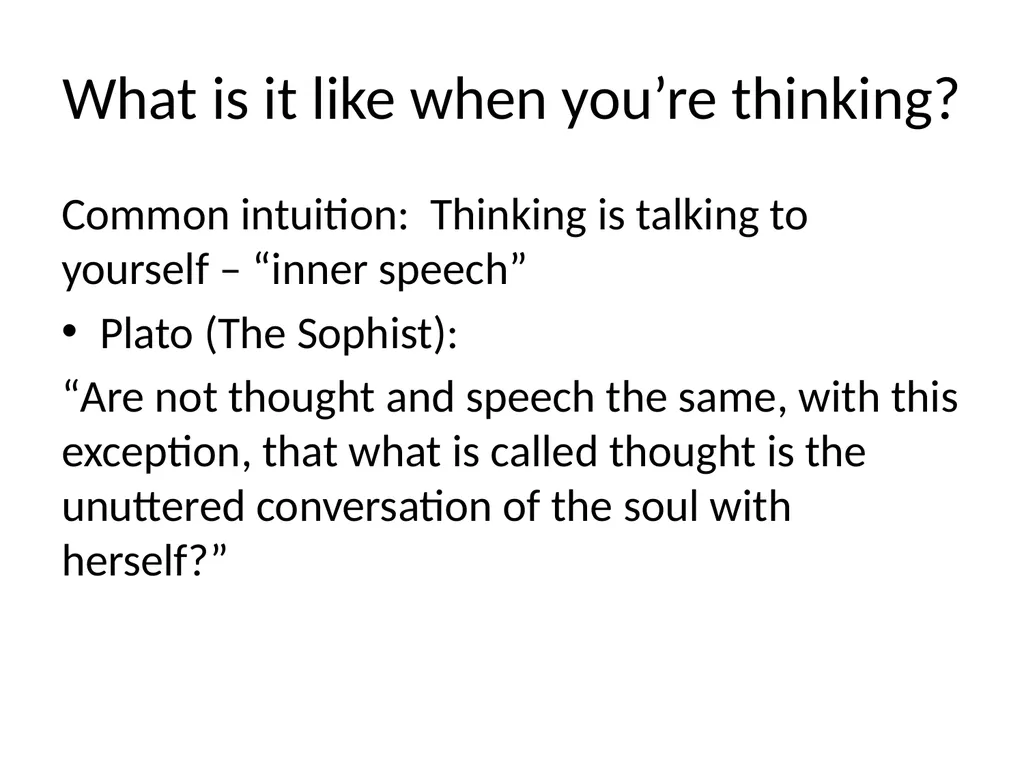
What is it like when you’re thinking? Common intuition: Thinking is talking to yourself – “inner speech”
Plato (The Sophist):
“Are not thought and speech the same, with this exception, that what is called thought is the unuttered conversation of the soul with herself?”<br>
Plato (The Sophist):
“Are not thought and speech the same, with this exception, that what is called thought is the unuttered conversation of the soul with herself?”<br>
03
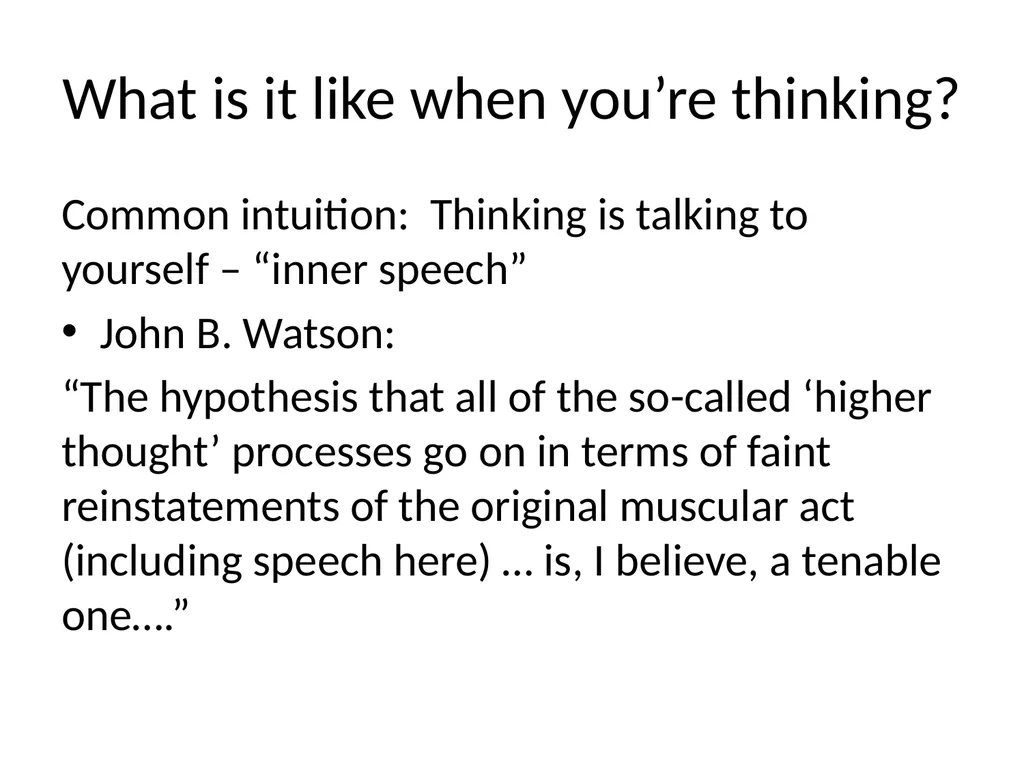
What is it like when you’re thinking? Common intuition: Thinking is talking to yourself – “inner speech”
John B. Watson:
“The hypothesis that all of the so-called ‘higher thought’ processes go on in terms of faint reinstatements of the original muscular act (including speech here) … is, I believe, a tenable one….”<br>
John B. Watson:
“The hypothesis that all of the so-called ‘higher thought’ processes go on in terms of faint reinstatements of the original muscular act (including speech here) … is, I believe, a tenable one….”<br>
04
What is it like when you’re thinking? Common intuition: Thinking is talking to yourself – “inner speech”
Peter Carruthers:
“It is images of natural language sentences which are the primary vehicles of our conscious thoughts. [Even my 4½ year-old son said,] ‘I think in English… I can hear myself think.’”<br>
Peter Carruthers:
“It is images of natural language sentences which are the primary vehicles of our conscious thoughts. [Even my 4½ year-old son said,] ‘I think in English… I can hear myself think.’”<br>
05
What is it like when you’re thinking? Common intuition: Thinking is talking to yourself – “inner speech”
Noam Chomsky:
“Language is not properly regarded as a system of communication. It is a system for expressing thought, something quite different…. Language use is largely to oneself: ‘inner speech’ for adults, monologue for children.”<br>
Noam Chomsky:
“Language is not properly regarded as a system of communication. It is a system for expressing thought, something quite different…. Language use is largely to oneself: ‘inner speech’ for adults, monologue for children.”<br>
06
What is it like when you’re thinking? Common intuition: Thinking is talking to yourself – “inner speech”
Ludwig Wittgenstein:
“When I think in language, there aren’t ‘meanings’ going through my mind in addition to the verbal expressions: the language is itself the vehicle of thought.<br>
Ludwig Wittgenstein:
“When I think in language, there aren’t ‘meanings’ going through my mind in addition to the verbal expressions: the language is itself the vehicle of thought.<br>
07
Problems with thought as inner speech 1. Wittgenstein again:
“‘So you really wanted to say....’.... One is tempted to use the following picture: what he really ‘wanted to say’, what he ‘meant’ was already present somewhere in his mind even before we gave it expression.”
– which implies that there’s some sort of meaning/thought independent of the language.<br>
“‘So you really wanted to say....’.... One is tempted to use the following picture: what he really ‘wanted to say’, what he ‘meant’ was already present somewhere in his mind even before we gave it expression.”
– which implies that there’s some sort of meaning/thought independent of the language.<br>
08
Problems with thought as inner speech 2. If the thought = the linguistic expression, how can we translate (even roughly) between languages?<br>
09
Problems with thought as inner speech If the thought = the linguistic expression, how can we translate (even roughly) between languages?
3. What are we saying when we say two sentences mean the same thing? (The lion chased the bear vs. The bear was chased by the lion)<br>
3. What are we saying when we say two sentences mean the same thing? (The lion chased the bear vs. The bear was chased by the lion)<br>
10
Problems with thought as inner speech If the thought = the linguistic expression, how can we translate (even roughly) between languages?
3. What are we saying when we say two sentences mean the same thing? (The lion chased the bear vs. The bear was chased by the lion)
4. How could animals think? (and they do!)<br>
3. What are we saying when we say two sentences mean the same thing? (The lion chased the bear vs. The bear was chased by the lion)
4. How could animals think? (and they do!)<br>
11
Problems with thought as inner speech A different intuition (Chomsky): Language expresses thought.
But then:<br>
But then:<br>
12
Problems with thought as inner speech A different intuition (Chomsky): Language expresses thought.
But then:
WHAT’S THE THOUGHT THAT LANGUAGE EXPRESSES?<br>
But then:
WHAT’S THE THOUGHT THAT LANGUAGE EXPRESSES?<br>
13
What’s language?
What are words and sentences?<br>
14
What’s language?
What are words and sentences? Words and sentences wouldn’t exist if there weren’t people using them.<br>
15
What’s language?
What are words and sentences? Words and sentences wouldn’t exist if there weren’t people using them.
The cognitive perspective: What’s going on in people when they speak or understand words and sentences?<br>
The cognitive perspective: What’s going on in people when they speak or understand words and sentences?<br>
16
What’s language?
What are words and sentences? Words and sentences wouldn’t exist if there weren’t people using them.
The cognitive perspective: What’s going on in people when they speak or understand words and sentences?
A word is a linkage in a speaker’s longterm memory between a pronunciation and a concept (the word’s meaning).<br>
The cognitive perspective: What’s going on in people when they speak or understand words and sentences?
A word is a linkage in a speaker’s longterm memory between a pronunciation and a concept (the word’s meaning).<br>
17
What’s language?
What are words and sentences? Words and sentences wouldn’t exist if there weren’t people using them.
The cognitive perspective: What’s going on in people when they speak or understand words and sentences?
A word is a linkage in a speaker’s longterm memory between a pronunciation and a concept (the word’s meaning).
But WHAT’S A CONCEPT??<br>
The cognitive perspective: What’s going on in people when they speak or understand words and sentences?
A word is a linkage in a speaker’s longterm memory between a pronunciation and a concept (the word’s meaning).
But WHAT’S A CONCEPT??<br>
18
What does a concept have
to be able to do? 1. Reference: Identifying and categorizing things in the environment as coded in the mind by perception: That is an X.<br>
19
What does a concept have
to be able to do? Reference: Identifying and categorizing things in the environment as coded in the mind by perception: That is an X.
Inference: If something is an X,
It does such-and-such
You can do such-and-such with it
It’s worth such-and-such
etc.<br>
Inference: If something is an X,
It does such-and-such
You can do such-and-such with it
It’s worth such-and-such
etc.<br>
20
What does a concept have
to be able to do? Inference in perception: If that thing turns around, it will have a back – it won’t be a hollow shell.<br>
21
What does a concept have
to be able to do? Inference in perception: If that thing turns around, it will have a back – it won’t be a hollow shell.
Inferential patterns among concepts stored in memory as links in a semantic network.<br>
Inferential patterns among concepts stored in memory as links in a semantic network.<br>
22
What’s a word? Word = linkage of pronunciation (stored in memory) and a concept (stored in memory)<br>
23
What’s a word? Word = linkage of pronunciation (stored in memory) and a concept (stored in memory)
Nonsense syllable (thit, squig) has pronunciation not linked to concept.
“Sniglets” are concepts not linked to words.<br>
Nonsense syllable (thit, squig) has pronunciation not linked to concept.
“Sniglets” are concepts not linked to words.<br>
24
What’s a sentence? Sentence = linkage of pronunciation and a meaning in speaker’s head. Sentences are (typically) not memorized, so linkage is established in working memory.<br>
25
What’s a sentence? Sentence = linkage of pronunciation and a meaning in speaker’s head. Sentences are (typically) not memorized, so linkage is established in working memory.
Pronunciation made up of pronunciations of words in the sentence
Meaning made up of meanings of words – plus “other stuff,” pieces of meaning that don’t come from the words<br>
Pronunciation made up of pronunciations of words in the sentence
Meaning made up of meanings of words – plus “other stuff,” pieces of meaning that don’t come from the words<br>
26
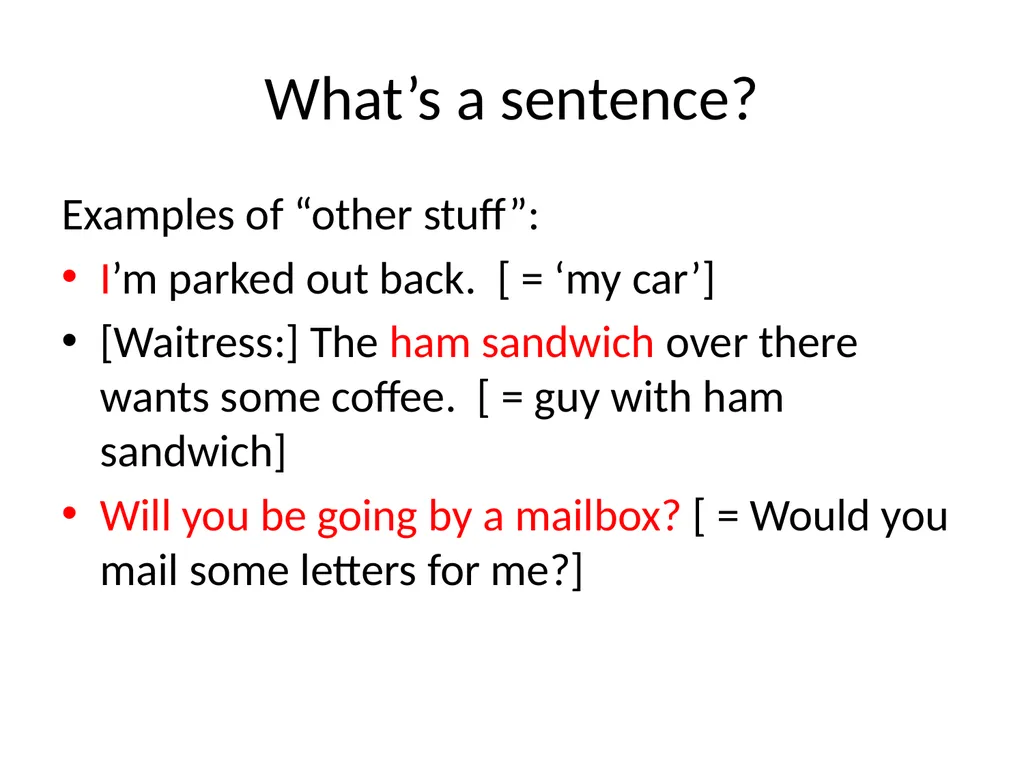
What’s a sentence? Examples of “other stuff”:
I’m parked out back. [ = ‘my car’]
[Waitress:] The ham sandwich over there wants some coffee. [ = guy with ham sandwich]
Will you be going by a mailbox? [ = Would you mail some letters for me?]<br>
I’m parked out back. [ = ‘my car’]
[Waitress:] The ham sandwich over there wants some coffee. [ = guy with ham sandwich]
Will you be going by a mailbox? [ = Would you mail some letters for me?]<br>
27
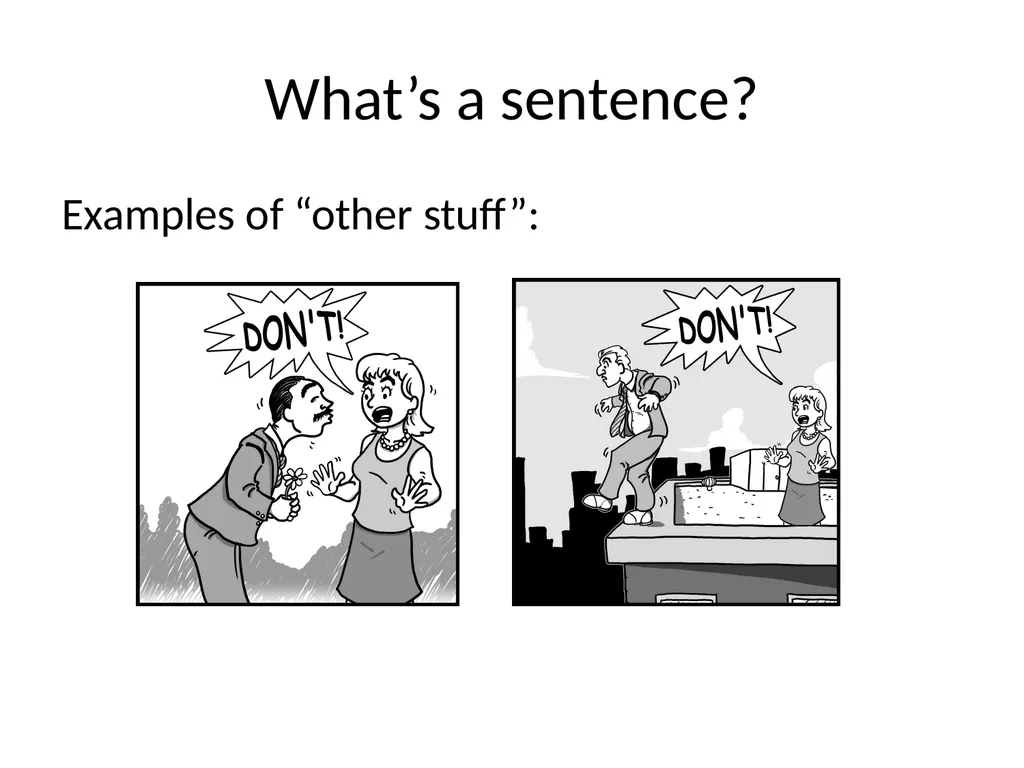
What’s a sentence? Examples of “other stuff”:<br>
28
What’s a sentence? Two sentences mean the same if they express the same concept, either within the same language or in different languages.<br>
29
What’s a sentence? The meaning of a sentence has
referential properties (it pertains to some situation in the environment)
and
inferential properties (one can draw conclusions based on it)<br>
referential properties (it pertains to some situation in the environment)
and
inferential properties (one can draw conclusions based on it)<br>
30
What’s a sentence? So words and sentences are articulated into
A sound component – pronunciation
and
A conceptual component – meaning
Meaning is the mental structure in terms of which thought takes place<br>
A sound component – pronunciation
and
A conceptual component – meaning
Meaning is the mental structure in terms of which thought takes place<br>
31
What’s the experience of
inner speech?<br>
32
What’s the experience of
inner speech? Plato et al.: It’s thought (i.e. concepts)<br>
33
What’s the experience of
inner speech? Plato et al.: It’s thought (i.e. concepts)
Introspection: It’s primarily pronunciation!!<br>
Introspection: It’s primarily pronunciation!!<br>
34
What’s the experience of
inner speech? Plato et al.: It’s thought (i.e. concepts)
Introspection: It’s primarily pronunciation!!
It’s in a language: “Do you think in English, or in French?”
It has syllables, words, word order, verb agreement, possibly even intonation.<br>
Introspection: It’s primarily pronunciation!!
It’s in a language: “Do you think in English, or in French?”
It has syllables, words, word order, verb agreement, possibly even intonation.<br>
35
What’s the experience of
inner speech? Could you think without language?
Other primates do think:
They categorize things in the world
They draw inferences
They carry out plans<br>
Other primates do think:
They categorize things in the world
They draw inferences
They carry out plans<br>
36
What’s the experience of
inner speech? Could you think without language?
Other primates do think:
They categorize things in the world
They draw inferences
They carry out plans
But they can’t have inner speech.
(What language would it be in?)<br>
Other primates do think:
They categorize things in the world
They draw inferences
They carry out plans
But they can’t have inner speech.
(What language would it be in?)<br>
37
What’s the experience of
inner speech? What’s different about the two ways of understanding
Visiting relatives can be dangerous?
They sound the same. They just feel different.<br>
Visiting relatives can be dangerous?
They sound the same. They just feel different.<br>
38
What’s the experience of
inner speech? What’s the same about these two sentences (if you speak German):
My dog is dead. Mein Hund ist tot.
You “just know” they mean the same. But that isn’t reflected in the form in which they reach awareness.<br>
My dog is dead. Mein Hund ist tot.
You “just know” they mean the same. But that isn’t reflected in the form in which they reach awareness.<br>
39
What’s the experience of
inner speech? What’s happening when you have a “tip-of-the-tongue” experience?
You know you have a concept in mind, but it lacks conscious form.
You can draw inferences from it, you can judge that this word isn’t the right one, you know when you’ve got it right.<br>
You know you have a concept in mind, but it lacks conscious form.
You can draw inferences from it, you can judge that this word isn’t the right one, you know when you’ve got it right.<br>
40
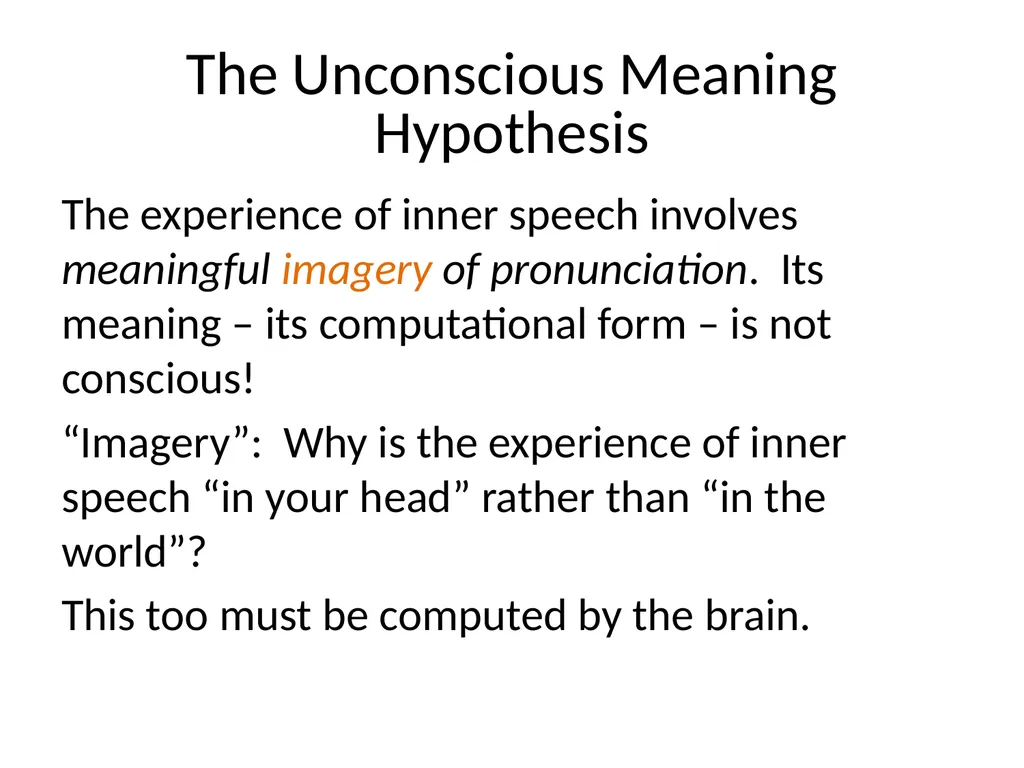
The Unconscious Meaning Hypothesis The experience of inner speech involves imagery of pronunciation. Its meaning – its computational form – is not conscious!<br>
41
The Unconscious Meaning Hypothesis The experience of inner speech involves meaningful imagery of pronunciation. Its meaning – its computational form – is not conscious!
‘Meaningful’: The feeling of meaningfulness going with a pronunciation. Contrast famous dentist (meaningful) and otkin adarab (meaningless).<br>
‘Meaningful’: The feeling of meaningfulness going with a pronunciation. Contrast famous dentist (meaningful) and otkin adarab (meaningless).<br>
42
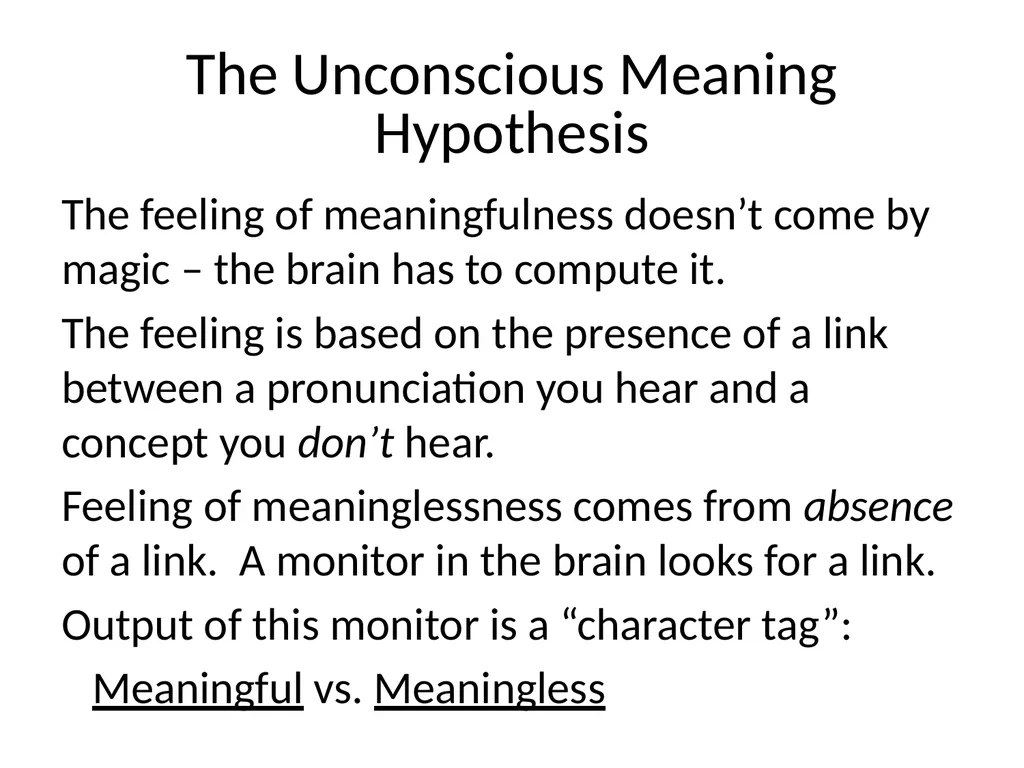
The Unconscious Meaning Hypothesis The feeling of meaningfulness doesn’t come by magic – the brain has to compute it.<br>
43
The Unconscious Meaning Hypothesis The feeling of meaningfulness doesn’t come by magic – the brain has to compute it.
The feeling is based on the presence of a link between a pronunciation you hear and a concept you don’t hear.
Feeling of meaninglessness comes from absence of a link. A monitor in the brain looks for a link.<br>
The feeling is based on the presence of a link between a pronunciation you hear and a concept you don’t hear.
Feeling of meaninglessness comes from absence of a link. A monitor in the brain looks for a link.<br>
44
The Unconscious Meaning Hypothesis The feeling of meaningfulness doesn’t come by magic – the brain has to compute it.
The feeling is based on the presence of a link between a pronunciation you hear and a concept you don’t hear.
Feeling of meaninglessness comes from absence of a link. A monitor in the brain looks for a link.
Output of this monitor is a “character tag”:
Meaningful vs. Meaningless<br>
The feeling is based on the presence of a link between a pronunciation you hear and a concept you don’t hear.
Feeling of meaninglessness comes from absence of a link. A monitor in the brain looks for a link.
Output of this monitor is a “character tag”:
Meaningful vs. Meaningless<br>
45
The Unconscious Meaning Hypothesis The experience of inner speech involves meaningful imagery of pronunciation. Its meaning – its computational form – is not conscious!
“Imagery”: Why is the experience of inner speech “in your head” rather than “in the world”?
This too must be computed by the brain.<br>
“Imagery”: Why is the experience of inner speech “in your head” rather than “in the world”?
This too must be computed by the brain.<br>
46
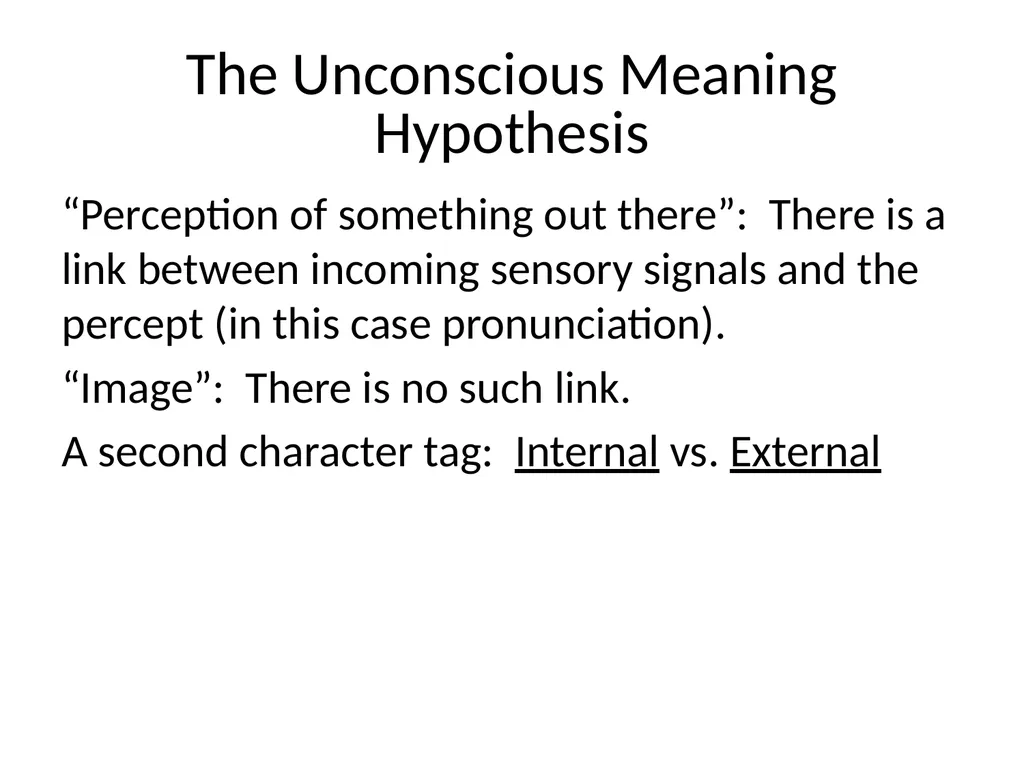
The Unconscious Meaning Hypothesis “Perception of something out there”: There is a link between incoming sensory signals and the percept (in this case pronunciation).
“Image”: There is no such link.
A second character tag: Internal vs. External<br>
“Image”: There is no such link.
A second character tag: Internal vs. External<br>
47
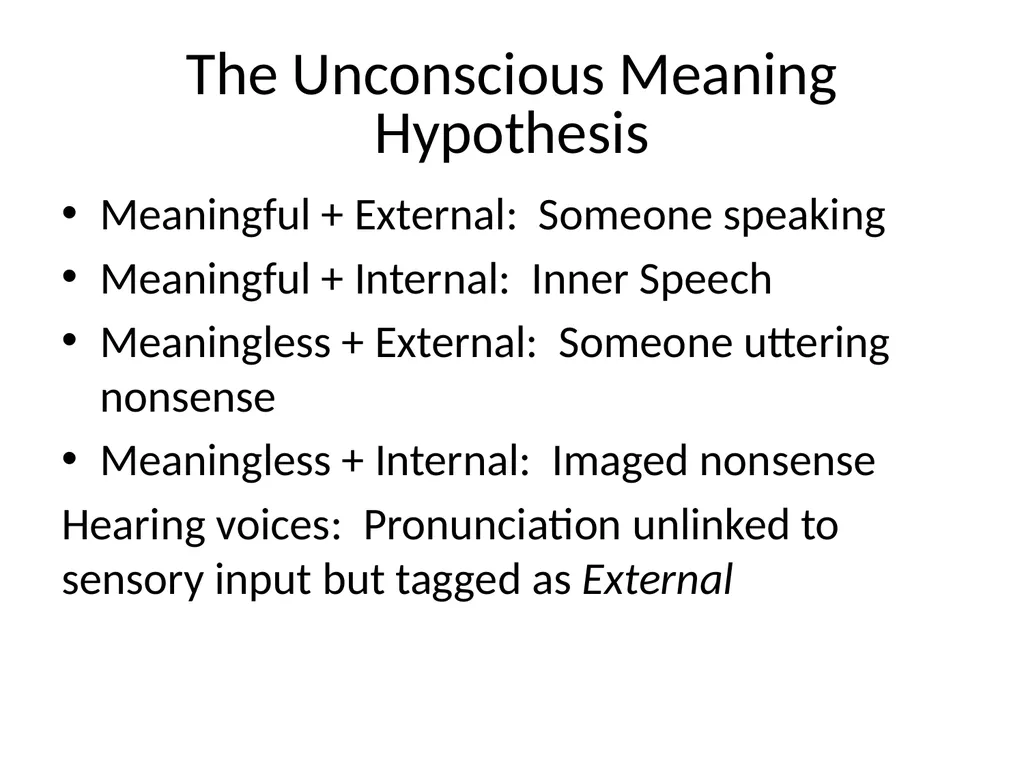
The Unconscious Meaning Hypothesis Meaningful + External: Someone speaking
Meaningful + Internal: Inner Speech
Meaningless + External: Someone uttering nonsense
Meaningless + Internal: Imaged nonsense
Hearing voices: Pronunciation unlinked to sensory input but tagged as External<br>
Meaningful + Internal: Inner Speech
Meaningless + External: Someone uttering nonsense
Meaningless + Internal: Imaged nonsense
Hearing voices: Pronunciation unlinked to sensory input but tagged as External<br>
48
The Unconscious Meaning Hypothesis The pronunciation serves as a conscious “handle” for the unconscious concept.
It gives the experience form, and the character tags are “feelings” that go with it.
The pronunciation and the character tags together are the conscious “vehicle” of thought.<br>
It gives the experience form, and the character tags are “feelings” that go with it.
The pronunciation and the character tags together are the conscious “vehicle” of thought.<br>
49
What about visual experience? “Visual surface”: What is processed bottom-up from the retina, what would be reproduced in a picture.
“Visual meaning”: Your understanding of “actual” shapes of objects
Visual meaning includes the backs and insides of objects.<br>
“Visual meaning”: Your understanding of “actual” shapes of objects
Visual meaning includes the backs and insides of objects.<br>
50
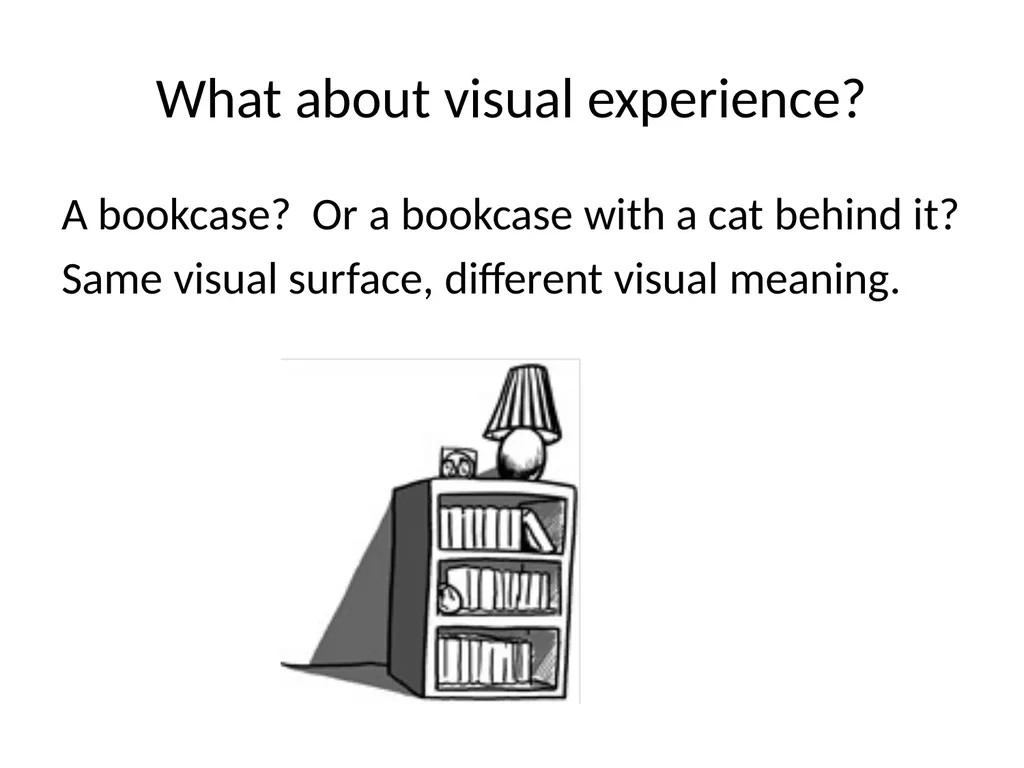
What about visual experience? A bookcase? Or a bookcase with a cat behind it?
Same visual surface, different visual meaning.<br>
Same visual surface, different visual meaning.<br>
51
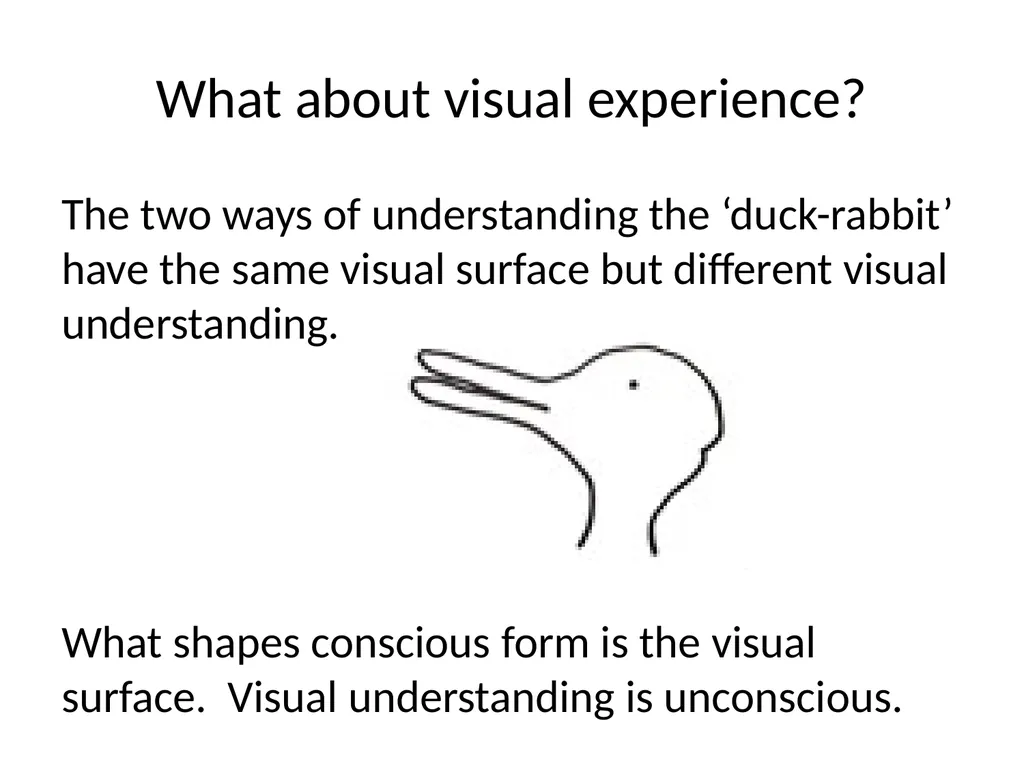
What about visual experience? The two ways of understanding the ‘duck-rabbit’ have the same visual surface but different visual understanding.
What shapes conscious form is the visual surface. Visual understanding is unconscious.<br>
What shapes conscious form is the visual surface. Visual understanding is unconscious.<br>
52
What about visual experience? Character tags pertain also to visual perception.
Internal vs. external:
Visual imagery vs. visual perception<br>
Internal vs. external:
Visual imagery vs. visual perception<br>
53
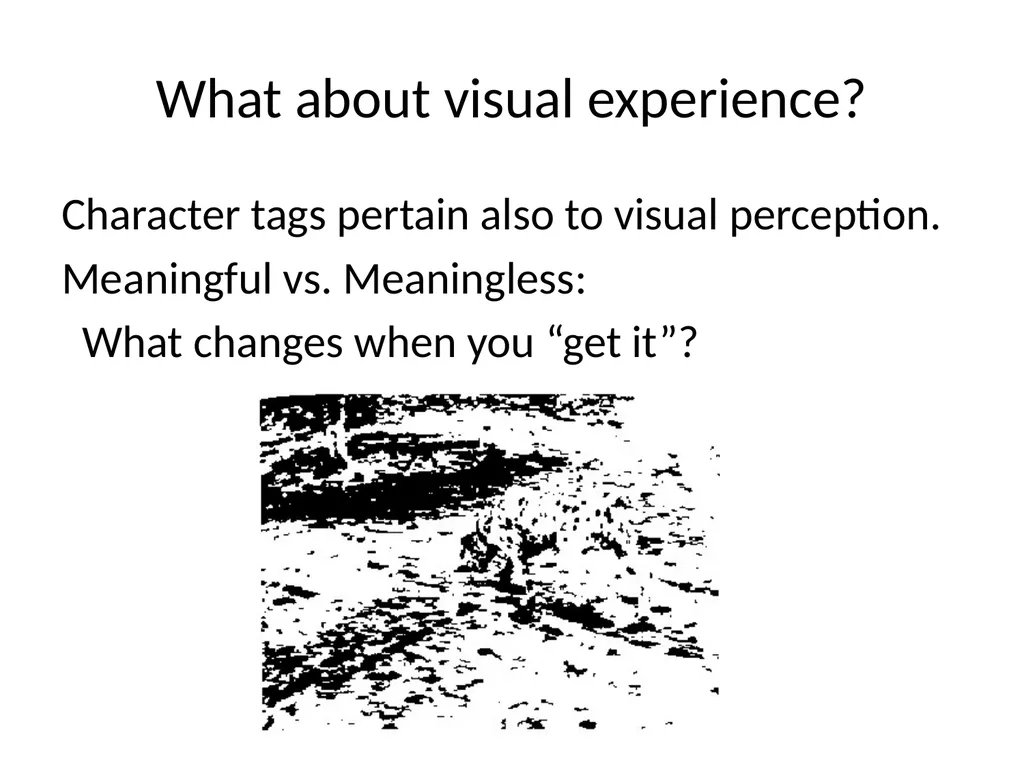
What about visual experience? Character tags pertain also to visual perception.
Meaningful vs. Meaningless:
What changes when you “get it”?<br>
Meaningful vs. Meaningless:
What changes when you “get it”?<br>
54
What about visual experience? Character tags pertain also to visual perception.
Hallucinations: Experiences that are internally generated but “erroneously” come with the character tag External.
Dreams too.<br>
Hallucinations: Experiences that are internally generated but “erroneously” come with the character tag External.
Dreams too.<br>
55
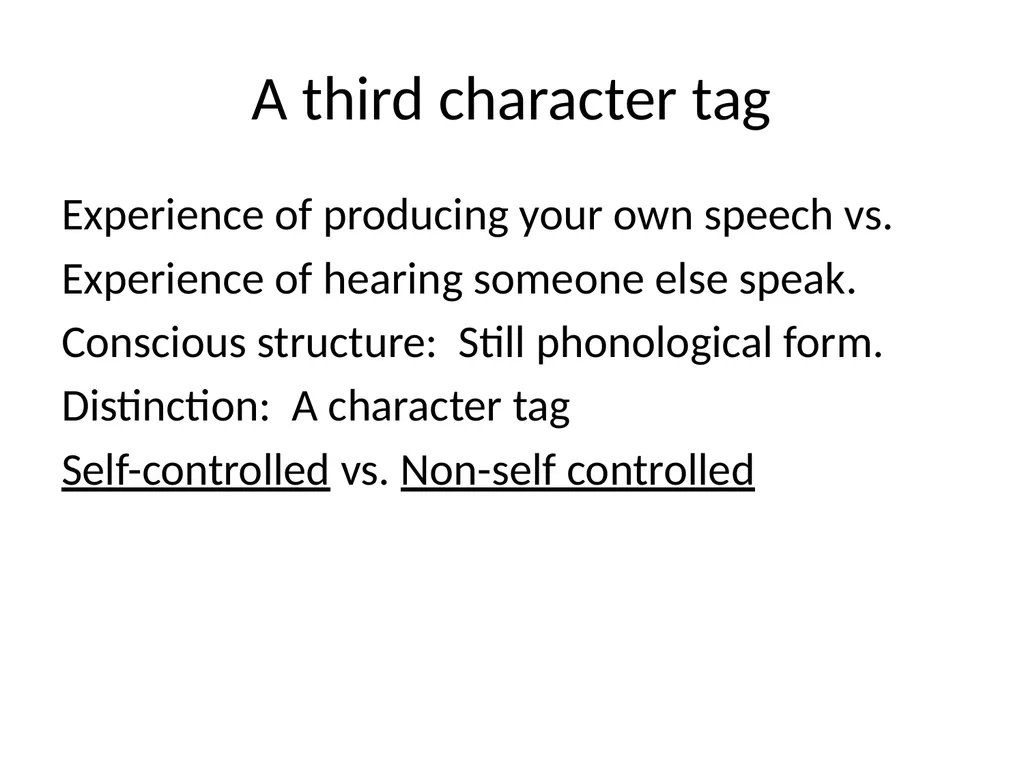
A third character tag Experience of producing your own speech vs.
Experience of hearing someone else speak.
Conscious structure: Still phonological form.<br>
Experience of hearing someone else speak.
Conscious structure: Still phonological form.<br>
56
A third character tag Experience of producing your own speech vs.
Experience of hearing someone else speak.
Conscious structure: Still phonological form.
Distinction: A character tag
Self-controlled vs. Non-self controlled<br>
Experience of hearing someone else speak.
Conscious structure: Still phonological form.
Distinction: A character tag
Self-controlled vs. Non-self controlled<br>
57
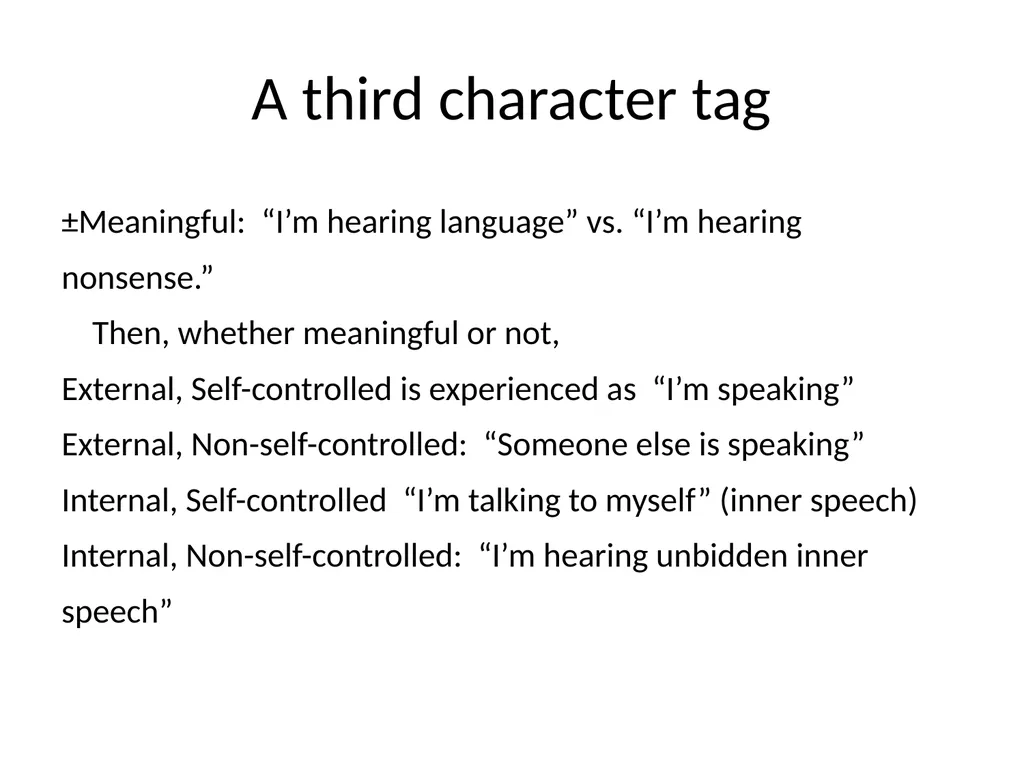
A third character tag ±Meaningful: “I’m hearing language” vs. “I’m hearing nonsense.”
Then, whether meaningful or not,
External, Self-controlled is experienced as “I’m speaking”
External, Non-self-controlled: “Someone else is speaking”
Internal, Self-controlled “I’m talking to myself” (inner speech)
Internal, Non-self-controlled: “I’m hearing unbidden inner speech”<br>
Then, whether meaningful or not,
External, Self-controlled is experienced as “I’m speaking”
External, Non-self-controlled: “Someone else is speaking”
Internal, Self-controlled “I’m talking to myself” (inner speech)
Internal, Non-self-controlled: “I’m hearing unbidden inner speech”<br>
58
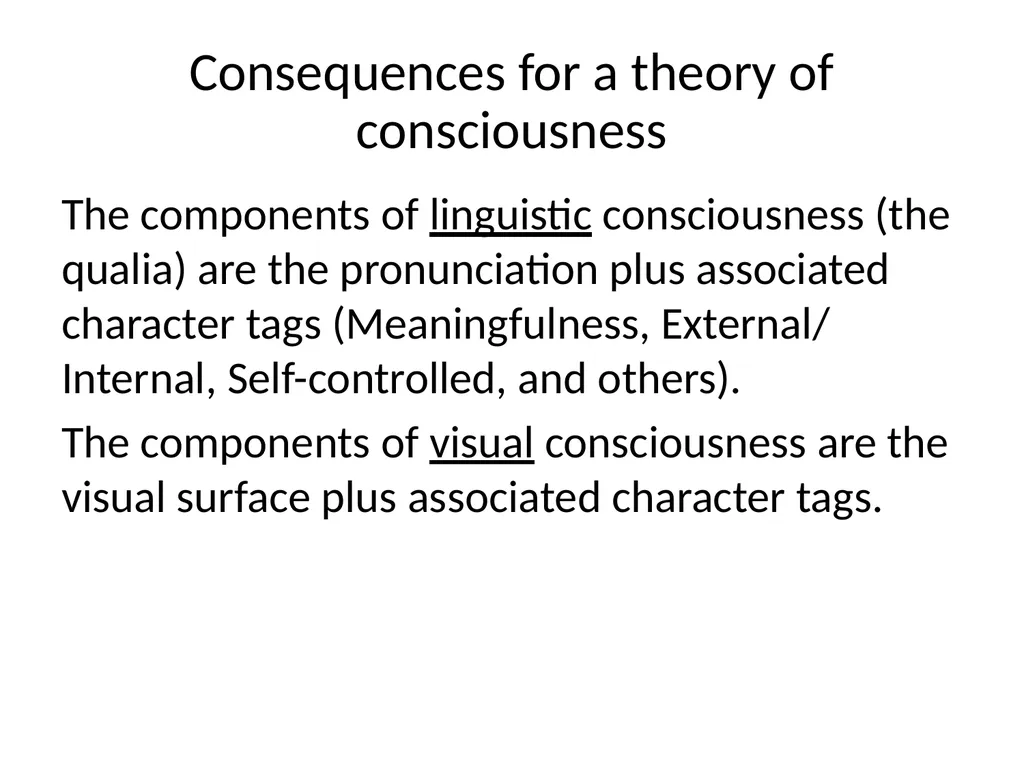
Consequences for a theory of consciousness The components of linguistic consciousness (the qualia) are the pronunciation plus associated character tags (Meaningfulness, External/ Internal, Self-controlled, and others).
The components of visual consciousness are the visual surface plus associated character tags.<br>
The components of visual consciousness are the visual surface plus associated character tags.<br>
59
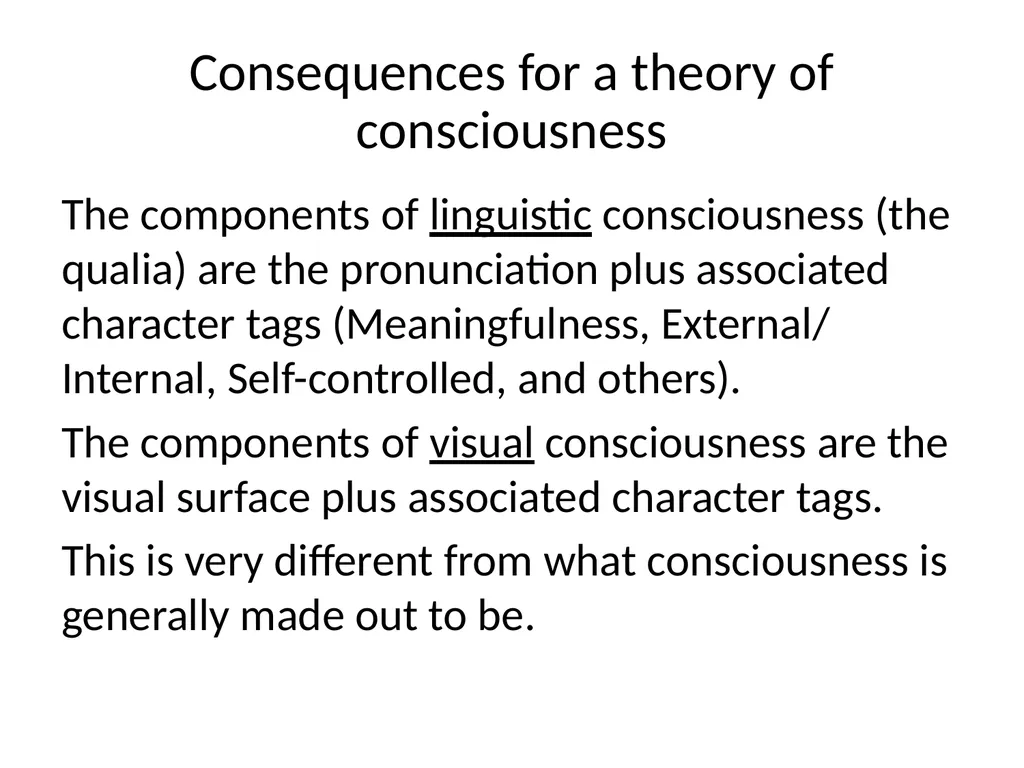
Consequences for a theory of consciousness The components of linguistic consciousness (the qualia) are the pronunciation plus associated character tags (Meaningfulness, External/ Internal, Self-controlled, and others).
The components of visual consciousness are the visual surface plus associated character tags.
This is very different from what consciousness is generally made out to be.<br>
The components of visual consciousness are the visual surface plus associated character tags.
This is very different from what consciousness is generally made out to be.<br>
60
Consequences for a theory of consciousness Some prestigious theories:
Consciousness is the basis of thought.
NO. Pronunciation is not the basis of thought, meaning is, and meaning is not conscious.<br>
Consciousness is the basis of thought.
NO. Pronunciation is not the basis of thought, meaning is, and meaning is not conscious.<br>
61
Consequences for a theory of consciousness Some prestigious theories:
2. Consciousness is the mind’s summary of everything it’s processing.
NO. Pronunciation is linked to some of the concepts the mind is processing, but the concepts aren’t conscious.<br>
2. Consciousness is the mind’s summary of everything it’s processing.
NO. Pronunciation is linked to some of the concepts the mind is processing, but the concepts aren’t conscious.<br>
62
Consequences for a theory of consciousness Some prestigious theories:
Consciousness is the mind’s model of itself.
NO. The character tags do reflect the mind’s monitoring the existence of linkage between structures. But pronunciation is only a model of speech sounds, not of the overall state of things in the mind/brain.<br>
Consciousness is the mind’s model of itself.
NO. The character tags do reflect the mind’s monitoring the existence of linkage between structures. But pronunciation is only a model of speech sounds, not of the overall state of things in the mind/brain.<br>
63
Consequences for a theory of consciousness Most discussions of consciousness don’t touch on language.
If they do, they invariably talk about “consciousness of language,” and fail to make the distinction between pronunciation and the structure of meaning.<br>
If they do, they invariably talk about “consciousness of language,” and fail to make the distinction between pronunciation and the structure of meaning.<br>
64
Consequences for a theory of consciousness Most discussions of consciousness don’t touch on language.
If they do, they invariably talk about “consciousness of language,” and fail to make the distinction between pronunciation and the structure of meaning.
Even in vision, they typically miss the distinction between the visual surface and visual understanding.<br>
If they do, they invariably talk about “consciousness of language,” and fail to make the distinction between pronunciation and the structure of meaning.
Even in vision, they typically miss the distinction between the visual surface and visual understanding.<br>
65
Changing gears A different question:
What is the nature of rational thinking?<br>
What is the nature of rational thinking?<br>
66
What is rational thinking? The ideal: Rational thinking makes every step conscious and explicit, with no hidden assumptions. The explicit steps are expressed in language. (Descartes, Discourse on Method)
Formal logic is an attempt to achieve this ideal, running inferences mechanically, on form alone.<br>
Formal logic is an attempt to achieve this ideal, running inferences mechanically, on form alone.<br>
67
What is rational thinking? The ideal: Rational thinking makes every step conscious and explicit, with no hidden assumptions. The explicit steps are expressed in language. (Descartes, Discourse on Method)
Formal logic is an attempt to achieve this ideal, running inferences mechanically, on form alone.
This ideal is actually impossible.<br>
Formal logic is an attempt to achieve this ideal, running inferences mechanically, on form alone.
This ideal is actually impossible.<br>
68
Problems with the ideal of
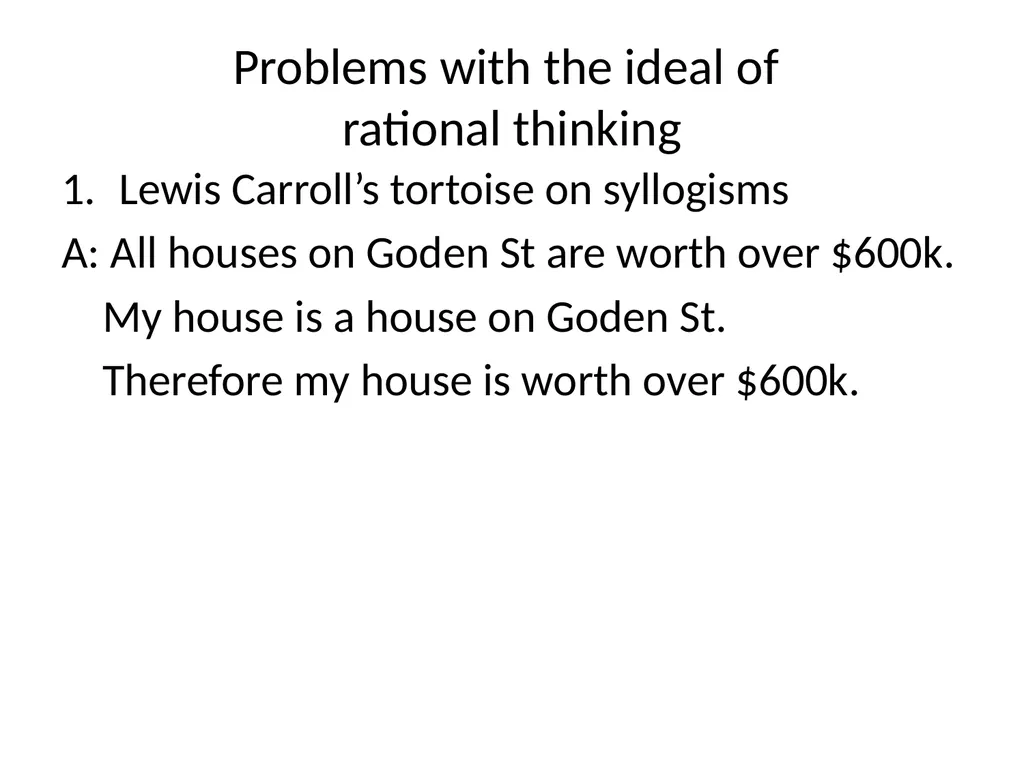
rational thinking Lewis Carroll’s tortoise on syllogisms
A: All houses on Goden St are worth over $600k.
My house is a house on Goden St.
Therefore my house is worth over $600k.<br>
A: All houses on Goden St are worth over $600k.
My house is a house on Goden St.
Therefore my house is worth over $600k.<br>
69
Problems with the ideal of
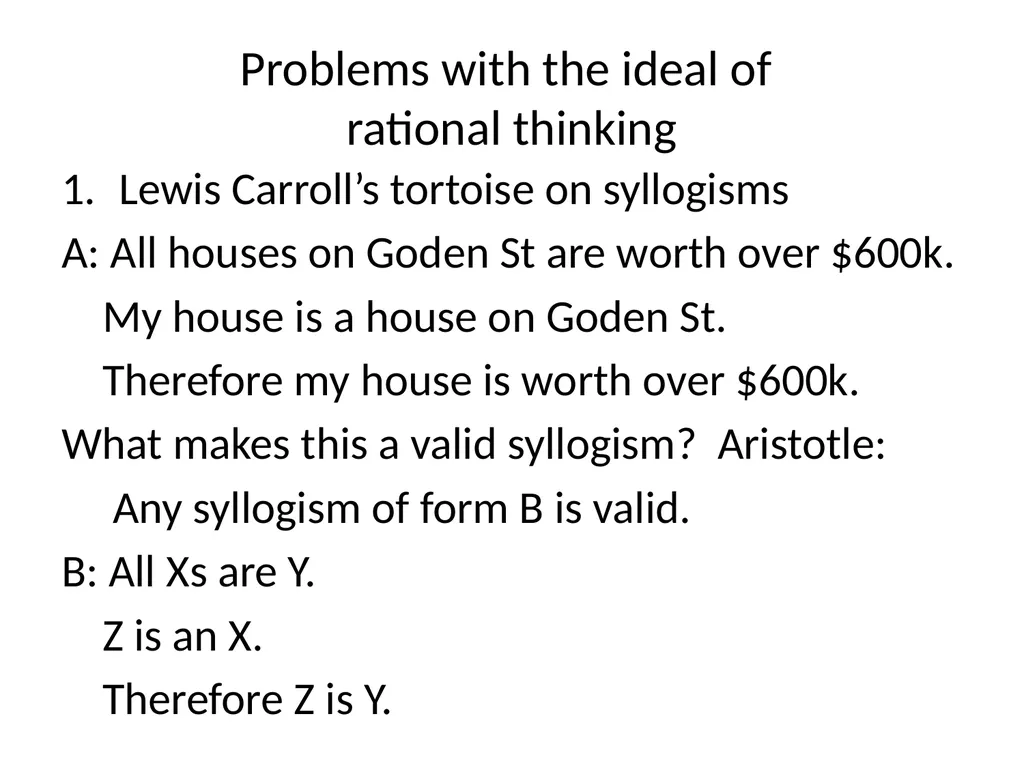
rational thinking Lewis Carroll’s tortoise on syllogisms
A: All houses on Goden St are worth over $600k.
My house is a house on Goden St.
Therefore my house is worth over $600k.
What makes this a valid syllogism? Aristotle:
Any syllogism of form B is valid.
B: All Xs are Y.
Z is an X.
Therefore Z is Y.<br>
A: All houses on Goden St are worth over $600k.
My house is a house on Goden St.
Therefore my house is worth over $600k.
What makes this a valid syllogism? Aristotle:
Any syllogism of form B is valid.
B: All Xs are Y.
Z is an X.
Therefore Z is Y.<br>
70
Problems with the ideal of
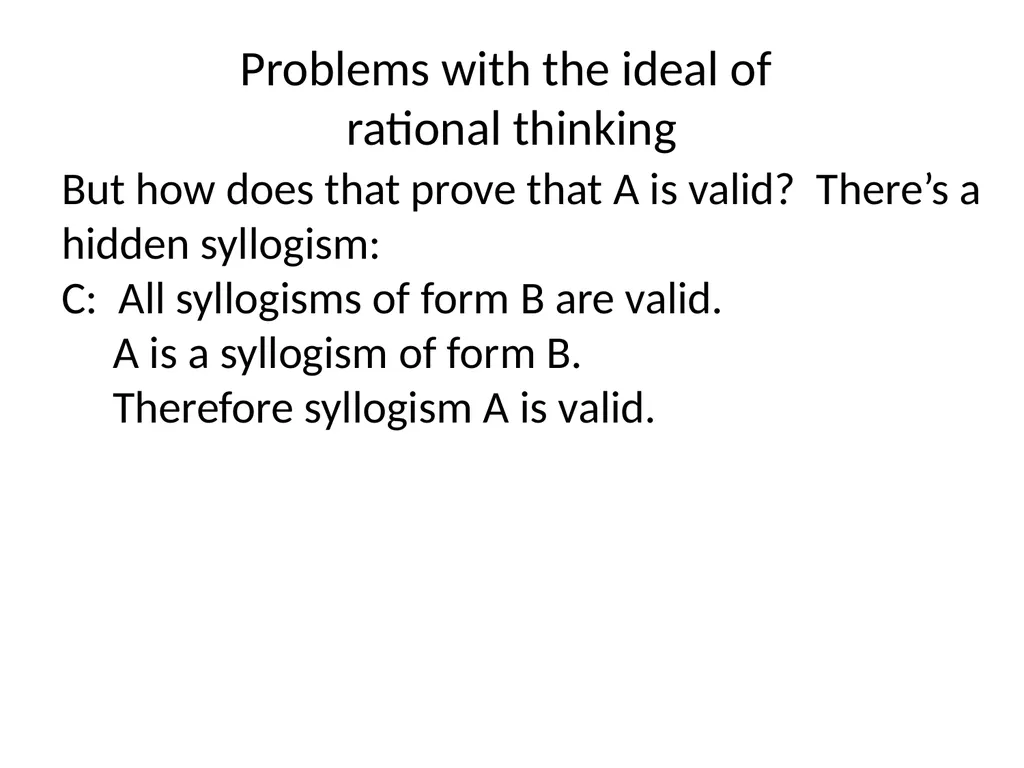
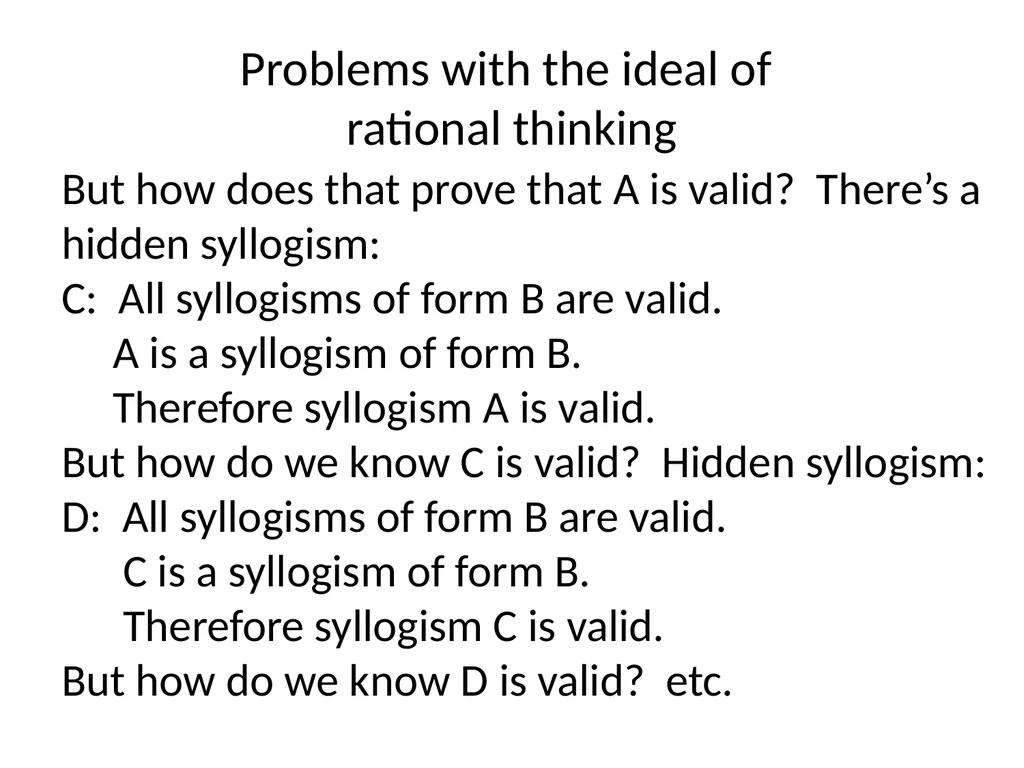
rational thinking But how does that prove that A is valid? There’s a hidden syllogism:
C: All syllogisms of form B are valid.
A is a syllogism of form B.
Therefore syllogism A is valid.<br>
C: All syllogisms of form B are valid.
A is a syllogism of form B.
Therefore syllogism A is valid.<br>
71
Problems with the ideal of
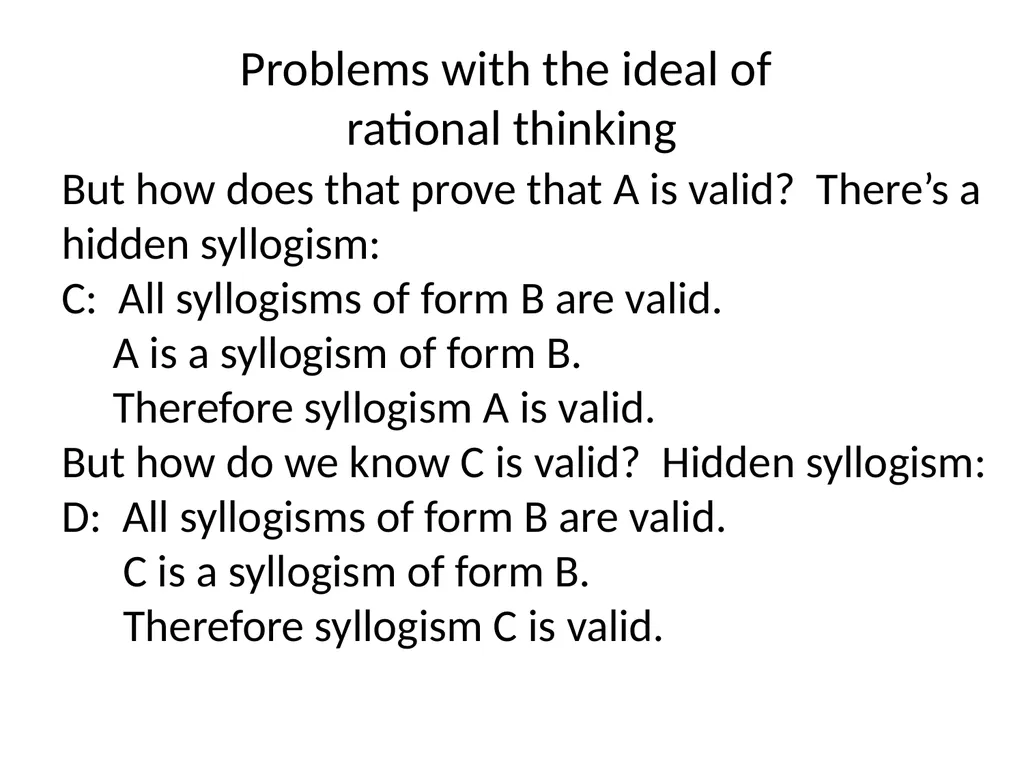
rational thinking But how does that prove that A is valid? There’s a hidden syllogism:
C: All syllogisms of form B are valid.
A is a syllogism of form B.
Therefore syllogism A is valid.
But how do we know C is valid? Hidden syllogism:
D: All syllogisms of form B are valid.
C is a syllogism of form B.
Therefore syllogism C is valid.<br>
C: All syllogisms of form B are valid.
A is a syllogism of form B.
Therefore syllogism A is valid.
But how do we know C is valid? Hidden syllogism:
D: All syllogisms of form B are valid.
C is a syllogism of form B.
Therefore syllogism C is valid.<br>
72
Problems with the ideal of
rational thinking But how does that prove that A is valid? There’s a hidden syllogism:
C: All syllogisms of form B are valid.
A is a syllogism of form B.
Therefore syllogism A is valid.
But how do we know C is valid? Hidden syllogism:
D: All syllogisms of form B are valid.
C is a syllogism of form B.
Therefore syllogism C is valid.
But how do we know D is valid? etc.<br>
C: All syllogisms of form B are valid.
A is a syllogism of form B.
Therefore syllogism A is valid.
But how do we know C is valid? Hidden syllogism:
D: All syllogisms of form B are valid.
C is a syllogism of form B.
Therefore syllogism C is valid.
But how do we know D is valid? etc.<br>
73
Problems with the ideal of
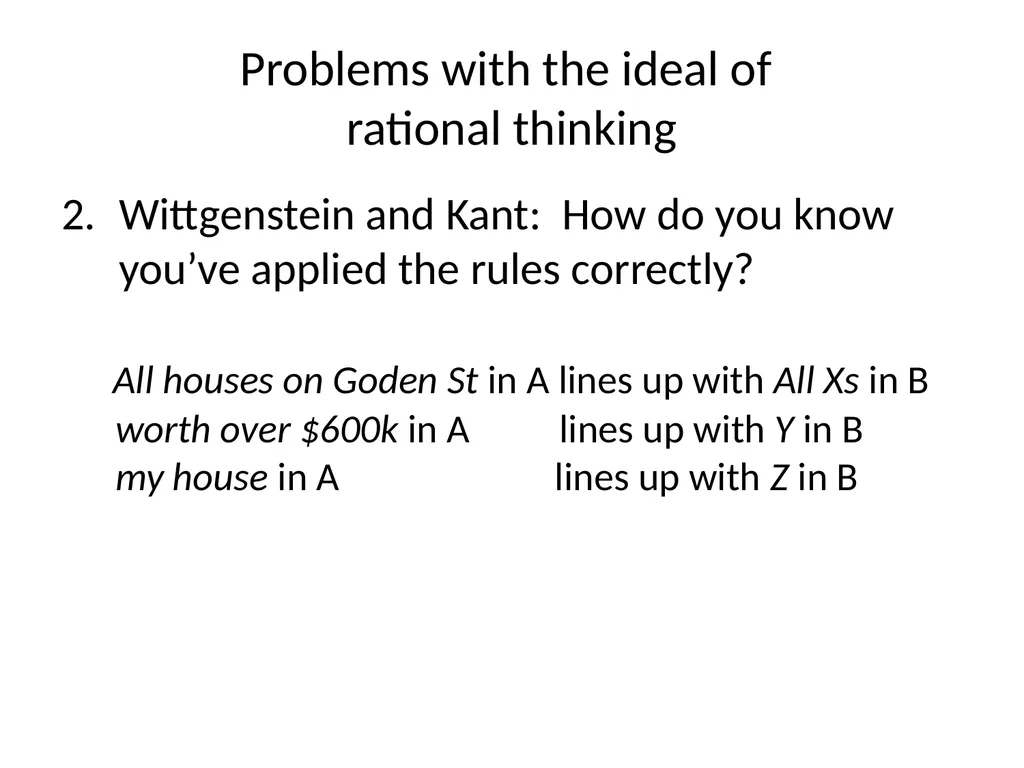
rational thinking Wittgenstein and Kant: How do you know you’ve applied the rules correctly?
All houses on Goden St in A lines up with All Xs in B
worth over $600k in A lines up with Y in B
my house in A lines up with Z in B<br>
All houses on Goden St in A lines up with All Xs in B
worth over $600k in A lines up with Y in B
my house in A lines up with Z in B<br>
74
Problems with the ideal of
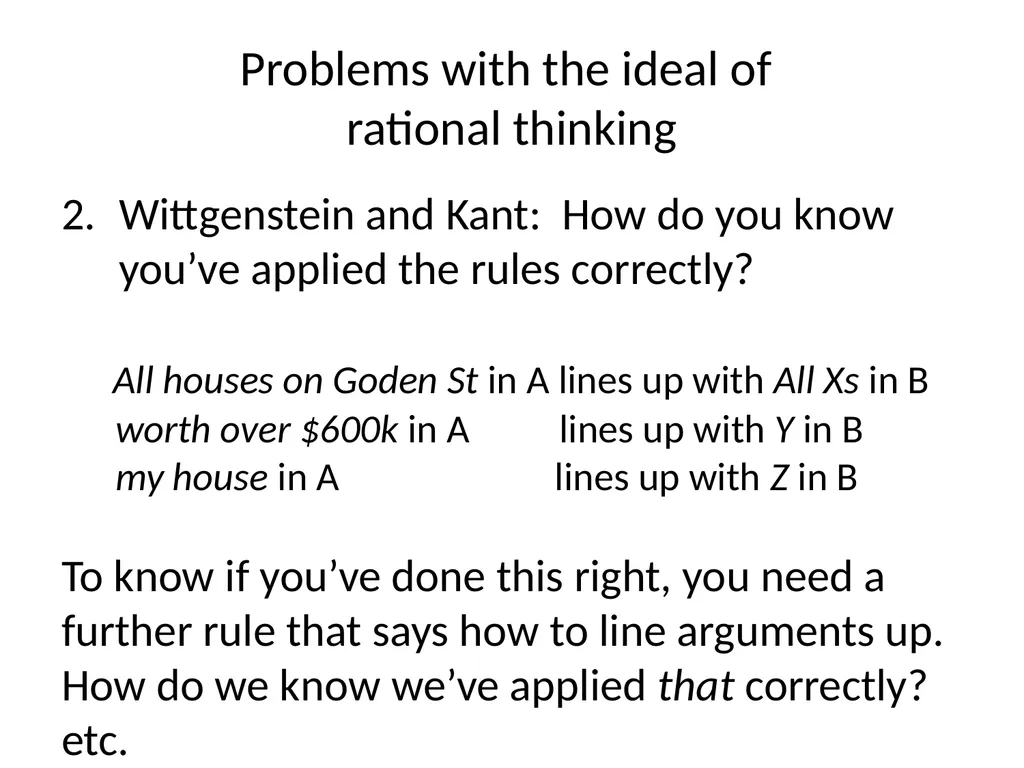
rational thinking Wittgenstein and Kant: How do you know you’ve applied the rules correctly?
All houses on Goden St in A lines up with All Xs in B
worth over $600k in A lines up with Y in B
my house in A lines up with Z in B
To know if you’ve done this right, you need a further rule that says how to line arguments up. How do we know we’ve applied that correctly?
etc.<br>
All houses on Goden St in A lines up with All Xs in B
worth over $600k in A lines up with Y in B
my house in A lines up with Z in B
To know if you’ve done this right, you need a further rule that says how to line arguments up. How do we know we’ve applied that correctly?
etc.<br>
75
Problems with the ideal of
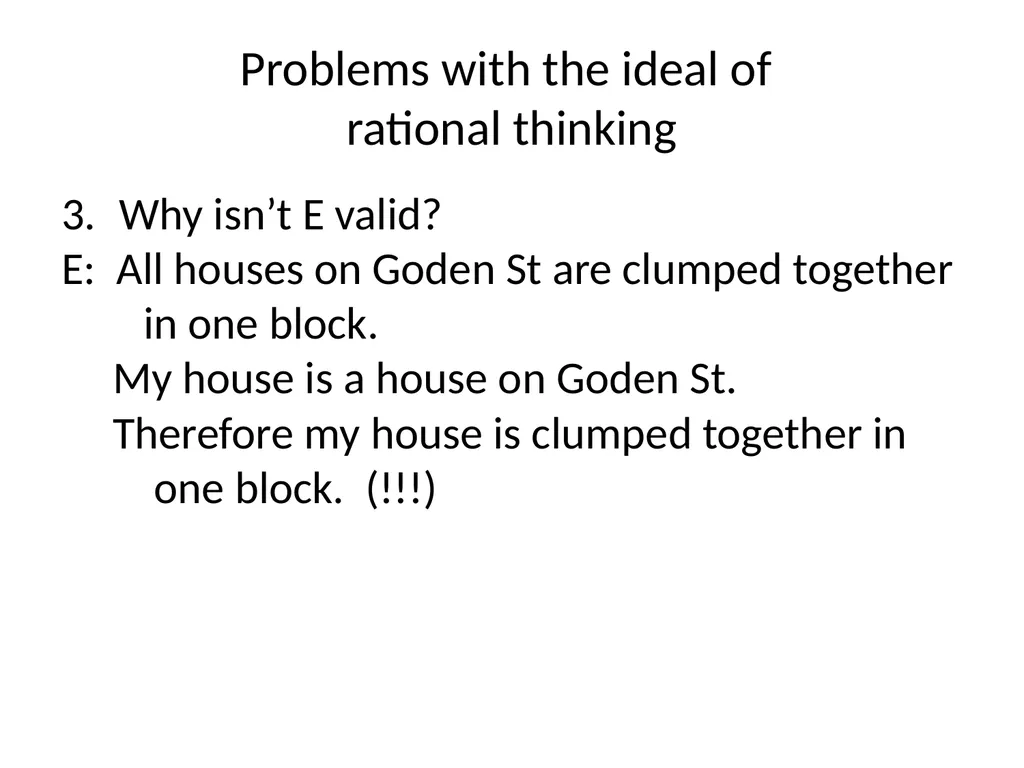
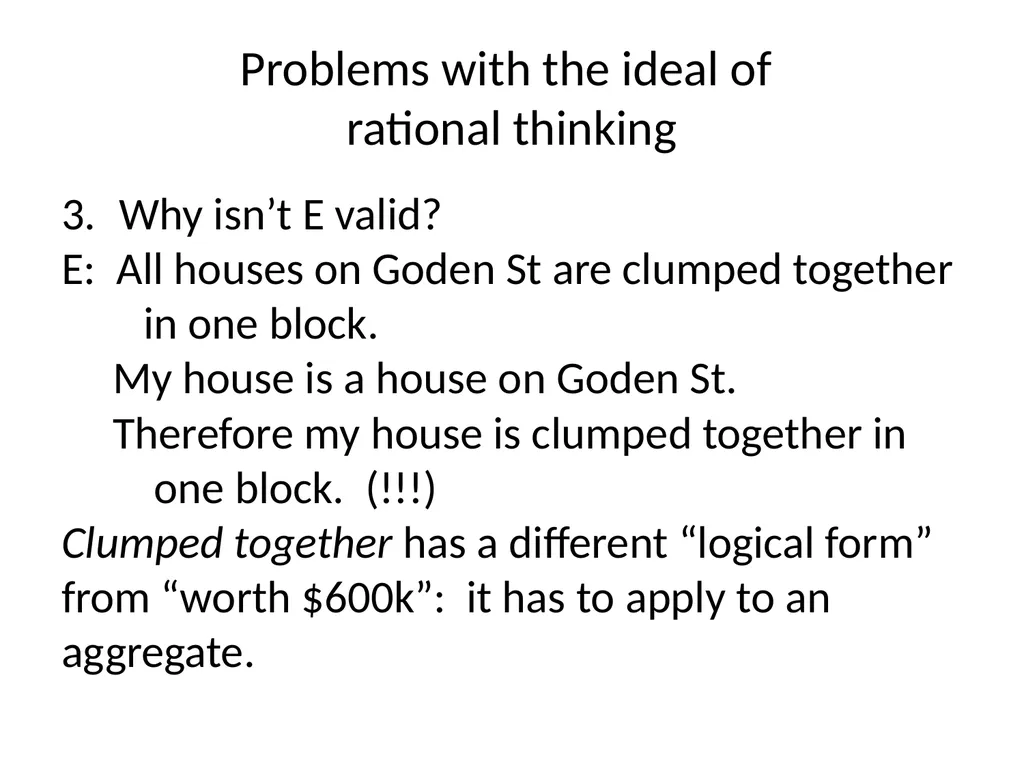
rational thinking Why isn’t E valid?
E: All houses on Goden St are clumped together
in one block.
My house is a house on Goden St.
Therefore my house is clumped together in
one block. (!!!)<br>
E: All houses on Goden St are clumped together
in one block.
My house is a house on Goden St.
Therefore my house is clumped together in
one block. (!!!)<br>
76
Problems with the ideal of
rational thinking Why isn’t E valid?
E: All houses on Goden St are clumped together
in one block.
My house is a house on Goden St.
Therefore my house is clumped together in
one block. (!!!)
Clumped together has a different “logical form” from “worth $600k”: it has to apply to an aggregate.<br>
E: All houses on Goden St are clumped together
in one block.
My house is a house on Goden St.
Therefore my house is clumped together in
one block. (!!!)
Clumped together has a different “logical form” from “worth $600k”: it has to apply to an aggregate.<br>
77
Problems with the ideal of
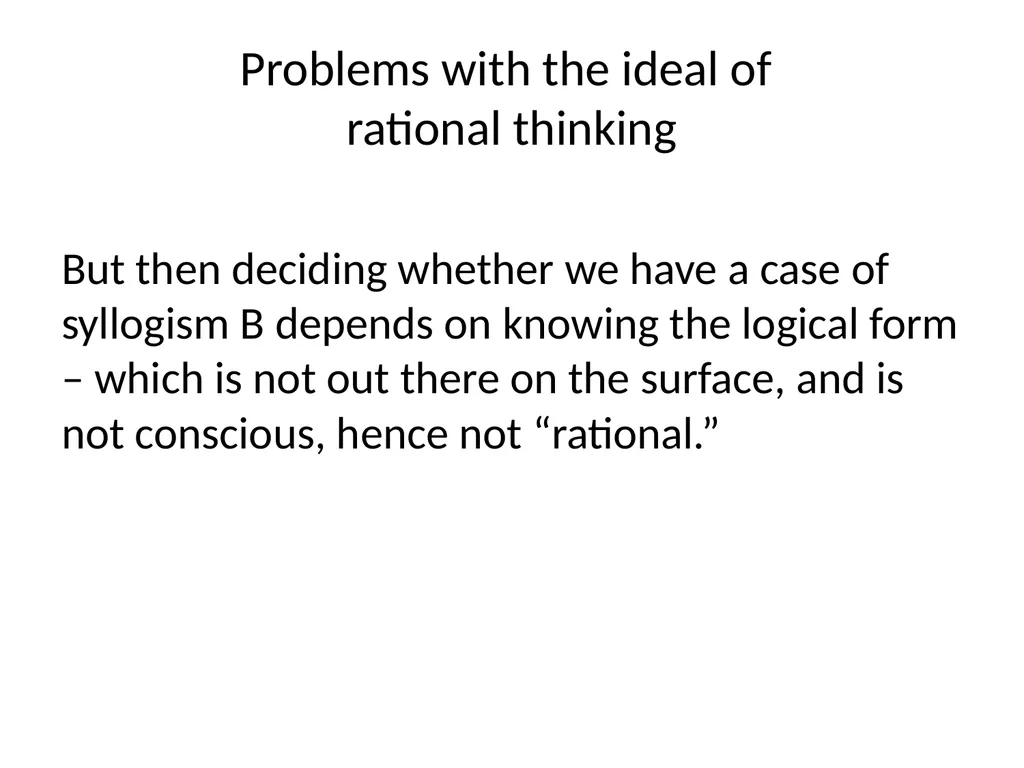
rational thinking But then deciding whether we have a case of syllogism B depends on knowing the logical form – which is not out there on the surface, and is not conscious, hence not “rational.”<br>
78
Problems with the ideal of
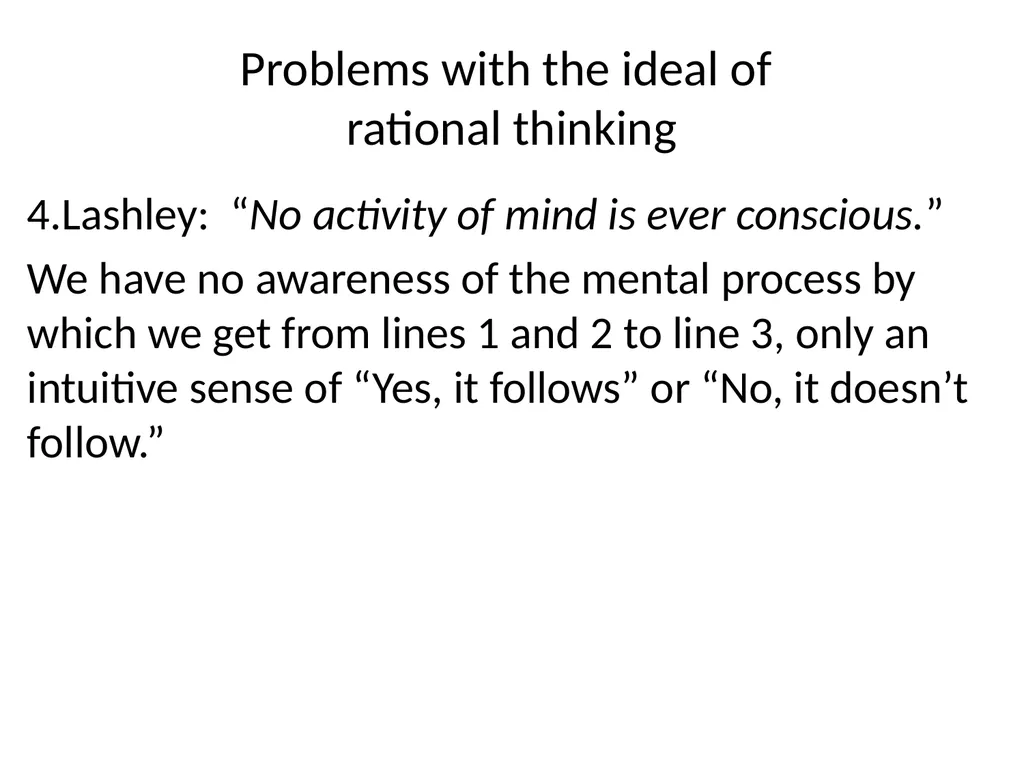
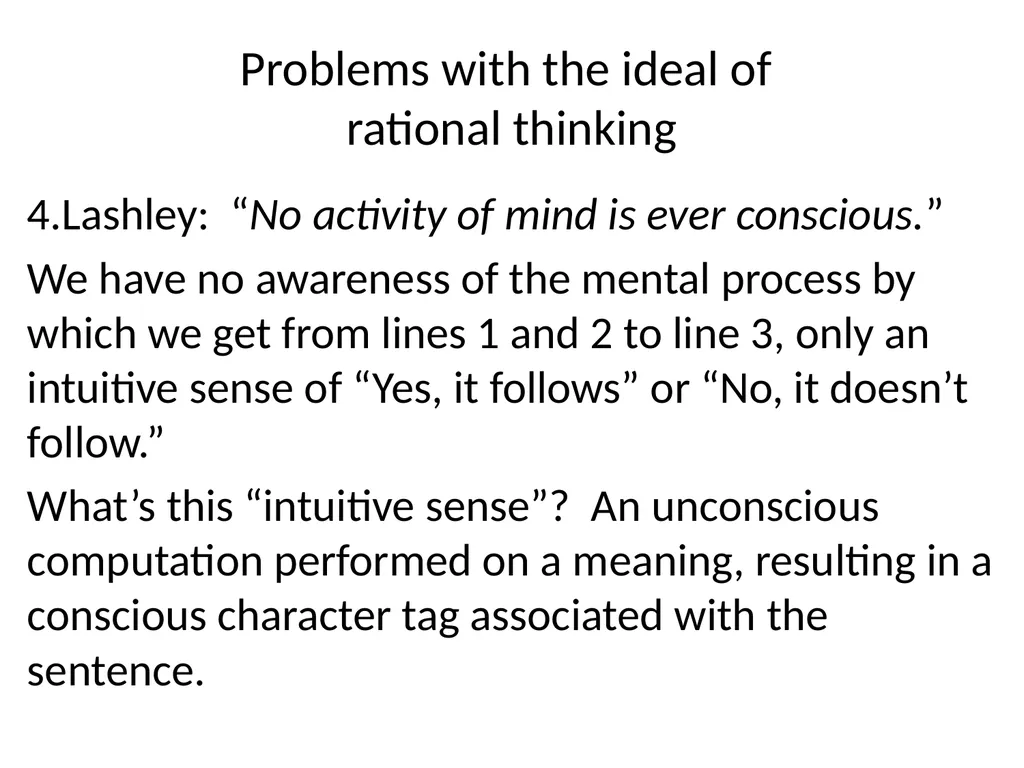
rational thinking Lashley: “No activity of mind is ever conscious.”
We have no awareness of the mental process by which we get from lines 1 and 2 to line 3, only an intuitive sense of “Yes, it follows” or “No, it doesn’t follow.”<br>
We have no awareness of the mental process by which we get from lines 1 and 2 to line 3, only an intuitive sense of “Yes, it follows” or “No, it doesn’t follow.”<br>
79
Problems with the ideal of
rational thinking Lashley: “No activity of mind is ever conscious.”
We have no awareness of the mental process by which we get from lines 1 and 2 to line 3, only an intuitive sense of “Yes, it follows” or “No, it doesn’t follow.”
What’s this “intuitive sense”? An unconscious computation performed on a meaning, resulting in a conscious character tag associated with the sentence.<br>
We have no awareness of the mental process by which we get from lines 1 and 2 to line 3, only an intuitive sense of “Yes, it follows” or “No, it doesn’t follow.”
What’s this “intuitive sense”? An unconscious computation performed on a meaning, resulting in a conscious character tag associated with the sentence.<br>
80
Problems with the ideal of
rational thinking The conscious language in which the thought process is “made explicit” consists only of pronunciation plus character tags! The actual work of inference is done unconsciously.<br>
81
So what is rational thinking? Rational thinking isn’t an alternative to intuitive thinking.
Rather it depends on intuitive thinking. It involves language, which is conscious by virtue of its pronunciation.<br>
Rather it depends on intuitive thinking. It involves language, which is conscious by virtue of its pronunciation.<br>
82
So what is rational thinking? You can never be perfectly explicit.
The best you can do is to be more explicit, be sensitive to gaps, and avoid confirmation bias (self-interest, judging true what you want to be true).<br>
The best you can do is to be more explicit, be sensitive to gaps, and avoid confirmation bias (self-interest, judging true what you want to be true).<br>
83
So what is rational thinking? You can never be perfectly explicit.
The best you can do is to be more explicit, be sensitive to gaps, and avoid confirmation bias (self-interest, judging true what you want to be true).
Learning to do this (“critical thinking”) is like learning any skill or craft, requiring a combination of explicit explanation and intuitive “getting it.”<br>
The best you can do is to be more explicit, be sensitive to gaps, and avoid confirmation bias (self-interest, judging true what you want to be true).
Learning to do this (“critical thinking”) is like learning any skill or craft, requiring a combination of explicit explanation and intuitive “getting it.”<br>
84
So what is rational thinking? How much rational thinking do we actually do? And how much do we simply take on faith?
Do we seek rational explanations of everything in our lives?<br>
Do we seek rational explanations of everything in our lives?<br>
85
So what is rational thinking? How much rational thinking do we actually do? And how much do we simply take on faith?
Do we seek rational explanations of everything in our lives?
Where our food comes from?
How our computers and cellphones work?
How our clothes, dishes, and tools, are manufactured?
Do you pick your friends rationally?
Your profession?<br>
Do we seek rational explanations of everything in our lives?
Where our food comes from?
How our computers and cellphones work?
How our clothes, dishes, and tools, are manufactured?
Do you pick your friends rationally?
Your profession?<br>
86
So what is rational thinking? How much rational thinking do we actually do? And how much do we simply take on faith?
Do we seek rational explanations of everything in our lives?
In science: Do we insist on reconstructing the foundations of our field, or do we trust the Received Wisdom? (Which received wisdom?)<br>
Do we seek rational explanations of everything in our lives?
In science: Do we insist on reconstructing the foundations of our field, or do we trust the Received Wisdom? (Which received wisdom?)<br>
87
How does rational thinking help? 1. The “handle” of pronunciation enables us to pay attention to the thought, hold it in memory, retrieve it when needed.<br>
88
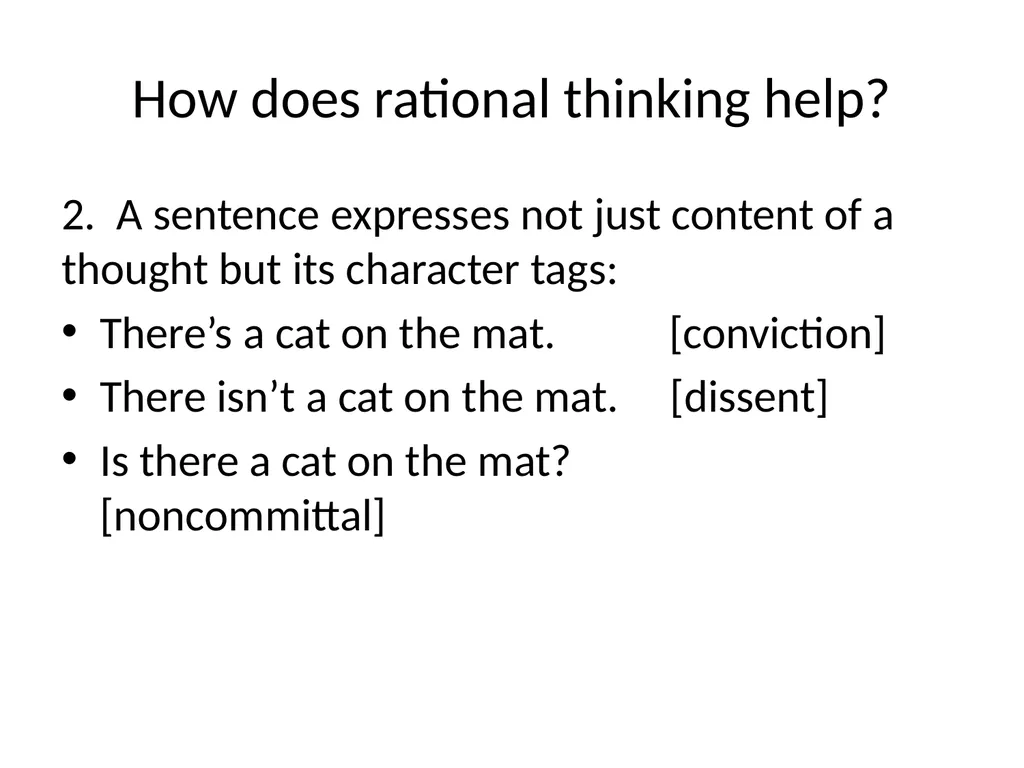
How does rational thinking help? 2. A sentence expresses not just content of a thought but its character tags:
There’s a cat on the mat. [conviction]
There isn’t a cat on the mat. [dissent]
Is there a cat on the mat? [noncommittal]<br>
There’s a cat on the mat. [conviction]
There isn’t a cat on the mat. [dissent]
Is there a cat on the mat? [noncommittal]<br>
89
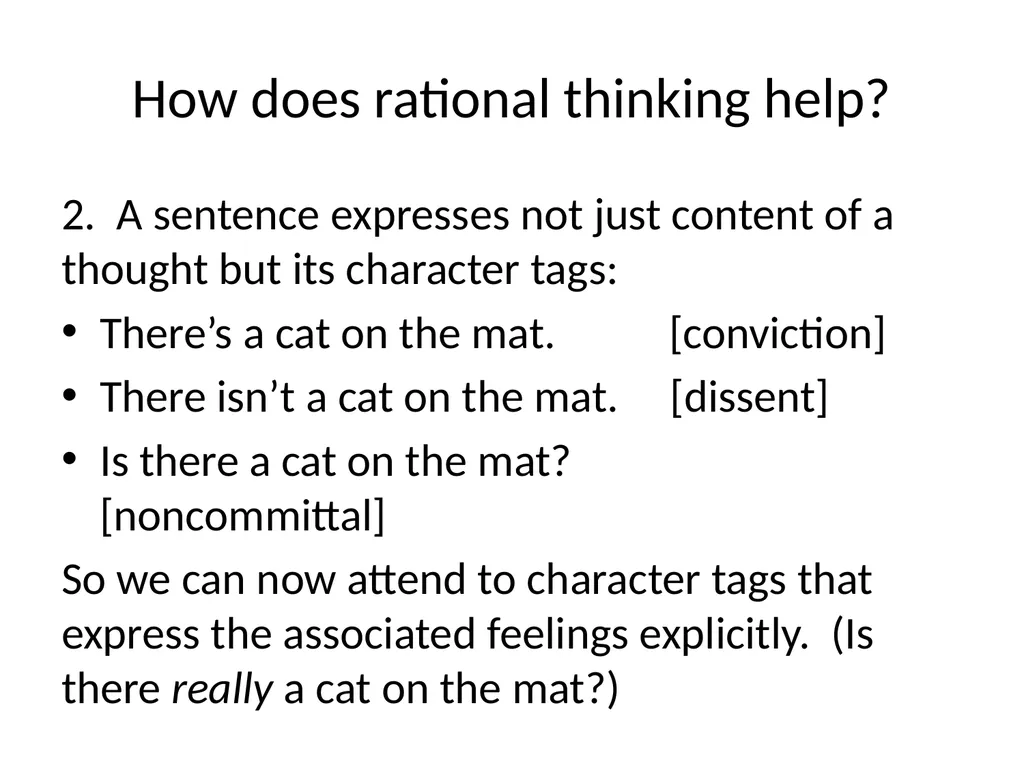
How does rational thinking help? 2. A sentence expresses not just content of a thought but its character tags:
There’s a cat on the mat. [conviction]
There isn’t a cat on the mat. [dissent]
Is there a cat on the mat? [noncommittal]
So we can now attend to character tags that express the associated feelings explicitly. (Is there really a cat on the mat?)<br>
There’s a cat on the mat. [conviction]
There isn’t a cat on the mat. [dissent]
Is there a cat on the mat? [noncommittal]
So we can now attend to character tags that express the associated feelings explicitly. (Is there really a cat on the mat?)<br>
90
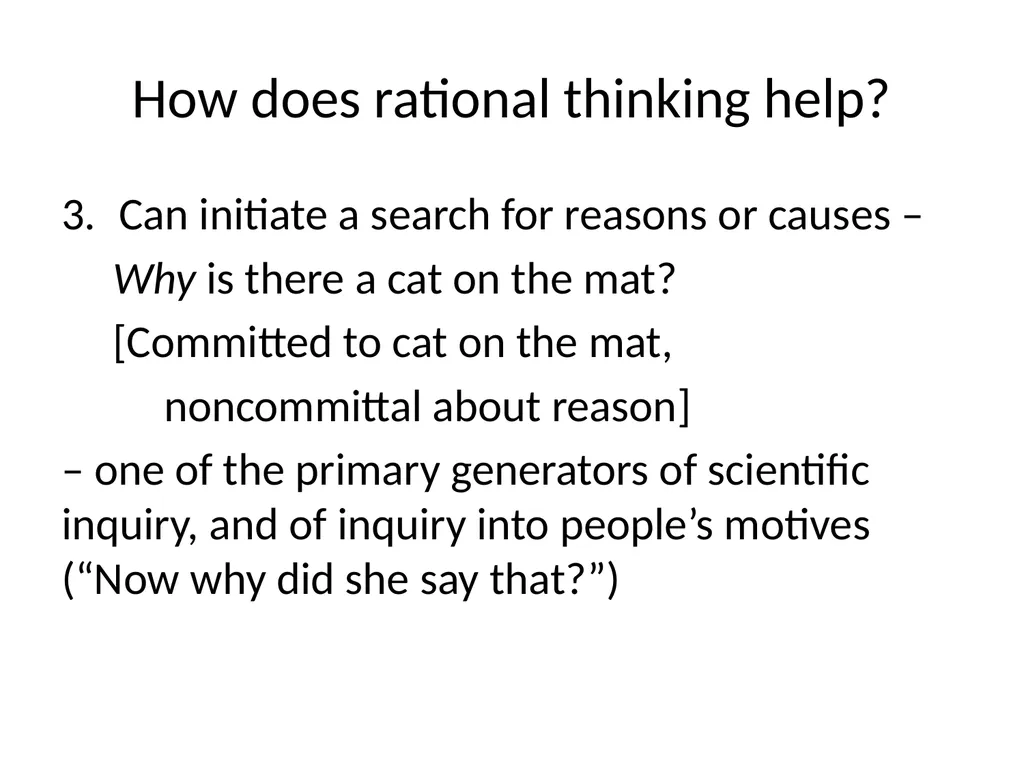
How does rational thinking help? Can initiate a search for reasons or causes –
Why is there a cat on the mat?
[Committed to cat on the mat,
noncommittal about reason]
– one of the primary generators of scientific inquiry, and of inquiry into people’s motives (“Now why did she say that?”)<br>
Why is there a cat on the mat?
[Committed to cat on the mat,
noncommittal about reason]
– one of the primary generators of scientific inquiry, and of inquiry into people’s motives (“Now why did she say that?”)<br>
91
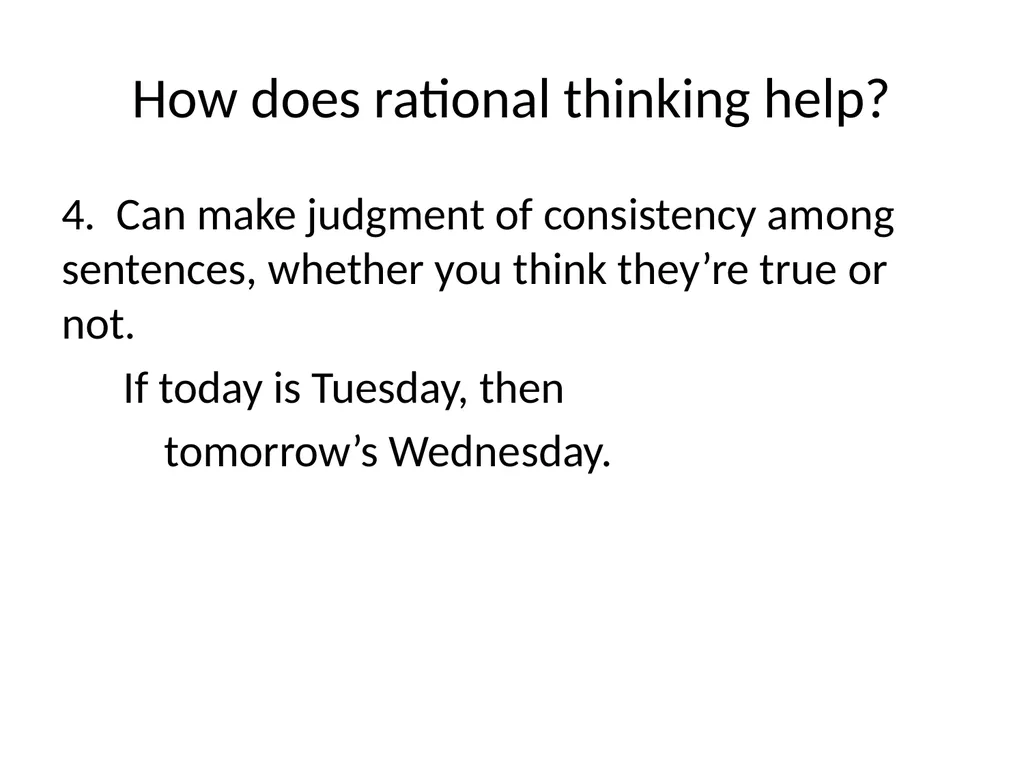
How does rational thinking help? 4. Can make judgment of consistency among sentences, whether you think they’re true or not.
If today is Tuesday, then
tomorrow’s Wednesday.<br>
If today is Tuesday, then
tomorrow’s Wednesday.<br>
92
How does rational thinking help? 4. Can make judgment of consistency among sentences, whether you think they’re true or not.
If today is Tuesday, then
tomorrow’s Wednesday.
Can manipulate these connections:
If today is Tuesday, is tomorrow Thursday?<br>
If today is Tuesday, then
tomorrow’s Wednesday.
Can manipulate these connections:
If today is Tuesday, is tomorrow Thursday?<br>
93
How does rational thinking help? 6. Can understand and maintain two thoughts as alternatives to each other:
Either it’s snowing or I’m dreaming.
Either JOHN or BILL ate the leftover pasta.<br>
Either it’s snowing or I’m dreaming.
Either JOHN or BILL ate the leftover pasta.<br>
94
How does rational thinking help? These procedures enable us to examine our reasoning and break it into smaller steps – just what we want rational thinking to do.
We can’t do these manipulations with unconscious thoughts, and we can’t represent these connections with visual imagery. So the phonological “handles” provided by language are a fantastic tool for enhancing and enriching thinking.<br>
We can’t do these manipulations with unconscious thoughts, and we can’t represent these connections with visual imagery. So the phonological “handles” provided by language are a fantastic tool for enhancing and enriching thinking.<br>
95
How does rational thinking help? 7. Concepts that can only be attained with linguistic “handles”:
Rules of games The past
Organized religion The number system
Finance Science
The power of human thought comes from linking conscious phonological form to unconscious conceptual structure.<br>
Rules of games The past
Organized religion The number system
Finance Science
The power of human thought comes from linking conscious phonological form to unconscious conceptual structure.<br>
96
Some pitfalls of
apparently rational thinking Having a word leads to the assumption that there’s a sharp category boundary:
Either it’s a dog or it’s not (what about dog-wolf hybrids?)
Either it’s a murder or it’s not (abortion?)
Either it’s genocide or it’s not (3? no; 6 million? yes; 2000? 150,000? 1 million?)<br>
Either it’s a dog or it’s not (what about dog-wolf hybrids?)
Either it’s a murder or it’s not (abortion?)
Either it’s genocide or it’s not (3? no; 6 million? yes; 2000? 150,000? 1 million?)<br>
97
Some pitfalls of
apparently rational thinking If there isn’t a word for something, it tends to be invisible.
If you believe thinking requires language, then what do monkeys do? (It must be “mere instinct.”)
If we invent a word for it, say “shmink,” then we can ask “Does thinking = shminking + language? Or something else entirely?”<br>
If you believe thinking requires language, then what do monkeys do? (It must be “mere instinct.”)
If we invent a word for it, say “shmink,” then we can ask “Does thinking = shminking + language? Or something else entirely?”<br>
98
Some pitfalls of
apparently rational thinking You can put words together with just an aura of meaningfulness:
“I don’t think of consciousness as something that happens in us to us but as something that we achieve or something that we do through our action and interaction with the world around us.” ???<br>
“I don’t think of consciousness as something that happens in us to us but as something that we achieve or something that we do through our action and interaction with the world around us.” ???<br>
99
Some pitfalls of
apparently rational thinking Our reasoning is still only as good as the intuitive judgments that support the connections between thoughts:
“Yes, it follows” or “No, it doesn’t”.
Is it rational thinking?
Or is it rationalizing?<br>
“Yes, it follows” or “No, it doesn’t”.
Is it rational thinking?
Or is it rationalizing?<br>
100
Some pitfalls of
apparently rational thinking A symptom of rationalizing: Different reasons all the time for the same conclusion.
“We should go to war because they harbor people who attacked us/because they have weapons of mass destruction/because they don’t respect women’s rights/because …”
“Lowering taxes will create jobs” (even though it hasn’t)/”keep inflation down” (even though it hasn’t).
“Government should be kept off our backs” (but not when it comes to abortion and gay marriage…).
etc.
These all feel rational to their proponents!<br>
“We should go to war because they harbor people who attacked us/because they have weapons of mass destruction/because they don’t respect women’s rights/because …”
“Lowering taxes will create jobs” (even though it hasn’t)/”keep inflation down” (even though it hasn’t).
“Government should be kept off our backs” (but not when it comes to abortion and gay marriage…).
etc.
These all feel rational to their proponents!<br>
101
Some pitfalls of
apparently rational thinking And what are you and I rationalizing about?<br>
102
Some pitfalls of
apparently rational thinking And what are you and I rationalizing about?
From the inside, we have no way to tell.
The best we can do is to watch for cues from our physical and social environments that conflict with our convictions.<br>
From the inside, we have no way to tell.
The best we can do is to watch for cues from our physical and social environments that conflict with our convictions.<br>
103
Some pitfalls of
apparently rational thinking And what are you and I rationalizing about?
From the inside, we have no way to tell.
The best we can do is to watch for cues from our physical and social environments that conflict with our convictions.
Being alert to the possibility that one may be wrong at least keeps one modest.<br>
From the inside, we have no way to tell.
The best we can do is to watch for cues from our physical and social environments that conflict with our convictions.
Being alert to the possibility that one may be wrong at least keeps one modest.<br>
104
Some pitfalls of
apparently rational thinking How to avoid paralysis from worrying whether one might be wrong?
That’s an intuitive judgment too!<br>
That’s an intuitive judgment too!<br>
105
Conclusions Although we often experience our thought as inner speech, the speech is not the thought. It is only the conscious “handle” of the thought, which is itself unconscious.<br>
106
Conclusions Although we often experience our thought as inner speech, the speech is not the thought. It is only the conscious “handle” of the thought, which is itself unconscious.
The ideal of rational thought, in which every step is made explicit, comes from a widespread but incorrect conviction that thought is nothing but language.<br>
The ideal of rational thought, in which every step is made explicit, comes from a widespread but incorrect conviction that thought is nothing but language.<br>
107
Conclusions Although we often experience our thought as inner speech, the speech is not the thought. It is only the conscious “handle” of the thought, which is itself unconscious.
The ideal of rational thought, in which every step is made explicit, comes from a widespread but incorrect conviction that thought is nothing but language.
What we experience as rational thought rides on top of a robust base of intuitive thought.<br>
The ideal of rational thought, in which every step is made explicit, comes from a widespread but incorrect conviction that thought is nothing but language.
What we experience as rational thought rides on top of a robust base of intuitive thought.<br>
108
Conclusions Having conscious “handles” enhances thought vastly.<br>
109
Conclusions Having conscious “handles” enhances thought vastly.
But this does not excuse us from carefully examining our intuitions of rationality, which cannot be made fully conscious.<br>
But this does not excuse us from carefully examining our intuitions of rationality, which cannot be made fully conscious.<br>
110
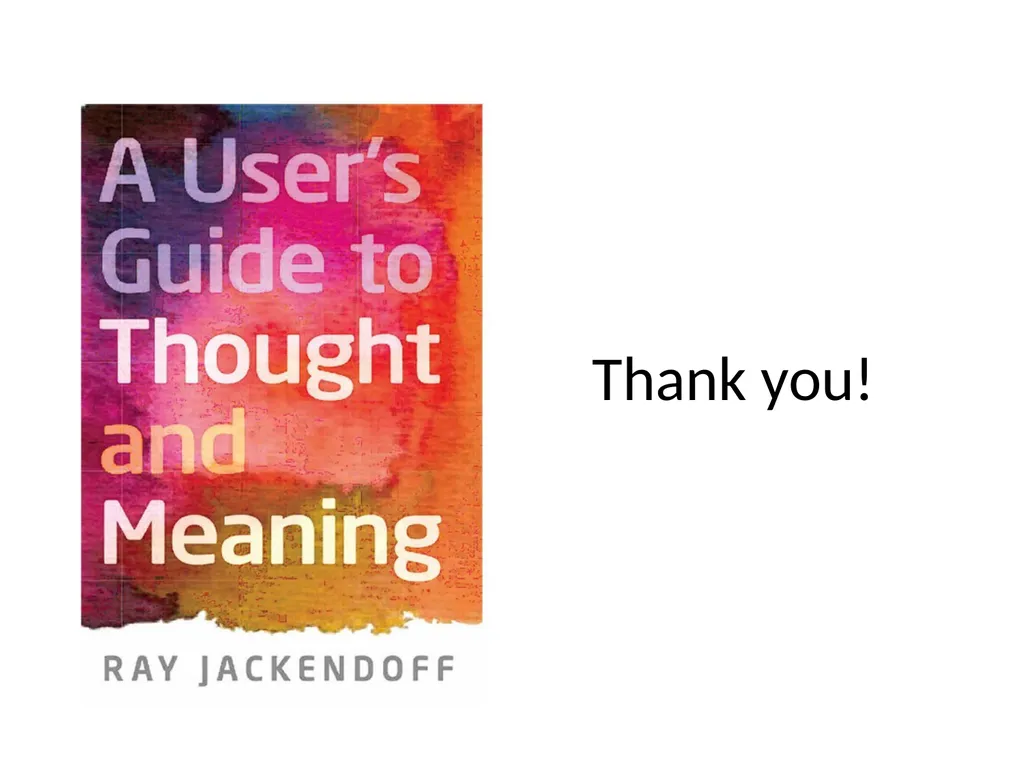
Thank you!<br>