Laser Cladding for repair for frogs and crossing diamonds Break through performance John Haake President Titanova, Inc AMS - austenitic manganese steel or Hadfield Steel Presentation with granted permission form Holland Patent 10,767,318
"Laser Cladding for repair for frogs and crossing" is the property of its rightful owner. Permission is granted to
download and print the materials on this website for personal, non-commercial use only, and to display it
on your personal computer provided you do not modify the materials and that you retain all copyright
notices contained in the materials. By downloading content from our website, you accept the terms of this
agreement.
Presentation Transcript
01
Laser Cladding for repair for frogs and crossing diamonds Break through performance John Haake
President
Titanova, Inc AMS - austenitic manganese steel or Hadfield Steel Presentation with granted permission form Holland
Patent 10,767,318<br>
02
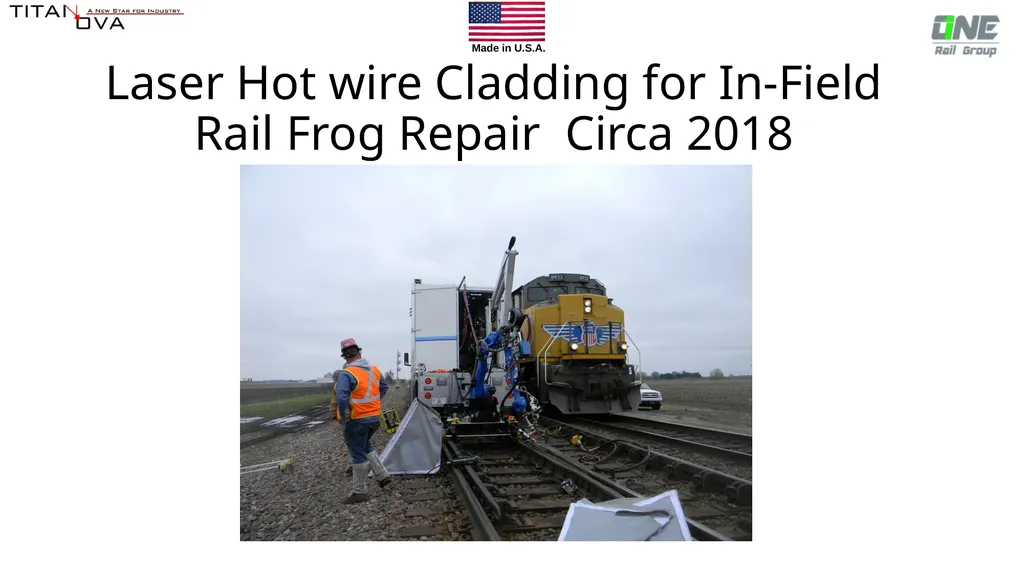
Laser Hot wire Cladding for In-Field Rail Frog Repair Circa 2018<br>
03
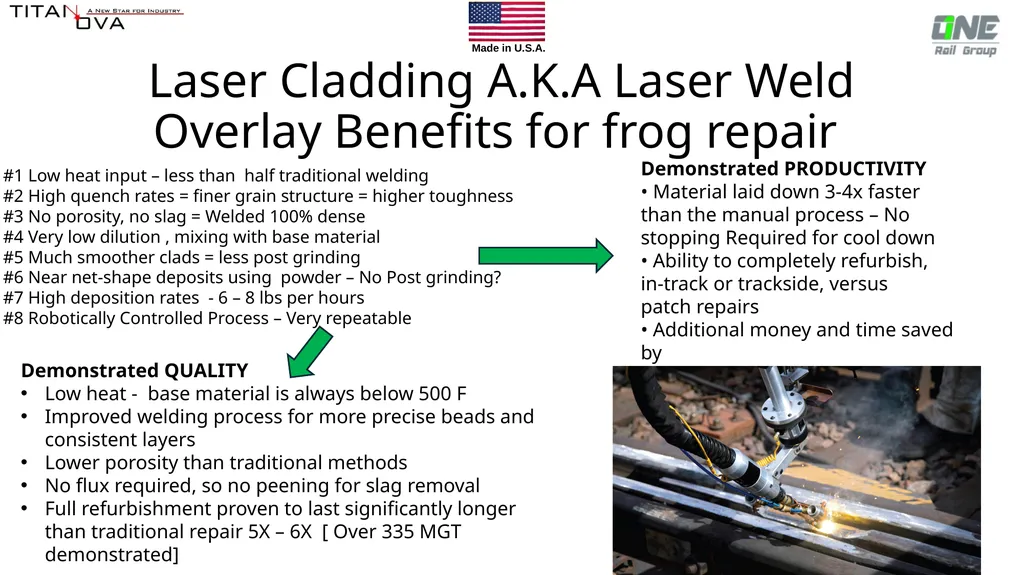
Laser Cladding A.K.A Laser Weld Overlay Benefits for frog repair #1 Low heat input – less than half traditional welding
#2 High quench rates = finer grain structure = higher toughness
#3 No porosity, no slag = Welded 100% dense
#4 Very low dilution , mixing with base material
#5 Much smoother clads = less post grinding
#6 Near net-shape deposits using powder – No Post grinding?
#7 High deposition rates - 6 – 8 lbs per hours
#8 Robotically Controlled Process – Very repeatable Demonstrated PRODUCTIVITY
• Material laid down 3-4x faster
than the manual process – No stopping Required for cool down
• Ability to completely refurbish,
in-track or trackside, versus
patch repairs
• Additional money and time saved by
By significant reduction in post grinding Demonstrated QUALITY
Low heat - base material is always below 500 F
Improved welding process for more precise beads and consistent layers
Lower porosity than traditional methods
No flux required, so no peening for slag removal
Full refurbishment proven to last significantly longer than traditional repair 5X – 6X [ Over 335 MGT demonstrated]<br>
04
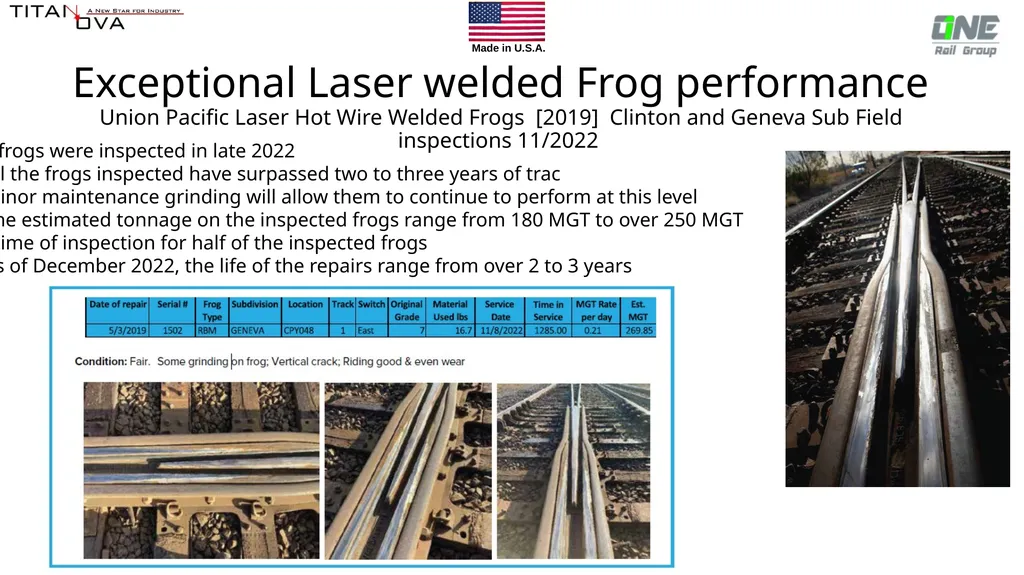
Exceptional Laser welded Frog performance Union Pacific Laser Hot Wire Welded Frogs [2019] Clinton and Geneva Sub Field inspections 11/2022 15 frogs were inspected in late 2022
• All the frogs inspected have surpassed two to three years of trac
• Minor maintenance grinding will allow them to continue to perform at this level
• The estimated tonnage on the inspected frogs range from 180 MGT to over 250 MGT
at time of inspection for half of the inspected frogs
• As of December 2022, the life of the repairs range from over 2 to 3 years<br>
05
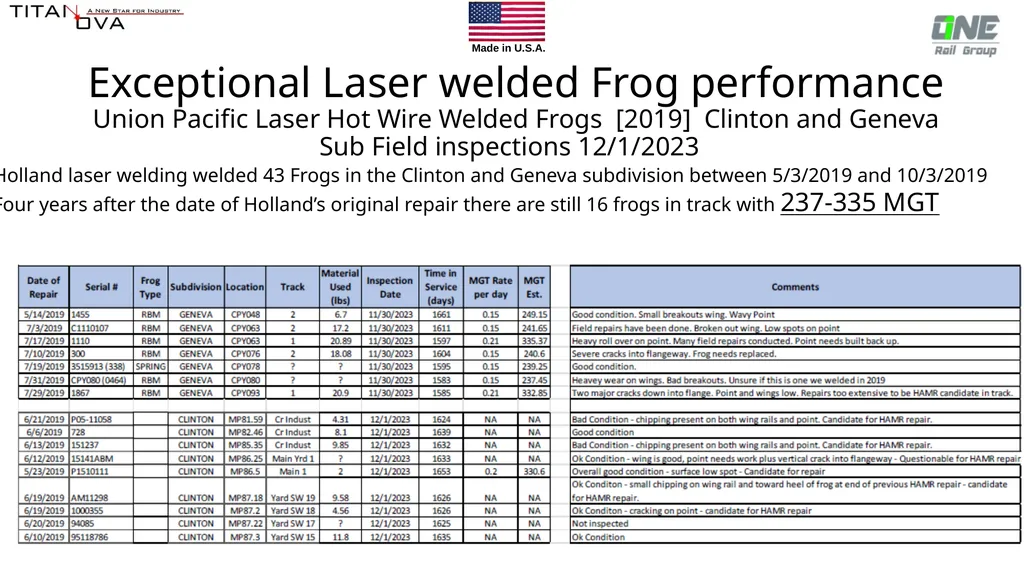
Exceptional Laser welded Frog performance Union Pacific Laser Hot Wire Welded Frogs [2019] Clinton and Geneva Sub Field inspections 12/1/2023 Holland laser welding welded 43 Frogs in the Clinton and Geneva subdivision between 5/3/2019 and 10/3/2019
Four years after the date of Holland’s original repair there are still 16 frogs in track with 237-335 MGT<br>
06
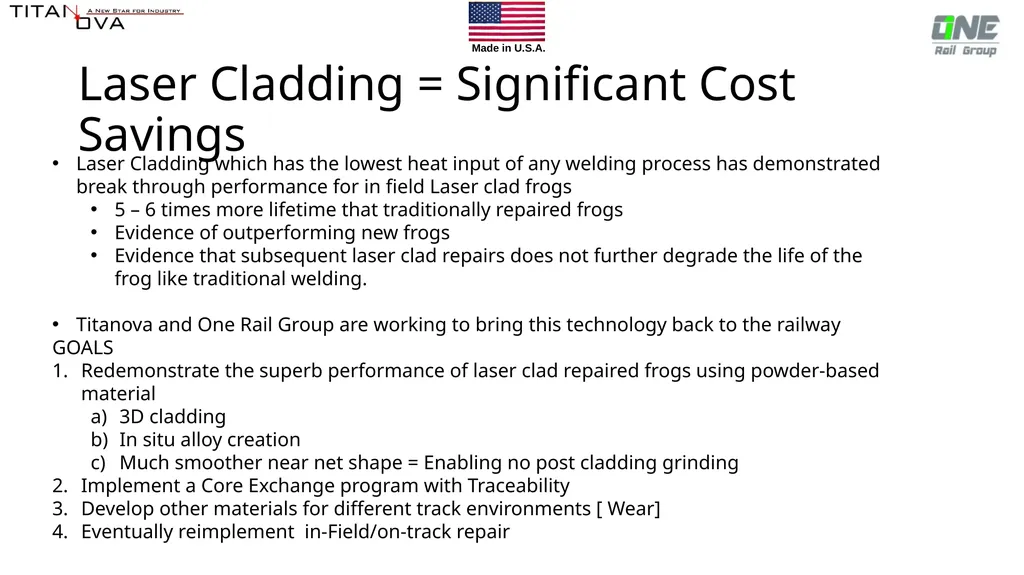
Laser Cladding = Significant Cost Savings Laser Cladding which has the lowest heat input of any welding process has demonstrated break through performance for in field Laser clad frogs
5 – 6 times more lifetime that traditionally repaired frogs
Evidence of outperforming new frogs
Evidence that subsequent laser clad repairs does not further degrade the life of the frog like traditional welding.
Titanova and One Rail Group are working to bring this technology back to the railway
GOALS
Redemonstrate the superb performance of laser clad repaired frogs using powder-based material
3D cladding
In situ alloy creation
Much smoother near net shape = Enabling no post cladding grinding
Implement a Core Exchange program with Traceability
Develop other materials for different track environments [ Wear]
Eventually reimplement in-Field/on-track repair<br>