"Laser Material Processing(LMP) Lecture 6 Laser" is the property of its rightful owner. Permission is granted to
download and print the materials on this website for personal, non-commercial use only, and to display it
on your personal computer provided you do not modify the materials and that you retain all copyright
notices contained in the materials. By downloading content from our website, you accept the terms of this
agreement.
Presentation Transcript
01
Laser Material Processing(LMP) Lecture 6 Laser Cutting<br>
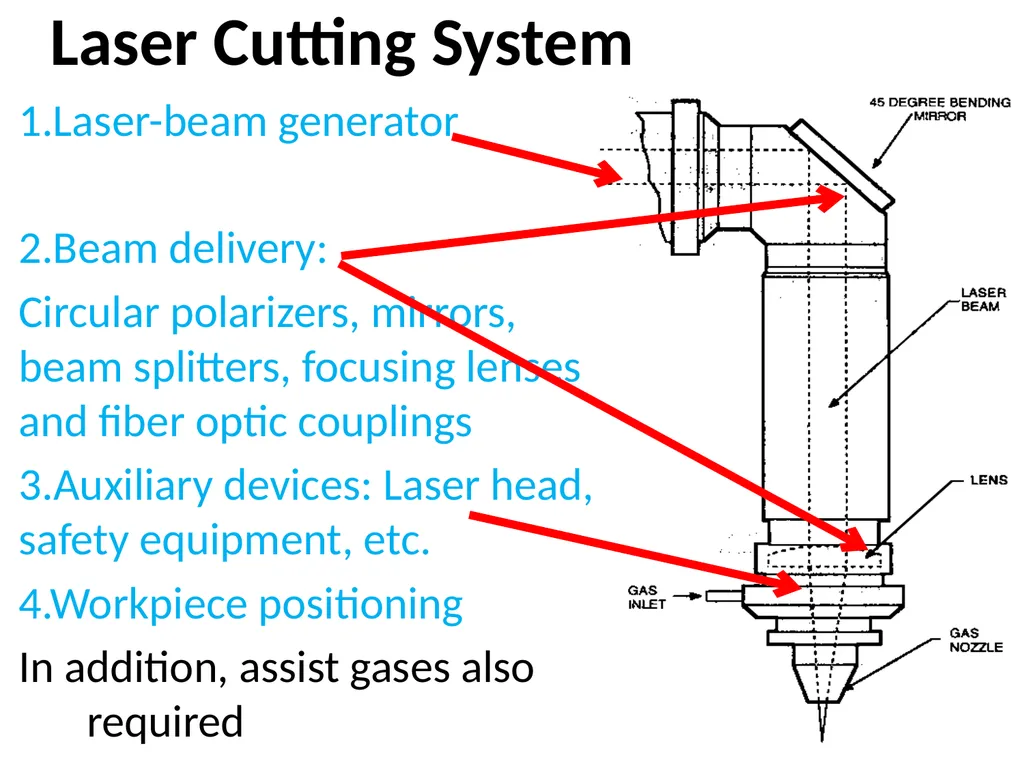
2.Beam delivery:
Circular polarizers, mirrors, beam splitters, focusing lenses and fiber optic couplings
3.Auxiliary devices: Laser head, safety equipment, etc.
4.Workpiece positioning
In addition, assist gases also required Laser Cutting System<br>
04
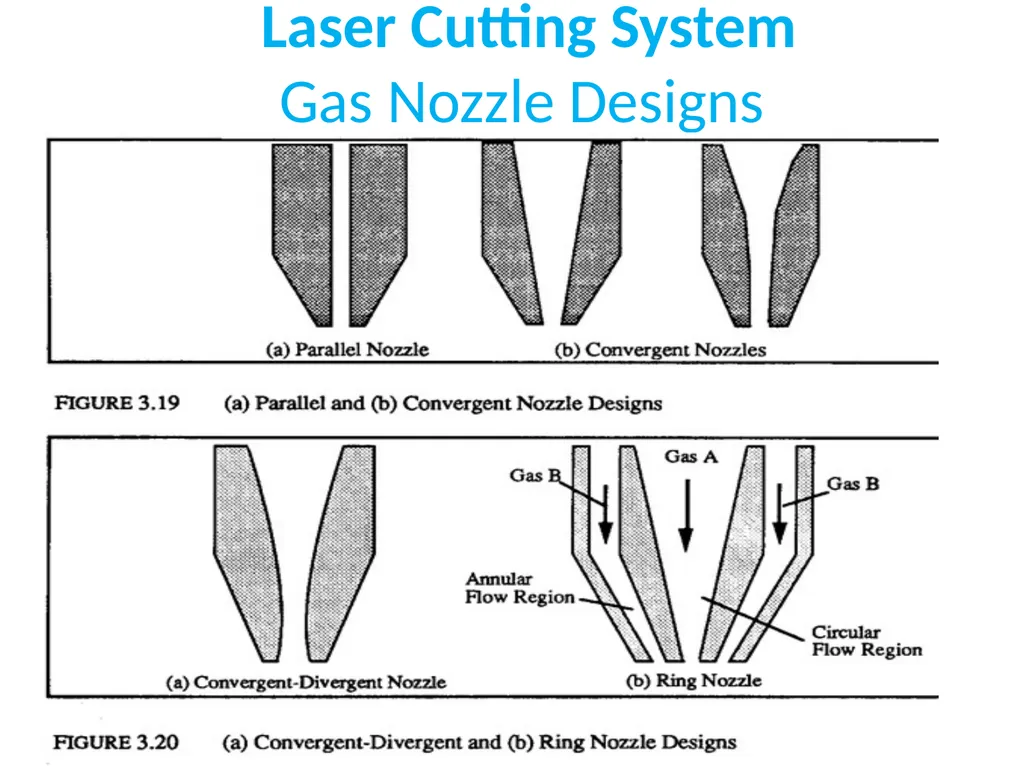
Laser Cutting System Gas Nozzle Designs<br>
05
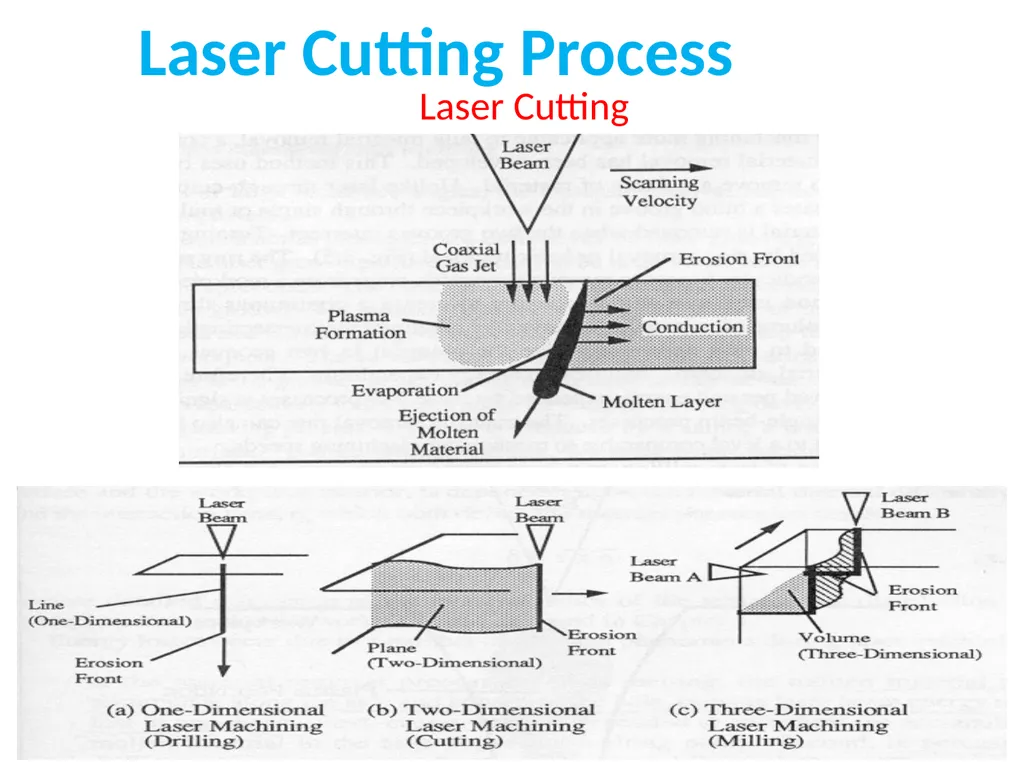
Laser Cutting Process Laser Cutting<br>
06
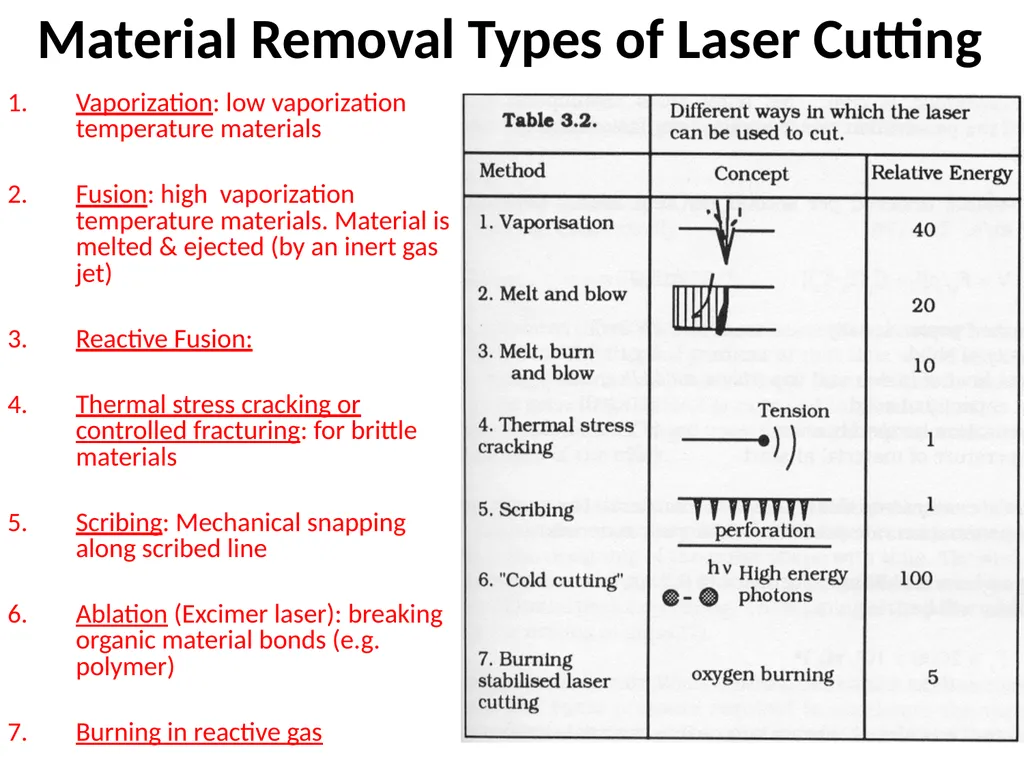
Material Removal Types of Laser Cutting Vaporization: low vaporization temperature materials
Fusion: high vaporization temperature materials. Material is melted & ejected (by an inert gas jet)
Reactive Fusion:
Thermal stress cracking or controlled fracturing: for brittle materials
Scribing: Mechanical snapping along scribed line
Ablation (Excimer laser): breaking organic material bonds (e.g. polymer)
Burning in reactive gas<br>
07
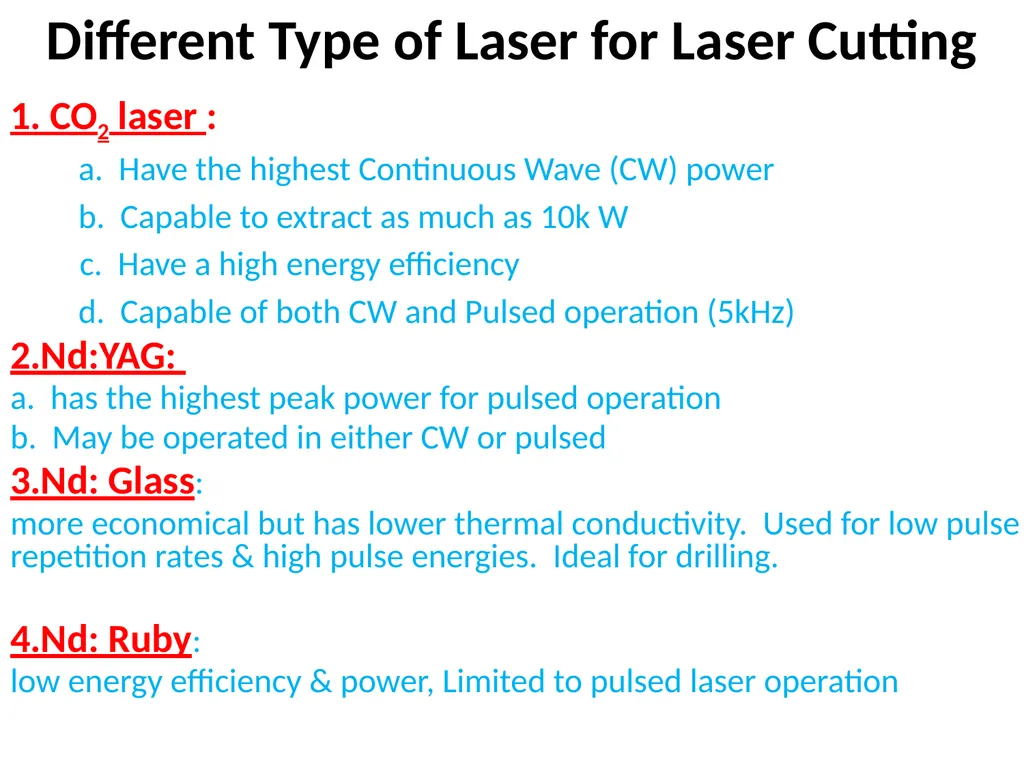
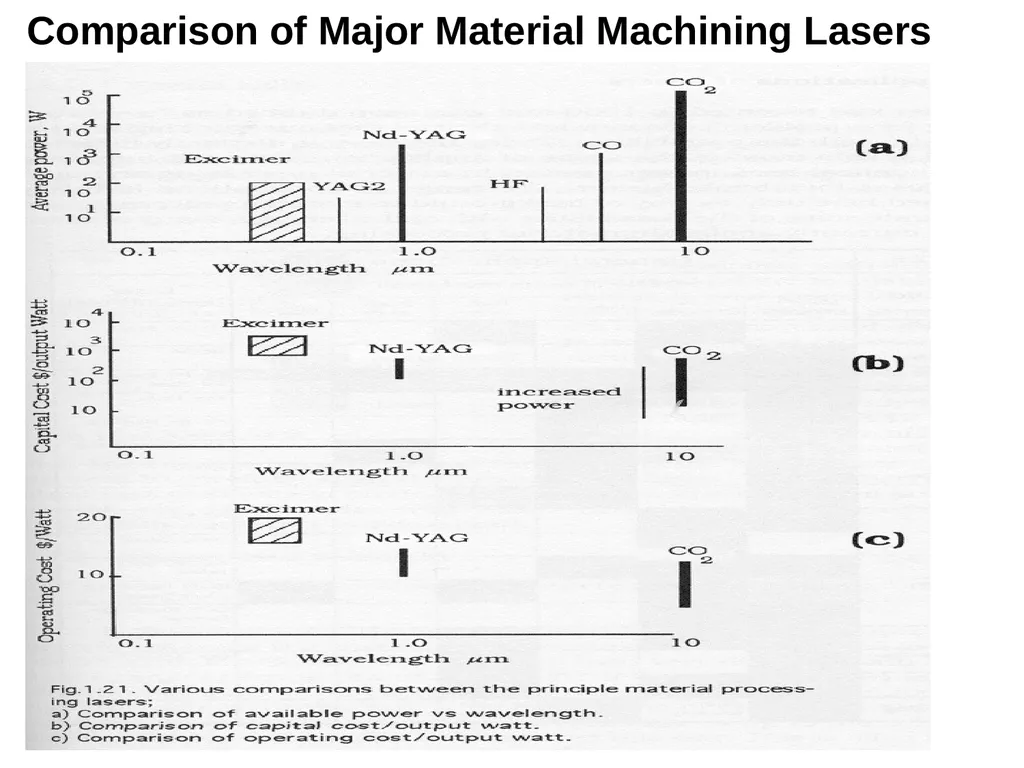
Different Type of Laser for Laser Cutting 1. CO2 laser :
a. Have the highest Continuous Wave (CW) power
b. Capable to extract as much as 10k W
c. Have a high energy efficiency
d. Capable of both CW and Pulsed operation (5kHz)
2.Nd:YAG:
a. has the highest peak power for pulsed operation
b. May be operated in either CW or pulsed
3.Nd: Glass:
more economical but has lower thermal conductivity. Used for low pulse repetition rates & high pulse energies. Ideal for drilling.
4.Nd: Ruby:
low energy efficiency & power, Limited to pulsed laser operation<br>
08
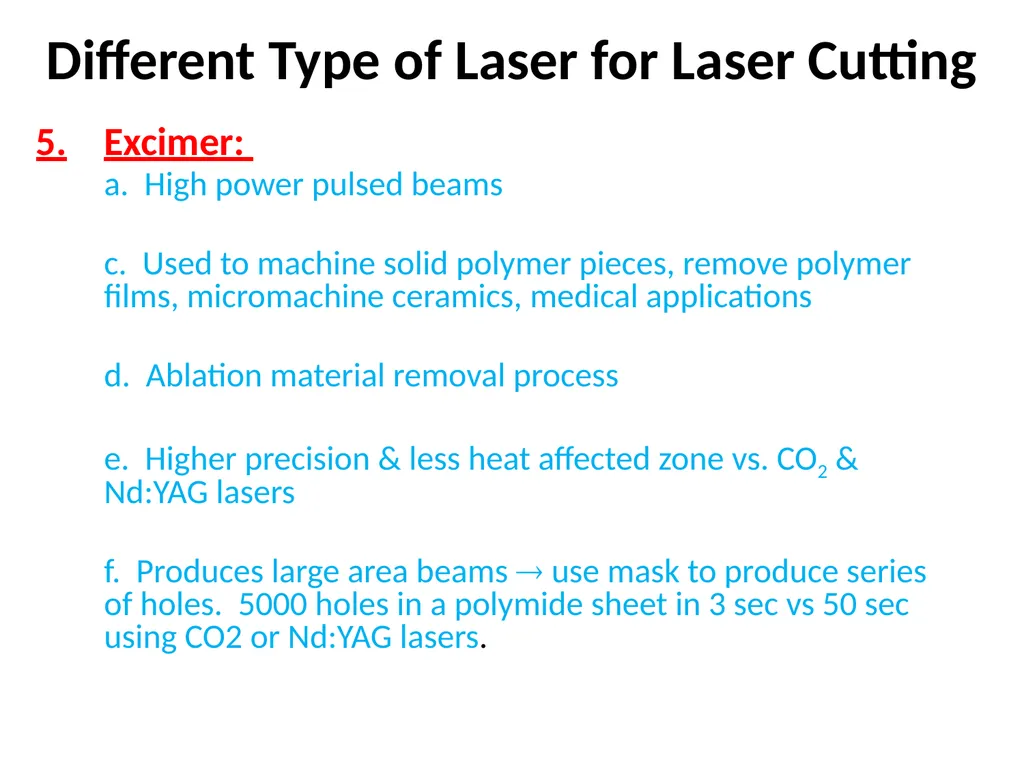
5. Excimer:
a. High power pulsed beams
c. Used to machine solid polymer pieces, remove polymer films, micromachine ceramics, medical applications
d. Ablation material removal process
e. Higher precision & less heat affected zone vs. CO2 & Nd:YAG lasers
f. Produces large area beams use mask to produce series of holes. 5000 holes in a polymide sheet in 3 sec vs 50 sec using CO2 or Nd:YAG lasers. Different Type of Laser for Laser Cutting<br>
09
Comparison of Major Material Machining Lasers<br>
10
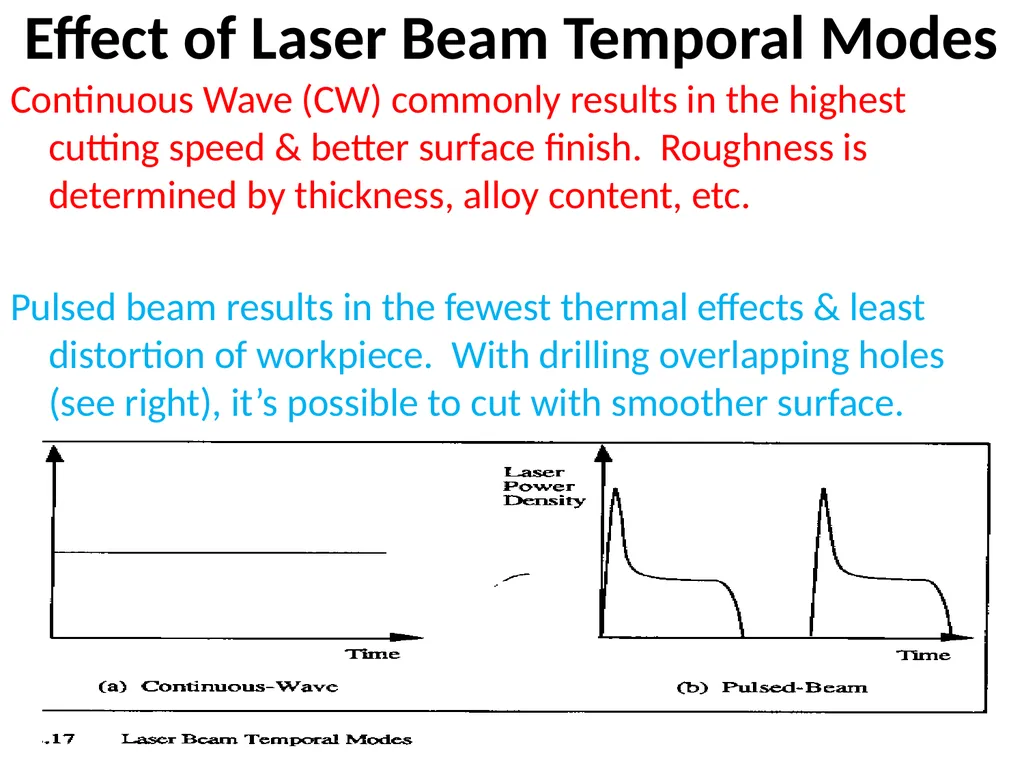
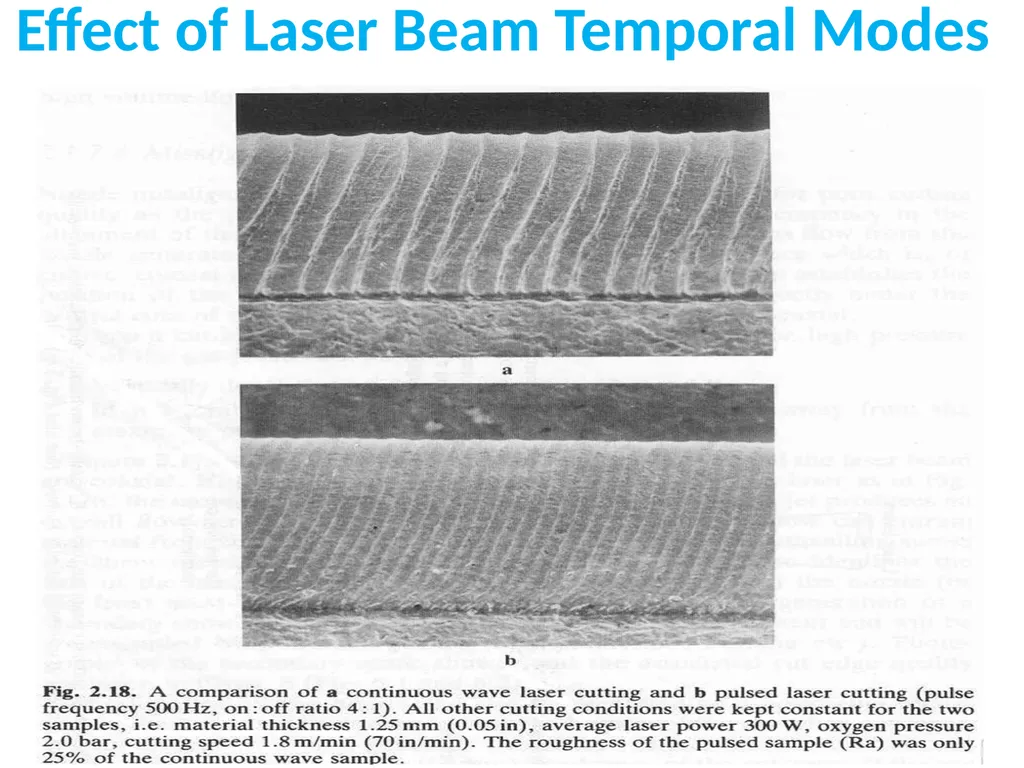
Effect of Laser Beam Temporal Modes Continuous Wave (CW) commonly results in the highest cutting speed & better surface finish. Roughness is determined by thickness, alloy content, etc.
Pulsed beam results in the fewest thermal effects & least distortion of workpiece. With drilling overlapping holes (see right), it’s possible to cut with smoother surface.<br>
11
Effect of Laser Beam Temporal Modes<br>
12
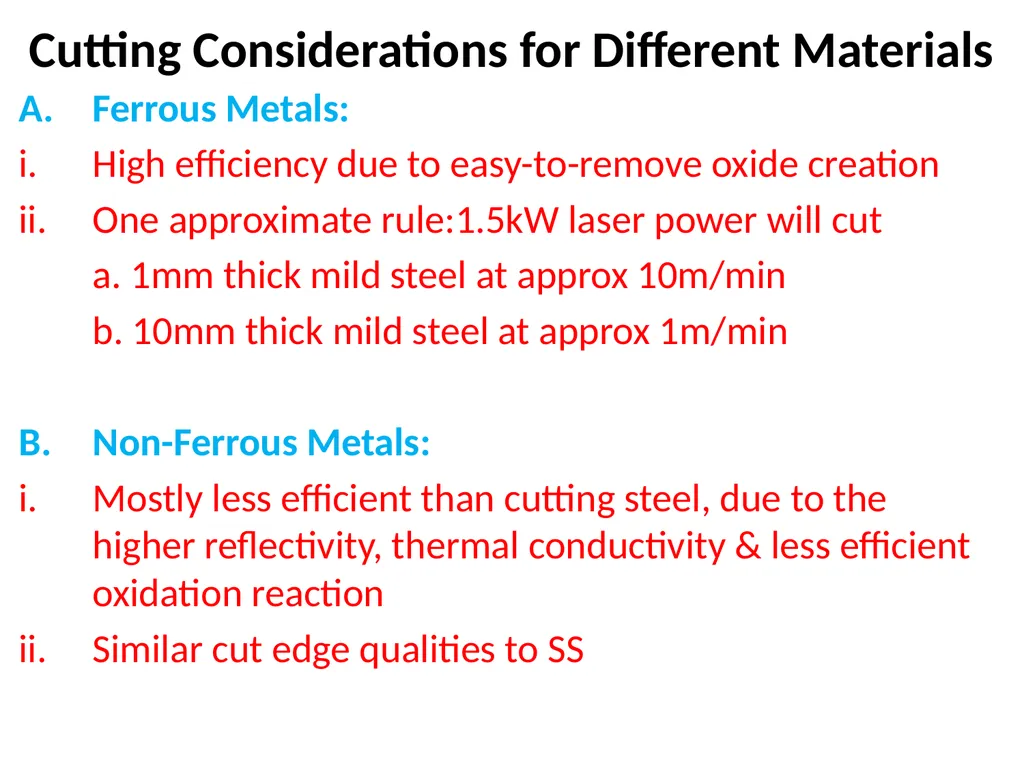
Cutting Considerations for Different Materials Ferrous Metals:
High efficiency due to easy-to-remove oxide creation
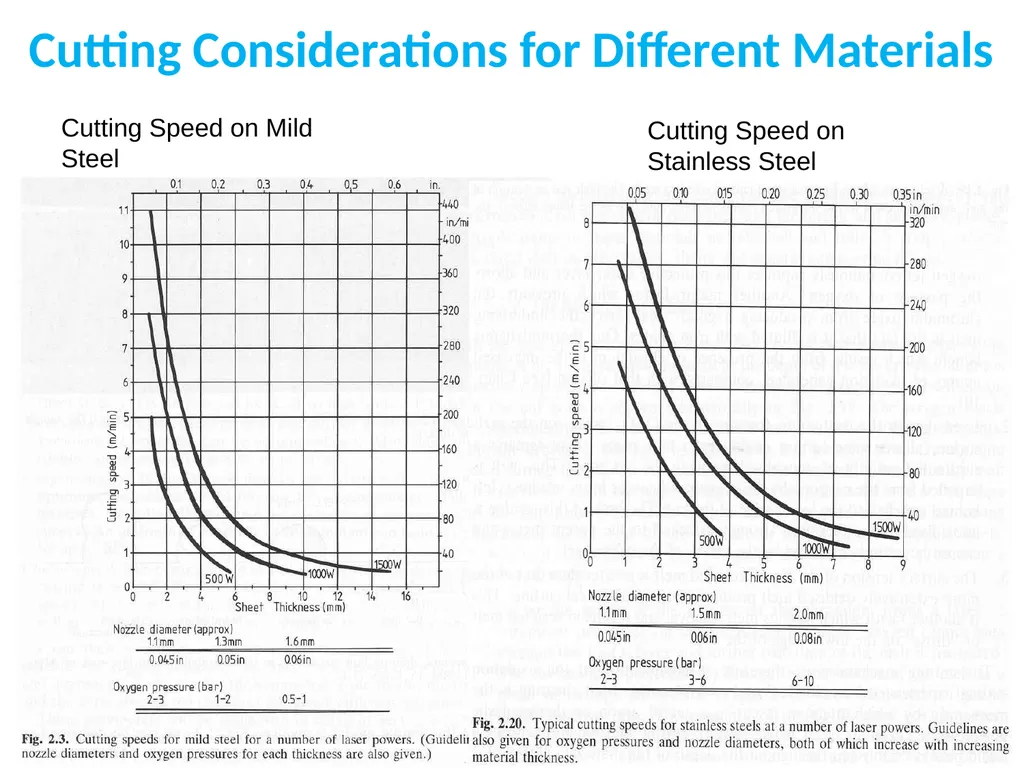
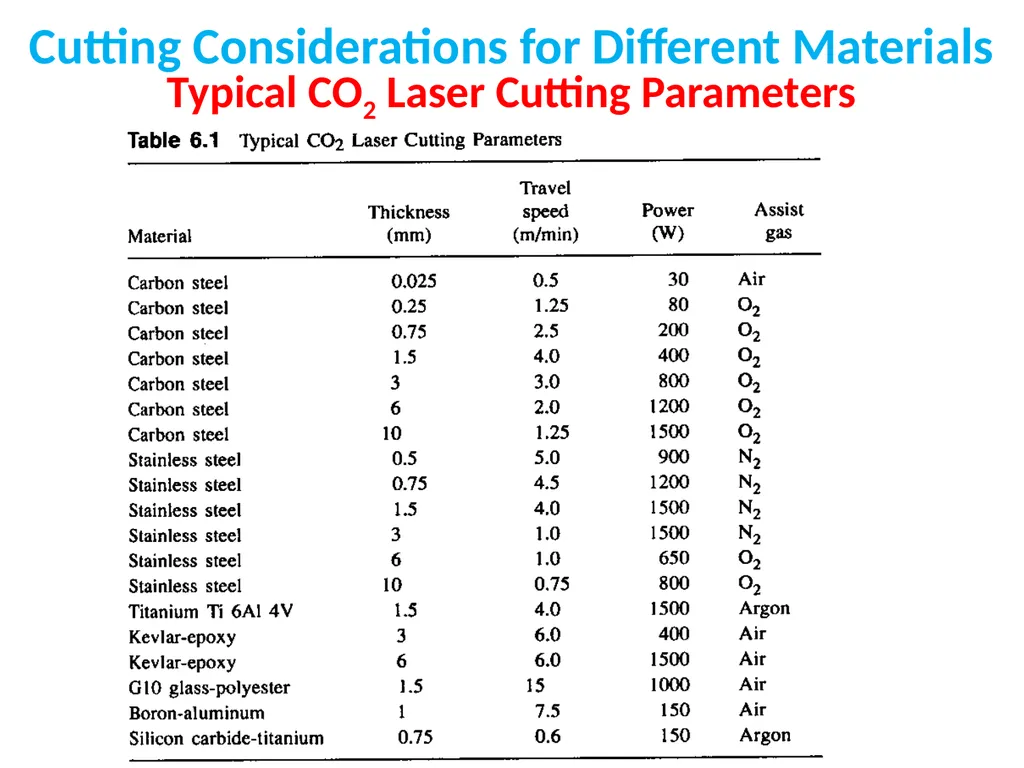
One approximate rule:1.5kW laser power will cut
a. 1mm thick mild steel at approx 10m/min
b. 10mm thick mild steel at approx 1m/min
Non-Ferrous Metals:
Mostly less efficient than cutting steel, due to the higher reflectivity, thermal conductivity & less efficient oxidation reaction
Similar cut edge qualities to SS<br>
13
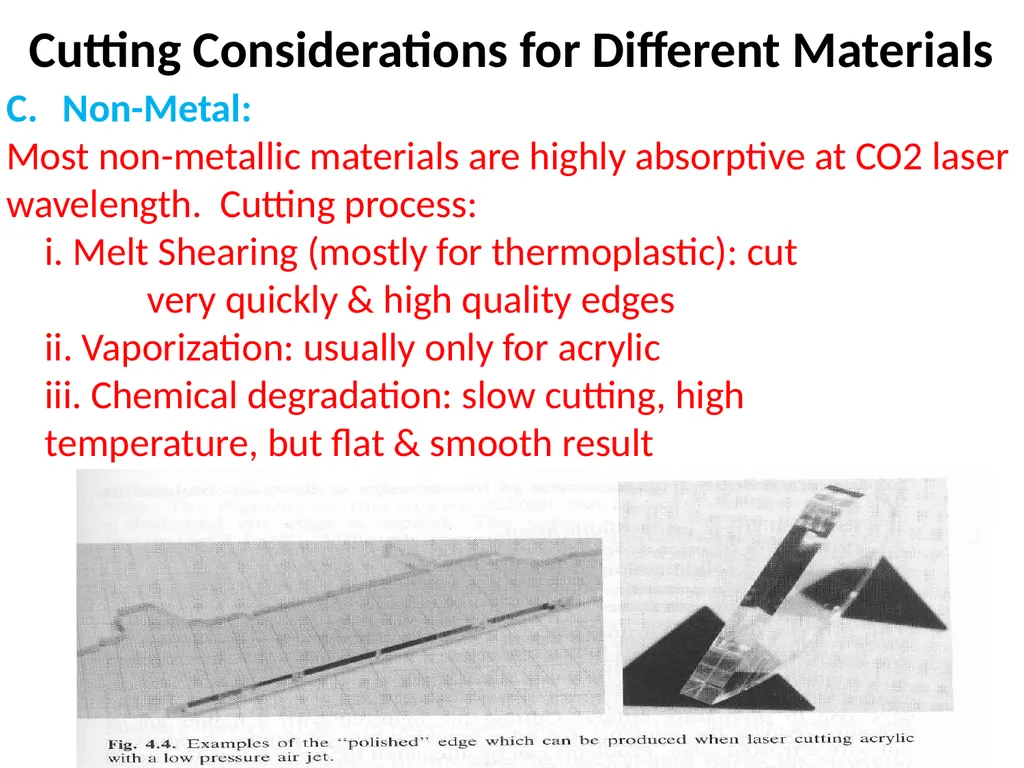
Non-Metal:
Most non-metallic materials are highly absorptive at CO2 laser wavelength. Cutting process:
i. Melt Shearing (mostly for thermoplastic): cut
very quickly & high quality edges
ii. Vaporization: usually only for acrylic
iii. Chemical degradation: slow cutting, high temperature, but flat & smooth result Cutting Considerations for Different Materials<br>
14
Cutting Speed on Mild Steel Cutting Speed on Stainless Steel Cutting Considerations for Different Materials<br>
15
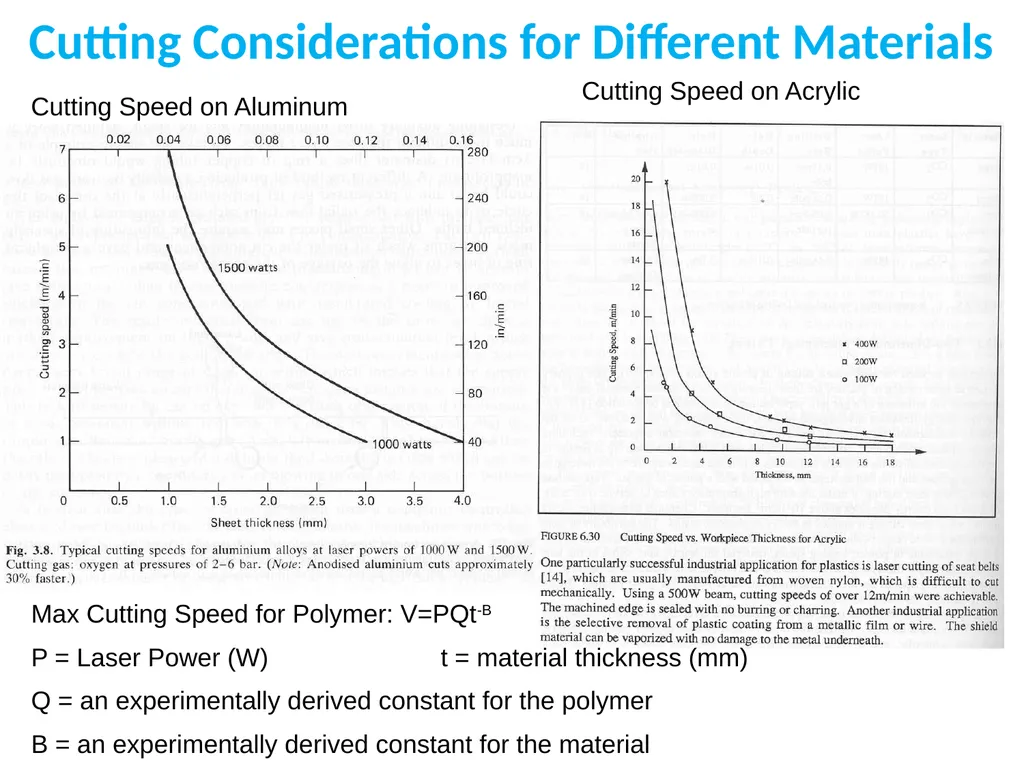
Cutting Speed on Aluminum Cutting Speed on Acrylic Max Cutting Speed for Polymer: V=PQt-B
P = Laser Power (W) t = material thickness (mm)
Q = an experimentally derived constant for the polymer
B = an experimentally derived constant for the material Cutting Considerations for Different Materials<br>
16
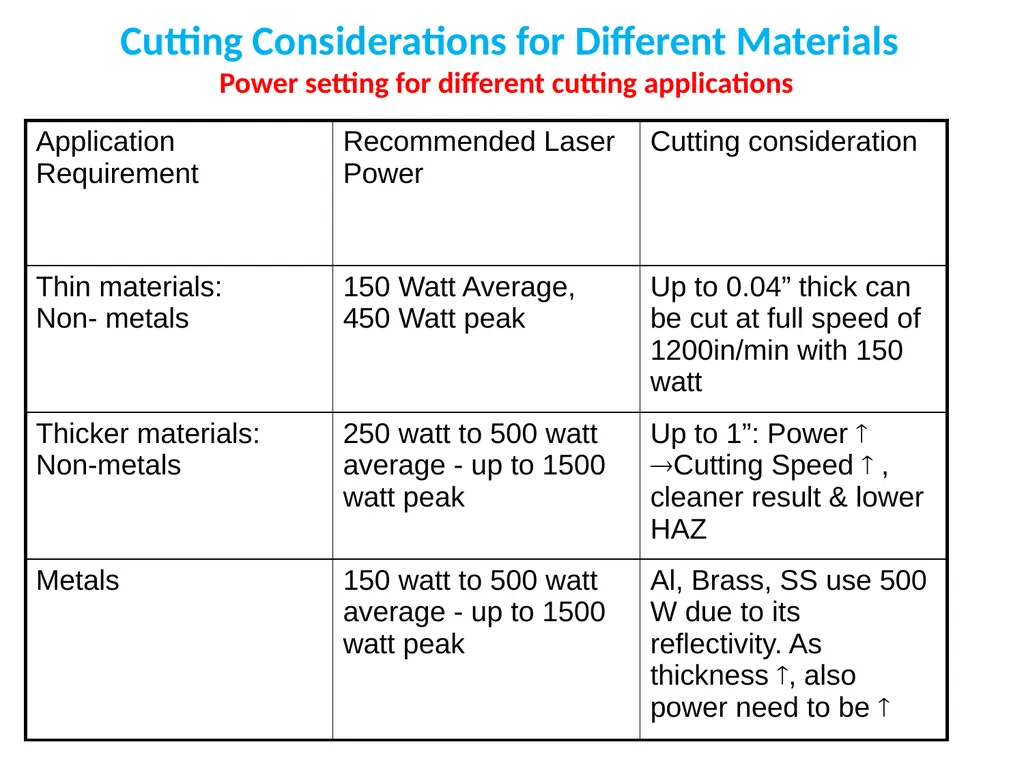
Cutting Considerations for Different Materials
Power setting for different cutting applications<br>
17
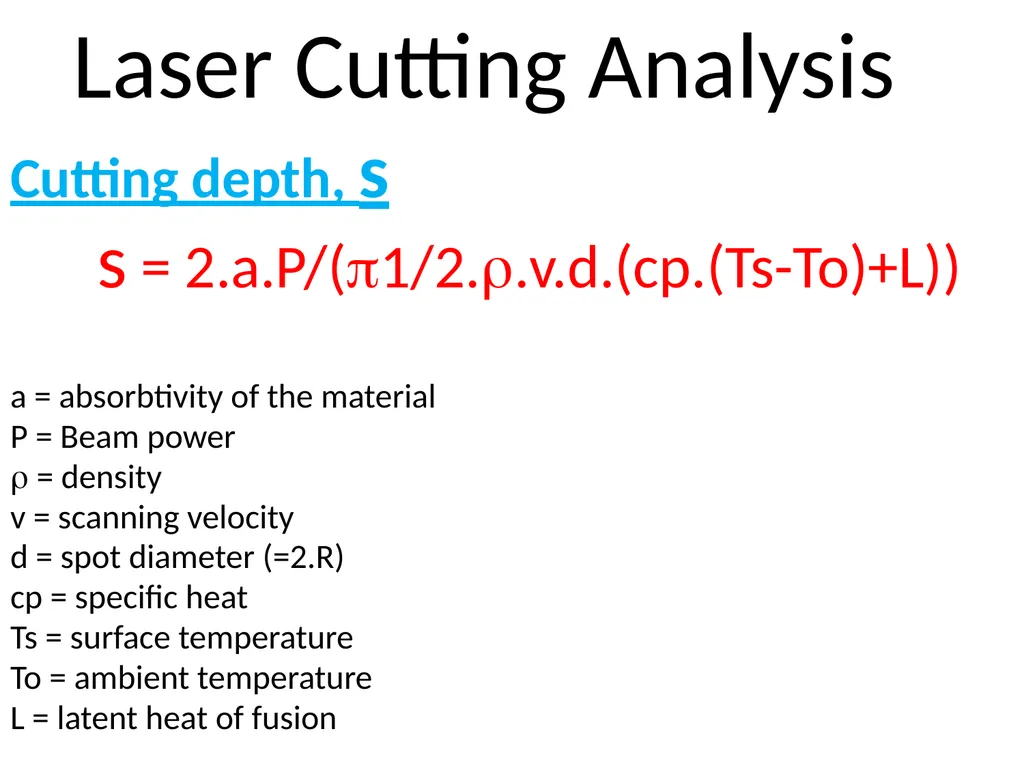
Laser Cutting Analysis Cutting depth, s
s = 2.a.P/(1/2..v.d.(cp.(Ts-To)+L))
a = absorbtivity of the material
P = Beam power
= density
v = scanning velocity
d = spot diameter (=2.R)
cp = specific heat
Ts = surface temperature
To = ambient temperature
L = latent heat of fusion<br>
18
Typical CO2 Laser Cutting Parameters Cutting Considerations for Different Materials<br>
19
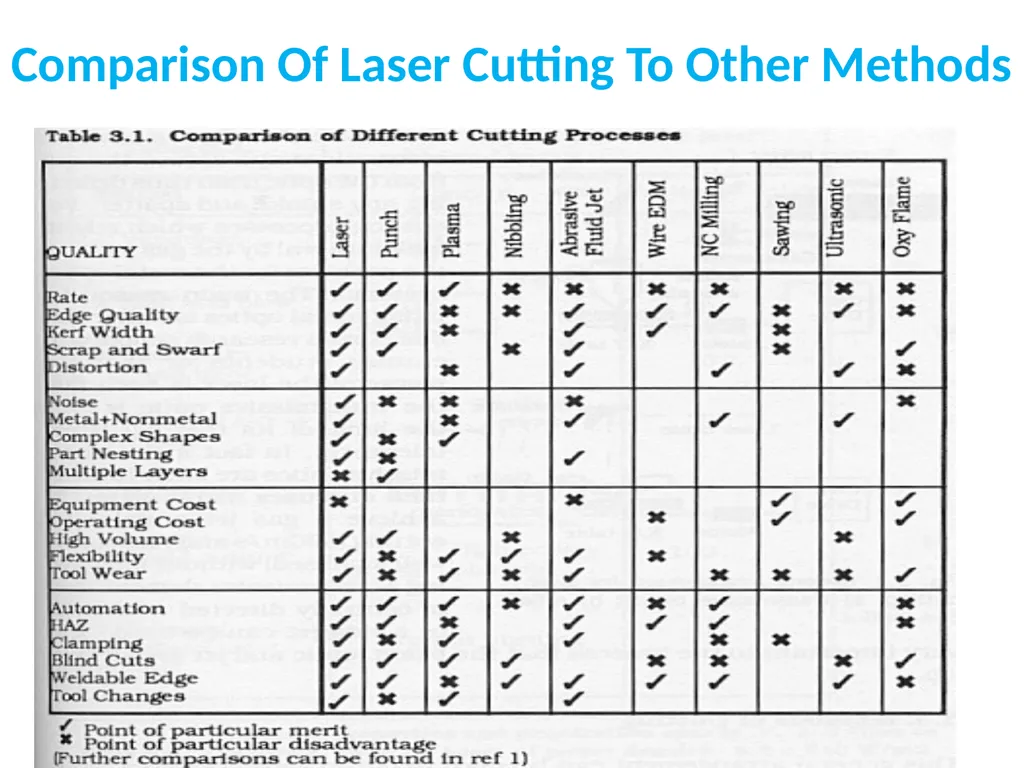
Comparison Of Laser Cutting To Other Methods<br>
20
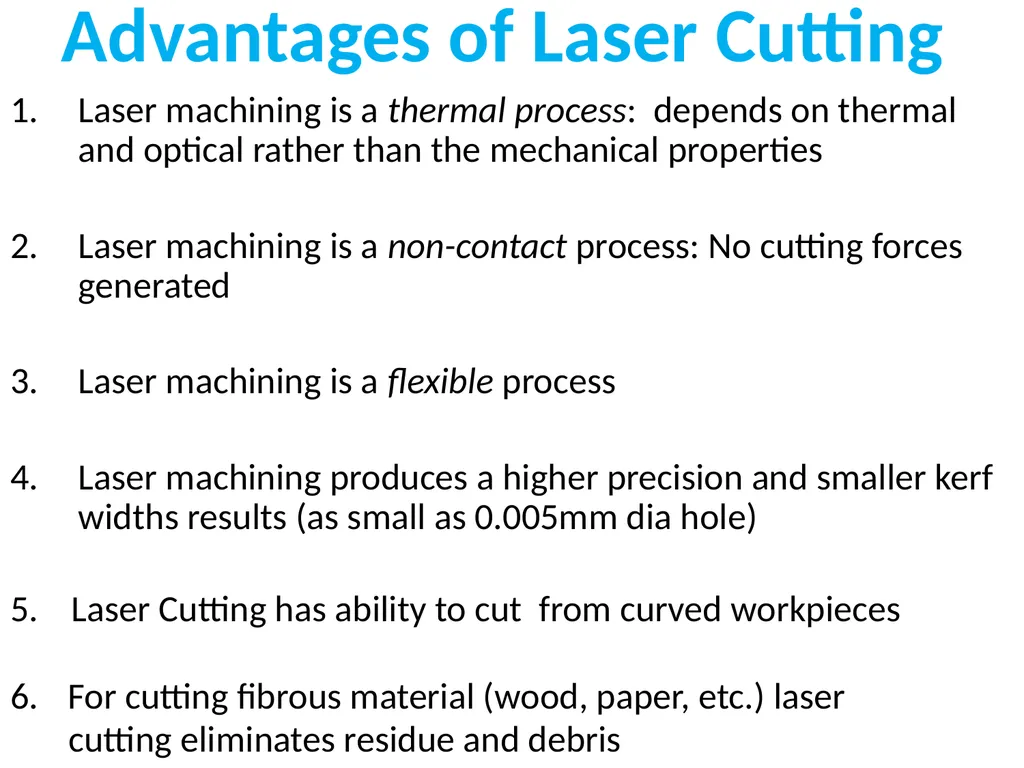
Advantages of Laser Cutting Laser machining is a thermal process: depends on thermal and optical rather than the mechanical properties
Laser machining is a non-contact process: No cutting forces generated
Laser machining is a flexible process
Laser machining produces a higher precision and smaller kerf widths results (as small as 0.005mm dia hole)
5. Laser Cutting has ability to cut from curved workpieces
For cutting fibrous material (wood, paper, etc.) laser
cutting eliminates residue and debris<br>
21
Disadvantage of Laser Cutting Low energy efficiency
Material damage: Heat affected zone (HAZ)
Laser cutting effectiveness reduces as the workpiece thickness increases
Laser cutting produces a tapered kerf shape (due to divergence)<br>
22
Compare between Continuous Wave (CW) mode laser cutting process and Pulsed mode laser cutting process Home Work<br>