Law making process by advocate regina Mabwe Arms of the state Functions of the Senate and National Assembly initiate, prepare, consider or reject legislation-s130 of the Constitution may exercise any further functions conferred or imposed
"Law making process by advocate regina Mabwe Arms" is the property of its rightful owner. Permission is granted to
download and print the materials on this website for personal, non-commercial use only, and to display it
on your personal computer provided you do not modify the materials and that you retain all copyright
notices contained in the materials. By downloading content from our website, you accept the terms of this
agreement.
Presentation Transcript
01
Law making process by advocate regina Mabwe<br>
02
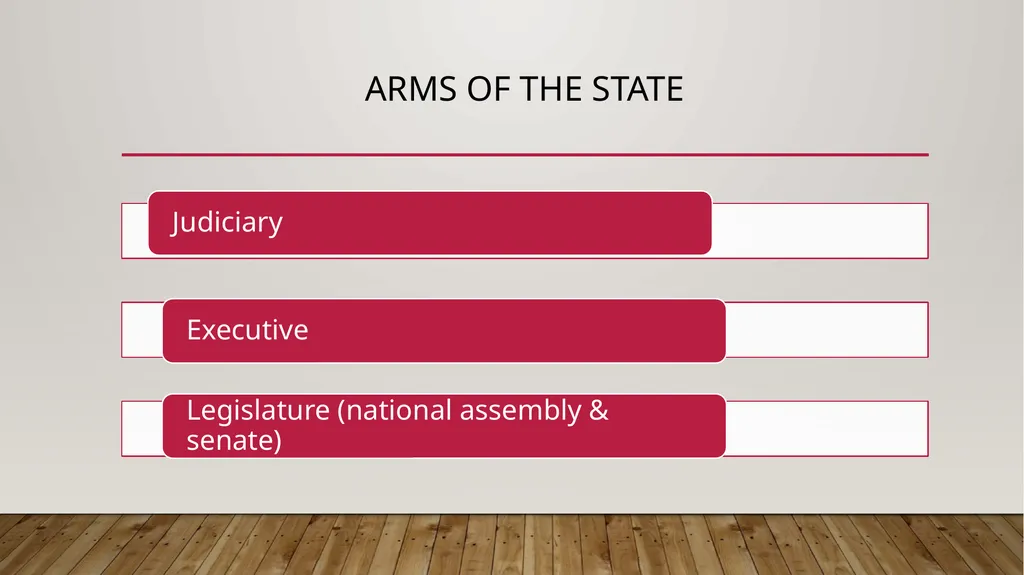
Arms of the state<br>
03
Functions of the Senate and National Assembly initiate, prepare, consider or reject legislation-s130 of the Constitution
may exercise any further functions conferred or imposed on them under any law.<br>
04
Legislative authority of Parliament Exercised through the enactment of an Act of Parliament- s131 (1) of the Constitution
An act of parliament is complete when
presented as a Bill in and passed by both Houses of Parliament; and
assented to and signed by the President
When acts a and b are done in accordance with the Constitution<br>
05
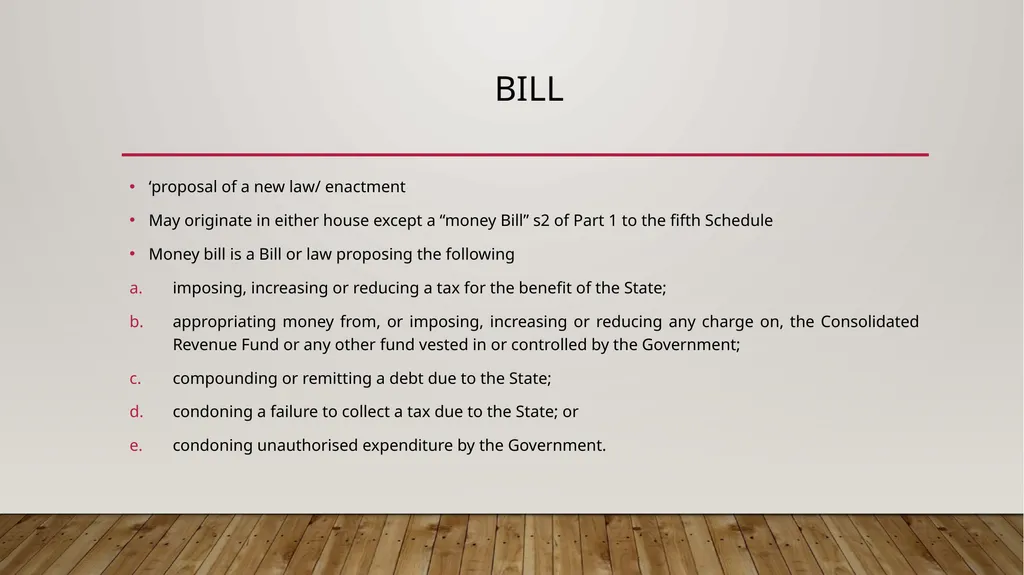
Bill ‘proposal of a new law/ enactment
May originate in either house except a “money Bill” s2 of Part 1 to the fifth Schedule
Money bill is a Bill or law proposing the following
imposing, increasing or reducing a tax for the benefit of the State;
appropriating money from, or imposing, increasing or reducing any charge on, the Consolidated Revenue Fund or any other fund vested in or controlled by the Government;
compounding or remitting a debt due to the State;
condoning a failure to collect a tax due to the State; or
condoning unauthorised expenditure by the Government.<br>
06
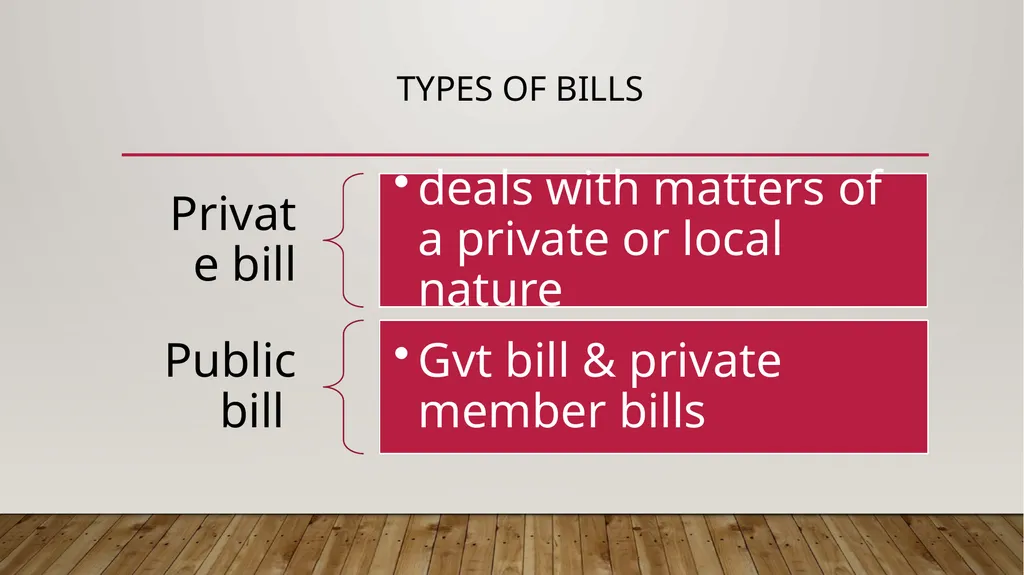
Types of bills<br>
07
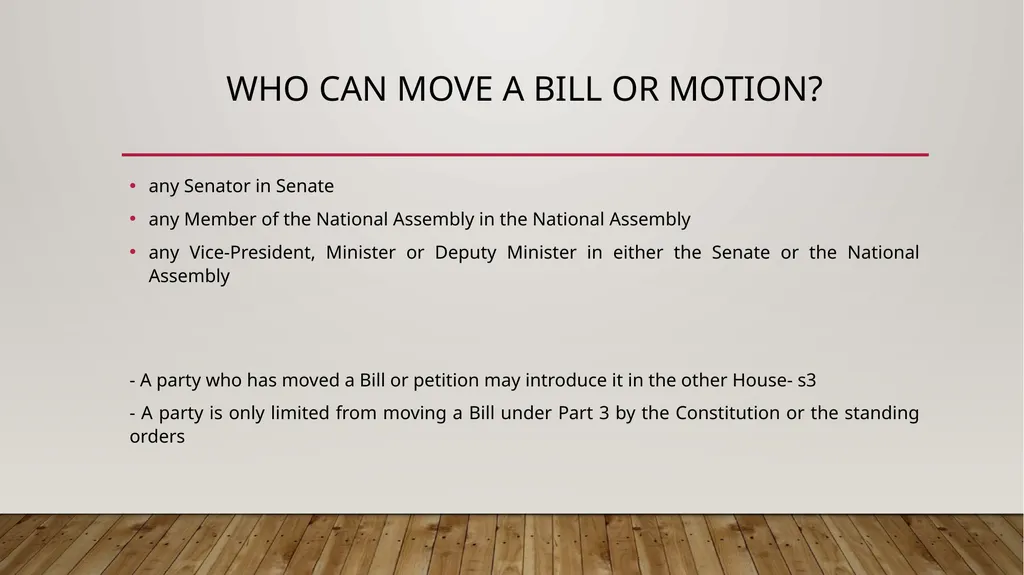
Who can move a Bill or motion? any Senator in Senate
any Member of the National Assembly in the National Assembly
any Vice-President, Minister or Deputy Minister in either the Senate or the National Assembly
- A party who has moved a Bill or petition may introduce it in the other House- s3
- A party is only limited from moving a Bill under Part 3 by the Constitution or the standing orders<br>
08
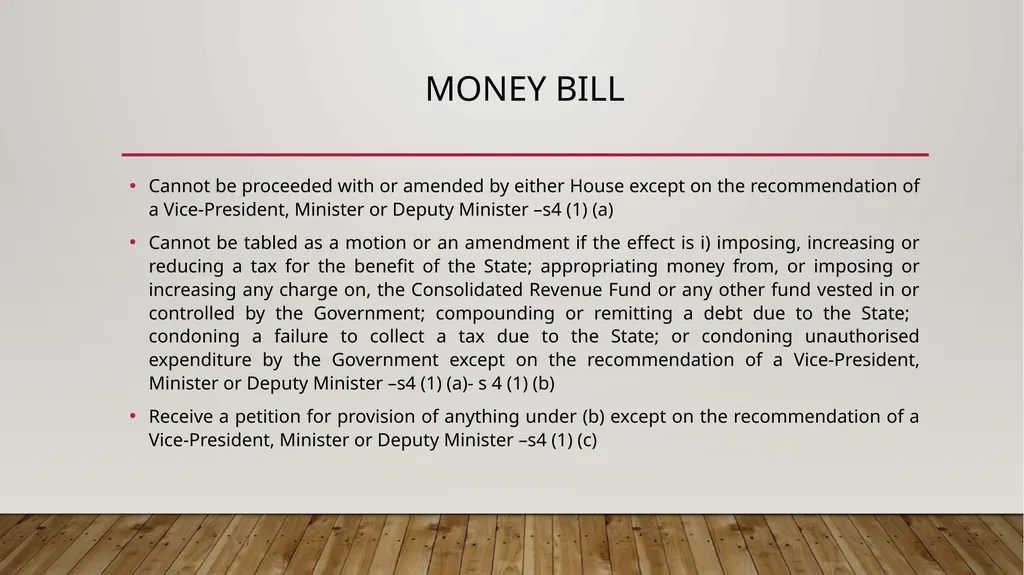
Money Bill Cannot be proceeded with or amended by either House except on the recommendation of a Vice-President, Minister or Deputy Minister –s4 (1) (a)
Cannot be tabled as a motion or an amendment if the effect is i) imposing, increasing or reducing a tax for the benefit of the State; appropriating money from, or imposing or increasing any charge on, the Consolidated Revenue Fund or any other fund vested in or controlled by the Government; compounding or remitting a debt due to the State; condoning a failure to collect a tax due to the State; or condoning unauthorised expenditure by the Government except on the recommendation of a Vice-President, Minister or Deputy Minister –s4 (1) (a)- s 4 (1) (b)
Receive a petition for provision of anything under (b) except on the recommendation of a Vice-President, Minister or Deputy Minister –s4 (1) (c)<br>
09
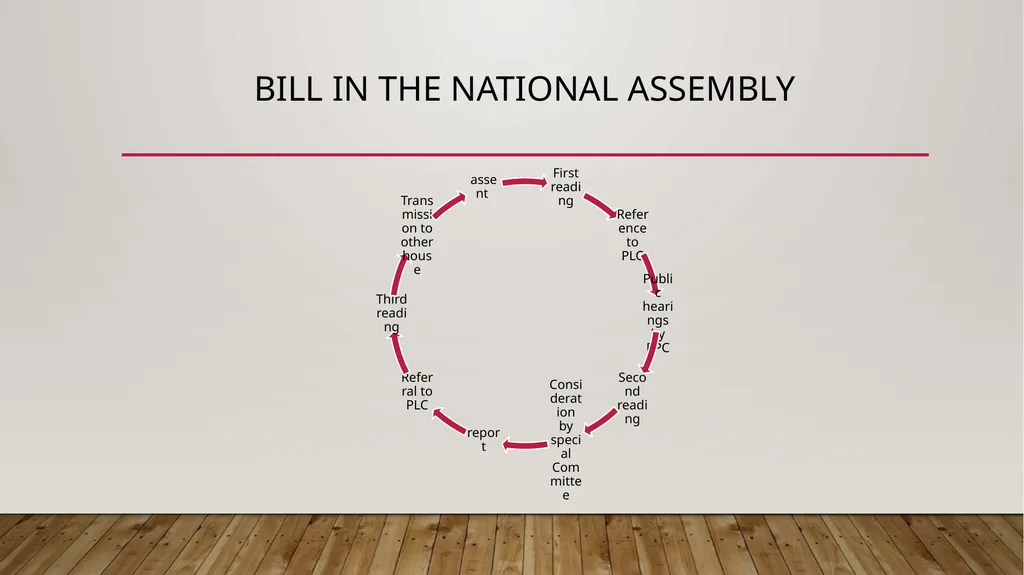
transmission Once Bill is voted, it must be transmitted to the other house and the date of transmission recorded- s5 (1)
The House must be introduced without delay after which it may be passed with or without amendment –s 5 (2)
If there are any amendments it must be sent back to the originating house, which can either accept the amendments or reject them –s5 (3)
The house that amended, may withdraw its amendment or agree to it pursuant to a resolution and convey that message to the other House –s5 (4)<br>
10
Disagreements If within 90days
a. Senate and the National Assembly have not agreed on amendments to be made to a Bill which originated in the National Assembly or
b. the Senate and the National Assembly have not agreed on amendments to be made to a Bill which originated in the Senate
c. a Bill that originated in the National Assembly has been rejected or has not been passed by the Senate
-the bill may be presented to the President for assent in the form passed by the National Assembly-s6
the Bill cannot be presented to the President unless NA agrees to present it for assent after 90days –s(3)<br>
11
Identical bills If, in the opinion of the Speaker, a Bill which—
originated in the National Assembly; and
was introduced into the National Assembly within ninety days after a previous Bill originating in the Senate was introduced into the Senate; contains provisions identical to those contained in that previous Bill, except for minor changes required by the passage of time,
s 6 (1) applies and the 90days stated in (a) and (c) is reckoned as eight sitting days<br>
12
Presentation of bill must be accompanied by a certificate from the Speaker stating that the Bill is one to which s6 applies and that the requirements of s6 have been satisfied
A Bill presented to the President in accordance with this paragraph is deemed to have been duly passed by Parliament in the form in which it is presented to the President<br>