
Leaping Over Trade Remedies in a Single Bound:
AM
Published · 50 slides · 0 views

1 / 1



Description
Leaping Over Trade Remedies in a Single Bound: Steel, Aluminum, IEEPA Other Tariffs Program Sponsored by Sandra Langford-Coty NCBFAA Customs Committee Chair; Director of Operational Development, A.N. Deringer, Inc. Ralph De La Rosa NCBFAA
Related Topics
Share
Embed code
Download this presentation From Below
"Leaping Over Trade Remedies in a Single Bound:" is the property of its rightful owner. Permission is granted to download and print the materials on this website for personal, non-commercial use only, and to display it on your personal computer provided you do not modify the materials and that you retain all copyright notices contained in the materials. By downloading content from our website, you accept the terms of this agreement.
Presentation Transcript
01
Leaping Over Trade Remedies in a Single Bound: Steel, Aluminum, IEEPA & Other Tariffs Program Sponsored by Sandra Langford-Coty
NCBFAA Customs Committee Chair; Director of Operational Development, A.N. Deringer, Inc.
Ralph De La Rosa
NCBFAA Customs Committee Vice Chair; President, Imperial Freight Brokers, Inc.<br>
NCBFAA Customs Committee Chair; Director of Operational Development, A.N. Deringer, Inc.
Ralph De La Rosa
NCBFAA Customs Committee Vice Chair; President, Imperial Freight Brokers, Inc.<br>
02
Leaping Over Trade Remedies in a Single Bound: Steel, Aluminum, IEEPA & Other Tariffs Panelists:
Ralph De La Rosa, President, Imperial Freight Brokers
Sandy Coty, Director, A.N. Deringer, Inc
Lenny Feldman, Managing Partner, Operating Committee Sandler, Travis & Rosenberg, P.A. 2<br>
Ralph De La Rosa, President, Imperial Freight Brokers
Sandy Coty, Director, A.N. Deringer, Inc
Lenny Feldman, Managing Partner, Operating Committee Sandler, Travis & Rosenberg, P.A. 2<br>
03
This communication is provided by the NCBFAA for educational and informational purposes only and does not constitute the rendering of legal counsel or other professional services. We do not assume legal liability for the accuracy, completeness or validity of the information contained in this communication. While NCBFAA has made every attempt to ensure credibility of all information included in the communication, we do not bear the legal liability for its content or that of any hyperlinks or other websites to which the communication refers. Before you act on any information provided in this communication, you should seek professional advice regarding its applicability to your specific circumstances
ALL THE INFORMATION IN THIS PRESENTATION IS DATED AS OF APRIL 9, 2025. GIVEN THE QUICKLY CHANGING ENVIRONMENT DO NOT RELY ON THIS INFORMATION BEYOND THIS DATE AND TIME OF PRESENTATION 3<br>
ALL THE INFORMATION IN THIS PRESENTATION IS DATED AS OF APRIL 9, 2025. GIVEN THE QUICKLY CHANGING ENVIRONMENT DO NOT RELY ON THIS INFORMATION BEYOND THIS DATE AND TIME OF PRESENTATION 3<br>
04
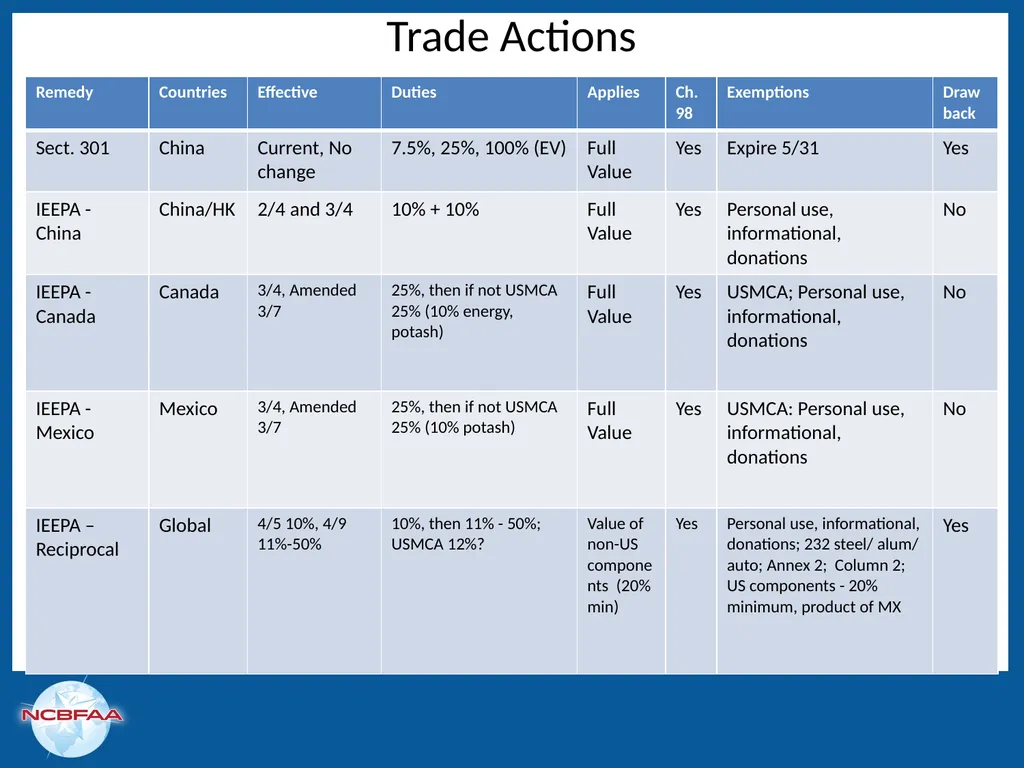
Trade Actions 4<br>
05
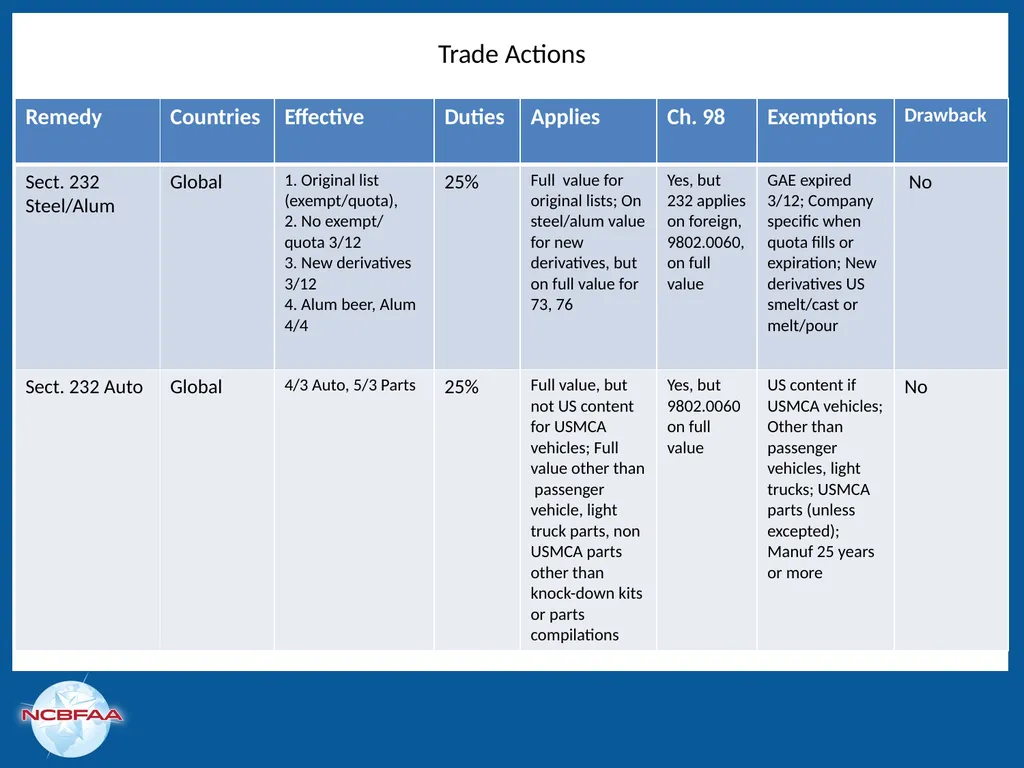
Trade Actions 5<br>
06
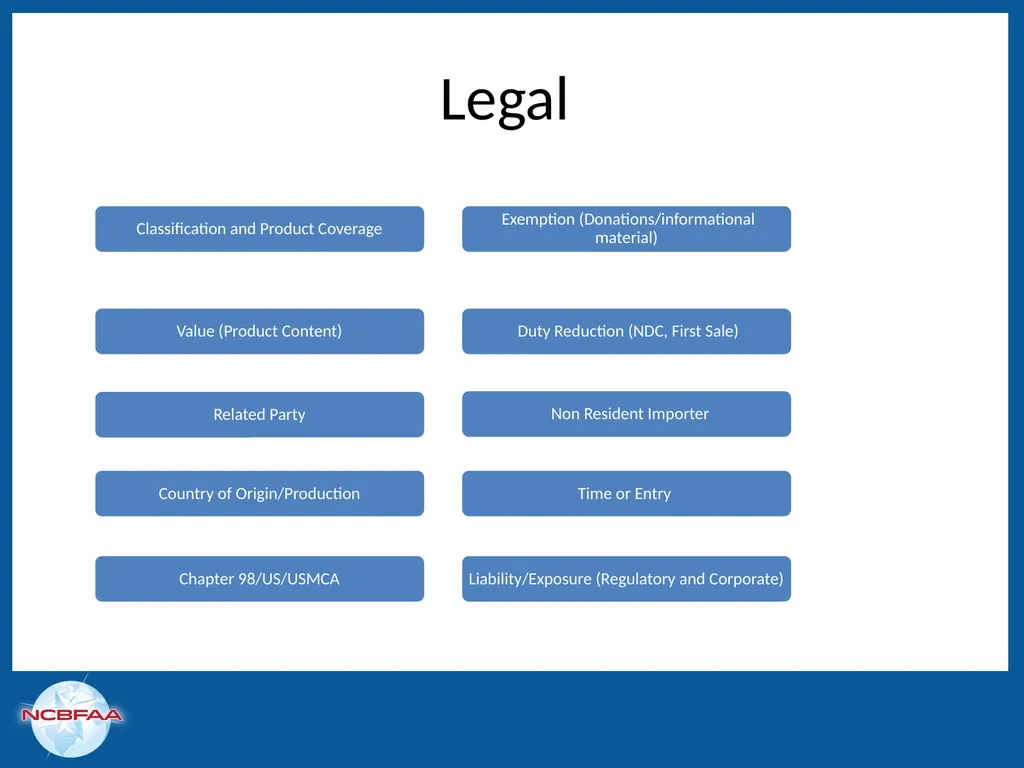
Legal 6<br>
07
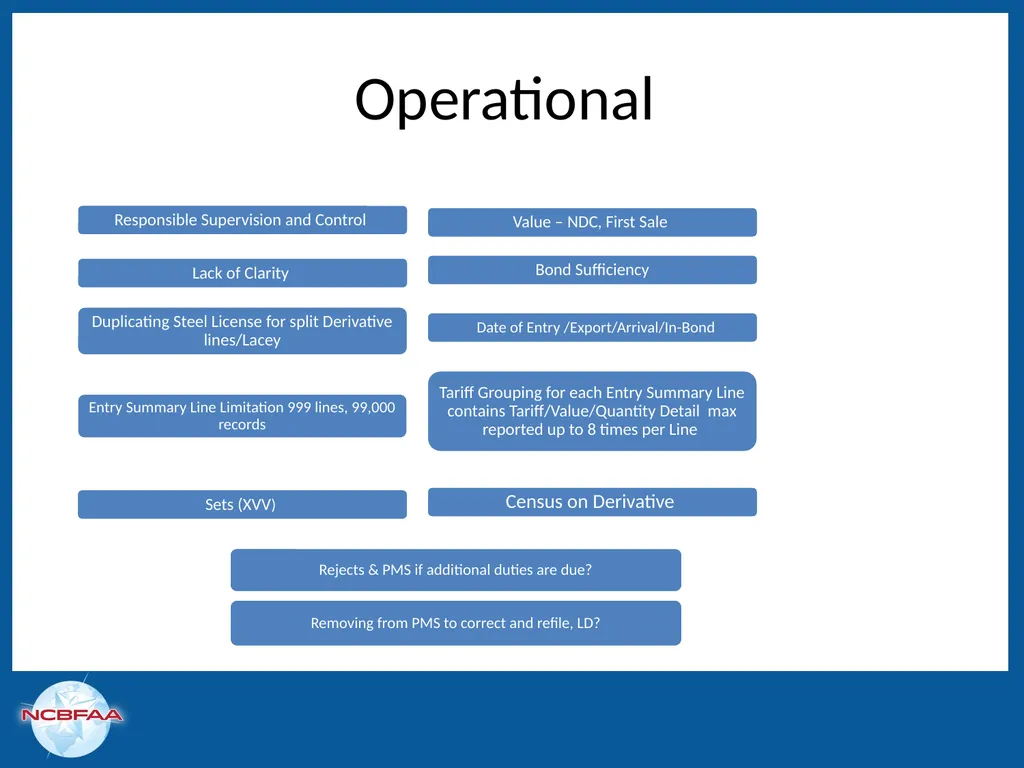
Operational 7<br>
08
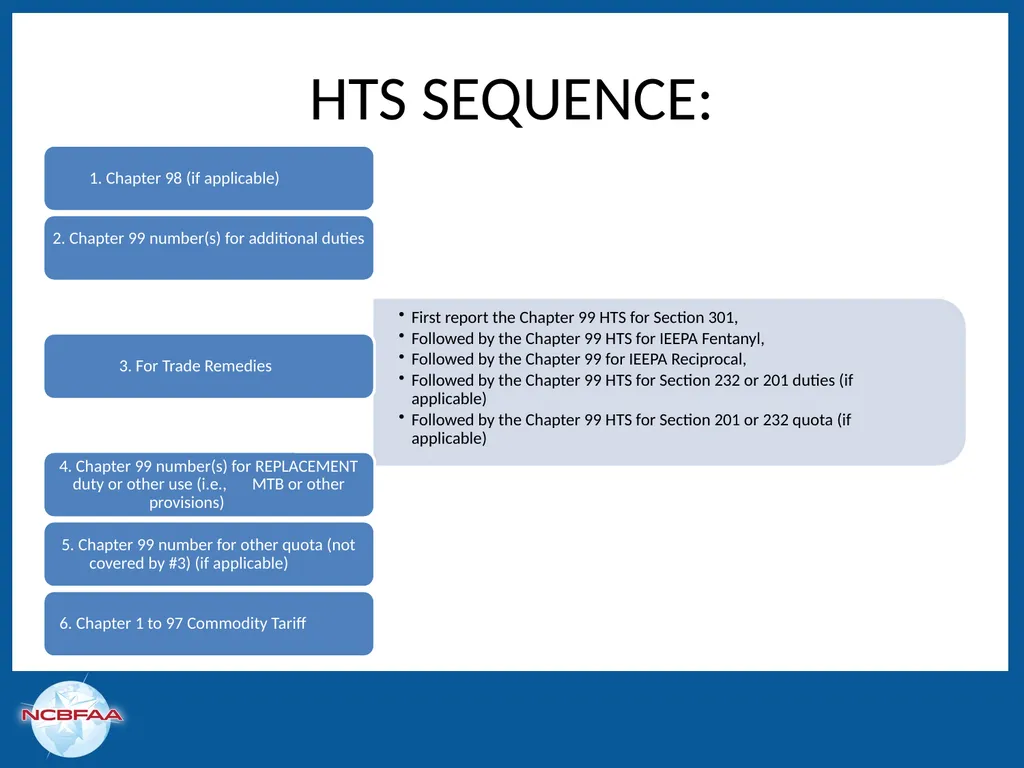
HTS SEQUENCE: 8<br>
09
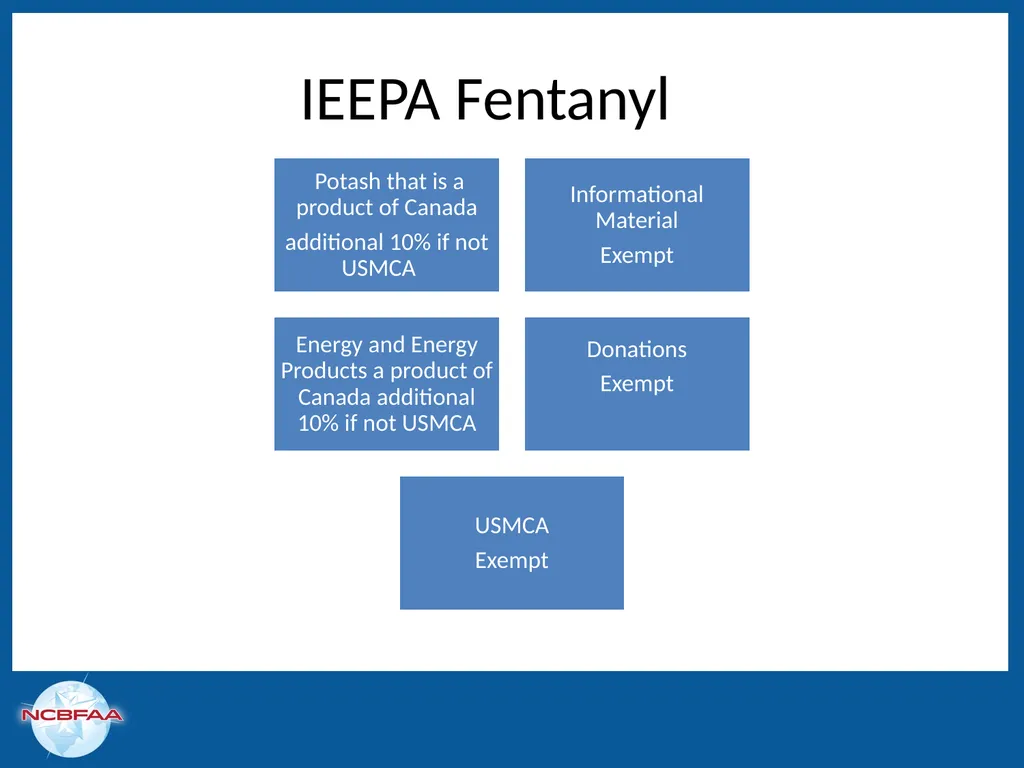
IEEPA Fentanyl 9<br>
10
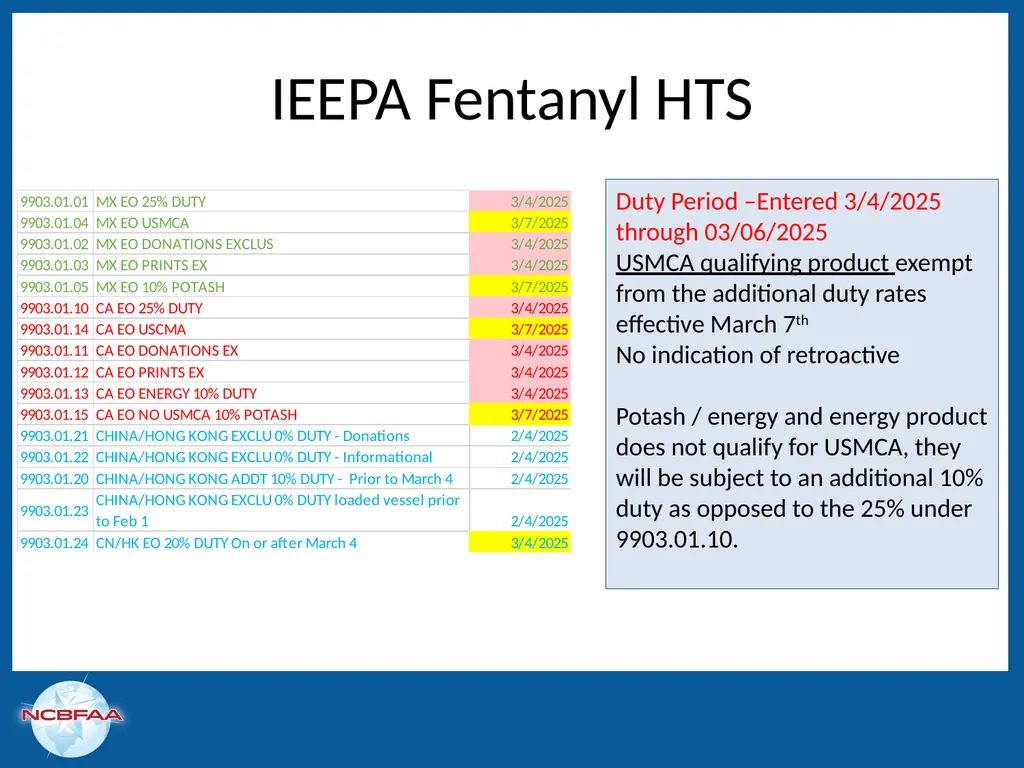
IEEPA Fentanyl HTS Duty Period –Entered 3/4/2025 through 03/06/2025
USMCA qualifying product exempt from the additional duty rates effective March 7th
No indication of retroactive
Potash / energy and energy product does not qualify for USMCA, they will be subject to an additional 10% duty as opposed to the 25% under 9903.01.10. 10<br>
USMCA qualifying product exempt from the additional duty rates effective March 7th
No indication of retroactive
Potash / energy and energy product does not qualify for USMCA, they will be subject to an additional 10% duty as opposed to the 25% under 9903.01.10. 10<br>
11
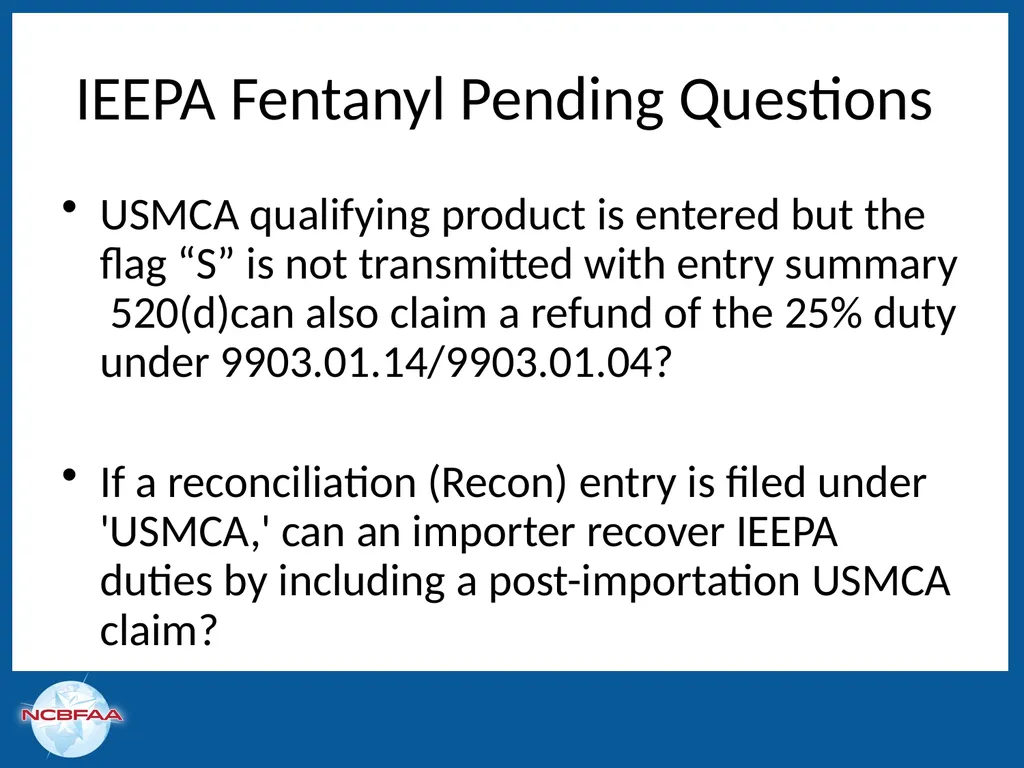
IEEPA Fentanyl Pending Questions USMCA qualifying product is entered but the flag “S” is not transmitted with entry summary 520(d)can also claim a refund of the 25% duty under 9903.01.14/9903.01.04?
If a reconciliation (Recon) entry is filed under 'USMCA,' can an importer recover IEEPA duties by including a post-importation USMCA claim? 11<br>
If a reconciliation (Recon) entry is filed under 'USMCA,' can an importer recover IEEPA duties by including a post-importation USMCA claim? 11<br>
12
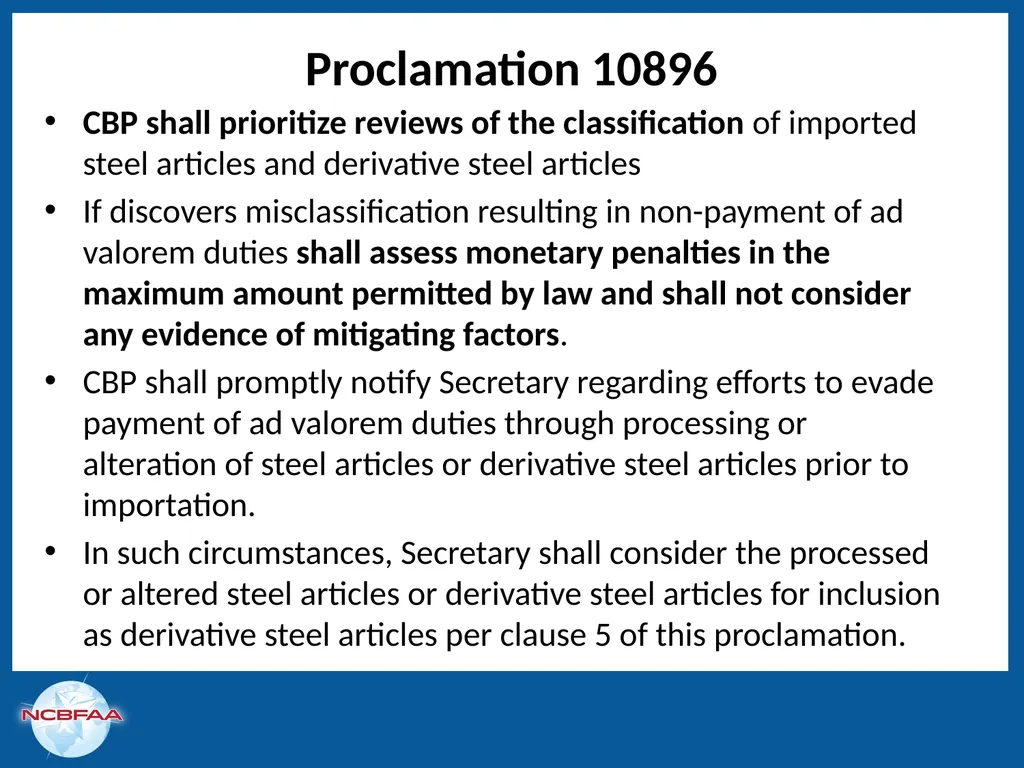
Proclamation 10896 CBP shall prioritize reviews of the classification of imported steel articles and derivative steel articles
If discovers misclassification resulting in non-payment of ad valorem duties shall assess monetary penalties in the maximum amount permitted by law and shall not consider any evidence of mitigating factors.
CBP shall promptly notify Secretary regarding efforts to evade payment of ad valorem duties through processing or alteration of steel articles or derivative steel articles prior to importation.
In such circumstances, Secretary shall consider the processed or altered steel articles or derivative steel articles for inclusion as derivative steel articles per clause 5 of this proclamation. 12<br>
13
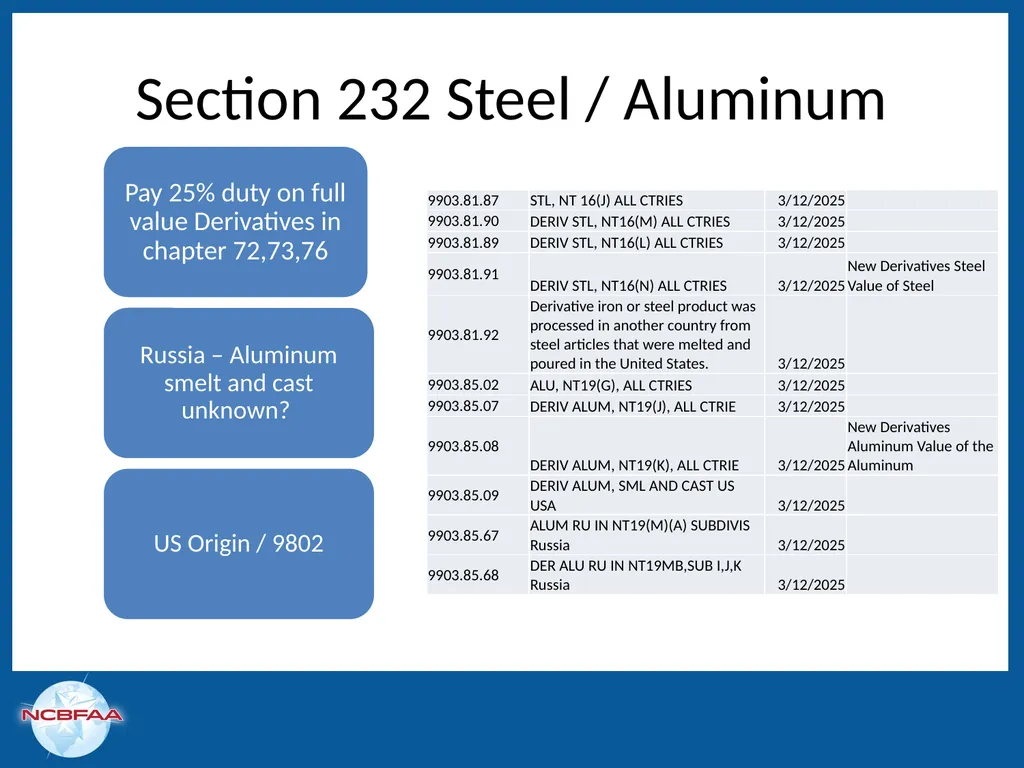
Section 232 Steel / Aluminum 13<br>
14
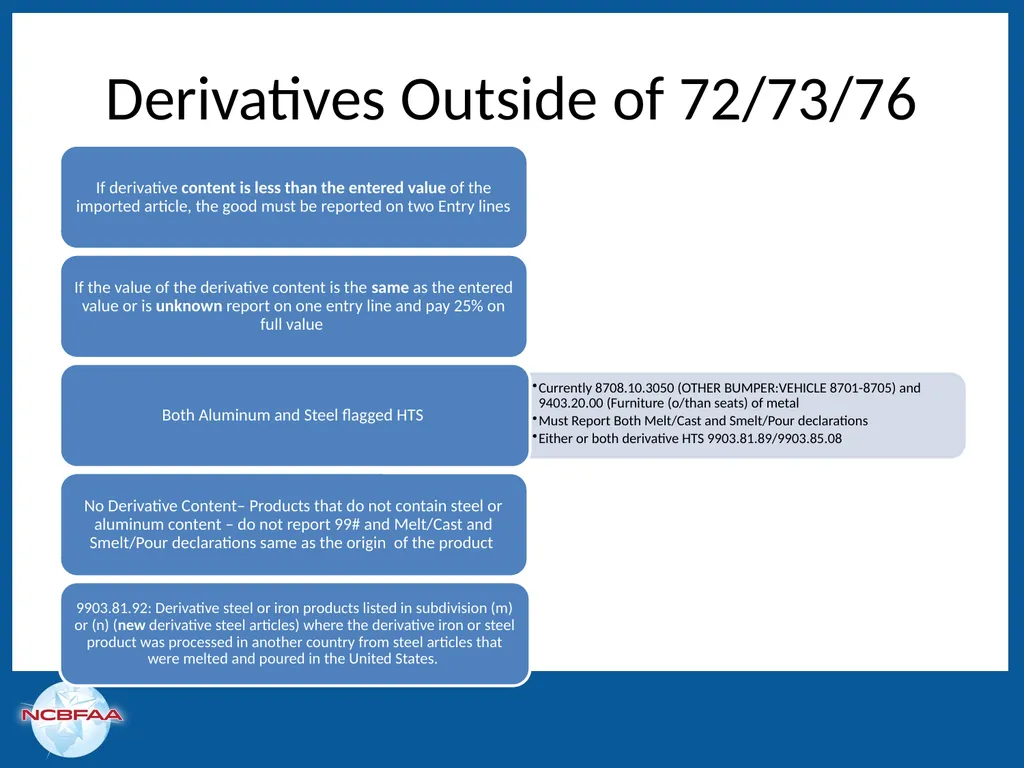
Derivatives Outside of 72/73/76 14<br>
15
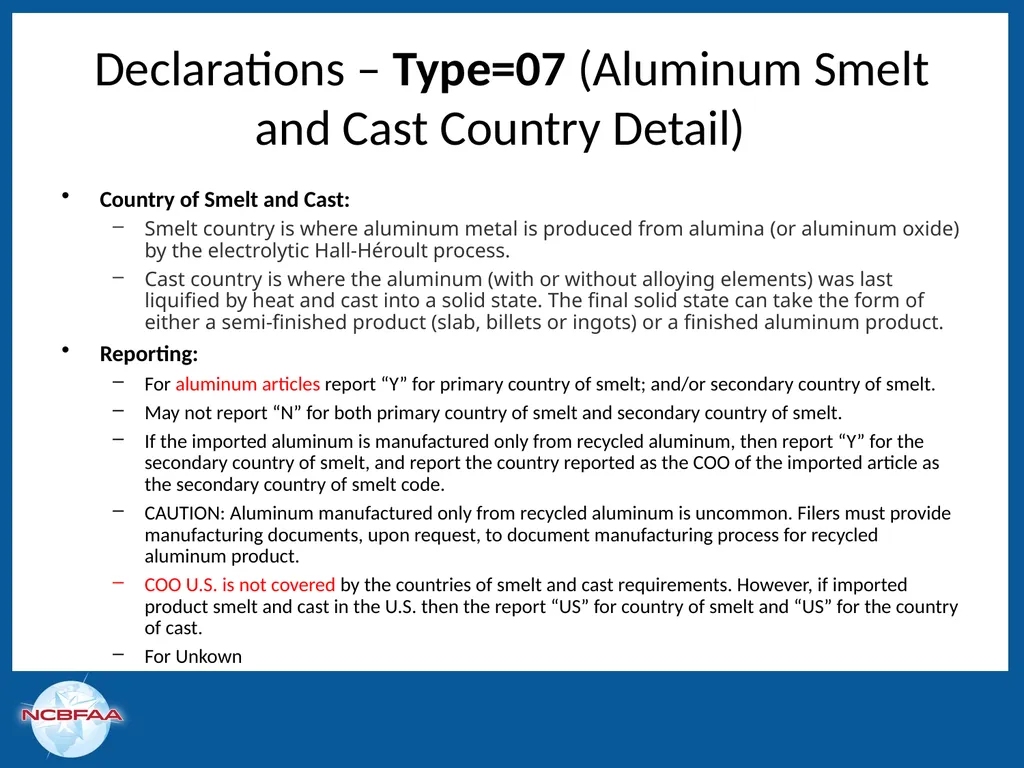
Declarations – Type=07 (Aluminum Smelt and Cast Country Detail) Country of Smelt and Cast:
Smelt country is where aluminum metal is produced from alumina (or aluminum oxide) by the electrolytic Hall-Héroult process.
Cast country is where the aluminum (with or without alloying elements) was last liquified by heat and cast into a solid state. The final solid state can take the form of either a semi-finished product (slab, billets or ingots) or a finished aluminum product.
Reporting:
For aluminum articles report “Y” for primary country of smelt; and/or secondary country of smelt.
May not report “N” for both primary country of smelt and secondary country of smelt.
If the imported aluminum is manufactured only from recycled aluminum, then report “Y” for the secondary country of smelt, and report the country reported as the COO of the imported article as the secondary country of smelt code.
CAUTION: Aluminum manufactured only from recycled aluminum is uncommon. Filers must provide manufacturing documents, upon request, to document manufacturing process for recycled aluminum product.
COO U.S. is not covered by the countries of smelt and cast requirements. However, if imported product smelt and cast in the U.S. then the report “US” for country of smelt and “US” for the country of cast.
For Unkown 15<br>
16
Declarations Type=08
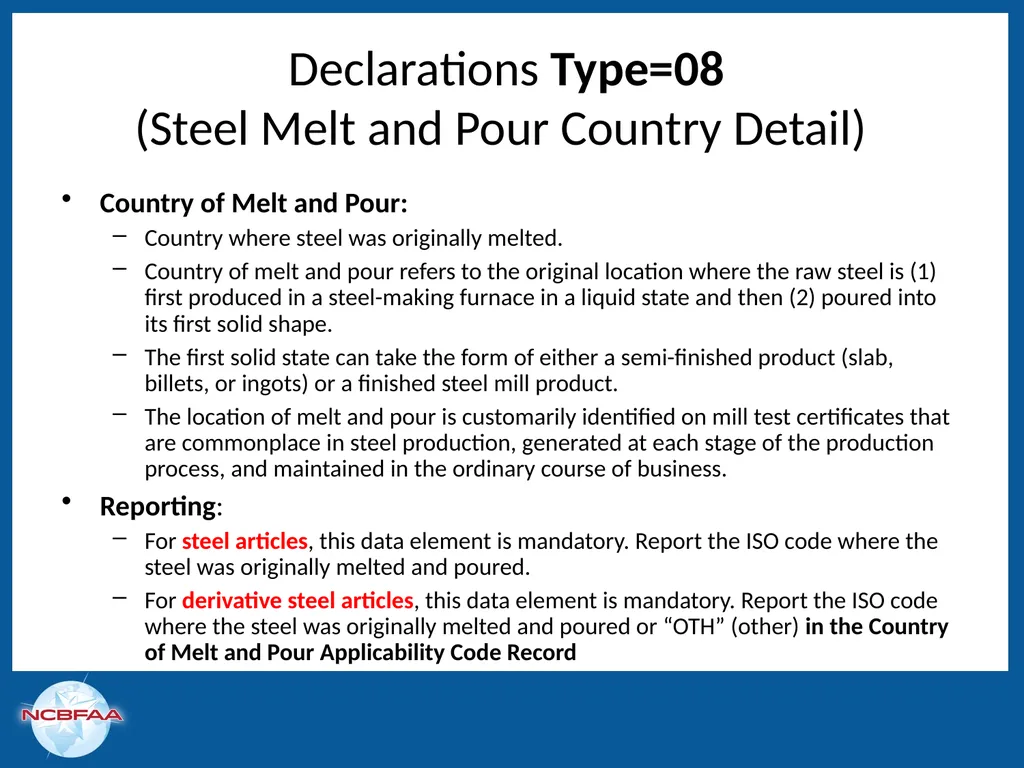
(Steel Melt and Pour Country Detail) Country of Melt and Pour:
Country where steel was originally melted.
Country of melt and pour refers to the original location where the raw steel is (1) first produced in a steel-making furnace in a liquid state and then (2) poured into its first solid shape.
The first solid state can take the form of either a semi-finished product (slab, billets, or ingots) or a finished steel mill product.
The location of melt and pour is customarily identified on mill test certificates that are commonplace in steel production, generated at each stage of the production process, and maintained in the ordinary course of business.
Reporting:
For steel articles, this data element is mandatory. Report the ISO code where the steel was originally melted and poured.
For derivative steel articles, this data element is mandatory. Report the ISO code where the steel was originally melted and poured or “OTH” (other) in the Country of Melt and Pour Applicability Code Record 16<br>
17
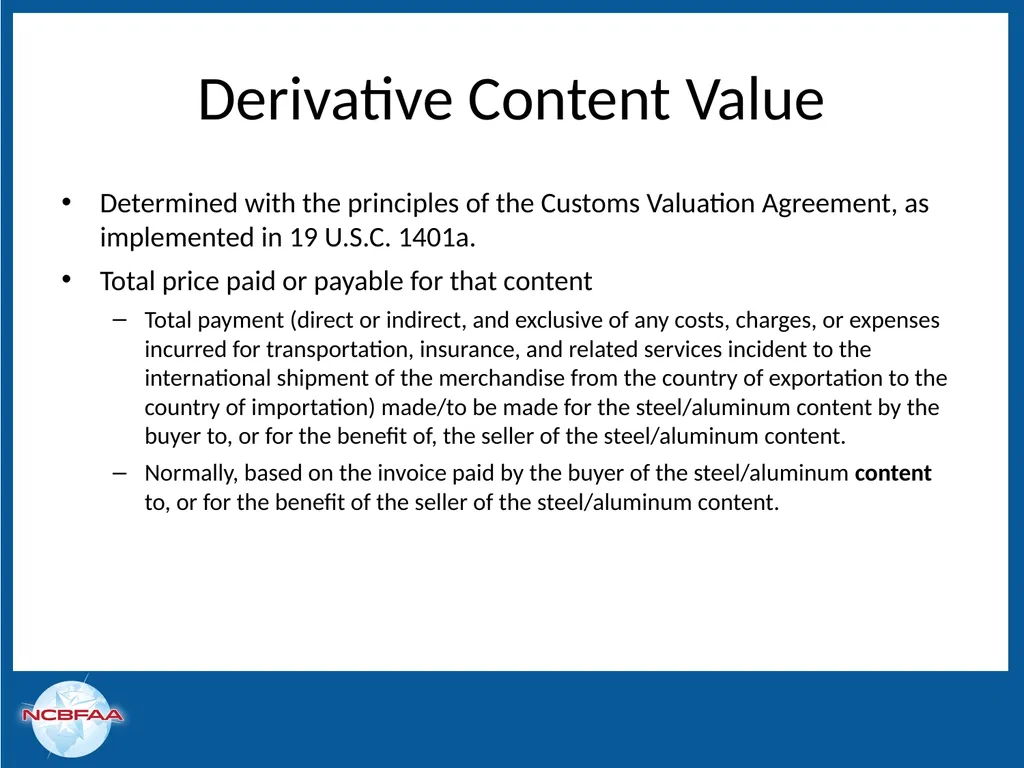
Derivative Content Value Determined with the principles of the Customs Valuation Agreement, as implemented in 19 U.S.C. 1401a.
Total price paid or payable for that content
Total payment (direct or indirect, and exclusive of any costs, charges, or expenses incurred for transportation, insurance, and related services incident to the international shipment of the merchandise from the country of exportation to the country of importation) made/to be made for the steel/aluminum content by the buyer to, or for the benefit of, the seller of the steel/aluminum content.
Normally, based on the invoice paid by the buyer of the steel/aluminum content to, or for the benefit of the seller of the steel/aluminum content. 17<br>
18
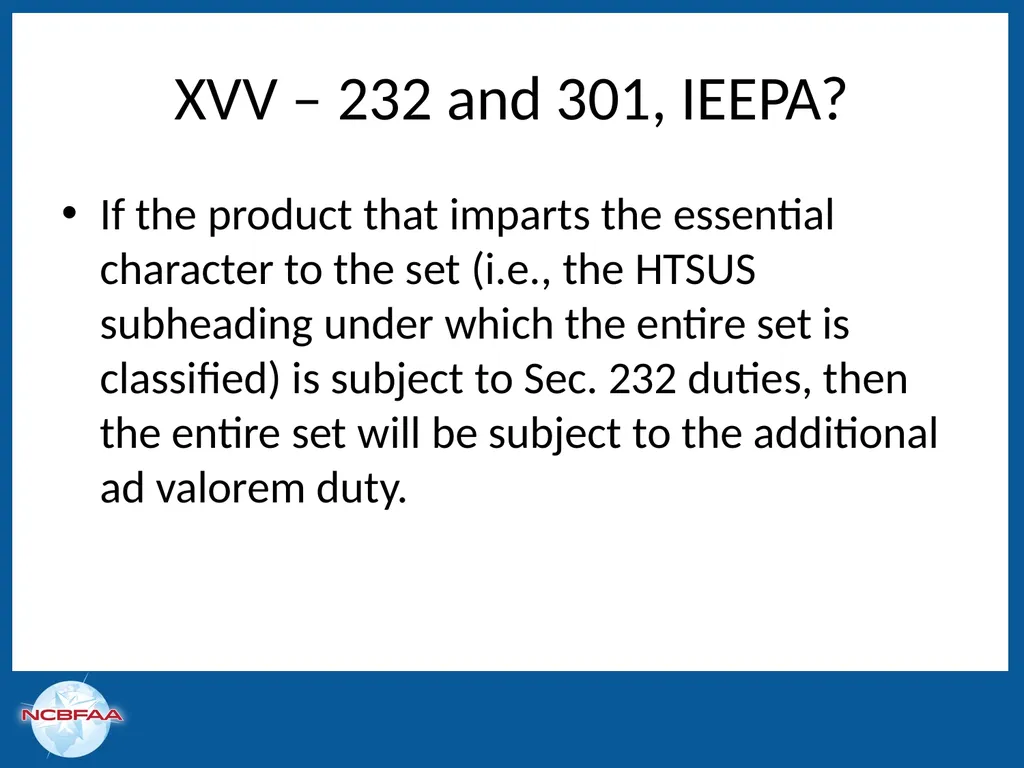
XVV – 232 and 301, IEEPA? If the product that imparts the essential character to the set (i.e., the HTSUS subheading under which the entire set is classified) is subject to Sec. 232 duties, then the entire set will be subject to the additional ad valorem duty. 18<br>
19
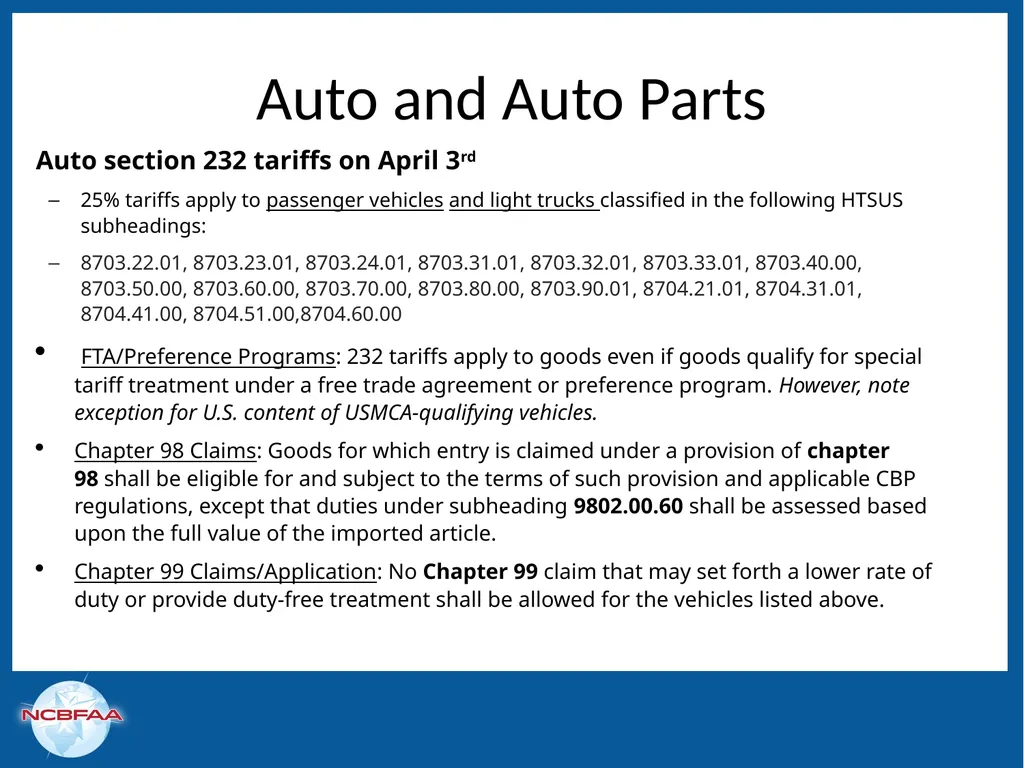
Auto and Auto Parts Auto section 232 tariffs on April 3rd
25% tariffs apply to passenger vehicles and light trucks classified in the following HTSUS subheadings:
8703.22.01, 8703.23.01, 8703.24.01, 8703.31.01, 8703.32.01, 8703.33.01, 8703.40.00, 8703.50.00, 8703.60.00, 8703.70.00, 8703.80.00, 8703.90.01, 8704.21.01, 8704.31.01, 8704.41.00, 8704.51.00,8704.60.00
FTA/Preference Programs: 232 tariffs apply to goods even if goods qualify for special tariff treatment under a free trade agreement or preference program. However, note exception for U.S. content of USMCA-qualifying vehicles.
Chapter 98 Claims: Goods for which entry is claimed under a provision of chapter 98 shall be eligible for and subject to the terms of such provision and applicable CBP regulations, except that duties under subheading 9802.00.60 shall be assessed based upon the full value of the imported article.
Chapter 99 Claims/Application: No Chapter 99 claim that may set forth a lower rate of duty or provide duty-free treatment shall be allowed for the vehicles listed above. 19<br>
20
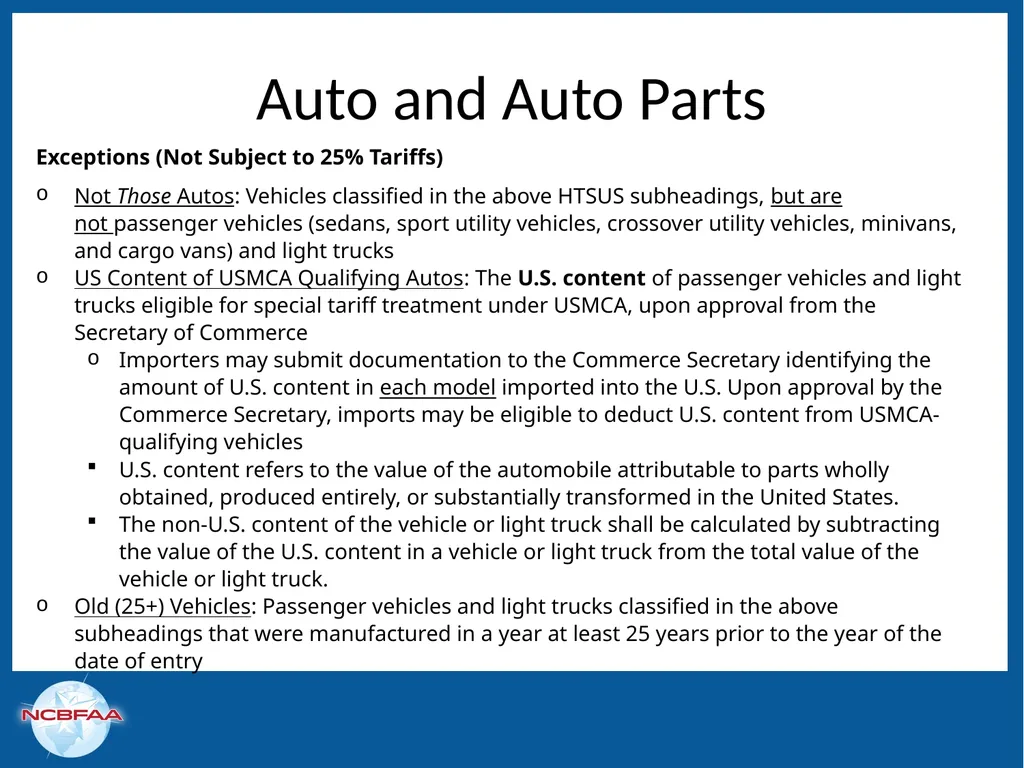
Auto and Auto Parts Exceptions (Not Subject to 25% Tariffs)
Not Those Autos: Vehicles classified in the above HTSUS subheadings, but are not passenger vehicles (sedans, sport utility vehicles, crossover utility vehicles, minivans, and cargo vans) and light trucks
US Content of USMCA Qualifying Autos: The U.S. content of passenger vehicles and light trucks eligible for special tariff treatment under USMCA, upon approval from the Secretary of Commerce
Importers may submit documentation to the Commerce Secretary identifying the amount of U.S. content in each model imported into the U.S. Upon approval by the Commerce Secretary, imports may be eligible to deduct U.S. content from USMCA-qualifying vehicles
U.S. content refers to the value of the automobile attributable to parts wholly obtained, produced entirely, or substantially transformed in the United States.
The non-U.S. content of the vehicle or light truck shall be calculated by subtracting the value of the U.S. content in a vehicle or light truck from the total value of the vehicle or light truck.
Old (25+) Vehicles: Passenger vehicles and light trucks classified in the above subheadings that were manufactured in a year at least 25 years prior to the year of the date of entry 20<br>
21
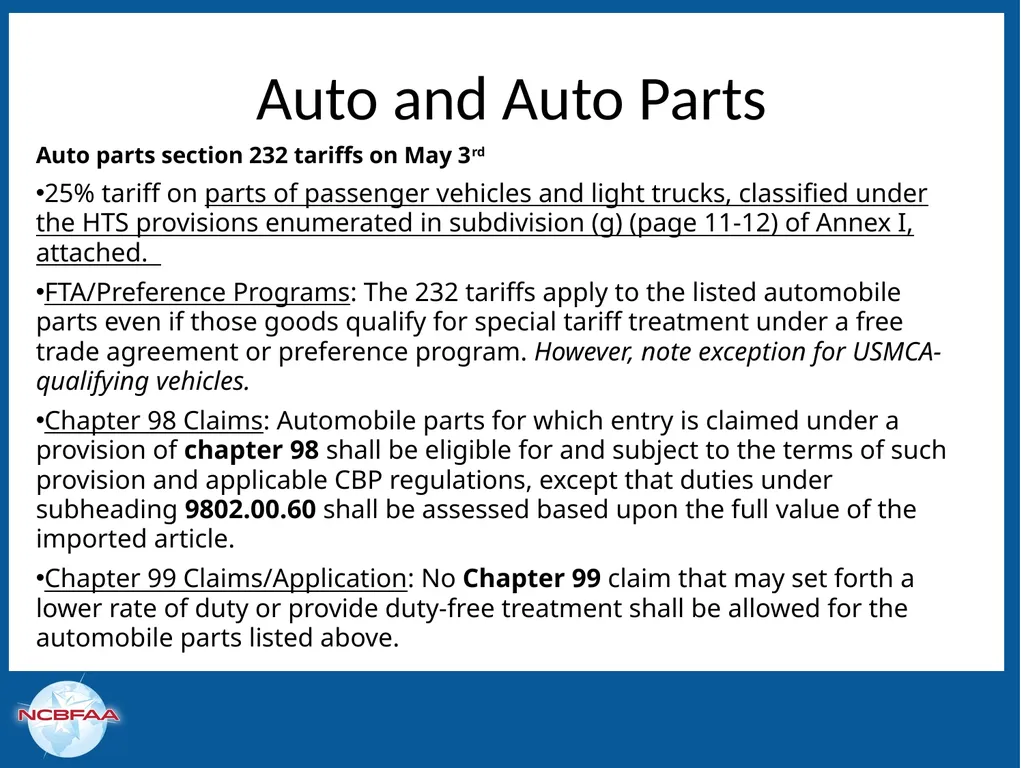
Auto and Auto Parts Auto parts section 232 tariffs on May 3rd
25% tariff on parts of passenger vehicles and light trucks, classified under the HTS provisions enumerated in subdivision (g) (page 11-12) of Annex I, attached.
FTA/Preference Programs: The 232 tariffs apply to the listed automobile parts even if those goods qualify for special tariff treatment under a free trade agreement or preference program. However, note exception for USMCA-qualifying vehicles.
Chapter 98 Claims: Automobile parts for which entry is claimed under a provision of chapter 98 shall be eligible for and subject to the terms of such provision and applicable CBP regulations, except that duties under subheading 9802.00.60 shall be assessed based upon the full value of the imported article.
Chapter 99 Claims/Application: No Chapter 99 claim that may set forth a lower rate of duty or provide duty-free treatment shall be allowed for the automobile parts listed above. 21<br>
22
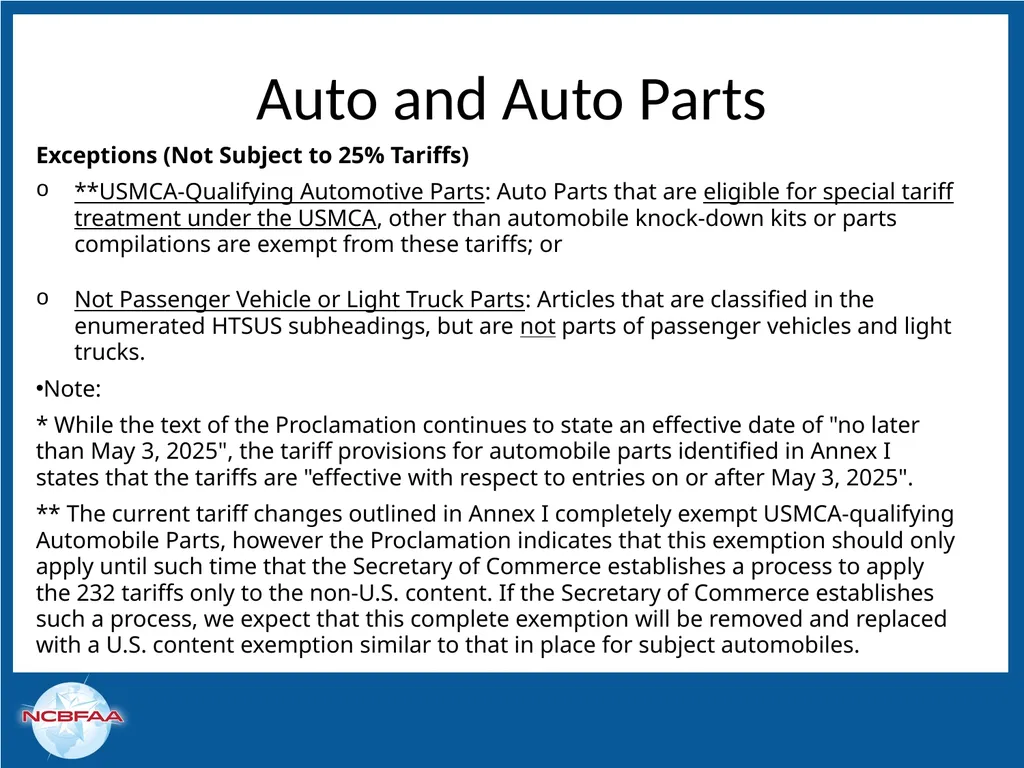
Auto and Auto Parts Exceptions (Not Subject to 25% Tariffs)
**USMCA-Qualifying Automotive Parts: Auto Parts that are eligible for special tariff treatment under the USMCA, other than automobile knock-down kits or parts compilations are exempt from these tariffs; or
Not Passenger Vehicle or Light Truck Parts: Articles that are classified in the enumerated HTSUS subheadings, but are not parts of passenger vehicles and light trucks.
Note:
* While the text of the Proclamation continues to state an effective date of "no later than May 3, 2025", the tariff provisions for automobile parts identified in Annex I states that the tariffs are "effective with respect to entries on or after May 3, 2025".
** The current tariff changes outlined in Annex I completely exempt USMCA-qualifying Automobile Parts, however the Proclamation indicates that this exemption should only apply until such time that the Secretary of Commerce establishes a process to apply the 232 tariffs only to the non-U.S. content. If the Secretary of Commerce establishes such a process, we expect that this complete exemption will be removed and replaced with a U.S. content exemption similar to that in place for subject automobiles. 22<br>
23
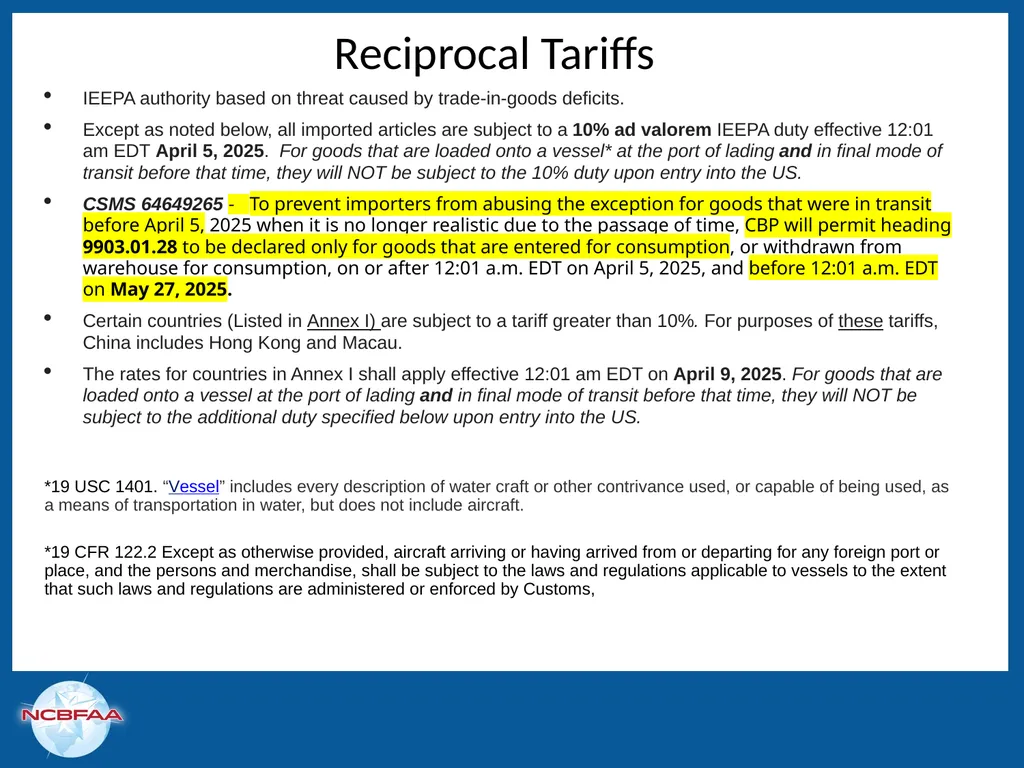
Reciprocal Tariffs IEEPA authority based on threat caused by trade-in-goods deficits.
Except as noted below, all imported articles are subject to a 10% ad valorem IEEPA duty effective 12:01 am EDT April 5, 2025. For goods that are loaded onto a vessel* at the port of lading and in final mode of transit before that time, they will NOT be subject to the 10% duty upon entry into the US.
CSMS 64649265 - To prevent importers from abusing the exception for goods that were in transit before April 5, 2025 when it is no longer realistic due to the passage of time, CBP will permit heading 9903.01.28 to be declared only for goods that are entered for consumption, or withdrawn from warehouse for consumption, on or after 12:01 a.m. EDT on April 5, 2025, and before 12:01 a.m. EDT on May 27, 2025.
Certain countries (Listed in Annex I) are subject to a tariff greater than 10%. For purposes of these tariffs, China includes Hong Kong and Macau.
The rates for countries in Annex I shall apply effective 12:01 am EDT on April 9, 2025. For goods that are loaded onto a vessel at the port of lading and in final mode of transit before that time, they will NOT be subject to the additional duty specified below upon entry into the US.
*19 USC 1401. “Vessel” includes every description of water craft or other contrivance used, or capable of being used, as a means of transportation in water, but does not include aircraft.
*19 CFR 122.2 Except as otherwise provided, aircraft arriving or having arrived from or departing for any foreign port or place, and the persons and merchandise, shall be subject to the laws and regulations applicable to vessels to the extent that such laws and regulations are administered or enforced by Customs, 23<br>
24
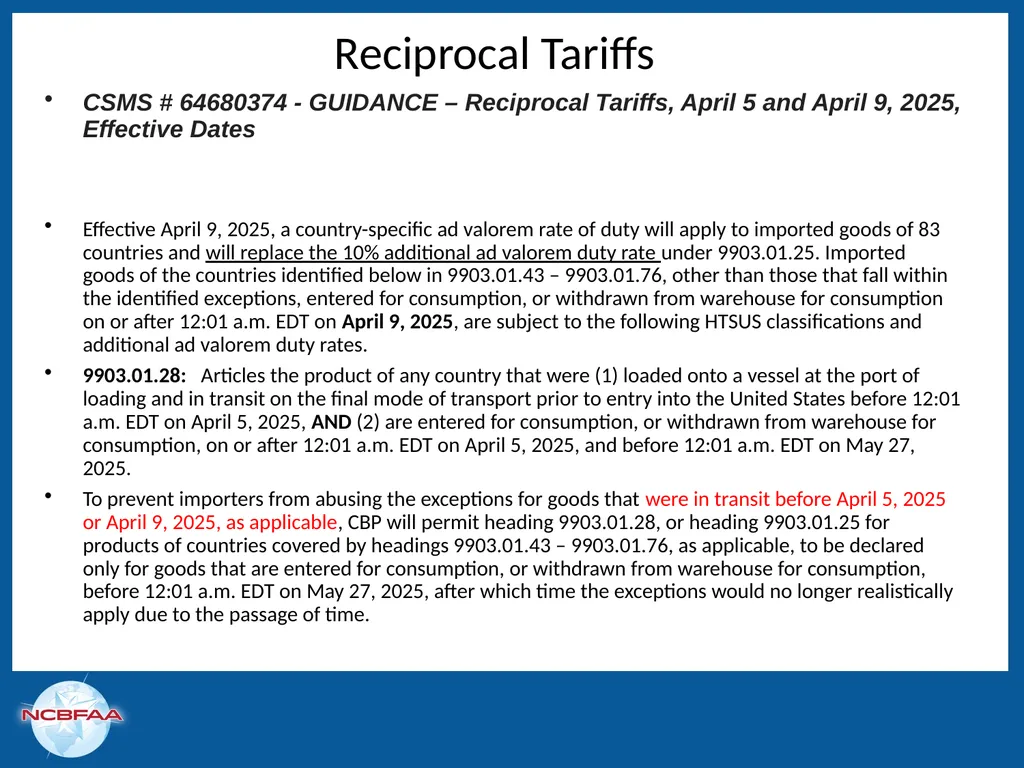
Reciprocal Tariffs CSMS # 64680374 - GUIDANCE – Reciprocal Tariffs, April 5 and April 9, 2025, Effective Dates
Effective April 9, 2025, a country-specific ad valorem rate of duty will apply to imported goods of 83 countries and will replace the 10% additional ad valorem duty rate under 9903.01.25. Imported goods of the countries identified below in 9903.01.43 – 9903.01.76, other than those that fall within the identified exceptions, entered for consumption, or withdrawn from warehouse for consumption on or after 12:01 a.m. EDT on April 9, 2025, are subject to the following HTSUS classifications and additional ad valorem duty rates.
9903.01.28: Articles the product of any country that were (1) loaded onto a vessel at the port of loading and in transit on the final mode of transport prior to entry into the United States before 12:01 a.m. EDT on April 5, 2025, AND (2) are entered for consumption, or withdrawn from warehouse for consumption, on or after 12:01 a.m. EDT on April 5, 2025, and before 12:01 a.m. EDT on May 27, 2025.
To prevent importers from abusing the exceptions for goods that were in transit before April 5, 2025 or April 9, 2025, as applicable, CBP will permit heading 9903.01.28, or heading 9903.01.25 for products of countries covered by headings 9903.01.43 – 9903.01.76, as applicable, to be declared only for goods that are entered for consumption, or withdrawn from warehouse for consumption, before 12:01 a.m. EDT on May 27, 2025, after which time the exceptions would no longer realistically apply due to the passage of time. 24<br>
25
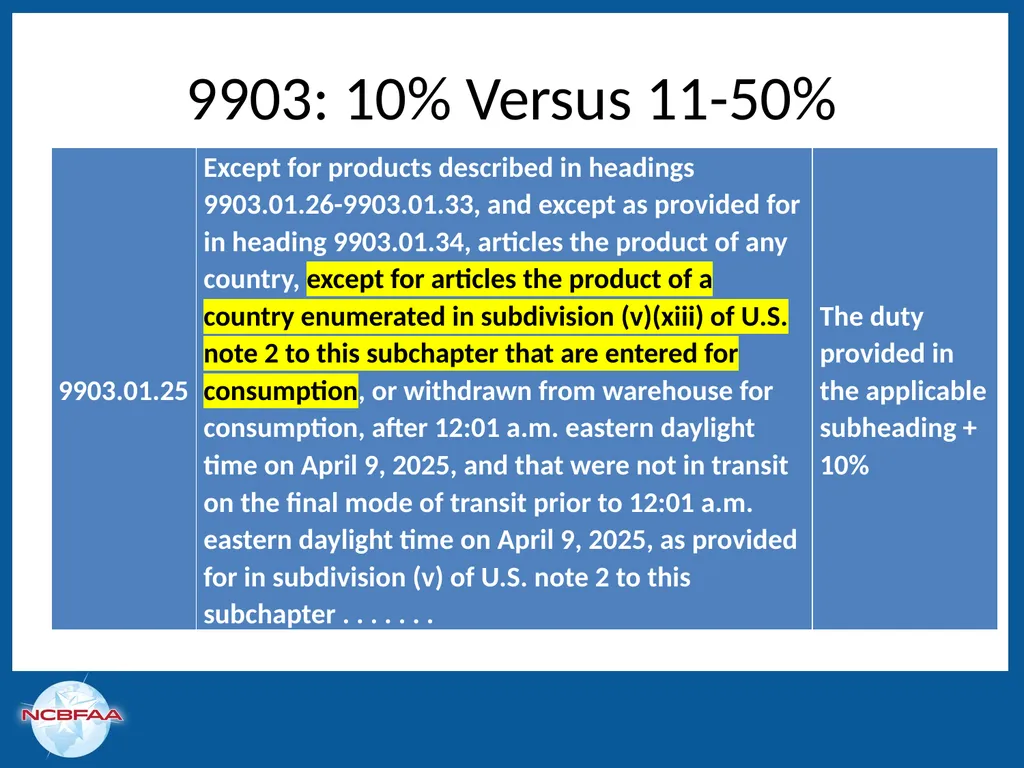
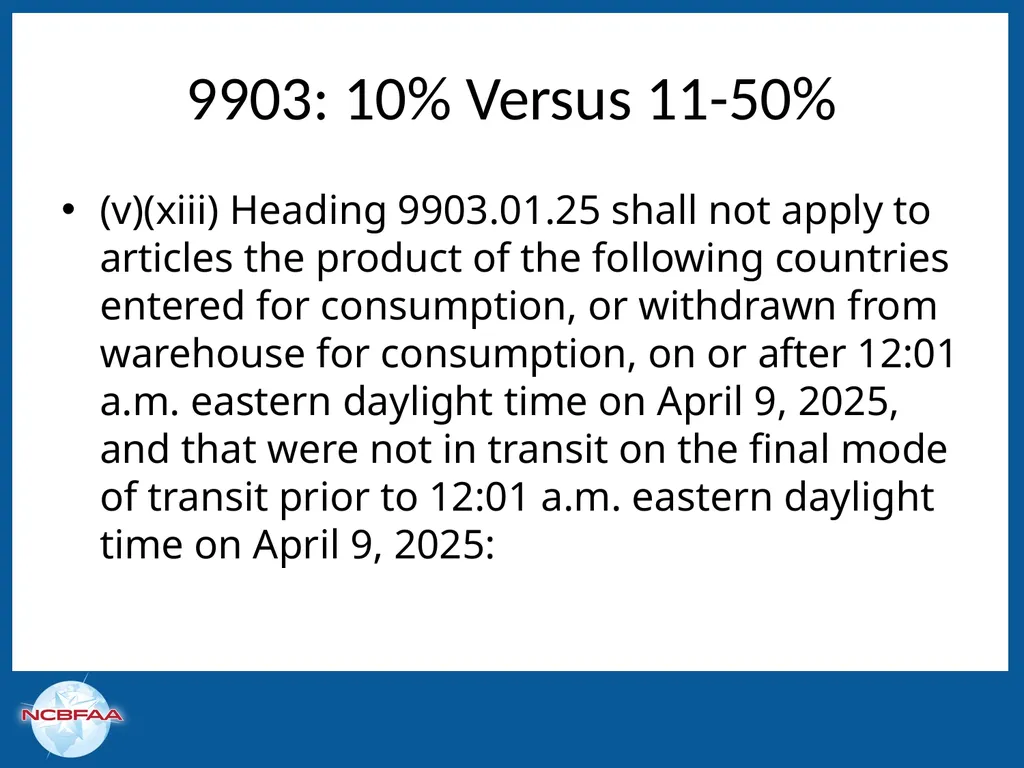
9903: 10% Versus 11-50% 25<br>
26
9903: 10% Versus 11-50% (v)(xiii) Heading 9903.01.25 shall not apply to articles the product of the following countries entered for consumption, or withdrawn from warehouse for consumption, on or after 12:01 a.m. eastern daylight time on April 9, 2025, and that were not in transit on the final mode of transit prior to 12:01 a.m. eastern daylight time on April 9, 2025: 26<br>
27
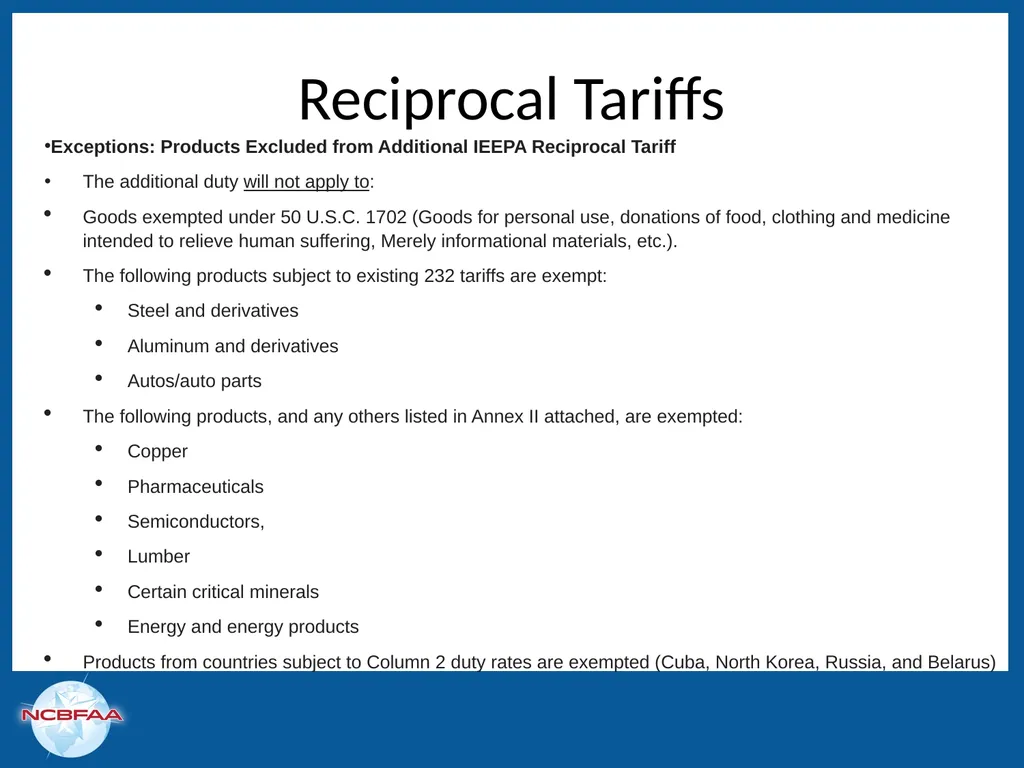
Reciprocal Tariffs Exceptions: Products Excluded from Additional IEEPA Reciprocal Tariff
The additional duty will not apply to:
Goods exempted under 50 U.S.C. 1702 (Goods for personal use, donations of food, clothing and medicine intended to relieve human suffering, Merely informational materials, etc.).
The following products subject to existing 232 tariffs are exempt:
Steel and derivatives
Aluminum and derivatives
Autos/auto parts
The following products, and any others listed in Annex II attached, are exempted:
Copper
Pharmaceuticals
Semiconductors,
Lumber
Certain critical minerals
Energy and energy products
Products from countries subject to Column 2 duty rates are exempted (Cuba, North Korea, Russia, and Belarus) 27<br>
28
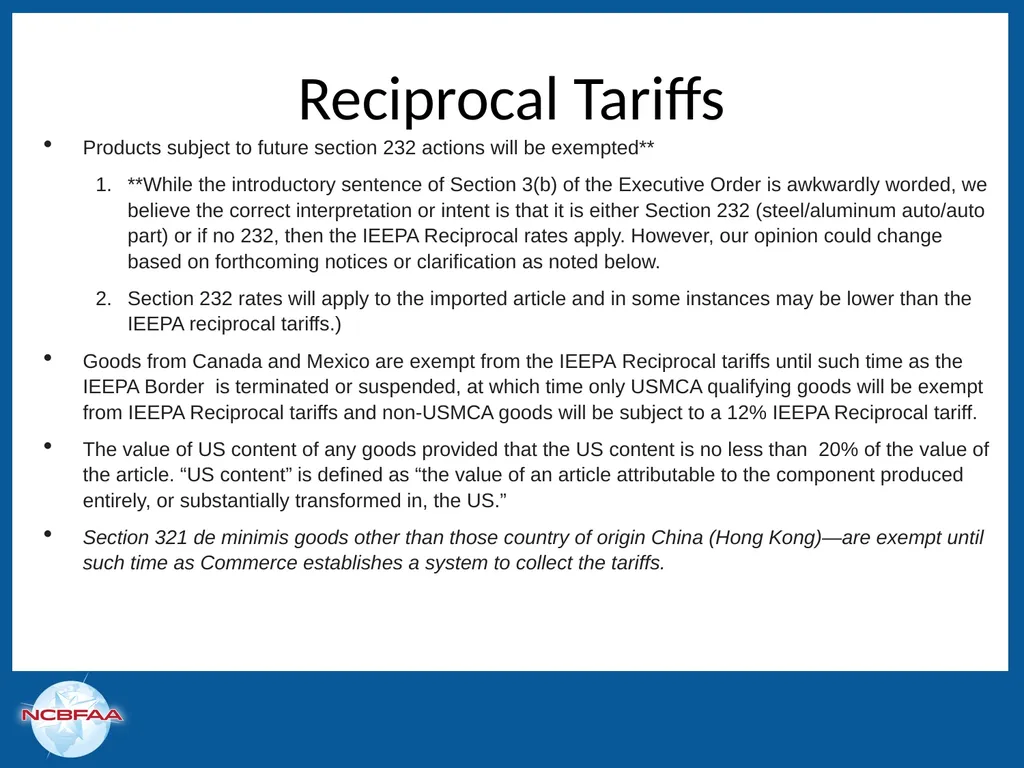
Reciprocal Tariffs Products subject to future section 232 actions will be exempted**
**While the introductory sentence of Section 3(b) of the Executive Order is awkwardly worded, we believe the correct interpretation or intent is that it is either Section 232 (steel/aluminum auto/auto part) or if no 232, then the IEEPA Reciprocal rates apply. However, our opinion could change based on forthcoming notices or clarification as noted below.
Section 232 rates will apply to the imported article and in some instances may be lower than the IEEPA reciprocal tariffs.)
Goods from Canada and Mexico are exempt from the IEEPA Reciprocal tariffs until such time as the IEEPA Border is terminated or suspended, at which time only USMCA qualifying goods will be exempt from IEEPA Reciprocal tariffs and non-USMCA goods will be subject to a 12% IEEPA Reciprocal tariff.
The value of US content of any goods provided that the US content is no less than 20% of the value of the article. “US content” is defined as “the value of an article attributable to the component produced entirely, or substantially transformed in, the US.”
Section 321 de minimis goods other than those country of origin China (Hong Kong)—are exempt until such time as Commerce establishes a system to collect the tariffs. 28<br>
29
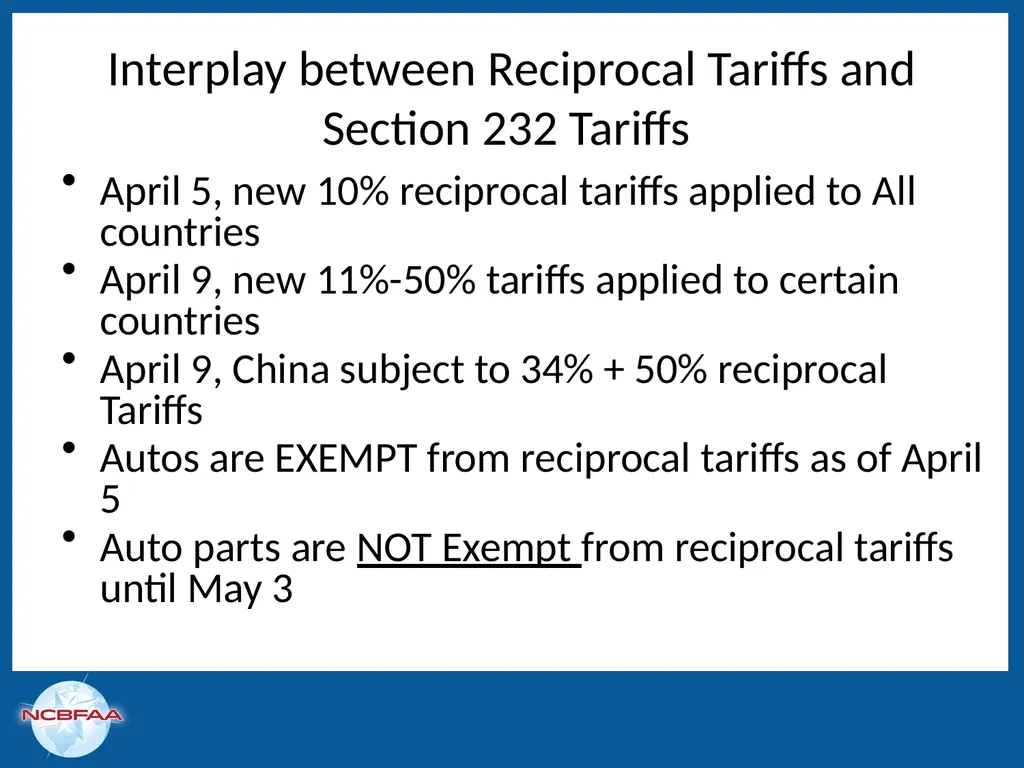
Interplay between Reciprocal Tariffs and Section 232 Tariffs April 5, new 10% reciprocal tariffs applied to All countries
April 9, new 11%-50% tariffs applied to certain countries
April 9, China subject to 34% + 50% reciprocal Tariffs
Autos are EXEMPT from reciprocal tariffs as of April 5
Auto parts are NOT Exempt from reciprocal tariffs until May 3 29<br>
April 9, new 11%-50% tariffs applied to certain countries
April 9, China subject to 34% + 50% reciprocal Tariffs
Autos are EXEMPT from reciprocal tariffs as of April 5
Auto parts are NOT Exempt from reciprocal tariffs until May 3 29<br>
30
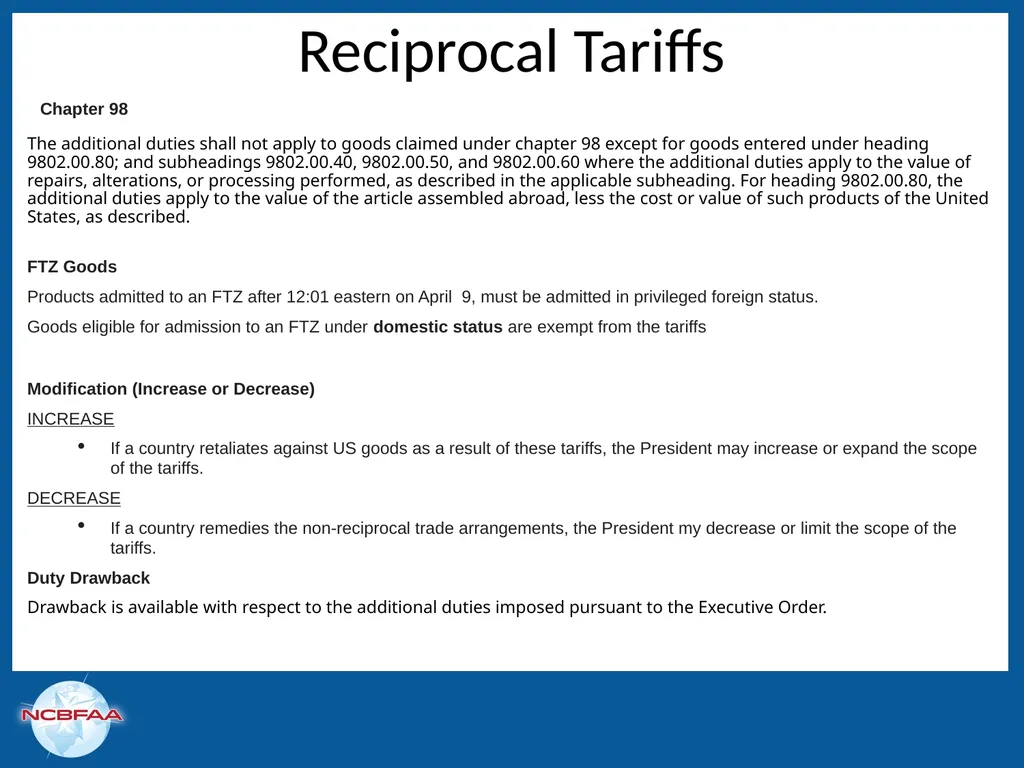
Reciprocal Tariffs Chapter 98
The additional duties shall not apply to goods claimed under chapter 98 except for goods entered under heading 9802.00.80; and subheadings 9802.00.40, 9802.00.50, and 9802.00.60 where the additional duties apply to the value of repairs, alterations, or processing performed, as described in the applicable subheading. For heading 9802.00.80, the additional duties apply to the value of the article assembled abroad, less the cost or value of such products of the United States, as described.
FTZ Goods
Products admitted to an FTZ after 12:01 eastern on April 9, must be admitted in privileged foreign status.
Goods eligible for admission to an FTZ under domestic status are exempt from the tariffs
Modification (Increase or Decrease)
INCREASE
If a country retaliates against US goods as a result of these tariffs, the President may increase or expand the scope of the tariffs.
DECREASE
If a country remedies the non-reciprocal trade arrangements, the President my decrease or limit the scope of the tariffs.
Duty Drawback
Drawback is available with respect to the additional duties imposed pursuant to the Executive Order. 30<br>
31
Venezuela Oil Any country that imports Venezuelan oil
25% on imports “on or after April 25th
On all goods imported into the U.S. from any country importing Venezuelan oil, whether directly from Venezuela or indirectly through third parties. Duties will be supplemental to other duties. 31<br>
25% on imports “on or after April 25th
On all goods imported into the U.S. from any country importing Venezuelan oil, whether directly from Venezuela or indirectly through third parties. Duties will be supplemental to other duties. 31<br>
32
Other Tariffs President Trump indicated that he will also be announcing tariffs on lumber, pharmaceuticals and possibly on computer chips 32<br>
33
Reference material 33<br>
34
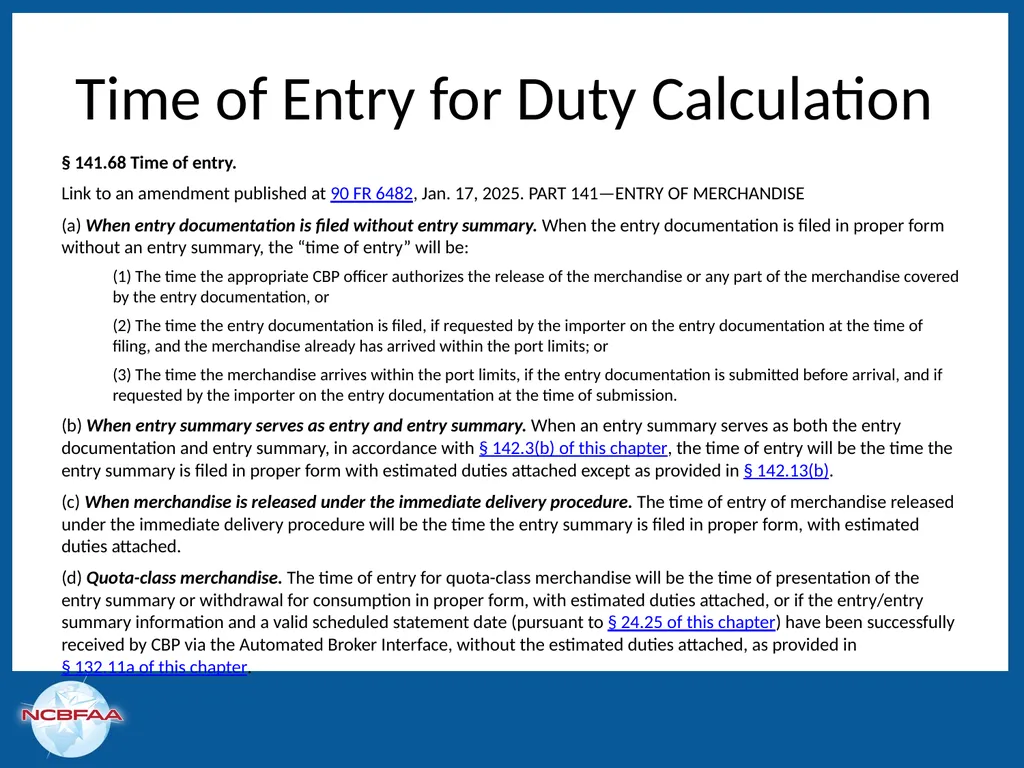
Time of Entry for Duty Calculation § 141.68 Time of entry.
Link to an amendment published at 90 FR 6482, Jan. 17, 2025. PART 141—ENTRY OF MERCHANDISE
(a) When entry documentation is filed without entry summary. When the entry documentation is filed in proper form without an entry summary, the “time of entry” will be:
(1) The time the appropriate CBP officer authorizes the release of the merchandise or any part of the merchandise covered by the entry documentation, or
(2) The time the entry documentation is filed, if requested by the importer on the entry documentation at the time of filing, and the merchandise already has arrived within the port limits; or
(3) The time the merchandise arrives within the port limits, if the entry documentation is submitted before arrival, and if requested by the importer on the entry documentation at the time of submission.
(b) When entry summary serves as entry and entry summary. When an entry summary serves as both the entry documentation and entry summary, in accordance with § 142.3(b) of this chapter, the time of entry will be the time the entry summary is filed in proper form with estimated duties attached except as provided in § 142.13(b).
(c) When merchandise is released under the immediate delivery procedure. The time of entry of merchandise released under the immediate delivery procedure will be the time the entry summary is filed in proper form, with estimated duties attached.
(d) Quota-class merchandise. The time of entry for quota-class merchandise will be the time of presentation of the entry summary or withdrawal for consumption in proper form, with estimated duties attached, or if the entry/entry summary information and a valid scheduled statement date (pursuant to § 24.25 of this chapter) have been successfully received by CBP via the Automated Broker Interface, without the estimated duties attached, as provided in § 132.11a of this chapter. 34<br>
35
Time of Entry for Duty Calculation (e) When merchandise has not arrived. Merchandise will not be authorized for release, nor will an entry or an entry summary which serves as both the entry and entry summary be considered filed or presented, until the merchandise has arrived within the port limits with the intent to unlade.
(f) Informal mail entry. The time of entry of merchandise under an informal mail entry, CBP Form 3419 or 3419A or CBP Form 368 or 368A, is the time the preparation of the entry documentation by a CBP employee is completed.
(g) Withdrawal from warehouse for consumption. The time of entry of merchandise withdrawn from warehouse for consumption (the process preparatory to the issuance of a permit for the release of the merchandise to or upon the order of the warehouse proprietor) is when:
(1) CBP Form 7501, or its electronic equivalent, is executed in proper form and filed together with any related documentation required by these regulations to be filed at the time of withdrawal, and
(2) Estimated duties, if any, required to be paid at the time of withdrawal have been deposited.
Unless the requirements of this paragraph and section 315(a), Tariff Act of 1930, as amended (19 U.S.C. 1315(a)), including the deposit of estimated duties, if any, are completed within 60 days from the date of presentation of CBP Form 7501, or its electronic equivalent, the request for withdrawal will be considered abandoned. 35<br>
36
Time of Entry - Duty is Expected to Increase If duty is going up need to look at 141.68
For any of the scenarios listed below the conveyance has to arrive 141.68 (e)
If requesting Time of Entry pursuant to 141.68 (a) (2) or (3) the entry must be filed as a two part process and request for time of entry to be arrival or time of filing is uploaded to DIS
Under 19 CFR 141.68(a)(2) an importer may request the time of entry to be the time the entry documentation is filed if the request is made on the entry documentation at the time of filing and the merchandise has already arrived. 36<br>
37
Time of Entry - Duty is Expected to Increase Under section 141.68(a)(3), the importer may request the time of entry to be the time the merchandise arrives within the port limits, if requested on the entry documentation and submitted before arrival.
If requesting Time of Entry pursuant to 141.68 (a) (2) or (3)
Submit the cargo release (CR)(Entry) The cargo release must be filed separately from the entry summary. (Two Part)
The broker must file a statement or letter with the cargo release requesting that the arrival / filing date be set as the entry date per 19 CFR 141.68(a) (2) or (3).
The broker must upload the request to ACE using DIS. This request must be submitted shortly after the cargo release transmission. The instructions do not specify a specific DIS Document type filer can choose to use DIS Document type: CBP03 - OTHER
Should confirm the actual arrival of the vessel and file the summary, locking in the entry date 37<br>
38
Time of Entry Duty is Expected to Increase ACE Entry Summary Certified for Cargo Release as in 141.68 ( b). The ACE Entry Summary Certified for Cargo Release time of entry will be the time the entry summary is filed in proper form with estimated duties attached or scheduled on a statement. This locks in the lower duty regardless of release date. Some risk here if user resends or deletes the entry summary or removes the entry from statement. Must verify conveyance arrival to ensure it is prior to the increase duty effective date to ensure the duty is not due.
Risk if Entry Summary is retransmitted
If Exam/Hold
Should confirm the actual arrival of the vessel
Did entry also have an IT? 38<br>
Risk if Entry Summary is retransmitted
If Exam/Hold
Should confirm the actual arrival of the vessel
Did entry also have an IT? 38<br>
39
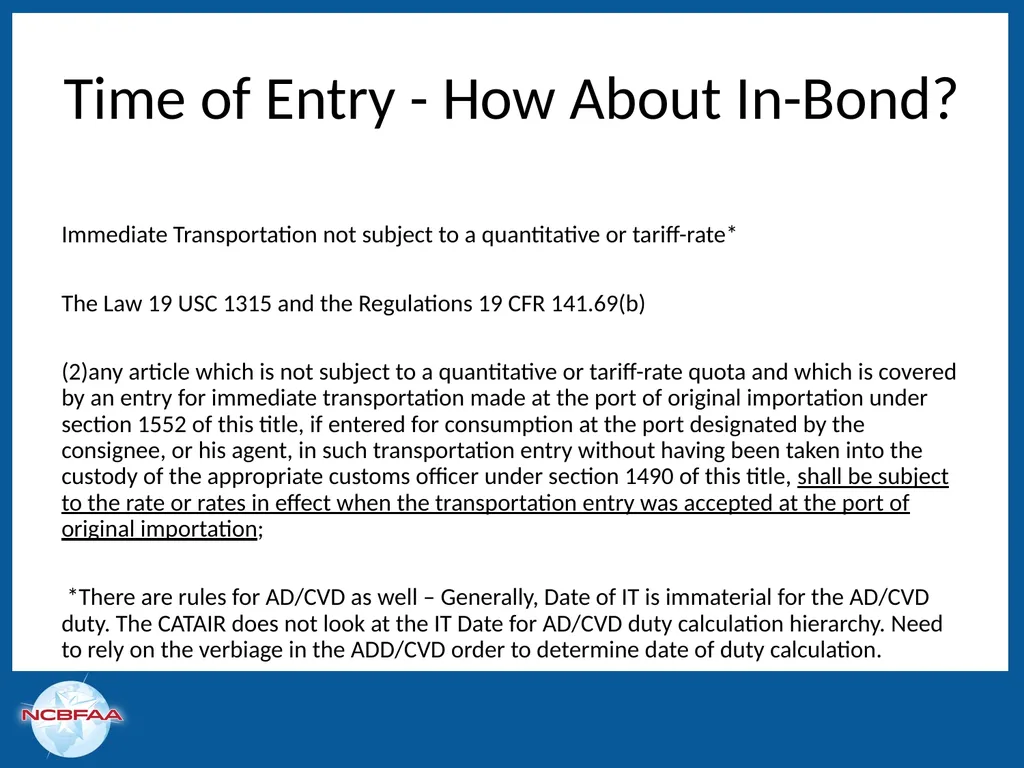
Time of Entry - How About In-Bond? Immediate Transportation not subject to a quantitative or tariff-rate*
The Law 19 USC 1315 and the Regulations 19 CFR 141.69(b)
(2)any article which is not subject to a quantitative or tariff-rate quota and which is covered by an entry for immediate transportation made at the port of original importation under section 1552 of this title, if entered for consumption at the port designated by the consignee, or his agent, in such transportation entry without having been taken into the custody of the appropriate customs officer under section 1490 of this title, shall be subject to the rate or rates in effect when the transportation entry was accepted at the port of original importation;
*There are rules for AD/CVD as well – Generally, Date of IT is immaterial for the AD/CVD duty. The CATAIR does not look at the IT Date for AD/CVD duty calculation hierarchy. Need to rely on the verbiage in the ADD/CVD order to determine date of duty calculation. 39<br>
40
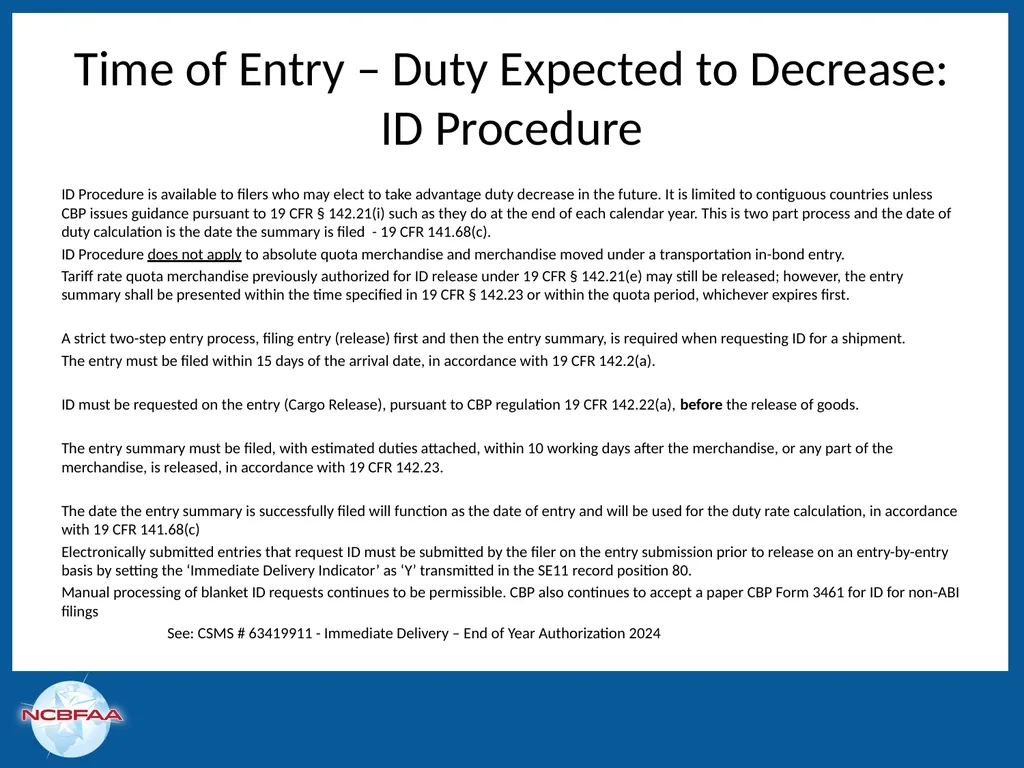
Time of Entry – Duty Expected to Decrease: ID Procedure ID Procedure is available to filers who may elect to take advantage duty decrease in the future. It is limited to contiguous countries unless CBP issues guidance pursuant to 19 CFR § 142.21(i) such as they do at the end of each calendar year. This is two part process and the date of duty calculation is the date the summary is filed - 19 CFR 141.68(c).
ID Procedure does not apply to absolute quota merchandise and merchandise moved under a transportation in-bond entry.
Tariff rate quota merchandise previously authorized for ID release under 19 CFR § 142.21(e) may still be released; however, the entry summary shall be presented within the time specified in 19 CFR § 142.23 or within the quota period, whichever expires first.
A strict two-step entry process, filing entry (release) first and then the entry summary, is required when requesting ID for a shipment.
The entry must be filed within 15 days of the arrival date, in accordance with 19 CFR 142.2(a).
ID must be requested on the entry (Cargo Release), pursuant to CBP regulation 19 CFR 142.22(a), before the release of goods.
The entry summary must be filed, with estimated duties attached, within 10 working days after the merchandise, or any part of the merchandise, is released, in accordance with 19 CFR 142.23.
The date the entry summary is successfully filed will function as the date of entry and will be used for the duty rate calculation, in accordance with 19 CFR 141.68(c)
Electronically submitted entries that request ID must be submitted by the filer on the entry submission prior to release on an entry-by-entry basis by setting the ‘Immediate Delivery Indicator’ as ‘Y’ transmitted in the SE11 record position 80.
Manual processing of blanket ID requests continues to be permissible. CBP also continues to accept a paper CBP Form 3461 for ID for non-ABI filings
See: CSMS # 63419911 - Immediate Delivery – End of Year Authorization 2024 40<br>
41
CBP FAQ’s 232 FAQ
https://www.cbp.gov/trade/programs-administration/entry-summary/232-tariffs-aluminum-and-steel/faqs
IEEPA FAQ
https://www.cbp.gov/trade/programs-administration/trade-remedies/IEEPA-FAQ 41<br>
https://www.cbp.gov/trade/programs-administration/entry-summary/232-tariffs-aluminum-and-steel/faqs
IEEPA FAQ
https://www.cbp.gov/trade/programs-administration/trade-remedies/IEEPA-FAQ 41<br>
42
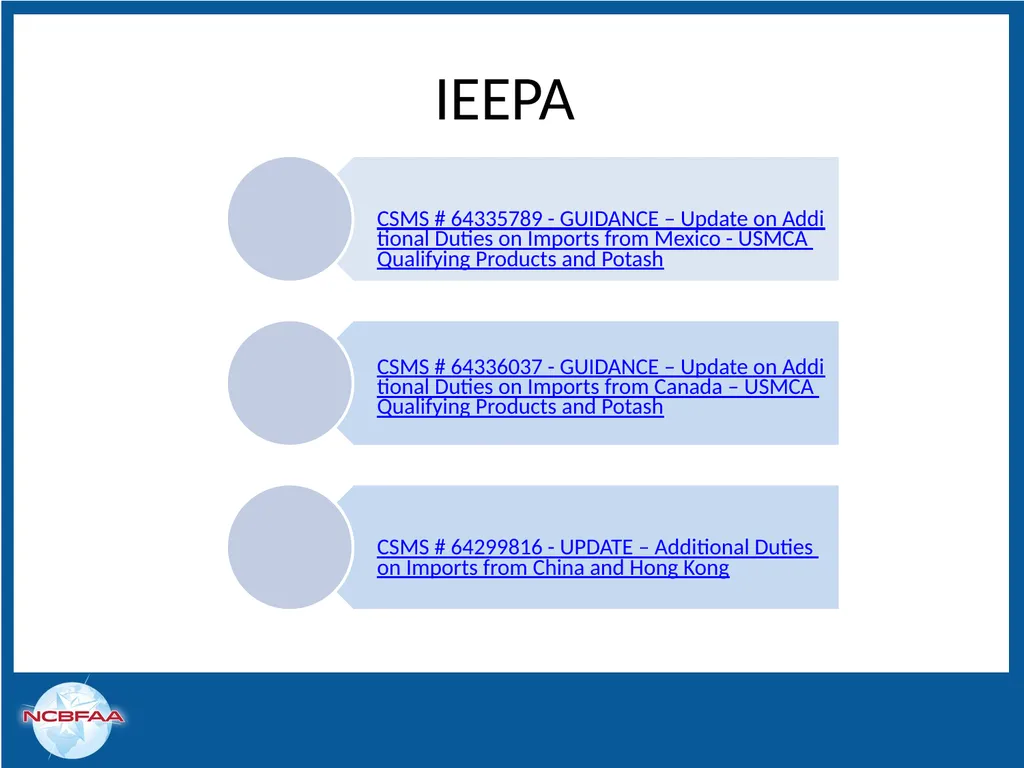
IEEPA 42<br>
43
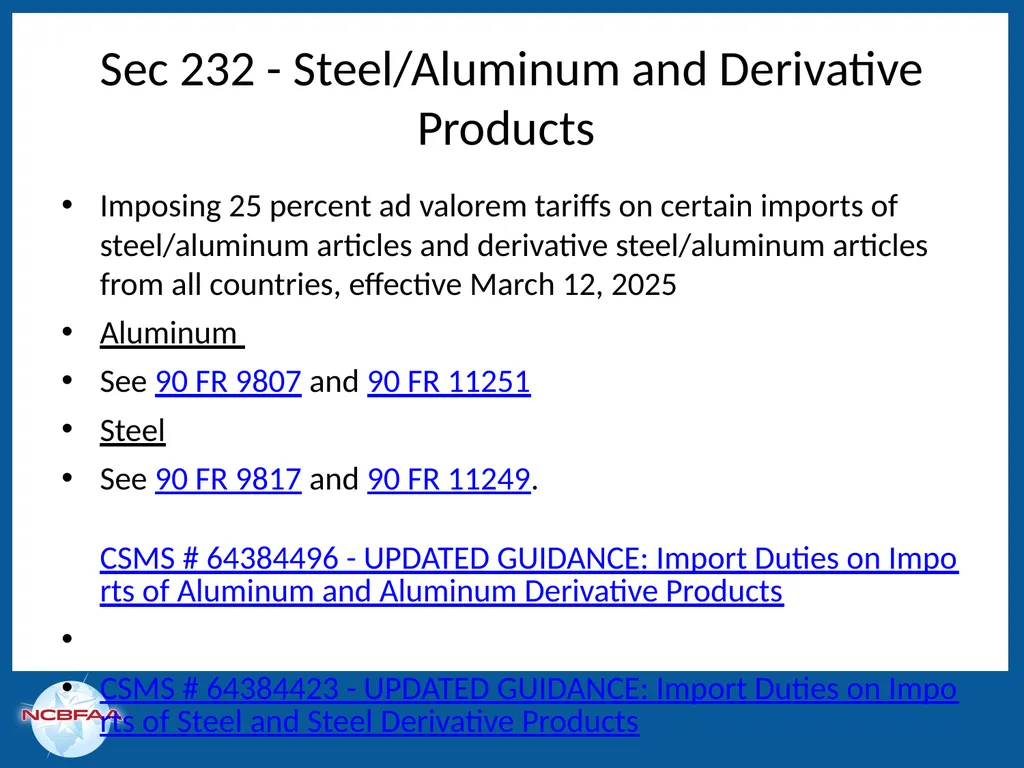
Sec 232 - Steel/Aluminum and Derivative Products Imposing 25 percent ad valorem tariffs on certain imports of steel/aluminum articles and derivative steel/aluminum articles from all countries, effective March 12, 2025
Aluminum
See 90 FR 9807 and 90 FR 11251
Steel
See 90 FR 9817 and 90 FR 11249. CSMS # 64384496 - UPDATED GUIDANCE: Import Duties on Imports of Aluminum and Aluminum Derivative Products
CSMS # 64384423 - UPDATED GUIDANCE: Import Duties on Imports of Steel and Steel Derivative Products 43<br>
Aluminum
See 90 FR 9807 and 90 FR 11251
Steel
See 90 FR 9817 and 90 FR 11249. CSMS # 64384496 - UPDATED GUIDANCE: Import Duties on Imports of Aluminum and Aluminum Derivative Products
CSMS # 64384423 - UPDATED GUIDANCE: Import Duties on Imports of Steel and Steel Derivative Products 43<br>
44
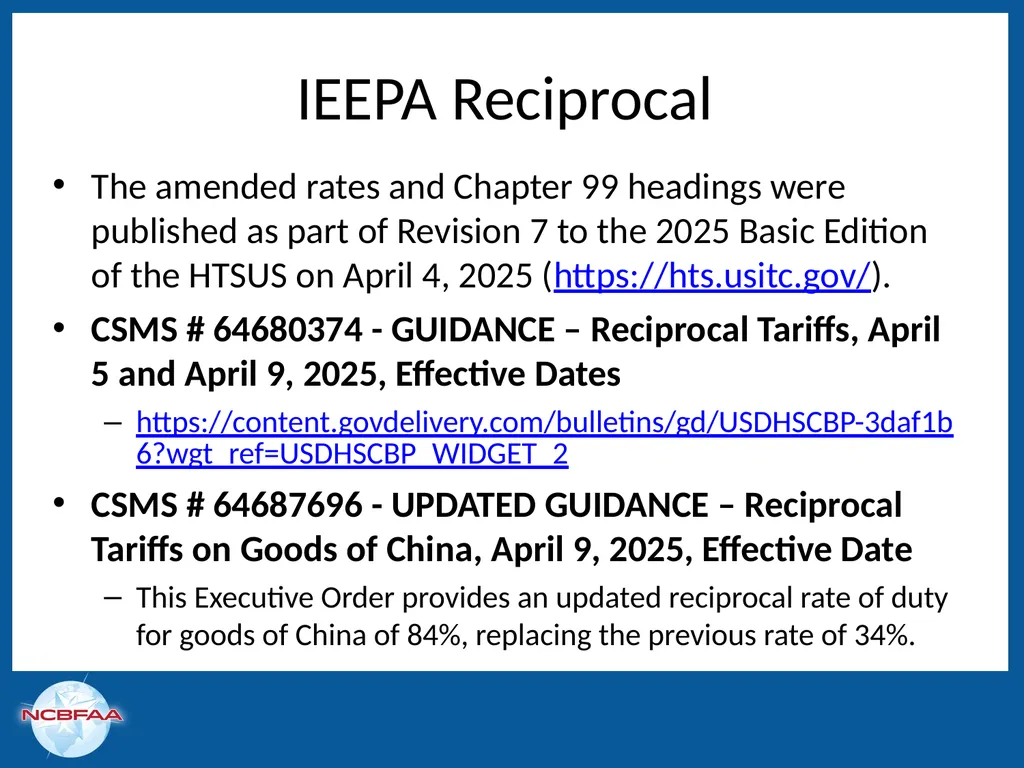
IEEPA Reciprocal The amended rates and Chapter 99 headings were published as part of Revision 7 to the 2025 Basic Edition of the HTSUS on April 4, 2025 (https://hts.usitc.gov/).
CSMS # 64680374 - GUIDANCE – Reciprocal Tariffs, April 5 and April 9, 2025, Effective Dates
https://content.govdelivery.com/bulletins/gd/USDHSCBP-3daf1b6?wgt_ref=USDHSCBP_WIDGET_2
CSMS # 64687696 - UPDATED GUIDANCE – Reciprocal Tariffs on Goods of China, April 9, 2025, Effective Date
This Executive Order provides an updated reciprocal rate of duty for goods of China of 84%, replacing the previous rate of 34%. 44<br>
45
Sec 232 Automobiles CSMS # 64624801 - GUIDANCE: Import Duties on Certain Automobiles
https://content.govdelivery.com/accounts/USDHSCBP/bulletins/3da18a1 45<br>
https://content.govdelivery.com/accounts/USDHSCBP/bulletins/3da18a1 45<br>
46
Questions? 46<br>
47
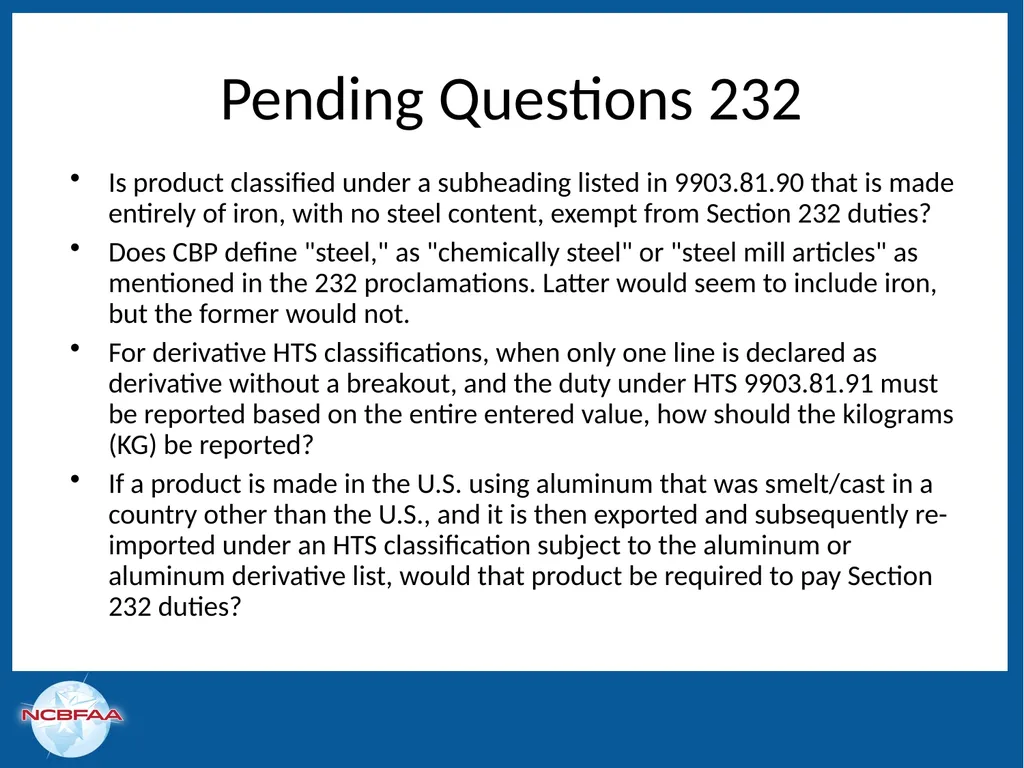
Pending Questions 232 Is product classified under a subheading listed in 9903.81.90 that is made entirely of iron, with no steel content, exempt from Section 232 duties?
Does CBP define "steel," as "chemically steel" or "steel mill articles" as mentioned in the 232 proclamations. Latter would seem to include iron, but the former would not.
For derivative HTS classifications, when only one line is declared as derivative without a breakout, and the duty under HTS 9903.81.91 must be reported based on the entire entered value, how should the kilograms (KG) be reported?
If a product is made in the U.S. using aluminum that was smelt/cast in a country other than the U.S., and it is then exported and subsequently re-imported under an HTS classification subject to the aluminum or aluminum derivative list, would that product be required to pay Section 232 duties? 47<br>
48
Pending Questions 232 Guidance provided states that when the value of the steel content is less than the entered value of the imported article, the good must be reported on two lines. When reporting steel content on the second line, we are to report a second quantity (of the steel content) in kilograms. What if weight of steel content in kilograms is not available?
What actions should be taken when mill certificates are not available for items purchased from retail locations, such as hardware store in Mexico? 48<br>
What actions should be taken when mill certificates are not available for items purchased from retail locations, such as hardware store in Mexico? 48<br>
49
Pending Questions 232 If the importer is willing to sign an affidavit affirming that the products do not contain any Russian aluminum and can provide supporting documentation, including a possible list of the aluminum’s countries of origin, is there a process to exempt from the 200% duty?
In what cases is steel/metal article, eligible for duty-free treatment of ordinary duties under Chapter 98 claim, b/c Ch. 99 tariff and Ch. 98 are considered independently of each other. Is the only exception for metal goods entered under 9802.00.60, which are always subject to Section 232 duties based on the full value of the imported article, despite eligibility for Ch. 98 duty exemption? However, would a Chapter 98 claim be appropriate for U.S. smelt/cast or melt/pour under 9802.00.60 because not subject to section 232
Can a 'split' line logic be applied to HTS classifications other than 9903.85.08 and 9903.81.91? Specifically, an importer whose finished goods fall under HTS 7309, where 99% of the steel used is of U.S. origin but 1% originates from other countries (in components such as rods, wheel casters, and hinges), would it be possible to apply a split treatment for Section 232 duty purposes?
COO US Entry Line, you still have to add Smelt and Cast US . If COO US but smelt / cast, but cast in Peru, are you eligible? 49<br>
50
Pending Questions 232 How to report content breakouts where there are both steel and aluminum (e.g., fiberglass body parts with two steel and one aluminum bracket)?
8708.10.3050 - OTHER BUMPER:VEHICLE 8701-8705 ; Some high-end vehicles use aluminum bumper beams with steel brackets or impact-absorbing elements for an optimal balance of strength and lightweight properties.
9403.20.00 - Furniture (o/than seats) of metal nesoi, o/than of a kind used in offices (STL OR ALM); A storage locker made with steel frame for structural support but with aluminum panels/doors.
Single product produced whose steel content is 60% US and 40% Canadian steel.
A factory uses steel billets sourced from two different countries which they further process to create a finished good. Consider is Chapter 73/76 or outside of these chapters.
What is correct way to report a product properly classified under a single HTSUS which contains different assemblies with multiple countries of smelt/cast or melt/pour? For example, a single boom assembly may have several hundred subassemblies which contain steel derivatives each having unique country of origin and country of melt/pour combinations.
Consider 8431.49.10 Parts of: Ships' derricks; cranes, including cable cranes; mobile lifting frames, straddle carriers or works trucks fitted with a crane. A cable crane boom would be properly classified here. However, the boom is comprised of subassemblies which contain steel derivatives each having unique country of origin and country of melt/pour combinations 50<br>