04
No! A budget can be as simple as you need it to be — you can decide what you need! Are budgets complicated? Budgeting helps you answer these questions:
What do I actually spend money on?
How can I save more money?
How can I make better decisions�about my money? What is a budget?�A budget is a plan for your money.<br>
05
A budget will:
Help you reach your money goals.
Keep you from spending too much.
Help you save for things you want.
Prepare you for unexpected expenses�(especially if you’re an adult). Why you should �create a budget<br>
06
Are you saving money for anything in�particular right now? Let’s talk!<br>
07
What do you think you’ll want to save�money for in the future? And another �question<br>
08
Keep it simple to start: You can keep track of your spending on paper! How should I keep track? Start by keeping track when you receive or spend money. Do you get an allowance or money for your birthday? Keep track of where it goes!
Make a note of every purchase you make for a month to see how much you spend. Let’s get a budget going!<br>
09
Use that information to help plan next month’s budget.
Your goal should be to have money left over each month for savings. Let’s get a budget going!<br>
10
Lydia is 8 years old and wants to start a budget. Hands on example:�Building a budget<br>
11
Her only income is a weekly allowance of $8. �She decides to divide it three ways. Hands on example:�Building a budget<br>
12
$4 goes to her savings account. $3 goes to her checking account to �spend on things she likes to buy, like a candy bar or a new book. �She sends $1 to her favorite charity for pet adoption and rescue. Hands on example:�Building a budget<br>
13
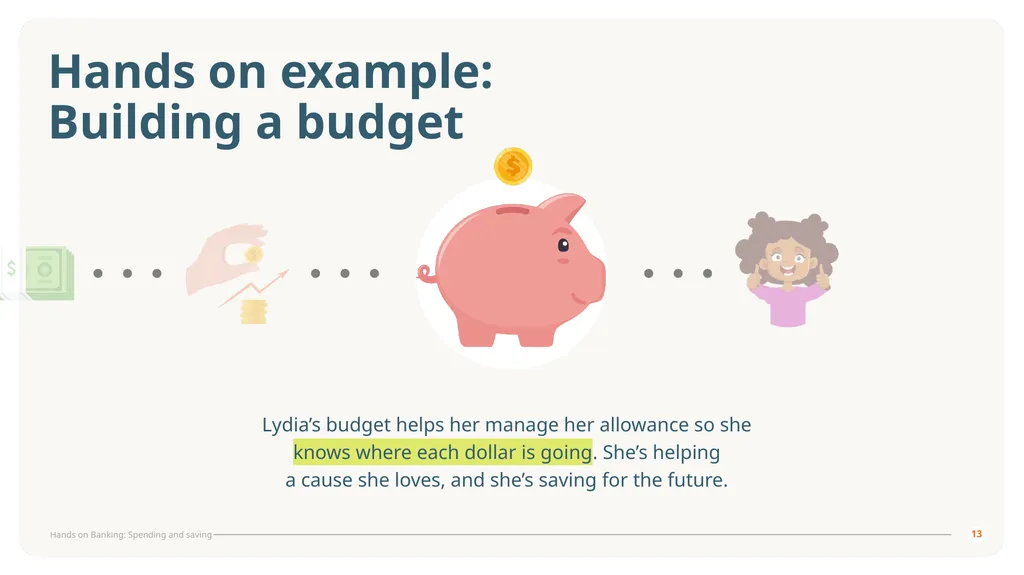
Lydia’s budget helps her manage her allowance so she �knows where each dollar is going. She’s helping �a cause she loves, and she’s saving for the future. Hands on example:�Building a budget<br>
14
Great job, Lydia! Hands on example:�Building a budget<br>
15
Less spending means more saving.
When you spend more than you �earn, you go into debt. Your goal: Don’t spend it all!<br>
16
Have you ever spent money on something �and regretted it later? Let’s talk!<br>
17
Will I use it? How often?
Did I want this before I walked into the store or saw it in an ad?
Where will I keep it?
Do I already have something like this at home?
Do I really need this? 5 questions to ask yourself before you buy something<br>
18
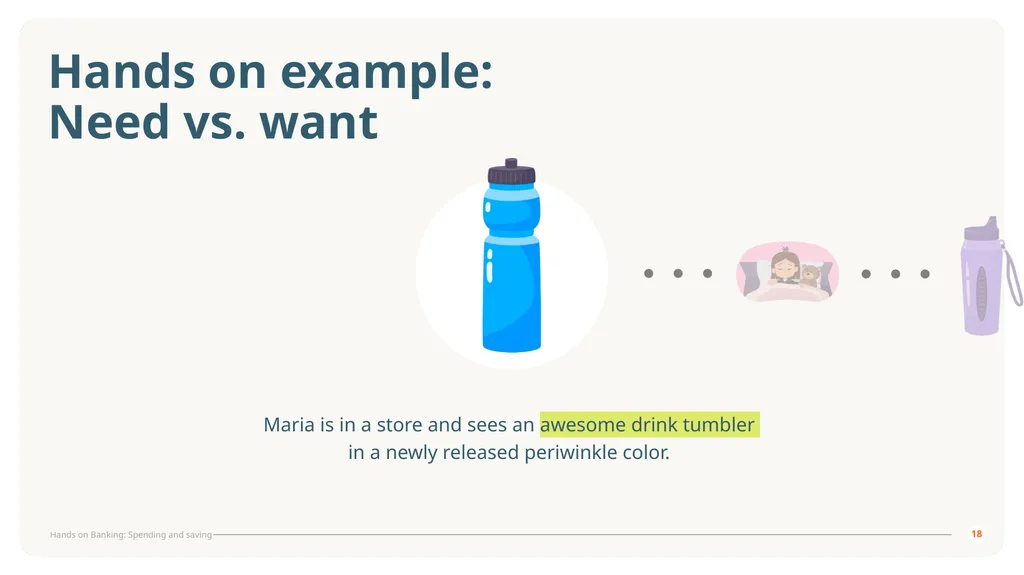
Maria is in a store and sees an awesome drink tumbler �in a newly released periwinkle color. Hands on example:�Need vs. want<br>
19
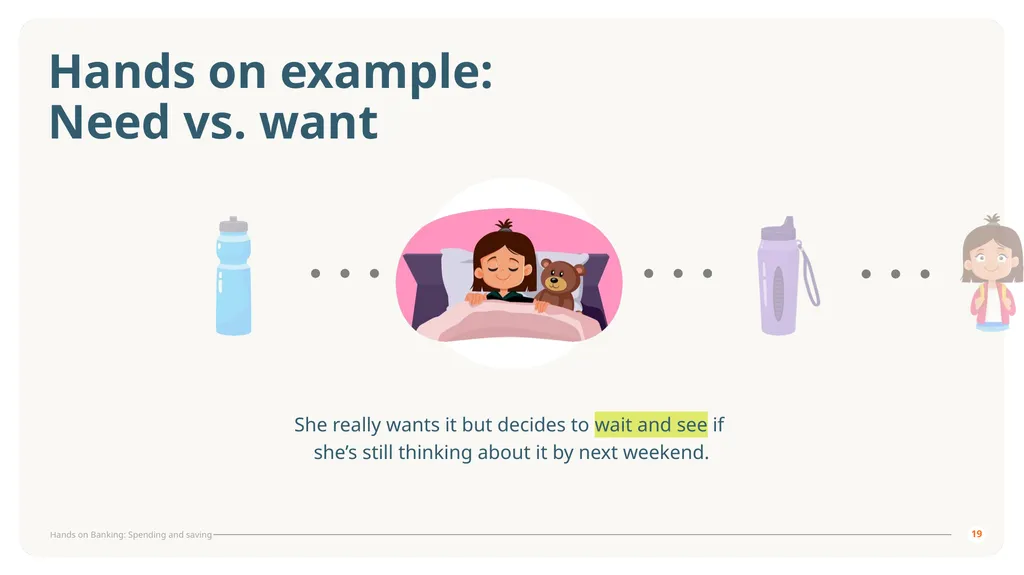
She really wants it but decides to wait and see if �she’s still thinking about it by next weekend. Hands on example:�Need vs. want<br>
20
Five days go by, and she’s no longer thinking about the tumbler — �and she realizes her own purple tumbler is pretty close to periwinkle. Hands on example:�Need vs. want<br>
21
Waiting a week helped her to see if she needed the item �rather than just wanting it. Hands on example:�Need vs. want<br>
22
And it saved her $35. Nice work, Maria! Hands on example:�Need vs. want<br>
23
Food
Water
Shelter
Clothing
Transportation
Medicine Needs: Things you need to have for a safe, healthy, stable life. Needs vs. wants<br>
24
Electronics
Fancy cars
Vacations
Toys
Entertainment (music, streaming services, etc.) Wants: Things that are nice to have, but you could get by without them. Needs vs. wants<br>
25
Want.
Although delicious, �it’s not necessary. Need.
All basic meals are a need. The cake pop your mom buys you on her coffee run The lunch you bring to school Want or need? Quiz time!<br>
26
Want.
You don’t need a smartwatch�to get by. Need.
You need clothing to protect�your body. A smartwatch The shoes you wear to school most days Want or need? Quiz time!<br>
27
Need.
Shelter, or a home, is�always a need. Want.
It’s awesome family time, but vacations are a bonus. A place to live while your house�is under construction Your family’s trip to�the beach each year Want or need? Quiz time!<br>
28
Checking accounts are used for everyday purchases, like buying groceries or paying for items online. This is where your “spending money” would be kept. How bank accounts �can help you save<br>
29
Savings accounts are not used for daily spending. They are where you deposit money to keep it safe for the future. Savings accounts earn interest.
Special accounts offer different savings benefits for specific purposes. For example, a 529 plan can help you save for college. How bank accounts �can help you save<br>
30
Charlie wants to buy a $200 bike. He decides to use �his savings account to help. Hands on example: �Saving for a want<br>
31
He makes a plan to save for the bike using his weekly allowance of $10. He saves $7 each week in his savings account and uses $3 for other items. Hands on example: �Saving for a want<br>
32
A few weeks into saving, he gets a $75 birthday gift from his grandma, which he puts toward the bike. Hands on example: �Saving for a want<br>
33
After 18 weeks — about 4 months — he hits his saving goal and has �$201 for his new set of wheels. Hands on example: �Saving for a want<br>
34
Nice work, Charlie! Hands on example: �Saving for a want<br>
35
Interest is a payment the bank gives you for keeping your savings with them (usually in a savings account).
It’s calculated as a percentage of the amount you have �in your account.
Compound interest is earned on both the original money you put in your savings account and the additional interest payments. Over time, this can really add up. What is interest?<br>
36
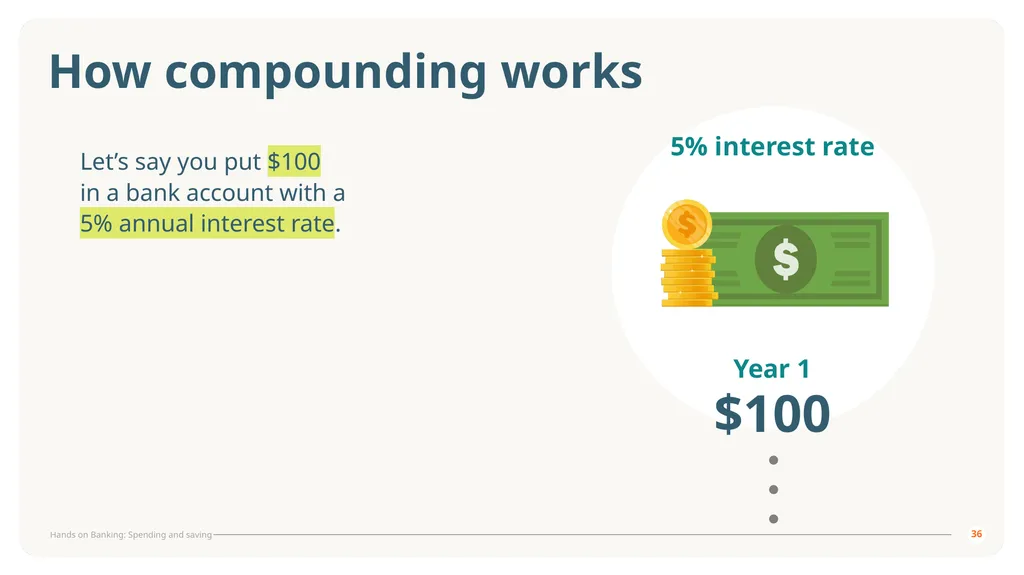
$100 Year 1 5% interest rate Let’s say you put $100�in a bank account with a�5% annual interest rate. How compounding works<br>
37
$127.63 Year 5 5% interest rate Your $100 is earning interest each month. Plus, all the interest you’ve previously earned is earning interest. That’s compound interest. How compounding works<br>
38
$62.89 interest earned $162.89 Year 10 5% interest rate Even if you never add more money, that $100 will become more than $160 over 10 years, all because of compound interest. How compounding works<br>
39
Reach goals, keep you from spending too much,�help you save, or help you prepare for emergencies Question:
What’s one thing a budget can help you do? Quiz time!<br>
40
False.
Checking accounts are for everyday spending money. True or false:
Savings accounts are for daily purchases. Quiz time!<br>
41
debt Fill in the blank:
When you spend more than you earn, �you go into . Quiz time!<br>
42
True.
Over time, compound interest on your savings can add up. True or false:
Compound interest takes time to add up to great savings. Quiz time!<br>
43
Hands on Banking�(Search online: Hands on Banking for Youth)
Consumer Financial Protection Bureau: Money as You Grow�(Search online: Money as You Grow)
FDIC Money Smart�(Search online: FDIC Money Smart)
Next Gen Personal Finance�(Search online: Next Gen Finance Games) Where to keep learning about finance<br>