Learning New Vocabulary Unit 3 - Vocabulary Ramos 78 Part 1: Using Context (Context Clues) Focus Questions What is a context clue? What strategies can I use to use the context as clues to what a word might mean? How do I use what I know
"Learning New Vocabulary Unit 3 - Vocabulary Ramos" is the property of its rightful owner. Permission is granted to
download and print the materials on this website for personal, non-commercial use only, and to display it
on your personal computer provided you do not modify the materials and that you retain all copyright
notices contained in the materials. By downloading content from our website, you accept the terms of this
agreement.
Presentation Transcript
01
Learning New Vocabulary Unit 3 - Vocabulary
Ramos 7/8<br>
02
Part 1: Using Context (Context Clues)<br>
03
Focus Questions What is a context clue?
What strategies can I use to use the context as clues to what a word might mean?
How do I use what I know and the information around a word to determine what it means?<br>
04
What is a context clue? Think/Pair/Share
A context clue is a hint within the context (words/meaning/information around the unknown word) to help you determine what a word means.<br>
05
What strategies can I use to determine the meaning of unknown words? Paste the table of the six types of context clues in your notebook.
Strategy 1: Using the information around a word and my own background knowledge to determine its meaning. Includes the definition, example illustration, contrast and logic context clues.
Strategy 2: Using your knowledge of Root words and Affixes (prefixes and suffixes) to determine its meaning.
Strategy 3: Using your knowledge of how a word functions (part of speech) to determine its meaning.<br>
06
Using strategies to help You will probably use more than one strategy at a time to determine the meaning of an unknown word.
Your own background knowledge may limit the strategies you can use.
Even if you can’t get a precise meaning, if you have a general understanding it can help you understand the meaning of the text more.<br>
07
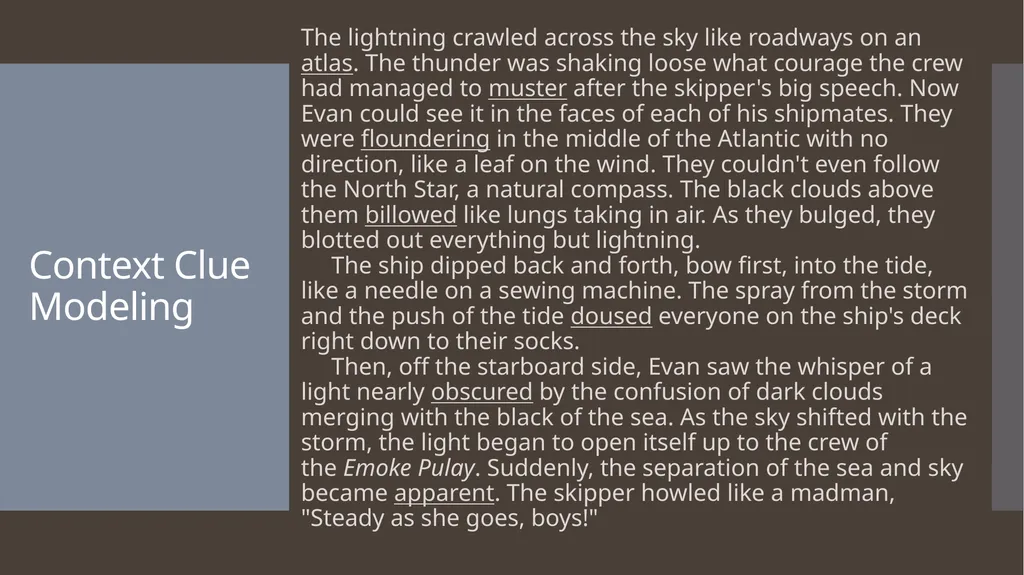
Context Clue Modeling The lightning crawled across the sky like roadways on an atlas. The thunder was shaking loose what courage the crew had managed to muster after the skipper's big speech. Now Evan could see it in the faces of each of his shipmates. They were floundering in the middle of the Atlantic with no direction, like a leaf on the wind. They couldn't even follow the North Star, a natural compass. The black clouds above them billowed like lungs taking in air. As they bulged, they blotted out everything but lightning. The ship dipped back and forth, bow first, into the tide, like a needle on a sewing machine. The spray from the storm and the push of the tide doused everyone on the ship's deck right down to their socks. Then, off the starboard side, Evan saw the whisper of a light nearly obscured by the confusion of dark clouds merging with the black of the sea. As the sky shifted with the storm, the light began to open itself up to the crew of the Emoke Pulay. Suddenly, the separation of the sea and sky became apparent. The skipper howled like a madman, "Steady as she goes, boys!"<br>
08
Practice Read the first passage of the unit.
Annotate as normal – but we are especially focused on finding words we do not know.
As you circle words you do not know – write a note in the margins about what you think the word may mean – try to use the context clues from strategy 1.<br>
09
Strategy 2 Greek and Latin Roots and Affixes<br>
10
Focus Questions What is a root?
What is an affix?
What are common roots and affixes for English words?
How do I use my knowledge of roots and affixes to determine the meaning of a word?<br>
11
What is a root? A root, as the name suggests, is a word or word part from which other words grow. The root of the word vocabulary, for example, is voc, a Latin rot meaning “word” or “name”<br>
12
What is an affix? A affix is a letter or a group of letters attached to the beginning (Prefix) or the end (Suffix) of a word that will partly indicate the words meaning.
For example, the word prefix begins with a affix, pre, which means “before”
A suffix also alters (changes) the grammatical function of the original word (Part of Speech)
For example, if you add the suffix –er to the verb read you make the word into a noun, reader.<br>
13
Common Roots and Affixes Paste the tables in your notebook – this is a list of the most common Greek and Latin Roots and English affixes.
After you paste the tables in take 5 minutes to study them.<br>
14
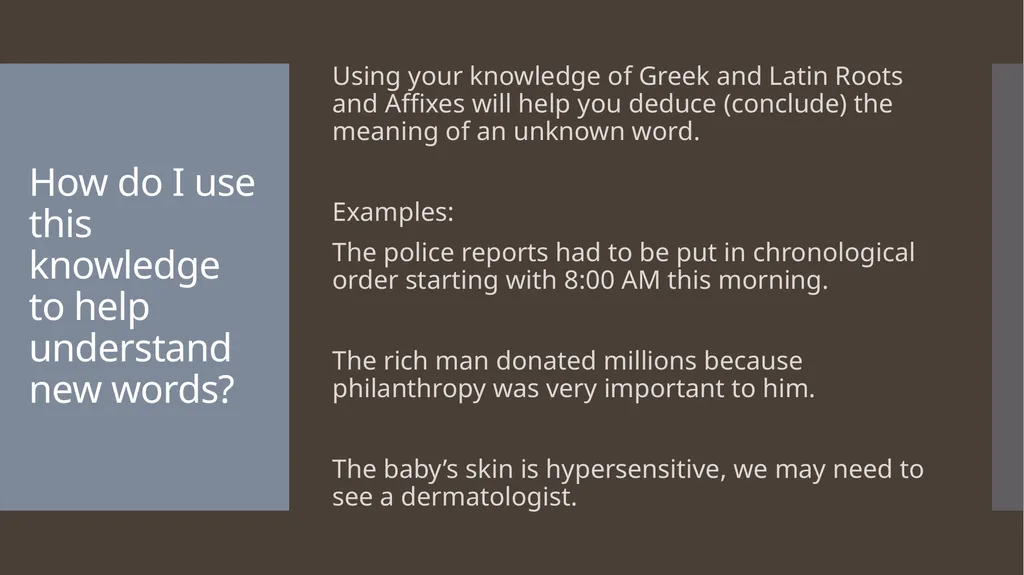
How do I use this knowledge to help understand new words? Using your knowledge of Greek and Latin Roots and Affixes will help you deduce (conclude) the meaning of an unknown word.
Examples:
The police reports had to be put in chronological order starting with 8:00 AM this morning.
The rich man donated millions because philanthropy was very important to him.
The baby’s skin is hypersensitive, we may need to see a dermatologist.<br>
15
Practice Go back through the words you circled in your passage 1 annotations.
See if you can further understand a word by applying your knowledge of Greek/Latin Roots and Affixes.<br>