
Learning Objective 1.4 Identify the shortcomings
Description: Learning Objective 1.4 Identify the shortcomings of current normative instruments for use in emergency situations, and evaluate alternatives WHO Training Manual Ethics in epidemics, emergencies and disasters: Research, surveillance and
Related Topics
Download Presentation
"Learning Objective 1.4 Identify the shortcomings" is the property of its rightful owner. Permission is granted to download and print the materials on this website for personal, non-commercial use only, and to display it on your personal computer provided you do not modify the materials and that you retain all copyright notices contained in the materials. By downloading content from our website, you accept the terms of this agreement.
Presentation Transcript
slide1. Learning Objective 1.4
Identify the shortcomings of current normative instruments for use in emergency situations, and evaluate alternatives WHO Training Manual
Ethics in epidemics, emergencies and disasters: Research, surveillance and patient care<br>
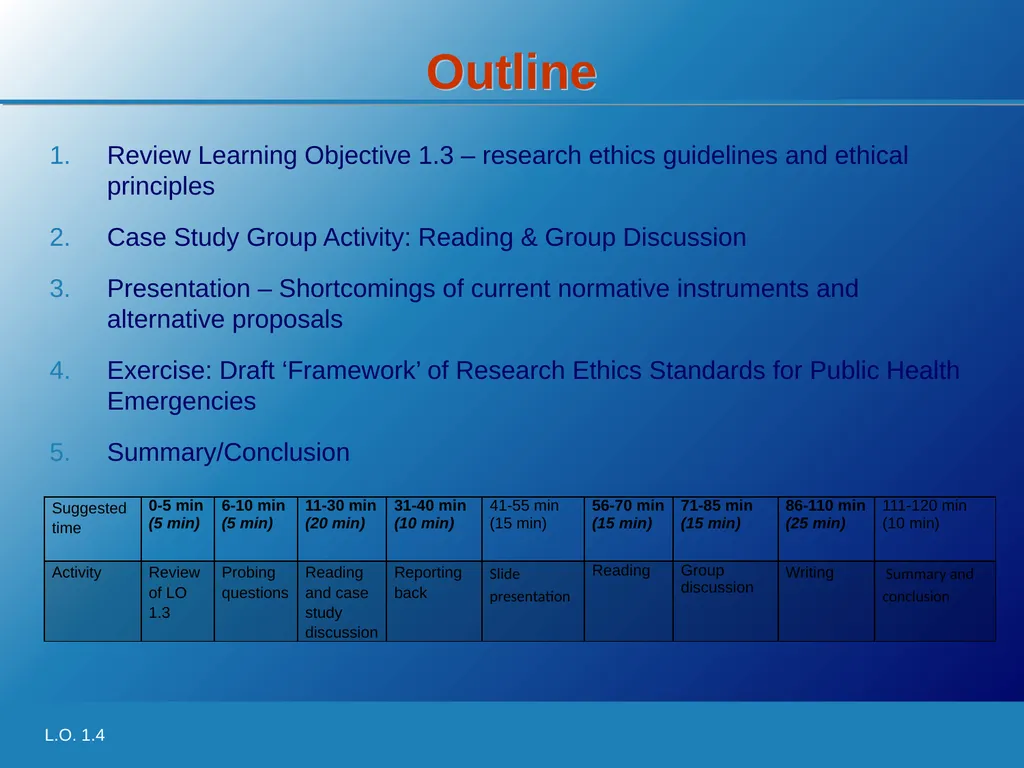
slide2. Outline Review Learning Objective 1.3 – research ethics guidelines and ethical principles
Case Study Group Activity: Reading & Group Discussion
Presentation – Shortcomings of current normative instruments and alternative proposals
Exercise: Draft ‘Framework’ of Research Ethics Standards for Public Health Emergencies
Summary/Conclusion<br>
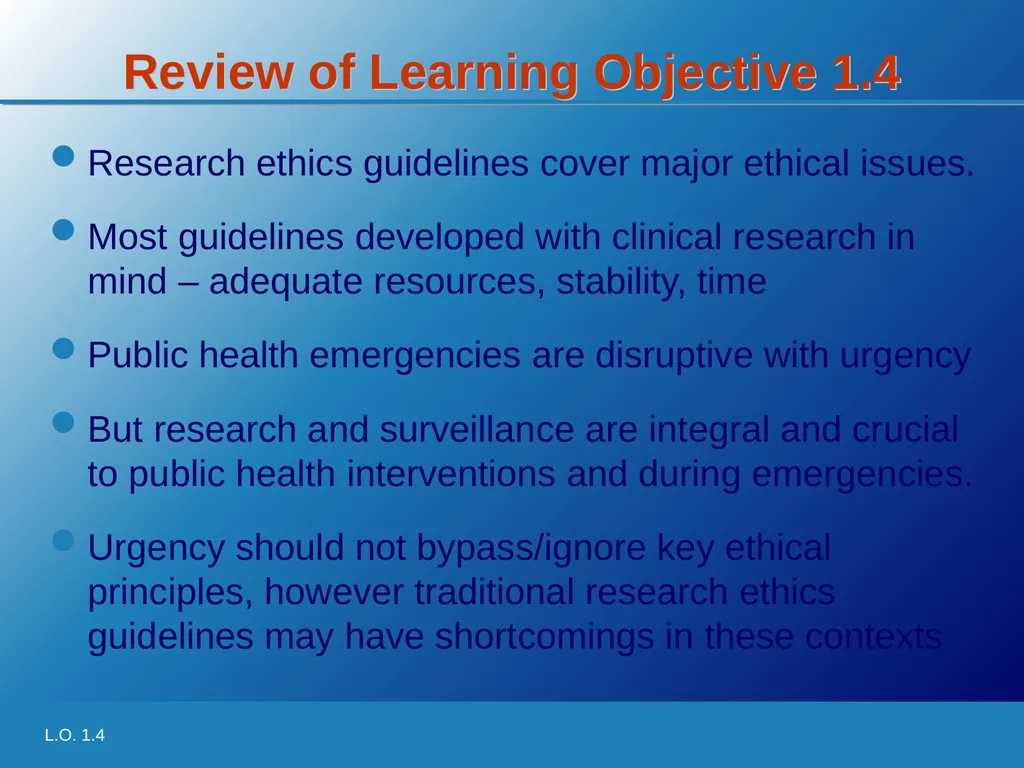
slide3. Review of Learning Objective 1.4 Research ethics guidelines cover major ethical issues.
Most guidelines developed with clinical research in mind – adequate resources, stability, time
Public health emergencies are disruptive with urgency
But research and surveillance are integral and crucial to public health interventions and during emergencies.
Urgency should not bypass/ignore key ethical principles, however traditional research ethics guidelines may have shortcomings in these contexts<br>
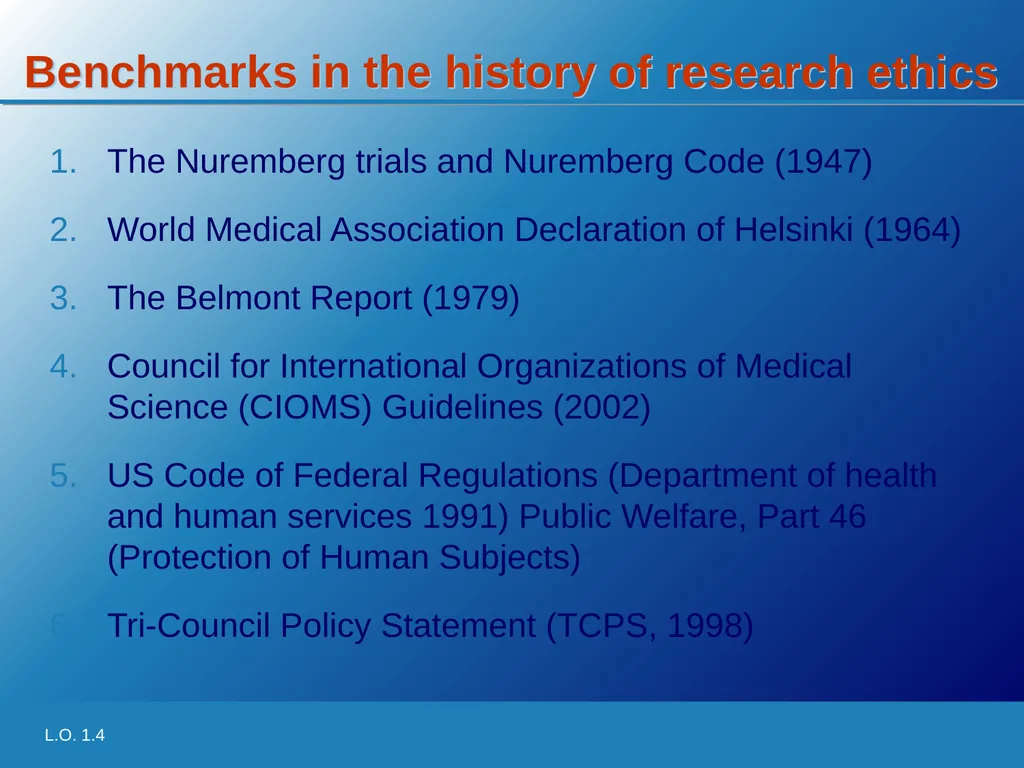
slide4. Benchmarks in the history of research ethics The Nuremberg trials and Nuremberg Code (1947)
World Medical Association Declaration of Helsinki (1964)
The Belmont Report (1979)
Council for International Organizations of Medical Science (CIOMS) Guidelines (2002)
US Code of Federal Regulations (Department of health and human services 1991) Public Welfare, Part 46 (Protection of Human Subjects)
Tri-Council Policy Statement (TCPS, 1998)<br>
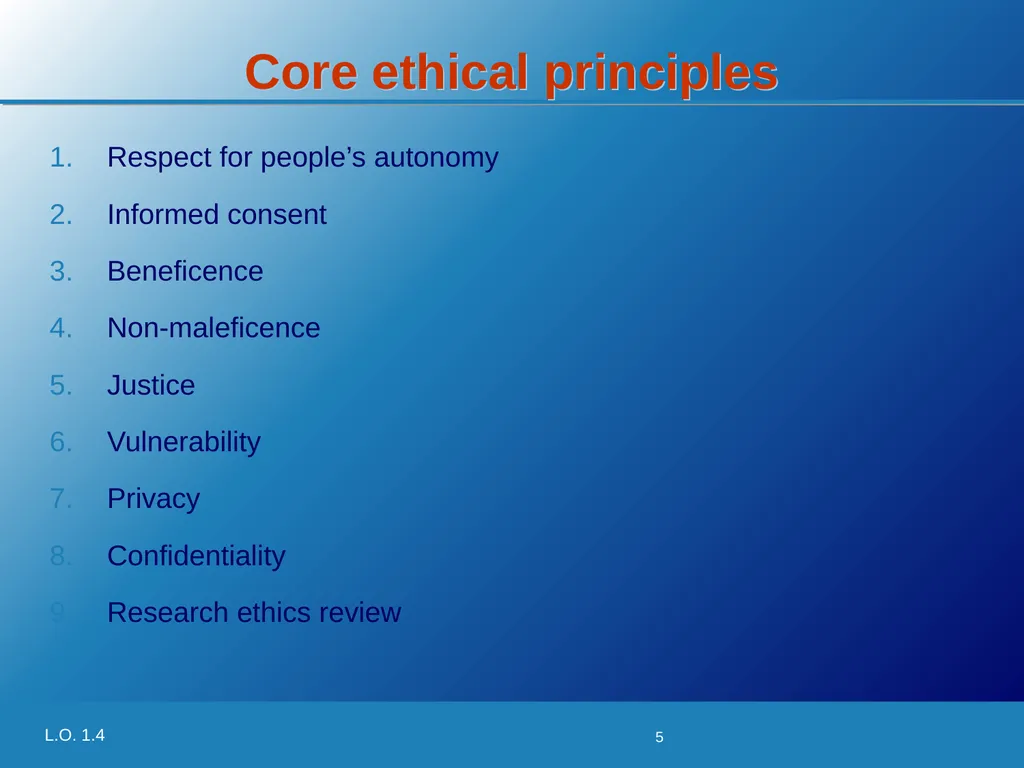
slide5. Core ethical principles Respect for people’s autonomy
Informed consent
Beneficence
Non-maleficence
Justice
Vulnerability
Privacy
Confidentiality
Research ethics review 5<br>
slide6. Case Study Case study 1: Meningitis in Nigeria (see also Murray (2007), Boseley & Smith (2010), Médecins sans Frontières (2011), Okonta (2014), and Nyika (undated))
Divide into small groups
20 minutes reading
Discuss the case in small groups
Each group shares their reflections<br>
slide7. Case Study Discussion Case Questions:
Use one of the research ethics guidelines or regulations introduced in LO 1.3, discuss three of the main ethical issues that you identified in the case study, focusing on whether you found your research ethics instrument helpful in deciding whether you should approve this study.
If you found gaps or shortcomings to your research ethics instrument, describe these shortcomings and discuss with your colleagues at least one suggestion to overcome each one of them.<br>
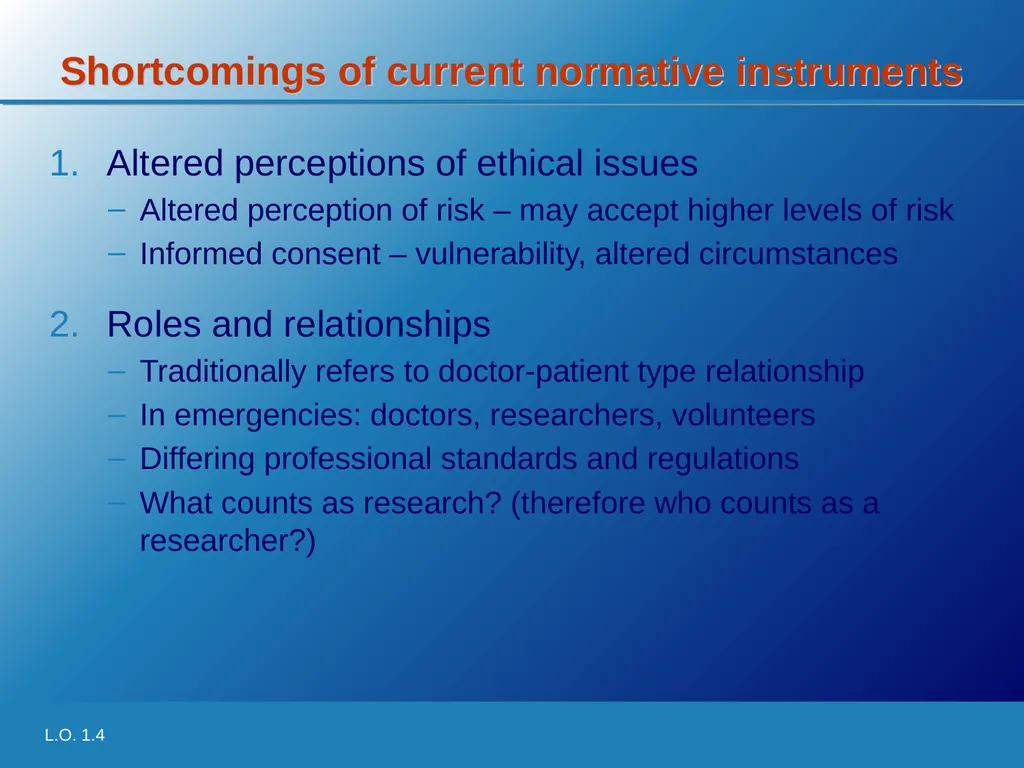
slide8. Shortcomings of current normative instruments Altered perceptions of ethical issues
Altered perception of risk – may accept higher levels of risk
Informed consent – vulnerability, altered circumstances
Roles and relationships
Traditionally refers to doctor-patient type relationship
In emergencies: doctors, researchers, volunteers
Differing professional standards and regulations
What counts as research? (therefore who counts as a researcher?)<br>
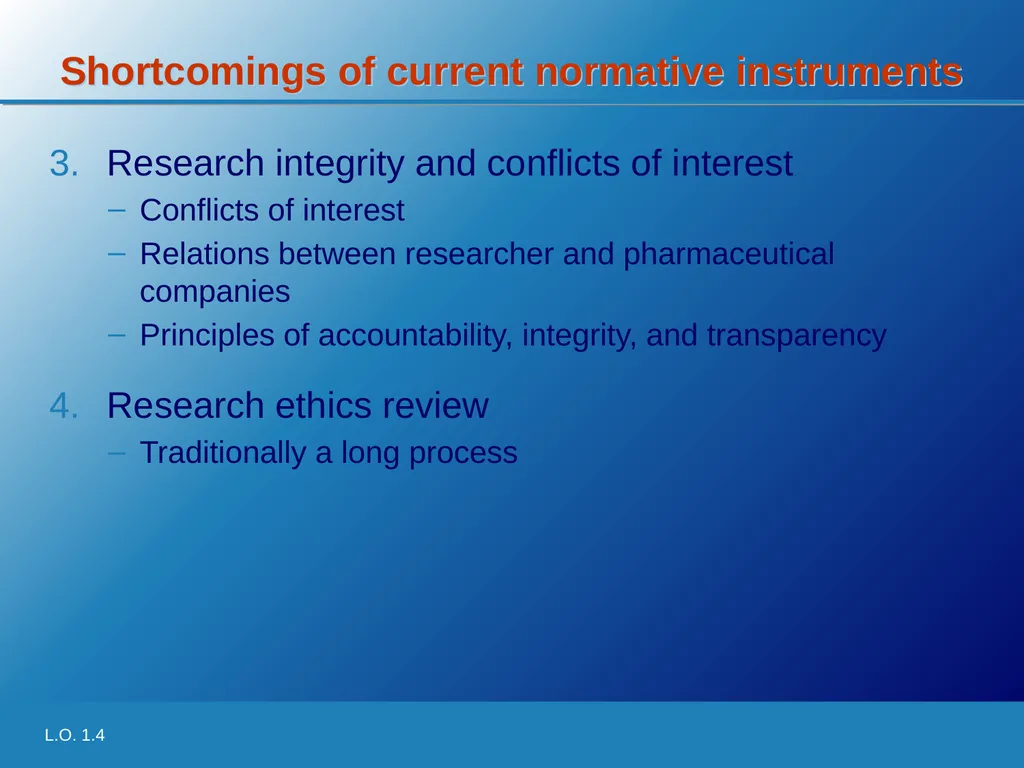
slide9. Shortcomings of current normative instruments Research integrity and conflicts of interest
Conflicts of interest
Relations between researcher and pharmaceutical companies
Principles of accountability, integrity, and transparency
Research ethics review
Traditionally a long process<br>
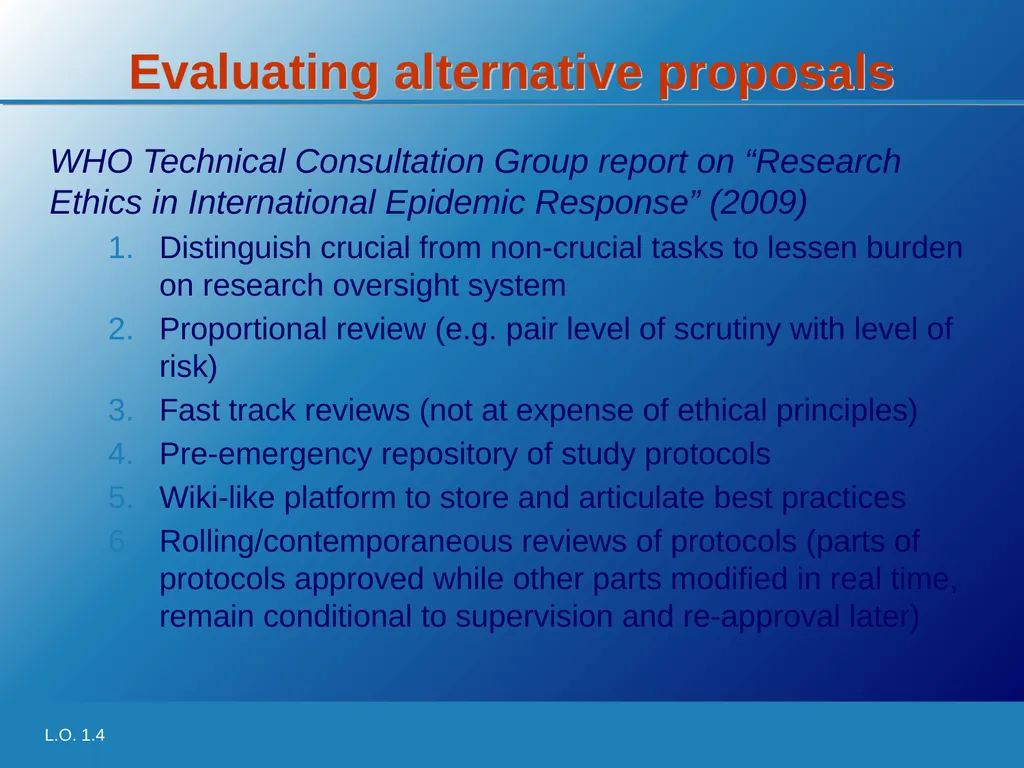
slide10. Evaluating alternative proposals WHO Technical Consultation Group report on “Research Ethics in International Epidemic Response” (2009)
Distinguish crucial from non-crucial tasks to lessen burden on research oversight system
Proportional review (e.g. pair level of scrutiny with level of risk)
Fast track reviews (not at expense of ethical principles)
Pre-emergency repository of study protocols
Wiki-like platform to store and articulate best practices
Rolling/contemporaneous reviews of protocols (parts of protocols approved while other parts modified in real time, remain conditional to supervision and re-approval later)<br>
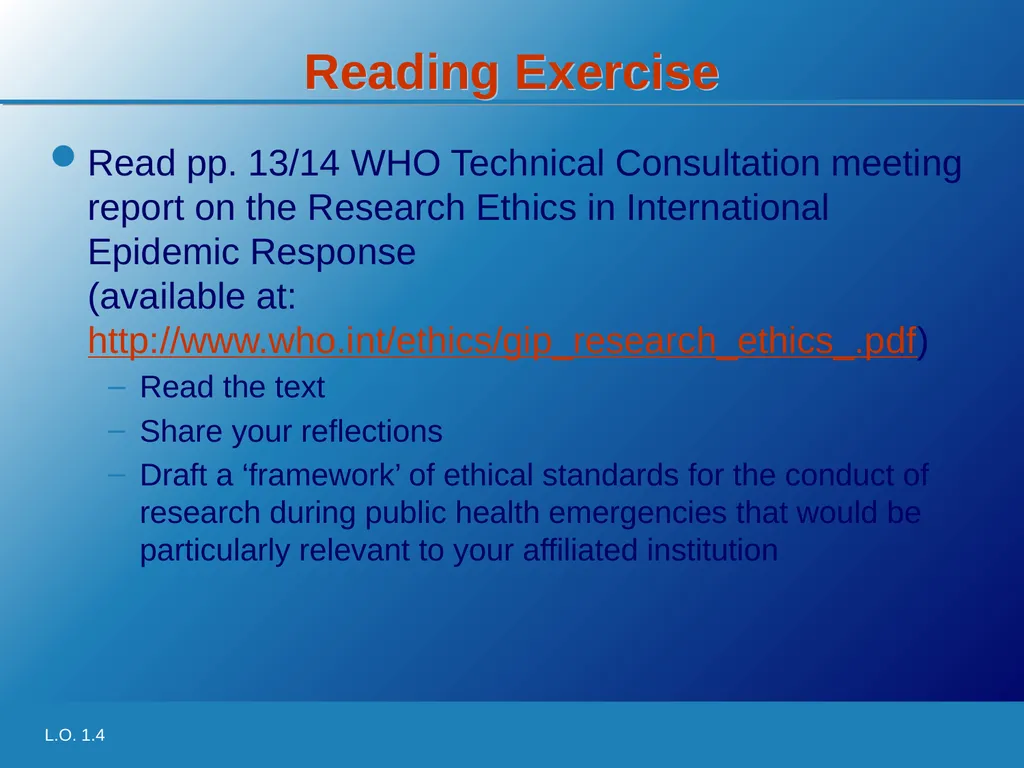
slide11. Reading Exercise Read pp. 13/14 WHO Technical Consultation meeting report on the Research Ethics in International Epidemic Response (available at: http://www.who.int/ethics/gip_research_ethics_.pdf)
Read the text
Share your reflections
Draft a ‘framework’ of ethical standards for the conduct of research during public health emergencies that would be particularly relevant to your affiliated institution<br>
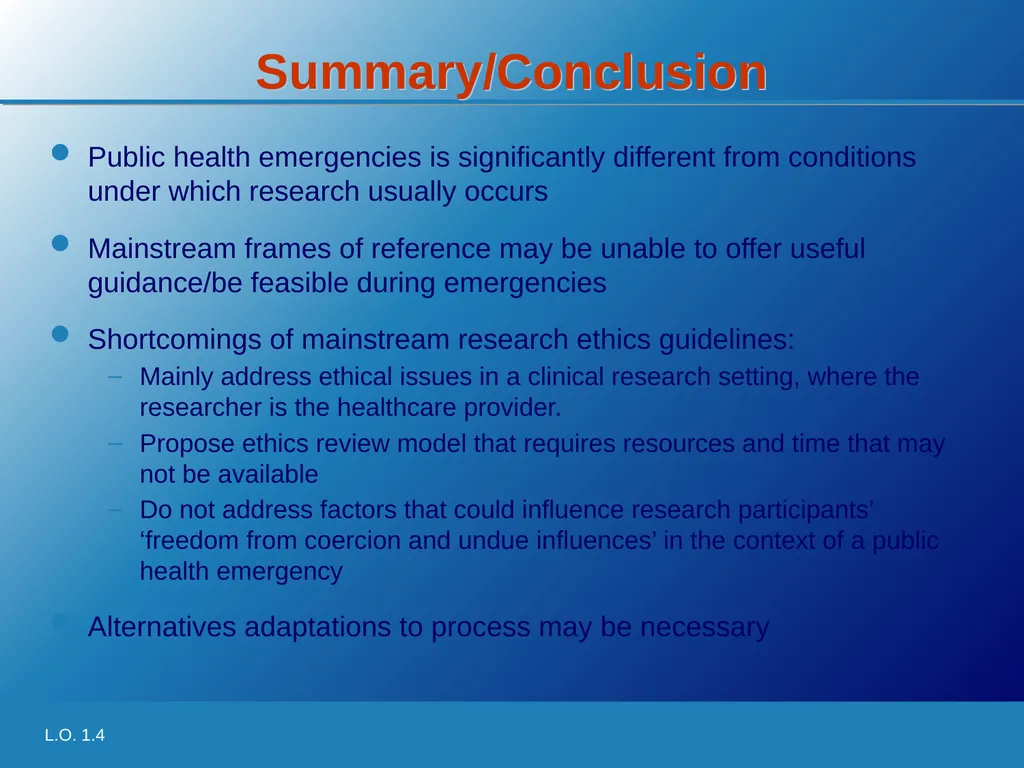
slide12. Summary/Conclusion Public health emergencies is significantly different from conditions under which research usually occurs
Mainstream frames of reference may be unable to offer useful guidance/be feasible during emergencies
Shortcomings of mainstream research ethics guidelines:
Mainly address ethical issues in a clinical research setting, where the researcher is the healthcare provider.
Propose ethics review model that requires resources and time that may not be available
Do not address factors that could influence research participants’ ‘freedom from coercion and undue influences’ in the context of a public health emergency
Alternatives adaptations to process may be necessary<br>
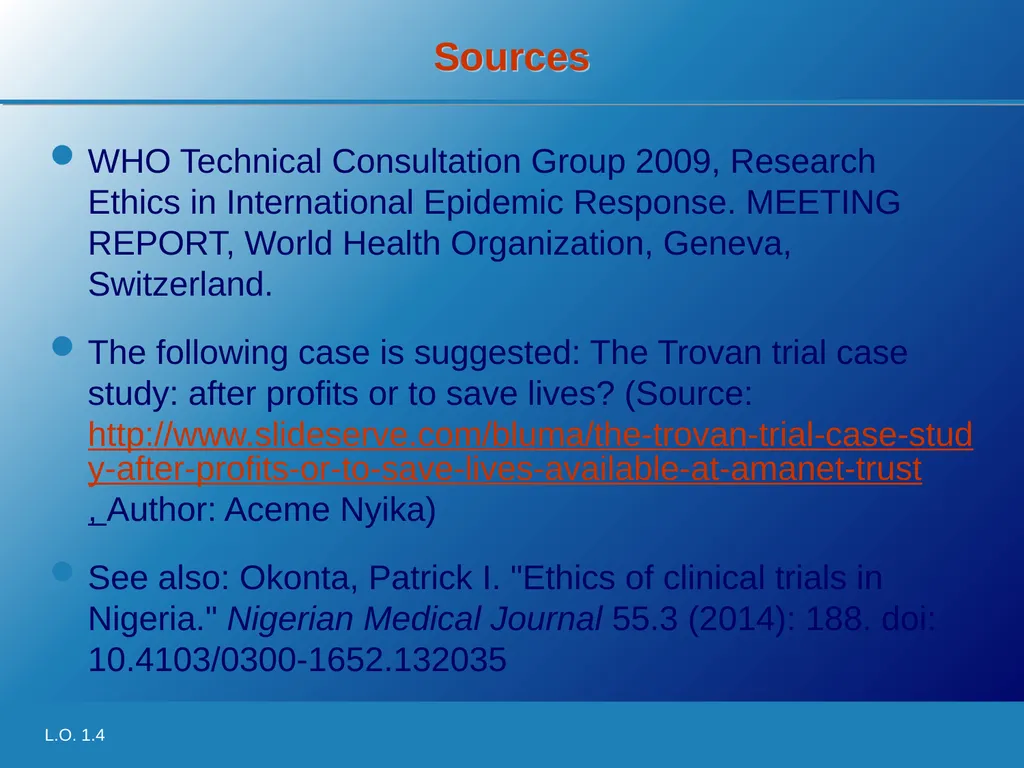
slide13. Sources WHO Technical Consultation Group 2009, Research Ethics in International Epidemic Response. MEETING REPORT, World Health Organization, Geneva, Switzerland.
The following case is suggested: The Trovan trial case study: after profits or to save lives? (Source: http://www.slideserve.com/bluma/the-trovan-trial-case-study-after-profits-or-to-save-lives-available-at-amanet-trust, Author: Aceme Nyika)
See also: Okonta, Patrick I. "Ethics of clinical trials in Nigeria." Nigerian Medical Journal 55.3 (2014): 188. doi: 10.4103/0300-1652.132035<br>
slide14. Acknowledgements Chapter author
Hussein, Ghaiath, School of Health and Population Science, University of Birmingham, Birmingham, United Kingdom<br>
Identify the shortcomings of current normative instruments for use in emergency situations, and evaluate alternatives WHO Training Manual
Ethics in epidemics, emergencies and disasters: Research, surveillance and patient care<br>
slide2. Outline Review Learning Objective 1.3 – research ethics guidelines and ethical principles
Case Study Group Activity: Reading & Group Discussion
Presentation – Shortcomings of current normative instruments and alternative proposals
Exercise: Draft ‘Framework’ of Research Ethics Standards for Public Health Emergencies
Summary/Conclusion<br>
slide3. Review of Learning Objective 1.4 Research ethics guidelines cover major ethical issues.
Most guidelines developed with clinical research in mind – adequate resources, stability, time
Public health emergencies are disruptive with urgency
But research and surveillance are integral and crucial to public health interventions and during emergencies.
Urgency should not bypass/ignore key ethical principles, however traditional research ethics guidelines may have shortcomings in these contexts<br>
slide4. Benchmarks in the history of research ethics The Nuremberg trials and Nuremberg Code (1947)
World Medical Association Declaration of Helsinki (1964)
The Belmont Report (1979)
Council for International Organizations of Medical Science (CIOMS) Guidelines (2002)
US Code of Federal Regulations (Department of health and human services 1991) Public Welfare, Part 46 (Protection of Human Subjects)
Tri-Council Policy Statement (TCPS, 1998)<br>
slide5. Core ethical principles Respect for people’s autonomy
Informed consent
Beneficence
Non-maleficence
Justice
Vulnerability
Privacy
Confidentiality
Research ethics review 5<br>
slide6. Case Study Case study 1: Meningitis in Nigeria (see also Murray (2007), Boseley & Smith (2010), Médecins sans Frontières (2011), Okonta (2014), and Nyika (undated))
Divide into small groups
20 minutes reading
Discuss the case in small groups
Each group shares their reflections<br>
slide7. Case Study Discussion Case Questions:
Use one of the research ethics guidelines or regulations introduced in LO 1.3, discuss three of the main ethical issues that you identified in the case study, focusing on whether you found your research ethics instrument helpful in deciding whether you should approve this study.
If you found gaps or shortcomings to your research ethics instrument, describe these shortcomings and discuss with your colleagues at least one suggestion to overcome each one of them.<br>
slide8. Shortcomings of current normative instruments Altered perceptions of ethical issues
Altered perception of risk – may accept higher levels of risk
Informed consent – vulnerability, altered circumstances
Roles and relationships
Traditionally refers to doctor-patient type relationship
In emergencies: doctors, researchers, volunteers
Differing professional standards and regulations
What counts as research? (therefore who counts as a researcher?)<br>
slide9. Shortcomings of current normative instruments Research integrity and conflicts of interest
Conflicts of interest
Relations between researcher and pharmaceutical companies
Principles of accountability, integrity, and transparency
Research ethics review
Traditionally a long process<br>
slide10. Evaluating alternative proposals WHO Technical Consultation Group report on “Research Ethics in International Epidemic Response” (2009)
Distinguish crucial from non-crucial tasks to lessen burden on research oversight system
Proportional review (e.g. pair level of scrutiny with level of risk)
Fast track reviews (not at expense of ethical principles)
Pre-emergency repository of study protocols
Wiki-like platform to store and articulate best practices
Rolling/contemporaneous reviews of protocols (parts of protocols approved while other parts modified in real time, remain conditional to supervision and re-approval later)<br>
slide11. Reading Exercise Read pp. 13/14 WHO Technical Consultation meeting report on the Research Ethics in International Epidemic Response (available at: http://www.who.int/ethics/gip_research_ethics_.pdf)
Read the text
Share your reflections
Draft a ‘framework’ of ethical standards for the conduct of research during public health emergencies that would be particularly relevant to your affiliated institution<br>
slide12. Summary/Conclusion Public health emergencies is significantly different from conditions under which research usually occurs
Mainstream frames of reference may be unable to offer useful guidance/be feasible during emergencies
Shortcomings of mainstream research ethics guidelines:
Mainly address ethical issues in a clinical research setting, where the researcher is the healthcare provider.
Propose ethics review model that requires resources and time that may not be available
Do not address factors that could influence research participants’ ‘freedom from coercion and undue influences’ in the context of a public health emergency
Alternatives adaptations to process may be necessary<br>
slide13. Sources WHO Technical Consultation Group 2009, Research Ethics in International Epidemic Response. MEETING REPORT, World Health Organization, Geneva, Switzerland.
The following case is suggested: The Trovan trial case study: after profits or to save lives? (Source: http://www.slideserve.com/bluma/the-trovan-trial-case-study-after-profits-or-to-save-lives-available-at-amanet-trust, Author: Aceme Nyika)
See also: Okonta, Patrick I. "Ethics of clinical trials in Nigeria." Nigerian Medical Journal 55.3 (2014): 188. doi: 10.4103/0300-1652.132035<br>
slide14. Acknowledgements Chapter author
Hussein, Ghaiath, School of Health and Population Science, University of Birmingham, Birmingham, United Kingdom<br>