04
Factors affecting standard of care Factors leading to altered standard of care in a public health emergency:
Logistical constraints
Increased availability of unproven treatments
Variability in risk aversion
Research with controlled arms
Variability of coverage by public sector<br>
05
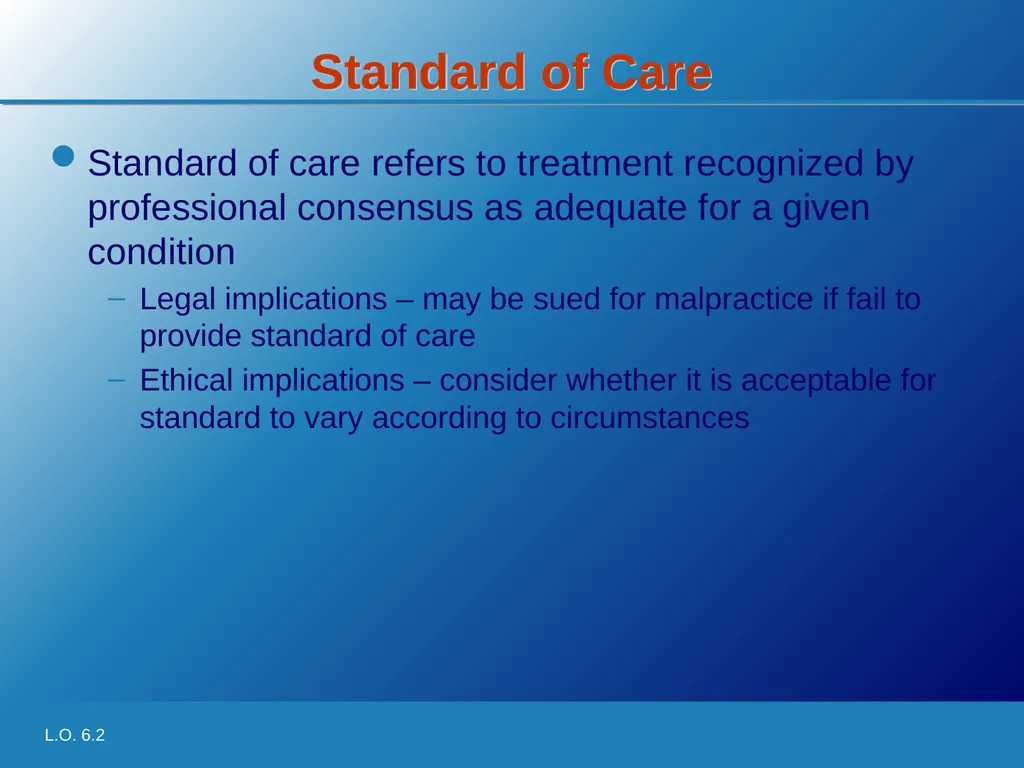
Standard of care in emergencies SOC may need to be compromised in public health emergencies
May need to decide between triaging/rationing versus reducing the SOC for all to maintain equity
When SOC is lowered, conducting clinical trials may be more affordable
Unethical to divert resources away from clinical care to research as may reduce SOC
What should be the SOC be in international medical research? (e.g. control groups in comparative treatment trials)<br>
06
Case study 1- reading ‘The deadly choices at Memorial’ by S. Fink in New York Times Magazine 25 August, 2009 (first 2 pages)
http://www.nytimes.com/2009/08/30/magazine/30doctors.html
(5 min)<br>
07
Case study 1 - video Morley Safer interviews Dr. Pou on CBS News ‘60 Minutes’ programme
http://www.cbsnews.com/video/watch/?id=2040496n&tag=mncol;lst;1
(4 min 30 sec)<br>
08
Case study 1 – group discussion What was Dr. Pou’s moral dilemma?
Who among you sympathizes with Dr. Pou vs. Who thinks she is “guilty”?
What do you mean by “guilty” in this case? Are there differences between moral and legal responsibilities at play here?
(10 min)<br>
09
Case study 2 - reading Scenarios 2 and 5 from:
Levin et al. Altered standards of care during an influenza pandemic: identifying ethical, legal, and practical principles to guide decision making. Disaster Medicine and Public Health Preparedness, 3 (Suppl.2), S132-S140.(2009)
Read scenarios
Write down brief individual reflections
(15 min)<br>
10
Case study 2 - Context It is 6 weeks into an influenza pandemic, and the health care system has been taxed beyond capacity, with every hospital bed full, every ventilator in use, and all health care providers working extended shifts. To increase the number of available beds to accommodate the surge of influenza patients, all scheduled operations have been postponed for the past 2 weeks.<br>
11
Case study 2 - Issues The postponed procedures include diagnostic and palliative operations for patients with pancreatic cancer, ovarian cancer, and malignant brain tumors, among other diseases. For many of these patients, their expected survival is less than 6 months, but without immediate operations, they will likely die within 2 weeks. As a result of the pandemic, medical resources are scarce, and the usual critical care that would follow those operations cannot be provided to all in need. Hospitals across the country are independently making decisions to govern how to modify standards of critical care to provide limited but high-yield critical care interventions and processes for many additional patients.
Hospital A: Providing critical care according to usual standards on a first-come, first-served basis.
Hospital B: Providing key critical care interventions only to those patients with an expected survival of more than 6 months.<br>
12
Case study 2 – Dr Smith As a surgeon, Dr Smith deeply opposes hospital B’s decision to provide key critical care interventions only to those patients with an expected survival of >6 months. This new rule requires that Dr Smith cancel a bowel obstruction surgery scheduled for later this week. Without surgery, his patient—a 36-y-old mother of 3 with ovarian cancer—will die within 2 weeks. Dr Smith is considering performing the operation in violation of hospital rules, potentially risking his career. In light of his disagreement with recent hospital policies, Dr Smith is torn between his professional mission to use his skills and expertise to help the patients who need him, and his obligation to observe the rules of his institution.<br>
13
Case study 2 – group discussions In groups of 3 or 4:
Discuss the case
Determine what Dr. Smith should do (i.e. performing the operation in violation of hospital rules or not) and why
Present your conclusions<br>
14
Case study 2 – additional information 2 stakeholder meetings held in July 2006 – one for consumers and one for healthcare professionals
Each attended by 15 Massachusetts residents
Each meeting lasted 4 hours – professionally facilitated discussion of scenarios<br>
15
Case study 2 – Stakeholders reactions Both groups expressed importance of healthcare providers being advocates for their patients
Providers particularly opposed Dr Smith violating hospital policy
Providers acknowledged that a surgeon’s decision to violate hospital rules would implicate a number of others in the process
Identified need for improved systems within hospitals to support physicians in the event that rules governing the allocation of critical care interventions are introduced, e.g. liability, protection, mental health support.<br>
16
Summary Establishing the standard of care is always challenging, especially in public health emergencies
Need a standard of care which respects the dignity of patients but takes into account resource limitations
Triage and resource allocation will impact on the care patients receive
Participation in research could allow access to some forms of care when triage rules unfavourably
This raises ethical questions regarding voluntariness<br>
17
Sources Selgelid M. (2005). Module four: standard of care and clinical trials. Developing World Bioethics, 5(1): 55-72.
Annas GJ. Standard of care – In sickness and in health and in emergencies. (2010). The New England Journal of Medicine, 362(22), 2126-2131.
Okie S. (2008). Dr. Pou and the hurricane—implications for patient care during disasters. New England Journal of Medicine, 358, 1–5.
Gebbie KM, Peterson CA, Subbarao I, White KM. (2009). Adapting standards of care under extreme conditions. Disaster Medicine and Public Health Preparedness, 3(2), 111-116.
Fink S. The deadly choices at Memorial. New York Times Magazine, August 25, 2009, 28-46. http://www.nytimes.com/2009/08/30/magazine/30doctors.html
Nossiter A. Grand Jury Won’t Indict Doctor in Hurricane Deaths. New York Times, July 25, 2007. http://www.nytimes.com/2007/07/25/us/25doctor.html?scp=1&sq=Grand%20Jury%20Won%92t%20Indict%20Doctor%20in%20Hurricane%20Deaths&st=cse.
US Department of Health and Human Services, Agency for Healthcare Research and Quality. 2005. Altered Standards of Care in Mass Casualty Events. http://www.ahrq.gov/research/altstand.
Levin D, Cadigan RO, Biddinger PD, Condon S, Koh HK, on behalf of the Joint Massachusetts Department of Public Health-Harvard Altered Standards of Care Working Group. Altered standards of care during an influenza pandemic: identifying ethical, legal, and practical principles to guide decision making. (2009). Disaster Medicine and Public Health Preparedness, 3(Suppl.2), S132-S140. http://journals.cambridge.org/action/displayAbstract?fromPage=online&aid=8844907&fulltextType=RA&fileId=S1935789300002184<br>
18
Acknowledgements Chapter authors
Calain, Philippe, Médecins Sans Frontières, Geneva, Switzerland
Boulanger, Renaud F., Faculty of Medicine, McGill University, Montréal, Québec, Canada<br>