
Learning Objectives: Know the formulae of common

Description: Learning Objectives: Know the formulae of common acids and bases. State that an acid releases H ions in aqueous solution. State that common bases are metal oxides, metal hydroxides and ammonia. State that an alkali is a soluble base that
Related Topics
Download Presentation
"Learning Objectives: Know the formulae of common" is the property of its rightful owner. Permission is granted to download and print the materials on this website for personal, non-commercial use only, and to display it on your personal computer provided you do not modify the materials and that you retain all copyright notices contained in the materials. By downloading content from our website, you accept the terms of this agreement.
Presentation Transcript
slide1. Learning Objectives:
Know the formulae of common acids and bases.
State that an acid releases H+ ions in aqueous solution.
State that common bases are metal oxides, metal hydroxides and ammonia.
State that an alkali is a soluble base that releases OH– ions in aqueous solution.
Key Words:
Acid, base, alkali, pH, neutral, Acids and Bases<br>
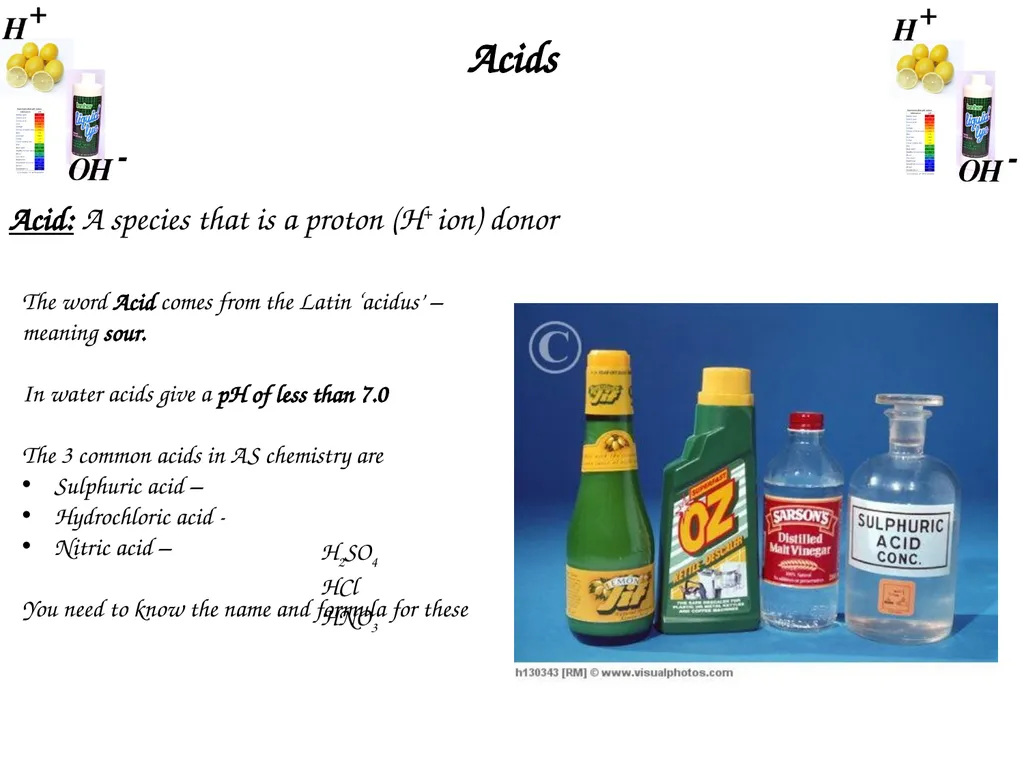
slide2. Acid: A species that is a proton (H+ ion) donor Acids The word Acid comes from the Latin ‘acidus’ – meaning sour.
In water acids give a pH of less than 7.0
The 3 common acids in AS chemistry are
Sulphuric acid –
Hydrochloric acid -
Nitric acid –
You need to know the name and formula for these H2SO4
HCl
HNO3<br>
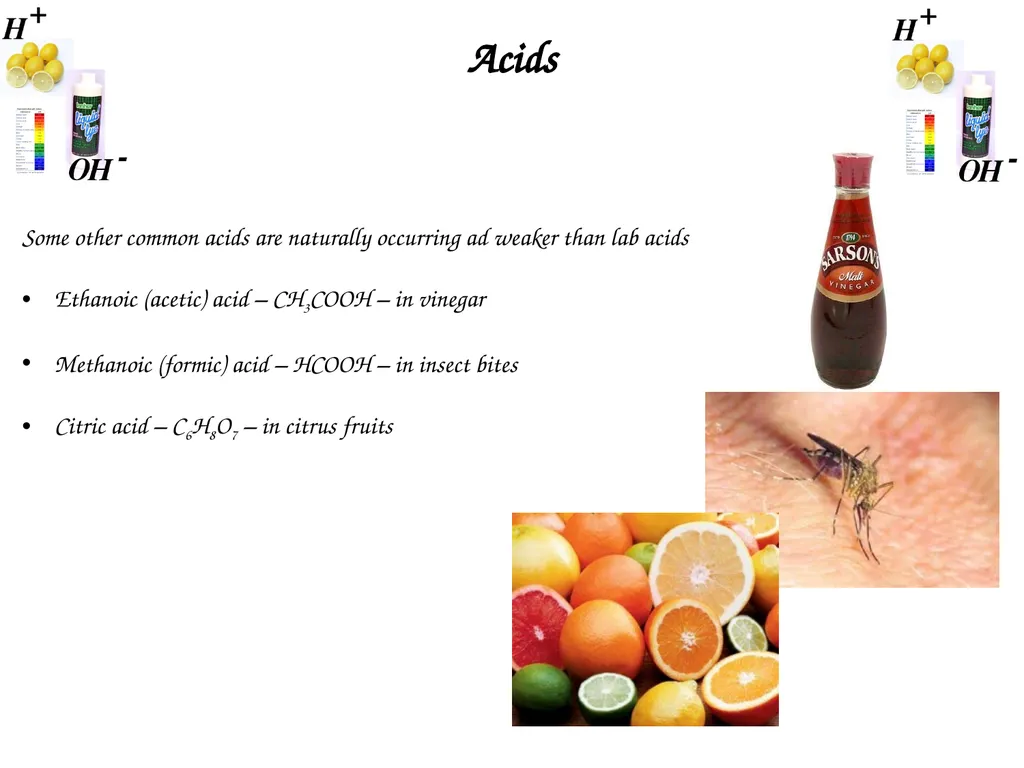
slide3. Acids Some other common acids are naturally occurring ad weaker than lab acids
Ethanoic (acetic) acid – CH3COOH – in vinegar
Methanoic (formic) acid – HCOOH – in insect bites
Citric acid – C6H8O7 – in citrus fruits<br>
slide4. If you look at the formulae of all acids you will notice that they all contain hydrogen; Acids H2SO4
HCl
HNO3 When an acid is added to water the acid splits into it’s component ions and releases H+ ions.
HCl + aq H+ + Cl-
H2SO4 + aq 2H+ + SO42- The H+ ion (proton) if the active ingredient in acids.
All acids are proton donors<br>
slide5. Base: A species that is a proton (H+ ion) acceptor
Common bases are metal oxides and hydroxides:
Metal Oxides – MgO, CuO Metal Hydroxides – NaOH, Mg(OH)2
Ammonia – NH3 is also a base as are all amines e.g. CH3NH2 Bases We can use bases in every day life:
For acid indigestion MgO is in milk of magnesia
Ca(OH)2 is used to treat acid soils<br>
slide6. Alkali: a type of base that dissolves in water to form hydroxide (OH-) ions.
A chemical that gives a solution with a pH greater than 7.0 when dissolved in water.
Common alkalis are:
Sodium Hydroxide – NaOH
Potassium hydroxide – KOH
Ammonia – NH3 Alkalis An alkali is a certain type of base that dissolves in water to give aqueous hydroxide ions – OH-(aq)
E.g. NaOH + aq Na+(aq) + OH-(aq) Alkalis are very corrosive and sometimes more dangerous than acids!<br>
slide7. When the protons (H+) from acids and the hydroxide ions (OH-) from bases meet in solution. This is called a neutralisation reaction. Water is formed:
H+(aq) + OH-(aq) H2O(l)
E.g. HCl + NaOH NaCl + H2O
Acid + Base Salt + Water Neutralisation<br>
slide8. Ammonia as a Weak Base<br>
slide9. Write down the formulae of the following;
Sulphuric acid
Nitric acid
Ethanoic acid
Potassium hydroxide
Calcium hydroxide
Ammonia
2) Define the following terms;
a) acid
b) base
c) alkali Questions<br>
slide10. Calculate the unknown concentration of hydrochloric acid if 25 cm3 of 0.125 mol dm-3 aqueous sodium hydroxide is titrated with 22.75 cm3 of the acid.
Calculate the molar mass of the acid H2X from the following information.
A student dissolved 1.571 g of the acid in water and made the solution up to 250 cm3. She titrated 25.0 cm3 of this solution against 0.125 mol dm-3 sodium hydroxide solution. 21.30 cm3 of this solution was needed to reach the end point.
The equation for this reaction is;
2NaOH(aq) + H2X(aq) Na2X(aq) + 2H20(l) Questions<br>
Know the formulae of common acids and bases.
State that an acid releases H+ ions in aqueous solution.
State that common bases are metal oxides, metal hydroxides and ammonia.
State that an alkali is a soluble base that releases OH– ions in aqueous solution.
Key Words:
Acid, base, alkali, pH, neutral, Acids and Bases<br>
slide2. Acid: A species that is a proton (H+ ion) donor Acids The word Acid comes from the Latin ‘acidus’ – meaning sour.
In water acids give a pH of less than 7.0
The 3 common acids in AS chemistry are
Sulphuric acid –
Hydrochloric acid -
Nitric acid –
You need to know the name and formula for these H2SO4
HCl
HNO3<br>
slide3. Acids Some other common acids are naturally occurring ad weaker than lab acids
Ethanoic (acetic) acid – CH3COOH – in vinegar
Methanoic (formic) acid – HCOOH – in insect bites
Citric acid – C6H8O7 – in citrus fruits<br>
slide4. If you look at the formulae of all acids you will notice that they all contain hydrogen; Acids H2SO4
HCl
HNO3 When an acid is added to water the acid splits into it’s component ions and releases H+ ions.
HCl + aq H+ + Cl-
H2SO4 + aq 2H+ + SO42- The H+ ion (proton) if the active ingredient in acids.
All acids are proton donors<br>
slide5. Base: A species that is a proton (H+ ion) acceptor
Common bases are metal oxides and hydroxides:
Metal Oxides – MgO, CuO Metal Hydroxides – NaOH, Mg(OH)2
Ammonia – NH3 is also a base as are all amines e.g. CH3NH2 Bases We can use bases in every day life:
For acid indigestion MgO is in milk of magnesia
Ca(OH)2 is used to treat acid soils<br>
slide6. Alkali: a type of base that dissolves in water to form hydroxide (OH-) ions.
A chemical that gives a solution with a pH greater than 7.0 when dissolved in water.
Common alkalis are:
Sodium Hydroxide – NaOH
Potassium hydroxide – KOH
Ammonia – NH3 Alkalis An alkali is a certain type of base that dissolves in water to give aqueous hydroxide ions – OH-(aq)
E.g. NaOH + aq Na+(aq) + OH-(aq) Alkalis are very corrosive and sometimes more dangerous than acids!<br>
slide7. When the protons (H+) from acids and the hydroxide ions (OH-) from bases meet in solution. This is called a neutralisation reaction. Water is formed:
H+(aq) + OH-(aq) H2O(l)
E.g. HCl + NaOH NaCl + H2O
Acid + Base Salt + Water Neutralisation<br>
slide8. Ammonia as a Weak Base<br>
slide9. Write down the formulae of the following;
Sulphuric acid
Nitric acid
Ethanoic acid
Potassium hydroxide
Calcium hydroxide
Ammonia
2) Define the following terms;
a) acid
b) base
c) alkali Questions<br>
slide10. Calculate the unknown concentration of hydrochloric acid if 25 cm3 of 0.125 mol dm-3 aqueous sodium hydroxide is titrated with 22.75 cm3 of the acid.
Calculate the molar mass of the acid H2X from the following information.
A student dissolved 1.571 g of the acid in water and made the solution up to 250 cm3. She titrated 25.0 cm3 of this solution against 0.125 mol dm-3 sodium hydroxide solution. 21.30 cm3 of this solution was needed to reach the end point.
The equation for this reaction is;
2NaOH(aq) + H2X(aq) Na2X(aq) + 2H20(l) Questions<br>